Sample Category Title
GBP/USD Daily Outlook
Daily Pivots: (S1) 1.3562; (P) 1.3618; (R1) 1.3651; More...
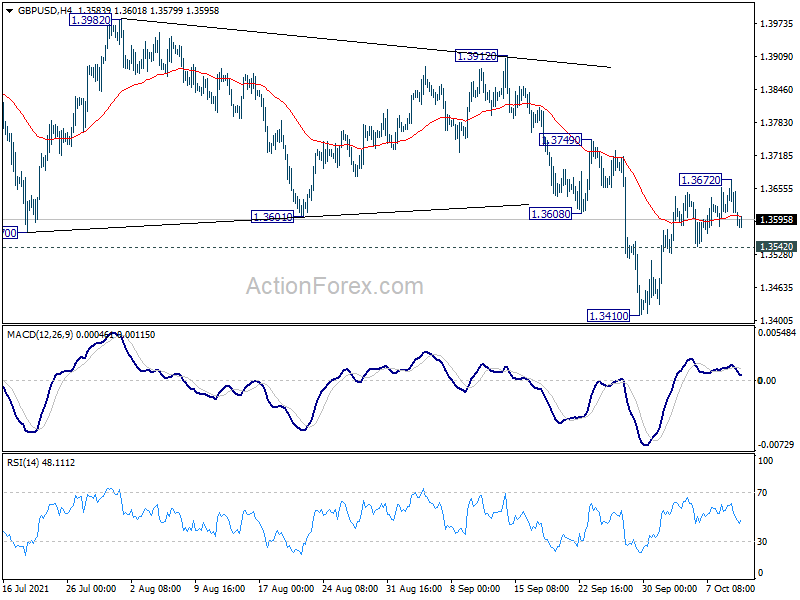
Intraday bias in GBP/USD is turned neutral as it lost momentum again after hitting 1.3672. On the downside, break of 1.3542 minor support will suggest that rebound from 1.3410 has completed, and fall from 1.4248 is ready to resume. Intraday bias will be turned back to the downside for 1.3410 and below. On the upside, though, above 1.3672 will resume the rebound to 55 day EMA (now at 1.3717) first.
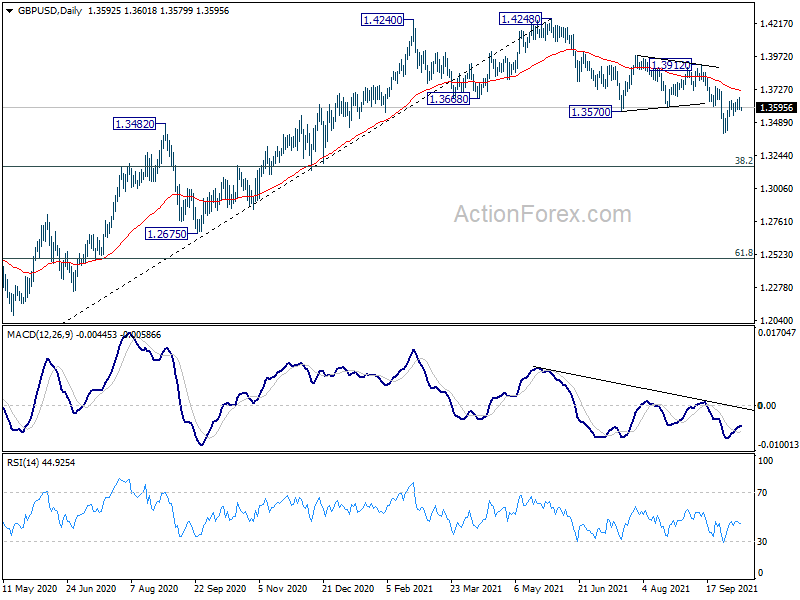
In the bigger picture, fall from 1.4248 is at least a correction to the up trend from 1.1409 (2020 low). Such correction could extend to 38.2% retracement of 1.1409 to 1.4248 at 1.3164 before completion. However, considering the rejection by 1.4376 key resistance (2018 high), sustained trading below 1.3164 will argue that it's indeed a bearish trend reversal and would target 61.8% retracement at 1.2493. Nevertheless, break of 1.3912 resistance will revive medium term bullishness and target 1.4248/4376 resistance zone again.
Focus Turns to UK and Germany Data, as Yen Pares Loss
The forex markets turn into consolidative mode in Asian session. Yen recovers mildly, digesting the recent steep selloff. But there is no clear sign of bottoming in the Japanese currency yet. Commodity currencies are also retreating mildly, following some mild selloff in stocks. Euro and Dollar are mixed while Gold is struggling in tight range around 1750. WTI crude oil is also paring some gains but stays firm above 80 handle.
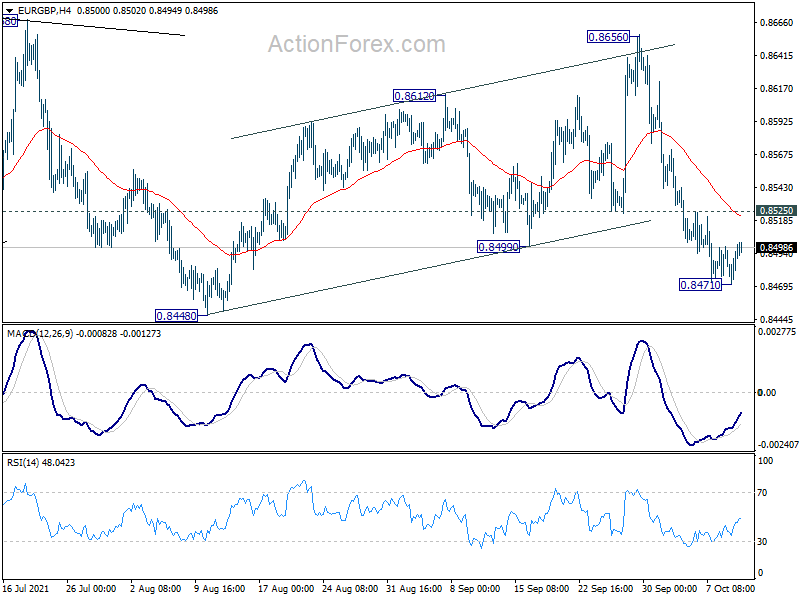
Technically, as Yen crosses are probably turning into consolidation, focus will be turned to interplay between Euro and Sterling. Some movements could be triggered in EUR/GBP buy UK job data and German ZEW today. EUR/GBP has lost some downside momentum after edging lower to 0.8471, kept well above 0.8448 low. Recovery from the current level and break of 0.8525 minor resistance would bring stronger rebound. The question is, if that happens, whether EUR/USD would rebound through 1.1539 minor resistance, or GBP/USD would drop through 1.3542 minor support.
In Asia, at the time of writing, Nikkei is down -0.93%. Hong Kong HSI is down -1.12%. China Shanghai SSE is down -1.13%. Singapore Strait Times is down -0.64%. Japan 10-year JGB yield is down -0.005 at 0.092. Overnight, DOW dropped -0.72%. S&P 500 dropped -0.69%. NASDAQ dropped -0.64%. 10-year yield rose 0.009 to 1.614.
Japan wholesale prices rose 6.3% yoy in Sep, highest in 13 years
Japan corporate goods price index, a PPI equivalent, rose 6.3% yoy in September, above expectation of 5.9% yoy. That's also the highest level in 13 years. Yen based wholesale import prices rose a record 31.3% yoy. Petroleum and coal costs rose 32.4% yoy. Wood products spiked 48.3% yoy.
Some analysts noted that the surge in wholesale prices would be absorbed mainly by businesses, with little impact on consumers. But according to a BoJ survey published on Monday, 68.2% of Japanese households are expecting prices to rise a year from now, up from 66.8% three months ago. Median projection of inflation a year from now rose to 3.0%, up from June's 2.0%.
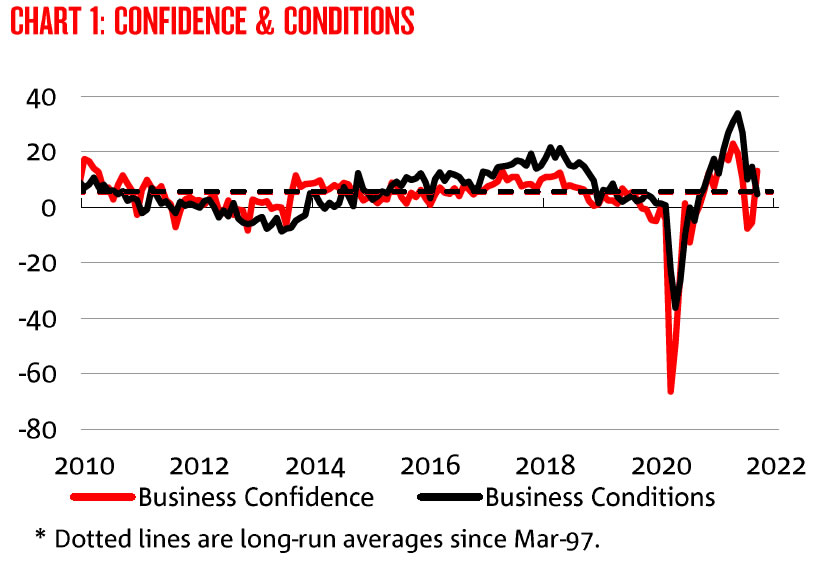
Australia NAB business confidence jumped to 13, but condition tumbled to 5
Australia NAB Business Confidence jumped sharply from -6 to 13 in September. Strong improvement was seen in New South Wales (up 52 pts to 27) and Victoria (up 16 pts to 5). Business Conditions, however, dropped from 14 to 5. Trading condition dropped from 20 to 10. Profitability condition dropped from 15 to 2. Employment confidence dropped from 9 to 1.
NAB said, "Interpreting this month's results really depends if you are an optimist or a pessimist. Businesses are really looking forward to reopening, and confidence increased markedly on the back of NSW and Victoria's reopening roadmaps. The rise in confidence suggests they see the roadmaps that have been announced as sufficient to allow activity to really rebound in the coming months."
"Still, confidence is more about hope for the future than what is happening in the present. On that front, conditions really deteriorated which shows that lockdowns are taking a toll, despite the resilience the economy has shown through this period."
Looking ahead
UK employment and Germany ZEW economic sentiment are the main focuses for today.
GBP/USD Daily Outlook
Daily Pivots: (S1) 1.3562; (P) 1.3618; (R1) 1.3651; More...
Intraday bias in GBP/USD is turned neutral as it lost momentum again after hitting 1.3672. On the downside, break of 1.3542 minor support will suggest that rebound from 1.3410 has completed, and fall from 1.4248 is ready to resume. Intraday bias will be turned back to the downside for 1.3410 and below. On the upside, though, above 1.3672 will resume the rebound to 55 day EMA (now at 1.3717) first.
In the bigger picture, fall from 1.4248 is at least a correction to the up trend from 1.1409 (2020 low). Such correction could extend to 38.2% retracement of 1.1409 to 1.4248 at 1.3164 before completion. However, considering the rejection by 1.4376 key resistance (2018 high), sustained trading below 1.3164 will argue that it's indeed a bearish trend reversal and would target 61.8% retracement at 1.2493. Nevertheless, break of 1.3912 resistance will revive medium term bullishness and target 1.4248/4376 resistance zone again.
Economic Indicators Update
| GMT | Ccy | Events | Actual | Forecast | Previous | Revised |
|---|---|---|---|---|---|---|
| 23:01 | GBP | BRC Like-For-Like Retail Sales Y/Y Sep | -0.60% | 1.50% | ||
| 23:50 | JPY | Bank Lending Y/Y Sep | 0.60% | 0.80% | 0.60% | |
| 23:50 | JPY | PPI Y/Y Sep | 6.30% | 5.90% | 5.50% | 5.80% |
| 00:30 | AUD | NAB Business Confidence Sep | 13 | -5 | -6 | |
| 00:30 | AUD | NAB Business Conditions Sep | 5 | 14 | ||
| 06:00 | GBP | Claimant Count Change Sep | -58.6K | |||
| 06:00 | GBP | ILO Unemployment Rate (3M) Aug | 4.50% | 4.60% | ||
| 06:00 | GBP | Average Earnings Including Bonus 3M/Y Aug | 8.40% | 8.30% | ||
| 09:00 | EUR | Germany ZEW Economic Sentiment Oct | 20.4 | 26.5 | ||
| 09:00 | EUR | Germany ZEW Current Situation Oct | 29.5 | 31.9 | ||
| 09:00 | EUR | Eurozone ZEW Economic Sentiment Oct | 26.5 | 31.1 | ||
| 10:00 | USD | NFIB Business Optimism Index Sep | 99.7 | 100.1 |
Australia NAB business confidence jumped to 13, but condition tumbled to 5
Australia NAB Business Confidence jumped sharply from -6 to 13 in September. Strong improvement was seen in New South Wales (up 52 pts to 27) and Victoria (up 16 pts to 5). Business Conditions, however, dropped from 14 to 5. Trading condition dropped from 20 to 10. Profitability condition dropped from 15 to 2. Employment confidence dropped from 9 to 1.
NAB said, "Interpreting this month's results really depends if you are an optimist or a pessimist. Businesses are really looking forward to reopening, and confidence increased markedly on the back of NSW and Victoria's reopening roadmaps. The rise in confidence suggests they see the roadmaps that have been announced as sufficient to allow activity to really rebound in the coming months."
"Still, confidence is more about hope for the future than what is happening in the present. On that front, conditions really deteriorated which shows that lockdowns are taking a toll, despite the resilience the economy has shown through this period."
Japan wholesale prices rose 6.3% yoy in Sep, highest in 13 years
Japan corporate goods price index, a PPI equivalent, rose 6.3% yoy in September, above expectation of 5.9% yoy. That's also the highest level in 13 years. Yen based wholesale import prices rose a record 31.3% yoy. Petroleum and coal costs rose 32.4% yoy. Wood products spiked 48.3% yoy.
Some analysts noted that the surge in wholesale prices would be absorbed mainly by businesses, with little impact on consumers. But according to a BoJ survey published on Monday, 68.2% of Japanese households are expecting prices to rise a year from now, up from 66.8% three months ago. Median projection of inflation a year from now rose to 3.0%, up from June's 2.0%.
Eco Data 10/12/21
[php_everywhere instance="1"]
Pound Edges Higher on BOE, Job Data Next
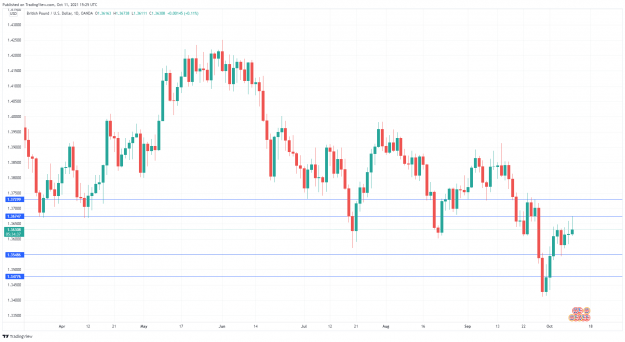
The British pound has started the week with modest gains. GBP/USD is currently trading at 1.3636, up 0.16% on the day.
In the US, a highly-anticipated nonfarm payrolls report proved to be a major disappointment. The economy added just 194 thousand new jobs, well off the forecast of around 500 thousand. Still, the weak reading did not cause any panic on the markets, as other employment data was strong. The unemployment rate fell to 4.8%, down from 5.1%. As well, wage growth climbed 0.6%, up from 0.4%. The solid wage gains provide have bolstered the argument that high inflation is not so transient after all. On a year-to-year basis, wages were up 4.6%. With inflation running at its highest level in some 30-years, the Fed’s position that the surge in inflation is temporary is starting to ring hollow to market ears.
The sharp unemployment and wage growth numbers helped ally any concerns that the weak nonfarm payrolls reading might cause a ‘taper off’. December seems a likely start-off for tapering, even though back-to-back NFP reports have been on the low side and below expectations. As expectations rise that a taper is imminent, the US dollar is well-positioned to gain ground in the short-term.
The British pound showed some volatility on Friday but ended the day unchanged. GBP/USD has edged upwards on Monday after a BoE policymaker said on the weekend that interest rates were likely coming sooner rather than later. Michael Saunders said that with inflation running above 4%, it was “appropriate” for the markets to have priced in a rate hike earlier than previously. Saunder’s comments come just a few days after BoE Governor Andrew Bailey said that inflation needed to be reigned in and brought closer to the BoE’s target of 2.0%. It appears that the BoE is telegraphing its intention to raise rates, possibly as early as December.
GBP/USD Technical Analysis
- 1.3711 is the next resistance line. 1.3879 is next.
- There is support at 1.3394. Below, there is support at 1.3245
Jitters Remain at the Start of the Week
Stock markets have started the week a little mixed, as nerves persist around the large list of downside risks for the global economy.
While the focus recently has shifted from Evergrande to the energy crisis, it's arguably the slightly lesser talked about inflation/monetary policy dynamic that's really making investors nervous. We've dealt with plenty of growth headwinds over the years but throughout that time, central banks have had our backs. That appears to be changing.
It's long been debated just how big a role zero interest rates and quantitative easing have had in stock markets performing so well, even against difficult backdrops. While monetary policy is going to remain extremely accommodative for some time, so we shouldn't get too carried away, the direction of travel is changing and that could make investors anxious.
More and more, it seems we're hearing policymakers making statements that suggest inflation is becoming more of a headache than they envisaged and hoped. It's also becoming evident that they can be of the belief that inflation is transitory and concerned that it will last long enough to potentially become a problem, hence the temptation to attack it early.
That's clearly the view of the Bank of England, which the markets believe will raise interest rates in December and twice more next year, despite the country facing greater growth headwinds than many, despite the economy having fully reopened in July and remaining so.
Michael Saunders, typically one of the most hawkish members of the MPC that recently voted for a premature end to the Bank's asset purchases, backed financial markets interpretation of future interest rate moves, suggesting that recent adjustments have been appropriate.
It seems households and businesses can add a rate hike this year and more next to the ever-growing list of challenges, on top of the end of the furlough scheme and benefits top-up, tax hikes and higher energy prices, among other things.
Chinese energy crisis worsens, Evergrande poised to miss another coupon payment
As efforts continue to boost China's energy capacity going into a worrying winter period, the country faced a setback as 60 of 682 coal mines were forced to close following heavy rain and flooding. With extreme weather seemingly becoming more frequent around the globe and the energy market extremely tight, I expect disruptions that would otherwise have little impact will continue to boost prices, especially as the weather cools.
Evergrande is due to make another coupon payment to offshore bondholders today and it's safe to say, that's highly unlikely considering how the last two deadlines have gone. The key for offshore holders is the next couple of weeks and whether any payment or communication will come from the company in relation to its first missed offshore coupon.
Oil jumps again after Chinese coal mine closures
Oil prices are rising once again today, up a little over 2%, and hitting fresh highs as the energy crisis continues to drive support for crude. The flooding in China may have given oil an extra lift on Monday but we're looking at a tight market that OPEC+ is allowing to run hot after a long period of low prices.
It's hard to see the rally easing up too much as long as OPEC+ continue to take this approach. Of course, if Nord Stream 2 is approved, we could see energy prices correct themselves quite aggressively if last week is anything to go by. But given the political sensitivity around the pipeline, it would be a bold move to rush the decision at this point.
There is still plenty of momentum behind the oil rally and the fundamentals remain extremely favourable. As was reported last week, the energy crisis has already increased crude demand by 500,000 barrels per day and that's before the weather turns. Will it be a surprise to see oil back in the triple digits later this year? Probably not.
Gold holding strong despite rising yields
Gold hasn't really gone anywhere this month. In fact, it's only a couple of dollars above its closing price in September. But it's been fascinating to follow in that time as traders appear to be struggling to determine exactly what it's function is against the backdrop of higher inflation, tighter monetary policy, growing uncertainty and stock market jitters.
Friday's jobs report appeared to break the deadlock but the rally quickly ran on fumes and the price returned back to where it started. The yellow metal is trading a little higher today but there isn't a huge amount of momentum behind it. The fact that prices are supported though even as US yields rise is promising for gold and perhaps a sign of its safe haven properties being favoured once more.
Bitcoin losing momentum on approach to $60,000
Bitcoin is continuing to climb at the start of the week, hitting its highest level since May and with momentum. We're potentially starting to see that momentum slow a little, although possibly not enough to prevent a run at $60,000. It may even be this psychological barrier that's responsible for it slowing a little, with traders less keen on the dips. Profit taking on approach could see momentum slip further. Beyond those short-term moves though, the cryptocurrency looks in a healthy position for a run at the highs.
Yen is in Vertical Fall; Oil Surpasses $82
Yen plunges driving dollar/yen sharply higher
As a new week begins, the yen continues to plunge, pushed lower by a comeback in Asian stocks despite a rise in Japanese yields. Indeed, the 10-year JGB yield, which is currently at 0.093%, is on its way to 0.1%. The pound is currently the strongest, thanks to hawkish statements from Bank of England officials over the weekend. The Australian Dollar is closely following, and it is leading other commodity currencies higher as well. The US dollar index is weakening, while dollar/yen surged to a fresh 34-month high above 113.00. The euro is holding near $1.1560, and US futures are suggesting a negative open.
BoE may raise interest rates soon
Officials from the Bank of England hinted that interest rates may be raised soon to combat inflation. Governor Andrew Bailey warned of a "very harmful" period of inflation unless policymakers act, while Michael Saunders said that traders were correct to push forward bets on rises. Markets are nearly entirely pricing in the first shift by the end of the year — the next monetary policy announcement is scheduled for November 4. Pound/dollar is holding above 1.3600, remaining in a bullish correction since September 30.
The UK's Brexit minister will seek revisions to the protocol that oversees trade flows with Ireland this week, setting up a potential clash between Britain and the EU on Northern Ireland. It comes as the government grapples with other issues such as rising energy prices and a fishing rights conflict with France. During the fishing dispute, France is threatening to cut the power supply of Britain's Channel Islands.
WTI crude oil advances to new 7-year high; gold holds firm
For the first time since 2014, WTI crude oil futures have surpassed the psychological level of $82/per barrel. Oil has benefited from rising natural gas prices and falling stocks as the northern hemisphere prepares for winter. Gold prices are still underneath the 20-day SMA, which is acting as strong resistance over the last sessions, remaining in a trading range of $1,723-$1,834/per ounce in the broader outlook.olds ground
Sunset Market Commentary
Markets
The UK yield curve bear steepens today with yields adding 4 bps (2-yr) to 2.6 bps (30-yr). The UK 2-yr yield added around 55 bps since the Bank of England switched positions at its August meeting. From that moment, the onus changed from keeping monetary policy very accommodative to enable inflation to rise to the 2% target over the medium term to applying some modest tightening in order for inflation to slow to the 2% target over that same policy horizon. Modest interest rate hikes are part of the plan and could even come before the BoE ends net asset purchases under its QE-programme and thus before the end of the year. That’s what markets have been discounting and could be derived from weekend comments by BoE governor Bailey and inflation hawk Saunders. The former warned on the potentially very destructive impact from persistent inflation pressure if the BoE doesn’t act. The latter aligns with market thinking about a 2021 inaugural rate hike. Sterling tested EUR/GBP 0.8472 support, but the move lacked dash. The range bottom of the sideways channel (0.8472/50) doesn’t seem like giving away that easily. GBP/USD tried to force its way above the recent intraday spikes just below 1.3650, but the move similarly lacked panache.
European yields maintained last week’s upward momentum as well. German yields add 1.5 bps (2-yr) to 2.9 bps (10-yr) across the curve. The 10-yr yield easily passed the June high (-0.15%) and has the 2021 recovery high for grabs (-0.07%). The European 10y swap rate currently trades above highly relevant technical resistance. A sustained break above the zone 0.21% (38% retracement 2018/2020 decline) – 0.23% (previous all-time low in 2016) – 0.24% (early 2020 high) would end the medium term sideways trading channel (-0.39%-0.24%) and set the stage for a new trading arena defined by the previous resistance as bottom and 0.59% on the upside (62% retracement on 2018/2020 decline). Oil price developments continue to play an influential role with Brent crude setting a new recovery high above $84/barrel before showings some signs of topping off. Key ECB policy makers (see below) for now don’t budge despite dangerous inflation developments. Today’s eco calendar wasn’t influential while the absence of US traders (Columbus Day) lowered trading volumes. European stock markets cede slightly ground, failing to build on last week’s comeback. The biggest victim on FX markets from rising interest rates is the Japanese yen. USD/JPY gains another big figure from 112 to 113, trading at the strongest level since 2018. EUR/JPY approaches 131.
News Headlines
Czech headline Inflation rose 0.2% M/M and 4.9% Y/Y (from 4.1%), the highest since October 2008. The rise is predominantly due to an unexpectedly sharp pick-up in core inflation and faster growth in food prices. Within core inflation, the cost of owner-occupied housing is an important factor. According to the CNB, the rise in costs ‘stems both from the domestic economy, which is characterized by a renewed increase in labour market tightness and a strong consumer appetite, and from abroad’. The CNB already responded to this risk by raising interest rates by 0.75% in September and will assess it comprehensively in the forthcoming autumn forecast. The initial reaction of the Czech krone to the data was modest, but the currency regained traction after the CNB comments with EUR/CZK currently trading in the 25.40 area. However, the key 25.25 area stays out of reach.
ECB’s Lane elaborated on the conditions that need to be fulfilled to raise the policy rate over time. With respect to the condition that “realized progress in underlying inflation is sufficiently advanced to be consistent with inflation stabilizing at 2% over the medium term”, he mentioned the need to sharply differentiate between volatile components of headline inflation and persistent dynamics of underlying inflation. According to Lane, this approach also applies to wage rises. ‘In particular, a one-off shift in the level of wages as part of the adjustment to a transitory unexpected increase in the price level does not imply a trend shift in the path of underlying inflation’.
EUR/JPY Mid-Day Outlook
Daily Pivots: (S1) 129.26; (P) 129.59; (R1) 130.23; More....
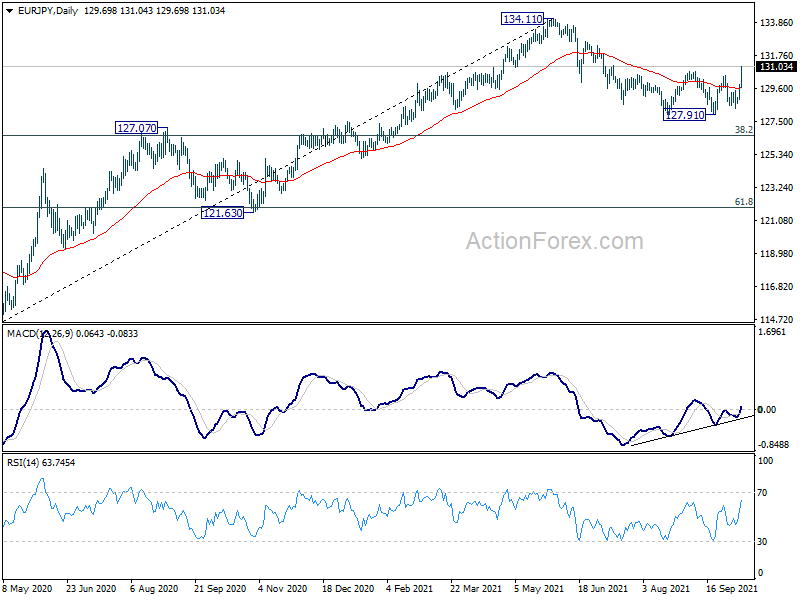
EUR/JPY's firm break of 130.45 resistance suggests that corrective pattern from 134.11 has already completed at 127.91. Intraday bias is now on the upside and further rise should be seen to retest 134.11 high. On the downside, below 130.29 minor support will dampen the bullish case and turn intraday bias neutral first.
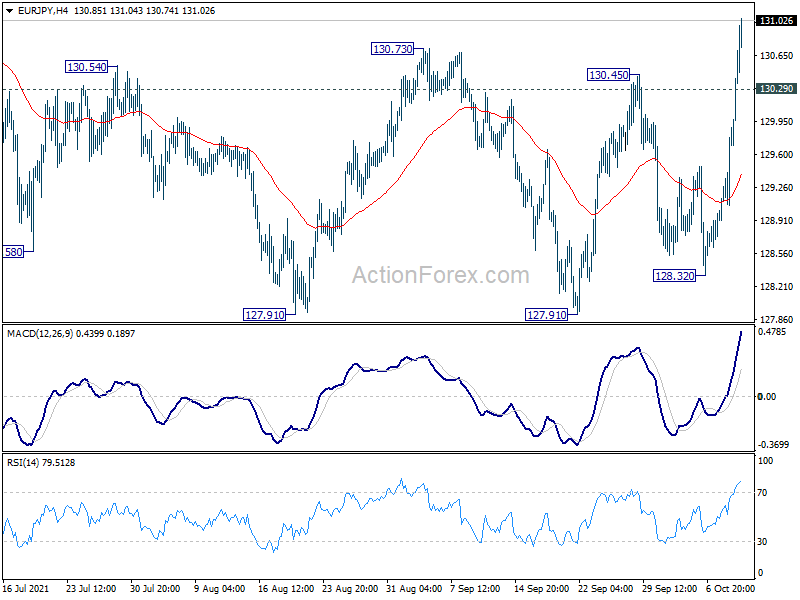
In the bigger picture, rise from 114.42 is seen as a medium term rising leg inside a long term sideway pattern. As long as 127.07 resistance turned support holds, further rise is still expected to retest 137.49 (2018 high). However, firm break of 127.07 will argue that the medium term trend has reversed, deeper fall would be seen to 61.8% retracement of 114.42 to 134.11 at 121.94.