

Sample Category Title
AUD/NZD Breached Channel Pattern
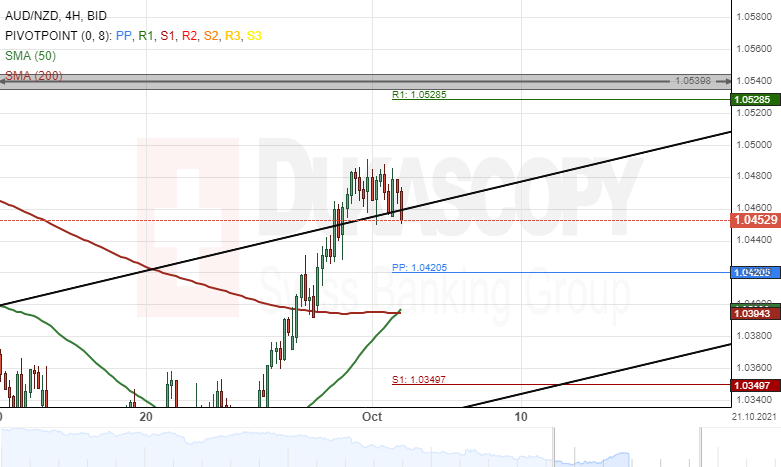
Since last week's trading sessions, the Australian Dollar has surged by 1.52% against the New Zealand Dollar. The currency pair breached the upper boundary of an ascending channel pattern on September 30.
Given that the exchange rate has breached the channel pattern, buyers are likely to continue to drive the AUD/NZD pair higher during the following trading sessions.
However, the currency exchange rate could encounter the weekly resistance level at 1.0528 this week
ECB de Guindos: Structural impact of current inflation goes beyond expected
ECB Vice-President Luis de Guindos said the current increase in inflation is "not only responding to base effects but is also a component that is going to have a more structural impact." He added, "this is having an impact that goes beyond what we were expecting only a few months ago." He expected supply bottlenecks to ease but emphasized the importance to "avoid second-round effects".
On monetary policy, de Guindos said it will "remain accommodative but the goal is price stability." "If economic activity normalizes, PEPP will have accomplished its mission."
Eurozone Sentix investor confidence dropped to 16.9, still a mid-cycle slowdown
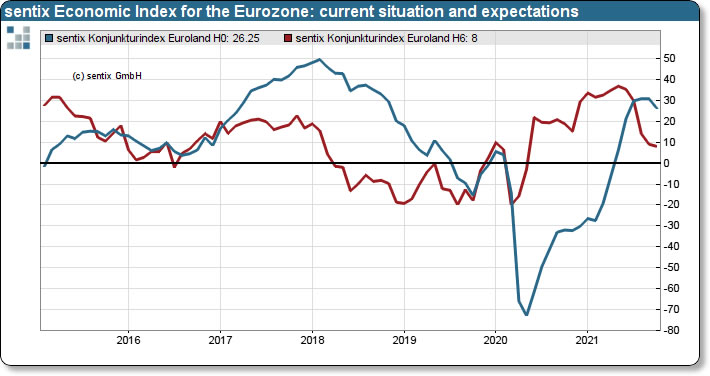
Eurozone Sentix Investor Confidence dropped to 16.9 in October, down from 19.6, missed expectation of 19.0. That's the third decline in a row and the lowest level since April. Current Situation Index dropped from 30.8 to 26.3. Expectations index dropped from 9.0 to 8.0, fifth decline in a row, lowest since May 2020.
Sentix said, "Autumn revival fails to materialize for the time being". It added, "so far, the criteria for a mere 'mid-cycle slowdown' have still been met. It remains crucial that the expectations do not fall below the zero line. For then a stronger slump in economic output would be expected - a trend reversal would then be in the offing."
Gold Price Is Correcting Lower From The $1,765 High
Gold price found support near $1,722 and started a fresh increase against the US Dollar. The price was able to surpass the $1,735 and $1,740 resistance levels.
There was a break above the $1,750 level and the 50 hourly simple moving average. The price traded as high as $1,765 and it is now correcting lower. On the downside, there is a key rising channel forming with support near $1,755 on the hourly chart.
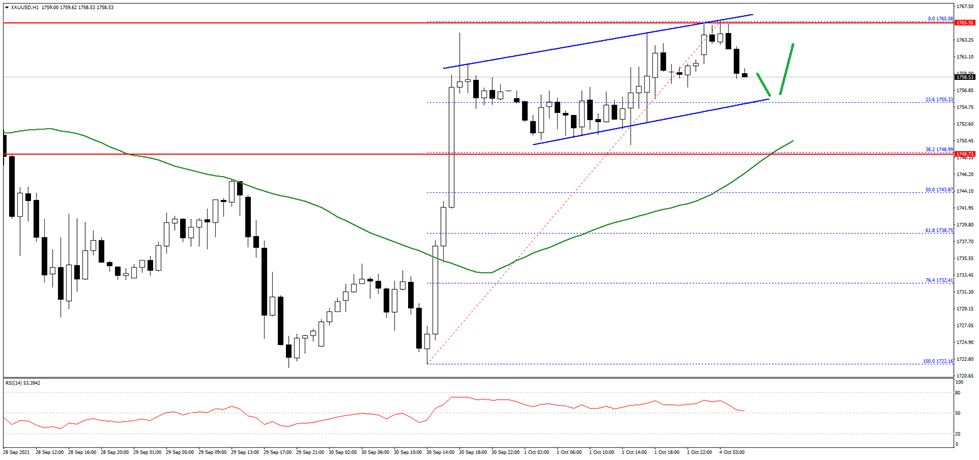
The next key support is near the $1,748 level and the 50 hourly simple moving average, below which the price could revisit $1,732. Any more losses could lead the price to $1,722 on FXOpen.
On the upside, an immediate resistance is near the $1,765 level. A clear break above the $1,765 resistance could push the price further higher. The next main resistance could be near the $1,785 level.
EUR/USD Outlook: Bears Are Pausing Above Strong 1.16 Support Zone
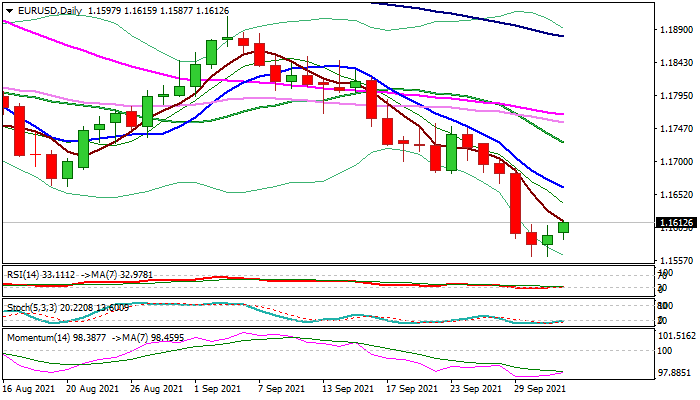
The Euro is consolidating above new multi-week low (1.1562) posted last week after larger bears cracked key 1.16 support zone (Sep/Nov 2020 higher base) and registered a marginal weekly close below here.
Overall structure remains negative and favors bearish continuation, but oversold daily studies suggest bears may take a breather above 1.1600 zone.
Consolidation should be capped by solid barriers at 1.1659/64 (daily Tenkan-sen/former low of Aug 20) to keep bears intact and offer better levels to re-enter larger bearish action.
Firm break of 1.1600 pivots would expose next key supports at: 1.1572 (cracked 200WMA), 1.1538 (weekly cloud base) and 1.1492 (50% retracement of 1.0635/1.2349, Mar 2020/Mar 2021 uptrend), break of which would confirm reversal.
Last week’s large bearish weekly candle (the pair was down 1.13% for the week, thee biggest weekly fall since the third week of June) weighs on near-term action, while firm dollar adds pressure on the single currency.
Caution on break above 1.1659/64 barriers that would signal stronger correction, which would require verification on sustained break above 1.1700 zone (Fibo 38.2% of 1.1909/1.1562/psychological).
Res: 1.1660, 1.1695, 1.1736, 1.1761.
Sup: 1.1587, 1.1562, 1.1538, 1.1492.
Bulls Are Fighting For Trend In Stocks
The bulls in the US stock markets seem to reverse the single-digit negative sentiment and close the week with major indices rising more than 1%. Increased demand for risky assets put pressure on the dollar. Still, investors and traders should be prepared that the currency market will continue to trend higher, despite some technical bounces and stops.
US equity investors are not taking the breaking of the strong bullish trend in equities, stepping up their buying after the Dow Jones index touched its 200-day moving average near 33500 and managing to push the index into the area above 34300 to close the week. This looks like a positive signal that buyers remain committed to a buying strategy on declines.
Last year, the approach of the 200-day average triggered a powerful rally. But there are several differences between the situation a year earlier and now. Technically, back then, the 200-day average was moving horizontally and even had some downward slope, while now it is sharply directed upwards. It is not easy to support the rise in share prices at such a pace.
The fundamentals for growth stocks have also changed: The best quarters in terms of annual earnings growth are clearly behind us. At the same time, the US government is reducing its support for the economy and delaying discussions on new stimulus. The US Federal Reserve said the start of tapering of asset purchases was “warranted” soon, which raises interest rates in debt markets and puts pressure on equities.
The currency market has also seen some shifts. The EURUSD has surrendered a former important support level near 1.1600. At the same time, analysis of speculative positions on the CFTC shows that hedge funds have recently become more active in betting on the fall of the EUR. At the same time, their short positions are far from the pre-pandemic levels, which leaves significant room to increase selling, which should put pressure on the EUR.
The short-term technical picture reflects the potential for a speculative rebound in the EURUSD pair, where the RSI on the daily charts is back above 30. However, the rebound only lasted for a couple of days in June and July in similar conditions, after which pressure on the pair continued.
Having failed under significant support at 1.1600, the EURUSD might encounter little resistance in the weeks ahead until it reaches 1.1400, and the former strong support could become an equally strong resistance. Cancellation of the bearish scenario will only occur after a new consolidation above 1.1675 in the coming days. In that case, we could discuss a false breakdown of support and a return of EURUSD to the previous sideways trend.
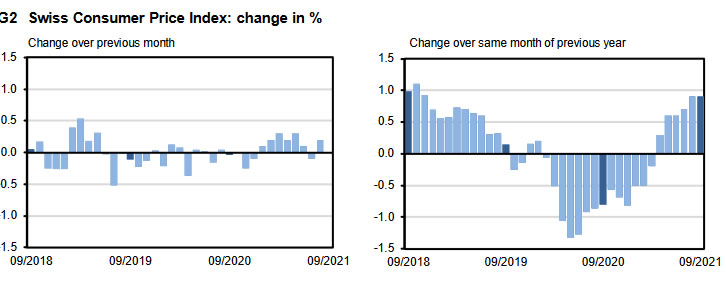
Swiss retail sales rose 0.5% yoy in Aug, CPI unchanged at 0.9% yoy in Sep
Swiss real retail sales rose 0.5% yoy in August, below expectation of 0.6% yoy. In nominal terms, sales rose 0.2% yoy. Excluding service stations, nominal turnover dropped -0.4% yoy. Sales of food, drinks and tobacco dropped -2.9% yoy nominal. No-food sector rose 2.1% yoy nominal.
CPI came in at 0.0% mom, 0.9% yoy in September, versus expectation of 0.2% mom, 1.1% yoy. The annual rate was unchanged from August's reading.
USD Seems To Recover After Friday’s Drop
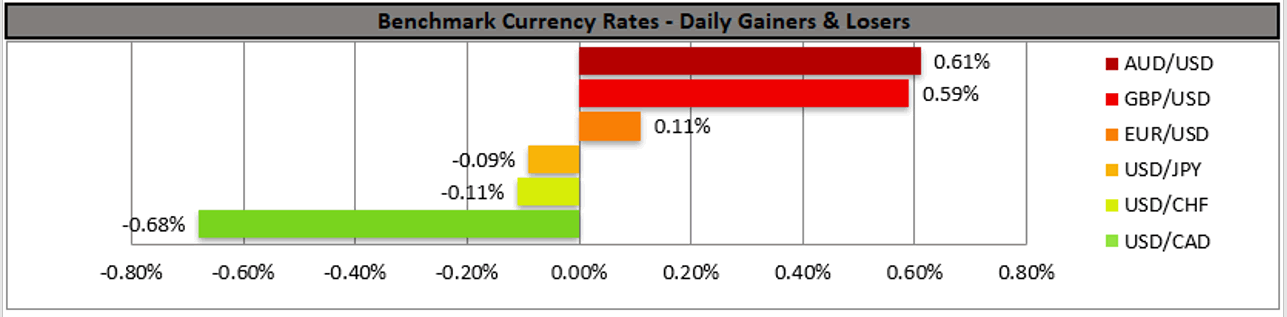
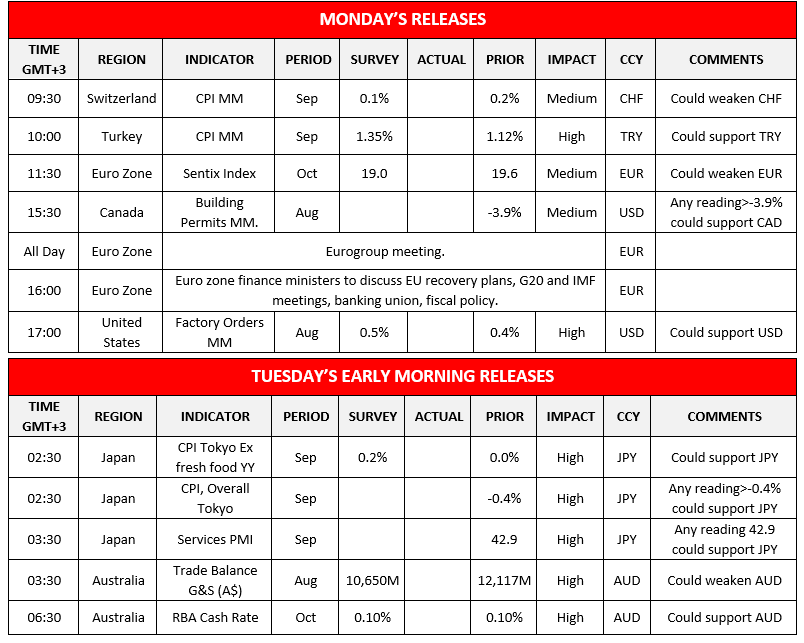
The USD seemed to recover somewhat against some of its counterparts during todays' Asian session, after Friday's wide retreat as uncertainty seems to be on the rise once again. It should be noted that shares in China's giant developer Evergrande were halted from trading in the Hong Kong stock exchange forcing uncertainty to resurface about the issue in the markets. The uncertainty tended to strengthen the USD during today's Asian session, while US Stockmarkets seemed to weaken in the premarket hours as the possible ripple effects seem to worry traders. It should be noted though that Dow Jones tended to gain during Friday's session, as Merck's Covid 19 pill seemed to provide optimism regarding the US economic recovery. Also, on US fundamentals, we note the possibility of further escalations in the US-Sino relationships which could provide further support for the USD, while traders eye the release of the US employment report for September on Friday. The CAD gained on Friday against the USD as the positive market sentiment tended to provide support for the commodity currency, while local data tended to be lukewarm capping the bull's action. On the other hand, oil prices edged higher on Friday yet corrected a bit lower during today's Asian session, as trader's eyes turn towards the OPEC meeting in order to decide how much oil production levels are to be raised. We note from Australia RBA's interest rate decision tomorrow and the bank is widely expected to remain on hold at 0.10% while New Zealand's RBNZ is expected to proceed with a 25-basis points rate hike on Wednesday.
The USD index corrected a bit higher during today's Asian session yet remains below the 94.10 (R1) resistance line for now. We tend to maintain a bias for a sideways motion currently, as the price action shows signs of stabilisation and given that the RSI indicator below our 4-hour chart is near the reading of 50, implying a rather indecisive market. Should buyers take charge of the index's direction, we may see it breaking the 94.10 (R1) line which kept the bulls at bay in today's Asian session and aim for the 94.60 (R2) level. Should a selling interest be displayed by the market, we may see the index aim if not breach the 93.70 (S1) support line.
AUD/USD seems to be aiming for the 0.7280 (R1) resistance line today. We tend to maintain a bullish outlook for the pair as long as it remains above the upward trendline incepted since the 29th of September. Should the bulls actually maintain control over the pairs' direction, we may see it breaking the 0.7280 (R1) resistance lien and aim for the 0.7335 (R2) resistance level. Should the bears take over, we may see the pair reversing course breaking the prementioned upward trendline and aim if not breach the 0.7225 (S1) support line.
Today's events and expectations
Today during the European session, we note the release of Turkeys' and Switzerland's CPI rates for September while in the American session we get the US factory orders growth rates.
As for the rest of the week
On Tuesday, we get from Japan Tokyo's inflation data for September, Australia's RBA interest rate decision, UK's reserve totals for September, the US and Canada's trade balances for August and the US ISM non-manufacturing PMI for September. On Wednesday, we get from New Zealand RBNZ's interest rate decision, Germany's industrial orders for August, Eurozone's retail sales for August and form the US the ADP National employment figure for September. On Thursday we get, UK's Halifax House prices for September, Germany's industrial output for August and the weekly US initial jobless claims, while from Canada BoC Governor Macklem is scheduled to speak. On Friday, we get Japan's current account balance for August, Germany's trade data for August, the US employment report for September and Canada's employment data also for September.
USD index H4 Chart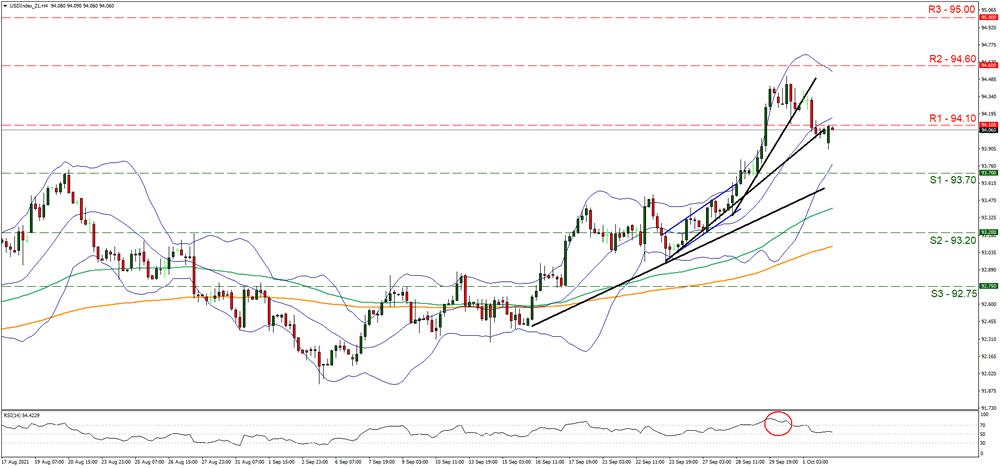
Support: 93.70 (S1), 93.20 (S2), 92.75 (S3)
Resistance: 94.10 (R1), 94.60 (R2), 95.00 (R3)
AUD/USD H4 Chart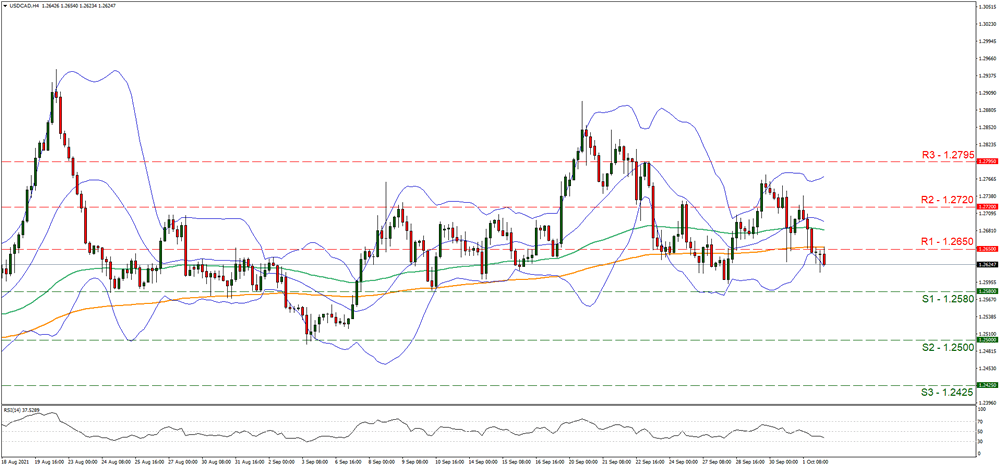
Support: 0.7225 (S1), 0.7170 (S2), 0.7110 (S3)
Resistance: 0.7280 (R1), 0.7335 (R2), 0.7420 (R3)
EURUSD Points Slightly Up After Meeting 14-Month Low
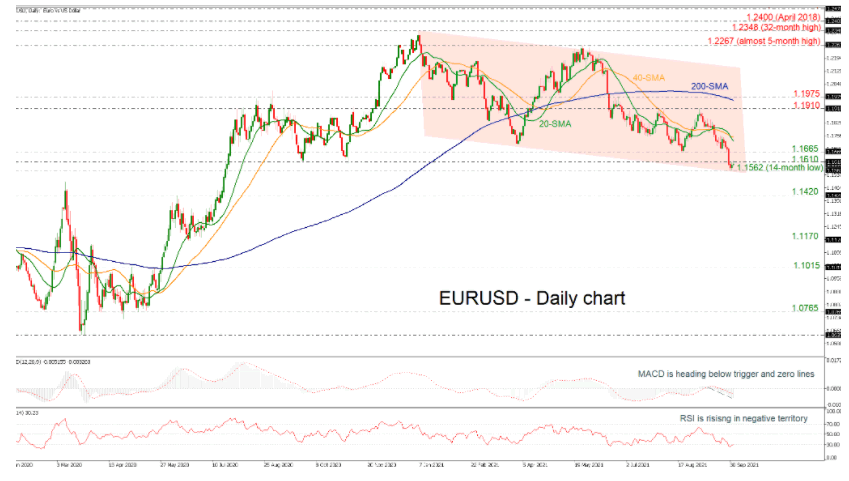
EURUSD found strong support at the 14-month low of 1.1562 last week, turning up from the lower boundary of the descending channel.
Technically, the RSI indicator is mirroring the latest bullish move and is moving above the oversold territory; however, the MACD oscillator is still extending its negative movement beneath its trigger and zero lines. In trend indicators, the 20- and 40-day simple moving averages (SMAs) completed a bearish crossover.
Any advances beyond the 1.1610 resistance could open the way for the 1.1665 barrier ahead of the short-term SMAs around 1.1720-1.1745. Rising further, the bulls could meet the 1.1910 hurdle before the battle starts near the 200-day SMA at 1.1953 and the 1.1975 obstacle.
On the flip side, a drift below the long-term downward sloping channel could endorse the broader negative outlook, hitting the 1.1420 support, taken from the inside swing high on June 9. Steeper decreases could open the way for 1.1170 and 1.1015.
In conclusion, EURUSD is ticking marginally up in the very short-term, but the bigger view is negative
Core Bond Markets Reversed Early
Markets
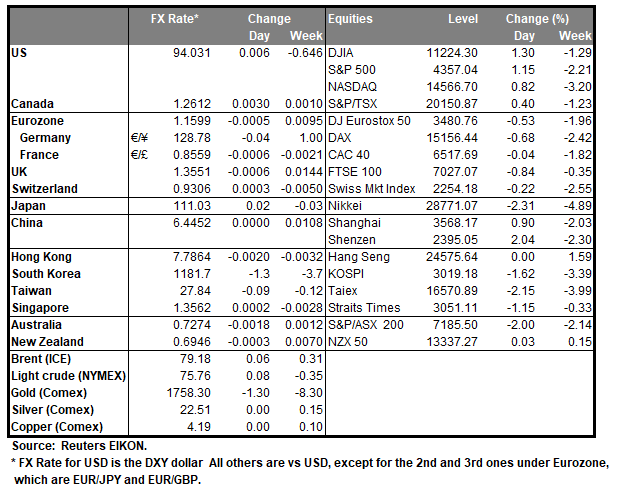
US stock markets set aside inflation worries on Friday even as both the core and headline PCE deflator accelerated to a 30-year high of 3.6% and 4.3% y/y respectively. Wall Street instead focused on a consensus-beating manufacturing ISM (61.1 from 59.9). Details were strong with new orders stable at 66.7, output coming in at 59.4 and employment rising again slightly (50.2) after a month in contraction territory. After easing for two months straight from historically high levels, prices paid picked up again (81.2 from 79.4). Late-stage trial results showing Merck’s Covid-19 pill cuts the risk of hospitalization or death by half supported sentiment as well. Equities in the US ended 0.8-1.4% higher. Democrats meanwhile are trying to get out of a deadlock that takes hostage of both the infrastructure and social spending plan (see below). Bi-partisan discussions on the US debt ceiling still haven’t resulted in a breakthrough either. Markets are getting more nervous with yields on US T-bills maturing past X-date (October 18) spiking. Despite a constructive environment and solid US data, yields on other tenors fell with the belly (-2.6 bps to -3.7 bps) outperforming the wings of the curve (-1.2 bps to -1.6 bps). German yields declined in lockstep with changes varying from -1.4 bps (2y) to -2.5 bps (5y/10y). The dollar lost further momentum after hitting important resistance at 94.74 in the trade-weighted variant the days before. DXY eased from 94.31 to 94.03. EUR/USD tried to recoup the 1.16. Sterling clawed back and almost completely reversed the heavy losses incurred on Wednesday’s risk-off. EUR/GBP finished at 0.856. Cable settles north of 1.35 again.
Asian sentiment was hit by the decision to suspend trading in Evergrande shares without a reason given. Reports later suggesting a rival company acquired a majority stake in the beleaguered property firm remain unconfirmed. Hong Kong and South Korean stocks underperform (-2%). Chinese markets are closed until Friday for the Golden Week. FX markets trade muted. The Australian dollar is leading G10 peers ahead of the RBA tomorrow. Core bond markets reversed early Asian strength to trade slightly below or near Friday’s closing levels.
Trading today is probably going to be technically inspired. The eco calendar heats up from tomorrow onwards with the US services ISM and Friday’s payrolls report as culmination point. In between we have several central bank meetings and a slew of ECB/Fed speeches. Core bond yields are looking for a bottom after last week’s repositioning. The 10y yield could find support around 1.45% in the US and -0.24% in Germany. We’re monitoring the very short end of the US curve (T-bills) closely as we expect the debt ceiling debate to intensify. EUR/USD started a bottoming out process as well but is struggling to take out the 1.16 big figure. It may need help from a generous risk climate to do so. Sterling awaits finance minister Sunak’s £500mln jobs plan.
News headlines
US Democrats have given themselves an additional month’s time to settle their difference on the spending agenda. House speaker Pelosi pulled the planned vote on the infrastructure bill a second time as Progressive Democrats still want it to be tied to the $3.5tn Build Back Better spending bill which includes childcare, paid leave, climate change and housing. Several progressive Democrats later said they are willing to compromise on the amount with the Capitol Hill whisper number being somewhere around $2tn. Moderate Democrats want assurances on that matter, before supporting any other spending bill (apart from the pulled infrastructure bill).
Czech central bank governor Rusnok rebuffed criticism from the country’s finance minister Schillerova who last week took a shot at the CNB’s unexpected 75 bps rate hike which increased the wedge between the CNB and other developing countries who for now retain easy policies which support wealth and living standards. Rusnok reminded Schillerova that the CNB’s sole legal mandate is safeguarding price stability. He suggested that other countries would follow swiftly. The CNB took a head start as it wants to stop higher inflation from boosting wage demands and that way become entrenched in the economy for longer. EUR/CZK continues trading near key support at 25.30.