Sample Category Title
EUR/USD Breaks Key Support as Dollar Rise Continues
Dollar is generally strong today, but buying focus is temporarily shifted from against Yen to Euro and Sterling. In particular, EUR/USD has taken out key support level at 1.1663. Overall markets are mixed though, with stocks recovering while treasury yields retreat. Yen and Swiss Franc are the stronger ones for today followed by the greenback. New Zealand Dollar is the worst performing, followed by the Pound.
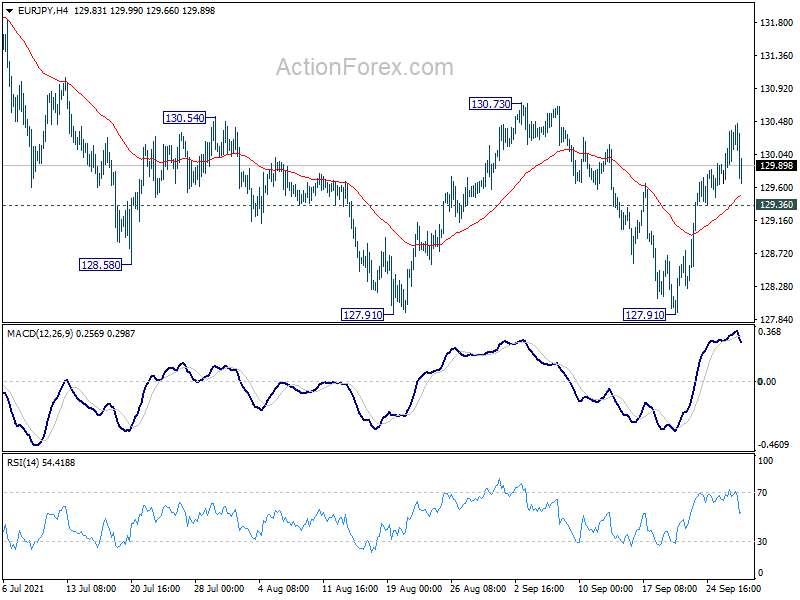
Technically, EUR/USD's break of 1.1663 should confirm resumption of whole fall from 1.2265. The pair should now target 1.1602 key medium term structural support. While USD/JPY is struggling to break through 111.65/71 resistance cleanly, retreat is so far shallow. As noted before, firm break of 111.71 will carry larger bullish implications for USD/JPY. We'd now also look at EUR/JPY, to see if it would break through 130.73 resistance to align with Yen selling, or break through 129.36 minor support to align with Euro selling.
In Europe, at the time of writing, FTSE is up 0.0%. DAX is up 0.87%. CAC is up 1.03%. Germany 10-year yield is down -0.0139 at -0.210. Earlier in Asia, Nikkei dropped -2.12%. Hong Kong HSI rose 0.67%. China Shanghai SSE dropped -1.83%. Singapore Strait Times dropped -0.11%. Japan 10-year JGB yield dropped -0.0057 to 0.069.
ECB Makhlouf not looking to raise rates or respond to transitory inflation
ECB Governing Council member Gabriel Makhlouf warned in a Bloomberg TV interview, "we must be very vigilant of the risks out there." He referred to the risk of persistently high inflation sue to supply bottlenecks.
"That's the risk that we at the ECB need to be very cautious of and very aware of and ready to respond to if it happens," Makhlouf said. "Right now I don't think we should be looking to raise rates or respond to transitory inflation."
The crisis program "was set up for an emergency at the start of the pandemic. As we see the emergency disappear there are logical consequences to that particular program," Makhlouf said. "On the other hand there's a long discussion to be had at the ECB, there's a lot of uncertainty around with what's happening in economies."
Eurozone economic sentiment rose to 117.8, employment expectation rose to 113.6
Eurozone Economic Sentiment Indicator rose slightly from 117.6 to 117.8 in September, above expectation of 116.9. Employment Expectation Indicator rose 0.8 pts to 113.6, highest since 2018. Industrial confidence rose from 13.8 to 14.1. Services confidence dropped from 16.8 to 15.1. Consumer confidence rose from -5.3 to -4.0. Retail trade confidence dropped from 4.6 to 1.3. Construction confidence rose from 5.5 to 7.5.
EU ESI was unchanged at 116.6 while EEI rose 1 pt to 113.6 (highest since 2018). Amongst the largest EU economies, the ESI rose in Spain (+1.7), Germany (+0.8), the Netherlands and Poland (both +0.6), while it worsened in France (-1.3) and Italy (-0.9).
Also released, Swiss ZEW economic expectations rose from -7.8 to 25.7 in September. UK mortgage approvals dropped to 74k in August. UK M4 money supply rose 0.5% mom in August.
Japan's GPIF will not investment in Chinese government bonds
Japan's Government Pension Investment Fund (GPIF) said it will not investment in Chinese government bonds, even though FTSE Russell's World Government Bond Index starts to include them in October. GPIS is the world's largest pension fund, with total assets of JPY 192T.
Masataka Miyazono, president of GPIF, said, "Chinese government bonds cannot be settled in an international settlement system that can be used for other major government bonds. The market's liquidity is still limited compared with the size of GPIF's investment scale. Trading of futures is not allowed for foreign investors."
EUR/USD Mid-Day Outlook
Daily Pivots: (S1) 1.1667; (P) 1.1685; (R1) 1.1702; More...
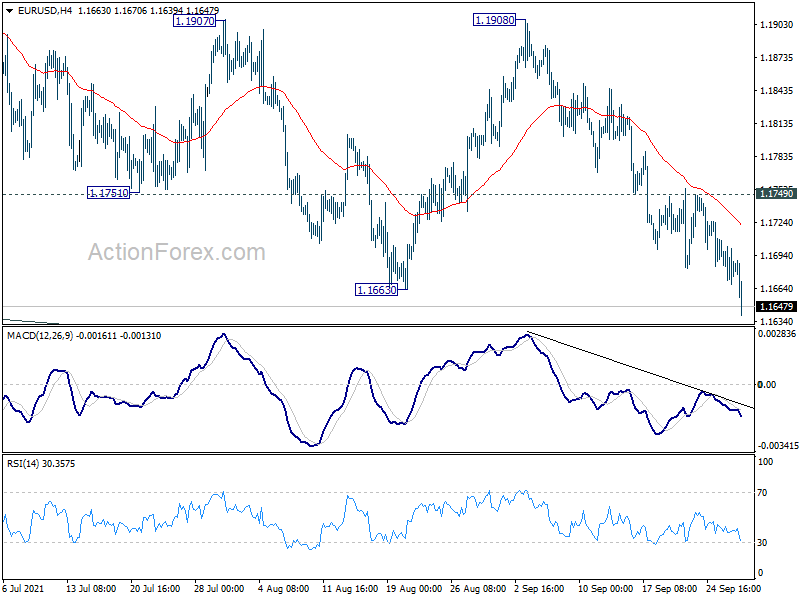
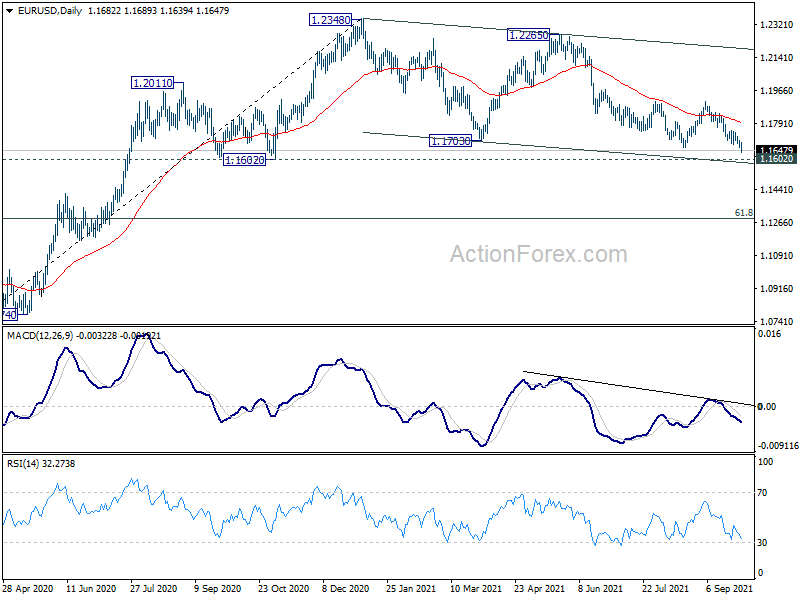
EUR/USD's break of 1.1663 support indicates resumption of fall from 1.2265, which is seen as the third leg of the pattern from 1.2348. Intraday bias is back on the downside for 1.1602 key support level next. Sustained break there will argue that it's at least on larger scale correction. Next target would be 1.1289 medium term fibonacci level. On the upside, break of 1.1749 resistance is needed to indicate short term bottoming. Otherwise, outlook will stay bearish in case of recovery.
In the bigger picture, rise from 1.0635 is seen as the third leg of the pattern from 1.0339 (2017 low). Further rally remains in favors long as 1.1602 support holds, to cluster resistance at 1.2555 next, (38.2% retracement of 1.6039 to 1.0339 at 1.2516). However sustained break of 1.1602 will argue that the rise from 1.0635 is over, and turn medium term outlook bearish again. Deeper fall would be seen to 61.8% retracement of 1.0635 to 1.2348 at 1.1289 and below.
Economic Indicators Update
| GMT | Ccy | Events | Actual | Forecast | Previous | Revised |
|---|---|---|---|---|---|---|
| 23:01 | GBP | BRC Shop Price Index Y/Y Aug | -0.50% | -0.80% | ||
| 08:00 | CHF | ZEW Expectations Sep | 25.7 | -7.8 | ||
| 08:30 | GBP | Mortgage Approvals Aug | 74K | 73K | 75K | |
| 08:30 | GBP | M4 Money Supply M/M Aug | 0.50% | 0.30% | 0.10% | |
| 09:00 | EUR | Eurozone Economic Sentiment Indicator Sep | 117.8 | 116.9 | 117.5 | 117.6 |
| 09:00 | EUR | Eurozone Services Sentiment Sep | 15.1 | 16.5 | 16.8 | |
| 09:00 | EUR | Eurozone Industrial Confidence Sep | 14.1 | 12.5 | 13.7 | 13.8 |
| 09:00 | EUR | Eurozone Consumer Confidence Sep F | -4 | -4 | -4 | -5.3 |
| 09:00 | EUR | Eurozone Business Climate Sep | 1.72 | 1.75 | 1.74 | |
| 14:00 | USD | Pending Home Sales M/M Aug | 1.10% | -1.80% | ||
| 14:30 | USD | Crude Oil Inventories | -2.5M | -3.5M |
NZDUSD Starts New Bearish Cycle Within Channel
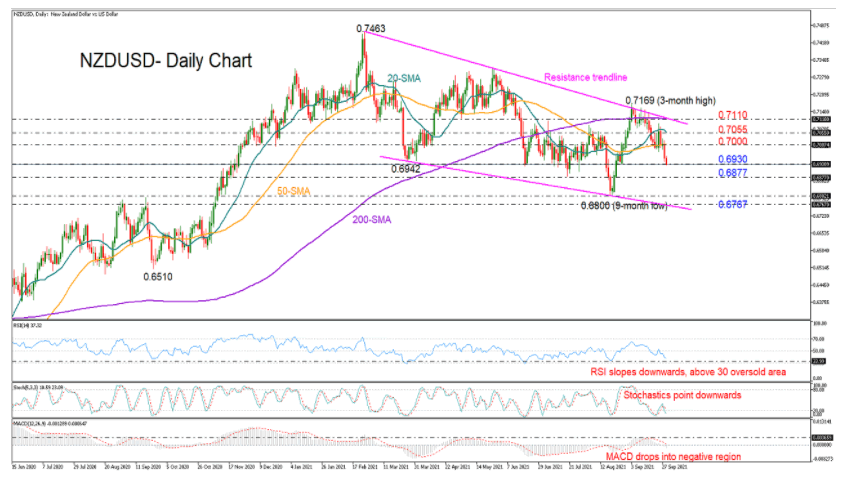
NZDUSD embarked itself on a new bearish cycle after the bulls got defeated once again near the tough resistance trendline drawn from February’s four-year high of 0.7463.
The 0.7000 level could not catch the fall this week, with the price currently seeking shelter near the 0.6930 handle, where bearish actions halted several times over the past few months.
While a rebound at this point cannot be excluded, the momentum indicators are currently flagging that the sell-off has more room to run. With the MACD decelerating below its zero and signal lines, the Stochastics reversing lower again, and the RSI sailing southwards below its 50 neutral mark, downside corrections are more likely than upside ones.
Yet, whether the bearish cycle will last until the bottom of the downward-sloping channel, breaching the previous low of 0.6800 too, that remains to be seen as key obstacles at 0.6930 and 0.6877 could stand in the way.
In the event of an upside reversal, the price will push for a close above the 0.7000 level, where the 50-day simple moving average (SMA) is laying at the moment. Slightly higher, the 20-day SMA at 0.7050 could prevent the bulls from testing the resistance trendline and the 200-day SMA at 0.7110 as it did last week.
All in all, NZDUSD is expected to stay in the bearish phase in the short term, likely facing some constraints around 0.6930 and 0.6877.
EURUSD Is Possibly Bearish
Technical analysis
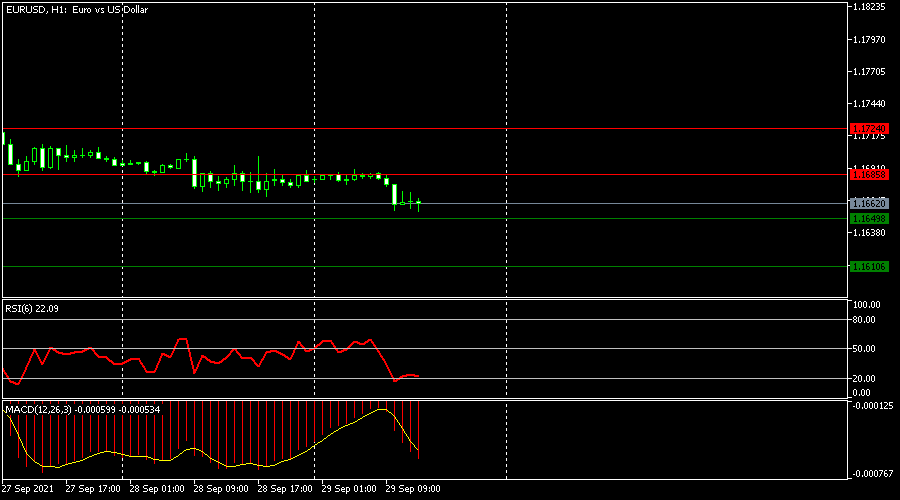
The RSI is near the oversold zone
The MACD is below 0, with an indicator line pointing downwards.
Most likely scenario - SELL
Target prices: 1.16498 1.16106
Alternative scenario - BUY
Target prices: 1.16858 1.17240
Key levels
Support 1.16498 1.16106
Resistance 1.16858 1.17240
ECB Makhlouf not looking to raise rates or respond to transitory inflation
ECB Governing Council member Gabriel Makhlouf warned in a Bloomberg TV interview, "we must be very vigilant of the risks out there." He referred to the risk of persistently high inflation sue to supply bottlenecks.
"That's the risk that we at the ECB need to be very cautious of and very aware of and ready to respond to if it happens," Makhlouf said. "Right now I don't think we should be looking to raise rates or respond to transitory inflation."
The crisis program "was set up for an emergency at the start of the pandemic. As we see the emergency disappear there are logical consequences to that particular program," Makhlouf said. "On the other hand there's a long discussion to be had at the ECB, there's a lot of uncertainty around with what's happening in economies."
Oil Slips, Gold Falls As Dollar Shines
US API Crude Inventories and speculators sink oil
Brent crude rose over USD80.50 a barrel overnight before speculative longs rushed into book profits after the US API Crude Inventory data showed a surprise 4 million-plus rise in stocks. Brent crude ended the day down 1.50% at USD 78.20 an ounce. WTI failed ahead of USD 77.00 before falling 1.30% to USD 74.40 a barrel by session’s end.
With the relative strength indexes (RSIs) on both contracts in overbought territory yesterday, the odds of a speculator-driven pullback were high. It is likely to be only a stay of execution though, with natural gas and coal prices high and China’s energy deficit hogging the headlines. The RSIs have moved back to neutral now as well meaning oil from here is likely to be a buy on dips.
Prices are almost unchanged in Asia today, with nearby support in Brent crude at USD 78.00 a barrel. Only a fall through USD 76.00 a barrel will temporarily change the bullish outlook. WTI has support at USD 74.00 a barrel with key near-term support at USD 73.00 a barrel.
Gold sinks on stronger US dollar/yields
Gold fell by 0.90% to USD 1734.00 an ounce overnight before recovering slightly to USD 1738.00 in Asia today. A spike in long-dated US yields and the US dollar as Fed tapering implications started to be priced by markets, pushed gold lower and it is now extremely vulnerable to more US dollar strength. The fallout in gold has been softened slightly by risk-hedging buying, but it appears that if things stay the same, that will only slow gold’s descent.
Gold has now broken through support at USD 1740.00 an ounce which becomes resistance. That is followed by USD 1760.00 and USD 1780.00 an ounce. The overnight low at USD 1728.00 and then USD 1720.00 are initial support. That is followed by USD 1700.00 and then critical long-term support around USD 1680.00 an ounce. Gold looks set to test USD 1700.00 an ounce this week if tapering repricing continues.
The US Dollar Rises On Higher US Yields
US dollar gains ground
The US dollar marched higher overnight, benefiting from a rise in US yields after a less-dovish Powell and a small amount of risk aversion buyers. The implications of a Fed taper have been making their way through currency markets for a while now, even as equity markets stayed in their own dreamland space. The dollar index climbed 0.35% overnight to 93.74, before easing slightly in Asia to 93.70 as US equity futures rally. The index is now locked and loaded for a further rally above 94.00.
EUR/USD was sidelined overnight, easing to 1.1685 this morning. 1.650 to 1.1750 continues to contain nicely. The British pound suffered, GBP/USD tumbling by 1.20% to 1.3540 as petroleum shortages persist and winter of discontent fears rise. GBP/USD crashed through major support at 1.3610 overnight and this sets up a much larger move lower targeting 1.3300 initially. The spike higher in US yields lifted USD/JPY 0.45% higher to 111.50 overnight. It will ignore the politics of a new Japanese PM today, and a daily close above 111.70 will signal the start of a directional move higher targeting 114.00. Much will depend on the direction of US yields, however.
AUD/USD and NZD/USD tumbled by around 0.70% overnight on rising fear gauges, with AUD/USD catching an energy price tailwind today, rising 0.20% to 0.7250. NZD/USD has continued falling by 0.15% to 0.6950 today after Covid-19 cases spiked in Auckland. If the delta variant jumps the fence around Auckland, NZD/USD has a lot more downside, having broken support at 0.6980 overnight.
Asian currencies retreated overnight, led by the won and the baht. If we are indeed on the cusp of a taper repricing in markets, the Thai baht, Korean won, Indonesian rupiah and Philippine peso will be the most vulnerable with monetary policies completely out of Fed-sync. High energy prices and a reopening economy appear to be sparing the Malaysian ringgit from the fallout for now. China’s PBOC continues to set neutral USD/CNY fixes signalling which will provide some stability to the Asian FX space.
Gold – Further To Fall?
How much lower will it go?
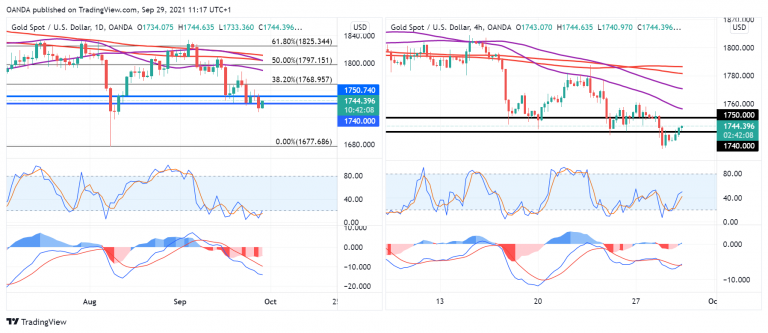
Gold continued to fall on Tuesday, breaking below $1,740 and further losses could be on the cards.
The yellow metal has come under significant pressure as central banks have prepared the markets for the end of pandemic era stimulus and even rate hikes as early as next year.
Even higher inflation hasn’t tempted traders back in, despite its reputation as a hedge, while yesterday’s bout of risk aversion also did nothing to lift it, quite the opposite.
That leaves gold languishing at seven-week lows and it may get worse yet. We have seen a small recovery today but that has only brought it back towards $1,740 – prior support – where it now seeing significant resistance.
A rotation off this level would act as confirmation of the initial breakout and could turn attention back towards $1,700, maybe even $1,680, last months flash crash low and long-term support.
Wall Street Casts Shadow On Asia
Asian equity markets sink on Wall Street woes
Asian equity markets are showing a distinctive North/South split today. The northern Asia heavyweights, with the highest beta to the US tech rally and China, and with the highest percentage of speculative zeal, have plummeted. ASEAN markets, with less technology darlings and a high percentage of old school banks and property heavyweights are down, but much less so.
The sharp rise in US yields overnight broke the already fragile spirit of Wall Street, helped along by testimony from Chairman Powell that wasn’t as dovish as hoped, and rising fears over the US debt ceiling. The S&P 500 slumped by 2.04%, while the Nasdaq plummeted by 2.83% and the Dow Jones fell by 1.62%. As Wall Street reluctantly assimilates Fed tapering implications, it is not yet clear whether the buy-the-dip army has finally been halted. Index futures on all three indexes have rallied by over 0.50% in Asia, suggesting a Napoleonic retreat from the gates of Moscow is not yet a done deal. We have also been led to water quite a few times by rising yields in the US, only for it to be found wanting.
Japan markets, the centre of much speculative fervour of late have tumbled, with the Nikkei 225 down 2.83%. The Kospi is also suffering, falling by 2.0%. In China, the Shanghai Composite has fallen by 1.80% followed by the CSI 300, down 1.55%. Hong Kong is calm comparatively, perhaps with one eye on the US futures. The Hang Seng is only 0.65% lower.
Singapore is a bastion of calm, the STI climbing 0.05% today. Kuala Lumpur is down 0.40% with Jakarta also modestly in the green, up 0.15%. Taiwan though has plummeted by 1.80% in keeping with its Northern Asian neighbours with its heavy weighting towards tech. Bangkok and Manila are both down 0.40%. Australian markets are also lower with the ASX 200 and All Ordinaries falling by 1.0%.
The stabilising of base metal prices and the rally by US index futures appears to have limited the fallout in ASEAN markets today, along with a lower beta to technology in favour of cyclical sectors. That is likely to be of cold comfort to Europe though, which will head south this afternoon, although, like ASEAN, I suspect the losses will be more limited. Much will depend, I believe, on whether the rally in US index futures in Asia is sustained or turns out to be a false dawn.
Yields Continue To Rise, UK 30-Year Auction Disappoints
Notes/Observations
- Yields kept climbing pulled up by a hawkish shift at the Fed.
- EU confidence rises as data defied concerns over supply-side constraints and a new surge in Covid-19 cases (Note: Both German and French reading beat consensus).
- Senate fails to advance debt ceiling, government funding measure.
- China Aug industrial profit growth slows for sixth month.
- Oil extends rally into 6th day on tight supply, Brent hitting 3-year high.
Asia
- China PBOC Open Market Operation (OMO) again injected CNY100B in 14-day reverse repos (Note: 8th straight session of PBoC net liquidity injection).
- BOJ July Meeting Minutes (two decisions ago) reiterates its overall assessment that domestic economy had picked up as a trend, although it remained in a severe situation due to the impact of COVID.
- Japan Fin Min Aso stated that he did not believe pent up demand would emerge too easily and would take time for demand to return after state of emergency ends.
- Australia Aug Preliminary Retail Sales M/M: -1.7% v -2.5%e.
- China Aug Industrial Profits slow for the 6th consecutive month (Y/Y: 10.1% v 16.4% prior).
- North Korea fires unidentified projectile into East Sea.
Europe
- ECB’s de Cos (Spain) stated that reduction of ECB monetary support must be done with caution.
- UK govt said to place the army on standby to help ease fuel supply issues with up to 150 military drivers preparing to deliver fuel to station forecourts.
Americas
- Fed Chair Powell Senate testimony stated that Fed would act against 'sustained' high inflation; Bottleneck effects were larger and more persistent than expected.
- Fed's Bostic (FOMC voter, hawk) stated that was not convinced were facing a lengthy bout with troublesome inflation; Without clear data demonstrating inflation had arrived and was likely to last, we would allow labor markets to run their course.
- Fed's Williams (FOMC voter): Tapering bond buying might soon be warranted; Conditions to support a rate hike still well off.
- Fed’s Brainard noted that economy could reform to pre-pandemic equilibrium of low unemployment and mild inflation. Expected inflation to return to pre-virus dynamics, did not take any signal on liftoff from taper timing.
- Fed's Kashkari (dove, non-voter) stated that our highest priority was to put people back to work.
- Dallas Fed's Kaplan to retire on Oct 8th (Reminder: Fed's Rosengren (non-voter) said to retire on Sept 30th).
- Senate Republicans blocked a measure to fund the government and suspend the debt ceiling Monday evening.
- Democrats said to be hinting that they could be willing to drop the debt ceiling from their government funding package this week in order to avoid a government shutdown - Politico.
Energy
- WTI Crude continues to rise, Brent trades above $80/bbl.
Speakers/Fixed income/FX/Commodities/Erratum
Equities
- Indices [Stoxx600 -1.03% at 457.64, FTSE -0.28% at 7,043.31, DAX -0.70% at 15,464.75, CAC-40 -1.14% at 6,575.28, IBEX-35 -0.97% at 8,915.50, FTSE MIB -0.63% at 25,967.00, SMI -1.16% at 11,556.00, S&P 500 Futures -0.65%].
- Market Focal Points/Key Themes: European indices open mixed with a downward bias, then fell into the red later in the session; better performing sectors include energy and financials; consumer discretionary and technology sectors among those leading to the downside; oil and gas subsector supported by rise in crude prices; Castellum divests property portfolio; Blue Prism to be acquired by Vista; reportedly SocGen looking to acquire ING’s retail bank unit; Maerks sells it’s reefer construction unit; Wolters Kluwer sells its US legal ed business; focus on upcoming testimony from Fed’s Powell before Congress; earnings expected later in the US session include IHS Markit, Micron Technologies and Synnex.
Equities
- Consumer discretionary: Ferguson [FERG.UK] +1% (earnings; buyback), Smiths Group [SMIN.UK] +3% (earnings; confirms divestment), Go-Ahead [GOG.UK] -18% (CFO resigns; Updates on Southern Contract), Card Factory [CARD.UK] -1% (earnings), EasyJet [EZJ,UK] -3% (results of rights issue).
- Technology: ASM International [ASM.NL] -4% (investor day), Blue Prism Group [PRSM.UK] -2.5% (to be acquired).
Speakers
- ECB's Villeroy (France) reiterated view that inflation rate will fall below 2% by 2023.
- ECB's Kazimir (Slovakia): Financing conditions remain favorable.
- Sweden Central Bank (Riksbank) Bremam stated had clearly indicated that would tolerate inflation over target for a while. Having Repo Rate outlook that was on the accommodative side was OK as it was only a forecast.
- Turkey Central Bank Gov Kavcioglu stated that planned to increase FX reserves and saw no reason for further depreciation in currency.
- Romania Central Bank official Popa: Favor faster rate hikes.
- Japan PM Suga to lift the Coronavirus State of Emergency on Sept 30th (as expected).
- China State Grid stated that power supply for Beijing was ample and that cuts made during the week were due to regular checks.
- China PBOC Gov Yi Gang: No need to purchase assets at this time. Saw China's economy potential growth between 5.0-6.0%.
Currencies/Fixed Income
- Plethora of recent Fed speak reinforces message of tapering and US bond yields continued to climb. The 10-year Treasury yield approached the 1.55% level during the session.
- USD/JPY at 3-month highs and edging to the key resistance area of 112. JPY currency furthered weakened after a weak JGB auction that added to negative sentiment. Focus also on the LDP ruling party election on Wednesday.
- EUR/USD holding below the 1.17 level as US yields kept climbing pulled up by a hawkish shift at the Fed.
- GBP/USD moved back below the 1.37 level as markets reassessed the BOE. Dealers noted the current supply chain crisis could discourage the Bank of England from raising interest rates.
Economic data
- (NL) Netherlands Sept Producer Confidence Index: 11.1 v 9.6 prior.
- (FI) Finland Aug Preliminary Retail Sales Volume Y/Y: 1.2% v 3.4% prior.
- (DE) Germany Oct GfK Consumer Confidence: +0.3 v -1.5e (1st positive reading in 19 months).
- (NO) Norway Aug Retail Sales (includes auto/fuel) M/M: -3.8% v +0.6%e.
- (FR) France Sept Consumer Confidence: 102 v 100e.
- (ES) Spain July Total Mortgage Lending Y/Y: 5.7% v 29.9% prior; House Mortgage Approvals Y/Y: 36.8% v 41.2% prior.
- (HU) Hungary Aug Unemployment Rate: 4.0% v 3.7%e.
- (SE) Sweden Aug Retail Sales M/M: +0.7% v -0.2%e; Y/Y: 6.6% v 5.3%e.
- (SE) Sweden Aug Trade Balance (SEK): -10.3B v 6.6B prior.
- (AT) Austria Sept Manufacturing PMI: 62.8 v 61.8 prior (15th straight expansion).
- (HK) Hong Kong Aug Trade Balance (HKD): -26.3B v -29.2Be; Exports Y/Y: 25.9% v 26.0%e; Imports Y/Y: 28.1% v 28.9%e.
- (IS) Iceland Sept CPI M/M: 0.5% v 0.5% prior; Y/Y: 4.4% v 4.3% prior.
Fixed income Issuance
- (NL) Netherlands Debt Agency (DSTA) sold €4.92B vs. €3.0-5.0B indicated range in new 0.0% Jan 2029 DSL Bonds; Avg Yield: -0.251% v -0.479% prior.
- (ID) Indonesia sold total IDR12.0T vs. IDR12.0T target in bills and bonds.
- (IT) Italy Debt Agency (Tesoro) sold €5.5B vs. €5.5B indicated in 6-month bills; Avg Yield: -0.545% v -0.519% prior; Bid-to-cover: 1.29x v 1.28x prior.
- (UK) DMO sold £2.0B in 1.25% July 2051 Gilts; Avg Yield: 1.332% v 0.972% prior; bid-to-cover: 2.05x v 2.41x prior; Tail: 1.1bps v 0.5bps prior..
- (CH) Switzerland sold CHF637.0M in 6-month Bills; Avg Yield: -0.776% v -0.750% prior.
Looking Ahead
- (PL) Poland Central Bank to hold non-monetary policy meeting.
- 05:25 (EU) Daily ECB Liquidity Stats.
- 05:30 (ZA) South Africa Q2 Non-farm Payrolls Q/Q: +0.1%e v -0.1% prior; Y/Y: -1.0%e v -5.4% prior.
- 05:30 (HU) Hungary Debt Agency (AKK) to sell 3-Month Bills; Avg Yield: % v 1.11% prior; bid-to-cover: x v 1.70x prior.
- 05:30 (EU) ECB allotment in 7-Day Main Refinancing Tender (MRO).
- 05:30 (ZA) South Africa to sell combined ZAR3.9B in 2035, 2040 and 2048 bonds.
- 06:00 (IE) Ireland Aug Retail Sales Volume M/M: No est v -1.7% prior; Y/Y: No est v 5.2% prior.
- 06:45 (US) Daily Libor Fixing.
- 07:00 (MX) Mexico Aug Unemployment Rate NSA (unadj): 4.4%e v 4.4% prior.
- 07:00 (BR) Brazil Central Bank (BCB) Sept Minutes.
- 07:00 (SE) Sweden Central Bank (Riksbank) Dep Gov Skingsley.
- 08:00 (UK) Daily Baltic Dry Bulk Index.
- 08:00 (EU) ECB chief Lagarde opens ECB forum.
- 08:30 (US) Aug Advance Goods Trade Balance: -$87.3Be v -$86.4B prior.
- 08:30 (US) Aug Preliminary Wholesale Inventories M/M: 0.8%e v 0.6% prior; Retail Inventories M/M: 0.5%e v 0.4% prior.
- 08:30 (ES) ECB’s De Guindos (Spain).
- 08:50 (UK) BOE’s Mann.
- 08:55 (US) Weekly Redbook LFL Sales data.
- 09:00 (US) July FHFA House Price Index M/M: 1.5%e v 1.6% prior.
- 09:00 (US) July S&P Case-Shiller House Price Index (20-City) M/M: 1.70%e v 1.77% prior; Y/Y: 20.00%e v 19.08% prior.
- 09:00 (US) July S&P Case-Shiller House Price Index (Overall) Y/Y: No est v 18.61% prior.
- 09:00 (EU) Weekly ECB Forex Reserves.
- 09:00 (RU) Russia announcement on upcoming OFZ bond issuance (held on Wed).
- 09:00 (US) Fed’s Evans.
- 09:45 (IT) ECB’s Panetti (Italy).
- 09:45 (EU) ECB weekly QE bond buying update.
- 09:45 (UK) BOE to buy £1.47B in APF Gilt purchase operation (20+ years).
- 10:00 (US) Sept Consumer Confidence Index: 115.0e v 113.8 prior.
- 10:00 (US) Sept Richmond Fed Manufacturing Index: 10e v 9 prior.
- 10:00 (MX) Mexico Weekly International Reserve data.
- 10:00 (US) Fed chief Powell in Senate.
- 10:00 (SE) Sweden Central Bank (Riksbank) Gov Ingves.
- 11:00 (DE) ECB’s Schnabel (Germany).
- 13:00 (US) Treasury to sell 7-year notes.
- 15:00 (AR) Argentina July Economic Activity Index (Monthly GDP) M/M: No est v 2.5% prior; Y/Y: 8.5%e v 10.8% prior.
- 15:00 (US) Fed’s Bostic.
- 16:30 (US) Weekly API Oil Inventories.
- 19:01 (UK) Sept BRC Shop Price Index Y/Y: No est v -0.8% prior.
- 21:10 (JP) BOJ Outright Bond Purchase Operation for 3~5 Years and 5~10 Years maturities.
- 22:00 (VN) Vietnam Q3 GDP Y/Y: 1.9%e v 6.6% prior.
- 22:00 (VN) Vietnam Sept CPI Y/Y: 3.1%e v 2.8% prior.
- 22:00 (VN) Vietnam Sept Trade Balance: -$1.8Be v -$1.3B prior; Exports Y/Y: +0.5%e v -5.4% prior; Imports Y/Y: 15.0%e v 21.2% prior.
- 22:00 (VN) Vietnam Sept YTD Retail Sales Y/Y: No est v -4.7% prior.
- 22:00 (VN) Vietnam Sept Industrial Production Y/Y: No est v 5.6% prior (revised from -7.4%).
- (JP) Japan Ruling Party (LDP) agreed on leadership.
Eurozone CPI: Inflation On The Boil
With Germany beginning a weeks- or months- long bargaining process of forming a three-party coalition after Sunday’s election resulted in a marginal victory for the left-centre SPD, the euro will shift its focus back to the economic calendar this week and particularly to the September CPI inflation figures due on Friday at 09:00 GMT. The data are expected to notch a 13-year high, flagging that the worst of inflation has not passed yet, but unless the news raises hawkish voices within the ECB, any reaction in the euro could be less powerful.
The lady is not tapering despite hot inflation
Although the excuse of transient inflation dominates central bankers’ views worldwide, the tenacious pickup in price measures is definitely making policymakers sweat ahead of the winter season.
With the headline Consumer Price Index advancing surprisingly above 2.0% to a decade high of 3.0% y/y in August, the ECB had one more reason on top of its brighter forecasts for the eurozone economy to cut the pace of its monthly pandemic-led PEPP asset purchases during this month’s policy meeting, with analysts estimating a slowdown to 60-70 billion euros in the next three months from 80bln previously.
The ECB, however, is not scaling back its 1.85trl euros envelope according to Ms. Lagarde but recalibrating the March increase in bond buying, which is a divergence from the Fed’s bond tapering plans. Also, unlike the Fed, the central bank is not foreseeing any rate hikes at least before 2023, while some analysts have lifted the timeline further into the next decade.
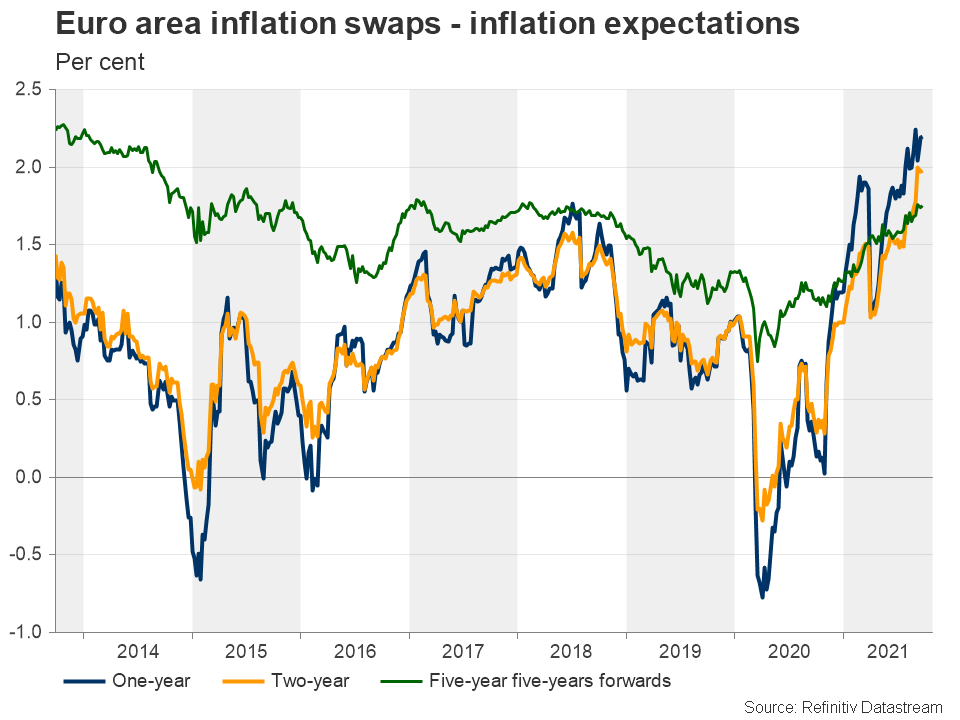
Eurozone inflation could become hot
Hence, the ECB is not expected to play catch-up for some years to come, which overall could be negative for the euro, but the reduction in PEPP purchases is a sign that policymakers are favouring a less stimulative policy. The main question now is how long the ECB will remain patient if inflation continues to overshoot its 2021 projection of 2.2%, and more importantly, if there will be any tweaks in the traditional APP asset purchases early in 2022 after the PEPP scheme expires in March.
On Friday, the headline CPI is expected to drift up to 3.3% y/y in September from 3.0% in August – the highest since 2008 – while the core measure, which excludes food and energy, is said to accelerate by the same amount from 1.6% y/y to 1.9%.
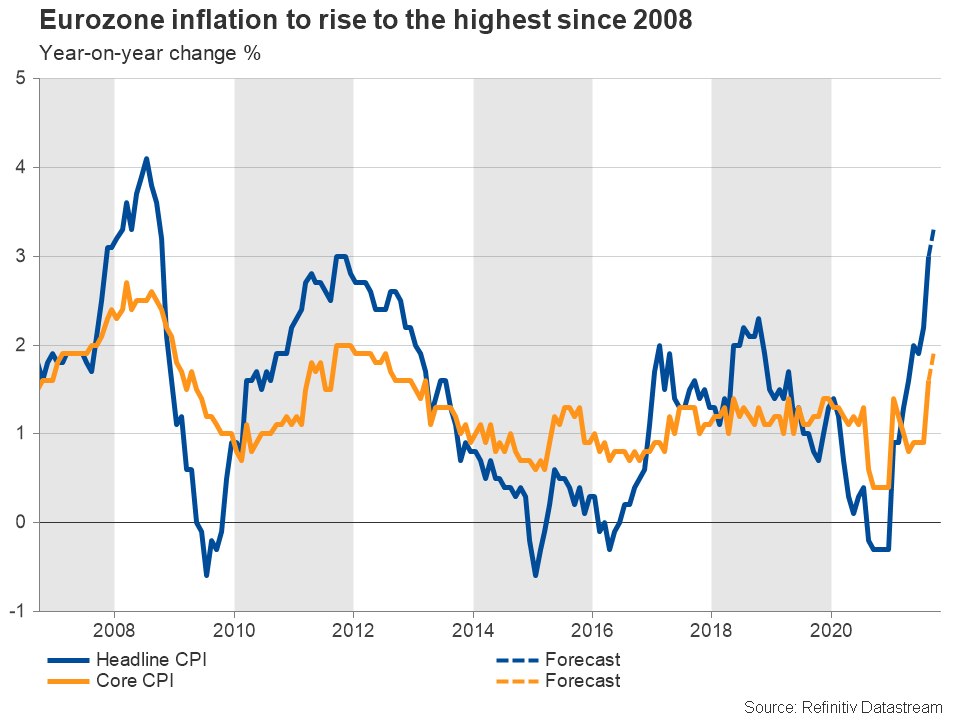
Given the boost in shipping costs and the spiral in commodity and energy prices, another increase in CPI figures would not be very surprising as inflation expectations continued to soar in the eurozone this month.
Yet, a stronger-than-expected outcome may see ECB hawks bringing the case for a termination to the PEPP program before the March expiration date back on the table, while also expressing scepticism about the flexibility of boosting the pre-Covid APP program once the PEPP scheme is phased out, as the Governing council member Madis Muller and ECB member Peter Kažimír said recently.
EUR/USD
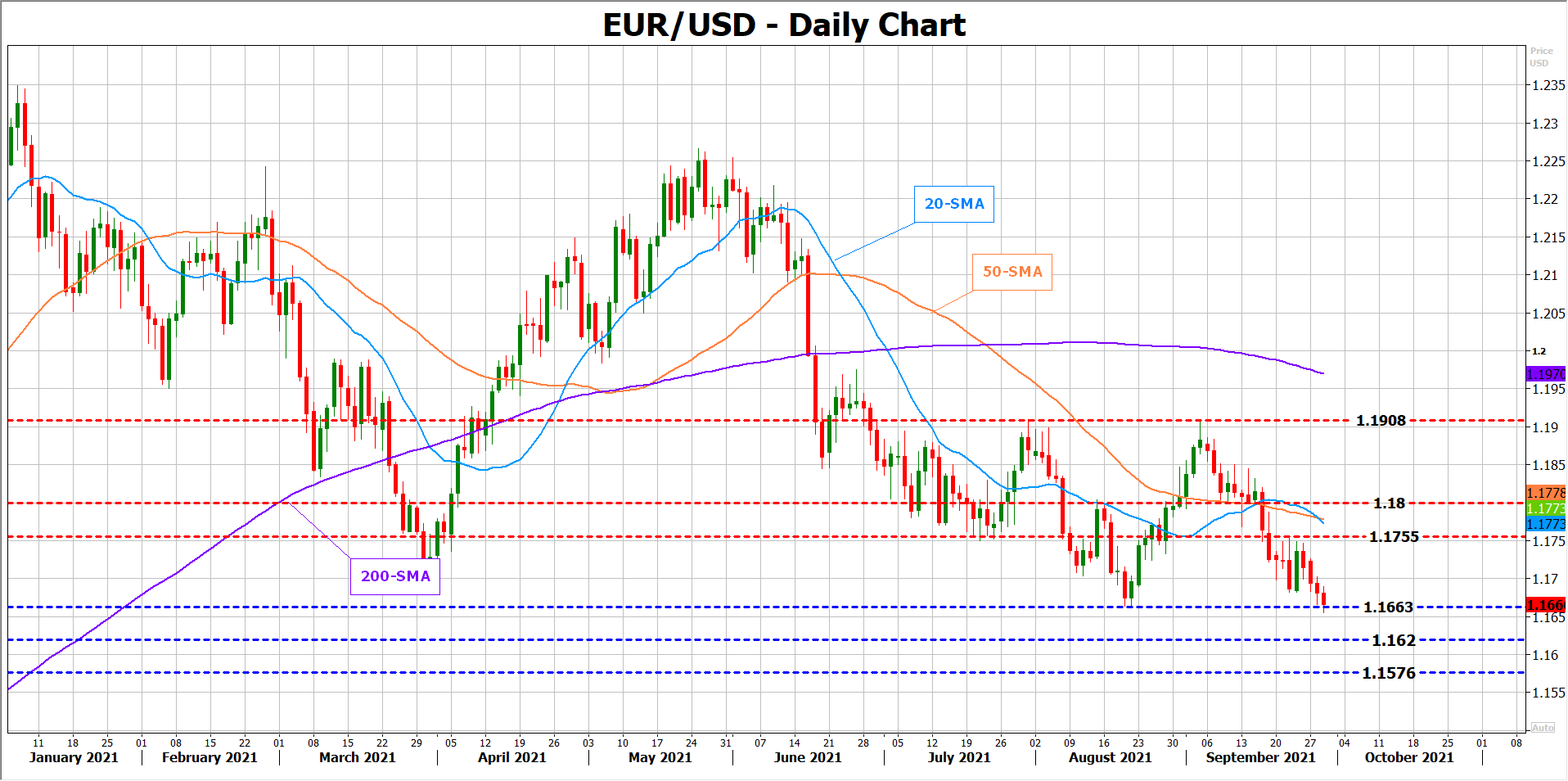
As for the euro, another unexpected pickup in CPI readings could bode well for the common currency as investors are sensitive to any inflation updates these days, especially if the stats induce some hawkish comments from ECB policymakers thereafter. Such an event could put the brakes on the one-month decline in euro/dollar near the 1.1663 low and push the pair up to last week’s high of 1.1755, avoiding an outlook deterioration. Thenn, a close above 1.1800 would then open the door for the crucial 1.1908 resistance zone.
Otherwise, if September’s inflation eases back below 3.0%, justifying the ECB’s policy strategy, euro/dollar could crack the 1.1663 floor, extending May’s downtrend towards the 2020 support area of 1.1620, while deeper, 1.1576 may attract special attention as this is where the 200-weekly simple moving average is laying.