Sample Category Title
Early Gains Fizzle Out
It's been an interesting start to the week as equity markets made strong gains early in the day before giving most back as the morning wore on.
US futures had a similar experience and Wall Street has opened a little mixed to start the week. What's interesting about the moves is how happy investors are to turn a blind eye to a growing list of risks for the economy and markets.
In the space of a week, Evergrande has gone from being viewed as a potential Lehman moment to seemingly being nothing to be concerned about. In that time, one deal was reached with onshore bondholders, while an $83.5 million offshore coupon payment was missed without explanation and another $45m is due to be paid this week.
Policymakers are continuing to grapple with rising inflation which is both higher and potentially less transitory than previously anticipated. An energy crisis isn't likely to ease those pressures, with households and businesses facing higher bills and input costs, which could exacerbate the supply and inflation issues further and make life very uncomfortable for central banks.
Thankfully, we'll hear the views of many policymakers from a number of central banks this week who will no doubt be keen to reassure investors. ECB President Christine Lagarde got the week underway and stated that the view remains that the inflation upswing is "largely transitory" and while there are some factors that could lead to stronger price pressures, the baseline scenario remains that it will remain below target over the medium term.
Federal Reserve Bank of Chicago President, and FOMC voter in 2021, Charles Evans has aired his views today and they seemingly align with what the central bank put out last week, that conditions soon be met for tapering. Interestingly though, he claimed that he's more uneasy about not generating enough inflation in 2023 and 2024 than living with too much now.
Fed policymakers Lael Brainard, John Williams and Neel Kashkari are also due to speak today. All err more on the dovish side typically so it will be interesting to hear their views on the recent trends and whether they support the plan to taper this year. Fed policy makers will be busy all week so there'll be no shortage of views to get stuck into.
Negotiations to start towards traffic light coalition
The SPD narrowly won the German election over the weekend and will now seek to form a coalition in the coming weeks and months, with the traffic light coalition the most likely at this point. It was clear ahead of the weekend that weeks or months of negotiations would follow the vote so the impact in the markets has been minimal.
Negotiations between Olaf Scholz and the Greens and Free Democrats will be far from straightforward, particularly the latter, and with CDU head Armin Laschet seemingly not giving up hope of leading an alternative coalition, pressure will be heightened. The hard work begins now and in the interim, Angela Merkel will remain at the wheel.
Oil rally continues
Oil prices are continuing to surge, with Brent crude now closing in on $80 and WTI perhaps not too far behind it. The global energy crisis could see demand for crude rise if the northern hemisphere experiences a cold winter, with many countries not equipped to cope.
If momentum is sustained, pressure will grow on OPEC+ to speed up the pace that it increases output, after a historic production cut early in the pandemic. Plans to increase production by 400,000 barrels per day, each month, will see output return to normal by the end of next year but recent events may require the group to pick up the pace.
The last thing the global economy needs going into an uncertain winter period is a fuel crisis to top everything off. Producers may not rush into a decision though, with some potentially comfortable with prices at these levels and others wanting to see if further restrictions accompany Covid surges that weigh on demand.
Gold finding support after Fed blow
Gold is making small gains at the start of the week after once again finding support around $1,740 late last week. The Fed's insistence that tapering is still the aim this year and a couple more dots suggesting a rate hike late next year could be on the cards dealt a heavy blow to gold prices last week and the outlook remains challenging if policymakers don't change course.
With downside momentum seemingly slowing, gold could see some reprieve in the near-term but the broader outlook isn't great. Inflation is typically part of the bullish case for gold but it's very much working against it at the moment as it pushes central banks towards the stimulus exit doors. A significant uptick could see attitudes change. but for now, lower inflation and more central bank stimulus is seemingly more favourable for the yellow metal.
Bitcoin showing resilience once more
Bitcoin has quickly shrugged off the Chinese ban, it seems, with cryptos once again rebounding at the start of the week. Once again we're seeing some real resilience in bitcoin, which at one stage was pushing $40,000.
It's now rangebound between $40,000 and $45,000 and a breakout in either direction will be significant. It has appeared to be heading for a correction for weeks now and the break lower last Tuesday looked to be the catalyst but once again, it has found strong support. A move below $40,000 would be a psychological blow, while the technicals wouldn't look great in the near-term.
Sunset Market Commentary
Markets:
The topics to guide trading were not that much different from the end of last week. What will be the impact of potential financial instability in the Chinese real estate sector for the Chinese economy and for Chinese markets? And how big is the contagion risk for (selected) markets outside China? There wasn’t that much specific news on the issue over the weekend. One of many channels for a Chinese growth slowdown to affect broader markets are commodity prices. At least for now, broader commodity indices return near the post-corona top levels (e.g. the CRB commodity index). Brent oil ($79.5/b) is nearing the psychological barrier of $80. So at least this source of global inflation doesn’t look like abating, with or without a Chinese slowdown. In this context, interest rate markets continued their post-Fed repositioning with core yields extending the forceful break-out that started on Thursday. The belly (10y/5y +3.75 bps) of the US yield curve underperforms the wings (2y +1 bp, 30y +1.75 bps). The rise is slightly more driven by inflation expectations rather than by real yields (cf commodities). The 10-y yield briefly crossed 1.5% intraday, but the move could not be sustained. US durable goods orders for August were ok (cf infra) but had little impact on intraday dynamics. German Bunds outperformed Treasuries, with yields rising between 0.2 bps and 1.5 bps (10-y). Uncertainty on the new German government the this weekend’s parliamentary election is too high for markets to anticipate on more fiscal leeway for the German and/or the European economy. In a hearing before the European Parliament, ECB Lagarde, reiterated the ECB view that inflation is seen as mainly temporary. However, this didn’t decouple European interest rate markets from the broader ‘normalization trade’. ST uptrends in the German 10-y yield (-0.20%) and the 10-y EMU swap (0.15%) remain firmly in place. For now, the impact of higher core yields on intra-EMU spreads remains modest (10-y Italy today widens by 2 bps). After a poor performance on Friday, European equity markets took a courageous start, but momentum again couldn’t be maintained. Is buy-on-dips evolving to sell-on-upticks? The S&P and the Nasdaq also open in red.
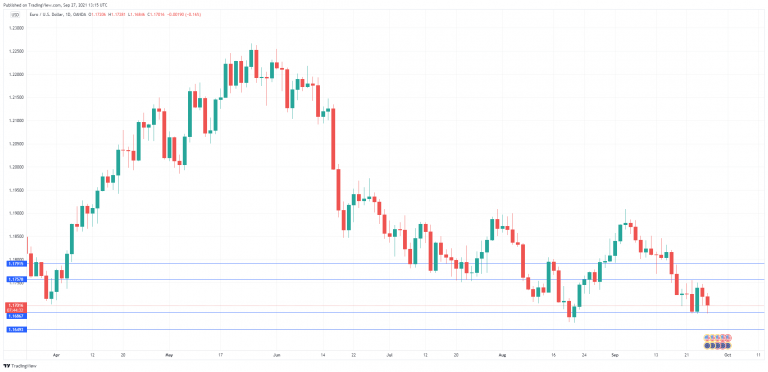
A rising US-EMU interest rate differential, a lack of visibility on German fiscal policy going forward and a dwindling sentiment on global equity markets conspired to send EUR/USD back below the 1.1685 area. Still, the 1.1664 key support stayed out of reach. Whatever the reason, the move probably was also due to euro softness. Cable even gains marginal ground (1.37 area). EUR/GBP declined further in in the 0.85 big figure (0.8535). On CE markets, the forint didn’t profit from Moody’s credit rating upgrade late on Friday (EUR/HUF 358.2).
News Headlines:
The German Bundesbank in its monthly bulletin warned that inflation rates between 4% and 5% are possible on a temporary basis between September and the end of the year. Inflation is likely to decrease noticeably at the start of 2022 but it will still be above 2% by the middle of the year. ECB President Lagarde in a hearing before EU parliament defended this temporary narrative on the basis of a dissipating impact from increases in oil prices and the reversal of a German VAT rate cut, though she pinpointed some upward risks. Material shortages could prove more persistent while higher inflation could also result in higher wage demands. So far, those risks aren’t materializing.
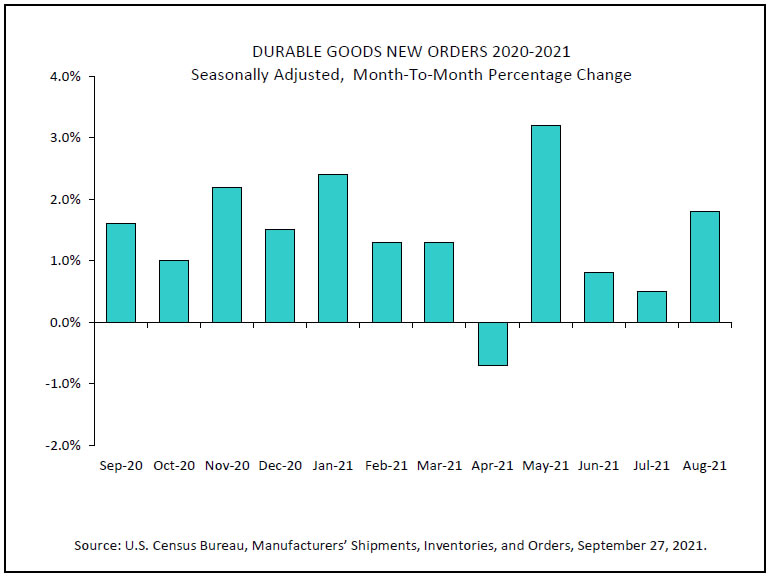
US durable goods orders rose by a more than expected 1.8% m/m in August, from an upwardly revised 0.5% m/m in July. Orders for commercial aircraft were responsible for a big part of the 4th consecutive monthly increase, rising by 77.9% m/m. Details further showed increase for communications equipment, electronical hardware and fabricated metals while order for motor vehicles, computer and machinery slipped. Core capital goods shipments, used a proxy to calculate the investment component in GDP, rose by 0.7% m/m from 0.9% m/m in July
Germans Vote, But Outcome Unclear
The euro is showing limited movement in the Friday session. Currently, EUR/USD is trading at 1.1701, down 0.16% on the day.
Germany election inconclusive
Germans have gone to the polls, but the results of the federal election remain unclear, and the political picture could remain muddy for up to several months. Angela Merkel’s Christian Democrats (CDU) and the main opposition Social Democrats (SPD) are almost tied, which means that a third party will have to be included in order to form a coalition government. The most important takeaway for the financial markets is that Merkel, who is stepping down as Chancellor after 16 years, will remain in power until a new government is formed. The markets are happy to have Merkel stay on, and EUR/USD has shown movement since the election.
Merkel may help keep the euro and financial markets steady, but at some point soon she will be replaced. If the SDP forms the next government, Germany would take a significant step to the left, which could mean higher taxes and a less friendly stance towards big business. The business sector and investors are wishing the conservative CDU well, hoping that they can take the torch from Merkel and keep Germany firmly on its current fiscal and economic path. However, if the CDU finds itself on the outside when a new government is formed, the result could be a loss of confidence in Germany as well as the euro.
Over in the US, this week’s key release is third-quarter GDP later this week, with a forecast of 6.6%. This would be a repeat of growth in Q2 and would be a reliable indication that the recovery is continuing at a brisk clip. A strong GDP release will increase expectations that the Federal Reserve will hit the taper button by December, which could give the US dollar a boost.
EUR/USD Technical
On the upside, EUR/USD faces resistance at 1.1757 and 1.1791
There is weak support at 1.1685. Close by is the next support line at 1.1649
EUR/USD Mid-Day Outlook
Daily Pivots: (S1) 1.1700; (P) 1.1723; (R1) 1.1746; More...
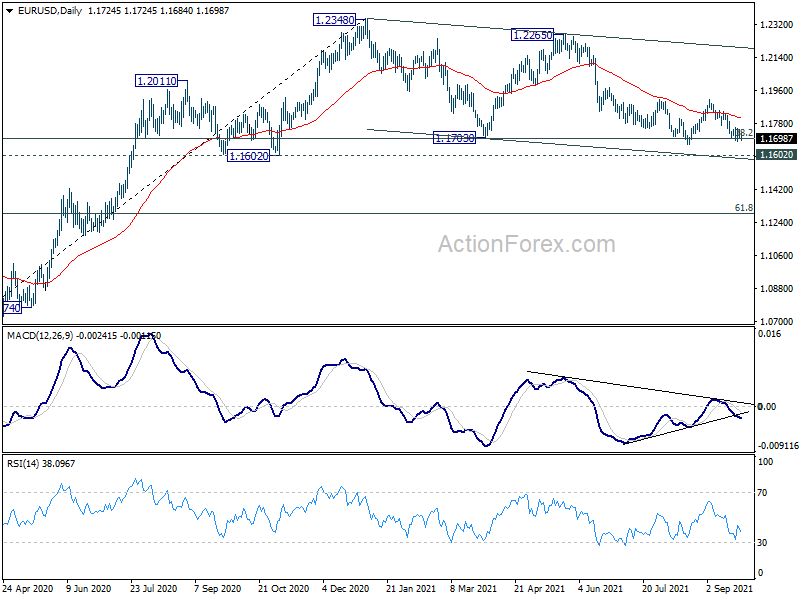
Intraday bias in EUR/USD remains neutral at this point. On the downside, sustained break of 1.1663 support will resume the fall from 1.2265, and the pattern from 1.2348, to 1.1602 key support next. On the upside, however, above 1.1754 minor resistance will turn bias back to the upside for 1.1908 again.
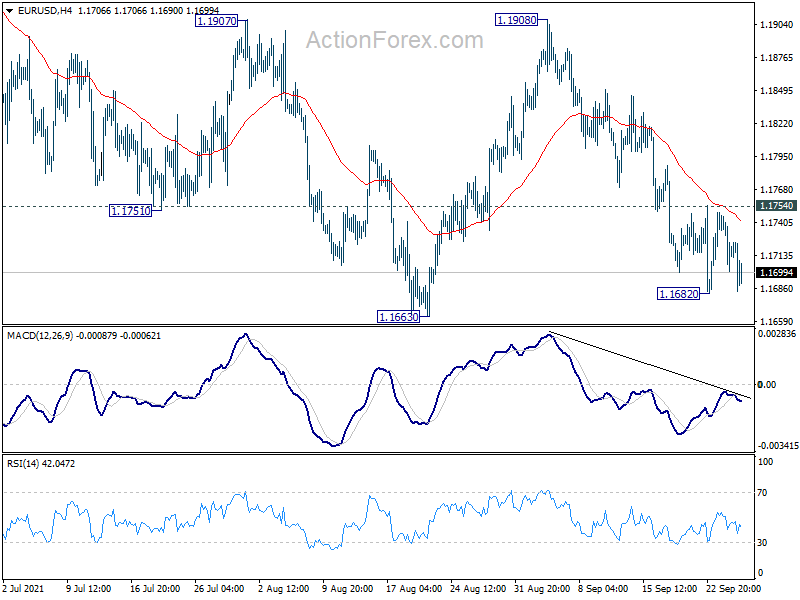
In the bigger picture, rise from 1.0635 is seen as the third leg of the pattern from 1.0339 (2017 low). Further rally remains in favors long as 1.1602 support holds, to cluster resistance at 1.2555 next, (38.2% retracement of 1.6039 to 1.0339 at 1.2516). However sustained break of 1.1602 will argue that the rise from 1.0635 is over, and turn medium term outlook bearish again. Deeper fall would be seen to 61.8% retracement of 1.0635 to 1.2348 at 1.1289 and below.
GBP/USD Mid-Day Outlook
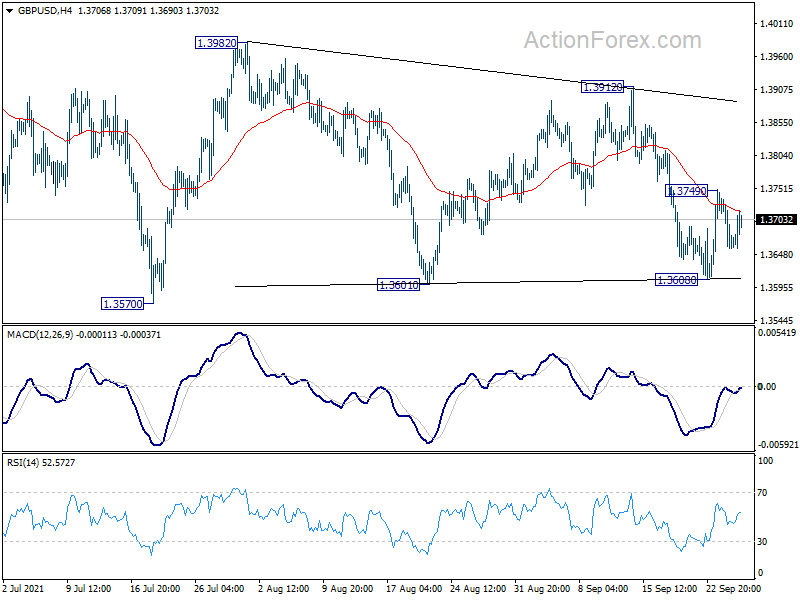
Daily Pivots: (S1) 1.3641; (P) 1.3689; (R1) 1.3719; More...
Intraday bias in GBP/USD remains neutral first, as sideway trading continues. On the upside, above 1.3749 will target a test on 1.3912 resistance. Firm break there will argue that consolidation pattern from 1.4248 has completed and stronger rally to retest this high. On the downside, however, break of 1.3570 support will target 1.3482 key support level. Sustained break there will carry larger bearish implication and target 1.3163 fibonacci level.
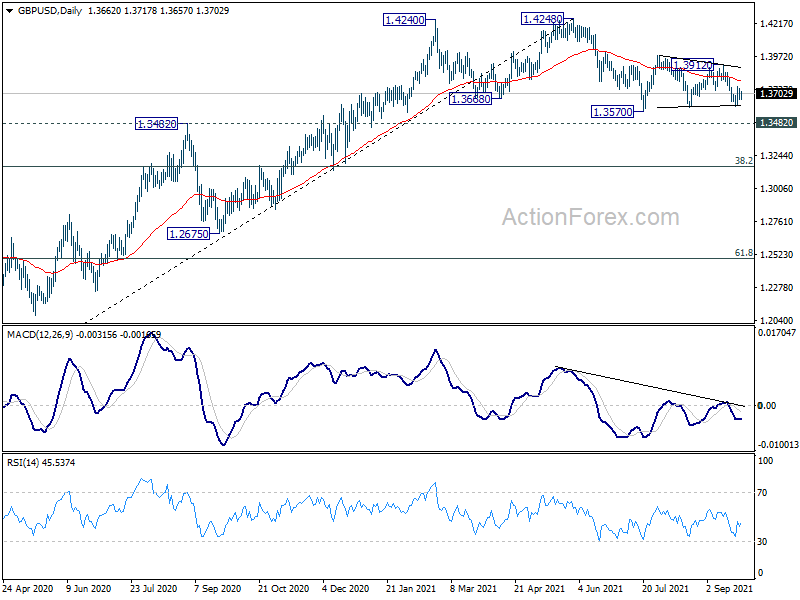
In the bigger picture, as long as 1.3482 resistance turned support holds, we'd still treat price actions from 1.4248 as a corrective move. That is, up trend from 1.1409 (2020 low) is in favor to resume. Decisive break of 1.4376 key resistance (2018 high) would indeed carry long term bullish implications. However, sustained break of 1.3482 will at least bring deeper fall to 38.2% retracement of 1.1409 to 1.4248 at 1.3164, or even further to 61.8% retracement at 1.2493.
USD/CHF Mid-Day Outlook
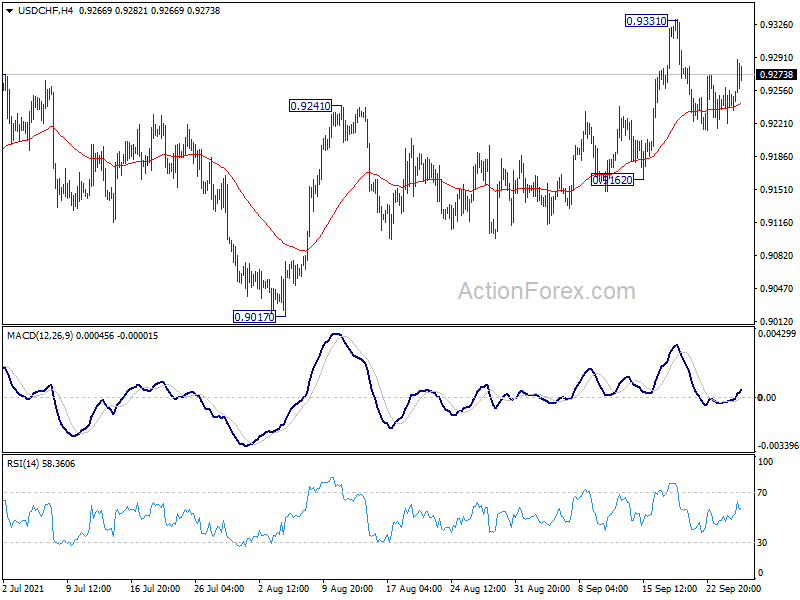
Daily Pivots: (S1) 0.9224; (P) 0.9243; (R1) 0.9262; More....
Sideway trading continues in USD/CHF and intraday bias remains neutral for the moment. Further rally is expected as long as 0.9162 support holds. On the upside, break of 0.9331 will target 0.9471 key resistance. Sustained break there will carry larger bullish implications. However, break of 0.9162 will turn bias back to the downside for 0.9017 support instead.
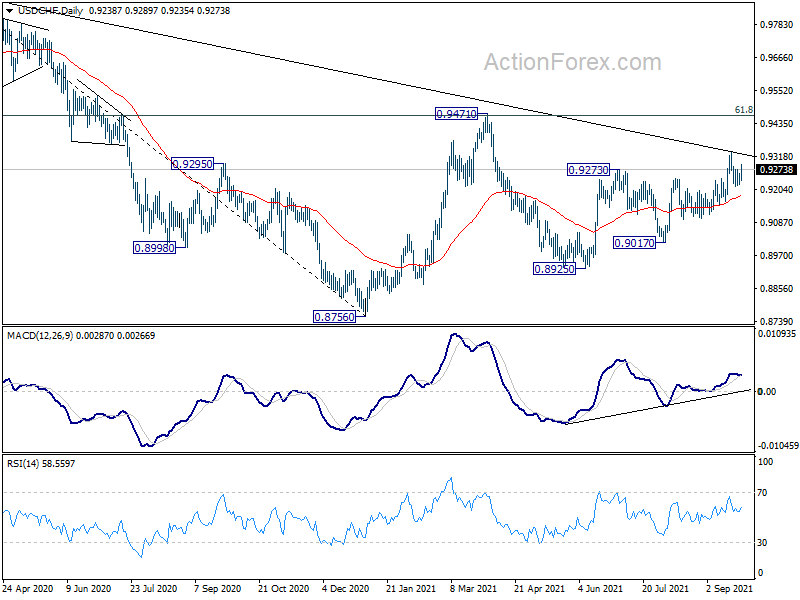
In the bigger picture, the strong rally above 55 week EMA (now at 0.9175) now tilts favor to the case of bullish trend reversal. That is, decline from 1.3042 (2016 high) is probably completed at 0.8756 already. Sustained break of 0.9471 resistance should confirm this case and pave the way to retest 1.0342 ahead. However, rejection by 0.9471 will mix up the outlook again and retain some medium term bearishness.
European Gas Price Triples amidst Supply Disruption and Rising Demand
European gas price has kept breaking new records over the past months. Both higher-than-usual demand and supply shortage have led to the price strength. As winter is approaching, we expect price to remain at elevated levels in the months to come.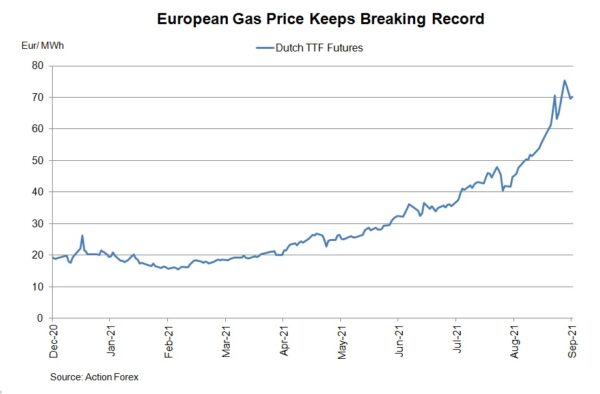
The front-month Dutch TTF gas contract has remained firm after breaking above EUR 70/MWh. In fact, gas price has more than tripled since the beginning of the year and been making new record since June. There are several reasons for the phenomenon. On the demand side, cooler-than- normal weather in April and May raised electricity consumption. This delayed the typical injection season from March/April to the middle of May. The chart below shows that natural gas storage in Europe this year is significantly below than of 2020. Since late-May, it has also fallen below the lower bound of storage from 2016 to 2020. Higher coal price and regulations to limit carbon emission have also lifted demand. Imports to China have in particular soared as a result.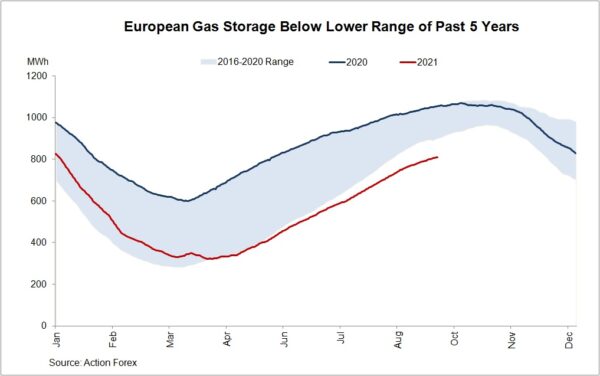
Supply to Europe has also been disrupted due to maintenance and unexpected outage, as well as business considerations of exporters. Maintenance on both the Yamal-Europe and Nord Stream pipeline disrupted gas flow from Russia in July. Meanwhile, a fire at the condensate de-ethanization unit of the first stage of the Urengoy Condensate Treatment Plant in early August also affect supply. It was reported that average Russian flows via the Mallnow entry into Germany sank -40% m/m in August. Elsewhere, maintenance of the Troll gas field in Norway also resulted in a sharp fall in gas flow. While flow should return to normal in coming months, this would coincide with the high demand seasons as winter is approaching.
Exporters have over the past few months diverted their supply to Asia from Europe, due to the price premium of the former. The ramp up of demand from China, the world’s largest natural gas consumer, has been in part driven by government policy to reduce carbon emission. Meanwhile, the rally in domestic coal price as a result of both import restrictions and the temporary closure of some coal mines earlier in the year also helps drive natural gas demand.
Things will likely intensify as winter arrives in two months. Natural gas storage usually peaks in mid-October and declines until March the next year. Price is expected to stay high in the coming months. We will not be surprised to see new records after pullback.
USD/JPY Mid-Day Outlook
Daily Pivots: (S1) 110.40; (P) 110.60; (R1) 110.93; More...
USD/JPY rises further to as high as 111.05 so far today and intraday bias stays on the upside. Current development affirms that consolidation pattern from 11.65 has completed already. Further rise should be seen to retest this high, as well as 111.71 key resistance. On the downside, however, below 110.30 minor support will mix up the near term outlook and turn bias neutral again.
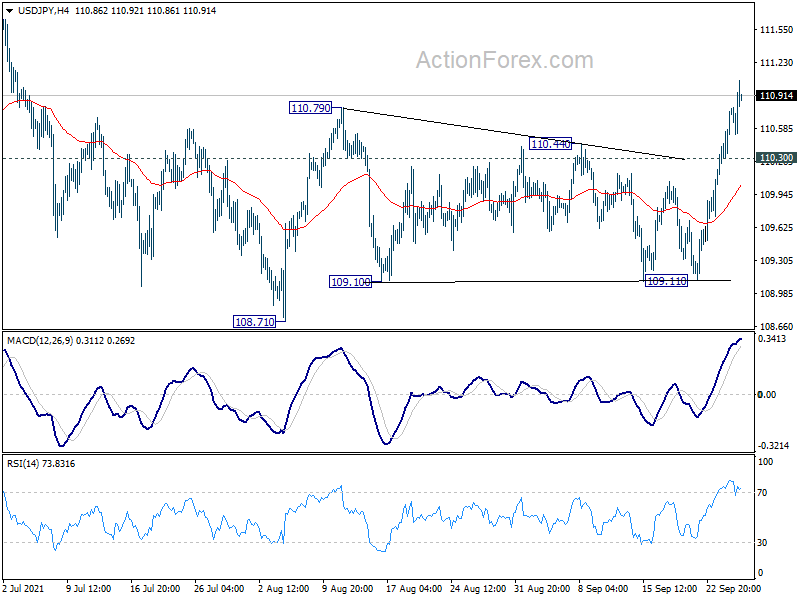
In the bigger picture, medium term outlook is staying neutral with 111.71 resistance intact. The pattern from 101.18 could still extend with another falling leg. Sustained trading below 55 day EMA will bring deeper fall to 107.47 support and below. Nevertheless, strong break of 111.71 resistance will confirm completion of the corrective decline from 118.65 (2016 high). Further rise should then be seen to 114.54 and then 118.65 resistance.
Dollar Mildly Higher after Durable Goods Orders, Sterling Advancing in Crosses
Dollar trades mildly higher in early US session, lifted by stronger than expected durable goods orders data. But it's being overwhelmed by both Sterling and Aussie. Commodity currencies are firmer on "stable" market sentiment, but there is no follow through buy yet, including Canadian Dollar. On the other hand, Euro and Swiss Franc are the weaker ones so far, together with Yen. Euro is having little reaction to news that German Social Democrat came in first in Sunday's election, and is preparing a three-way coalition government with Greens and the liberal Free Democrats, without Angela Merkel's CDU/CSU conservative bloc.
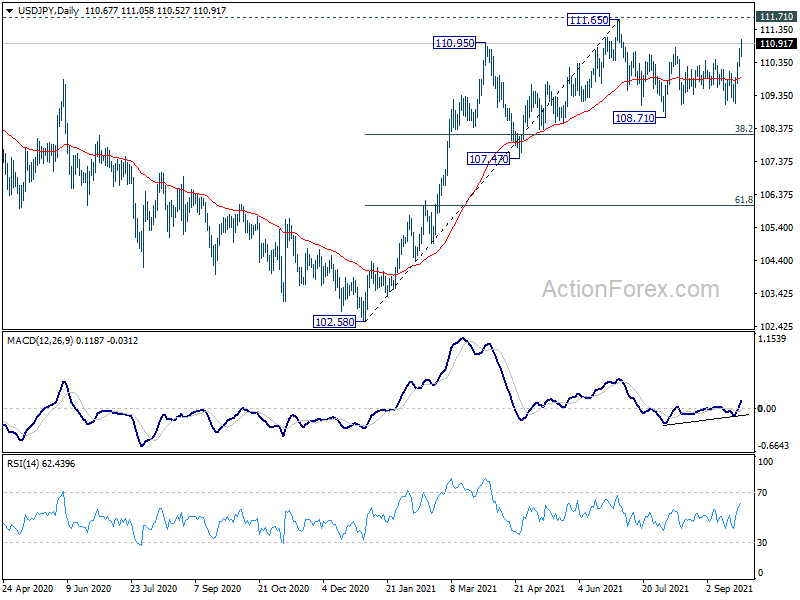
Technically, USD/JPY's break of 110.79 resistance affirms the near term bullish view that consolidation from 111.65 has completed. Stronger rise should be seen next to retest this 111.65 high. We'd also keep an eye on whether EUR/USD would fall through 1.1682 temporary low, as well as 1.1663 support to signal general underlying buying in Dollar.
In Europe, at the time of writing, FTSE is up 0.01%. DAX is up 0.27%. CAC is up 0.23%. Germany 10-year yield is up 0.0197 at -0.205. Earlier in Asia, Nikkei dropped -0.02%. Hong Kong HSI rose 0.07%. China Shanghai SSE dropped -0.84%. Singapore Strait Times rose 1.27%. Japan 10-year JGB yield rose 0.0010 to 0.056.
US durable goods orders rose 1.8% in August, ex-transport orders rose 0.2%
US durable goods orders rose 1.8% mom to USD 263.5B in August, well above expectation of 0.6% mom. Ex-transport orders rose 0.2% mom, below expectation of 0.5% mom. Ex-defense orders rose 2.4% mom. Transportation equipment rose 5.5% mom to USD 80.8B.
Fed Evans more uneasy about not generating enough inflation in 2023 and 2024
In a speech, Chicago Fed President Charles Evans said, for the balance sheet, the economy as being close to meeting the "substantial further progress" standard for beginning to taper asset purchases. "If the flow of employment improvements continues, it seems likely that those conditions will be met soon and tapering can commence," he added.
On inflation, Evans said, "long-run inflation expectations are still likely somewhat below target", as " inflation break-even rates in financial markets over the five- to ten-year horizon are still below the levels we saw in 2012 and 2013—a period when they were arguably better aligned with 2 percent PCE inflation." And, "a ten-year nominal Treasury rate in the range we've seen recently simply can't have a whole lot of expectations of long-run inflation built into it."
"Taken altogether, I am more uneasy about us not generating enough inflation in 2023 and 2024 than the possibility that we will be living with too much," he said. "My concern is that when the Covid distress ultimately recedes broadly around the world, we will not have been freed from the downward bias on inflation imparted by the ELB."
ECB Lagarde expects continued strong growth in H2
In the hearing of the Committee on Economic and Monetary Affairs of the European Parliament, ECB President Christine Lagarde said, " it is evident that the economic recovery in the euro area is increasingly advanced". Policymakers expected "continued strong growth" in H2, "enabling euro area output to exceed its pre-pandemic level by the end of the year". GDP growth is forecast to reach 5.0% in 2021, then 4.6% in 2022, and 2.21% in 2023. Risks to growth are "broadly balanced".
Eurozone inflation, at 3% in August, is expected to "rise further this autumn". But Lagarde reiterated, "we continue to view this upswing as largely temporary". ECB's projections foresee annual inflation at 2.2% in 2021, 1.7% in 2022, and 1.5% in 2023. There are factors that could lead to stronger price pressures than expected, inflation shortages of materials and equipment, and higher than anticipated wage demands. She said, "but we are seeing limited signs of this risk so far, which means that our baseline scenario continues to foresee inflation remaining below our target over the medium term.
Bundesbank: Inflation at 4-5% temporarily possible until year-end
In the monthly report, Bundesbank said German economy continued recovery at a "faster pace" in summer. economic output is "likely to grow more stronger in the third quarter than in Spring". But, due to supply-side difficulties, output had not reached pre-pandemic level yet.
Production level "continued to lag behind strong demand" because of supply bottlenecks. In July, demand for industrial productions already exceeded pre-pandemic level by a whopping 18%. But production remained -3.5% below the pre-pandemic levels. Labor market "recovered extraordinarily strongly since June" and unemployment is likely to continue to fall sharply in the next three months.
On inflation, Bundesbank said, "rates between 4 percent and 5 percent are temporarily possible from September until the end of the year". One reason for this is the base effect of the temporary VAT reduction in the previous year. The economists assume that inflation will decrease noticeably at the beginning of 2022, but will still be over 2 percent by the middle of the year.
Released from Eurozone, M3 money supply rose 7.9% yoy in August, above expectation of 7.7% yoy.
BoJ Kuroda: Must continue to focus on responding to the pandemic
BoJ Governor Haruhiko Kuroda admitted, "it's true Japan's economy has been held back by the successive waves of COVID-19." "While corporate funding conditions have improved from a while ago, those of firms offering face-to-face services remain severe," he added.
"Given high uncertainty over the outlook due to the spread of the Delta variant, the BOJ must continue to focus on responding to the pandemic for the time being," he said.
Meanwhile, Kuroda is not concerned about the supply shortages that manufacturers are facing. "This will only be transitory, and from a somewhat long-term perspective, exports and production are expected to continue on an increasing trend, partly supported by the restocking of inventories and a recovery in production from the decline brought about by the supply-side constraints," he said.
From Japan, corporate service price index rose 1.0% yoy in August, versus expectation of 1.2% yoy.
USD/JPY Mid-Day Outlook
Daily Pivots: (S1) 110.40; (P) 110.60; (R1) 110.93; More...
USD/JPY rises further to as high as 111.05 so far today and intraday bias stays on the upside. Current development affirms that consolidation pattern from 11.65 has completed already. Further rise should be seen to retest this high, as well as 111.71 key resistance. On the downside, however, below 110.30 minor support will mix up the near term outlook and turn bias neutral again.
In the bigger picture, medium term outlook is staying neutral with 111.71 resistance intact. The pattern from 101.18 could still extend with another falling leg. Sustained trading below 55 day EMA will bring deeper fall to 107.47 support and below. Nevertheless, strong break of 111.71 resistance will confirm completion of the corrective decline from 118.65 (2016 high). Further rise should then be seen to 114.54 and then 118.65 resistance.
Economic Indicators Update
| GMT | Ccy | Events | Actual | Forecast | Previous | Revised |
|---|---|---|---|---|---|---|
| 23:50 | JPY | Corporate Service Price Index Y/Y Aug | 1.00% | 1.20% | 1.10% | |
| 08:00 | EUR | Eurozone M3 Money Supply Y/Y Aug | 7.90% | 7.70% | 7.60% | |
| 12:30 | USD | Durable Goods Orders Aug | 1.80% | 0.60% | -0.10% | |
| 12:30 | USD | Durable Goods Orders ex Transportation Aug | 0.20% | 0.50% | 0.80% |
US durable goods orders rose 1.8% in August, ex-transport orders rose 0.2%
US durable goods orders rose 1.8% mom to USD 263.5B in August, well above expectation of 0.6% mom. Ex-transport orders rose 0.2% mom, below expectation of 0.5% mom. Ex-defense orders rose 2.4% mom. Transportation equipment rose 5.5% mom to USD 80.8B.