Sample Category Title
Fed Evans more uneasy about not generating enough inflation in 2023 and 2024
In a speech, Chicago Fed President Charles Evans said, for the balance sheet, the economy as being close to meeting the "substantial further progress" standard for beginning to taper asset purchases. "If the flow of employment improvements continues, it seems likely that those conditions will be met soon and tapering can commence," he added.
On inflation, Evans said, "long-run inflation expectations are still likely somewhat below target", as " inflation break-even rates in financial markets over the five- to ten-year horizon are still below the levels we saw in 2012 and 2013—a period when they were arguably better aligned with 2 percent PCE inflation." And, "a ten-year nominal Treasury rate in the range we've seen recently simply can't have a whole lot of expectations of long-run inflation built into it."
"Taken altogether, I am more uneasy about us not generating enough inflation in 2023 and 2024 than the possibility that we will be living with too much," he said. "My concern is that when the Covid distress ultimately recedes broadly around the world, we will not have been freed from the downward bias on inflation imparted by the ELB."
ECB Lagarde expects continued strong growth in H2
In the hearing of the Committee on Economic and Monetary Affairs of the European Parliament, ECB President Christine Lagarde said, " it is evident that the economic recovery in the euro area is increasingly advanced". Policymakers expected "continued strong growth" in H2, "enabling euro area output to exceed its pre-pandemic level by the end of the year". GDP growth is forecast to reach 5.0% in 2021, then 4.6% in 2022, and 2.21% in 2023. Risks to growth are "broadly balanced".
Eurozone inflation, at 3% in August, is expected to "rise further this autumn". But Lagarde reiterated, "we continue to view this upswing as largely temporary". ECB's projections foresee annual inflation at 2.2% in 2021, 1.7% in 2022, and 1.5% in 2023. There are factors that could lead to stronger price pressures than expected, inflation shortages of materials and equipment, and higher than anticipated wage demands. She said, "but we are seeing limited signs of this risk so far, which means that our baseline scenario continues to foresee inflation remaining below our target over the medium term.
EUR/USD Remains Neutral
On Monday afternoon, the major currency pair is steadily trading at 1.1720 without any sharp fluctuations: the “greenback” remains strong, while the Euro can’t rise despite a huge risk appetite on the market.
The latest data on the American real estate market was in favour of the USD. For example, the New Home Sales added 1.5% in August (seasonally-adjusted) and showed 740K against the expected reading of 714K.
American monetary policymakers delivered several speeches and investors were listening to them very carefully. For example, there was an opinion that the labour market still didn’t look quite stable and might not pass the test of the QE program reduction planned by the US Federal Reserve System.
At the same time, some other committee members believe that the regulator should start reducing the program as early as November and raise the rates late in 2022 if the employment sector allows.
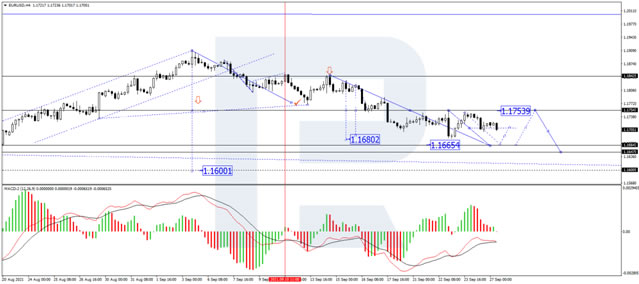
In the H4 chart, EUR/USD continues forming the third descending wave with the target at 1.1655 and may later correct towards 1.1750; right now, it is forming the fifth structure of the above-mentioned wave. Possibly, today the pair may reach 1.1670 and then grow to test 1.1710 from below. After that, the instrument may resume trading downwards to reach the target at 1.1655. From the technical point of view, this scenario is confirmed by MACD Oscillator: its signal line is steadily moving below 0 and may continue falling towards new lows.
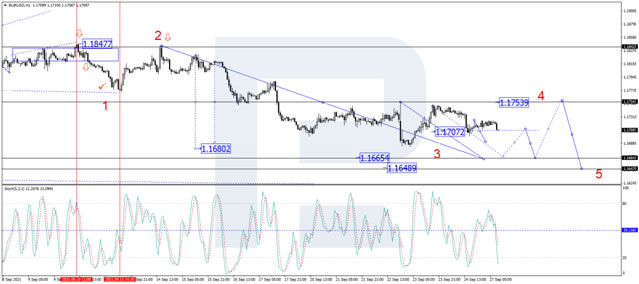
As we can see in the H1 chart, EUR/USD continues forming the fifth structure of the descending wave. Today, the pair may consolidate around 1.1707. Later, the market may fall towards 1.1695 and then grow to test 1.1707 from below. Later, the market may start another decline to reach the short-term target of this structure at 1.1666. From the technical point of view, this scenario is confirmed by the Stochastic Oscillator: its signal line is steadily falling towards 50, a breakout of which may lead to further decline to reach 20.
AUD Steady, But Evergrande Lurks
The Australian dollar is in calm waters in the Monday session. Currently, AUD/USD is trading at 0.7264, up 0.14% on the day.
Evergrande fears ease, for now
The Evergrande crisis has shaken investor risk sentiment, which has had a strong impact on risk currencies like the Australian dollar. It is unclear what Chinese authorities have in mind for the property giant. The options range from default to bailout or restructuring the company into smaller parts. What is clear is that Evergrande is in massive trouble and missed a coupon payment last week, with another payment due this week. The markets were willing to overlook the missed payment, but news on Friday that Evergrande’s electric vehicle subsidiary was facing severe liquidity problems spooked investors and sent the Aussie lower. If there is more bad news from Evergrande, the weak Australian dollar could lose more ground. The currency hasn’t managed a winning month since May, as ongoing lockdowns have hurt economic growth.
Concerns that the economy will record negative growth in the third quarter could increase after Retail Sales for August is released on Tuesday. The forecasts range from -1.5% to -4.0%, with the Australian Bureau of Statistics projecting a decline of 2.0%. Retail Sales accounts for some 60% of domestic growth, and the release could signal a dismal September GDP reading. Negative readings from retail sales or GDP will likely sour sentiment towards the Australian dollar.
The US also releases third-quarter GDP later this week, but the forecast is much more positive, with a forecast of 6.6%. This would be a repeat of growth in Q2 and would signal that the recovery is continuing at a brisk clip. A strong GDP release will increase expectations that the Federal Reserve will hit the taper button by December, which could give the US dollar a boost.
AUD/USD Technical

- There is resistance at 0.7311, followed by 0.7362
- On the downside, there is support at weak support at 0.7215. Below, there is support at 0.7170
Gold Price Started An Upside Correction Below $1.737
Gold price formed a base above the $1,740 level after a major decline against the US Dollar. The price traded as low as $1,737 and recently started an upside correction.
There was a break above the $1,750 level and the 50 hourly simple moving average. Besides, there was a clear break above a key bearish trend line at $1,752 on the hourly chart.
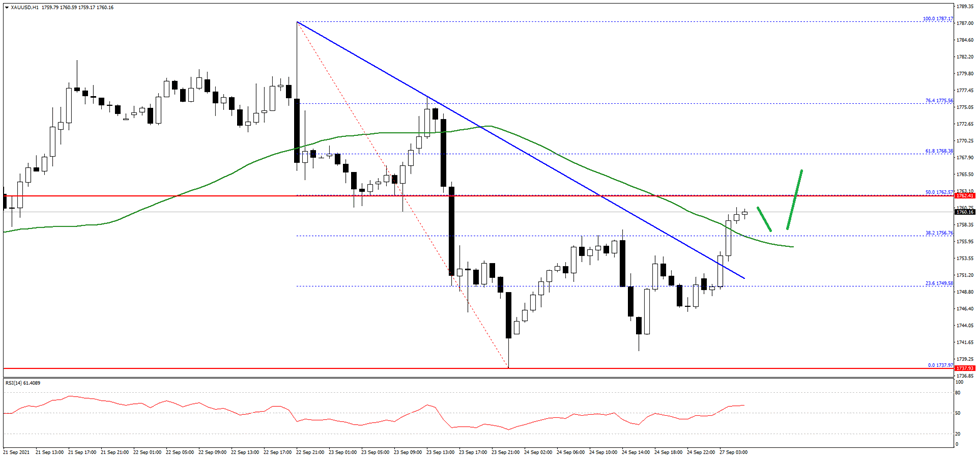
On the upside, an immediate resistance is near the $1,762 level. A clear break above the $1,762 resistance could push the price further higher. The next main resistance could be $1,780, followed by $1,788 on FXOpen.
On the downside, an immediate support is near the $1,755 and the 50 hourly simple moving average. The next key support is near the $1,750 level, below which the price could revisit $1,740. Any more losses could lead the price to $1,725.
Bundesbank: Inflation at 4-5% temporarily possible until year-end
In the monthly report, Bundesbank said German economy continued recovery at a "faster pace" in summer. economic output is "likely to grow more stronger in the third quarter than in Spring". But, due to supply-side difficulties, output had not reached pre-pandemic level yet.
Production level "continued to lag behind strong demand" because of supply bottlenecks. In July, demand for industrial productions already exceeded pre-pandemic level by a whopping 18%. But production remained -3.5% below the pre-pandemic levels. Labor market "recovered extraordinarily strongly since June" and unemployment is likely to continue to fall sharply in the next three months.
On inflation, Bundesbank said, "rates between 4 percent and 5 percent are temporarily possible from September until the end of the year". One reason for this is the base effect of the temporary VAT reduction in the previous year. The economists assume that inflation will decrease noticeably at the beginning of 2022, but will still be over 2 percent by the middle of the year.
NZD Steadies After Friday Plunge
The New Zealand dollar is trading quietly at the start of the week. NZD/USD is currently trading at 0.7005, up 0.01% on the day.
New Zealand slides on contagion fears
The New Zealand dollar continues to be racked by strong volatility, as investors anxiously monitor the Evergrande crisis. The Chinese property giant failed to make a USD 85.0 million coupon payment last week, and another USD 47.5 million payment is due this week. The markets shrugged off the missed payment, and NZD/USD jumped 0.96% on Thursday. However, almost all of these gains were lost on Friday, after reports that Evergrande’s Electric Vehicle subsidiary had severe liquidity problems. The kiwi has settled down for now, but the roller-coaster ride could continue, based on new developments in the Evergrande saga. Chinese authorities are unlikely to bail out the company, but if they take measures to prevent contagion, stability in the markets will be preserved.
It’s a light calendar week for New Zealand data, which means that Chinese and US events could have a magnified impact on the movement of the New Zealand dollar this week. This includes US GDP and the Core PCE Price Index, which is the preferred inflation indicator for the Federal Reserve.
The Federal Reserve is never far away from the spotlight, especially with the Fed broadly hinting that it will begin tapering shortly, likely at the December meeting. Fed Chair Jerome Powell has two speaking engagements this week, and the markets will be listening closely, looking for any insights about a timeline for a taper. Powell will testify before Congress about Covid and the CARES Act on Tuesday and will speak at an ECB forum on Wednesday. Given that this week is a somewhat light data calendar, these events could be market-movers for the US dollar.
NZD/USD Technical
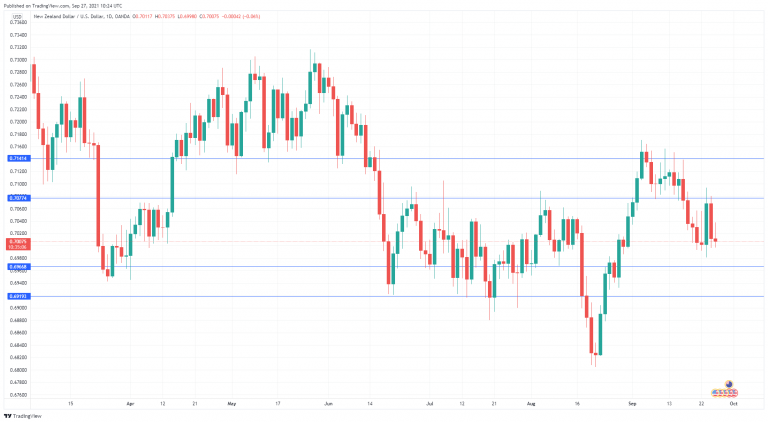
- The next resistance line is at 0.7077. This is followed by resistance at 0.7141
- There are support lines at 0.6966 and 0.6919
Surging Yields Puts Tech Stocks Under Spotlight
- Yields continue upsurge on inflation worries
- Rising yields increases risk of correction for growth and tech stocks
- Evergrande uncertainty continues to linger
- Plethora of central bank speeches
That start of the new week has been a positive one for risk assets with Chinese equities rallying overnight and European indices jumping the gate at the open. However, by mid-morning, some of the European indices has come sharply off their earlier highs, while US futures had turned mixed. Nasdaq futures fell as rising bond yields weighed on appetite for growth stocks, with which the tech-heavy index is blessed with. Meanwhile, investors were also wary of surging oil and energy prices, while Evergrande uncertainty continued to linger. So, after a volatile last week, it looked like investors were bracing themselves for even more fireworks as we look forward to the start of the US session and the rest of the new week.
Yields continue upsurge on inflation worries
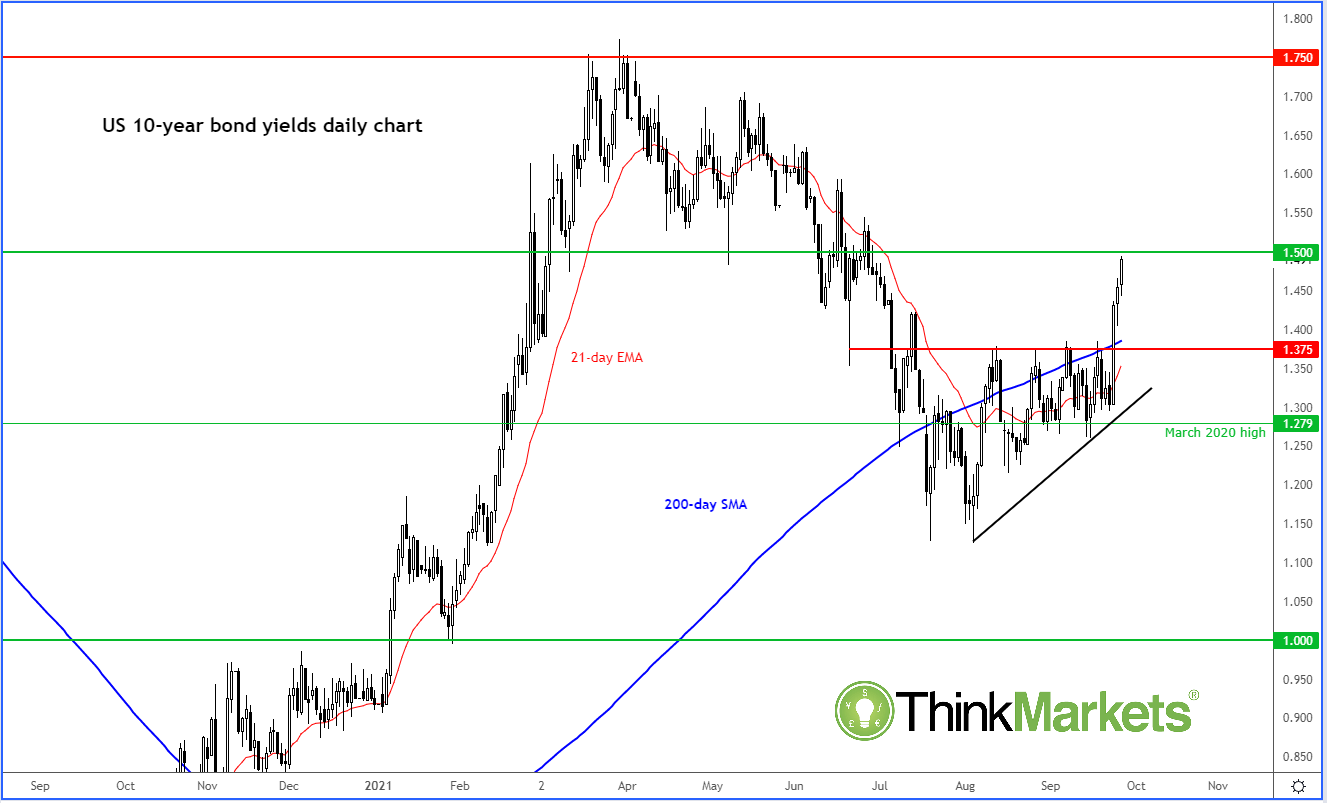
Right now, it is all about government bond yields driving the FX markets. Yields are rising sharply, reflecting investors’ expectations about monetary tightening amid surging inflationary pressures. Today saw Brent oil prices broke to a new yearly high, almost having reached $80 per barrel. Other energy prices have also skyrocketed recently with electricity and gas both increasing so much that some factories such as those making fertilisers having to halt production. The long and short of it is that inflation is rising, and markets are responding as they expect central banks to tighten their belts. This is why I think stock markets are very risky at these levels and a correction might be on the way.
The US 10-year has broken out again:
 UK yields are also rising, with similar moves seen elsewhere too: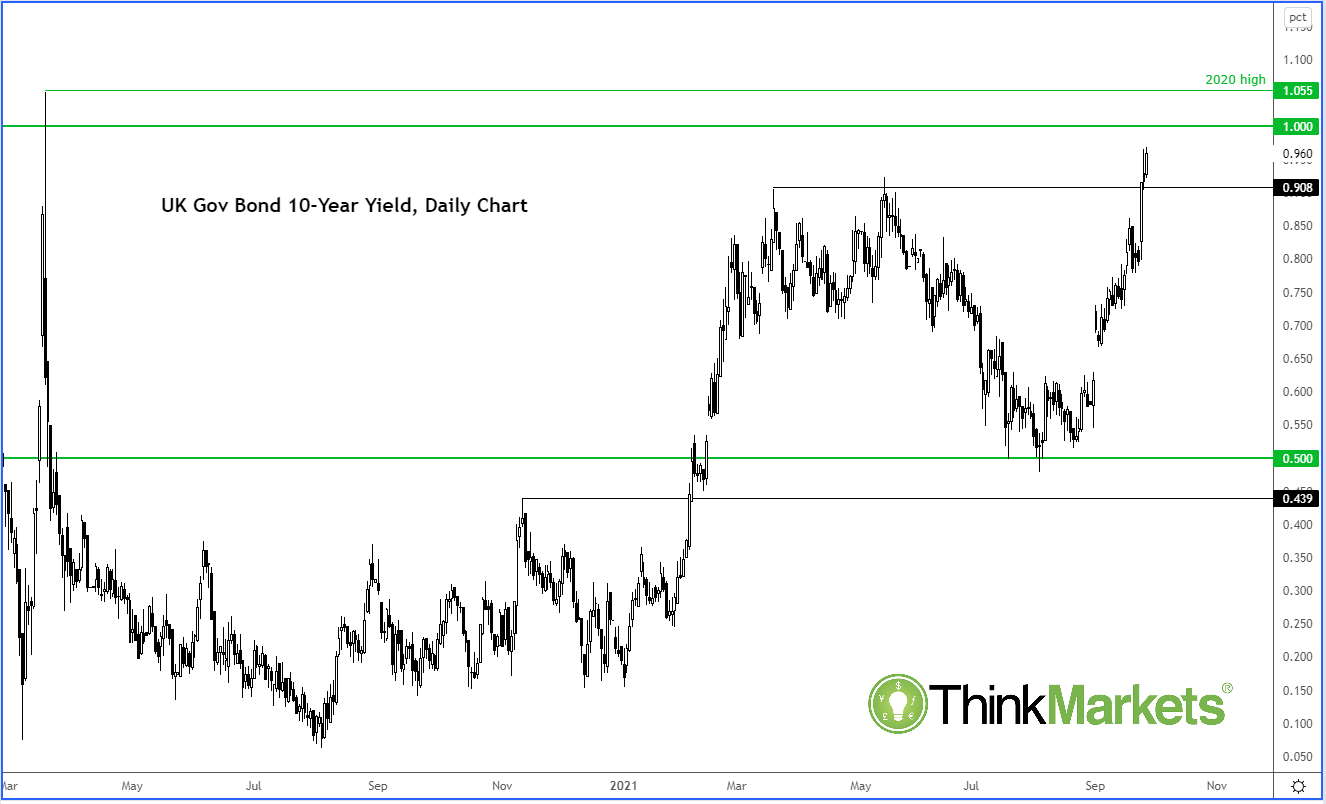
Rising yields increases risk of correction for growth and tech stocks
If yields climb higher, this could weigh especially on the overstretched growth stocks in the technology sector, which have low dividend yields. Investors might prefer the relative safety of government debt and fixed coupon payments than buying severely overvalued stocks, just as the Fed starts to reduce the pace of its asset purchases. Indeed, the Nasdaq 100 has started to turn lower again, finding resistance from the backside of the broken trend line and former support area around the 15300 to 15400 area: 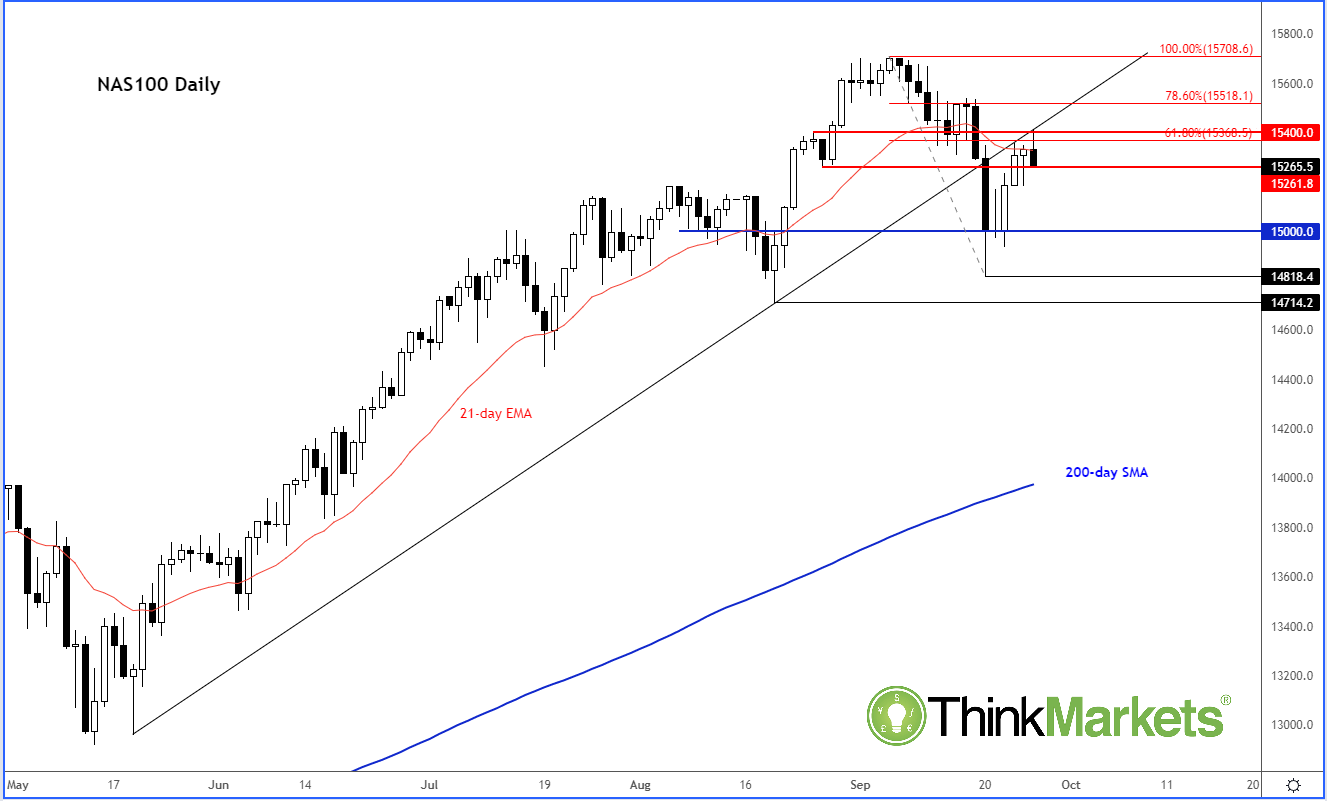
Evergrande uncertainty continues to linger
The first half of the previous week was dominated by the fallout from Evergrande, the debt-laden Chinese property developer, as investors fretted over contagion risks. But the company agreed to settle interest payments on a domestic bond in mid-week, while the People’s Bank of China injected cash into the banking system. This helped to soothe fears over imminent contagion from the troubled Chinese developer – and the global stock markets recovered as a result towards the end of last and start of this week. However, the company’s foreign bondholders did not receive $83.5 million interest payment that was due on Thursday. There is a 30-day grace period before a hard default is triggered, so there might still be time to avoid that. It looks like China’s government has taken over the company to ensure funds are used to complete housing projects first, before paying creditors. But the situation remains uncertain and needs to be monitored closely as it could move the markets again in the weeks ahead. For now, we are in the 30-day grace period, but it is difficult to see any lights at the end of the tunnel for Evergrande.
Plethora of central bank speeches
There were plenty of central bank meetings last week, and the overall message was that the global economy is continuing to recover and that we are getting closer to the start of policy normalization. That’s at least what the Federal Reserve implied, with the Bank of England also turning more hawkish amid the inflation upsurge. Other central banks such as the BoJ and SNB continued to re-iterate that their policies won’t be changing anytime soon. As a result, we have seen the yield differential between hawkish central banks widen compared to the dovish ones.
In the week ahead, there will be plenty of central bank speeches to look forward to – starting with ECB President Christine Lagarde (see the calendar below). Will yields rise further? Are they going to cause further volatility? I think that growth stocks in particular look vulnerable (see above).
FX traders might play long hawkish central banks’ currencies against dovish central banks’ currencies. The USD/JPY is a prime suspect, which broke out sharply last week from its prior consolidation range.
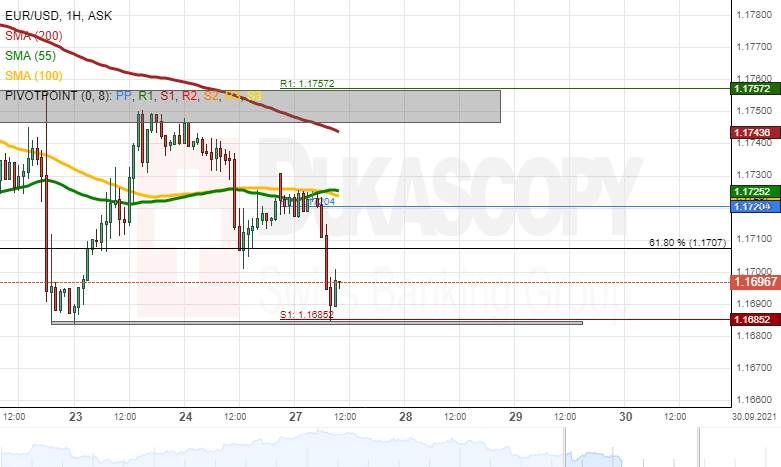
EUR/USD Analysis: Tests Recent Low Level
On Monday morning, the EUR/USD found support in the low level of September 22 at 1.1685. In addition, the weekly S1 simple pivot point of this week was located at this level. Near term future forecast scenarios were based upon whether or not the support holds.
In the case that the rate passes the support of the 1.1685 level, a decline would follow. A target for a potential decline would be the weekly S2 simple pivot point at 1.1648 and the 1.1650 mark.
Meanwhile, a holding out of the support level would most likely result in a recovery. A recovery of the EUR/USD could encounter resistance in the 1.1700 mark and the 61.80% Fibonacci retracement level at 1.1707 before aiming at the weekly simple pivot point at 1.1720 and the 55-hour SMA at 1.1725.
GBP/USD Analysis: Finds Support In 1.3660
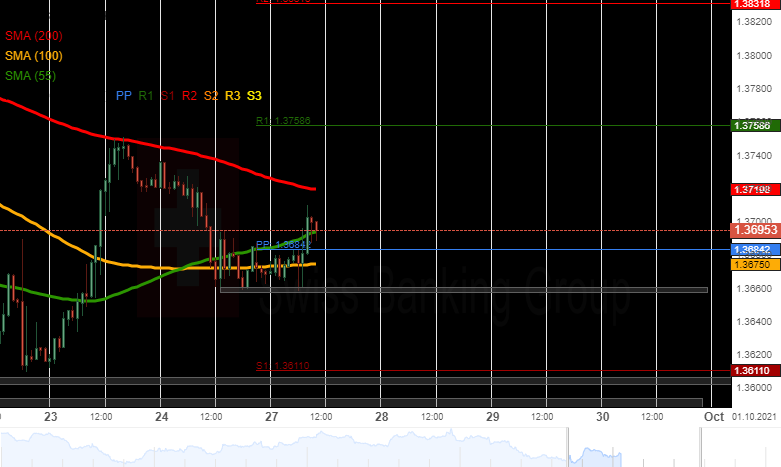
At mid-day on Friday, the GBP/USD started to find support in the 1.3660 level. On Monday, the rate bounced off the support level and began a surge. The surge passed the resistance of the 55, 100 and weekly simple pivot points from 1.3675 to 1.3690. Next target for the surge was the 200-hour simple moving average near 1.3720.
In the case that the resistance of the 200-hour SMA fails to push the rate down, the pair would aim at the resistance of the 1.3750 mark and the weekly simple pivot point at 1.3759.
On the other hand, if the 200-hour SMA pushes the rate down, it would look for support in the 1.3660 level, which provided support previously.