Sample Category Title
Dollar Drifting As Week Kicks Off
Currencies are sleepless in Singapore
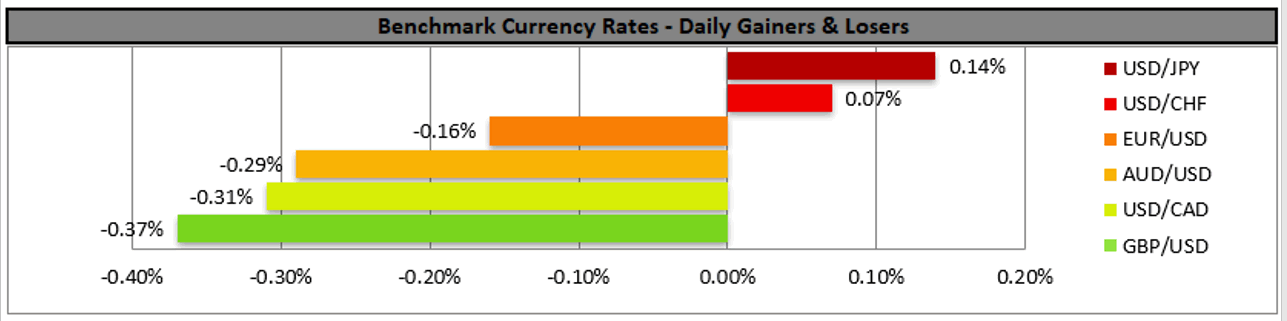
Currency markets limped to the close in New York on Friday, with a rise in US yields reversing the US dollar’s early losses and leading most majors to an almost unchanged close. The dollar index rose 0.21% to 92.28, easing modestly to 92.24 in directionless Asian trading with the index locked in a 92.00 to 92.50 range.
EUR/USD is unchanged at 1.1722 today and its key levels at 1.1680 and 1.1660 below, and 1.1750 above. GBP/USD is also unchanged from Friday at 1.3675, its Friday rally running out of steam ahead of resistance at 1.3750. With news that the government is looking at conscripting the army into the fuel delivery business, the UK energy woes will likely cap gains in Sterling. A failure of critical support at 1.3610 potentially signals another 300 points lower. USD/JPY climbed 0.35% to 110.70 on Friday before fading to 110.55 in Asia today. USD/JPY remains a yield differential play, ignoring politics in Japan. If US yields firm again this week, USD/JPY could test resistance at 110.80 which would signal more gains to 111.70 initially.
Rising commodity prices, diminishing Evergrande fears, and state reopening plans have lifted AUD/USD 0.35% higher to 0.7285 today, after both it and NZD/USD fell 0.80% on Friday as risk-proxy indicators. Because of that, both Antipodeans remain acutely vulnerable to more selling pressure if news out of China takes another turn for the worse. As such, both likely remain sell-on rallies for the first few days this week and definitely so if China’s Thursday PMI data is very weak.
Another neutral USD/CNY fixing and liquidity injection by the PBOC has left Asian currencies free to follow improving risk sentiment. That has seen regional currencies rally across the board versus the US Dollar today. USD/KRW has fallen 0.35% to 1175.80, USD/CNY by 0.10% to 6.4590 while the Indonesian Rupiah, Malaysian Ringgit, Thai Baht and Singapore Dollar have all recorded small gains. Like the Australian and New Zealand Dollars, Asian FX will move to the nuances of swinging fear aversion levels this week. Negative developments on Evergrande could quickly see today’s gains disappear.
JPY Drops As Evergrande Uncertainty Tends To Ease
The Japanese currency experiences some safe haven outflows on Friday as market worries about the possible ripple effects of Evergrande, a giant Chinese developer, defaulting tended to ease. It should be noted that the USD tended to get considerable support against a number of its counterparts on Friday as US yields tended to be on the rise before correcting lower today, possibly reflecting also the more hawkish stance of the Fed on Wednesday. The common currency remained relatively stable, while EUR traders keep an eye out for the results of Germany’s elections as a long negotiation period seems about to follow the results to form a governing alliance. The Loonie gained against the USD during today’s Asian session, possibly also reflecting the positive market mood yet probably also supported by higher oil prices which continued to rise for a fifth consecutive day feeding on supply worries. US stockmarkets remained in the greens as market participants tended to shake off any worries for a possible Evergrande default, yet the Chinese developer seems to have missed yet another interest payment which could increase uncertainty in today’s session. Gold prices rose on Friday despite rising yields and a strengthening USD, possibly reflecting some market uncertainty. USD/JPY corrected lower during today’s Asian session after a five-day rally and before reaching the 110.90 (R1) resistance line. Given that in its correction lower the pair broke the upward trendline guiding it, we tend to switch our bullish outlook in favor of a sideways bias temporarily. The RSI indicator below our 4-hour chart seems to remain near the reading of 70, which on the one hand tends to confirm the bull’s dominance yet reminds us that the pair is near overbought levels. Should the bulls actually take charge once again of the pair’s direction, we may see it breaking 110.90 (R1) resistance line and aim for the 111.65 (R2) level. If the bears take over, we may see the pair breaking the 110.20 (S1) support line, aiming for the 109.25 (S2) level.
EUR/USD seems to have stabilised somewhat over the 1.1695 (R1) resistance line. In its stabilisation the pair seems to have broken the downward trendline guiding it since the 3rd of September, hence we tend to maintain a bias for a sideways motion currently. Please note that the RSI indicator below our 4-hour chart is near the reading of 50, implying a rather indecisive market. Should a selling interest be displayed by the market, we may see the pair breaking 1.1695 (S1) support line and aim for the 1.1615 (S2) level. If buyers take over the direction of the price action, we may see EUR/USD aiming if not breaching the 1.1785 (R1) line.
Other economic highlights today and the following Asian session:
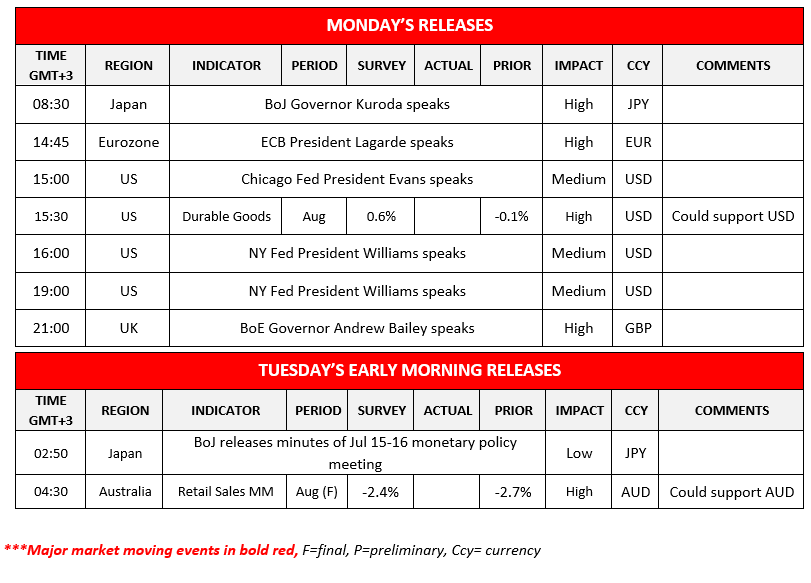
Today we note the release of the US durable goods orders growth rate for August, while on the monetary front, BoJ Governor Kuroda, ECB President Lagarde and BoE Governor Bailey are scheduled to speak.
As for the rest of the week
On Tuesday, we note the release of Germany’s GfK Consumer Sentiment for October and the US consumer confidence while ECB’s two-day forum on central banking begins. On Wednesday, we get Eurozone’s business climate for September and the area’s final consumer confidence for the same month. On a packed Thursday we get Japan’s preliminary industrial output for August, China’s NBS and Caixin manufacturing PMI figures for September, Australia’s building approvals growth rate for August, UK’s nationwide house prices for September, France’s and Germany’s preliminary HICP rates for September, Switzerland’s KOF indicator for September, UK’s GDP rate for Q2, the US final GDP rate for Q2, the US weekly initial jobless claims figure and from the Czech Republic, CNB’s interest rate decision. On Friday we get Japan’s Tankan indicators for Q3, Eurozone’s preliminary HICP rate for September, the US consumption rate for August, Canada’s GDP rate for July and the Markit manufacturing PMI for September as well as the final US Un. Michigan consumer sentiment for September.
USD/JPY H4 Chart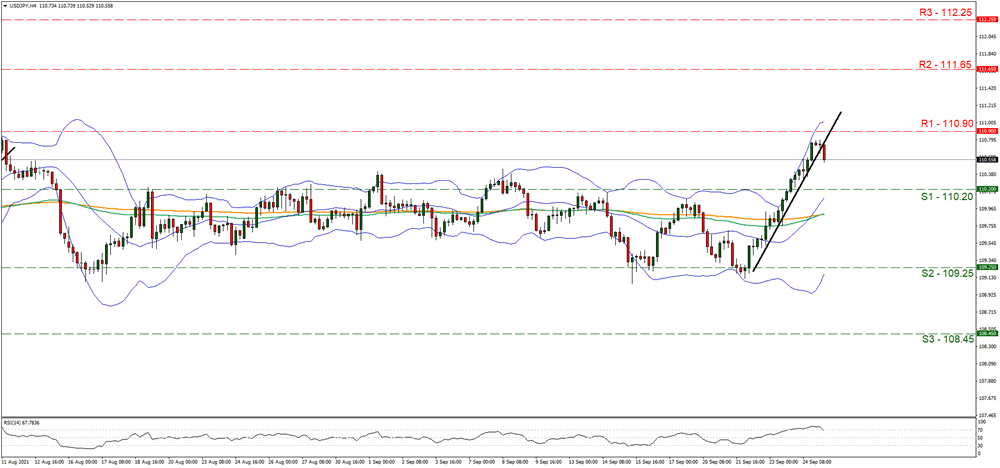
Support: 110.20 (S1), 109.25 (S2), 108.45 (S3)
Resistance: 110.90 (R1), 111.65 (R2), 112.25 (R3)
EUR/USD Cash H4 Chart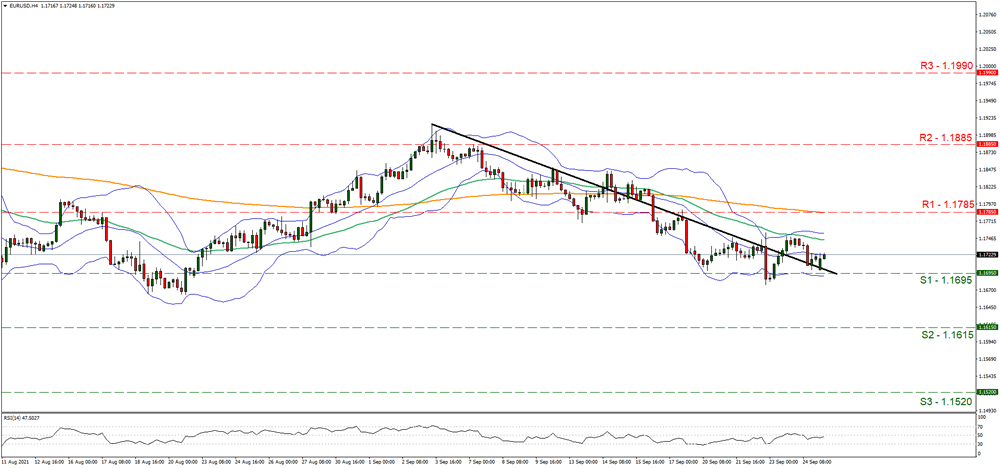
Support: 1.1695 (S1), 1.1615 (S2), 1.1520 (S3)
Resistance: 1.1785 (R1), 1.1885 (R2), 1.1990 (R3)
Asian Equities Off To A Flying Start
Asian markets post gains as Evergrande fears recede
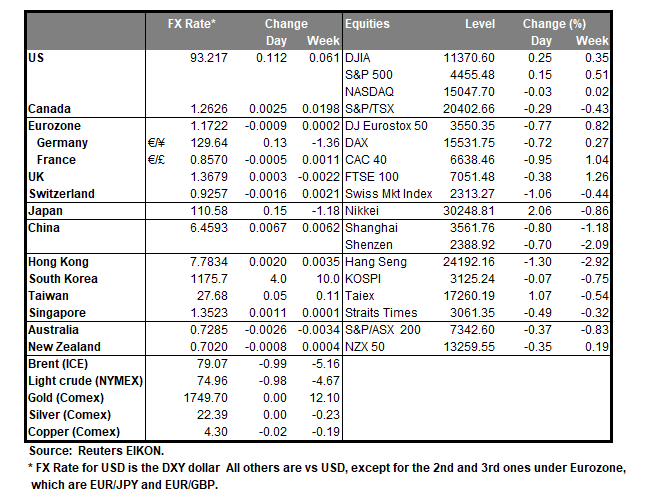
With no major developments on the Evergrande front over the weekend, markets seem to have priced in oblivions for the EV subsidiary already, Asian stock markets are off to a flying start. Banks are leading the rally across the Asia-Pacific region, I am guessing on the assumption that no material compromise will occur if the China property market hiccups.
All the more interesting is that Asia is ignoring the non-descript finish in New York, where rising US bond yields and a supply chain warning from Nike ahead of the crucial Christmas season, unwound intraday rallies and left Wall Street almost unchanged. The S&P 500 rose just 0.15% while the Nasdaq edged lower by 0.03% and the Dow Jones closed just 0.10% higher. US futures on all three indexes have rallied powerfully today, rising by 0.50% on no news is good news euphoria.
Asian markets have given back some of their early gains but are broadly higher. The Nikkei 225 is up 0.50% while the Kospi is 0.45% higher. In China, the broader Shanghai Composite is 1.30% lower, but the narrower SOE-heavy Shanghai 50 has leapt 2.0% higher. The CSI 300 has rallied 0.85% while the Hang Seng is 1.05% higher. The price action suggests to me that China’s “national team” is out and about buying, with another liquidity injection by the PBOC helping proceedings.
Regionally, Singapore has leapt 1.20% higher led by the big banks, while Kuala Lumpur and Jakarta have slipped by 0.30%. Taipei has risen by 0.20% while Bangkok and Manila are unchanged. Australian markets are enjoying a stellar day as commodities and energy rally, with those two sectors and banking outperforming. The ASX 200 is 0.80% higher, with the All Ordinaries rising by 0.70%.
It seems that a dialling down of contagion fears, with some subtle assistance from China has been an irresistible lure for the buy-the-dippers. Interestingly, the commodity-centric KLCI and JCI are the worst regional performers today, with ASEAN, Singapore excepted, suffering from a rotation back into the North Asia heavyweights. European stock markets are likely to take their lead from Asia’s reduced Evergrande concerns, and open higher this afternoon. UK markets could be the exception after petrol stations ran dry there over the weekend and winter of discontent noises increase.
No News Is Good News
There were no ugly surprises over the weekend, either from the German federal elections or, more importantly, the Evergrande saga in China. Nor has the surge in oil prices on Friday, which has continued unabated today in Asia, dented equity investors enthusiasm, with Asian stock markets off to a rollicking start to the week.
The German elections have reached an inconclusive result, to the surprise of no one. The ruling Christian Democrats (CDU) are narrowly trailing the Social Democrats (SPD). Both leaders are claiming a mandate to start coalition negotiations which on the mathematics, will require three parties coming together. That means that CDU incumbent, outgoing Chancellor Angela Merkel, and her government remains in power until a coalition is formed. With an outcome possibly months away, that probably explains why EUR/USD is sharply unchanged at 1.1720.
Markets seem to be rapidly pricing in Evergrande as a fully controllable outcome that won’t spill over China’s borders into the wider financial universe. Evergrande has not made its USD 85.0 million US dollar coupon payment due last week, and it has another USD 47.5 million coupon due this week. It appears that the 30-day grace period will be used to its fullest. News that its Electric Vehicle subsidiary is facing severe liquidity problems sent those Hong Kong-listed shares down 25.0% in early trading today but seems not to have mattered a jolt. China stocks are on fire today, helped along by another CNY 100 bio liquidity injection by the PBOC, and I suspect, China’s “national team” “smoothing” stock markets.
That is given more credence by news outlets running stories all weekend and about electricity-intensive sectors and factories being forced to shut down temporarily to meet emission targets and to cap the rise in energy prices. That won’t be good news for value chains anywhere in the world or inflationary input anywhere in the world. Once again though, markets are unconcerned.
US spending bill hits bump
In the US, the House of Representatives pushed back the USD 1.2 trillion infrastructure bill vote. Progressives, seemingly intent on destroying the Democrats’ mid-term election chances next year as quickly as possible, want the bill tied to the USD 3.5 trillion build-back-better plan, something moderate Democrats have pushed back on due to cost. The US debt ceiling is fast approaching as well with Republicans indicating the Democrats will have to pass a vote to raise it on their own, instead of the usual bi-partisan vote. Once again, a mess like this should weigh on market sentiment but is being complacently ignored. Nike’s announcement on Friday that supply chain issues could affect stock levels into the crucial shopping season had a greater dampening effect on Wall Street.
Even the sight of petrol pumps running dry over Britain this weekend, as panic buying took hold amidst a truck-driver crunch and skyrocketing energy prices hasn’t dented sterling this morning, again sharply unchanged at 1.3665. That said, plans to draft the army in to deliver petrol, and a government backtrack on foreign drive visas hasn’t move sterling either.
Japan’s LDP will select a new prime minister to replace PM Suga on Wednesday. Japan’s equity markets have outperformed over the last month as investors there expect whoever is chosen to reopen the fiscal pork barrel. The four-way race appears to be wide open, and nothing can diminish Japan’s fiscal stimulus myopia, not even surging oil prices.
On that note, nerves about energy shortages continue to add momentum to oil’s price rally. Notably, natural gas is now trading at nearly twice the per barrel equivalent of oil. Thanks to some ill-informed headline-grabbing by the UK press, Britons were panic buying petrol over the weekend. Natural gas storage is also below seasonal levels in Europe with Norway’s Equinor promise of more gas ignored by markets. China is forcing parts of key industries to temporarily close, and oil is 1.50% higher in Asia, a most unusual move as Asian markets prefer to buy dips and not chase prices. All of Asia is basically reliant on energy imports and thus, surging energy prices should be weighing on regional equity markets.
I learned long ago that markets can remain irrational longer than you or I can stay solvent, and it appears that is how Asia is choosing to start the week. Financial markets never let the facts get in the way of a good story and I’m not sure a set of shocking China PMIs, due on Thursday, will change the stimulus forever, Evergrande is contained, winter of energy discontent, US political-economic self-harming will shake the FOMO-TINA dip-buyers. It seems the no news or bad news is good news. To quote Gordon Gekko, “Greed, for lack of a better word, is good.” I will observe the migrating herds with interest this week from the safety of my safari vehicle.
Oil Is Bullish But Historical Sellers Are Close
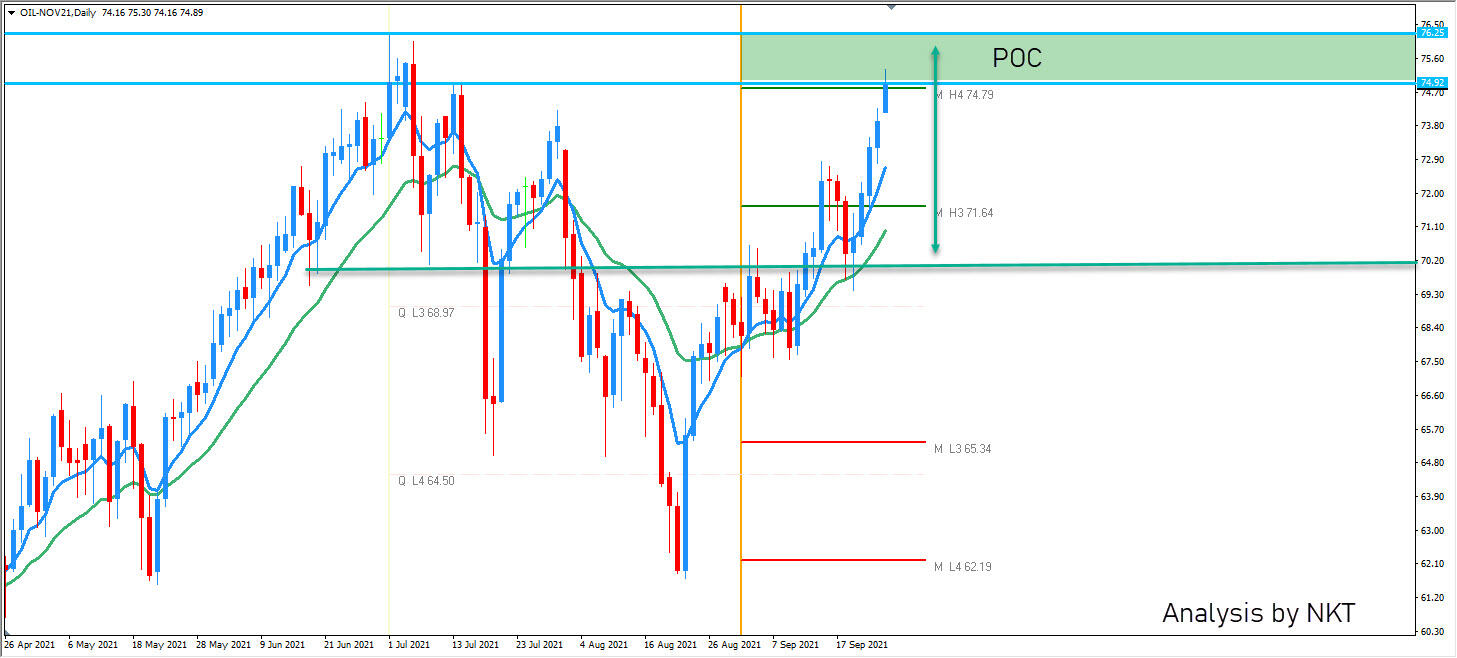
Oil is in uptrend but it’s getting close to historical resistance. Daily candlestick/pattern configuration is a signal for a short trade.
At this point we can clearly see the resistance. It’s highlighted in green. If we saw the market moving down that would be considered a pullback. I am aiming for a short trade on a bearish candlestick pattern configuration. Watch for it on a daily TF and look for 71.60 and 70.20 as the targets.
Brent Crude Marches Towards $80 On Tight Supplies
Following three consecutive weekly gains, oil bulls do not seem tired yet as crude oil extended gains for the fifth straight session today. The world’s demand is not being met with enough supplies and this has pushed Brent towards $80. Inventories across all continents are dropping as we head into the winter season, with US stockpiles sitting near a three-year low. Exacerbating the global energy crunch is the shortages in natural gas supplies, which is leading to higher oil demand as some consumers switch fuels.
Going green or shifting towards renewable energy resources has a big price to be paid, particularly in Europe where wind stopped blowing in the summer season and electricity prices have surged to record highs.
Stronger energy demand from the reopening of economies was also met with supply losses from the US due to Hurricane Ida. Gulf of Mexico losses have exceeded 30 million barrels so far, and more are expected due to the extensive infrastructure damage to some producers.
The Brent crude term structure remains well in backwardation with November 2021 contracts sitting 90 cents above December ones and the gap widens to about $5.70 compared to July 2022 contracts. This shows traders remain bullish on prices and investment banks are now updating their year-end targets for oil. Goldman Sachs raised its forecast for Brent from $80 to $90 and more investment banks are likely to follow with upgrades.
Whether we’ll see prices moving closer to $90 or revert back towards $70 depends a lot on OPEC+’s next move. The upcoming October 4 meeting will be watched very closely by traders, and oil consuming countries hope to see more easing in supplies. We know with a high degree of certainty that the group will confirm a 400,000 barrel per day supply increase for November, but are we going to see any additional increases in production? That will determine whether bulls remain in control or take a short-term break.
BoJ Kuroda: Must continue to focus on responding to the pandemic
BoJ Governor Haruhiko Kuroda admitted, "it's true Japan's economy has been held back by the successive waves of COVID-19." "While corporate funding conditions have improved from a while ago, those of firms offering face-to-face services remain severe," he added.
"Given high uncertainty over the outlook due to the spread of the Delta variant, the BOJ must continue to focus on responding to the pandemic for the time being," he said.
Meanwhile, Kuroda is not concerned about the supply shortages that manufacturers are facing. "This will only be transitory, and from a somewhat long-term perspective, exports and production are expected to continue on an increasing trend, partly supported by the restocking of inventories and a recovery in production from the decline brought about by the supply-side constraints," he said.
Aussie Resilient Despite China Property Jitters and the Fed
The Aussie dollar did well to hold its ground last week given global concern over China’s property sector and the US Federal Reserve which nudged its interest rate profile higher once more. China will remain in focus for A$ in the week ahead, while Australia's domestic data calendar includes retail sales and housing.
Aussie resilient despite China property jitters and the Fed
Early last week, with extensive national holidays across North Asia, markets elsewhere fretted over struggling Chinese property giant Evergrande. Reports that Beijing would not bail it out added to the pressure on iron ore prices, with futures prices tumbling to $94/tonne on Monday and Tuesday, down a remarkable -38% from end-August. US equities sagged and the ASX 200 closed at its lowest level since June.
Given A$ is often the proxy of choice for worries over China’s economy, it made sense to see AUD/USD slip to 0.7220, a low since 24 August. But 0.7200 did not give way even when newswires reported that Evergrande missed interest payments on bonds. There was little official comment from Chinese officials but gradually a view emerged that while investors – particularly foreign – would lose money, there would not be a major threat to China’s economy or global markets. Equity markets rebounded.
Perhaps investors have already priced plenty of bad news into the Aussie, with data from US futures markets showing large net short positions as of 21 September, around when concern over China real estate was at its height.
Attention then turned to the Federal Reserve’s policy-setting body, the FOMC. The committee said that if progress continued towards its goals of maximum employment and price stability, then “a moderation in the pace of asset purchases may soon be warranted.” This was about as expected – not confirming a date to taper the pace of bond purchases but “soon.”
Somewhat more eye-catching was the quarterly update from FOMC members on their forecasts for economic growth, inflation and the likely path of the federal funds rate. This showed another two officials joined the seven already pencilling in lift-off for 2022, leaving the Fed evenly divided on the prospect of starting rate hikes next year. The median ‘dot’ for 2023 rose by another 25bp too, signalling three hikes for that year while the first stab at 2024 was for a 1.75% funds rate.
After the FOMC meeting, US 10 year Treasury yields broke multi-week trading ranges to the topside, up from about 1.30% to 1.45%. The US dollar found some support from this rise in yields, though mostly against the Japanese yen, since the Bank of Japan is committed to keeping its own 10 year government bond yield near 0%.
The Australian bond market could not ignore such a move, with the 10 year Commonwealth government bond today around 1.40%, versus 1.26% ahead of the FOMC meeting. This will have contributed to AUD/USD’s relative stability over the week.
Domestic data took a back seat last week and probably won’t offer too much distraction from coronavirus headlines this week. We will see a substantial lockdown impact on retail sales and a range of data on the housing market which should confirm ongoing substantial rises in prices but an easing in the construction pipeline. If AUD/USD is to break recent ranges, the catalyst will probably need to come from offshore developments.
Event risk this week
Aust Aug retail sales, US Sep consumer confidence, Fed Chair Powell and Treasury Secretary Yellen testify to Senate (Tue), Aust Aug dwelling approvals and private credit, China Sep manufacturing and services PMIs (Thu), Aust Aug housing finance and Sep housing prices, US Aug personal income and spending (Fri), US House vote on infrastructure bill (no set date)
GBP/JPY Daily Outlook
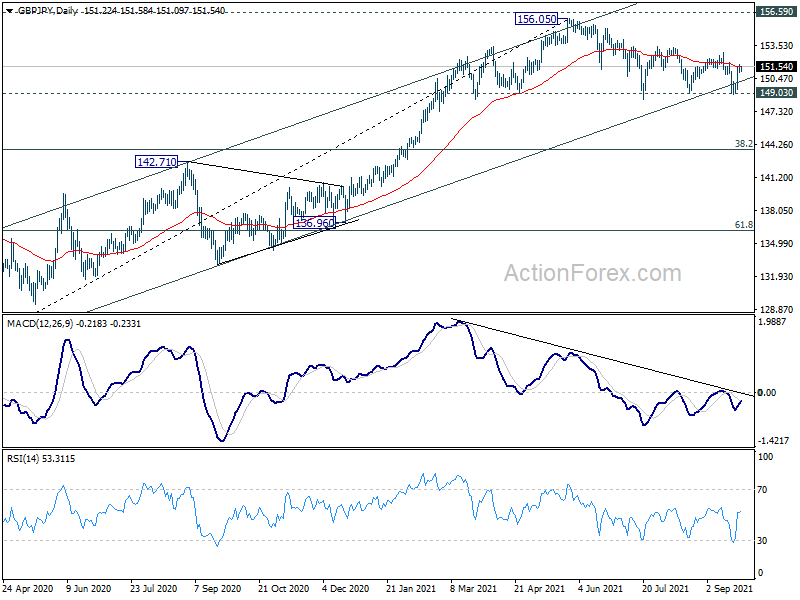
Daily Pivots: (S1) 151.04; (P) 151.38; (R1) 151.76; More...
Intraday bias in GBP/JPY remains mildly on the upside, as rebound form 148.93 would target 152.82 resistance. Sustained break there will suggest that correction from 156.05 has completed, and turn near term outlook bullish for retesting this high. On the downside, break of 150.70 minor support will turn bias back to the downside for 149.03 key support instead.
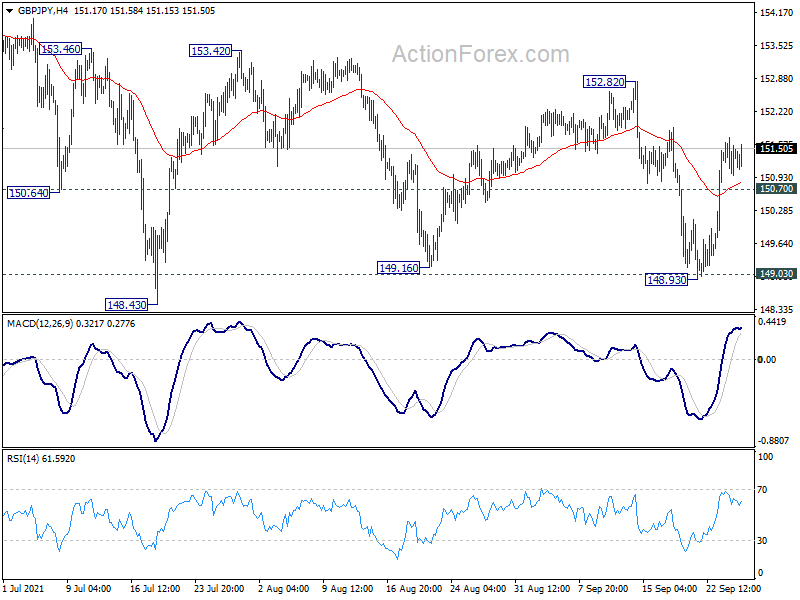
In the bigger picture, rise from 123.94 is seen as the third leg of the pattern from 122.75 (2016 low). As long as 149.03 support holds, such rise would still resume at a later stage. However, sustained break of 149.03 support will indicate rejection by 156.59. Fall from 156.05 would be at least correcting the whole rise from 123.94. Deeper fall would be seen back 38.2% retracement of 123.94 to 156.05 at 143.78 first.
EUR/JPY Day Outlook
Daily Pivots: (S1) 129.52; (P) 129.68; (R1) 129.98; More....
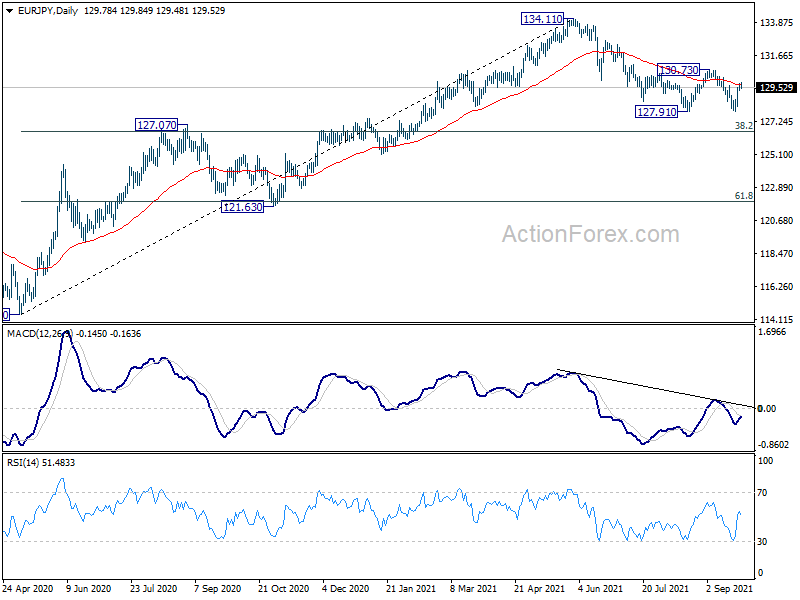
Intraday bias in EUR/JPY remains mildly on the upside and rebound from 127.91 could target 130.73 resistance. Firm break there will argue that correction from 134.11 has completed and turn near term outlook bullish for retesting this high. On the downside, break of 129.03 minor support will turn bias back to the downside for retesting 127.91 instead.
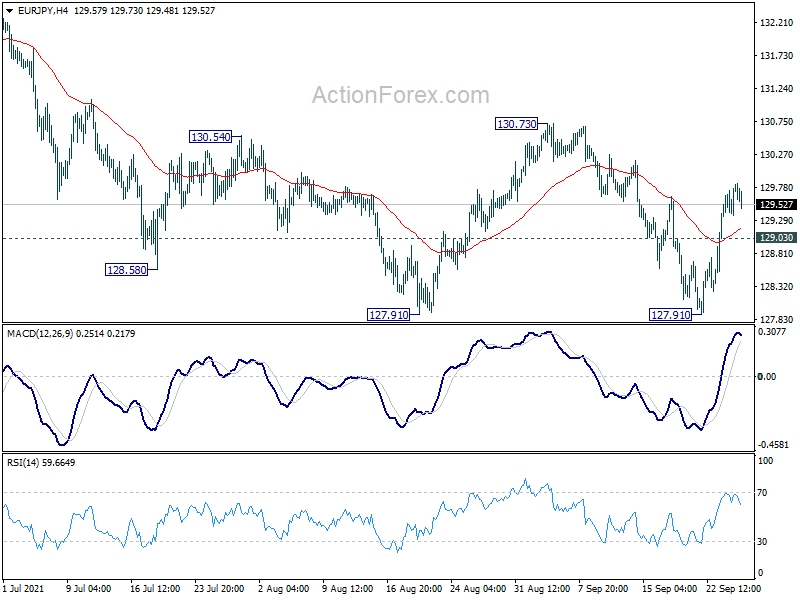
In the bigger picture, rise from 114.42 is seen as a medium term rising leg inside a long term sideway pattern. As long as 127.07 resistance turned support holds, further rise is still expected to retest 137.49 (2018 high). However, firm break of 127.07 will argue that the medium term trend has reversed, deeper fall would be seen to 61.8% retracement of 114.42 to 134.11 at 121.94.