

Sample Category Title
USD/JPY Analysis: Reaches 111.00
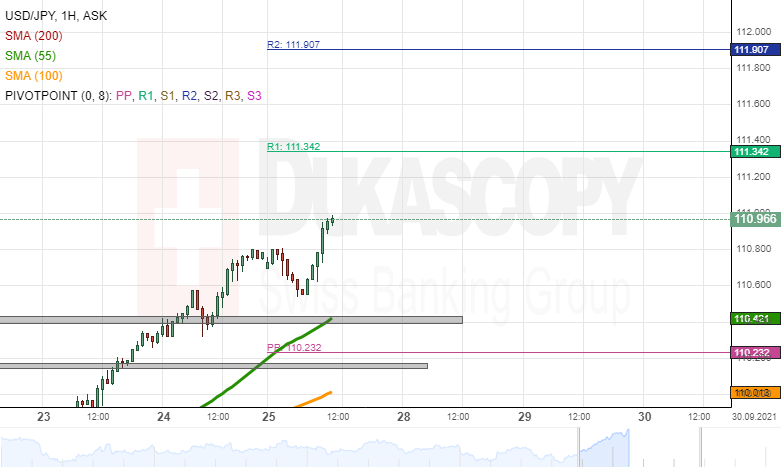
On Monday morning, the USD/JPY currency exchange rate found support in the 110.60 level. Afterwards, a surge followed. By the middle of the day's European trading, the rate was aiming at the 111.00 level.
If the 111.00 level manages to provide resistance, the rate could retrace down to the 110.80 and 110.60 levels. These round exchange rate levels have been providing both support and resistance to the currency pair. Below these levels, note the approaching 55-hour simple moving average near 110.40.
However, the pair might continue to surge and reach above the 111.00 level. A surge above the 111.00 mark might find resistance in the weekly R1 simple pivot point at 111.34.
Gold Analysis: Fails At Recovery
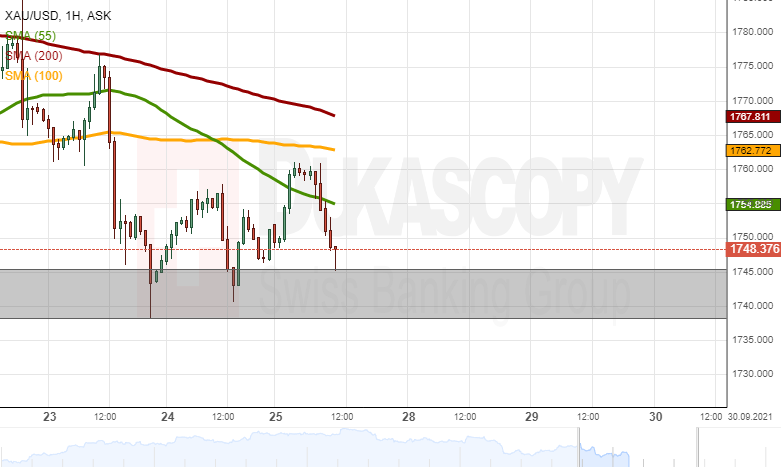
Gold found resistance on Monday in the 1,760.00 level. The event was followed by a decline, which by the middle of the day was approaching the September low level zone from 1,738.25/1,745.40.
If the September support zone holds, the metal's price might recover. A potential recovery could find resistance in the 55, 100 and 200-hour simple moving averages near 1,755.00, 1,760.00 and 1,765.00. In addition, round price levels could once again act as resistance.
A passing below the low levels could reach August low levels near 1,720.00.
EUR/CAD Breakout Occurs
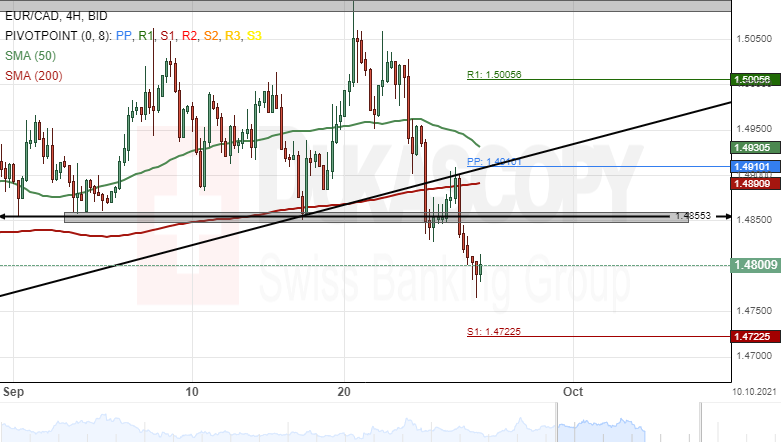
The Eurozone single currency has declined by 1.80% against the Canadian Dollar since September 20. A breakout occurred through the bottom border of an uptrend line during last week's trading sessions.
Given that a breakout has occurred, sellers could continue to drive the currency pair lower during this week's trading sessions. The potential target for bearish traders would be near the 1.4600 level.
However, the weekly support level at 1.4722 could provide support for the EUR/CAD currency exchange rate this week.
EUR/AUD Two Scenarios Likely
Since last week's trading sessions, the common European currency has declined by 0.99% against the Australian Dollar.
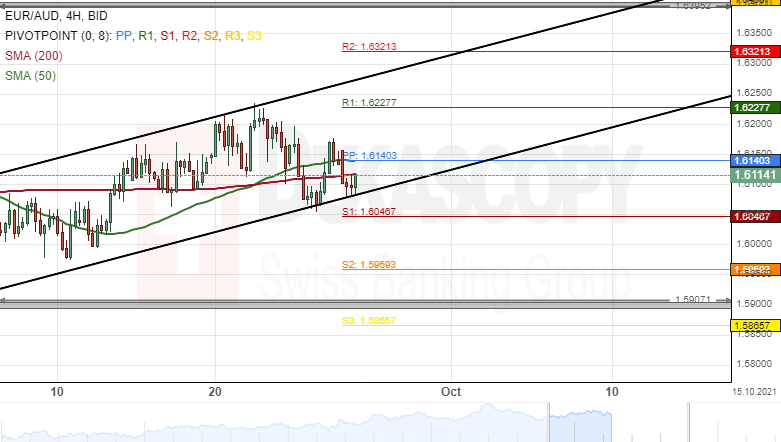
Currently, the EUR/AUD exchange rate is trading near the lower boundary of an ascending channel pattern and could be set for a breakout.
If the breakout occurs, a decline towards the weekly support level at 1.5950 could be expected this week.
However, if the channel pattern holds, buyers may pressure the currency exchange rate higher during the following trading session.
German Coalition Talks Might Take Until Christmas To Form Govt
Notes/Observationsf
- German Federal elections results setting in motion what could be months of complex coalition talks (Note: no prospect of a hard-left coalition).
- House Speaker Pelosi sets Thursday vote on infrastructure vote.
Asia
- PBOC again injected net liquidity of CNY100B into market via 14-day Reverse repo.
- Two local governments in China have taken control of sales revenue from Evergrande properties so that homebuyers interest can be protected and project construction continues.
- Election of the next PM of Japan likely go to a run-off as neither of the two main candidates (Kono and Kishida) look able to secure an outright majority in the first round of voting (taking place on Wed).
Coronavirus
- Japan govt said to be planning to lift emergency measures in all areas at the end of the month.
Europe
- Germany Election Final Results saw the Social Democrats (SPD) narrowly defeat Merkel CDU/CSU coalition (25.7% v 24.1%); Green Party register’s its best results ever at 14.8%; Coalition talks will take time (might take until Christmas).
- BP provided updates on shortage of deliver drivers in UK: 30% of UK fuel stations have nearly no gas to supply, 1.2K locations were running out of the 2 main fuel types.
- UK army was expected to provide personnel to drive petrol tankers to forecourts within days after it was estimated that between 50-90% of Britain’s petrol stations had run out of fuel.
- UK Govt approved to issue temporary visas for 5,000 foreign truck drivers, also temporarily suspended competition rules to allow companies to coordinate fuel supplies to the most affected regions.
Americas
- House Speaker Pelosi sets Thursday (Sept 30th) to vote on $1.0T infrastructure bill. Noted that President Biden’s $3.5T reconciliation bill may be smaller than expected.
SPEAKERS/FIXED INCOME/FX/COMMODITIES/ERRATUM
Equities
- Indices [Stoxx600 +0.32% at 464.78, FTSE +0.32% at 7,074.06, DAX +0.90% at 15,671.85, CAC-40 +0.62% at 6,679.37, IBEX-35 +1.00% at 8,961.50, FTSE MIB +0.45% at 26,086.00, SMI -0.18% at 11,796.14, S&P 500 Futures +0.33%].
- Market Focal Points/Key Themes: European indices open higher across the board and remained in the green as the session progressed; sectors among those leading to the upside are real estate and industrails; underperforming sectors include telecom; German housing firms supported following German non-binding referendum; Faurecia confirms to acquire Hella; Hikma acquires Custopharm; EQT launches takeover of zooplus; no major earnings expected in the upcoming US session.
Equities
- Consumer discretionary: zooplus [ZO1.DE] +4% (new offer), International Workplace Group [IWG.UK] +6% (speculation on company's break-up), Plastic Omnium [POM.FR] -1% (cuts outlook).
- Consumer staples: La Doria [LD.IT] -13% (stake offer).
- Financials: Bank of Ireland [BIRG.IE] -2% (CFO steps down).
- Industrials: Rolls-Royce Holdings [RR.UK] +6% (selected for CERP program).
Speakers
- German Social Democrats (SPD) leader Scholz stated that his SPD party had the mandate to lead German govt. Saw a possible coalition between SPD, Greens and FDP (**Note: referred to as Traffic Light coalition). He added that the vote suggested that the Merkel coalition CDU/CSU should go into opposition.
- Hungary Debt Agency (AKK) chief: Kurali expected a soft landing for the local bond market from the central bank’s tapering of its asset-purchase program.
- UK Road Haulage Association official stated that UK govt driver visa plan was designed to fail (**Note: refers to UK Govt approved to issue temporary visas for 5,000 foreign truck drivers).
- BOJ Gov Kuroda reiterated stance that would not hesitate to add easing if necessary; watching impact of coronavirus closely. Needed to continue with easing persistently. Reiterated that inflation to gradually rise toward the end of the current projection period in FY23 but would not reach the 2% price stability target.
- China govt stated thatLi Bo was no longer a PBoC Dep Gov.
Currencies/Fixed Income
- USD began the week under favorable conditions since the Fed noted that the taper process could begin soon.
- EUR/USD was probing below 1.1700 level following the Germany election results. Dealers noted that the next German government coalition hung in a limbo but a 3-way coalition was expected. Possible changes to Germany's fiscal stance and to its approach to European/foreign policy and climate action are at stake.
- GBP/USD was back above 1.37 by mid-session as more analysts brought forward their calls for a BOE rate hike by Feb 2022.
Economic data
- (FI) Finland Sept Consumer Confidence: 6.0 v 4.0 prior; Business Confidence: 21 v 22 prior..
- (DK) Denmark Aug Retail Sales M/M: -0.4% v -0.1% prior; Y/Y: 4.0% v 4.98% prior.
- (ES) Spain Aug PPI M/M: 1.9% v 2.0% prior; Y/Y: 18.0% v 15.6% prior.
- (SE) Sweden Aug Household Lending Y/Y: 6.4% v 6.3% prior.
- (EU) Euro Zone Aug M3 Money Supply Y/Y: 7.9% v 7.7%e.
- (CH) Swiss weekly Total Sight Deposits (CHF): 714.5B v 714.7B prior; Domestic Sight Deposits: 636.0B v 636.0B prior.
- (TW) Taiwan Aug Industrial Production Y/Y: 13.7% v 12.7%e.
- (TW) Taiwan Aug Monitoring Indicator: 39 v 38 prior.
Fixed income Issuance
- (NO) Norway sold NOK vs. NOK2.0B indicated in 3-month Bills; Avg Yield: 0.18% v 0.07% prior; Bid-to-cover: 2.44x v 2.55x prior.
Looking Ahead
- (EU) European Union to sell €2.0-2.5B in NextGeneration (INGEU) 2026 bonds.
- 05:25 (EU) Daily ECB Liquidity Stats.
- 05:30 ((DE) Germany to sell €4.0B in 12-month BuBills.
- 05:30 (ZA) South Africa announces details of upcoming I/L bond sale (held on Fridays).
- 06:00 (BE) Belgium Debt Agency (BDA) to sell €3.0-3.5B in 2031, 2037 and 2050 OLO Bonds.
- 06:00 (IL) Israel to sell bonds.
- 06:00 (RO) Romania to sell RON400M in 2.5% Oct 2027 Bonds.
- 06:45 (US) Daily Libor Fixing.
- 07:00 (MX) Mexico Aug Trade Balance: -$1.1Be v -$4.1B prior.
- 07:00 (MX) Mexico July IGAE Economic Activity Index (Monthly GDP) M/M: +0.8%e v -0.9% prior; Y/Y: 8.5%e v 13.3% prior.
- 07:00 (BR) Brazil Sept FGV Construction Costs M/M: 0.4%e v 0.6% prior.
- 07:00 (BR) Brazil Sept FGV Consumer Confidence: No est v 81.8 prior.
- 07:25 (BR) Brazil Central Bank Weekly Economists Survey.
- 08:00 (UK) Daily Baltic Dry Bulk Index.
- 08:00 (US) Fed’s Evans at NABE Conference.
- 08:00 (IN) India announces details of upcoming bond sale (held on Fridays).
- 08:30 (US) Aug Preliminary Durable Goods Orders: +0.6%e v -0.1% prior; Durables (ex-transportation): 0.5%e v 0.8% prior; Capital Goods Orders (non-defense/ex-aircraft): 0.4%e v 0.1% prior; Capital Goods Shipments (non-defense/ex-aircraft): 0.5%e v 0.9% prior.
- 08:30 (BR) Brazil Aug Total Outstanding Loans (BRL): 4.302Te v 4.266T prior; M/M: 1.2%e v 1.2% prior; Personal Loan Default Rate: No est v 4.1% prior.
- 09:00 (FR) France Debt Agency (AFT) to sell €5.7-6.9B in 3-month, 6-month and 12-month bills.
- 09:45 (UK) BOE to buy £1.147B in APF Gilt purchase operation (3-7 years).
- 10:30 (US) Sept Dallas Fed Manufacturing Activity Index: 11.0e v 9.0 prior.
- 12:15 (US) Fed’s Brainard at NABE Conference
- 15:00 (AR) Argentina July Supermarket Sales Y/Y: No est v 1.0% prior; Shop Center Sales Y/Y: No est v 241.5% prior..
- 16:00 (US) Weekly Crop Progress Report.
- 17:00 (KR) South Korea Sept Consumer Confidence: No est v 102.5 prior.
- 19:30 (AU) Australia ANZ Roy Morgan Weekly Consumer Confidence Index: No est v 103.3 prior.
- 21:30 (CN) China Aug Industrial Profits Y/Y: No est v 16.4% prior.
- 21:30 (AU) Australia Final Aug Retail Sales M/M: -2.2% v -2.7% prelim.
- 22:30 (KR) South Korea to sell KRW500B in 20-year Bonds.
- 23:00 (TH) Thailand Central Bank to sell THB55B in 3-month bills.
- 23:30 (HK) Hong Kong to sell 3-month, 6-month and 12-month Bills.
- 23:35 (JP) Japan to sell 40-year JGB Bonds.
The Analytical Overview Of The Main Currency Pairs
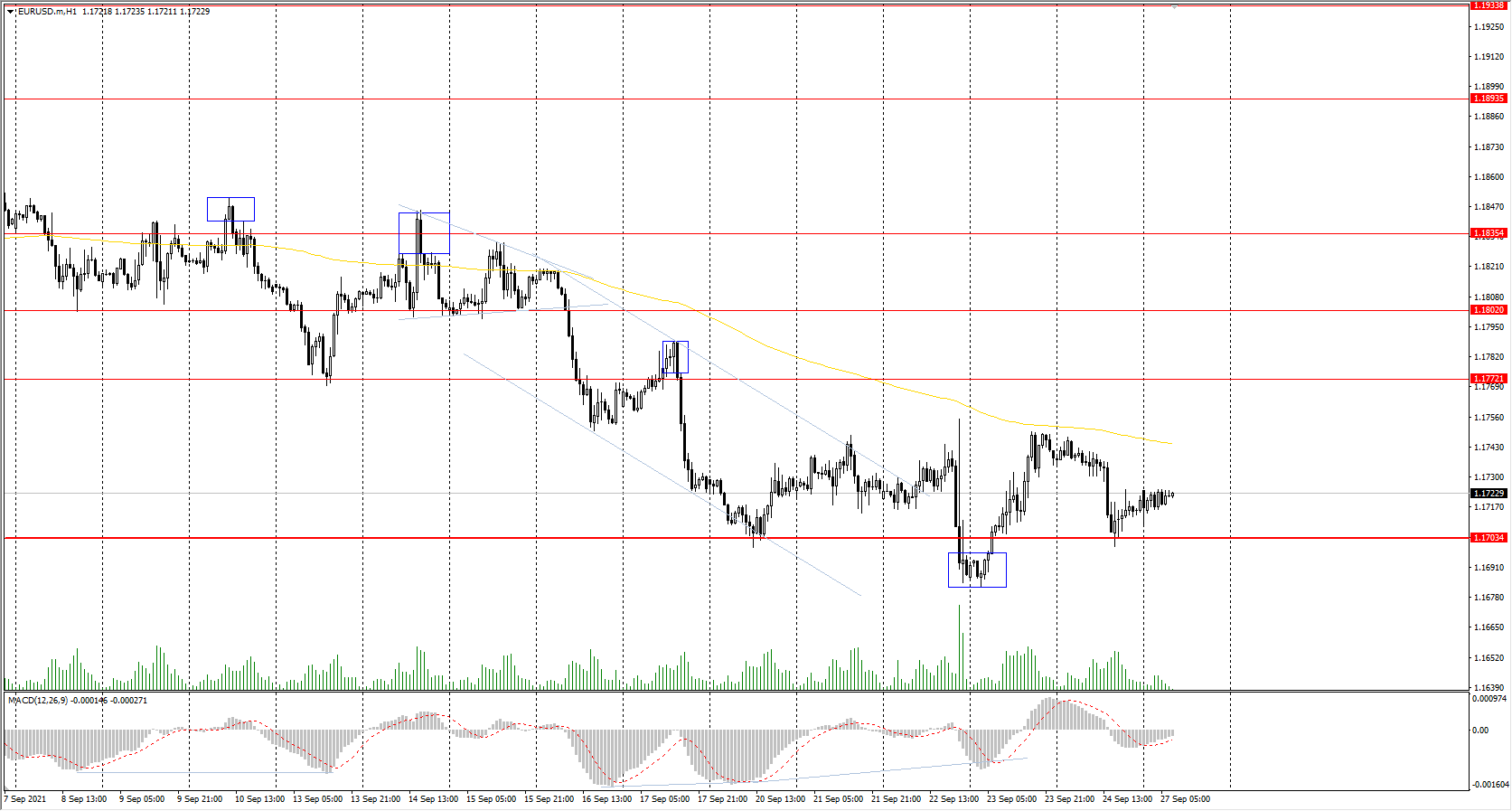
The EUR/USD currency pair
Technical indicators of the currency pair:
Prev Open: 1.1738
Prev Close: 1.1720
% chg. over the last day: -0.15%
According to the IFO Munich Economic Institute, which estimated business sentiment in Germany, the German industry is in recession. It is noted that many companies that took part in the IFO survey stated that not only their current business situation but also their perspectives are worsening. Meanwhile, companies that operate in the tourism and hotel business, as well as in the construction business, noted the improvement of the situation.
Trading recommendations
Support levels: 1.1704, 1.1620
Resistance levels: 1.1772, 1.1802, 1.1835, 1.1894, 1.1934, 1.1969
From the technical point of view, the general trend of the EUR/USD currency pair is bullish. The price is trading near the priority change level. The MACD indicator shows a divergence. Under such market conditions, buy deals can be considered from the priority change level. It is best to look for sell trades from the resistance levels near the moving average or after the breakdown of priority change level.
Alternative scenario: if the price breaks down through the 1.1704 support level and fixes below, the mid-term uptrend will likely be broken.
News feed for 2021.09.27:
- Eurozone ECB President Lagarde’s Speech at 14:45 (GMT+3);
- US FOMC Member Evans’s Speech at 15:00 (GMT+3);
- US Core Durable Goods Orders (m/m) at 15:30 (GMT+3);
- US FOMC Member Williams’s Speech at 19:00 (GMT+3);
- US FOMC Member Brainard’s Speech at 19:15 (GMT+3).
The GBP/USD currency pair
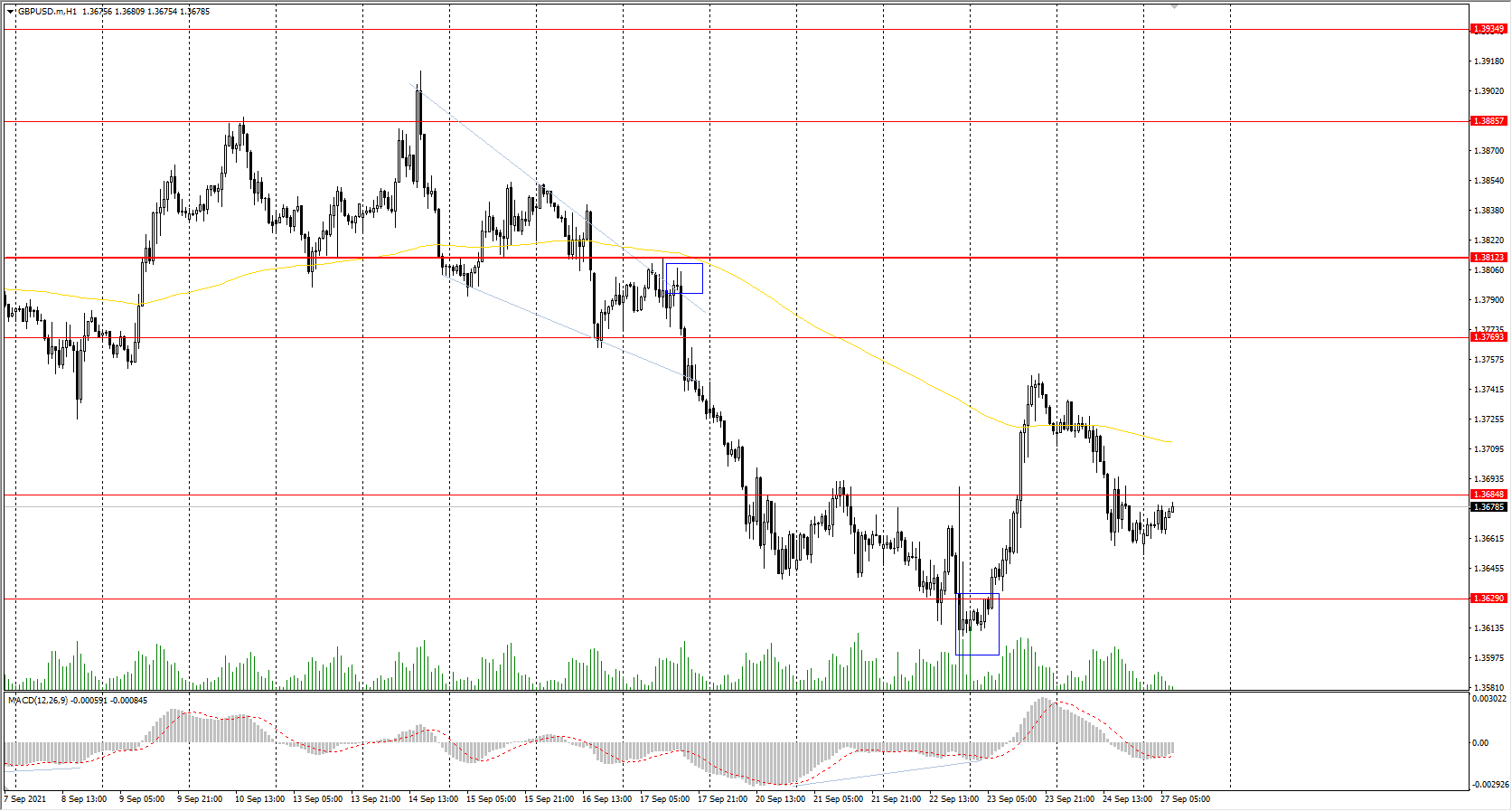
Technical indicators of the currency pair:
Prev Open: 1.3718
Prev Close: 1.3666
% chg. over the last day: -0.38%
One-third of BP's gas stations are out of fuel. Car queues near gas stations have been observed for the third consecutive day. The shortage of drivers is causing problems transporting fuel from refineries to gas stations. Some operators were forced to limit deliveries and others even closed gas stations.
Trading recommendations
Support levels: 1.3629, 1.3614, 1.3525
Resistance levels: 1.3685, 1.3769, 1.3812, 1.3886, 1.3935, 1.4002
On the hourly time frame, the GBP/USD trend is bearish. The MACD indicator has become inactive. Under such market conditions, it is better to look for sell trades from the resistance levels near the moving average line. Buy deals should be considered only intraday and only with short targets from the support levels.
Alternative scenario: if the price breaks out through the 1.3812 resistance level and consolidates above, the bullish scenario will likely resume.
News feed for 2021.09.27:
- UK BoE Gov Andrew Bailey’s Speech at 21:00 (GMT+3).
The USD/JPY currency pair
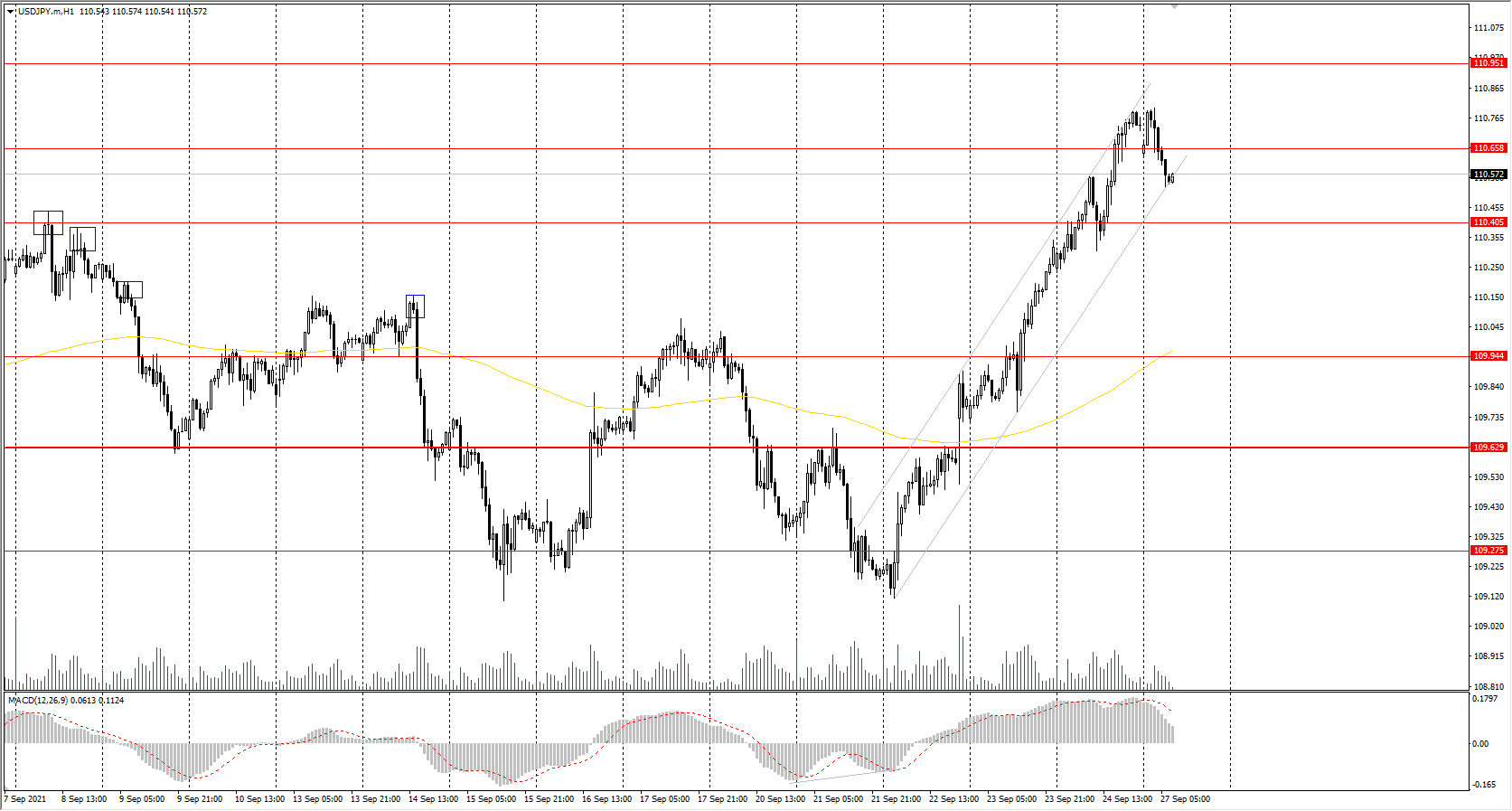
Technical indicators of the currency pair:
Prev Open: 110.25
Prev Close: 110.74
% chg. over the last day: +0.44%
Last week, the Japanese government announced that more than half of the population is fully vaccinated against COVID-19, with vaccination rates finally catching up with the US, UK, and other major countries. As for supply chain disruptions, new measures are needed to solve the problem of the lack of key products such as semiconductors and auto parts. And while the prime ministerial candidates plan to compile a package of measures to stimulate the economy, the Japanese yen is losing its positions against the dollar index.
Trading recommendations
Support levels: 110.40, 109.95, 109.63, 109.27
Resistance levels: 110.65, 110.95, 111.49
The main trend of the USD/JPY currency pair has changed to bullish. Against the background of the Japanese Yen weakness, the USD/JPY quotes sharply rushed up. The MACD indicator has become positive. There are signs of overbuying but no signs of reversal. Under such market conditions, it’s better to look for buy positions from the support levels after a small pullback, as the price has deviated strongly from the moving average. Sell positions should be considered only throughout the day from the resistance levels but only after the sellers' initiative.
Alternative scenario: if the price falls below 109.63, the uptrend is likely to be broken.
The USD/CAD currency pair
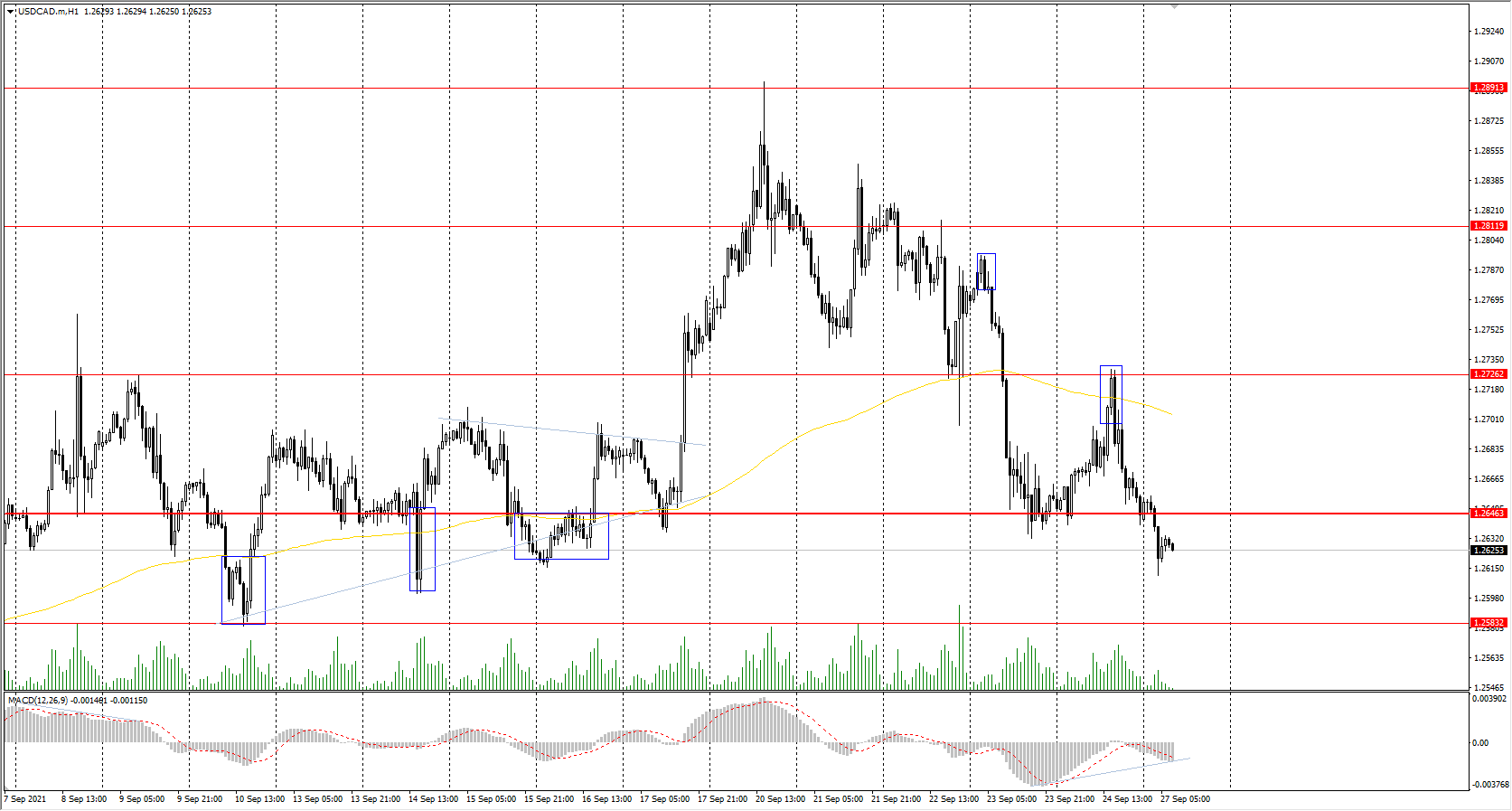
Technical indicators of the currency pair:
Prev Open: 1.2654
Prev Close: 1.2646
% chg. over the last day: -0.06%
The Canadian dollar is a commodity currency, so the USD/CAD currency pair is highly dependent on the dynamics of the dollar index and oil prices. The dollar index traded in a range on Friday, while oil prices continued to rise. As a result, the USD/CAD quotes are declining against the background of the strengthening Canadian dollar.
Trading recommendations
Support levels: 1.2583, 1.2518, 1.2425
Resistance levels: 1.2646, 1.2726, 1.2812, 1.2891, 1.2951
From the technical point of view, the trend has changed to bearish. The price fell below the moving average and broke through down the priority change level. The MACD indicator is negative, but there are signs of a reversal in the form of divergence. That means that a breakout of the priority change level might be false. Under such market conditions, it is better to buy only after the price returns above the level of priority change level, with a bullish initiative. It is best to look for sell trades from resistance levels near the moving average.
Alternative scenario: if the price breaks out through the 1.2646 support level and fixes above again, the uptrend will likely resume.
No Clear Winner In German Elections
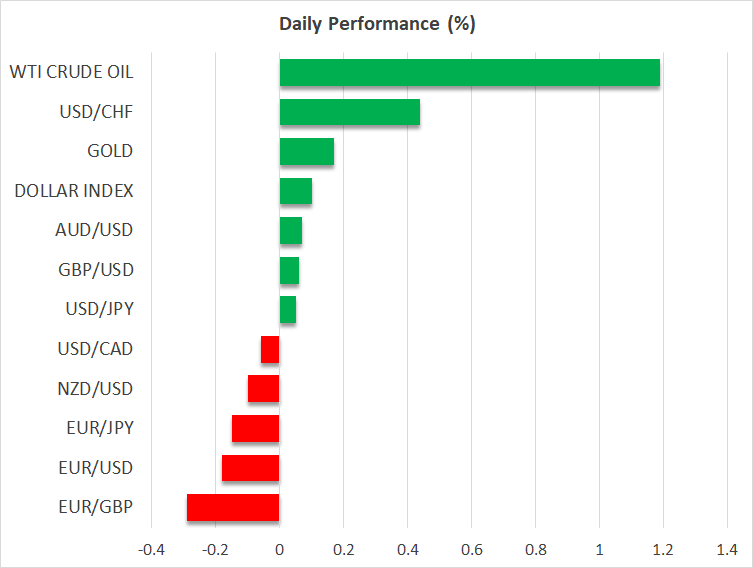
- Euro pulls back after inconclusive German election outcome
- Dollar balances faster Fed hikes against fading Evergrande fears
- Wall Street and oil prices keep climbing ahead of busy week
Political deadlock in Germany?
After a knife-edge election that produced no clear winner, several weeks of intense political negotiations lie ahead in Germany. The Social Democrats narrowly won the vote but the conservative CDU party was just a couple of percentage points behind, so both parties will now try to form a government by luring the Greens and FDP into a ruling coalition.
Hence, the next few weeks will likely bring a political firesale, where the two major parties put as much water in their wine as possible to win over the smaller coalition partners. While the most likely endgame is an alliance spearheaded by the Social Democrats that allows for greater investment both domestically and on a European level, the euro was still a touch softer on Monday as investors wrestled with the short-term uncertainty.
There are several events this week that could rattle the euro, including a speech by ECB President Lagarde today at 11:45 GMT and the latest edition of Eurozone inflation on Friday. In the big picture, it’s still difficult to get excited about the euro even if Germany ultimately shifts towards a slightly looser fiscal regime, amid a slowing data pulse and an ECB that will likely fall years behind most central banks in raising rates.
Fed vs Evergrande
The Fed meeting last week did not disappoint. Chairman Powell essentially signaled that the tapering process will begin in November absent some catastrophe, while the new interest rate projections showed the FOMC is split 9-9 on whether rates will be raised next year already.
Markets seem much more confident, with the first quarter-point rate increase now being fully priced in for December 2022 according to Fed funds futures. This timing recalibration propelled US Treasury yields higher, but the dollar couldn’t capitalize much as investors turned more sanguine that the Evergrande fallout will be contained, diminishing defensive demand for the reserve currency.
The only pair that couldn’t ignore the sharp moves in the bond market was dollar/yen, which edged higher to play catch-up with yields and fading risk aversion.
Stocks and oil cruise higher
Wall Street seems to have put the Evergrande mishap behind it. The S&P 500 closed higher last week as investors concluded that Beijing would limit spillovers by ring-fencing and restructuring the company - a controlled demolition.
The main risk now is whether this will lead to a hangover in the real estate sector that amplifies the ongoing slowdown in the economy. Chinese authorities will have to walk a tightrope as they attempt to revive growth since they can’t simply juice up the economy with a flood of cheap money like in the past, cautious of an already overleveraged banking system.
In energy markets, oil prices are trading near three-year highs amid a combination of supply disruptions and spillover effects from soaring natural gas prices. A massive technical battle will be fought around the $76/barrel region in WTI. Overall though, higher prices would ultimately invite faster production hikes from OPEC, likely keeping a lid on any sustained rally.
As for today, the economic calendar is low-key. Besides ECB President Lagarde, we will also hear from the Fed’s Evans (12:00 GMT), Williams (13:00 GMT), and Brainard (16:50 GMT). The rest of the week holds a political leadership contest in Japan, crucial PMI releases from China, and a vote on the $1 trillion ‘hard’ infrastructure bill in Congress.
EURUSD Challenges Floor Of 2-Month Trading Range
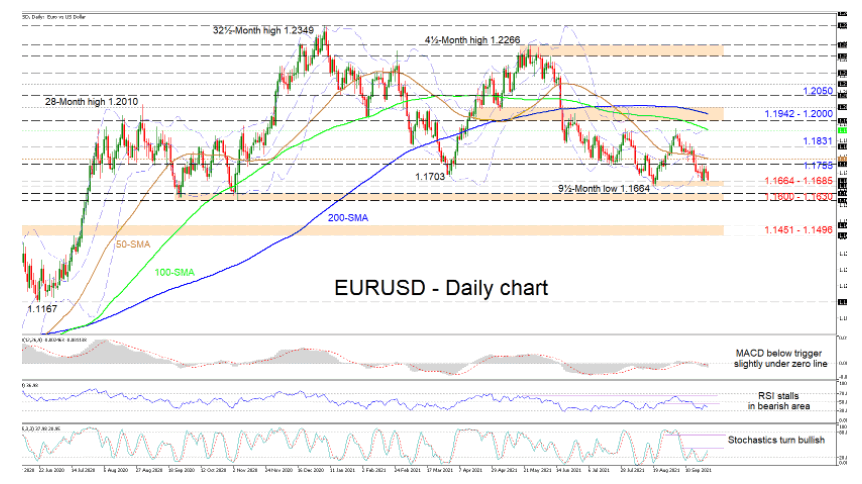
EURUSD remains skewed to the downside with sellers looking ready to retest the nine-and-a-half-month trough of 1.1664, which has managed to deny downward forces from snowballing. The short-term bearish tone in the pair is also being endorsed by the slight dip in the simple moving averages (SMAs).
At the moment the short-term oscillators are transmitting conflicting messages in directional momentum. The MACD, not too far beneath the zero threshold, is falling below its red trigger line, while the RSI is declining in bearish territory. On the other hand, the bullish stochastic oscillator has yet to confirm any waning in positive price action in the pair.
If sellers remain in the driver’s seat, initial downside deterrence could be met from the immediate base of 1.1664-1.1685 of the two-month sideways market. However, if the bears drive the price underneath the lower Bollinger band, residing within the mentioned support base, they may then encounter the foundation of the positive structure of 1.1600-1.1630, which has held since late September of 2020. Should this critical boundary break down too, bearish forces may then target the 1.1451-1.1496 support border.
Otherwise, if buying interest increases, preliminary resistance could develop from the 1.1755 nearby high and the 50-day SMA overhead at 1.1778. Overstepping the mid-Bollinger band around 1.1778, upside limitations from the 1.1831 obstacle may attempt to delay buyers from challenging the 100-day SMA at 1.1900, currently in-line with the peaks of the consolidation period. From here, in order to clearly bolster the upside momentum and head for the 1.2050 barrier, buyers would need to conquer the reinforced resistance section of 1.1942-1.2000.
Summarizing, in the short-term timeframe, EURUSD is exhibiting a neutral-to-bearish bias. A break below the 1.16000 handle could repower negative tendencies, while a shift above 1.1900 could see the pair regain a positive appeal.
The US Stock Market Sees The Biggest Outflow Of Capital
The US stock market closed in the green zone on Friday. The Dow Jones Industrial Average increased by 0.10% (+0.98% for the week), the S&P 500 added 0.15% (+1.19% for the week) and the Nasdaq Technology Index added 0.11% (+1.96% for the week). Despite all of the major indices rising by the end of the week, US stocks experienced their biggest weekly outflow in more than three years, with traders withdrawing $28.6 billion from US equity funds during the week. With the QE program cuts set to begin in a little over a month, there is no reason to expect further significant growth in the indices.
US House Speaker Nancy Pelosi urged her Democratic colleagues to pass the Biden administration's $3.5 trillion spending package. The House of Representatives is scheduled to vote on the infrastructure package this Thursday. US President Joe Biden indicated in his speech that the administration was going to make historic tax cuts for the middle class and increase taxes on large corporations and wealthy citizens.
Stock markets in Western Europe ended Friday trading with a decline. British FTSE 100 index decreased by 0.4% (+1.26% for the week), German DAX decreased by 0.7% (+1.78% for the week), French CAC 40 lost 1% (+2.92% for the week), Spanish IBEX 35 decreased by 0.4% (+2.71% for the week). Stocks of sports goods producers fell on Friday. Adidas AG dropped 2.5%, Puma SE dropped 3% and JD Sports decreased by 2.4%. The UK consumer confidence index fell five points in September compared to the previous month. The UK is facing several crises at once: an international gas price hike that is forcing energy companies out of business, which threatens to undermine meat production; a truck driver shortage that brings chaos on the retail trade and leaving not only empty store shelves but also empty gasoline stations. In Germany, the Chancellor held elections, which will succeed Angela Merkel, who served as the head of the German office for 16 years. The first data of exit polls were published in Germany. The German Social Democrats led by Olaf Scholz are leading the Bundestag elections with 26%.
Energy shortages around the world continue. Natural gas prices in Europe are at record highs. The gas crisis in Europe is already bigger than the oil shock of the 1970s in the United States. Oil prices increased for the fifth straight day on Monday, with Brent crude hitting $80 amid concerns about tight supply as some parts of the world see demand rise with pandemic conditions easing. Goldman Sachs raised its year-end forecast for Brent crude oil from $80 to $90 per barrel.
The 10-year Treasury yield jumped from 1.30% to 1.45% last week after the Fed signaled a reduction in its QE program. Rising yields and a rising dollar index are always negative for gold and silver prices, as these instruments are inversely correlated.
Coal prices in China also reached an all-time high. The National Energy Administration of China (NEA) has ordered coal and gas companies to increase production to ensure the country has enough energy to keep homes warm in winter. Car sales in China could rise in 2021, breaking a three-year slump. Vietnam plans to ease coronavirus measures and allow businesses to resume production from next week to support an economy hit by prolonged lockdowns.
Adding to the semiconductor shortages plaguing many industries appears to be a shortage of passive components such as capacitors. Chemi-Con, Nichicon, and Rubycon plants in Malaysia and Indonesia, where most of the well-known aluminum electrolytic capacitors are made, were closed in July and August. Meanwhile, the three listed companies together control about 50% of the market for these products. The current restrictions are expected to reduce capacitor shipments by 30-60%.
Evergrande's foreign investors have not received an interest payment. Evergrande Payment was to be made on Thursday. The missed payment opens Evergrande's grace period, which could lead to the largest default. It would also raise questions about the financial solvency of investors and could lead them to start selling their other assets to cover the losses.
Main market quotes:
- S&P 500 (F) 4,455.48 +6.50 (+0.15%)
- Dow Jones 34,798.00 +33.18 (+0.095%)
- DAX 15,531.75 −112.22 (−0.72%)
- FTSE 100 7,051.48 −26.87 (−0.38%)
- USD Index 93.28 −0.19 (−0.20%)
Important events for today:
- Eurozone ECB President Lagarde’s Speech at 14:45 (GMT+3);
- US FOMC Member Evans’s Speech at 15:00 (GMT+3);
- US Core Durable Goods Orders (m/m) at 15:30 (GMT+3);
- US FOMC Member Williams’s Speech at 19:00 (GMT+3);
- US FOMC Member Brainard’s Speech at 19:15 (GMT+3);
- UK BoE Gov Andrew Bailey’s Speech at 21:00 (GMT+3).
Oil Extends Rally, Gold Vulnerable
Oil rallies in Asia
Oil prices finished last week on a firm note as ever-increasing natural gas prices continue to lift oil prices and coal prices as energy substitutes. With OPEC+ struggling to meet its present production targets and US shale production returning at a snail’s pace from last year, global energy woes are set to continue as the northern hemisphere winter approaches, leaving the case for higher oil constructive. Brent crude and WTI closing 1.0% higher at USD 78.00 and USD 73.95 a barrel.
With news over the weekend that China is enacting energy curbs by shuttering factories and other limits on heavy energy users, Asia is once again scrambling, helped along by the UK’s energy distribution woes and winter fears. Oil is once again sharply higher, Brent crude and WTI rallying by 1.20% to USD 79.00 and USD 74.85 a barrel, having been nearly 2.0% higher at one stage this morning.
Markets are nervous about supply constraints, no more so than Asia, which imports most of its energy needs. That alone should mean that price dips will have plenty of buyers queued up. Despite the Relative Strength Indexes (RSIs) moving close to overbought on both contracts, the fear index and physical demand equation indicated that an USD 80.00 handle on Brent crude will occur sooner rather than later. Next week’s OPEC+ JMMC meeting now assumes a far greater importance, although I do not expect OPEC+ to indicate any change to their present production plans.
Brent crude will have resistance at USD 79.50, the intra-day high, followed by USD 80.00 a barrel. It should then move quickly to USD 82.00, and a rally to the 2019 highs around USD 87.00 a barrel in the days ahead is not inconceivable. Brent crude’s technical picture remains constructive as long as prices remain above USD 76.00 a barrel.
Having risen through resistance at USD 74.20, WTI has traded as high as USD 75.30 intra-day, marking out initial resistance. Its next targets are USD 75.50 and USD 77.00 a barrel, a significant double top and the high of 2018 and 2021 which would likely see USD 80.00 tested quite quickly. Only a failure of USD 70.00 a barrel darkens the bullish technical outlook.
Gold lingers in limbo
Gold has risen in Asia today, but that is probably a coat-tailing move of the strong rallies in palladium and platinum this morning, itself a function of a decent rally industrial metals. On Friday, heightened fear sentiment continued to provide modest support to gold as it rose 0.47% to USD 1750.50 an ounce. In Asia, the broader commodity rally has lifted gold another 0.47% higher to USD 1758.50 an ounce even as Evergrande nerves have diminished.
Given that US yields and the US dollar have risen over the past week, always a negative for gold prices these days, it is a measure of the power of the commodity rally and the fear sentiment in markets that gold is now nearly 1.0% higher over the last two sessions. If Evergrande and China nerves continue easing, it is likely that gold will start to, once again, find headwinds.
Gold has support around USD 1740.00 an ounce, with resistance at USD 1780.00 an ounce. That range is likely to cover trading for the greater part of the week but I believe that gold’s rally remains fragile and a move lower to USD 1700.00 an ounce will eventually occur, especially if Fed tapering momentum rises.