Sample Category Title
Fed Meeting: Forget the Slow Crawl to Tapering, it’s the Dot Plot that Matters
The US Federal Reserve isn’t expected to announce any changes in policy when it concludes its two-day meeting on Wednesday at 18:00 GMT. However, the meeting is building up to be the Fed’s most important one of the year so far, with investors on the lookout for two separate sets of clues about the policy path. Will the Fed finally commit to a taper timeline this week, ending months of speculation, or will Chair Powell leave markets guessing again when he briefs reporters at 18:30 GMT? The US dollar is at risk of a pullback should investors not get the answers they are seeking, or expecting.
US economy on sound footing despite some wobbles
There have been a lot of worrying signs for the US economy lately. The unexpected resurgence in Covid infections due to the highly contagious Delta variant has knocked back both business and consumer sentiment over the summer, to the extent that jobs growth slowed substantially in August. In the meantime, there are some early indications that inflationary pressures may be cooling a bit. Both are strong grounds for the Fed to wait a little longer before reaching a decision on tapering.
However, although the economic data have been somewhat as unpredictable as the evolution of the virus path, there’s more than enough evidence to suggest that the American economy is far from being in trouble. The housing market is still booming, record job vacancies suggest the bumps in the jobs recovery are a supply problem not a demand one, and even consumers aren’t as gloomy as pointed out by some of the surveys, with retail spending growing solidly in August.
Tapering: almost there but not quite
So does this mean the Fed will announce a plan on Wednesday on how it will wind down its $120 billion monthly asset purchases? Probably not, but policymakers will very likely give strong hints that they’re getting very close to meeting their criterion to begin tapering and markets should expect a decision at the next meeting in November.
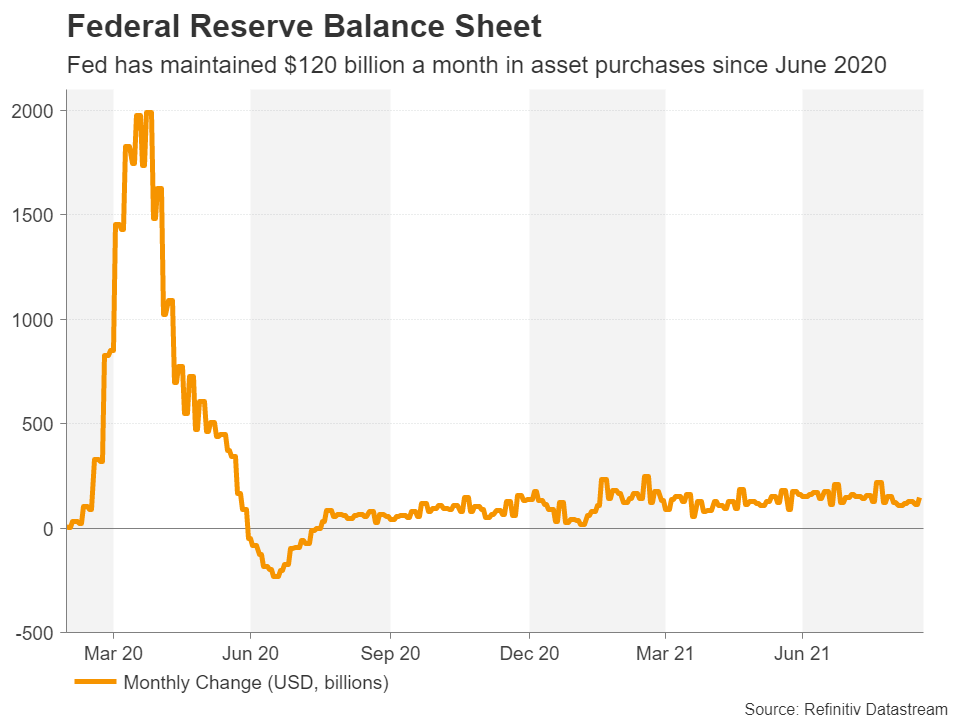
While this would mark a momentous point in the Fed’s own fight against the pandemic, the well-telegraphed move is unlikely to spark many fireworks in the markets. Investors will instead be focusing their attention on the updated economic projections, which of course include the famous dot plot chart.
Markets eyeing earlier rate hike
Back in June, FOMC participants had pencilled in the first post-pandemic rate hike for some time in 2023. But 2022 was a close call and it would only take three FOMC members to change their dots to bring forward the median prediction for a rate rise from 2023 to next year. Markets are already betting on an end of 2022 rate hike so such a signal would not lead to a huge repricing in fed fund futures.
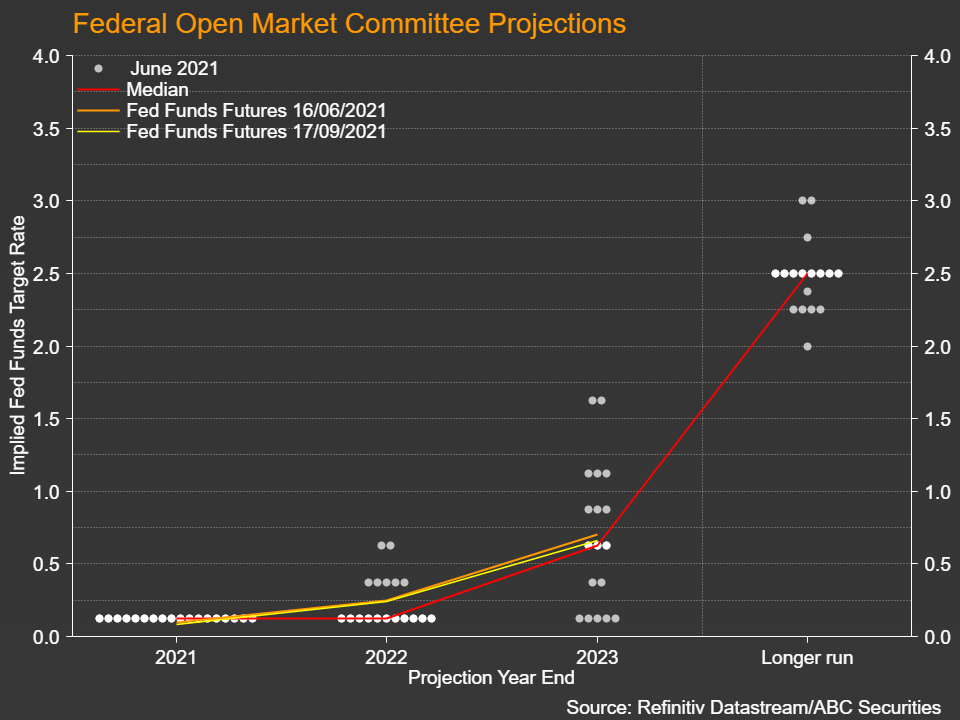
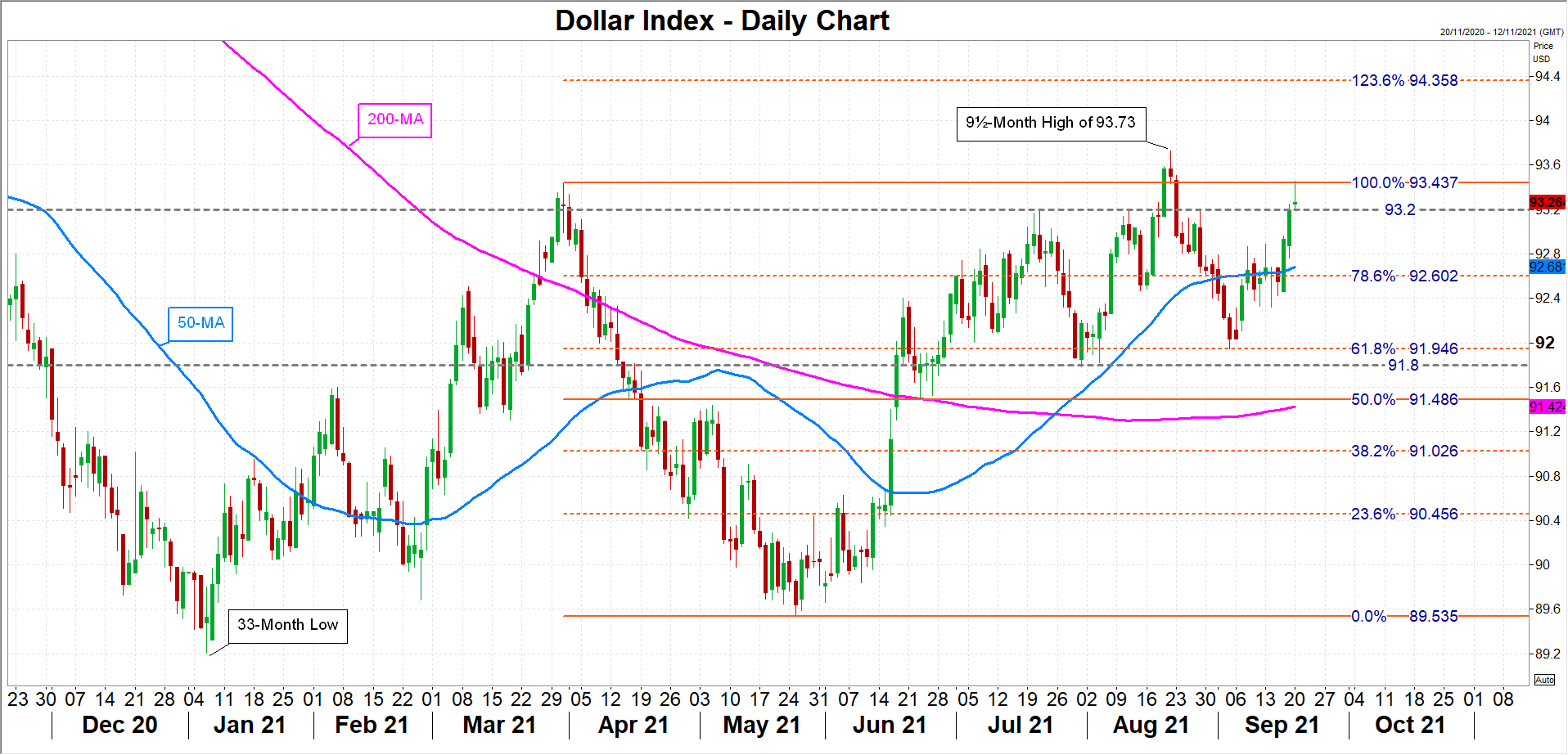
Nevertheless, it would go a long way in confirming that tapering is definitely on the way whilst clarifying the Fed’s exit strategy from pandemic-era stimulus. The US dollar, which has been rebounding sharply from its early September lows, could stretch its gains if the Fed clearly flags taper action in November. Having just cracked above the 93.20 resistance, the dollar index could climb back towards its August peak of 93.73, before aiming for the 123.6% Fibonacci extension of the March-May downleg at 94.36.
A dovish Powell is dollar’s biggest risk
However, if the Fed does take a big step towards tapering but either the dot plot stays unchanged or the FOMC statement simply doesn’t deliver on the hawkish rhetoric, the dollar could come under selling pressure. The key support to the downside for the dollar index is the 50-day moving average just below 92.70, with the 61.8% Fibonacci of 91.95 being another critical level to watch.
Fresh jitters about the Chinese economy have added some uncertainty going into the meeting. But even if the fallout from the Evergrande crisis were to escalate, the Fed is already seen as being behind the inflation curve, so policymakers are unlikely to be able to delay tapering beyond the end of this year. A bigger risk for Wednesday is probably what Fed chief Jerome Powell says about inflation – whether he thinks it is levelling off, how worried he is about a slowdown in growth, and if he makes any remarks about the longer term outlook for US rates.
Some Risk Composure Reasserted
Notes/Observations
- Riksbank steered clear of signaling any post-pandemic tightening.
- Indonesia keep key rate at record low to continue to support economy after the recent Covid outbreak.
- Number of different clouds of concern and risk factors over the past few sessions (impending collapse of the Chinese real estate giant Evergrande, a rising battle over US self-imposed Federal debt ceiling; uncertainty over Fed's signaling in new forecasts).
- Some calm returning to market on hopes of a road out of the Evergrande corporate crisis (aka having authorities to step in to conduct a managed restructuring of the company's debt to prevent disorderly debt-recovery efforts).
Asia
- RBA Sept Minutes reiterated its forward guidance that that conditions to raise rates would not be met before 2024 at the earliest. considerable uncertainty about the timing and pace of the recovery, which was likely to be slower than experienced earlier in 2021.
- RBNZ Assistant Gov Hawkesby stated that did not regret to reduce stimulus back in Aug. MPs noted more confidence in meeting goals, given uncertainty central banks move in 25bps increments.
- Evergrande Chairman noted he was confident the firm would walk out of its darkest moment and deliver property projects, Must fulfil responsibilities to property buyers, investors , partners and financial institutions.
- S&P stated it did not expect China Govt to provide support for Evergrande. Believed China banking sector could digest Evergrande default with no significant disruption but would be mindful of potential knock on effects.
- S&P downgraded another Chinese property developer (Sinic Holdings).
Coronavirus
- White House Covid adviser Zients confirmed US to reopen travel to fully vaccinated foreign nationals, CDC to determine what would be deemed fully vaccinated.
Europe
- ECB's Villeroy (France): No doubt that inflation rate will fall below 2% by 2023 but ECB would need to keep policy accommodative.
- ECB's Kazaks (Latvia) stated that Inflation rise is hump shaped and transitory.
- Business Min Kwarteng and Regulator OFGEM joint statement noted that If an energy supplier failed were committed that consumers would face least amount of disruption as possible. Central to any next steps was our clear and agreed position that energy price cap would remain in place.
- UK PM Johnson stated while en route to US that would prefer a great free trade agreement (FTA) over a quick trade deal.
Americas
- House Speaker Pelosi and Sen. Schumer (D-NY) confirmed continuing resolution to deal with debt limit; Seeking debt limit suspension through Dec 2022.
- GOP Senate Minority Leader McConnell reiterated stance that Democrats would not get GOP help on debt limit.
- House Speaker Pelosi might need votes from the Republicans if she hoped to pass the infrastructure Bill by next Monday (Sept 27th).
- Canada PM Trudeau projected to win 3rd term; Liberal party to form Govt (minority).
Speakers/Fixed income/FX/Commodities/Erratum
Equities
- Indices [Stoxx600 -1.67% at 454.14, FTSE -1.27% at 6,875.05, DAX -1.96% at 15,186.95, CAC-40 -1.91% at 6,444.91, IBEX-35 -1.84% at 8,599.50, FTSE MIB -2.07% at 25,178.00, SMI -1.40% at 11,768.70, S&P 500 Futures -1.08%].
- Market focal points/Key themes: European indices open higher across the board and pushed higher as the session progressed; sectors leading towards the upside include financials; industrials and materials among the underperforming sectors; Universal Music debuts on market; National Express in talks to take over Stagecoach; Shell to sell it's Permian assets to ConocoPhilips; earnings expected in the upcoming US session include Adobe, AutoZone and FedEx.
Equities
- Consumer discretionary: Universal Music Group [UMG.NL] +40% (1st day of trading), Vivendi [VIV.FR] -14% (distribution related to UMG's IPO), International Consolidated Airlines Group [IAG.UK] +7% (EasyJet CEO comments).
- Consumer staples: National Express Group [NEX.UK] +4% (merger talks).
- Energy: Royal Dutch Shell [RDSA.UK] +4% (divestment).
- Industrials: Stagecoach [SGC.UK] +17% (confirms merger talks with National Express), Kingfisher [KGF.UK] -5% (earnings).
Speakers
- ECB’s De Guindos (Spain reiterated view that EU Q3 GDP growth to be strong. Saw CPI possibly peaking between 3.4-3.5% in Nov. Needed to remain vigilant for upside surprises on inflation but saw no indications that wages were on the rise.
- ECB's Stournaras (Greece): ECB may need to recalibrate APP. Expect ECB to buy Greek debt in QE when PEPP program ends. Council has accepted that inflation has an upside risk.
- Sweden Central Bank (Riksbank) Polist Statement reiterated its forward guidance that Repo rate expected to remain at zero for entire forecast period, at least until Q3 2024. To continue purchasing securities in Q4, in line with earlier plan; Riksbank holdings would be more or less unchanged in 2022. Announced it would cose lending facilities launched in pandemic.
- Sweden Central Bank (Riksbank) Gov Ingves post rate decision press conference noted that the uptick in inflation was welcomed but move seen as temporary.
- Russia Central Bank 1st Dep Gov Shvetsov: To maintain CPI target close to 4.0% in 2022.
- Czech Central Bank's Holub (chief economist) stated that was likely to support a 50bps hike at Sept 30's meeting. Monetary tightening expected to continue into 2022 at a moderate pace.
- Indonesia Central Bank Policy Statement reiterated stance that decision to keep policy steady in-line with need to keep IDR currency (Rupiah) steady amid low inflation outlook and support growth. Policy stance remains accommodative.
- Indonesia Central Bank (BI) Gov Warjiyo pre-rate decision comment saw global 2021 GDP growth at 5.8% and aided by trade and commodities. Indonesia trade surplus to help the current account balance. Reiterated stance to stabilize the IDR currency (rupiah) to be in-line with fundamental.
- OPEC Sec Gen Barkindo stated that gas crisis shows more oil and gas investment needed. OPEC is not concerned about supply surplus in 2022.
- Russia budget said to raise 2021 oil production to 516.8M tons.
Currencies/Fixed income
- USD was slightly lower during the EU session as markets steady after Monday's turbulence. Unwinding of some safe-haven flows.
- Some analysts noted that the potential debt crisis in China appears to have Chinese government not want to be seen as engineering a bailout but could still see a road out of the crisis (aka having authorities to step in to conduct a managed restructuring of the company's debt to prevent disorderly debt-recovery efforts).
- EUR/USD at 1.1730 by mid-session.
- USD/JPY at 109.65 by mid-session.
Economic data
- (FI) Finland Aug Unemployment Rate: 6.5% v 7.1% prior.
- (UK) Aug Public Finances (PSNCR): +£5.8B v -£2.3B prior; Public Sector Net Borrowing: £19.8B£14.6Be; Central Government NCR: £8.5B v £1.8B prior; PSNB (ex-banking groups): £20.5B v £15.6Be.
- (CH) Swiss Aug Trade Balance (CHF): 5.1B v 5.3B prior; Real Exports M/M: -0.4% v +1.1% prior; Real Imports M/M: 0.2% v 1.0% prior; Watch Exports Y/Y: 11.5% v 29.1% prior.
- (JP) Japan Aug Final Machine Tool Orders Y/Y: 85.2% v 86.2 prelim.
- (CH) Swiss Aug M3 Money Supply Y/Y: 3.1% v 3.3% prior.
- (ZA) South Africa July Leading Indicator: 122.0 v 125.1 prior.
- (ID) Indonesia Central Bank (BI) left the 7-Day Reverse Repo Rate unchanged at 3.50% (as expected).
- (SE) Sweden Central Bank (Riksbank) left the Repo Rate unchanged at 0.00% (as expected).
- (SE) Sweden Aug Unemployment Rate: 8.5% v 8.0% prior; Unemployment Rate (seasonally adj): 8.8% v 8.4% prior; Trend Unemployment Rate: 8.9% v 9.00% prior.
- (PL) Poland Aug Real Retail Sales M/M: -1.0% v -0.7%e; Y/Y: 5.4% v 5.5%e; Retail Sales Y/Y: 10.7% v 10.5%e.
- (PL) Poland Aug Construction Output Y/Y: 10.2% v 8.0%e.
- (BE) Belgium Sept Consumer Confidence: 8 v 5 prior.
Fixed income issuance
- (ID) Indonesia sold total IDR6.1T vs. IDR10.0T target in Islamic bills and bonds (sukuk).
- UK DMO opened its book to sell new 0.875% July 2033 green Gilts via syndicate; spread set at +7.5bps to UK Treasuries; order book above £65B.
Looking ahead
- 05:25 (EU) Daily ECB Liquidity Stats.
- 05:30 (HU) Hungary Debt Agency (AKK) to sell 3-Month Bills.
- 05:30 (DE) Germany to sell€3.0B in 0.25% Nov 2028 Bunds.
- 05:30 (EU) ECB allotment in 7-Day Main Refinancing Tender (MRO).
- 05:30 (ZA) South Africa to sell combined ZAR3.9B in 2030, 2044 and 2048 bonds.
- 06:00 (UK) Sept CBI Industrial Trends Total Orders: 16e v 18 prior; Selling Prices: 43e v 43 prior.
- 06:00 (FI) Finland to sell €1.0B in 2.625% Apr 2042 RFGB bonds.
- 06:30 (EU) ESM to sell €1.5B in 6-month Bills.
- 06:45 (US) Daily Libor Fixing.
- 07:00 (TR) Turkey to sell Bonds (2 tranches).
- 08:00 (HU) Hungary Central Bank (MNB) Interest Rate Decision: expected to raise Base rate by 25bps to 1.75%.
- 08:00 (UK) Daily Baltic Dry Bulk Index.
- 08:00 (RU) Russia announcement on upcoming OFZ bond issuance (held on Wed).
- 08:30 (US) Aug Housing Starts: 1.555Me v 1.534M prior; Building Permits: 1.600Me v 1.630M prior (revised from 1.635M).
- 08:30 (US) Q2 Current Account Balance: -$191.0Be v -$195.7B prior.
- 08:55 (US) Weekly Redbook LFL Sales data.
- 09:00 (EU) Weekly ECB Forex Reserves.
- 09:00 (HU) Hungary Central Bank (MNB) Gov Matolcsy post rate decision statement.
- 09:45 (EU) ECB weekly QE bond buying update.
- 09:45 (UK) BOE to buy £1.47B in APF Gilt purchase operation (20+ years).
- 10:00 (MX) Mexico Weekly International Reserve data.
- 15:00 (AR) Argentina Q2 GDP Q/Q: No est v 2.6% prior; Y/Y: No est v 2.5% prior.
- 16:30 (US) Weekly API Oil Inventories.
- 18:01 (NL) Netherlands Aug House Price Index M/M: No est v 2.4% prior; Y/Y: No est v 16.3% prior.
- 20:30 (AU) Australia Aug Leading Index M/M: No est v -0.1% prior.
- 21:00 (AU) RBA's Bullock speech.
- 21:30 (CN) China PBoC Monthly Loan Prime Rate Setting; Expected to leave 1-year LPR and 5-year LPR unchanged at 3.85% and 4.65% respectively.
- (JP) Bank of Japan (BOJ) interest Rate Decision: expected to leave Interest rate on Excess Reserves (IOER) unchanged at -0.10% and maintain 10-year Yield Target (YCC) at 0.00%.
Calmer Markets Despite Evergrande Risks, Loonie Jumps On Trudeau Win
- Fears of Evergrande contagion ease slightly but markets remain edgy
- Loonie soars after Trudeau narrowly secures third term
- Aussie and kiwi brush off dovish reserve banks
- Pound up too but UK energy crisis a worry, dollar off highs
 Stocks bounce back after Evergrande panic
Global equities were steadier on Tuesday, recouping some of the previous days’ losses, as fears of a huge spillover from Evergrande’s debt crisis subsided a little. As investors increasingly liken the Evergrande crisis with the collapse of the Lehman Brothers in 2008, they remain in the dark about the Chinese government’s intentions on whether or not to rescue the world’s most indebted real estate developer.
The secrecy behind a possible state bailout to prevent a collapse in China’s biggest property company will likely keep markets nervous over the next few days when two interest payments are due on its bonds. The first payment is on Thursday, which if Evergrande defaults, could quickly escalate the fallout, potentially triggering an even sharper selloff than those seen in recent sessions.
While some traders do not foresee a widespread global contagion should a default occur, the risk of a domino effect in China’s troubled property sector is uncomfortably high and it’s unclear how well authorities would be able to contain a major blowup.
For now, the mood has calmed a bit, with plenty of other events for investors to focus their attention on. The Hang Seng index turned positive to close up 0.5% after slumping to a fresh one-year low earlier in the day. US stock futures also rebounded and were last trading around 1.5% higher. The S&P 500 closed at a near two-month low on Monday, but its woes may not be over as the Fed begins a two-day monetary policy meeting today to debate how soon stimulus should be withdrawn.
Dollar retreats slightly, loonie jumps on election outcome
Although it’s unlikely policymakers will reach a tapering decision this week, they will likely signal that an announcement should be expected at the next meeting in November. However, investors are probably more concerned about the timing of the first post-pandemic rate hike. The Fed is due to publish its updated dot plot chart tomorrow and should FOMC members predict a rate hike in 2022, that could lift Treasury yields and the US dollar slightly.
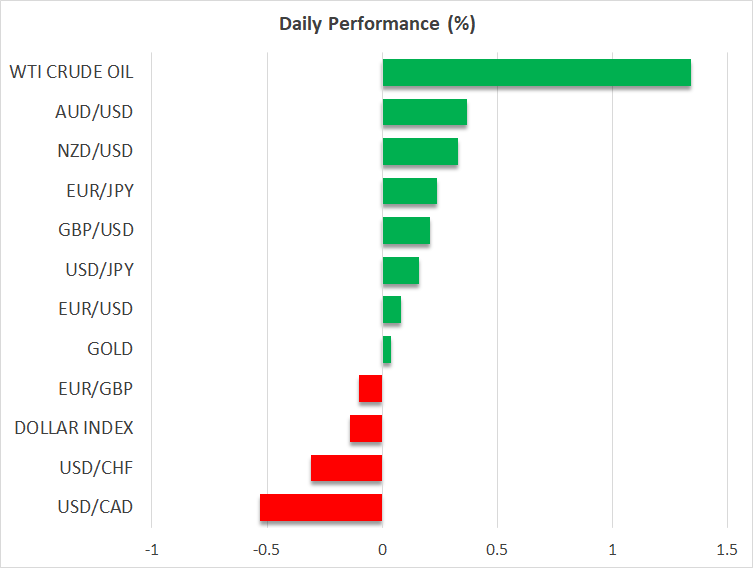
The dollar index is marginally lower today amid the somewhat improved risk appetite. The yen is also broadly weaker, with the risk-sensitive commodity dollars among the best performers, led by the loonie.
The Canadian dollar is up more than 0.5% versus its US counterpart, boosted by Canada’s election outcome that’s seen as maintaining the status quo. The ruling Liberal party won the most seats in yesterday’s federal vote, securing Prime Minister Justin Trudeau a third term in government. Although Trudaeu once again failed to get the majority he wanted, he should still be able to lead a minority government, keeping his party’s spending pledges intact and eliminating the immediate downside risks for the loonie from a more fiscally prudent administration.
Aussie and kiwi perk up, pound lags
The Australian and New Zealand dollar were also attempting a decent rebound on Tuesday as the mood brightened.
The kiwi fought off some selling pressure after RBNZ Assistant Governor Christian Hawkesby downplayed the possibility of a 50 basis point rate rise at the October meeting. The RBA, meanwhile, reiterated its dovish stance in the minutes of its September policy meeting, sounding more worried about a slower recovery from the Delta variant. But on the whole, the minutes offered nothing new and the aussie is up 0.3% today.
The pound climbed as well, though more modestly, amid growing concerns about the impact on the British economy by a looming energy crisis in the country. The UK’s overreliance on natural gas for electricity has left energy firms highly exposed to the recent surge in prices and may need government help to stay afloat.
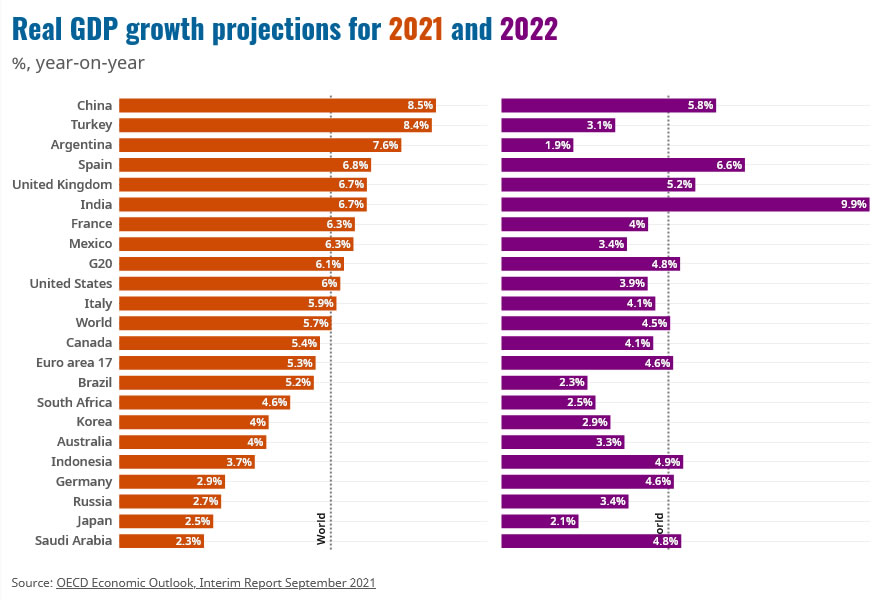
OECD lowers 2021 global growth forecast slightly to 5.7%
OECD lowered 2021 global growth forecast slightly to 5.7%, down from May's projection of 5.8%. 2022 global growth was revised slightly higher to 4.5%, up from 4.4%. It added, "the global economy is growing far more strongly than anticipated a year ago but the recovery remains uneven, exposing both advanced and emerging markets to a range of risks".
It also said there is a "marked variation in the outlook for inflation". But the inflationary pressures "should eventually fade". "Consumer price inflation in the G20 countries is projected to peak towards the end of 2021 and slow throughout 2022. Wage growth remains broadly moderate and medium-term inflation expectations remain contained."
Chief Economist Laurence Boone said: "Policies have been efficient in buffering the shock and ensuring a strong recovery; planning for more efficient public finances, shifted towards investment in physical and human capital is necessary and will help monetary policy to normalise smoothly once the recovery is firmly established."
European, US Stock Markets Drop On Evergrande Worries
European and US stockmarkets retreated considerably yesterday as worries about a possible collapse of China’s mega developer Evergrande tended to intensify, especially for a possible contagion. It’s characteristic that all three major US indexes retreated with Dow Jones and S&P 500 leading the way since their last highs early September. It should be noted that Evergrande is considered to be one of the largest property Developers in China and has more than $300 billion in liabilities, and most analysts expect the developer to default. A rescue with an intervention by the Chinese government could be possible yet for the time being does not seem probable and the risk of defaulting rises as two major interest payments are due in the following days. The bearish sentiment intensified for the US stockmarkets as the risk factor increased due to US Congress failure to reach a deal about raising the US debt ceiling, thus risking the US government defaulting by mid-October. Should there be any signs of the Evergrande issue being containable, we may see the rebound of the US stockmarkets extending and vice versa.
Dow Jones dropped yesterday breaking all of our support levels yet managed to recover somewhat and float above the 34060 (S1) support level. The bears seem to remain in neighborhood, yet the correction higher seems to be gaining momentum as the RSI indicator is below the reading of 50 yet with an upward slope. Should the bears actually maintain control over the index, we may see Dow Jones breaking the 34060 (S1) support line and aim if not breach also the 33740 (S2) level. Should the bulls take over, we would expect the index to break the 34400 (R1) resistance line and aim for the 34700 (R2) level.
BoJ to maintain accommodative stance
During Wednesday’s Asian session, we get BoJ’s interest rate decision, and the bank is widely expected to remain on hold at -0.10% as JPY OIS imply a probability of 97.79% for such as scenario to materialize currently. In general, we would expect the bank to maintain a wait and see position keeping an accommodative stance, with an eye on Japan’s fundamentals and the path of the Japanese economic recovery. We would like to highlight though that the momentum in the Japanese economy seems to be easing despite the GDP rate for Q2 having accelerated. Overall, the bank’s meeting could pass as a non-event unless the bank deepens its dovishness, given the most recent wave of the pandemic that has passed over Japan in August and the resignation of Japan’s PM Suga.
USD/JPY dropped yet remained in the boundaries of its sideways movement between the 109.25 (S1) support line and the 110.20 (R1) resistance line, as both levels have been extensively tested since the 16th of August. We tend to maintain a bias for a sideways motion between the aforementioned levels, given also that the RSI indicator below our 4-hour chart is near the reading of 50, implying a rather indecisive market. Should market display a selling interest we may see GBP/USD breaking the 109.25 (S1) support line and aim for the 108.45 (S2) level. Should buyers be in control of the pair’s direction, we may see the pair breaking the 110.20 (R1) resistance line paving the way for the 110.90 (R2) level.
Other economic highlights today and the following Asian session:
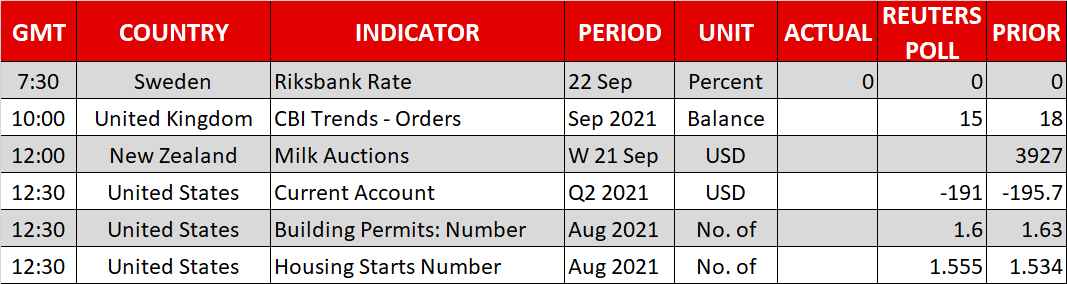
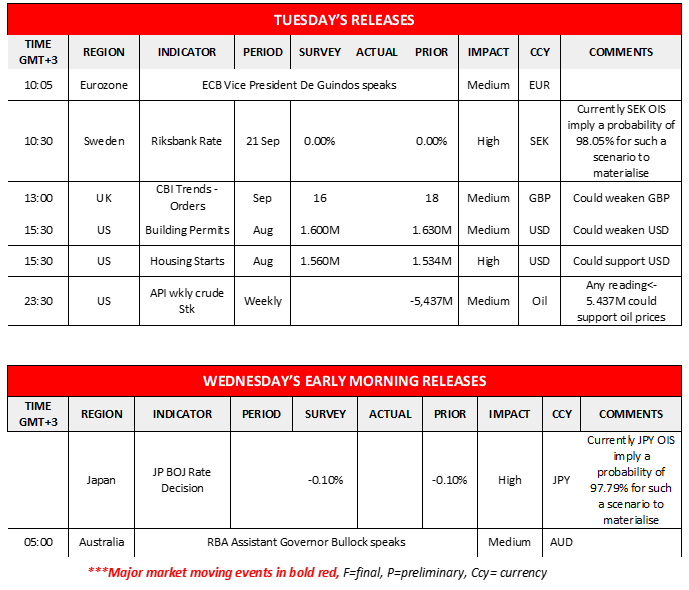
During today’s European session, besides Riksbank’s interest rate decision, we also note the speech of ECB vice president De Guindos and UK’s CBI trends (orders) for August. In the American session, we get from the US the number of building permits and housing starts, with the releases being simultaneous and both being for the month of August. Just before the Asian session starts oil traders may be interested in the release of the API weekly crude oil inventories figure.
US30 Cash H4 Chart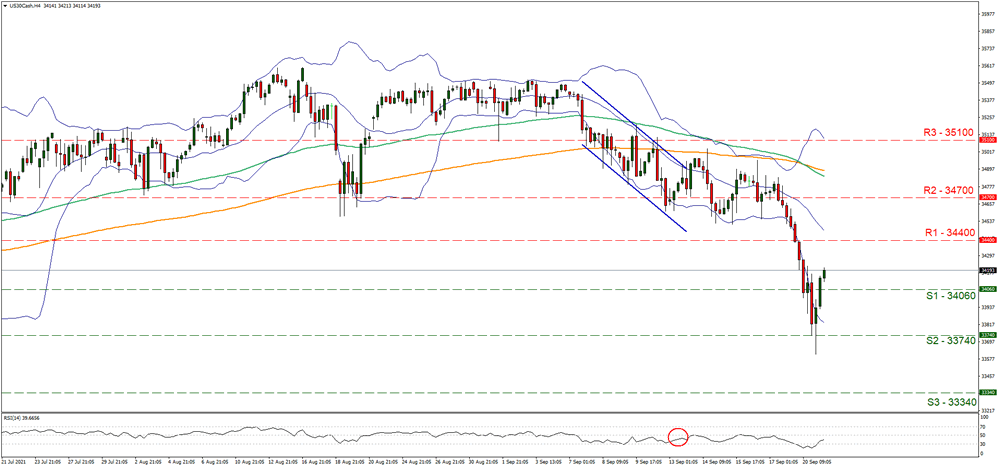
Support:34060 (S1), 33740 (S2), 33340 (S3)
Resistance: 34400 (R1), 34700 (R2), 35100 (R3)
USD/JPY H4 Chart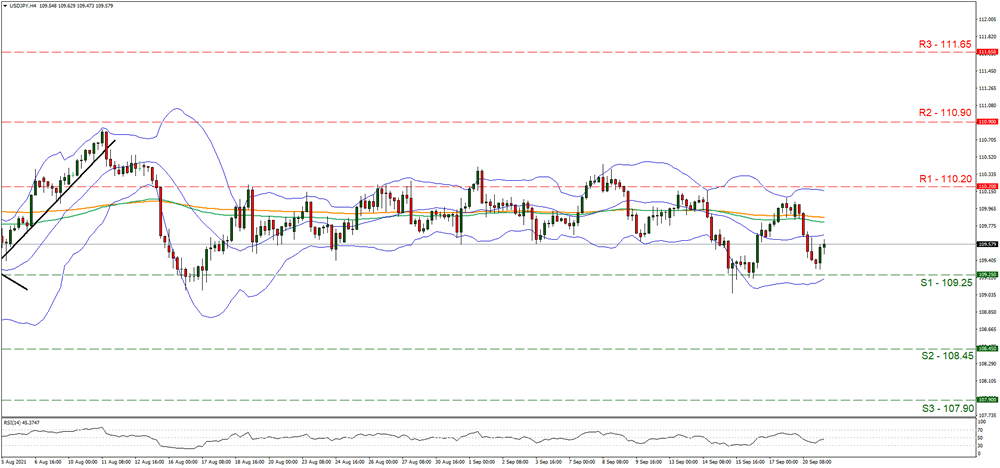
Support: 109.25 (S1), 108.45 (S2), 107.90 (S3)
Resistance: 110.20 (R1), 110.90 (R2), 111.65 (R3)
Global Stock Markets Fall Amid Problems With Evergrande And Expectations Of The QE Program Reduction
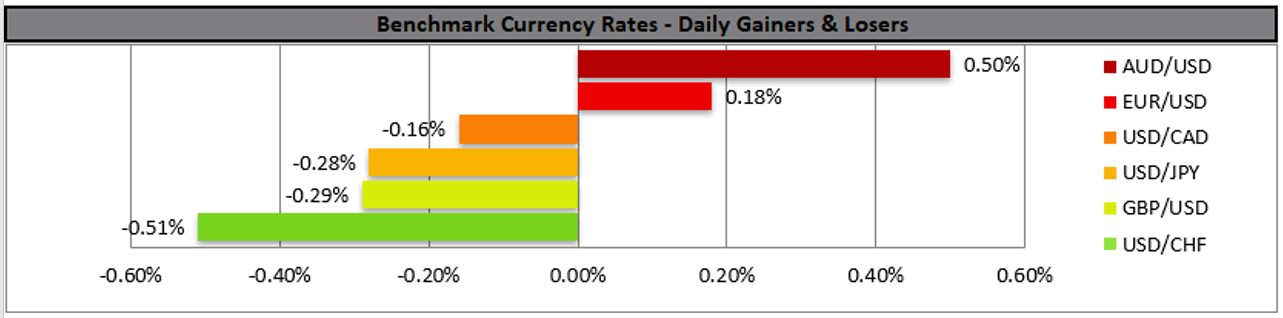
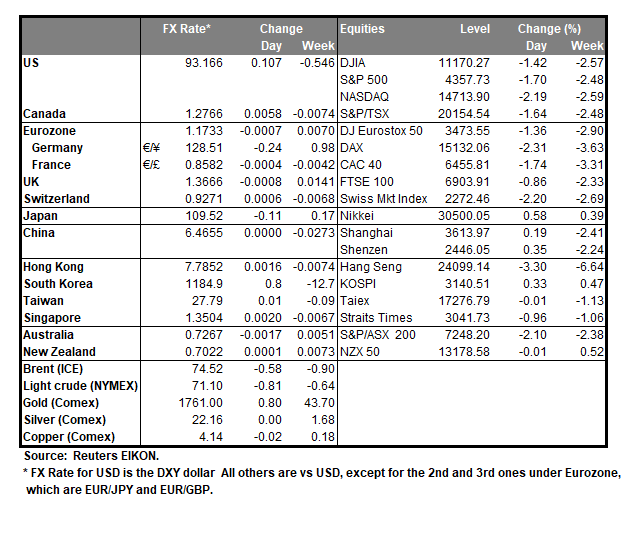
Monday, September 20, was the worst day for the US market in almost a year. At the stock market’s close, the Dow Jones decreased by 1.78% to a 1-month low, the S&P 500 decreased by 1.70%, and the NASDAQ lost 2.19%. The sell-off was triggered by investor concerns about the possible bankruptcy of Evergrande, China's largest real estate developer, and expectations of a reduction in the Federal Reserve's stimulus programs. Also, the VIX volatility index, also known as the fear index, reached a maximum of four months. Morgan Stanley analysts warn that they do not exclude the chances of the S&P 500 to correct by 20% or more.
The debt problems of Chinese real estate developer Evergrande Group have raised strong concerns among investors worldwide. The company has accumulated more than $300 billion in debt and acknowledged the possibility of defaulting on its debt last week. Market fears are also associated with the fact that Beijing's actions will lead to a drop in real estate values in mainland China and Hong Kong.
European and Asian markets also fell on Monday. The British FTSE 100 index decreased by 0.9% (to a two-month low), the German DAX lost 2.3% (its lowest level since May 19), and the French CAC 40 decreased by 1.7% (to a two-week low). Spain's IBEX 35 lost 2.6%, and Italy's FTSE MIB decreased by 1.2%. Europe's banking sector and automaker stocks collapsed yesterday. Energy problems in Europe aggravate the situation, which is likely to strengthen inflation dynamics in the near future. Fears of life insurance company bankruptcies are growing in Germany. 20 out of 80 life insurers are under tighter supervision of the BaFin financial regulator.
Oil prices are rising slowly amid signals of supply shortages in the US. Analysts at ANZ say global companies are switching to fuel oil because of rising natural gas and coal prices and ongoing shutdowns in the Gulf of Mexico after Hurricane Ida. It indicates reduced supplies.
Precious metal prices have not changed much for the last session.
Japanese and Hong Kong stock markets are trading in a bearish trend, while Australia's ASX200 index is rising after a Reserve Bank of Australia meeting. The regulator left its key rate at a record low but approved a plan to cut stimulus starting from November 2021. South Korea's and mainland China exchanges are closed due to holidays. The New Zealand dollar fell after the central bank's assistant governor mentioned a possible 50 basis point interest rate hike next month. The Chinese yuan fell to a one-month low, while the US dollar and Japanese yen remained a safe haven for investors.
Canadian Prime Minister Justin Trudeau is close to winning the election, but Trudeau's party will likely lose the fight for a parliamentary majority.
The White House says that the ban on UK and EU travelers to the US will be lifted in November. The UK Prime Minister Boris Johnson welcomed this step.
Main market quotes:
- S&P 500 (F) 4,357.73 −75.26 (−1.70%)
- Dow Jones 33,970.47 −614.41 (−1.78%)
- DAX 15,132.06 −358.11 (−2.31%)
- FTSE 100 6,903.91 −59.73 (−0.86%)
- USD Index 93.24 +0.05 (+0.05%)
Important events for today:
- RBA Meeting Minutes at 04:30 (GMT+3);
- US Building Permits (m/m) at 15:30 (GMT+3).
USD/ZAR Bearish SHS Pattern Formation
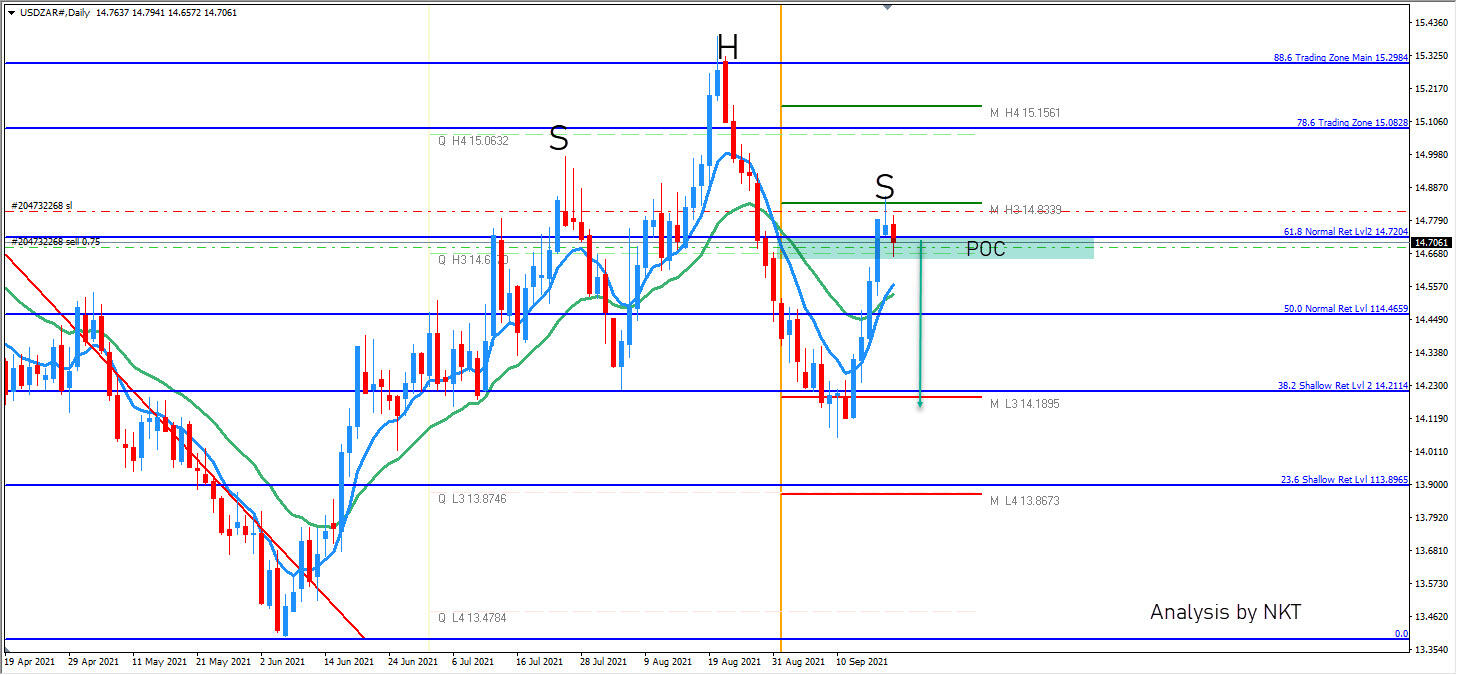
The USD/ZAR has made a bearish SHS formation. We should see a move down.
MH3 is the right shoulder of the bearish formation. We can see the pin bar rejection at the M H3. The shooting star is the signal for a short trade. The zone is clear. 14.700-72 is the zone where we could see a move down. Watch for a bearish momentum up there. If M H3 stays strong we should see a drop towards 14.460 and 14.210.
The Analytical Overview Of The Main Currency Pairs
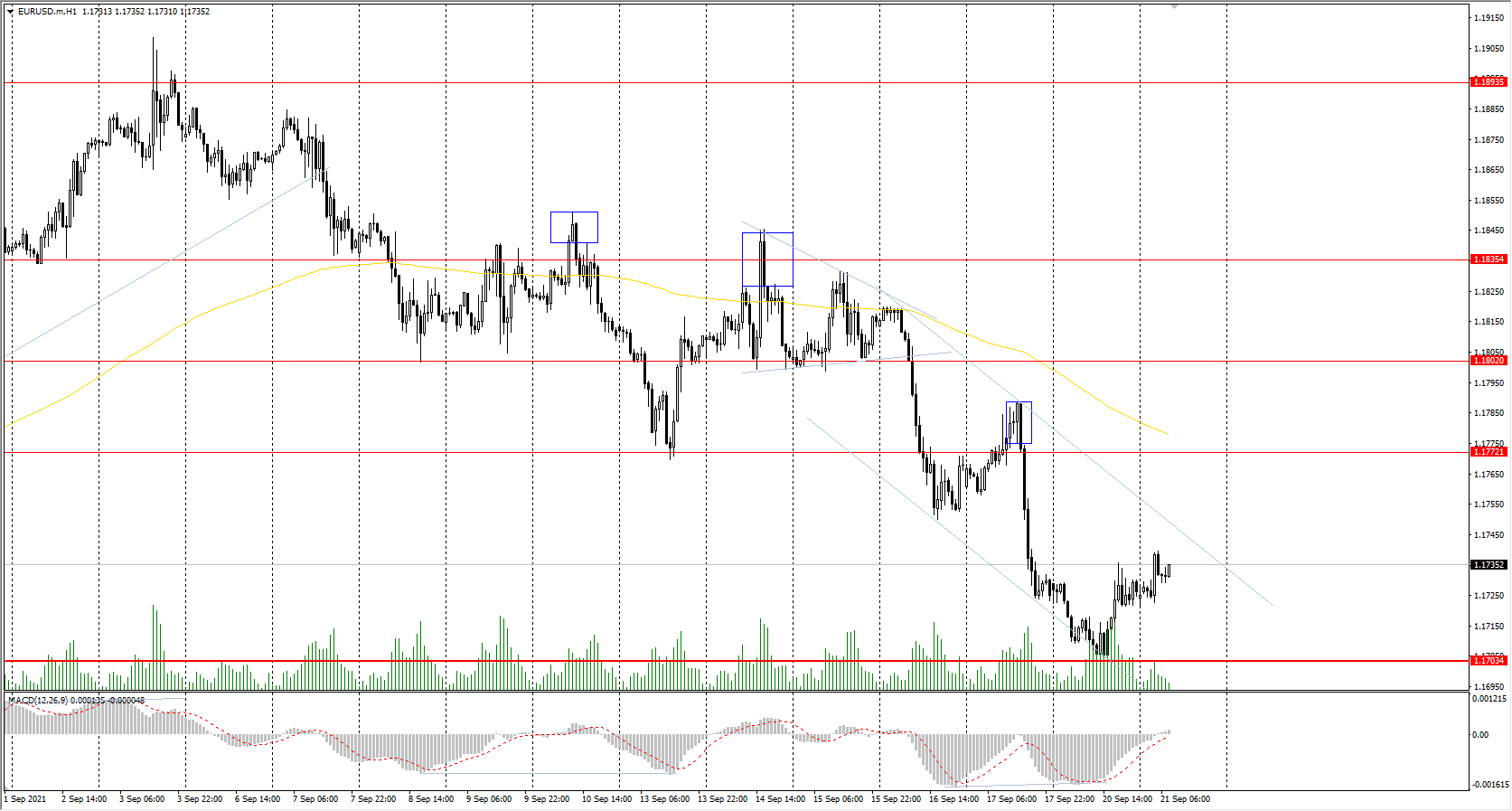
The EUR/USD currency pair
Technical indicators of the currency pair:
Prev Open: 1.1729
Prev Close: 1.1725
% chg. over the last day: -0.03%
Despite the growth of the German producer price index by 12%, the German Dax index decreased by 2.3% yesterday amid general concerns over the Evergrande problems. Europe's banking sector and automaker stocks collapsed. Energy problems in Europe aggravate the situation, which is likely to strengthen inflation dynamics in the near future.
Trading recommendations
Support levels: 1.1704, 1.1620
Resistance levels: 1.1772, 1.1802, 1.1835, 1.1894, 1.1934, 1.1969
From the technical point of view, the general trend of the EUR/USD currency pair is bullish. Yesterday, the price reached the priority change level but couldn't break through it. The MACD indicator is in the negative zone, but there are also signs of overselling and reversal. Under such market conditions, the buy deals from the priority change level can be considered. This is where the buyers show initiative. It is best to look for sell trades throughout the day, from the resistance zone near the moving average.
Alternative scenario: if the price breaks down through the 1.1704 support level and fixes below, the mid-term uptrend will likely be broken.
News feed for 2021.09.21:
- US Building Permits (m/m) at 15:30 (GMT+3).
The GBP/USD currency pair
Technical indicators of the currency pair:
Prev Open: 1.3731
Prev Close: 1.3651
% chg. over the last day: -0.58%
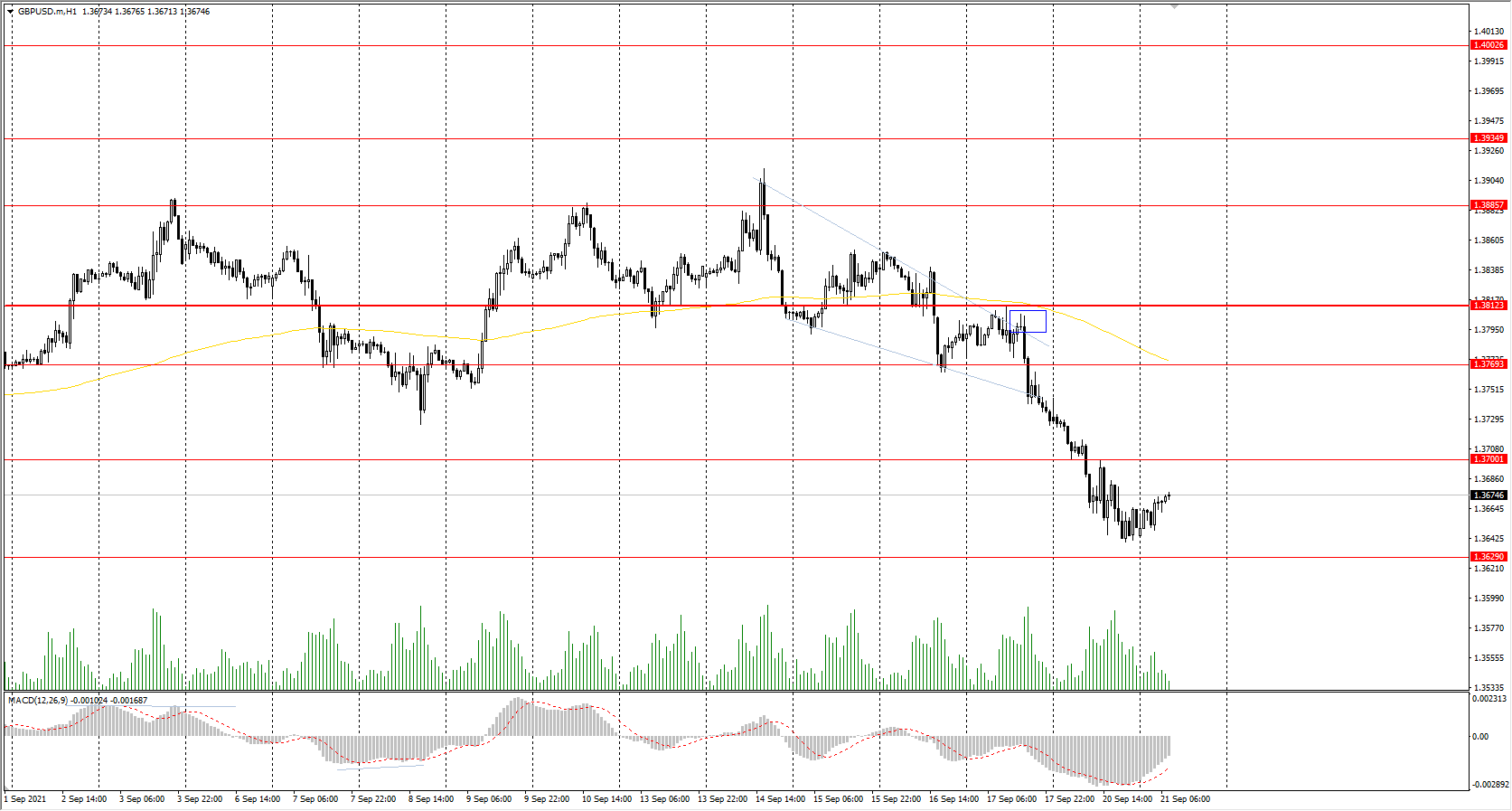
There is an increase in the three-month dollar LIBOR rate in the interbank market in London. It indicates the demand for the US currency. The British pound has been losing its positions against the US dollar for the last 5 trading sessions. The UK is getting ready to distribute a booster vaccine to people over 50.
Trading recommendations
Support levels: 1.3629, 1.3614, 1.3525
Resistance levels: 1.3701, 1.3769, 1.3812, 1.3886, 1.3935, 1.4002
On the hourly time frame, the GBP/USD trend changed to bearish. GBP/USD currency pair is under sellers' pressure now. The MACD indicator is in the negative zone, but there are signs that the sell-off is slowing down. Under such market conditions, it is better to look for sell deals from resistance levels near the moving average. Buy trades should be considered only throughout the day and only with short targets from the support levels of higher time frames.
Alternative scenario: if the price breaks out through the 1.3812 resistance level and consolidates above, the bullish scenario will likely resume.
The USD/JPY currency pair
Technical indicators of the currency pair:
Prev Open: 109.91
Prev Close: 109.38
% chg. over the last day: -0.48%
While anticipation of a new government has already raised Tokyo stocks to their highest level for 31 years, many analysts believe that the victory of the Minister of Vaccination and reform advocate Taro Kono in the September 29 election will push stock prices even higher. The Japanese yen is also strengthening ahead of the upcoming election of the prime minister.
Trading recommendations
Support levels: 109.43, 109.18, 108.65
Resistance levels: 109.82, 110.09, 110.40, 110.66, 110.95
The main trend of the USD/JPY currency pair is bearish. But amid the strengthening of the Japanese yen, the USD/JPY moved downward again. The MACD indicator is in the negative zone, but there are weak signs of buying. Under such market conditions, traders should look for sell positions from the resistance level near the moving average. Only intraday buy positions from the support levels should be considered, where there is an initiative of buyers.
Alternative scenario: if the price rises above 110.09, the uptrend is likely to resume.

The USD/CAD currency pair
Technical indicators of the currency pair:
Prev Open: 1.2756
Prev Close: 1.2819
% chg. over the last day: +0.49%
The Canadian dollar is a commodity currency, so the USD/CAD currency pair is highly dependent on the dynamics of the dollar index and oil prices. The dollar index is slowly rising, while oil prices are trading flat. As a result, the price of USD/CAD keeps moving up. Options analysis shows that the Canadian dollar has turned into one of the worst derivatives for hedge funds.
Trading recommendations
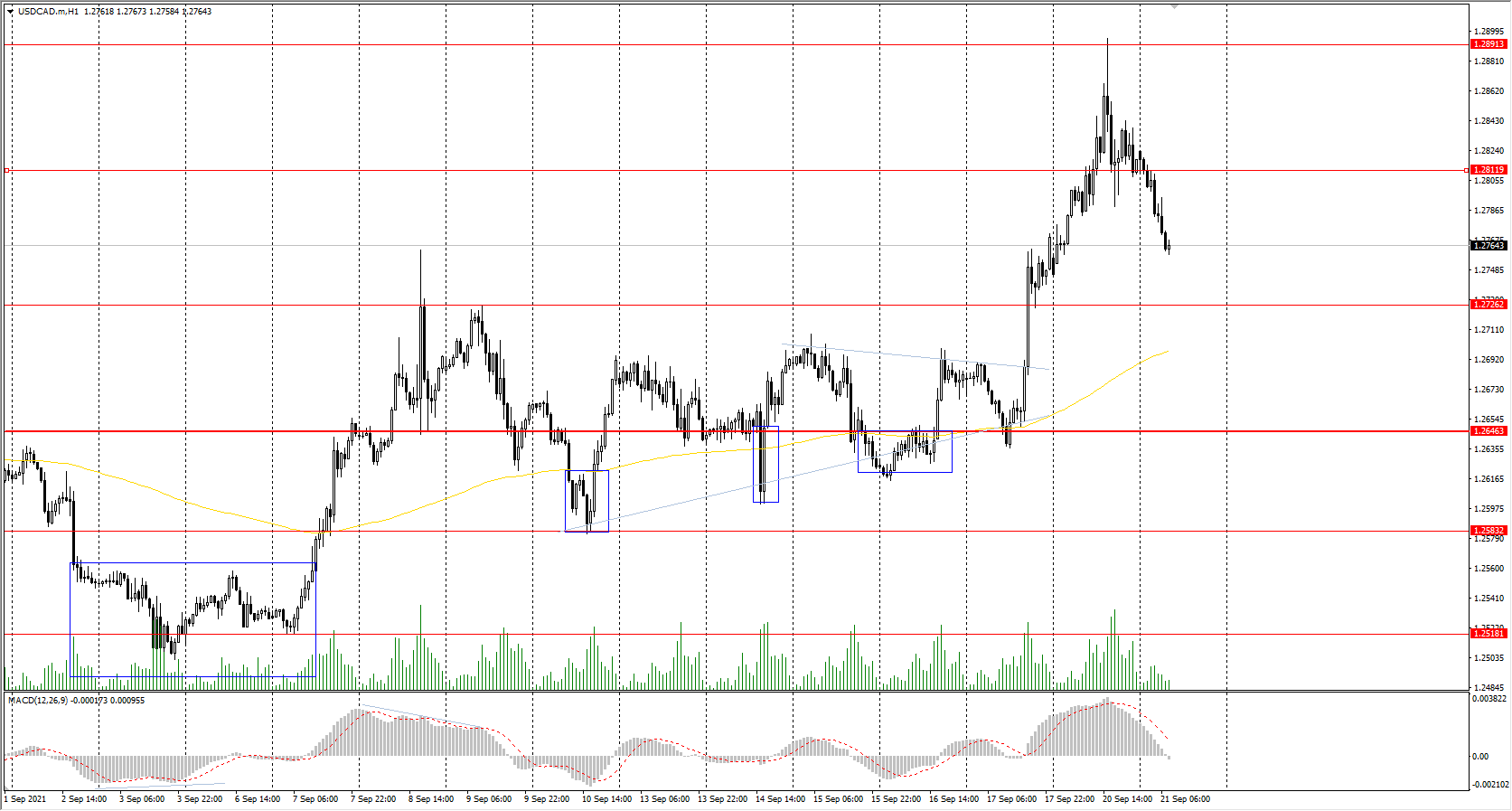
Support levels: 1.2726, 1.2646, 1.2583, 1.2518, 1.2425
Resistance levels: 1.2812, 1.2891, 1.2951
From the technical point of view, the situation is uncertain. On the one hand, the price broke through the priority change level yesterday, but on the other hand, the price quickly returned back below the level. The MACD indicator became inactive. Under such market conditions, it is better to trade within the local trend, which is obviously bullish. It is best to look for buy trades from the support levels near the moving average. There are no optimal entry points for sell positions now.
Alternative scenario: if the price breaks down through the 1.2646 support level and fixes below, the uptrend will likely be broken.
GBPUSD Slips To One-Month Low, Bias Bearish
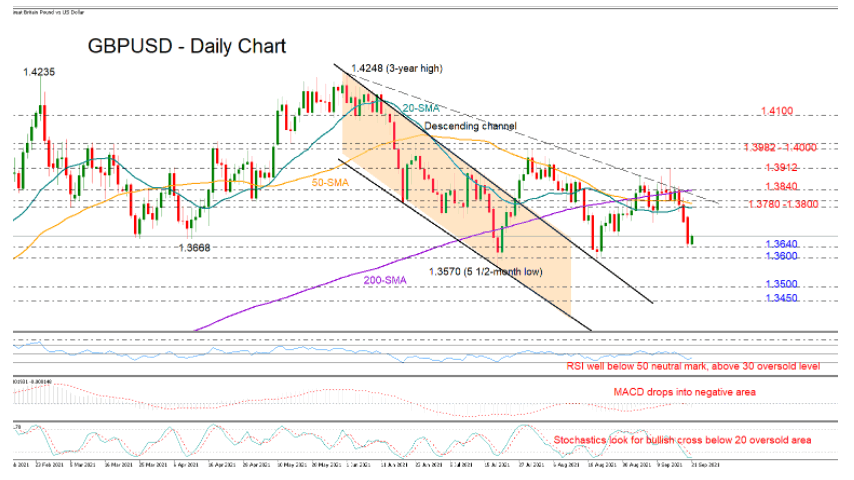
GBPUSD retraced to an almost one-month low of 1.3640 on Monday after a multi-day battle with the 200-day simple moving average (SMA) and the 1.3840 barrier, where a dashed resistance trendline also happens to be.
The pair is currently trying to heal yesterday’s wounds, but downside risks remain intact as the RSI is fluctuating comfortably below its 50 neutral mark, the Stochastics have yet to bullishly cross each other in the oversold area, and the MACD continues to stretch within the negative zone and below its red signal line.
As regards the market structure, the three-month-old neutral trajectory is still in place despite the recent sell-off and only a decisive close below the lower boundary of 1.3600 would put the pound back on the bearish path. If that is the case, support could be next detected within the 1.3500 – 1.3450 restrictive area, last active from the end of 2019 to the start of 2021.
On the upside, the bulls will need a clear victory above the 200-day SMA at 1.3840 to sustainably drive towards last week’s peak of 1.3912, though the 20- and 50-day SMAs could challenge any bullish attempts beforehand around 1.3780. Should the rally face no limits, the door would open for the 1.3982-1.4000 resistance zone, a break of which could open the door for the 1.4100 handle. Still, unless the pair resumes the long-term uptrend above the three-year high of 1.4248, there won’t be much to celebrate.
In brief, the technical signals remain discouraging for GBPUSD despite today’s push for some recovery. A move below 1.3600 could bring new sellers into the market, switching the outlook to bearish, while a bounce above 1.3840 could enhance buying exposure in the market.
GBP/JPY Daily Outlook
Daily Pivots: (S1) 148.63; (P) 149.92; (R1) 150.65; More...
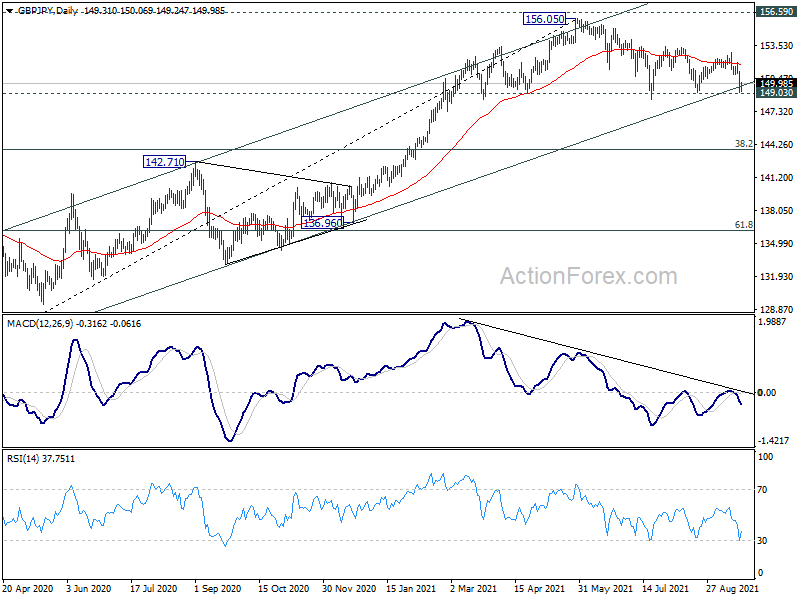
Intraday bias in GBP/JPY remains on the downside for 148.43/149.16 key support zone. Decisive break there will resume whole fall from 156.05 to 143.78 fibonacci level. On the upside, above 150.80 minor resistance will turn intraday bias back to the upside for 152.82 resistance instead.
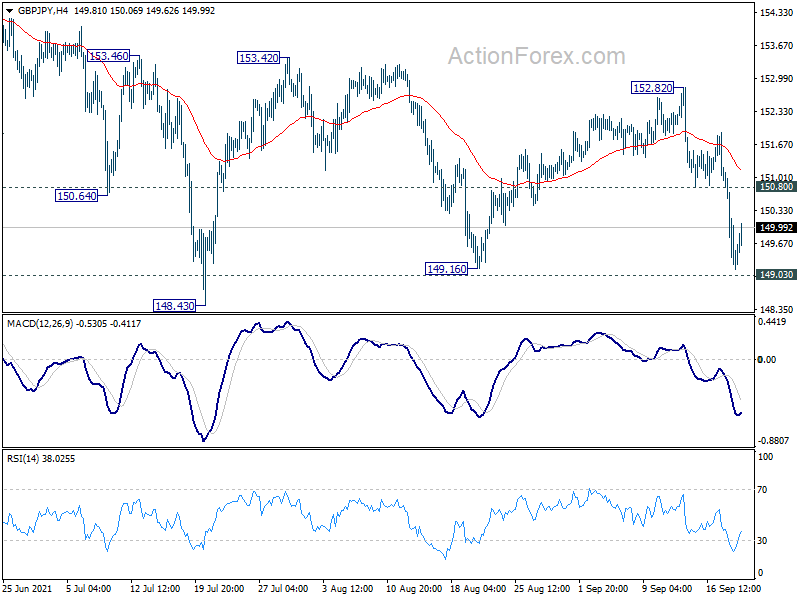
In the bigger picture, rise from 123.94 is seen as the third leg of the pattern from 122.75 (2016 low). As long as 149.03 support holds, such rise would still resume at a later stage. However, sustained break of 149.03 support will indicate rejection by 156.59. Fall from 156.05 would be at least correcting the whole rise from 123.94. Deeper fall would be seen back 38.2% retracement of 123.94 to 156.05 at 143.78 first.