Sample Category Title
Eco Data 9/22/21
[php_everywhere instance="1"]
Sunset Market Commentary
Markets
Welcome back, bargain hunters. They emerged from the sidelines today to prop up equity markets after two days of selling off. The EuroStoxx50 bounced off support at 4040 with gains of 1.5% as sentiment improved markedly. Capturing resistance around 4100 for now is a bridge too far though. US stock markets open almost 1% higher. Other risky assets including oil also perform better (Brent +0.75% to trade $74.5 a barrel). There’s no specific trigger for today’s turnaround in mood but soothing reports and comments from some high profile investors saying that the Evergrande crisis is manageable and/or not systemically important may have helped ease market fears. We’re anyway keen to see how Chinese markets are going to adjust to the recent turmoil when they reopen for the first time this week. In other news today, the OECD published new interim forecasts (see headline below). The headlines however just came and went without being actually noticed. It’s risk-on also on FX markets. This means smaller currencies are profiting with the NOK and CAD leading on the oil price rebound. The dollar suffers from ebbing safe haven flows and in the runup to the Fed policy meeting tomorrow. EUR/USD edged higher towards 1.173. Sterling’s performance is disappointing given the whammy it received yesterday. EUR/GPB still ekes out a small gain towards 0.859. Thanks to the weaker USD, cable advances marginally to 1.366. The Hungarian forint holds ups well even as the MNB hiked rates with less than expected (15 bps to 1.65% vs 1.75% consensus). The zloty is underperforming CE peers hugely with EUR/PLN jumping beyond 4.6(2) amid escalating fears for an inflation doom loop. Both the yen and especially the Swiss franc are surprisingly resilient though. USD/JPY eased from an intraday high around 109.7 to 109.26 (from 109.44 at the open). CHF rallies about 0.4% to the euro (EUR/CHF 1.08) and the USD (USD/CHF 0.92). This might be the result of activity on bond markets. Core bond yields forfeited on an early rise during the Asian session, conflicting with risk-on price action on other financial markets. The US yield curve flattens with the belly of the curve (5y ,7y both -1.4 bps) outperforming. German yields ease 1.4 bps (5y) over 1.8 bps (30y) to 2 bps (10y). It was already a close call yesterday, but the 10y variant (-0.34%) today tumbles out of the upward sloping trend channel.
News Headlines
The Swedish Riksbank kept its policy rate unchanged at 0% and it is expected to remain at that level for the entire forecast period (Q3 2024). The central bank will exhaust its QE envelope during Q4 before keeping the portfolio more or less unchanged during 2022. Swedish growth has been higher than expected, but it is primarily inflation that has been surprisingly high in relation to the forecasts in July. The Riksbank upgraded the 2021 inflation forecast from 1.8% to 2.3% for 2021 and from 1.7% to 2.1% in 2022. 2023 & 2024 prediction remain stable at 1.8% and 2.1%. The Riksbank thus sticks with the temporary higher inflation narrative even as the bump is significantly higher than expected back in July. GDP forecasts were broadly unchanged in 2022-2024 (3.6%-3%-1.8%), but upwardly revised for this year (4.7% from 4.2%). The Swedish krone didn’t respond to the central bank’s unchanged, dovish behavior with EUR/SEK stable near 10.17.
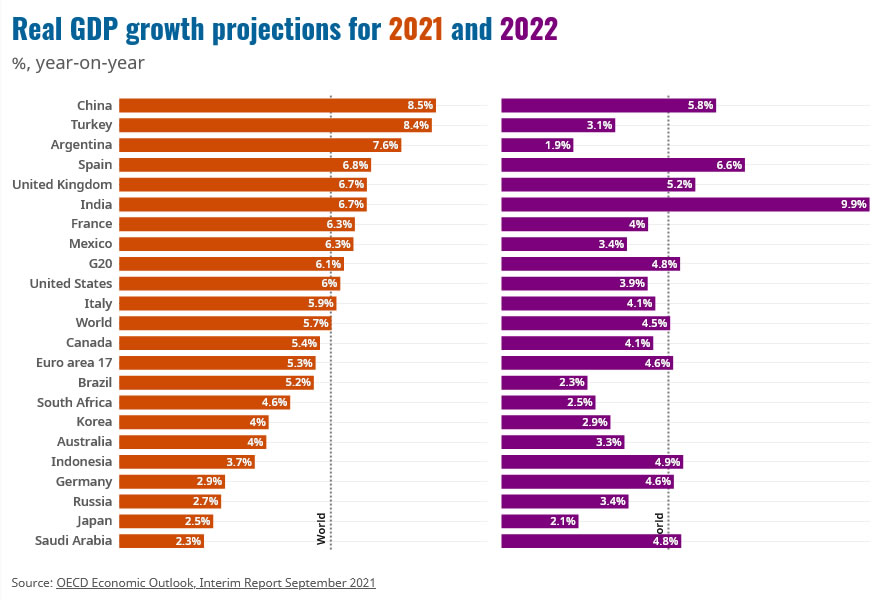
The OECD published its interim economic outlook. The global recovery remains strong, but uneven with countries emerging from the crisis facing different challenges. World GDP growth forecasts stand at 5.7% and 4.5% for this year and next. Inflation is rising, but is expected to moderate. Near-term risks are on the upside, particularly is pent-up demand by consumers is stronger than anticipated or if supply shortages take a long time to overcome. The impact of past increases in shipping costs and commodity prices is already sizeable and is likely to linger though much of 2022. An increasing share of items in price baskets already have prices rising 4%+ rates. A lasting upward move in inflation is likely to occur only if wage inflation intensifies substantially or if inflation expectations drift upwards. Global central banks need to set out clear strategies for coping with inflation risks, the OECD urged.
US: Housing Starts Increase in August, Recouping Some of Last Month’s Drop
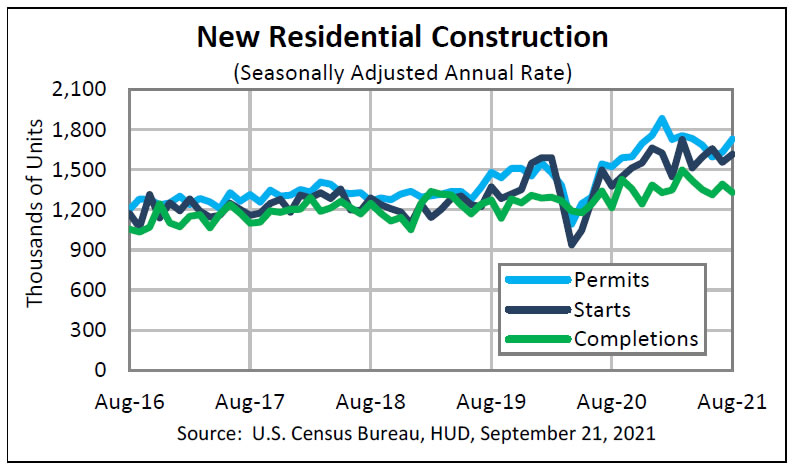
U.S. housing starts rose by 3.9% to 1.615 million (annualized) units in August, after declining by 6.2% in July. This exceeded market expectations for a 1.0% increase. Starts were revised up by 20k in July and 7k in June, reflecting upward revisions to the multifamily segment, as single family starts were revised down in both months.
The increase was a multifamily story, as starts in the single-family segment fell 2.8% (or -31k) to 1.076 million, while starts in the multifamily segment were up 20.6% (or 92k) to 539 thousand.
Permitting activity recorded its second gain in five months, rising 6.0% to 1.728 million. There were permit increases in both market segments, with multifamily permits leading the way. Multifamily permits rose 15.8% to 674k, while the increase in single-family permits to 1.054 million was much more staid at 0.6% (its first increase in five months).
Reversing last month's pattern, housing starts were up across most regions, with a decline in the West (-21.1%) the only exception. Increases were led by the Northeast (+167.2%), followed by the Midwest (+11.4%) and the South (+1.4%).
Key Implications
The uptick in housing starts is a welcome development in a housing market that has been beleaguered with low inventory, strong demand and rising prices. Further good news is that U.S. home builder sentiment has also come off recent lows, ticking up in September as the recent run-up in some raw material prices has started to abate. The combination bodes well for future home construction activity.
Much of the nascent uptick in starts has been emanating from the multifamily segment, as new construction of the much larger single family segment proceeds in fits and starts. While demand for single family homes remains strong, the lack of available land and some zoning restrictions have prevented builders from meeting it.
All in all, today's report was a spot of good news for the housing market, as both permits and starts increased. While labor shortages, material costs, and supply-chain disruptions may slow progress, the combination of low borrowing rates and strong demand for more living and work-from-home space, will continue to provide a solid basis of support.
EUR/USD Mid-Day Outlook
Daily Pivots: (S1) 1.1707; (P) 1.1721; (R1) 1.1743; More...
Intraday bias in EUR/USD remains on the downside with 1.1788 minor resistance intact. Fall from 1.1908 would target 1.1663 support. Firm break there will resume the fall from 1.2265, and the pattern from 1.2348, to 1.1602 key support next. On the upside, above 1.1788 minor resistance will turn bias back to the upside for 1.1908 again.
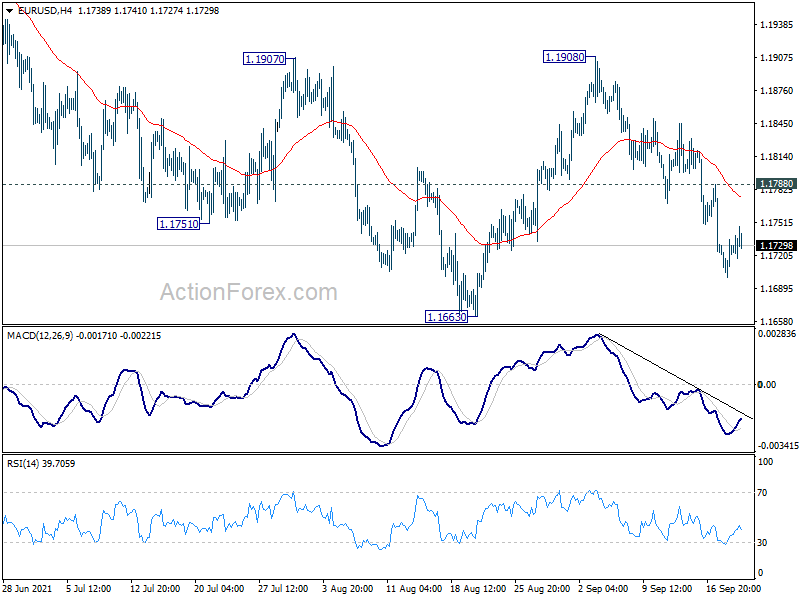
In the bigger picture, rise from 1.0635 is seen as the third leg of the pattern from 1.0339 (2017 low). Further rally remains in favors long as 1.1602 support holds, to cluster resistance at 1.2555 next, (38.2% retracement of 1.6039 to 1.0339 at 1.2516). However sustained break of 1.1602 will argue that the rise from 1.0635 is over, and turn medium term outlook bearish again. Deeper fall would be seen to 61.8% retracement of 1.0635 to 1.2348 at 1.1289 and below.
GBP/USD Mid-Day Outlook
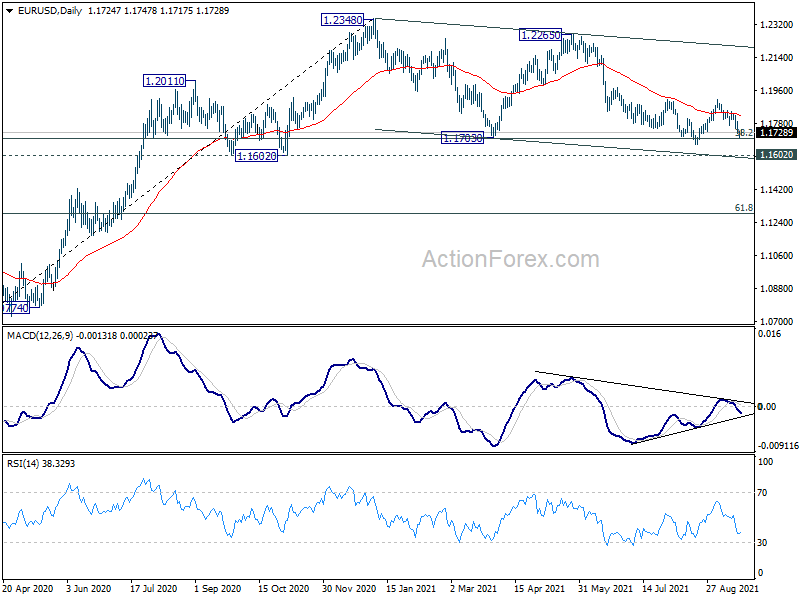
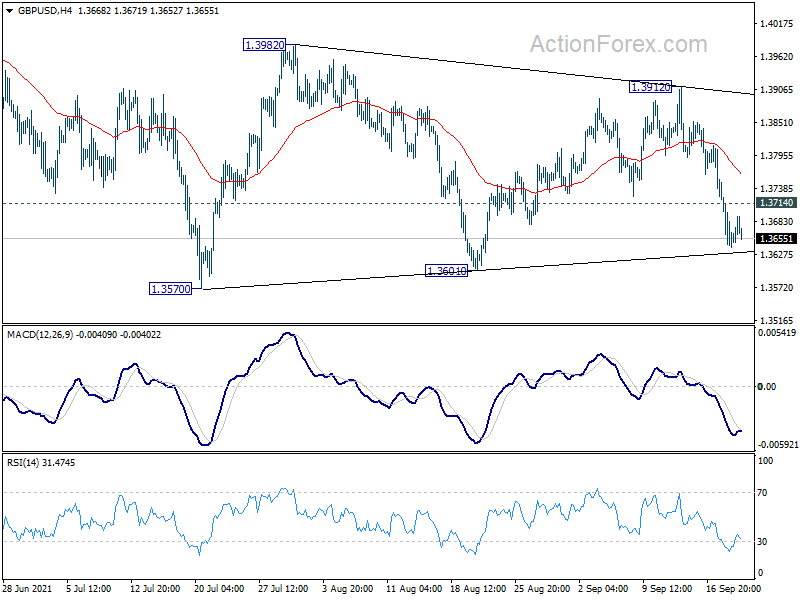
Daily Pivots: (S1) 1.3613; (P) 1.3684; (R1) 1.3726; More...
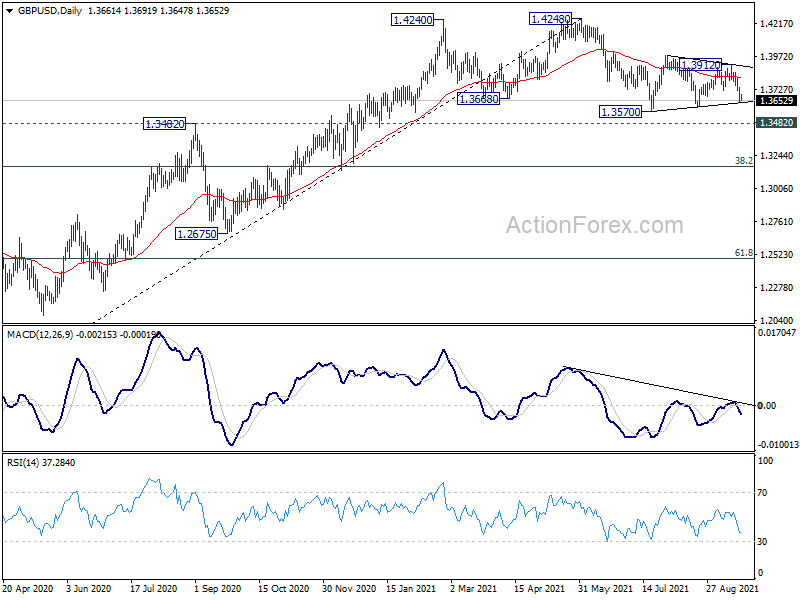
With 1.3714 minor resistance intact, intraday bias in GBP/USD stays on the downside for 1.3570/3601 support zone. . Larger decline form 1.4248 is likely resuming and break of 1.3570 will target 1.3482 key support level. Sustained break there will carry larger bearish implication and target 1.3163 fibonacci level. On the upside, above 1.3714 minor resistance will turn intraday bias neutral again first.
In the bigger picture, as long as 1.3482 resistance turned support holds, we'd still treat price actions from 1.4248 as a corrective move. That is, up trend from 1.1409 (2020 low) is in favor to resume. Decisive break of 1.4376 key resistance (2018 high) would indeed carry long term bullish implications. However, sustained break of 1.3482 will at least bring deeper fall to 38.2% retracement of 1.1409 to 1.4248 at 1.3164, or even further to 61.8% retracement at 1.2493.
USD/JPY Mid-Day Outlook
Daily Pivots: (S1) 109.12; (P) 109.58; (R1) 109.84; More...
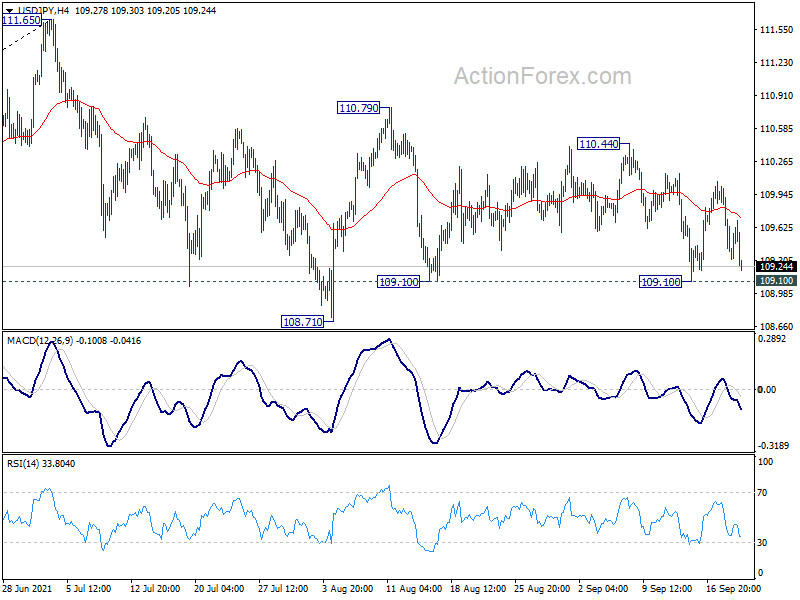
Range trading continues in USD/JPY and intraday bias remains neutral at this point. On the downside, break of 109.10 will argue that larger fall from 111.65 is resuming. Deeper decline should then be seen to 108.71 support first, and then 38.2% retracement of 102.58 to 111.65 at 108.18 next. On the upside, above 110.44 will turn bias back to the upside for 110.79, and then 111.65 high.
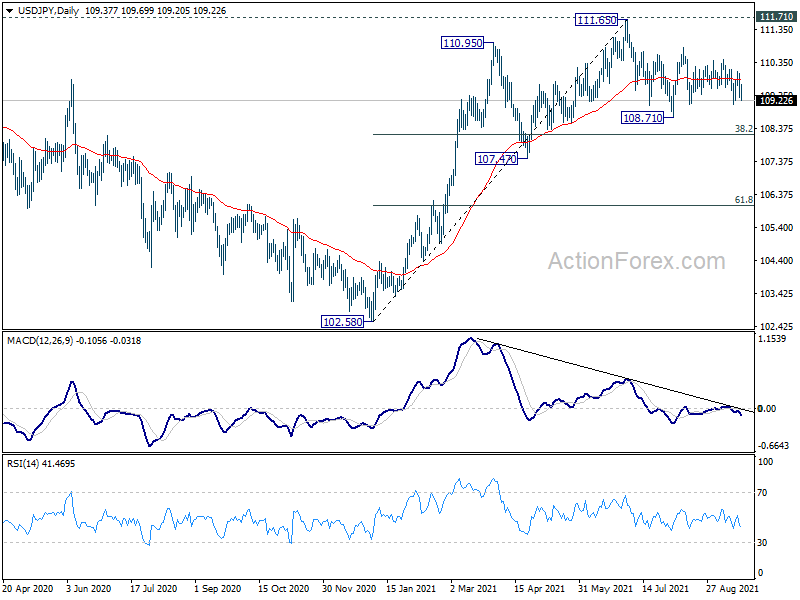
In the bigger picture, medium term outlook is staying neutral with 111.71 resistance intact. The pattern from 101.18 could still extend with another falling leg. Sustained trading below 55 day EMA will bring deeper fall to 107.47 support and below. Nevertheless, strong break of 111.71 resistance will confirm completion of the corrective decline from 118.65 (2016 high). Further rise should then be seen to 114.54 and then 118.65 resistance.
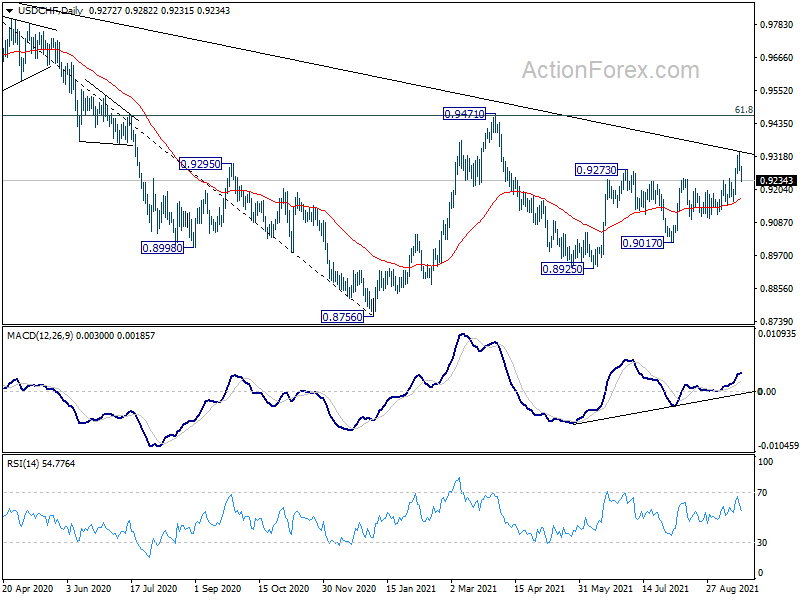
USD/CHF Mid-Day Outlook
Daily Pivots: (S1) 0.9254; (P) 0.9294; (R1) 0.9316; More....
USD/CHF's fall from 0.9331 extends lower today but stays above 0.9162 support. Intraday bias remains neutral first and another rise is still in favor. Rise from 0.8925 is in progress and break of 0.9331 will target 0.9471 key resistance. Sustained break there will carry larger bullish implications. However,m break of 0.9162 will turn bias back to the downside for 0.9017 support instead.
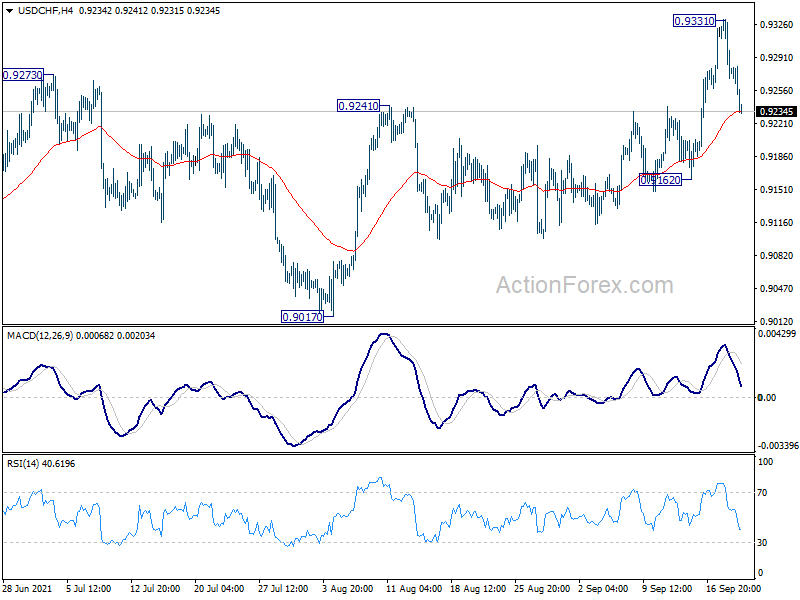
In the bigger picture, the strong rally above 55 week EMA (now at 0.9182) now tilts favor to the case of bullish trend reversal. That is, decline from 1.3042 (2016 high) is probably completed at 0.8756 already. Sustained break of 0.9471 resistance should confirm this case and pave the way to retest 1.0342 ahead. However, rejection by 0.9471 will mix up the outlook again and retain some medium term bearishness.
Swiss Franc Jumps While Risk Aversion Eased
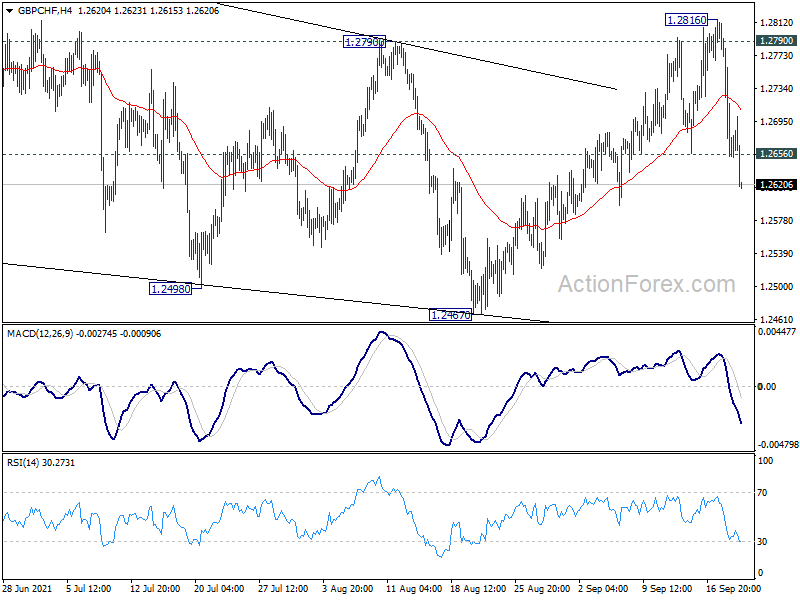
Risk aversion seems to have eased a bit today, with recoveries seen in European markets and US futures. Yen and Dollar have both turned into sideway consolidations. But no clear support is seen in Aussie and New Zealand, as both remain under pressured. Meanwhile, Swiss Franc and Canadian Dollar are taking the lead and strengthen broadly. But overall, traders are rather cautious as a wave of central bank announcements will start tomorrow.
Technically, GBP/CHF finally takes out 1.2656 support firmly today, which indicates completion of the rebound from 1.2467. The rejection by 1.2790 resistance retains near term bearishness and GBP/CHF would now be targeting 1.2467 low. Meanwhile, EUR/CHF is also pressing 1.0837 support and firm break there will align the outlook that rebound from 1.0694 has completed. EUR/CHF could then target a retest on 1.0694 low.
In Europe, at the time of writing, FTSE is up 1.13%. DAX is up 1.44%. CAC is up 1.39%. Germany 10-year yield is down -0.017 to -0.335. Earlier in Asia, Nikkei dropped -2.17%. Hong Kong HSI rose 0.51%. Singapore Strait Times rose 0.71%. Japan 10-year JGB yield dropped -0.0101 to 0.040. China was on holiday.
OECD lowers 2021 global growth forecast slightly to 5.7%
OECD lowered 2021 global growth forecast slightly to 5.7%, down from May's projection of 5.8%. 2022 global growth was revised slightly higher to 4.5%, up from 4.4%. It added, "the global economy is growing far more strongly than anticipated a year ago but the recovery remains uneven, exposing both advanced and emerging markets to a range of risks".
It also said there is a "marked variation in the outlook for inflation". But the inflationary pressures "should eventually fade". "Consumer price inflation in the G20 countries is projected to peak towards the end of 2021 and slow throughout 2022. Wage growth remains broadly moderate and medium-term inflation expectations remain contained."
Chief Economist Laurence Boone said: "Policies have been efficient in buffering the shock and ensuring a strong recovery; planning for more efficient public finances, shifted towards investment in physical and human capital is necessary and will help monetary policy to normalise smoothly once the recovery is firmly established."
US housing starts rose to 1.62m, building permits rose to 1.73m
US housing starts rose 3.9% mom to1615k in August, above expectation of 1550k. Building permits rose 6.0% mom to 1728k, above expectation of 1600k. Also released, current account deficit came in at USD -190B in Q2, versus expectation of USD -187B.
Also released, Canada housing starts rose 0.7% mom in August, below expectation of 0.8% mom.
RBA Minutes: Economy expected to bounce back as vaccination rates increase and restrictions are eased
In the minutes of the September 7 RBA meeting, it's noted, "the outbreak of the Delta variant had delayed, but not derailed, the recovery." The economy was "expected to bounce back as vaccination rates increase and restrictions are eased" but "there was considerable uncertainty about the timing and pace of the recovery, which was likely to be slower than experienced earlier in 2021". In the central scenario, growth will return in Q4 and its "pre-Delta path in the second half of 2022".
As a result of the delay in recovery and uncertainty about the future, "progress towards the Bank's goals was likely to take longer and was less assured". But at the same time, fiscal policy is "more appropriate" in dealing with a "temporary and sharp reduction in private sector incomes". Hence, RBA decided to taper purchases to AUD 4B per week, but extend the period to mid February 2022.
RBA also reiterated its commitment to "maintaining highly supportive monetary conditions to achieve a return to full employment in Australia and inflation consistent with the target." And it will not raise interest rate until 2024.
RBNZ Hawkesby: Employment at maximum sustainable level, price pressures to feed through
RBNZ Assistant Governor Christian Hawkesby said in a speech, "while the demand side of the economy has been more resilient than expected when COVID-19 arrived, the disruption to the supply side of the economy has also been more prolonged than anticipated." Also, the developments combined are "likely to have reduced the level of maximum sustainable employment".
He reiterated that in the latest Monetary Policy Statement, it's noted RBNZ had "more confidence that employment was already at its maximum sustainable level and that pressures on capacity would feed through into more persistent inflation pressures over the medium-term".
Thus, the "least regrets policy stance" was to "further reduce the level of monetary stimulus so as to anchor inflation expectations and continue to contribute to maximum sustainable employment." Also, " whether or not a monetary policy response would be required in response to future health related lockdowns would depend on whether there was a more enduring impact on inflation and employment".
USD/CHF Mid-Day Outlook
Daily Pivots: (S1) 0.9254; (P) 0.9294; (R1) 0.9316; More....
USD/CHF's fall from 0.9331 extends lower today but stays above 0.9162 support. Intraday bias remains neutral first and another rise is still in favor. Rise from 0.8925 is in progress and break of 0.9331 will target 0.9471 key resistance. Sustained break there will carry larger bullish implications. However,m break of 0.9162 will turn bias back to the downside for 0.9017 support instead.
In the bigger picture, the strong rally above 55 week EMA (now at 0.9182) now tilts favor to the case of bullish trend reversal. That is, decline from 1.3042 (2016 high) is probably completed at 0.8756 already. Sustained break of 0.9471 resistance should confirm this case and pave the way to retest 1.0342 ahead. However, rejection by 0.9471 will mix up the outlook again and retain some medium term bearishness.
Economic Indicators Update
| GMT | Ccy | Events | Actual | Forecast | Previous | Revised |
|---|---|---|---|---|---|---|
| 21:00 | NZD | Westpac Consumer Survey Q3 | 102.7 | 107.1 | ||
| 01:30 | AUD | RBA Meeting Minutes | ||||
| 06:00 | CHF | Trade Balance (CHF) Aug | 5.10B | 4.50B | 5.25B | |
| 06:00 | GBP | Public Sector Net Borrowing (GBP) Aug | 19.8B | 14.5B | 9.6B | |
| 12:30 | CAD | New Housing Price Index M/M Aug | 0.70% | 0.80% | 0.40% | |
| 12:30 | USD | Building Permits Aug | 1.73M | 1.60M | 1.63M | |
| 12:30 | USD | Housing Starts Aug | 1.615M | 1.55M | 1.53M | |
| 12:30 | USD | Current Account (USD) Q2 | -190B | -187B | -196B |
US housing starts rose to 1.62m, building permits rose to 1.73m
US housing starts rose 3.9% mom to 1615k in August, above expectation of 1550k. Building permits rose 6.0% mom to 1728k, above expectation of 1600k. Also released, current account deficit came in at USD -190B in Q2, versus expectation of USD -187B.
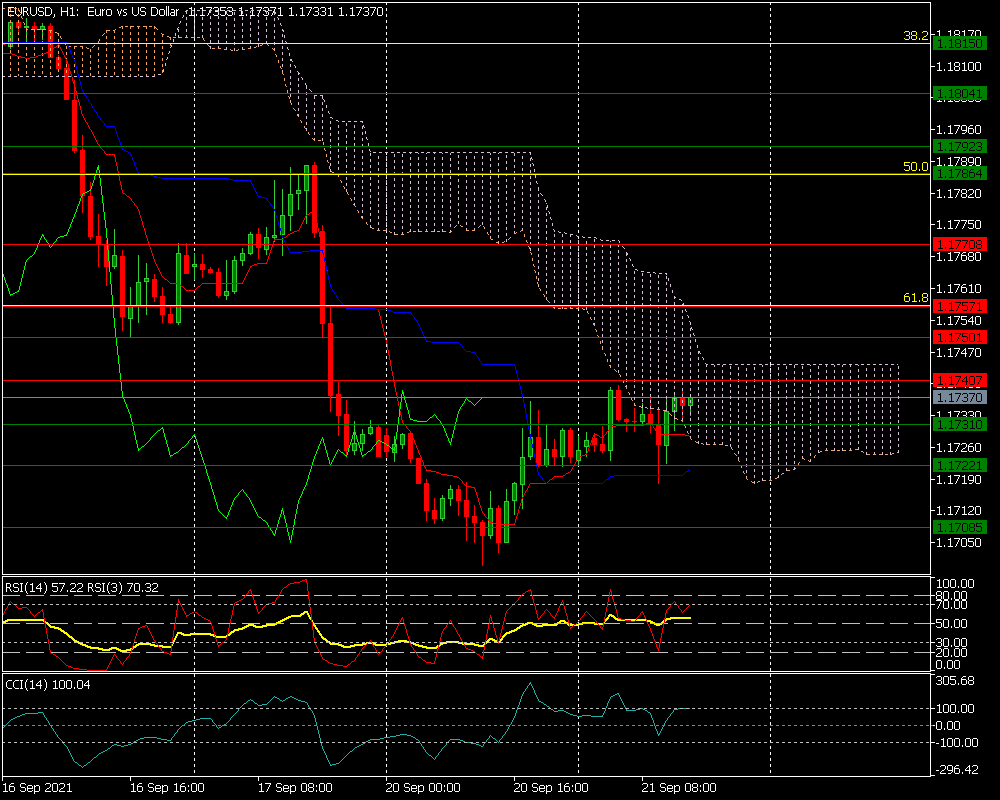
EURUSD Is Possibly Bullish
Technical analysis
The RSI(14) and the RSI(3) point to a possible upwards correction
The Ichimoku indicator displays a prevailing flat
The CCI suggests a possible upwards movement.
Most likely scenario - BUY
Target prices: 1.17407 1.17501
Alternative scenario - SELL
Target prices: 1.17310 1.17221
Key levels
Support 1.17407 1.17501
Resistance 1.17310 1.17221