Sample Category Title
Currency Markets Take A Breather
Currency markets moved back to the side-lines in the G-10 space overnight with a fall in US yields as investors parked money in treasuries, offsetting a risk in risk-aversion sentiment globally, which left the US Dollar marooned between the two. The dollar index finished almost unchanged at 93.22 where it remains in Asia today. If the rally in commodities and stocks continues, the US Dollar may give back some of its recent gains. Currency markets look like they are now moving into FOMC wait-and-see mode.
Despite probing the downsides early, EUR/USD. GBP/USD, AUD/USD and NZD/USD are not far away from their New York closing levels, which themselves were barely changed from Friday. AUD/USD getting a slight 20 point boost from the commodity rally today. The Canadian Dollar has reacted positively to the projected Liberal Party election win, rallying by 0.45% with USD/CAD falling to 1.2770. Until commodity prices show signs that the worst of the selloff is over, USD/CAD is probably a buy-on-dips to 1.2700.
Offshore Chinese Yuan sunk only slightly overnight on the Evergrande saga, with USD/CNH hovering around 6.4760 today with Mainland markets closed yesterday and today. The USD/CNH rally on Friday though has lifted the cross closer to a 6-month resistance line, today at 6.4950. A close above that line signals a move to near 6.6000 initially. That will probably not unfold though until Mainland markets return and if we get concrete tapering guidance from this week’s FOMC meeting. That is likely to lead to a G-10 FX sell-off and feed through to weaker CNY fixings. Tomorrows Loan Prime Rate decisions from China could also be bearish for the offshore Yuan if a surprise cut is announced. That is not my base case though.
The rest of USD/Asia is broadly unchanged from yesterday after the US Dollar had a subdued day versus G-10 FX. Asia’s traders will be content to wait for China’s return tomorrow for further directional signals and the FOMC, despite the Evergrande noise, remains currency markets primary concern.
Asia Equities Show Resilience
Given the meltdowns in markets around the world yesterday, Asia equity markets are showing surprising resilience today. The buy-the-dippers couldn’t resist and the Evergrande Charman’s soothing words appear to have lifted hopes, if not spirits temporarily.
Wall Street finished on a negative note, the S&P 500 sliding by 1.70%, the Nasdaq tumbling by 2.19%, and the Dow Jones retreating 1.79%. In Asia, however, futures on all three have rallied strongly by between 0.35% and 0.40%, which has perhaps also helped stabilise Asia with commodities also rallying.
Asian markets are mixed with Mainland China and South Korea closed today. The exception is Japan, where the Nikkei has played catch-up after being closed yesterday. The Nikkei 225 has fallen by 2.0%. Elsewhere though, the picture is mixed but could have been worse. Hong Kong is down just 0.90%, but Singapore has risen by 0.45%. Kuala Lumpur and Bangkok are flat, and Jakarta is down 0.60%.
Australian markets have completely unwound early losses as commodities, unloved yesterday, have rebounded sharply in Asia. The ASX 200 is down just 0.05%, while the All Ordinaries is now in positive territory, up by 0.15%. Sentiment was further boosted by the RBA minutes which suggested that no rate hikes were likely before 2024.
The dip-buying seen in Asia is likely to also lift European stocks this afternoon, particularly if US index futures maintain their strong gains this morning. I would remain cautious in the present climate however, and markets are probably just one headline away from an abrupt about face which will see investors hitting the sell button again. We can expect more of the same intra-day volatility throughout the rest of the week until Evergrande’s Thursday payment date.
EURJPY Shows Some Positive Signs After 5-Day Decline
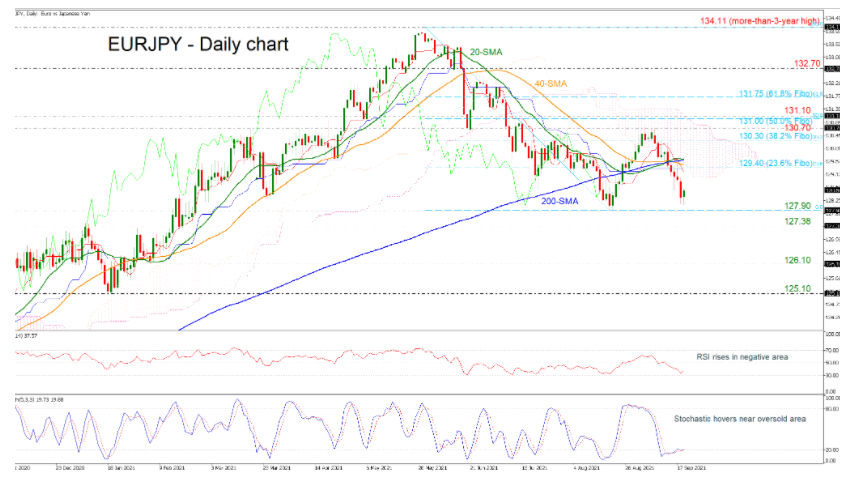
EURJPY is returning slightly up today, after the aggressive sell-off from the 130.70 resistance level. The buying pressure could find strong resistance around the 23.6% Fibonacci retracement level of the downward wave from 134.11 to 127.90 at 129.40 and the simple moving averages (SMAs), before moving towards the Ichimoku cloud.
Technically, the RSI indicator is pointing upwards in the bearish territory, while the stochastic oscillator, after the bearish cross within the %K and %D lines in the oversold zone, is making an attempt to exit from this region.
So, if the pair successfully climbs beyond the 129.40 barrier, it could meet the 38.2% Fibonacci of 130.30 and the highs from September 3 and September 8 at 130.70. More gains could take the market towards the psychological level of 131.00, which is the 50.0% Fibonacci and then at 131.10. Above this, the bulls could send the price until the 61.8% Fibonacci of 131.75 and any more increases could shift the bearish bias to bullish.
On the other side, a drop below the 127.90 support could open the way for a lower low in the medium-term, touching the 127.38 inside swing high, registered in January 29. A new movement lower could halt the bearish actions at 126.10 and 125.10. being the lows from February 4 and January 18.
Overall, EURJPY has been in a negative tendency over the last four months and only a push above 131.75 may switch this view to positive.
Global Markets Remain At The Mercy Of Risk Sentiment
Markets
A (modest) rise in yields combined with a faltering equity sentiment, recently flagged markets’ unease with inevitable choices central banks won’t be able to delay much longer. Until now, the Fed and ECB preferred to err on the side of easy financing conditions rather than risking a premature tightening. With inflation rising and at risk of staying higher for longer, this preoccupation is put in doubt. Delay of action is becoming a source of uncertainty. This conundrum yesterday unraveled into an outright risk-off mood. Other storylines (Evergrande/Chinese financial stability, uncertainty on the US budget/debt ceiling, rising gas and energy bills …) further convinced investors to take some chips off the table. US and European indices lost first support levels, turning the buy-on-dips bias into a ST stop-loss dynamic. Europe declined about 2%. US indices ceded between 1.7% (S&P) and 2.19% (Nasdaq), but closed off intraday lows after a late session rebound. Contrary to last week, the risk sell-off restored the usual safe haven run to core bonds. The decline in yields was mainly driven by inflation expectations (in line with the setback in commodities) rather than real yields. The US and German curves bull flattened with yields at longer maturities tumbling up to 5 bps. The Japanese yen (close USD/JPY at 109.44 from 109.95) and the Swiss franc (EUR/CHF close 1.0879 from 1.0930) regained their safe haven posture. The dollar first outperformed the euro, but EUR/USD avoided a break below 1.17. Closing at 1.1728, the damage was limited after all. Smaller and commodity-related currencies were hit hard. Sterling was no exception with EUR/GBP closing at 0.8585 (from 0.854). In Central Europe, the forint and the zloty faced strong headwinds. EUR/PLN cleared the key 4.60 reference.
Tension on Asian markets are easing this morning as markets ponder the potential (systemic?) risk of an Evergrande default. US yields gain, albeit marginally. The dollar trades on the backfoot (DXY 93.17; EUR/USD 1.1735). The Swedish Riksbank and the National Bank of Hungary (MNB) will today kick-off a long series of central bank meetings. Especially the decision of the MNB (30 or 15 bps rate hike?) will be important for the local market. Global markets remain at the mercy of risk sentiment. Uncertainty might persist at least until Wednesday’s Fed policy decision, with a ST sell-on up-ticks logic searching for next support (S&P 4235 area, EuroStoxx50 3900 area). The risk-off pushed US and German yields off recent highs, but no important support has been broken. We look out when/to what extent the tapering narrative will again interfere with risk-off. The 1.26% area in the US 10-y yield and -0.36% in the German 10-y serve as first reference on the charts. The dollar’s risk-off performance in the end was rather disappointing. The jury is still out, but the EUR/USD 1.1664 support might not be that easy to break.
News headlines
The leader of Canada’s main opposition Conservative Party, O’Toole, conceded defeat in the snap parliamentary election. Liberal party leader and prime minister Trudeau that way secures a third term in office. Trudeau didn’t get his hoped-for parliamentary majority. The projected count puts the Liberals at 157 seats in the 338-headed parliament, compared to 121 seats for the Conservatives. Trudeau will normally extend his minority government which has become quite common in Canada. The left-leaning New Democratic Party is the government’s most important partner and grants sufficient support to pass Trudeau’s (social) spending plans and economic agenda. The Canadian dollar slightly outperforms this morning, both against the dollar and the euro. USD/CAD returns below 1.28 after the past days’ volatility/risk related spike higher. A general easing in risk sentiment might be at play as well.
Reserve Bank of New Zealand assistant governor Hawkesby in a speech said that when risks are evenly balanced, central bank globally tend to follow a smoothed path and keep policy rates unchanged or move in 25 bps increments. Markets started discounting a more bold start to tightening cycle after a sudden Covid-outbreak on the eve of the August 18 RBNZ policy meeting, prompted the RBNZ to postpone the pre-announced start of the normalization cycle. The RBNZ meets on October 6 and will all else equal start hiking rates to fend off inflationary pressures (3.3% Q/Q in Q2). The kiwi dollar initially spiked lower, but made an intraday U-turn in line with this morning’s risk sentiment.
XAUUSD Is Possibly Bullish
Technical analysis
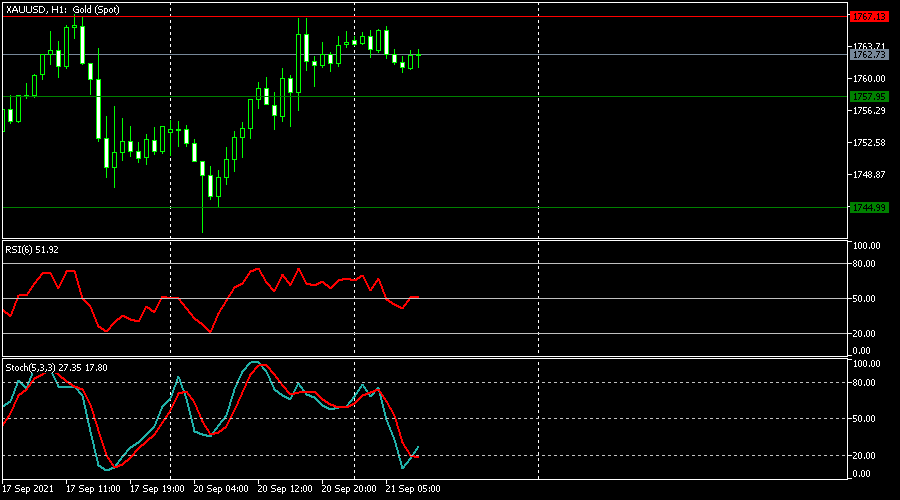
The RSI is slightly above 50
The Stochastic crossed the oversold zone, pointing up.
Most likely scenario - BUY
Target prices: 1,767.13 1,779.63
Alternative scenario - SELL
Target prices: 1,757.95 1,744.99
Key levels
Support 1,757.95 1,744.99
Resistance 1,767.13 1,779.63
USD/CAD Daily Outlook
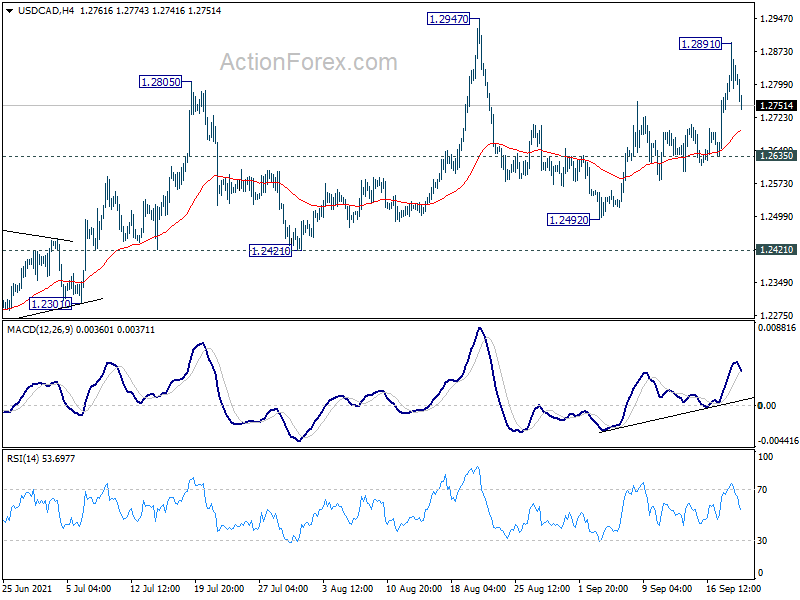
Daily Pivots: (S1) 1.2682; (P) 1.2727; (R1) 1.2817; More...
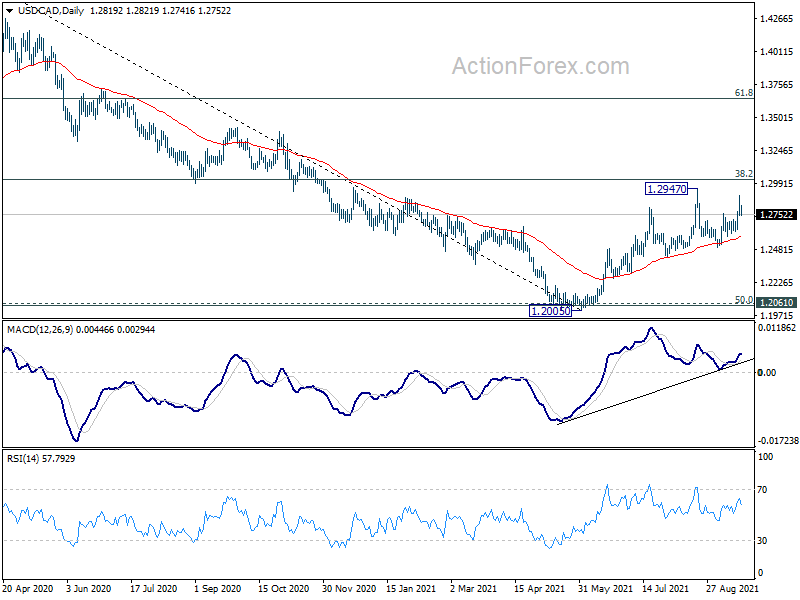
Intraday bias in USD/CAD is turned neutral with current retreat from 1.2891 temporary top. On the upside, above 1.2891 will target a test on 1.2947 high. On the downside, however, break of 1.2635 minor support will turn bias back to the downside for 1.2492 support. Overall, rise from 1.2005 is still in progress with 1.2421 support intact. Firm break of 1.2947 will target 1.3022 fibonacci level next.
In the bigger picture, fall from 1.4667 is seen as the third leg of the corrective pattern from 1.4689 (2016 high). It should have completed after hitting 1.2061 (2017 low) and 50% retracement of 0.9406 to 1.4689 at 1.2048. Sustained break of 38.2% retracement of 1.4667 to 1.2005 at 1.3022 will pave the way to 61.8% retracement at 1.3650 and above. Overall, medium term outlook remains neutral at worst with 1.2048/61 support zone intact.
USD/CAD Could Continue To Surge
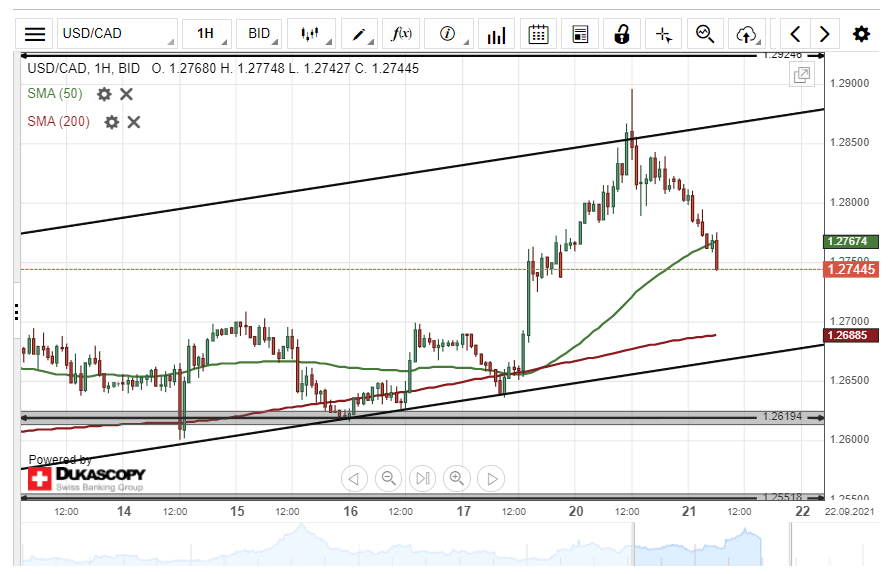
On Monday, the US Dollar edged higher by 119 pips or 0.93% against the Canadian Dollar. The currency pair tested the upper boundary of an ascending channel pattern at 1.2850 during Monday's trading session.
By and large, the exchange rate could continue to trend higher during the following trading session. The potential target for the USD/CAD pair will be near the 1.2920 level.
However, if the currency exchange rate breaks the support level at 1.2768, sellers may pressure the price lower today.
AUD/USD Daily Report
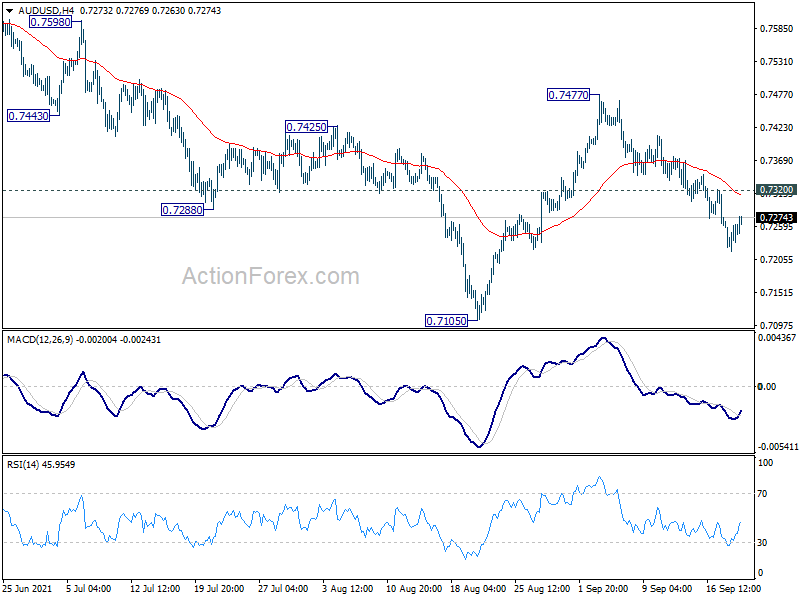
Daily Pivots: (S1) 0.7225; (P) 0.7247; (R1) 0.7273; More...
With 0.7320 minor resistance intact, fall from 0.7277 is still in progress. Deeper decline would be seen to retest 0.7105 low first. Firm break there will resume whole decline from 0.8006 for 0.6991 support next. On the upside, above 0.7320 minor resistance will turn bias back to the upside for 0.7477 resistance instead.
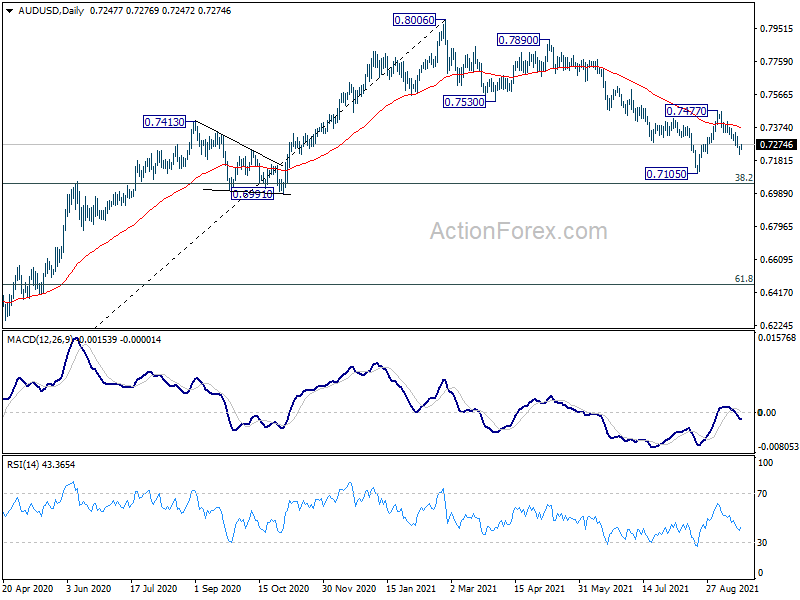
In the bigger picture, with 0.6991 cluster support (38.2% retracement of 0.5506 to 0.8006 at 0.7051) intact, we're seeing price action from 0.8006 as a correction only. That is, up trend from 0.5506 low would resume after the correction completes. In that case, main focus will be 0.8135 key resistance (2018 high). Sustained break there will carry larger bullish implications. However, sustained break of 0.6991 will argue that the whole medium term trend has indeed reversed.
USD/JPY Daily Outlook
Daily Pivots: (S1) 109.12; (P) 109.58; (R1) 109.84; More...
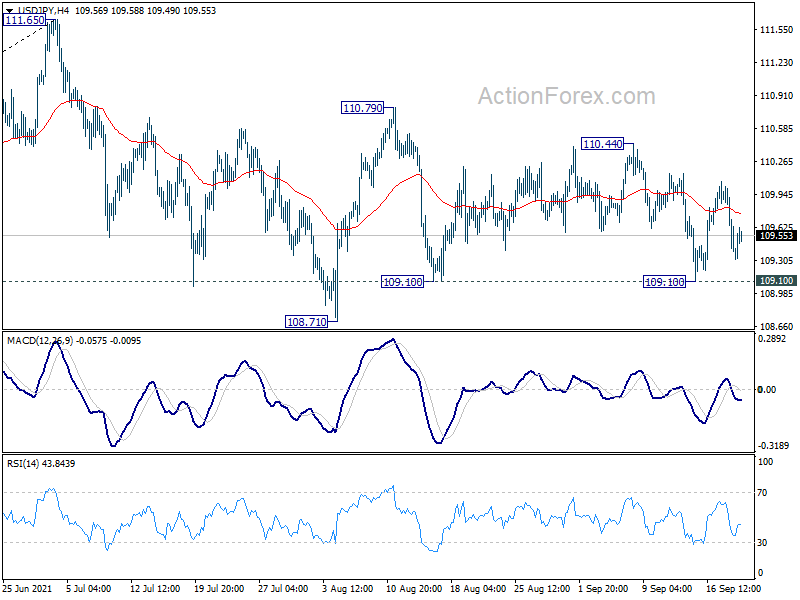
Intraday bias in USD/JPY remains neutral as range trading continues. On the upside, above 110.44 will turn bias back to the upside for 110.79, and then 111.65 high. On the downside, break of 109.10 will argue that larger fall from 111.65 is resuming. Deeper decline should then be seen to 108.71 support first, and then 38.2% retracement of 102.58 to 111.65 at 108.18 next.
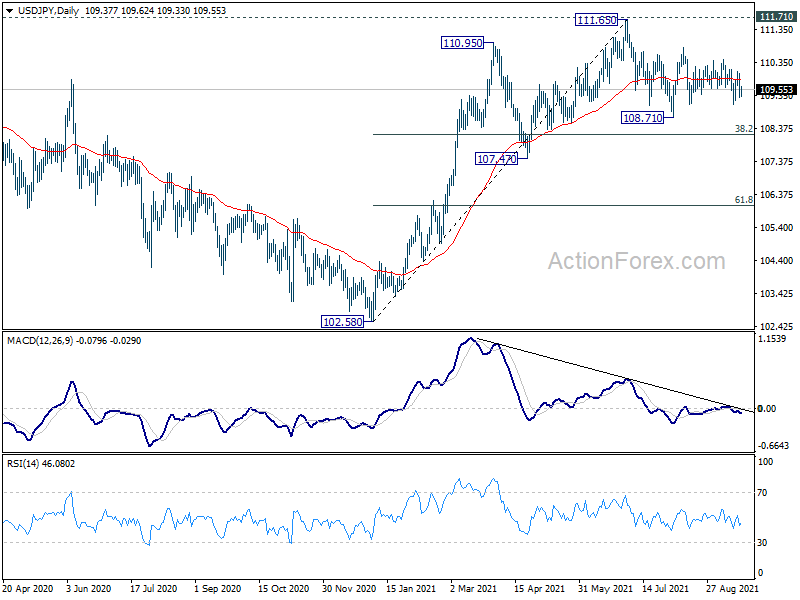
In the bigger picture, medium term outlook is staying neutral with 111.71 resistance intact. The pattern from 101.18 could still extend with another falling leg. Sustained trading below 55 day EMA will bring deeper fall to 107.47 support and below. Nevertheless, strong break of 111.71 resistance will confirm completion of the corrective decline from 118.65 (2016 high). Further rise should then be seen to 114.54 and then 118.65 resistance.
USD/CHF Daily Outlook
Daily Pivots: (S1) 0.9254; (P) 0.9294; (R1) 0.9316; More....
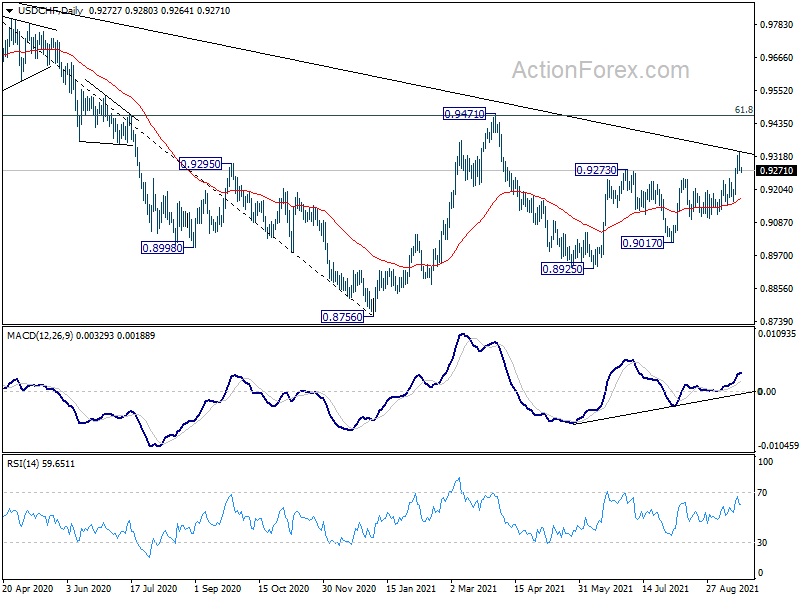
Intraday bias in USD/CHF remains neutral for consolidation below 0.9331 temporary top. Further rally will remain in favor as long a s0.9162 support holds. Rise from 0.8925 is in progress and break of 0.9331 will target 0.9471 key resistance. Sustained break there will carry larger bullish implications.
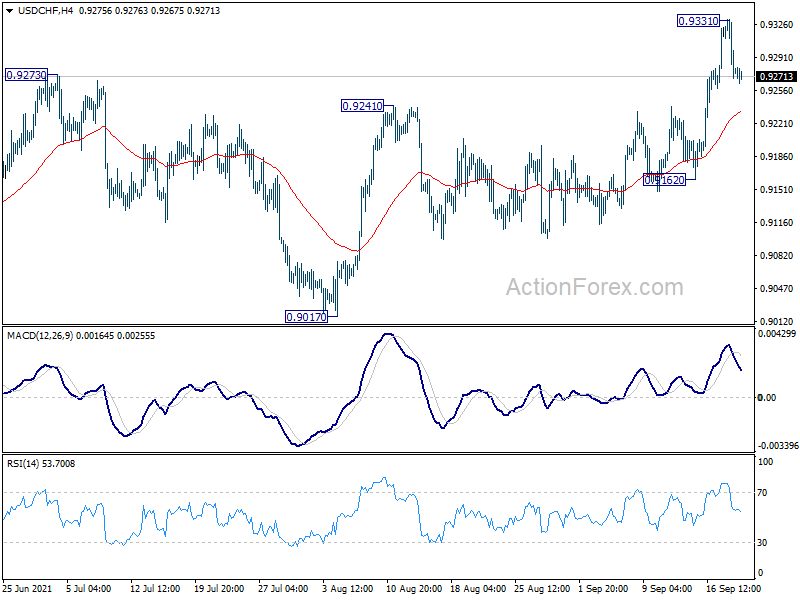
In the bigger picture, the strong rally above 55 week EMA (now at 0.9182) now tilts favor to the case of bullish trend reversal. That is, decline from 1.3042 (2016 high) is probably completed at 0.8756 already. Sustained break of 0.9471 resistance should confirm this case and pave the way to retest 1.0342 ahead. However, rejection by 0.9471 will mix up the outlook again and retain some medium term bearishness.