

Sample Category Title
Market Sentiment Remains Sour
Market movers today
- While global risk sentiment, stagflation risk and developments in the Chinese real estate market will take centre stage today we do have a range of central bank meetings to follow.
- First comes the Riksbank meeting. In short, we expect the Riksbank to leave policy rates unchanged and maintain a fully flat rate path at zero. That said we acknowledge that recent developments and not least the August inflation print could trigger a slight hiking bias in the very long-end of the rate path. For more information on the Riksbank please see our Scandi section.
- We expect the Hungarian central bank to keep the policy rate unchanged at 1.5% while consensus is looking for a hike to 1.75%. Either way, it is not a big market event.
- Besides that US data on building permits and housing starts in August are due out 14:30 CEST.
- At a meeting ending early Wednesday we expect the Bank of Japan will keep its QQE with yield curve control policy unchanged. With the economy still hampered from the lockdown, it is wait and see mode until pandemic programmes can be withdrawn next year.
The 60 second overview
Markets sentiment suffers ...: Global risk sentiment has taken a big hit over the last week. Sour sentiment has continued this week with equities moving lower across sectors, option volatilities moving higher across markets, credit spreads widening, core yields declining and long-end inflation expectations stalling. Interestingly, we are now also seeing global commodity prices trading on the back foot. Precious metals incl. gold have posted declines amid higher real rates but also industrial metals and energy have come considerably lower from the 2021 peak set earlier in September.
... as growth outlook takes a hit: Key to the change in market sentiment are global growth prospects, the risk of stagflation (see next section) and recently heightened focus on the state of the Chinese real estate sector. The latter is not least a reaction to the country's second biggest business developer Evergrande struggling to pay upcoming debt payments. While this leaves important contagion risks to follow we think the implied signal of a weak credit impulse from China to the rest of the global economy is as important.
Stagflation: This morning we published a new piece looking at the financial market implications of the stagflation risk scenario (for which we see a probability of 30%). While we think the central banks will be patient with regard to reacting to the high inflation into H1 2022 (especially given the weak underlying economic momentum), we think they will ultimately tighten monetary policy to avoid a de-anchoring of inflation expectations. This would lead to a significant rise in short-end US real rates and stronger USD, which will hit global risk sentiment, sending global equities lower and credit markets spreads wider especially for the high yield segment. While long-end rates would initially increase, we think the significant hit to the global growth outlook will reverse the sell-off in the long-end of rates curves, forcing a flattening of yield curves. For more details, Global Research - Market implications in a global stagflation scenario.
Air travel to the US: The Biden administration has announced that by November fully vaccinated people will be able to travel to the US from anywhere in the world. A negative COVID-19 test taken less than 3 days prior to the test is also a condition next to proof of vaccination. A decision has yet to be announced on which vaccines that will be accepted. Airliners rose on this announcement which we also regard positive for US growth prospects.
European energy crisis: Continental gas and electricity prices continue to move higher leaving the risk of hitting the European recovery post COVID-19 and hampering the prospects of green reforms. Yesterday, the second biggest gas supplier to the EU in Norway announced plans to step up supplies from Friday as Equinor is set to boost production from two North Sea fields. Also governments around Europe - most recently in Spain and Italy - are discussing measures to help consumers and companies via direct aid packages. Critiques argue that governments should not intervene in a market where part of the rise in prices is structural amid politicians combatting fossil fuel investments and raising black energy costs by changing the market for CO2 quotas. Proponents argue that this energy crisis shows the urgency of further investments in sustainable energy.
Equities: Full-blown risk-off struck markets yesterday for a first in a very long time. Risk-off also went cross asset, as investors rotated into cash or bonds and sold off most sectors and stocks. S&P 500 dropped -1.7% (and -2.9% intraday at most) with only 50 out of 500 shares higher. Nasdaq -2.2%, Dow -1.8% and Russell 2000 -2.4%. Implied volatility spiked, with VIX just south of 30 intraday, before falling back to 26. Among sectors, energy, financials (both insurance and banks), autos and materials were hit worst. Interestingly, big tech did not prove much safety, but drove weakness in consumer discretionary. Safe haven sectors such as utilities and health care and consumer staples coped best. Sentiment appears to have stabilised this morning. Chinese markets are still closed for holiday, and newly opened Nikkei is doing a -1.7% catch-up but Hong Kong only -0.3%. US futures point to a rebound with futures nearly 1% higher.
FI: A classical flight to quality theme was playing out in the markets yesterday on the back of the Evergrande story from China. Bunds dropped 4bp while intra-euro area spreads widened across the board, led by Italy where the BTP-Bund spread widened 3bp. Curves flattened from the long end. Swaps underperformed cash bonds massively with the Bund-ASW widened almost 2bp to above the 40bp mark.
FX: Amid the souring global risk sentiment EUR/GBP, EUR/SEK and EUR/NOK all rallied. EUR/USD was little changed.
Credit: Against a decidedly souring sentiment in equity markets, credit held up relatively well yesterday. Though CDS indices seemed to widen dramatically (with Xover and Main 26bp and 6.5bp wider than Friday, respectively), this was to a large extent caused by the index roll. The old series 'only' widened 8bp and 1.7bp, respectively. HY bonds widened 5bp and IG actually closed the day around 0.5bp tighter.
Nordic macro
Riksbank will release the Monetary Policy Report at 9.30 CET. With regards to the policy rate path, we have previously argued that the November meeting is a more likely date for the Riksbank to put in a hiking bias at the end of the repo rate path. Following the August inflation data, the probability for this happening now in September has indeed increased, but we stick to our call for this to happen only at the November meeting. Also, we expect the Riksbank to wait until November to announce the QE reinvestment volume and allocation for Q1-22. Our base case for re-investments in 2022 is that the quarterly pace will be kept even and that the allocation will be similar to 2021 with an overweight to covered bonds.
On the macro front, last week's data will likely lead to an upward revision of the inflation forecast but more modest upward revision of other macro variables such as GDP and unemployment. Market-wise we are already pricing in c.50bp of hikes until the end of 2024, so risk-reward in our view is for the short-end to come lower on a more cautious Riksbank, similar to what we saw after the July MPR.
GBP/USD Daily Outlook
Daily Pivots: (S1) 1.3613; (P) 1.3684; (R1) 1.3726; More...
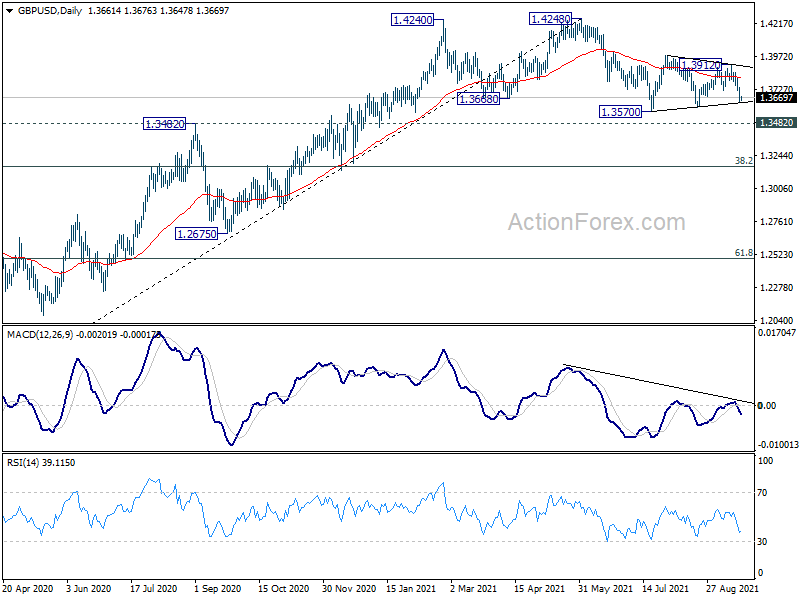
Intraday bias in GBP/USD remains on the downside as fall from 1.3912 in in progress. Larger decline form 1.4248 is likely resuming and break of 1.3570 will target 1.3482 key support level. Sustained break there will carry larger bearish implication and target 1.3163 fibonacci level. On the upside, above 1.3714 minor resistance will turn intraday bias neutral again first.
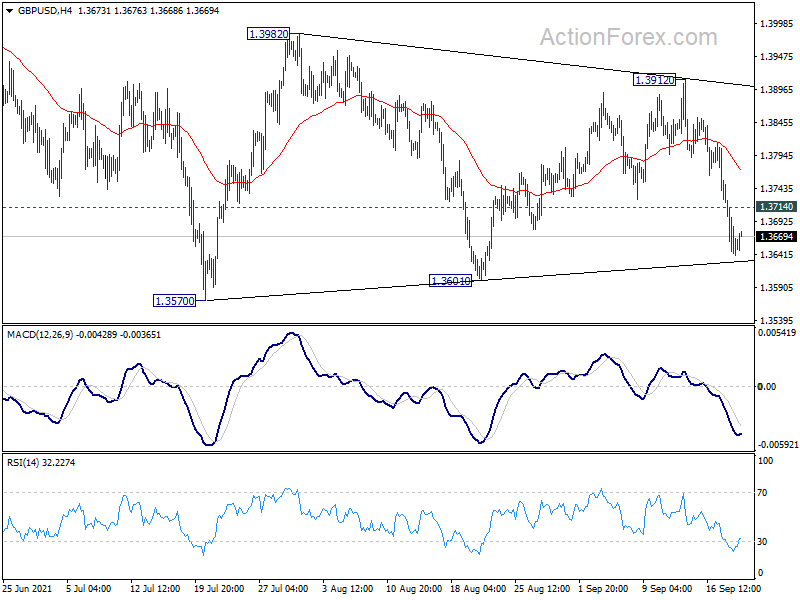
In the bigger picture, as long as 1.3482 resistance turned support holds, we'd still treat price actions from 1.4248 as a corrective move. That is, up trend from 1.1409 (2020 low) is in favor to resume. Decisive break of 1.4376 key resistance (2018 high) would indeed carry long term bullish implications. However, sustained break of 1.3482 will at least bring deeper fall to 38.2% retracement of 1.1409 to 1.4248 at 1.3164, or even further to 61.8% retracement at 1.2493.
Sentiments Stabilized after Selloff, Downside Prospect for Weak Sterling
Risk sentiment appears to have stabilized in Asia a bit. The steep fall in Nikkei was just a post-holiday catch up. Yen and Swiss Franc are digesting gains but remain the strongest for the week. Sterling is indeed the worst performing so far, worse than even commodity currencies. Selling in European crosses is clearly weighing on the Pound. Overall, the markets could turn cautious for today, as bigger risk of FOMC meeting just lies ahead on Wednesday.
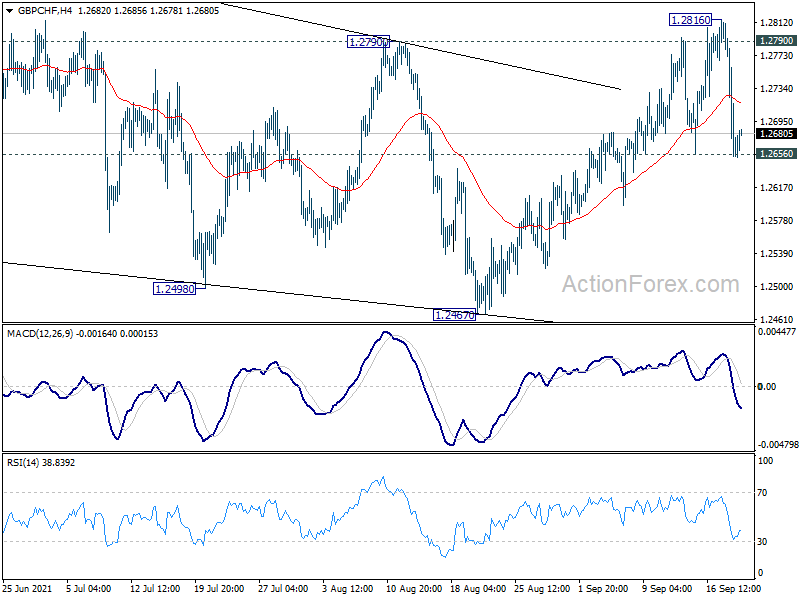
Technically, EUR/GBP's rebound suggests that pull back from 0.8612 has completed. It might be ready to resume the rise from 0.8448, subject to reaction to 0.8612 resistance. At the same time, GBP/CHF is pressing 1.2656 support. Sustained break there should indicate that rise from 1.2467 has completed after rejection by 1.2790 near term structural resistance. In this case, GBP/CHF would target a test on 1.2467 support. That, together with break of 0.8612 resistance in EUR/GBP, could confirm return to weakness in Sterling in general.
In Asia, at the time of writing, Nikkei is down -1.81%. Hong Kong HSI is down -0.75%. Singapore Strait Times is up 0.35%. Japan 10-year JGB yield is up -0.0064 at 0.044. China is on holiday. Overall, DOW dropped -1.78%. S&P 500 dropped -1.70%. NASDAQ dropped -2.19%. 10-year yield dropped -0.061 to 1.309.
S&P 500 broke channel support, risks further decline
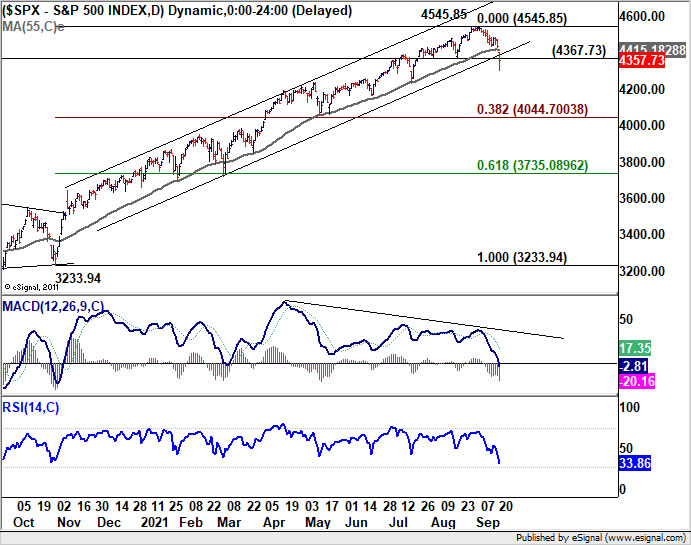
The selloff in US stocks overnight was a rather bearish development for the near term. S&P 500 gapped below 55 day EMA, and dive through medium term channel support without much hesitation. While it managed to pare back some losses to close at 4357.73, it's capped below 4367.73 structural support.
The condition for a medium term correction is there with bearish divergence condition in daily MACD. That is, 4545.85 is possibly a medium term top, and fall from there is corrective whole rise from 3233.94 at least. For now, risk will stay on the downside as long as any recovery is capped by 55 day EMA (now at 4415.18). SPX could fall further, for the rest of the year, to 38.2% retracement of 3233.94 to 4545.45 at 4044.70 before finding a bottom.
RBA Minutes: Economy expected to bounce back as vaccination rates increase and restrictions are eased
In the minutes of the September 7 RBA meeting, it's noted, "the outbreak of the Delta variant had delayed, but not derailed, the recovery." The economy was "expected to bounce back as vaccination rates increase and restrictions are eased" but "there was considerable uncertainty about the timing and pace of the recovery, which was likely to be slower than experienced earlier in 2021". In the central scenario, growth will return in Q4 and its "pre-Delta path in the second half of 2022".
As a result of the delay in recovery and uncertainty about the future, "progress towards the Bank's goals was likely to take longer and was less assured". But at the same time, fiscal policy is "more appropriate" in dealing with a "temporary and sharp reduction in private sector incomes". Hence, RBA decided to taper purchases to AUD 4B per week, but extend the period to mid February 2022.
RBA also reiterated its commitment to "maintaining highly supportive monetary conditions to achieve a return to full employment in Australia and inflation consistent with the target." And it will not raise interest rate until 2024.
RBNZ Hawkesby: Employment at maximum sustainable level, price pressures to feed through
RBNZ Assistant Governor Christian Hawkesby said in a speech, "while the demand side of the economy has been more resilient than expected when COVID-19 arrived, the disruption to the supply side of the economy has also been more prolonged than anticipated." Also, the developments combined are "likely to have reduced the level of maximum sustainable employment".
He reiterated that in the latest Monetary Policy Statement, it's noted RBNZ had "more confidence that employment was already at its maximum sustainable level and that pressures on capacity would feed through into more persistent inflation pressures over the medium-term".
Thus, the "least regrets policy stance" was to "further reduce the level of monetary stimulus so as to anchor inflation expectations and continue to contribute to maximum sustainable employment." Also, " whether or not a monetary policy response would be required in response to future health related lockdowns would depend on whether there was a more enduring impact on inflation and employment"
Looking ahead
Swiss trade balance and UK public sector net borrowing will be released in European session. Later in the day, Canada will release new housing price index. US will release building permits and housing starts, and current account.
GBP/USD Daily Outlook
Daily Pivots: (S1) 1.3613; (P) 1.3684; (R1) 1.3726; More...
Intraday bias in GBP/USD remains on the downside as fall from 1.3912 in in progress. Larger decline form 1.4248 is likely resuming and break of 1.3570 will target 1.3482 key support level. Sustained break there will carry larger bearish implication and target 1.3163 fibonacci level. On the upside, above 1.3714 minor resistance will turn intraday bias neutral again first.
In the bigger picture, as long as 1.3482 resistance turned support holds, we'd still treat price actions from 1.4248 as a corrective move. That is, up trend from 1.1409 (2020 low) is in favor to resume. Decisive break of 1.4376 key resistance (2018 high) would indeed carry long term bullish implications. However, sustained break of 1.3482 will at least bring deeper fall to 38.2% retracement of 1.1409 to 1.4248 at 1.3164, or even further to 61.8% retracement at 1.2493.
Economic Indicators Update
| GMT | Ccy | Events | Actual | Forecast | Previous | Revised |
|---|---|---|---|---|---|---|
| 21:00 | NZD | Westpac Consumer Survey Q3 | 102.7 | 107.1 | ||
| 1:30 | AUD | RBA Meeting Minutes | ||||
| 6:00 | CHF | Trade Balance (CHF) Aug | 4.50B | 5.25B | ||
| 6:00 | GBP | Public Sector Net Borrowing (GBP) Aug | 14.5B | 9.6B | ||
| 12:30 | CAD | New Housing Price Index M/M Aug | 0.80% | 0.40% | ||
| 12:30 | USD | Building Permits Aug | 1.60M | 1.63M | ||
| 12:30 | USD | Housing Starts Aug | 1.55M | 1.53M | ||
| 12:30 | USD | Current Account (USD) Q2 | -187B | -196B |
S&P 500 broke channel support, risks further decline
The selloff in US stocks overnight was a rather bearish development for the near term. S&P 500 gapped below 55 day EMA, and dive through medium term channel support without much hesitation. While it managed to pare back some losses to close at 4357.73, it's capped below 4367.73 structural support.
The condition for a medium term correction is there with bearish divergence condition in daily MACD. That is, 4545.85 is possibly a medium term top, and fall from there is corrective whole rise from 3233.94 at least. For now, risk will stay on the downside as long as any recovery is capped by 55 day EMA (now at 4415.18). SPX could fall further, for the rest of the year, to 38.2% retracement of 3233.94 to 4545.45 at 4044.70 before finding a bottom.
RBA Minutes: Economy expected to bounce back as vaccination rates increase and restrictions are eased
In the minutes of the September 7 RBA meeting, it's noted, "the outbreak of the Delta variant had delayed, but not derailed, the recovery." The economy was "expected to bounce back as vaccination rates increase and restrictions are eased" but "there was considerable uncertainty about the timing and pace of the recovery, which was likely to be slower than experienced earlier in 2021". In the central scenario, growth will return in Q4 and its "pre-Delta path in the second half of 2022".
As a result of the delay in recovery and uncertainty about the future, "progress towards the Bank's goals was likely to take longer and was less assured". But at the same time, fiscal policy is "more appropriate" in dealing with a "temporary and sharp reduction in private sector incomes". Hence, RBA decided to taper purchases to AUD 4B per week, but extend the period to mid February 2022.
RBA also reiterated its commitment to "maintaining highly supportive monetary conditions to achieve a return to full employment in Australia and inflation consistent with the target." And it will not raise interest rate until 2024.
China Economy Gauge And Sensitivity
Summary
A renewed COVID outbreak, natural disasters, enhanced regulatory scrutiny and noticeably unsettled financial markets have all contributed to a slowdown in China's economy. As these indicators have deteriorated, we have recognized the need to monitor the health of China's economy at a regular frequency, using a comprehensive approach. In that context, we are introducing our China Economy Gauge, a dashboard-style monitor designed to track the evolution of local economic conditions in China as well as potentially offer insight into the direction of monetary policy. As of now, the gauge indicates China's economy is indeed under pressure. That is consistent with multiple downward revisions we have made to our GDP forecast this year, and underpins our expectation for the People’s Bank of China (PBoC) to again lower its Reserve Requirement Ratio (RRR) before the end of this year.
In addition, we created a China Sensitivity framework in an effort to identify which countries could be vulnerable, both economically and from a financial markets perspective, to a prolonged economic slowdown in China as well as elevated volatility in Chinese financial markets. The combination of export exposure to China as well as statistical analysis gives us a sense for which countries could be most at risk should China experience a "hard landing" type of scenario.
China Economy Gauge Flashing Red
The slowdown of China's economy over the past few months has been well documented. As a reminder, we have revised our GDP outlook lower multiple times, and as of now, forecast China's economy to grow 8.2% this year. We have also noted that we see the risks around our GDP forecast as still tilted to the downside, and additional downward revisions to our growth forecast could be forthcoming. A renewed outbreak of COVID cases and subsequent restrictions have weighed on economic prospects and has placed uncertainty over China's economic outlook, while a severe flood has also put downward pressure on activity lately. On top of virus and natural disaster shocks, Chinese authorities have embarked on a regulatory crackdown targeting a wide array of sectors. President Xi's push for "common prosperity" has included stringent regulations on China's technology, education and real estate industries, and given Xi's commitment to social equity, we would not be surprised if the regulatory clampdown extended to additional sectors over time. And finally, Evergrande, China's largest property developer and one of the biggest real estate companies in the world, is potentially on the brink of collapse. Assessing the systemic impact of an Evergrande default or bankruptcy is challenging; however, we can say with more confidence that local consumer sentiment would be negatively impacted and foreign investment flow into China could be disrupted amid a disorderly resolution of Evergrande's debt issues.
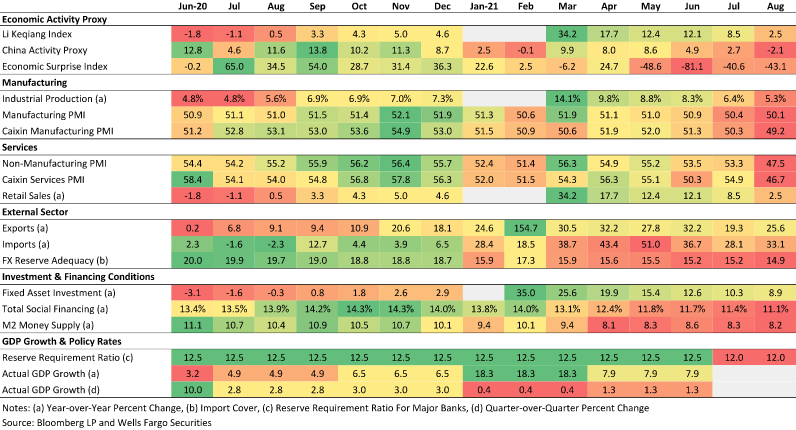
This combination of events has resulted in a noticeable decline in economic activity as well as sentiment. Retail sales slowed considerably in August, undershooting consensus expectations by a wide margin. In addition, the manufacturing and non-manufacturing PMIs have also softened over the last few months, with the services PMI currently in contraction territory at its lowest level since the beginning of the COVID crisis in February 2020. Other leading indicators such as industrial production have not been as robust either, while investment and financing conditions have also softened. While we monitor China's economy closely and update our forecasts frequently, the size and scale of China's economy arguably warrants a more regular update. In that context, we are introducing the China Economy Gauge, a dashboard-style monitor designed to track the evolution of local economic conditions. Included in the China Economy Gauge are alternative measures of activity and growth that we label as "Economic Growth Proxy." We also incorporate high frequency indicators to assess the manufacturing and services sectors, as well as China's trade position and FX reserve adequacy. In addition, our gauge includes monthly indicators of investment and financing conditions. Fixed asset investment is an important indicator of short-term investment, while total social financing and money supply are strong indicators of credit growth and financing conditions. In our view, these indicators should provide good scope into short-term GDP growth as well as the potential direction of PBoC monetary policy.
In short, the more red our dashboard shows, the more downward pressure the local economy is likely coming under. Q2-2021 is when our dashboard starts to flash red for most indicators, especially the external sector and local financing conditions. May is also when data started to surprise to the downside, as the economic surprise index turned negative. A negative economic surprise index number is defined as actual data coming in lower than consensus expectations. The bigger and more frequent the downside surprise is, the more negative the index turns. In Q3-2021, our monitor flashes red for additional indicators, and as August data were released, our economy gauge turned an even darker shade of red. The speed and magnitude of the slowdown also filtered down to PBoC policy. In July, China's central bank opted to lower the Reserve Requirement Ratio for all banks as economic conditions worsened and the outlook became less clear.
Our dashboard (Figure 1) suggests the short-term outlook for China's economy is indeed deteriorating, consistent with the multiple downward revisions we have made to our GDP forecast over the past few months. Given the signals our gauge is showing, we believe easier monetary policy could be the next major policy move from the PBoC, and another RRR reduction could be imminent as authorities look to offset some of the deceleration. To that point, we also believe the PBoC will look to lower the Reserve Requirement Ratio (RRR) by 1 percentage point for all banks at least one more time before the end of this year.
China Economy Gauge
Which Countries Are Sensitive to a China Slowdown?
A pronounced slowdown in China's economy could have wide ranging ripple effects. Given China's status as the second largest economy in the world, a drop in Chinese growth would likely have negative consequences for global growth prospects. China is also a major trading partner for many emerging market countries. A sharp deceleration in China's economy would likely result in less demand for foreign products, leaving countries heavily reliant on Chinese demand vulnerable to economic slowdowns in their domestic economies. In addition to export reliance and economic impacts, a sharp China slowdown could have implications for developing country financial markets as well. Should China's economy come under pressure, we would expect market participants to place depreciation pressure on China's currency. Given China's influence within the emerging markets, downward pressure could also build on emerging market currencies more broadly. The same could be said for equity prices as well. A sell-off in Chinese equities as a result of a downturn in China's economy could spread across the emerging markets and weigh on local equity prices within individual emerging market countries.
As a result, we have created the China Sensitivity table to assess which countries could be most vulnerable, both economically and from a financial markets perspective, to China's deceleration. As mentioned, economies with an elevated reliance on Chinese demand could be particularly sensitive to a slowdown in China. In our table, we label countries with exports to China worth over 6% of GDP as "Highly Sensitive" and highlight these countries in red under the "Exports to China" column. According to our analysis, and within our sample of countries, Singapore, South Korea, Chile, Thailand and Peru are most sensitive given their high level of export exposure to China. Countries highlighted in orange under the same column have export exposure to China worth between 2% and 6% of GDP and we identify these economies as "Moderately Sensitive", while countries in green have exports to China worth less than 2% of GDP and, in our view, have little direct economic sensitivity to a sustained downturn in the Chinese economy. Our analysis suggests economies such as Poland, Mexico, Colombia, India, Turkey and Israel could be insulated from a prolonged China deceleration.
Our analysis indicates a sharp and sustained economic slowdown in China could have more of an impact within the financial markets. In order to gauge the currency market impact, we analyzed the relationship of each emerging market currency in our sample in response to the Chinese renminbi using statistical regression analysis. We estimate that regression from the beginning of 2016 to today of weekly percentage changes in various emerging market currencies versus weekly percentage changes in the offshore Chinese renminbi (CNH). The coefficient or beta from these regressions indicate how sensitive these currencies are to moves in CNY. For example, the South African rand's beta of +1.54 indicates that ZAR and CNH tend to move in the same direction, and that a 1% depreciation in the offshore renminbi tends to result in the South African rand weakening by around 1.5%. Our sensitivity table assumes that currencies with a beta of +0.90 to CNH are highly sensitive and we highlight these currencies in red under the "Currency Beta" column. Highly sensitive currencies include the South African rand, Brazilian real, Russian ruble, Polish zloty as well as the Mexican and Colombian pesos. We also assume currencies with a beta between +0.40 and +0.90 are moderately sensitive and highlight these currencies in orange on our table, while currencies with a beta to CNH below +0.40 suggest little sensitivity and are labeled as green in the Currency Beta column.
We employ a similar methodology to gauge local equity market impacts as well. As far as the equity market response, we also analyzed the relationship of the major equity index of each emerging market country in our sample in response to China's Shanghai Stock Exchange Composite equity index again using statistical analysis. For example, in the case of South Korea, the country's Korea Composite Stock Price Index (KOSPI) has a beta of +0.40. A positive beta indicates the KOSPI and the Shanghai Composite tend to move in the same direction, and a 1% drop in Chinese equities could result in a 0.4% fall in local Korean equities. We assume a beta of above +0.30 is highly sensitive to Chinese equities and we highlight these countries in red under the "Equities Beta" column. Under this assumption, our framework suggests local equity markets in Singapore, South Africa and South Korea are highly sensitive to a sell-off in Chinese equities. A beta between 0.20 and 0.30 suggests local equities are moderately sensitive to Chinese equities, while a beta below 0.20 may not be as sensitive as the countries highlighted in green. According to our analysis, equity markets in Mexico, Colombia, Turkey and Israel may not be sensitive to an outsized sell-off in Chinese equities.
Combining these three indicators gives some sense of which countries could be most, or least, sensitive to China and the economic slowdown that is currently underway. Countries highlighted in red under the "Overall China Sensitivity" column are most sensitive and could experience relatively larger economic and financial market impacts from China's deceleration and regulatory crackdown. Countries highlighted in green should see a relatively small economic impact, while their respective currencies and equity markets should experience limited volatility. Our analysis indicates that countries heavily reliant on exports, high commodity prices, and which are tightly integrated into China's financial system should come under the most pressure. In that sense, Singapore and South Korea are often cited as bellwethers for the global economy, given their status as large exporting countries. Our analysis identifies Singapore and South Korea as particularly vulnerable to China. In addition, countries such as South Africa, Brazil, Chile and Russia are heavily reliant on high commodity prices, while each country is also fairly dependent on exporting commodities directly to China. An economic slowdown in China would likely result in less demand for commodities and could weigh on each economy. In addition, each of these currencies are highly correlated to commodity prices, while commodity-related companies make up a large component of each respective equity index. As a result, each currency as well as local equity markets could come under pressure.
On the other hand, countries less reliant on exports with more diversified economies could be less sensitive. In that sense, our framework suggests the Indian economy may not be sensitive to a slowdown in Chinese demand. India is also a large commodity importer and could also be a beneficiary if China were to pull back on demand for a broad range of commodities. In addition, the Reserve Bank of India (RBI) has a large stockpile of FX reserves that it regularly deploys to limit volatility in the rupee. RBI FX intervention is a key component to the rupee's low sensitivity to the offshore renminbi. Turkey and Israel also do not export a significant amount of product to China and are also commodity importers that could stand to benefit economically from a China slowdown. The Turkish lira tends to be one of the more volatile emerging market currencies; however, local equity markets do not respond much to moves in Chinese equities. In Israel's case, the Israeli economy is very diversified, while the Tel-Aviv equity index and Israeli shekel are not very volatile and their betas would indicate the currency and local equities do not react much to large moves in Chinese equity markets.
China Sensitivity 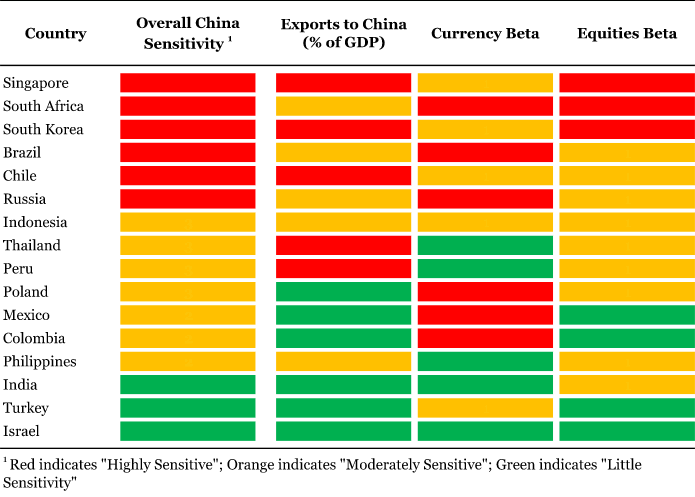
(RBA) Minutes of the Monetary Policy Meeting of the Reserve Bank Board
Videoconference – 7 September 2021
Members present
Philip Lowe (Governor and Chair), Guy Debelle (Deputy Governor), Mark Barnaba AM, Wendy Craik AM, Ian Harper AO, Carolyn Hewson AO, Steven Kennedy PSM, Carol Schwartz AO, Alison Watkins
Others participating
Luci Ellis (Assistant Governor, Economic), Christopher Kent (Assistant Governor, Financial Markets)
Anthony Dickman (Secretary), Penelope Smith (Deputy Secretary), Alexandra Heath (Head, International Department), Bradley Jones (Head, Economic Analysis Department), Jonathan Kearns (Head, Financial Stability Department), Marion Kohler (Head, Domestic Markets Department)
International economic developments
Members commenced their discussion of international economic developments by noting that momentum in the global economic recovery had eased in recent months. The global recovery also remained uneven, reflecting cross-country differences in policy support and vaccination rates. However, by year end, output in many economies was expected to have recovered to, or surpassed, pre-pandemic levels.
In countries with high vaccination rates, the recovery had been supported by the lifting of restrictions on mobility in recent months; rates of hospitalisation and recent deaths were relatively low despite an increase in case numbers of COVID-19. Consumption of services in the United States, Canada and several European countries had largely recovered from earlier declines, with high-frequency indicators of activity in the services sector (such as retail foot traffic and restaurant dining) returning to around pre-pandemic levels.
Members noted that unemployment rates in advanced economies had continued to decline over recent months. Demand for labour was high, although the supply of labour had been slower to respond to the lifting of restrictions, particularly in the services sector; these mismatches were contributing to pockets of labour shortages and wage pressures in some industries. Overall, wages growth had picked up in the United States, the United Kingdom and New Zealand, but remained modest in the euro area and Canada. Members noted that there was higher-than-usual uncertainty surrounding projections of spare capacity in the labour market, reflecting government support schemes and the medium-term effects of COVID-19 on labour supply.
Headline consumer price inflation remained high in advanced economies and it was likely that global supply chain disruptions would be more persistent than initially envisaged. Strong demand for goods continued to result in long supply times and high container freight rates. This had been exacerbated recently by disruptions to supply caused by virus outbreaks in key international trading ports. Members noted that once pandemic-related shocks to demand and supply begin to subside, the transitory inflationary pressures would ease and inflation would depend mostly on the extent of spare capacity in the labour market and the speed at which it was absorbed. Central banks' forecasts were for inflation to decline over the following year, and measures of underlying inflation and medium-term inflation expectations were broadly in line with central banks' targets in many advanced economies.
Members noted that health and economic outcomes across emerging Asian economies had been mixed in recent months. An increase in case numbers had prompted renewed containment measures in some countries in Asia. Restrictions in some middle-income east Asian countries had recently led to sharp declines in population mobility, which were expected to have dampened services activity in affected regions. Intermittent restrictions had also continued to weigh on activity in high-income east Asian countries. In contrast, mobility in India had recovered substantially as the earlier outbreak of the Delta variant of COVID-19 subsided, pointing to a strong recovery in economic activity in the September quarter.
Members noted that data on economic activity in China had softened in recent months and the outlook had become more uncertain than it had been for some time. Low tolerance for the community spread of COVID-19 had resulted in intermittent targeted lockdowns and restrictions on movement, which had weighed on activity and been disruptive for some key ports. There was also uncertainty about the effects of a range of recent policy measures, including those aimed at curbing financial stability risks, reducing carbon emissions and achieving broader social objectives.
The price of iron ore had fallen from high levels in recent times as Chinese authorities intensified efforts to restrict steel production. However, prices for coal and liquefied natural gas had continued to increase in recent months alongside strength in industrial output in China and elsewhere, and a boost to electricity demand from an unseasonably warm northern hemisphere summer. As a result, Australia's terms of trade were likely to remain at a high level in the September quarter, after reaching a record high in the June quarter.
Domestic economic developments
Turning to domestic economic developments, members noted that the national accounts confirmed the recovery had established strong momentum prior to the recent outbreak of the Delta variant of COVID-19. Domestic final demand increased by 1.7 per cent in the June quarter, to be 3.2 per cent above its pre-pandemic level. Growth in household consumption of just over 1 per cent in the quarter had been led by a rebound in the consumption of services. Growth in dwelling investment had slowed in response to capacity constraints, with a large pipeline of work still to be completed. Growth in business investment of around 2 per cent had been led by non-mining investment, while mining investment had declined in the quarter. Overall, GDP increased by 0.7 per cent in the June quarter, broadly in line with the most recent set of Bank forecasts, as strong growth in private and public consumption and investment had been partly offset by a decline in resource exports.
The outbreak of the Delta variant had interrupted the recovery in a manner that was more severe than expected a month earlier. While private demand had increased solidly in the June quarter, the spread of the Delta variant in New South Wales and Victoria had set back the recovery and created uneven conditions across states and industries. GDP was expected to decline materially in the September quarter; the near-term outlook resembled the downside scenario presented in the most recent forecasts. Measures of population mobility in New South Wales and Victoria had declined to around the low levels reached during earlier lockdowns. As in previous lockdowns, household consumption had been curtailed by reduced opportunities for households to spend. Dwelling and business investment were also likely to decline in the September quarter in response to restrictions in New South Wales and Victoria. Information from the Bank's liaison program suggested that restrictions affecting the construction industry could delay activity for a period, with limited scope to make up for this in light of ongoing capacity constraints.
Conditions in the established housing market had remained more robust in recent months compared with the Melbourne lockdown in the second half of 2020. Nevertheless, growth in housing prices had slowed a little in Sydney and Melbourne following the rapid increases over the first half of 2021. Housing prices had continued to increase strongly in most other markets. Growth in advertised rents also remained strong in most capital cities and regional areas. Building approvals data indicated that demand for new housing and alterations and additions had continued to ease after the conclusion of the HomeBuilder application period, but remained high compared with pre-pandemic activity.
Consistent with the effect of the lockdowns on activity, members assessed that further improvement in the labour market would be delayed. Hours worked and employment were little changed in July at a national level, but this masked the offsetting effects of declines in New South Wales and a recovery in Victoria from a previous lockdown early in June. Large declines in hours worked and employment were expected in both states in coming months before rebounding later in the year. Members noted that workers in New South Wales and Victoria who were stood down without pay for longer than four weeks were likely to be classified as not employed even if they were still attached to their employer; this differed from the treatment of workers who were stood down but received the JobKeeper payment in 2020, and would affect measured employment while restrictions remained in place. The decline in the unemployment rate in July was mainly due to people exiting the labour force. Alternative measures, which included employees working zero hours, rose in July and further increases were expected in the near term as more workers are stood down for longer than four weeks. Members noted that the measured unemployment rate would be a less useful indicator of labour market underutilisation over coming months compared with hours-based measures.
Members also noted that, prior to the recent outbreak of the Delta variant, notwithstanding the strong rebound in economic activity and employment, there had been little sign of upward pressure on wages growth. Increases in the Wage Price Index in the June quarter were modest for almost all industries, including those where there had been some reports of labour shortages amid strong labour demand, such as construction and mining. Business liaison suggested that most firms did not expect the recent lockdowns to have a significant effect on wages growth in the year ahead.
Beyond the September quarter, members agreed that the timing and pace of the rebound in economic activity would depend largely on the lifting of restrictions in response to health outcomes. Vaccination rates had been increasing swiftly in the period leading up to the meeting, especially in New South Wales. As vaccination coverage increased, this would allow restrictions to be eased and recovery from the recent setback to begin in the December quarter. As restrictions were likely to be lifted gradually, the recovery could be slower than experienced earlier in the pandemic, when the end of community transmission of COVID-19 allowed for a more rapid lifting of restrictions. It was possible that precautionary behaviour by households and firms after lengthy lockdowns would also contribute to a slower rebound, although there had been little evidence of this from the international experience or from domestic spending patterns outside of lockdown areas. Information from liaison also suggested that many firms were preparing to look beyond the near-term uncertainty and were committing to previous hiring and investment decisions. In the central scenario, activity was expected to return to its pre-Delta path in the second half of 2022, with the health situation the key source of uncertainty around this scenario.
Members agreed that the substantial increase in pandemic support by the Australian Government and state and territory governments would be one of the factors supporting the recovery into 2022. This support was more targeted than earlier in the pandemic, but for many individuals the COVID-19 disaster relief payments were offering the same level of income support as the earlier JobKeeper payments. This income support was expected to boost the household saving rate in the near term, and would eventually boost consumption when restrictions are eased later in the year. Business support grants, payroll tax deferrals and rental forbearance had also supported the cash flows of many businesses affected by lockdowns. More generally, members noted that business conditions across and within states remained uneven, with some industries experiencing very challenging conditions, while others, including professional services, appeared to have weathered the recent period reasonably well.
International financial markets
Globally, financial conditions remained highly accommodative. Yields on long-term government bonds had risen a little over the previous month, having declined significantly in prior months as the spread of the Delta variant of COVID-19 moderated optimism about the global economic recovery. In general, yields on shorter-term bonds had remained at low levels.
Some central banks in advanced economies had reduced their highly stimulatory policy settings or signalled they would soon start doing so. The Bank of Korea had raised its policy rate in August, citing rising inflationary pressures and a desire to curb financial imbalances. Members noted that the Reserve Bank of New Zealand (RBNZ) had also been expected to increase its policy rate in August, but had chosen to hold the rate steady given the policy meeting had been held shortly after a lockdown had been announced. The RBNZ had indicated that an increase in its policy rate would be appropriate soon because the economy is experiencing capacity constraints, inflationary pressures are building and inflation is near the RBNZ's target. The RBNZ had also signalled that it was considering further restrictions on high loan-to-value lending in response to rapid growth in housing prices and housing credit.
Members noted that market pricing implied that market participants were expecting the Bank of Canada and the Bank of England to start increasing their policy rates around mid 2022. Both central banks were widely expected to have ceased net asset purchases by that time. For the United States, most members of the Federal Open Market Committee had indicated that a reduction in the pace of the Federal Reserve's asset purchases was likely to be appropriate before the end of the year, given the progress that had been made towards its macroeconomic goals. Market pricing suggested that the conditions the Federal Reserve had set itself for raising its policy rate were unlikely to be met before 2023.
Financing conditions for corporations in advanced economies had remained favourable. Over the preceding month, equity markets in advanced economies had been around all-time or post-pandemic highs, including in Australia, supported by the recent strength in earnings. The spread between yields on corporate bonds and yields on government bonds had generally remained narrow.
In China, some weaker-than-expected economic data suggested downside risks to the economic outlook, which had increased expectations for a further easing in monetary policy. Members noted that a number of risks to the outlook for growth and financial stability were receiving attention in China. In particular, regulatory changes aimed at reducing leverage among real estate developers, as well as restrictions on demand for real estate, had led to slower construction activity and liquidity difficulties for some large property developers. This had led to a heightened risk of fire sales of assets and raised concerns about the potential for financial stability issues. There had also been a tightening of regulation in some other sectors, notably information technology and private education. This had resulted in significant declines in the share prices of affected firms, particularly those listed in offshore markets.
Financial conditions in other emerging markets had generally remained stable, despite rising COVID-19 case numbers in many countries. Central banks in a number of emerging market economies, including Brazil, Mexico and Russia, had increased their policy rates since early 2021 in response to high and rising inflation, and were expected to increase their policy rates further before the end of the year. Inflation in Asia had remained relatively well contained, but some central banks in the region were expected to start increasing policy rates in the near future. Bank Indonesia had announced it would purchase more government debt in the primary debt market in a burden-sharing arrangement to support government spending on COVID-19 response measures, following a similar arrangement in 2020. Members noted that the recent allocation of Special Drawing Rights by the International Monetary Fund was expected to be used by some emerging market economies to access additional foreign exchange, partly to assist with their COVID-19 policy responses.
Although there had been little change in the Australian dollar exchange rate from a month earlier, the Australian dollar had depreciated over the course of 2021 both against the US dollar and in trade-weighted terms. Over the year to date, the difference between interest rates in Australia and in other major advanced economies had declined, while most commodity prices had increased.
Domestic financial markets
Domestically, interest rates on outstanding home and business loans had edged down to new lows, as new loans and refinancing of existing loans were taken out at lower rates than existing loans. Housing loan commitments remained at high levels and overall credit growth had picked up further in July in six-month-ended annualised terms. Members noted that the current lockdowns were likely to affect demand for new loans in the coming months. The recent strength in banks' lending to businesses had followed a period of little change since late in 2020 and was mirrored by a pick-up in other forms of business debt issuance, including corporate bonds. Banks had offered targeted support to those household and business borrowers affected by lockdown measures, and the Australian Prudential Regulation Authority (APRA) had provided regulatory relief for this support. To date, the uptake of payment deferrals by households and businesses had been much lower than in the previous year.
Yields on 10-year Australian Government Securities (AGS) had been little changed over the preceding month but had declined relative to US 10-year yields since June, leaving a gap of around 10 basis points. Short-term yields on AGS out to the April 2024 bond had remained very low and in some cases had fallen a little below zero. In part, this had reflected the effects of the Bank's policies, including the bond purchases, which had contributed to further rises in system liquidity.
The Bank had completed the $200 billion of purchases under its bond purchase program at the time of the meeting. Around half of surveyed market economists expected the Bank to maintain the pace of bond purchases at $5 billion per week, in light of the economic effects of recent lockdowns and other containment measures. A similar proportion expected the Bank to taper purchases to $4 billion per week as was announced following the July 2021 meeting.
Expectations for the cash rate in the near term had been little changed. Market pricing continued to suggest that market participants expected the cash rate target to be increased to 25 basis points around the end of 2022.
Members reviewed the Term Funding Facility (TFF) following its closure to new drawdowns at the end of June 2021. The $188 billion of low-cost funding that had been drawn under the TFF will continue to support low borrowing costs until mid 2024. Business credit had held up since early 2020, which was a better outcome than seen in earlier periods of sizeable contractions in economic activity in Australia, when business credit had declined noticeably. The TFF had contributed to lower funding costs for banks, which had been passed through to lower borrowing rates. This suggested that the TFF had provided, and would continue to provide, significant support to the economy. Members noted that the banks' task of refinancing the maturing funding from the TFF in around three years' time would be sizeable, but manageable. Australian banks had issued similarly large volumes of bonds as a share of assets in the past, and currently have the capacity to smooth their funding arrangements.
Considerations for monetary policy
In considering the policy decision, members observed that the Australian economy had considerable momentum prior to the outbreak of the Delta variant of COVID-19. Business investment had been picking up and the labour market had strengthened, with the unemployment rate falling further in June. However, despite the strong economic and labour market outcomes, wage and price pressures had remained subdued.
The outbreak of the Delta variant had delayed, but not derailed, the recovery. GDP was expected to decline materially in the September quarter and the unemployment rate was expected to rise, but the economy was expected to bounce back as vaccination rates increase and restrictions are eased. However, there was considerable uncertainty about the timing and pace of the recovery, which was likely to be slower than experienced earlier in 2021. Much would depend on the health situation and the easing of restrictions on activity. In the central scenario, the economy would return to growth in the December quarter and to its pre-Delta path in the second half of 2022. Wages growth and underlying inflation were expected to pick-up gradually as the economy recovers.
Members noted that very accommodative financial conditions were supporting the recovery. Borrowing rates were at record lows, sovereign bond yields were at very low levels and the exchange rate had depreciated over preceding months. Members noted also that housing prices had continued to rise. Housing credit growth had increased, reflecting stronger demand for credit from both owner-occupiers and investors. Given the environment of rising housing prices and low interest rates, members continued to emphasise the importance of maintaining lending standards and carefully monitoring trends in borrowing.
Members discussed the implications of the outbreak of the Delta variant for the Bank's bond purchase program.
As part of their discussion, members considered the roles of fiscal and monetary policy in response to the current shock. They observed that fiscal policy is the more appropriate policy instrument for dealing with a temporary and sharp reduction in private sector incomes. In this context, they welcomed the fiscal responses by the Australian Government and the state and territory governments in supporting household and business balance sheets. While acknowledging that monetary policy can do little more to offset this type of temporary shock to aggregate demand, members recognised that the outbreak of the Delta variant was delaying the recovery and had added to the uncertainty about the future. As a result, progress towards the Bank's goals was likely to take longer and was less assured. In response, members judged that a modification to the previously announced plans was appropriate.
Two modifications were considered. The first was to maintain the recent rate of purchases at $5 billion a week to at least November 2021 and then review the program. The second was to taper purchases to $4 billion as had been announced, but to extend the period over which bonds would be purchased at this rate to mid February 2022. With the economy expected to return to its pre-Delta path by mid 2022, members assessed that, on balance, tapering remained appropriate. The Board also took account of the fact that a number of other central banks are tapering their bond purchases. In addition, at $4 billion a week, the Bank's bond purchase program is expanding faster relative to the stock of bonds outstanding than that of many other central banks. The Board also saw value in providing greater clarity regarding bond purchases after November 2021.
The Board therefore decided on the second option – namely, to purchase bonds at $4 billion a week until at least mid February 2022. The Board will continue to review the bond purchase program in light of economic conditions and the health situation, and their implications for the expected progress towards full employment and inflation reaching the target. The bond purchases – together with the low level of the cash rate, the yield target and the funding under the TFF – were providing substantial and ongoing support to the Australian economy.
The Board remains committed to maintaining highly supportive monetary conditions to achieve a return to full employment in Australia and inflation consistent with the target. It will not increase the cash rate until actual inflation is sustainably within the 2 to 3 per cent target range. The central scenario for the economy is that this condition will not be met before 2024. Meeting this condition will require the labour market to be tight enough to generate wages growth that is materially higher than it was at the time of the meeting.
The decision
The Board decided upon the following policy settings:
- maintain the cash rate target at 10 basis points and the interest rate on Exchange Settlement balances of zero per cent
- maintain the target of 10 basis points for the April 2024 Australian Government bond
- purchase government securities at the rate of $4 billion a week and to continue the purchases at this rate until at least mid February 2022.
Other policy matters
The Board discussed the Bank's arrangements for Exceptional Liquidity Assistance (ELA). This was prompted by ongoing developments in the international regulatory architecture, where it has become increasingly common for central banks to provide more detailed information on ELA arrangements to assist banks in their contingency planning. This transparency can assist banks in their recovery and resolution planning and thereby support financial stability. In Australia, APRA intends to release its new prudential framework for recovery and resolution for consultation later in 2021. Australia's financial institutions currently have high liquidity buffers and are strongly capitalised. Against this background, the Board discussed current arrangements for ELA in Australia.
The provision of ELA to illiquid but solvent banks is a core responsibility of central banks. While each financial institution is responsible for managing its own liquidity, situations can arise when the provision of liquidity to a specific institution by the central bank can be in the public interest. Doing so can reduce unnecessary disruptions to the financial system and help preserve financial stability.
The regulatory framework for authorised deposit-taking institutions (ADIs) in Australia anticipates that institutions may at times face unexpected outflows or difficulty accessing liquidity. ADIs are required to maintain holdings of liquid assets above a regulatory minimum and to plan how they would respond to liquidity stress. Larger ADIs are also expected to hold additional 'contingent liquidity' assets that could be used in a crisis situation to access liquidity from the Bank via repurchase agreements (repos) of self-securitised mortgages – that is, debt securities backed by pools of mortgages created and held by ADIs specifically to be used in repos with the Bank.
In situations of market-wide liquidity stress, the Bank can boost system-wide liquidity through open market operations, reducing uncertainty about the availability of liquidity in the banking system and contributing to a lower cost of liquidity than otherwise. The Bank has done this on multiple occasions in the past, notably during the global financial crisis and during a period of pandemic-related stress in March and April 2020.
However, where liquidity pressures arise in an individual institution, or in parts of the financial system where open market operations are less well suited, the Bank can consider providing ELA directly to individual financial institutions. Liquidity risk has generally been well managed by ADIs, which suggests that the provision of ELA would be exceptionally rare.
While risk to the Bank from providing ELA is managed by holding collateral, with appropriate 'haircuts', the Bank would consider providing ELA only if it was considered to be in the public interest. Further, it would need to be clear that the recipient was experiencing acute liquidity difficulties and had made reasonable efforts to obtain liquidity from private sources, and the Bank would need to judge that the entity was solvent. The recipient would be expected to have informed its regulator of its liquidity concerns before approaching the Bank, and the Bank would liaise closely with the regulator in making judgements about the entity's situation and solvency. The provision of ELA and the terms of that assistance would be at the Bank's discretion.
The focus of liquidity support is generally on ADIs, but in principle it could also be provided to a domestic clearing and settlement facility, where the facility is unable to obtain liquidity from its collateral holdings for market or operational reasons. This could occur either as part of the facility's normal default management arrangements, or during recovery or resolution when extraordinary measures were being taken to secure the facility's viability. The arrangements for providing liquidity would be broadly similar to those for ADIs.
Members endorsed the proposal for the Bank to publish information on its website regarding technical requirements and other considerations for ELA, in order to increase the transparency of ELA arrangements. This information will note the Bank's expectation that entities should: inform their regulator of any liquidity concerns and their intention to request ELA before approaching the Bank; have made reasonable efforts to obtain liquidity from the private sector; and be able to demonstrate their solvency. It will also emphasise that the Bank retains full discretion over the provision and terms of ELA. As in other countries, this information will assist institutions with their recovery and resolution plans.
RBNZ Hawkesby: Employment at maximum sustainable level, price pressures to feed through
RBNZ Assistant Governor Christian Hawkesby said in a speech, "while the demand side of the economy has been more resilient than expected when COVID-19 arrived, the disruption to the supply side of the economy has also been more prolonged than anticipated." Also, the developments combined are "likely to have reduced the level of maximum sustainable employment".
He reiterated that in the latest Monetary Policy Statement, it's noted RBNZ had "more confidence that employment was already at its maximum sustainable level and that pressures on capacity would feed through into more persistent inflation pressures over the medium-term".
Thus, the "least regrets policy stance" was to "further reduce the level of monetary stimulus so as to anchor inflation expectations and continue to contribute to maximum sustainable employment." Also, " whether or not a monetary policy response would be required in response to future health related lockdowns would depend on whether there was a more enduring impact on inflation and employment"
Market Morning Briefing: Pound Has Bounced From 1.3640
STOCKS
Short selling continues in the equities globally as most indices break immediate supports and look bearish for the next few sessions. Dow and Dax have broken below 34000 and 15400 respectively and can head towards 33500-33000 and 15000-14800. Nikkei has broken below 30000 and can test 29500-29000 in the near term. Shanghai seems to be the only index amongst all that holds above support near 3570. Nifty and Sensex too can fall today towards 17200-17000 and 58000 respectively.
Dow (33970.47, -614.41, -1.78%) broke below immediate supports at 34500 and 34000 respectively and is now bearish for a test of 33500-33000 in the near term. Any break below 33000 can drag it lower to 32000 but that does not look certain just now. Watch for a possible corrective bounce from 33500-33000 zone.
DAX (15132.06, -358.11, -2.31%) too opened with a sharp gap down and now has chance to test 15000-14800 from where a bounce is possible.
Nikkei (29852.98, -647.07, -2.11%) broke below 30000 and while it continues to trade lower, a test of 29500-29250 or even 29000 cannot be negated. View is likely to be bearish for another couple of sessions.
Shanghai (3613.97, +6.87, +0.19%) has also dipped but seems to be the only one on the mentioned indices that has not broken support at 3570. We expect the support to hold and keep the index ranged for now.
Nifty (17396.90, -188.25, -1.07%) fell sharply in yesterday’s session and looking at the sharp fall in global equities, Nifty can see a sharp fall today possibly breaking immediate supports near 17200. Below 17200, the index can fall towards 17000.
Sensex (58490.93, -524.96, -0.89%) has scope to test 58000 today which is an interim support. Failure to hold above 58000 can be strongly bearish for the next few sessions.
COMMODITIES
Slight bounce is seen in commodity prices globally but we would wait and watch if this is short lived or the prices can again fall back in the near term. Copper is bearish towards 4.10-4.00 while below 4.20, Gold and Silver can fall towards 1725-1700 and 22-21 on a break below current levels. Crude prices have risen well from supports but need to see if they sustain the rise or fall back in the next few sessions. We would wait and watch price action near current levels.
Brent (74.51) dipped slightly but rose back to levels above 74 as support near 74-73.75 held well yesterday. We need to see if the price can bounce back to 75-77 levels or break below support in the near term. Need to wait and watch for now.
WTI (70.79) too has risen from 70.36 but we need to see if the price bounces towards 72-73 in the near term.
Gold (1763.40) has not broken below 1742 yesterday and has instead bounced higher. But while below 1800-1780, there is still scope for a fall towards 1725-1700.
Silver (22.27) has support in the 22-21 zone which can hold and produce a bounce in the near term. Any break below the mentioned support zone can be strongly bearish.
Copper (4.1420) has fallen as expected and while below 4.20, there is scope for a fall to 4.10-4.00 in the near term.
FOREX
Dollar Index has fallen sharply pulling up Euro from 1.17 itself. We need to see if the movement sustains or gives way again in the near term. EURJPY, Aussie and Pound have risen from respective interim supports which need to hold to take them up in the near term. Else a fall again can be seen on the cards. USDCNY has resistance near 6.47/48 but a possible SHS pattern on the USDCNH can indicate bullishness above 6.48. We will have to wait and watch the movement in the near term. USDINR can range between 73.40-73.80-74.00 with bias for a rise towards 74.
Dollar Index (93.217) can see a rise to 93.60 on the upside before seeing profit taking from there. However, if the index holds below 93.40 just now, we may expect a decline towards 93.00-92.80 in the near term.
Euro (1.1730) has bounced from 1.17 but we need to see if the bounce is short lived or if there is scope for a fall to 1.1660-1.1600 in this month. Watch price action near current levels.
EURJPY (128.53) has bounced from 128.14 as support near 128 has held well. The pair should be able to rise back to 129 or higher to avoid an immediate break below 128 which if seen could be very bearish for the medium term. Watch if the bounce sustains over the next few days.
Dollar-Yen (109.58) continues to fluctuate within 110.20/50-109.00/25 region and may hold on for some more time before any fresh break out is seen. Overall view remains ranged.
Aussie (0.7264) tested 0.7220 before rising to current levels. We need to see if the bounce sustains or gives way towards 0.72.
Pound (1.3663) has bounced from 1.3640 but we need to see if the bounce can take the price higher towards 1.37-1.3750 or there is some more downside left in the coming sessions.
USDCNY (6.4655) has risen well but has resistance near 6.47/48 which can hold for the near term. Chinese market is closed today. A possible Shoulder-Head-shoulder pattern seems to be seen on the USDCNH, breaking above 6.48 but we would wait and see how the movement shapes up.
USDINR (73.74) rose by the end of the session yesterday to re-attempt a test of 73.80. We may expect fluctuation within 73.50/60-73.80-74.00 in the near term with slight bias to see an upmove towards 74 while above 73.60.
INTEREST RATES
The US Treasury yields have dipped back. Resistances are ahead which have to be broken in order to move up further. Will the Fed meeting tomorrow provide a trigger to break the resistances? We will have to wait and watch. Otherwise, we see a broad range of move in the Treasury yields with high chances of breaking the range on the downside from a long-term perspective. The German yields are turning down from their resistances as expected marking the end of their corrective rally. A further fall from here will indicate the resumption of the broader downtrend and drag them lower. The 5Yr and 10Yr GoI have broken their range on the downside and are keeping our bearish view intact.
The US 2Yr (0.22%) Treasury yield remains stable while the 5Yr (0.83%), 10Yr (1.32%) and the 30Yr (1.86%) have fallen-back. We see resistance at 1.4%-1.45% on the 10Yr while below which a dip to 1.2%-1.18% is possible. Broadly 1.18%-1.4/1.45% looks to be the range of trade. The 30Yr on the other hand has to break above 1.9% to move up to 2%. Else a test 1.8% and a break below it cannot be ruled out.
The German 2Yr (-0.73), 5Yr (-0.64%), 10Yr (-0.32%) and 30Yr (0.17%) yields have turned down. The resistances at -0.25% (10Yr) and 0.2% (30Yr) have held very well as expected. A further fall from here will confirm the same and can drag the yields lower to -0.5% (10Yr) and 0% (30Yr) in the coming weeks.
The Indian 10Yr GoI (6.1380%)and the 5Yr GoI (5.5599%) have declined sharply breaking below their range on the downside as expected. The bearish view remains intact. The 10Yr can test 6.1% and then see a corrective bounce 6.15%-6.16% before extending the fall to 6% over the medium-term. The 5Yr has tested 5.55% as expected and can extend the fall to 5.5% in the coming days in line with our expectation.
GBP/USD At Risk of More Downsides Below 1.3650
Key Highlights
- GBP/USD started a fresh decline from the 1.3900 resistance zone.
- It traded below a major bullish trend line at 1.3810 on the 4-hours chart.
- EUR/USD extended its decline below the 1.1750 support.
- USD/JPY failed to clear the key 110.00 resistance zone.
GBP/USD Technical Analysis
The British Pound topped near the 1.3900 zone against the US Dollar. GBP/USD traded as high as 1.3913 and started a major decline.
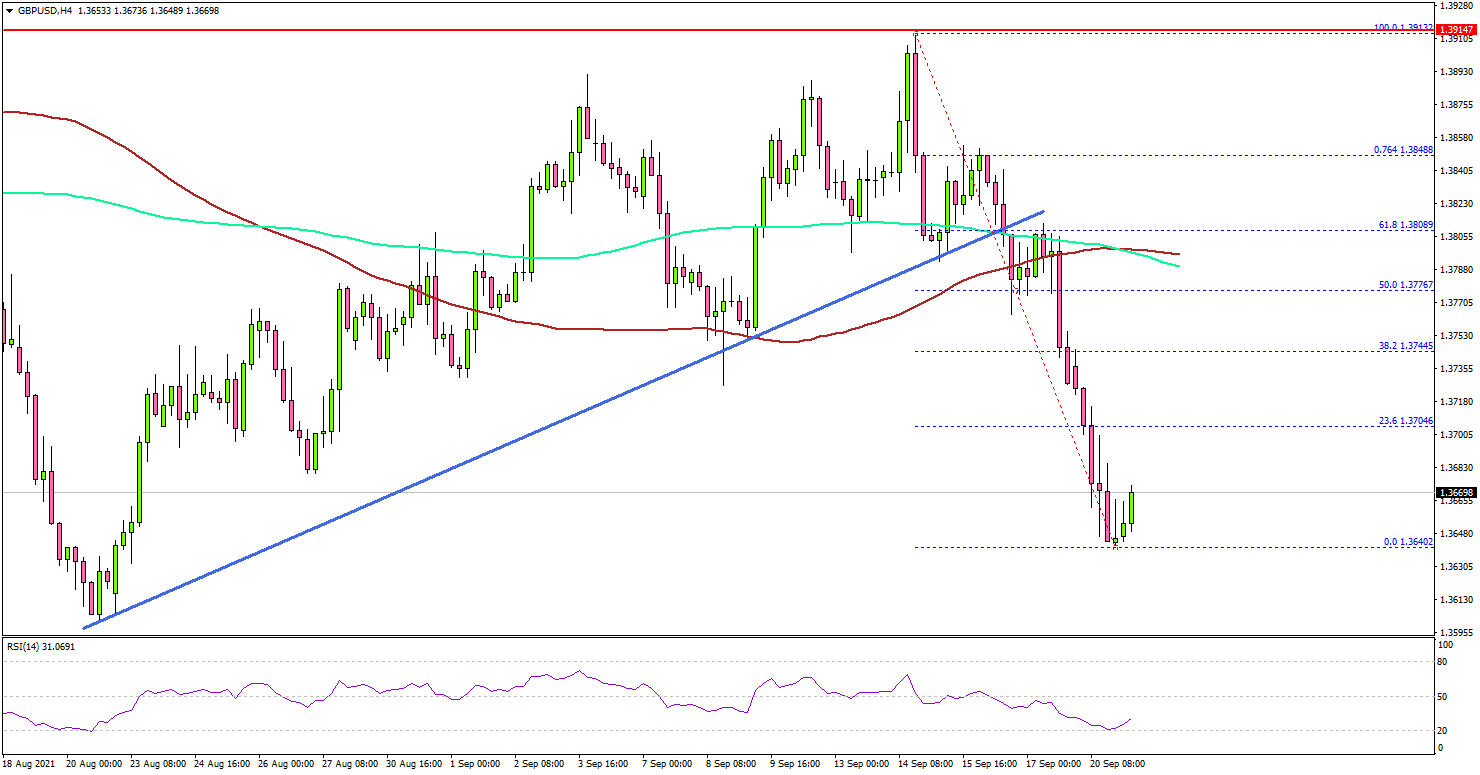
Looking at the 4-hours chart, the pair traded below the 1.3820 and 1.3800 support levels. There was also a break below a major bullish trend line with support at 1.3810.
The pair gained pace below the 1.3750 level, the 100 simple moving average (red, 4-hours), and the 200 simple moving average (green, 4-hours). It even traded below the 1.3700 level.
If the bears remain in action, the pair could even decline below 1.3620. The next major support is near 1.3600, below which there is a risk of a larger decline. In the stated case, the pair may possibly test 1.3540.
An immediate resistance on the upside is near the 1.3700 level. It is close to the 23.6% Fib retracement level of the recent decline from the 1.3913 swing high to 1.3640 low.
The first major resistance is now forming near the 1.3800 level and the 100 simple moving average (red, 4-hours). The pair must settle above 1.3800 to start a steady increase in the near term.
Looking at EUR/USD, the pair extended its decline below 1.1750, but the bulls are now protecting the 1.1700 support zone.
Economic Releases
- US Housing Starts for August 2021 (MoM) – Forecast 1.580M, versus 1.534M previous.
- US Building Permits for August 2021 (MoM) – Forecast 1.610M, versus 1.630M previous.