Sample Category Title
EUR/USD Outlook: Euro Holds Firm Bearish Tone Ahead Of Fed
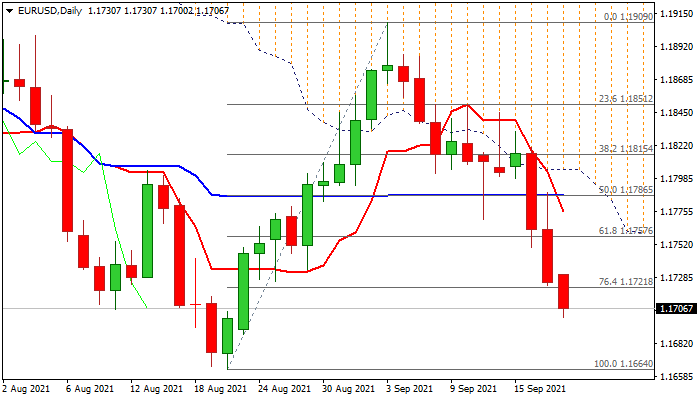
The Euro remains firmly in red at the beginning of the week and extends sharp fall from last Thu/Fri, hitting new one-month lows in European trading on Monday.
The pair keeps firm bearish tone following 1.3% drop in past two weeks as bears accelerated after bull-trap above Fibo barrier at 1.1894 in early September.
Falling thick daily cloud continues to heavily weigh on near-term action which is pressuring pivots at 1.1700/1.1694 (psychological / Fibo 38.2% of 1.0635/1.2349 rally) and focusing key support at 1.1664 (2021 low posted on Aug 20), loss of which could risk drop towards 1.1600/1.1500 zone.
Rising bearish momentum, daily MA’s in negative setup and forming a number of bear-crosses, add to bearish picture.
Oversold conditions on daily chart may slow bears, as traders also await fresh signals from Fed’s policy meeting which ends on Wednesday.
Upticks are expected to provide better selling opportunities while remain capped by falling daily Tenkan-sen (currently at 1.1775).
Res: 1.1721, 1.1757, 1.1775, 1.1786.
Sup: 1.1694, 1.1664, 1.1602, 1.1500.
European Indices Plunge On China Woes
Notes/Observations
- Risk aversion globally as China worries persist; Evergrande falls to 11 year lows.
- Tensions grow between France and Australia following cancelled submarine deal.
Asia
- China, Japan, South Korea and Taiwan closed for holiday.
- (HK) Macau official: want to hear gaming industry views on diversification; Stay open to opinions on license terms, local ownership.
- (IR) IAEA chief Grossi: North Korea's nuclear program is going full steam ahead.
Europe
- (IT) Italy PM Draghi govt reportedly targets growth >10% for 2-year period 2021-2022.
- (UK) UK govt reportedly considers offering state-backed loans to energy firms amid gas prices surge.
- (DE) German weak-ahead baseload power price at €144.0/MWh +8.7% d/d.
- (UK) UK meat industry said to have warned about carbon dioxide (CO2) shortage; some meat firms have 5 days of available CO2 supply - press.
- EU Parliament Trade Committee Chair notes it will be more complicated to conclude EU-Australia trade agreement on the back drop of Australia’s submarine deal with the US-UK angering France.
Americas
- (US) Reportedly Senator Manchin (D-WV) considers the Congress should take a strategic pause until 2022 before voting on Pres Biden’s $3.5T social-spending package.
Speakers/Fixed income/FX/Commodities/Erratum
Equities
- Indices [Stoxx600 -1.67% at 454.14, FTSE -1.27% at 6,875.05, DAX -1.96% at 15,186.95, CAC-40 -1.91% at 6,444.91, IBEX-35 -1.84% at 8,599.50, FTSE MIB -2.07% at 25,178.00, SMI -1.40% at 11,768.70, S&P 500 Futures -1.08%].
- Market Focal Points/Key Themes: European indices open down across the board and move further into the red as the session progressed; risk sentiment impacted by concerns over housing market in China; less negative sectors include consumer discretionary and health care; sectors leading to the downside include materials and financials; reportedly Sainsbury’s looking to fend off takeover; no major earnings expected during the upcoming US session.
Equities
- Consumer discretionary: Lufthansa [LHA.DE] +2% (capital raise).
- Financials: Prudential [PRU.UK] -7% (capital raise in HK).
- Healthcare: AstraZeneca [AZN.UK] +3% (trial data), Santhera Pharmaceuticals [SANN.CH] -18% (earnings; funding).
- Technology: Zoo Digital [ZOO.UK] +3% (trading update).
- Utilities: SSE [SSE.UK] -1% (refutes media rumors on breakup of company).
Speakers
- (UK) Business Sec Sharma: UK govt is currently confident there is no risk to the gas supply to consumers - weekend press interview.
- (EU) EU Economic Commissioner Gentiloni (Italy): Not in Ireland to pressure on tax rate.
- (UK) Business Sec Sharma: UK govt is currently confident there is no risk to the gas supply to consumers.
- (EU) EU Parliament Trade Committee Chair: It will be much more complicated now to conclude EU-Australia trade agreement.
- (EU) EU Parliament Trade Committee Chair: It will be much more complicated now to conclude EU-Australia trade agreement.
- (CZ) Czech Central Bank Dep Gov Nidetzky: 100bps Czech hikes are possible by end-2021.
Currencies/Fixed Income
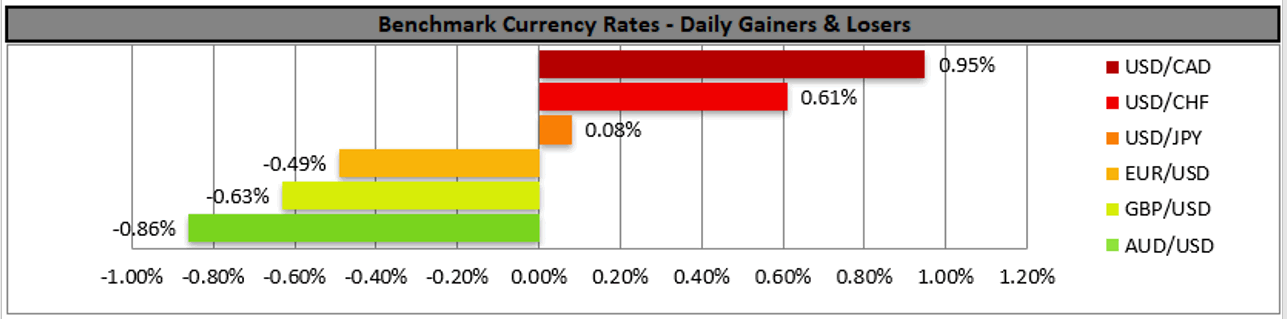
- Overall dollar strength puts most pairs under pressure with demand for safe havens. EUR/USD just above the 1700 handle, just ~30pips over the year’s low.
- Turkish Lira (TRY) falls past 8.72 per US dollar (USD) level, lowest since July 2021.
Economic data
- (DE) Germany Aug PPI M/M: 1.5% v 0.8%e; Y/Y: 12.0% v 11.1%e.
- (HU) Hungary Q2 Current Account: -€0.8B v -€0.5Be.
- (PL) Poland Aug PPI M/M: 0.6% v 0.7%e; Y/Y: 9.5% v 9.3%e.
- (PL) Poland Aug Sold Industrial Output M/M: -2.5% v -1.1%e; Y/Y: 13.2% v 14.6%e.
- (CH) Swiss weekly Total Sight Deposits (CHF): 714.7B v 714.8B prior.
- (ES) Spain July Trade Balance: -€1.6B v -€1.0B prior.
- (HK) Hong Kong Aug CPI Composite Y/Y: 1.6% v 1.6%e.
Fixed income Issuance
- (PH) Philippines sells total PHP15.0B vs. PHP15.0B indicated in 3-month, 6-month and 12-month bills.
- (EU) European Investment Bank (EIB) to sell PLN-denominated 3.0% May 2024 bonds; guidance seen +20bps to Polish Treasuries.
Looking Ahead
- 06:00 (IE) Ireland July Trade Balance: No est v €4.7B prior.
- 07:00 (MX) Mexico Q2 Aggregate Supply and Demand: No est v -2.9% prior.
- 07:25 (BR) Brazil Central Bank Weekly Economists Survey.
- 07:30 (CL) Chile Central Bank Traders Survey.
- 08:00 (UK) Daily Baltic Dry Bulk Index.
- 08:30 (CA) Canada Aug Teranet/House Price Index M/M: No est v 2.0% prior; Y/Y: No est v 17.8% prior; HPI Index: No est v 281.67 prior.
- 08:30 (UR) Ukraine Q2 Final GDP Q/Q: No est v -0.8% prelim; Y/Y: No est v 5.4% prelim.
- 10:00 (US) Sept NAHB Housing Market Index: 74e v 75 prior.
- 16:00 (US) Weekly Crop Progress Report.
- 17:00 (NZ) New Zealand Q3 Consumer Confidence: No est v 107.1 prior.
- 19:30 (AU) Australia ANZ Roy Morgan Weekly Consumer Confidence Index: No est v 103.1 prior.
- 21:30 (AU) RBA Sept Minutes.
- 23:00 (NZ) New Zealand Aug Credit Card Spending M/M: No est v -0.6% prior; Y/Y: No est v 6.9% prior.
Speakers/events
- 07:00 (SE) Sweden Parliament debates budget proposal.
- 21:30 (AU) RBA Sept Minutes.
- (CA) Canada Federal Election.
Fixed Income
- 01:00 (KR) Bank of Korea (BOK) sell KRW in 3-month Monetary Stabilization Bonds (MSB Bonds; Avg Yield % v % prior.
- 01:00 (PH) Philippines to sell combined PHP in 3-month, 6-month and 12-month bills.
- 05:00 (EU) Daily Euribor Fixing.
- 05:00 (SK) Slovakia Debt Agency (Ardal) to sell 2030, 2036 and 2047 Bonds.
- 05:30 ((DE) Germany to sell 6-month and 12-month Bubills.
- 05:30 (NL) Netherlands Debt Agency (DSTA) to sell €1.5-2.5B in 6-month Bills.
- 05:30 (ZA) South Africa announces details of upcoming I/L bond sale (held on Fridays).
- 06:00 (IL) Israel to sell bonds.
- 06:00 (RO) Romania to sell RON300M in 4.15% Jan 2028 Bonds.
- 07:00 (TR) Turkey to sell Bonds (2 tranches).
- 06:45 (US) Daily Libor Fixing.
- 08:00 (IN) India announces details of upcoming bond sale (held on Fridays).
- 09:00 (FR) France Debt Agency (AFT) to sell €B in 3-month, 6-month and 12-month bills.
- 11:30 (US) Treasury to sell 13-Week and 26-Week Bills.
- 23:00 (TH) Thailand Central Bank to sell THB55B in 3-month bills.
- 23:30 (HK) Hong Kong to sell 3-month and 6-month Bills.
- 22:30 (JP) Japan to sell 6-Month Bills.
The Analytical Overview Of The Main Currency Pairs
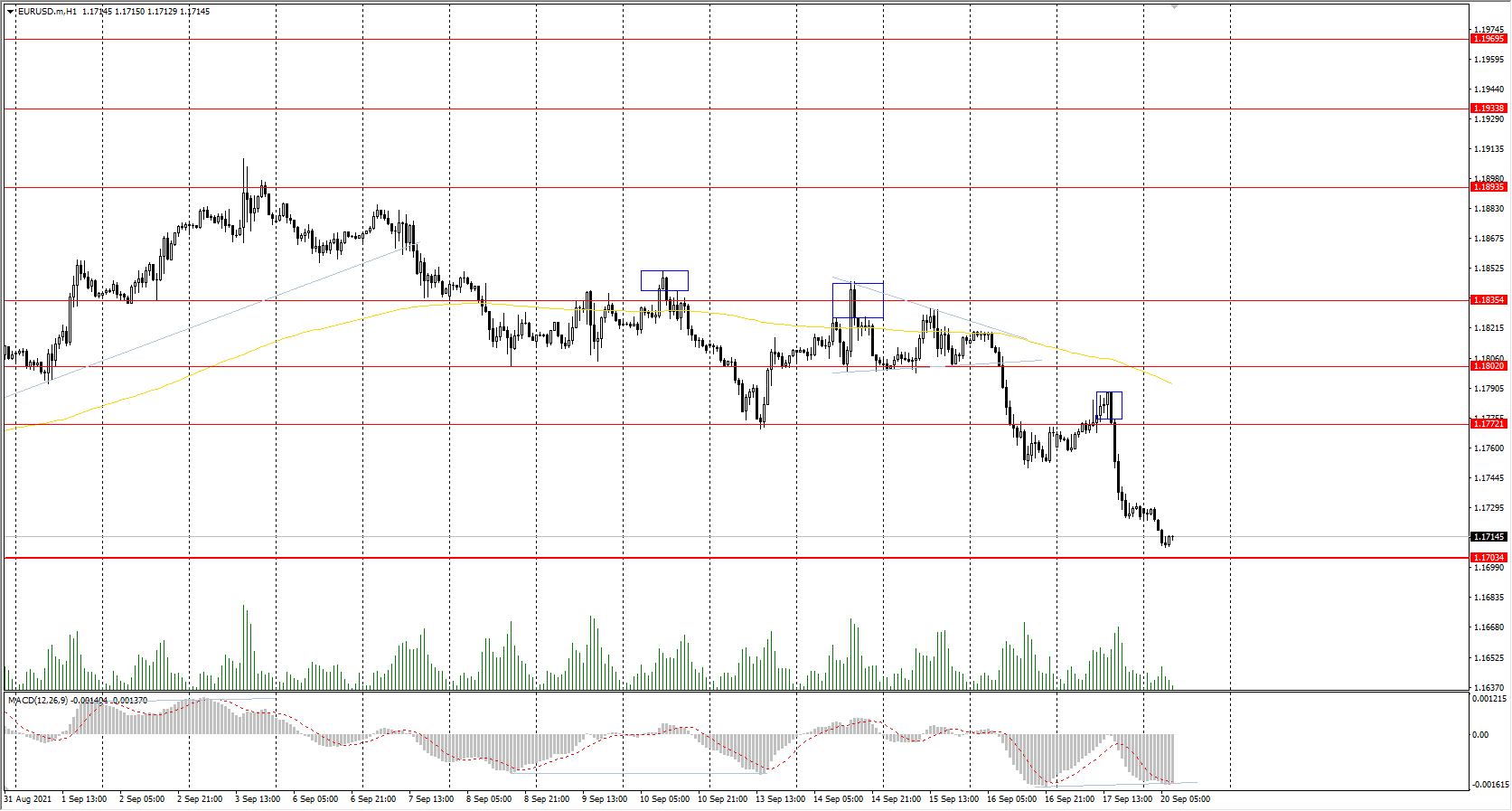
The EUR/USD currency pair
Technical indicators of the currency pair:
Prev Open: 1.1761
Prev Close: 1.1725
% chg. over the last day: -0.30%
Inflationary expectations continue to grow in Germany. Inflation is no longer seen as a temporary phenomenon but as something more permanent. The German inflation expectations index increased by 1.60% last week; it’s the highest level since 2013.
Trading recommendations
Support levels: 1.1704, 1.1620
Resistance levels: 1.1772, 1.1802, 1.1835, 1.1894, 1.1934, 1.1969
From the technical point of view, the general trend on the EUR/USD currency pair is bullish. However, the selling pressure is rising, and the price has approached the priority change level. The MACD indicator is in the negative zone, but there are signs of overselling and a reversal in the form of divergence. Under such market conditions, buy trades can be considered from the priority change level, but after a new buyers initiative. It is better to look for sell trades throughout the day from the resistance level in the area of the broken triangle.
Alternative scenario: if the price breaks down through the 1.1704 support level and fixes below, the mid-term uptrend will likely be broken.
News feed for 2021.09.20:
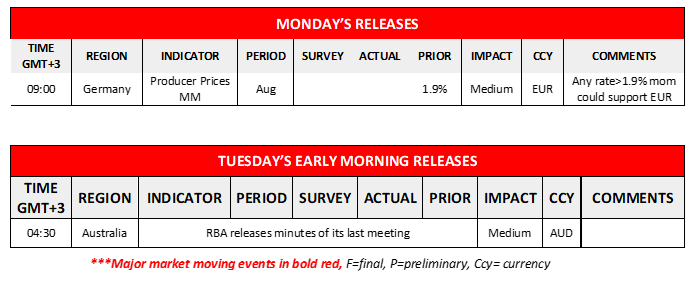
- German Producer Price Index (m/m) at 09:00 (GMT+3).
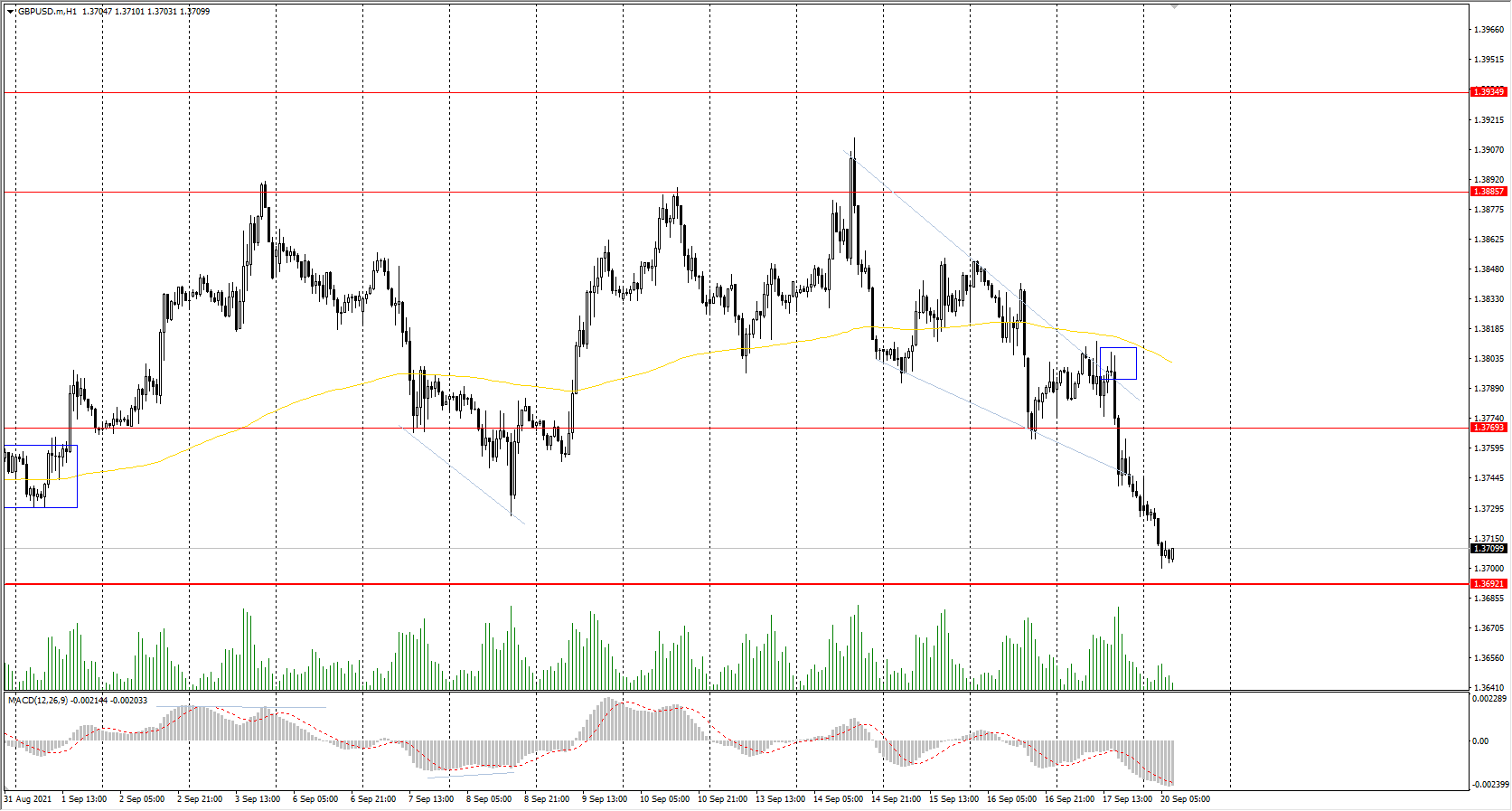
The GBP/USD currency pair
Technical indicators of the currency pair:
Prev Open: 1.3788
Prev Close: 1.3729
% chg. over the last day: -0.43%
Consumer prices in the UK rose at the fastest pace in August as global supply shortages and wage increases accelerated inflation. The National Statistics reported that inflation accelerated from 2% to 3.2% year-over-year.
Trading recommendations
Support levels: 1.3692, 1.3632, 1.3614, 1.3525
Resistance levels: 1.3769, 1.3886, 1.3935, 1.4002
On the hourly timeframe, the GBP/USD trend is bullish. But amid the strengthening of the dollar index, the GBP/USD currency pair is under sellers' pressure. The MACD indicator has become negative. There are signs of overselling but no signs of reversal. Under such market conditions, it is better to look for buy trades from the priority change level, but after a new initiative from the buyers. Sell positions can be considered from the resistance levels with short targets throughout the day.
Alternative scenario: if the price breaks down through the 1.3692 support level and consolidates below, the bearish scenario will likely resume.
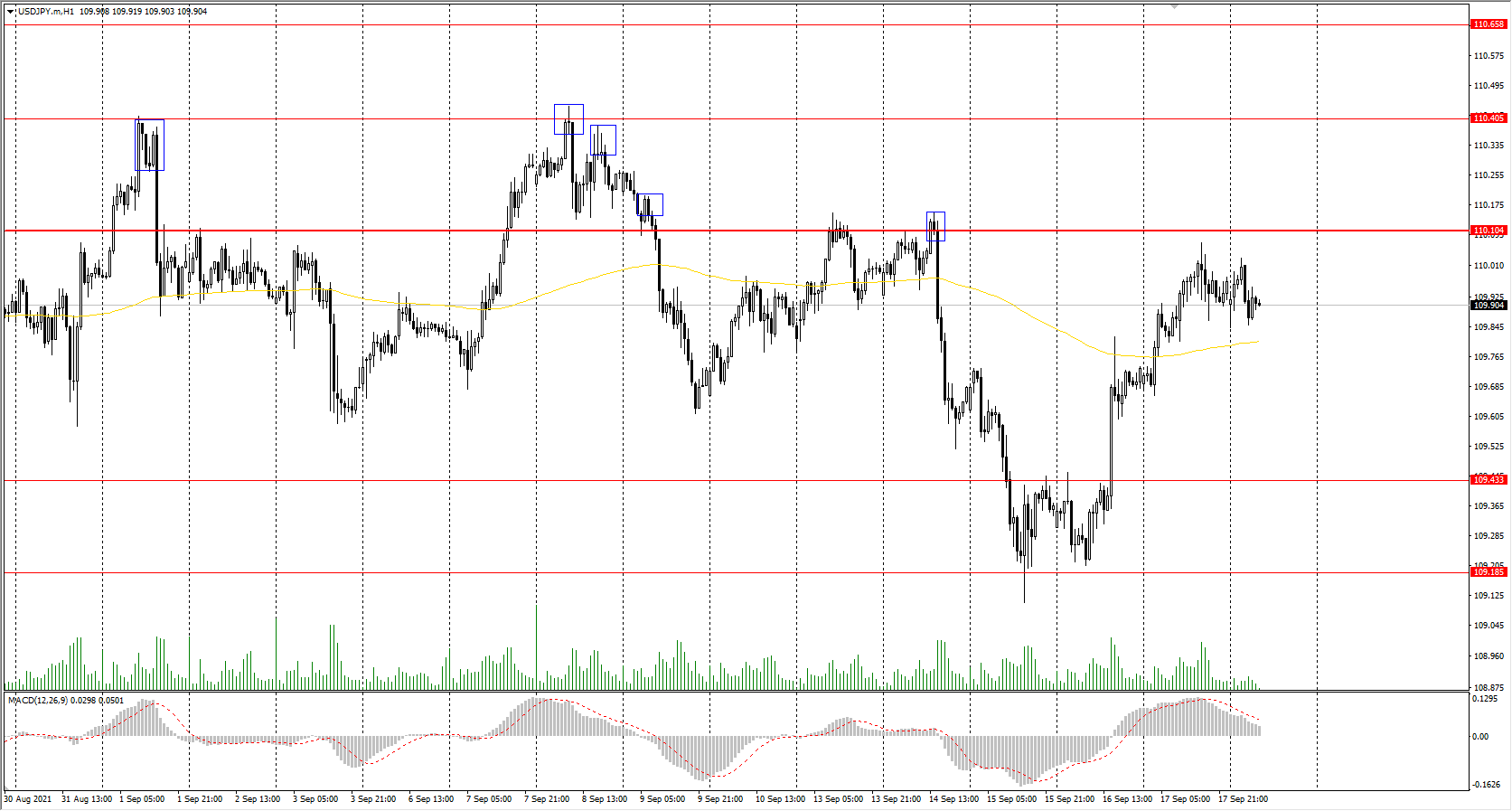
The USD/JPY currency pair
Technical indicators of the currency pair:
Prev Open: 109.72
Prev Close: 109.97
% chg. over the last day: +0.23%
Today is a bank holiday in Japan, so volatility on currency pairs with the Japanese yen will be low, and the price will follow the dollar index.
Trading recommendations
Support levels: 109.43, 109.19, 108.65
Resistance levels: 110.10, 110.40, 110.66, 110.95, 111.48
The main trend of the USD/JPY currency pair is bearish. But amid the strengthening of the dollar index and weakness of the Japanese yen, the USD/JPY moved upward again. The MACD indicator has become positive, showing no signs of reversal. Under such market conditions, traders should look for sell positions from the priority change level. Buy positions should be considered only from the support levels where the buyers show initiative throughout the day.
Alternative scenario: if the price rises above 110.10, the uptrend is likely to resume.
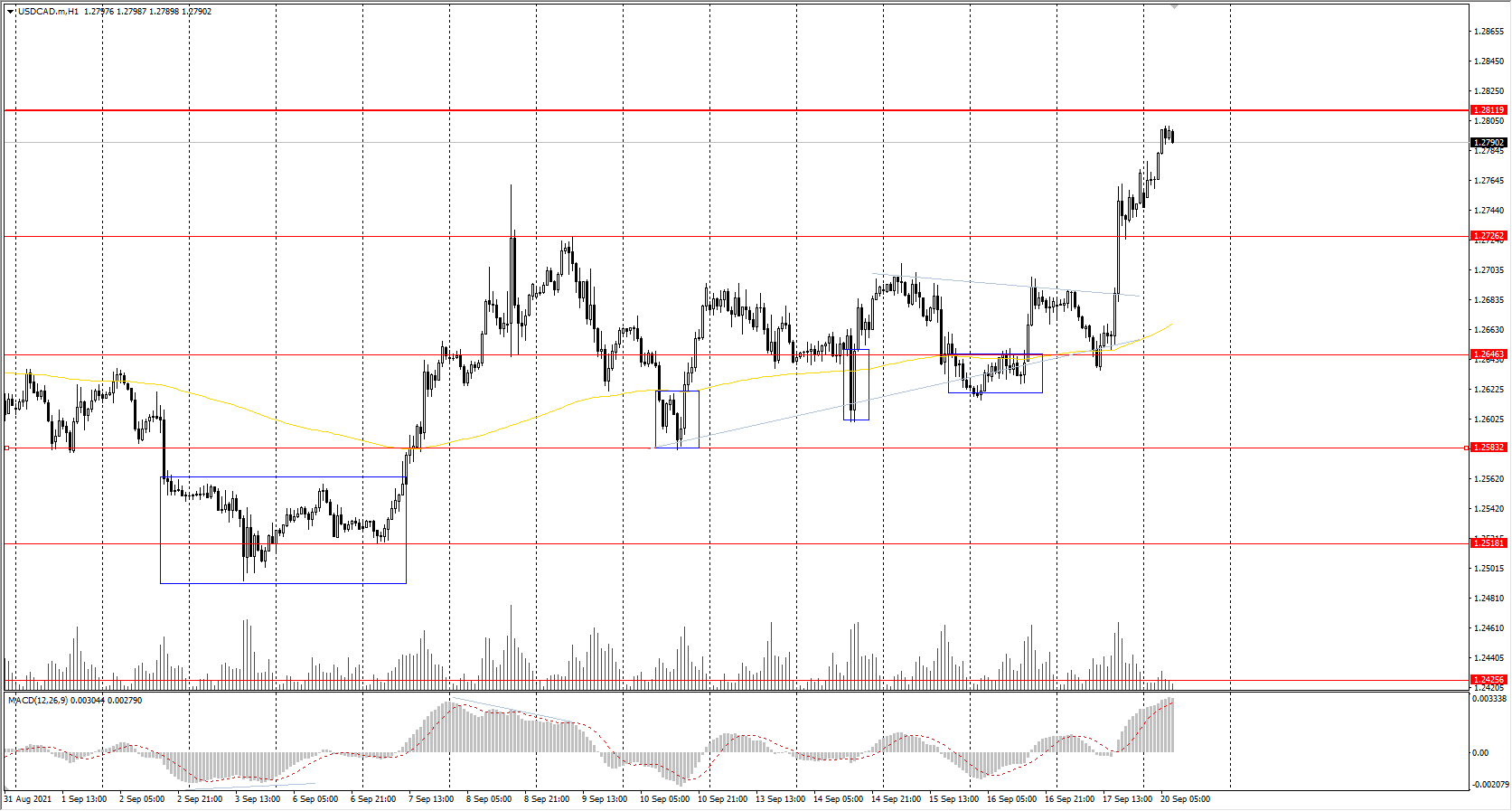
The USD/CAD currency pair
Technical indicators of the currency pair:
Prev Open: 1.2680
Prev Close: 1.2769
% chg. over the last day: +0.70%
The Canadian dollar is a commodity currency, so the USD/CAD currency pair is highly dependent on the dynamics of the dollar index and oil prices. The dollar index increased on Friday, while oil prices decreased. As a result, the price of USD/CAD moved upward. Today federal elections are held in Canada.
Trading recommendations
Support levels: 1.2726, 1.2646, 1.2583, 1.2518, 1.2425
Resistance levels: 1.2812, 1.2891, 1.2951
In terms of technical analysis, the trend of the USD/CAD currency pair is bearish. But due to the growth of the dollar index, the price is now under the pressure of buyers. On Friday, the price broke out of the triangle upward. Buy positions can be considered from the support levels where buyers show initiative, and only with short targets. It is better to look for sell positions from the priority change level, but only after the new initiative from the sellers.
Alternative scenario: if the price breaks out through the 1.2812 resistance level and fixes above, the uptrend will likely resume.
News feed for 2021.09.20:
- Canada Federal Election, All Day.
Oil Is Still Bullish As The Retracement Is Underway
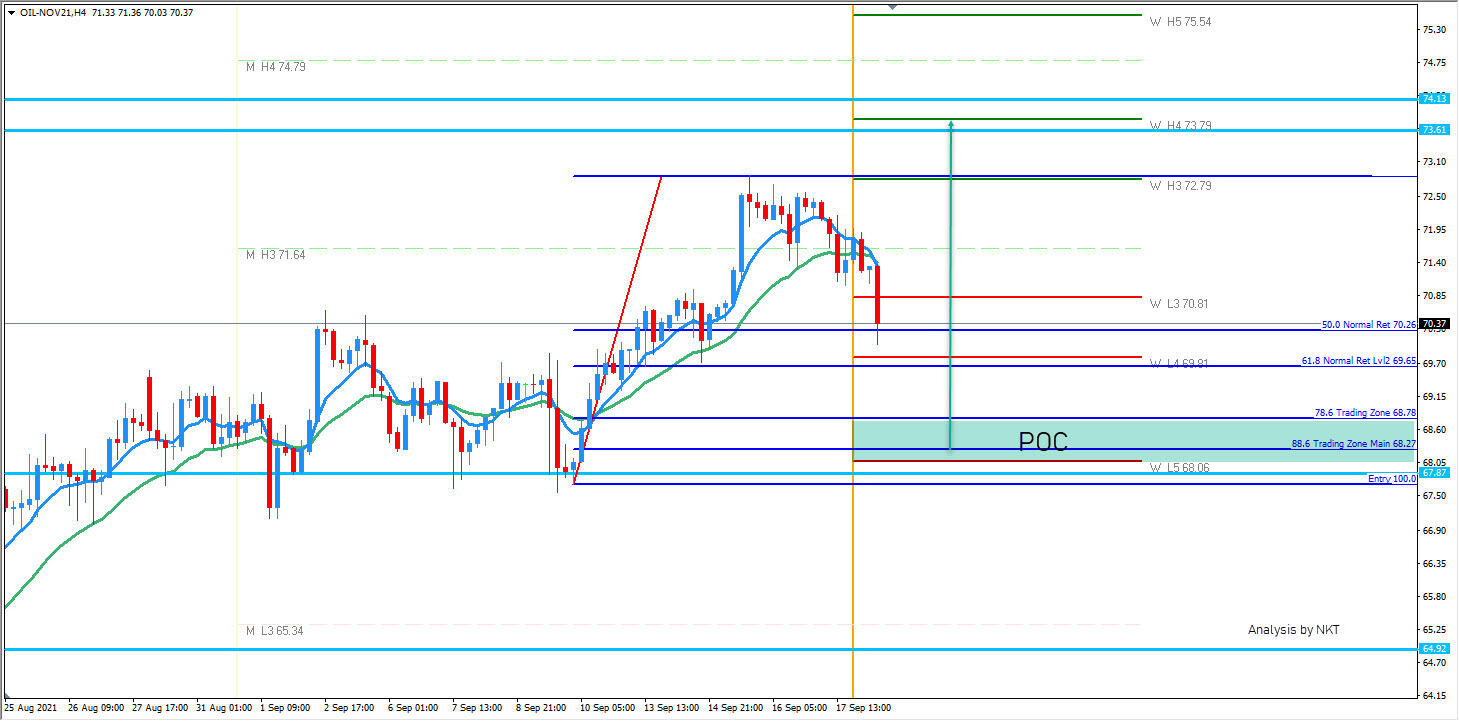
Oil is dropping as the price is still in a retracement. Watch for a possible rejection at the POC zone.
The POC zone 68.25-68.80 is the zone where the price might bounce. CAD is dropping and CAD is correlating to Oil. If we see a retracement there, watch for a move towards 70.80 and 73.79. If bulls want to stay in control the price needs to stay above 67.00. Buying the dips is still the strategy to go with.
US, UK, SWISS, And Japanese Central Bank Meetings Are Expected This Week
Last week, investors focused on the US consumer price index. According to the Labor Department report, US inflation growth has slowed down. However, investors are still very concerned as the stock market is not responding with growth. It means hedge funds are cutting their positions ahead of the Fed’s meeting.
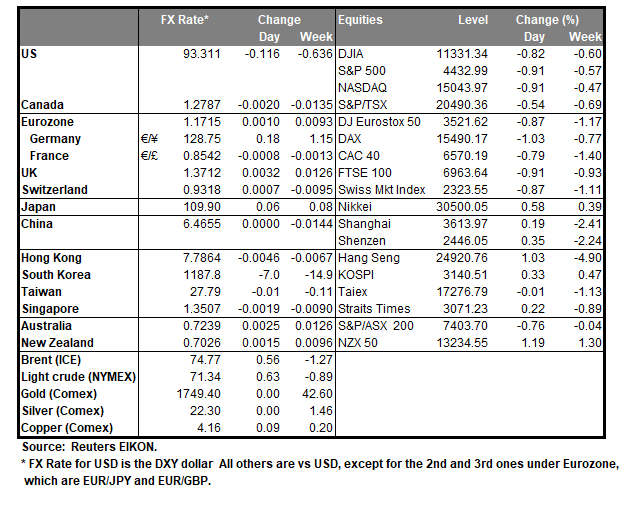
The US stock market ended Friday's trading lower amid negative dynamics from the basic materials, utilities, and technology sectors. At the closing of the exchange, the Dow Jones Industrial Average decreased by 0.48%, the S&P 500 decreased by 0.91%, and the NASDAQ lost 0.91%. At the end of the week, the Dow Jones decreased by 0.23%, the S&P 500 decreased by 0.93%, and the NASDAQ lost 1.1%. Statistically, more than 15% of the S&P 500 stock is down more than 20% from this year's peak. Many investors are losing faith in the ability of most of the market to maintain profit growth above the current levels. Amid the prospects of loosening monetary policy and increasing tax pressure in the US, and fears of a credit crisis in China and a global increase in the Delta cases, the prospects for further growth of stock indices are limited.
But according to a Bank of America Corp. survey, professional market participants are still investing in stocks, betting that the Federal Reserve will not cut the QE program soon. According to a survey of Bloomberg economists, the Fed is likely to hint at its meeting this week that it will reduce its monthly asset purchases and make an official statement in November. Still, it will keep interest rates near zero level until 2022.
European stock indices closed in the red area on Friday. The German DAX fell by more than 1%, and the British FTSE 100 lost 0.91%. At the end of the week, the DAX lost 1.22%, the FTSE 100 decreased by 0.93%, the French CAC 40 dropped 1.77%, but the Spanish IBEX 35 was an exception and showed an increase of 0.41% per week. Inflationary expectations continue to grow in Germany. Inflation is no longer seen as a temporary phenomenon but as something more permanent. The German inflation expectations index increased by 1.60% last week. It’s the highest level since 2013. The UK said it would try to keep the consequences of a sharp increase in gas prices after the growing concerns that more energy suppliers and food producers would struggle to operate at such high prices.
Australia announced that it would refuse the 2016 deal with France to build a fleet of conventional submarines. Instead, the country will build eight nuclear-powered submarines using American and British technology after concluding a trilateral security partnership. This step caused rage in France, a US, and British NATO ally, prompting it to recall its ambassadors in Washington and Canberra.
China's manufacturing and retail sectors suffered in August, with production and sales growth reaching a one-year low, as new coronavirus outbreaks and supply disruptions threatened the country's economic recovery. Concerns about the health of China's economy and Beijing's repression of tech companies continue to haunt the region, with stocks in Hong Kong decreasing by more than 3% to their lowest level in nearly 11 months.
The issue of Chinese real estate giant Evergrande and its $300 billion obligations is also open, especially considering the fact that interest on bonds should be paid on Thursday.
Central banks in the US, Japan, Great Britain, Switzerland, Sweden, Norway, Indonesia, Philippines, Taiwan, Brazil, South Africa, Turkey, and Hungary will hold meetings this week.
Main market quotes:
- S&P 500 (F) 4,432.99 −40.76 (−0.91%)
- Dow Jones 34,584.88 −166.44 (−0.48%)
- DAX 15,490.17 −161.58 (−1.03%)
- FTSE 100 6,963.64 −63.84 (−0.91%)
- USD Index 93.25 +0.31 (+0.34%)
Important events for today:
- German Producer Price Index (m/m) at 09:00 (GMT+3);
- Canada Federal Election, All Day.
Dollar Starts Fed Week On Front Foot, Stocks Hit By Evergrande Fallout
- Dollar climbs to 4-week high amid Fed taper expectations and Evergrande contagion fears
- Global stock markets tumble as Evergrande stock crashes again, default risk grows
- All eyes on Fed in busy week for central banks; hawkish BoE bets can't rescue sliding pound
- Loonie slips ahead of Canada's election outcome
 China jitters hit sentiment as stocks skid
Fears of global contagion from the worsening crisis in China's property sector continued to weigh heavily on sentiment at the start of trading on Monday as markets panicked about the possibility of Evergrande defaulting on its debt. Shares in the Chinese property giant plummeted again in Hong Kong on Monday, pulling the Hang Seng index to near one-year lows.
In Australia, the S&P/ASX 200 index closed down more than 2% as mining stocks were sold off on the growing threat of a collapse in Evergrande, which could push China's already slowing construction industry into a full-blown crisis. Falling iron ore prices have been a drag on the Australian dollar for some time now and the risk of a further drop in Chinese demand for Australia's major export doesn't bode well for the currency's outlook.
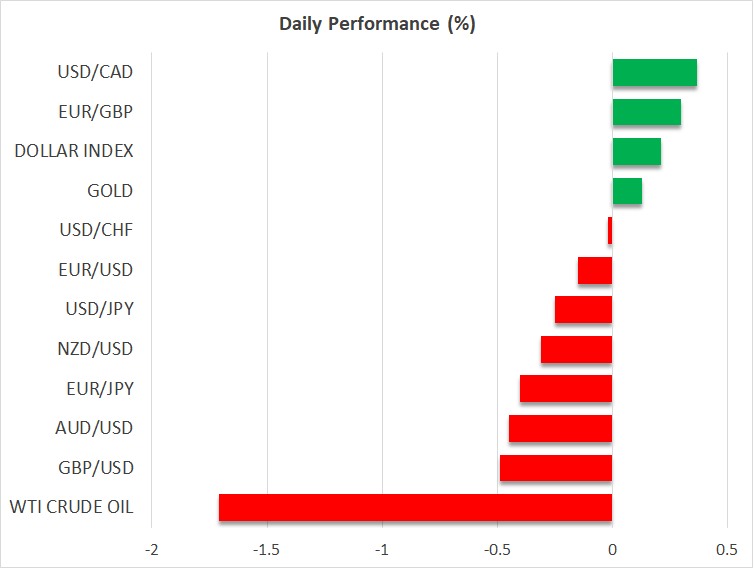
The aussie was last down almost 0.5% against its US counterpart, while the dollar index was up 0.2%, extending last week's strong gains to a fresh four-week high.
The safe havens Japanese yen and Swiss franc were also firmer across the board on Monday as the prospect of Evergrande's debt crisis becoming China's ‘Lehman moment' sparked a flight to safety.
Evergrande panic grips global markets
While it's so far unclear how contagious Evergrande's possible collapse could be to the global economy and to what extent the Chinese government will try to bail out the world's most indebted property developer, it's certainly got Wall Street investors spooked.
The S&P 500 just posted its second straight week of declines and e-mini futures for the major US indices were pointing to losses of more than 1% at today's open. European shares took an even bigger blow, with Germany's China-exposed Xetra Dax last quoted down 2.25%.
The selloff could intensify tomorrow when Chinese and Japanese markets reopen, following today's bank holiday in both countries.
The gradual exit of central banks around the world from their emergency stimulus is likely exacerbating the risk-off trades from the China jitters. The US Federal Reserve will probably take another step towards tapering when it announces its latest policy decision on Wednesday, with FOMC members potentially bringing forward their rate hike predictions from 2023 to 2022.
Norway's central bank could hike its policy rate as early as Thursday, while the Bank of England is expected to sound more hawkish when it too meets this Thursday.
Pound's woes deepen, loonie dreading election deadlock
However, the Bank's notably more hawkish tone of late doesn't appear to have done sterling any favours. The pound has slumped to a four-week low versus the US dollar, breaching the $1.37 support today following Friday's shock drop in August retail sales. Many traders have been paring back their bullish bets on the currency despite expectations of an earlier-than-anticipated rate hike by the BoE. There are worries that Brexit will make the labour shortages and supply constraints much more pronounced in the UK than in most other countries, which, although they will stoke inflation, they could also curtail growth. Hence, expectations are that even if the BoE does raise rates before the Fed, they won't go up much after that.
The Canadian dollar was also on edge on Monday, weakening to around 1.2810 to the greenback as Canadians go to the polls today to elect a new government. The latest opinion polls suggest no party will be able to win a majority, with incumbent Prime Minister Justin Trudeau facing the prospect of a humiliating defeat. Should he manage to hold on to power, however, the loonie could get a significant lift.

Risk Averse Mood Dominates Global Markets
Investors sitting at their screens this morning are feeling a bit anxious. The red colour can be seen across the globe from Asian stocks to European and US futures. Commodity prices are also tumbling with iron ore extending losses below $100 per metric ton. Oil, precious metals and cryptocurrencies are all in negative territory with the dollar being the main beneficiary of today’s turmoil.
Hong Kong is feeling most of the pain with the Hang Seng index dropping 4% as the crisis at real estate developer Evergrande Group dragged the property index lower by 7% at the time of writing. The fate of China’s second biggest property developer remains unknown as it is expected to default on debt due to its creditors this week. The company has $300 billion in liabilities and there are growing concerns that Evergrande’s crisis could spread into other developers and possibly become a Lehman moment for China’s markets.
So far, we are not seeing contagion risk outside China’s property markets and their high yielding debt. Bond yields in China’s investment grade debt remain well within the range of the past several weeks, but whether this event turns into a bigger crisis depends a lot on how the government responds. If the Chinese government doesn’t restructure Evergrande’s debt things will get messy, and not just impact China’s markets but other emerging markets and developed ones. The next few days are going to be crucial, and all investors hope policymakers will avert another Lehman crisis.
This week also features several central banks meetings, with Norges Bank expected to be the first in the G10 to raise interest rates on Thursday. The Bank of England will also be watched closely on how it will respond to the surprise jump in inflation. If Andrew Bailey indicates that we’re getting closer to an interest rate hike, sterling should receive a boost, particularly against the euro.
The Federal Reserve monetary policy meeting remains at the top of risk events this week when it concludes a two-day meeting on Wednesday. The disappointing August employment figures may delay the announcement of tapering the $120 billion in monthly purchases of Treasuries and mortgage-backed securities, but the Fed could provide a clearer signal on when the process will start. The Fed’s dot plot is probably of even more interest as it will include 2024 expectations of where interest rates will be. In their last projections, the Fed brought interest rates hikes forward to 2023 and it only requires two members to shift 2022 expectations higher. With all these risk events, be prepared for a volatile week ahead.
BOE Preview – How will New Members Shift the Views of Rate Hike Conditions?
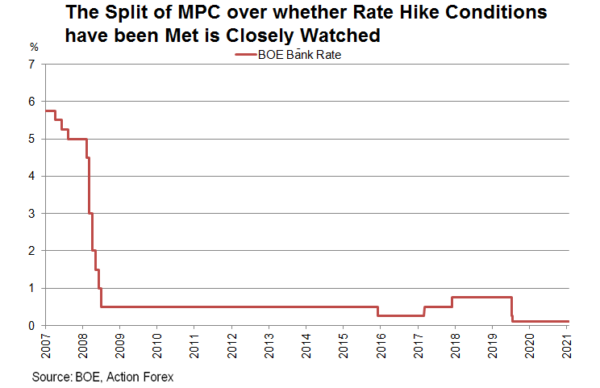
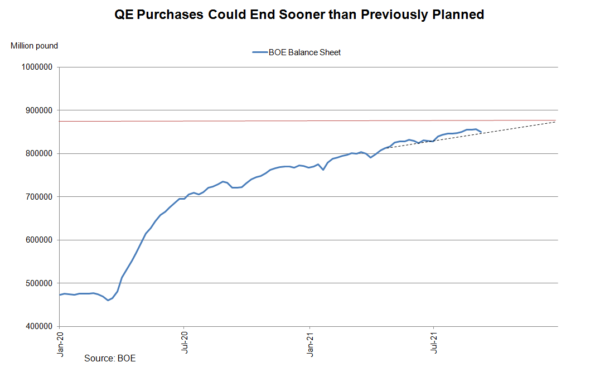
Economic developments since the last meeting have raised concerns of "stagflation" in the UK, i.e. slow growth with strong inflation. As the main constraint to growth is supply chain, we do not expect this to derail BOE's monetary policy stance. We expect the central bank to vote unanimously to leave the Bank rate unchanged at 0.1% and 8-1 to keep the asset purchase program at 875B pound. BOE split evenly in August on whether basic conditions for rate hike have been met. The focus of this meeting is whether and how the two new committee members would affect this balance.
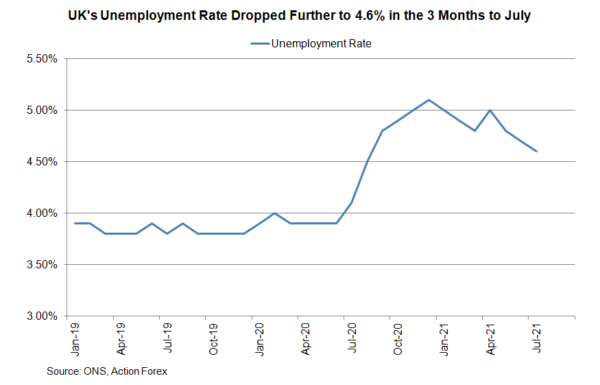
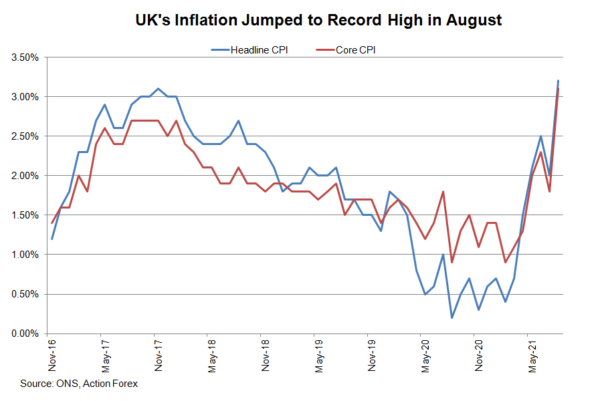
 The dataflow released since the last meeting has sent a mixed picture about the economic outlook. On the positive side, the job market has continued to thrive. The unemployment rate slipped further to 4.6% in the three months to July. Meanwhile, the number of payrolls gained +241K to 29.1M in August. This marks a return to the pre- pandemic (February 2020) levels. Vacancies rose to a record 1.034M in June to August 2021. Inflation strengthened further. Headline CPI jumped +3.2% y/y in August, from +2% a month ago. The market had anticipated a jump to +2.9%. Note also that the increase of 1.2 ppts was the biggest on record. The ONS continued to warn of the temporary nature of strong price levels. Core CPI rose to +3.1% y/y from July’s +1.9%, beating consensus of 2.9%.
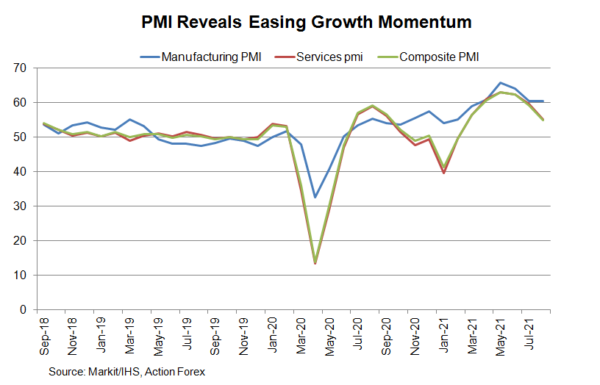
 On the flip side, GDP growth eased to +0.1% m/m in July, from +1% a month ago. The PMI data also show that both services and manufacturing sectors are losing momentum. The services PMI dropped -4.6 point to 55 in August. While staying in the expansionary territory, the reading marks the slowest since February. The manufacturing PMI also eased to 60.3 in August, from 60.4% a month ago. However, slowdown in economic activities has mainly been brought about by the supply chain disruption, rather than demand.
We expect the BOE to vote unanimously to leave the Bank rate unchanged at 0.1% and 8-1 to keep the asset purchase program at 875B pound. Michael Saunders will likely dissent as he prefers to end the program early. What interests us the most is the members view on whether the economic conditions have been met for tightening. Earlier this month, Governor Andrew Bailey indicated that four of the eight MPC members who voted in August judged that some initial conditions for tightening have been met. The Governor himself, Dave Ramsden, Ben Broadbent and Silvana Tenreyro are amongst the hawks. With the departure of a hawkish member, Andy Haldane, the MPC will be joined by two new officials, Chief Economist Huw Pill and external member Catherine Mann. Their stance is worth watching. Note, however, that a majority of members judging that the minimum necessary conditions have been met would not automatically trigger a rate hike. As Bailey noted, the guidance is a “necessary but not a sufficient condition for raising interest rates”.
Gold Eases Again, SMAs Point Down
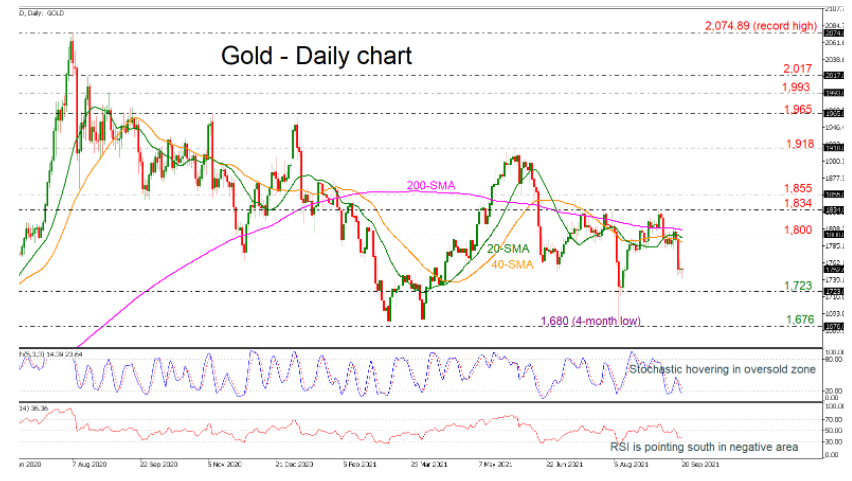
Gold is still heading south, continuing the negative structure after the pullback from the 1,800 significant level.
In trend indicators, the short-term simple moving averages (SMAs) are pointing down and are ready for a bearish crossover. The stochastic oscillator has entered the oversold territory, while the RSI is sloping marginally down in the negative region, both suggesting a downside movement.
An extension below the intraday low of 1,742 will strengthen the case for a down-trending market, likely activating a fresh bearish wave towards the 1,723 level. Failure to hold above that floor could cause another negative extension towards the four-month low of 1,680 and the 1,676 restrictive region.
Alternatively, a successful climb beyond the 1,800 round number could open the way for the 1,834-1,855 resistance area before opening the door for a bullish bias towards the high from 1,918. A rise above this crucial line could add optimism for an upside tendency until 1,965.
Overall, the yellow metal has been in a neutral phase over the last three months and only an exit above 1,834 or below 1,676 may change this view.
USD Strengthens As Taper Announcement Expected
The USD begun the week on the front foot, as expectations for a possible announcement by the Fed for a tapering of its QE program, intensified. It should be noted that the Fed's interest rate decision on Wednesday is to provide also a new dot plotand the bank's new projections. On the flip side Gold's price reached a one-month low during today's Asian session pressured by the strong USD, yet USD yields showed little upward price movement in the past few days. US stockmarkets tended to retreat, as the market may prepare for a tighter monetary policy by the Fed while at the same time the White House warned of a possible recession, adding to the bearish sentiment. It's characteristic that US Treasury Secretary Yellen on Sunday, called once again for Congress to raise or suspend the US debt ceiling, or the government risks running out of money to pay its obligations around mid-October. On the other hand, GBP pound retreated against the USD as well as JPY and EUR, despite markets carrying hawkish expectations for BoE's interest rate decision next week and a string of positive data in the past week. The Loonie reached its weakest point against the USD in almost a month, as the Canadian elections are to be held today and uncertainty remains high as to which party will win, while oil prices retreated on Friday and during today's Asian session.
The USD Index rallied, breaking the 92.85 (S2) and the 93.20 (S1) resistance lines, both now turned to support. We tend to maintain a bullish outlook for the index as long as it remains above the upward trendline which started to from since the 16th of September. Please note that the RSI indicator below our 4-hour chart is above the reading of 70 which confirms the bulls' dominance on the one hand, yet on the other may imply that the index is overbought and a correction lower is imminent. Should the bulls actually maintain control over the index, we may see it breaking the 93.70 (R1) resistance line aiming for new highs, yet should the bears take over, we may see the index, breaking the 93.20 (S1) support line, the downward trendline and aim for the 92.85 (S2) support level.
GBP/USD on the other hand dropped breaking the 1.3750 (S1) support line on Friday. We tend to maintain a bearish outlook for the pair given that the RSI indicator below our 4-hour chart runs along the reading of 30. Should the bears actually maintain charge over the pair's direction we may see it breaking the 1.3600 (S2) support line, aiming for lower grounds. Should the bulls take over, we may see cable breaking the 1.3750 (R1) resistance line, the downward trendline and aim for the 1.3875 (R2) level.
Other economic highlights today and the following Asian session:
During today's European session, we note the release of Germany's PPI rates for August, while during tomorrow's Asian session we get RBAs' latest meeting minutes from Australia.
As for the rest of the week
On Tuesday, RBA is to release the minutes of its last meeting and Sweden's Riksbank is to release its interest rate decision. On Wednesday, we get from Japan BoJ's interest rate decision, Eurozone's preliminary consumer confidence indicator for September, while the highlight of the week maybe may be the release of the Fed's interest rate decision. On Thursday, we get the preliminary PMI readings for September from Australia, France, Germany, Eurozone, UK and the US as well as the US weekly initial jobless claims figure, and Canada's retail sales growth rate for July, while on the monetary front we note interest rate decisions from, Switzerland's SNB, Norway's Norgesbank, UK's BoE and Turkey's CBT. On Friday, we get New Zealand's Trade Balance for August, Japan's CPI rates for August, Japan's preliminary Jibun bank manufacturing PMI figure for September and Germany's Ifo indicators for September, while on the monetary front Fed Chairman Jerome Powell is scheduled to speak.
USD Index H4 Chart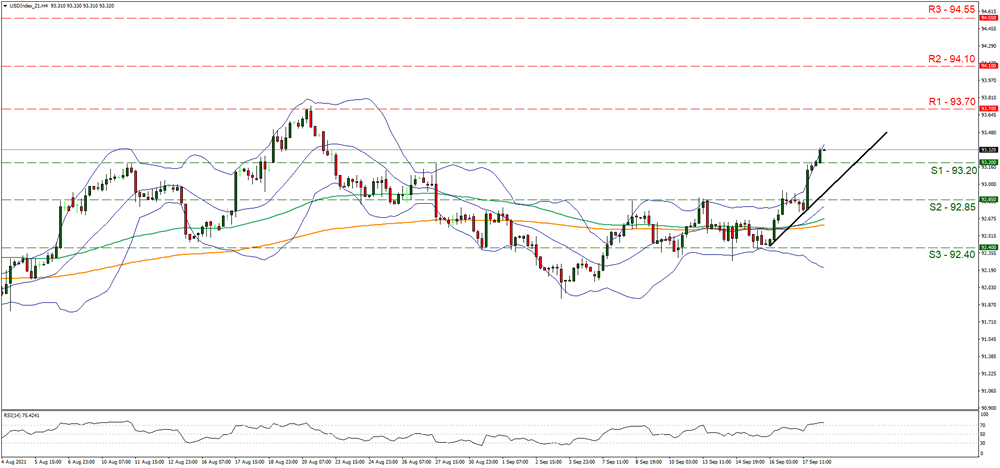
Support: 93.20 (S1), 92.85 (S2), 92.40 (S3)
Resistance: 93.70 (R1), 94.10 (R2), 94.65 (R3)
GBP/USD H4 Chart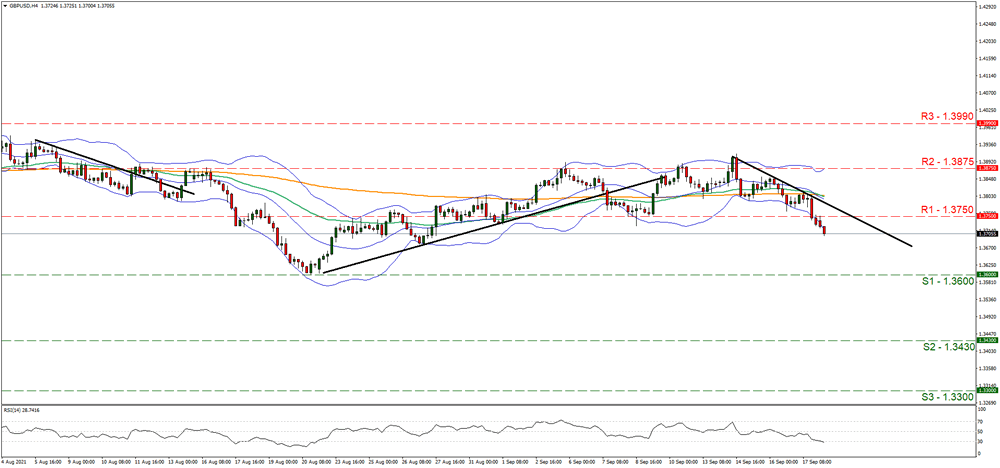
Support: 1.3600 (S1), 1.3430 (S2), 1.3300 (S3)
Resistance: 1.3750 (R1), 1.3875 (R2), 1.3990 (R3)