Sample Category Title
The Wrong Question On Evergrande
The 3rd week of September keeps up with its negative seasonality as one of the worst weeks of the year amid surging fears of Fed taper and Evergrande. Equity indices are down nearly 2%, VIX hit 26 to show its 4th biggest increase of the year, while falling yields are helping metals over energy. JPY and CHF are the strongest currencies of the day (not the USD), while CAD and GBP are the weakest. The word on everyone's lips on the weekend was 'Evergrande' as the Chinese property giant stumbles towards a seemingly-inevitable bankruptcy. The EURUSD short hit the stop, while the SPX short hit its final target. More ahead.
China's second-largest property developer remains in dire straights as the company's bonds trade at extremely distressed levels. There were weekend reports of offers to give investors property in exchange for debt and that employees were told to help fund the company or forfeit bonuses.
The company is undoubtedly in a death spiral. Even if it can find a way out of this, its brand is forever tarnished and that will make raising further funds impossible.
The question everyone is asking is whether this will be China's Lehman Brothers moment; a large firm failing and threatening to bring down the financial system.
That's the wrong question because there's ample evidence that Evergrande isn't the problem, but rather a symptom of a change in philosophy in Chinese leadership. There was a time in China's recent development it would never have let the problems get anywhere near as bad as they are. More importantly, it comes at the same time as cultural crackdowns, censorship, seemingly-targeted attacks on rich tycoons like Jack Ma and official talk of a fresh policy on 'common prosperity'.
So while some well-informed people have convincingly argued that Evergrande doesn't pose systemic risks alone, we fear that China is showing signs of a shift to a new paradigm; one where GDP growth isn't its north star. The inevitable conclusion is slower growth domestically and globally.
Of course, it's all still in flux but we note that all three of the most-read stories on Bloomberg this weekend were about Evergrande. We've been writing about Chinese risks for a month but they're finally now on top of the market's consciousness. Expect it to remain that way through year end.
Eco Data 9/21/21
[php_everywhere instance="1"]
EURGBP – Strong Bullish Signal is Developing Following a Break Above Daily Cloud
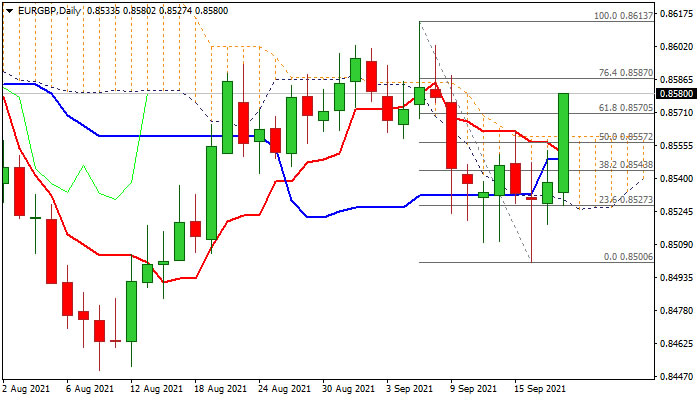
The cross rose over 0.5% on Monday and hit 8-day high, on a biggest one-day rally in one month.
Sterling, as more risk-sensitive currency than the euro, reacted negatively on strong risk aversion that pushed global equities sharply lower.
Today’s rally completed reversal pattern on a daily chart, signaling an end of multi-day congestion, while surge above daily cloud (spanned between 0.8525 and 0.8559) suggest that bulls regained control, with close above daily cloud top to confirm and generate strong bullish signal.
Improving daily studies (north-heading 14-d momentum is about to break into positive territory and MA turned to bullish setup) support the action.
Fresh bullish acceleration has so far retraced over 61.8% of 0.8613/0.8500 bear-leg) and pressuring next Fibo barrier at 0.8587 (76.4%) violation of which would open way towards key resistance at 0.8613 Sep 7 high).
Broken cloud top reverted to significant support which should keep the downside protected.
Res: 0.8595; 0.8609; 0.8633; 0.8642
Sup: 0.8569; 0.8559; 0.8543; 0.8525
Sunset Market Commentary
Markets
It’s crunch time on stock markets. Risk aversion on Asian markets (Evergrande-related) spilled into Europe. Main indices lose over 2.5%. The EuroStoxx 50 fell below 4082 support, painting a double top on the charts. The final target stands around 3900 which matches the July low. The total correction from the September top now amounts 5.64%. Ever since the start of the vaccination rally early November last year, investors stepped up to buy the dip (5-6% corrections lower) on every single occasion (4 times). We suspect it likely that eagerness to do so is more limited this time around. First and foremost, inflation (expectations) continue rising. Second, central bankers are about to signal the start to policy normalization. If not, they risk inflation (expectations) running out of control. Both scenarios suggests cautiousness going forward on both equities and bonds. The latter was visible last Friday on ECB gossip, but less so today. We see some reasons. First, ECB rumours were rapidly denied from inside Frankfurt and betting against the central bank over the past years hasn’t been the best investment plan. Second, the reaction function of core bonds hasn’t been clear-cut over the past weeks. It’s a give and take between the classic risk function and a scare of the inflation bogeyman. Finally, the US 10-yr yield again bumped into 1.37% key resistance without a break higher. We suggest this will be difficult ahead of Wednesday’s FOMC meeting where the Fed faces the tough call between a (hard) reality check and a (soft) ostrich attitude. Choosing the second only delays and likely worsens the future hit. The US Treasury yield curve bull flattens with yields sliding 0.5 bps (2-yr) to 3.7 bps (30-yr). Changes on the German curve are more or less similar, ranging between -1.6 bps (2-yr) and 3.8 bps (30-yr). 10-yr yield spreads vs Germany widen by up to 2 bps.
FX markets deserve some special attention today because of relatively big moves. The Japanese yen and Swiss France are the ones to beat the dollar. EUR/USD tested the 1.17 big figure. USD/JPY drifts towards 109.50; but remains within its narrow sideways range of late. The EUR/CHF rebound higher since August strands at 1.0940 with return action today sub 1.09. Amongst the biggest victims of the risk-off climate are the Hungarian forint (EUR/HUF 353) and the Polish zloty (EUR/PLN important resistance at 4.60). A weaker currency might translate in another 30 bps rather than 15 bps MNB rate hike tomorrow while throwing a spanner in the works of the NBP who vows to keep policy rates unchanged this year amid inflation at a 20y-high. The Swedish krone and Aussie dollar are in similar dire straits. We must add though that the start of the US session is causing some reversal on intraday price trends.
News Headlines
The BIS warned for a growing “green bubble” risk. It is seeing signs that valuations of ESG assets “may be stretched”. Some estimates put a total value of $35tn in 2020 on ESG-focused assets. Borio, head of the monetary and economic department, compared the surge in ESG ETFs and mutual funds to parts of the MBS market in the runup to the financial crisis or the internet stock boom in the early 2000s. Authorities should be aware of the risks that these shifts of investor demand can have.
Polish factory inflation accelerated from 8.4% y/y in July to 9.5% in August, slightly higher than the 9.3% consensus and matching levels seen in 2011. The m/m figure eased from 1.5% to 0.6% but is still significantly higher compared to previous years. All sectors but mining & quarrying added to the monthly increase with price pressures in electricity & gas and construction building the fastest. In other producer-side news, industrial output fell in August with 2.5% m/m (from -3.9% in July) to bring the yearly figure to 13.2% (vs. 9.8% in July). All categories retreated, with electricity and gas underperforming from a relative point of view (from strong increase in July to -1.7% m/m in August).
JPY: Markets Await BoJ, Fed Meetings
The Japanese yen is in positive territory in the Monday session and has pulled away from the 110 level. Currently, USD/JPY is trading at 109.54, down 0.37% on the day.
Markets eye FOMC meeting
There are a host of central bank meetings this week, with both the Federal Reserve and the Bank of Japan policymakers gathering on Wednesday. The expectations ahead of the two meetings could not be more divergent.
The FOMC has the full attention of the markets, and any comments from Fed members ahead of the meeting will be splashed in the headlines and could move the markets. Investors haven’t been able to put a finger on the timing of a taper, but there is growing speculation that at the upcoming meeting the Fed will signal that it will begin tapering at the November meeting. The US dollar is already rallying ahead of the meeting, and even a hint of a November taper should fuel further gains for the greenback. Investors will be combing through the rate statement as well as the dot plot – if the Fed brings forward rate hike expectations, the US dollar should respond with strong gains.
The situation couldn’t be more different when it comes to the Bank of Japan. With Japan’s economy limping and many regions under a state of emergency due to Covid, I don’t expect the Bank to do much other than put on a brave face and try to sound positive about a rather bleak economic picture. Inflation has been mired in negative territory for the past 12 months, so it would be a small achievement if CPI is flat in August. What could have a greater impact on the movement of the Japanese yen are developments on the political rather than the economic front. Next week, the ruling LDP holds a leadership vote to determine who succeeds Prime Minister Suga, with an election to be called in October.
USD/JPY Technical
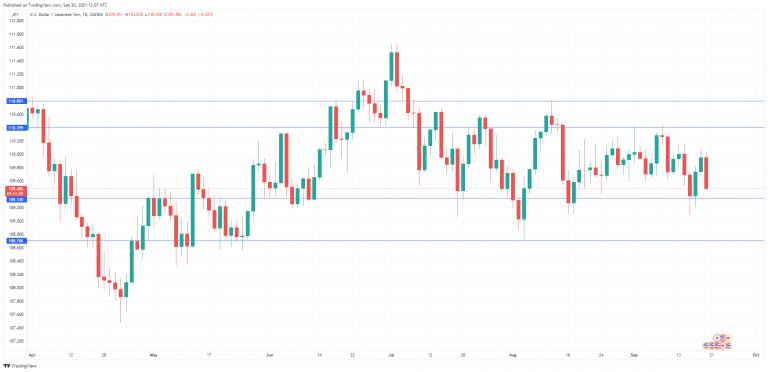
- 110.39 has some breathing room in resistance with USD/JPY moving lower. Next, there is resistance at 110.80
- On the downside, the pair is putting strong pressure on 109.34. Below, we find support at 108.70
EUR/USD Mid-Day Outlook
Daily Pivots: (S1) 1.1704; (P) 1.1746; (R1) 1.1768; More...
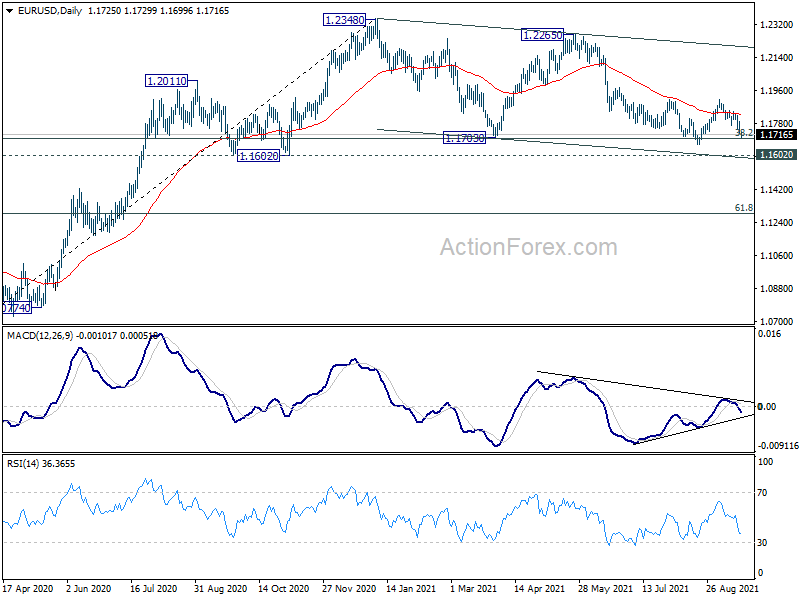
EUR/USD's fall from 1.1908 is still in progress and intraday bias stays on the downside for retesting 1.1663 low. Firm break there will resume the fall from 1.2265, and the pattern from 1.2348, to 1.1602 key support next. On the upside, above 1.1788 minor resistance will turn bias back to the upside for 1.1908 again.
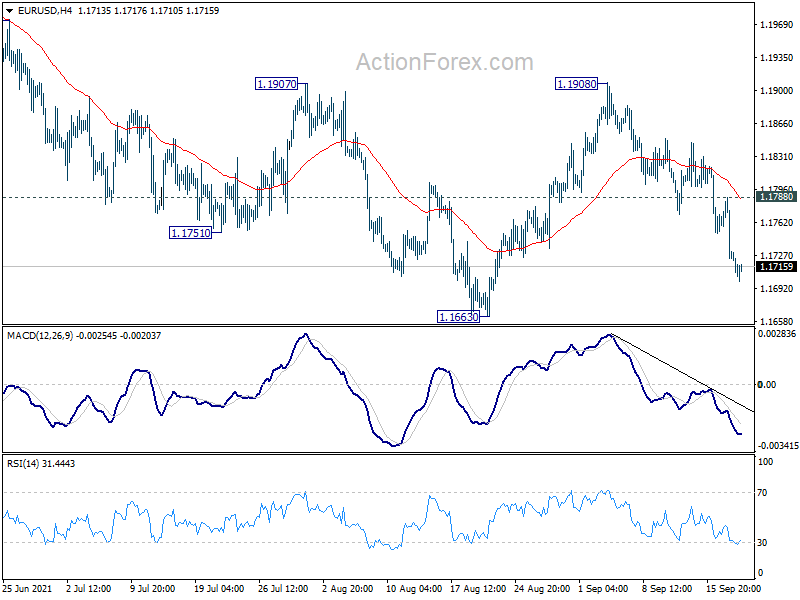
In the bigger picture, rise from 1.0635 is seen as the third leg of the pattern from 1.0339 (2017 low). Further rally remains in favors long as 1.1602 support holds, to cluster resistance at 1.2555 next, (38.2% retracement of 1.6039 to 1.0339 at 1.2516). However sustained break of 1.1602 will argue that the rise from 1.0635 is over, and turn medium term outlook bearish again. Deeper fall would be seen to 61.8% retracement of 1.0635 to 1.2348 at 1.1289 and below.
GBP/USD Mid-Day Outlook
Daily Pivots: (S1) 1.3700; (P) 1.3756; (R1) 1.3785; More...
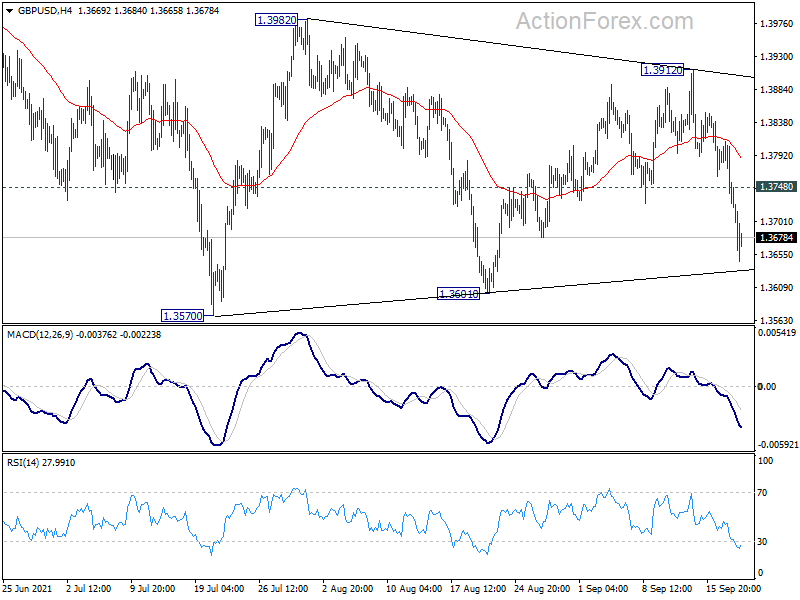
Intraday bias in GBP/USD remains on the downside for the momentum. Fall form 1.4248 is likely resume resumption and break of 1.3570 will target 1.3482 key support level. Sustained break there will carry larger bearish implication and target 1.3163 fibonacci level. On the upside, above 1.3748 minor resistance will turn intraday bias neutral again first.
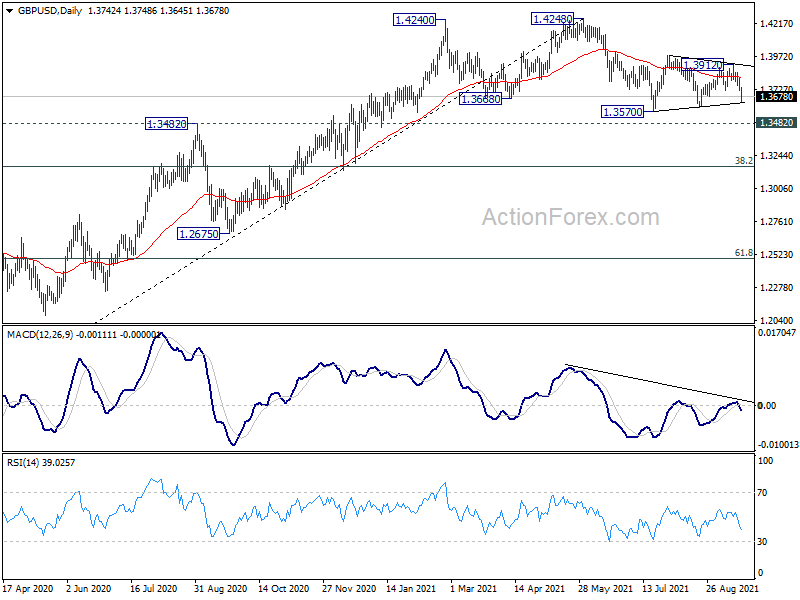
In the bigger picture, as long as 1.3482 resistance turned support holds, we'd still treat price actions from 1.4248 as a corrective move. That is, up trend from 1.1409 (2020 low) is in favor to resume. Decisive break of 1.4376 key resistance (2018 high) would indeed carry long term bullish implications. However, sustained break of 1.3482 will at least bring deeper fall to 38.2% retracement of 1.1409 to 1.4248 at 1.3164, or even further to 61.8% retracement at 1.2493.
USD/CHF Mid-Day Outlook
Daily Pivots: (S1) 0.9280; (P) 0.9303; (R1) 0.9345; More....
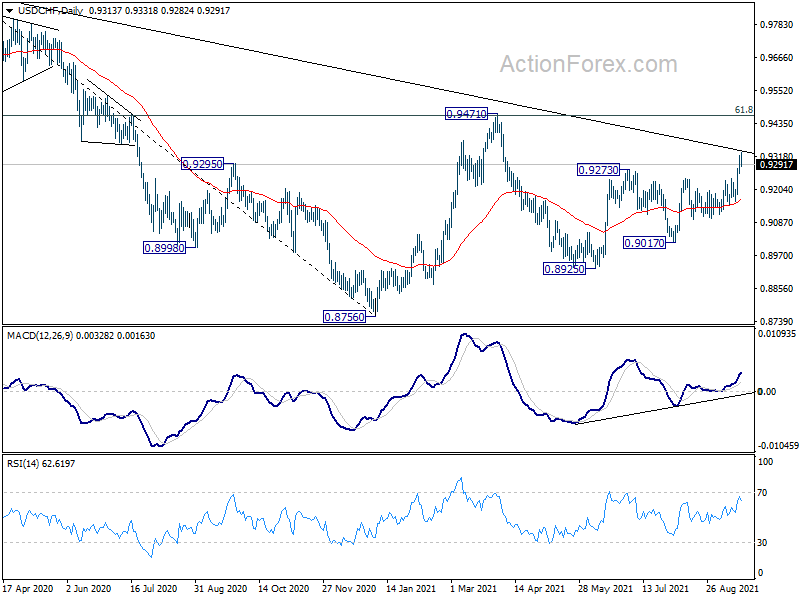
Intraday bias in USD/CHF is turned neutral with today's retreat, and some consolidations could be seen. But further rally will remain in favor as long as 0.9162 support holds. Rise form 0.8925 is in progress and break of 0.9331 will target 0.9471 key resistance. Sustained break there will carry larger bullish implications.
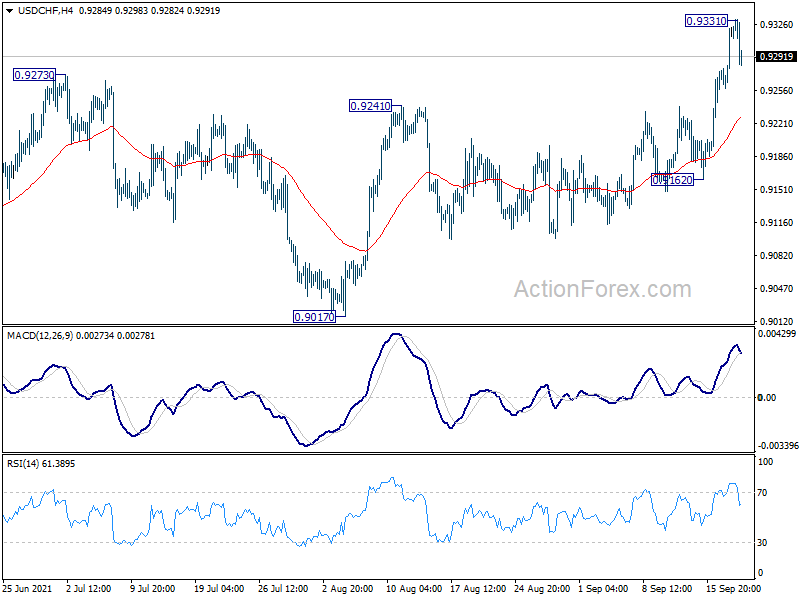
In the bigger picture, the strong rally above 55 week EMA (now at 0.9182) now tilts favor to the case of bullish trend reversal. That is, decline from 1.3042 (2016 high) is probably completed at 0.8756 already. Sustained break of 0.9471 resistance should confirm this case and pave the way to retest 1.0342 ahead. However, rejection by 0.9471 will mix up the outlook again and retain some medium term bearishness.
USD/JPY Mid-Day Outlook
Daily Pivots: (S1) 109.74; (P) 109.91; (R1) 110.15; More...
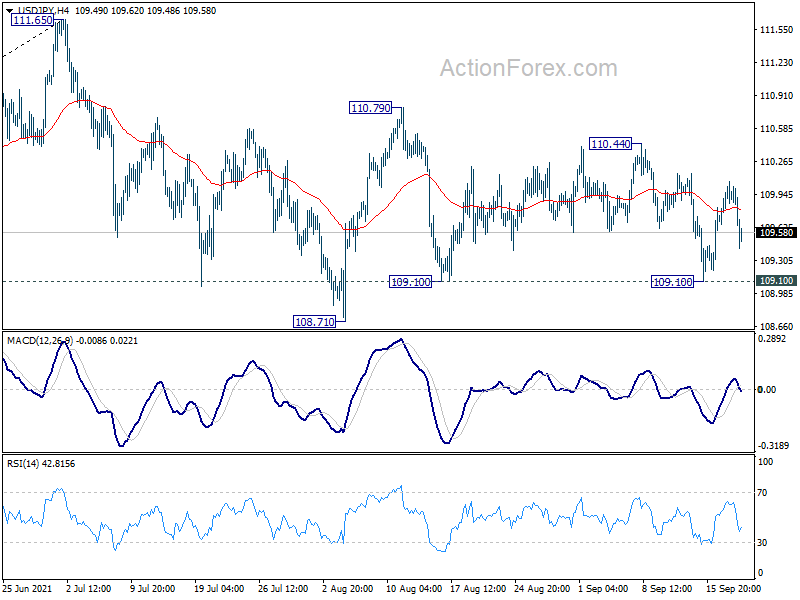
Range trading continues in USD/JPY and intraday bias remains neutral first. On the upside, above 110.44 will turn bias back to the upside for 110.79, and then 111.65 high. On the downside, break of 109.10 will argue that larger fall from 111.65 is resuming. Deeper decline should then be seen to 108.71 support first, and then 38.2% retracement of 102.58 to 111.65 at 108.18 next.
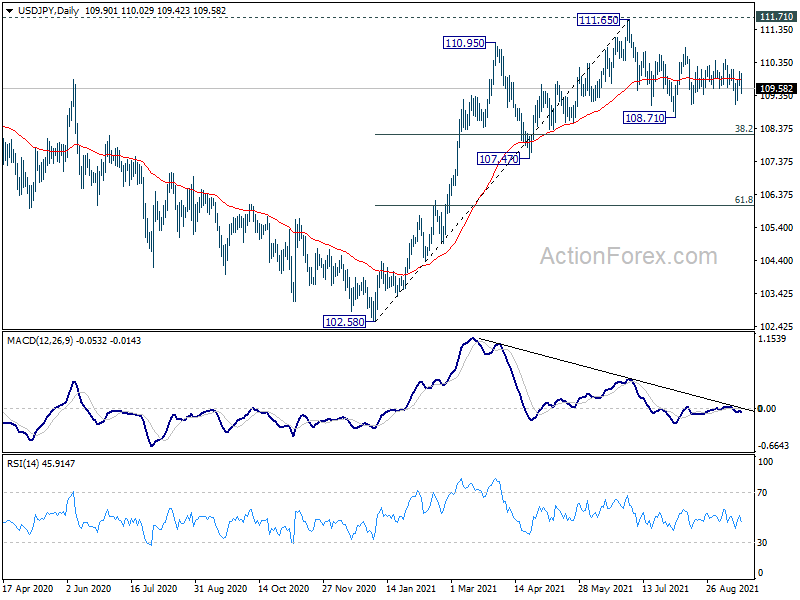
In the bigger picture, medium term outlook is staying neutral with 111.71 resistance intact. The pattern from 101.18 could still extend with another falling leg. Sustained trading below 55 day EMA will bring deeper fall to 107.47 support and below. Nevertheless, strong break of 111.71 resistance will confirm completion of the corrective decline from 118.65 (2016 high). Further rise should then be seen to 114.54 and then 118.65 resistance.
EUR/JPY Mid-Day Outlook
Daily Pivots: (S1) 128.69; (P) 129.18; (R1) 129.45; More....
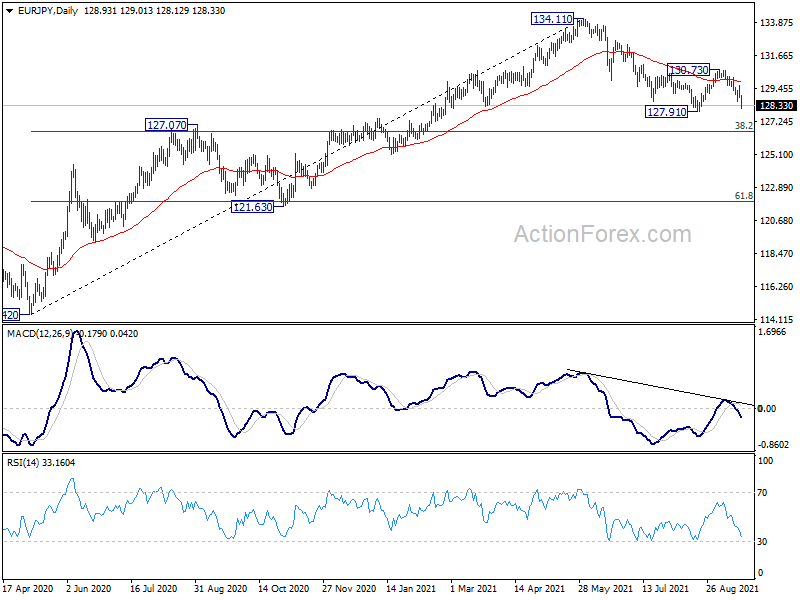
EUR/JPY's fall resume by breaking 128.59 and intraday bias is back on the downside for 127.91 support. Firm break there will resume whole fall from 134.11 and target 127.07 resistance turned support. Sustained break there will carry larger bearish implication and pave the way to 121.91 fibonacci level. On the upside, however, break of 129.65 will turn bias back to the upside for 130.73 resistance.
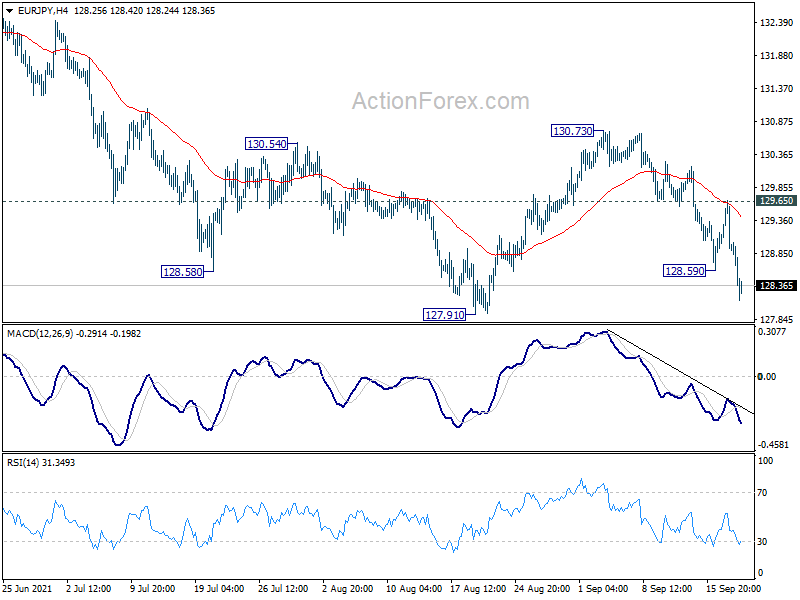
In the bigger picture, rise from 114.42 is seen as a medium term rising leg inside a long term sideway pattern. As long as 127.07 resistance turned support holds, further rise is still expected to retest 137.49 (2018 high). However, firm break of 127.07 will argue that the medium term trend has reversed, deeper fall would be seen to 61.8% retracement of 114.42 to 134.11 at 121.94.