

Sample Category Title
Weekly Focus – Fed is in a Difficult Situation amid Rising Stagflation Risks
In China, there is a lot of focus on China's second-largest property group Evergrande, which is facing a default on a big part of its debt. Home sales dropped 20% y/y in August, which have added to the challenges for developers already feeling the heat from tighter regulation last year. The Chinese stock market has been hit hard but so far the financial stress in China has not spread to developed markets. This may change if things turn worse. A lot of focus on whether China announces new stimulus measures soon to offset the rising headwinds to the economy.
Besides that 'stagflation' has become a hot topic among economists and investors due to a combination of clear global slowdown signals and widespread bottlenecks/labour shortages (including still high inflation especially in the US). Our base case is a soft landing but as we believe the stagflation risks are on the rise. Challenges with the delta variant over the winter could prolong freight challenges and hamper labour supply further. A result could be rising wage pressures to levels not seen for a long time and a further increase in inflation expectations. If such a scenario plays out, central banks (in particular the Fed) are likely to tighten policy despite weaker economies. For more details see Research Global: Stagflation risks on the rise, 15 September.
The most important event next week is the FOMC meeting on Wednesday. After the weak jobs report and lower-than-anticipated CPI inflation print this week, we expect the Fed to wait a bit longer before announcing details on tapering. The tapering pace is going to be more important than the exact timing, given the strong signals that tapering is set to begin before the end of the year. We expect the Fed to signal one rate hike next year (up from zero) in the updated projections. For more details see Fed Research - Preview: What to do in a bad trade-off?, 16 September.
In the UK, we do not expect much new from the Bank of England, as it is one of the interim meetings. That said, the combination of high inflation and payroll employment now above pre-covid levels (although total employment remains subdued) means that risks are tilted towards a more hawkish Bank of England. QE is set to end by the end of the year and the question is whether the Bank of England will hike as early as in spring next year. Bank of Japan meets on Wednesday.
Also both the Riksbank and Norges Bank meet next week. Read more in the scandi section.
The German election takes place on Saturday next week. It is a close race and we believe there is an equally likely probability for a 'Jamaica' coalition (40%) led by the CDU/CSU and a 'traffic light' coalition (40%) led by the SPD. Only a major election surprise has the potential to trigger significant market moves, in our view. For more details see German Politics Monitor: The tables are turning left, 9 September.
Next week, preliminary PMIs for the euro area, the US, the UK and Japan are due out on Thursday. We are looking for further signs that we have seen a peak in manufacturing. The subcomponents are likely to show that there are still many bottlenecks globally.
Sunset Market Commentary
Markets
When the ECB starts responding using official statements on financial media news articles, then you know something is going on. It does not happen often and the language used was pretty direct. Let’s circle back for a moment. The Financial Times this morning reported that ECB chief economist Lane during a private meeting with economists said the central bank expects to hit the 2% inflation target soon after the policy horizon (ending in 2023). “Didn’t happen”, the ECB replied in a first reaction. Later, ECB governor de Cos (Spain) and Makhlouf (Ireland) sought to further downplay market speculation by saying that “current conditions don’t allow for a rate hike in 2023”, the FT’s conclusion is “incompatible with ECB guidance” and “fears of excessive inflation are overstated”. Their comments were widely ignored however. Kazaks’ comments, although not the most closely watched ECB governor, caught market’s attention instead. He said that the inflation outlook is likely to be revised higher in December. He sounded cautious on price developments otherwise (eg. he doesn’t see the 2% reached in the medium term), but that didn’t matter to markets. With the inflation genie out of the bottle, European stocks fell abruptly from intraday highs into the red. It doesn’t necessarily mean markets expect rate hikes soon but the inflation talk does add to the idea ultra-easy monetary policy (via PEPP) may be scaled back a little faster than initially thought/suggested by the ECB last week. European stocks bottomed in the meantime and even trade marginally back in the green in early US dealings. WS opens with minor losses, showing more signs that the buy-on-dips pattern is losing momentum. The German yield curve sticks to its bear steepening trend nonetheless. Yields advance 0.9 bps (2y) to 3.1 bps (30y). It’s 10y variant marches on in the upward trend channel, taking out resistance around -0.287%. US yields were flat for most of the day before suddenly jumping as the US started joining. The curve currently shifts north with 2-3 bps increases in tenors from 5-30y with the 10y attacking 1.37% resistance. As a result, EUR/USD lost it’s intraday interest rate differential and has to forfeit earlier gains. The currency pair retreated from today’s high around 1.179 to 1.176 (unch.) at the time of writing. Support lies at 1.1752. USD/JPY tries to cap 110. The yen is under pressure overall due to higher core yields. Disappointing UK August retail sales don’t break sterling’s spirits. After a minor kneejerk uptick this morning, EUR/GBP is trading flat near 0.853. Cable is changing hands in the high 1.378 area. Next week will be important for the USD and GBP with both the Fed and Bank of England having a policy meeting.
News Headlines
Russian Central Bank governor Elvira Nabiullina indicated that the Central Bank still might raise its policy rate further at the upcoming meetings. The Bank last week raised the policy rate from 6.50% to 6.75%, slightly less than some in the market had expected. However, Bank took a bold step by raising the policy rate by 1% in July. Governor Nabiullina indicated that the key rate could only return to its neutral level of 5%-6% once the central bank is confident of a stable slowdown in inflation. Inflation in Russia still printed at 6.7% in August (core 7.1%). Even as the central Bank maintains a tightening bias the central bank governor in another interview indicated that inflation is currently near its peak levels and might start easing in in October. The rubble recently remained well bid with EUR/RUB breaking below the EUR/RUB 85.75 support/previous 2021 low. The pair currently trades near 85.42.
According to a statement from the Spanish Labour Ministry, the Spanish government has agreed to raise the minimum wage for the second time in less than two years. The minimum wage will be raised by €15 per month, which is about 1.6%. The increase is applicable from 1 September. The government intends to raise the minimum wage further. Contrary to the previous increase, the current decision was not backed by industry groups. Economy Minister Calvino resisted earlier calls for such a move. However, the economic recovery, higher inflation and rising employment now created an environment to allow for higher minimum wages.
EUR/USD Mid-Day Outlook
Daily Pivots: (S1) 1.1799; (P) 1.1816; (R1) 1.1832; More...
EUR/USD's fall from 1.1908 is still in progress and intraday bias stays on the downside for retesting 1.1663 low. Break there will resume the fall from 1.2265, as well as the pattern from 1.2348. Next target is 1.1602 key support level. On the upside, above 1.1845 minor resistance will turn bias back to the upside for 1.1908 resistance instead.
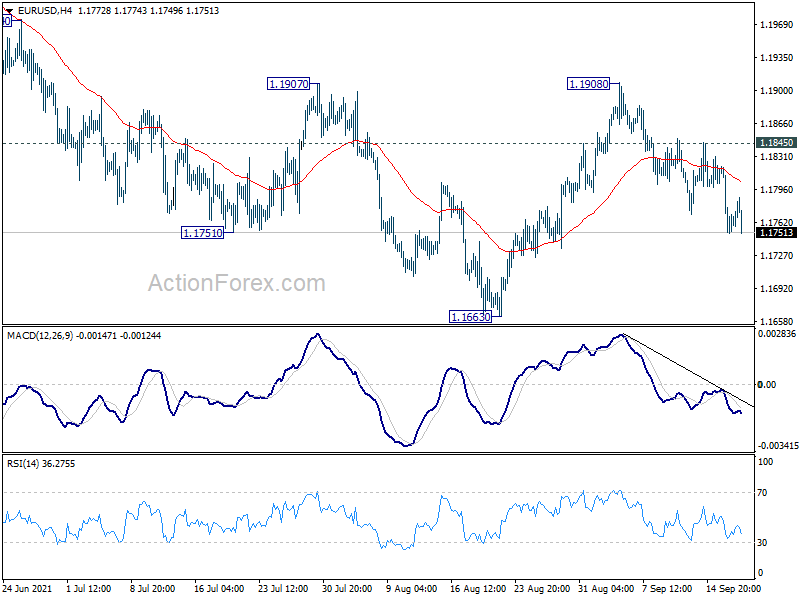
In the bigger picture, rise from 1.0635 is seen as the third leg of the pattern from 1.0339 (2017 low). Further rally remains in favors long as 1.1602 support holds, to cluster resistance at 1.2555 next, (38.2% retracement of 1.6039 to 1.0339 at 1.2516). However sustained break of 1.1602 will argue that the rise from 1.0635 is over, and turn medium term outlook bearish again. Deeper fall would be seen to 61.8% retracement of 1.0635 to 1.2348 at 1.1289 and below.

GBP/USD Mid-Day Outlook
Daily Pivots: (S1) 1.3754; (P) 1.3804; (R1) 1.3842; More...
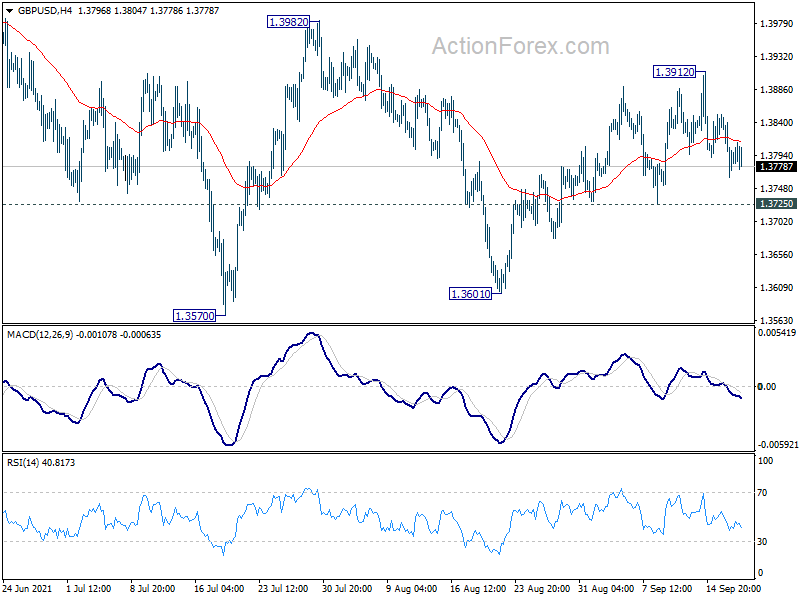
Intraday bias in GBP/USD remains neutral first. On the upside, break of 1.3912 will target 1.3982 resistance next. Decisive break there will indicate that fall from 1.4248 has completed. Stronger rally would then be seen back to 1.4248 high. On the downside, however, break of 1.3725 support will turn bias back to the downside for retesting 1.3570/3601 support zone instead.
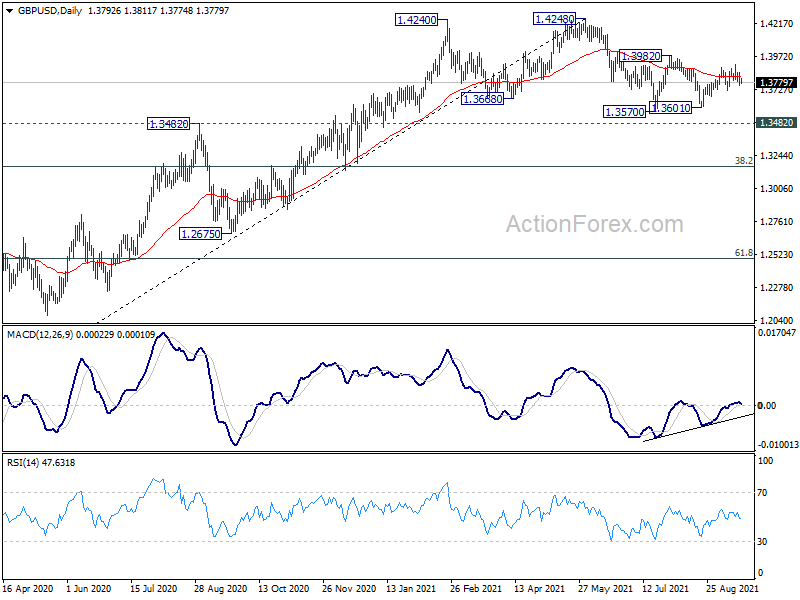
In the bigger picture, as long as 1.3482 resistance turned support holds, we'd still treat price actions from 1.4248 as a corrective move. That is, up trend from 1.1409 (2020 low) is in favor to resume. Decisive break of 1.4376 key resistance (2018 high) would indeed carry long term bullish implications. However, sustained break of 1.3482 will at least bring deeper fall to 38.2% retracement of 1.1409 to 1.4248 at 1.3164, or even further to 61.8% retracement at 1.2493.
USD/JPY Mid-Day Outlook
Daily Pivots: (S1) 109.36; (P) 109.59; (R1) 109.98; More...
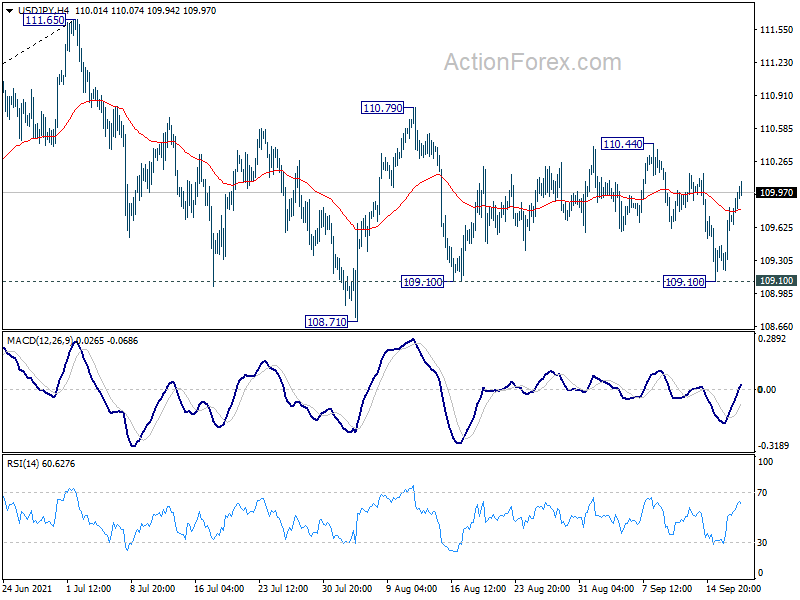
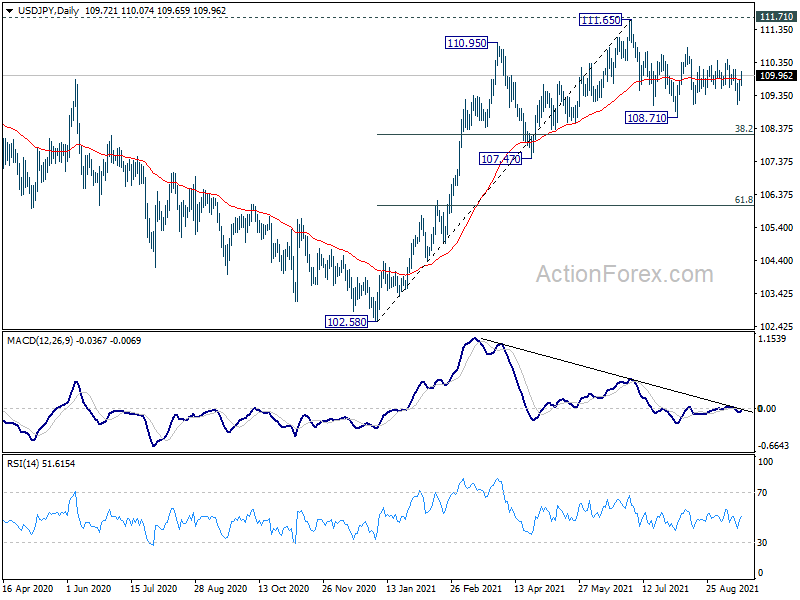
Intraday bias in USD/JPY stays neutral for the moment. On the downside, break of 109.10 will argue that larger fall from 111.65 is resuming. Deeper decline should then be seen to 108.71 support first, and then 38.2% retracement of 102.58 to 111.65 at 108.18 next. On the upside, above 110.44 will turn bias back to the upside for 110.79, and then 111.65 high instead.
In the bigger picture, medium term outlook is staying neutral with 111.71 resistance intact. The pattern from 101.18 could still extend with another falling leg. Sustained trading below 55 day EMA will bring deeper fall to 107.47 support and below. Nevertheless, strong break of 111.71 resistance will confirm completion of the corrective decline from 118.65 (2016 high). Further rise should then be seen to 114.54 and then 118.65 resistance.
USD/CHF Mid-Day Outlook
Daily Pivots: (S1) 0.9221; (P) 0.9249; (R1) 0.9307; More....
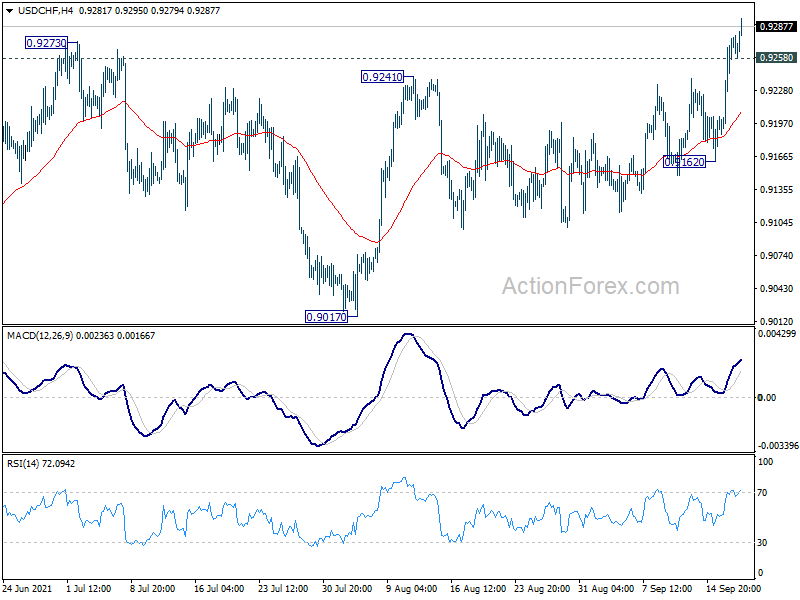
Sustained break of 0.9273 resistance confirms resumption of whole rise from 0.8925. Intraday bias remains on the upside for 0.9471 resistance next. Decisive break there will carry larger bullish implications. On the downside, below 0.9258 minor support will turn intraday bias neutral first, before staging another rally.
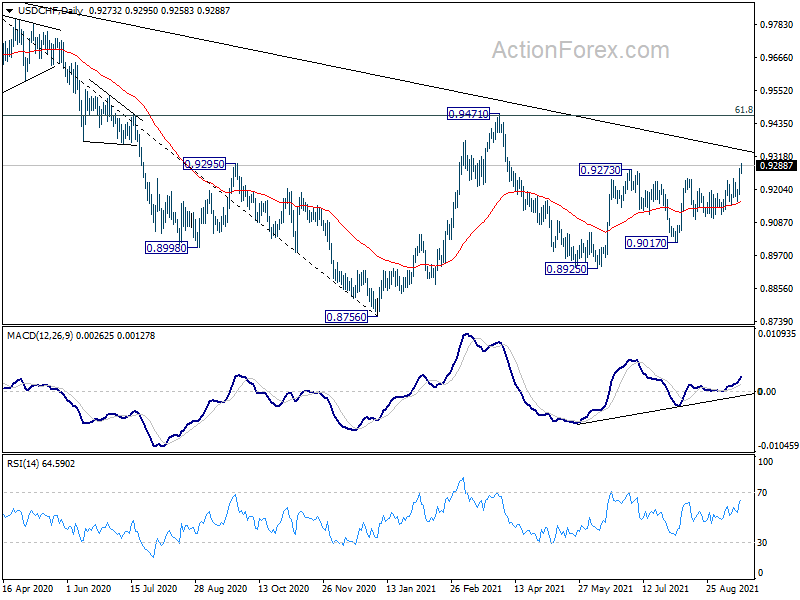
In the bigger picture, USD/CHF is still struggling around 55 week EMA (now at 0.9178) and outlook is mixed for now. Confirmed rejection by the 55 week EMA will retain medium term bearishness. That is, larger fall from 1.0342 would resume through 0.8756 low at a later stage. However, sustained trading above 55 week EMA will tilt favor to the case of bullish reversal. Focus would then be turned to 0.9471 resistance for confirmation.
Swiss Franc and Yen Under Some Selling Pressure ahead of Weekly Close
Swiss Franc and Yen are both under some selling pressure today, following rallying major global treasury yields. Sterling is weighed down by weak retail sales while Euro is not too far away. Dollar is mixed and Canadian and Aussie are the relatively stronger ones. The economic calendar is light in US session, and risk markets development would drive the forex markets towards the end of the week.
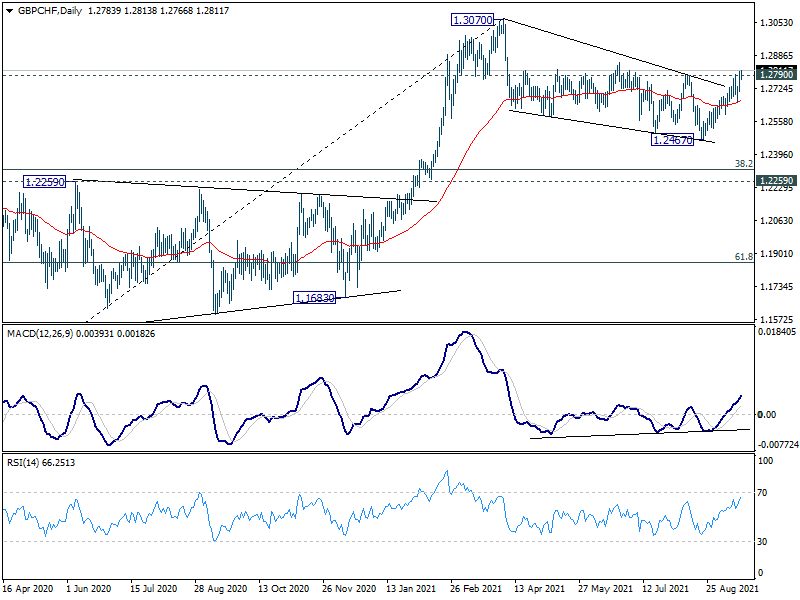
Technically, GBP/CHF could finally be making a decision to break through 1.2790 resistance in a firm way. The development would argue that corrective pattern from 1.3070 has completed at 1.2467. Further rise is now in favor as long as 55 day EMA holds, to retest 1.3070 high. EUR/CHF is on track to 1.0985 resistance and break will pave the way to retest 1.1149 high. USD/CHF is also resuming whole rise from 0.8925 to retest 0.9471 resistance.
In Europe, at the time of writing, FTSE is up 0.06%. DAX is down -0.02%. CAC is up 0.32%. Germany 10-year yield is up 0.0312 at -0.269. Earlier in Asia, Nikkei rose 0.58%. Hong Kong HSI rose 1.03%. China Shanghai SSE rose 0.19%. Singapore Strait Times rose 0.22%. Japan 10-year JGB yield rose 0.0047 to 0.050.
ECB Makhlouf: Fears of excessive euro area inflation are overstated
ECB Governing Council member Gabriel Makhlouf said, "I believe that, at the moment, fears of excessive euro area inflation are overstated and that the current price pressures reflect transitory factors that will fade out over time."
But he also admitted, "there is considerable uncertainty about the persistence of price pressures and we need to interpret this (inflation) data and the outputs of our models with caution."
ECB Kazaks: There are some decimals upside in inflation outlook
ECB Governing Council member Martins Kazaks said, "if Covid does not surprise on the negative side, there is some upside for the inflation outlook over the medium term." But he added, "I am talking about decimals here."
"There is perhaps some upside for those numbers to be revised up in the following forecasting rounds," Kazaks said. "I agree with the current outlook, but I would say that the balance of risks for inflation are somewhat on the upside."
"We hear some anecdotal evidence that there could be some wage pressures down the road, but we have not seen that yet in the data," he said. "There is no reason to expect that inflation would be permanently very hot. If at some point inflation will be significantly higher than our strategy and monetary-policy mandate, then of course we will know how to react."
Eurozone CPI finalized at 3% yoy in Aug, EU at 3.2% yoy
Eurozone CPI was finalized at 3.0% yoy in August, up from July's 2.2% yoy. The highest contribution to the annual euro area inflation rate came from energy (+1.44%), followed by non-energy industrial goods (+0.65%) and food, alcohol & tobacco and services (both +0.43%).
EU CPI was finalized at 3.2% yoy, up from July's 2.5% yoy. The lowest annual rates were registered in Malta (0.4%), Greece (1.2%) and Portugal (1.3%). The highest annual rates were recorded in Estonia, Lithuania and Poland (all 5.0%). Compared with July, annual inflation remained stable in one Member State and rose in twenty-six.
UK retail sales dropped -0.9% mom in Aug, ex-fuel sales dropped -1.2% mom
UK retail sales dropped -0.9% mom in August, well below expectation of 0.5% mom rise. For the 12-month period, headline sales rose 0.0% yoy versus expectation of 2.6% yoy.
Overall sales volume were still up 0.3% in the three months to August, compared with the previous three months. It's also 4.6% higher than their pre-pandemic levels in February 2020.
Ex-fuel sales dropped -1.2% mom, well below expectation of 0.7% mom rise too. For the 12-month period, ex-fuel sales dropped -0.9% yoy versus expectation of 2.5% yoy.
New Zealand BusinessNZ manufacturing dropped to 40.1, economic pain being felt
New Zealand BusinessNZ manufacturing index dropped to 40.1 in August, down from 62.6, back in contraction. Looking at some more details, production tumbled from 63.9 to 27.7. Employment dropped from 57.9 to 54.5. New orders dropped from 63.7 to 44.4. Finished stocks dropped from 56.8 to 46.1 Deliveries dropped from 56.3 to 33.6.
BNZ Senior Economist, Doug Steel stated that "while many anticipate a bounce in activity as the country progresses down alert levels (all going well on the Covid front), today's PMI clearly demonstrates the economic pain being felt. This should not be underestimated, even if there is hope for the future. GDP and manufacturing output are expected to fall heavily in Q3. It is something of a reality check in the afterglow of yesterday's very strong Q2 GDP outcome."
USD/CHF Mid-Day Outlook
Daily Pivots: (S1) 0.9221; (P) 0.9249; (R1) 0.9307; More....
Sustained break of 0.9273 resistance confirms resumption of whole rise from 0.8925. Intraday bias remains on the upside for 0.9471 resistance next. Decisive break there will carry larger bullish implications. On the downside, below 0.9258 minor support will turn intraday bias neutral first, before staging another rally.
In the bigger picture, USD/CHF is still struggling around 55 week EMA (now at 0.9178) and outlook is mixed for now. Confirmed rejection by the 55 week EMA will retain medium term bearishness. That is, larger fall from 1.0342 would resume through 0.8756 low at a later stage. However, sustained trading above 55 week EMA will tilt favor to the case of bullish reversal. Focus would then be turned to 0.9471 resistance for confirmation.
Economic Indicators Update
| GMT | Ccy | Events | Actual | Forecast | Previous | Revised |
|---|---|---|---|---|---|---|
| 22:30 | NZD | BusinessNZ Manufacturing Index Aug | 40.1 | 62.6 | ||
| 6:00 | GBP | Retail Sales M/M Aug | -0.90% | 0.50% | -2.50% | -2.80% |
| 6:00 | GBP | Retail Sales Y/Y Aug | 0.00% | 2.60% | 2.40% | |
| 6:00 | GBP | Retail Sales ex-Fuel M/M Aug | -1.20% | 0.70% | -2.40% | |
| 6:00 | GBP | Retail Sales ex-Fuel Y/Y Aug | -0.90% | 2.60% | 1.80% | |
| 8:00 | EUR | Eurozone Current Account (EUR) Jul | 21.6B | 22.3B | 21.8B | |
| 8:30 | GBP | Consumer Inflation Expectations | 2.70% | 2.40% | ||
| 9:00 | EUR | Eurozone CPI Y/Y Aug F | 3.00% | 3.00% | 3.00% | |
| 9:00 | EUR | Eurozone CPI Core Y/Y Aug F | 1.60% | 1.60% | 1.60% | |
| 14:00 | USD | Michigan Consumer Sentiment Index Sep P | 70.2 | 70.3 |
Cautious End to the Week
Stock markets are a little lower on the final trading day of the week. The European day got off to a decent start but that has fizzled out as the session has worn on.
It's been quite an interesting week in the markets, in which one eye has been consistently on the Fed meeting next Wednesday. There's been plenty of ups and downs but ultimately, we're pretty much back where we started. With that now drawing ever closer, we could increasingly see caution among investors wary of the potential for a nasty shock.
There's no doubt the downside risks are piling up and are coming from a variety of areas, be it inflation/monetary tightening, Covid, Evergrande, energy prices etc. The list goes on. But then we see US data this week - easing inflation, stronger retail sales and manufacturing activity - and suddenly there's cause for optimism.
I think the risks are too hard to ignore at the moment, especially if the Fed and other central banks are so intent on removing stimulus measures. And it's not the fact that economies around the world aren't doing well, or that many of these countries now have high vaccination rates, but there's so much uncertainty in the months ahead, the timing strikes me as a little odd.
While it's also impossible to ignore the commentary coming from various central bank officials in recent weeks, I feel they may be persuaded to wait until the turn of the year if some of the downside risks unfold over the next couple of months and investors become anxious.
Next week should clear up some of the confusion as the Fed commentary we've had recently doesn't seem to align with the mood in the markets. This week's data from the US has alleviated some of the concerns but ultimately, if the message from the Fed is that its planning to reduce asset purchases regardless of downside risks due to inflation concerns, a taper tantrum may swiftly follow.
Eurozone inflation jumps, UK Retail Sales slump
It's not just the Fed that's seeing plenty of internal debate about inflation risks. The ECB - whose inflation problem has for years been an inability to generate any - is also experiencing above target of inflation. It rose to 3% in August, 1.6% on a core basis, and may rise further into the end of the year.
The ECB was forced to reject a story on Thursday that suggested the central bank may envisage a rate hike late in 2023 based on inflation projections over the next five years. I mean, aside from the story being based on private comments that were rejected, the idea of five year ECB inflation projections being taken seriously is laughable.
The UK is a more serious conversation when it comes to interest rate movements but expectations here even seem a little optimistic. The economy is in a decent position, much better than once imagined, but I'm not convinced two rate hikes next year is likely.
A retail sales decline of 0.9% in August supports a more cautious view, especially when combined with headwinds facing consumers over the next year including the end of the furlough scheme and Universal Credit boost, income tax threshold freeze, 1.25% increase in national insurance contributions and higher energy prices. Not to mention the more restrained behaviour in the event of a winter surge in Covid cases.
Oil eases off highs
Oil prices are pulling back a little at the end of the week after coming within a whisker of summer highs on Wednesday. We're clearly seeing some profit-taking kicking in on approach to those highs, with the restarting of operations in the Gulf of Mexico and the dollar rally further backing the move.
Any correction in price could see some support arrive around $70 in WTI, where it finally broke back above earlier this week. There still appears plenty of momentum in the rally which could keep dip buyers interested. There's also a couple more months of Hurricane season so further disruption in the Gulf is likely.
Gold stable after plunge
Gold took a pummeling on Thursday. A break of key support around $1,780 followed by stronger US retail sales and manufacturing data was a hammer blow for the yellow metal which rapidly fell below $1,750 before paring some of those losses. It's making minor gains today but struggling to even maintain them.
It seems traders view the risks next week as being tilted to the downside for gold and have started pricing it in early. It's not an outrageous assumption given the commentary we had from policymakers ahead of the blackout period, especially when combined with yesterday's data, but it may be a little premature.
I imagine the Fed will want to remain committed to its desire to taper later this year but if they do, I expect there'll be plenty of dovish caveats designed to keep the markets on board. And this may spare gold in the short term as we wait to see if the downside risks materialise.
Still waiting
There isn't too much to add on bitcoin, not a lot has changed over the last few days. To the upside, $48,000 continues to look interesting and a failure to break above here could add to the case for a correction. A significant move below $44,000 and a correction could be underway (finally) which could make things a lot more interesting.
ECB Makhlouf: Fears of excessive euro area inflation are overstated
ECB Governing Council member Gabriel Makhlouf said, "I believe that, at the moment, fears of excessive euro area inflation are overstated and that the current price pressures reflect transitory factors that will fade out over time."
But he also admitted, "there is considerable uncertainty about the persistence of price pressures and we need to interpret this (inflation) data and the outputs of our models with caution."
ECB Kazaks: There are some decimals upside in inflation outlook
ECB Governing Council member Martins Kazaks said, "if Covid does not surprise on the negative side, there is some upside for the inflation outlook over the medium term." But he added, "I am talking about decimals here."
"There is perhaps some upside for those numbers to be revised up in the following forecasting rounds," Kazaks said. "I agree with the current outlook, but I would say that the balance of risks for inflation are somewhat on the upside."
"We hear some anecdotal evidence that there could be some wage pressures down the road, but we have not seen that yet in the data," he said. "There is no reason to expect that inflation would be permanently very hot. If at some point inflation will be significantly higher than our strategy and monetary-policy mandate, then of course we will know how to react."