Sample Category Title
Weekly Economic & Financial Commentary: August Data Holding Up Despite Delta
Summary
United States: August Data Holding Up Despite Delta
- Data released this week generally showed a stronger economy in August than many expected in the wake of surging COVID cases. Retail sales jumped 0.7%, defying expectations for a decline, and consumer price inflation came in better than expected, with the factors that boosted price growth this summer weighing on the index in August.
- Next week: Housing Starts (Tue.), Existing Home Sales (Wed.), New Home Sales (Fri.)
International: China Still Surprising to the Downside, Mix of Data Down Under
- A renewed outbreak of COVID and subsequent restrictions have weighed on economic prospects and have placed uncertainty over China's economic outlook, while a severe flood has also put downward pressure on economic activity lately. In Australia and New Zealand, high frequency activity indicators have slowed noticeably over the past two months.
- Next week: Brazilian Selic Rate Decision (Wed.), Eurozone PMI (Thu.), South African Reserve Bank Interest Rate Decision (Thu.)
Interest Rate Watch: Hunting for Hints at the September FOMC Meeting
- As a taper announcement draws nearer, the FOMC will likely begin to make some adjustments to its post-meeting statement. Given the disappointing August job numbers, however, such tweaks are more likely to show up in the November statement to foreshadow to an announcement in December.
Credit Market Insights: Consumer Indicators Mixed, but Finances Remain Solid
- Over the past six weeks, consumer data have been mixed to say the least, and times have been rocky financially as most fiscal support has been phased out and extended unemployment benefits have ended. But consumer fundamentals remain strong, and the threat to spending is not shaky household finances but consumers choosing to refrain from spending.
Topic of the Week: Fiscal Aid Pushes Incomes Up and Poverty Down
- New data released by the Census Bureau provide additional evidence that the massive amounts of fiscal aid deployed over the course of the pandemic helped bolster household incomes throughout the public health crisis and economic downturn.
The Weekly Bottom Line: Blame Both Supply & Demand for Inflation
U.S. Highlights
- Retail sales surprised on the upside in August, growing by 0.7% month-on-month. This followed a downward revision to the decline in July, but suggests resilience in the face of increased headwinds.
- Consumer price inflation slowed in August. From a peak of 5.4% year-on-year, the headline rate edged lower to 5.3%. Core inflation (ex. food and energy) decelerated more, moving from 4.3% to 4.0%.
- The Federal Open Market Committee will announce its next moves on monetary policy next week. It is likely to signal its intentions to begin tapering asset purchases in the near future.
Canadian Highlights
- Inflation accelerated to 4.1% year-on-year (y/y) in August from 3.7% in July, above the median analyst estimate for 3.9%. Durable goods prices were a major contributor to that acceleration, up 5.7% y/y (from 5.0% in July).
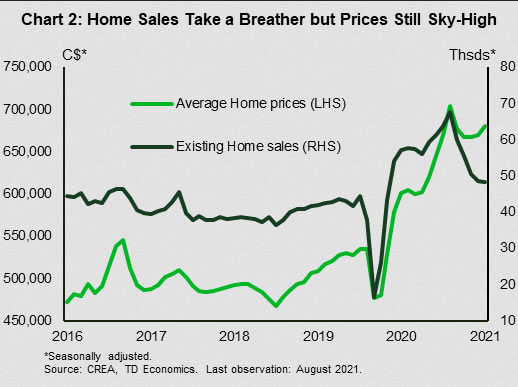
- Existing home sales dipped by a slight 0.5% m/m in August, marking the smallest of five straight monthly declines. Meanwhile, average home prices climbed a sturdy 1.7% month-on-month.
- The Delta variant continues to cast a shadow on the pace of the recovery. This week, Alberta declared state of emergency and re-imposed social distancing restrictions amid a record number of patients in ICUs.
U.S. - Transitory Setbacks vs. Transitory Inflation
The American economy continues to be buffeted by the pandemic and supply chain challenges. Still, it is showing its resilience. Retail sales in August surprised economists’ dour predictions for decline, rebounding by 0.7% month-on-month (Chart 1). A lack of inventory prevented consumers from spending on automobiles, while rising virus counts appear to have taken a toll on dining out. But, where consumers could spend, they did – at furniture and general merchandise stores, and, as they have been doing at a record pace since the pandemic began, at online retailers.
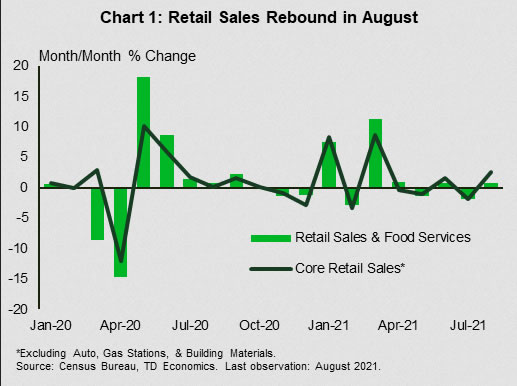
The rebound in retail sales is encouraging, showing there is still gas in the consumer tank and that while slowing after its stimulus-fueled surge in the first half of the year, it will not become a drag on economic activity. Even the sources of weakness in retail sales in August have a silver lining. The slowdown in auto production will not last forever. As long as demand is there, sales should rebound once inventories are rebuilt – if not this year, then next. The setback in spending at food services and drinking places is no doubt a consequence of the worsening virus trend, but there are signs of better days. Cases are now falling in the worst hit states.
At the same time, the acceleration in inflation – the consequence of buoyant demand and constrained supply – appeared to slow in August. Overall consumer prices were up 5.3% relative to a year ago, below the 5.4% peak in June and July. Excluding food and energy, the rate of core inflation slowed to 4.0% from 4.3%. The slowing is more evident on a month-on-month basis where price growth cooled to 0.3%, down from 0.5% in August and a peak of 0.9% in June. The core rate was up just 0.1% (Chart 2).
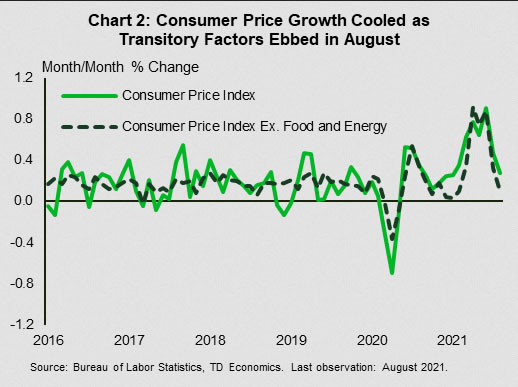
Just as important, some of the biggest contributors to inflation pulled back in August. For example, used vehicles prices had skyrocketed through the spring and early summer, adding over a percentage point to headline inflation, but pulled back 1.5% in August. This gives credence to the view that as the pandemic shock passes and transitory influences fade, the rate of price growth will also return to its pre-pandemic calm.
Into this to-and-fro, the Federal Open Market Committee meets next week to deliberate on the course of monetary policy. Importantly, the Fed’s statement will come alongside renewed projections for economic growth, unemployment and inflation. Economic growth projections are likely to be downgraded, but to rates that are still well above trend. The pace of improvement in unemployment is also likely to be slowed, but still make progress. The inflation forecast is also likely to see an upgrade in the near-term, marking to the data.
With these economic views, the Fed is likely to communicate that in order to ensure inflation remains transitory it must begin preparing to withdraw policy support. The first step is to slow the pace of asset purchases, which is likely to happen this calendar year. The Fed’s statement is likely to emphasize that this does not mean that policy rate hikes are around the corner, but as long as growth continues, they may not be too far on the horizon.
Canada - Blame Both Supply & Demand for Inflation
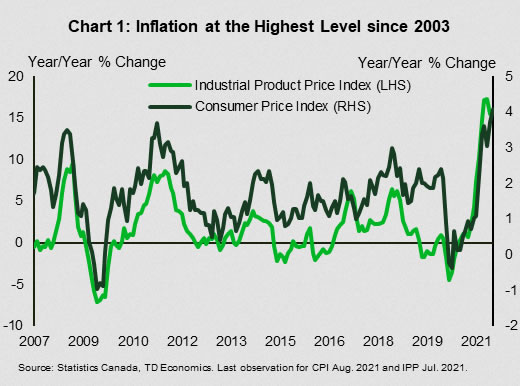
Inflation and housing data took center stage this week, with both likely to be important issues for Canadians as they head to the polls next week. On the inflation front, consumer prices continued to rise in August, accelerating to 4.1% year-on-year from 3.7% in July. One must time travel all the way back to 2003 to experience inflation at a similar level.
While the increase in consumer prices is notable, they are rising from last year's low levels when Covid-19 restrictions were still weighing on demand and prices for many goods and commodities. Energy prices are a case in point. Last month gasoline prices were up a whopping 33% relative to a year ago. Excluding gasoline, consumer price growth appears tamer at 3.2% year-over-year. Service prices were also depressed last year, but are now also on the rise as consumers resume travelling, dining out and other postponed activities.
Recovering consumer demand is just one part of the story. Ongoing supply-chain disruptions are also putting upward pressure on usually-benign goods inflation, with durable goods prices up 5.7% from the year ago. With retailers trying to rebuild inventories, container freight shipping costs have risen exponentially this year. Furthermore, developing countries – where many consumer goods are manufactured – are also dealing with pandemic-related disruptions and shutdowns of their own. High commodity prices and shortages of inputs are, in turn, leading to higher prices at factory gates. The industrial product price index, which tracks prices for major commodities sold by Canadian manufacturers – is up 15% from the year-ago (Chart 1).
While talking about inflation, it's hard not to mention the housing market – another area where prices have been on fire over the last year and half. Activity in the housing market has come off the boil in recent months, but prices remain elevated. Including this week's August data, home sales have been falling for five consecutive months and were just 8% above their pre-pandemic level. Meanwhile, price pressures, which had been easing over the spring and early summer, picked up again in August, rising a sturdy 1.7% month-on-month (and up 27% from where they were in February 2020, Chart 2). Even with the drop in sales, inventories of homes for sale also remain very low. As a result, the housing market is still tight and firmly in sellers' market territory. This is likely to continue to put upward pressure on home prices in the near-term.
All told, inflation is likely to remain elevated for the remainder of this year even as downside risks to domestic and global growth emerge as a result of the Delta variant. On that front, this week Alberta declared a state of emergency and re-imposed social distancing restrictions amid a record number of patients in intensive care units. Still, the pandemic is increasingly just as much a supply as demand problem and while price growth may slow in some areas, it may push even higher in others. As long as economic growth is only postponed, the Bank of Canada will continue to reduce the pace of its asset purchases in order to ensure that inflation remains temporary. Policy rate hikes are likely still not on the immediate horizon, but pose the question a year from now and the answer is likely to be different.
Week Ahead – All Eyes on the Fed
The week we’ve all been waiting for
Next week is action-packed including rate decisions from the US, Japan, UK, South Africa, Turkey, Switzerland, Norway and Sweden.
The Federal Reserve is the obvious standout among these, with investors seemingly uneasy at the prospect of the central bank tapering asset purchases at a time when the recovery is slowing and Covid is spreading rapidly. Markets will be very sensitive to the communication, especially if the underlying message remains that the central bank still intends to pare back asset purchases this year.
A lot of focus remains on China as the crackdown on various sectors continues, the latest of which being Casinos. Evergrande is also looking likely to reach a conclusion soon, one way or another.
The Russian parliamentary election also takes place this weekend, starting today and lasting three days. The United Russia party is expected to remain in control but its supermajority is at stake.
Country
US
The main event of the trading week is the FOMC policy decision, but traders should closely watch the developments on Capitol Hill. The most important economic release of the week will be the September preliminary PMI readings, which could show further signs the economy has stabilized from the delta variant hit.
The two-day FOMC policy meeting will likely be a reiteration that they are poised to taper before the end of the year. Economists will fixate on the updated dot plot forecast to see if any members brought forward a rate hike into the end of 2022.
The Fed will not rush a tightening cycle and expectations should remain firm that 2023 is when the first rate hike will be delivered. Fed Chair Powell may provide hints that tapering won’t be quick, possibly indicating it won’t finish until next winter. The economy appears to have survived the delta variant hit, which should suggest further stabilizing economic releases will pave the way for a November taper announcement.
With monetary and fiscal stimulus starting to wane, clarity on the size of the next economic package will enter a crucial phase. President Biden was unable to convince conservative democrats of a $3.5 trillion budget and talks will likely lead to a final price tag between $1.5 -2.0 trillion. Some traders will pay close attention to the upcoming tax increases and whether they are retroactive from earlier in the year or September could be just as important in determining the major move with risk appetite.
EU
It’s a relatively quiet week in Europe, with flash PMIs on Thursday and German Ifo on Friday the only notable economic events.
The German election is where all the attention will be, with the final Chancellor debates taking place on Thursday ahead of the election on Sunday 26th September. The polls currently have the Social Democrats in the lead by four points but with coalitions always required, that will just be the start of the negotiations.
UK
How many interest rate hikes next year is the question on everyone’s lips. The market is currently positioned for two, one 15 basis point in March or May and another 25 basis points at the end of 2022, taking the base rate to 0.5%.
This seems a stretch for a central bank that’s not yet completed its asset purchases. Not to mention a country that has seen a slowdown in consumer spending and is facing numerous headwinds over the next 12 months including the end of the furlough scheme and Universal Credit boost, income tax threshold freeze, 1.25% increase in national insurance contributions and higher energy prices.
Emerging Markets
Russia
Russia goes to the polls this weekend in a vote lasting three days, with the ruling United Russia party expected to win, despite support waning following an apparent crackdown on critics and political opponents, something the Kremlin denies. At stake is the party’s supermajority.
Apple and Google were forced to remove a tactical voting app from their stores this week following pressure from the Kremlin. The app was set up by Alexei Navalny, a jailed critic of Vladimir Putin.
South Africa
The SARB is expected to leave interest rates unchanged next week, with hikes on hold until early next year. Inflation will be released a day before the decision and is expected to rise to 4.8%, which the central bank is comfortable with. The economy is expected to contract this quarter following the riots so the SARB can afford to be patient.
Turkey
It seems Governor Şahap Kavcıoğlu is going to go back on his word to keep interest rates above inflation, after CPI earlier this month rose to 19.25%, above the 19% policy rate. He has previously stressed that inflation is expected to fall again later this year and is clearly in no mood to risk his job just to keep his word.
Some are even expecting the Governor to cut rates next week by 50 basis points, although under the circumstances, it’s more likely that will be left until later in the year when inflation is falling once more. It’s one thing not to keep your word, it’s another altogether to do the complete opposite.
Asia Pacific
China
The government squeeze on the private sector continued this week, this time it was the Macau casino industry’s turn. Casino stocks listed in Hong Kong plunged. The week is dominated by holidays amongst Asia’s heavyweights. Mainland China is on holiday Monday and Tuesday with Hong Kong on Wednesday. South Korea is also away.
The holiday schedule next week will substantially reduce market liquidity in Asia. Readers should watch for further weekend developments regarding Evergrande, which appears to be on the final strait of collapse or liquidation or debt/equity swap. Negative developments over the weekend could cause a severe risk aversion move on Monday in Asia, into a low liquidity day.
The only data from China this week is the 1-year and 5-year Loan Prime Rate decisions. It would be a huge surprise if China blinked and cut them with an October RRR cut far more likely. Nevertheless, a surprise cut would see Asian equities rally strongly in the short term.
USD/CNY remains range-bound with no sign that the PBOC is looking to engineer a weaker currency to stimulate the economy, yet.
India
No significant data or event risk this week. EM will be dominated by central banks globally and the FOMC outcome on Thursday, Asian time.
Australia & New Zealand
The Australian and New Zealand Dollars continue to bounce around on daily shifts in international risk sentiment, rather than domestic developments. Half of Australia and Auckland in New Zealand remain under virus lockdowns. Given that New Zealand’s outbreak appears contained to Auckland where daily cases are approaching single digits, any news that suggests the virus has escaped Auckland will provoke an aggressive sell-off in the New Zealand Dollar.
New Zealand releases Services PSI and Balance of Trade, while Australia releases the RBA Minutes and Markit Services, which will show the Covid-19 outbreak. Any reactions in local markets will be subsumed by low Asia liquidity and the focus on the US FOMC outcome.
Japan
Japan’s Bank of Japan releases its latest policy decision on Wednesday with no change expected to its stimulus plans. Inflation is released on Friday but will have a low market impact post FOMC. It should be a quiet week for Japan with national holidays on Monday and Thursday. With Greater China and South Korea also having national holidays next week, Asia will suffer from lower than usual liquidity, exacerbating reactions to headline risks.
Equity investors remain myopically focused on Japan’s next Prime Minister, who will be selected at the end of the month and should see Japan markets, when open, continue outperforming. Markets are expecting the new PM to push through a new fiscal stimulus ahead of an election due in November at the latest, giving a boost to the economy and equity prices.
USD/JPY remains a pure rate differential play between the US 10-year and Japan JGBs. Follow that for directions and bring a good book to read in between.
Key Economic Events
Sunday, Sept. 19
- Conclusion of Russian three-day parliamentary election.
Monday, Sept. 20
- Canada Federal Election
- International Atomic Energy Agency’s 65th general conference is held in Vienna.
- ECB Executive Board Member Schnabel speaks
Economic Data/Events
- Hong Kong CPI
Tuesday, Sept. 21
- United Nations 76th General Assembly begins
- Iraq’s oil minister speaks at the Gastech conference in Dubai
- The OECD updates its global economic forecasts
Economic Data/Events
- US housing starts, building permits, current account balance
- New Zealand credit card spending
- Australia RBA minutes of September policy meeting
- Japan machine tool orders
- Mexico international reserves
- Sweden central bank (Riksbank) rate decision: Expected to keep Interest Rate unchanged at 0.00%, hotter-than-expected inflation could allow some members to raise the rate path.
Wednesday, Sept. 22
- Reserve Bank of Australia’s Assistant Governor Bullock speaks at the Bloomberg Inside Track online event.
Economic Data/Events
- FOMC Rate Decision: Expected to keep interest rates unchanged, possibly inching closer to paring bond purchases
- BOJ Rate Decision: Expected to keep BOJ Policy Balance Rate and 10-year target unchanged, possibly lowering their outlook
- BOJ Gov Kuroda press conference
- US existing home sales
- Eurozone consumer confidence
- Australia Westpac leading index
- China loan prime rates
- Russia industrial production
- South Africa CPI
- EIA Crude Oil Inventory Report
Thursday, Sept. 23
- Final debate for German chancellor candidates. Election day is September 26th
- Hungary Central Bank Governor Matolcsy and CEE deputy governors speak.
Economic Data/Events
- US Sept Prelim Manufacturing PMI: 60.5e v 61.1 prior; Services PMI: 55.0e v 55.1 prior, initial jobless claims, leading index
- European Flash PMIs: Eurozone, France, Germany, U.K.
- BOE Rate decision: No changes expected to Bank Rate, Corporate bond target, and Gilt purchase target, likely to expected to tone down the hawkish rhetoric
- Norges Rate decision: Possibly ready to begin the tightening cycle
- South Africa central bank (SARB) rate decision: Expected to keep interest rates unchanged at 3.50%
- Swiss National Bank (SNB) rate decision: Expected to keep policy rate unchanged at -0.75%
- Turkey central bank (CBRT) rate decision: Expected to keep One-Week Repo Rate unchanged at 19.0%
- ECB Economic Bulletin
- Australia preliminary PMIs
- Singapore CPI
- Mexico CPI
- Thailand trade
- China SWIFT global payments
- Spain GDP
Friday, Sept. 24
- President Joe Biden hosts prime ministers Morrison of Australia, Modi of India, and Suga of Japan at the White House for the inaugural Quad Leaders’ Summit.
- Cleveland Fed President Mester discusses the economic outlook at a virtual event hosted by the Ohio Bankers League; Kansas City Fed President George speaks at an American Enterprise Institute event.
- Fed Chair Powell delivers opening remarks and Fed Governor Bowman and Vice Chairman Clarida moderate a discussion at “Fed Listens: Perspective on the Pandemic Recovery.”
- Norges Bank Deputy Governor Bache speaks
Economic Data/Events
- US new home sales
- Germany IFO business climate
- Japan CPI
- New Zealand trade
- Japan PMIs, supermarket/department store sales
- Singapore industrial production
- Thailand foreign reserves, forward contracts
- Mexico retail sales
Sovereign Rating Updates
- Belgium (Fitch)
- Iceland (Fitch)
- Germany (S&P)
- Saudi Arabia (S&P)
- Hungary (Moody’s)
- Sweden (Moody’s)
- EU (DBRS)
- Finland (DBRS).
BoJ Meeting, Japanese Elections, and the Yen
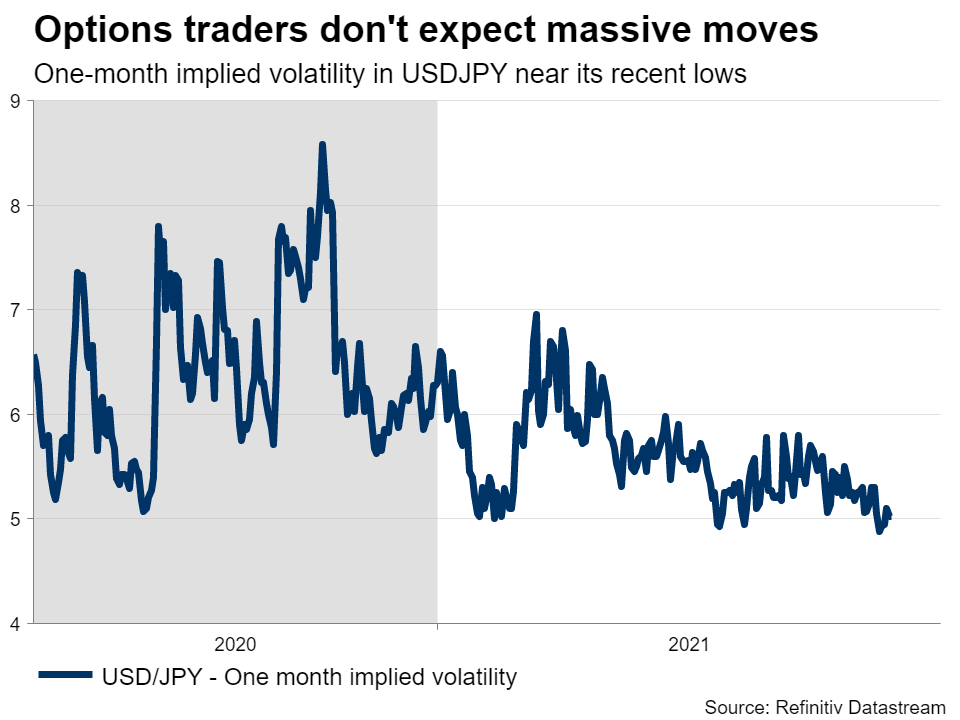
With a Bank of Japan meeting coming up on Tuesday and an inter-party election to decide who will succeed Prime Minister Suga later this month, the yen might finally enjoy some volatility. The central bank is unlikely to disturb the waters as the economy remains trapped in deflation, so the yen’s fortunes will be decided mainly by who wins the election and how global forces evolve.
Deflation blues
Don’t expect much from the Bank of Japan next week. Other central banks may be headed for the exits from aggressive money printing, but the BoJ won’t for a very long time. Much of that comes down to Japan’s fragile recovery, and of course, its multi-decade battle with aging demographics and saving habits.
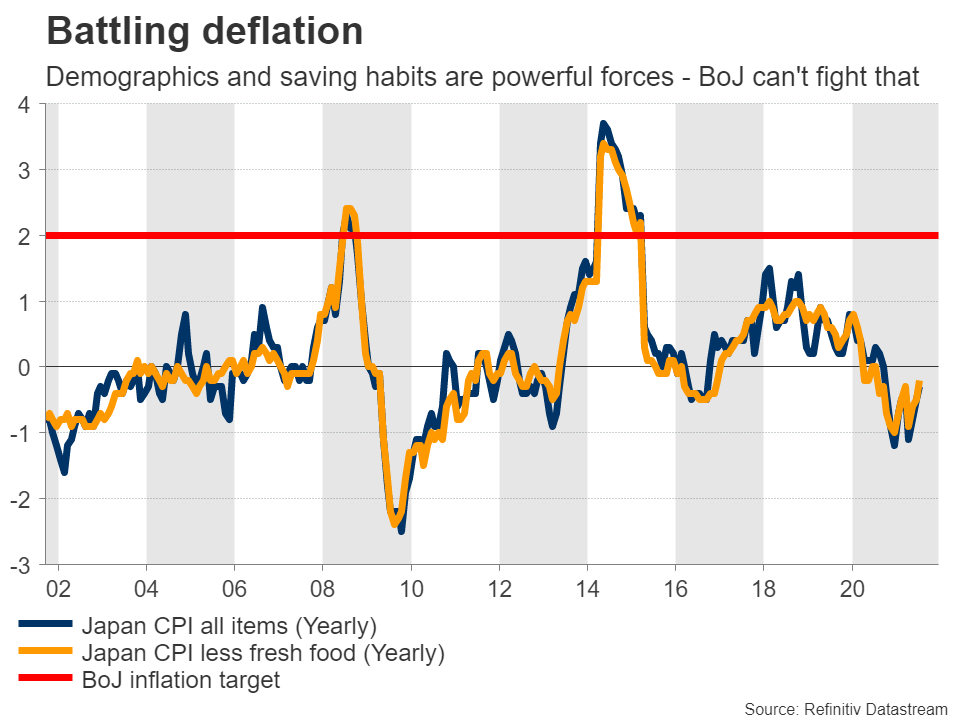
Let’s explain. While most of the world has been grappling with an inflationary episode lately thanks to severe supply chain disruptions, Japan is still trapped in deflation. Consumption hasn’t been impressive either despite massive stimulus packages, and the latest PMI surveys have cratered, pointing to slower growth ahead.
On the bright side, vaccination levels have reached parity with America and Europe, even though Japan was late to the party.
That’s the short-term story. The bigger picture is that the economy simply cannot escape the curse of an aging population and very high saving rates. If your population is shrinking and people are saving a high percentage of their income away, that’s a terrible recipe for consumption and growth. Ultimately, it breeds deflation.
BoJ to stay quiet
The central bank has tried all sorts of tricks to push inflation higher. It has used negative interest rates, quantitative easing, yield curve control, and even buying stocks. Yet even its own forecasts suggest the inflation target won’t be reached over the next few years.
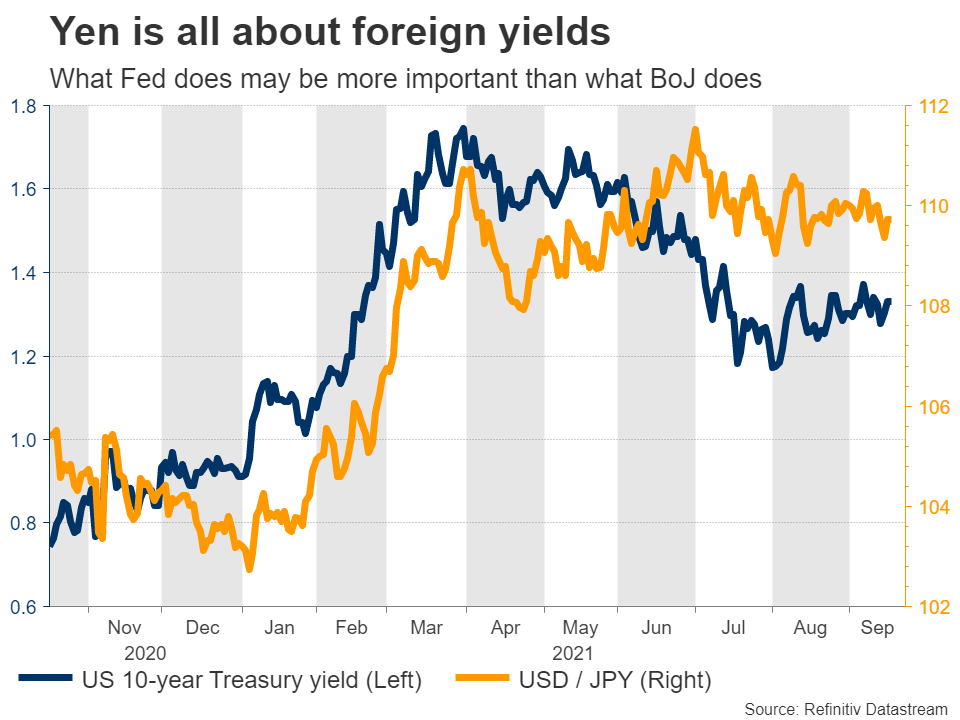
As a result, the BoJ will most likely be the last major central bank to exit cheap-money policies. Investors know this very well, hence why the yen no longer reacts to economic data or BoJ meetings.
Elections imminent
But an election could be a different story. When prime minister Suga announced he would step down, Japanese stock markets immediately went into overdrive, smelling fresh government spending ahead.
The next date to watch is September 29. That’s when the nation’s ruling LDP party will host its leadership election. The winner will become prime minister automatically because of the party’s majority in parliament, but might not hold that throne for long as a general election will take place over the next two months.
The three frontrunners in the LDP election are Taro Kono, Fumio Kishida, and Sanae Takaichi. Kono is leading the race in opinion polls and is in favor of a spending package that focuses on boosting wages and growth. He has also urged the Bank of Japan in the past to outline an exit strategy from cheap money, so he might replace Governor Kuroda with someone less dovish when his term expires in 2023.
Kishida has similar policies. He also favors higher spending but has advocated for restoring fiscal health in the past, and has also warned that BoJ stimulus cannot last forever. Finally, Takaichi is essentially a political descendant of ex-prime minister Shinzo Abe. She favors bold government spending and ultra-expansionary monetary policy.
As for the yen, it might perform best under Kono’s leadership, given the potential incentives for businesses to raise wages and a more conservative BoJ Governor in the future. In contrast, Takaichi might be bad news for the currency.
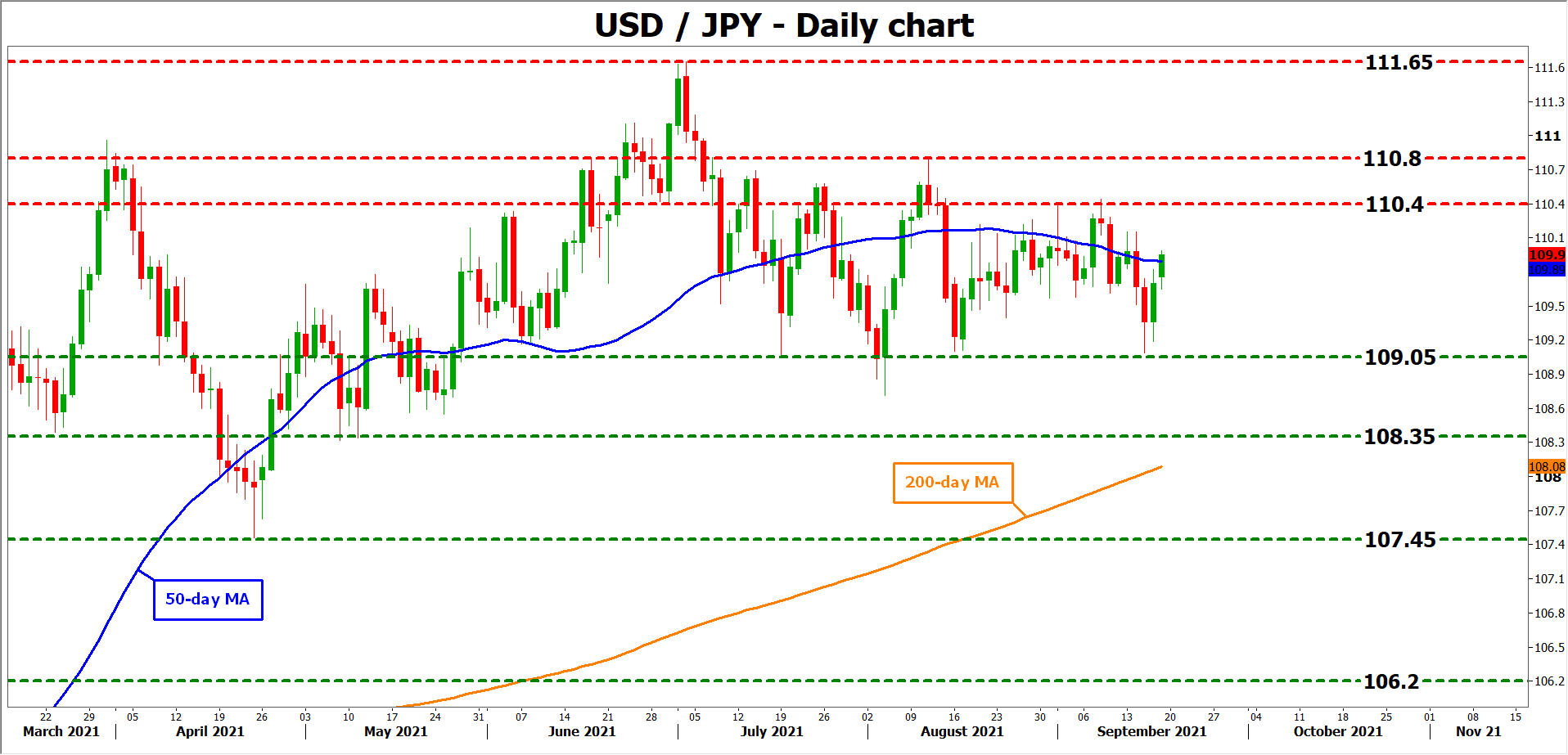
Taking a technical look at dollar/yen, immediate resistance to advances might be found near the 110.40 zone.
On the downside, the first target for sellers would likely be the 109.05 area.
Week Ahead – Fed to Headline Jam-Packed Week for Central Banks
The Federal Reserve is widely expected to give its clearest signal yet next week that tapering is just around the corner. But the Fed will have to fight for attention as the Bank of Japan, Bank of England and Swiss National Bank meetings are some of the other policy gatherings taking place in the coming days. However, central banks will not be the only ones to fall under the limelight as elections in Canada and the flash PMIs for September will be watched closely too.
Fed to take big step towards tapering
The Federal Open Market Committee (FOMC) announcement on Wednesday will undoubtedly grab the chunk of next week’s market headlines as policymakers will likely end months of speculation by strongly flagging a taper decision for the November meeting. August’s soft payrolls numbers dampened expectations of an earlier taper action and although there is some evidence that both economic growth and price pressures are easing in the United States, the risks to inflation are clearly tilted to the upside. Many, including some FOMC members, think the Fed is already behind the curve on inflation so the question is, can Powell & Co afford to delay a decision any further?
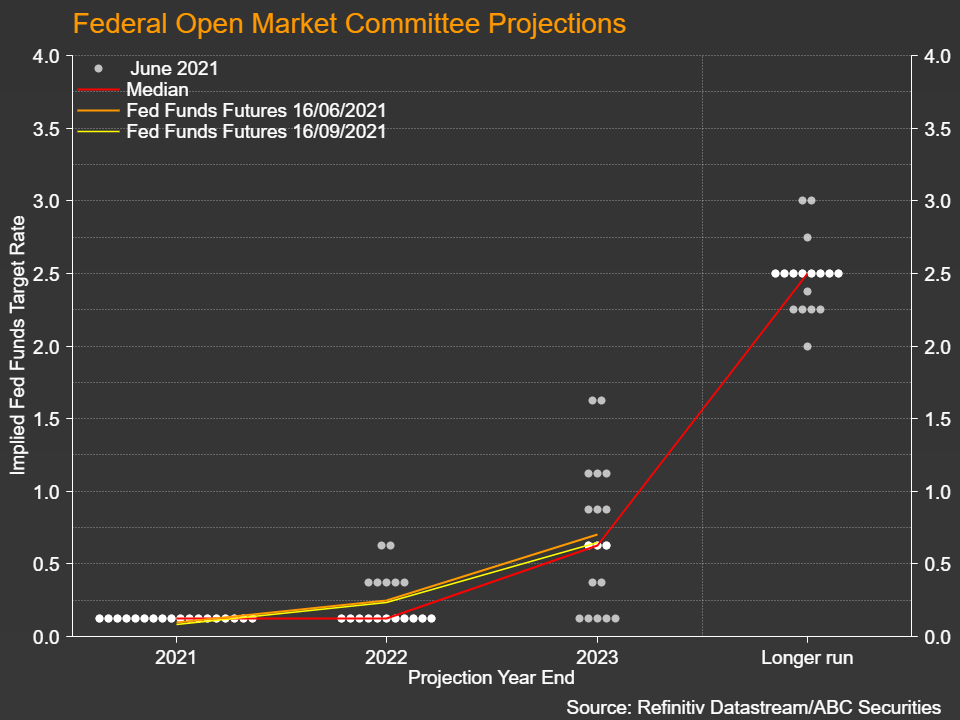
Nevertheless, with a tapering move sometime this year a foregone conclusion, investors will be more concerned about what the Fed will project in its latest quarterly forecasts, and of course, the updated dot plot chart. In the last dot plot, policymakers had penciled in the first post-pandemic rate increase for 2023. But there’s been a notable hawkish shift since then so the median projection might point to a 2022 rate hike, which could give a bit of a lift to both Treasury yields and the US dollar.
On the data front, investors will be keeping an eye on building permits and housing starts on Tuesday, existing home sales on Wednesday, the flash IHS Markit PMIs on Thursday, and lastly, new home sales on Friday.
SNB and BoJ to stay the course
The Swiss franc shouldn’t count on much of a reaction from the Swiss National Bank’s policy decision on Thursday. The SNB is almost certain to hold rates at -0.75% and indicate no desire to tighten policy anytime soon, while repeating that the franc remains highly overvalued.
The Bank of Japan meeting might be another bore on Wednesday as there is no prospect of a near-term change in policy. Japan’s economy is struggling at the moment with many regions still in a state of emergency. Although there is some light at the tunnel as infections are falling and the country’s vaccination rate has caught up with America’s, inflation remains very muted despite the surge elsewhere. CPI numbers due on Friday are expected to show core inflation being flat in August, having been negative for the past 12 months.
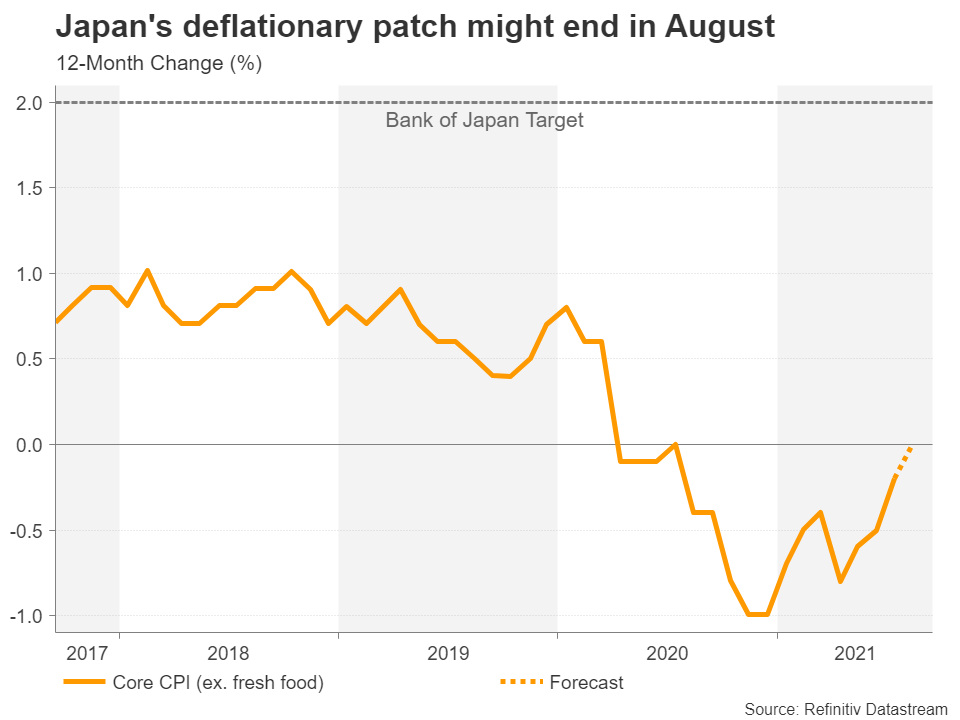
The yen will probably shrug off both the BoJ decision and the CPI data as neither will have any significant bearing on the long-term policy outlook for Japan. However, the LDP leadership vote on September 29 to elect Prime Minister Suga’s replacement might have more of an impact on the yen so that’s another reason for traders to stay on the sidelines next week.
Don’t forget the Nordics
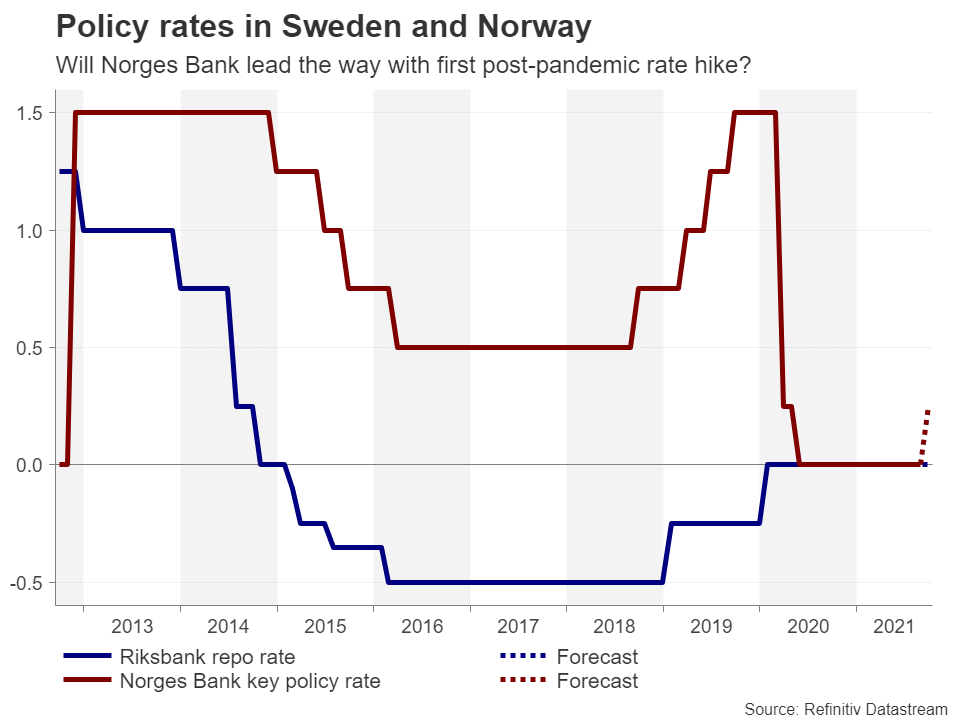
The central bank action may be centered around the FOMC but Sweden’s Riksbank will officially kick off next week’s raft of meetings on Tuesday. The Riksbank will probably hold policy unchanged but following the recent stronger-than-expected pickup in Swedish inflation, policymakers might announce that their QE programme will not be renewed when the current round ends in December. However, the real game changer for the Swedish krona would be if the Riksbank were to bring forward the expected timing of a rate hike.
The Norges Bank, on the other hand, has already signalled that it will likely raise rates on Thursday, becoming the first Western nation to do so in a post-pandemic world. The Norwegian krone has been appreciating against both the US dollar and euro since late summer, but unless the Norges Bank hints at more hikes to come, the immediate gains might be limited.
BoE to likely lay more groundwork for tapering
Finally, the Bank of England will wrap up the central bank activity on Thursday by keeping its policy settings unchanged. However, the odds are high that the Bank will outline more details around its QE exit strategy. So far, the BoE has strongly implied but not outright said that its bond purchases will come to an end in December. However, following some unexpectedly hawkish remarks lately by Governor Andrew Bailey, the Bank could make its intentions known that QE will definitely not be extended after December 31, 2021.
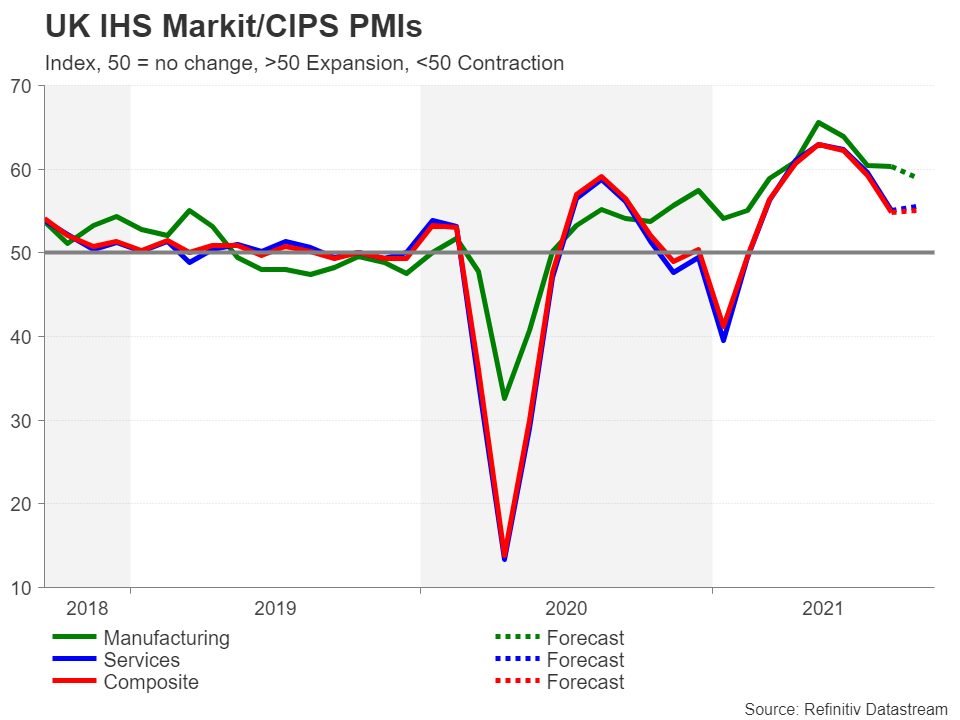
But as far as the rate hike path is concerned, the updated forecasts won’t be available until the November meeting so the pound might not rise much beyond its recent highs on the back of Bailey’s comments. Another risk for sterling next week is Thursday’s flash PMI prints. The UK economy has lost some steam lately as the reopening boost appears to have faded more quickly than anticipated. So if the PMIs disappoint again, the pound could struggle to make any headway against the greenback.
Eurozone PMIs to ease down a notch
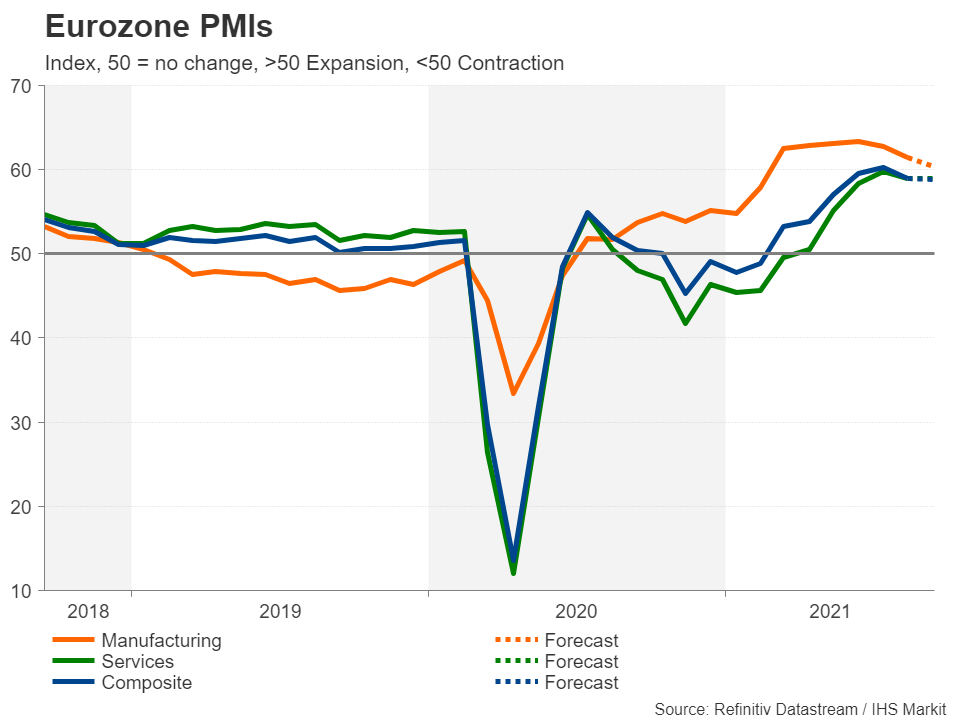
The flash PMIs will also be watched in the euro area as it’s the sole highlight on the European calendar, with the only other important release being Germany’s Ifo business climate gauge on Friday. The Eurozone economy just had a bumper summer thanks to looser virus restrictions and a successful vaccination campaign. But there are fears that the reopening-led growth is peaking just like it has in the US and Britain. Investors will therefore be monitoring Thursday’s flash PMI readings carefully for any signs that slowing growth in other countries and rising inflation across the bloc may be weighing on Eurozone activity.
Should the PMIs dip more than expected in September, the euro’s two-week losing streak could stretch for another week.
Loonie eyes Canadian elections
Canadians are heading to the polls on September 20 after Prime Minister Justin Trudeau called a snap election to capitalize on his government’s popularity for doing a relatively good job in steering the country and the economy through the virus crisis. However, Trudeau’s rating in the opinion polls has since nosedived as voters have questioned his judgement for forcing an early election in the middle of a pandemic. Although his Liberal party has regained some ground in recent days, a win is by no means certain. Should the opposition Conservative Party manage to oust him, either through an outright majority or by forming a coalition, there could be some repercussions in the FX markets.
The Conservatives want to rein in some of the massive spending the Liberals have undertaken in response to the pandemic and this could be seen as holding back growth and ultimately lowering expectations of how many rate hikes would be needed to contain soaring inflation in Canada.
Hence, the election outcome could spark a selloff in the loonie if Trudeau is defeated. Given the focus on the elections, Thursday’s retail sales numbers for July will likely get brushed aside.
Forward Guidance: Canadian Election Week; New Data to Confirm Shifts in Spending
The federal election is the headline event next week. Polling results suggest a tight race between the Conservatives and Liberals with a minority government the most likely outcome. As long as the pandemic remains a major threat, any pullback in government support that might challenge broader economic growth isn’t expected. Indeed, none of the major parties have been pushing for aggressive near term fiscal restraint.
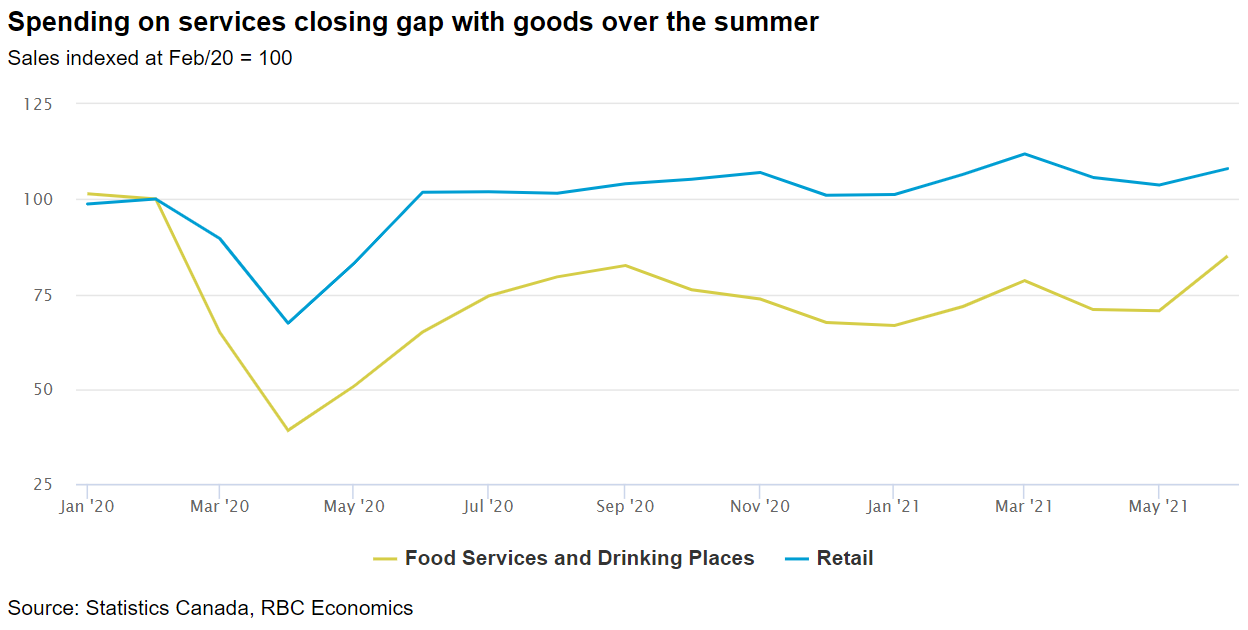
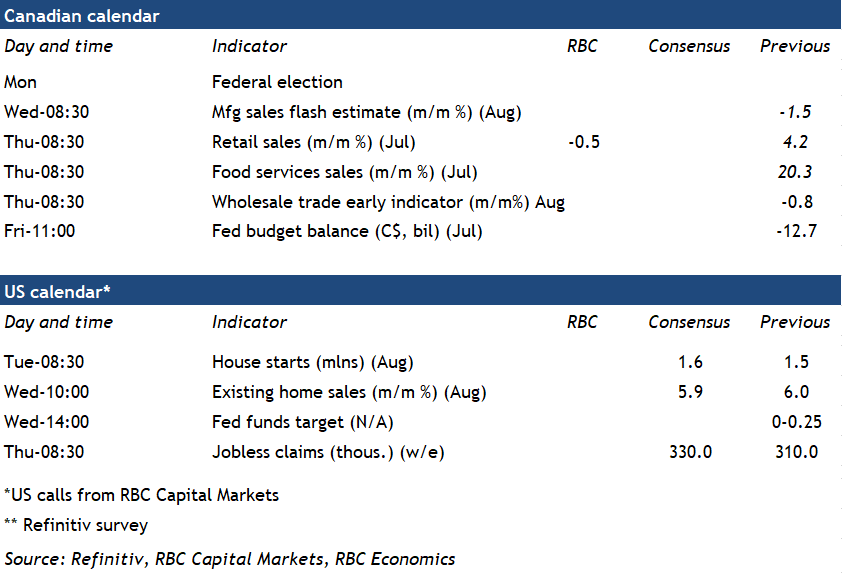
The immediate question for the economy then, is if and when consumers will put their trove of pandemic savings to work. Purchases of retail goods appear to have declined over the summer—reflecting in part supply chain problems that limited the availability of products like motor vehicles. The slip in goods purchasing has also come as households shift spending back to hospitality services that were largely unavailable over the past year. We expect the monthly Canadian retail (merchandise) sales report to show lower sales over July and August. And our own tracking of card transactions points to a large recovery in hotel and restaurant spending over the same period. Next week’s release of the survey of food services and drinking places should further confirm the shift, with another jump in restaurant sales in July expected to build on a 20.3% surge in June. Meantime, the advance manufacturing sales report will likely show another decline in August as producers struggle to obtain inputs. Those pressures will result in higher consumer prices and push up near term inflation readings.
Week ahead data watch:
We expect Canadian retail sales to have declined 0.5% in July—a smaller decrease than Statistics Canada’s preliminary estimate for a 1.7% drop. Our tracking of card spending points to another decline of about 1.5% in August.
The US FOMC may provide more hints on when the pace of asset purchases will be dialed back. That said, the Fed is expected to keep its foot firmly on the accelerator with no increase expected in the fed funds target range until late next year.
Weekly Focus – Fed is in a Difficult Situation amid Rising Stagflation Risks
In China, there is a lot of focus on China's second-largest property group Evergrande, which is facing a default on a big part of its debt. Home sales dropped 20% y/y in August, which have added to the challenges for developers already feeling the heat from tighter regulation last year. The Chinese stock market has been hit hard but so far the financial stress in China has not spread to developed markets. This may change if things turn worse. A lot of focus on whether China announces new stimulus measures soon to offset the rising headwinds to the economy.
Besides that 'stagflation' has become a hot topic among economists and investors due to a combination of clear global slowdown signals and widespread bottlenecks/labour shortages (including still high inflation especially in the US). Our base case is a soft landing but as we believe the stagflation risks are on the rise. Challenges with the delta variant over the winter could prolong freight challenges and hamper labour supply further. A result could be rising wage pressures to levels not seen for a long time and a further increase in inflation expectations. If such a scenario plays out, central banks (in particular the Fed) are likely to tighten policy despite weaker economies. For more details see Research Global: Stagflation risks on the rise, 15 September.
The most important event next week is the FOMC meeting on Wednesday. After the weak jobs report and lower-than-anticipated CPI inflation print this week, we expect the Fed to wait a bit longer before announcing details on tapering. The tapering pace is going to be more important than the exact timing, given the strong signals that tapering is set to begin before the end of the year. We expect the Fed to signal one rate hike next year (up from zero) in the updated projections. For more details see Fed Research - Preview: What to do in a bad trade-off?, 16 September.
In the UK, we do not expect much new from the Bank of England, as it is one of the interim meetings. That said, the combination of high inflation and payroll employment now above pre-covid levels (although total employment remains subdued) means that risks are tilted towards a more hawkish Bank of England. QE is set to end by the end of the year and the question is whether the Bank of England will hike as early as in spring next year. Bank of Japan meets on Wednesday.
Also both the Riksbank and Norges Bank meet next week. Read more in the scandi section.
The German election takes place on Saturday next week. It is a close race and we believe there is an equally likely probability for a 'Jamaica' coalition (40%) led by the CDU/CSU and a 'traffic light' coalition (40%) led by the SPD. Only a major election surprise has the potential to trigger significant market moves, in our view. For more details see German Politics Monitor: The tables are turning left, 9 September.
Next week, preliminary PMIs for the euro area, the US, the UK and Japan are due out on Thursday. We are looking for further signs that we have seen a peak in manufacturing. The subcomponents are likely to show that there are still many bottlenecks globally.
Sunset Market Commentary
Markets
When the ECB starts responding using official statements on financial media news articles, then you know something is going on. It does not happen often and the language used was pretty direct. Let’s circle back for a moment. The Financial Times this morning reported that ECB chief economist Lane during a private meeting with economists said the central bank expects to hit the 2% inflation target soon after the policy horizon (ending in 2023). “Didn’t happen”, the ECB replied in a first reaction. Later, ECB governor de Cos (Spain) and Makhlouf (Ireland) sought to further downplay market speculation by saying that “current conditions don’t allow for a rate hike in 2023”, the FT’s conclusion is “incompatible with ECB guidance” and “fears of excessive inflation are overstated”. Their comments were widely ignored however. Kazaks’ comments, although not the most closely watched ECB governor, caught market’s attention instead. He said that the inflation outlook is likely to be revised higher in December. He sounded cautious on price developments otherwise (eg. he doesn’t see the 2% reached in the medium term), but that didn’t matter to markets. With the inflation genie out of the bottle, European stocks fell abruptly from intraday highs into the red. It doesn’t necessarily mean markets expect rate hikes soon but the inflation talk does add to the idea ultra-easy monetary policy (via PEPP) may be scaled back a little faster than initially thought/suggested by the ECB last week. European stocks bottomed in the meantime and even trade marginally back in the green in early US dealings. WS opens with minor losses, showing more signs that the buy-on-dips pattern is losing momentum. The German yield curve sticks to its bear steepening trend nonetheless. Yields advance 0.9 bps (2y) to 3.1 bps (30y). It’s 10y variant marches on in the upward trend channel, taking out resistance around -0.287%. US yields were flat for most of the day before suddenly jumping as the US started joining. The curve currently shifts north with 2-3 bps increases in tenors from 5-30y with the 10y attacking 1.37% resistance. As a result, EUR/USD lost it’s intraday interest rate differential and has to forfeit earlier gains. The currency pair retreated from today’s high around 1.179 to 1.176 (unch.) at the time of writing. Support lies at 1.1752. USD/JPY tries to cap 110. The yen is under pressure overall due to higher core yields. Disappointing UK August retail sales don’t break sterling’s spirits. After a minor kneejerk uptick this morning, EUR/GBP is trading flat near 0.853. Cable is changing hands in the high 1.378 area. Next week will be important for the USD and GBP with both the Fed and Bank of England having a policy meeting.
News Headlines
Russian Central Bank governor Elvira Nabiullina indicated that the Central Bank still might raise its policy rate further at the upcoming meetings. The Bank last week raised the policy rate from 6.50% to 6.75%, slightly less than some in the market had expected. However, Bank took a bold step by raising the policy rate by 1% in July. Governor Nabiullina indicated that the key rate could only return to its neutral level of 5%-6% once the central bank is confident of a stable slowdown in inflation. Inflation in Russia still printed at 6.7% in August (core 7.1%). Even as the central Bank maintains a tightening bias the central bank governor in another interview indicated that inflation is currently near its peak levels and might start easing in in October. The rubble recently remained well bid with EUR/RUB breaking below the EUR/RUB 85.75 support/previous 2021 low. The pair currently trades near 85.42.
According to a statement from the Spanish Labour Ministry, the Spanish government has agreed to raise the minimum wage for the second time in less than two years. The minimum wage will be raised by €15 per month, which is about 1.6%. The increase is applicable from 1 September. The government intends to raise the minimum wage further. Contrary to the previous increase, the current decision was not backed by industry groups. Economy Minister Calvino resisted earlier calls for such a move. However, the economic recovery, higher inflation and rising employment now created an environment to allow for higher minimum wages.
EUR/USD Mid-Day Outlook
Daily Pivots: (S1) 1.1799; (P) 1.1816; (R1) 1.1832; More...
EUR/USD's fall from 1.1908 is still in progress and intraday bias stays on the downside for retesting 1.1663 low. Break there will resume the fall from 1.2265, as well as the pattern from 1.2348. Next target is 1.1602 key support level. On the upside, above 1.1845 minor resistance will turn bias back to the upside for 1.1908 resistance instead.
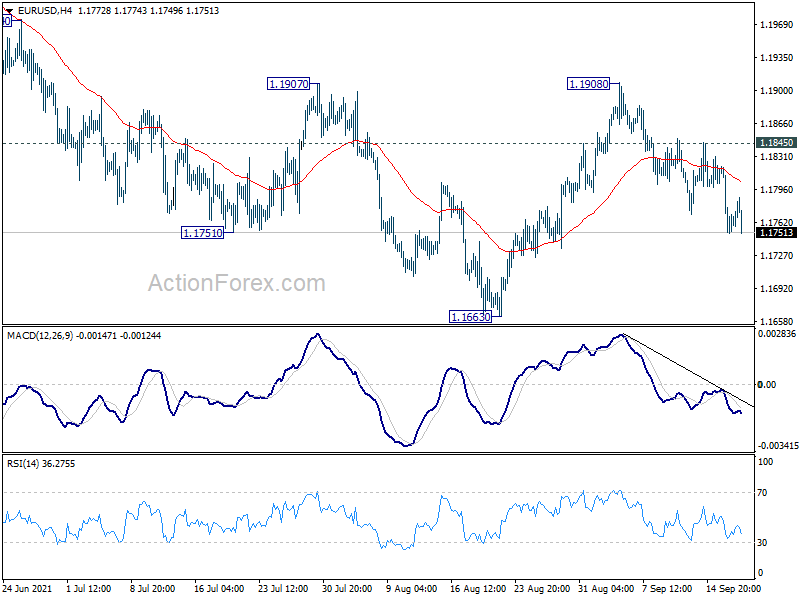
In the bigger picture, rise from 1.0635 is seen as the third leg of the pattern from 1.0339 (2017 low). Further rally remains in favors long as 1.1602 support holds, to cluster resistance at 1.2555 next, (38.2% retracement of 1.6039 to 1.0339 at 1.2516). However sustained break of 1.1602 will argue that the rise from 1.0635 is over, and turn medium term outlook bearish again. Deeper fall would be seen to 61.8% retracement of 1.0635 to 1.2348 at 1.1289 and below.

GBP/USD Mid-Day Outlook
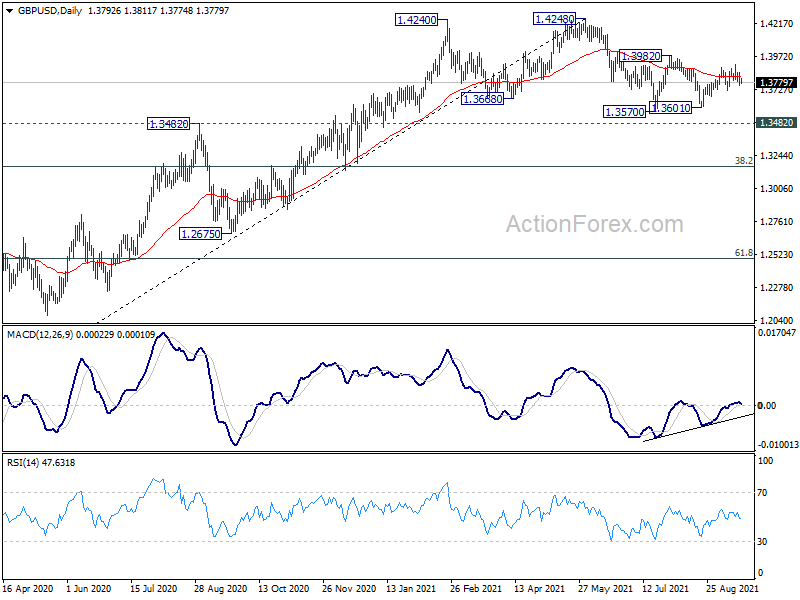
Daily Pivots: (S1) 1.3754; (P) 1.3804; (R1) 1.3842; More...
Intraday bias in GBP/USD remains neutral first. On the upside, break of 1.3912 will target 1.3982 resistance next. Decisive break there will indicate that fall from 1.4248 has completed. Stronger rally would then be seen back to 1.4248 high. On the downside, however, break of 1.3725 support will turn bias back to the downside for retesting 1.3570/3601 support zone instead.
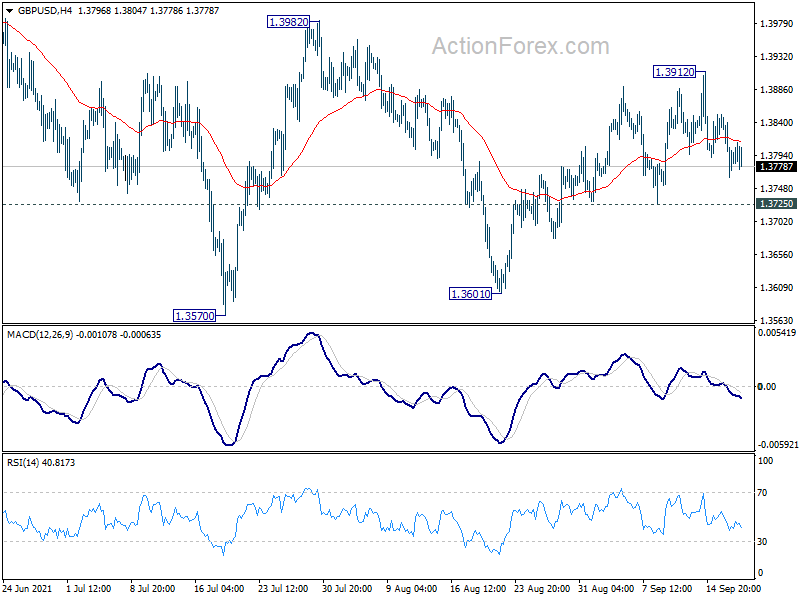
In the bigger picture, as long as 1.3482 resistance turned support holds, we'd still treat price actions from 1.4248 as a corrective move. That is, up trend from 1.1409 (2020 low) is in favor to resume. Decisive break of 1.4376 key resistance (2018 high) would indeed carry long term bullish implications. However, sustained break of 1.3482 will at least bring deeper fall to 38.2% retracement of 1.1409 to 1.4248 at 1.3164, or even further to 61.8% retracement at 1.2493.