Sample Category Title
EUR/USD Seeks Support
The US dollar advanced after the Philadelphia Fed President commented in favor of tapering this year.
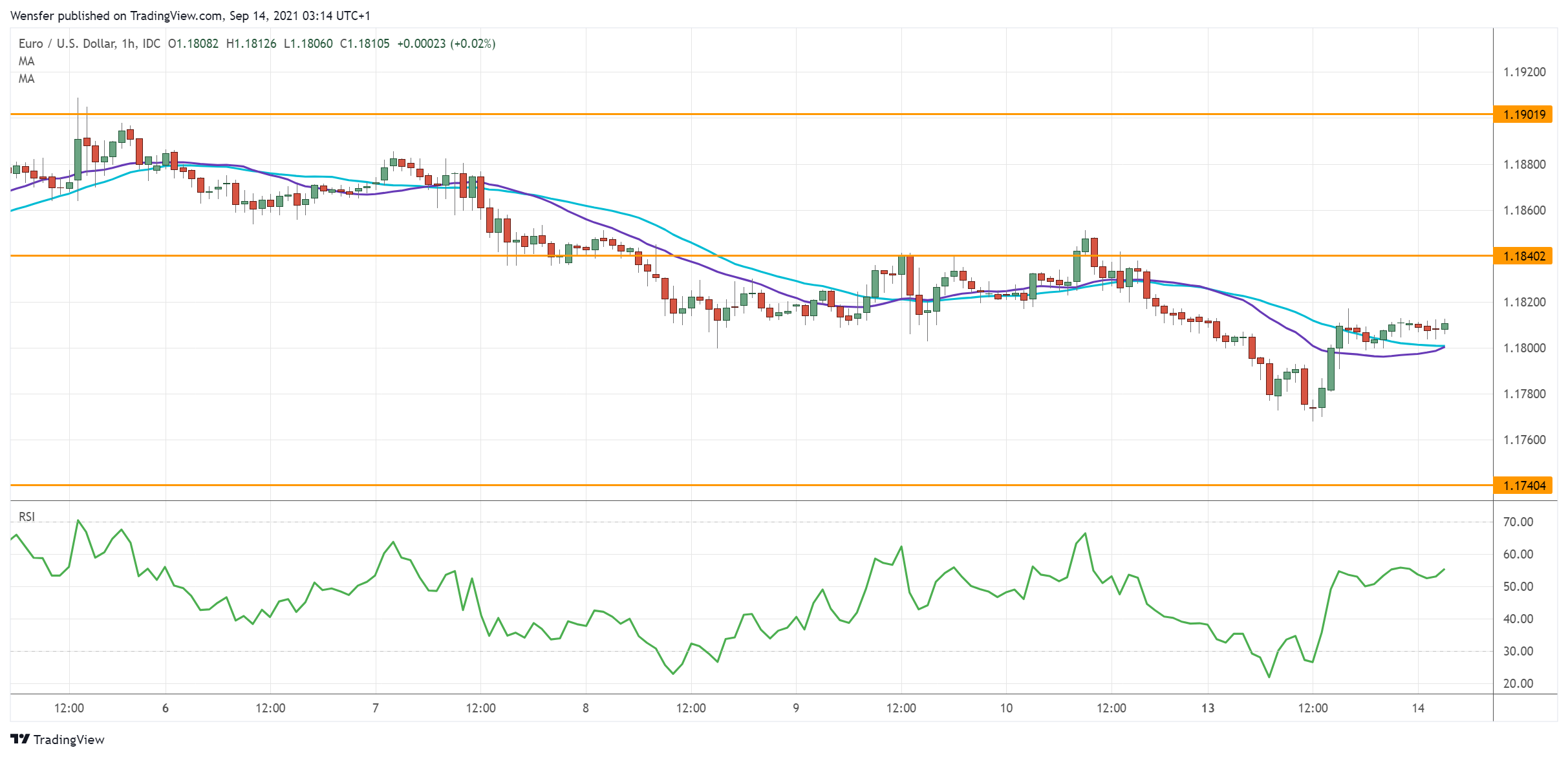
The single currency has not looked back after it turned away from the daily resistance at 1.1920. The bulls’ effort to bid at 1.1800 has been futile.
An oversold RSI has attracted some buying interest, but they will need to clear the fresh hurdle at 1.1840. Then 1.1900 would be the next stop.
Failing that, the rebound could be an opportunity to sell into strength. 1.1740 is a key support in case of an extended pullback.
GBP/JPY Daily Outlook
Daily Pivots: (S1) 152.00; (P) 152.16; (R1) 152.42; More...
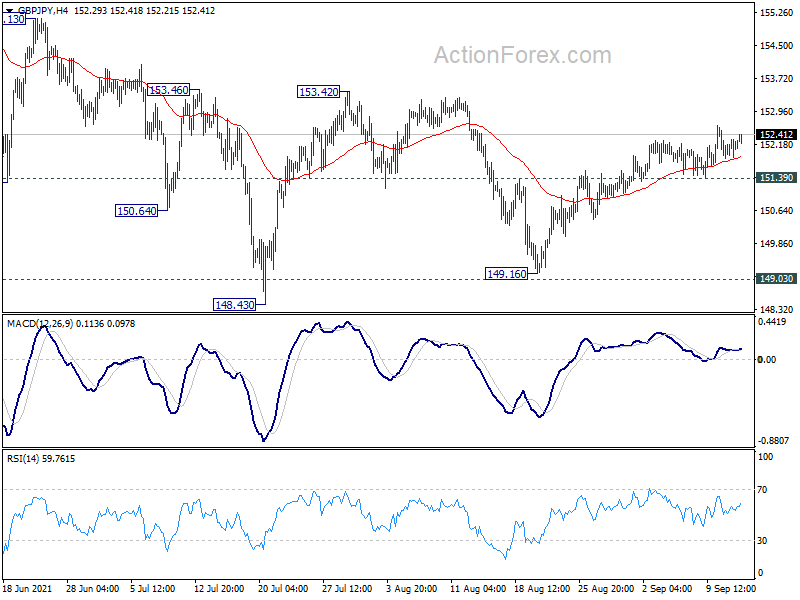
With 151.39 minor support intact, intraday bias in GBP/JPY remains mildly on the upside. Rise from 149.16 would target 153.42 resistance first. Firm break there would indicate that the whole corrective pattern from 156.05 has completed. Further rally would then be see to retest this high. However, break of 151.39 support will argue that rebound from 149.16 has completed, and turn bias back to the downside for retesting this support.
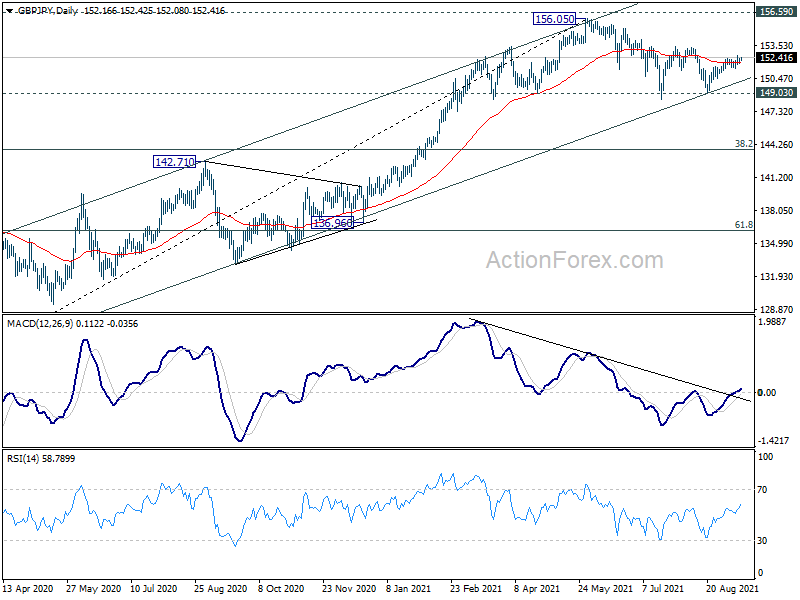
In the bigger picture, rise from 123.94 is seen as the third leg of the pattern from 122.75 (2016 low). As long as 149.03 support holds, such rise would still resume at a later stage. However, sustained break of 149.03 support will indicate rejection by 156.59. Fall from 156.05 would be at least correcting the whole rise from 123.94. Deeper fall would be seen back 38.2% retracement of 123.94 to 156.05 at 143.78 first.
Inflation, Inflation, Inflation
Last week's US producer price data wasn't encouraging, with the factory gate prices accelerating to 8.3% in August from 7.8% printed a month earlier. The strong PPI read hints at the possibility of an unpleasant surprise on the CPI front at today's release, as well.
The consensus of analyst expectations on a Bloomberg survey for the US inflation hints that consumer prices may have slightly fallen from 5.4% to 5.3% in August. Yet, of course, there is always room for a positive surprise in inflation figures as we are not done worrying about the global chip shortage, the slow logistics, firm energy and commodity prices, rising wages, and rising Covid worries.
Of course, rising Covid cases wouldn't be a headache for financial markets, if we weren't feeling the supportive hand of the Fed gently being pulled away due to the rising inflation.
The market should take a breather for a CPI figure softer than the 5.3% expected, but a strong release will likely further dampen the mood, as the bad news on inflation front won't boost the Federal Reserve (Fed) doves, as high inflation is the major reason why the Fed can't keep doing what it does: throwing cheap liquidity into the market.
The market mood wasn't so bad on Monday. European indices traded in the positive, Dow Jones gained 0.29% as energy stocks led gains on US crude advancing past the $70pb mark. As such, the price of a barrel just broke above its two-month downtrending channel top, as a sign of a bullish reversal in energy prices on US supply concerns following the Hurricane Ida hit. But, the major driver of oil prices is a short-term factor, and the bulls may not last long due to various other concerns, such as a new delta outbreak in China that has been recently discovered. Still, I revise short-term view to neutral from bearish, and keep an eye on the evolution of US inventories this week.
Else, the S&P500 closed last week below the 4500 mark and could continue falling toward its 50-dma (4425) in the coming sessions. Testing the 50-dma isn't a big deal for the S&P500, as it has regularly tested this metric and rebounded higher to claim new records. That means that, so far, the price retreats below the 50-dma only served as an opportunity of buying the dip. However, prospects of rising inflation and tighter Fed policy could further weigh on the risk appetite and let the S&P500 slip below the 50-dma this time.
But gold may not be the perfect hedge against an eventual market turmoil. Although the rising inflation is positive for gold, the positive pressure in the US yields will also rise the opportunity cost of holding the non-interest-bearing gold and limit the upside potential of the yellow metal above the $1800 per oz.
In the UK, the inflation data due Wednesday is expected to reveal a surge in British consumer prices to 2.9% from 2% printed a month earlier. Rising inflation can only revive the Bank of England (BoE) hawks, after Governor Bailey hinted that the ‘growth is plateauing and the minimum criteria for a tighter UK policy is now met'. The pound sterling has broken above its downtrending channel top building since June against the US dollar and could well claim another advance toward the 1.40 on the back of the hawkish shift in BoE expectations. So, the FTSE 100 will continue swinging between firming energy, commodity prices and stronger pound.
RBA Pushes Review Of Taper To February
General trend
- Markets remain mixed today with a light data session. Tomorrow will receive the remainder of China’s August data, which is expected to show continued slowdown.
- Hurricane Nicholas making landfall in Texas and Louisiana Gulf Coast, expected to impact LNG movement and some oil operations in the region and could hit some areas still recovering from Ida. Shell announced they were moving workers out of some locations.
- China Evergrande warns of deteriorating conditions and warns of pressures on cash flows and liquidity, also not seeing much progress in attempts to sell some assets to improve position.
- RBA Gov Lowe warned that Q3 GDP could be -2% or worse, but expects recovery and growth to start in Q4 and continue into 2022. Also pushing back taper review to Feb, as Delta variant is delaying recovery. Still does not expect conditions for a rate hike to be met until 2024.
- China continues to contain Delta outbreaks. Locks down city of Xiamen. Analysts as of now don’t think the pockets of virus will impact Macau too much.
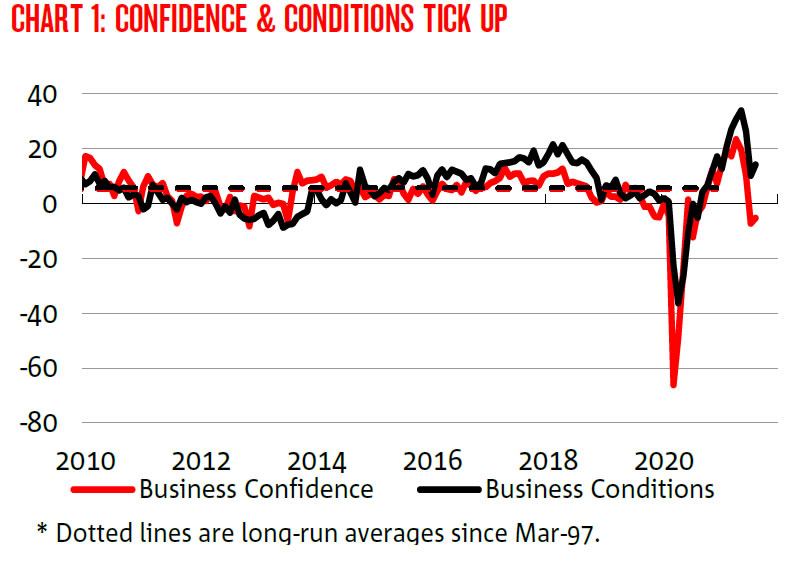
- Business confidence in Australia improves despite extended lockdowns.
Headlines/Economic Data
Australia/New Zealand
- ASX 200 opened 0.0%.
- (AU) Reserve Bank of Australia (RBA) Gov Lowe: Q3 GDP likely down 'at least' 2%, could be significantly lower; Delay in taper review to Feb due to delayed recovery, Likely to stop bond buying in 2022 - Delta, the Economy and Monetary Policy.
- (AU) RBA Assist Gov (Economic) Ellis and Head of Economics Jones: Should make it harder for people to own a house in Australia, rather than increasing supply - Appearance before the Standing Committee on Tax and Revenue.
- (AU) AUSTRALIA Q2 HOUSE PRICE INDEX Q/Q: 6.7% V 6.1%E; Y/Y: 16.8% V 7.5% PRIOR.
- (AU) Australia Aug NAB Business Confidence: -5 v -7 prior; Conditions: 14 v 10 prior.
- (NZ) New Zealand Aug REINZ House Sales Y/Y: -26.5% v -11.7% prior.
- WBC.AU Updates on sale of Pacific Businesses: Papua New Guinea regulator denies sale of Westpac Fiji 89.9% stake in Westpac Bank PNG to Kina Securities.
- (AU) Australia sells A$100M v A$100M indicated in 2030 indexed bonds, avg yield -0.84% v -0.9102% prior; bid to cover 4.04x v 4.27x prior.
Japan
- Nikkei 225 opened +0.5%.
- (JP) Japan Min Koizumi reportedly will support Kono in the LDP leadership election; Ishiba will not run for PM - Japanese press.
- 7974.JP Cuts Switch price in EU 9% due to FX – Nikkei.
- (JP) Japan Chief Cabinet Sec Kato: making arrangements for PM Suga to attend the quad meeting and visit to the US.
- (JP) Japan Fin Min Aso: For economy to grow, more consumer spending is needed; If corporations do not raise worker income, GDP won't grow, need to ease virus restrictions when and however possible.
Korea
- Kospi opened +0.3%.
- (KR) South Korea Aug Export Price Index Y/Y: 18.6% v 16.9% prior; Import Price Index Y/Y: 21.6% v 19.2% prior.
- (KR) US and South Korea Trade Mins have spoken on supply chain resiliency including chip market.
- 039130.KR Talk that employees on leave since last year will return to work in Oct, on an expected resumption of overseas trips - Korean press.
China/Hong Kong
- Hang Seng opened +0.1%; Shanghai Composite opened -0.2%.
- (CN) China Sec Daily: China PBoC May roll over MLF or lower than amount that is due in Sept.
- 3333.HK Expects continuing significant decline in contract sales in Sept.
- (CN) China PBOC sets Yuan reference rate: 6.4500 v 6.4497 prior.
- (CN) China PBOC Open Market Operation (OMO): Injects CNY10B in 7-day reverse repos v CNY10B in 7-day reverse repos prior; Net CNY0B v Net drain CNY0B prior.
Other
- (TW) Taiwan Central Bank is conducting special investigations into certain banks in loans of real estate sector over rules of credit control and property market overheating - Commercial times.
- DBS.SG Expect crypto trading platform to grow 20-30%/yr for the next 3 years - press.
North America
- HLF Cuts Q3 and FY21 guidance on 'lower than expected levels of activity amongst its independent distributors'; Guides Q3 Rev +14-18% vs Q3'19; Guides FY21 Rev +19-23% vs FY19.
- ORCL Reports Q1 $1.03 v $0.97e, Rev $9.73B v $9.77Be; Guides Q2 Non-GAAP EPS $1.09-1.13 ($1.09-1.13 cc) v $1.10e, Rev +3-5% (+3-5% cc) v +4.1%e - earnings call.
- INTU To acquire Mailchimp for ~$12B in cash and shares.
Europe
- (UK) Brexit negotiator Frost: EU should take UK's warning over Northern Ireland protocol seriously; There must be a real negotiation with EU over Northern Ireland.
Levels as of 01:15ET
- Hang Seng -0.4%; Shanghai Composite -0.6%; Kospi +0.8%; Nikkei225 +0.9%; ASX 200 -0.1%.
- Equity Futures: S&P500 +0.2%; Nasdaq100 +0.2%, Dax -0.0%; FTSE100 +0.1%.
- EUR 1.1814-1.1805; JPY 110.08-109.96; AUD 0.7373-0.7358; NZD 0.7129-0.7111.
- Commodity Futures: Gold -0.1% at $1,792/oz; Crude Oil +0.5% at $70.78/brl; Copper -0.2% at $4.36/lb.
EURGBP Forms Bearish Flag Ahead Of UK Jobs Data
US stocks wavered on Monday after House Democrats unveiled their tax proposals and as some Wall Street analysts predicted that stocks will retreat in the fourth quarter. The Dow Jones rose by more than 100 points while the S&P 500 and Nasdaq 100 indices tilted lower. In a report, Democrats said that they intend to raise corporate taxes from 21% to 26.5%. They also plan to boost capital gains taxes and increase taxes for the wealthy. They plan to use the additional tax collections to fund a $3.5 trillion anti-poverty plan. Still, the new plan will need to pass both the House and the Senate, where they hold majorities. At the same time, analysts at key banks like Deutsche Bank, Morgan Stanley, and Bank of America believes that stocks are due for a correction.
The British pound wavered against key currencies as traders waited for the upcoming UK employment numbers. The data, which will come in the morning session is expected to show that the country’s unemployment rate declined from 4.7% to 4.6% as the country reopened. The country’s labour market has been relatively stable than in other countries because of the furlough program that has more than 1.3 million members. However, this situation will likely change as the government moves to wind down the program. The pound is also wavering ahead of the key inflation numbers scheduled for Tuesday morning. Also, investors are reacting to the recent tax increase by Boris Johnson.
The US dollar index held steady in the overnight session as investors wait for the key American inflation data. The data, which will come out later today, is expected to show that the country’s headline inflation declined from 5.4% in July to 5.3% in August. Similarly, the core CPI is expected to fall to 4.2%. The data will come a few days after the US published relatively strong PPI data. With commodity prices and wages rising, there is a likelihood that prices will remain high for a while. Other key data scheduled for today are the IEA monthly report, Swedish CPI, and Canada’s manufacturing sales.
XAUUSD
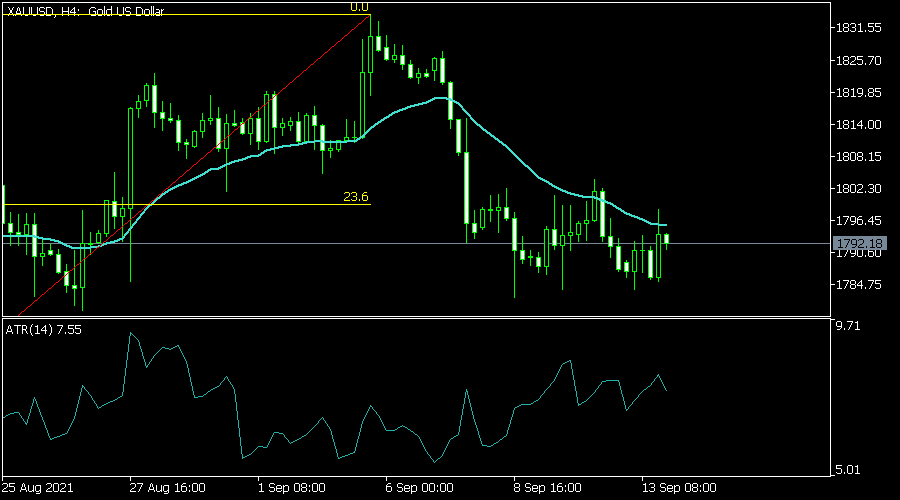
The XAUUSD pair is trading at 1,790 ahead of the latest American inflation data. This price is significantly lower than this month’s high of 1,833. On the four-hour chart, the price is slightly below the 23.6% Fibonacci retracement level. It has also formed a bearish flag and head and shoulders patterns. Therefore, the pair will likely break out lower as bears target the 38.2% retracement level at 1,777.
EURUSD
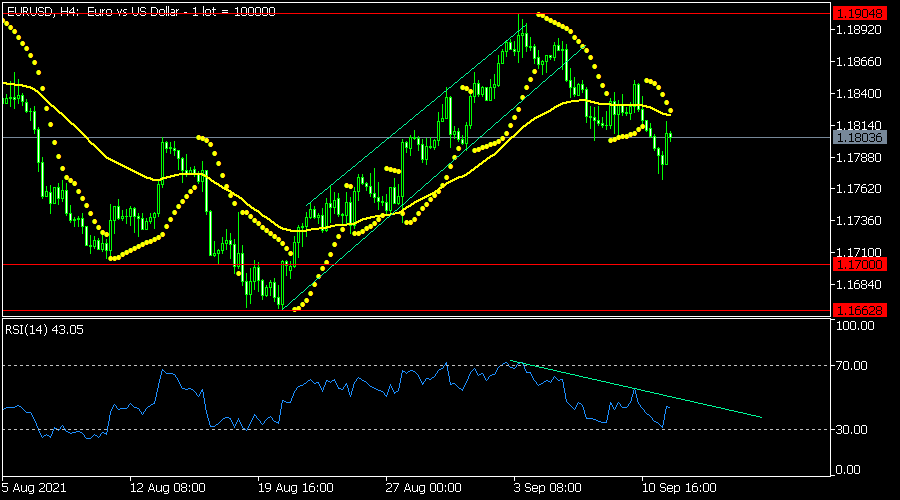
The EURUSD pair rose to 1.1800, which was slightly above Monday’s low of 1.1770. On the four-hour chart, the price is below the Parabolic SAR and is below the 25-day moving average. The Relative Strength Index (RSI) has formed a bearish divergence pattern. It has also formed a small head and shoulders pattern. Therefore, the pair will likely maintain a bearish trend as bears target the key level at 1.1700.
EURGBP
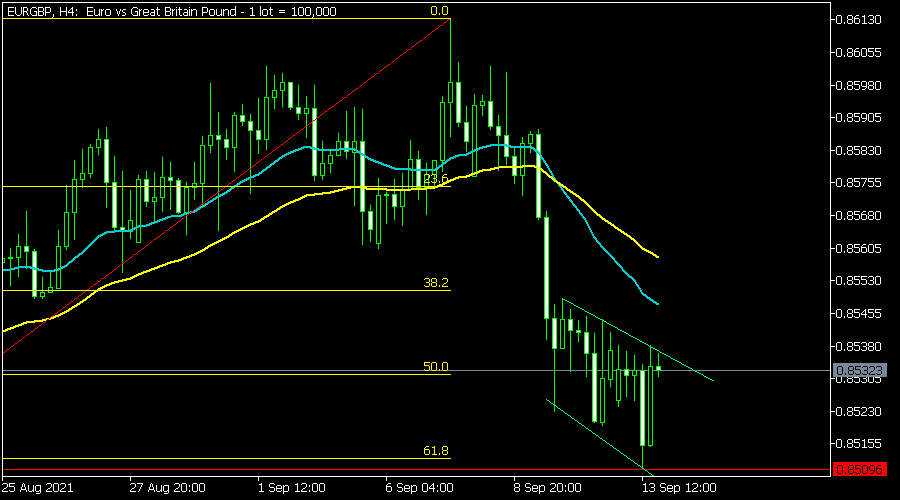
The EURGBP pair wavered during the overnight session ahead of the latest UK jobs data. The pair is trading at 0.8532, which is slightly above last week’s low of 0.8510. On the four-hour chart, the pair moved to the 50% Fibonacci retracement level. It also moved below the 25-day and 50-day moving averages. It has also formed a bearish flag pattern. Therefore, the pair will likely break out lower this week.
Inflation Pricing Continues To Be In Focus
Market movers today
- Focus today turns to inflation with US and Sweden releasing CPI.
- On the US CPI, we think there are two things to look out for. The first one is whether the monthly increases in CPI core remain high. The other is whether high price increases spread to more categories than e.g. cars, which would signal that inflation is broadening and could become more persistent.
- US also releases NFIB small business optimism index, which contains an index on labour shortage and wage compensation plans that are worth keeping an eye on. They have both increased to very high levels over the past months.
- On Swedish CPI we are in line with the Riksbank's forecast but would highlight high uncertainty on the outcome.
The 60 second overview
Euro Area inflation expectation: The inflation pricing continues to be in focus. From the early European trading session yesterday, 5y5y inflation swaps touch new multi-year high at 1.82%, but was later reversed to end broadly unchanged on the day around 1.79%. Last time such levels were reached was in 2014, prior to ECB starting QE. While fundamentally we remain unconvinced that inflation pricing will stay elevated in 2022, we do not want to fade the recent rally from a risk-reward perspective as the momentum is rather strong. ECB's Schnabel gave a strong speech clearly outlining that she is in the 'transitory inflation narrative' camp, however she did also address certain upside risks that warranted special attention. She stressed 'A premature monetary policy tightening in response to a temporary rise in inflation would choke the recovery and be most harmful to those who are already suffering from the current spike in inflation.'
Freight rates: Freight rates continue to rise to new highs. In Shanghai, some container port operations are halted as the Typhoon Chantu approaches the city. Ningbo port, China's second-biggest container transporting hub after Shanghai, had suspended operations since Sunday noon. The port just resumed from a weeks-long port congestion, following typhoon In-Fa in late-July and a COVID-19-related terminal closure in mid-August.
US labour market: Given how much weight the Fed puts on employment, it is crucial to monitor the labour market to get an idea of what the Fed is going to do over the next years. The weak jobs report for August was a disappointment and we have dived into several labour market indicators to get an idea of what is going on in the US labour market. In our view, it is difficult to solve the mismatch problems within manufacturing near-term (where it is hard to find qualified workers) but the fact that the temporarily higher unemployment benefits have now expired, we think some of the bottlenecks in "leisure and hospitality" will ease in coming months. For more details see US Labour Market Monitor: Weak jobs report - noise or a signal of something else?, 13 September.
Norwegian election: In Norway, the preliminary (88 % of votes counted) results clearly suggest a change of government as expected. The Labour party will regain the power with the support of the Centrists Political Part and the Social Lefts Party, with 88 of 169 mandates. We expect no market reaction.
Equities: Equities started the week on a higher note, lifted by energy and financials. Value outperformed growth and small cap outperformed large cap as tech and health care sold off. The risk on mode yesterday took VIX back down below 20. In the US, Dow +0.8%, S&P 500 +0.2%, Nasdaq -0.1% and Russell 2000 +0.6%. The positive tone continuing this morning with most Asian market higher and the same goes for European and US futures.
FI: It was a slow start to the week with focus on the new 7y NGEU issuance that was announced in the morning in what is to be expected to today's business. It will come on top of an already issuance-heavy day with 30y Dutch tap as well as 2y German and Italian supply in the 3y, 7y and 30y segments (up to 2bn of 0% 2024, up to 2bn of 0.5% 2028 and up to 1.75bn of 1.7% 2051). While this week is significantly net cash negative, we still expect to see solid demand across the jurisdictions. EGBs ended virtually unchanged with some outperformance in Greece and Italy.
FX: As expected, EUR/USD continues to move largely in line with global equities and relatives such as US vs Europe, or value versus growth. Though there are a few noticeable releases this week, we largely expect the very high correlation between EUR/USD and equities to persist as the market narrative will be largely unchanged up until the FOMC meeting next week.
Credit: Credit markets sold off slightly yesterday, where iTraxx Xover widened 0.5bp (closing in 227.8bp) and Main closed in 44.8bp (0.1bp wider). HY bonds widened 1bp and IG bonds were unchanged.
Nordic macro
Focus in Sweden is on the August inflation outcome which in our view is highly uncertain due to erratic price behaviour for foreign airline tickets and charter packages. August inflation in Denmark and Norway seems to suggest a slight downside vs our forecast when looking at food, restaurant and clothing prices. We look for a CPIF ex. Energy print that is spot on Riksbank's forecast which, however, is 0.2 p.p. lower than the market consensus.
We expect Norges Bank's regional survey to signal a slowdown in Q3. The reason, quite simply, is that the greatest boost from the lifting of restrictions and increase in mobility has already materialised. This was reflected in the aggregated output index climbing in the previous survey from 0.92 to 1.88, equivalent to annualised growth of 3.75%. We therefore expect the output index to drop to somewhere between 1.25 and 1.50 this time around, indicating annualised growth of 2.5-3.0% over the next two quarters. It is important to stress that such a slowdown would be in line with the projections in Norges Bank's June monetary policy report and so have no impact on the interest rate decision next week.
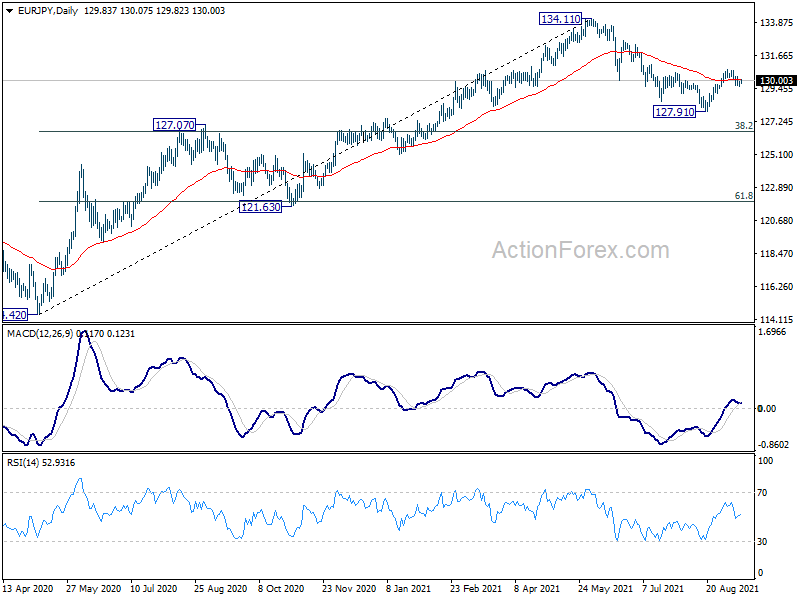
EUR/JPY Daily Outlook
Daily Pivots: (S1) 129.68; (P) 129.84; (R1) 130.08; More....
EUR/JPY recovers after touching 129.57 minor support but stays well below 130.73. Intraday bias remains neutral first. On the upside, break of 130.73 will resume the rebound from 127.91 low. That would also reaffirm the case that correction from 134.11 has completed at 127.91. Intraday bias will be turned to the upside for 132.68 resistance next. However, firm break of 129.57 will argue that the rebound has completed, and turn bias back to the downside for retesting 127.91 low.
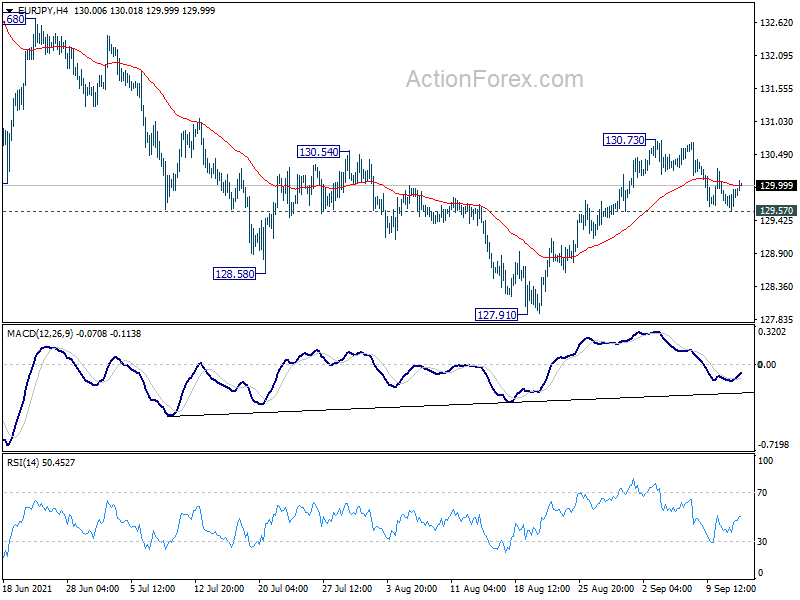
In the bigger picture, rise from 114.42 is seen as a medium term rising leg inside a long term sideway pattern. As long as 127.07 resistance turned support holds, further rise is still expected to retest 137.49 (2018 high). However, firm break of 127.07 will argue that the medium term trend has reversed, deeper fall would be seen to 61.8% retracement of 114.42 to 134.11 at 121.94.
Euro Strengthening Mildly While Dollar Awaits CPI
Overall market sentiment is mildly positive with the strong rebound in DOW overnight, followed by slight gain in Nikkei. European majors are having a small edge over the others but Swiss Franc is still clearly lagging behind. Australia Dollar is leading commodity currencies lower for now, after some cautious comments from RBA Governor. Dollar is mixed and awaiting CPI data from the US for some inspirations.
Technically, EUR/CHF is now eye 1.0899 resistance and break will resume the rebound from 1.0694. EUR/JPY is also recovery after drawing support from 129.57 support. Stronger could be seen back to retest 130.73 temporary top. EUR/USD also lost some downside momentum. While deeper fall could be seen as long as 1.1850 minor resistance holds. Break of this resistance will put focus back to last week's high at 1.1908. We'll see if Euro could stage a rally from here.
In Asia, at the time of writing, Nikkei is up 0.48%. Hong Kong HSI is down -0.05%. China Shanghai SSE is up 0.05%. Singapore Strait Times is up 0.48%. Japan 10-year JGB yield is up 0.0045 to 0.051. Overnight, DOW rose 0.76%. S&P 500 rose 0.23%. NASDAQ dropped -0.07%. 10-year yield dropped -0.017 to 1.324.
RBA Lowe explains tapering asset purchases while extending the program
In a speech, RBA Governor Philip Lowe said, "n the economy, our central message is that the Delta outbreak has delayed – but not derailed – the recovery of the Australian economy". While the outbreak is a "significant setback", there is a "clear path out of the current difficulties".
Lowe provided some explanations to the decision to taper weekly asset purchases to AUD 4B, but extend the program till February next year. Firstly, give the delay in recovery, "we considered it appropriate that we delay any consideration of a further taper in our bond purchases until next year." Continuing the with purchases will also "provide some additional insurance against downside scenarios."
Secondly, fiscal policy is considered the "more effective policy instrument in responding to the Delta outbreak." Public balance sheet can be used to "offset the hit to private incomes during the lockdown". But monetary policy "works mainly on the demand side and the effects on income are felt with a lag".
Thirdly, "by continuing to purchase government bonds at the rate of $4 billion a week we will be adding to the support provided to the economy during the recovery phase."
Lowe also reiterated that the condition for lifting interest rate will "not be met before 2024". A "tighter labor market" is needed to meet the condition, with wages growing by "at least 3 per cent", comparing to the 1.7% yoy rate in Q2.
Australia NAB business confidence rose to -5, resilience and well positioned to rebound
Australia NAB business confidence rose slightly from -7 to -5 in August. Business conditions improved from 10 to 14. Looking at some details, trading condition rose from 12 to 19. Profitability condition rose from 5 to 15. Employment condition, however, dropped from 11 to 9.
NAB said, "while the sustained lockdowns now in place will cause a large hit to activity in the quarter, the resilience seen in the August survey results suggest that the supports in place, and lingering momentum from earlier in the year, are continuing to support the economy".
"There are also signs that progress on the vaccine rollout and growing certainty that lockdowns will end in coming months are providing a reason for optimism. The economy remains well positioned to rebound once restrictions are eased."
Also released, Australia house price index rose 6.7% qoq in Q2, above expectation of 6.2% qoq.
Looking ahead
UK job data is a major focus in European session while Swiss will release PPL. Later in the day, Canada manufacturing sales will be released, but main event is US CPI.
EUR/JPY Daily Outlook
Daily Pivots: (S1) 129.68; (P) 129.84; (R1) 130.08; More....
EUR/JPY recovers after touching 129.57 minor support but stays well below 130.73. Intraday bias remains neutral first. On the upside, break of 130.73 will resume the rebound from 127.91 low. That would also reaffirm the case that correction from 134.11 has completed at 127.91. Intraday bias will be turned to the upside for 132.68 resistance next. However, firm break of 129.57 will argue that the rebound has completed, and turn bias back to the downside for retesting 127.91 low.
In the bigger picture, rise from 114.42 is seen as a medium term rising leg inside a long term sideway pattern. As long as 127.07 resistance turned support holds, further rise is still expected to retest 137.49 (2018 high). However, firm break of 127.07 will argue that the medium term trend has reversed, deeper fall would be seen to 61.8% retracement of 114.42 to 134.11 at 121.94.
Economic Indicators Update
| GMT | Ccy | Events | Actual | Forecast | Previous | Revised |
|---|---|---|---|---|---|---|
| 01:30 | AUD | House Price Index Q/Q Q2 | 6.70% | 6.20% | 5.40% | |
| 01:30 | AUD | NAB Business Confidence Aug | -5 | -8 | -7 | |
| 01:30 | AUD | NAB Business Conditions Aug | 14 | 11 | 10 | |
| 04:30 | JPY | Industrial Production M/M Jul F | -1.50% | -1.50% | -1.50% | |
| 06:00 | GBP | Claimant Count Change Aug | -71.7K | -7.8K | ||
| 06:00 | GBP | ILO Unemployment Rate (3M) Jul | 4.60% | 4.70% | ||
| 06:00 | GBP | Average Earnings Including Bonus 3M/Y Jul | 8.60% | 8.80% | ||
| 06:00 | GBP | Average Earnings Excluding Bonus 3M/Y Jul | 7.30% | 7.40% | ||
| 06:30 | CHF | Producer and Import Prices M/M Aug | 0.20% | 0.50% | ||
| 06:30 | CHF | Producer and Import Prices Y/Y Aug | 3.30% | |||
| 10:00 | USD | NFIB Business Optimism Index Aug | 99 | 99.7 | ||
| 12:30 | CAD | Manufacturing Sales M/M Jul | -1.00% | 2.10% | ||
| 12:30 | USD | CPI M/M Aug | 0.40% | 0.50% | ||
| 12:30 | USD | CPI Y/Y Aug | 5.30% | 5.40% | ||
| 12:30 | USD | CPI Core M/M Aug | 0.30% | 0.30% | ||
| 12:30 | USD | CPI Core Y/Y Aug | 4.20% | 4.30% |
RBA Lowe explains tapering asset purchases while extending the program
In a speech, RBA Governor Philip Lowe said, "n the economy, our central message is that the Delta outbreak has delayed – but not derailed – the recovery of the Australian economy". While the outbreak is a "significant setback", there is a "clear path out of the current difficulties".
Lowe provided some explanations to the decision to taper weekly asset purchases to AUD 4B, but extend the program till February next year. Firstly, give the delay in recovery, "we considered it appropriate that we delay any consideration of a further taper in our bond purchases until next year." Continuing the with purchases will also "provide some additional insurance against downside scenarios."
Secondly, fiscal policy is considered the "more effective policy instrument in responding to the Delta outbreak." Public balance sheet can be used to "offset the hit to private incomes during the lockdown". But monetary policy "works mainly on the demand side and the effects on income are felt with a lag".
Thirdly, "by continuing to purchase government bonds at the rate of $4 billion a week we will be adding to the support provided to the economy during the recovery phase."
Lowe also reiterated that the condition for lifting interest rate will "not be met before 2024". A "tighter labor market" is needed to meet the condition, with wages growing by "at least 3 per cent", comparing to the 1.7% yoy rate in Q2.
Australia NAB business confidence rose to -5, resilience and well positioned to rebound
Australia NAB business confidence rose slightly from -7 to -5 in August. Business conditions improved from 10 to 14. Looking at some details, trading condition rose from 12 to 19. Profitability condition rose from 5 to 15. Employment condition, however, dropped from 11 to 9.
NAB said, "while the sustained lockdowns now in place will cause a large hit to activity in the quarter, the resilience seen in the August survey results suggest that the supports in place, and lingering momentum from earlier in the year, are continuing to support the economy".
"There are also signs that progress on the vaccine rollout and growing certainty that lockdowns will end in coming months are providing a reason for optimism. The economy remains well positioned to rebound once restrictions are eased."