Sample Category Title
GBP/USD Mid-Day Outlook
Daily Pivots: (S1) 1.3809; (P) 1.3849; (R1) 1.3871; More...
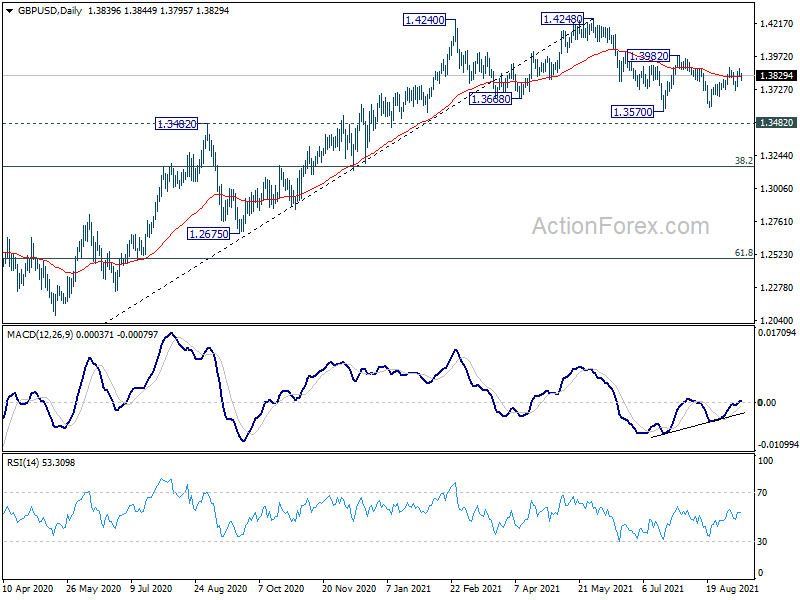
Intraday bias in GBP/USD remains neutral as it's staying in range below 1.3890. On the upside, above 1.3890 will resume the rise from 1.3601 for 1.3982 resistance. Decisive break there will indicate that fall from 1.4248 has completed. On the downside, however, break of 1.3725 support will turn bias back to the downside for retesting 1.3570/3601 support zone instead.
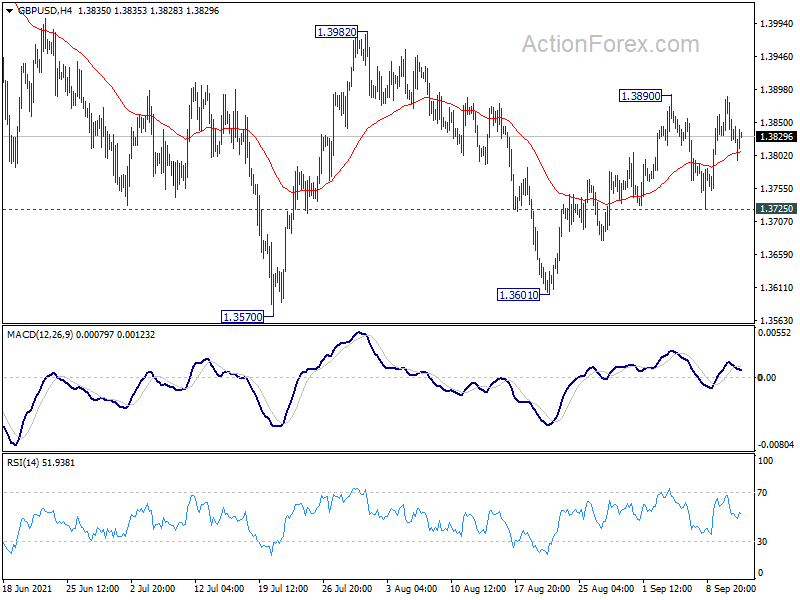
In the bigger picture, as long as 1.3482 resistance turned support holds, we'd still treat price actions from 1.4248 as a corrective move. That is, up trend from 1.1409 (2020 low) is in favor to resume. Decisive break of 1.4376 key resistance (2018 high) would indeed carry long term bullish implications. However, sustained break of 1.3482 will at least bring deeper fall to 38.2% retracement of 1.1409 to 1.4248 at 1.3164, or even further to 61.8% retracement at 1.2493.
USD/JPY Mid-Day Outlook
Daily Pivots: (S1) 109.47; (P) 109.87; (R1) 110.03; More...
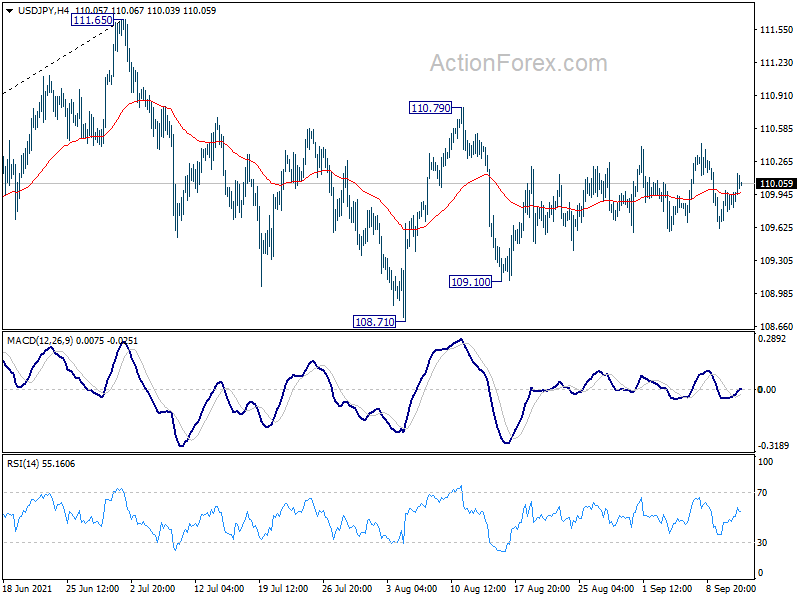
Intraday bias in USD/JPY stays neutral at this point as sideway trading continues. On the upside, break of 110.79 will resume the rebound from 108.71 to retest 111.65 high. On the downside, break of 109.10 will target 108.71 support first. Firm break there will resume the decline from 111.65 and target 38.2% retracement of 102.58 to 111.65 at 108.18 next.
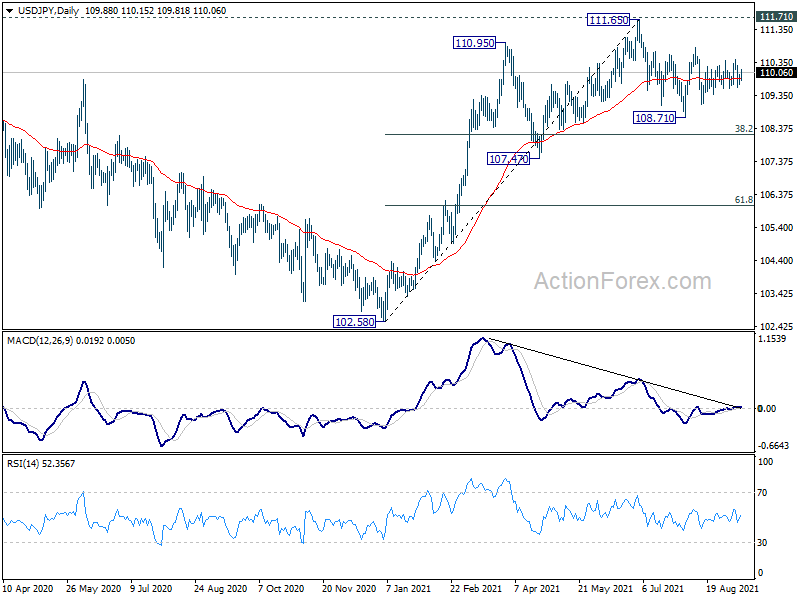
In the bigger picture, medium term outlook is staying neutral with 111.71 resistance intact. The pattern from 101.18 could still extend with another falling leg. Sustained trading below 55 day EMA will bring deeper fall to 107.47 support and below. Nevertheless, strong break of 111.71 resistance will confirm completion of the corrective decline from 118.65 (2016 high). Further rise should then be seen to 114.54 and then 118.65 resistance.
USD/CHF Mid-Day Outlook
Daily Pivots: (S1) 0.9160; (P) 0.9172; (R1) 0.9195; More....
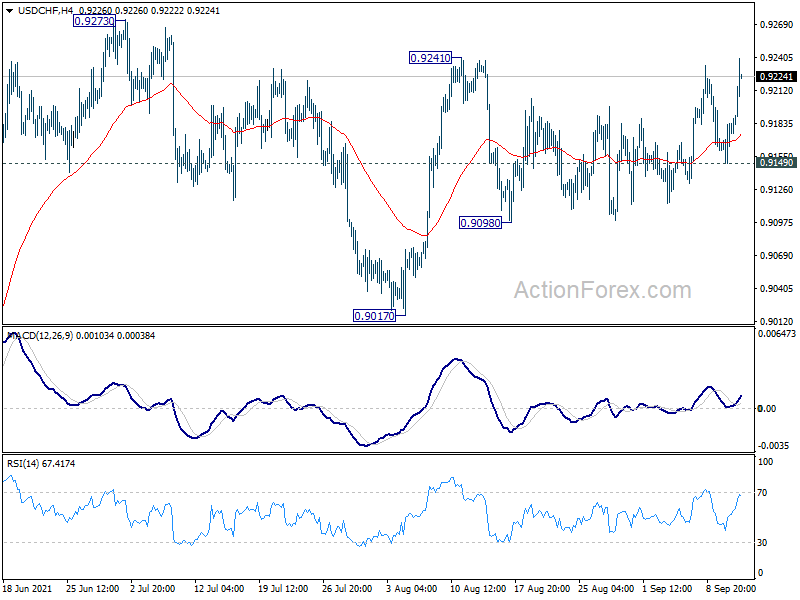
USD/CHF's breach of 0.9017 suggests resumption of rise from 0.9017. Intraday bias is back on the upside for 0.9273 resistance first. Firm break there will solidify near term bluishness for 0.9471 resistance next. However, break of 0.9149 support will turn focus back to 0.908 support instead.
In the bigger picture, USD/CHF is still struggling around 55 week EMA (now at 0.9178) and outlook is mixed for now. Confirmed rejection by the 55 week EMA will retain medium term bearishness. That is, larger fall from 1.0342 would resume through 0.8756 low at a later stage. However, sustained trading above 55 week EMA will tilt favor to the case of bullish reversal. Focus would then be turned to 0.9471 resistance for confirmation.
Selling Turns to Euro and Swiss Franc as Risk-on Rally Returns
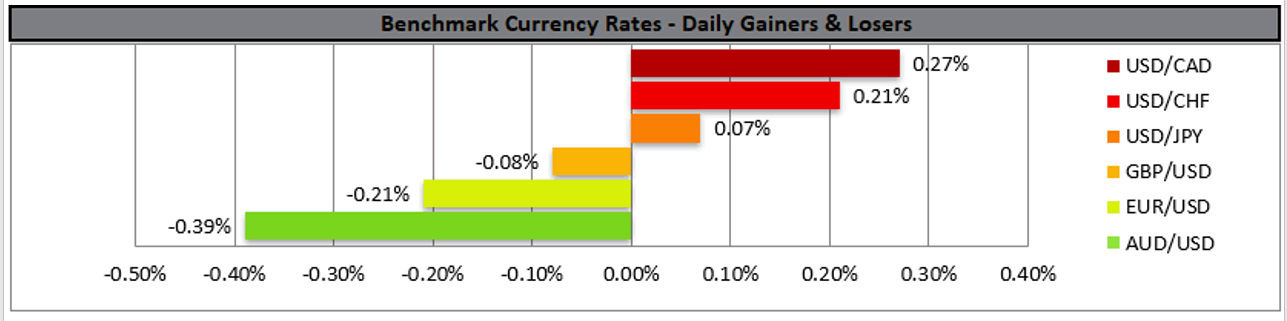
Commodity currencies came back to live entering into US session, with help from broad based rally in European indexes and US futures. Canadian Dollar is also lifted as WTI oil price recaptures 70 handle. Dollar turned mixed for now as selling turns to Swiss Franc, Euro and Yen. With an empty economic calendar for the rest of the day, the currency markets would likely follow risk markets closely.
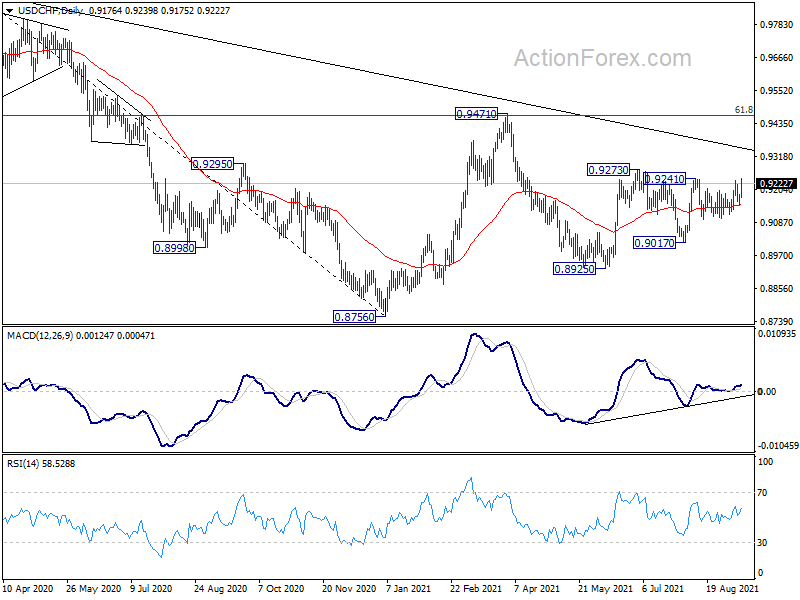
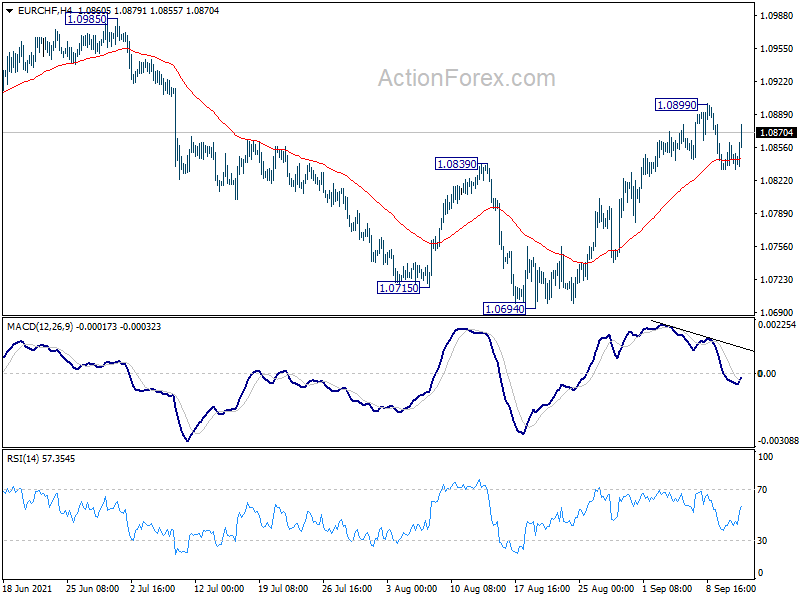
Technically, USD/CHF breaches 0.9241 and focus could be on 0.9273 resistance. Break there will resume rise from 0.8925. EUR/CHF also drew support from 4 hour 55 EMA and rebounds. Break of 1.0899 will resume whole rise from 1.0694 to 1.0985 resistance. Such development, if happens, could either fuel upside acceleration in USD/CHF, or help cushion EUR/USD's decline somewhat.
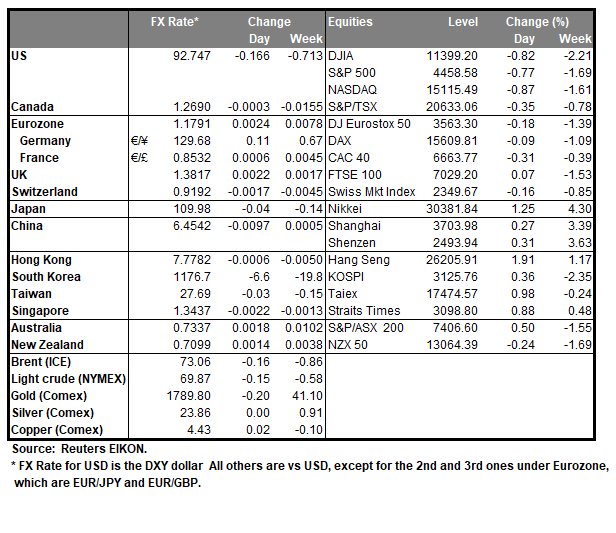
In Europe, at the time of writing, FTSE is up 0.68%. DAX is up 0.96%. CAC is up 0.75%. Germany 10-year yield is down -0.0044 at -0.332. Earlier in Asia, Nikkei rose 0.22%. Hong Kong HSI dropped -1.50%. China Shanghai SSE rose 0.33%. Singapore Strait Times dropped -0.79%. Japan 10-year JGB yield rose 0.0008 to 0.046.
ECB Schnabel: Premature tightening would choke the recovery
In a speech, ECB Executive Board member Isabel Schnabel said inflation in Eurozone is "likely to ease noticeably next year". She warned that "a premature monetary policy tightening in response to a temporary rise in inflation would choke the recovery and be most harmful to those who are already suffering from the current spike in inflation."
Also she said, "there are good reasons to assume that the current constellation of fiscal and monetary policy in the euro area may finally chart the path out of the low interest rate environment."
BoE Hauser: Balance sheet will be structurally larger even after QE unwind
BoE Executive Director Andrew Hauser said in a speech, the central bank balance sheets will be "structurally larger", comparing to the start of the millennium, even after current QE program unwind. Central will need to meet at "bigger share of the structurally higher demand for liquidity; and contemplate possible Central Bank Digital Currencies.".
Also, the balance sheets will be "more variable as lower global interest rates and a broader liquidity insurance toolkit mean balance sheets play a more active countercyclical role."
Germany likely to have a noticeable jump in output in Q3
Germany's Economy Ministry said in its monthly report that "there will likely be a noticeable increase in economic output in the current third quarter." Nevertheless, there were also signs of normalization of growth in Q4. Also, the spread of new variants of COVID-19 could cloud the outlook.
GDP grew only 1.6% qoq in Q2, as constrained by shortage of semiconductor chips and other intermediate goods.
Japan corporate goods price ticked down to 5.5% yoy, wholesale inflation will remain under upward pressure
Japan's corporate goods price index slowed slightly to 5.5% yoy in August. But it was close to July's 5.6% yoy, which was the highest reading since September 2008. Also, at 105.8, the index marked the highest level since 1982.
Shigeru Shimizu, head of the BoJ's price statistics division, said, "as the global economy continues to recover thanks to progress in vaccinations, domestic wholesale inflation will remain under upward pressure, though there's uncertainty over the outlook due to a resurgence in infections."
NZIER revised up inflation forecast, NZD to remain elevated for coming years
In NZIER's September survey, consensus forecast for 2021/22 GDP was revised down from 5.0% to 4.5%. But 2022/23 GDP forecast for 2022/23 was revised up from 3.7% to 4.5%. The revision likely reflects the impact of the current COVID-19 outbreak. GDP is forecast to grow 2.3% in 2023/24 (revised down from 2.6%), then pick up to 2.7% in 2024/25.
Inflation forecasts were revised up sharply from 2.1% to 3.5% in 2021/22, up from 1.9% to 2.0% in 2022/23. It's unchanged at 2.2% in 2023/24 and expected to be steady at 2.2% in 2024/25. NZIER said, "Capacity pressures continue to build up across the New Zealand economy, as acute labour shortages and COVID-related supply chain disruptions drive up cost pressures further. Solid demand has made it easier for businesses to pass these costs onto customers by raising prices."
The NZD outlook is mixed with trade-weighted index revised lower in the near term. However, NZIER said, "expectations are for the currency to remain elevated over the coming years," as RBNZ rate hike expectations improved yield attractiveness.
New Zealand ANZ business confidence rose to -6.8, showing resilience
In the preliminary September read, New Zealand ANZ Business confidence rose to -6.8, up from August's -14.2. Own Activity outlook dropped to 18.2, down from 19.2. Looking at some more details, export intentions dropped from 7.4 to 5.7. Investment intentions dropped from 14.4 to 12.2. Employment intentions dropped from 17.0 to 14.7. Inflation expectations ticked lower from 3.05 to 2.97.
ANZ said the report showed "resilience" despite lockdown in Auckland, with most forward-looking activity indicators holding up well. ANZ said, "We examined a split between Auckland and the rest of the country but the differences were very small."
"Overall, the preliminary ANZ Business Outlook results suggest that firms can see light at the end of the tunnel, even in Auckland. We can do this, it said".
OPEC: Oil demand recovery delayed in to H1 2022
In the monthly oil market report, OPEC revised down Q4 oil demand forecasts to average 99.70m bpd, down 110k bpd from last months' projections. For 2022, Overall, global oil demand would rise by 5.96m bpd in the whole of 2021. Demand growth forecasts for 2022 was revised from 3.28m bpd to 4.1m bpd.
It said the "increased risk of COVID-19 cases primarily fueled by the Delta variant is clouding oil demand prospects going into the final quarter of the year." As a result, "second-half 2021 oil demand has been adjusted slightly lower, partially delaying the oil demand recovery into first-half 2022."
"The pace of recovery in oil demand is now assumed to be stronger and mostly taking place in 2022," OPEC said. "As vaccination rates rise, the COVID-19 pandemic is expected to be better managed and economic activities and mobility will firmly return to pre-COVID-19 levels."
USD/CHF Mid-Day Outlook
Daily Pivots: (S1) 0.9160; (P) 0.9172; (R1) 0.9195; More....
USD/CHF's breach of 0.9017 suggests resumption of rise from 0.9017. Intraday bias is back on the upside for 0.9273 resistance first. Firm break there will solidify near term bluishness for 0.9471 resistance next. However, break of 0.9149 support will turn focus back to 0.908 support instead.
In the bigger picture, USD/CHF is still struggling around 55 week EMA (now at 0.9178) and outlook is mixed for now. Confirmed rejection by the 55 week EMA will retain medium term bearishness. That is, larger fall from 1.0342 would resume through 0.8756 low at a later stage. However, sustained trading above 55 week EMA will tilt favor to the case of bullish reversal. Focus would then be turned to 0.9471 resistance for confirmation.
Economic Indicators Update
| GMT | Ccy | Events | Actual | Forecast | Previous | Revised |
|---|---|---|---|---|---|---|
| 23:50 | JPY | PPI Y/Y Aug | 5.50% | 5.60% | 5.60% | |
| 23:50 | JPY | BSI Large Manufacturing Conditions Index Q3 | 7 | -0.9 | -1.4 | |
| 18:00 | USD | Monthly Budget Statement (USD) Aug | -260.5B | -302.1B |
OPEC: Oil demand recovery delayed in to H1 2022
In the monthly oil market report, OPEC revised down Q4 oil demand forecasts to average 99.70m bpd, down 110k bpd from last months' projections. For 2022, Overall, global oil demand would rise by 5.96m bpd in the whole of 2021. Demand growth forecasts for 2022 was revised from 3.28m bpd to 4.1m bpd.
It said the "increased risk of COVID-19 cases primarily fueled by the Delta variant is clouding oil demand prospects going into the final quarter of the year." As a result, "second-half 2021 oil demand has been adjusted slightly lower, partially delaying the oil demand recovery into first-half 2022."
"The pace of recovery in oil demand is now assumed to be stronger and mostly taking place in 2022," OPEC said. "As vaccination rates rise, the COVID-19 pandemic is expected to be better managed and economic activities and mobility will firmly return to pre-COVID-19 levels."
Aussie Pauses after Tough Week
The Australian dollar is slightly lower as the currency markets are static at the start of the week. Currently, AUD/USD is trading at 0.7346, down 0.11% on the day.
Investors eye Business Confidence, RBA’s Lowe
The economic calendar is on the thin side this week, which could mean limited, choppy movement for the Australian dollar. Things will pick up during the week, starting with NAB Business Confidence on Tuesday. The index sank in July with a reading of -8, ending a streak of nine consecutive gains. This will be followed by RBA Governor Phillip Lowe speaking at an online event; the markets will be listening closely and looking for hints as to any plans to reduce the bank’s bond-buying progamme.
It was a rough week for the Australian dollar, which fell 1.36% last week. Much of the downswing can be attributed to the RBA, which announced at last week’s meeting that it would not review tapering its bond purchases until February. The Bank had planned to review the programme in November, but the weak recovery in light of a spike in cases of Delta variant of Covid-19 necessitated the extension. The Bank is currently buying AUD 4 billion in bonds each week, down from AUD 5 billion.
In the Bank’s rate statement, Lowe said that the damage from Covid would “delay, but not derail” the economic recovery. The reaction from the markets which sent the Aussie was understandable. At the same time, the RBA remains committed to further tapering when economic conditions improve. The question is one of timing – a taper is highly likely in February, but the Bank could make a move earlier than that if economic activity storms back.
AUD/USD Technical
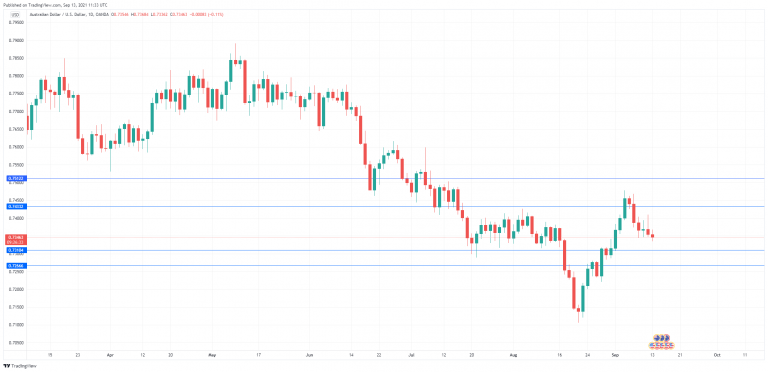
- There is resistance at 0.7433, followed by 0.7512
- The first line of support is at 0.7310, followed by 0.7266
AUD/USD Recovering Higher Towards the 0.7365 Resistance
The Aussie Dollar started a fresh decline from well above 0.7450 against the US Dollar. The AUD/USD pair even broke the 0.7400 support level to enter a bearish zone.
The pair traded as low as 0.7347 and it settled below the 50 hourly simple moving average. It is now recovering higher towards the 0.7365 resistance. There is also a key bearish trend line forming with resistance near 0.7365 on the hourly chart.
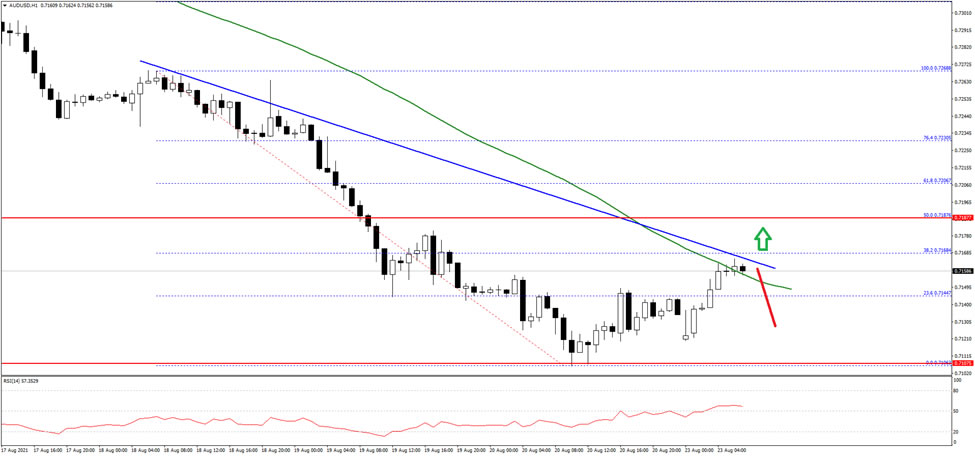
A clear break above the trend line resistance could lead the pair towards the 0.7375 resistance. The next major resistance for the bulls could be 0.7382, above which it could rally above 0.7400 on FXOpen.
If the pair fails to clear the trend line resistance, it could start a fresh decline below 0.7350. The next major support is near the 0.7340 level, below which there is a risk of a larger decline in the near term.
Greenback Gains Support Early in the Week
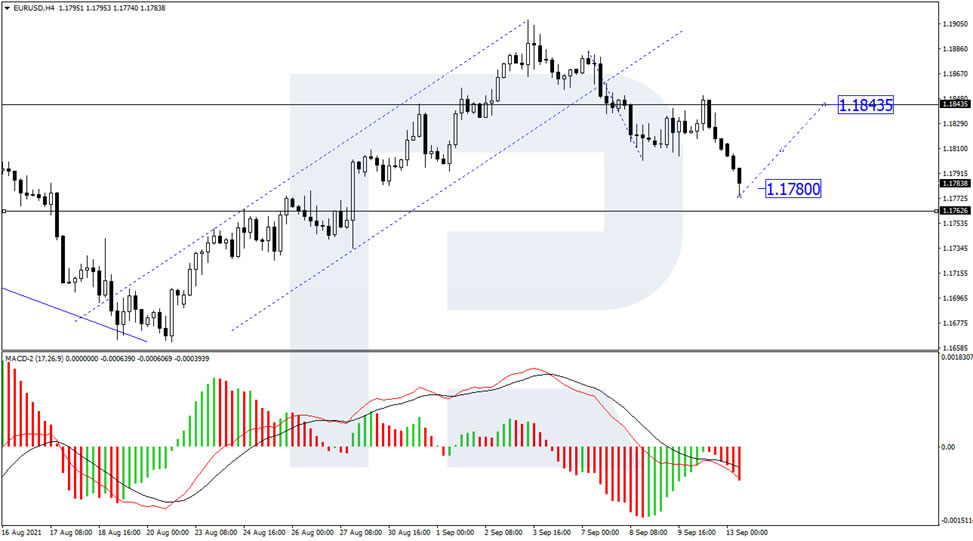
Early in another week of September, EUR/USD is significantly falling and trading at 1.1790.
The major currency pair started moving downwards after negotiations between American and Chinese Presidents. It was their first conversation in seven months. The key topics discussed were economics and mutual interests, including the areas where the parties are still far away from consensus.
Additional support the “greenback” got from the statistics on the Producer Price Index, which improved pretty much in August. As a result, American inflation is likely to remain quite high but the logistic structure for producers may remain as tough as before because of the pandemic effect.
In the H4 chart, after breaking 1.1840 to the downside and finishing the fifth descending structure at 1.1780, EUR/USD is expected to form a new consolidation range near the highs. If the price breaks this range to the upside, the market may resume trading upwards to test 1.1850. From the technical point of view, this scenario is confirmed by MACD Oscillator: its signal line is about to leave the histogram area and start another growth towards 0. After breaking 0, the line is expected to continue growing towards new highs of the indicator.
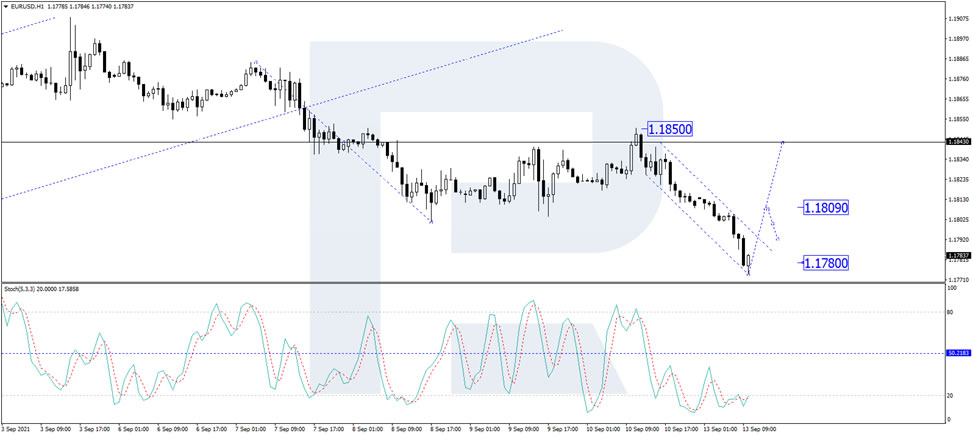
As we can see in the H1 chart, EUR/USD is consolidating above 1.1780 and may later grow to reach 1.1809. After that, the instrument may fall towards 1.1790 and then start another growth with the short-term target at 1.1830. Later, the market may correct to test 1.1809 from above and then resume trading upwards to reach 1.1850. From the technical point of view, this scenario is confirmed by the Stochastic Oscillator: after breaking 20 to the upside and leaving the “oversold area”, its signal line is steadily moving towards 50, a breakout of which may lead to further growth to reach 80.
XAUUSD Is Possibly Bearish
Technical analysis
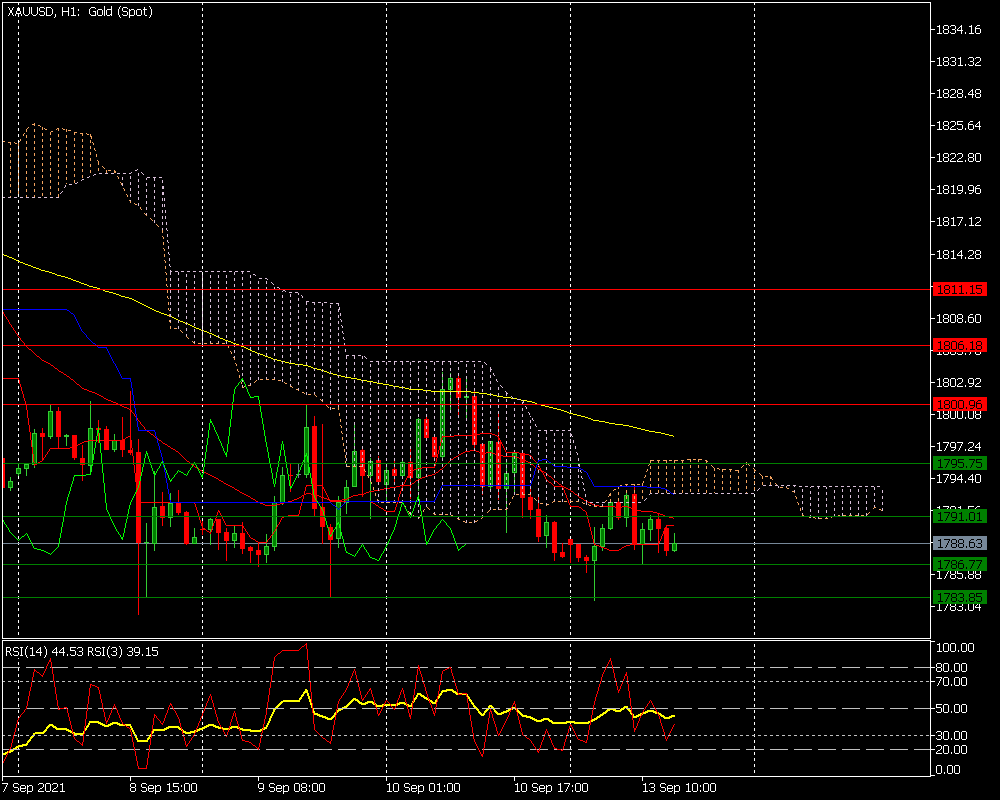
The price is under EMA(24) and EMA(120), suggesting a prevailing downtrend
The RSI(14) and the RSI(3) point to a possible upwards correction
The Ichimoku indicator displays a prevailing downtrend.
Most likely scenario - SELL
Target prices: 1,786 1,783
Alternative scenario - BUY
Target prices: 1,791 1,795
Key levels
Support 1,783 1,786
Resistance 1,791 1,795
USD Gains A Bit Yet Ended Last Week Lower
The greenback seems to have begun the week on the front foot, as traders begin to prepare for some high impact financial releases scattered through the week, while on fundamentals, the Fed’s intentions are still considered of key importance and rising US yields on Friday provided support. It should be noted that during today’s Asian session Philadelphia Fed President Patrick Harker added to the market’s concerns, sounding somewhat hawkish as he expressed the hope for FOMC to start tapering soon, possibly this year. In a rather slow Monday, given the low number of high impact financial releases, traders may remain patient for Tuesday’s August CPI release, while fundamentals may take the lead for now. US stockmarkets were for a fifth consecutive day in the reds, as worries for the economic rebound of the US seem to persist. Gold prices traded in rather narrow range during today’s Asian session, and we expect issues such as the direction of the USD and US yields, as well as the Fed’s intentions and the expectations for the US CPI data of Tuesday to be among the main factors for its direction. The sterling also tended to remain rather stable against the USD and the EUR on Friday, yet gained against JPY, as GBP traders prepare for a number of important financial releases due out this week, while BoE in the past week sounded rather confident. The Canadian Dollar retreated against the USD as the Canadian elections on the 20th of September are nearing and uncertainty seems to remain high about the result, which could weigh on the CAD, despite oil prices rising during Friday’s session. Oil prices rose, as worries for production levels seemed to rise, given that the production at the Gulf of Mexico seems to remain low after hurricane Ida’s passing.
The USD index rose aiming for the 92.75 (R1) resistance line, yet the picture of a sideways movement seems to be maintained. Please note that the RSI indicator below our 4-hour chart is higher than the reading of 50 with an upward slope which may imply a slight advantage for the bulls. Should the USD remain in high demand, we may see the Index breaking the 92.75 (R1) resistance lien and aim for the 93.20 (R2) level. Should a selling interest be displayed by the market we may see the USD reversing course and take aim for the 92.30 (S1) support line and if broken the path opens for the 91.75 (S2) support level.
Gold prices maintained a tight range bound movement just below the 1800 (R1) resistance line. We tend to maintain our bias for a sideways movement for the precious metal and the RSI indicator below our 4-hour chart is below the reading of 30, yet with an upward slope, which may imply that the bearish sentiment may be dwindling. Should the bulls actually take charge of the bullion’s direction, we may see gold’s price aiming if not breaking the 1760 (S1) support line. Should the bulls take over we may see gold’s price breaking the 1800 (R1) resistance line and aim for the 1835 (R2) level.
Other economic highlights today and the following Asian session:
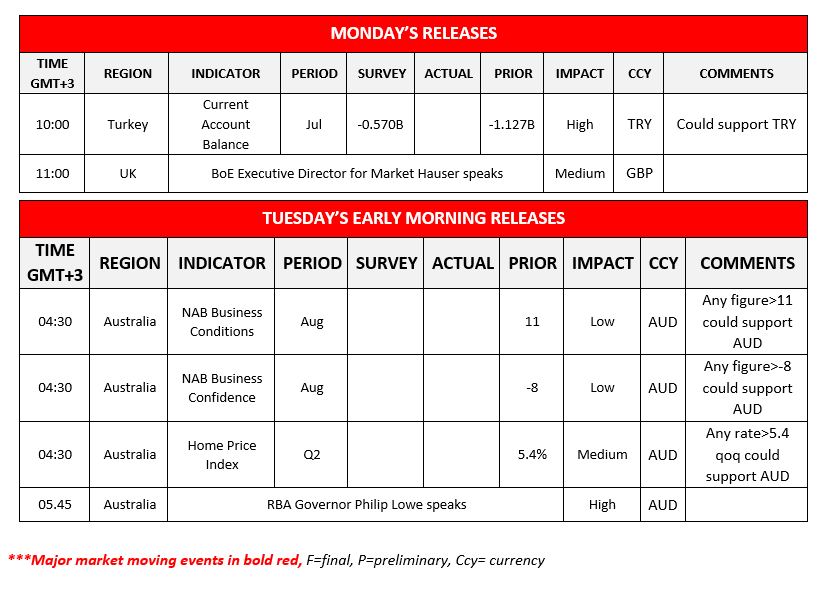
On a slow Monday we note Turkey’s current account balance, while during tomorrow’s Asian session we note Australia’s Home Price index for Q2 and NAB indicators for August, as well as RBA Lowe’s speech.
As for the rest of the week
On Tuesday we get the UK employment data for July while we highlight the US CPI rates for August. On Wednesday we get China’s industrial output for August and UK’s, Frances’ and Canada’s CPI rates for August, while the US industrial production growth rate for August should not be underestimated. On Thursday we note New Zealand’s GDP rate for Q2, Australia’s employment data for August and in the American session, we get the weekly initial jobless claims figure, the Philly Fed Business index for September and the retail sales for August. On Friday we note UK’s retail sales for August, Eurozone’s final HICP rate for August and the US preliminary University of Michigan consumer sentiment for September.
USD Index H4 Chart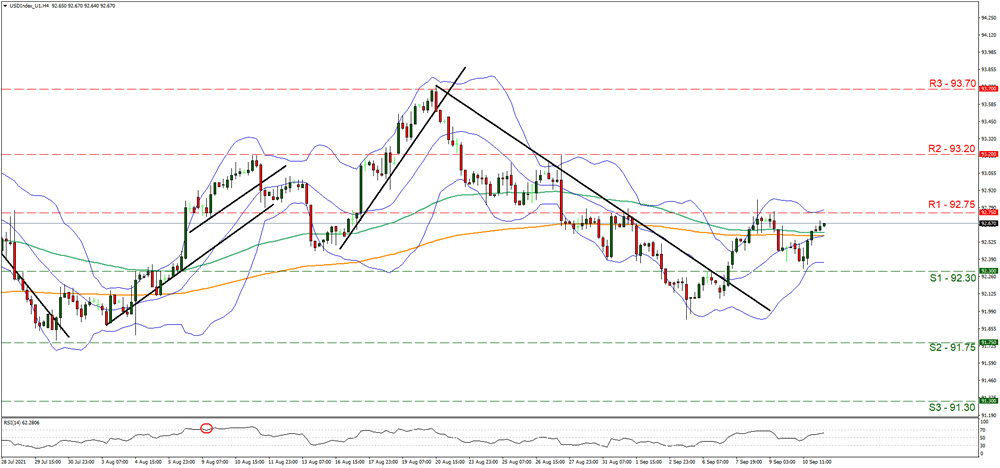
Support: 92.30 (S1), 91.75 (S2), 91.30 (S3)
Resistance: 92.75 (R1), 93.20 (R2), 93.70 (R3)
XAU/USD H4 Chart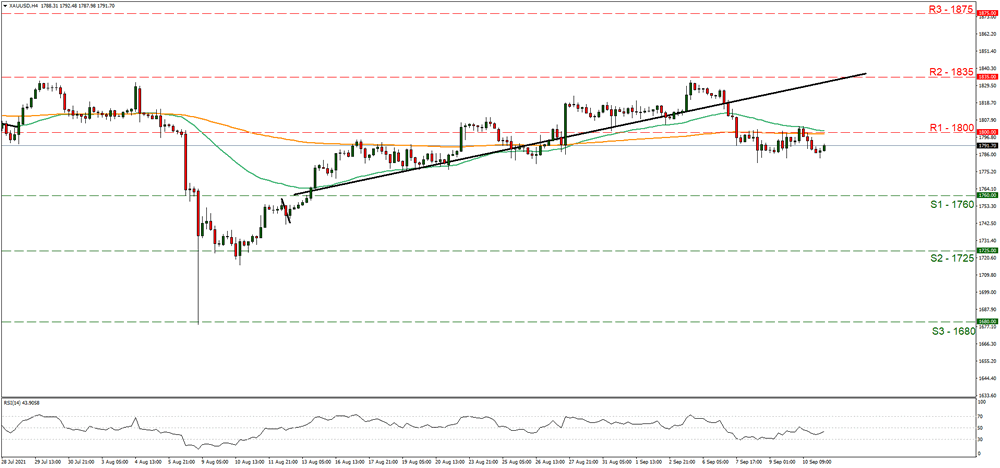
Support: 1760 (S1), 1725 (S2), 1680 (S3)
Resistance: 1800 (R1), 1835 (R2), 1875 (R3)