Sample Category Title
The Dollar Index Continues To Strengthen, Sending Major Stock Indices Down
Last week, investors focused on the release of the ECB's monetary policy plans. The European Central Bank left the interest rate unchanged and slightly raised its inflation target this year. But the ECB will likely start to reduce its stimulus program in the next quarter. Such news had a negative impact on the US market as well. Also, investors are now inclined to believe that the Federal Reserve will follow its colleagues from Europe and start cutting its quantitative easing program next quarter as well. A lot will depend on inflation data released this week in the USA, Canada, Great Britain, Europe, and Japan.
The US stock market finished Friday's trading with a decline amid negative dynamics from the utilities, technology, and health care sectors. Dow Jones index lost 0.78% (-2.24% for the week) reaching a monthly minimum, S&P 500 decreased by 0.77% (-1.63% for the week), NASDAQ index lost 0.87% (-1.29% for the week). Apple shares were the biggest fallers among the Dow Jones components, falling by 3.3%. It becomes clear that investors and hedge funds are cutting their positions now.
US Democratic senators have proposed imposing a 2% tax on the amount that public companies spend on stock buybacks. Given the Democrats' plans to substantially increase taxes on large corporations, such rhetoric puts negative pressure on major US stock markets. On the other hand, tax benefits for electric vehicles will be expanded.
The main European stock indexes closed in the red zone on Friday. The only exception was the British FTSE 100 index, which increased by 0.07%. But by the end of the week, the index lost 1.53%. German DAX lost 1.32% at the end of the week. The correlation between the American and the European indices is clearly seen again. Considering the fact that the ECB plans to start cutting back its stimulus program in the next quarter, traders should not expect significant growth of the main European indices.
Oil prices increased to $73 a barrel on Friday, helped by growing signs of a US inventory shortage in the wake of Hurricane Ida and the hopes for a renewal of trade between the US and China, which boosted riskier assets. Two OPEC+ sources said Monday the group would lower its 2022 oil demand growth forecast as the spread of the Delta virus casts doubt on fuel demand growth.
Asia-Pacific stock indices opened the trading week lower, following Friday's negative performance by US indices last week. Japan's Nikkei 225 index has already lost 0.3% since the opening session, Hong Kong's Hang Seng index decreased by 2.2%, China's Shanghai Composite decreased by 0.2%, South Korea's KOSPI lost 0.5%. In Japan, the PPI index increased by 5.5% in August compared to the same period of the previous year. Shares of Chinese technology companies are falling again amid increasing control by the authorities. Regulators have strongly warned internet platforms not to try to bypass recently introduced restrictive measures.
Main market quotes:
- S&P 500 (F) 4,458.58 −34.70 (−0.77%)
- Dow Jones 34,607.72 −271.66 (−0.78%)
- DAX 15,609.81 −13.34 (−0.085%)
- FTSE 100 7,029.20 +4.99 (+0.07%)
- USD Index 92.64 +0.16 (−0.17%)
Important events for today:
- Japan PPI (m/m) at 02:50 (GMT+3).
Dollar Grinds Higher, Wall Street Loses Altitude
- Dollar capitalizes on rare selloff in US equity markets
- Chinese and Japanese stocks go their separate ways
- Crucial US data and election polls to drive markets this week
Autumn blues for Wall Street?
The relentless rally in US stock markets took a breather last week. Wall Street suffered a rare pullback as investors took some profits off the table, positioning for a new regime of fading central bank liquidity, moderating growth, and higher taxes.
Sure, the selloff was rather shallow and equity traders are already in a better mood this week, but looking into the autumn, there are several risks that could play havoc with markets. The obvious boogeyman is the Fed and the push to slash asset purchases this year. While the threat of tapering alone was clearly not enough to scare markets, it might be if it’s accompanied by tax increases.
The Democrats are trying to pay for their gargantuan $3.5 trillion investment plan by raising corporate and capital gains taxes, as well as introducing a 2% tax on stock buybacks. That would be a triple-whammy that capital markets cannot ignore, even if the overall package raises the productive capacity of the economy in the longer run.
Therefore, the next few months could be challenging for equity markets, with the Fed closing the liquidity taps while Congress goes after businesses and investors in an environment where growth is already losing speed and valuations are unforgiving. Of course, that would ultimately be another dip to buy as the macro landscape remains solid.
Asian markets diverge, dollar shines
Meanwhile, the regulatory drama in China continues to torment local bourses. The Hang Seng lost another 1.75% today after news that Beijing will break up Alipay, the payments app owned by Ant Group. Regulators also took another shot at their tech giants, saying they have to stop blocking each other’s links on their sites.
In contrast, the gravy train keeps on rolling in Japanese equities. The Topix index hit a new three-decade peak today, supercharged by hopes that the next Prime Minister will embark on a powerful spending spree to battle the virus and chronic deflation.
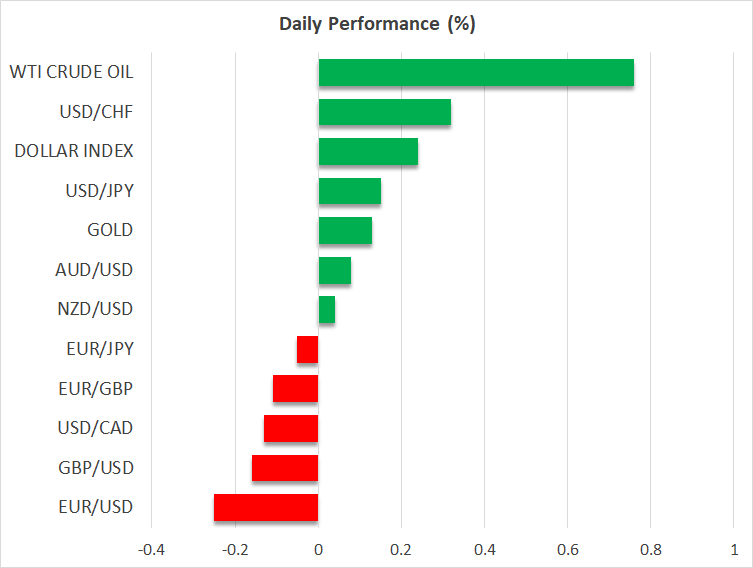
The atmosphere was calmer in the FX battleground. The only real mover has been the US dollar, which drew power from the recent defensive tones and some minor gains in Treasury yields. With the Fed now in its blackout period, the greenback’s fortunes hang on the upcoming US inflation and retail sales numbers this week.
Inflation in particular will pique the market’s interest as it increasingly seems that it won’t cool as quickly as the Fed thinks. Business surveys like the PMIs continue to stress that supply chain problems aren’t getting any better thanks to the shutdowns in Asia and container shipping costs have absolutely exploded this year.
Oil prices and elections
In the energy sphere, oil prices managed to defy the cautious mood on Friday and are heading even higher on Monday, capitalizing on the fallout from Hurricane Ida that has left a lot of production offline in the Gulf of Mexico.
Politics will likely become a bigger theme moving forward, with crucial elections scheduled in Canada, Germany, and Japan. Their respective currencies could become more sensitive to incoming opinion polls as we approach these elections, since surveys conducted just a few days ahead of the vote may carry more weight in the eyes of investors.
Even though options markets suggest the German election will be a muted affair for the euro, with implied volatility in euro/dollar being relatively low, the outcome could still be crucial for European economic policy and for opening the door towards a fiscal union.
EUR/USD Outlook: Bears Accelerate Under Thick Daily Cloud
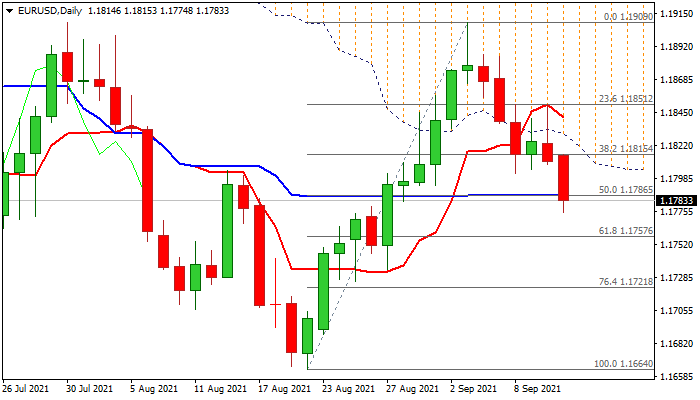
The Euro starts week in red and extends weakness below 1.18 mark in early Monday trading.
Fresh bears emerged after Sep 3 bull-trap above 1.1894 Fibo barrier (38.2% of 1.2266/1.1664) and gained pace after return below thick falling daily cloud which weighs on near-term action.
Near-term structure weakened further after Monday’s acceleration broke below daily Kijun-sen/50% retracement of 1.1664/1.1909 upleg (1.1786), with close below here to add to reversal signals.
Daily studies show fading bullish momentum and MA’s turning to bearish setup, contributing to negative near-term outlook.
Bears eye initial target at 1.1751 (Fibo 61.8%) break of which to confirm reversal ad risk drop to 1.1721/00 (Fibo 76.4%/psychological).
Broken Fibo 38.2% of 1.1664/1.1909 upleg (1.1815) reverted to solid resistance which needs to keep the upside limited and maintain bearish bias.
Res: 1.1800, 1.1815, 1.1834, 1.1851.
Sup: 1.1774, 1.1757, 1.1721, 1.1700.
BoE Hauser: Balance sheet will be structurally larger even after QE unwind
BoE Executive Director Andrew Hauser said in a speech, the central bank balance sheets will be "structurally larger", comparing to the start of the millennium, even after current QE program unwind. Central will need to meet at "bigger share of the structurally higher demand for liquidity; and contemplate possible Central Bank Digital Currencies.".
Also, the balance sheets will be "more variable as lower global interest rates and a broader liquidity insurance toolkit mean balance sheets play a more active countercyclical role.".
Germany likely to have a noticeable jump in output in Q3
Germany's Economy Ministry said in its monthly report that "there will likely be a noticeable increase in economic output in the current third quarter." Nevertheless, there were also signs of normalization of growth in Q4. Also, the spread of new variants of COVID-19 could cloud the outlook.
GDP grew only 1.6% qoq in Q2, as constrained by shortage of semiconductor chips and other intermediate goods.
EURUSD Declines Below 1.1800, Neutral-To-Bearish Bias
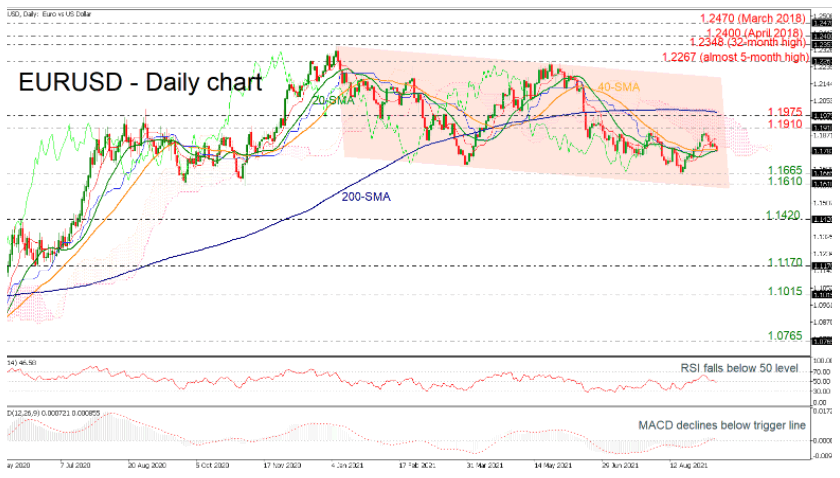
EURUSD has been in a bearish-to-neutral outlook from the beginning of the year and currently are approaching again the 20- and 40-day simple moving averages (SMAs) below 1.1800 in the short-term. After the pullback on the 1.1910 resistance, the price is heading south with the technical indicators mirroring the latest negative move. The RSI is falling in the negative region, while the MACD is slipping below its trigger line in the positive area.
If the pair declines underneath the SMAs, the next immediate support could come from the 1.1610-1.1665 zone. Steeper decreases could open the door for the 1.1420 barrier, taken from the inside swing high on June 10.
On the flip side a rise back into the Ichimoku cloud could meet the 1.1910 and 1.1975 resistances, which holds around the strong 200-day SMA at 1.1990. Any advances may drive the market until the upper boundary of the descending channel near 1.2180 before challenging the almost five-month peak of 1.2267.
To sum up, EURUSD is slightly negative in the broader view and any moves below the channel could open the way for a stronger bearish picture.
Daily Technical Analysis
EUR/USD
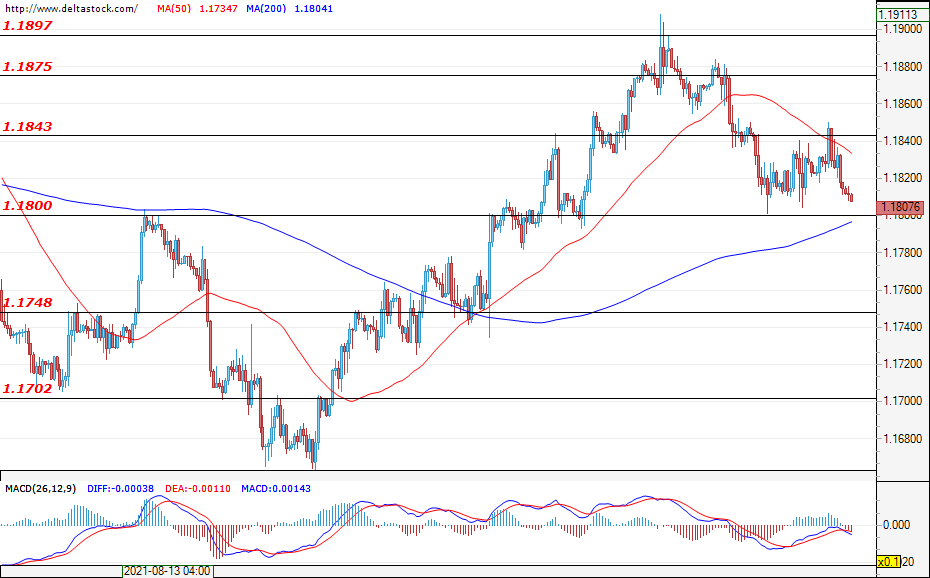
Current level - 1.1807
During the last trading session from the previous week, the pair couldn't breach the resistance at 1.1843 and, at the time of writing this analysis, the EUR/USD is found in a consolidation phase in the range between 1.1800 - 1.1843. If the bears manage to breach the support at 1.1800, this would probably lead to a sell-off towards the next support found at 1.1748. On the other hand, if the bulls enter the market and successfully breach the resistance at 1.1843, then their next target should be the resistance at 1.1875. This week, investors' attention will be focused on the Claimant Count unemployment rate for the U.S. (Wednesday; 12:30 GMT) and on the data on the consumer price index for the euro area (Friday; 09:00 GMT).
| Resistance | Support | ||
| intraday | intraweek | intraday | intraweek |
| 1.1843 | 1.1900 | 1.1800 | 1.1700 |
| 1.1875 | 1.1950 | 1.1748 | 1.1700 |
USD/JPY
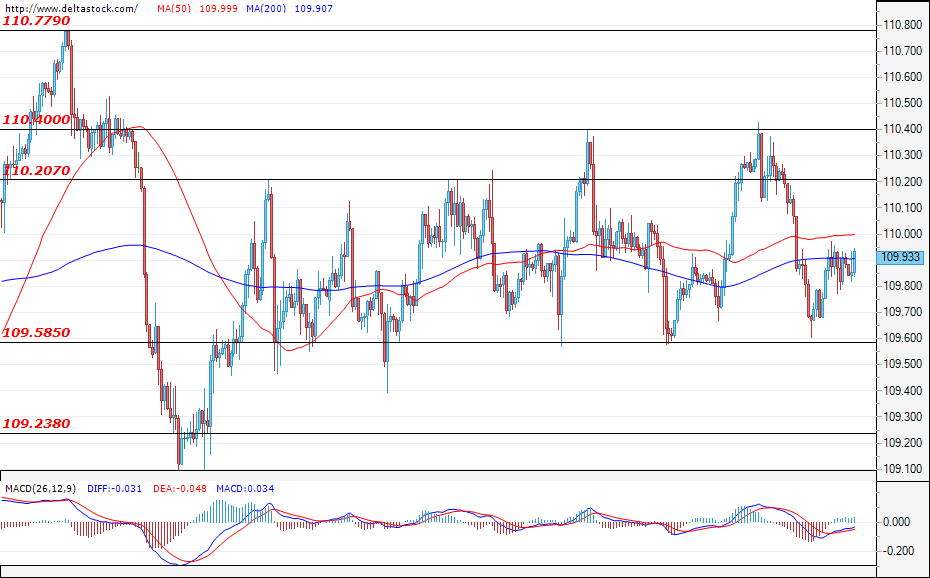
Current level - 109.93
During the last trading session from the previous week, the pair couldn't breach the resistance at 1.1843 and, at the time of writing this analysis, the EUR/USD is found in a consolidation phase in the range between 1.1800 - 1.1843. If the bears manage to breach the support at 1.1800, this would probably lead to a sell-off towards the next support found at 1.1748. On the other hand, if the bulls enter the market and successfully breach the resistance at 1.1843, then their next target should be the resistance at 1.1875. This week, investors' attention will be focused on the Claimant Count unemployment rate for the U.S. (Wednesday; 12:30 GMT) and on the data on the consumer price index for the euro area (Friday; 09:00 GMT).
| Resistance | Support | ||
| intraday | intraweek | intraday | intraweek |
| 110.20 | 110.78 | 109.58 | 109.23 |
| 110.40 | 111.00 | 109.58 | 108.74 |
GBP/USD
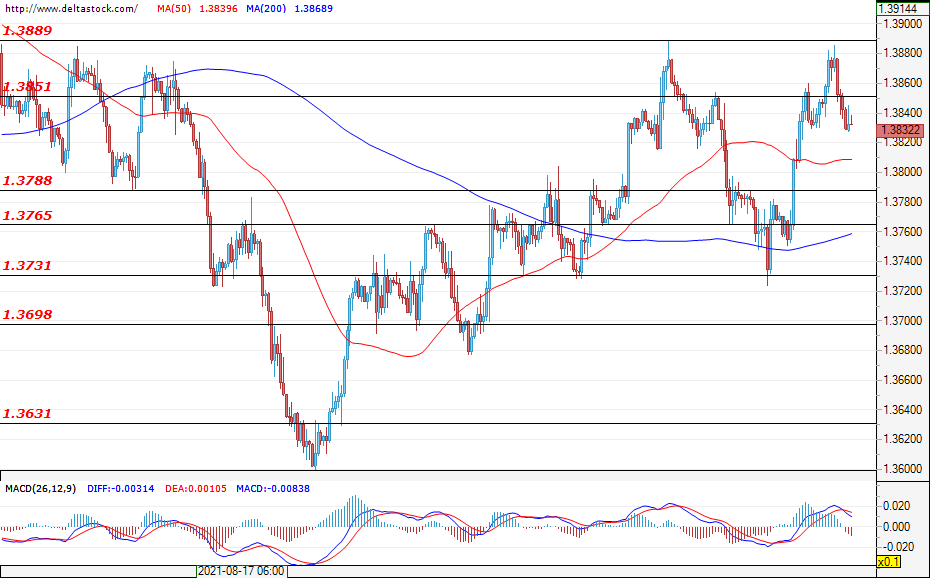
Current level - 1.3832
After the second unsuccessful test of the resistance at 1.3889, the pound is losing ground against the dollar and the forecasts for today's trading session are for the pair to head towards the support level at 1.3788. However, if the bulls re-enter the market and manage to breach the resistance at 1.3889, this would pave the way for the currency towards the resistance at 1.4000. This week, investors' attention will be focused on the Claimant Count data (Tuesday; 06:00 GMT) and the retail sales data for the UK (Friday; 06:00 GMT).
| Resistance | Support | ||
| intraday | intraweek | intraday | intraweek |
| 1.3851 | 1.3890 | 1.3788 | 1.3731 |
| 1.3890 | 1.4000 | 1.3765 | 1.3698 |
XAG/USD Sees Bearish Breakout
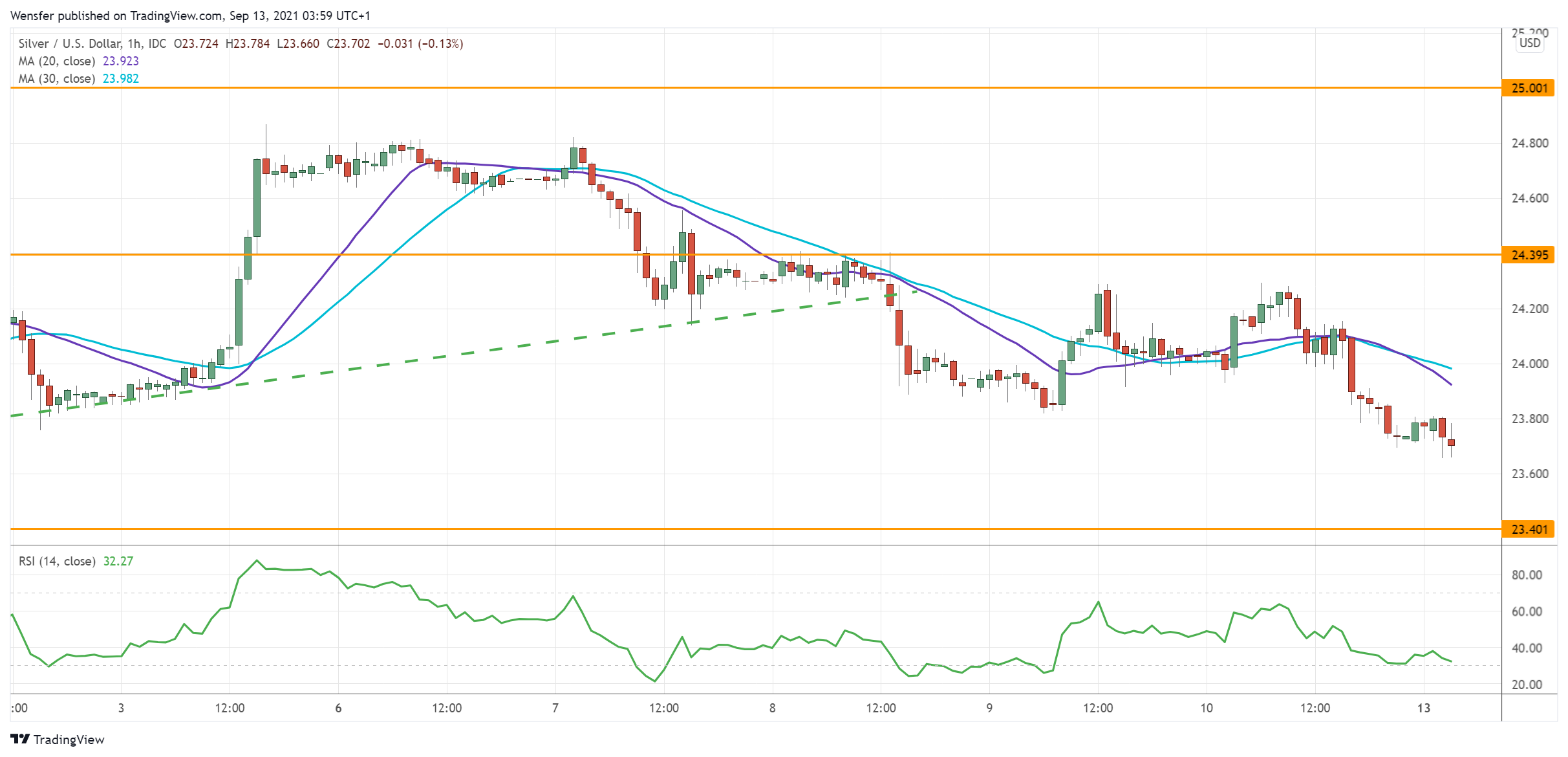
Bullions weakened after the US dollar advanced on better-than-expected producer prices.
The break below the rising trendline has put silver’s recovery at risk. Then the bears’ push below the critical support at 23.80 was an indication that they have gained the upper hand.
An oversold RSI may cause a limited bounce.
The bulls have the daunting task of lifting offers around 24.40 to turn the downbeat bias around. If momentum traders join in, a cascade of sell-offs may target 23.40 and then the psychological tag at 23.00.
CAD/JPY Hits Key Resistance
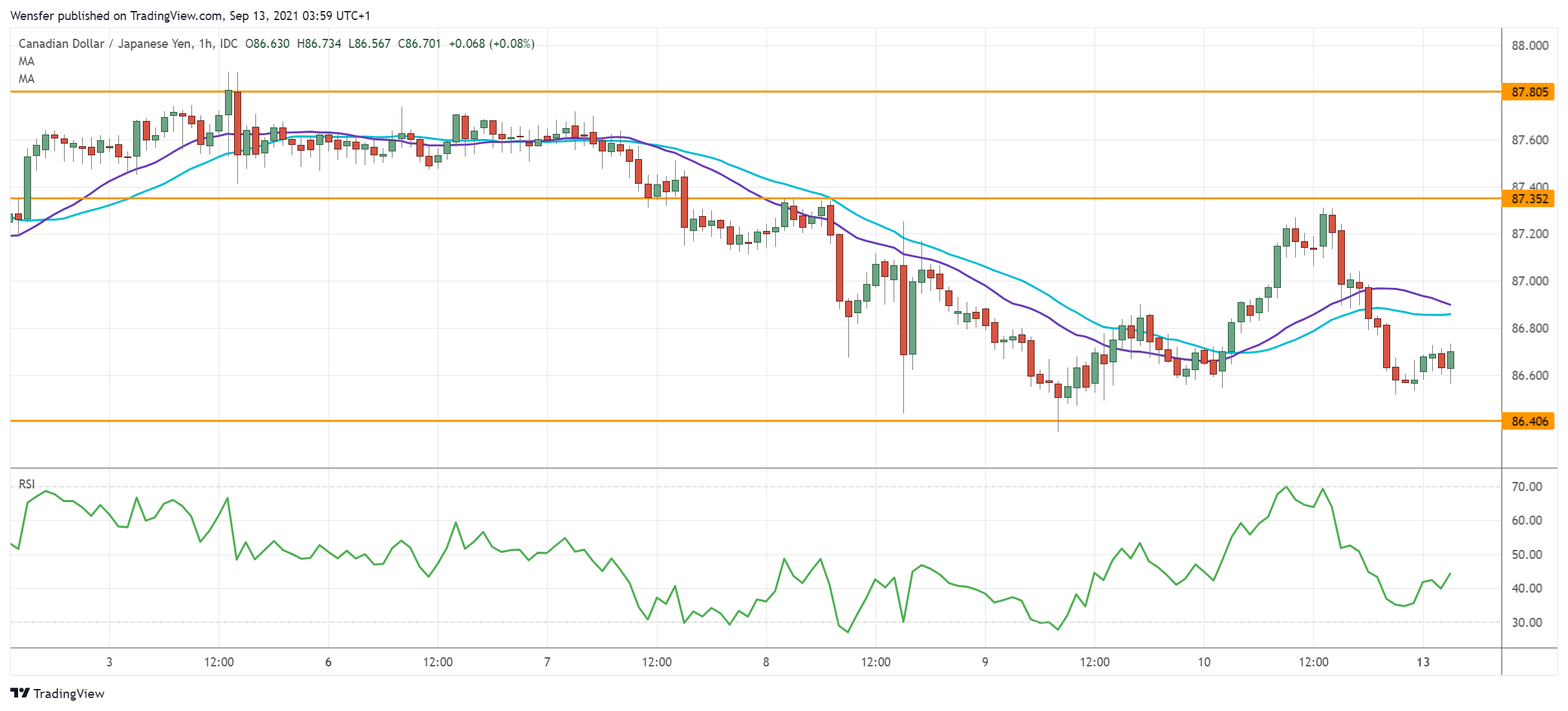
The loonie stalled after Canada’s mixed employment data in August. The pair has previously broken below the demand zone at 86.60, putting buyers on the defensive.
The latest rebound has turned out to be a dead cat bounce after the price saw strong selling pressure at 87.35. An overbought RSI was an opportunity for sellers to step in.
Sentiment remains bearish in line with the downtrend initiated in early June. 86.40 is the last line of defence for the bulls and a fall below may trigger a sell-off to 85.50.
GER 30 Tests Key Support
The stock markets recover as a discussion between Biden and Xi raises hopes of a thaw in US-China relations.
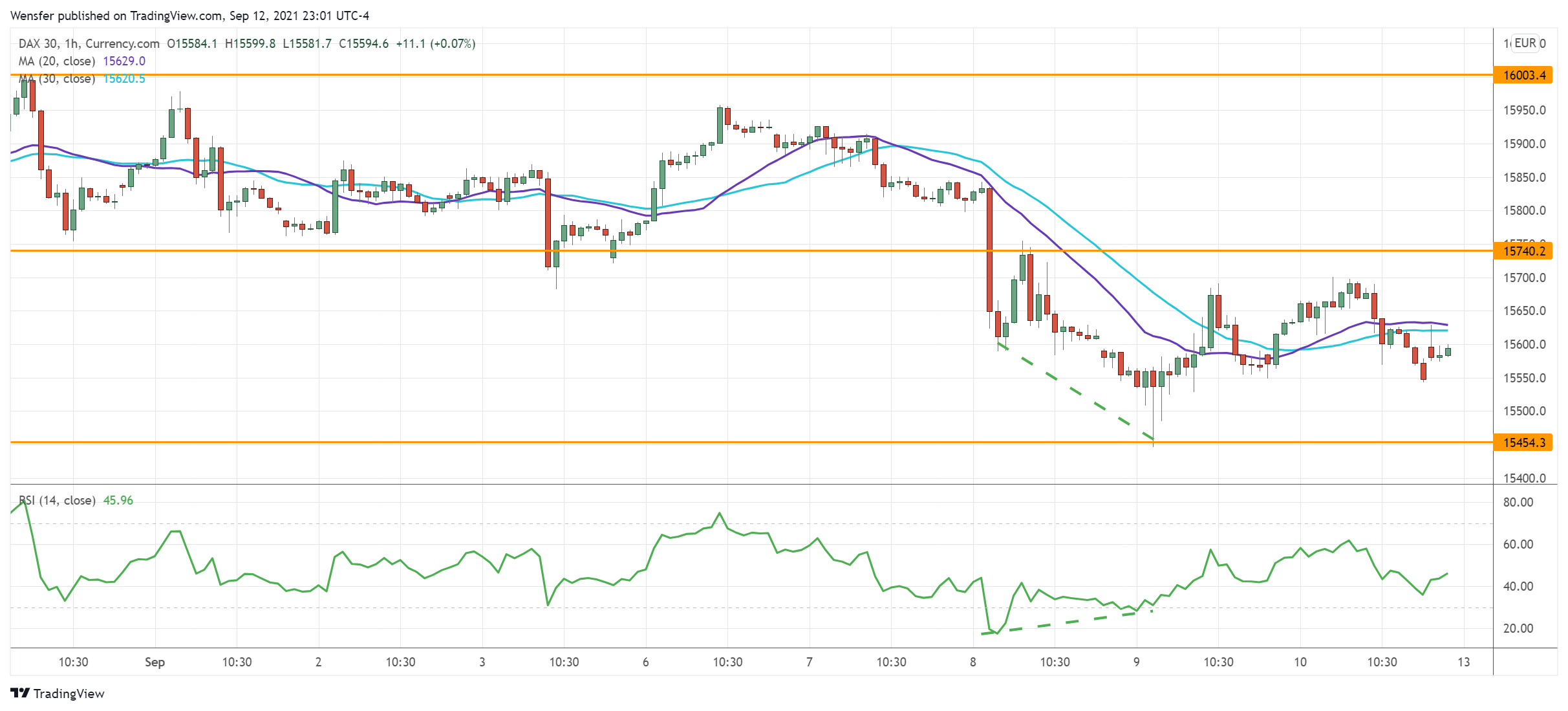
The Dax 30 has found buying interest on the daily support (15450).
A bullish RSI divergence suggests a loss in the sell-off momentum. Traders were eager to buy the dip in this area of congestion when the RSI showed an oversold situation.
A rally above 15740 would confirm the rebound. 16000 would be the target when buyers regain confidence. Otherwise, a slide below 15450 may trigger an extended correction.