

Sample Category Title
EUR/USD Breaks 1.179 Support as Dollar Rebound Continues
Dollar rebound continues in Asian session today and trades generally high. Weakness in more notable in Aussie and Euro, as both turn soft in crosses. Overall risk sentiment is slightly negative, with particular deep selloff in Hong Kong stocks, but Nikkei remains resilient. The economic calendar is very light today and movements in the currencies would likely follow broader markets. Nevertheless, inflation data from US, Canada and UK could lift volatility later in the week.
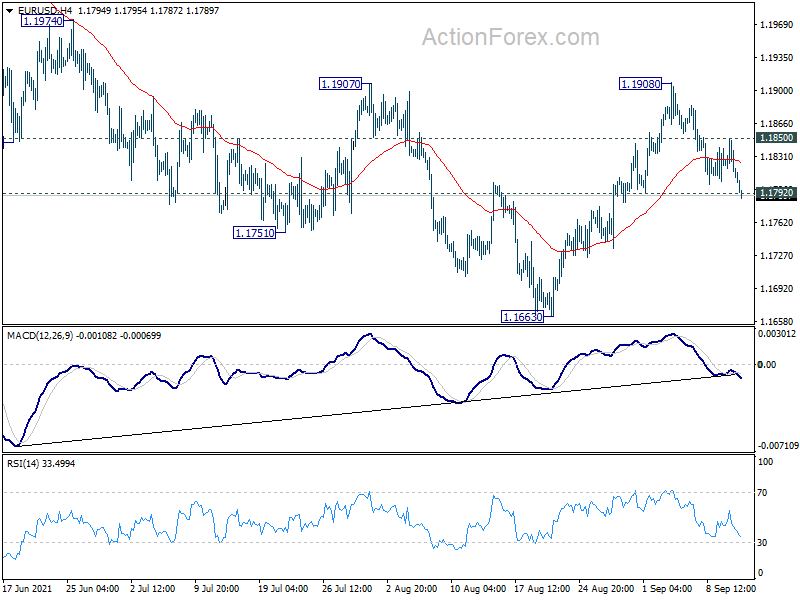
Technically, EUR/USD's break of 1.1792 support suggests rebound from 1.1663 has completed after rejection by 1.1907 structural resistance. We'd pay attention to whether the development is more of a release of Dollar strength or Euro weakness, or both. Break of 129.57 support in EUR/JPY would bring deeper fall back to 127.91 low. On the other hand, USD/JPY might try to rise back towards 110.79 resistance, even if sideway trading continues. We'll keep an eye on the interactions between the three.
In Asia, at the time of writing, Nikkei is down -0.34%. Hong Kong HSI is down -2.38%. China Shanghai SSE is down -0.38%. Singapore Strait Times is down -1.06%. Japan 10-year JGB yield is up 0.0025 at 0.048.
Fed Harker: I'd like to start tapering soon to buy ourselves option
Philadelphia Fed President Patrick Harker said in a Nikkei interview that he'd like to start tapering asset purchases. He sees "elevated risk" of inflation running higher.
He said, "my baseline forecast is still to have inflation around 4% this year, ending this year, and then starting to fall back to 2% over the years 2022 and 2023. However, I do see elevated risk that inflation could run higher".
"I'd like to start the taper process soon, so that we can finish the tapering process, so if we need to increase the policy rate, we have the room to do that. And I think we need to buy ourselves that option," he added.
SNB Zurbruegg: Negative interest rates still needed due to the situation globally
SNB Vice President Fritz Zurbruegg said in a Sonntagszeitung interview over the weekend, "at the moment we need the negative interest rates due to the situation globally." He warned, "if we were to hike interest rates now, the franc would appreciation markedly, economic growth would slow and joblessness would increase." He also noted that the pickup in inflation in Switzerland is "temporary". In the medium term, "we expect it to stay low," he said.
President Thomas Jordan remains on leave on medical grounds and there is no return date yet. Zurbregg said finding a successor for Jordan "isn't a topic". "Thomas Jordan will take up his post again."
Japan corporate goods price ticked down to 5.5% yoy, wholesale inflation will remain under upward pressure
Japan's corporate goods price index slowed slightly to 5.5% yoy in August. But it was close to July's 5.6% yoy, which was the highest reading since September 2008. Also, at 105.8, the index marked the highest level since 1982.
Shigeru Shimizu, head of the BoJ's price statistics division, said, "as the global economy continues to recover thanks to progress in vaccinations, domestic wholesale inflation will remain under upward pressure, though there's uncertainty over the outlook due to a resurgence in infections."
NZIER revised up inflation forecast, NZD to remain elevated for coming years
In NZIER's September survey, consensus forecast for 2021/22 GDP was revised down from 5.0% to 4.5%. But 2022/23 GDP forecast for 2022/23 was revised up from 3.7% to 4.5%. The revision likely reflects the impact of the current COVID-19 outbreak. GDP is forecast to grow 2.3% in 2023/24 (revised down from 2.6%), then pick up to 2.7% in 2024/25.
Inflation forecasts were revised up sharply from 2.1% to 3.5% in 2021/22, up from 1.9% to 2.0% in 2022/23. It's unchanged at 2.2% in 2023/24 and expected to be steady at 2.2% in 2024/25. NZIER said, "Capacity pressures continue to build up across the New Zealand economy, as acute labour shortages and COVID-related supply chain disruptions drive up cost pressures further. Solid demand has made it easier for businesses to pass these costs onto customers by raising prices."
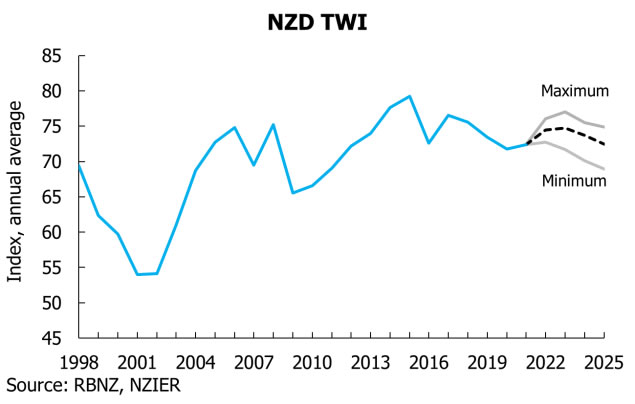
The NZD outlook is mixed with trade-weighted index revised lower in the near term. However, NZIER said, "expectations are for the currency to remain elevated over the coming years," as RBNZ rate hike expectations improved yield attractiveness.
New Zealand ANZ business confidence rose to -6.8, showing resilience
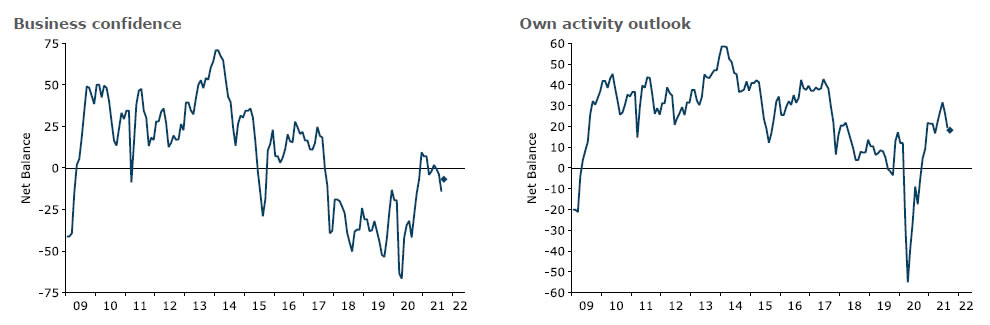
In the preliminary September read, New Zealand ANZ Business confidence rose to -6.8, up from August's -14.2. Own Activity outlook dropped to 18.2, down from 19.2. Looking at some more details, export intentions dropped from 7.4 to 5.7. Investment intentions dropped from 14.4 to 12.2. Employment intentions dropped from 17.0 to 14.7. Inflation expectations ticked lower from 3.05 to 2.97.
ANZ said the report showed "resilience" despite lockdown in Auckland, with most forward-looking activity indicators holding up well. ANZ said, "We examined a split between Auckland and the rest of the country but the differences were very small."
"Overall, the preliminary ANZ Business Outlook results suggest that firms can see light at the end of the tunnel, even in Auckland. We can do this, it said".
Eyes on CPI from US, Canada and UK
Focuses will turn back to economic data this week. In particular, US, Canada, and UK will release CPI, which might not start to show plateauing in the surge in inflation. In additional, US retail sales and regional Fed surveys, UK employment and retail sales, Australia employment, and a bunch of data from China will be closely watched. Here are some highlights for the week:
- Monday: Japan BSI manufacturing index, PPI.
- Tuesday: Australia house price index, NAB business confidence; UK employment; Swiss PPI; US CPI; Canada manufacturing sales.
- Wednesday: New Zealand current account; Japan machine orders, tertiary industry index; China retail sales, industrial production, fixed asset investment; UK PI, PPI; Eurozone industrial production; Canada CPI; US Empire state manufacturing, import prices, industrial production.
- Thursday; New Zealand GDP, Australia employment; Japan trade balance; Eurozone trade balance; Canada housing starts, ADP employment wholesale sales; US retail sales Philly Fed survey, jobless claims, business inventories.
- Friday: New Zealand BusinessNZ manufacturing; UK retail sales; Eurozone current account CPI final; US U of Michigan sentiment.
EUR/USD Daily Outlook
Daily Pivots: (S1) 1.1797; (P) 1.1824; (R1) 1.1838; More...
EUR/USD's break of 1.1792 support argues that rebound from 1.1663 has completed at 1.1908, after rejection by 1.1907 key structural resistance. The development also dampened our original bullish view. Intraday bias is back on the downside for retesting 1.1663 support. Break there will extend the whole pattern from 1.2348 towards 1.1602 key support level. On the upside, above 1.1850 minor resistance will turn bias back to the upside for another test on 1.1907/8 resistance.
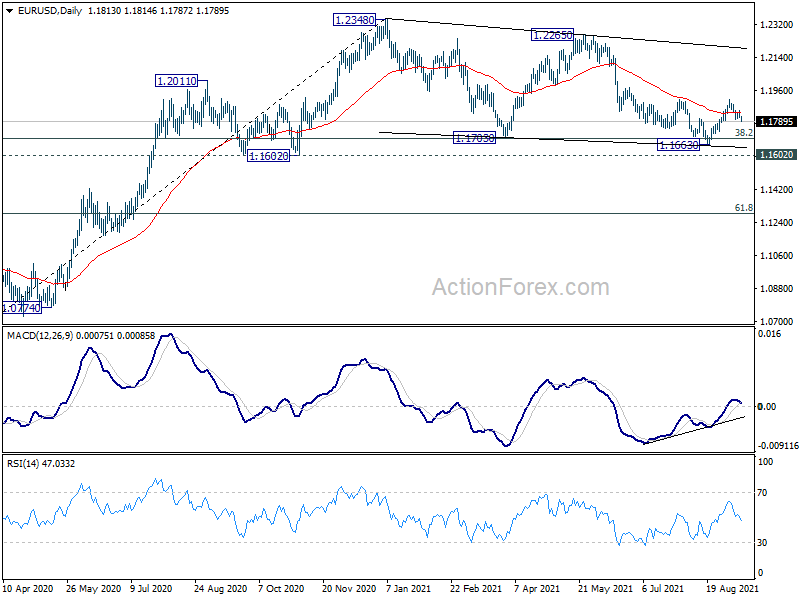
In the bigger picture, rise from 1.0635 is seen as the third leg of the pattern from 1.0339 (2017 low). Further rally remains in favors long as 1.1602 support holds, to cluster resistance at 1.2555 next, (38.2% retracement of 1.6039 to 1.0339 at 1.2516). However sustained break of 1.1602 will argue that the rise from 1.0635 is over, and turn medium term outlook bearish again. Deeper fall would be seen to 61.8% retracement of 1.0635 to 1.2348 at 1.1289 and below.
Economic Indicators Update
| GMT | Ccy | Events | Actual | Forecast | Previous | Revised |
|---|---|---|---|---|---|---|
| 23:50 | JPY | PPI Y/Y Aug | 5.50% | 5.60% | 5.60% | |
| 23:50 | JPY | BSI Large Manufacturing Conditions Index Q3 | 7 | -0.9 | -1.4 | |
| 18:00 | USD | Monthly Budget Statement (USD) Aug | -260.5B | -302.1B |
EUR/USD Corrects Lower, Key Support Nearby
Key Highlights
- EUR/USD started a downside correction from the 1.1900 region.
- It broke a major bullish trend line with support near 1.1840 on the 4-hours chart.
- GBP/USD recovered losses, but it is still facing hurdles near 1.3880.
- Gold price is showing a few bearish signs below the $1,800 support.
EUR/USD Technical Analysis
The Euro started a steady increase after it broke the 1.1800 resistance against the US Dollar. EUR/USD climbed above 1.1850, but it struggled to gain pace above 1.1900.
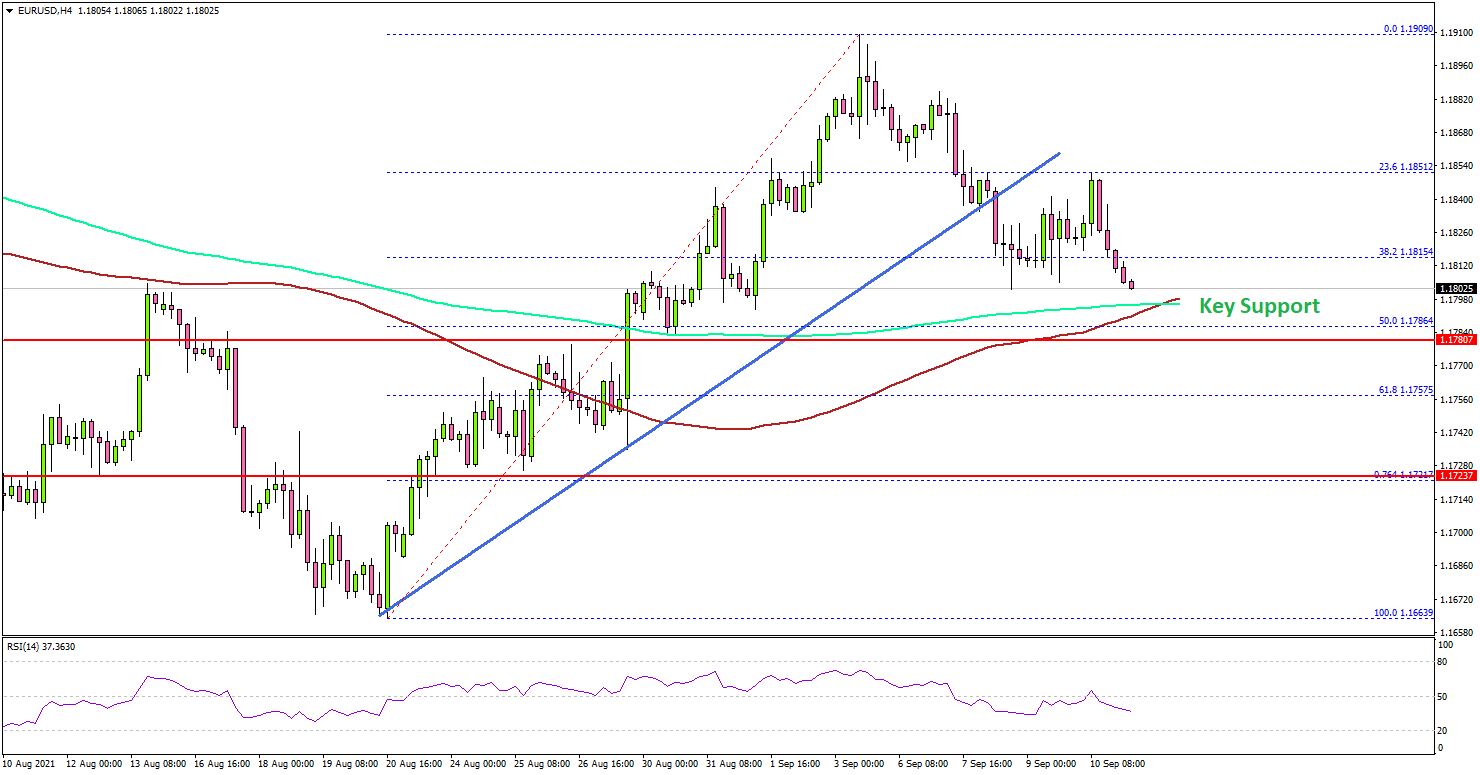
Looking at the 4-hours chart, the pair traded as high as 1.1909 before correcting lower. There was a break below the 1.1880 and 1.1850 support levels. Besides, there was a break below a major bullish trend line with support near 1.1840.
The pair traded below the 38.2% Fib retracement level of the upward move from the 1.1663 swing low to 1.1909 high.
On the downside, there is a major support waiting near 1.1785, the 200 simple moving average (green, 4-hours), and the 100 simple moving average (red, 4-hours).
The 50% Fib retracement level of the upward move from the 1.1663 swing low to 1.1909 high is also near the 1.1785 level. If the pair fails to stay above the 1.1785 support zone, there is a risk of a move towards the 1.1720 support.
On the upside, an initial resistance is near the 1.1850 level. The first major resistance is near the 1.1880 level. The main hurdle sits near the 1.1900 level, above which EUR/USD might rise towards the 1.2000 level.
Looking at GBP/USD, the pair corrected lower, but it bounced back from 1.3740 and it climbed above the 1.3800 resistance zone. Besides, USD/JPY is still facing resistance near the 110.20 level.
Economic Releases
- US Monthly Budget Statement.
Market Morning Briefing: Aussie Holds Well Below 0.74
STOCKS
Dow and Dax trade lower while Nikkei and shanghai too have dipped slightly. We may expect some consolidation within the immediate support and resistance levels for a few sessions. Indian equities had risen on Friday but we need to see if the rise would sustain today or the indices may see a small corrective dip from current levels.
Dow (34607.72, -271.66, -0.78%) has broken 34750 and is heading towards crucial trend support near 34500/450 which needs to hold in order to see a sharp bounce back towards 35000 or higher in the medium term. Failure to bounce from 34500/450 will be strongly bearish for a sharp fall in the longer run taking the index down towards 34000-33000 in the coming weeks. Watch price action near 34500/450 in the next few sessions.
DAX (15609.81, -13.34, -0.085%) has support near 15600 and lower near 15400 and while that holds, we may expect a trade within 15800-15600/400 in the near term. A bounce from 15600-15400 is on the cards in the medium term.
Nikkei (30292.84, -89, -0.29%) is sustaining above 30,000 and while that holds, view remains bullish to see a test of 30500/700 on the upside before we see a dip back to 30000-29500 is seen in the coming sessions.
Shanghai (3699.27, -3.84, -0.10%) is trying to rise above 3700 in line with our expectations. Shanghai needs to sustain above 3700 to test 3800 in the coming 1-2 weeks.
Nifty (17369.25, +15.75, +0091%) is still trading between the range of 17250-17500 as we had mentioned previously. The view is to see a test of 17250 which is the lower side of the range followed by a rise towards 17500 and eventually 17700/800.
Sensex (58305.07, +54.81, +0.094%) has been consolidating between the levels of 58000-59000. View remains bullish to see a rise above 59000 in the coming sessions.
COMMODITIES
Commodity prices trade higher. Crude prices have risen and could rise further to test respective resistances in the near term before coming off from there. Brent may rise towards 74-75 or even 76-78 while WTI may test 72. Gold needs to sustain above 1780 to move up slowly else can fall back to 1770/40. Silver may test 23.50-23.00 before bouncing back from there. Resistance on Copper has held at 4.47 and while that holds, a fall to 4.40/30 is possible.
Brent (73.44) has held well above immediate trend support at 71 and bounced back from there to rise sharply breaking above immediate resistance at 73. While above 73, Brent is likely to be bullish and test 74-75 or even 76-78 on the upside before a fall from there is seen. Contrary to our expectation of a fall to 67/65, we may have to allow for a rise in the near term.
WTI (70.24) has broken above immediate trend resistance at 70 and if that sustains, a rise to 72 is possible before falling off from there. Support is seen near 68 for the near term.
Gold (1791.40) fell sharply from 1806 on Friday. Immediate support is seen near 1780 which if breaks can take the price sharply lower towards 1770/40 in the coming sessions. Watch price action near 1780 for now,
Silver (23.79) is trading within our expected range of 23.50-25 and while that holds, we may expect a test of 23.50 or even 23 before a bounce is seen from there.
Copper (4.4290) rose sharply yesterday testing immediate trend resistance near 4.47 before dipping back from there. While resistance near 4.47 holds, price can fall towards 4.30 in the next few sessions before any bounce is seen from there.
FOREX
Dollar Index has bounced back and can test 92.80/93.00 before falling back from there. Euro needs to sustain above 1.1775/1.1750 to eventually head higher breaking above 1.19 on the upside. EURJPY looks ranged within 131-129.60. Aussie and Pound can be stable while below resistances at 0.7450 and 1.39 respectively. USDCNY is rising and may test 6.46/47 in the near term while USDINR can test 73.40/30 before bouncing higher. USDJPY can trade within 110.40-109.60 in the near term.
Dollar Index (92.67) can test 92.80-93.00 on the upside on a break above 92.75. While below 92.75, there is scope for a fall to 92.25-92.00. Overall broad range of 92.00-93.00 can hold for the next 1-2 weeks.
Euro (1.1802) can fall to 1.1775-1.1750 but may bounce back from there and hold the upward momentum in the medium term. A break below 1.1750 if seen can again trigger a fall towards 1.17-1.1660 in the medium term. While above 1.1750, there are chances of a bounce back.
EURJPY (129.77) is holding below 131 and can fall towards 129.50-129.00 before bouncing back towards 131 again in the medium term.
Dollar-Yen (109.94) fell from 110.40 last week and while that holds, we may expect trade within 110.40-109.60 in the near term. A break on either side of this range can lead to a sharp break out in the longer run.
Aussie (0.7359) holds well below 0.74 and is likely to trade within 0.7450-0.7350 in the very near term. A break below 0.7350, if seen can take the price lower towards 0.73 or even 0.7250-0.72in the medium term before a sharp bounce is seen. Watch price action near 0.7350 for now.
Pound (1.3835) is holding below 1.39 and while that holds, a fall to 1.3750-1.37 is possible before it bounces back again in the medium term. Overall broad range of 1.39-1.37 may hold for the next few weeks.
USDCNY (6.4531) fell to 6.4337 on Friday before bouncing back sharply from there. A rise to 6.46/47 is possible in the near term.
USDINR (73.5050) fell sharply from 73.85 levels last week. While the fall sustains, a test of 73.40/30is possible before a bounce back is seen in the medium term.
INTEREST RATES
The US Treasury yields remain stable. While the near-term supports on the 10Yr and 30Yr continues to holds, we expect the yields to move up further in the coming weeks. The chances of seeing an extended rise are also there which we will have to keep a close watch. The German yields sustain higher and have room to move up further within the current corrective rally to test the key resistances and then can reverse lower again. The 10Yr and 5Yr GoI have come-off last week after testing their resistances. The outlook is bearish to see a fresh fall in the coming days.
The US 2Yr (0.21%), 5Yr (0.82%), 10Yr (1.33%) Treasury yields remain stable while the 30Yr (1.92%) has dipped slightly. While above 1.3%, the 10Yr is bullish to test 1.45%-1.5% even (revised up from 1.4%-1.45% mentioned last week). From a bigger picture we will have to see the chances of this rise extending even up to 1.7% in the coming months. A strong fall below the 1.2%-1.18% support zone is needed to become bearish again. The 30Yr on the other hand can break 2% and rise to 2.1% and even higher while it stays above 1.8%.
The German 2Yr (-0.71), 5Yr (-0.64%), 10Yr (-0.33%) and 30Yr (0.15%) yields continue to sustain higher and stable. Our view of seeing -0.30%/-0.25% (10Yr) and 0.20% (30Yr) on the upside remains intact. Thereafter we expect the yields to reverse lower and resume the broader downtrend.
The Indian 10Yr GoI (6.1782%)had come-off last week after testing 6.2%. The outlook is bearish while below 6.2% to test 6.15%-6.14% immediately and then 6.1%-6% eventually in the coming weeks. The 5Yr GoI (5.6080%) had failed to break above the resistance at 5.64% and keeps our bearish view intact of testing 5.55%-5.5% on the downside.
Aussie Struggles ahead of Key Jobs Data
The Aussie dollar was weakest in the G10 last week, down -1.4%. This seems consistent with 4 straight days of declines in global equities, but Australia’s local news also continues to weigh. A busy calendar in the week ahead includes Australia’s August labour force survey and US August CPI.
Aussie struggles ahead of key jobs data
The Aussie dollar was weakest in the G10 last week, down -1.4%. This seems consistent with 4 straight days of declines in global equities, but Australia’s local news also continues to weigh. With little official data, the domestic focus was the RBA policy decision. A$ popped higher briefly to 0.7468 on the initial headlines revealing that the RBA was proceeding with its plan to slow the pace of weekly bond purchases from $5bn to $4bn. But the RBA also decided to extend its program through February 2022 rather than review it in November.
The RBA’s confidence in the Australian economy rebounding later this year was also toned down. The AUD/USD reversal to below 0.7400 later that day was mostly driven by a stronger US dollar, but of course there was little reason to buy the currency as Australia’s battle with the delta variant of Covid-19 kept Sydney and Melbourne in lockdown. Both NSW and Victoria reported 2021 highs for daily new cases.
There remains reason to be optimistic about where Australia eventually ends up in terms of vaccination coverage relative to other nations. This would be a major positive for the economy and the currency. But it is probably a story for October-November at the earliest. Near term, there are some major data hurdles for the Aussie.
The NAB Australia business confidence index was historically buoyant earlier this year but slumped from +11 in June to -8 in July. It is hard to imagine much optimism in the August survey. The Westpac-Melbourne Institute consumer sentiment survey has been somewhat more resilient than expected lately, with the key index still above 100 in August, but its downward trend has been clear since the April high.
But Australia’s main market focus will be August jobs report. Westpac expects a -150k slide in employment, with plenty of room for surprise: economists’ forecasts range from -300k to +2k. The unemployment rate should rise to 5.0% after the misleading 4.6% in July.
There is also plenty to watch offshore. Last week’s US dollar gains were probably due to haven demand as equities wobbled rather than a vote of confidence in the US economy. As the delta variant impedes the recovery of many industries, US Q3 GDP growth estimates are being marked lower. Influential New York Fed president John Williams indicated that the FOMC would take its time to ease back on stimulus. But expectations for the Fed are still fluid, so there will be keen interest in the US August inflation data as well as the first of the September regional business surveys.
On the commodity side, coal prices remain at multi-year highs but iron ore has slipped back below $130/tonne. China’s August industrial production data will be an important guidepost to future industrial commodity price trends though for now, Australia’s trade surpluses remain massive.
Event risk this week
Aust Aug NAB business confidence, RBA Governor Lowe speaks on economy, UK Jul unemployment, US Aug CPI (Tue), Aust Sep Westpac consumer sentiment, NZ Q2 balance of payments, China Aug industrial production & retail sales, UK Aug CPI, US Sep NY Fed Empire State survey (Wed), Aust Aug labour force survey, NZ Q2 GDP, US Aug retail sales (Thu), UK Aug retail sales, US Sep consumer sentiment (Fri)
Japan corporate goods price ticked down to 5.5% yoy, wholesale inflation will remain under upward pressure
Japan's corporate goods price index slowed slightly to 5.5% yoy in August. But it was close to July's 5.6% yoy, which was the highest reading since September 2008. Also, at 105.8, the index marked the highest level since 1982.
Shigeru Shimizu, head of the BoJ's price statistics division, said, "as the global economy continues to recover thanks to progress in vaccinations, domestic wholesale inflation will remain under upward pressure, though there's uncertainty over the outlook due to a resurgence in infections."
NZIER revised up inflation forecast, NZD to remain elevated for coming years
In NZIER's September survey, consensus forecast for 2021/22 GDP was revised down from 5.0% to 4.5%. But 2022/23 GDP forecast for 2022/23 was revised up from 3.7% to 4.5%. The revision likely reflects the impact of the current COVID-19 outbreak. GDP is forecast to grow 2.3% in 2023/24 (revised down from 2.6%), then pick up to 2.7% in 2024/25.
Inflation forecasts were revised up sharply from 2.1% to 3.5% in 2021/22, up from 1.9% to 2.0% in 2022/23. It's unchanged at 2.2% in 2023/24 and expected to be steady at 2.2% in 2024/25. NZIER said, "Capacity pressures continue to build up across the New Zealand economy, as acute labour shortages and COVID-related supply chain disruptions drive up cost pressures further. Solid demand has made it easier for businesses to pass these costs onto customers by raising prices."
The NZD outlook is mixed with trade-weighted index revised lower in the near term. However, NZIER said, "expectations are for the currency to remain elevated over the coming years," as RBNZ rate hike expectations improved yield attractiveness.
New Zealand ANZ business confidence rose to -6.8, showing resilience
In the preliminary September read, New Zealand ANZ Business confidence rose to -6.8, up from August's -14.2. Own Activity outlook dropped to 18.2, down from 19.2. Looking at some more details, export intentions dropped from 7.4 to 5.7. Investment intentions dropped from 14.4 to 12.2. Employment intentions dropped from 17.0 to 14.7. Inflation expectations ticked lower from 3.05 to 2.97.
ANZ said the report showed "resilience" despite lockdown in Auckland, with most forward-looking activity indicators holding up well. ANZ said, "We examined a split between Auckland and the rest of the country but the differences were very small."
"Overall, the preliminary ANZ Business Outlook results suggest that firms can see light at the end of the tunnel, even in Auckland. We can do this, it said".
Fed Harker: I’d like to start tapering soon to buy ourselves option
Philadelphia Fed President Patrick Harker said in a Nikkei interview that he'd like to start tapering asset purchases. He sees "elevated risk" of inflation running higher.
He said, "my baseline forecast is still to have inflation around 4% this year, ending this year, and then starting to fall back to 2% over the years 2022 and 2023. However, I do see elevated risk that inflation could run higher".
"I'd like to start the taper process soon, so that we can finish the tapering process, so if we need to increase the policy rate, we have the room to do that. And I think we need to buy ourselves that option," he added.
SNB Zurbruegg: Negative interest rates still needed due to the situation globally
SNB Vice President Fritz Zurbruegg said in a Sonntagszeitung interview over the weekend, "at the moment we need the negative interest rates due to the situation globally." He warned, "if we were to hike interest rates now, the franc would appreciation markedly, economic growth would slow and joblessness would increase." He also noted that the pickup in inflation in Switzerland is "temporary". In the medium term, "we expect it to stay low," he said.
President Thomas Jordan remains on leave on medical grounds and there is no return date yet. Zurbregg said finding a successor for Jordan "isn't a topic". "Thomas Jordan will take up his post again."
Eco Data 9/13/21
[php_everywhere instance="1"]