Sample Category Title
Weekly Focus – Fed Tapering Delayed, Not Derailed
It's been a fairly quiet week in financial markets with equities slightly lower, bond yields flat on the week and the USD strengthening a bit. The ECB meeting turned out to be a bit of a non-event with the ECB broadly meeting consensus expectations of signalling a moderate reduction in asset purchases. The inflation projection was revised slightly higher, but with core inflation in 2023 seen at 1.5% (previously 1.4%) there is still some way up to 2% in the medium term.
The Fed's decision on tapering of asset purchases is still looming but the timing was thrown into renewed uncertainty after the weak US employment report last week. Views expressed by Fed members this week was a mixed bag but points to a delay. Bullard and Kaplan still favours a tapering announcement on the Fed meeting this month while Bostic and Willams prefer a delay due to the weaker data lately. They still look for tapering to begin this year, though. As Williams is vice Chairman and close to Fed Chairman Powell it indicates that we will not get a tapering announcement on the next Fed meeting. We still expect tapering to begin this year and to be done around the middle of 2022.
'Stagflation' fears have been on the rise lately as economic data has increasingly dissapointed while inflation concerns persist as freight rates have continued higher, labour shortages are widespread in many countries and bottle necks in manufacturing and ports delay delivery of consumer goods. The delta variant continues to challenge many big Asian countries with a big share of manufacturing such as Malaysia and Vietnam. Whether this 'stagflationary' scenario is more persistent will depend a lot on whether more people that left the labour force during the past year returns to the labour market and whether inflation expectations remain anchored. This week we sent out Big Picture -Delta delayed recovery, in which we downgraded our global growth forecasts. The balance of risk to our growth outlook is to the downside, while supply side problems could lead to more persistent inflation problems stoking more stagflation concerns. This week the German ZEW expectations index showed another drop highlighting that economic sentiment is coming down from the recent high levels.
In China, the leadership tried to calm fears over the recent crackdown within certain sectors. An op-ed on the front page of People's Daily highlighted that recent regulation aims at supporting the private economy and was targeting a level playing field by cracking down on violations of laws such as abusive market power. The op-ed follows comments by China's economic tsar Liu He, who on Monday vowed that "policies for supporting the private economy have not changed... and will not change in the future".
In the coming week focus turns to the US again. Retail sales will give more information on how much goods consumption is slowing as the effect of the stimulus checks fade. Very strong US goods consumption is a key driver behind the global manufacturing overheating and pressure on global freight. US CPI inflation and regional business surveys will also be very interesting. In the euro area focus will be on ECB speakers, final inflation numbers for August (which provide more details) and German election polls. China releases data on industrial production and retail sales, which have disappointed lately.
Sunset Market Commentary
Markets
Yesterday, the ‘minimalistic’ ECB approach on policy normalization reversed a cautiously ‘hawkish’ positioning on (European) markets earlier this week. Markets understood that the policy calibration indeed was no real change. At the same time, yesterday’s inaction only laid de groundwork for an open, potentially heated debate within a divided ECB in the run-up to the key December meeting. If data on growth and inflation continue on recent trends, the doves might face a more uphill battle. ECB’s Lagarde today evidently repeated yesterday’s growth supportive assessment. Headlines from an interview with ECB Holmann reminded markets of a different view within the ECB. Whatever, markets didn’t build on yesterday’s dovish setback. With no data on the agenda, there was room for a ‘correction on the correction’. German yields are rising/rebounding between 0.7bp (2-y) and 1.5 bp (10-y). Some other interesting observations. The EMU 10 year swap yield rebounded back in positive territory (0.02%) with recent correction top still very nearby. Yesterday’s soft ECB tone and the reluctance to reduce bond purchases pushed the (German 10-y) real yield to an historic low (-2.09). On the other side of the equation, the 5Y/5Y EMU inflation swap continues griding higher touching the 1.80% level, the highest in more than 3 year and creeping further away from the 1.75% reference that ECB’ Lagarde mentioned at the press conference. The narrowing in intra-EMU spreads also already halted today. US interest rates show a similar picture rising between 0.4 bp (2-y) and 2.5 bp (10-y). The 30-y (+ 1.6 bp) showed resilience after yesterday’s impressive auction. European equities mostly show modest gains (~0.3%) but with a lackluster intraday momentum. US indices open about 0.5% higher.
On the FX market, the euro remains in the defensive (EUR/USD 1.1825). The 1.1909 resistance probably has become more solid as investors look forward to the outcome of the tapering debate at the Fed’s September 22 policy meeting. At the same time, the trade-weighted dollar also doesn’t gain traction (92.45). It was a bit under the radar this week, but in retrospect, sterling performed rather well the previous days. EUR/GBP’s rejected test of the 0.86 area evidently includes some post ECB euro weakness. Today’s July UK output/GDP data were unconvincing. Still the market ponders some mildly ‘hawkish’ comments from BoE’s Bailey earlier this week. At 0.8525, EUR/GBP has returned to the middle of the 0.8450/0.8614 ST trading range.
News Headlines
Czech inflation in August accelerated to a faster-than-expected 4.1% y/y (0.7% m/m), the highest in more than a decade. Prices were driven by rents, food and in segments of the economy associated with the reopening (restaurants & hotels, recreation & culture). Inflation is seen increasing even further to around 5% by the end of this year as the winter will push up prices of regulated items including energy and heating. The number far exceeds the CNB’s upper limit of the 2% +/- 1ppt target range. It is a near-done deal that the CNB will hike rates at each of the three remaining policy meetings this year. Today’s inflation figure adds more fuel to the debate whether one of the hikes should be a 50 bps one instead of a regular 25 bps. The Czech krone strengthens against the euro in a response today. EUR/CZK briefly broke below strong 25.3 support but that move failed for now.
The central bank of Russia increased policy rates again from 6.50% to 6.75%. Today’s rate hike was less than expected (50 bps) but followed the biggest one since 2014 in July (+100 bps). The Bank of Russia is trying to rein in inflation as price growth exceeds the 4% target substantially (6.7% in August). With inflation expectations still high, the balance of risks for inflation remains tilted to the upside, the bank said, suggesting more tightening to come. It may stick to a slower pace however, as Russia’s economic recovery is losing steam. Next week’s parliamentary elections are further complicating the picture. President Putin has pledged almost 700bn rubbles in new social spending, which may add to price pressure. The rubble holds steady after the policy announcement. EUR/RUB is testing important support at 86. A break lower would drastically improve the rubble’s technicals.
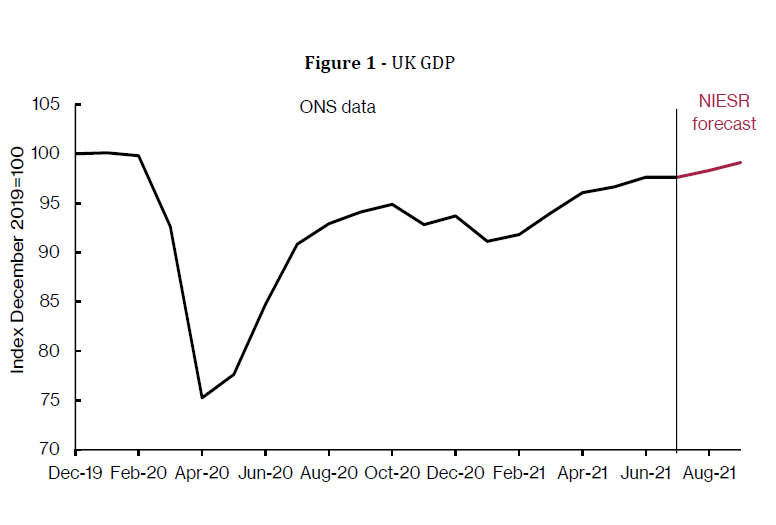
NIESR expects UK GDP growth to pick up to 0.7% in Aug and 0.8% in Sep
Despite weaker than expected 0.1% monthly GDP growth in UK, NIESR expects growth to pic up in August to 0.7%, followed by 0.8% in September. That would lead to overall 1.6% growth in Q3. It added that however, there are "notable downside risks" to a consumption led recovery, including the re-emergence of Covid-19 and the response of household and business spending to the end of the furlough scheme and the planned reduction in Universal Credit.
"GDP growth of under 0.1 per cent in July would have been negative had it not been for the reopening of an oil field previously closed for temporary maintenance. There was also relatively good news for the arts and recreation sector, thanks to the lifting of restrictions on 19th July, but clearly the boost to GDP from reopening had slowed by the summer. The Delta variant and supply issues – some but not all of which are linked to Covid-19 – have also provided headwinds to growth in the third quarter but there remains potential for 'catch-up' in transport, hospitality and arts, which remained between 7 and 19 per cent below their February 2020 levels." Rory Macqueen Principal Economist - Macroeconomic Modelling and Forecasting.
EUR/USD Mid-Day Outlook
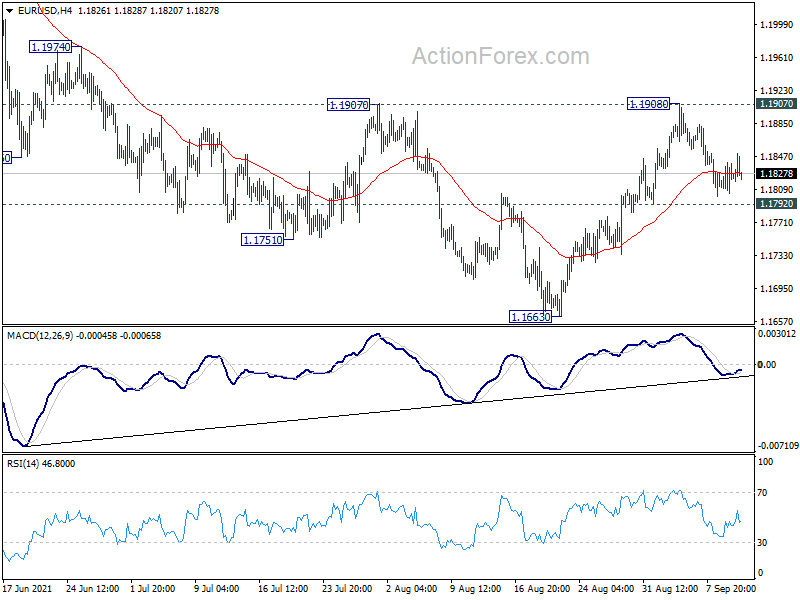
Daily Pivots: (S1) 1.1805; (P) 1.1823; (R1) 1.1841; More...
Outlook in EUR/USD is unchanged and intraday bias remains neutral first. On the downside, break of 1.1792 support will confirm rejection by 1.1907 resistance. Intraday bias will be turned back to the downside for retesting 1.1663 low first. On the upside, sustained break of 1.1907 should indicate that fall from 1.2265, as well as the consolidation pattern from 1.2348, have completed. Near term outlook will be turned bullish for 1.2265/2348 resistance zone.
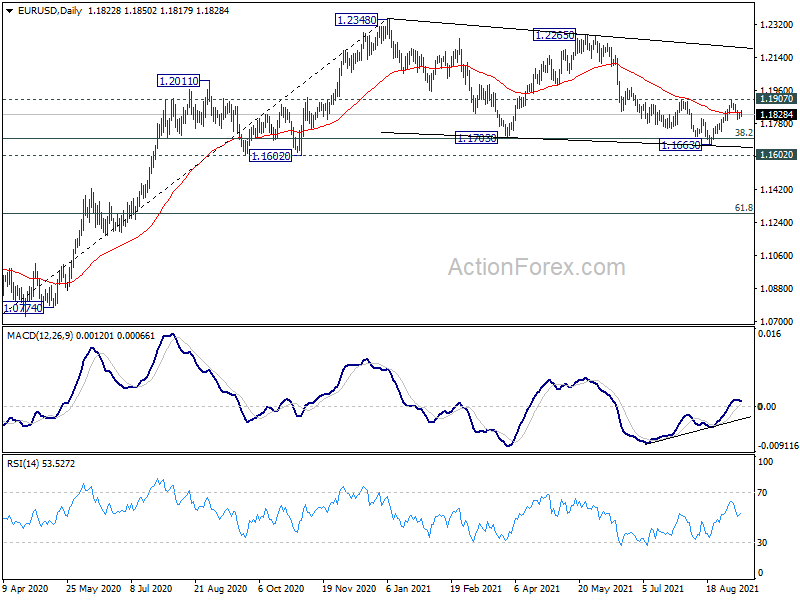
In the bigger picture, rise from 1.0635 is seen as the third leg of the pattern from 1.0339 (2017 low). Further rally remains in favors long as 1.1602 support holds, to cluster resistance at 1.2555 next, (38.2% retracement of 1.6039 to 1.0339 at 1.2516). However sustained break of 1.1602 will argue that the rise from 1.0635 is over, and turn medium term outlook bearish again. Deeper fall would be seen to 61.8% retracement of 1.0635 to 1.2348 at 1.1289 and below.
GBP/USD Mid-Day Outlook
Daily Pivots: (S1) 1.3774; (P) 1.3818; (R1) 1.3883; More...
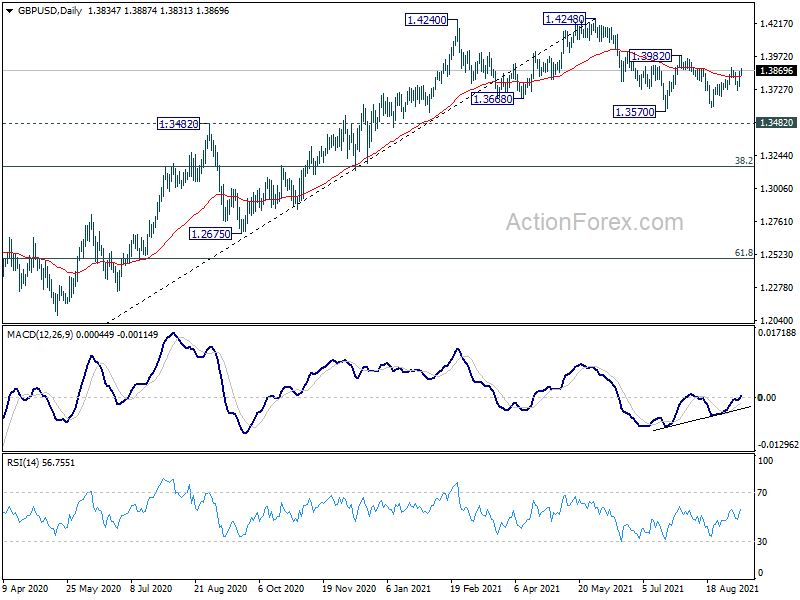
Intraday bias in GBP/USD remains neutral with focus on 1.3890 resistance. On the upside, break of 1.3890 will target 1.3982 resistance first. Decisive break there will indicate that fall from 1.4248 has completed. Near term outlook will be turned bullish for retesting 1.4248. On the downside, firm break of 1.3725 support will suggest that rise from 1.3601 has completed. Intraday bias will be turned back to the downside for 1.3570/3601 support zone.
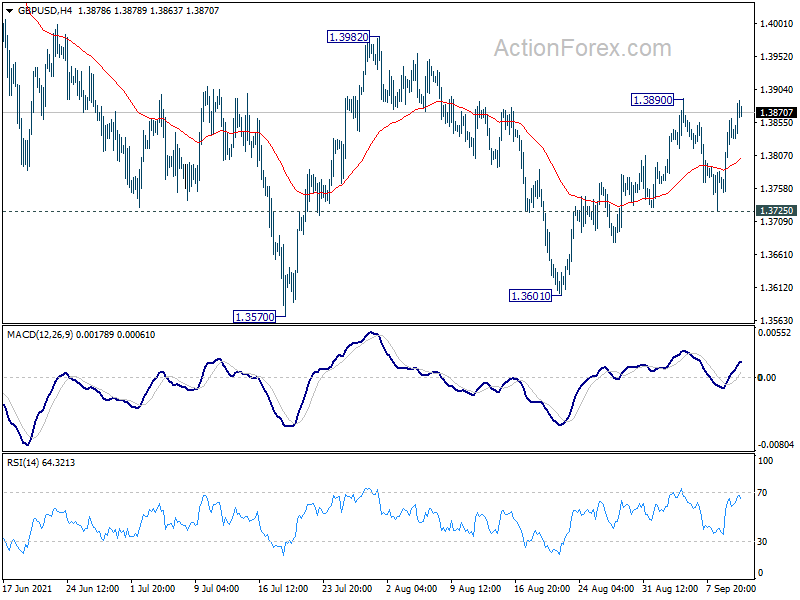
In the bigger picture, as long as 1.3482 resistance turned support holds, we'd still treat price actions from 1.4248 as a corrective move. That is, up trend from 1.1409 (2020 low) is in favor to resume. Decisive break of 1.4376 key resistance (2018 high) would indeed carry long term bullish implications. However, sustained break of 1.3482 will at least bring deeper fall to 38.2% retracement of 1.1409 to 1.4248 at 1.3164, or even further to 61.8% retracement at 1.2493.
USD/CHF Mid-Day Outlook
Daily Pivots: (S1) 0.9144; (P) 0.9183; (R1) 0.9206; More....
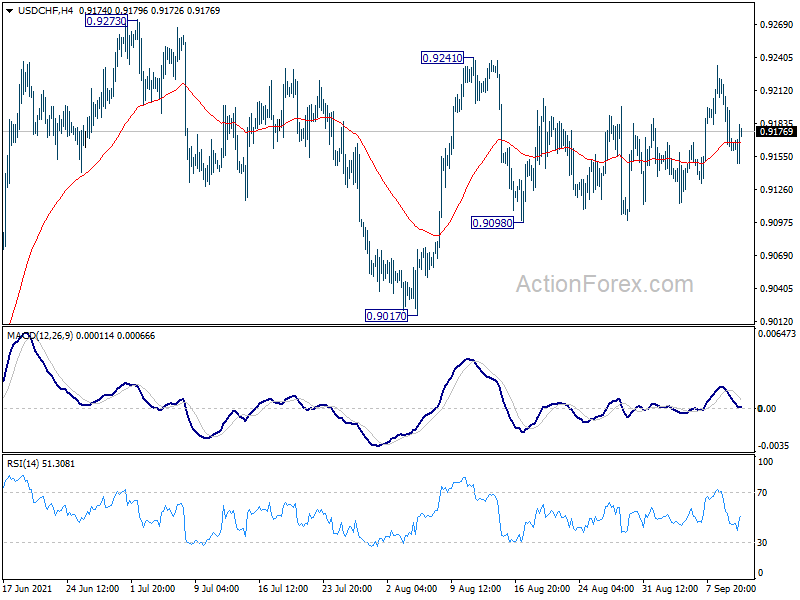
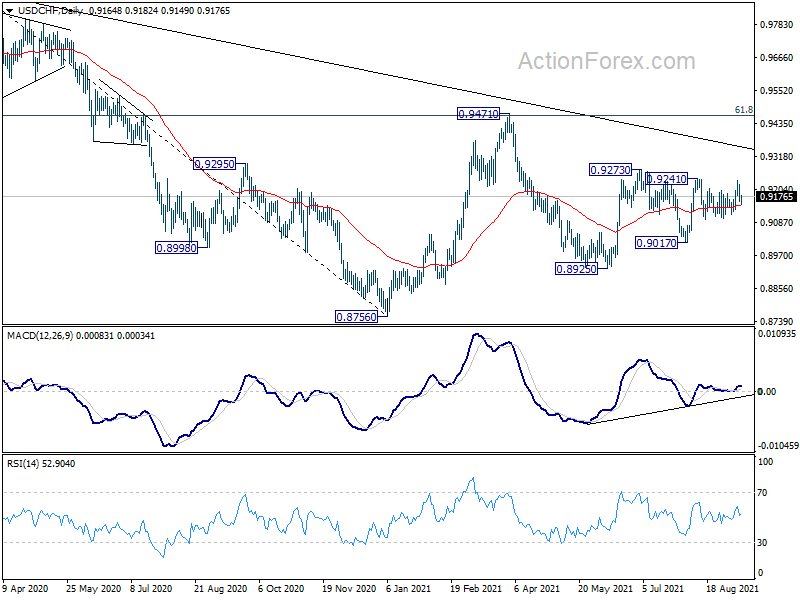
Intraday bias in USD/CHF remains neutral as sideway trading continues. On the upside, break of 0.9241 resistance should resume the rise from 0.8925 through 0.9273. On the downside, break of 0.9098 will target 0.9017 support first. Further break there will likely resume the decline from 0.9471 through 0.8925 low.
In the bigger picture, USD/CHF is still struggling around 55 week EMA (now at 0.9176) and outlook is mixed for now. Confirmed rejection by the 55 week EMA will retain medium term bearishness. That is, larger fall from 1.0342 would resume through 0.8756 low at a later stage. However, sustained trading above 55 week EMA will tilt favor to the case of bullish reversal. Focus would then be turned to 0.9471 resistance for confirmation.
USD/JPY Mid-Day Outlook
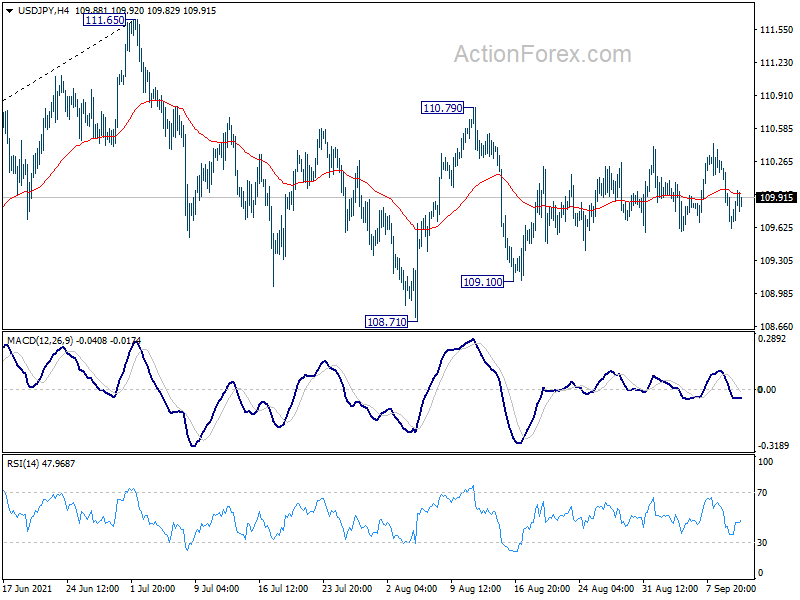
Daily Pivots: (S1) 109.47; (P) 109.88; (R1) 110.14; More...
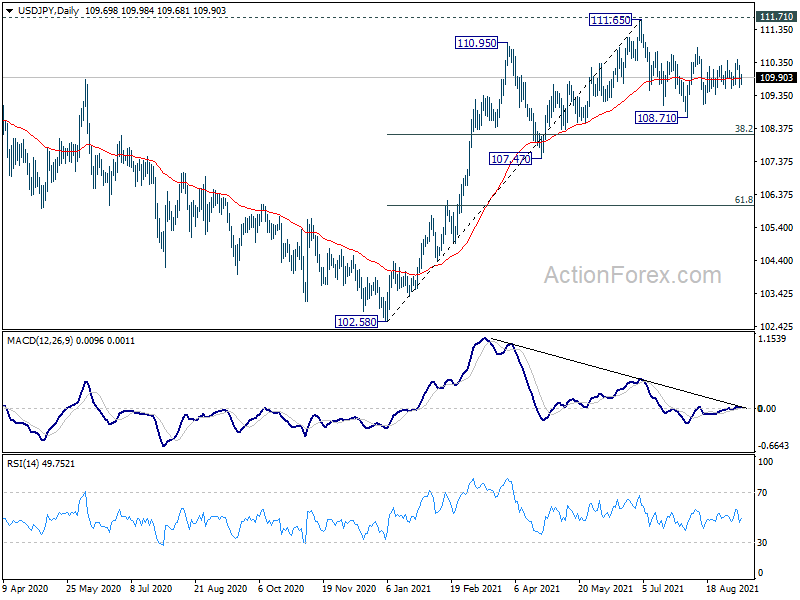
Intraday bias in USD/JPY remains neutral for the moment, as range trading is still in progress. On the upside, break of 110.79 will resume the rebound from 108.71 to retest 111.65 high. On the downside, break of 109.10 will target 108.71 support first. Firm break there will resume the decline from 111.65 and target 38.2% retracement of 102.58 to 111.65 at 108.18 next.
In the bigger picture, medium term outlook is staying neutral with 111.71 resistance intact. The pattern from 101.18 could still extend with another falling leg. Sustained trading below 55 day EMA will bring deeper fall to 107.47 support and below. Nevertheless, strong break of 111.71 resistance will confirm completion of the corrective decline from 118.65 (2016 high). Further rise should then be seen to 114.54 and then 118.65 resistance.
British Pound Closing in on 1.39
The British pound is in positive territory for a second successive day. GBP/USD is currently trading at 1.3883, up 0.35% on the day.
The markets were treated to a data dump out of the UK today, with the highlights being GDP and Manufacturing Production. Investors shrugged off a weak GDP for July, as the economy expanded a negligible 0.1%. This was below expectations and much weaker than the 1.0% gain in June. On a more positive note, GDP grew by 3.6% in the three months to July, due to the reopening of much of the services sector in July. Manufacturing Production came in as expected at 6.0% (YoY), as manufacturing continues to expand.
In the US, inflation remains a critical issue for the markets, which means that US inflation indicators are being closely watched and should be treated as market-movers. The US will release the Producer Price Index (PPI) for August, with the consensus at 8.2%, compared to 7.8% in July. Inflation remains red-hot in the US, but the Fed insists that the jump is transitory and that inflation will ease. However, if we continue to see inflation rising in the final months of 2021, the markets will become more sceptical of the Fed’s stance, and policymakers may have to adjust monetary policy in order to curb inflation, which is well above the Fed’s target of 2%.
The Federal Reserve Beige Book, which was released ahead of the FOMC meeting on September 21-22, points to a bumpy road for the US economy. The report stated that the economy “downshifted slightly” in August as the Delta variant of Covid took a toll on the services particularly, dining, travel and tourism. At the same time, the report stated that the unleashing of demand has resulted in rising prices and labor shortages. Importantly, the report casts doubts on the Fed stance that inflation is transitory, and we could see more Fed members begin to question this view in the coming weeks and months.
GBP/USD Technical Analysis
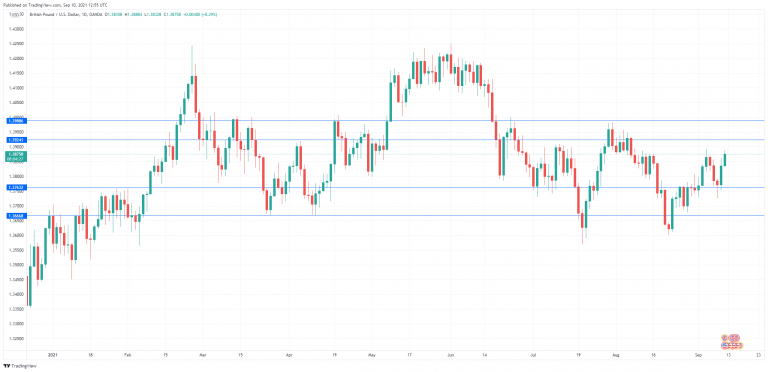
- There is resistance at 1.3924. Above, there is resistance at 1.3988, just below the symbolic line of 1.40
- On the downside, we have support at 1.3763 and 1.3666
Canada: Employment Recovery Continues in August
The Canadian labour market added 90k positions in August and was above the consensus call for 67k. This left employment 0.8% below its pre-pandemic (February 2020) level. Gains were in both full-time (+69k) and part-time (+22k) employment.
Canada's labour force also expanded in August, rising by 9k. However, as employment gains were stronger, the unemployment rate fell by 0.4 percentage points to 7.1% in August, the lowest its been since the start of the pandemic.
By industry, the services sector (+93k) accounted for all of the job growth in August. High-touch services sectors such as accommodation and food (+75k), information, culture, and recreation (+24k) did much of the heavy lifting. Gains were also seen in professional, scientific and technical services (+15k), and public administration (+14k). Meanwhile, employment declines in other services (-30k), and finance, insurance, real estate, rental and leasing (-17k). On the whole, services sector employment returned to its pre-pandemic level for the first time in August.
On the goods side, employment declined by 3k positions. The manufacturing (-6k) and agriculture (-11k) both shed jobs last month, while the construction industry (+20k) saw employment rise for the first time since March this year.
In terms of provinces, Ontario (+53k) once again led the way, followed by Alberta (+20k), Saskatchewan (+10k), and B.C. (+14k). Most other provinces saw little change in August.
Total hours worked only ticked up by 0.1% m/m in August. This left hours 2.6% below the February 2020 level.
Key Implications
Canada's labour market continued to make strides in August, adding a healthy number of jobs, especially in sectors that were hardest hit by the pandemic. Accommodation and food, and information, culture, and recreation, drove the improvement as public health measures were lifted across the country. In addition, relaxation of quarantine rules for U.S. travelers likely aided the recovery.
Still, even with August's advance, the level of employment in high-touch industries was 10% (nearly 300k jobs) off its pre-pandemic mark, and gains have slowed despite provinces further reopening their economies this summer. Indeed, high frequency job postings data show robust demand for workers in these fields, but it appears labour supply has not kept pace, resulting in staff shortages. Career changes, and ongoing health concerns could be possible reasons for the lack of available workers.
Looking ahead, the Delta variant could complicate the labour market recovery in coming months. The virus may have already contributed to weaker confidence among consumers, which could lead to weaker spending activity, thus weighing on labour market improvements. The recovery is likely to be slower and bumpier this fall season.
USD/CAD Mid-Day Outlook
Daily Pivots: (S1) 1.2614; (P) 1.2671; (R1) 1.2719; More...
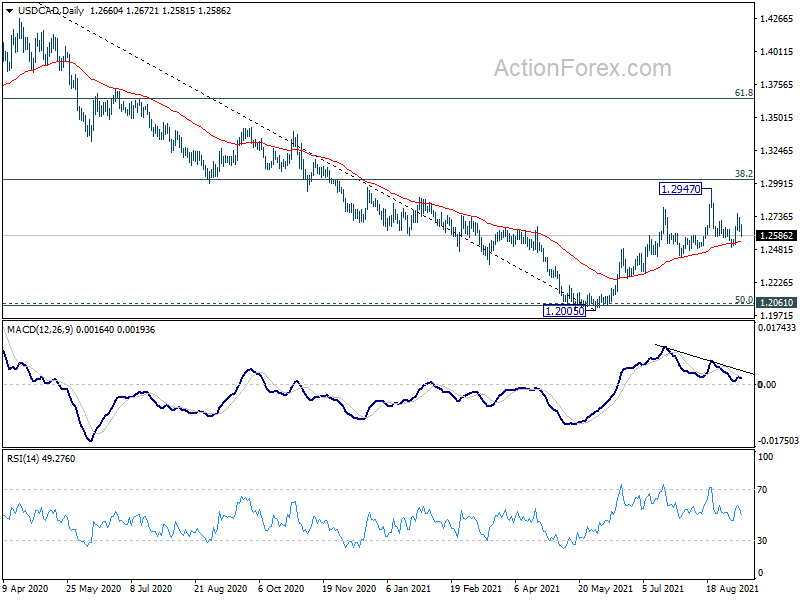
USD/CAD's fall from 1.2760 extends lower today but stays above 1.2492 support. Intraday bias remains neutral first. On the downside, break of 1.2492 will target 1.2421 key structural support next. Sustained break there should indicate completion of whole choppy rise form 1.2005. On the upside, above 1.2760 will bring retest of 1.2947 high instead.
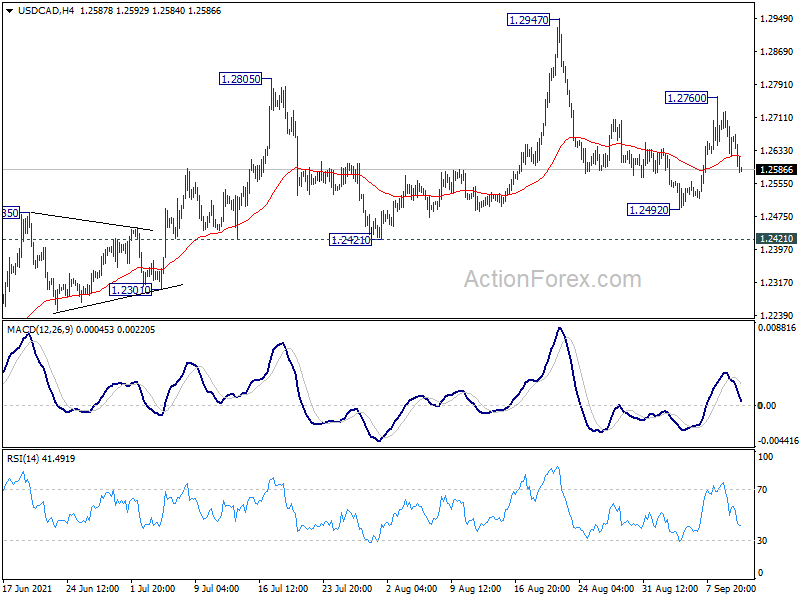
In the bigger picture, fall from 1.4667 is seen as the third leg of the corrective pattern from 1.4689 (2016 high). It should have completed after hitting 1.2061 (2017 low) and 50% retracement of 0.9406 to 1.4689 at 1.2048. Sustained break of 38.2% retracement of 1.4667 to 1.2005 at 1.3022 will pave the way to 61.8% retracement at 1.3650 and above. Overall, medium term outlook remains neutral at worst with 1.2048/61 support zone intact.