

Sample Category Title
AUD/USD Weekly Outlook
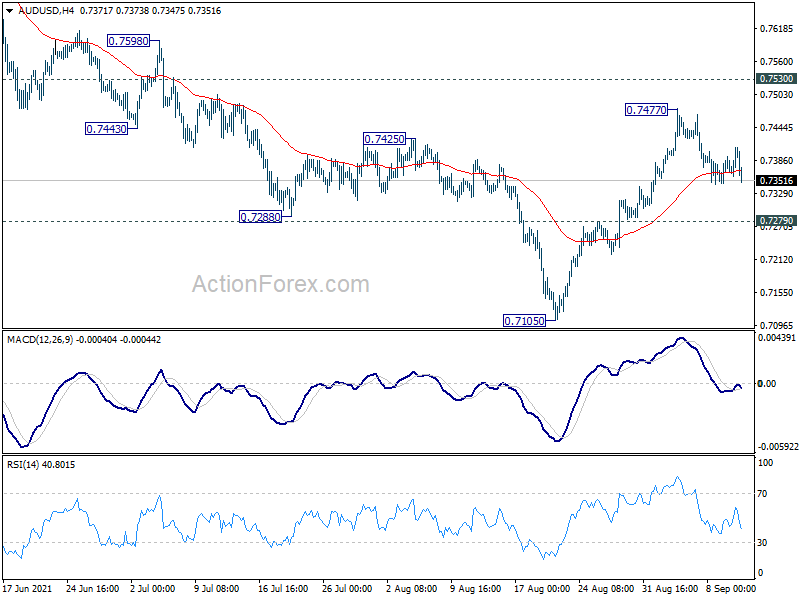
AUD/USD stayed in consolidation last week and outlook is unchanged. Whole corrective pattern from 0.8006 might have completed at 0.7105 already. Further rise is in favor as long as 0.7279 minor support holds. Above 0.7477 will target 0.7530 support turned resistance first. However, break of 0.7279 will dampen our bullish view and turn bias back to the downside for 0.7105 low instead.
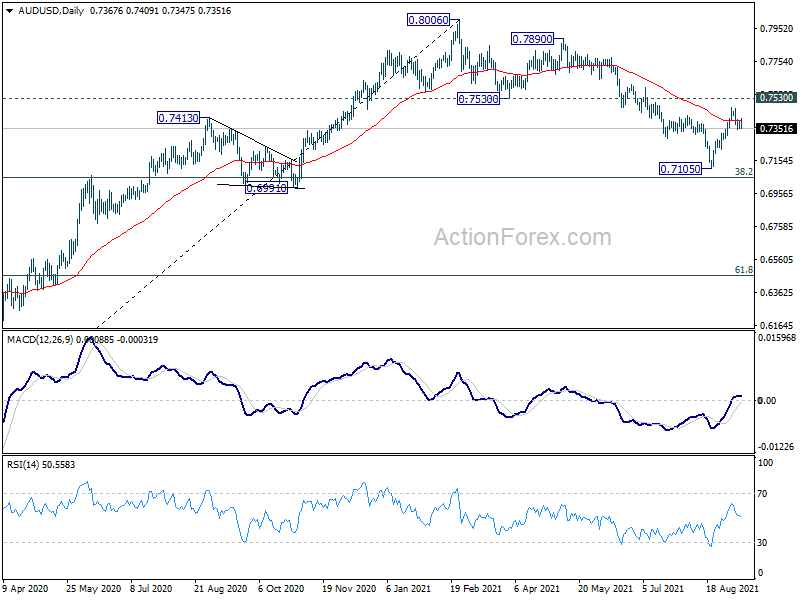
In the bigger picture, with 0.6991 cluster support (38.2% retracement of 0.5506 to 0.8006 at 0.7051) intact, we're seeing price action form 0.8006 as a correction only. That is, up trend from 0.5506 low would resume after the correction completes. In that case, main focus will be 0.8135 key resistance (2018 high). Sustained break there will carry larger bullish implications. However, sustained break of 0.6991 will argue that the whole medium term trend has indeed reversed.
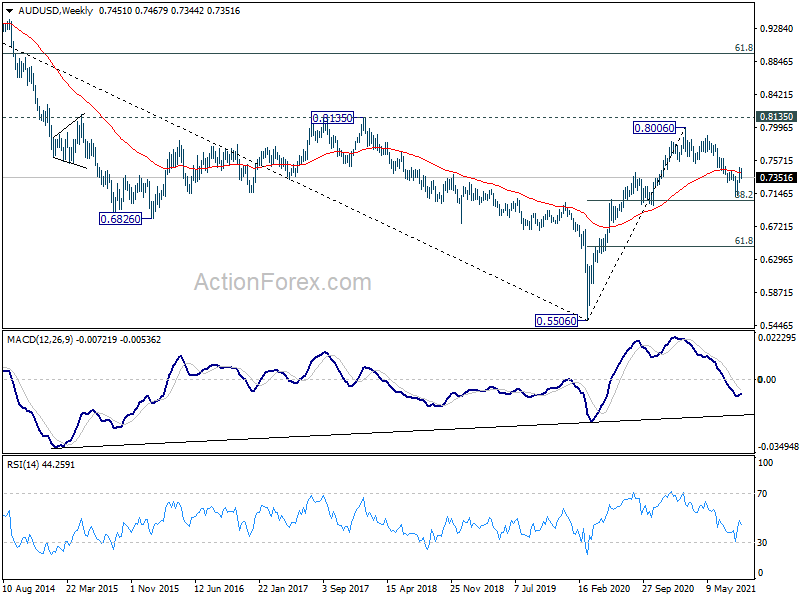
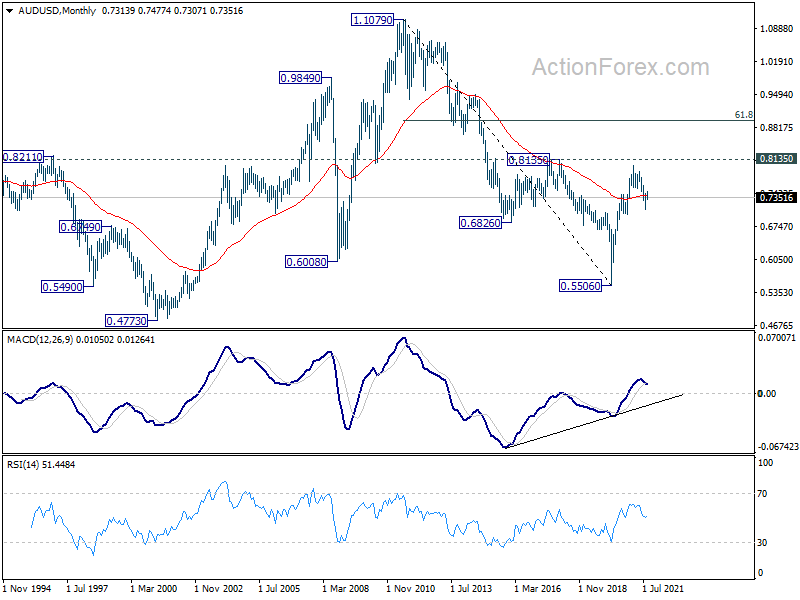
In the longer term picture, focus remains is back on 0.8135 structural resistance. Decisive break there will argue that rise from 0.5506 is developing into a long term up trend that reverses whole down trend from 1.1079 (2011 high). In that case, further rally would be seen to 61.8% retracement of 1.1079 to 0.5506 at 0.8950 and possibly above.
USD/CAD Weekly Outlook
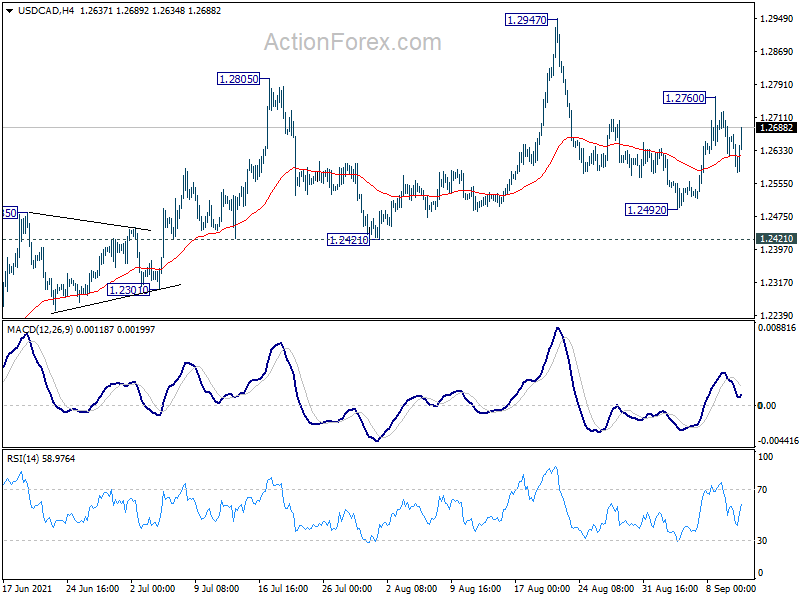
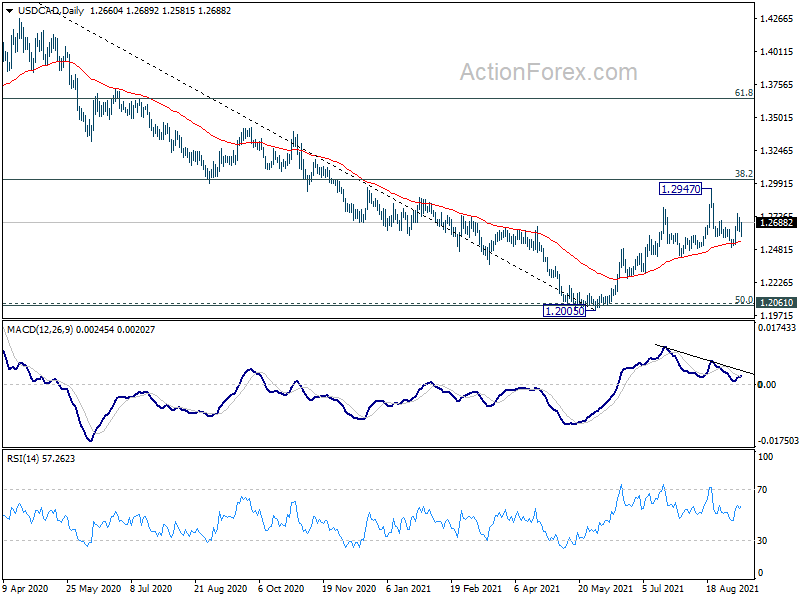
USD/CAD rebounded after dipping to 1.2492 last week. The development suggests that pull back form 1.2947 has completed ahead of 1.2421 support. Rise from 1.2005 is still in progress. But as a temporary top was formed at 1.2760, initial bias remains neutral this week first. On the upside, break of 1.2760 will target a test on 1.2947 high. However, break of 1.2492 will resume the fall from 1.2947 to 1.2421 key structural support.
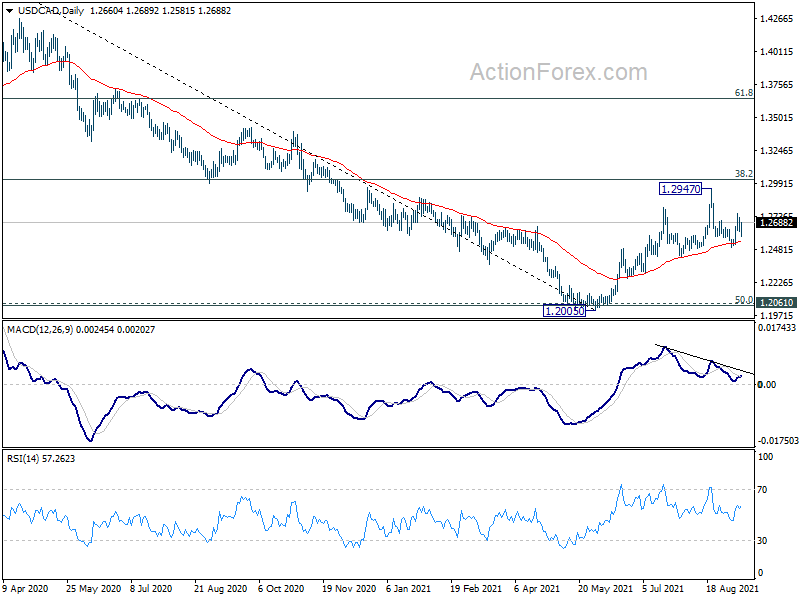
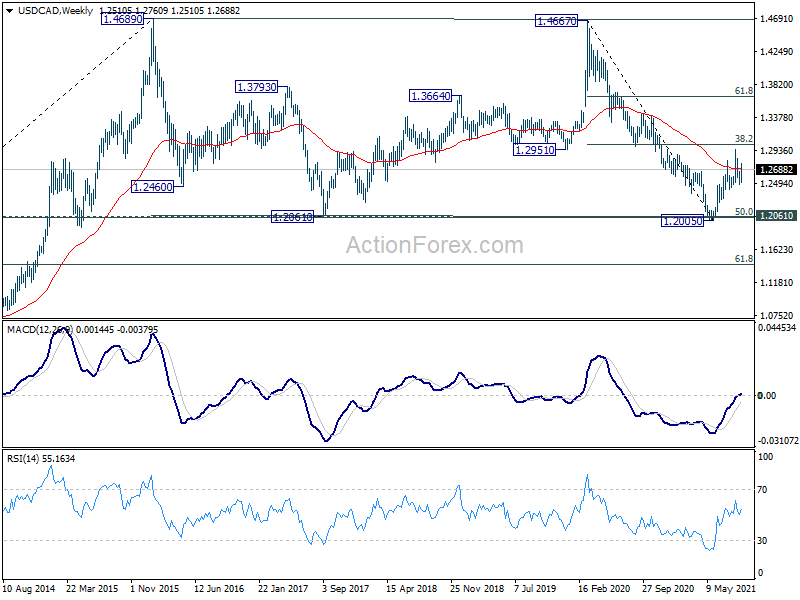
In the bigger picture, fall from 1.4667 is seen as the third leg of the corrective pattern from 1.4689 (2016 high). It should have completed after hitting 1.2061 (2017 low) and 50% retracement of 0.9406 to 1.4689 at 1.2048. Sustained break of 38.2% retracement of 1.4667 to 1.2005 at 1.3022 will pave the way to 61.8% retracement at 1.3650 and above. Overall, medium term outlook remains neutral at worst with 1.2048/61 support zone intact.
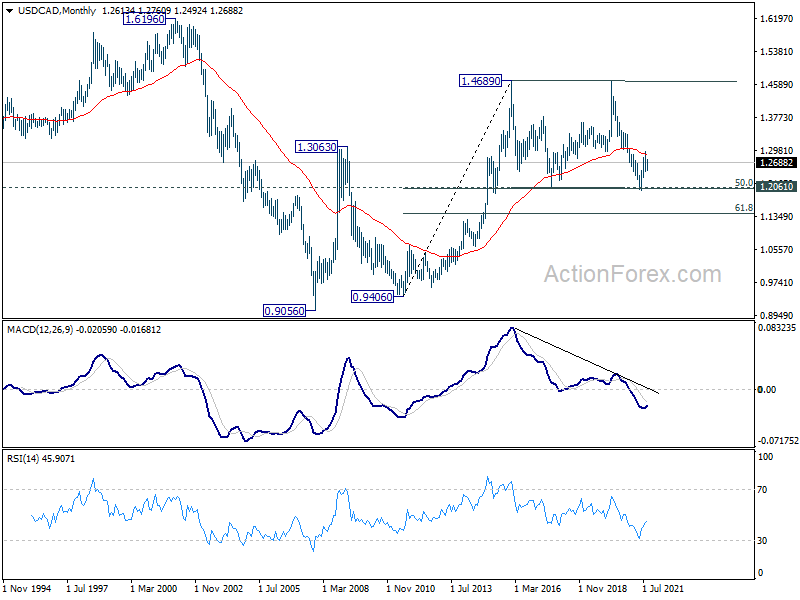
In the longer term picture, we're viewing price actions from 1.4689 as a consolidation pattern. Thus, up trend from 0.9506 (2007 low) is still expected to resume at a later stage. This will remain the favored case as long as 1.2061 support holds, which is close to 50% retracement of 0.9406 to 1.4689 at 1.2048. However, rejection by 55 month EMA, follow by firm break of 1.2061 support, will argue that USD/CAD has already started a long term down trend.
GBP/JPY Weekly Outlook
GBP?JPY's rise from 149.16 continued last week after brief consolidations. Initial bias stays on the upside this week for 153.42 resistance. Firm break there would indicate that the whole corrective pattern from 156.05 has completed. Further rally would then be see to retest this high. However, break of 151.39 support will argue that rebound from 149.16 has completed, and turn bias back to the downside for retesting this low.
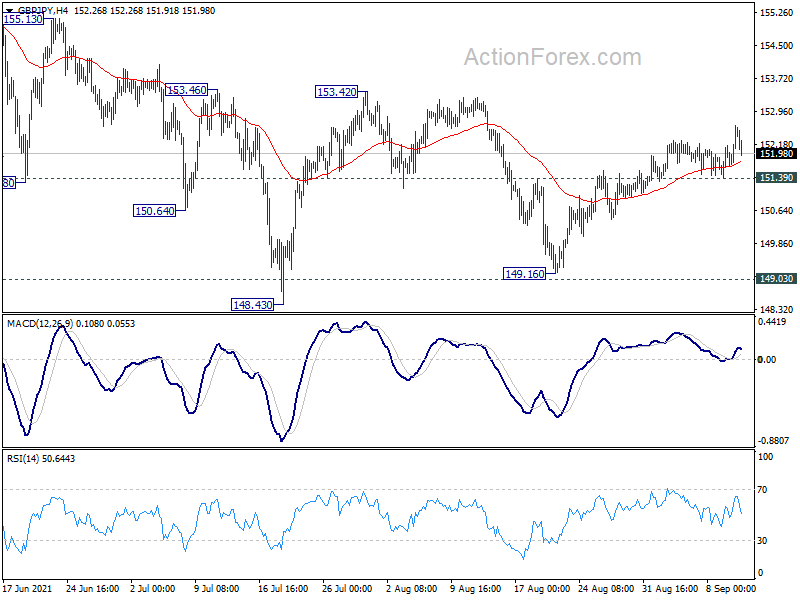
In the bigger picture, rise from 123.94 is seen as the third leg of the pattern from 122.75 (2016 low). As long as 149.03 support holds, such rise would still resume at a later stage. However, sustained break of 149.03 support will indicate rejection by 156.59. Fall from 156.05 would be at least correcting the whole rise from 123.94. Deeper fall would be seen back 38.2% retracement of 123.94 to 156.05 at 143.78 first.
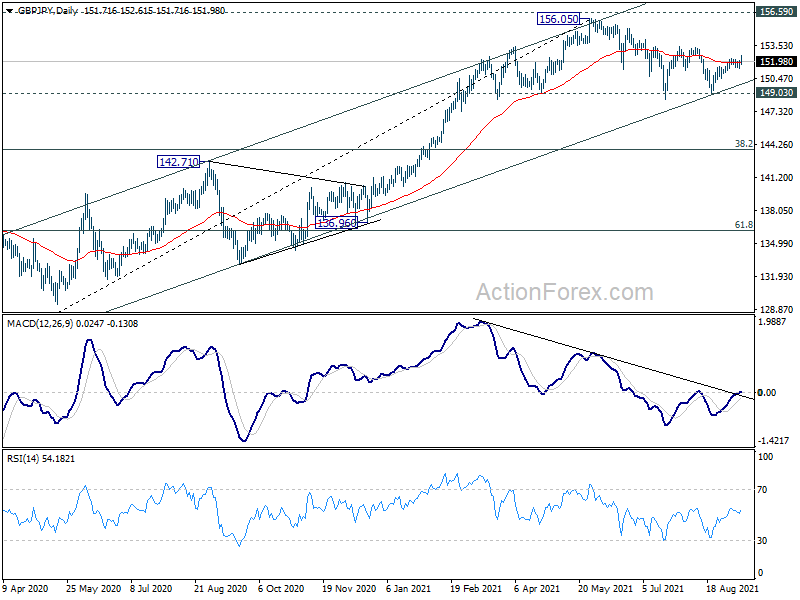
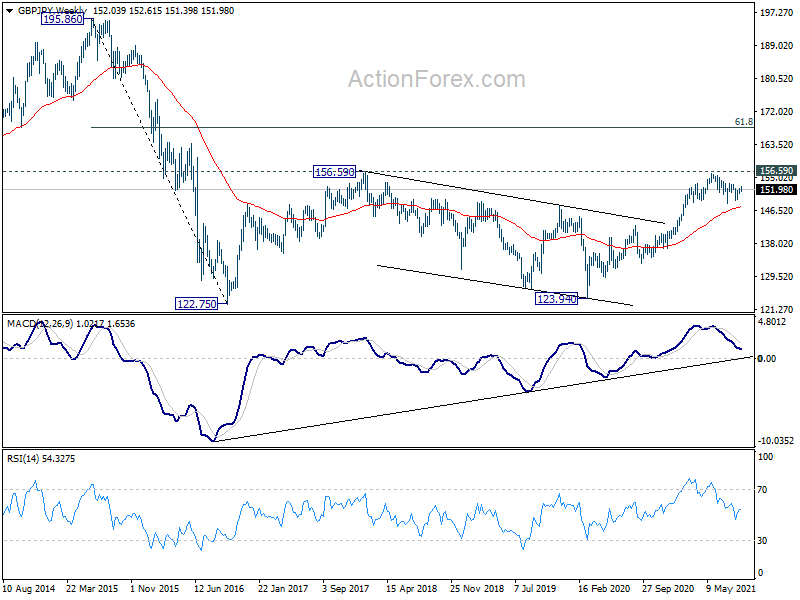
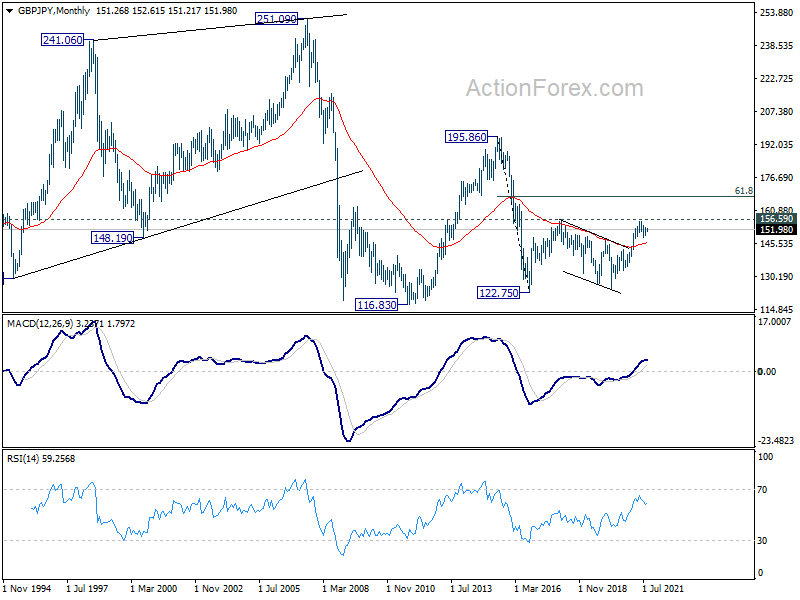
In the longer term picture, the strong break of 55 months EMA was an early sign of long term bullish reversal. Firm break of 156.69 resistance should now confirm the start of an up trend for 195.86 (2015 high). However, rejection by 156.69 will invalidate the bullish signal and keep long term outlook neutral first.
EUR/JPY Weekly Outlook
EUR/JPY's retreat from 130.73 continued last week but stayed above 129.57 minor support. Initial bias is neutral this week first. On the upside, break of 130.73 will resume the rebound from 127.91 low. That would also reaffirm the case that correction from 134.11 has completed at 127.91. Intraday bias will be turned to the upside for 132.68 resistance next. However, firm break of 129.57 will argue that the rebound has completed, and turn bias back to the downside for retesting 127.91 low.
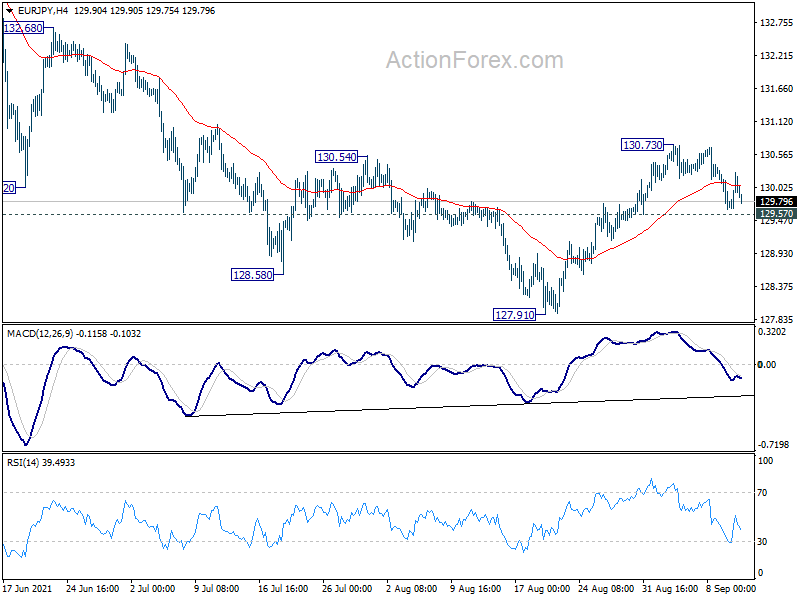
In the bigger picture, rise from 114.42 is seen as a medium term rising leg inside a long term sideway pattern. As long as 127.07 resistance turned support holds, further rise is still expected to retest 137.49 (2018 high). However, firm break of 127.07 will argue that the medium term trend has reversed, deeper fall would be seen to 61.8% retracement of 114.42 to 134.11 at 121.94.
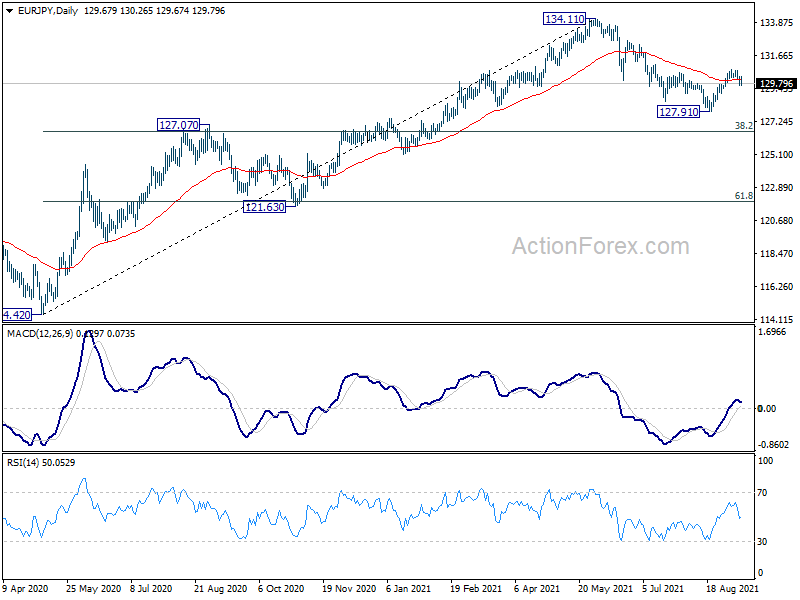
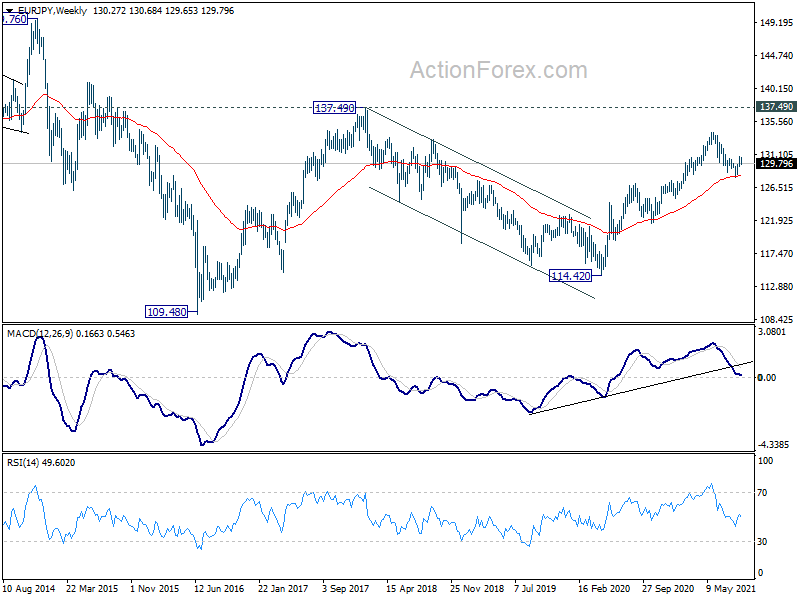
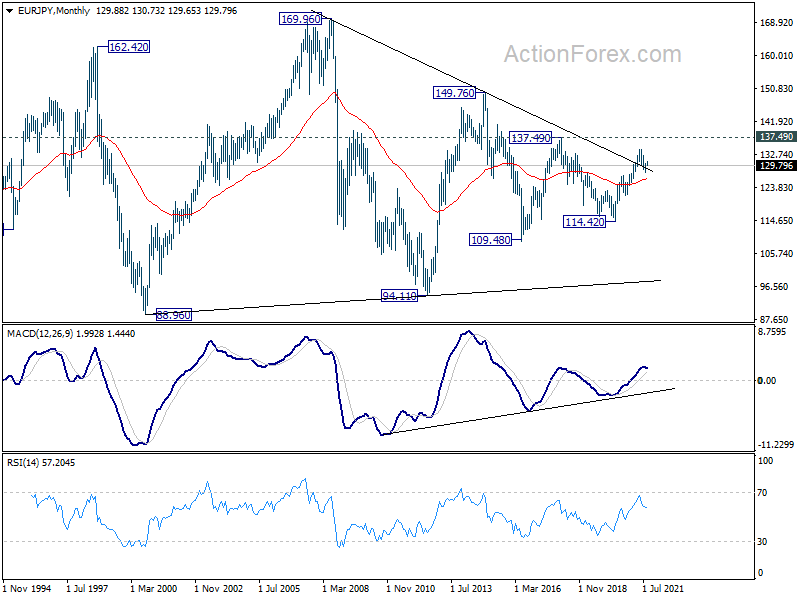
In the long term picture, EUR/JPY is staying in long term sideway pattern, established since 2000. Another rising leg in progress for 137.49 resistance and above.
EUR/GBP Weekly Outlook
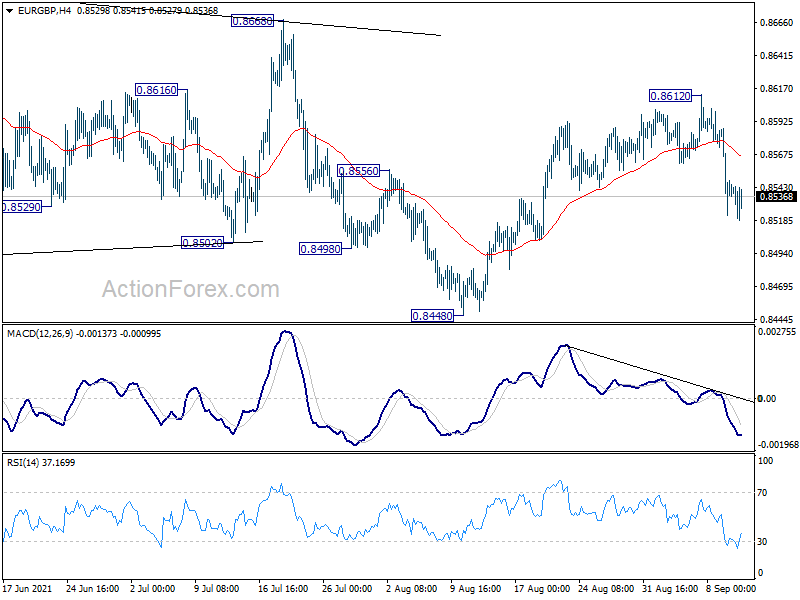
EUR/GBP edged higher to 0.8612 last week but dropped sharply since then. The development argues that rebound from 0.8448 has completed already. With 0.8668 resistance intact, larger fall from 0.9499 is probably still in progress. Initial bias stays mildly on the downside for retesting 0.8448 low first. On the upside, though, break of 0.8612 will resume the rise from 0.8448 to 0.8668 resistance.
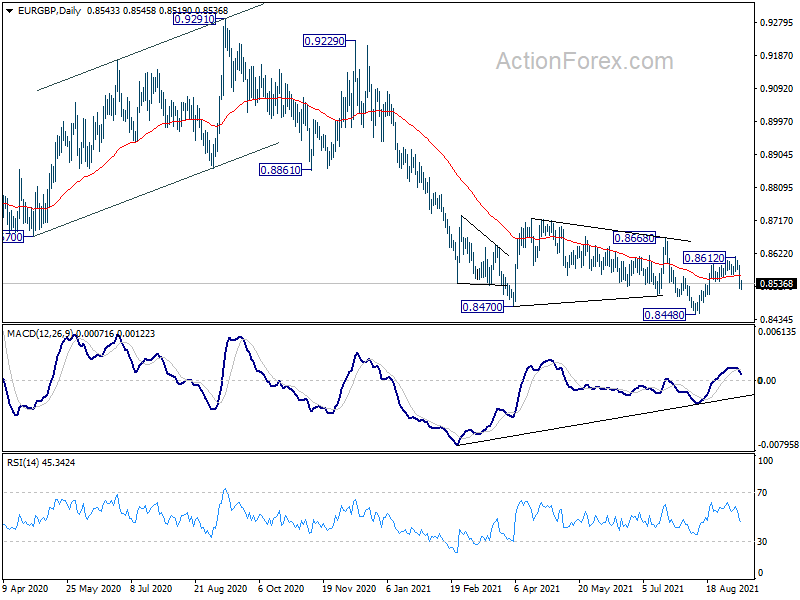
In the bigger picture, price actions from 0.9499 (2020 high) are still seen as developing into a corrective pattern. Deeper fall could be seen as long as 0.8668 resistance holds, towards long term support at 0.8276. However, firm break of 0.8668 resistance would argue that a medium term bottom was already formed. Stronger rise would be seen to 0.8861 support turned resistance to confirm completion of the corrective pattern.
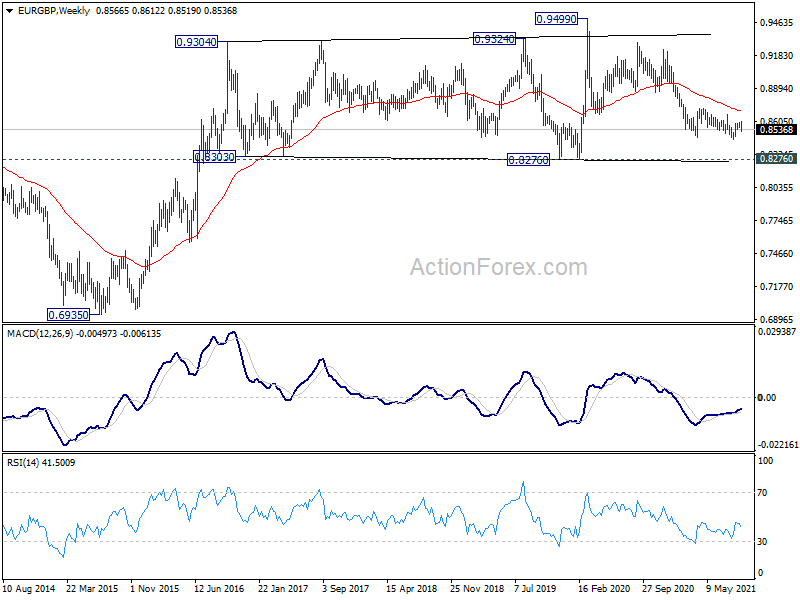
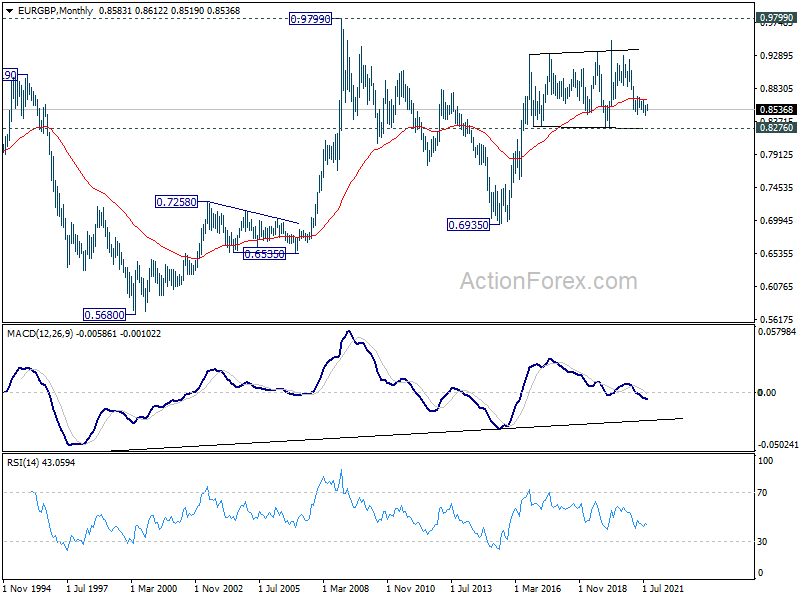
In the long term picture, outlook will stay bullish as long as 0.8276 support holds. Break of 0.9499 is in favor at a later stage, to resume the up trend from 0.6935 (2015 low).
EUR/AUD Weekly Outlook
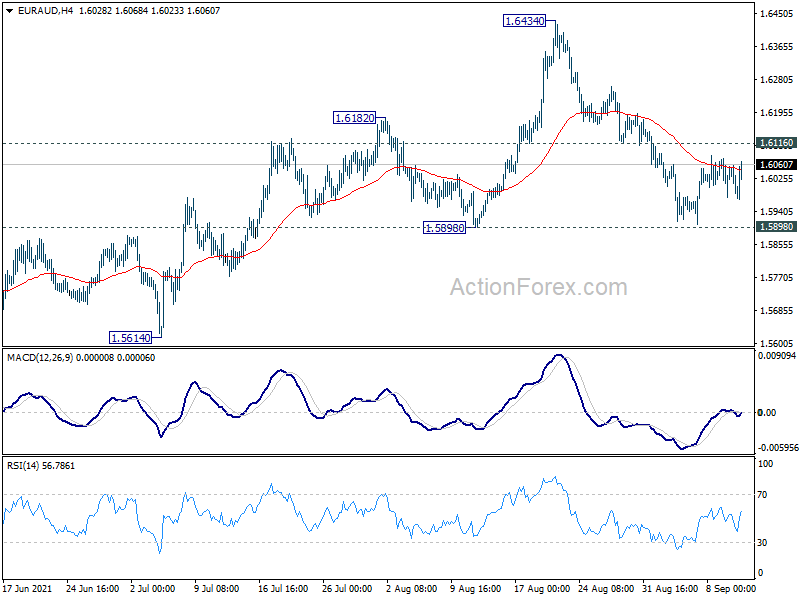
EUR/AUD recovered ahead of 1.5898 support last week, but upside is limited below 1.6116 resistance so far. Initial bias remains neutral this week first. On the upside, break of 1.6116 will argue that pull back from 1.6434 has completed after defending 1.5898 structural support. Larger rise from 15250 is still in progress. Intraday bias will be turned back to the upside for retesting 1.6434 first. On the downside, however, firm break of 1.5898 will argue that corrective rise from 1.5250 has already completed. Near term outlook will be turned bearish for 1.5614 support next.
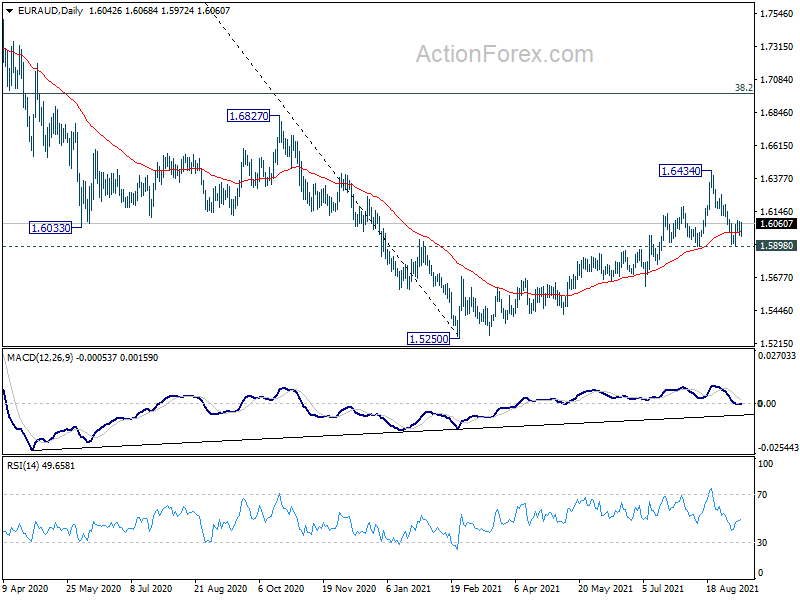
In the bigger picture, rise from 1.5250 medium term bottom is currently seen as a correction to the down trend from 1.9799 first. Stronger rise could be seen to 38.2% retracement of 1.9799 to 1.5250 at 1.6988 next. We'd tentatively expect strong resistance from there to limit upside, at least on first attempt. Meanwhile, break of 1.5898 support will indicate that the rebound has completed. Larger down trend from 1.9799 might be ready to resume through 1.5250 low.
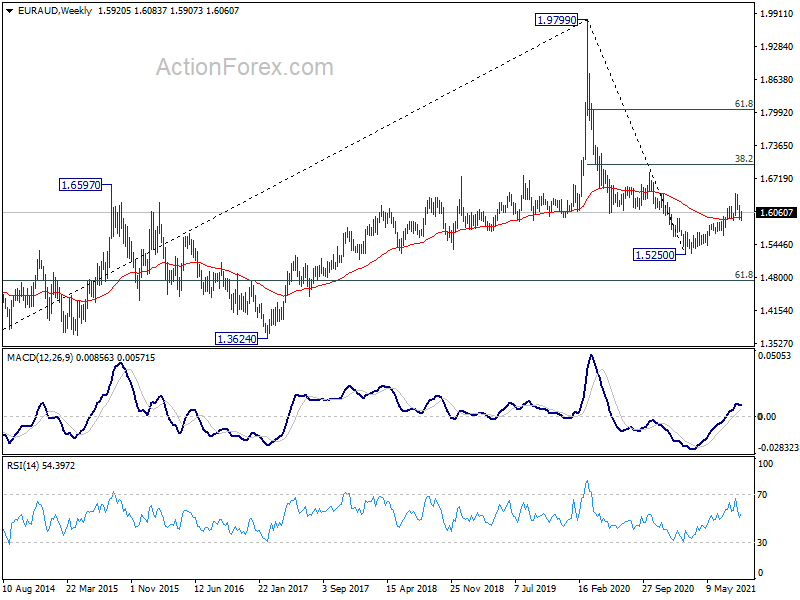
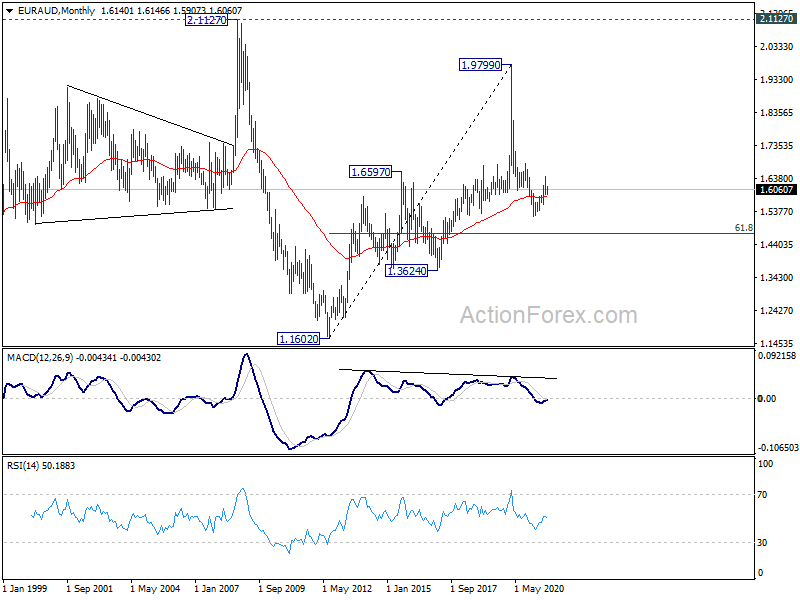
In the longer term picture, rise from 1.1602 (2012 low) should have already completed with three waves up to 1.9799 (2020 high). Fall from there is seen as a medium term to long term down leg as a long term down trend, or a sideway pattern. We'll assess the odds again at a later stage.
EUR/CHF Weekly Outlook
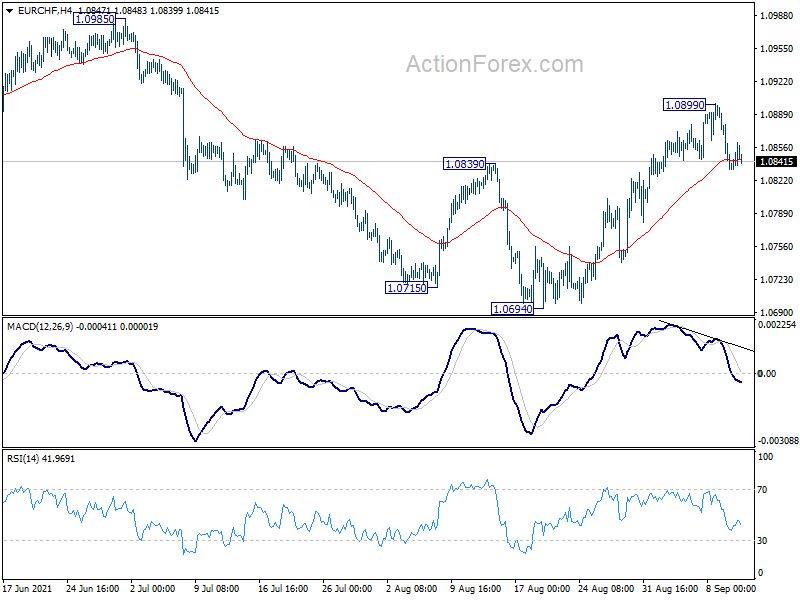
EUR/CHF edged higher to 1.0899 last week but retreated since then. Initial bias remains neutral this week for some consolidations first. Another rise is mildly in favor for now and break of 1.0899 will resume the rebound from 1.0694 to 1.0985 resistance next. However, on the downside, sustained trading below 55 day EMA (now at 1.0825) will turn focus back to 1.0694 low.
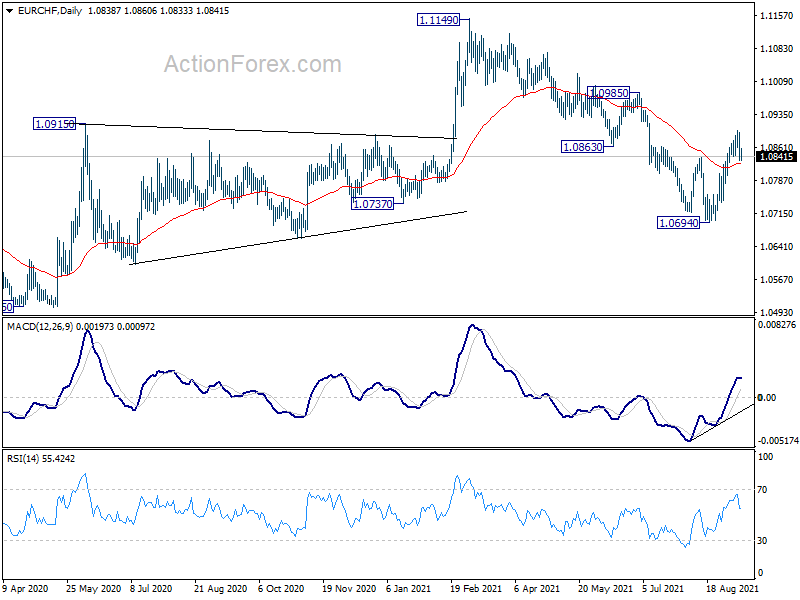
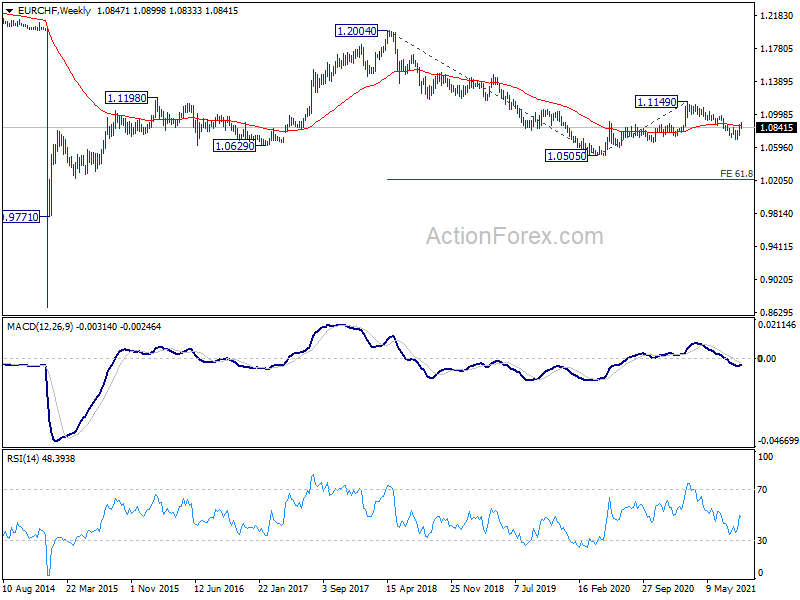
In the bigger picture, rebound from 1.0505 (2020 low) should have completed at 1.1149 already. The three-wave corrective structure argues that the downtrend from 1.2004 (2018 high) is not over yet. Medium term outlook will now stay bearish as long as 55 week EMA (now at 1.0858) holds. Break of 1.0505 low would be seen at a later stage. However, sustained trading above 55 week EMA will bring retest of 1.1149 high instead.
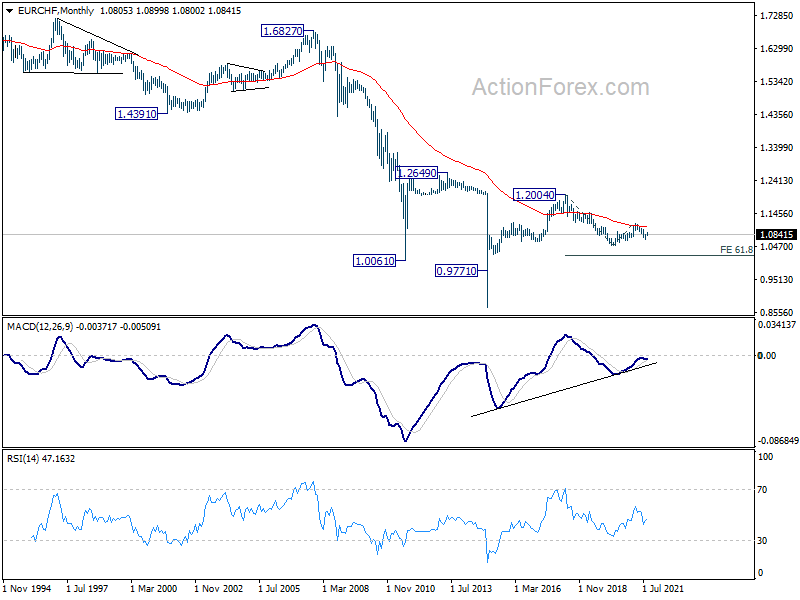
In the long term picture, rejection by 55 month EMA (now at 1.1056) retains long term bearishness. Break of 1.0505 low will resume down trend to 61.8% projection of 1.2004 to 1.0505 to 1.1149 at 1.0223.
Dollar Rebounded as DOW’s Selloff Posts a Warning to Risk Sentiment
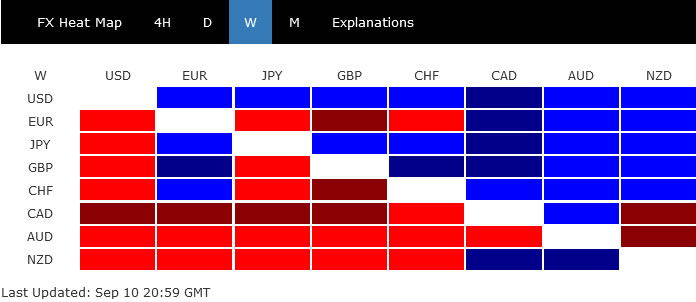
Dollar ended as the strongest one last week, with some held from the late selloff in US stocks. Yen was the second strongest on risk aversion while Swiss Franc was not too far away. Commodity currencies, on the other hand, ended generally lower. Traders ignored the dovish tapering of RBA, and the cautiously optimistic BoC. Euro also got no support from ECB's PEPP recalibration.
Risk sentiment would likely continue drive the forex markets in the near term at least. In particular, DOW's selloff on Friday is seen as a technical warning that deeper correction is underway. We'll keep an eye on the development there, and see if DOW would drag other major indexes further down. Or, strength in tech and others could help floor DOW's fall, and thus, cap Dollar and Yen's rebound.
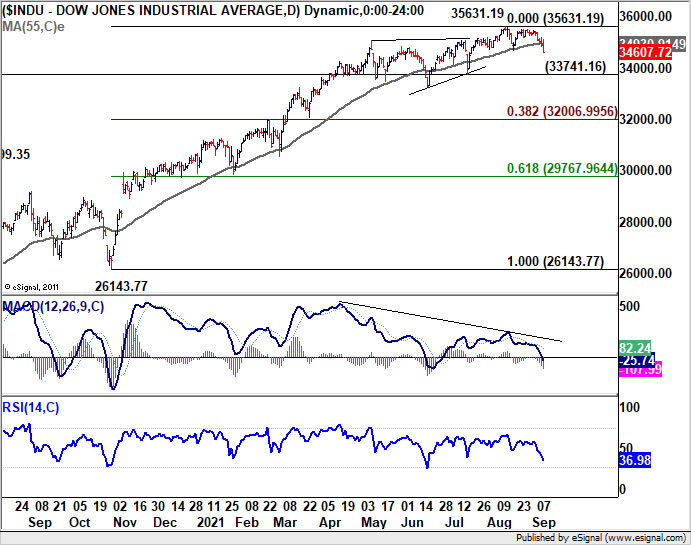
DOW broke 55 day EMA, a warning for stock bulls
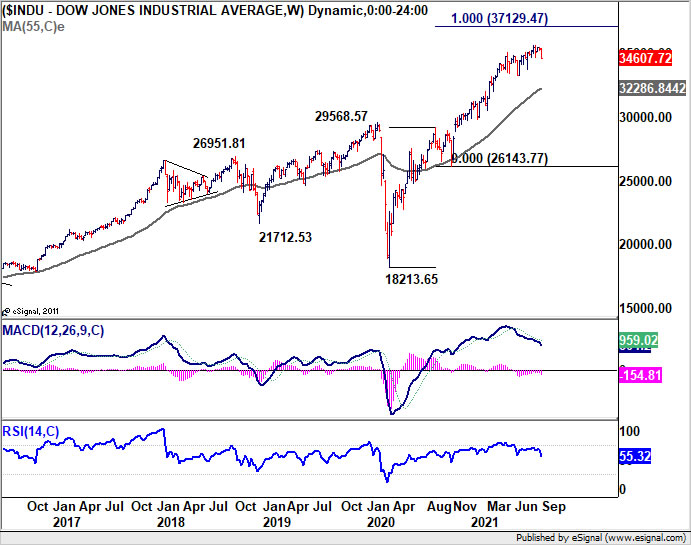
While developments in S&P 500 and NASDAQ are still bullish despite Friday's pull back, the extended decline in DOW is sending investors a warning. DOW has lost its near term bullishness again by breaking through 55 day EMA, as well as 34690.25 support. It's still early to call 35631.19 a medium term top. If DOW could quickly climb back above 55 day EMA, recent up trend is still intact for another record high.
However, risk of a deeper correction is increasing, considering bearish divergence condition in daily MACD. Sustained trading below 55 day EMA this week would likely extend the decline to test on 33741.16 support. Firm break there will argue that it's already in correction to whole up trend from 26143.77. In this case, next target would be 38.2% retracement of 26143.77 to 35631.19 at 32006.99, which is slightly below 55 week EMA.
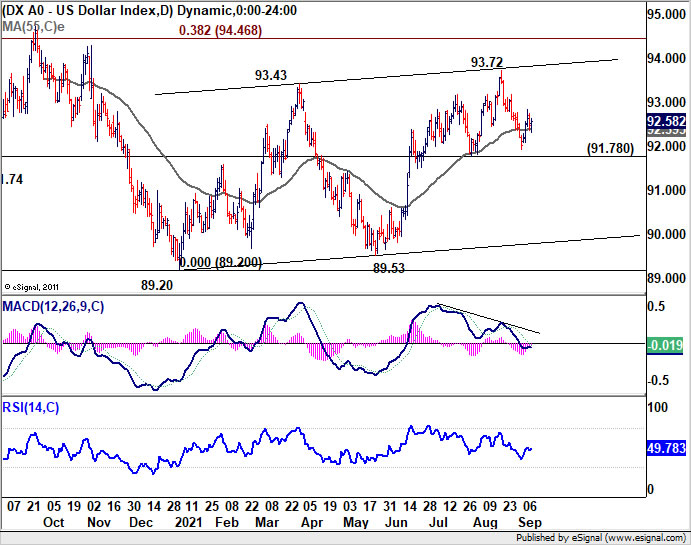
DXY recovered ahead of 91.78 support, maintains upside prospect
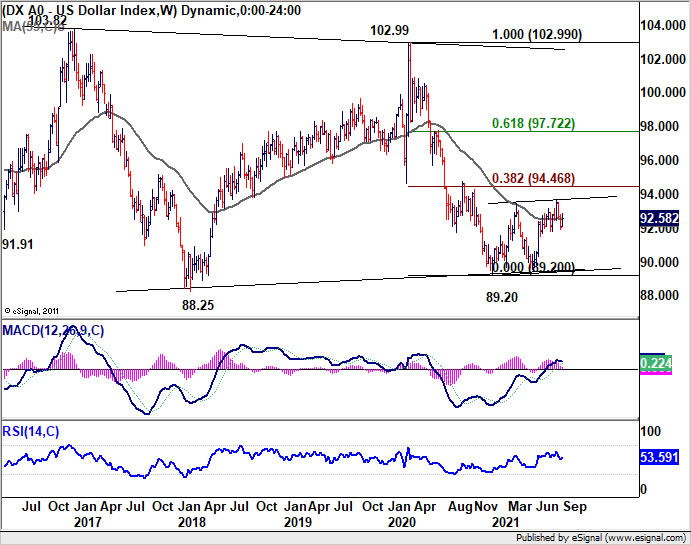
Dollar index recovered ahead of 91.78 support last week, maintaining some near term bullishness. There is prospect of extend the rise from 89.53 through 93.72, in particular if risk sentiments turn sour. But overall, we're still slightly favoring that the pattern from 89.20 as a three wave consolidation pattern. Hence, 38.2% retracement of 102.99 to 89.20 at 94.46 is a major hurdle for DXY to overcome to turn medium term outlook bullish.
On the other hand, break of 91.78 support, or rejection by 94.46 in case of anther rise, would argue that whole down trend from 102.99 (2020 high) is ready to resume through 89.20, and possibly through 88.25 (2018 low) too.
EUR/GBP down despite ECB's PEPP recalibration
The key takeaways from ECB meeting last week was firstly, it will end front-loading of PEPP asset purchases in a flexible way. President Christine Lagarde stressed that it "isn't tapering" and warned that the Eurozone is "not out of the woods". Secondly, the council acknowledged a more persistent inflation pressure.
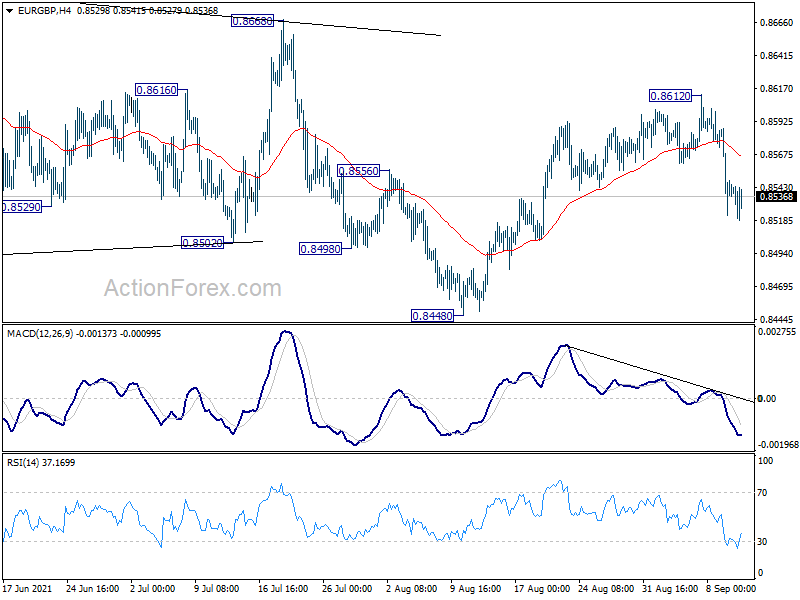
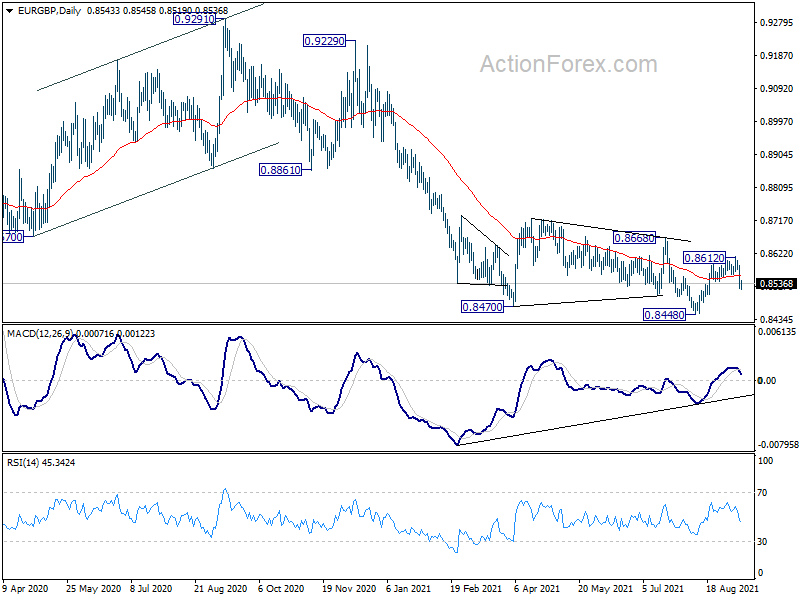
But Euro bulls were not satisfied with the outcome with the common currency sent down in European crosses. Development in EUR/GBP argues that rebound from 0.8448 has possibly completed at 0.8612 already, on bearish divergence condition in 4 hour MACD. It's also back below the flat 55 day EMA. Deeper fall is in favor for the neat term to retest 0.8448 low at least. Also, with 0.8668 resistance intact, medium term decline could eventual extend through 0.8448 low.
CAD dropped despite cautiously optimist BoC
BoC's message was actually cautiously optimistic after keeping policy unchanged. There are some speculations that BoC would resume tapering to CAD 1B per week at the October meeting. Governor Tiff Macklem also laid down the path to transit to the "reinvestment" phase, keeping the bond holdings roughly stable. August job data from Canada was also solid. But the Loonie followed general risk sentiments lower.
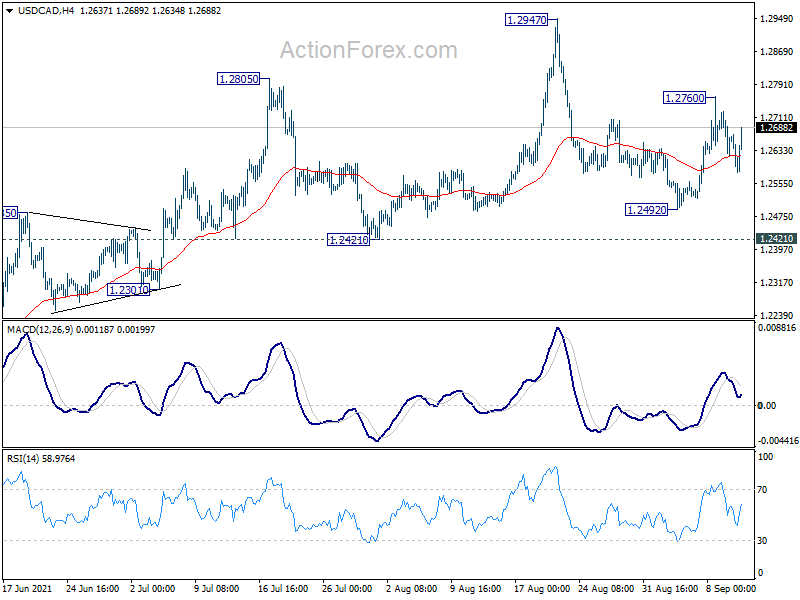
USD/CAD's rebound argues that pull back from 1.2947 might have completed at 1.2492 already. That came after well defending 1.2421 structural support, with some help from 55 day EMA. The developments suggests that rise from 1.2005 is probably not over yet. Immediate focus will be back on 1.2760 temporary top this week. Break there will reaffirm near term bullishness and bring retest of 1.2947 first, and probably resume the rise from 1.2005 beyond.
AUD/JPY follows risk lower after dovish RBA taper
The RBA decision was a mixed bag, as it maintained the plan to taper asset purchases to AUD 4B per week. But the QE program was extended to "at least mid February 2022". The central bank sounded optimistic that Delta outbreak will only delay but not derail recovery. Yet, he economy would only return to its "pre-Delta" path in H2 2022.
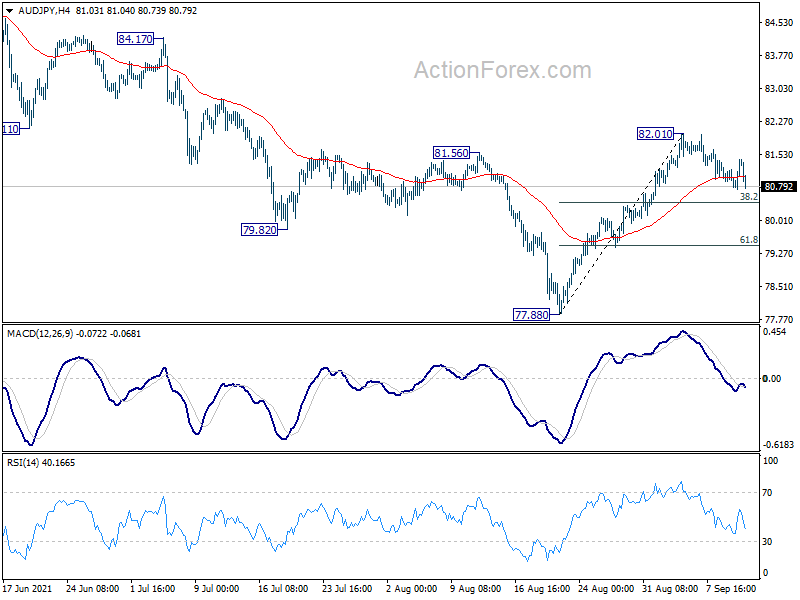
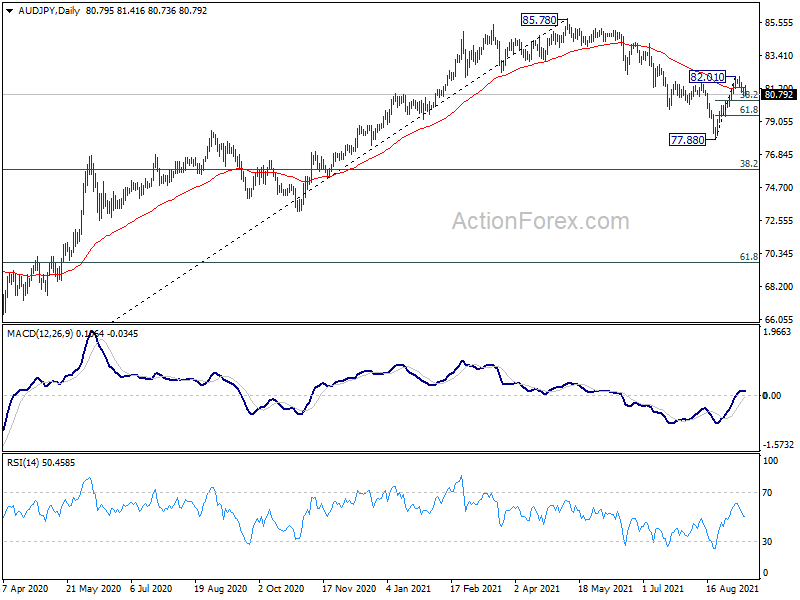
AUD/JPY also followed broad based risk selloff lower on Friday. The developments suggests that fall from 82.01 is still in progress. Near term focus is now on 38.2% retracement of 77.88 to 82.01 at 80.43. Break there will argue that rebound from 77.88 has completed indeed, after rejection by 55 day EMA. That could also set up the stage for resuming larger fall from 85.78 through 77.88 low.
USD/JPY Weekly Outlook
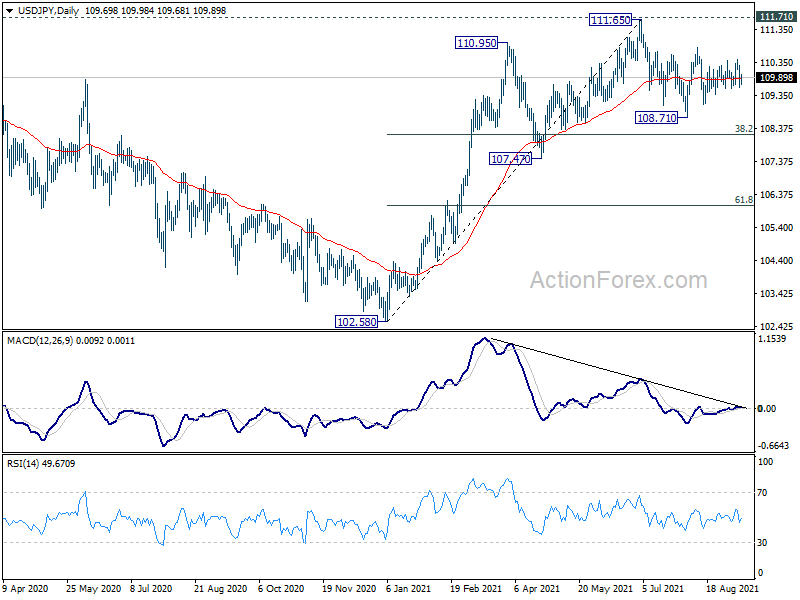
USD/JPY stayed in range of 109.10/110.79 last week and outlook is unchanged. On the upside, break of 110.79 will resume the rebound from 108.71 to retest 111.65 high. On the downside, break of 109.10 will target 108.71 support first. Firm break there will resume the decline from 111.65 and target 38.2% retracement of 102.58 to 111.65 at 108.18 next.
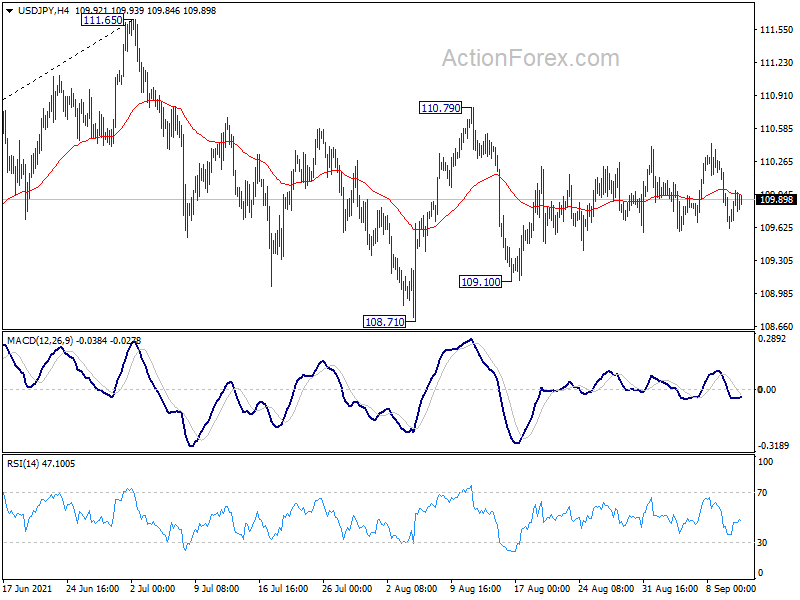
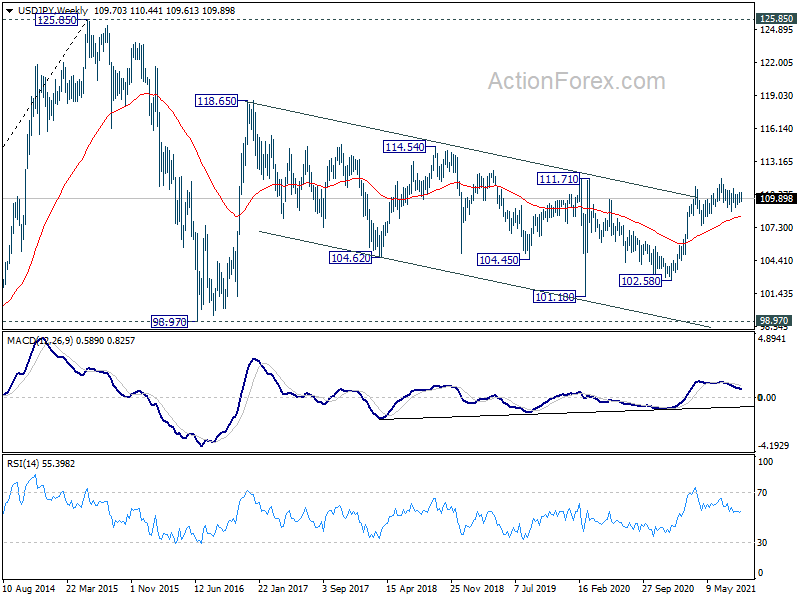
In the bigger picture, medium term outlook is staying neutral with 111.71 resistance intact. The pattern from 101.18 could still extend with another falling leg. Sustained trading below 55 day EMA will bring deeper fall to 107.47 support and below. Nevertheless, strong break of 111.71 resistance will confirm completion of the corrective decline from 118.65 (2016 high). Further rise should then be seen to 114.54 and then 118.65 resistance.
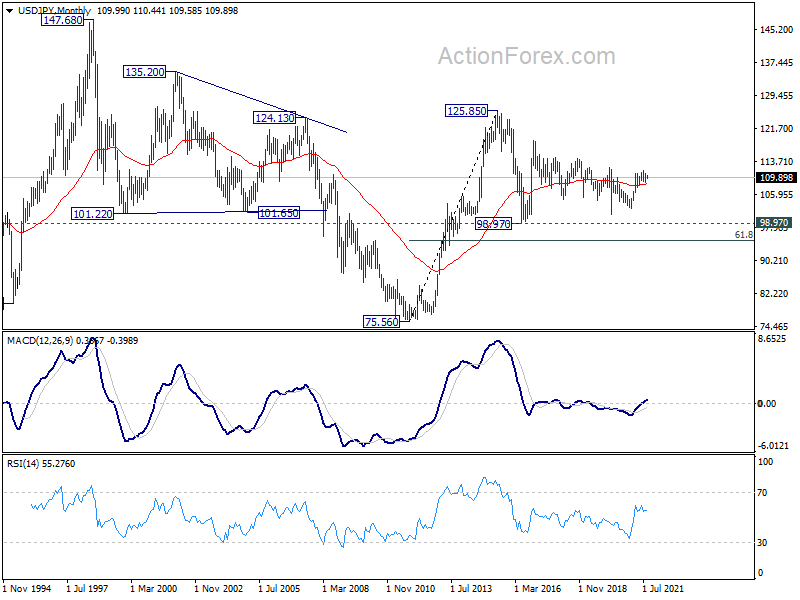
In the long term picture, the rise from 75.56 (2011 low) long term bottom to 125.85 (2015 high) is viewed as an impulsive move, no change in this view. Price actions from 125.85 are seen as a corrective pattern which could still extend. In case of deeper fall, downside should be contained by 61.8% retracement of 75.56 to 125.85 at 94.77. Up trend from 75.56 is expected to resume at a later stage for above 135.20/147.68 resistance zone.
Week Ahead: Focus Shifts to Pricing Pressures
Country
US
The focus in the US shifts from the labor market to pricing pressures. Tuesday’s release of the August inflation report could move some Fed members into joining the ‘inflation is persistent’ camp. Prices that Americans pay for everyday goods and services are expected to continue to accelerate in August, with most core readings maintaining the jump seen last month.
On Wednesday, economists will also closely follow the Empire manufacturing report should show expansion continues to moderate and whether selling prices continue to surge. Thursday is all about the US consumer and if retail sales continued to weaken in August. Friday’s release of the University of Michigan sentiment is expected to steady.
With the Fed entering the blackout period for the September 22nd FOMC policy meeting, market position might be limited if risk aversion does not become the dominating theme.
EU
EU economic and financial affairs ministers are meeting in Slovenia. The meeting concludes on Saturday, September 11.
Also on September 11: In France, the National Front, Marine Le Pen’s party is holding a meeting near the Cote d’Azure.
In Germany, Armin Laschet, the CDU’s candidate for chancellor, addresses a party congress in Nuremberg.
On Sunday, candidates in the race to replace Angela Merkel as Chancellor will participate in a debate on ARD TV.
France releases August industrial sentiment on Monday. The indicator is expected to remain steady at 105.
On Wednesday, the Eurozone releases industrial production. Italy and France publish CPI.
On Thursday, ECB Governing Council member and Bank of Finland Governor Olli Rehn will host a press conference. Rehn will discuss monetary policy and the international economic situation.
Also on Thursday, the Eurozone releases new car registrations and Italy publishes trade balance.
The EU trade policy committee will meet in Slovenia for a two-day gathering on Thursday and Friday.
The Eurozone releases CPI on Friday.
UK
The UK releases August unemployment claims and the unemployment rate on Tuesday.
August CPI will be released on Wednesday, with a consensus of 2.9% (YoY), up from 2.0% in July.
Norway
Norwegians vote in a general election on Monday. Polls show that the Labor Party, led by Jonas Gahr Store is favored to oust Prime Minister Erna Solberg, who has been in office for eight years.
Sweden
On Tuesday, Sweden releases August CPI, which is expected to rise to 1.5%, up from 1.4% in July.
Emerging Markets
Hungary
The Governor of the National Bank of Hungary, Gyorgy Matolcsy, will deliver remarks at the Renminbi Initiative conference in Budapest.
Poland
Poland releases July current account balance and trade balance on Monday. The current account balance is expected to show a deficit of -165 million US dollars, compared to a surplus of 281 million dollars in June. The trade surplus is expected to fall to 375 million dollars, down from 761 million on June.
Russia
On Thursday, Russian President Vladimir Putin and other regional leaders are scheduled to hold talk about the situation in Afghanistan. As well, Russia releases gold and forex reserves.
Russians will go to polls in parliamentary elections from Friday, Sept.17, to Sunday, Sept. 19. President Vladimir Putin has engaged in an extensive crackdown of the opposition and is expected to tighten his control of the country.
South Africa
South Africa publishes mining, gold and platinum production on Tuesday and retail sales on Wednesday.
Turkey
On Monday, Turkey releases Industrial Production for July. The indicator is expected to slow to 15.3%, down from 23.9% in June.
Asia Pacific
China
The government squeeze on the private sector continued this week, but China equities rose after President Biden and President Xi had their first phone call in 7 months, dangling the carrot of improved relations. But with government restriction/investigations/interventions in the private sector now a daily occurrence, buying the dip in China equities remains a perilous endeavour.
USD/CNY remains range bound with no sign that the PBOC is looking to engineer a weaker currency to stimulate the economy, yet.
The data calendar is heavier in the week ahead featuring New Yuan Loans, Industrial Production, Retail Sales and Fixed Asset Investment. If the data comes in soft, like the PMIs, stimulus noise will increase once again. That will likely boost equities in the short-term.
India
India appears to be the major recipient of diverted China flows at the moment, with the INR and stock market rallying impressively. That rally in INR resumed into the end of the week, suggesting that positive momentum remains robust.
The data calendar is busier in the week ahead featuring Inflation, WPI and the Balance of Trade. Stagflationary pressures will still be evident but the Balance of Trade should show a large jump in imports, suggesting India is recovering from its last Covid-19 wave. That is what markets will be focusing on along with China rotation flows, should see another strong week for local equities.
Australia & New Zealand
The Australian and New Zealand Dollars continue to bounce around on daily shifts in international risk sentiment, rather than domestic developments.
That could change this week for New Zealand which is making sterling progress in controlling its latest Covid-19 outbreak, with only Auckland remaining in full lockdown. If restrictions are eased there, that will put October RBNZ hikes front and center again and lead to sustained Kiwi strength.
In contrast, the heavy data release schedule is expected to show the impact of the prolonged NSW and Victoria lockdowns on domestic consumption. NAB Business Confidence, Westpac Consumer Confidence will take a hit and Thursday’s Employment data should be flat. A surprise jump in employment should see the AUD spike higher but that is not the base case.
Local equity markets continue to ignore domestic consumption with resources and banks outperforming. Equities are being driven by international recovery sentiment and a potential thaw in US/China relation, and an olive branch extended by China over the TPP this week are both strong positives.
Japan
Japan has a packed data calendar this week including PPI, Industrial Production, the Tankan Survey, Machinery Orders and the Balance of Trade. Apart from the same supply change and material cost pressures that the rest of the world is experiencing, the data should highlight that Japan’s export machine is in good shape, even as domestic consumption falters.
However, none of that will matter to Japan equity markets which have enjoyed a stellar week. That should continue next week as equity investors remain myopically focused on Japan’s next Prime Minister, who will be selected at the end of the month. Markets are expecting the new PM to push through new fiscal stimulus ahead of an election due in November at the latest, giving a boost to the economy and equity prices.
USD/JPY remains a purely rate differential play between the US 10-year and Japan JGBs. Follow that for directions and bring a good book to read in between.
Markets
Oil
Crude prices could remain volatile as energy traders digest China’s rare reserve release, if Congress moves closer to deliver oil drilling ban across most US offshore waters, and if crude demand improves as the delta variant peak appears to be across most of the world. US production was decimated by Hurricane Ida and should start returning. The 1.5 million hit to US production last week is helping keep the oil market heavily in deficit.
Oil market fundamentals are still mostly bullish and that could help WTI crude run higher if risk appetite remains in place. The $74 level remains key resistance for the US benchmark.
Gold
Gold is a choppy mess and that could last a while if Treasury yields continue trade rangebound. Tapering expectations for the Fed have been pushed to the end of the year, but the only thing that could get gold going if pricing pressures start to ease. Right now, Treasury yields seem to be the primary beneficiary to hotter inflation and that should send the dollar higher, which is negative for gold right now. Gold needs a catalyst above the $1800 level soon, otherwise momentum selling could get ugly for bullion.
Bitcoin
Bitcoin volatility will likely remain elevated as further regulatory oversight appears to be just around the corner. The Fed is expected to unveil a research paper this summer that explores a move to a central bank digital currency. The heavily anticipated Fed research paper could show how the Fed anticipates regulation to deliver a safer environment for the public in using cryptos and how to make payment systems more efficient. The SEC might also deliver new guidelines that could disrupt how crypto lenders behave and which products they can offer.
Bitcoin prices are attempting to form a base after a crash was triggered on the first day El Salvador made it legal tender. If the floor gives, panic selling could lead to another massive drop.
Key Economic Events
Saturday, Sept. 11
- French presidential candidate Marine Le Pen’s party meets
- German CDU chancellor candidate Laschet addresses CSU party congress
Sunday, Sept. 12
- German chancellor candidates debate ahead of September 26th election
- Gold Forum Americas 2021 – 4-day virtual event
- International Atomic Energy Agency holds its quarterly board meeting and annual general conference, in Vienna.
Monday, Sept. 13
- Norway hold a general election. Jonas Gahr Støre, leader of the social democratic party, Arbeiderpart is expected to form a new centre-left government.
- MINExpo mining conference begins
- First day of school and daycare for New York City
- SkyBridge Capital’s annual SALT Conference
Economic Data/Events:
- US monthly budget statement
- Japan PPI
- New Zealand food prices
- India CPI
- Turkey industrial production, current account
- France industrial sentiment
- Poland current account, trade
- OPEC Monthly Oil Market Report
Tuesday, Sept. 14
Economic Data/Events:
- US CPI, empire manufacturing, industrial production
- Australia consumer confidence
- China retail sales, property prices, industrial production
- Canada existing home sales, CPI
- Eurozone industrial production
- India Trade
- Japan machinery orders, tertiary index
- UK CPI
- Italy CPI
- France CPI
- Poland CPI
- South Africa retail sales
- Apple Product Event
- EIA crude oil inventory report
Thursday, Sept. 16
- Russian officials expected to hold a summit to talk about Afghanistan.
- ECB Governing Council member Rehn speaks on monetary policy and international economic situation
- National Bank of Hungary Governor Matolcsy speaks at the Budapest Renminbi Initiative conference.
- Informal meeting of the EU trade policy committee in Slovenia
Economic Data/Events:
- US initial jobless claims, retail sales, TIC flows
- Australia unemployment
- Canada housing starts
- Eurozone new car registrations
- Hong Kong jobless rate
- Italy Trade
- Japan Trade
- New Zealand GDP
- Russia gold and forex reserves
Friday, Sept. 17
- Quadruple witching day for US markets.
- Russia holds parliamentary elections
Economic Data/Events:
- US University of Michigan consumer sentiment
- Eurozone CPI
- New Zealand PMI
- Singapore trade
Sovereign Rating Updates:
- Belgium (S&P)
- Spain (S&P)
- European Union (Moody’s)
- Portugal (Moody’s)
- Greece (DBRS)
Week Ahead – US Inflation Takes Center Stage
Without any central bank meetings on the agenda next week, the spotlight will fall on the latest edition of US inflation and retail sales. The chances of a Fed taper announcement this month have fallen dramatically after the disappointing jobs report, but this dataset could still be crucial for the normalization timeline and the dollar. There’s also a storm of economic releases from the UK, Canada, Australia, and China.
Supply chain blues
It looks like inflation won’t cool as quickly as the Fed thinks. The idea was that the pandemic disrupted global supply chains, pushing prices higher for some goods and services, but those issues would get resolved fairly quickly as companies adapted and expanded their production capabilities.
That narrative took a beating lately as several Asian economies went into lockdowns to battle the Delta outbreak. Business surveys like the PMIs highlight that supply disruptions have become even worse. Production and shipping costs are rising, and companies are passing much of that on to consumers in the form of higher prices. Even the world’s largest chipmaker, TSMC, is raising its prices significantly next year.
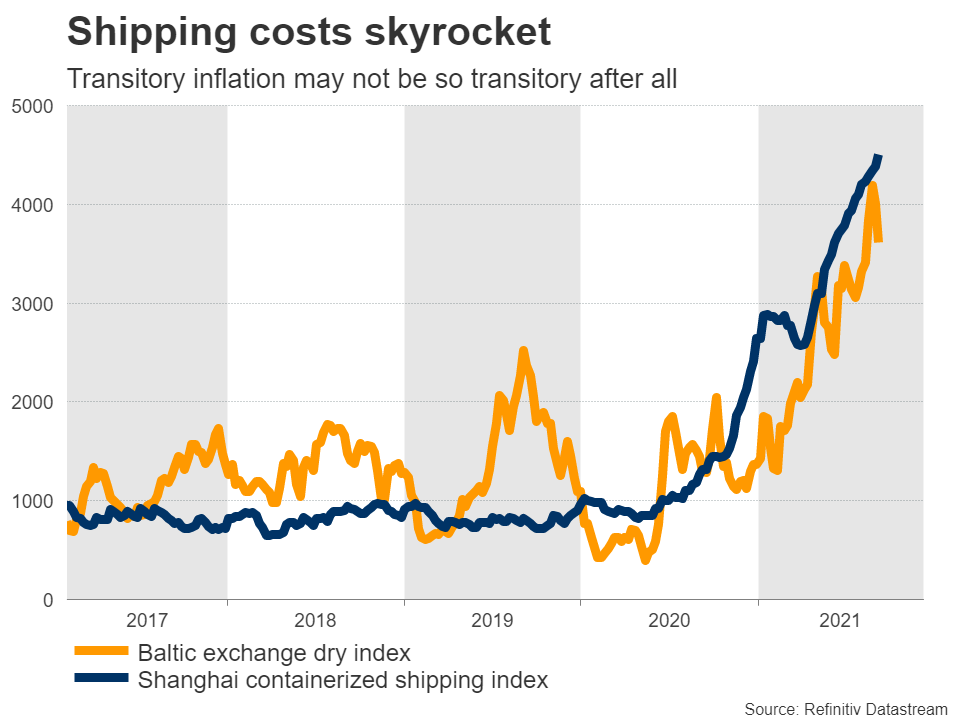
The idea of ‘transitory inflation’ could therefore turn into ‘slightly persistent inflation’ soon. Funnily enough, once supply chains normalize and cost inflation cools down next year, demand-driven inflation could make a comeback as the labor market returns to full employment. Workers are already enjoying more bargaining power than they have in decades and globalization is going into reverse.
In this light, markets will keep a close eye on the upcoming US inflation data that are scheduled for Tuesday, ahead of retail sales on Thursday. Forecasts suggest the headline CPI rate held steady at 5.4% in August, while retail sales are expected to have fallen for a second month.
As for the Fed, the stars now point to a November taper announcement. Inflation will likely remain hot and the easing in consumption shouldn’t be too worrisome given the astonishing gains this past year. The housing market is also booming. Policymakers essentially want to see another strong jobs report before they push the normalization button.
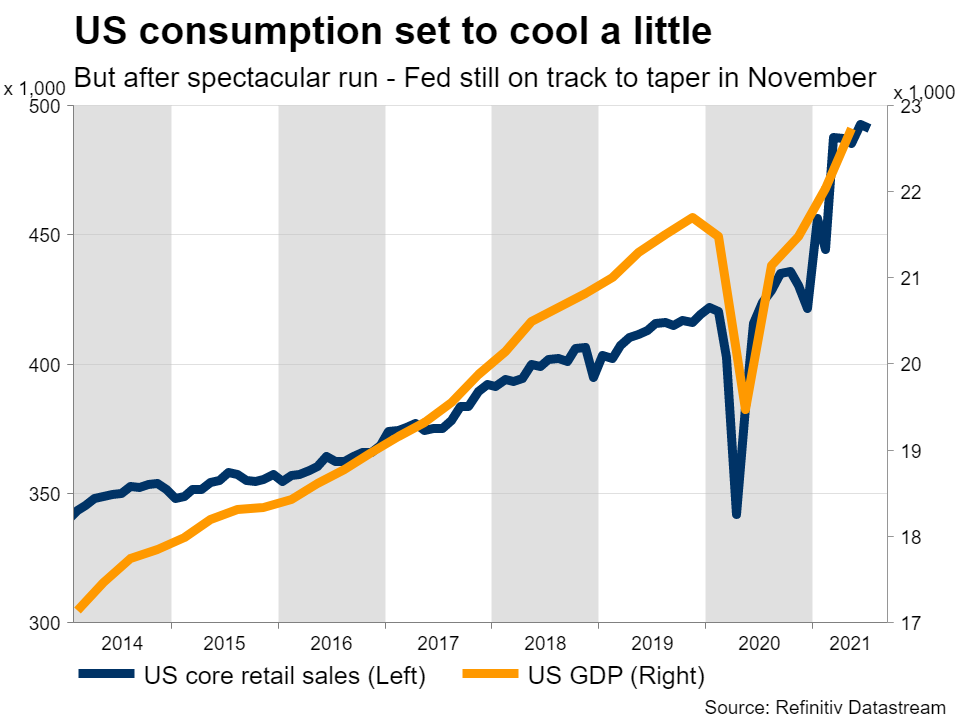
Therefore, the risks surrounding euro/dollar remain tilted to the downside, with the Fed set to out-normalize the ECB as the American economy heals faster than Europe’s. The prospect of greater spending from Congress argues in the same direction. The wild card in this equation is the upcoming German election, which may allow the euro a brief relief rally if a center-left victory raises the chances of greater EU integration and investment.
Sterling awaits data flood
Across the Atlantic ocean, there’s a flurry of data releases coming up in the United Kingdom. Jobs numbers for July are out on Tuesday, ahead of inflation stats for August on Wednesday and retail sales on Friday.
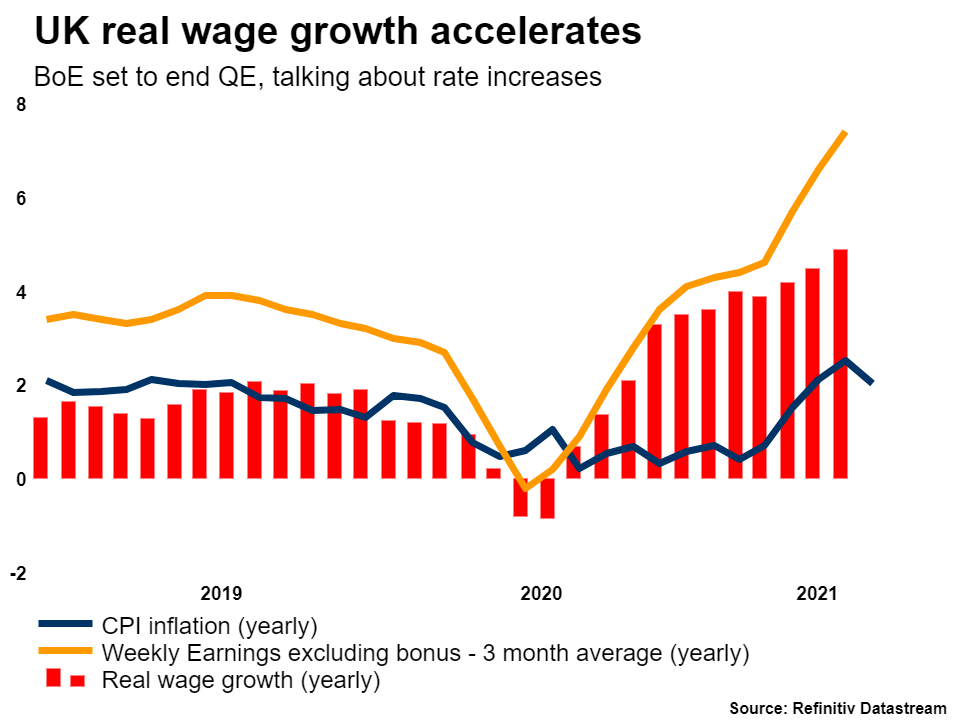
There has been a lot of attention lately on the tax increases on workers that Prime Minister Johnson is trying to push through, to fund healthcare and social services. But what flew under the radar were some exceptionally hawkish remarks from the Bank of England Governor.
Speaking before lawmakers this week, Andrew Bailey essentially said his central bank was split 4-4 at its last meeting on whether the minimum conditions for a rate increase had already been met. This revelation suggests markets may be underestimating how quickly the first hike will be delivered. A quarter-point rate increase is currently priced in for next August.
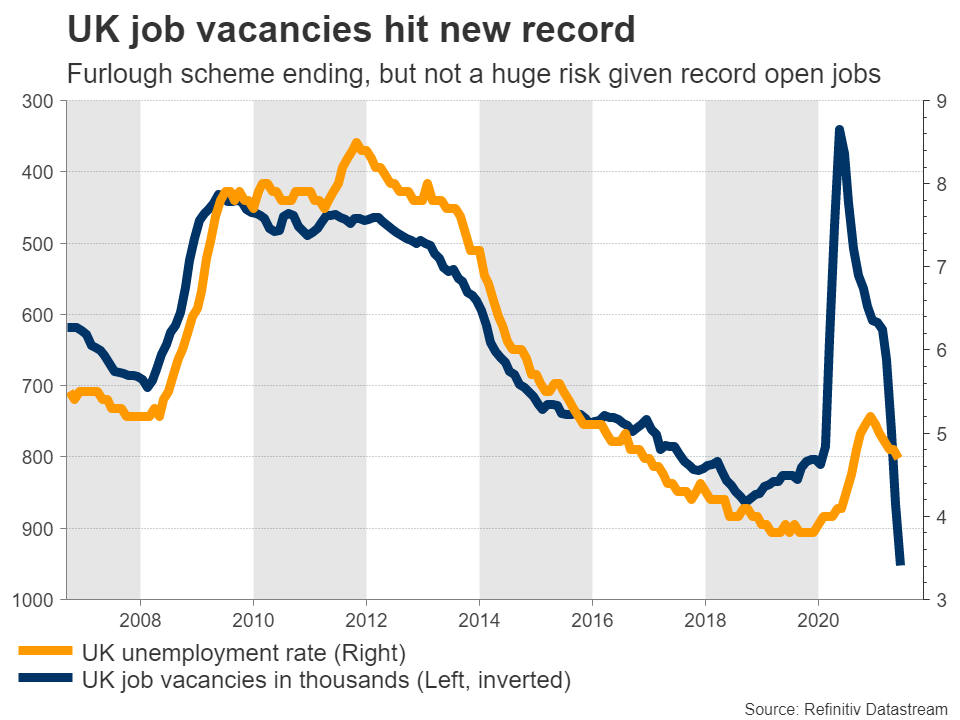
At the least, the BoE will almost certainly end its asset purchase program this year. In the near term, the pound will have to grapple with the end of the furlough program, which risks a spike in unemployment. But given the record number of open jobs in the economy, that may never materialize. The bigger picture for sterling seems bright, particularly against the euro and yen, which won’t enjoy higher rates in the coming years.
Canadian inflation eyed
Over in Canada, inflation numbers for August will hit the markets on Wednesday. The Bank of Canada was quite cryptic when it met this week, showing no concern about some signs that growth cooled in the second quarter. The Bank meets again in October when it is widely expected to slash its asset purchases again.
Overall, the economy is still in good shape. Vaccinations have been impressive, the jobs market has almost recovered, inflation is nearly double the BoC’s target, and the housing market is on fire. Therefore, the outlook for the loonie remains positive, although for now, a lot will depend on the upcoming election on September 20.
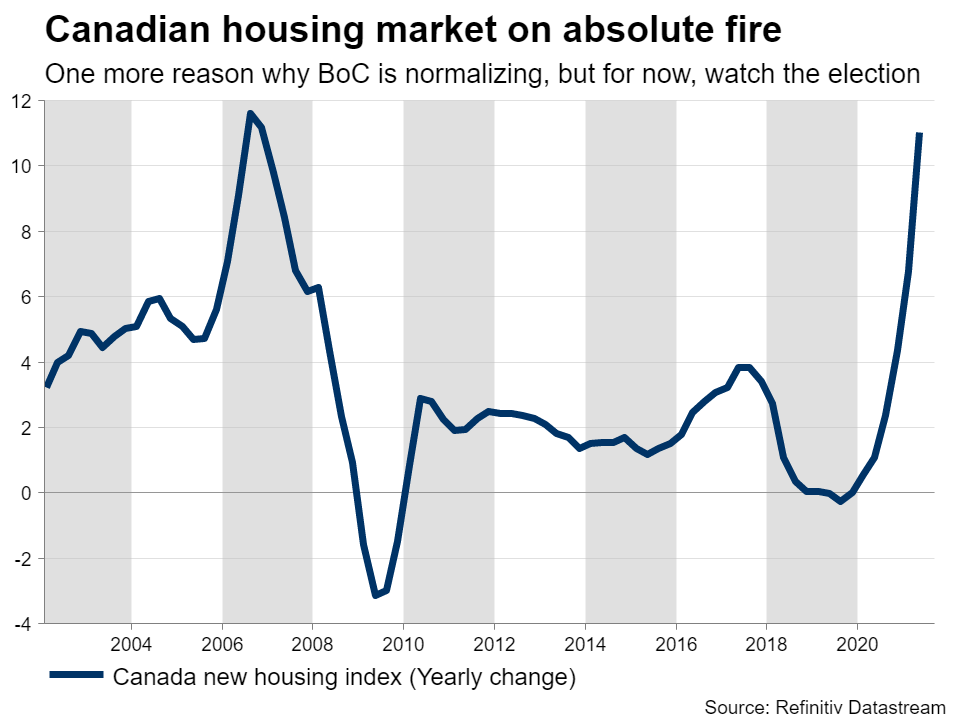
Prime Minister Trudeau has fallen behind his conservative opponent in opinion polls, and if he loses, that would imply less spending in the economy moving forward. That could see the loonie take a hit, but it wouldn’t change the bigger picture much, as any spending cuts are far away.
Australia and China
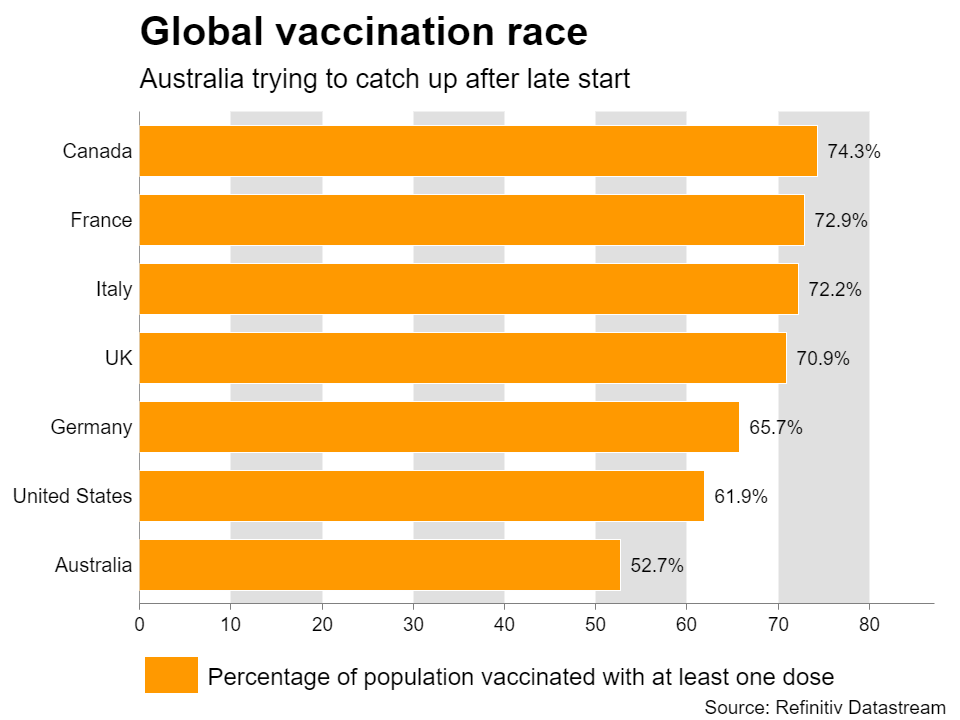
Staying in the commodity FX arena, Australia’s employment report for August is out on Thursday. The aussie has staged an impressive rebound lately, drawing power from an accelerated pace of vaccinations, which opens the door for an escape from lockdowns over the coming weeks.
But whether this recovery has legs will also depend on how the Chinese economy performs, given the close trading relationship between Australia and China. In this sense, China’s monthly data dump that includes retail sales and industrial production for August will be in focus on Wednesday. More signs that the world’s second-largest economy is slowing could be bad news for the aussie and risk sentiment more generally.
Finally, New Zealand's second-quarter GDP stats will be released Thursday, but with the third quarter now almost over and the nation suffering shutdowns lately, markets will likely view this dataset as outdated.