Sample Category Title
Oil Leaps Higher, Gold Steady Ahead Of NFP
Oil rallies post-OPEC+
With OPEC+ done and dusted, and the US dollar remaining soft, oil markets rallied strongly overnight. As the dust settles, though, both Brent and WTI have remained roughly in my preferred, if noisy, trading ranges for the week as traders scramble to find the most nebulous of news stories to explain intra-day price moves.
Brent crude rose by 2.15% to USD 73.80 overnight, with WTI leaping 2.20% to USD 69.75 a barrel. In Asia, both contracts have crept higher to USD 73.00 and USD 69.80 a barrel, respectively. Notably, Brent crude’s 100-DMA today at USD 71.10 a barrel, held every sell-off this week, and prices remain constructive as long as that continues. WTI has had a much choppier range, complicated by Hurricane Ida considerations, but seems to have found plenty of support on those short forays to USD 67.00 this week.
We can ponder the global supply/demand balance and its implications for oil prices next week. In the meantime, we have a US Non-Farm Payrolls release and a US holiday on Monday to negotiate first. Consequently, I anticipate Brent crude continuing to trade in a USD 72.00 to USD 74.00 a barrel range ahead of the data, while WTI should chase its tail noisily between USD 69.00 and USD 71.00 a barrel.
Gold on hold
Gold has another Sleepless in Seattle session overnight, closing almost unchanged once again at USD 1812.50 an ounce. Gold bulls should probably be a little concerned though. US yields have edged lower this week, and the US dollar has fallen quite a lot, yet gold prices have not been able to rally. That reinforces my fears that the V-shaped recovery momentum in gold prices has stalled.
Although gold remains confined to the tender embrace of its 100 and 200-day moving averages at USD 1814.80 and USD 1809.35 an ounce, respectively, gold is now set up for a solid directional move into the end of the week. Given its inability to continue rallying, the risks are skewed to the downside. If the US Non-Farm Payroll data exceeds expectations, gold could suffer an ugly sell-off tonight.
At this stage, resistance at USD 1820.00 and particularly, the USD 1830.00 to USD 1835.00 an ounce zone look more than capable of capping rallies. A fall through USD 1800.00 an ounce will see gold retest support at USD 1780.00 an ounce. If things get ugly, gold could fall as far as USD 1750.00 an ounce as stale long positioning heads to the abattoir.
The US Dollar Retreat Continues
Hawkish ECB officials send EUR/USD higher
The US dollar fell overnight with hawkish inflation comments from European officials pushing the euro higher and leading the US dollar sell-off. The dollar index fell by 0.31% to 92.21 as currency markets, perhaps more than any other asset class, have placed their stall in a delayed taper. Asia appears content to wait Friday out ahead of the US data, with the index unchanged today so far.
EUR/USD rose 0.30% to 1.1875 overnight as inflation noise continued ratcheting higher. A rally through 1.1900 will signal a retest of 1.2000 next week. Sterling rose through its 200-day moving average (DMA) at 1.3810 overnight, on its way to a 0.47% gain to 1.3833. The close above 1.3810 is significant, especially as news outlets are running tax increase stories. Assuming a soft Non-Farms, GBP/USD could well test 1.4000 next week.
Both AUD/USD and NZD/USD outperformed overnight as risk appetite remains firm in currency markets. AUD/USD rose 0.45% to 0.7400, and NZD/USD rose 0.45% to 0.7110, climbing through its 100-DMA and closing just under its 200-DMA at 0.7115. With more vaccines on the way to Australia and Covid-19 cases falling once in New Zealand, there aren’t many reasons to be bearish. If New Zealand’s lockdown strategy continues to deliver, the RBNZ rate hike will be back on the cards in October. NZD/USD could rise to 0.7300 next week, assuming the Non-Farm Payrolls doesn’t upend the narrative.
USD/Asia is quiet today, as it was overnight, with Asian currencies mostly content to edge slightly higher versus the greenback. I expect that to remain the status quo for the rest of today’s session with the potential direction of US monetary policy of far more importance to regional Asia at this time than other areas of the world.
Currency markets look locked and loaded to deliver a further general US dollar sell-off into the end of the week and into next, as long as the US Non-Farm Payrolls come in on the soft to middling side. Therein lies the danger, though. If the data surprises to the upside, there could be a lot of painful US dollar short culling into the week’s end. Hurry up and wait is the preferred strategy.
Running The Payrolls
Finally, it's Friday; let's run the payrolls. In this case, the US Non-Farm Payrolls. The NFP is always good for some juicy volatility intra-session, but this one will assume potentially greater importance than usual, as the headline result will go a long way towards solidifying financial markets' timing of the Federal Reserve taper. Well, that's the theory anyway.
As ever, the range of forecasts is far and wide, but the median consensus seems to be around 750,000 jobs added this evening. My thruppence worth, as a mere pilot fish cleaning the global market's shark's teeth, is thus; a number lower than 600,000 jobs will push back tapering expectations from the Fed. That will see markets “buy everything” and sell the US dollar. A number nearer to 1 million jobs will have the opposite effect, sell everything and buy the US dollar, perhaps ships some bonds out the door as well. This scenario is likely to be more violent as the street has hitched its wagon to the first scenario this week. A number around expectations will be a bit of a meh for me, giving us no clarity one way or the other. The result will still be “buy everything”, just less vigorously.
One development overnight that has caught my eye was Democrat Senator (D) Joe Manchin's call for his fellow Democrats to pause the USD 3.5 trillion spending bill. Senator Manchin is the Democrat's swing vote outlier in the upper house, looking more red than blue much of the time. If Mr Manchin digs his heels in, the spending bill could become dead in the water from a vote's perspective. That would be another blow for the taperers and could account for some of the US dollar selling overnight, especially as the Initial Claims and Factory Orders data should have been US dollar positive at the margins. How this plays out is worth watching, perhaps more so than the impending debt-ceiling saga.
Now that's out of the way; we can turn to Asia. Australian Markit, Japan Jibun, and China Caixin Services PMIs for August have been released this morning, and all have disappointed. In the case of the Jibun (42.9) and Caixin (46.7), they have missed severely. We can lay delta-variant lockdowns and restrictions at the doors of all three. It highlights the struggles the Asia/Pacific is having with Covid-19 and the vulnerability of Covid-zero countries to the more transmissible delta variant. China aside, with the rest of the region struggling to get their vaccination programmes of the launch pad, let alone into low earth orbit except for the exceptional Singapore, it highlights once again that Asia's recovery will now lag the northern hemisphere heavyweights into Q4. That is especially so for ASEAN, and once again, if the taper trade gains momentum, the region's currencies will be in for a very tough Q4. A large-scale outbreak in China requiring extended mass lockdowns is another potentially gruesome headwind for the region to watch out for as delta is changing the game.
Australian Retail Sales plunged by 2.70% this morning as the NSW and Victoria lockdowns sap demand. Australian markets continued to look through that situation as transitory. They were further boosted by the announcement that Britain will “lend” its former colony 4.0 million Pfizer doses, arriving in the next week. That is 4.5 million secured this week so far, and for once, ScoMo is having a good week as PM. Singapore's Markit PMI fell to 52.1 today, still expansionary. The reopening of the economy from recent restrictions and its stellar vaccination programme should leave Singapore as an out-performer in Asia for the rest of the year. Retail Sales will probably be flat later today, but that should be the nadir of the data for 2021.
Pan-Europe Eurozone Services PMIs are released this afternoon as well. They should outperform, in contrast to Asia. After yesterday's huge rise in Eurozone PPI MoM for July to 2.30%, we will hear more inflationary fighting rhetoric from Northern Europe officials. It's a strange old world indeed when we talk about inflation concerns and Europe in the same sentence after 15 years, but here we are. It should be enough to keep the rally in the euro, and by association, the sterling, going strong.
Given that the ECB has moved to a very dovish stance with their new inflation target methodology, next week's ECB policy meeting could be more frisky than usual. I will ponder this one over the weekend as we need to move past today's NFP first. I am contemplating some changes to the PEPP now and a lot of Germanic table-slapping at the meeting.
Looking ahead into next week for Asia, China's trade data will be the centre of focus. Close behind will China's CPI and policy meetings from the Reserve Bank of Australia and Bank Negara Malaysia. Of the two, the RBA will attract the most attention, with the burning question being, will they delay their QE tapering? Liquidity will be thinner than usual on Monday as US markets are closed.
Equities Creep Higher Pre-Payrolls
Asia markets mixed ahead of nonfarm payrolls
US equity markets edged higher overnight despite US Initial Jobless Claims falling to a post-pandemic low. After the weak ADP Employment earlier this week, markets, always looking for a reason to FOMO-buy, have set their stall cautiously in a lower Non-Farm, more distant Fed taper corner. The S&P 500 rose 0.28%, and the Nasdaq edged 0.14% higher, with the Dow Jones rising by 0.37% after a tough couple of days. US futures on all three continue to move higher in Asia, increasing by around 0.20%.
That cautious bullishness has translated into an uneven day in Asia, posting a very mixed regional performance. In Japan, the Nikkei 225 has rocketed 1.90% higher as the retail fast-money army puts its cash behind more stimulus measures from the government ahead of an expected October election. The Kospi is also higher, rising by 0.75%.
In China, the Caixin Services PMI slumped, sending the Shanghai Composite down 0.50%, with the CSI 300 slipping by 0.10%. Hong Kong has fallen by 0.75%. Singapore is unchanged, with Kuala Lumpur edging 0.15% higher, while Taipei has rallied strongly by 0.80%. Bangkok has jumped by 1.05%, while Jakarta is 0.25% lower. Another 4 million vaccines on the way have helped Australian markets rise today. The ASX 200 has climbed by 0.70%, while the All Ordinaries has rallied by 0.80%.
Once again, against a background of pre-Non-Farm caution, local markets have been left to their own devices, with the more “tech-facing” North Asia bourses outperforming once again. There is no consistent theme in Asia at the moment, although that may change next week. After a small rally in New York, European stocks should be happy to take their cue from Asia and open higher. Gains will be limited ahead of the US data, however.
Looking ahead into next week for Asia, China’s trade data will be the centre of focus, and CPI will also garner market attention.
The Analytical Overview Of The Main Currency Pairs
The EUR/USD currency pair
Technical indicators of the currency pair:
Prev Open: 1.1838
Prev Close: 1.1875
% chg. over the last day: +0.31%
Good data on the US labor market has not stopped the decline of the US dollar. The decline in the dollar index plays in favor of the euro strengthening. Considering that investors are betting on the recovery of the European economy, the euro exchange rate may significantly strengthen in the next 1-2 months.
Trading recommendations
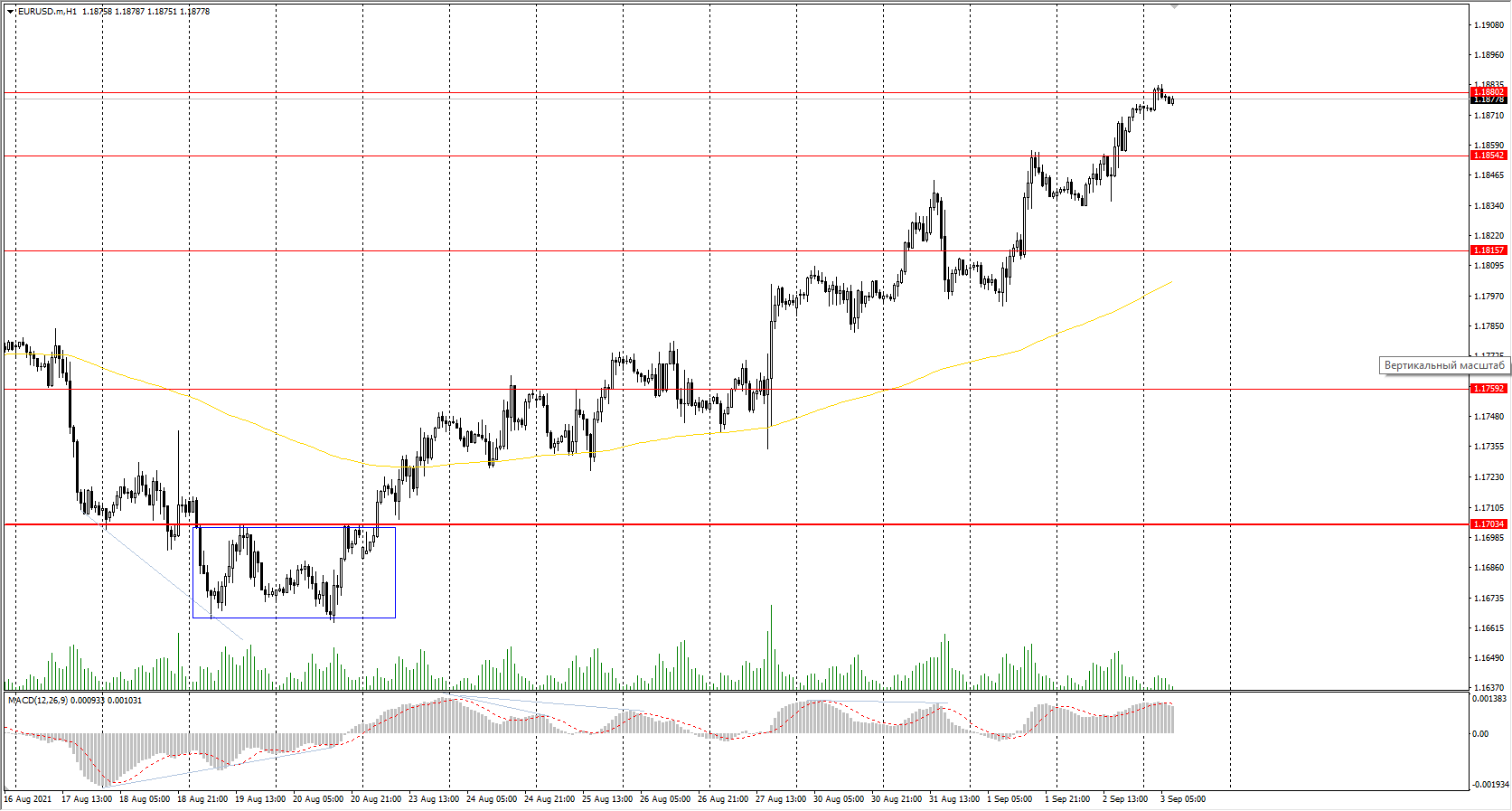
Support levels: 1.1854, 1.1816, 1.1799, 1.1759, 1.1704, 1.1620
Resistance levels: 1.1880, 1.1934, 1.1969
From a technical point of view, the general trend of the EUR/USD currency pair has changed to bullish. The price broke through the priority change level and consolidated above. The MACD indicator is still signaling a divergence in the opposite direction. The price has deviated from the moving average; given the divergence, there is an increasing probability of a corrective downward movement. Under such market conditions, it is best to look for sell trades from the resistance levels, where sellers show initiative. Buy trades can be considered only after a pullback to the support levels near the moving average.
Alternative scenario: if the price breaks through the 1.1704 support level and fixes below, the mid-term uptrend will likely be broken.
News feed for 2021.09.03:
- US Nonfarm Payrolls (m/m) at 15:30 (GMT+3);
- US Unemployment Rate (m/m) at 15:30 (GMT+3);
- US ISM Services PMI (m/m) at 17:00 (GMT+3).
The GBP/USD currency pair
Technical indicators of the currency pair:
Prev Open: 1.3769
Prev Close: 1.3732
% chg. over the last day: +0.46%
The British pound is also getting stronger against the background of the dollar index decline. The growth of quotes is also supported by the growth of Brent oil price. The UK will report on the situation in the industrial and service sectors today.
Trading recommendations
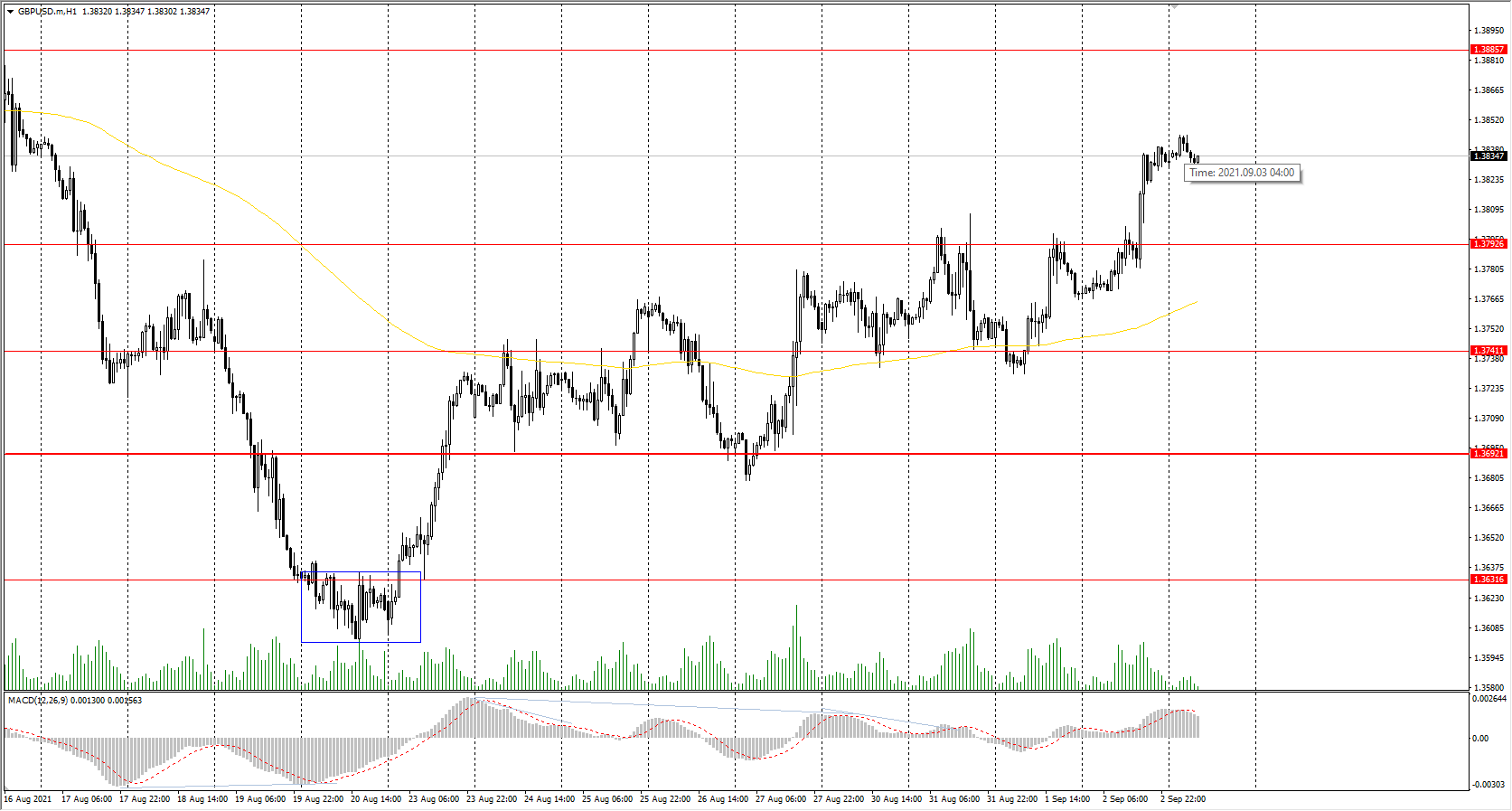
Support levels: 1.3793, 1.3741, 1.3692, 1.3632, 1.3614, 1.3525
Resistance levels: 1.3886, 1.3935, 1.4002
On the hourly time frame, the GBP/USD trend changed to bullish. The price broke through the priority change level on the impulsive movement and consolidated higher. The MACD indicator is in the positive zone, and there are the first signs of divergence on higher time frames. Under such market conditions, it is better to look for buy trades from the support levels after the price pullback, as the price has now deviated strongly from the moving average. Sell positions can only be considered from the resistance levels with short targets throughout the day.
Alternative scenario: if the price breaks through the 1.3692 support level and consolidates below, the bearish scenario will likely resume.
News feed for 2021.09.03:
- US Nonfarm Payrolls (m/m) at 15:30 (GMT+3);
- US Unemployment Rate (m/m) at 15:30 (GMT+3).
The USD/JPY currency pair
Technical indicators of the currency pair:
Prev Open: 109.97
Prev Close: 109.93
% chg. over the last day: -0.04%
The USD/JPY currency pair is highly dependent on the dynamics of the dollar index now. The dollar index is declining, which leads to a decrease in the USD/JPY quotes. Japan's services sector activity contracted at the fastest pace in over a year in August as the sharp outbreak of COVID-19 hit the recovery of the world's third largest economy.
Trading recommendations
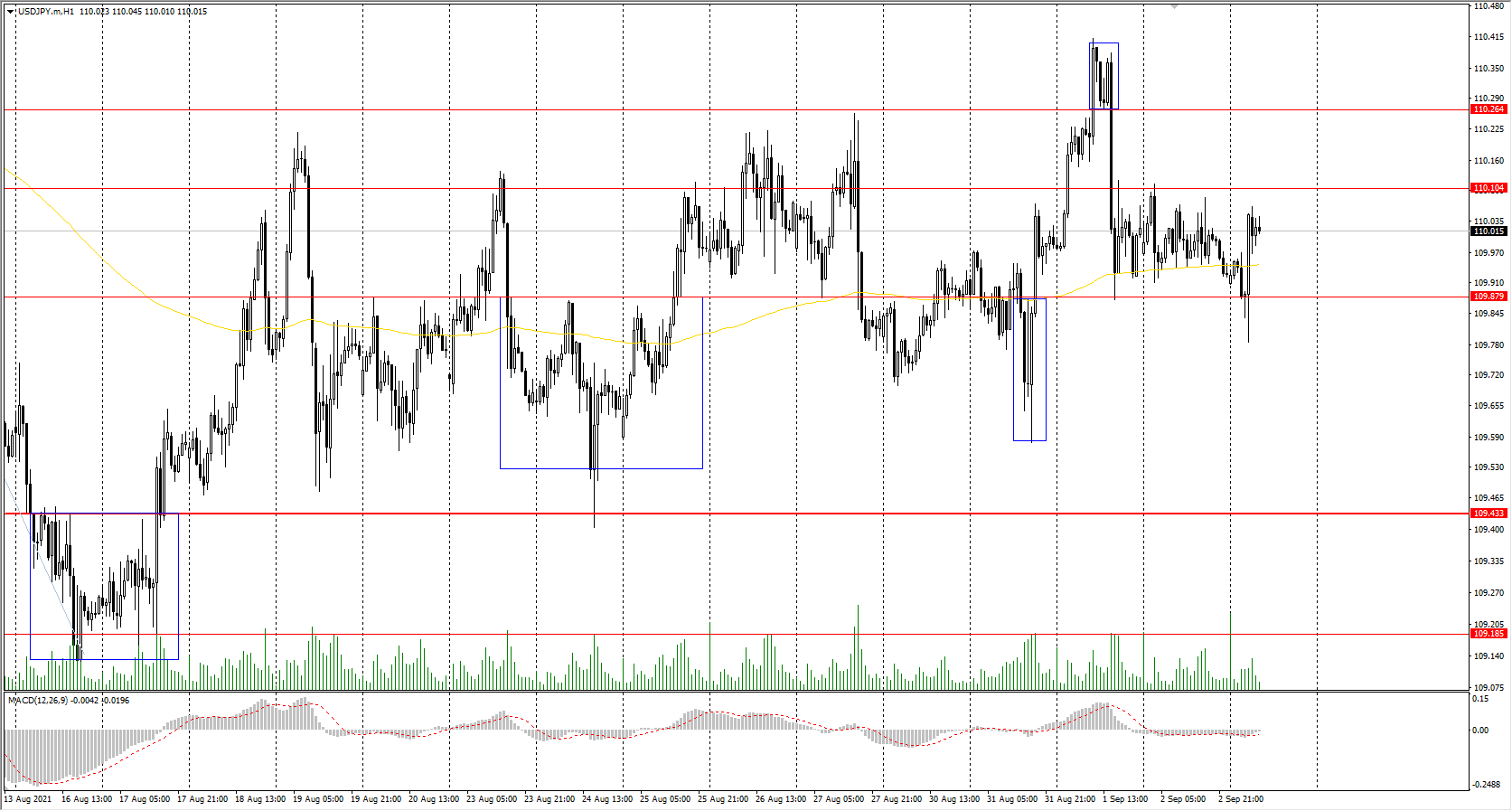
Support levels: 109.88, 109.43, 109.19, 108.65
Resistance levels: 110.11, 110.34, 110.66, 110.95, 111.48
The main trend of the USD/JPY currency pair is bullish. The price is now trading in a narrow corridor. The MACD indicator is inactive. Under such market conditions, traders should look for buy trades from the support level, where buyers show initiative. Sell positions should be considered only on the lower time frames from the false breakdown zone.
Alternative scenario: if the price falls below 109.43, the uptrend is likely to be broken.
News feed for 2021.09.03:
- US Nonfarm Payrolls (m/m) at 15:30 (GMT+3);
- US Unemployment Rate (m/m) at 15:30 (GMT+3).
The USD/CAD currency pair
Technical indicators of the currency pair:
Prev Open: 1.2610
Prev Close: 1.2551
% chg. over the last day: -0.47%
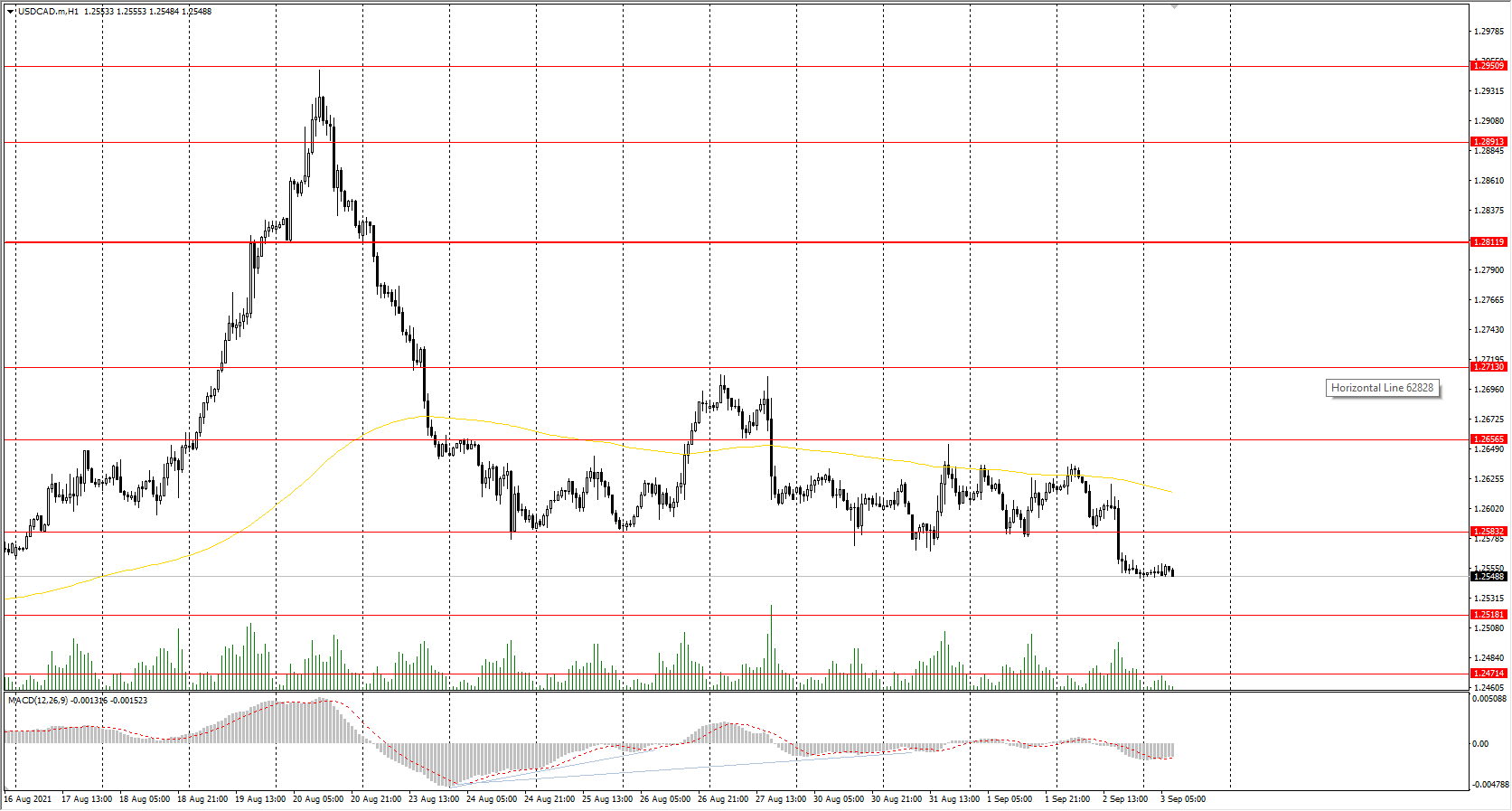
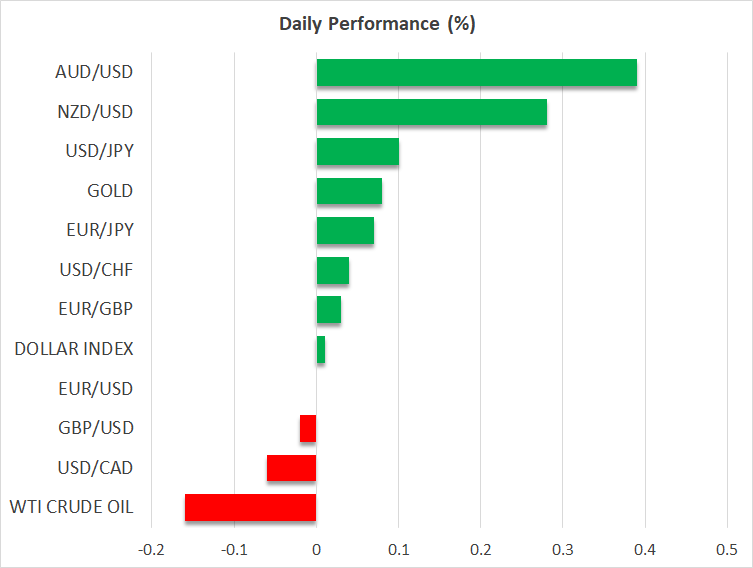
The Canadian dollar is a commodity currency, so the USD/CAD currency pair is highly dependent on the dynamics of the dollar index and oil prices. The dollar index is falling while oil prices are rising. As a result, the USD/CAD currency pair is decreasing due to the strengthening of the Canadian dollar.
Trading recommendations
Support levels: 1.2518, 1.2471
Resistance levels: 1.2583, 1.2656, 1.2713, 1.2812, 1.2891, 1.2951
In terms of technical analysis, the trend on the USD/CAD currency pair has changed to bearish. The price broke through the priority change level on the impulsive movement and consolidated below. It is now best to consider sell positions from the resistance levels, where sellers show the initiative. Buy positions can be considered from the support levels, but after additional confirmation in the form of buyers' initiative.
Alternative scenario: if the price breaks through the 1.2812 resistance level and fixes above, the uptrend will likely resume.
News feed for 2021.09.03:
- US Nonfarm Payrolls (m/m) at 15:30 (GMT+3);
- US Unemployment Rate (m/m) at 15:30 (GMT+3).
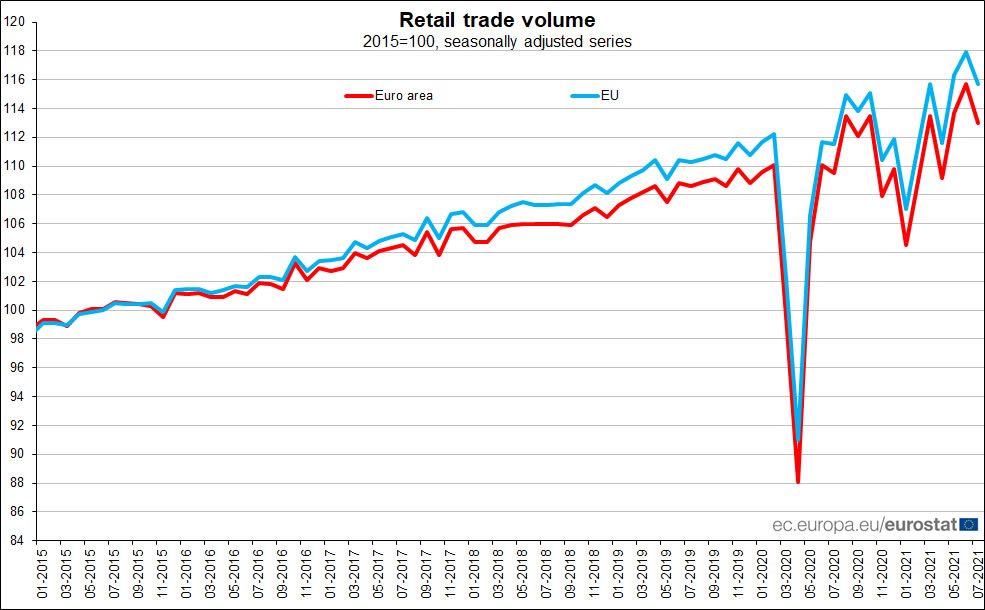
Eurozone retail sales dropped -2.3% mom in Jul, EU down -1.9% mom
Eurozone retail sales dropped -2.3% mom in July, well below expectation of 1.2% mom rise. For the month, the volume of retail trade decreased by -3.5% for non-food products, by -1.6% for automotive fuels and by -0.7% for food, drinks and tobacco.
EU retail sales dropped -1.9% mom. Among Member States for which data are available, the largest monthly decreases in total retail trade were registered in Ireland (-5.9%), Germany (-5.1%) and Austria (-3.9%). The highest increases were observed in Croatia (+2.5%), Malta (+2.3%) and Luxembourg (+2.2%).
Investors’ Attention Is Focused On Nonfarm Payrolls Data
The number of initial jobless claims in the US fell to 340,000, the lowest level since March 2020. Investors are now focusing on nonfarm payrolls data. Economists expect the number of workers to increase by 720,000 a month and the unemployment rate to fall from 5.4% to 5.2%. If the data is above those expectations, the dollar index will rise substantially, and major stock indices will decrease. The US stock market ended Thursday's trading higher due to the strength of the oil and gas, health care, and utilities sectors. The Dow Jones increased by 0.37%, the S&P 500 increased by 0.28%, and the NASDAQ added 0.14%.
European stock indices increased on Wednesday as investors bet that the global economic recovery would continue, even as central banks considered cutting stimulus. The Stoxx Europe 600 composite index of the region's largest companies added 0.3%. The current value is very close to its all-time high. The British FTSE 100 added 0.2%, the German DAX and the French CAC 40 increased by 0.1%, the Italian FTSE MIB added 0.2%. Meanwhile, Spain's IBEX 35 lost 0.1%.
Oil prices jumped sharply yesterday. The pressure on prices triggers a sharp decrease in US inventories, the data on which was released on Wednesday. Despite an increase in production by OPEC+ countries, market supply is still far below demand. Optimism about economic recovery and the weakening of the US dollar also contributed to the growth of quotes.
The situation with gold has not changed much in recent days. Fundamentally, quotes will rise as long as the Federal Reserve maintains a soft monetary policy. But traders have to be careful, as good labor market data can make the dollar index and government bond yields rise, which in turn will make gold prices fall.
Japanese stocks jumped on Friday after officials had said Prime Minister Yoshihide Suga would resign. Japan's TOPIX stock index jumped to a 30-year high, while the Nikkei added 1.87%.
Main market quotes:
- S&P 500 (F) 4,536.95 +12.86 (+0.28%)
- Dow Jones 35,443.82 +131.29 (+0.37%)
- DAX 15,840.59 +16.30 (+0.10%)
- FTSE 100 7,163.90 +14.06 (+0.20%)
- USD Index 92.23 −0.22 (−0.23%)
Important events for today:
- Australia Retail Sales (m/m) at 04:30 (GMT+3);
- UK Composite PMI (m/m) at 11:30 (GMT+3);
- UK Services PMI (m/m) at 11:30 (GMT+3);
- US Nonfarm Payrolls (m/m) at 15:30 (GMT+3).
Locked And Loaded For Nonfarm Payrolls
- Dollar on the defensive ahead of US employment report
- Stocks and commodity currencies continue to party
- Japanese leader steps down, Nikkei smells more spending
Markets position for NFP disappointment
The moment of truth is finally here. Investors across the world are on the edge of their seats waiting for the latest US employment report, which will hopefully settle the debate of when the Fed will begin to close the liquidity taps.
Nonfarm payrolls are expected to clock in at 750k in August, pushing the unemployment rate down another two ticks to reach 5.2%. If the actual numbers meet the forecasts, that would leave the US economy some 5 million jobs shy of a complete labor market recovery.
Subtract from that around 2.5 million people that retired early because of the pandemic and are unlikely to return to the labor force, and it is entirely possible that America returns to full employment by the turn of the year. It would only take a few more months at this pace. With the economy overflowing in open jobs and federal unemployment benefits ending, that’s quite realistic.
That said, it looks like the markets anticipate a disappointment today. The ADP jobs report printed only 374k jobs in August, the composite Markit PMI showed jobs growth hitting a one-year low, and the employment sub-index of the ISM manufacturing survey fell into contractionary waters.
Indeed, judging by the latest price action in the dollar, bonds, and stocks, investors seem positioned for a much lower payrolls figure by now. As such, even a number that simply meets forecasts could spark a comeback in the dollar as a Fed taper move in September comes back into play.
Stocks keep going, antipodeans shine
Wall Street closed a shade higher on Thursday, with a little help from expectations for a soft US jobs report that delays the Fed’s normalization plans. Interestingly enough, markets shrugged off some remarks from Senator Joe Manchin that the Democrats should “pause” their efforts on the $3.5 trillion reconciliation bill, citing soaring debt levels and accelerating inflation.
With the Senate split 50-50, the Democrats can’t afford to lose a single vote if this bill is to pass. Of course, Manchin could be playing political chess and his opposition might ultimately water down the tax increases in this bill, so markets were happy to ignore this for now.
Meanwhile, the risk-on mood was also reflected in commodity currencies like the aussie and kiwi, both of which are headed for weekly gains of around 1.8% against the US dollar. This is the second week of sensational gains for the two currencies as they recover from their recent virus troubles.
Nikkei jumps as Japanese PM resigns
In the political sphere, Japan’s prime minister - Yoshihide Suga - announced he will not run for reelection as party leader. Suga was elevated to the role last year but has seen his approval ratings collapse lately as Japan grappled with a nasty virus outbreak and a slow vaccination rollout.
Japanese stocks were ecstatic. The Nikkei 225 rose by 2% as investors sensed momentum behind a new round of government spending after one of the frontrunners to replace Suga pledged more fiscal measures to battle the virus. The inter-party election is scheduled for September 29. Whoever wins is almost certain to become the next prime minister given the LDP’s parliamentary majority.
Over in China, incoming PMI surveys continue to confirm that the economy is losing speed, raising the question of how forcefully the nation’s authorities will respond as they try to revive growth but simultaneously remain wary of an overleveraged economy.
Finally, with all the attention on the US jobs report today, markets might be sleeping on the ISM services PMI that will be released ninety minutes later. It could also prove crucial for the Fed’s decisions.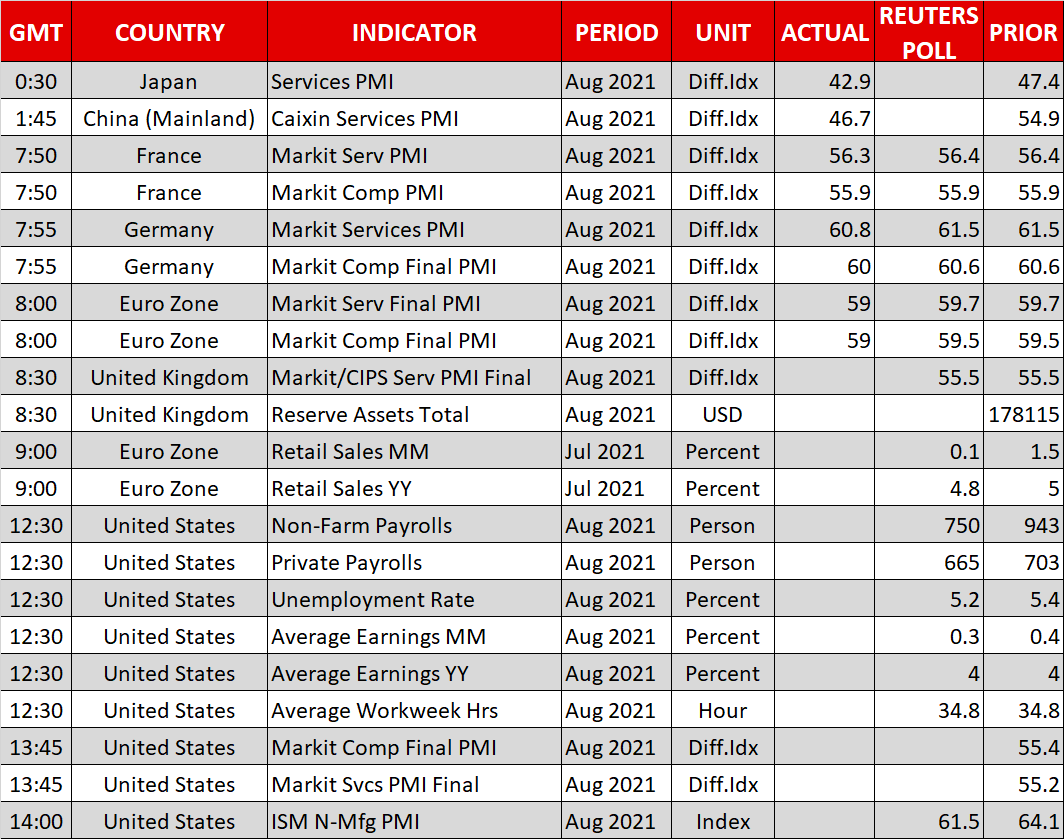
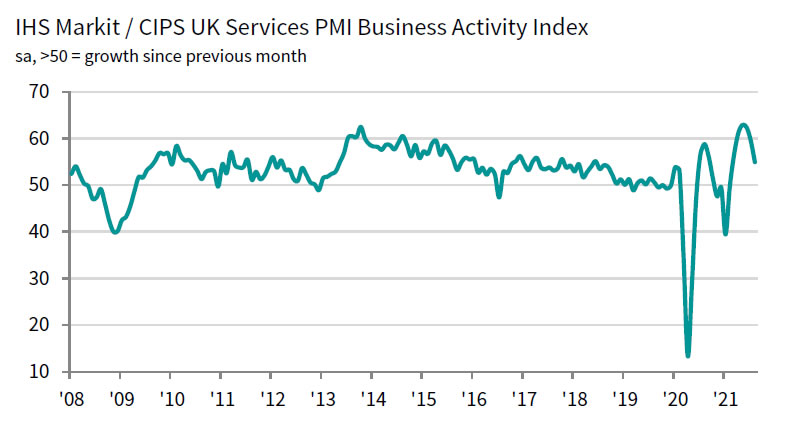
UK PMI services finalized at 55.0, staff shortages, self-isolation rules and stretched supply chain capacity
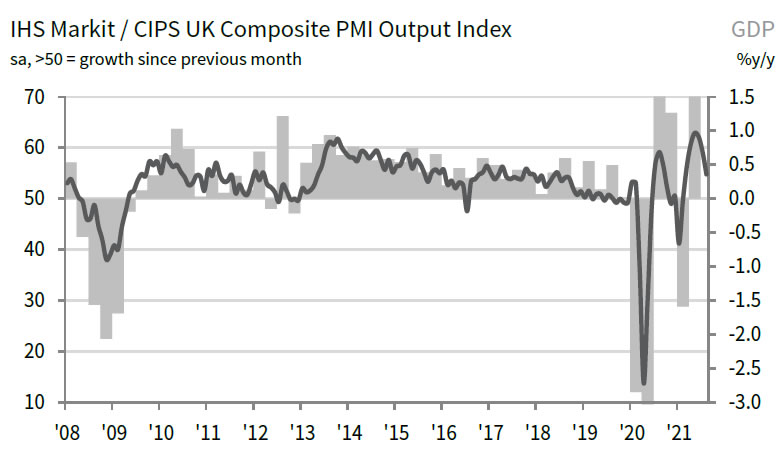
UK PMI Services was finalized at 55.0 in August, down from July's 59.6, and way below May's record high of 62.9. PMI Composite was finalized at 54.8, down from July's 59.2. Markit said recovery in business activity eased further from May's peak. Employment numbers rose at fastest rate since survey began in July 1996. Business optimism also climbed to three-month high.
Tim Moore, Economics Director at IHS Markit, which compiles the survey: "The service sector lost momentum for the third consecutive month as the impact of looser pandemic restrictions faded in August. Many businesses suffered constraints on growth due to staff shortages, self-isolation rules and stretched supply chain capacity...
"Tight labour market conditions pushed up wages as service sector companies sought to attract and retain employees. The overall rate of input cost inflation remained steep, but eased from the record high seen in July...
"Business optimism edged up to a three-month high during August, suggesting that service providers have become slightly more confident about longer-term prospects for demand and supply availability."
USDCAD At Risk Of More Declines, Uptrend Still Valid
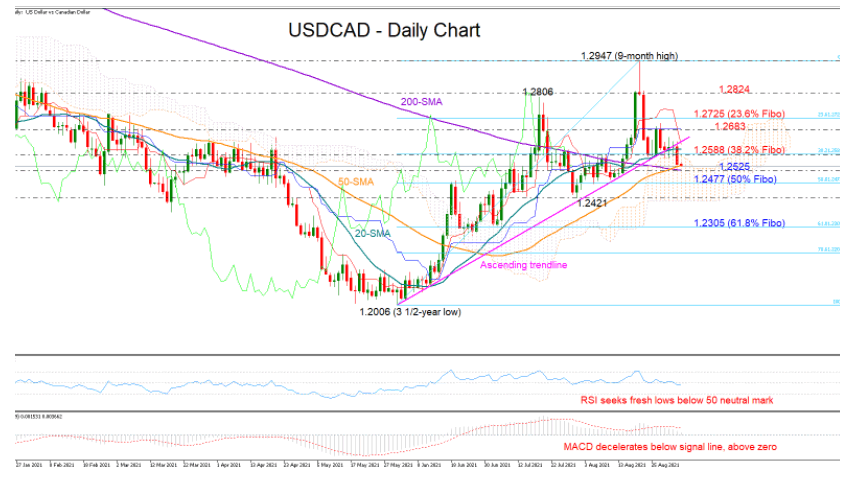
USDCAD bears snapped the ascending trendline after a three-day battle on Thursday, forcefully pushing the price towards the 50- and 200-day simple moving averages (SMAs) and to a two-week low of 1.2539 ahead of the all-important US nonfarm payrolls .
With the RSI dipping below its 50 neutral mark to seek fresh lows, and the MACD decelerating below its red signal line, expectations are for the negative momentum to dominate in the short term.
That said, the upward trajectory from the June low of 1.2006 is still valid despite the depreciation in the past two weeks and only an aggressive selling below the previous low of 1.2421 would disprove it, consequently shifting the spotlight towards the 1.2300 level – being the 61.8% Fibonacci retracement of the latest upleg. For now, the bullish SMA crosses continue to feed hopes for a continuation of the original positive trend.
In the meantime, the bears will also need to knock down the wall of 1.2525 – 1.2477 formed by the 200-day SMA and the 50% Fibonacci to keep the upper hand in the market.
In the event of an upside reversal, the pair could face some challenges between the 38.2% Fibonacci of 1.2588 and the broken supportive trendline, which could switch to resistance around 1.2630. Breaching these barriers, the focus will shift back to the 1.2683 handle and the 23.6% Fibonacci of 1.2725, while higher, a decisive close above 1.2824 would open the door for the 1.2947 peak.
Summarizing, USDCAD is currently exposed to additional negative corrections, though whether the sell-off can forestall the upward trajectory from June lows remains to be seen.