

Sample Category Title
Weekly Economic & Financial Commentary: Supply Problem Derails August Jobs Report
Summary
United States: Supply Problem Derails August Jobs Report
- The 235K jobs added in August was about half a million jobs short of expectations. For financial markets, which were hanging on every indication of the labor market as a clue to eventual Fed tapering, this report did not shout "substantial further progress." Other economic indicators this week were emblematic of the crosscurrents confronting the U.S. economy as it transitions from the vaccine- & stimulus-fueled surge in activity earlier in the year to a yet-to-be-determined new normal.
- Next week: JOLTS (Wed), PPI (Fri)
International: COVID Shows Up in GDP Data and China PMIs Disappoint
- Both Canadian and Indian GDP data revealed just how much of an economic impact COVID had in the second quarter of this year. The Canadian economy unexpectedly contracted in Q2 on an annualized basis, while the sharp spike in infections resulted in another significant quarterly contraction in India. COVID restrictions also played a role in uninspiring August PMI data in China.
- Next week: Reserve Bank of Australia (Tues), Bank of Canada (Wed), European Central Bank (Thurs)
Interest Rate Watch: Summer Doldrums for U.S. Interest Rates
- Despite plenty of headlines related to COVID, monetary and fiscal policy and incoming economic data, U.S. Treasury yields have moved very little over the past month. The 10-year Treasury yield spent most of the month of August anchored around 1.30%, and despite a disappointing nonfarm payrolls number this morning, the 10-year yield is up a few basis points and currently sits at 1.33%.
Topic of the Week: Hurricane Ida Rains Over the East
- The cruel indifference of Mother Nature was on full display this week. While much of the West continues to battle droughts and wildfires, Hurricane Ida dumped massive amounts of rainfall on large swathes of the East. The potential negative economic impacts extend to both the local and broader U.S. economy.
U.S. Review
One Ugly Report Does Not Mean the Job Market Is in Trouble
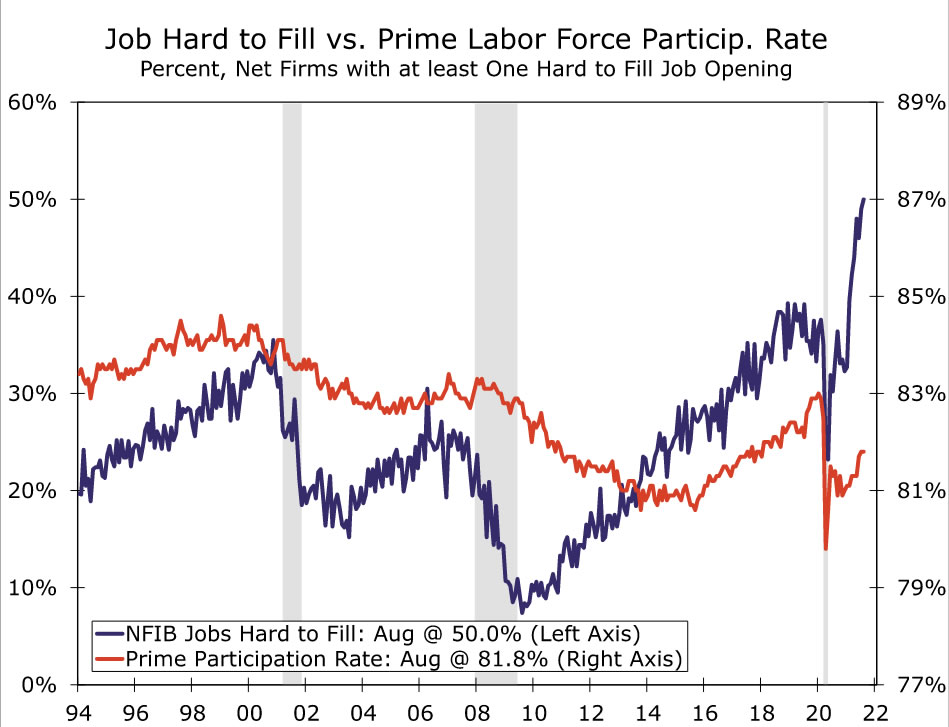
The jobs report for August was a major miss at a critical time. That said, we do not see this as a sign that the job market is in trouble. Like so many things in this pandemic era, this is a supply problem not a demand problem. The NFIB small business survey showed the share of businesses reporting that jobs are hard to fill rose to its highest on record in August. Employers are more than eager to hire, but a variety of factors are keeping would-be workers out of the market. The labor force participation rate did not budge from a still-low 61.7%. It is increasingly a sellers' market for labor as evidenced by the rising costs for employees: average hourly earnings rose 0.6% in August, which was more than twice the expected monthly gain and lifted the year-over-year rate to 4.3%. Any number of factors could be keeping would-be workers out of the market, from COVID fears and lack of child care to the idea that extended jobless benefits diminish the urgency to find work. Most of these impediments could be removed or diminished by higher pay. For now, the lackluster increase of just 235K makes it very unlikely that the FOMC will announce a taper of its asset purchases at its September 21-22 meeting.
The rest of the economic data we got this week reflect the various crosscurrents confronting the U.S. economy as it transitions from the initial vaccine- & stimulus-fueled surge to a yet-to-be-determined new normal.
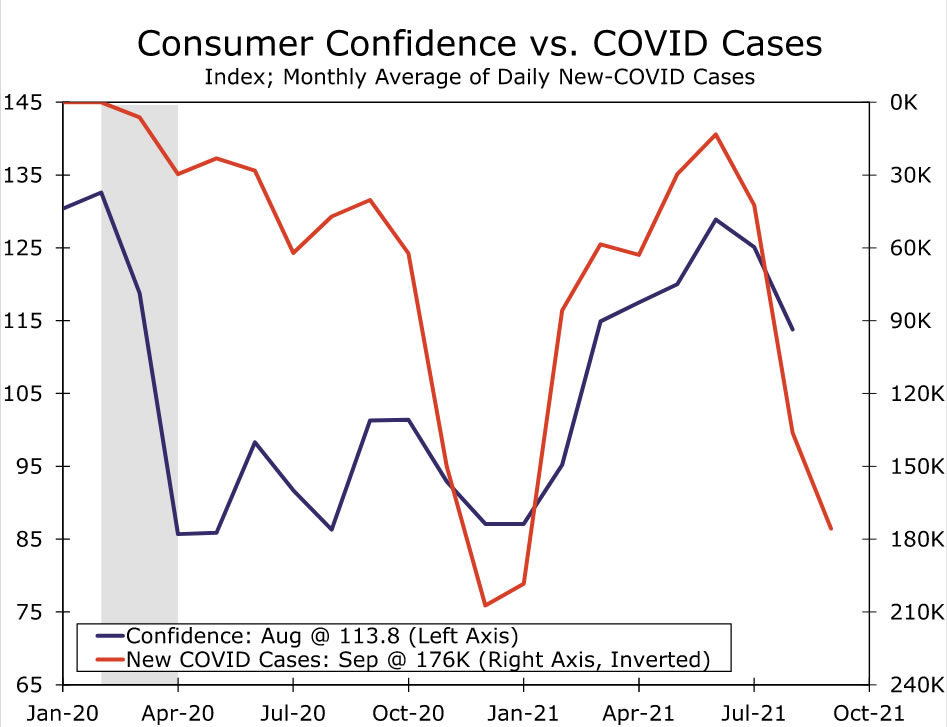
The crosscurrents theme is certainly evident in the consumer data. For the past several months, consumers have been spending some of their accumulated savings, but the categories seeing the biggest gains are in the service sector. The goods-spending boom of last year has largely faded. There is no sign of an immediate turnaround in the consumer confidence report, which showed buying intentions for durable goods, such as autos and appliances, declined in August. Consumer confidence in general fell to its lowest level since last winter, as households take in the latest surge in COVID cases and news about the war in Afghanistan. Still, the share of households reporting that jobs are plentiful remains near its highest levels of the past two decades, even though the share fell slightly in the latest reading. In short, households are worried about the future even though they see strength in the jobs market.
Some Potentially Good News for GDP
Businesses largely agree that the job market is tight. The ISM manufacturing index for August rose to 59.9 and showed that the factory sector is finding ways to thrive even in a very difficult environment. Apart from a notable miss in the employment index, there was incremental improvement in many of the categories that have defined the struggles of the COVID era. The comments section pointed to the difficulty that firms are experiencing matching open positions to viable job candidates.
Two developments this week actually brightened the outlook for Q3 GDP growth somewhat. The first was in the details of the ISM manufacturing report. The two biggest upward moves of the various components were both indicative of a rebuilding of depleted stockpiles. Both inventories and customer inventories shot up more than five points. In the case of the inventories index, that component crossed into expansion territory and rose to its highest level since 2018. This could point to a boost for GDP as even a modest rebuilding of inventories has scope to provide a big boost to the headline growth rate. However, the service sector is still struggling to get needed inputs. Both inventory measures in the ISM services index released this week remained well in contraction territory. The other bright spot was the narrowing in the trade deficit. The July trade report showed the ripple effects of the pandemic-era disruption as the United States and the rest of the world attempt to return to some semblance of normal. The U.S. trade deficit narrowed to $70.1 billion which, if sustained, would boost third quarter GDP growth. That said, the factors driving the narrowing have to do with long wait times at U.S. ports and the re-emergence of foreign travel in July, which may prove fleeting.
U.S. Outlook
JOLTS • Wednesday
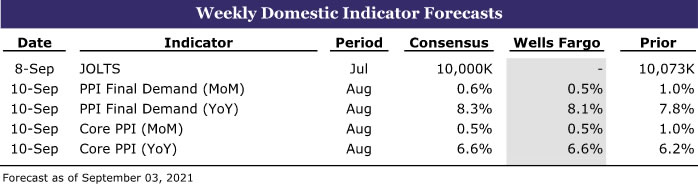
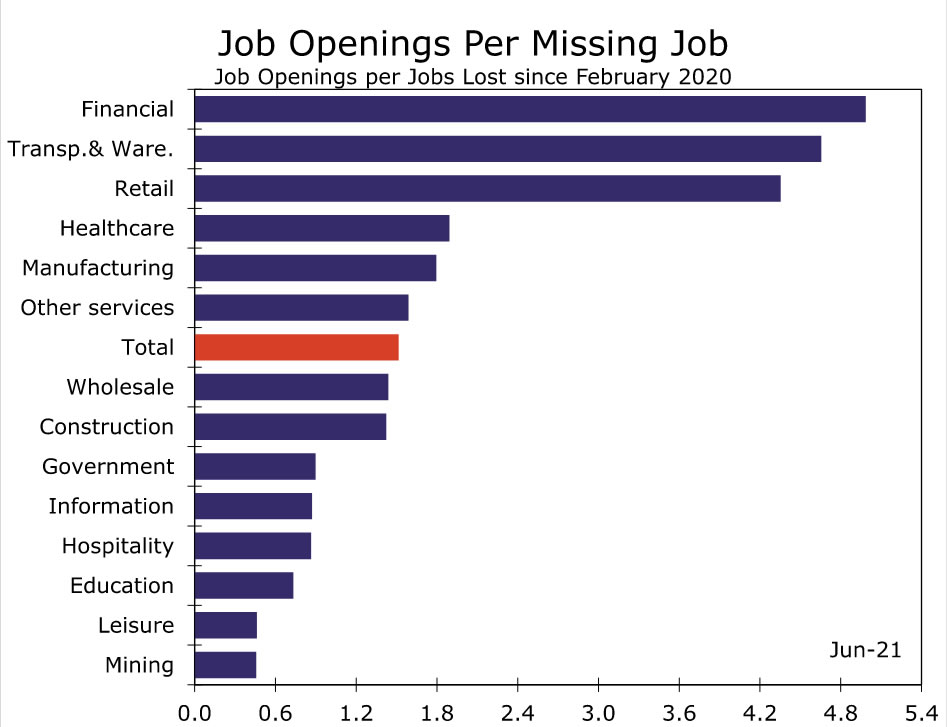
Next week's Job Opening and Labor Turnover Survey (JOLTS) should provide a deeper dive into the labor market's underlying dynamics this summer, as we start to look ahead to the fall. The June JOLTS report showed all the signs of a strong job market, with job openings at a series high of 10.1 million and layoffs at a series low of 1.3 million. Quits, which show workers' willingness or ability to leave their jobs, also picked up in June, only slightly below the April series high. We expect next week's report to show that July was still a good time to be looking for a job. Indeed job postings continued to trend up in July, and as of August 27, they are at a level consistent with about 10.5 million job openings.
While the surge of labor demand will likely recede at some point, it has remained exceptionally strong through much of the summer. Labor supply, however, has been a bit harder to come by. In fact, there were more job openings than there were unemployed persons in June. Part of the inability to fill open positions is a result of the fact that industries with job openings may not always match those in which jobs were cut last year. High-contact service industries have also had a hard time bringing workers back to the jobsite due to COVID concerns and lower pay, among other reasons. While COVID concerns remain top of mind, leisure & hospitality has seen some of the fastest wage growth of any industry over the past few months and enhanced unemployment insurance programs have started to expire, which may push some workers back into the job market. Despite the labor demand far outstripping labor supply, hiring has been able to maintain a relatively healthy pace. Total hires in June reached their highest level since last year's reopening, and firms continued to add jobs in July.
Producer Price Index • Friday
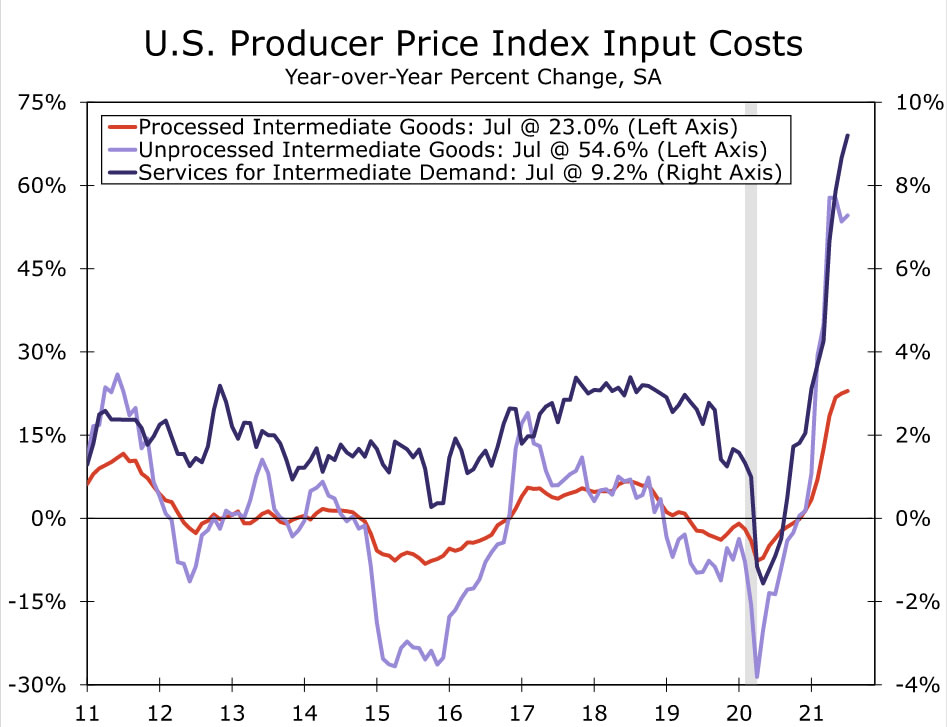
Coming in before the Consumer Price Index during a slow week for economic indicators, August's Producer Price Index report may get a bit more attention than usual. While we saw monthly growth in the CPI moderate in July, the PPI for final demand increased 1.0% for the second month in a row, bringing the three-month annualized rate up to 11.8%. Further up the pipeline, the PPI for intermediate services demand saw another healthy increase in July, while the PPI for intermediate processed and unprocessed goods slowed slightly. All of these measures, however, remain quite elevated relative to last year, reflecting the broad price pressures that firms are facing.
So far for August, there has been some indication of intermediate price pressures easing at the margin. The prices paid component of the ISM manufacturing survey fell 6.3 points to its first sub-80 reading since December. That said, purchasing managers continued to face difficulty sourcing needed inputs, as every commodity, except wood and lumber, was reported to be up in price. Altogether, we expect that growth in prices received by domestic producers moderated to 0.5% month-over-month in August, but the broad array of cost pressures will keep a healthy floor on the PPI in the months ahead.
International Review
Q2 GDP Data Underwhelms in Canada and India
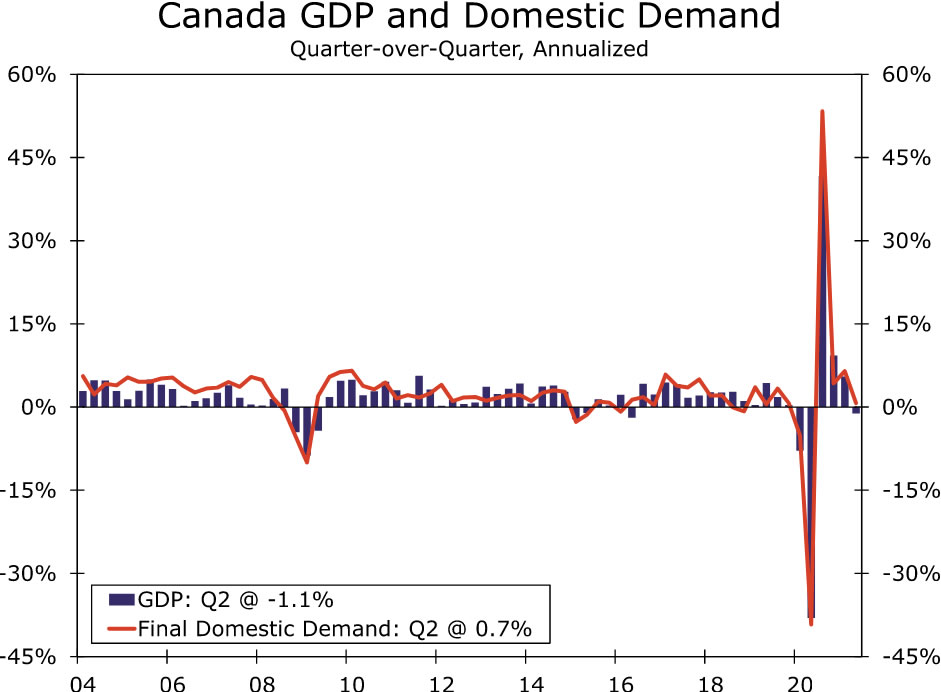
This week, we received Q2 GDP data from Canada as well as India. At a high level, the takeaway from each GDP print is the same: both economies came under more pressure than expected in the second quarter. Starting with Canada, Q2 GDP surprised to the downside, with data revealing the economy contracted 1.1% quarter-over-quarter annualized. Although the decline was a bit of a shock, the underlying details of the data reveal some silver linings. The slowdown in the economy appears to mostly be driven by exports. As a result, after stripping out exports and inventories, final domestic demand rose 0.7% during the second quarter. In addition, household finances remain in good shape, which should place Canada in a position to rebound following a temporary period of soft growth. While the renewed spread of COVID has injected some uncertainty into the path of monetary policy, we continue to believe the Bank of Canada will continue to slow asset purchases and is on pace to raise interest rates in the second half of next year.
Data also revealed the sharp spike in COVID cases earlier this year in India resulted in a significant economic contraction in the second quarter. By our estimates, the economy declined around 12.5% on a seasonally adjusted quarter-over-quarter basis; however, given the base effects associated with the significant decline in the second quarter of last year, the economy expanded a little over 20% year-over-year in Q2-2021. The second quarter of 2021 decline was largely driven by a sizable slowdown in personal consumption. Local government restrictions and an abundance of consumer caution weighed on consumer spending as well as the overall economy. The size of the contraction was more than we expected, and as a result, we revised our 2021 GDP forecast lower. We now expect India's economy to grow around 8.2% this year. However, the recovery is taking shape, and we believe the rebound will pick up pace in the second half of this year and we look for that momentum to carry forward into 2022. In that context, we revised our 2022 growth forecast higher and expect India's economy to grow a little under 8% next year.
China PMIs Under Pressure
We have commented on the pending slowdown in China's economy over the past few weeks, and we received even more evidence of the deceleration this week. Purchasing Manager Indices (PMIs) slowed further in August, with the manufacturing PMI dipping to 50.1 and the non-manufacturing PMI falling into contraction territory. COVID-related restrictions are the culprit, which we expected; however, the slowdown was more pronounced than consensus forecasts, especially on the non-manufacturing side. With the non-manufacturing sector now in contraction territory and the manufacturing sector slowing, the short-term outlook for China's economy remains less than stellar.
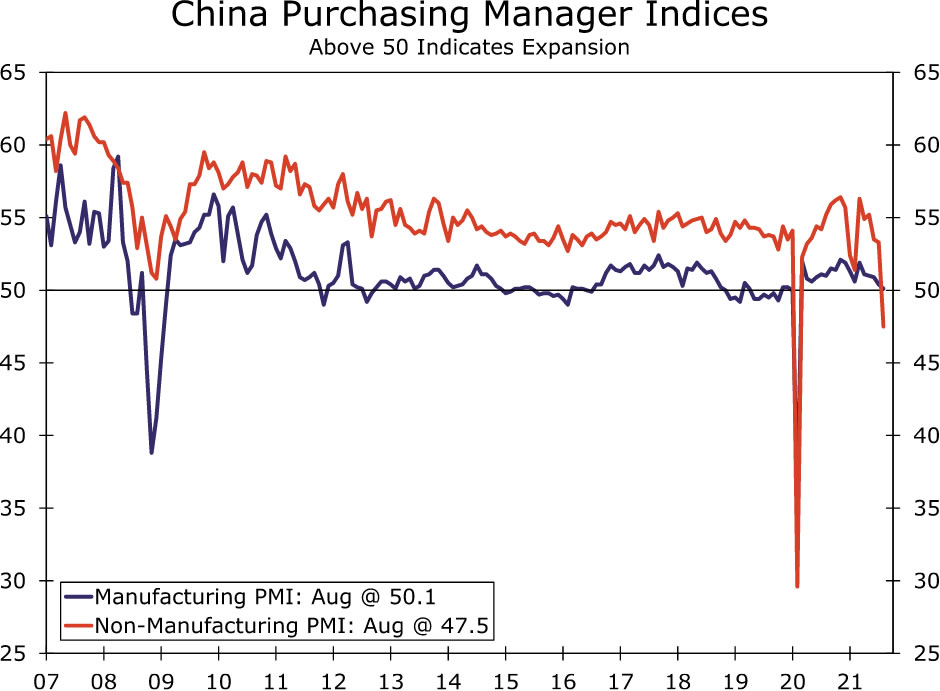
Our forecast profile has not changed materially after the release of the PMIs mostly due to the fact that we expected downside surprises to China's leading economic indicators and already made downward revisions. To that point, we continue to believe the Chinese economy will grow 8.2% this year, down from a prior forecast of 8.5% before the latest round of restrictions went into place. As the economy decelerates, Chinese authorities have suggested more support for small and medium-size businesses as well as local financial markets will be forthcoming. Just recently, People's Bank of China (PBoC) officials suggested liquidity is likely to remain available and the credit impulse will remain steady, which should support economic growth toward the end of the year and possibly into 2022.
Despite reassurances from the PBoC, uncertainty remains prevalent in China, given the regulatory crackdown currently under way. Local equity markets have declined rather significantly amid President Xi's push for "common prosperity," which over time, could result in investors becoming hesitant to deploy capital into China, or outright pulling capital out of the country. The path ahead for the regulatory and legal clampdown remains unclear. For now, Chinese authorities seem to be focused on the technology, education and real estate sectors; however, they could possibly broaden their focus to other industries. Should capital outflows mount or pressure build on China's economy as a result, the PBoC could look to intervene more aggressively in currency markets and accommodate a weaker renminbi. While we do not think an outright devaluation is likely, a weaker currency could soften the economic impact. Going forward, we will be focused on whether the PBoC turns more aggressive in its intervention methods as well as the overall direction of regulatory focus in China.
International Outlook
Reserve Bank of Australia • Tuesday
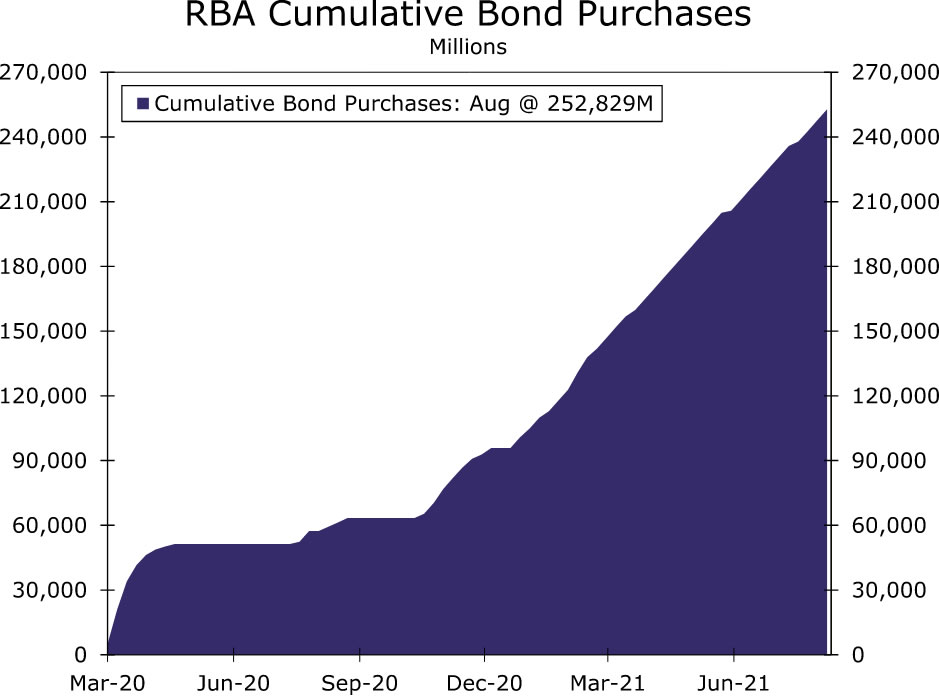
Next week's RBA meeting could result in some elevated volatility in local Australian financial markets. In August, RBA meeting minutes indicated policymakers considered delaying the tapering of asset purchases. Given the economic uncertainties associated with rising COVID cases and lockdowns, the case for continuing the current pace of purchases has strengthened. To that point, we expect RBA policymakers to indeed delay reducing the pace of asset purchases at its meeting next week and will opt to continue providing policy support to the economy.
As of now, the RBA is purchasing A$5 billion worth of government bonds in an effort to keep yields as low as possible. We expect the current pace of purchases to continue until November, at which time we expect purchases to slow A$4 billion. Further out, we expect another tapering to occur in early 2022; however, interest rate hikes are unlikely for the foreseeable future. Should the RBA signal indeed delay tapering purchases and sound more dovish than markets expect, the Australian dollar could come under modest pressure in the immediate aftermath of the announcement.
Bank of Canada • Wednesday
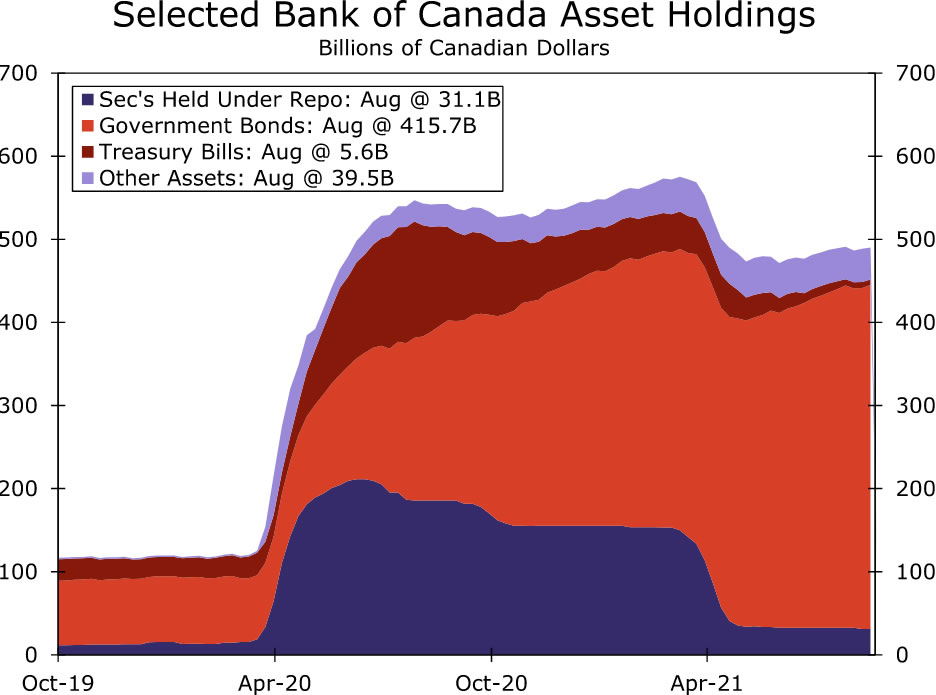
The Bank of Canada (BoC) was one of the first major central banks to begin reducing asset purchases, and despite recent shaky economic data, we believe the BoC is still on track to continue removing policy accommodation. Despite underwhelming GDP data, inflation is still relatively elevated, which we believe will be the focus of BoC policymakers for the time being. With that said, we expect the next reduction in asset purchases to take place in October, which would take the weekly pace of purchases down to C$1 billion per week.
In addition to reducing asset purchases, we believe the BoC will be one of the first major central banks within the G10 to begin lifting interest rates. The medium- to longer-term outlook for the Canadian economy remains, in our view, promising. Household spending power remains elevated, which should bode well for consumption once the current wave of COVID cases abates. In addition, oil prices remain supported for the time being and should also contribute to a solid economic recovery over the coming quarters. We believe this combination should allow BoC policymakers to lift interest rates starting in Q3-2022.
European Central Bank • Thursday
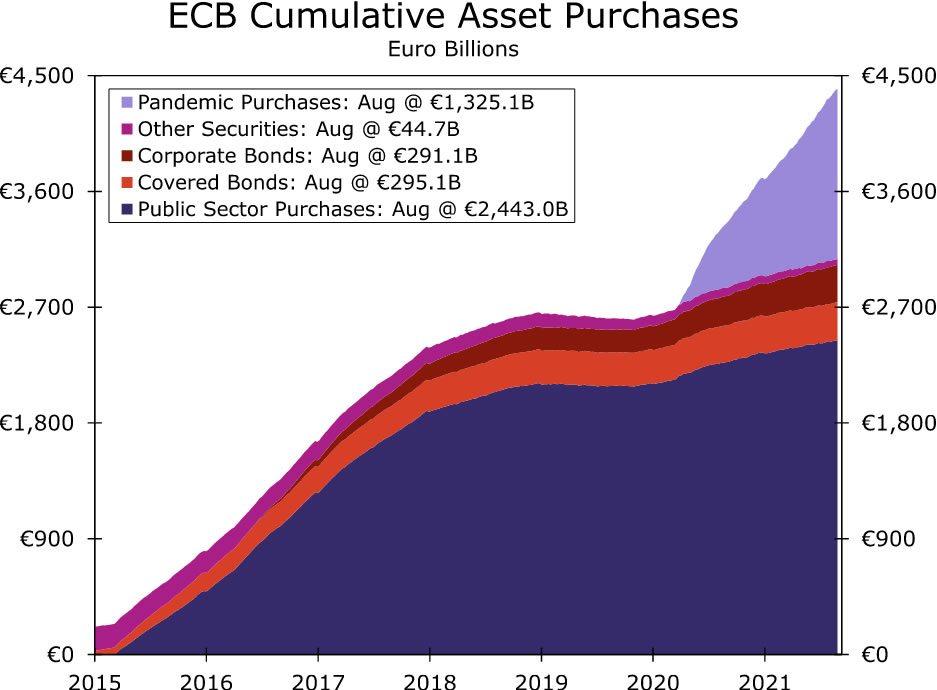
Given the ECB's recent shift to a symmetric inflation target and mixed messages on the direction of monetary policy, next week's monetary policy meeting should garner attention. In our view, we believe ECB policymakers will opt to keep policy unchanged next week; however, we continue to believe the central bank is on pace to ease monetary policy again before the end of this year. A higher inflation target should result in ECB policymakers opting to ease in asset purchases, picking up pace in Q4. In addition, we expect the ECB to announce a further increase in its Pandemic Emergency Purchase Program at its December meeting, possibly signaling this easing next week.
The mixed messages, however, stem from relatively less dovish commentary from select ECB members this week. Multiple members suggested the central bank should begin to consider removing policy accommodation as the Eurozone economy recovers and demonstrates the economic rebound can be sustained going forward. In addition, Eurozone inflation jumped to a recent high in August, rising 3% year-over-year. Higher-than-expected inflation could provide rationale for ECB policymakers to consider an early removal of accommodative policy; however, we remain unconvinced as of now.
Interest Rate Watch
Summer Doldrums for U.S. Interest Rates
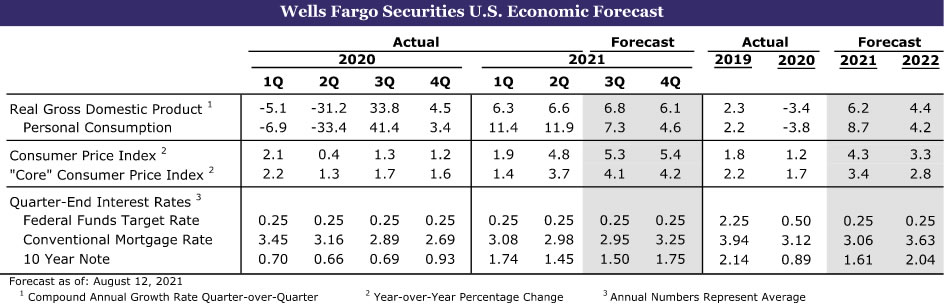
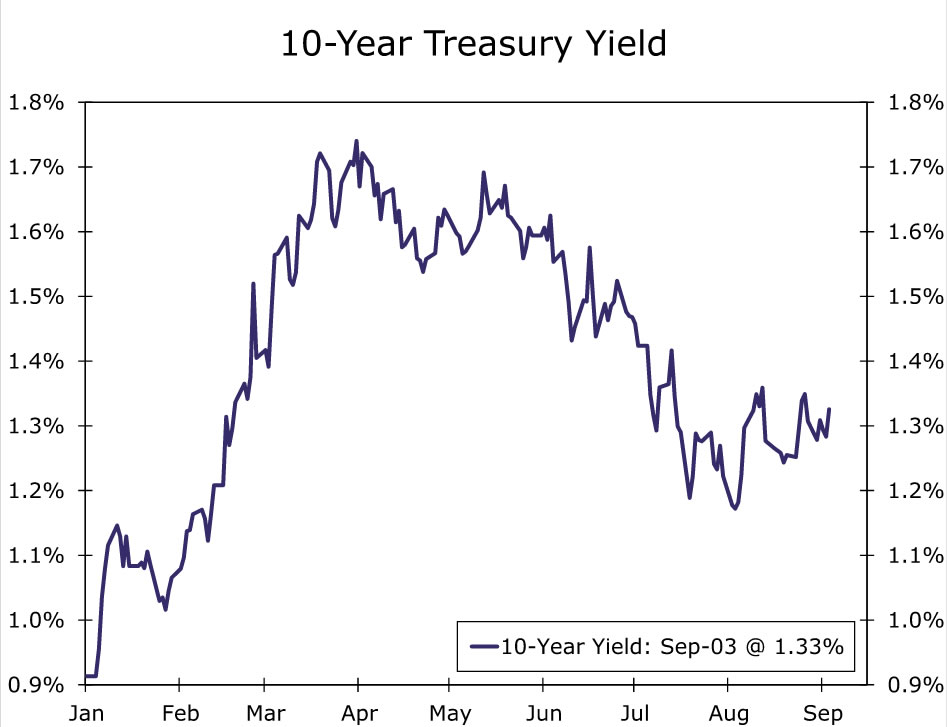
Despite plenty of headlines related to COVID, monetary and fiscal policy and incoming economic data, U.S. Treasury yields have moved very little over the past month. The 10-year Treasury yield spent most of the month of August anchored around 1.30%, and despite a disappointing nonfarm payrolls number this morning, the 10-year yield is up a few basis points and currently sits at 1.33% (see chart). Markets appear conflicted about where rates will head next. On the one hand, the rise of the Delta variant has pulled down forecasts for economic growth in the near term and raised new questions about the Federal Reserve's plans for tapering its asset purchases later this year. Additional uncertainty is also present in fiscal policy as policymakers in Washington D.C. are grappling with the prospects for a potential government shutdown, a debt ceiling showdown and a Democratic intraparty fight over several trillion dollars of new taxes and spending.
All that said, we continue to believe there is a case for yields to head higher from here, albeit to a still-low level by historical standards. There have been bumps in the reopening road before, and we believe the slowdown we are experiencing now is no different. GDP growth remains above potential and even August's disappointing jobs numbers were enough to whittle down the unemployment rate a bit further. Inflation continues to run hotter than many expected earlier this year, and the FOMC still appears poised to begin slowly removing monetary policy accommodation later this year despite the challenges associated with the Delta variant.
Pulling it all together, we look for the 10-year yield to rise to 1.75% by year-end, roughly matching the 2021 high reached in late March. This economic recovery continues to be a bumpy ride, but through the bumps, progress is being made and economic policy is normalizing. We believe this should correspond with Treasury yields normalizing as well. Of course, what "normal" looks like for interest rates in a post-COVID world is a difficult question to answer. Although we believe directionally higher is the answer, we also think the magnitude will be modest relative to the historic level of yields. Many structural factors that put downward pressure on interest rates are unlikely to abate anytime soon, and subsequently we have the 10-year yield finishing 2022 at just 2.15%.
Topic of the Week
Hurricane Ida Rains Over the East
The cruel indifference of Mother Nature was on full display this week. While much of the West continues to battle droughts and wildfires, Hurricane Ida dumped massive amounts of rainfall on large swathes of the East. On Sunday, Hurricane Ida arrived in southeast Louisiana as a Category 4 hurricane with over 150-mile-an-hour winds registered in some locations. Ida, which was the fifth most powerful hurricane to hit the United States, dumped between 10 and 15 inches of rain near its landfall location and brought a storm surge of 5 to 12 feet. After making landfall, the intensity of the storm lessened, and Ida was downgraded to a tropical storm as it coursed up through the Eastern Heartland and into the Northeast. While wind speeds died down, the rain did not, bringing flooding, agricultural ruin, infrastructure damage and general destruction for areas in the storm’s path.
While many major metro areas in the East are currently dealing with the aftermath of Ida, Louisiana appears to have been hit the hardest by the storm. Hurricane Ida made landfall exactly 16 years to the day that Hurricane Katrina devastated New Orleans. Fortunately, a $15 billion investment has been made in revamping the region's flood walls, levees, canals and barriers, which likely prevented a repeat of Katrina’s destruction. The flooding that occurred during Katrina was largely the result of engineering flaws in the region’s flood protection system. After the levees broke, approximately 80% of New Orleans and the surrounding neighborhoods and parishes were flooded. The storm also temporarily left tens of thousands without food or water, caused over 1,800 deaths and permanently displaced an estimated 1.5 million people from Louisiana, Mississippi and Alabama.
The good news is that Hurricane Ida’s damages do not appear to be of the same magnitude of Hurricane Katrina. That said, the storm prompted evacuations of about 580,000 residents and the intense winds knocked out power for over one million households in Louisiana and Mississippi. Initial estimates of the damages currently range from $50 billion to $80 billion, but Ida’s full impact will not likely to be known for some time. For context, Hurricane Katrina caused $125 billion in damage, mostly in the New Orleans area. What’s more, these estimates do not include the overall economic impact to the local economies that have essentially been shut down by power outages and flooding.
Source: U.S. Department of Labor and Wells Fargo Securities
Source: Bloomberg LP and Wells Fargo Securities
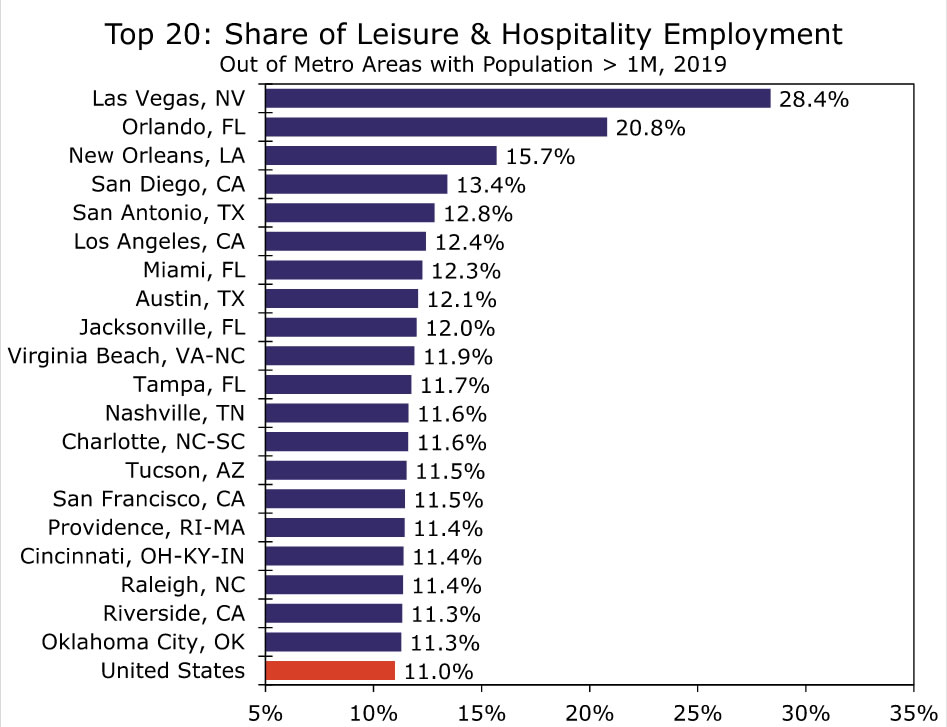
While power has been restored for some households in New Orleans, many businesses remain shuttered due to the power outages, and repairs are expected to take weeks. The tourism industry, which is still battling pandemic-related challenges and is one of the metro's key economic drivers, will likely be sidelined for an extended period. Most hotels, bars and restaurants remain shuttered, and live events that were scheduled to take place in the city have been canceled, postponed or relocated. Notably, the New Orleans Saints will now play their home opener in Jacksonville, Florida.
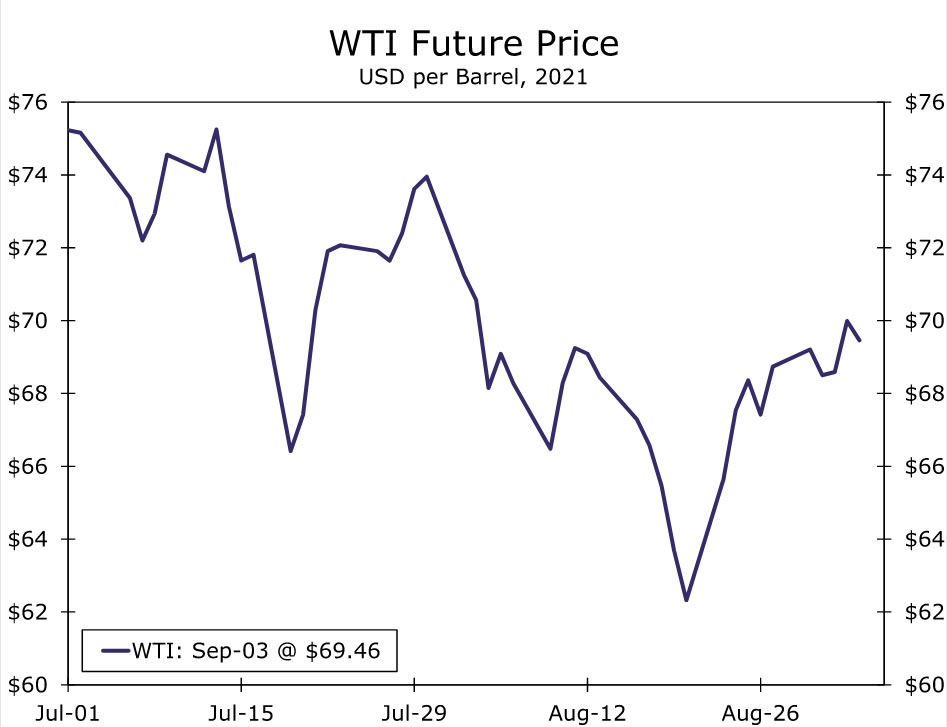
The potential negative economic impacts extend to the broader U.S. economy. For one, the Port of New Orleans (Port NOLA) is a key access point for the Mississippi River. Freight movement came to a standstill as the port closed down on Monday. Port NOLA has since reopened, but the disruption at the port could add to the pressures generated by ongoing supply-chain bottlenecks across the county. Furthermore, the storm temporarily shut-in almost all Gulf Coast oil production. Louisiana's onshore refineries appear to be back up and running after temporarily shutting down, but Hurricane Ida badly damaged Port Fourchon, which supports an estimated 16% of U.S. crude oil production and 4% of U.S. natural gas production. The Colonial Pipeline, which is the largest pipeline system for refined oil products in the U.S., was also shut down, but now is fully operational. West Texas Intermediate oil prices did not spike as a result of Hurricane Ida, but did end September 2nd at almost $70 a barrel, the highest level since early August.
The Weekly Bottom Line: Blame it on Delta
U.S. Highlights
- U.S. job growth slowed to 253k in August, well below market expectations for a 720k print. But the report also had plenty of bright spots. The jobless rate fell to 5.2% from 5.4%, while wage growth accelerated to 4.3% (y/y) from 4.1%.
- Progress in the recovery of jobs in leisure and hospitality – an industry that has been a primary driver of gains in recent months but that is sensitive to changing public health conditions with respect to the pandemic – stalled in August.
- Several other indicators echoed a deceleration in economic activity alongside an increase in COVID-19 infections as the summer was drawing to a close. These include the ISM services index, auto sales and pending home sales.
Canadian Highlights
- Second quarter GDP results dominated headlines this week. The economy contracted unexpectedly, its first decline since the pandemic struck in the second quarter last year.
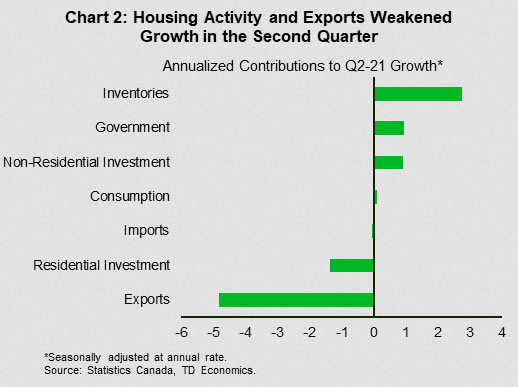
- The weakness was concentrated in residential investment and exports. Meanwhile, consumption was flat in the quarter as the third wave weighed on services spending.
- Statistics Canada indicated in its advance estimate that output will decline again in July. But early estimates usually underpredict actual GDP. In addition, the statistical agency may not be fully accounting for strong gains in services spending.
U.S. - Blame it on Delta
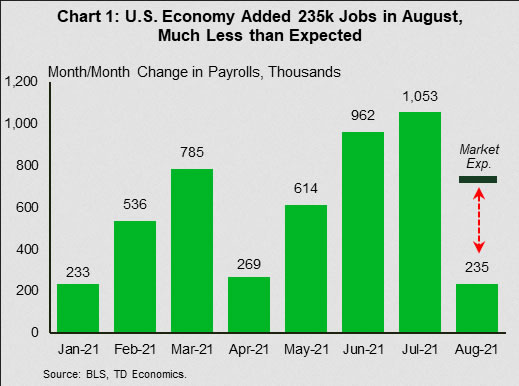
The week leading up to Labor Day Weekend was rich in economic data. Taken as a whole, the reports indicate that economic growth lost some steam in August, but that activity likely remained at fairly healthy levels. The most-awaited report of the week, the payrolls report, is a case in point. Job growth in August not only decelerated from a very strong July, but the 235k jobs print came in well below market expectations (Chart 1). Of note, progress in the leisure and hospitality sector – a primary driver of gains in recent months – stalled in August. Gains were led by professional and business services (+74k) and transportation and warehousing (+53k). The unemployment rate also made some progress, falling to 5.2% from 5.4% in the month prior. Meanwhile, average hourly earnings accelerated to 4.3% (year-over-year) from 4.1%. In short, while the employment report was certainly not as strong as expected, it still had plenty of bright spots.
The ISM Services Index carried through a similar narrative. The index came off a record high in the month prior, falling 2.4 points in August. Still, at a level of 61.7, it remains well in expansionary territory. The ISM manufacturing counterpart, which encompasses a smaller share of the economy, did better, rising 0.4 points to 59.9. This mild August uptick, however, does little to reverse a decelerating trend that has been in the works since March. What’s more, the underlying indicators in the manufacturing report still point to supply-side issues that continue to hamper the industry’s ability to meet demand.
Supply-related issues also featured in the vehicle sales report. Auto sales fell 10.7% to 13.1 million units (seasonally adjusted annual rate) in August, marking the fourth consecutive month of decline. Low inventory levels as a result of microchip shortages and other pandemic-related disruptions appear to be the main culprit behind the trend.
Tilting to the housing market, pending home sales pulled back for the second consecutive month in July, falling 1.8%. Pending sales lead actual sales by 1-2 months. As such, the pullback suggests that the upcoming August existing home sales report may also show some softness.
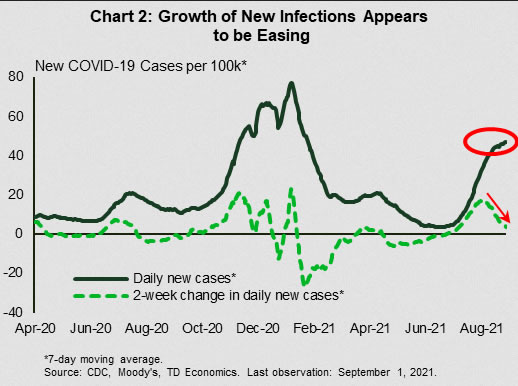
The deceleration in economic activity over the last month occurred alongside an increase in COVID-19 infections. The latest Delta-driven infection wave is likely a key factor behind the stalled progress in the recovery of leisure and hospitality payrolls, and behind some softening in consumer confidence (the latter fell to a six-month low in August). This headwind may continue in the near-term. Meanwhile, the sudden end to the eviction moratorium last week and the upcoming cutoff of pandemic unemployment benefits on Labor Day will add to difficulties for vulnerable households, likely taking a toll on spending. On a positive note, early indications that the pace of infections may be easing are a good sign, even as the inherently capricious nature of the virus offers little comfort (Chart 2).
With near-term risks tilted to the downside, we expect the Fed to wait for more confirmation of economic resilience before tapering later this year.
Canada - Second Quarter GDP Shocker
Second quarter GDP dominated headlines this week. The economy, which most had predicted to continue to recover in the second quarter — albeit at a slower pace — contracted unexpectedly. On a quarter-over-quarter annualized basis, GDP declined by 1.1%, while the consensus call was for a 2.5% expansion. This was the economy's first decline since the pandemic struck in the second quarter last year. So, what happened? How did analysts get the call so wrong?
That's because economy watchers did not foresee Statistics Canada making significant downward revisions to monthly GDP data, which form the basis of quarterly GDP calls. The statistical agency weakened month-over-month growth in April from -0.5% to -0.9%, while the May figure was lowered from -0.3% to -0.5%. These changes meant Canada's economic performance in the second quarter was considerably weaker than what was previously thought.
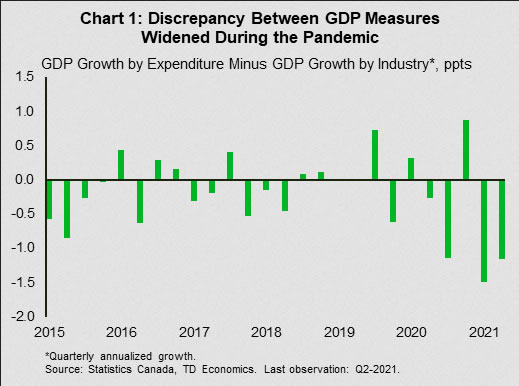
It’s important to note that monthly GDP data is calculated on an industry basis, while the quarterly headline series is constructed using expenditure components. Historically, growth in these two series has been closely correlated, but recently a gap has opened up (Chart 1). This likely reflects difficulties Statistics Canada has had in collecting data during the pandemic. Still, both GDP by expenditure and GDP by industry point to a subpar showing in the second quarter.
According to the expenditure accounts, residential investment and exports were the primary drivers of the weakness (Chart 2). The former doesn’t come as a surprise since housing market activity cooled recently with housing sales and starts in June around 20% below their March peaks. On the exports end, supply disruptions, particularly microchip shortages, badly hurt auto production, leading to a -47% (annualized) decline in motor vehicles and parts exports. Household consumption was also disappointing in the second quarter. Spending barely moved from its first quarter level as pandemic-related restrictions held back services consumption.
Despite the overall weakness, the second quarter ended on good note. Reopening of provincial economies led to a 0.7% m/m rebound in economic output in June, with high-touch services sectors seeing substantial gains. Surprisingly, the economic momentum appears to have been short-lived as Statistics Canada's flash estimate showed a 0.4% contraction in July GDP.
But there are good reasons to believe the statistical agency may be underestimating economic activity that month. First, the advance estimate is only produced with partial data in which services consumption information may be inadequate. TD credit and debit card spending data suggest a strong pick up in high-touch services expenditure throughout July which may not have been incorporated by Statistics Canada. Two, the flash estimate has typically underpredicted the actual release since it was first published in March of last year. Out of 16 releases, the early figure underpredicted official data 10 times. We could see the same happen when July data are formally published on October 1st.
Week Ahead – RBA Debates Taper Delay, Russia to Hike Rates, and ECB to Maintain PEPP Increase
Country
US
The August nonfarm payroll report showed the delta variant hit to the economy is just beginning. Investors are now pricing in a weak September payroll report, which will make the October report the key one for deciding if we get a November Fed taper. Now the focus for markets will tentatively go back to inflation and to see if these supply chain issues continue to lead to higher prices.
Next week is all about Fed speak. Wednesday, Fed’s Williams speaks on the economic outlook and Kaplan holds a virtual town hall meeting. Thursday, Fed’s Daly discusses economy equity, Evans speaks, Bowman talks about community banking, and Williams gives opening remarks at a conference on racism in the economy. On Friday, Fed’s Mester speaks at the Bank of Finland conference. Investors will get a better handle over tapering expectations and over how much more concerned they are with inflation.
It is a quiet week for economic data, with traders primarily focusing on Wednesday’s JOLTS job openings reading for July, Thursday’s weekly jobless claims, and the main event on Friday with the release of August PPI Final demand data.
EU
ECB meetings are about to get far more interesting. Under pressure from hawks within the committee, the ECB appears set to start reducing its bond purchases with some suggesting an announcement could come as early as this month. Euro area yields have been rising, seemingly in anticipation of such a move.
Any announcement is likely to be wrapped in dovish language and promises to prevent an unwanted tightening. Even if an announcement isn’t forthcoming next week, the language from the central bank and Christine Lagarde will be key to the market reaction.
UK
A relatively quiet week ahead for the UK, dominated by tier two and three data, the only one of note being the monthly GDP reading on Friday.
With so many central banks in the process of deciding the best time to pare back pandemic-era stimulus measures, the focus will be on comments from policymakers including Catherine Mann and Michael Saunders on Tuesday.
Emerging Markets
Russia
The Central Bank of Russia meets on Friday and is expected to raise interest rates by at least another 25 basis points to 6.75%. This comes after inflation rose to 6.79% y/y compared with 6.68% a week earlier and well above the central bank 4% target.
South Africa
The rand has been on a strong run over the last couple of weeks, buoyed by improved risk sentiment in the markets, but that stalled heading into the US jobs report.
Next week sees the release of second-quarter GDP data which is expected to show growth of 2.5% on a quarterly basis.
Turkey
Inflation posted another surprise increase as food prices surge, complicating what the central bank will do with rates.
The country grew by 21.7% in the second quarter, in line with market expectations. Next weeks data highlight will be the unemployment rate which stood at 10.6% in June.
Asia Pacific
China
Soft PMI data the past week has shaken confidence in the China recovery but the real damage has been done by the procession of government clampdowns on various sectors in the name of “common prosperity.” There seems to be a new one each day and the net result implies that China equities remain perilous to buy on dips. That light at the end of the tunnel is the CCP train coming the other way.
China’s trade balance and inflation data will garner the most attention next week but will be secondary to the market reaction from the US Non-Farm Payroll data and whichever sector lands in the CCP’s spotlight inthe week ahead.
A much higher Non-Farm Payrolls figure will put pressure on the Yuan and other Asian currencies as the Fed taper moves back into the spotlight.
India
India appears to be the major recipient of diverted China flows at the moment, with the INR and stock market rallying impressively. Much improved GDP lifted spirits in the past week and short of a major upside surprise in US employment data, much the same should continue in the week ahead.
The data calendar is quiet with Industrial Production and Manufacturing on Friday expected to show the lingering effects of India’s latest Covid-19 wave.
Australia & New Zealand
Australian markets continue to shrug off the extended lockdowns in NSW and Victoria, but noises are increasing about the knock-on effects in the Q3 data with the Lucky Country potentially falling into a recession for Q3. With millions of vaccines on the way though, I expect the negativity to be shallow as the domestic economy should rebound quickly on reopening.
All eyes will be on the RBA policy meeting on Tuesday where the RBA will remain uber-dovish and potentially will postpone their QE tapering plan. That will be good for local equities. AUD continues to outperform as global risk appetite bounces back, only a sharply higher Non-Farm Payrolls will derail further AUD rallies in the week ahead.
New Zealand eased the national lockdown ex-Auckland and cases have been trending lower nationally. That has seen the Covid-19 sell-off in NZD almost entirely reversed and if cases in Auckland continue to fall there is potentially another 200 points of upside for NZD/USD inthe week ahead.
The data calendar is quiet but noise around the RBNZ now hiking in October will be supportive of the currency as well.
Japan
Japan continues to struggle with an upsurge in Covid cases, and the state of emergencies will hamper economic growth. The main victim of the poor response has been PM Suga who announced he would not stand as leader in the forthcoming election, due by October. That has led to a massive surge in the Nikkei 225 as markets priced in a renewed wave of fiscal stimulus, coming on comments from a BoJ official this week that the central bank stands ready on monetary policy support as well.
USD/JPY is trading sideways as it remains a purely US/Japan yield differential play. Equities, however, could continue moving higher if the stimulus momentum continues. We will have to see who emerges as a potential replacement to PM Suga. As is the case elsewhere, markets continue to ignore the dire virus situation domestically and its impact on domestic consumption.
Japan has a packed data calendar this week including Household Spending, Q2 GDp and MAchine Tool Orders. All eyes, though, are likely to be on The Diet and the new leader and the likelihood of nw stimulus measures.
Markets
Oil
The energy market continues to deal with the lingering effects from Hurricane Ida. Gulf of Mexico production is struggling to restart, power outages remain, and inspections are still being done to make sure it is safe for workers to return to offshore facilities. The primary focus will be on how quickly production returns and if the economic slowdown leads to a bigger hit to the short-term demand outlook.
Gold
Gold is potentially on the verge of a major bullish breakout. A lackluster employment and rising wage pressures has gold rallying towards massive resistance. The Fed’s job will be much harder now that the economy is slowing and inflation intensifies. Gold might have a small window to break above the $1850 level before investors jump back on the bond market selloff trade. Gold trading should remain volatile for the remainder of the month.
Bitcoin
Bitcoin weekend volatility could see another surge after prices tentatively broke above the $51,000 level.
All eyes will be on Bitcoin’s historic moment of becoming legal tender in El Salvador. The Bitcoin law is effective on September 7th, but how strong adoption is over the coming weeks could impact how quickly other countries will follow suit. Bitcoin will work alongside the dollar in El Salvador, but a successful launch in use could be what is needed to help Bitcoin break out of its recent trading range.
Key Economic Events
Saturday, Sept. 4
- The European leaders meet for Annual Ambrosetti forum continues in Cernobbio, Italy
Sunday, Sept. 5
- Informal meeting of European Union agriculture ministers in Slovenia
Monday, Sept. 6
- US markets are closed for the Labor Day holiday
- US President Joe Biden expected to renominate Fed Chair Jerome Powell to a second term.
- US Federal emergency unemployment benefits expire today
- Informal video conference for EU economy and finance ministers
Economic Data/Events:
- Germany factory orders
- New Zealand ANZ commodity prices
- Australia inflation gauge, job advertisements
- Taiwan foreign reserves
- Thailand CPI
Tuesday, Sept. 7
- Bitcoin becomes legal tender in El Salvador
- German Chancellor Angela Merkel to speak at IAA Mobility trade show
Economic Data/Events:
- China trade, foreign reserves
- Australia central bank (RBA) rate decision: Expected to keep both Cash Rate and 3-year yield target at 0.10%
- Australia foreign reserves
- Eurozone GDP
- South Africa GDP
- Chile copper exports, trade
- Japan labor cash earnings, household spending, leading index
- Singapore Foreign reserves
- Mexico Foreign reserves
- Switzerland Foreign reserves
- Germany industrial production, ZEW survey expectations
- Turkey cash budget balance
- South Africa gross and net reserves
Wednesday, Sept. 8
- Dallas Fed President Kaplan holds a virtual town hall discussion.
Economic Data/Events:
- US Fed Beige Book, job openings
- Bank of Canada (BOC) Rate decision: No changes to interest rates and a pause over more tapering
- Poland Central Bank (NBP) Rate Decision: Expected to keep Base Rate unchanged at 0.10%
- Russia CPI: Chile, Russia
- France trade
- Japan bank lending, BoP, GDP, bankruptcies
- Indonesia consumer confidence
- Sweden industrial orders
- Italy retail sales
Thursday, Sept. 9
- Riksbank Governor Ingves speaks at SVD Bank Summit
- Bank of Canada Governor Macklem delivers the Economic Progress Report
- German Finance Minister Scholz speaks at the Handelsblatt Banking Summit.
Economic Data/Events:
- US initial jobless claims
- ECB Rate Decision: No changes with rates, to outline PEPP recalibration plan; President Lagarde post-rate decision press conference
- China PPI, CPI, new yuan loans, money supply, aggregate financing
- Germany Trade
- Australia weekly payrolls
- New Zealand ANZ Truckometer heavy traffic index, manufacturing activity
- Japan money stock, machine tool orders
- Thailand consumer confidence
- Mexico CPI
- South Africa manufacturing production, current account
- UK RICS house prices
- Norway monthly GDP
- EIA Crude Oil Inventory Report
Friday, Sept. 10
- Informal meeting of EU economic and financial affairs ministers in Slovenia.
- ECB Governing Council Member Rehn speaks at monetary policy conference.
Economic Data/Events:
- US wholesale inventories, PPI
- Russian Central Bank (CBR) Interest Rate Decision: Will consider delivering another key rate increase; Governor Nabiullina post-rate decision press conference
- Russia Trade data and GDP
- UK monthly GDP, trade, industrial production
- Canada Unemployment
- Turkey Unemployment
- France Industrial production
- India Industrial production
- Mexico Industrial production
- Germany CPI
- Thailand foreign reserves
- China FDI
Sovereign Rating Updates:
- Austria (S&P),
- Luxembourg (S&P),
- Norway (S&P)
- Portugal (S&P)
Forward Guidance: BoC to Parse Weak GDP Reports, Persisting Virus Risks
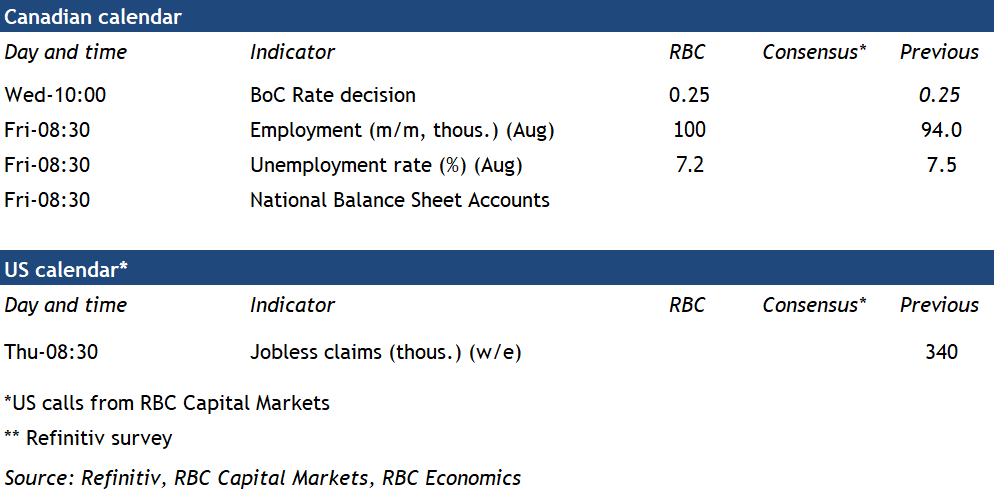
The Bank of Canada was likely as surprised as everyone else about a disappointing round of Q2 GDP data – and an even more surprising drop in July output as the economy was reopening from spring lockdowns. That left GDP growth tracking well-below the central bank’s call for a 7.3% Q3 gain. One data release does not make a trend, and other economic data from the summer have been better. Our own tracking of spending in the hospitality sector has looked much stronger with virus containment measures easing. Output in the goods sector continues to be restrained by severe supply chain disruptions and labour shortages, but exports of manufactured products (including motor vehicles) increased in July. We expect Friday’s jobs report will show another significant increase in employment in August, boosted by a continued recovery in those high-contact service sectors, with a drop in the unemployment rate to (a still elevated) 7.2%.
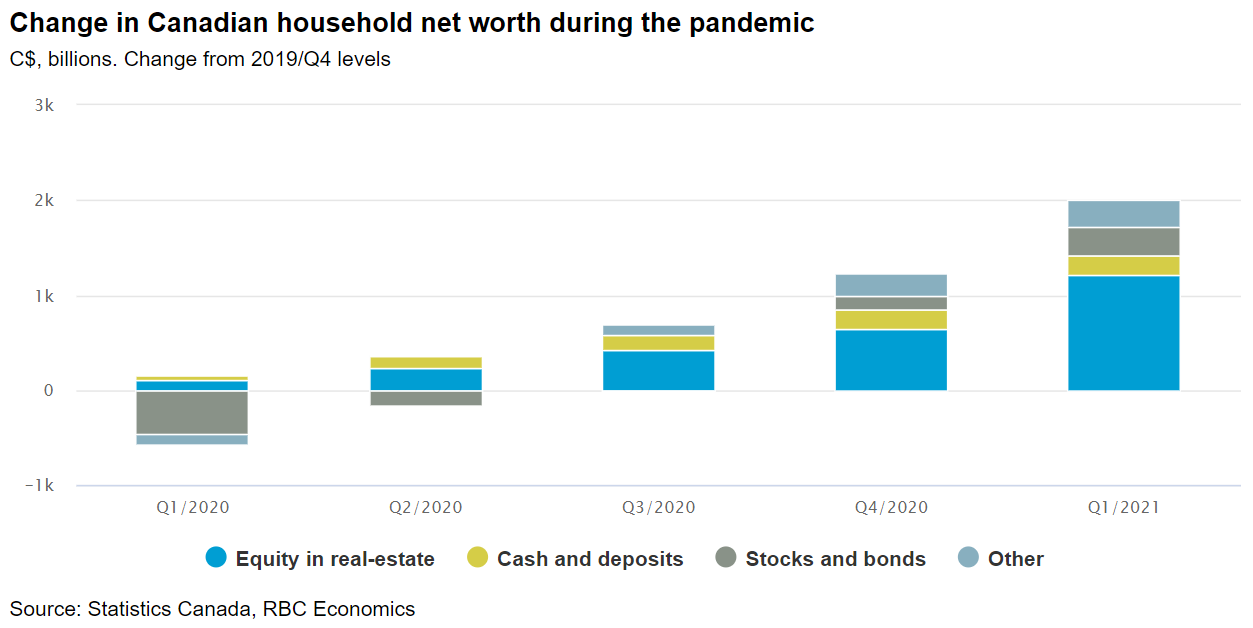
Friday will also see the release of Q2 national balance sheet accounts– and those will confirm that households are awash in purchasing power. Household net worth already increased by a whopping $2 trillion from Q4/2019 (pre-shock) to Q1/2021, boosted by a $1.2 trillion increase in equity in real-estate. And those numbers likely both got even bigger in Q2. In this abnormal pandemic economic backdrop, the concern remains not so much if households have the income to support stronger spending, but whether virus spread will allow it. While the backward-looking GDP data over the last week was disappointing, a larger concern for monetary policymakers will be the extent to which higher vaccination rates are successful at slowing virus spread/hospitalizations and preventing lockdowns of sectors of the economy. We expect no change in BoC monetary policy in September. Much more economic data will be available by the next meeting in October (when policymakers will also formally update their economic forecasts) but, all else equal, an announcement to taper central bank asset purchases at that meeting also looks less likely than it did a week ago.
Week ahead data watch:
We expect Canadian employment rose 100k in August, similar to the 94k gain in July with job growth benefiting from further easing in virus containment measures in parts of the country, including a move to Step 3 of Ontario’s re-opening plan that didn’t start until late in the July survey reference period.
Household asset appreciation likely continued to outpace mortgage debt growth in Q2. Stock market indices continued to rise – the TSX increasing close to 8% from Q1 – and equity in real estate likely continued to build on outsized pandemic gains with home prices continuing to rise.
Week Ahead – Tapering High on the Agenda as ECB, BoC and RBA Meet
After the recent taper fever, the Fed may fall out of the limelight next week as other central banks take centre stage. The European Central Bank, Bank of Canada and Reserve Bank of Australia will hold their policy meetings. While a hawkish tilt is possible with the first two, the latter may lean in the opposite direction. With not a lot happening on the data front, the tapering timelines of each central bank look set to dominate the market theme as September gets into full swing. But as expectations of an early Fed taper ease, will the US dollar continue its downslide or has the pullback gone far enough?
RBA taper plans on the line
The RBA will kick off next week’s policy gatherings on Tuesday and its decision is probably the least predictable out of the three. Back in August, the RBA stuck to its tapering plans despite soaring Delta infections and expanding lockdowns in Australia. Policymakers are unlikely to make a last-minute U-turn on reducing the pace of bond purchases in September from A$5 to A$4 billion a week. However, they may hint at a delay to the next review, which is penciled for November.
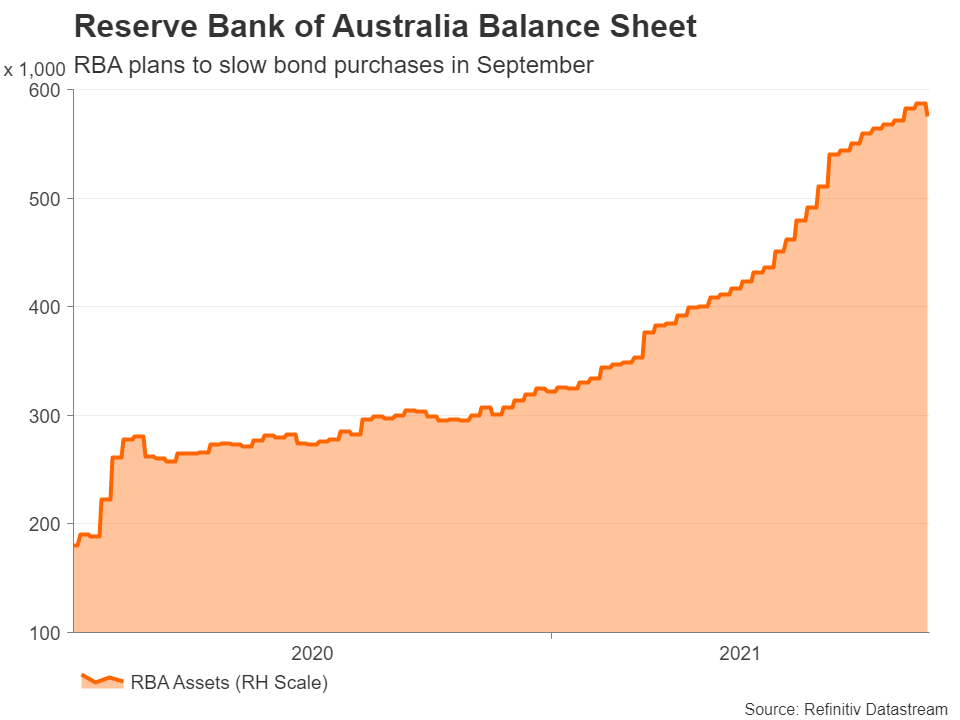
Stronger-than-expected GDP growth in the second quarter and record exports in July have somewhat lowered the odds of the RBA dialing back on its plans. Another reason why policymakers may prefer not to overreact to the worsening virus picture just yet is that Australia’s vaccine rollout has accelerated lately, raising optimism that the regional lockdowns could end soon.
However, the country is far from being out of the woods as the virus surge is showing no sign of peaking and it could be a while before restrictions are eased, meaning a deep contraction in Q3 GDP may be unavoidable.
Looking at the Australian dollar’s performance over the past couple of weeks, investors appear to have become less gloomy about the outlook. And although the aussie’s revival is mostly to do with a weaker US dollar, most analysts see the RBA slowing its tapering process over a longer duration rather than postponing or even reversing it.
China slowdown risks
As investors cheer the shift towards a more patient approach by some central banks in withdrawing their pandemic era stimulus, Chinese trade data might inject a fresh dose of doubt into the outlook on Tuesday. Fears that China’s recovery has lost considerable steam has been another weight on the aussie lately but rising hopes that more fiscal stimulus is on the way has alleviated some of the concerns.
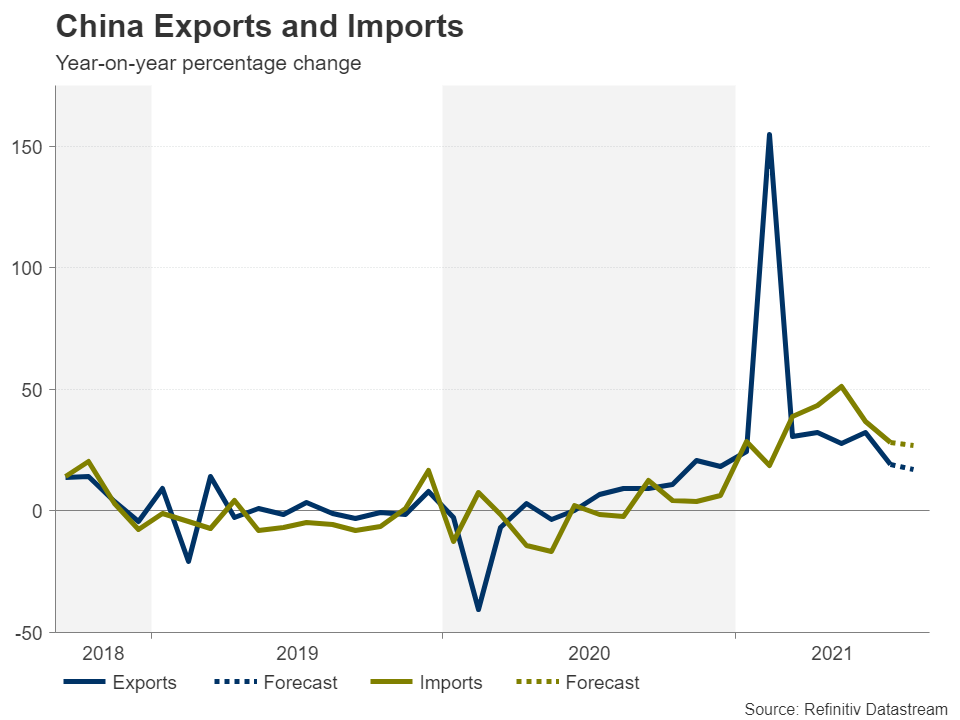
If exports rise by less than expected in August, it could put a cap on the China-sensitive aussie’s gains as well as take the shine off the recent rally in global stocks.
In addition to the trade figures, investors will also be keeping an eye on the consumer and producer price indices on Thursday out of China.
Bank of Canada to stand pat
The BoC’s meeting on Wednesday is almost certain to be a non-event as the Bank is unlikely to announce any policy changes ahead of federal elections in Canada on September 20. However, the spotlight was always on October as this is when the Bank next publishes its quarterly economic projections and when policymakers are therefore likely to next review the pace of QE.
That’s not to say, though, that there won’t be any surprises next week. The Canadian economy unexpectedly shrunk in the second quarter and although the country’s extremely high inoculation rate should protect it from the Delta variant, the economic fallout in other parts of the world could curtail Canada’s own recovery, particularly as the price of oil is hit. These setbacks might make policymakers have second thoughts about signaling another cut in their weekly bond purchases, which is widely expected in October.
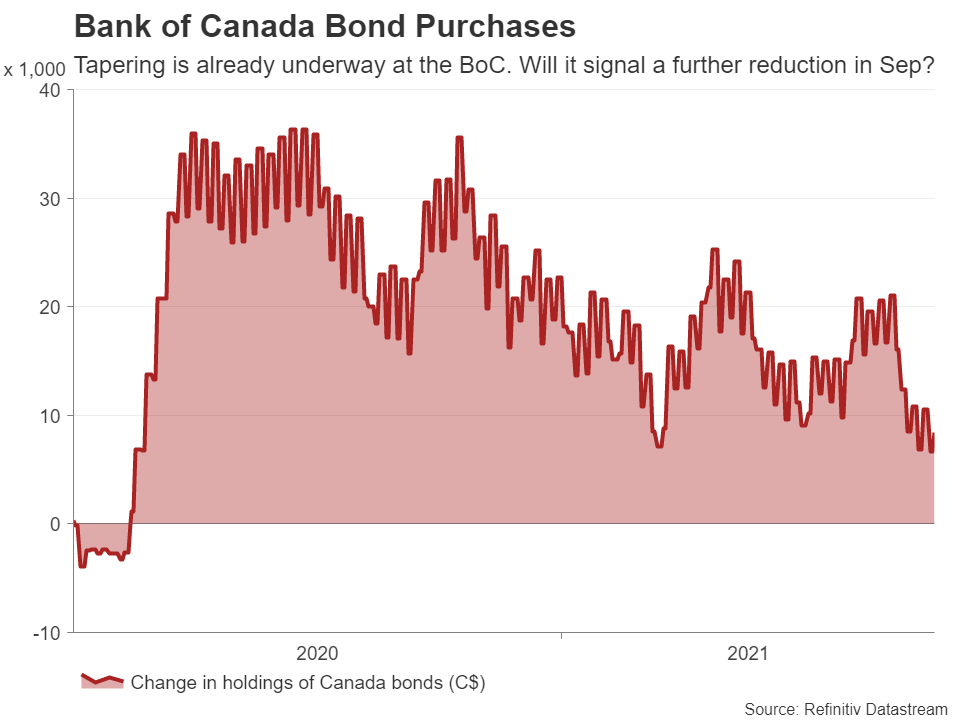
More clues about tapering in October could come from Friday’s employment report for August. The Canadian dollar has posted a tepid rebound versus the greenback after brushing an 8-month low on August 20. But its overall trajectory has been bearish since June. The absence of fresh taper hints by the BoC and soft Canadian jobs figures could reinforce that trajectory.
ECB taper talk heats up
Last but not least, markets are bracing for the ECB’s decision on Thursday amid the hawkish voices getting louder lately. Despite some policymakers earlier playing down the prospect of a taper move in September, the signs are unmistakable – the ECB seems to be setting the stage for winding down its pandemic emergency purchase programme (PEPP). The start of tapering could be announced as early as next week. But how significant is this really for the markets?
The ECB’s PEPP programme was always set to end in March 2022 so it’s inevitable that the speed at which the purchases are being conducted has to scaled down at some point, especially as they’ve been running at a “significantly higher pace” since March. With the vaccination rate across the continent close to reaching the ranks of Britain and Canada and the Eurozone recovery on a more solid footing, some reduction next week shouldn’t come as that much of a surprise.
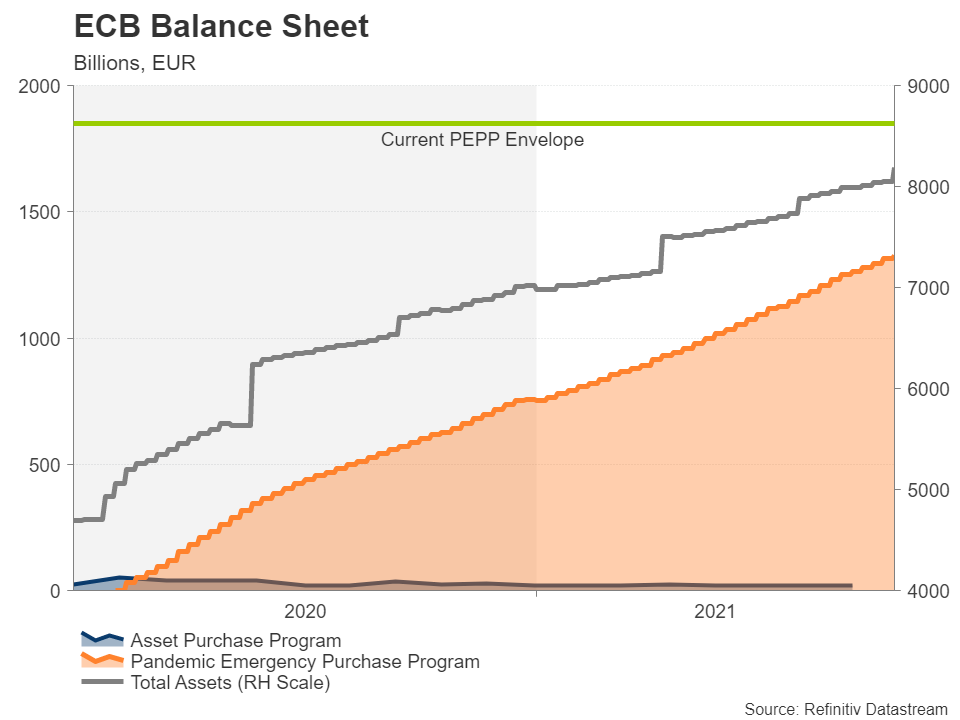
However, the tone that the ECB adopts will matter as there are a number of unanswered questions regarding QE, namely, will PEPP’s €1.85 trillion envelope be used in full and will the regular APP programme be bumped up once PEPP ends? Hence, there is plenty of scope for substantial hawkish turns over the next few months even though there’s no prospect of ECB stimulus stopping entirely anytime soon.
The euro could extend its recent gains versus the dollar if the ECB sets itself on the taper path, though traders will also be watching some key indicators out of the Eurozone’s biggest economy – Germany – for fresh clues about the growth momentum. Industrial orders for July are due on Monday followed by industrial production and the ZEW economic sentiment gauge on Tuesday, and trade numbers on Thursday.
Pound might overlook UK data
Across the Channel, monthly readings on industrial production and trade will also be doing the rounds in the UK, along with the GDP estimate for July. The pound’s rebound against the dollar has been more modest compared to its rivals’ but it's doubtful how much of a boost next week’s data could provide if there are any upside surprises. Investors are increasingly uneasy about the UK government's overly lax approach in lifting all virus restrictions amid rising Covid hospitalizations in recent weeks, which keep creeping higher.
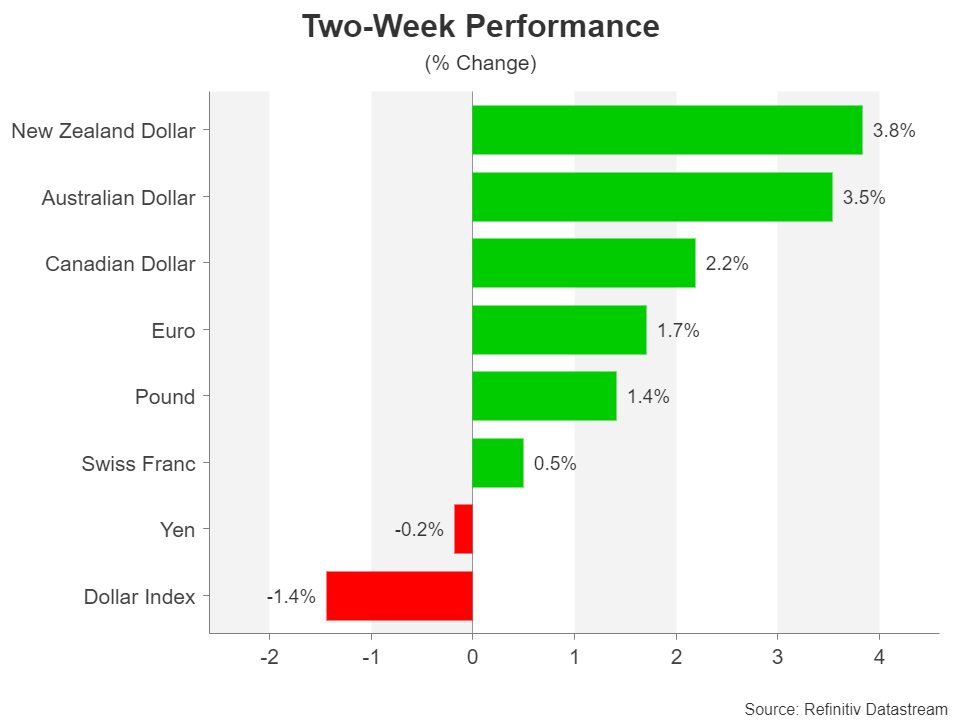
In the US, there will be even fewer drivers for the greenback in the aftermath of the August NFP report, though the latest JOLTS jobs openings on Wednesday and producer prices on Friday should attract some attention.
RBA Meeting: No Right Choices for the Aussie
The Reserve Bank of Australia (RBA) will conclude its latest meeting at 04:30 GMT Tuesday. Markets are split on whether the central bank will stick to its taper plans or whether it will reverse that decision as lockdowns continue. The risks surrounding the aussie from this meeting seem tilted to the downside, as even a decision to push ahead with tapering might be seen as a policy mistake.
Dodging a recession
The past couple of months have been tough for the Australian economy, which has been grappling with strict lockdowns to control the Delta outbreak. This will inevitably hit economic activity in the third quarter, something already evident in PMI business surveys that cratered.
On the bright side, the economy was quite strong heading into this weakness, with the unemployment rate falling substantially and GDP data for the second quarter showing solid growth. That diminishes the risk of a technical recession, which is defined as two consecutive quarters of negative growth. Of course, this assumes things will turn around in the final quarter.
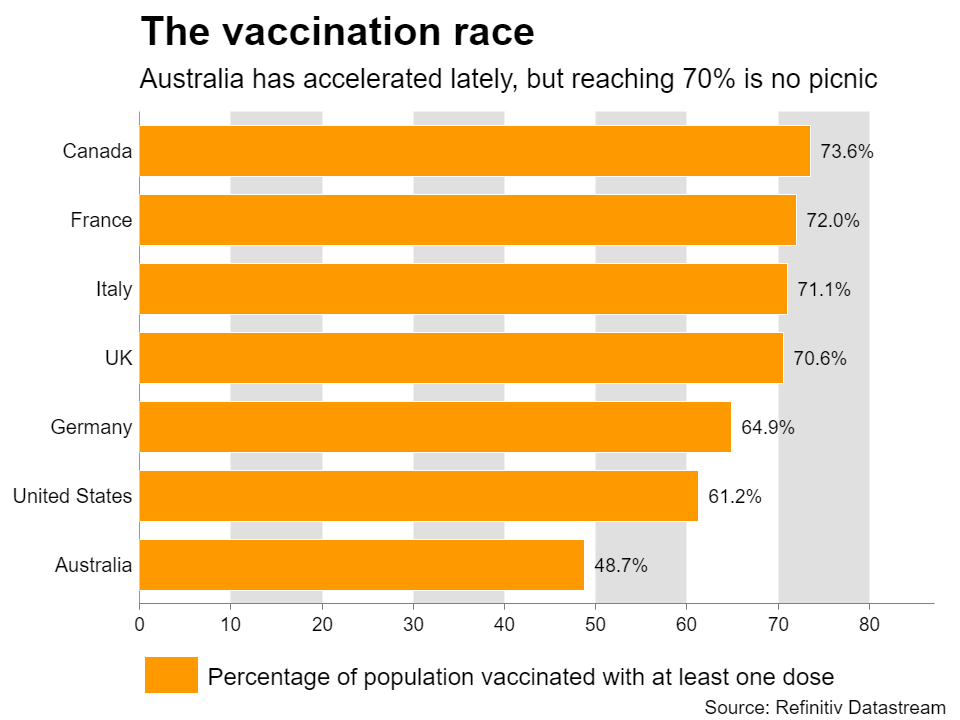
That’s debatable. The government has stressed it wants to see the nation’s vaccination rate hit 70 - 80% before relaxing any restrictions. While vaccinations have been accelerating lately, that’s a difficult target to hit. Most of Europe is still around 70% while America is even lower, despite starting much earlier.
RBA reversal?
When the RBA last met in early August, it decided to stick to its plan to reduce asset purchases despite the lockdowns. The logic was that previous shutdowns didn’t hit the economy that hard and if things worsened further, policymakers could always change their mind.
There is no doubt things have worsened and the economy looks set to take a much bigger hit than previously anticipated. To make matters worse, iron ore prices continue to fall and China is also slowing down. This is crucial since iron ore is one of Australia’s biggest exports and China is the nation’s biggest customer for that.
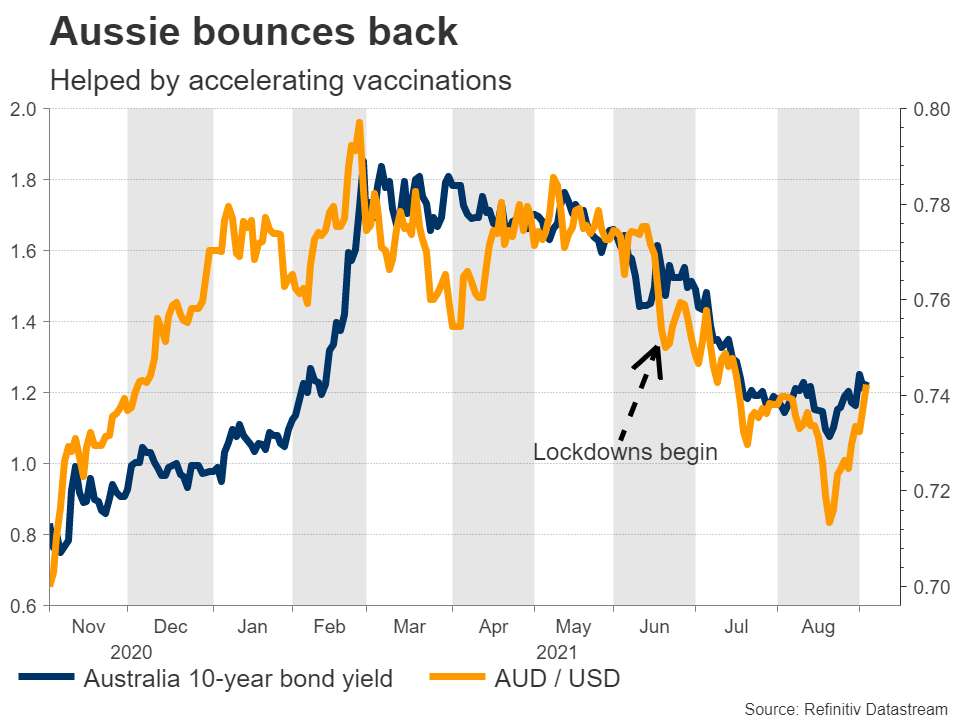
So what will the RBA do this time? Admittedly, the most prudent approach would be to pause the normalization plans for now. It made sense to reduce stimulus a few months ago, but not anymore. Pushing ahead with those plans would save the RBA some face, but it would be a very questionable move from a risk management perspective as it could exacerbate the ongoing economic hit.
Market reaction
As for the aussie, it is difficult to envision a scenario where the currency rallies powerfully after this meeting. Either the RBA will pause its tapering plans, sending a dovish signal that hits the aussie, or it will push ahead with normalization regardless of the worsening outlook. That may be seen as a policy mistake and therefore limit any upside in the currency.
Another middle-of-the-road solution would be for the central bank to reduce its asset purchases, but signal that it won’t cut them again for a while, at least until the economy is out of the woods. That’s a relatively neutral outcome for the FX market.
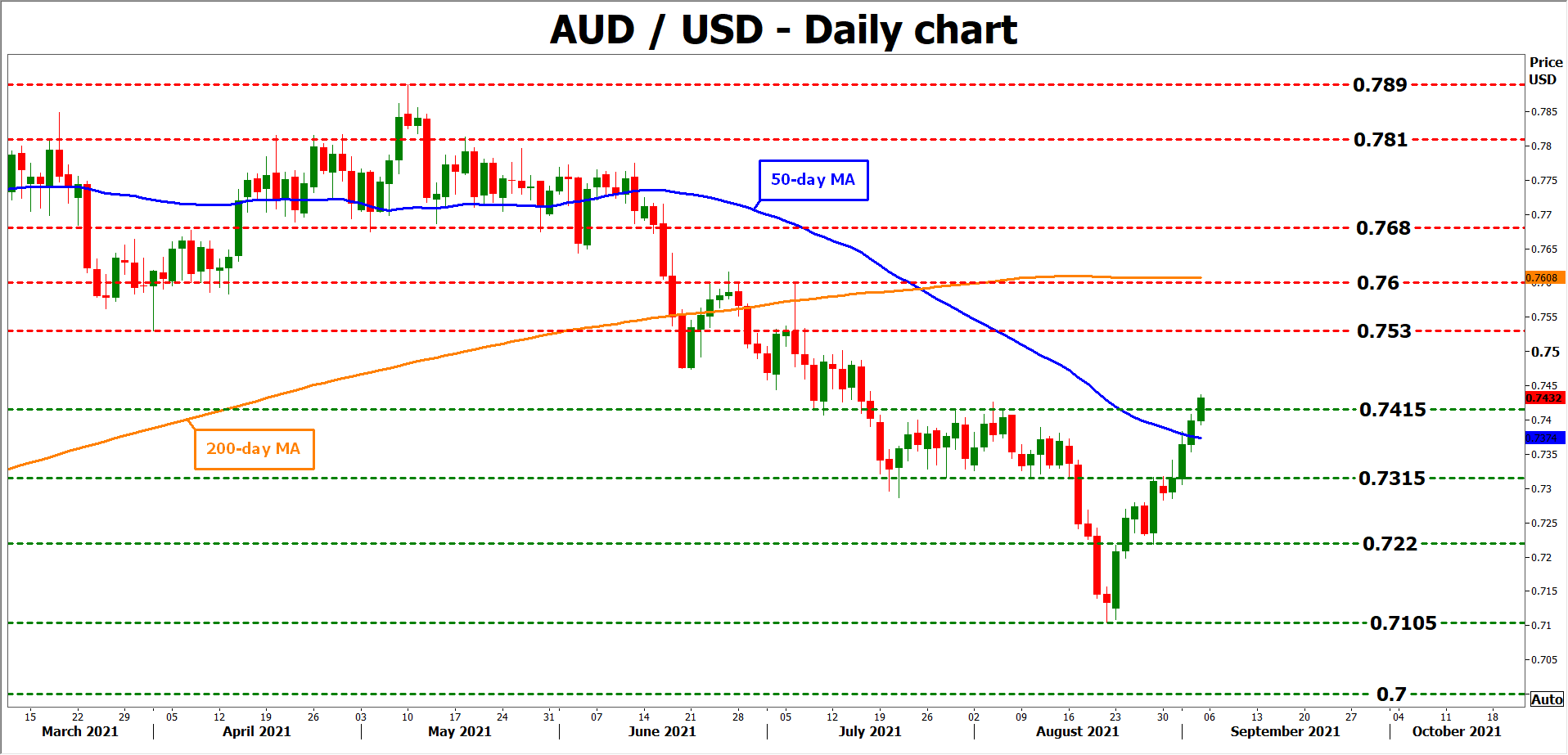
Turning to the technical picture, aussie/dollar has staged a strong comeback over the past couple of weeks, capitalizing on a softer US dollar as well. If the bulls remain in control, the next target may be the 0.7530 region.
On the flipside, if the RBA backpedals on its taper ambitions, the pair could edge back below the 0.7415 zone. If so, the focus would then turn towards the 50-day moving average, currently at 0.7374.
Weekly Focus – Markets Shrugging Off Negative Macro Surprises
This week brought more evidence that the global macro momentum is turning lower. Chinese PMIs for August were weaker than expected with notably the non-manufacturing component missing the estimate. The private Caixin PMI survey even pointed to a contraction in both the manufacturing and services sectors. While also a result of lockdowns due to earlier virus outbreaks, it is another clear sign that the Chinese economy is slowing rapidly and the global manufacturing peak is behind us. While manufacturing PMIs remained high in the US and in Europe during August, South East Asian PMIs are now below the 50 threshold, partly due to restrictions amid big outbreaks (see also COVID-19 Update - No need for booster shot in the EU yet, according to EMA, 2 September).
Despite the weakening macro momentum, the mood in markets stayed constructive. Industrial- and commodity sensitive currencies gained and EUR/USD has moved above 1.1850 for the first time since early August. However, investors' risk appetite might be increasingly tested in the coming weeks as the number of negative macro surprises accumulates. One important factor for the complacency was Fed Chair Powell's dovish speech at the Jackson Hole Symposium, where he avoided delivering any details on the Fed's tapering plans, besides that the conditions will likely be met later this year. As markets widely expect the Fed to announce a tapering plan this year, the main question is the exact beginning of tapering and not least how fast the Fed is going to taper. We stick to our view that the Fed will announce more details at the upcoming meeting in September and that the Fed will conclude tapering mid-2022. Markets will keep a close eye on any tapering hints from NY Fed President John Williams, when he speaks on Wednesday.
In Europe, market focus centred on Germany's upcoming election and further inflation upside surprises. The German election is shaping up to be a close call, with SPD's Scholz increasingly becoming the chancellor favourite, after seemingly winning the first TV debate among the candidates. However, his party may still be the biggest hurdle to succeed. Euro area inflation surged to a decade high of 3.0% in August. The price increases were driven by a multitude of factors, including the rebound in travel and tourism after lockdowns, higher energy costs, the reversal of last year's German VAT cut, increasing bottlenecks in supply chains and base effects from differing summer sales periods in France and Italy. With inflation expected to print above the ECB's new 2% symmetric inflation target for the remainder of this year, hawks in the ECB's Governing Council are getting more vocal about pro-inflationary risks and the need to slow bond purchases.
PEPP re-calibration and the inflation outlook will likely also be the big focus themes for Thursday's ECB meeting, where we expect an announcement to reduce the Q4 PEPP purchase pace to the January/February level of EUR60bn/month (see also ECB Preview: Recalibrating, not tapering - but hawks will squawk, 2 September 2021). Next week we also keep an eye on Chinese PPI inflation that should start to decline with the abating momentum in commodities prices and ease global inflationary concerns somewhat. As new infections in Australia continue to rise despite the lockdowns, there is a risk that the Reserve Bank of Australia (RBA) might delay its QE tapering (AUD 5bn to 4bn/month) that was announced back in early July and scheduled to start in September.
Sunset Market Commentary
Markets
We were hoping for a surprise in US payrolls, and we got one. To the downside. August job growth amounted to 235k, well below the 733k economists were predicting. The July figure was boosted to 1053k (+110k) but only compensates marginally for the headline miss. The delta variant brought a fourth wave of uncertainty to employers, in particular to those in leisure and hospitality. Net job growth there was flat this time while the sector was leading the job market recovery over the past few months. Business services (74k) and education & health (+35k) took over. Corona wasn’t the only factor weighing on the number. We’ve seen in earlier data that companies find it ever more difficult to find the right man for the right job in a labour supply pool that is still smaller than before the crisis (the participation rate stabilizes at 61.7%). The employment component in the US manufacturing ISM on Wednesday fell into contraction territory for this exact reason. We also note that the separate household survey is more optimistic. According to that publication, employment grew a stronger 509k in August. And let’s not forget the positive elements in today’s payrolls report. The unemployment rate fell further to a post-pandemic low of 5.2% (coming from 5.4%). Wages, lastly, grew 0.6% m/m to be up 4.3% y/y. To be clear: that’s a lot. Historically, wage growth was something in the area of 0.2-0.4%. If this lasts, inflation will soon be driven by more than just the temporary elements the Fed is currently using as a defense.
Markets are reacting interestingly. US bond yields advance 4-5 bps at the long end of the curve. This suggests investors do not assume the Fed will delay tapering much longer. At the Jackson Hole Symposium, Powell wanted to see more progress on the labour market first before slowing down bond purchases. Even if it is just 235k, there has been made such progress in August. Probably the sharp monthly increase in wages also helps to keep the “taper will start soon” (let’s say … September?) debate alive. Markets draw no firm conclusions on what this means for the Fed policy rate though. The short end of the US curve remains unchanged. Despite more (relative) interest rate support, the dollar declines. EUR/USD ventures further north in the high 1.18 area, with 1.1909 an obvious resistance level on the charts (end July top). It would be a nice technical landmark in the run-up to the ECB policy meeting September 9 though. Are currency markets already looking past the Fed and assuming that the ECB will soon follow? This week’s rise in the euro and European yields (German 10y close to -0.36/-0.35% resistance, European 10y swap flirts with 0%) at least suggests something’s about to happen.
News Headlines
Prices in Turkey continued to rise faster than expected in August. CPI inflation rose 1.12% M/M to be up 19.25% Y/Y (was 18.95% in July), driven by food prices (29.0% Y/Y). Core CPI slowed slightly from 17.22% to 16.76%. However, the rise in producer prices still accelerated further to 2.77% M/M and 45.52% Y/Y. The August rise in the headline inflation now surpasses the centrale bank’s policy rate of 19.00%. This could cause a problem for the CBTR’s communication as Governor Kavcioglu repeatedly indicated that it intends to keep a positive real policy rate. Still it won’t be evident to raise its policy rate further as the government doesn’t want monetary policy to slow growth. The next policy decision is scheduled on September 23. EUR/TRY currently trades only slightly higher near 9.86.
Statistics Norway upwardly revised its growth outlook for the Norwegian economy and expects a rate hike at the September policy meeting. SSB sees non-oil GDP growth at 3.6% this year (from 3.1%). Next year’s growth was slightly downwardly revised to a still solid 3.8% (from 4.1%). However, non-oil growth for 2023 (2.4%) and 2024 (2.3%) was also revised higher. Statistics Norway sees the policy rate at 1.75 in 2024. A separated rapport published today showed that Norway’s registered unemployment declined sharply from 3.1% to 2.7%, supporting for the case for a rate hike in the near future. Still, EUR/NOK today trades little changed near at 10.26.
US ISM services dropped to 64.1, still corresponds to 4.4% annualized GDP growth
US ISM Services PMI dropped from 64.1 to 61.7 in August, slightly above expectation of 61.3. Looking at some details, business activity/production dropped from 67.0 to 60.1. New orders dropped from 63.7 to 63.2. Employment dropped slightly from 53.8 to 53.7. Prices dropped from 82.3 to 75.4.
ISM said: "The past relationship between the Services PMI and the overall economy indicates that the Services PMI for August (61.7 percent) corresponds to a 4.4-percent increase in real gross domestic product (GDP) on an annualized basis."
US: Labor Market Recovery Slows in August
Strong hiring momentum slowed precipitously in August, as nonfarm payrolls rose by 235k jobs, well short of market expectations (+725k). That followed upward revisions to June and July of +134k jobs. The unemployment rate dropped 0.2 points to 5.2%, after ticking down to 5.4% in July.
As of August, nonfarm payroll employment was down by 5.3 million, or 3.5% from its pre-pandemic (February 2020) level.
Employment in leisure and hospitality, the sector emblematic of the pandemic was flat for the month. Gains in art entertainment and recreations (+36k) were offset by job losses at restaurants and bars (-42k). The sector remains down 10.0%, or 1.7 million jobs, versus pre-pandemic levels.
Job gains were mixed across other industries. Once again, job gains were up strongly in professional and business services (+74k). Gains were also seen in transportation and warehousing (+53k), other services (+37k), information services (+37k), finance (+16k) and manufacturing (+37k). Losers for the month were healthcare and social assistance (-6k), retail trade (-29k), and state government (-25k, most of which was a 20k drop in state educational services payrolls).
Atypical seasonal patterns in education hiring due to pandemic-related school closures and re-openings make interpretation of local government results challenging. As with state government education payrolls (-20k), local government education pulled back (-6k versus +225k in July) while private education (+40k) was up strongly again. What is important is that all sectors remain well below their pre-pandemic levels.
The drop in the unemployment rate was helped by the continued stagnation in labor force participation, which remained unchanged in August at 61.7%. This is 1.6 percentage points below what it was prior to the pandemic (February 2020).
The pandemic continues to affect work life as the share of people teleworking was 13.4% in August (up from 13.2% in July) and, among those not in the labor force, 1.5 million continue to report being prevented from looking for work due to the health crisis (relatively unchanged from July).
Key Implications
America's labor market recovery slowed in August as the pace of hiring dropped to levels last seen in January (+233k). The pace likely reflects the uncertainty presented by the spread of the Delta variant and constraints on labor availability.
The risks in the coming months are firmly to the downside due to the ongoing spread of the virus. As the Delta variant continues to circulate it is likely to lead to some consumer caution in areas where infections are rising strongly. This in turn could weigh on hiring in high-contact sectors in the near term.
However, as the Delta variant impact fades with time, we expect the unemployment rate to continue to fall as more pandemic-related constraints on work ease and activity normalizes.