

Sample Category Title
Market Morning Briefing: Dollar Index Has Broken Below 92.75
STOCKS
Equities are mixed. Dow has dipped while Dax trades slightly higher and could decline after testing interim resistance. Nikkei and shanghai trade lower today but could be overall ranged for now. Shanghai can rise if 3500 holds. Nifty and Sensex have resistance near 17000 and 57000 which may hold and produce a fall in the near term.
Dow (35399.84, -55.96, -0.16%) seems to be holding well below 35500 and struggling to rise above that over the past 4-sessions. A sustained break above 35500 if seen will be bullish towards 35750 else failure to rise past 35500 will keep it ranged within 35500-35250 for a few sessions while further downside to 35222-34750 can also be tested in a corrective decline. Watch price action near 35500 for now.
DAX (15887.31, +35.56, +0.22%) is trading higher and has some scope to rise towards 16000 which if breaks will open up further chances of a rise to 16200 in the longer run. 15600 is an important trend support that may hold for now.
Nikkei (27735.34, -53.95, -0.19%) has decline from resistance at 28000. While below 28000, view is bearish to see a further decline towards 27500-27250 before a bounce sets in.
Shanghai (3503.84, -24.31, -0.69%) is likely to hold above 350 and bounce back to 3560 on the upside but if it fails to sustain above 3500, we may have to allow for a fall to 3480-3460 before a bounce is seen.
Nifty (16931.05, +225.85, +1.35%) has risen sharply yesterday. We need to be cautious today to see if 17000 produces a sharp rejection towards 16700-16500 in the near term before again resuming the uptrend. On the contrary, any rise above 17000 if seen and sustained would be surprising and keep the bullish momentum on for the rest of the week.
Sensex (56889.76, +765.04, +1.36%) is likely to face rejection from 57000 that could push it down to 56000 in the near term.
COMMODITIES
Crude prices are holding below immediate trend resistances near 74 and 70 on Brent and WTI respectively and is likely to hold and decline in the near term while Gold trades below 1820 still trying to gather some momentum that could help to break above 1820 and move up which if fails could lead to a fall back to 1800. Silver is headed to 24.50-25 while Copper is bearish while below 4.40.
Brent (71.78) and WTI (68.76) have both fallen from higher levels seen yesterday and if it sustains, we may expect the dip to extend towards 70-68 and 65-60 respectively. Immediate resistances near 74 on Brent and 70 on WTI are likely to hold for the next few sessions. View is bearish.
Gold (1816.00) has dipped from 1820 and while that holds, Gold can fall back to 1810-1800. A sustained break above 1820 is needed to take price higher towards 1840/60 in the medium term.
Silver (24.06) has risen in line with our expectations to test 24.View is bullish towards 24.50-25.
Copper (4.3505) has come down from 4.38 and while the price holds below 4.40, we are bearish on the view to see 4.30/25 in the near term.
FOREX
Although the euro trades higher and dollar Index has dipped, there is lack of follow-through selling seen in the Dollar Index that may lead to a pause or a turnaround in the index soon. We would wait and watch price action near current levels. EURJPY can rise towards 130-130.50 in the near term before falling from there. USDCNY can trade between 6.45-6.48. We need to see if USDINR can fall below 73.25/20 to test 73-72.90 or rise to 73.60
Dollar Index (92.5930) has broken below 92.75 and is trading lower. Immediate trend support is broken but unless we see follow-through selling, there is scope for a bounce back in the index from 92.47/40 in the near term. We would wait and watch price action near current levels.
Euro (1.1814) sustains to trade higher. We need to be cautious near 1.1830-1.1850 that could produce a rejection and take Euro down in a corrective dip to 1.1750 again. Watch price action near 1.1830/50.
EURJPY (129.77) is rising and could test 130.0-130.5 in the near term before facing any rejection from there.
Dollar-Yen (109.85) has bounced from 109.70 yesterday but while below 110.20, the pair can oscillate within the 110.20-109.40 region with possibility to test 109 on the downside. View is broadly ranged to bearish for the near term.
Aussie (0.7298) is stable just now. It may test 0.7350 before falling from there back to 0.7250.
Pound (1.3773) is trading in the green and has scope to rise to 1.38 before facing rejection. Immediate view is bullish.
USDCNY (6.4682) has bounced a bit and can rise to 6.47-6.4750 while above 6.46. Note that there is support at 6.45 on the downside which cannot be negated and while below 6.48 immediate view could be to see a broad range of 6.48-6.45.
USDINR (73.2650) fell sharply yesterday to test support near 73.25/20. It would be important to see if the pair holds above 73.25/20 and bounces back to 73.60/80 or does RBI allow for a further decline to 73.0-72.90 before the expected bounce is seen especially today, being month closing.
INTEREST RATES
The US Treasury yields have dipped further and the chances of a rise that we were expecting have been reduced. A further fall looks likely in the coming days. The German yields continue to trade stable and have still chances of seeing a corrective rally in the coming days before resuming the broader downtrend. The 5Yr GoI has broken its 5.68%-5.72% range on the downside and has room to dip further today to test its next support at 5.63%-5.62%.
The US 2Yr (0.20%), 5Yr (0.76%), 10Yr (1.27%) and the 30Yr (1.89%) Treasury yields have come down further. The 10Yr has dipped below 1.3% and the 30Yr below 1.9% thereby reducing the chances of seeing 1.4%-1.45% (10Yr) and 2%-2.1% (30Yr). While below 1.3% (10Yr) and 1.9% (30Yr) the yields can fall further to 1.2%-1.18% (10Yr) and 1.8%-1.75% (30Yr) in the coming days.
The German 2Yr (-0.75%), 5Yr (-0.72%), 10Yr (-0.44%) and 30Yr (0.03%) yields have dipped slightly by 1 bps across tenors. View remains the same. As mentioned yesterday, the 10Yr has to break above -0.40% to see the corrective rally to -0.30%/-0.25%. The 30Yr however looks positive while above 0% and keeps alive the chances of seeing 0.10%-0.20% on the upside. Thereafter a fresh fall to resume the broader downtrend is possible.
The 5Yr GOI (5.6507%) has broken the 5.68%-5.72% range on the downside and has tested 5.66% as well. 5.63%-5.62% is a good immediate support which can be tested now. The price action in the 5.63%-5.62% will need a close watch in the coming sessions to see if the yields can bounce-back from there or not.
EUR/USD Daily Outlook
Daily Pivots: (S1) 1.1783; (P) 1.1797; (R1) 1.1810; More...
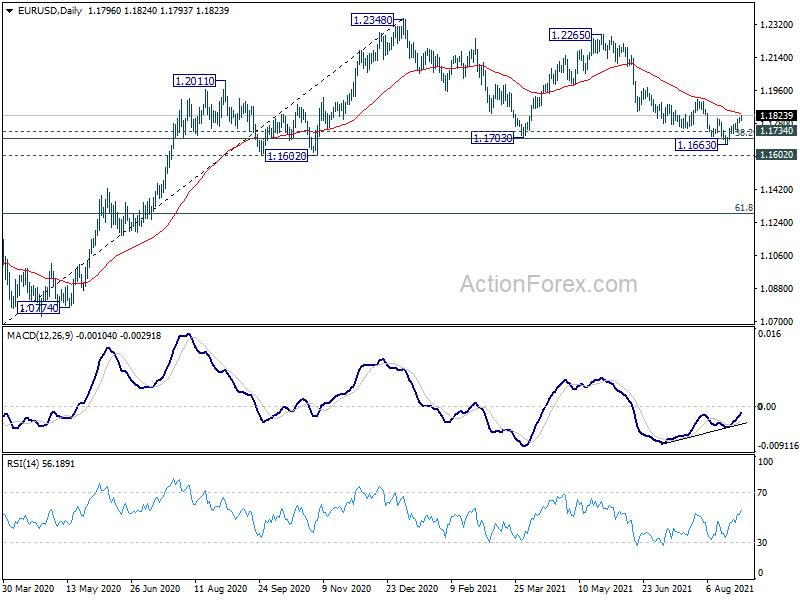
EUR/USD's break of 1.1804 resistance should now confirm short term bottoming at 1.1663, on bullish convergence condition in 4 hour MACD. Intraday bias is back on the upside for 1.1907 resistance first. Firm break there will indicate that fall from 1.2265, as well as the consolidation pattern from 1.2348, have completed. Near term outlook will be turned bullish for 1.2265/2348 resistance On the downside, break of 1.1734 minor support will turn focus back to 1.1602/1703 key support zone instead.
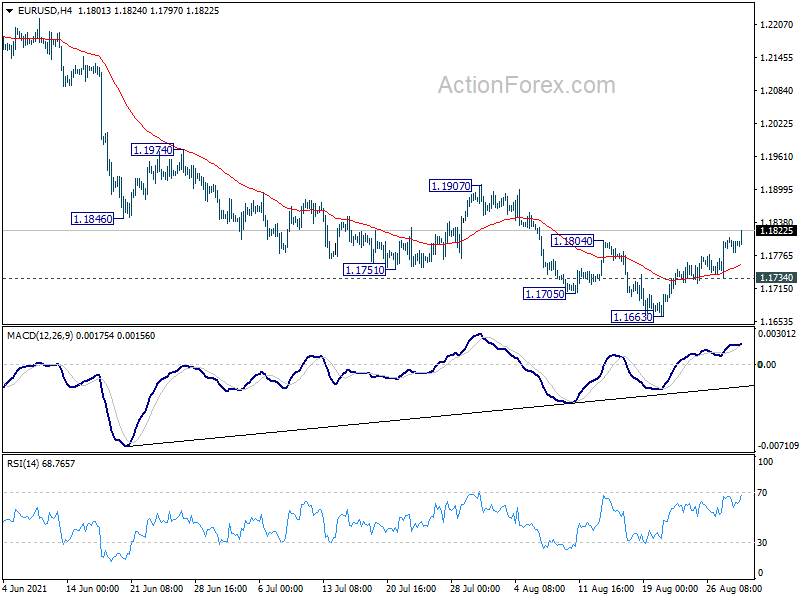
In the bigger picture, rise from 1.0635 is seen as the third leg of the pattern from 1.0339 (2017 low). Further rally remains in favors long as 1.1602 support holds, to cluster resistance at 1.2555 next, (38.2% retracement of 1.6039 to 1.0339 at 1.2516). However sustained break of 1.1602 will argue that the rise from 1.0635 is over, and turn medium term outlook bearish again. Deeper fall would be seen to 61.8% retracement of 1.0635 to 1.2348 at 1.1289 and below.
EUR/USD Breaks 1.18 handle on Fresh Dollar Selling
Selling of Dollar picks up momentum again in Asia today, with EUR/USD breaking through 1.18 handle finally. On the other hand, New Zealand Dollar is staging a notable rebound as Covid case number dropped to the lowest level in six days. The markets are mixed elsewhere though, with some additional strength see in Euro, followed by Sterling. Canadian and Australia Dollars are lagging behind the Kiwi.
Technically, EUR/USD's break of 1.1804 resistance should now put 1.1907 resistance in focus. Firm break there will turn outlook bullish for 1.2265/2348 ahead. We'll see if the move is accompanied more Dollar selling elsewhere, like break of 1.3785 resistance in GBP/USD and 0.9098 support in USD/CHF. Or, that would be followed by break of 130.54 resistance in EUR/JPY and 0.8592 resistance in EUR/GBP to signal Euro strength.
In Asia, at the time of writing, Nikkei is up 0.62%. Hong Kong HSI is down -1.43%. China Shanghai SSE is down -0.75%. Singapore Strait Times is down -1.41%. Japan 10-year JGB yield is up 0.0002 at 0.020. Overnight, DOW dropped -0.16%. S&P 500 rose 0.43%. NASDAQ rose 0.90%. 10-year yield dropped -0.027 to 1.285, back below 1.3 handle.
Japan industrial production dropped -1.5% mom in Jul, but expected to bounce back ahead
Japan industrial production dropped -1.5% mom in July, better than expectation of -2.5% mom. The overall output was back below pre-pandemic levels already. The Ministry of Economy, Trade and Industry expects, however, a bounce back of 3.4% in production in August, and 1.0% in September.
Unemployment rate ticked down to 2.8%, better than expectation of 2.9%.
China PMI manufacturing dropped to 50.1, services tumbled to 47.5
China's official PMI Manufacturing dropped slightly from 50.4 to 50.1 in August, below missed expectation of 50.2. PMI Non-Manufacturing dropped sharply from 53.3 to 47.5, well below expectation of 52.8, back in contraction for the first time since Q1 last year.
"This epidemic in multiple provinces and locations was a fairly big shock to the services industry, which is still in recovery," said Zhao Qinghe, of China's National Bureau of Statistics.
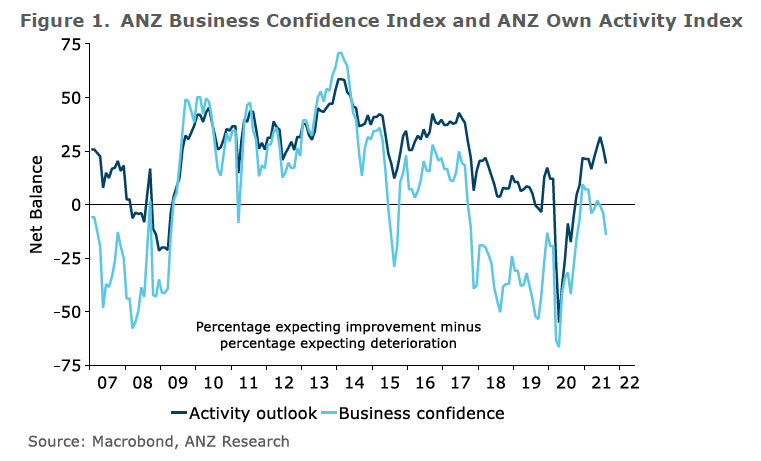
New Zealand ANZ business confidence dropped to -14.2 on Delta lockdown
New Zealand ANZ Business Confidence dropped sharply from -3.8 to -14.2 in August. Own Activity Outlook dropped from 26.3 to 19.2. Looking at some more details, export intentions ticked down from 7.6 to 7.4. Investment intentions dropped from 17.4 to 14.4. Employment intentions dropped from 21.4 to 17.0. Profit expectations dropped from 0.0 to -5.5. Inflation expectations, however, rose further from 2.70 to 3.05, above RBNZ's target band. ANZ said that the "initial responses after level 4 lockdown look encouragingly robust".
ANZ also noted while Delta is a "formidable opponent", there are some reasons to the "glass-half-full about the situation". The economy had "significant momentum" going into the lockdown. People will be a lot more confidence than last time regarding their job. Also evidence there and overseas suggests that the bounce out of lockdowns tends to be vigorous. But it's still too soon to be sure when the level 4 restrictions will stamp out Delta.
Also released, New Zealand building permits rose 2.1% mom in July.
From Australia, current account surplus widened to AUD 20.5B in Q2, versus expectation of AUD 21.0B. Private sector credit rose 0.7% mom in July versus expectation of 0.5% mom. Building permits dropped -8.6% mom, versus expectation of -5.0% mom.
Looking ahead
France GDP, Germany unemployment, UK mortgage approvals will be released in European session. But main focus will be in Eurozone CPI flash. Later in the day, Canada will release GDP. US will release house price index, Chicago PMI, and more importantly consumer confidence.
EUR/USD Daily Outlook
Daily Pivots: (S1) 1.1783; (P) 1.1797; (R1) 1.1810; More...
EUR/USD's break of 1.1804 resistance should now confirm short term bottoming at 1.1663, on bullish convergence condition in 4 hour MACD. Intraday bias is back on the upside for 1.1907 resistance first. Firm break there will indicate that fall from 1.2265, as well as the consolidation pattern from 1.2348, have completed. Near term outlook will be turned bullish for 1.2265/2348 resistance On the downside, break of 1.1734 minor support will turn focus back to 1.1602/1703 key support zone instead.
In the bigger picture, rise from 1.0635 is seen as the third leg of the pattern from 1.0339 (2017 low). Further rally remains in favors long as 1.1602 support holds, to cluster resistance at 1.2555 next, (38.2% retracement of 1.6039 to 1.0339 at 1.2516). However sustained break of 1.1602 will argue that the rise from 1.0635 is over, and turn medium term outlook bearish again. Deeper fall would be seen to 61.8% retracement of 1.0635 to 1.2348 at 1.1289 and below.
Economic Indicators Update
| GMT | Ccy | Events | Actual | Forecast | Previous | Revised |
|---|---|---|---|---|---|---|
| 22:45 | NZD | Building Permits M/M Jul | 2.10% | 3.80% | 4.00% | |
| 23:30 | JPY | Unemployment Rate Jul | 2.80% | 2.90% | 2.90% | |
| 23:50 | JPY | Industrial Production M/M Jul P | -1.50% | -2.50% | 6.50% | |
| 01:00 | CNY | NBS Manufacturing PMI Aug | 50.1 | 50.2 | 50.4 | |
| 01:00 | CNY | Non-Manufacturing PMI Aug | 47.5 | 52.8 | 53.3 | |
| 01:00 | NZD | ANZ Business Confidence Aug | -14.2 | -3.8 | ||
| 01:30 | AUD | Current Account Balance (AUD) Q2 | 20.5B | 21.0B | 18.3B | 18.9B |
| 01:30 | AUD | Private Sector Credit M/M Jul | 0.70% | 0.50% | 0.90% | |
| 01:30 | AUD | Building Permits M/M Jul | -8.60% | -5.00% | -6.70% | -5.50% |
| 05:00 | JPY | Housing Starts Y/Y Jul | 4.80% | 7.30% | ||
| 05:00 | JPY | Consumer Confidence Index Aug | 37.4 | 37.5 | ||
| 06:45 | EUR | France Consumer Spending M/M Jul | 0.70% | 0.30% | ||
| 06:45 | EUR | France GDP Q/Q Q2 | 0.90% | 0.90% | ||
| 07:55 | EUR | Germany Unemployment Rate Aug | 5.60% | 5.70% | ||
| 07:55 | EUR | Germany Unemployment Change Aug | -34K | -91K | ||
| 08:30 | GBP | Mortgage Approvals Jul | 79K | 81K | ||
| 08:30 | GBP | M4 Money Supply M/M Jul | 0.60% | 0.50% | ||
| 09:00 | EUR | Eurozone CPI Y/Y Aug P | 2.80% | 2.20% | ||
| 09:00 | EUR | Eurozone CPI Core Y/Y Aug P | 1.50% | 0.70% | ||
| 12:30 | CAD | GDP M/M Jun | 0.70% | -0.30% | ||
| 13:00 | USD | S&P/Case-Shiller Composite-20 HPI Y/Y Jun | 17.50% | 17.00% | ||
| 13:00 | USD | Housing Price Index M/M Jun | 2.10% | 1.70% | ||
| 13:45 | USD | Chicago PMI Aug | 69.8 | 73.4 | ||
| 14:00 | USD | Consumer Confidence Aug | 123.3 | 129.1 |
Japan industrial production dropped -1.5% mom in Jul, but expected to bounce back ahead
Japan industrial production dropped -1.5% mom in July, better than expectation of -2.5% mom. The overall output was back below pre-pandemic levels already. The Ministry of Economy, Trade and Industry expects, however, a bounce back of 3.4% in production in August, and 1.0% in September.
Unemployment rate ticked down to 2.8%, better than expectation of 2.9%.
China PMI manufacturing dropped to 50.1, services tumbled to 47.5
China's official PMI Manufacturing dropped slightly from 50.4 to 50.1 in August, below missed expectation of 50.2. PMI Non-Manufacturing dropped sharply from 53.3 to 47.5, well below expectation of 52.8, back in contraction for the first time since Q1 last year.
"This epidemic in multiple provinces and locations was a fairly big shock to the services industry, which is still in recovery," said Zhao Qinghe, of China's National Bureau of Statistics.
New Zealand ANZ business confidence dropped to -14.2 on Delta lockdown
New Zealand ANZ Business Confidence dropped sharply from -3.8 to -14.2 in August. Own Activity Outlook dropped from 26.3 to 19.2. Looking at some more details, export intentions ticked down from 7.6 to 7.4. Investment intentions dropped from 17.4 to 14.4. Employment intentions dropped from 21.4 to 17.0. Profit expectations dropped from 0.0 to -5.5. Inflation expectations, however, rose further from 2.70 to 3.05, above RBNZ's target band. ANZ said that the "initial responses after level 4 lockdown look encouragingly robust".
ANZ also noted while Delta is a "formidable opponent", there are some reasons to the "glass-half-full about the situation". The economy had "significant momentum" going into the lockdown. People will be a lot more confidence than last time regarding their job. Also evidence there and overseas suggests that the bounce out of lockdowns tends to be vigorous. But it's still too soon to be sure when the level 4 restrictions will stamp out Delta.
Eco Data 8/31/21
[php_everywhere instance="1"]
Swissie Dips as KOF Barometer Slides
The Swiss franc has lost ground in the Monday session. USD/CHF is currently trading at 0.9159, up o.52%. The Swissie has rebounded after a losing week, the first in a month.
KOF Economic Barometer
In Switzerland, the well-respected KOF Economic Barometer fell for a third successive month. The index slowed to 113.5 in August well of the consensus 126.3 and below the July reading of 130.9. Still, it should be remembered that the May reading of 143.2 marked an all-time high and the index remains comfortably above the long-term average of 100. If the slowdown continues in the upcoming months, however, sentiment towards the Swiss franc could weaken.
The markets will be keeping an eye on Thursday, with three Swiss releases on the calendar. GDP for Q1 is expected to rebound at 2.0% (QoQ), after a read of -0.5% in the first quarter. We’ll also get a look at CPI and Retail Sales, so I expect the Swiss franc to be busy on Thursday.
Risk sentiment has risen after Fed Chair Jerome Powell’s Jackson Hole speech on Friday. Powell highly-anticipated remarks didn’t really surprise the markets, with the Fed Chair reiterating that the Fed would likely begin tapering before the end of the year. At the same time, Powell said that rate hikes were not imminent, as the economy still had “much room to cover” before full employment was achieved.
The next key date for investors to circle on their calendars is September 22, when the Fed holds its next policy meeting. Fed officials have been hinting that a timeline for tapering could be announced on that date. However, the timing of a rate hike is less clear. In his speech, Powell reiterated that there was no link between tapering and a rate hike. Still, the announcement of a taper is likely to raise speculation about a rate hike and would be a bullish event for the US dollar.
USD/CHF Technical
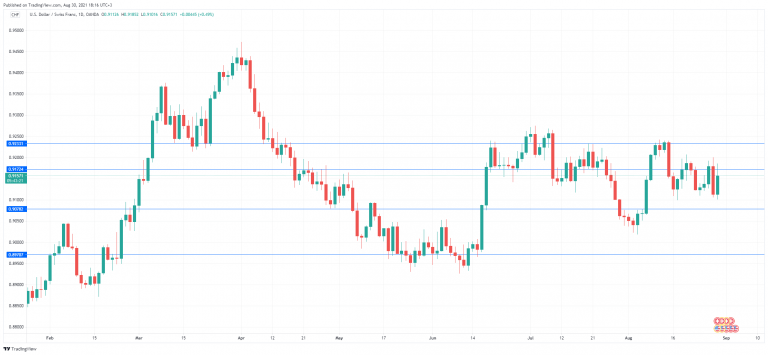
- On the upside, 0.9172 is under pressure in resistance. Above, there is resistance at 0.9233
- There is support at 0.9078. This is followed by support at 0.8970
Canadian GDP in the Spotlight
Economic growth data from Canada will hit the markets at 12:30 GMT Tuesday. The numbers will tell us how the economy performed coming out of the spring lockdowns. As for the loonie, the big picture seems bright as the Bank of Canada continues its taper mission, although a lot will depend on oil prices and the upcoming election.
Vaccination overdrive
When Canada does vaccinations, it does them right. The nation started out slow but it still managed to overtake every major country to become the leader in the vaccination race. Coupled with tremendous government spending and a sharp comeback in oil prices, this has allowed the economy to stage a phenomenal recovery.
So phenomenal that the Bank of Canada has already started to slash its asset purchases. In fact, the BoC’s own forecasts suggest that interest rates will be raised ‘sometime in the second half of 2022’.
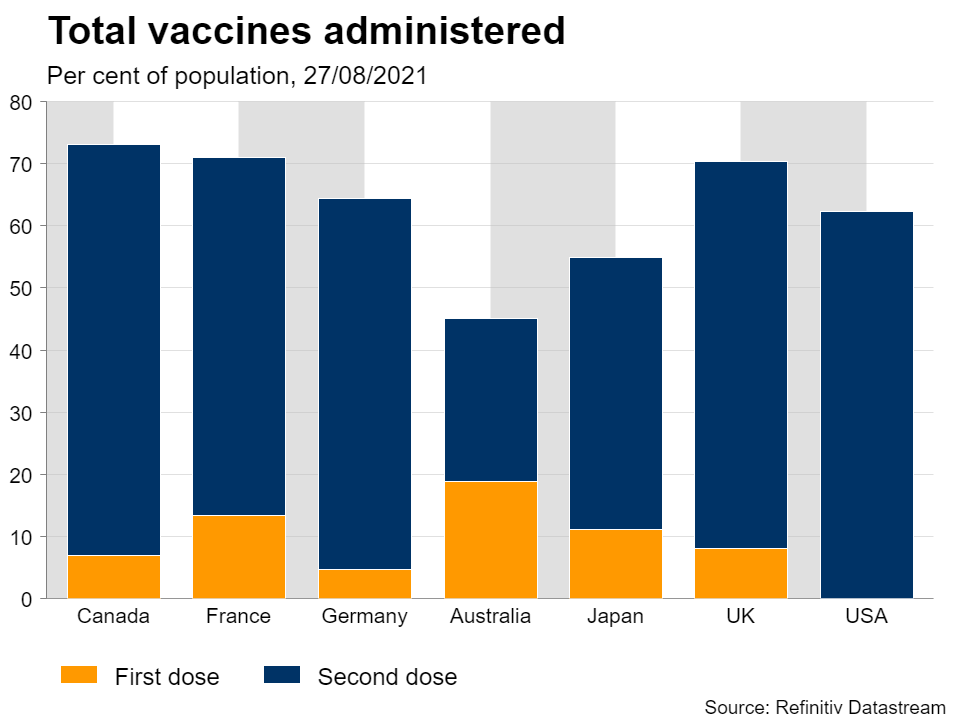
That said, all this optimism is unlikely to be reflected in the upcoming data. The numbers capture the second quarter, a period when the economy was mostly shut down. Restrictions started to be rolled back in June, so this data will be heavily distorted.
The economy is forecast to have grown by an annualized rate of 2.5% in the second quarter, with a sharp recovery in June more than offsetting contractions during both April and May. Nevertheless, markets will likely see this particular dataset as being outdated.
Loonie
Turning to the Canadian dollar, the outlook seems positive. The economy is strong, the BoC is ahead of almost every major central bank right now in the normalization game, and some benefits from the supermassive US spending packages could spill over across the border.
Of course, the loonie isn’t driven only by economic fundamentals. In recent weeks, it has been entirely at the hands of oil prices and stock market movements. It’s a commodity-linked currency after all, so risk sentiment in the markets is one of the most crucial variables.
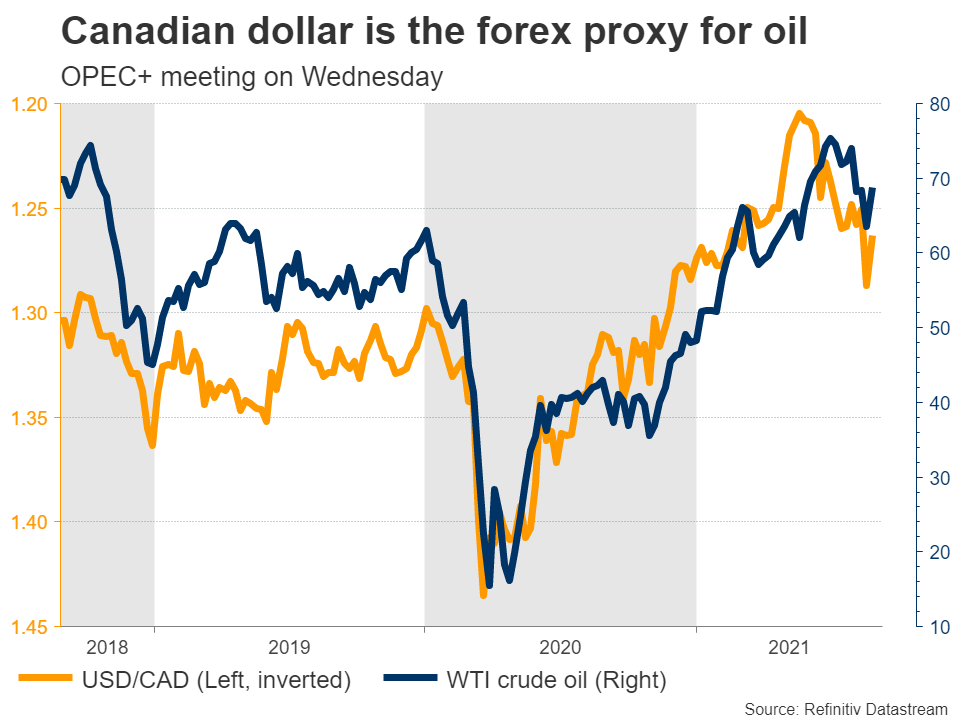
Beyond the economy and risk appetite, the other element that could shake the loonie is the federal election that’s scheduled for September 20. Prime Minister Trudeau is looking to strengthen his grip on power by capitalizing on the nation’s vaccination success. Opinion polls currently show Trudeau’s Liberals being neck-and-neck with the Conservatives.
Carry trade
Election uncertainty might keep the loonie in check for now, but ultimately, the revival of carry trades could help the currency gain momentum. A carry trade is when investors borrow in a low-yielding currency to invest that money in higher-yielding currencies abroad and bank a profit on the difference.
With the BoC preparing to raise rates but other major players like the European Central Bank and the Bank of Japan not following suit, interest rate differentials could begin to widen in the loonie’s benefit, allowing it to outshine the euro and yen over time.
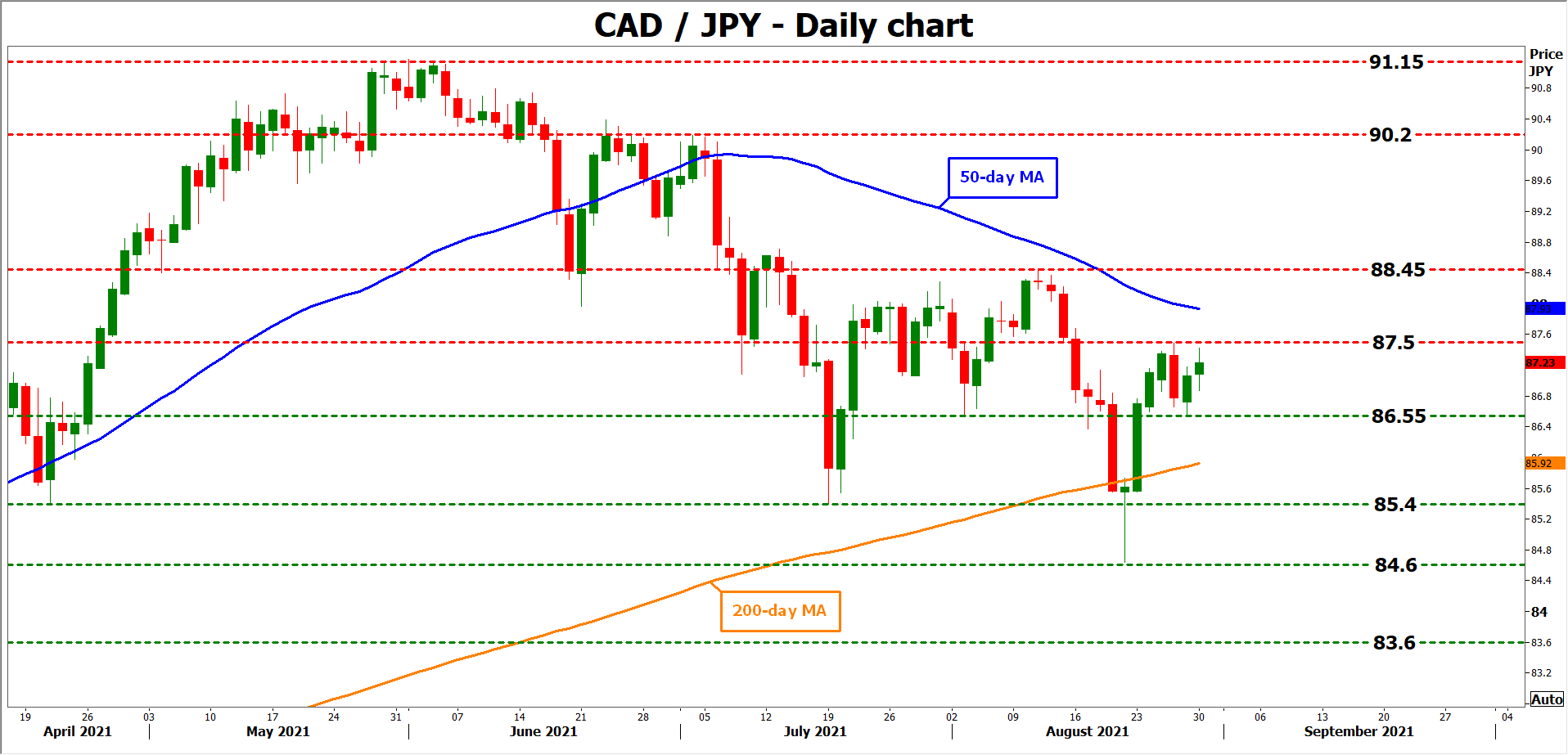
Taking a technical look at loonie/yen, initial resistance to any advances could come from the 87.50 zone. If violated, the next target for the bulls would be the 50-day moving average (MA) currently around 87.90, ahead of the 88.45 region.
If the bears retake control and manage to pierce back below 86.55, the 200-day MA could provide some support ahead of the 85.40 area.
Finally, note that there’s also an OPEC+ meeting scheduled for Wednesday, which could rattle oil prices and by extension the loonie as well.
Eurozone inflation to spike but ECB seen staying the course
The flash inflation estimates for August are due out of the Eurozone on Tuesday at 0900 GMT. The headline rate is expected to jump to a near-decade high. But this is unlikely to speed up policy normalization plans at the ECB, which, like other central banks, thinks the surge is transitory. The euro may therefore struggle to find much upside from the data, with any boost potentially being short lived.
Inflation is accelerating, but it’s ‘transitory’
Inflationary pressures in the euro area are clearly heating up. The Harmonised Index of Consumer Prices (HICP) is expected to hit the highest since late 2011 in August, rising to 2.8% year-on-year from 2.2% in July. Underlying measures of inflation are also projected to edge up. HICP excluding food and energy is forecast to increase from 0.9% to 1.4%, and the rate that also excludes alcohol and tobacco to more than double from 0.7% to 1.5%.
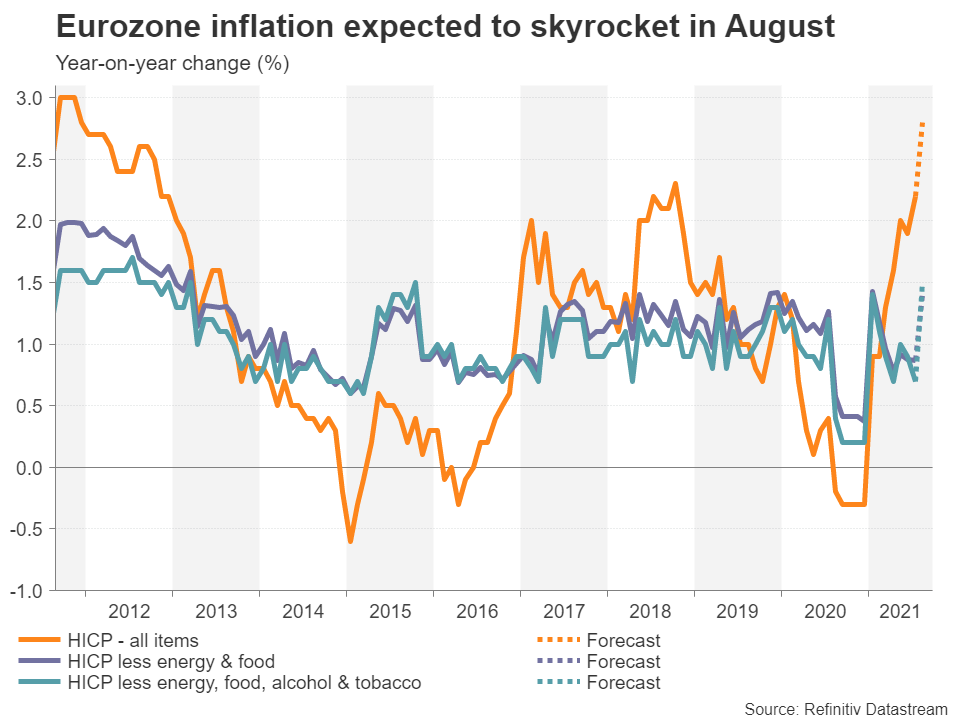
The expected spike will push inflation well above the European Central Bank’s newly adopted symmetric target of 2%. But the question is, would this raise any alarm bells among policymakers, who have been longing to see a revival of inflationary pressures after years of missing their previously stringent target of close to but below 2%? With ‘transitory’ being central bankers’ new favourite word, the answer is probably not.
ECB has toughened its criteria for hiking rates
Following the conclusion of the monetary policy strategy review in July, which then paved the way for a complete revamp of the forward guidance, the ECB has taken a leaf out of the Fed’s book by loosening its approach to how it targets inflation. The ECB now not only wants inflation to “durably” hit 2% “well ahead of the end of the projection horizon”, but it also wants to see underlying inflation to trend towards the target at the same time.
That means that policymakers will be in no rush to raise interest rates anytime soon as it could take several years for inflation to converge sustainably around 2% once the effects from pandemic have dissipated. And while speculation about the ECB’s own taper plans is also fast becoming a hot topic in the markets lately, ultimately, it is the timing of rate hikes by the Fed versus the ECB that investors care most about.
ECB taper may not lag Fed by much, but rate hikes will
That divergence in the interest rate path between the two central banks is expected to weigh on the euro’s outlook against the US dollar for quite some time. In the more medium term, the single currency might find some support from taper talk. The ECB will very likely end its emergency purchase program (PEPP) in March 2022 so it has to start drawing up plans on how this will be done by December at the latest, which is roughly when the Fed is anticipated to announce its own tapering.
But that’s where the similarities end. Although the Eurozone economy isn’t doing too badly and there’s little risk of the Delta variant pushing the bloc into another recession thanks to soaring vaccinations, the US economy is doing even better. Aside from the prospect of another big fiscal stimulus package from Congress, which should keep the growth momentum going, the threat of high inflation becoming sticky is much greater in the United States than in the euro area.
American businesses are grappling with rising costs from multiple sources, including wages as worker shortages seem to be getting worse. In contrast, the Eurozone’s relatively high unemployment rate should help contain wage pressures, while more subdued consumer spending should also curb big price hikes.
Euro outlook not bright
So where does all this leave the euro? On the plus side, the monetary policy divergence is mostly priced in and barring any surprises from either the Fed or the ECB, euro/dollar’s downtrend since June may not have much further to run. However, neither is there much prospect of the euro gaining significantly in the next few months.
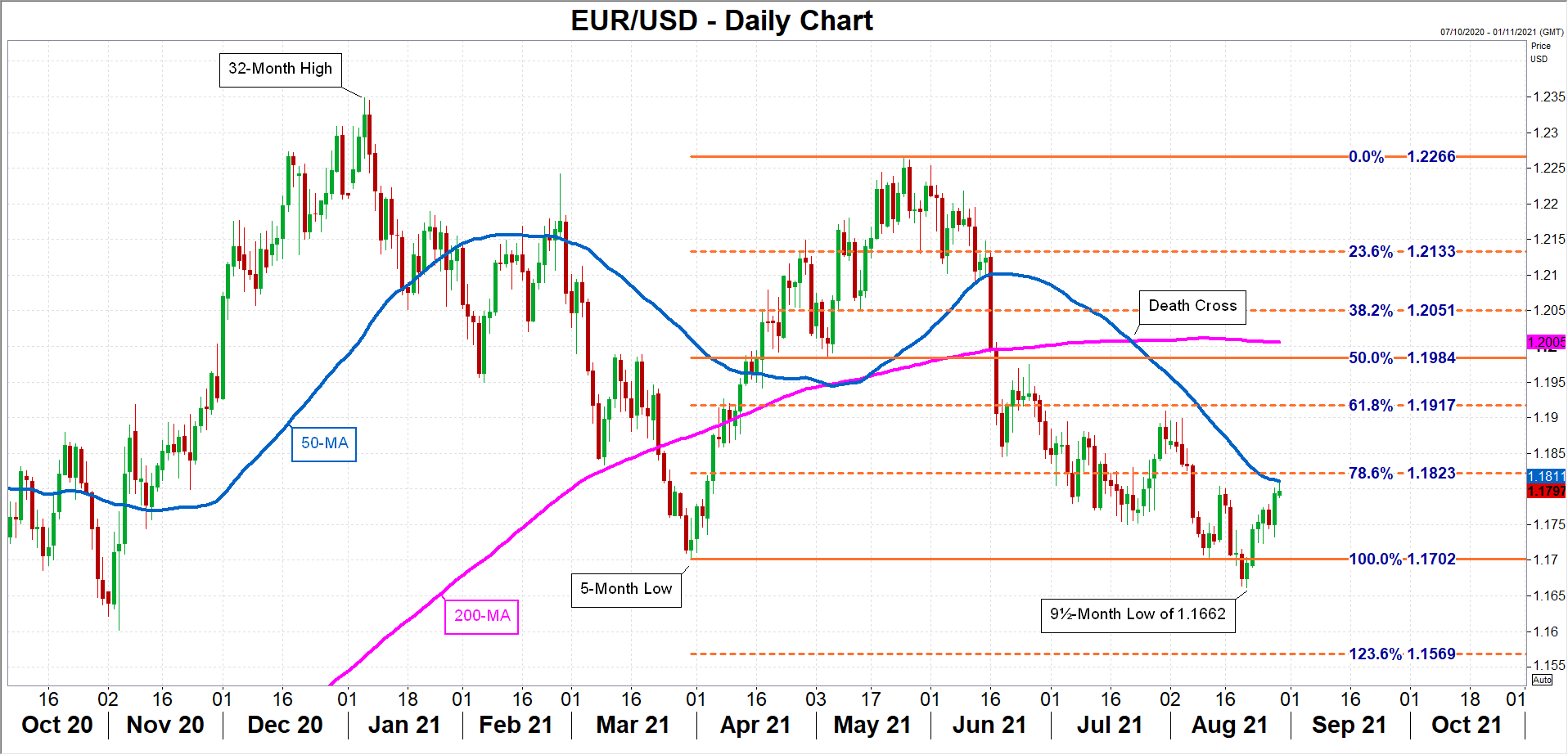
In the immediate term, euro/dollar is facing a challenge at its 50-day moving average around $1.1810. The 78.6% Fibonacci retracement of the April/May upleg is slightly overhead at $1.1823. Stronger-than-expected inflation numbers on Tuesday might help the pair overcome this resistance area, which could clear the way for the July peak of $1.1909 that can be found slightly below the 61.8% Fibonacci.
If, though, the recent rebound from the 9½-month low of $1.1662 falters, euro/dollar could revisit this trough, before slumping towards the 123.6% Fibonacci extension of $1.1569.