Sample Category Title
What Space Faring Amoeba Taught Me Last Week
What a difference a week makes; back from holidays and the faux pre-taper tantrum, sell-offs across various asset classes have been unceremoniously reversed in their entirety. I deliberately avoided looking at or thinking about markets over the past week, preferring sun and five books.
So, I guess it is with amoeba in mind that I ponder the buy-everything rally that swept markets on Friday. Much is being laid at the door of Jerome Powell’s Jackson Hole speech, where he did what everyone thought and signalled taperings were on the agenda, but interest rate hikes were not. Why this is a surprise to any thinking individual, I know not. He was not going to say we’ll start tapering this year and immediately start hiking rates; we have an FOMC dot plot for that, folks. Amoeba.
Anyway, having not upset the narrative the street wanted to hear, FOMO on everything swung into action with the recent taper nerves US dollar buying being unwound, risk sentiment currencies rallying powerfully. Those two dark towers of momentum-driven tail-chasing speculative anarchy, oil and precious metals, recorded outsized gains. However, I note that both asset classes had already retraced most of the previous week’s losses anyway, as had the US dollar. Mr Powell just added the fresh fruit and cream to the top of the pavlova.
Equity markets in the United States, despite much handwringing from the FOMO amoeba at sideways days, a harbinger of doom to us all, never really retreated at all over the past few taper-nerves weeks. They’re all at record highs, thank you; no helter-delta here. In fact, glancing at the S&P 500 chart for this year this morning, if you had closed your eyes and clicked buy-everything on every two per-cent-ish dips, you’d have done very well, thank you. We still live in a zero per cent world, floating on an ocean of unlimited central bank money that is determined to NPV the wealth of our children to keep the lights on today, back-stopping even the dumbest business or investment ideas. A tapering won’t change that. By the way, the buy-the-two-per-cent-dip S&P 500 strategy is not investment advice, merely an observation. However, like most of the world on any topic you can imagine, I am always 100% correct in hindsight.
Notably, US bond yields have held onto most of their recent gains, sending just a sliver of a warning signal out to the buy-everything amoeba that interstellar travel is not without its perils. Like financial markets, those space-faring amoebae promise much, in this case, unlimited free energy. A sure thing? We love that. But, when not handled with care, very ugly explosions can result in mass destruction. Gosh, there I go talking about cryptos and high-yield debt again.
All eyes on US Nonfarm Payrolls
We have a Non-Farm Payrolls due at the end of the week, and a 1.0 million-plus print could see tapering tantrums back on the front foot. 800,000 likely keeps the buy-everything trading bubbling on low heat like a good sauce. A low-ball print under 500,000 jobs, while technically bad news for the recovery, will probably see taper nerves anaesthetised; bad for the US dollar, great for every other asset class you can shake a stick at.
Despite the seemingly one-way trading seen last week, I will be taking any price action today and tomorrow with a grain of salt. That is because we are approaching month-end with the usual “rebalancing” flows seen across markets. Although the week’s highlight is Friday’s Non-Farm Payrolls, it also comes before the US Labour Day holiday next Monday. I long ago learnt to disregard the price action in the hours after the release. Trading that leads to the dark side. But with a US holiday next Monday, we may not get a clear picture of the market’s reaction until well into next week. I can see plenty of whipsaws in the days ahead.
Asia will see its beginning of month dump of PMI data this week, as will the rest of the world. China’s official and Caixin Manufacturing and Non-Manufacturing PMI reads will be the only ones to escape the pre-non-farm noise. Markets at this stage are most nervous about the data showing increasing weakness as delta disruptions mount against a seemingly never-ending background of government interventions in various sectors. Thus, weaker China PMI data could cap exuberance in Asian markets, either via currencies or equities, ahead of Friday’s main event.
The data calendar is quiet in Asia today, with better Japan Retail Sales having no noticeable impact. Currency markets, in particular, will be muted with London away for the August Bank Holiday today.
Finally, being a Monday, and with amoeba on my mind, it’s time to take a brief look at bitcoin. Crypto’s have consolidated in my absence but remain near recent highs. Back in late July, in the spirit of tradeable versus investable, I did the unthinkable and got bullish on bitcoin after it broke out of a giant triangle around 34,000.00 dollars of US taxpayer back fiat currency. The target at the time was USD 51,000.00, and that came very close last week. I must also grudgingly admit that cryptos have defied the US dollar strength of past weeks. The charts suggest the USD 51,000.00 target is still in play as long as the 200-day moving average (DMA) at USD 46.100.00 remains intact. A low US Non-Farm should give them another boost, if only because the US dollar will plummet. The charts suggest USD 60,000.00 is achievable by FOMO-meba crowd, but I will reassess once USD 51,000.00 trades. Longer-time readers should not get their hopes up that I will remain bullish forever; I’ll leave that for the single-cell organisms.
Stocks Party, Dollar Drops After Vague Powell Speech
- Fed Chair Powell offers no concrete taper signals at Jackson Hole
- Equities, gold, and commodity FX storm higher, dollar takes a hit
- Spotlight falls on Chinese PMIs and US jobs report this week
Powell plays it slow
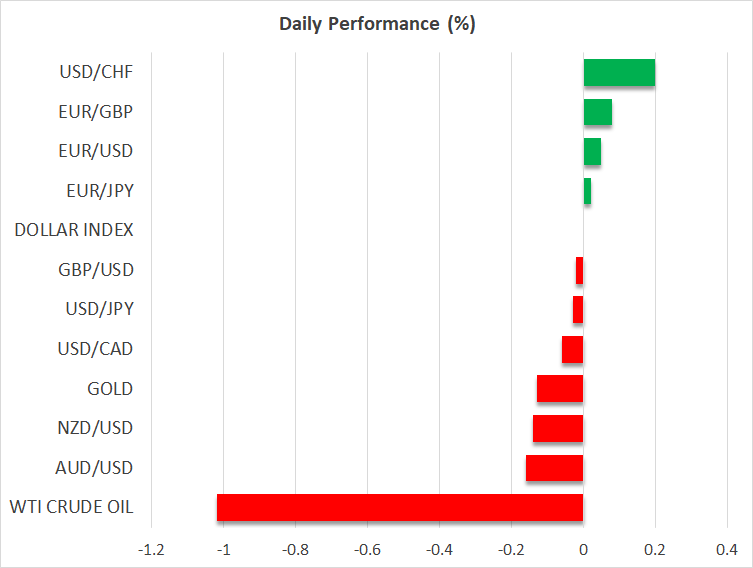
Global markets breathed a sigh of relief on Friday after the world’s most important central banker didn’t outline a clear roadmap towards normalizing monetary policy. Speaking at the Jackson Hole symposium, Fed Chairman Powell highlighted the Delta outbreak as a risk that has escalated lately and repeated that inflation will likely cool down soon.
He essentially hedged his bets, signaling that the tapering process could still begin this year, although that will depend on how the virus situation evolves. The main takeaway was that Powell is not in a rush to dial back asset purchases, with investors reading his vagueness as diminishing the chances of a September announcement.
Hopes that markets will stay flush in central bank liquidity for a while longer catapulted stocks on Wall Street to new record highs and hammered the dollar lower alongside Treasury yields, putting the shine back into gold. Commodity currencies advanced as well, capitalizing on the broader risk-on atmosphere.
Tapering still on track
That said, not much has changed in the big picture. The question is not whether the Fed will taper, but rather when this process will begin and how long it will last. The tea leaves now point towards a November announcement, with the Fed likely turning more hawkish in September to prepare the markets if the economy keeps humming along and the Delta outbreak abates.
Despite some recent signs that economic growth is losing steam, for instance with the composite Markit PMI falling and consumer confidence cratering in August, the US economic machine is still firing on most cylinders. The economy is already larger than it was pre-crisis, there are now more open jobs than people unemployed, and Congress is working on another supermassive spending package to juice up growth.
On top of everything, inflation might not cool as quickly as the Fed thinks. Supply chain disruptions are getting worse with shutdowns across Asia, causing freight shipping costs to skyrocket further and lengthening delivery times. Meanwhile, the US Supreme Court has canceled the ban on evictions, so rents could begin to play catch-up with soaring house prices, helping inflationary pressures to broaden out.
Therefore, the outlook for the dollar remains promising. Whether the Fed pushes the taper button in September or November doesn’t matter much - it is still years ahead of the ECB and the BoJ in the normalization business. This ultimately argues for the dollar to outshine the euro and yen as investors warm up to carry trades again.
Key events ahead, oil volatile
For now, a lot will depend on the upcoming US employment report on Friday. It could single-handedly decide whether September is a ‘live’ meeting for the Fed or not.
Beyond that, there are some crucial PMIs from China coming up on Tuesday. The world’s second-largest economy is losing momentum and if this data disappoints, that could telegraph more stimulus measures from Chinese authorities.
Finally in commodity markets, oil prices went for a rollercoaster ride. Crude opened the week higher as a category-four storm near the Gulf of Mexico threatened to disrupt production, only to surrender those gains and trade lower overall once the storm was downgraded in severity.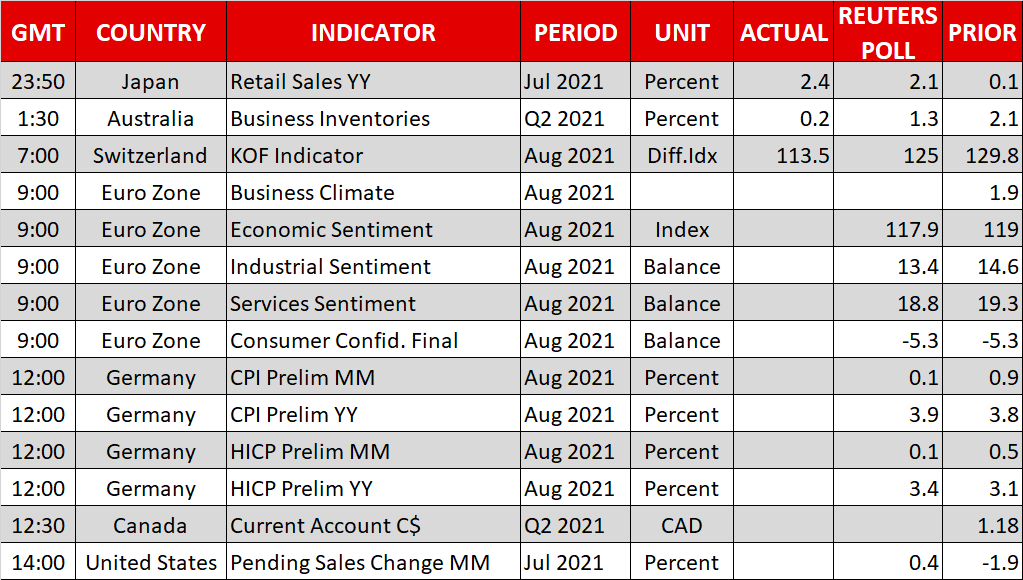
The Analytical Overview Of The Main Currency Pairs
The EUR/USD currency pair
Technical indicators of the currency pair:
Prev Open: 1.1751
Prev Close: 1.1794
% chg. over the last day: +0.36%
The US PCE Price Index declined in July. Manufacturers of cars, domestic appliances, and other goods are challenged with repair parts and labor shortages and are facing higher material costs. After the Jackson Hole symposium, the dollar index is now under pressure, which plays in favor of the stronger euro.
Trading recommendations
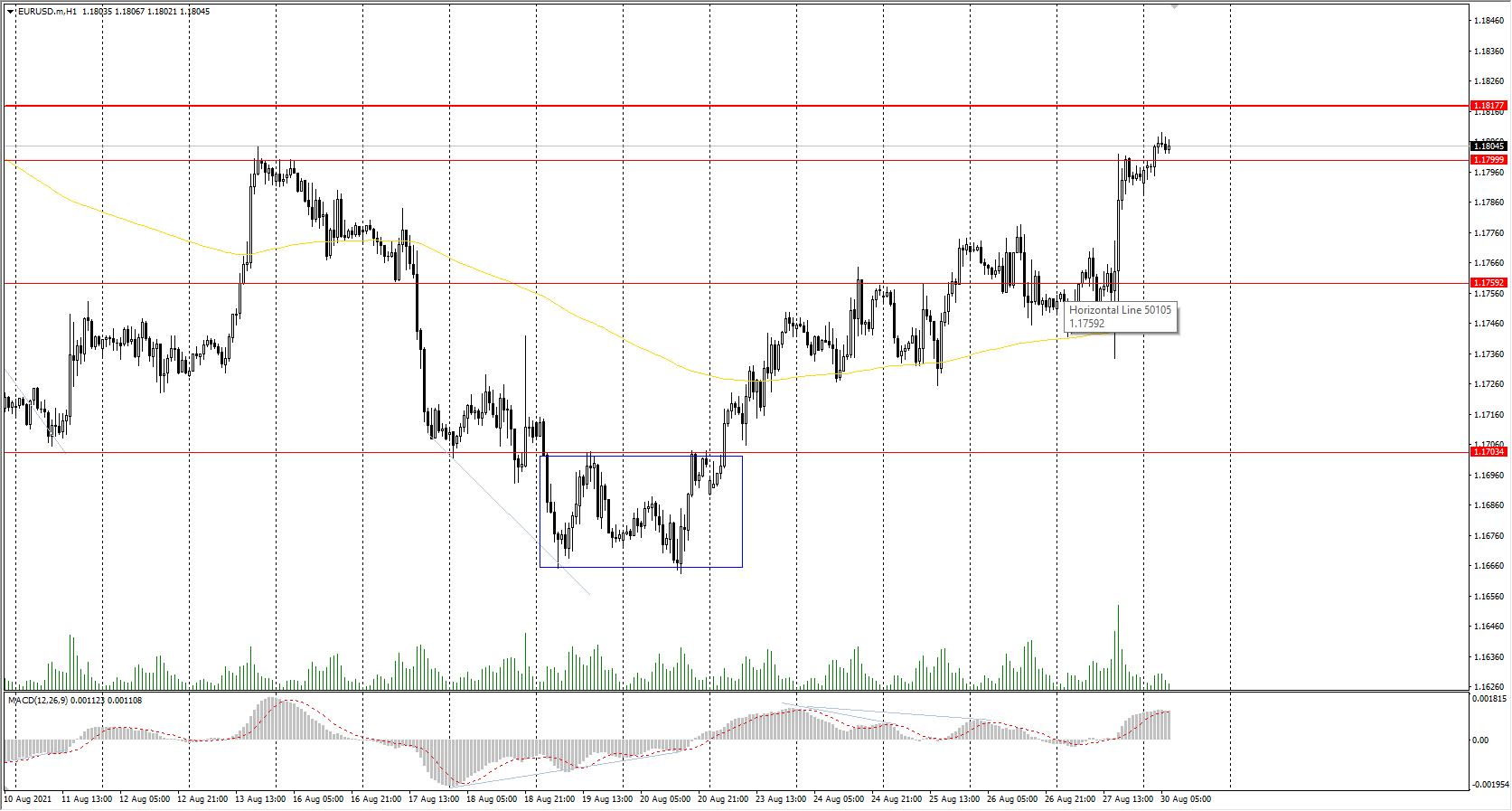
Support levels: 1.1799, 1.1759, 1.1704, 1.1620
Resistance levels: 1.1817, 1.1854, 1.1894, 1.1934, 1.1969
From a technical point of view, the general trend of the EUR/USD currency pair is bearish. But the price is trading above the moving average and has approached the priority change level. The MACD is signaling a divergence in the opposite direction. Under such market conditions, it is best to look for sell trades from the resistance levels, where sellers show initiative. Buy trades can only be considered from the support levels where buyers show initiative throughout the day.
Alternative scenario: if the price breaks through the 1.1817 resistance level and fixes above, the mid-term uptrend will likely resume.
News feed for 2021.08.30:
- Germany Consumer Price Index (m/m) at 15:00 (GMT+3);
- Pending Home Sales (m/m) at 17:00 (GMT+3).
The GBP/USD currency pair
Technical indicators of the currency pair:
Prev Open: 1.3695
Prev Close: 1.3752
% chg. over the last day: +0.42%
Against the background of the dollar index fall, the British pound has partially restored its position. The fundamental picture for the near future looks in favor of the dollar index decrease, so the pound sterling will continue to get stronger. It is the bank holiday in the UK today, so volatility on the GBP/USD currency pair will be low.
Trading recommendations
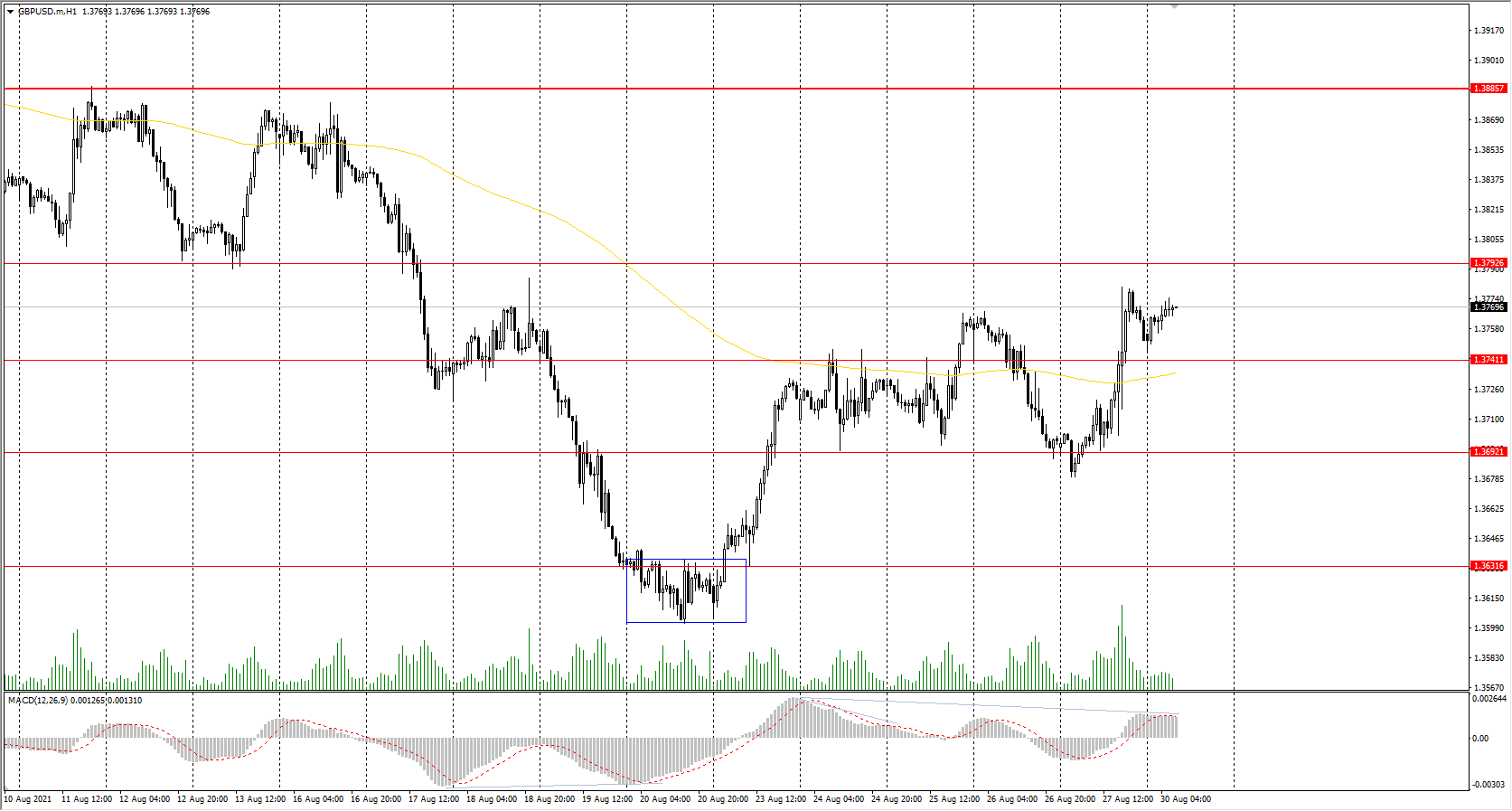
Support levels: 1.3741, 1.3692, 1.3632, 1.3614, 1.3525
Resistance levels: 1.3793, 1.3772, 1.3886, 1.3935, 1.4002
On the hourly time frame, the GBP/USD trend is bearish but the price is trading above the moving average; the local trend is upward. The MACD indicator became positive, but there is a divergence on the higher timeframe, which indicates an impending downward movement. Under such market conditions, it is better to look for sell trades from the resistance level, where sellers show initiative. Buy positions can be considered only with short targets throughout the day.
Alternative scenario: if the price breaks through the 1.3885 resistance level and consolidates above, the bullish scenario will likely resume.
The USD/JPY currency pair
Technical indicators of the currency pair:
Prev Open: 109.98
Prev Close: 109.83
% chg. over the last day: -0.14%
Japan's retail sales index showed an increase over the previous month, but Japan is still struggling with an outbreak of the Delta strain. The number of new daily infections exceeded 25,000 for the first time this month. Japan is exploring the possibility of mixing AstraZeneca's COVID-19 vaccine with vaccines developed by other drug product manufacturers in an effort to speed vaccine adoption.
Trading recommendations
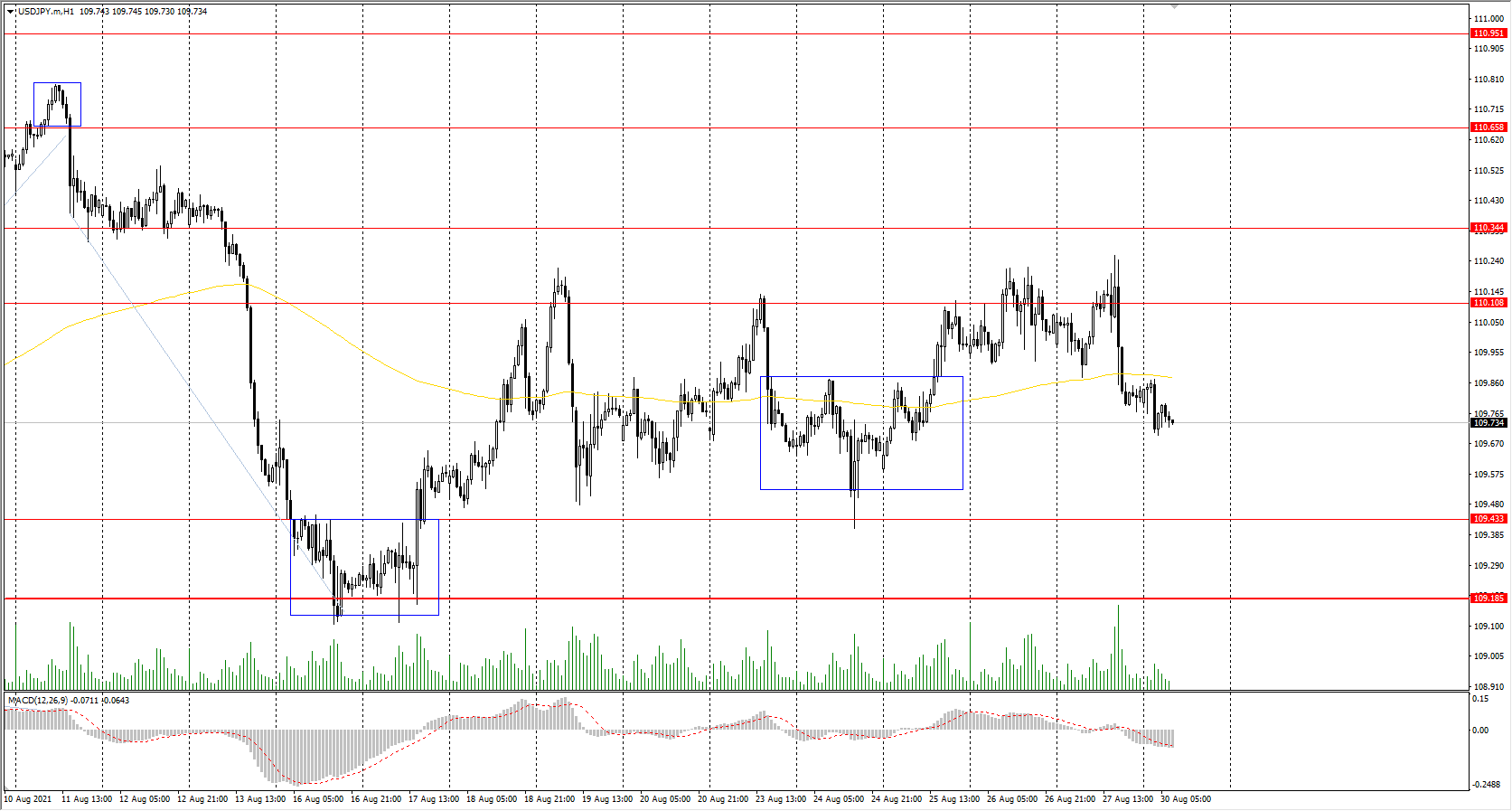
Support levels: 109.43, 109.19, 108.65
Resistance levels: 110.11, 110.34, 110.66, 110.95, 111.48
The main trend of the USD/JPY currency pair is bullish. The decline in the dollar index led to the fall in USD/JPY quotes on Friday. But despite the decline, the USD/JPY currency pair is still trading in the corridor. Under such market conditions, traders should look for buy trades from the support level, where the buyers show initiative. Sell positions should be considered only on lower time frames from the resistance levels with short targets.
Alternative scenario: if the price falls below 109.18, the uptrend is likely to be broken.
The USD/CAD currency pair
Technical indicators of the currency pair:
Prev Open: 1.2681
Prev Close: 1.2609
% chg. over the last day: -0.59%
The Canadian dollar is a commodity currency, so the USD/CAD currency pair is highly dependent on the dynamics of the dollar index and oil prices. On Friday, after Jerome Powell’s speech, the dollar index went down, while oil prices remained at the same level. As a result, the USD/CAD currency pair declined.
Trading recommendations
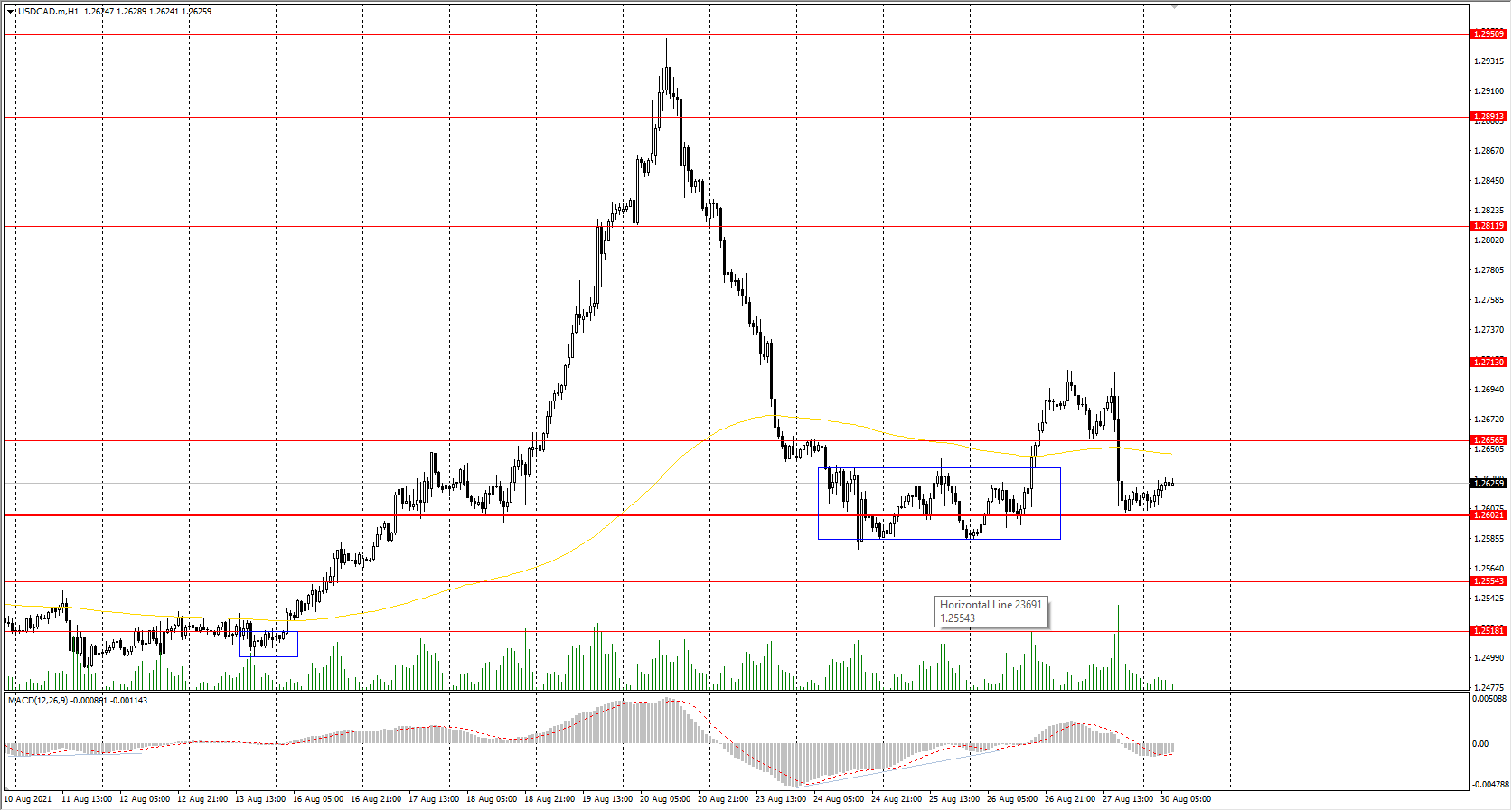
Support levels: 1.2602, 1.2554
Resistance levels: 1.2656, 1.2713, 1.2812, 1.2891, 1.2951
In terms of technical analysis, the USD/CAD trend is still bullish but the price returned to the priority change level. The probability of a breakthrough of the support level is increasing. It is better to look for buy positions from the priority change level but after buyers show initiative. Sell positions can be considered from the resistance levels, but only with short targets throughout the day.
Alternative scenario: if the price breaks down through the 1.2602 support level and fixes below, the uptrend will likely be broken.
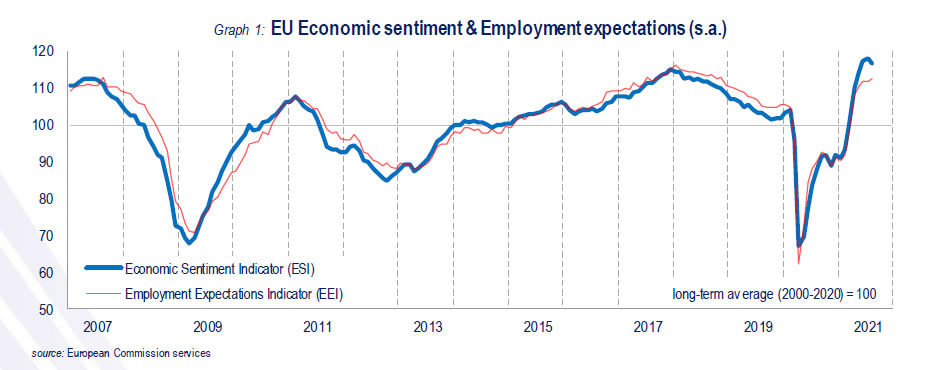
Eurozone economic sentiment dropped to 117.5, employment expectation rose to 112.8
Eurozone Economic Sentiment Indictor dropped from record high of 119.0 to 117.5 in August, below expectation of 118.6. Employment Expectations Indictor rose 1.2 pts to 112.8, hitting the highest level since November 2018. Looking at some more details, industry confidence dropped from 14.5 to 13.7. Services confidence dropped from 18.9 to 16.8. Consumer confidence dropped from -4.4 to -5.3. Retail trade confidence rose from 4.4 to 4.6. Construction confidence rose from 4.0 to 5.5.
EU ESI dropped -1.5 pts from record high 118.0 to 116.5. Amongst the largest EU economies, the ESI fell sharply in France (-4.5) and in the Netherlands (-3.0), and to a lesser extent, in Italy (-1.9), Poland (-1.7) and Spain (-1.2). Sentiment in Germany (-0.3) was virtually unchanged. Employment Expectation Indicator rose 1.0 pts to 112.6, highest since November 2018.
The US Federal Reserve’s Monetary Policy Remains Unchanged
Jerome Powell’s speech became the main event of the last week following the annual Symposium in Jackson Hole. Mr. Powell said that as long as the labor market remains substantially sluggish and the pandemic continues, tightening the monetary policy could be a premature mistake. In other words, the soft monetary policy remains the same. The Fed Chairman also added that the spread of the Delta strain poses a short-term risk to economic growth and said that the Fed remains optimistic about economic recovery. Nothing was said about the timing of the end of the QE program. Discussions are still ongoing, and this issue will depend on economic and health care risks. However, Powell noted that if inflation remains high, the Fed will undoubtedly take action to reduce price pressures. After it became known that the QE program was not planned to be cut in the nearest future, the main US stock indexes sharply jumped and closed the day at the maximums. At the close of the trading session, the Dow Jones increased by 0.69%, the S&P 500 index increased by 0.88%, and the NASDAQ index jumped by 1.23%. The rally continues.
On the other hand, the market indicator of billionaire investor Warren Buffett, who compares the stock market valuation with the size of the US economy, reached 205%, which indicates a huge overvaluation of stocks. This indicator has accurately predicted the impending collapse several times. It reached a record high during the dot-com bubble and was also high before the 2008 global financial crisis. And both times it remained below 150%.
During the testing of the distance on one charge, Lucid Air's first electric car traveled 445 miles and outperformed its Tesla Model S competitor (405 miles). At the same time, Lucid Air representatives said its Air Dream model can reach 517 miles on a single charge. But the cost of the car from Lucid Air is a little bit higher - $169,000. It looks like Tesla has a serious competitor.
European stock indices finished last week in the green zone. At the end of the week, British FTSE 100 added 0.8%, German DAX added 0.2%, French CAC 40 increased by 0.2%, Italian FTSE MIB increased by 0.2%, and Spanish IBEX remained the same. The consumer confidence index in France decreased by 1 point in August compared to the previous month. Germany’s import prices jumped by 15% in July compared to the same month last year and 2.2% in the previous month. European inflation data is expected this week.
Oil prices fell and rebounded from a 3-week high amid a powerful hurricane in the Mexican bay. Gasoline prices in the US increased by more than 3% as a power outage shut down the Persian Gulf Coast refineries. Analytical firms still expect oil prices to rise by the end of the year.
Gold and silver prices jumped on Friday as the Federal Reserve maintained its soft monetary policy. Until the Federal Reserve announces cutting its QE program, precious metal prices tend to rise.
The broadest index of Asia-Pacific shares outside of Japan, MSCI, jumped to a two-week high on Friday, Japan's Nikkei 225 added 0.46%, Australia's ASX200 added 0.2%, Korea's KOSPI increased by 0.25%, but China's blue-chip index CSI300 lost 0.26%. Japan is exploring the possibility of mixing AstraZeneca's COVID-19 vaccine with vaccines developed by other drugmakers in an effort to speed up vaccine introduction. Japan is struggling with the worst wave of infections caused by the Delta version, and for the first time this month, the number of new daily infections exceeded 25,000. In Japan, 54% of the population is vaccinated with at least one dose, and 43% are fully vaccinated. Japanese prime ministerial candidate Fumio Kishida is calling for a huge stimulus package in the amount of several tens of trillions of yen to maintain the pace of economic recovery.
Main market quotes:
- S&P 500 (F) 4,509.37 +39.37 (+0.88%)
- Dow Jones 35,455.80 +242.68 (+0.69%)
- DAX 15,851.75 +58.13 (+0.37%)
- FTSE 100 7,148.01 +23.03 (+0.32%)
- USD Index 92.68 -0.38 (-0.41%)
Important events for today:
- German Consumer Price Index (m/m) at 15:00 (GMT+3);
- Pending Home Sales (m/m) at 17:00 (GMT+3).
Investors Still Happy With Powell’s Dovish Stance
There may be a lot of disagreement with how the Federal Reserve is pursuing its current monetary policy, with inflation hawks becoming increasingly worried about extremely loose policy and its implications for the economy. But Chair Powell is not budging yet from the very gradual approach towards changes, which suggests an extended time of cheap money and further risk taking by investors.
Powell refrained from providing a detailed plan on how the Fed will kick off its tapering program. In his speech at the virtual Jackson Hole summit on Friday, he said the Fed had met the first of their two goals of average 2% inflation, while there's clear progress towards the second goal for maximum employment. However, with the economy continuing to fight the impact of the pandemic, Powell warned against acting quickly to wind down monetary policy stimulus.
In effect, investors only got confirmation of what they already know. Tapering of the asset purchase program will start later this year, but this will be separated from interest rate hikes that normally follow when tapering ends. The test for the first Fed tightening of rates will now be “substantially more stringent” than that used for tapering. This message has clearly avoided upsetting financial markets, and as result we saw new record highs in equities and a slight drop in US Treasury yields and the US dollar.
The current environment remains positive for risk taking so we are likely to see fresh records being made in global and US stock markets. However, investors should keep a close eye on economic data which has recently surprised to the downside. Earnings growth definitely reached a peak in the second quarter but that hasn't been enough to lead a pullback in equities. As long as bond yields remain depressed there are few alternatives to stocks. So, barring any surprises, I continue to be bullish on equities in the upcoming weeks.
The focus in commodity markets remains on Hurricane Ida. Oil prices hit a three-week high earlier today as the hurricane forced shutdowns in hundreds of offshore oil platforms in the Gulf of Mexico. Around 1.7 million barrels of oil output was lost on Sunday but given the pullback in prices during the Asian trading session, traders seem confident that output will be restored shortly. Later this week, the focus will shift to the OPEC+ meeting on September 1. Earlier this month, President Biden was urging OPEC to raise oil output to lower prices for consumers, but given the renewed lockdowns seen across Asia, the meeting was expected to be a non-event. However, the latest comments from Kuwait's oil minister that OPEC+ nations need to reconsider the previously agreed increase of 400,000 barrels per day will make this meeting an interesting one.
EURUSD Moves To The Next Obstacle After Trendline Breakout
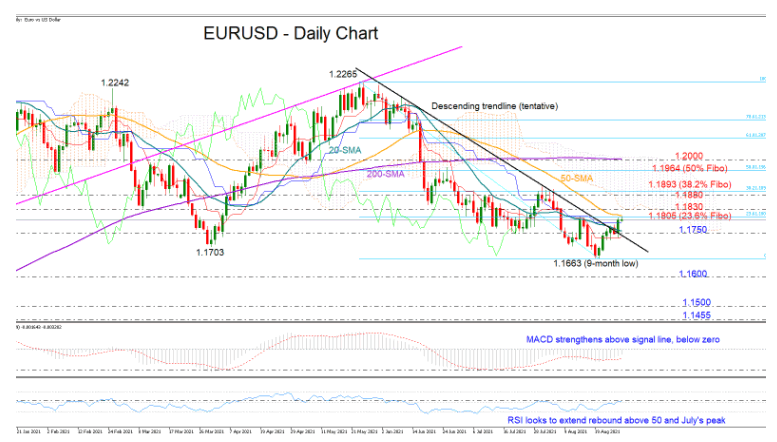
EURUSD closed decisively above the two-month-old resistance trendline and the 20-day simple moving average (SMA) on Friday following some dovish remarks from Fed Chair Jerome Powell at the Jackson Hole symposium.
The trendline breakout, which sent the price as high as 1.1809 on Monday, raised optimism that the latest rebound could see further continuation. Yet, another challenge needs to be addressed to confirm additional upside corrections.
Specifically, the price needs to overcome the 23.6% Fibonacci retracement of the 1.2265 – 1.1663 down leg and the 50-day SMA, both at 1.1805, and then pierce the lower boundary of the Ichimoku cloud around 1.1830, which cancelled upside corrections back in June. If efforts prove successful, the pair may attempt to close above the 1.1880 barrier and run beyond the 38.2% Fibonacci of 1.1893. Any violation at this point would negate the downward pattern in the short-term picture, likely boosting positive momentum up to the 50% Fibonacci of 1.1964 and the 200-day SMA at 1.2000.
In momentum indicators, the RSI is looking to extend its latest rebound above its 50 neutral mark, but it has yet to print fresh highs above July’s peak. Likewise, the MACD is distancing itself above its red signal line, though it is still below the zero line, both suggesting that downside risks have not entirely faded yet.
Should sellers take control, immediate support could occur around 1.1750, where the broken trendline, the 20-day SMA and the red Tenkan-sen line converge. Failure to bounce here could see the price diving towards the 1.1663 low, while lower, the decline could falter near the 1.1600 psychological level.
Summarizing, EURUSD could face more upside pressures in the near term, though a significant close above 1.1800 – 1.1830 is required to activate new buying orders.
USD/JPY Outlook: Bear-Trap Adds To Negative Signals After Dovish Powell Deflated Dollar
The USDJPY stands at the back foot in early Monday, following double upside rejection above 55 DMA and Friday’s big bearish candle with long upper shadow.
Bull trap above the cloud adds to negative signals after dovish comments from Fed chief Powell at the end of Jackson Hole symposium depressed dollar.
Daily MA’s remain in mixed mode with the price action ranging between 100DMA (109.64) and 55DMA (110.13) but rising bearish momentum keeps the downside at risk.
Clear break of 100 DMA would open way towards last week’s low (109.41) and more significant Aug 16-17 double-bottom at 109.11.
Psychological 110 barrier and 55DMA proved to be strong resistances and expected to continue to limit the upside and maintain bearish near-term bias.
Res: 110.00; 110.13; 110.26; 110.45.
Sup: 109.64; 109.41; 109.11; 108.87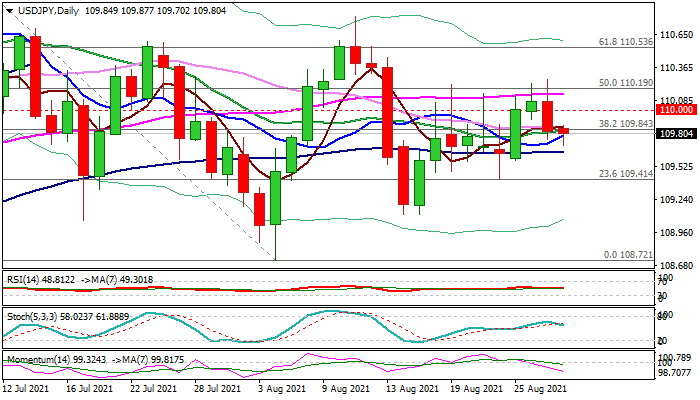
GER 30 Awaits Breakout
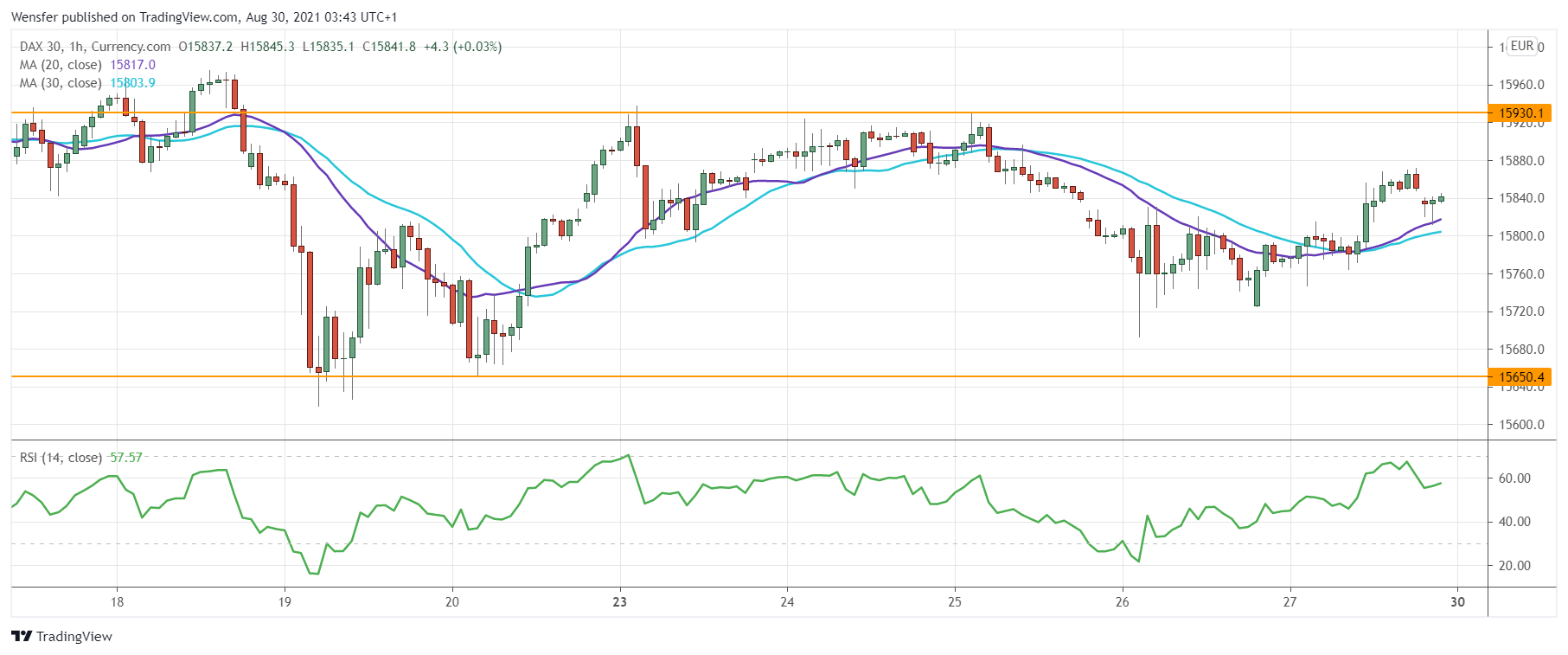
The Dax 30 index rises as investors expect prolonged stimulus.
Price action is seeking support along the 30-day moving average after a new high above 15810. A first wave of profit-taking has made 15930 a key resistance. The bulls will need to push through once again before they could expect the rally to resume.
The RSI’s double-dip into the oversold area has attracted buying interest. 15650 is a major support to keep the short-term bullish bias intact. Failing that, there is a chance of a deeper correction towards 15440.
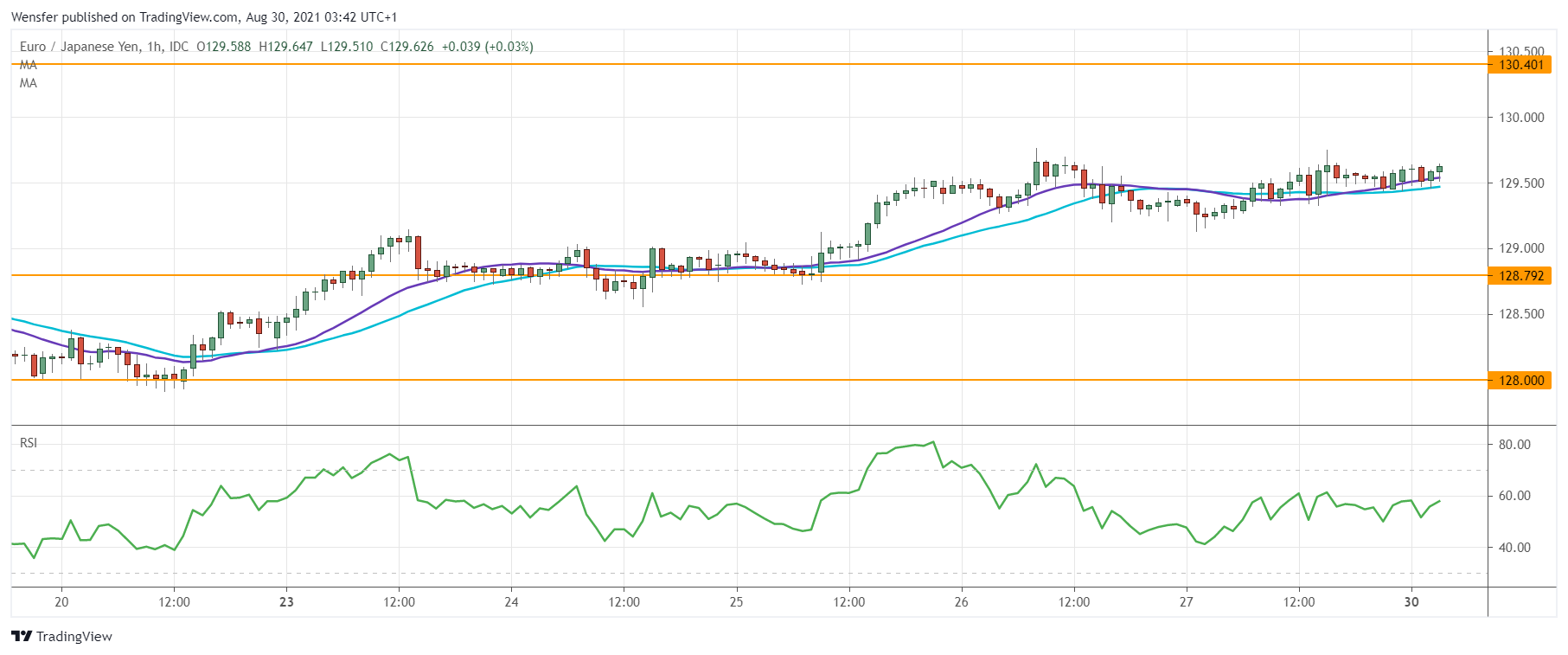
EUR/JPY Challenges Resistance
The Japanese yen softens as risk appetite makes its return.
The fall below the daily support at 128.30 has increased the pressure on the single currency. The current rebound above 129.30 is an indication of the bulls’ resolve to safeguard the uptrend in the medium term.
130.40 is a major hurdle ahead as the origin of the August sell-off.
The RSI has repeatedly shown an overbought situation and a temporary pullback is due with 128.80 as support. Further down, the psychological level of 128.00 could see more bargain hunters.