

Sample Category Title
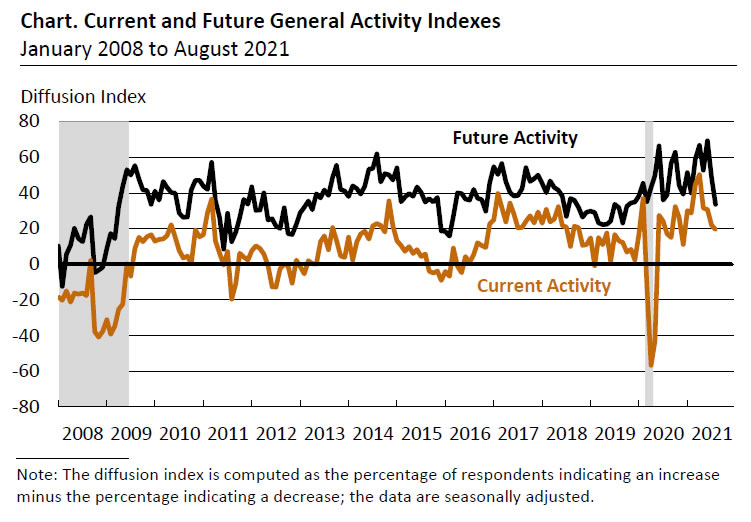
Philly Fed manufacturing dropped to 19.4, but remained elevated
In the August Philadelphia Fed Manufacturing Business Outlook Survey diffusion index for currency activity dropped to 19.4 in August, down from 21.9, below expectation of 24.3. It's also the fourth consecutive decline. 28% of the firms reported increases in current activity while 9% reported decreases.
Philadelphia Fed said: "Responses to the August Manufacturing Business Outlook Survey suggest continued expansion for the region's manufacturing sector. The indicators for current activity and shipments decreased from last month but remained elevated. Additionally, the firms reported increases in new orders and employment. The survey's future indexes moderated this month but continue to suggest expected growth over the next six months."
US initial jobless claims dropped to 348k, continuing claims at 2.82m
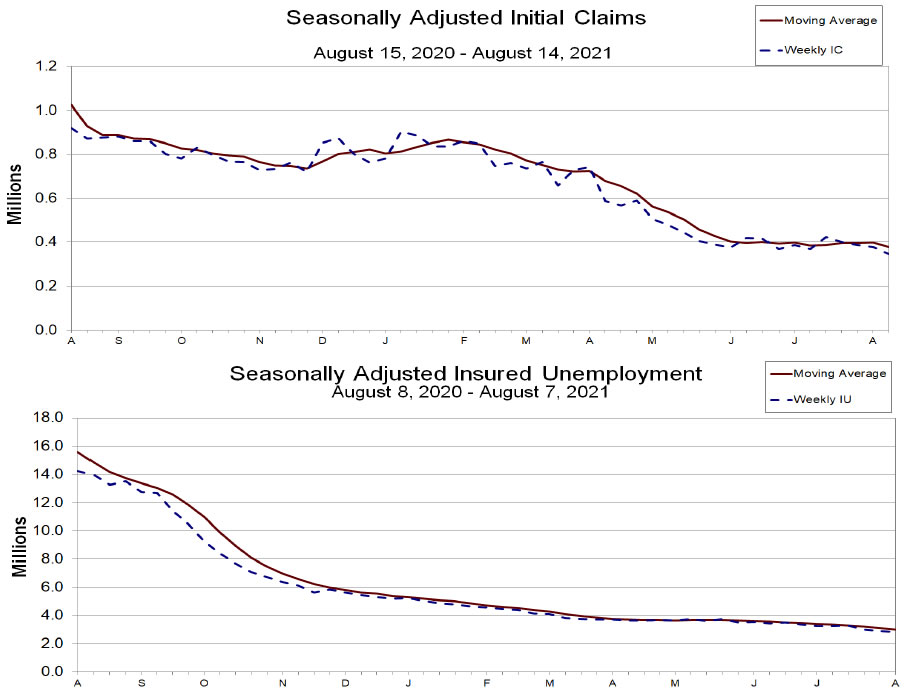
US initial jobless claims dropped -29k to 348k in the week ending August 14, better than expectation of 362k. That's also the lowest level since March 14, 2020. Four-week moving average of initial claims dropped -19k to 378k, lowest since March 14, 2020 too.
Continuing claims dropped -79k to 2820k in the week ending August 7, lowest since march 14, 2020. Four-week moving average of continuing claims dropped -111k to 2999k, lowest since March 21, 2020.
GBP/USD Outlook: Risk Aversion Pushes Cable Below 1.37 Mark
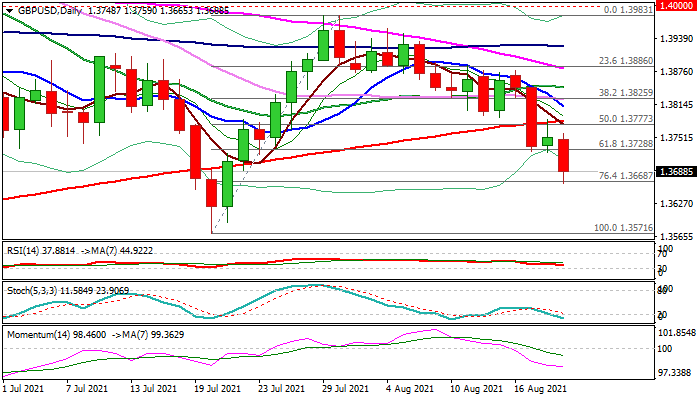
Cable resumes steep descend, which paused after 0.8% drop on Tuesday, and probed below 1.3700 mark on Thursday.
Bears cracked pivotal Fibo support at 1.3668 (76.4% of 1.3571/1.3983), on course to fully retrace the upleg from 1.3571 (July 20 low).
Rising bearish momentum and multiple MA bear crosses on daily chart support the action but bears may face headwinds on approach to the top of thick rising weekly cloud (1.3645) as daily stochastic is oversold.
Upticks should stay under broken 200DMA (1.3783) to keep bears in play and offer better levels to re-enter larger downtrend.
Res: 1.3700; 1.3728; 1.3783; 1.3810.
Sup: 1.3668; 1.3645; 1.3591; 1.3571.
Oil Falls, Gold Stays Steady
Oil sinks further on growth concerns
Both Brent crude and WTI endured a tough day at the office yesterday as global growth concerns and a strong post-minute’s US dollar saw both contracts post significant losses. The US official crude inventories fell by more than expected, as did distillates, but traders chose to focus on the unexpected rise in gasoline stocks. Oil markets usually tend to cherry-pick the data they want to fit their preferred narrative with official crude inventories. The fact that they focused on rising gasoline stocks underlines the growth/recovery fears and emphasises it as the prevailing sentiment in the market.
Brent crude fell by 2.35% to USD 67.45 a barrel, adding ten cents to USD 67.55 in the Asia session. WTI plummeted by 2.95% to USD 64.60 a barrel, where it remains in Asia. Brent crude managed to close on support at this level overnight, but the technical picture now signals that further losses to the triple bottom support at USD 64.50 a barrel could occur. Resistance is distant at USD 70.00, and the USD 70.35 a barrel, its 100-DMA.
WTI fell through important double bottom support at USD 65.10 a barrel overnight, which becomes short-term resistance. That is followed by USD 67.50 and USD 67.80 a barrel; its 100-DMA. WTI has no technical support of note until USD 61.50 and then the 200-DMA at USD 60.60 a barrel.
It is hard to see the negative sentiment surrounding growth fears, a tapering Federal Reserve and increasing production from OPEC+ miraculously turning about-face overnight. With that in mind, the downside remains the weaker side for oil prices which are in danger of seeing another capitulation sell-off.
Gold falls in Asia
Gold remained on the sidelines overnight thanks to a New York session where US yields and the US dollar barely move post-FOMC Minutes. Gold contented itself with trading in a narrow USD 1777.00 to USD 1793.00 range before closing almost unchanged at USD 1787.30 an ounce.
Things have changed in Asia as markets have seen a bout of US dollar strength sweep currency markets this morning. That has caused gold to fall by 0.50% to USD 1778.80 an ounce. Having traced out a series of lower daily highs this week, failing multiple times ahead of USD 1800.00 an ounce. Gold may be signalling that last week’s frenzied FOMO upward momentum is waning, especially as the US dollar strength seems to have some strong momentum now.
Gold has immediate resistance at USD 1787.00 and then USD 1800.00 an ounce. That is followed by a formidable region containing the 100-DMA at USD 1808.20 and the 200-DMA at USD 1812.70 and a series of daily highs, each side of USD 1834.00 an ounce. Gold has a lot of wood to chop to maintain its rally.
Failure USD 1770.00 is likely to spark a flurry of hot money sellers cutting long positions, pushing it lower to the next support at USD 1750.00 an ounce. If that fails, gold will be vulnerable to a deeper retracement targeting the USD 1700.00 an ounce area.
Global Stocks Extend Drop
The markets are throwing a mini taper tantrum. The key question is whether the latest dip will be bought or are we going to witness a proper sell-off? Well, so far it too early to tell, and until proven otherwise I would give the bulls the benefit of the doubt.
European stocks and US index futures extended their falls during the European morning session, while the dollar strengthened further against all major currencies except safe-havens Japanese yen and Swiss franc. Gold was caught between two major forces, with the impact of stronger dollar being offset by haven demand and slightly weaker European bond yields. Crude oil slumped and copper prices weakened further.
So, what’s going on?
Well, it looks like the market is responding two to major bearish catalysts. As you may recall from my note yesterday, commodities were already getting crushed on concerns the recovery was slowing down in both the US and China (the world’s largest economies), after a handful of disappointing macro numbers. Adding to those worries were uncertainty over Covid, as well as concerns over valuations and inflation. Then, investors were reminded about tapering after the FOMC’s last meeting minutes revealed Fed officials agreed they could start slowing the pace of bond purchases later this year.
Will the dip be bought again?
So, sentiment is cautious as we head towards mid-day. But remember that previous weakness for indices have repeatedly been bought. While this time it could be different, it is worth remembering a few things. First, the European Central Bank and a few others are in no rush to slow their stimulus measures. Second, even if the Fed tapers bond purchases, it will still have a very loose policy compared to pre-Covid. Third, the Fed has already prepared the market for tapering and so the FOMC’s meeting minutes revealed nothing we didn’t know already.
Indeed, as the ECB is likely to remain dovish for longer. Among other things, this should keep the pressure on the euro, which in turn should help Eurozone exports and boost the appeal of European equities on a relative basis. Obviously, there is a risk that a Chinese-led slowdown could hurt demand for European exports, while the US recovery may have peaked. Although data from both regions have been disappointing of late, a few misses here and there should be expected as the road to recovery was always going to be a bumpy one. Some softness in data should not trouble investors too much unless it becomes a trend. So far, we have only seen a handful of disappointing macro pointers. Let’s not jump to any conclusions.
DAX testing trend line
“Buying the dip” remains a favourite stock market strategy for many as it has consistently worked. Well, the DAX was testing a key support area around its rising trend line circa 15600-15700. Let’s see if the bulls will emerge here, or whether the selling pressure will cause a break down.

US Dollar Edges Higher
The US dollar jumps in Asia on EUR/USD stops
The US dollar edged higher overnight as the FOMC Minutes outlined an increasingly likely start to tapering, commencing around the end of the year. That follows on from a number of Fed officials making comments with a decidedly hawkish tone over the past two weeks, even previous doves. The dollar index was slightly higher at 93.15.
In Asia, though, currency markets have been rather enthusiastic for a change. The dollar index has leapt higher by 0.30% to 93.43, with the catalyst appearing to be stop-loss selling in EUR/USD as it sank through 1.1700. Although equities retreated in New York, the US dollar and US bonds hardly reacted to the Fed minutes, Asia appears to have taken rather more seriously, with potential divergence in monetary policy having heavy implications for the region.
The dollar index is now just shy of resistance at 95.50, which in turn opens the door to further rallies targeting 94.30 and 94.75. Only a fall through 93.00 temporarily upsets the bullish narrative. EUR/USD has fallen 0.34% to 1.1670 today, triggering stops as it passed through 1.1700. That becomes immediate resistance, with the single currency potentially falling to 1.1600.
GBP/USD has fallen 0.30% to 1.3717, well below its 200-day moving average (DMA) at 1.3786, with no support evident until 1.3580. Similarly, USD/JPY has jumped 0.37% to 110.17, just below its 50-DMA with no resistance apparent until 110.80.
AUD/USD and NZD/USD have been under the pump this morning as Covid-19 cases spiral in NSW and rise in Auckland against a general backdrop globally of risk aversion. AUD/USD has fallen 0.45% to 0.7200, my initial target for the technical breakout below 0.7360 last week. AUD/USD could now extend losses to 0.7000 next week. The post-RBNZ short-squeeze was short-lived for NZD/USD, which has fallen another 0.50% to 0.6850 today. Down nearly 2.50% for the week, the kiwi still looks like it has more to go with resistance at 0.6900, but no technical support evident until some congestion around 0.6600. The reality of the delta-variant breaching fortress New Zealand’s gates is now hitting home to investors, especially when you dig into the movement while infectious data. It is not good reading. An extended lockdown looms.
Asian currencies are also in a general retreat today, with USD/CNH climbing 0.20% to 4.4970 and USD/CNY in danger of breaching resistance on a daily basis at 6.4900, having risen to 6.4925 this morning. President Xi’s comments yesterday are likely further spooking investors against a background of general US dollar strength. USD/THB, USD/KRW, USD/SGD are around 0.30% higher, with central bank action possible from South Korea if USD/KRW climbs through 1180.00. USD/MYR is steady at 4.2380 as a political resolution edges forwards, shepherded by the Malaysian King. USD/IDR is steady at 14,380.00 ahead of the BI rate decision today, but IDR may weaken after this afternoon’s announcement, especially if BI makes dovish noises.
It is clear that Asia is giving more weight to the FOMC minutes than US markets did, with the FOMC members seemingly aligned about a start to tapering starting late Q4 or early Q1 2022. The move will have clear implications for USD/ASEAN and USD/JPY, a purely US/Japan rate differential play these days. The technical breaks by euro and sterling are worthy of note with the ECB’s QE forever policies likely to lead to a longer-term weakening of the single currency if monetary policy with the US diverges in the new year. Pop in the ever-present fears surrounding global growth due to the delta-variant, prevailing in markets now, and there aren’t a lot of reasons to be short US dollars right now.
EURUSD Is Possibly Bearish
Technical analysis
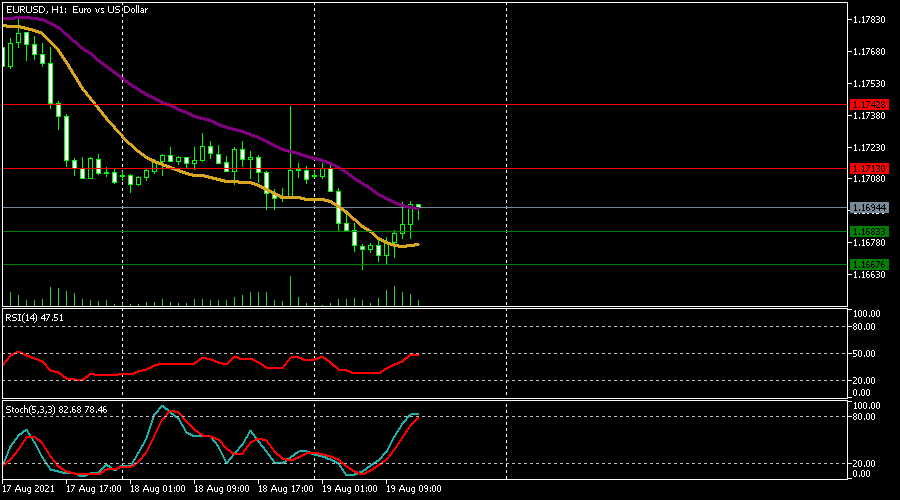
The EMA(100) is above the EMA(50), which is beneficial for bears
The RSI is below 50
The Stochastics is in an overbought zone, pointing to a possible downtrend.
What the possible outcomes are
The U.S. dollar moved to new heights after the FOMC minutes yesterday. EURUSD dropped to the new year lows of 1.16644 but rebounded to the current level of 1.16940.
In our most likely scenario, the pair may experience a downwards correction towards the first support level of 1.16833.
If the price passes the first support level, we can expect a continued downtrend towards the second support level of 1.16676.
Conversely, it's possible to see the pair rise towards the first resistance level of 1.17130.
If the pair surpasses the first resistance level, we should expect a continued surge towards the second resistance level of 1.17428.
Key levels
Support 1.16833 1.16676
Resistance 1.17130 1.17428
Asian Markets Head Lower
Asia markets turn south
As it diverged from New York’s lead, the bottom fishing across Asia we saw yesterday has vanished today, with most of Asia in the red. President Xi’s wealth redistribution remarks and a taper-heavy FOMC minutes combining to push regional markets lower today. Xi outlined thoughts on what is described as “common prosperity”.
Against the background of China’s regulatory interventions and Chinese company’s rocky IPO environment at the moment, this will be another dark cloud for China equity prices. Eventually, Chinese equities will fall to levels that offset the multitude of governmental risks they now face. That process has not finished yet.
Overnight, Wall Street ended on a sour note post the minutes release. The S&P 500 and Dow Jones fell by 1.07%, while the Nasdaq retreated by 0.89%. Futures on all three indexes have continued easing this morning, lower by around 0.10%.
The Nikkei 225 starts the day 0.70% lower, while the Kospi has fallen by 1.0%. In China, the Shanghai Composite is down by 1.10%, with the CSI 300 slipping by 0.60%, and Hong Kong has lost 1.70%. Singapore is 1.05% lower, with Taipei falling 1.20%, Kuala Lumpur by 0.40%, Manila by 0.35% and Jakarta by 0.85%. Australian markets are also lower, with the ASX 200 falling 0.50% while the All Ordinaries is 0.45% lower. Perhaps more ironic than today being Afghanistan’s official Independence Day, New Zealand’s NZX has leapt 1.50% higher despite the country being set for an extended national lockdown. I attribute this to the near 2.50% fall by the New Zealand dollar this week.
The close lower on Wall Street, and negative performance in Asia, will see Europe also assessing tapering implications and opening lower this afternoon. However, I expect European equities to remain relatively unscathed for now, as a lower euro, now and into the future, will be positive for export performance. The rest of the week is likely to be dominated by the implications of a Fed taper being much closer to reality than even a month ago.
Risk Aversion Sentiment Picks Up On Fed Taper Speculation, Pandemic Concerns
Notes/Observations
- Norway maintains plan for September rate hike.
- Increased speculation of Fed plans for tapering at next week's Jackson Hole conference.
- Continued concerns that delta virus variant threatens to undermine global growth.
Asia
- Australia July Employment Change: +2.2K v -43.1Ke; Unemployment Rate hit a 12-year low at 4.6% v 5.0%e.
- China Huarong Asset Management said it will incur a loss of nearly US$16bn for 2020 and unveiled a rescue plan.
- RBNZ Gov Orr reiterated that held OCR in at Aug meeting in light of lockdown and uncertainty of it; next opportunity to assess rate was in Oct and we could afford to wait.
Coronavirus
- Total Global cases: 210.1M; (+0.4% y/y); total deaths: 4.4M (+0.3% d/d).
- Oxford study noted that AstraZeneca vaccine’s efficacy fall to 61% 90 days after the 2nd dose; Pfizer/Biontech vaccine’s efficacy falls to 75% 90 days after a 2nd dose.
Americas
- FOMC July Minutes noted that official would evaluate bond taper prospects over coming meetings; Substantial further progress had not been met particularly in terms of labor market. Some members suggested that it would be prudent for the committee to prepare for starting to reduce pace of asset buys fairly soon.
- Fed’s Bullard (non-voter, hawk) recent data had been slightly weaker but still expected 'very robust' growth. Would prefer taper to be done in Q1'22; Would give the FOMC options.
- Goldman analyst cut its US 2021 GDP growth forecast from 8.5% to 5.5%.
Speakers/Fixed income/FX/Commodities/Erratum
Equities
- Indices [Stoxx600 -2.09% at 464.54, FTSE -2.18% at 7,013.17, DAX -1.80% at 15,678.05, CAC-40 -2.74% at 6,584.65, IBEX-35 -1.38% at 8,846.00, FTSE MIB -2.18% at 25,785.50 , SMI -1.68% at 12,334.40 , S&P 500 Futures -0.94%].
- Market Focal Points/Key Themes: European indices open lower across the board; less negative sectors include utilities and consumer discretionary; while industrials and energy sectors lead to the downside; mining subsector weighed on by disappointing results from Antofagasta; luxury brands under pressure from concerns over China; automotive subsector impacted following announcement by Toyota to cut production over chip shortages; NN sells investment unit to Goldman Sachs; earnings expected during the upcoming US session include Estee Lauder, Tapestry, Macy’s and Kohl’s.
Equities
- Consumer discretionary: Marshalls [MSLH.UK] +4% (earnings), Richemont [CFR.CH] - - - 7%, Swatch Group [UHR.CH] -5% (Swiss trade data).
- Financials: NN Group [NN.NL] -1% (divestment).
- Industrials: Daimler [DAI.DE] -3%, Volkswagen [VOW3.DE] -3% (Toyota said to cut output in Sept).
- Technology: Tremor International [TRMR.UK] +11% (earnings).
- Materials: Antofagasta [ANTO.UK] -5% (earnings).
Speakers
- ECB’s Lane (Ireland, chief economist) blog post noted that guidance was the 1st step in implementing new ECB strategy. The symmetry of the inflation target meant that the governing council considered negative and positive deviations of inflation from the target to be equally undesirable.
- Norway Central Bank (Norges) Policy Statement noted the decision to keep policy steady was unanimous and still saw a need for an expansionary monetary policy but economic conditions were normalizing. Reiterated forward guidance that policy rate to be most likely to be raise in Sept.
- Norway Central Bank (Norges) Gov Olsen post rate decision press conference saw a steady, gradual opening of society but did not not see signs of inflation jumping.
- Indonesia Central Bank Policy Statement reiterated to maintain accommodative monetary operations. Decision in line with low inflation and need to support economy. Stressed that its policy to be pro-growth. Decision to keep policy steady consistent to maintain stability in FX and financial markets amid uncertainty. Had been anticipating the Fed tapering plan and have triple intervention and coordination with Finance Ministry to face tapering.
- Indonesia Central Bank (BI) Gov Warjiyo pre-rate decision press conference noted that the domestic economic momentum was continuing with sign that activity resuming in Aug. To continue stabilizing the IDR currency (Rupiah) to be in-line with fundamentals. Saw very ample liquidity in banking system and to issue macroprudential policy on financing.
- China Commerce Ministry (MOFCOM) stated that it was maintaining normal communications with US on trade.
- OPEC+ delegate noted that OPEC+ compliance with production cuts steady at 109% in July.
Currencies/Fixed Income
- USD on firm footing aiding initially by Fed minutes that heightened expectations of a taper decision approaching. Greenback aided by safe-haven flows as well over covid infection concerns. Markets believing that the delta virus variant threatens to undermine global growth.
- The US Dollar index moved above 93.50 level for its highest level since Nov 2020; strength attributed to safe-haven flows.
- The strong USD weighed upon various base metal and oil commodities as saw the respective commodity-related currencies (AUD, NZD, CAD, NOK) sell-off.
Economic data
- (NL) Netherlands July Unemployment Rate: 3.1% v 3.2% prior.
- (CH) Swiss July Trade Balance (CHF): 5.3B v 5.5B prior; Real Exports M/M: +0.6% v -3.0% prior; Real Imports M/M: +1.0% v -2.7% prior; Watch Exports Y/Y: 29.1% v 71.3% prior.
- (NO) Norway Q3 Consumer Confidence: 10.9 v 4.7 prior.
- (CH) Swiss Q2 Industrial Output Y/Y: 15.7% v 4.7% prior; Industry & Construction Output Y/Y: 14.2% v 4.5% prior.
- (ID) Indonesia Central Bank (BI) left the 7-Day Reverse Repo unchanged at 3.50% (as expected).
- (EU) Euro Zone Jun Current Account Balance: €21.8B v €13.9B prior.
- (NO) Norway Central Bank (Norges) left the Deposit Rates unchanged at 0.00% (as expected).
- (ES) Spain Jun Trade Balance: -€1.0B v +€0.1B prior.
- (PL) Poland July Sold Industrial Output M/M: -3.9% v -3.5%e; Y/Y: 9.8% v 10.3%e.
- (PL) Poland July PPI M/M: 1.2% v 1.0%e; Y/Y: 8.2% v 7.7%e.
- (IT) Italy Jun Current Account Balance: €3.5B v €3.9B prior.
- (GR) Greece Jun Current Account Balance: -€1.3B v -€1.4B prior.
- (PT) Portugal Jun Current Account Balance: €0.0B v -€1.0B prior.
- (HK) Hong Kong July CPI Composite Y/Y: 3.7% v 3.7%e.
Fixed income Issuance
- 04:30 (NO) Norway Central Bank (Norges) Gov Olsen post rate decision press conference.
- (FR) France Debt Agency (AFT) sold total €6.997B vs. €6.0-7.0B indicated range in 2024, 2026 and 2027 Bonds.
- Sold €2.497B in 0.00% Mar 2024 Oat; Avg Yield: -0.71% v -0.58% prior; Bid-to-cover: 3.38x v 2.25x prior (July 16th 2020).
- Sold €2.506B in 0.50% May 2026 Oat; Avg Yield: -0.62% v -0.53% prior; Bid-to-cover: 2.70x v 1.92x prior (Sept 17th 2020).
- Sold €1.994B in 1.00% May 2027 Oat Avg Yield: -0.54% v -0.45% prior; Bid-to-cover: 2.62x v 2.32x prior (Aug 20th 2020).
- (SE) Sweden sold total SEK1.25B vs. SEK1.25B indicated in 2026 and 2032 I/L Bonds.
- (IE) Ireland Debt Agency (NTMA) sold €750M vs. €750M indicated 6-month bills; Avg Yield: -0.636% v -0.620% prior; Bid-to-cover: 2.40x v 2.10x prior.
Looking Ahead
- (PE) Peru Q2 GDP Y/Y: 42.0%e v 3.8% prior.
- 05:25 (EU) Daily ECB Liquidity Stats.
- 05:30 (HU) Hungary Debt Agency (AKK) to sell 12-month Bills.
- 05:50 (FR) France Debt Agency (AFT) to sell €0.5-1.0B in inflation-linked 2028 and 2028 bonds (Oatei).
- 06:00 (RO) Romania to sell RON400M in 3.25% 2026 Bonds.
- 06:45 (US) Daily Libor Fixing.
- 08:00 (UK) Daily Baltic Dry Bulk Index.
- 08:30 (US) Aug Philadelphia Fed Business Outlook: 23.1e v 21.9 prior.
- 08:30 (US) Initial Jobless Claims: 364Ke v 375K prior; Continuing Claims: 2.80Me v 2.866M prior.
- 08:30 (CA) Canada July Teranet House Price Index (HPI) M/M: No est v 2.7% prior; Y/Y: No est v 16.0% prior; HPI: No est v 276.28 prior.
- 08:30 (US) Weekly USDA Net Export Sales.
- 09:00 (RU) Russia Gold and Forex Reserve w/e Aug 13th: No est v $599.3B prior.
- 10:00 (US) July Leading Index: 0.7%e v 0.7% prior.
- 10:00 (US) Q2 MBA Mortgage Foreclosures: No est v 0.54% prior; Mortgage Delinquencies: No est v 6.38% prior.
- 10:30 (US) Weekly EIA Natural Gas Inventories.
- 11:30 (US) Treasury to sell 4-Week and 8-Week Bills.
- 12:00 (CA) Canada to sell 2-year notes.
- 13:00 (US) Treasury to sell 30-Year TIPS Reopening.
- 15:00 (AR) Argentina July Trade Balance: $1.1Be v $1.1B prior.
- 15:00 (AR) Argentina Jun Economic Activity Index (Monthly GDP) M/M: +2.0%e v -2.0% prior; Y/Y: 10.2%e v 13.6% prior.
- 17:00 (KR) South Korea July PPI Y/Y: No est v 6.4% prior.
- 19:01 (UK) Aug GfK Consumer Confidence: -7e v -7 prior.
- 19:05 (AU) RBA's Kent speech to Conference.
- 19:30 (JP) Japan July National CPI Y/Y: -0.4%e v +0.2% prior; CPI ex-fresh food (core) Y/Y: -0.4%e v +0.2% prior; CPI ex-fresh food/energy (core-core) Y/Y: -0.8%e v -0.2% prior.
- 21:30 (CN) China Monthly 1-year and 5-year Loan Prime Rate setting.
- 21:30 (CN) China Monthly 1-year and 5-year Loan Prime Rate setting.
- 22:30 (KR) South Korea to sell KRW100B in 10-Year Bonds.
- 23:00 (NZ) New Zealand July Credit Card Spending M/M: No est v -1.0% prior; Y/Y: No est v 6.3% prior.
- 23:00 (ID) Indonesia Q2 Current Account: +$0.3Be v -$1.0B prior.
- 23:30 (HK) Hong Kong to sell HKD1.2B in 2-year Bonds.
- 22:30 (JP) Japan to sell 3-Month Bills.
Hold On A Minutes
FOMC signals tapering is on the way
The overnight release of the FOMC Minutes provided some drama, with the committee members mostly lining up behind a tapering of quantitative easing sooner rather than later. Although caution was expressed about the potential impact of the Covid-19 delta-variant on the recovery, most of the discussion appears to be around timing. Views were split over starting into the end of the year or early next. That seems to be rather splitting hairs to me as to whether tapering commences in late Q4 or early Q1, which makes little difference; the fact is, Fed tapering looks likely to start in a few months.
The procession of Fed officials making up the FOMC who have made hawkish comments since the FOMC meeting, especially after the blockbuster Non-Farm Payrolls released at the start of August, would appear to swing the likelihood of tapering in December. Next week’s Jackson Hole Symposium may give markets more visibility on the Fed’s current thinking, and if not, the September FOMC meeting certainly will.
Of course, this does not mean that US interest rate hikes will also be arriving sooner than later. But the start of divergence of monetary policy between the United States and most of the rest of the world, notably Europe and Asia, will have implications, especially in the currency space. The US dollar continued its rally in Asia today, spiking higher in early trading. Most likely, that was because EUR/USD fell through 1.1700, triggering stop losses, but its strength is broad-based across the G-10 and DM space. With Europe and Japan on hold and QE-ing forever, both will be vulnerable in the medium to longer term.
With ASEAN interest rates at rock bottom, and with no room to think about tightening as delta rips through the region, challenges remain. Monetary policy running on empty across the region. However, going into Q4, if the US dollar keeps rising and the US bond market finally starts reacting to that new reality, moving US yields higher, much of Asia may find itself in a monetary bind. Although bulging with foreign currency reserves, it will be a tough choice by either running down those reserves intervening to protect their currencies or facing imported inflation. I believe that option two will win, with a bit of option one deployed tactically, aka South Korea, to keep everybody honest. Thus, I expect Asian currencies to weaken through Q4.
The first regional central bank to face that conundrum, and one that perpetually does, is Indonesia. Bank Indonesia releases its latest interest rate policy decision this afternoon. Indonesia’s recovery has taken and continues to take a massive hit from the wave of Covid-19 sweeping the archipelago. Don’t take the falling cases at face value; the pandemic has moved out of Java and Bali, and testing numbers have tanked. Although further monetary policy transmission via rate cuts likely has a declining marginal utility at these record low levels, BI will have one eye on the value of the rupiah (IDR). They said as much themselves at the last meeting, and I expect them to hold at 3.50% today and be on hold for the foreseeable future. BI will probably encourage local banks to get out there and lend. But as usual, the universe of credit-worthy opportunities at scale is somewhat limited. BI may provide some incentives to encourage banks to offset their rate bind. USD/IDR should continue bubbling under 14,500.00, but if it rises to BI’s line in the sand near 15,000.00 in the coming weeks, things will start getting interesting for the BI.
Australian Unemployment has just been released and given the scale of lockdowns across the country now, the data was surprisingly positive. 2,200 jobs were added in July, an excellent result in the circumstances. The Unemployment Rate fell to 4.60% versus 5.0% expected, a great result. Labour force participation remained steady at 66.0%, slightly lower than last month’s 66.2%. I’ll need to wrap a cold towel around my head to figure out how almost no change in jobs and steady labour force participation led to a 0.40% drop in unemployment. I’ll get back to you. The reaction to the data has been muted as local equities, and AUD/USD react to US dollar strength and spiralling Covid-19 cases in New South Wales and a disturbing increase in Victoria.
The data calendar is quiet today in Asia, Bank Indonesia aside, and pretty flat globally. Norway’s central bank could beat New Zealand to the finish tape and start rate hikes today; the market seems indecisive on this one. US Initial Jobless Claims, should they fall markedly from last week’s 375,000, could provoke more US dollar buying and equity sellers given the post-FOMC taper minutes mood.
One other thing that caught my eye in the last 24 hours was yesterday’s comments from China’s President Xi. President Xi outlined thoughts on what is described as “common prosperity” and what can only be described as redistributing wealth. Against the background of China’s regulatory interventions and Chinese company’s rocky IPO environment at the moment, this will be another dark cloud for China equity prices. The bottom fishing evident across equity markets yesterday in Asia has run out of steam quickly today, with Asia back to following the US lead. I will reiterate; eventually, Chinese equity prices will fall to levels that offset the multitude of governmental risks they now face. That process has not finished yet.
On one final note, it is Mrs Halley’s birthday next week. Our last attempt at exploring the island of Sumba was rudely interrupted by both of us catching Covid-19 (despite being vaccinated). It won’t be Sumba tomorrow, but we shall be heading to another more famous island (within Indonesia) tomorrow to support their economy, as she will not be denied her birthday. Like MacArthur, I shall return; on Monday, August 30th.