

Sample Category Title
USD, JPY and CHF in Range Against Each Other, AUD and CAD Heavy
Dollar, Swiss Franc and Yen are taking turns to be the strongest, with the greenback having a little upper hand. But they're kept in range against each other. Commodity currencies remain the weakest, with Aussie additionally pressured by strict lockdowns, while Loonie is dragged down by falling oil prices. Euro and Sterling are mixed in the middle. Stock traders appear to be relatively indecisive though, in particular in the US. S&P 500 and NASDAQ managed to reverse all initial decline to closed up. However, major Asian indexes are rather weak, especially in Hong Kong and China.
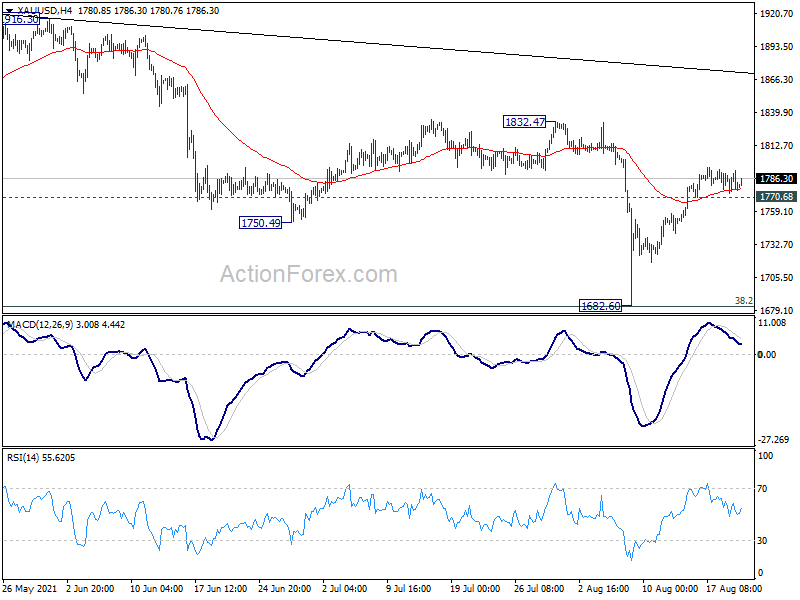
Technically, the overwhelming rally in Dollar this week is, to a certain extent, not overwhelming enough. Gold is just stuck in range around 1780 for now. Considering that it's close to 55 day EMA (now at 1979.58), it's actually rather resilient. To confirm more sustainable rise in the greenback, especially against the equally strong Swiss Franc and Yen, we'd prefer to see firm break of 1770.68 support in Gold to indicate rejection by 1800 handle. Otherwise, we'd maintain a bit of cautiousness in USD/CHF and USD/JPY, as well as EUR/USD.
In Asia, at the time of writing, Nikkei is down -0.70%. Hong Kong HSI is down -2.28%. China Shanghai SSE is down -1.66%. Singapore Strait Times is up 0.77%. Japan 10-year JGB yield is down -0.002 at 0.015. Overnight, DOW dropped -0.19%. S&P 500 rose 0.13%. NASDSAQ rose 0.11%. 10-year yield dropped -0.031 to 1.242.
UK Gfk consumer confidence dropped to -8, GBP/CHF breaks near term support
UK Gfk consumer confidence dropped slightly from -7 to -8 in August, below expectation of -6. "Against a backdrop of cooling headline inflation and soaring house prices, the U.K. consumer confidence index is stable at minus 8 this August," Joe Staton, GfK's client strategy director, said.
"Expectations for our personal financial situation for the coming 12 months are holding up and this positivity bodes well for the economy going forward this year and next," Staton said. The index measuring changes in personal finances over the past 12 months is up one point at 0.
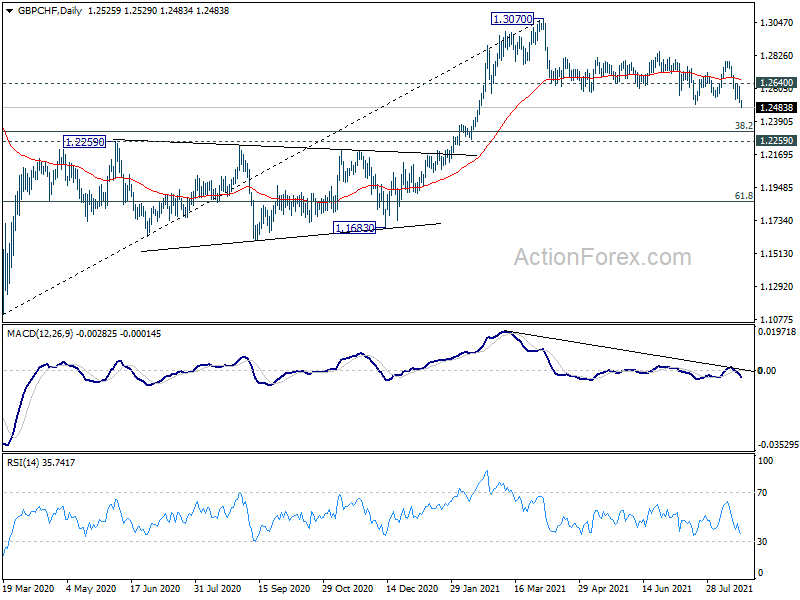
Sterling is the weakest European major for the week, and is trading just better than commodity currencies. GBP/CHF drops through 1.2498 support to resume the choppy fall from 1.3070. Deeper decline is now expected as long as 1.2640 resistance holds. Such decline is seen as a correction to up trend from 1.1107. Next target is 38.2% retracement of 1.1107 to 1.3070 at 1.2320. Nevertheless, we'd look for strong support 1.2259 resistance turned support to bring rebound, at least on first attempt.
AUD/USD to draw strong support from 0.7 on next fall
Australian Dollar remains broadly pressured today. New South Wales reported another 644 new coronavirus infections and 4 deaths. Greater Sydney's lockdown will be extended until the end of September. That is, the lockdown, which has already lasted for 8 weeks, will run for at least 13 weeks. Also, a curfew will be introduced for 12 local government areas of Sydney, as people there must stay stop between 9pm and 5am.
While more downside is still in favor in AUD/USD for the immediate future, we'd start to looking for bottoming sign on next move. Oversold condition in daily MACD could start to slow the decline. 161.8% projection of 0.8006 to 0.7530 from 0.7890 at 0.7120 will be met. Additionally, AUD/USD should then enter a key support zone around 0.7 psychological level, 0.6991 support, and 38.2% retracement of 0.5506 to 0.8006 at 0.7051. Let's see if AUD/USD would at least turn into sideway trading.

CAD/JPY pressing 85.40 key support, completing head and shoulder top?
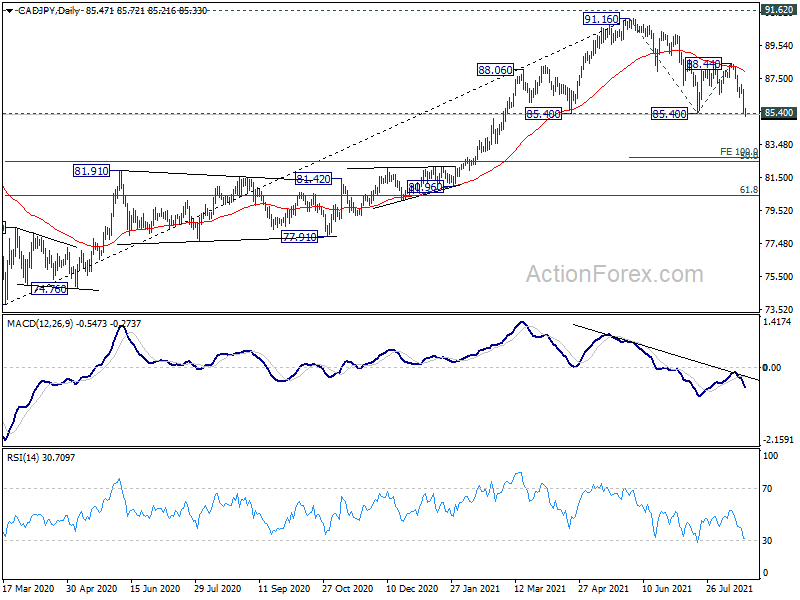
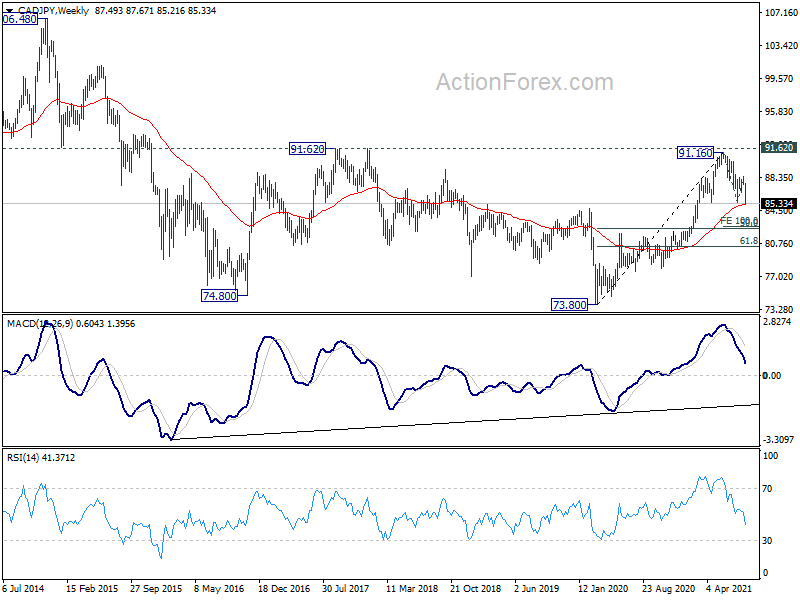
CAD/JPY is now pressing 85.40 key support level after this week's steep decline. Sustained break of this support would carry rather bearish medium term implications. Firstly, that would complete a head and shoulder top reversal pattern (ls: 88.06, h: 91.16, rs: 88.44). Secondly, 55 week EMA (now at 85.24) would be firmly taken out. Thirdly, that could also confirm completion of whole rise from 73.80 (2020 low) at 91.16, as a leg in the sideway pattern that started at 74.80 (2016 low), after rejection by 91.62 key resistance (2017 high).
Sustained break of 85.40 would push CAD/JPY to 100% projection of 91.16 to 85.40 from 88.44 at 82.68. That is close to 50 % retracement of 73.80 to 91.16 at 82.48.
Elsewhere
Japan CPI core dropped back to negative -0.20% yoy in July, down from 0.2% yoy, but beat expectation of -0.4% yoy. UK retail sales and public sector net borrowing will be released in European session. Germany will release PPI. Later in the day, Canada new housing price index and retail sales will be featured.
USD/JPY Daily Outlook
Daily Pivots: (S1) 109.43; (P) 109.83; (R1) 110.17; More...
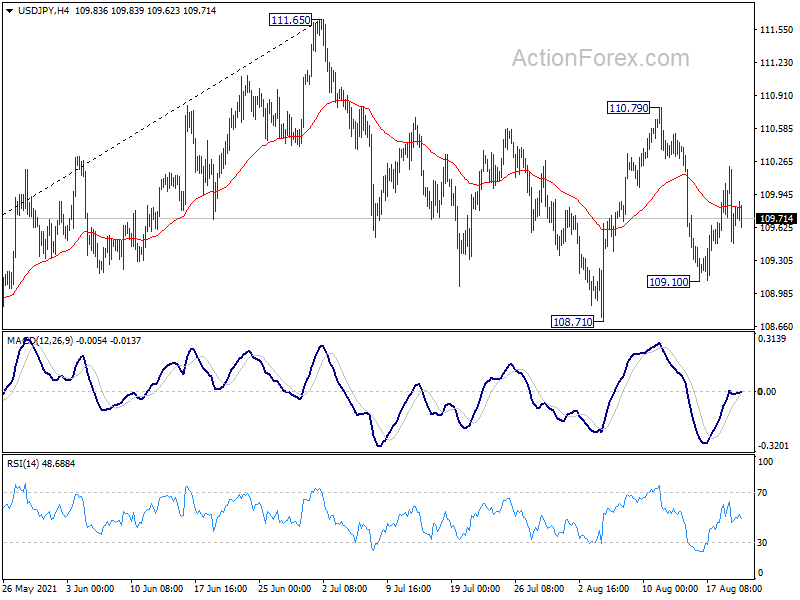
Intraday bias in USD/JPY remains neutral and outlook is unchanged. On the upside, break of 110.79 will resume the rebound from 108.71 to retest 111.65 high. On the downside, break of 109.10 will target 108.71 support first. Firm break there will resume the decline from 111.65 and target 38.2% retracement of 102.58 to 111.65 at 108.18 next.
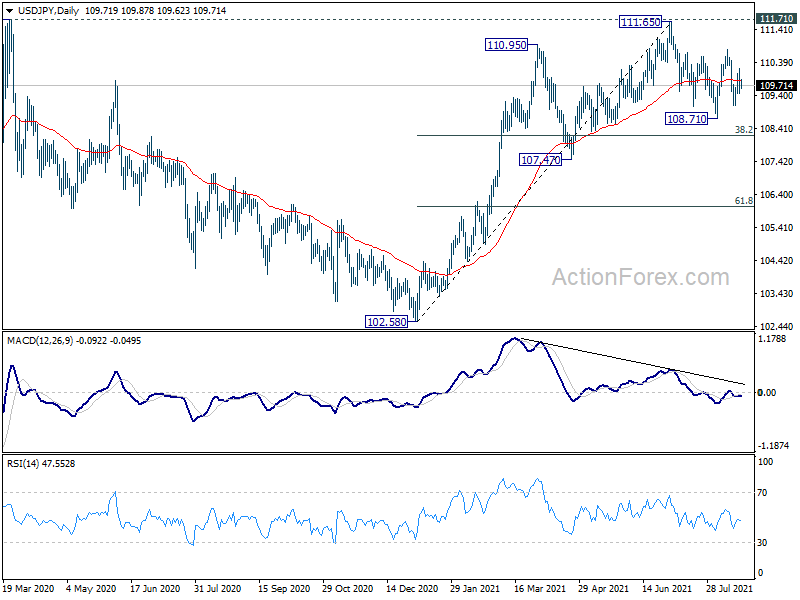
In the bigger picture, medium term outlook is staying neutral with 111.71 resistance intact. The pattern from 101.18 could still extend with another falling leg. Sustained trading below 55 day EMA will bring deeper fall to 107.47 support and below. Nevertheless, strong break of 111.71 resistance will confirm completion of the corrective decline from 118.65 (2016 high). Further rise should then be seen to 114.54 and then 118.65 resistance.
Economic Indicators Update
| GMT | Ccy | Events | Actual | Forecast | Previous | Revised |
|---|---|---|---|---|---|---|
| 23:01 | GBP | GfK Consumer Confidence Aug | -8 | -6 | -7 | |
| 23:30 | JPY | National CPI Core Y/Y Jul | -0.20% | -0.40% | 0.20% | |
| 06:00 | GBP | Retail Sales M/M Jul | 0.40% | 0.50% | ||
| 06:00 | GBP | Retail Sales Y/Y Jul | 6.40% | 9.70% | ||
| 06:00 | GBP | Retail Sales ex-Fuel M/M Jul | 0.30% | |||
| 06:00 | GBP | Retail Sales ex-Fuel Y/Y Jul | 7.40% | |||
| 06:00 | EUR | Germany PPI M/M Jul | 0.80% | 1.30% | ||
| 06:00 | EUR | Germany PPI Y/Y Jul | 8.40% | 8.50% | ||
| 06:00 | GBP | Public Sector Net Borrowing (GBP) Jul | 23.2B | 22.0B | ||
| 12:30 | CAD | New Housing Price Index M/M Jul | 1.30% | 0.60% | ||
| 12:30 | CAD | Retail Sales M/M Jun | 5.00% | -2.10% | ||
| 12:30 | CAD | Retail Sales ex Autos M/M Jun | 4.90% | -2.00% |
CAD/JPY pressing 85.40 key support, completing head and shoulder top?
CAD/JPY is now pressing 85.40 key support level after this week's steep decline. Sustained break of this support would carry rather bearish medium term implications. Firstly, that would complete a head and shoulder top reversal pattern (ls: 88.06, h: 91.16, rs: 88.44). Secondly, 55 week EMA (now at 85.24) would be firmly taken out. Thirdly, that could also confirm completion of whole rise from 73.80 (2020 low) at 91.16, as a leg in the sideway pattern that started at 74.80 (2016 low), after rejection by 91.62 key resistance (2017 high).
Sustained break of 85.40 would push CAD/JPY to 100% projection of 91.16 to 85.40 from 88.44 at 82.68. That is close to 50 % retracement of 73.80 to 91.16 at 82.48.
GBP/USD – Into Bearish Territory
What next after the breakout?
It hasn’t been a great couple of weeks for GBP/USD . From pushing a break above 1. 40 to breaking below moving averages and threatening to break below recent lows.
The outlook for the pound remains promising but the dollar is on a tear and, like others, the pound is suffering the consequences.
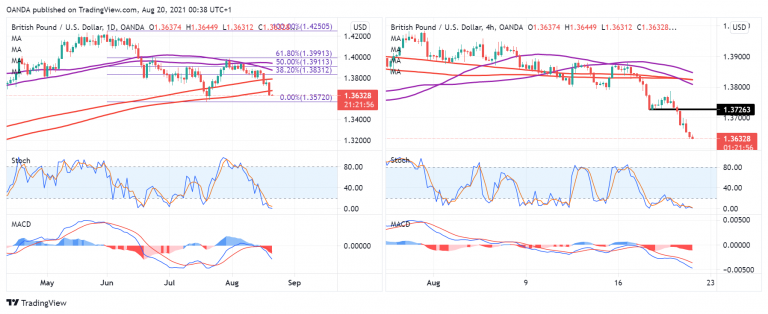
On Thursday, the pair broke below the 200/233-day SMA band, a major breakout that comes following a bearish rotation off a 61.8 fib level.
It’s not looking good for cable, with the next test of support being the July low at 1.3572. While this move is more reflective of the resurgence in the greenback than weakness in the pound, a move below this level would be very bearish , indeed.
The question is whether it will have the momentum to keep up the recent move. Any rebound could see a test of resistance around 1.3726.
Oil’s Losing Streak, Gold Hangs On
Oil extends slide
Oil prices are plunging closer to bear market territory on fears global crude demand forecasts for the remainder of the year will see drastic reductions. Visions of the US economy being fully reopened and with kids attending school in person might have several disruptions. Too many vaccinated individuals are coming down with COVID and while hospitalizations seem unlikely, a complete return to work for the majority of the population seems less likely as many families have unvaccinated children.
A strong dollar is also weighing on crude prices but that might not last much longer given how strong Treasuries are advancing. Wall Street is interpreting the Fed's minutes as a pivot towards hawkishness, but that was already priced in and the dollar will likely see limited upside from here.
WTI crude's six-day losing streak seems a bit overdone but for it to stop, it might need a sign from OPEC+ that they might hold off on plans to ramp up output. The oil market is still in deficit and a breach below the USD 60 level will likely attract many long-term bullish bets. The bottom could be nearing here for crude, but energy traders will need to see some positive headlines regarding global economic growth.
Gold
Gold prices are holding up nicely given the broad risk-off tone that is hitting all commodities. If financial markets deteriorate even further, it will be interesting to see if gold can continue remaining attractive.
Gold is attracting some safe-haven flows as investors turn bearish with stocks, the delta variant continues to impact high-frequency data, and global bond yields remain heavy. The American Association of Individual Investors (AAII) weekly survey showed bulls fell to 33.2% and bears rose to 35.1%. The theme with Treasury auctions shows demand remains strong and the Treasury curve will struggle to steepen. Today's 30-year TIPS auction was awarded at a record low yield of -0.292%.
Gold might struggle to break above the USD 1800 level in the short-term, but everything seems to be lining up perfectly for the medium and longer-term bullish outlooks.
USD/JPY Approaches Key Breakout, 110.00 Presents Resistance
Key Highlights
- USD/JPY remained well bid above the 109.35 support zone.
- A key contracting triangle is forming with resistance near 109.95 on the 4-hours chart.
- EUR/USD extended its decline below the 1.1700 support zone.
- GBP/USD settled below 1.3800 and declined below the 1.3720 support.
USD/JPY Technical Analysis
The US Dollar declined sharply from 110.80 against the Japanese Yen. USD/JPY remained stable above 109.00 and it is now attempting a fresh upside break.
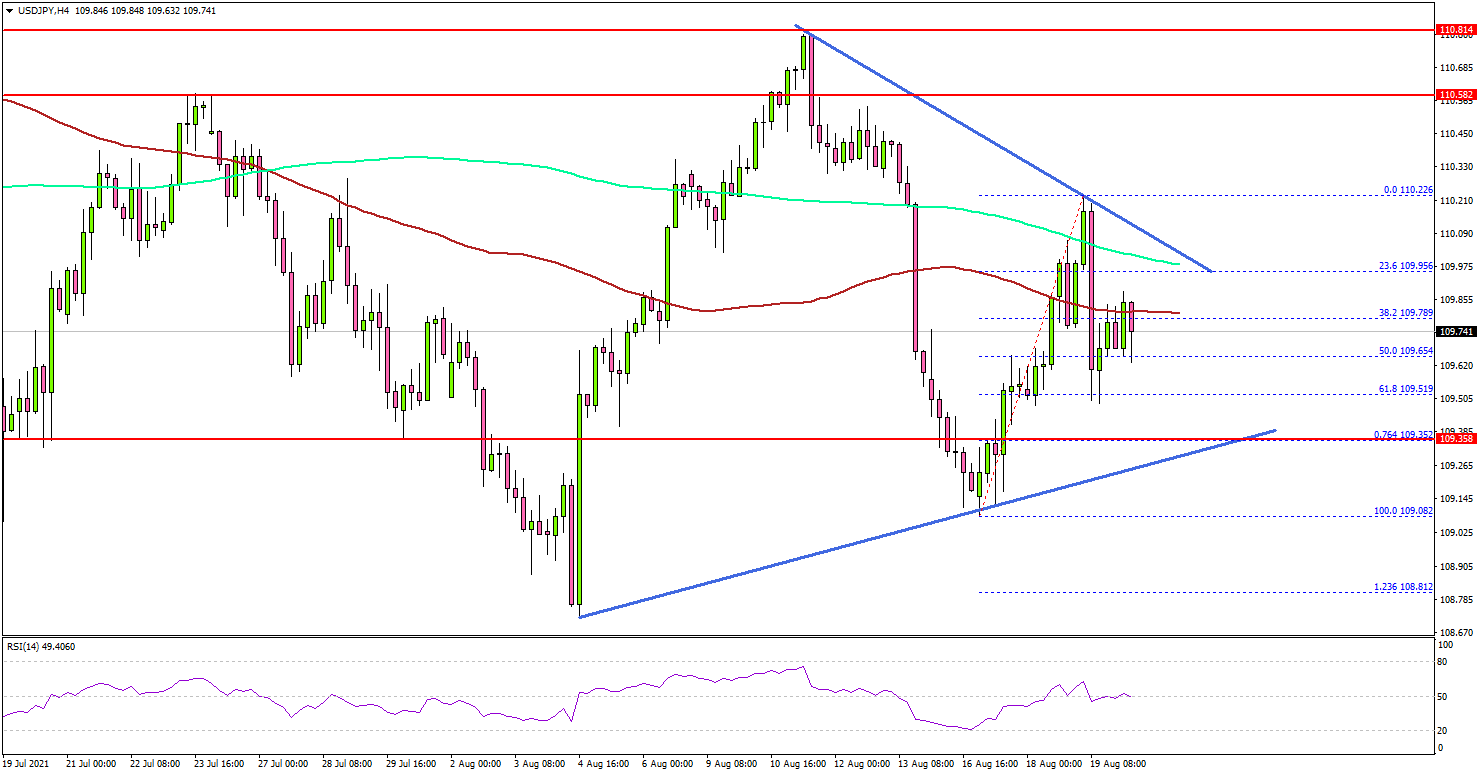
Looking at the 4-hours chart, there was a decent increase above the 109.50 level, the 100 simple moving average (red, 4-hours), and the 200 simple moving average (green, 4-hours). However, the pair failed to clear the 110.20 resistance.
There is also a key contracting triangle forming with resistance near 109.95. If there is an upside break above the triangle resistance, the pair could rise steadily above the 110.00 zone.
The next major resistance is near 110.20, above which the pair could revisit the 110.80 resistance zone. Any more gains may possibly lead the pair towards 111.50.
On the downside, the pair is likely to remain stable above 109.35. A downside break below 109.35 could spark a sharp decline. The next major support is near the 108.80 level.
Looking at EUR/USD, the pair traded below the 1.1700 support and it even tested 1.1665. Similarly, GBP/USD extended losses below the 1.3700 level.
Economic Releases
- UK Retail Sales for July 2021 (YoY) - Forecast +6%, versus +9.7% previous.
- UK Retail Sales for July 2021 (MoM) - Forecast +0.4%, versus +0.5% previous.
- Canadian Retail Sales for July 2021 (MoM) – Forecast +4.4%, versus -2.1% previous.
- Canadian Retail Sales ex Autos for July 2021 (MoM) – Forecast +4.6%, versus -2% previous.
Market Morning Briefing: Dollar Index Has Broken Sharply Above 93.30
STOCKS
Equities trade lower globally and may continue to remain in a downtrend for the near term. Dow and Dax could head towards 34750-34500 and 15400 respectively while Nikkei and Shanghai can test 27000-26000 and 3400-3350 respectively. Nifty and Sensex too could trade weaker in the near term and fall towards 16400/350 and 54500-54000 respectively.
Dow (34894.12, -66.57, -0.19%) has fallen sharply and could be headed towards 34750-34500 which is a near term support zone from where a bounce could be possible. The corrective dip is likely to be short lived.
DAX (15765.81, -200.16, -1.25%) has broken below our expected support at 15800. While below 15800, Dax is vulnerable to a fall to 15400 in the near term before pausing.
Nikkei (27096.65, -184.52, -0.68%) has also broken below support at 27250, contrary to our bullish expectations of rising above 28000. While below 28000, Nikkei can fall to 27000 or even 26000 before bouncing back from there. Near tern view is bearish.
Shanghai (3415.28, -50.27, -1.45%) needs to hold above 3400 and bounce back else can fall to 3350 before any reversal is seen. Watch price action near 3400.
Nifty (16568.85, -45.75, -0.28%) declined in the previous session and looks bearish for the near term towards 16400/350 initially on a break below 16500.
Sensex (55629.49, -162.78, -0.29%) can test 54500-54000 before rising from there. Failure to hold above the mentioned support zone will make it vulnerable to a sharp fall that could continue for the coming weeks. Watch price action near 54500-54000.
COMMODITIES
Crude prices fell sharply yesterday but have recovered a bit. Trend still points to the downside and we may expect a fall in Brent towards 65-60 and WTI towards 60-58 before reversing from there. Gold and Silver can consolidate between 1740/60- 1800 and 23-24 respectively. Copper has also started recovering after falling to 4.00 yesterday. The view is bullish to see a test of 4.20 and 4.30 while above 4.
Brent (66.66) and WTI (63.79) has fallen sharply in line with our expectations. While the momentum looks strong on the downside we may expect Brent to fall further towards 65-60 while WTI can test 60-58 soon before a bounce is seen. The fall is seen as Covid cases surges globally adding to Crude Weekly Inventory data released by EIA yesterday that stated a drop in inventory levels by 3.2mln barrels for week ended 13th Aug, 2021. This exceeded analysts’ projection of seeing a drop by 1.1mln barrels.
Gold (1784.50) came down to test 1774.6 yesterday but has managed to bounce back. A consolidation between 1740/60-1800/10 looks possible for some time before we see an eventual break on either side. The uptrend is intact while above 1740-1760.
Silver (23.21) tested 23.08 before rising and while 23 holds as immediate support, Silver can bounce back towards 24 slowly. Trade within 23-24 is possible for now. A break below 23, if seen in the near term would make it vulnerable to a sharp fall towards 22. Watch price action near 23.
Copper (4.0720) fell sharply as expected and could fall to test 3.80 on a break below 4. On the contrary if 4 sustains to hold, we may expect a bounce back towards 4.20-4.30 soon. Watch price action near 4 for now.
FOREX
Dollar Index has surged well and could be headed towards 94.0-94.50, dragging Euro down to levels below 1.17. Euro could now target 1.16 in the coming days. Aussie, Pound and EURJPY look strongly bearish for the near term. USDCNY has surged beyond 6.50 and can test 6.52 on the upside. We may expect a gap up opening for Dollar-Rupee today expecting a rise towards 74.40/50 which if breaks can open up chances of testing 74.80
Dollar Index (93.56) has broken sharply above 93.30 and looks bullish for a rise to 94.0-94.50 in the near term before any reversal is seen from there. Immediate view is bullish.
Euro (1.1679) has broken below 1.17 finally and looks strongly bearish towards 1.16 in the coming sessions.
EURJPY (128.19) is nearing immediate support at 128 which if fails to hold can drag the cross lower towards 126.50 in the medium term. Watch price action near 128 in the next few sessions.
Dollar-Yen (109.71) seems to be highly fluctuating within 110.50 and 109 levels. It is important for the pair to break on either side and give some directional clarity for the medium term else we may expect sideways movement above 109 to hold.
Aussie (0.7140) has fallen sharply breaking below 0.7250 and while the fall continues, we may expect a further dip to 0.70 before bouncing from there eventually.
Pound (1.3622) fell sharply and a break below 1.3565, if seen will drag Pound lower towards 1.35-1.30 in the medium term.
USDCNY (6.5027) has risen sharply breaking above 6.49/50 that we had been expecting. Sustained trade above 6.50 can take the pair higher towards 6.52 in the near term before a dip is seen. Immediate view is bullish for USDCNY.
USDINR (74.2450) did attempt to fall towards 74.20 in the last session but may rise back towards 74.40/50 or even 74.80 as both Chinese Yuan and Euro trades weak against the Dollar.
INTEREST RATES
The US Treasury yields have dipped further and keep intact our view of testing their key intermediate supports in the near-term. It is important to see if the yields are bouncing back thereafter or not. The German yields are breaking below their key supports which we had expected to hold. The broader downtrend can continue and a further fall is possible from here. The chances of seeing a corrective rally stands reduced as of now. The 5Yr GoI has tested 5.66% as expected and has room to fall further in the near-term.
The US 2Yr (0.22%) and 5Yr (0.77%) Treasury yields remain lower and stable while the 10Yr (1.24%) and the 30Yr (1.86%) have declined further. The 30Yr has dipped below 1.90% and can now test 1.85%-1.8%. The 10Yr on the other hand can test 1.18% in line with our expectation. The price action at 1.8% (30Yr) and 1.18% (10Yr) will be crucial to see if the yields are managing to bounce-back from there or not.
The German 2Yr (-0.76%), 5Yr (-0.75%), 10Yr (-0.49%) and 30Yr (-0.06%) yields have dipped further. The 10Yr is just above its crucial support level of -0.5% while the 30Yr has broken below -0.05%. The expected corrective bounce seems to be not happening now. A further fall from here can drag the yields lower to -0.6% (10Yr) and -0.2% (30Yr) straight away from here itself without seeing a corrective rally.
The 5Yr GOI (5.6577%) fell to test 5.66% as expected and indeed has closed below it. The bearish view remains intact and a further fall to 5.64%-5.62% can be seen in the near-term and then a bounce-back is possible.
AUD/USD to draw strong support from 0.7 on next fall
Australian Dollar remains broadly pressured today. New South Wales reported another 644 new coronavirus infections and 4 deaths. Greater Sydney's lockdown will be extended until the end of September. That is, the lockdown, which has already lasted for 8 weeks, will run for at least 13 weeks. Also, a curfew will be introduced for 12 local government areas of Sydney, as people there must stay stop between 9pm and 5am.
While more downside is still in favor in AUD/USD for the immediate future, we'd start to looking for bottoming sign on next move. Oversold condition in daily MACD could start to slow the decline. 161.8% projection of 0.8006 to 0.7530 from 0.7890 at 0.7120 will be met. Additionally, AUD/USD should then enter a strong support zone around 0.7 psychological level, 0.6991 support, and 38.2% retracement of 0.5506 to 0.8006 at 0.7051. Let's see if AUD/USD would at least turn into sideway trading.
UK Gfk consumer confidence dropped to -8, GBP/CHF breaks near term support
UK Gfk consumer confidence dropped slightly from -7 to -8 in August, below expectation of -6. "Against a backdrop of cooling headline inflation and soaring house prices, the U.K. consumer confidence index is stable at minus 8 this August," Joe Staton, GfK's client strategy director, said.
"Expectations for our personal financial situation for the coming 12 months are holding up and this positivity bodes well for the economy going forward this year and next," Staton said. The index measuring changes in personal finances over the past 12 months is up one point at 0.
Sterling is the weakest European major for the week, and is trading just better than commodity currencies. GBP/CHF drops through 1.2498 support to resume the choppy fall from 1.3070. Deeper decline is now expected as long as 1.2640 resistance holds. Such decline is seen as a correction to up trend from 1.1107. Next target is 38.2% retracement of 1.1107 to 1.3070 at 1.2320. Nevertheless, we'd look for strong support 1.2259 resistance turned support to bring rebound, at least on first attempt.
Cliff Notes: A Week of Uncertainty
Key insights from the week that was.
‘Risk off’ has been the defining characteristic of this week thanks to COVID-19, economic data and geopolitical concerns.
Beginning with COVID-19, this week yet another significant rise in daily new cases in Australia and an outbreak in New Zealand hit expectations hard, the Australian and New Zealand dollars falling around 2 cents against the US dollar.
For New Zealand, it was a particularly abrupt turn of events, with the new cases of COVID-19 and the re-introduction of Level 4 restrictions coming just a day before the RBNZ was expected to raise their cash rate for the first time in this cycle. Instead, the RBNZ held fire.
Our New Zealand economics team continue to believe that rate hikes will be forthcoming given the strength of domestic demand and capacity constraints related to closed borders. However, the virus’ near-term economic effect means the rate hike cycle is unlikely to begin until November. While it pre-dates this week’s developments by a day, the release of Westpac NZ economics’ August Economic Overview provides a timely in-depth update on New Zealand’s economy.
Back in Australia, August’s RBA meeting minutes again highlighted the confidence the RBA have in recovery post lockdown. As per their other recent communications, given monetary policy changes affect the future, and as this jolt to the economy is seen as temporary, at the time of the August meeting, the Board believed there was no reason to deviate from their planned taper process.
Instead of a loss of circa 1.0% as forecast by the RBA in their Statement on Monetary Policy, we are forecasting a 2.6% contraction in the September quarter. However, like the RBA, and as discussed by Chief Economist Bill Evans and the team in our latest Market Outlook in conversation podcast, we also continue to expect a strong rebound into 2022.
Labour market data received this week highlighted the underlying strength of Australia’s economy. In the month of July, 2k jobs were created – a materially better outcome than the market consensus of 43k job losses. Clearly, as the NSW lockdown took effect, instead of firing their staff, affected businesses (temporarily) reduced hours, with NSW hours worked down 7.0% in the month. The other key lockdown labour market dynamic to call out is for participation: in short, the lack of available work and family responsibilities saw participation fall 0.2ppts and the unemployment rate consequently decline 0.3ppts to 4.6%.
While we see large declines in employment in August through October, the robust underlying health of the labour market coming into this prolonged disruption supports the idea that the recovery from employment’s nadir will be quick.
The outlook for wages growth seems more uncertain however after the June quarter Wage Price Index (WPI) printed well below expectations at just 0.4%, 1.7%yr. Wage pressures were only evident in isolated instances across the economy despite the relatively low level of unemployment and closed borders, with private wages gaining just 0.5%, 1.9%yr overall. Wage growth in the public sector meanwhile remained weak, rising 0.4% for a third consecutive quarter, 1.3%yr.
Moving then to China. While there have been a lot of headlines regarding the risk of a large Delta outbreak there, evidence to hand suggests the situation remains under control, with only around 100 new cases being reported each day. The downside surprise to retail sales in July however implies the restrictions necessary to limit Delta’s spread were still having a significant effect on growth as the September quarter began. If restrictions and related uncertainty persists, as discussed in Market Outlook in conversation, China growth will have to be marked materially lower, likely down to the low 8% range from 9.25% at the time of our August Market Outlook.
Also investigated in our latest podcast, while the US economy and dollar is presently being given the benefit of the doubt with respect to Delta’s spread, readers should recognise the US is not immune to this latest wave of COVID-19. To the contrary, new cases are currently around half the peak level of December/January, on a proportional level of testing, and hospitalisations are rising rapidly.
While the minutes of the July FOMC meeting provided a constructive view of the economic outlook and continued to point to a taper announcement from the FOMC in September, also apparent was a desire to recognise risks and adapt policy. Since then, the US and global Delta outbreaks have intensified, and some indicators of sentiment and consumer spending have wavered. The effect of this current outbreak on US consumer sentiment and spending will be critical for the outlook for both monetary policy and the US dollar, particularly as fiscal support is rapidly coming to an end. Next Friday will provide a pivotal update on the outlook for the economy and policy, with FOMC Chair Powell to speak at the Jackson Hole Symposium.
Eco Data 8/20/21
[php_everywhere instance="1"]