Sample Category Title
Weekly Economic & Financial Commentary: Some Relief on Inflation, but It’s Still Hot Out There
Summary
United States: Some Relief on Inflation, but It's Still Hot Out There
- The CPI data this week showed that the sharpest monthly consumer price hikes may be behind us, but inflation is not about to quietly fade away. Ongoing supply constraints for products and labor, rising costs and renewed risks around COVID weighed on small business optimism in July and our own outlook for growth, as we describe in our latest Monthly Outlook.
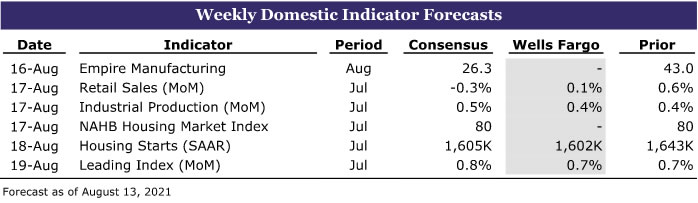
- Next week: Retail Sales (Tuesday), Industrial Production (Tuesday), Housing Starts (Wednesday)
International: Solid Showing From the U.K. Economy
- The U.K. economy rebounded in Q2 from an early 2021 stumble, as GDP jumped 4.8% quarter-over-quarter, with strong gains in consumer spending and government spending. A sizable gain in June GDP also indicated the quarter ended on a firm note. While July retail sales are expected to rise only moderately, we still expect a decent-sized gain in U.K. GDP in Q3.
- Next week: Japan GDP (Monday), China Retail Sales & Industrial Output (Monday), U.K. Retail Sales (Friday)
Credit Market Insights: Credit Cards Along for the Spending Ride
- Consumer credit outstanding grew by $37.7 billion during June, the largest increase on record according to data released by the Federal Reserve last week. While this is a significant jump, it is important to keep in mind that these increases are coming off of a relatively low base.
Topic of the Week: IMF Announces Significant New Allocation of SDRs
- The International Monetary Fund recently announced a significant new allocation of special drawing rights that is valued at $650 billion. Will the allocation have major consequence for the global economy?
U.S. Review
Some Relief on Inflation, but It's Still Hot Out There
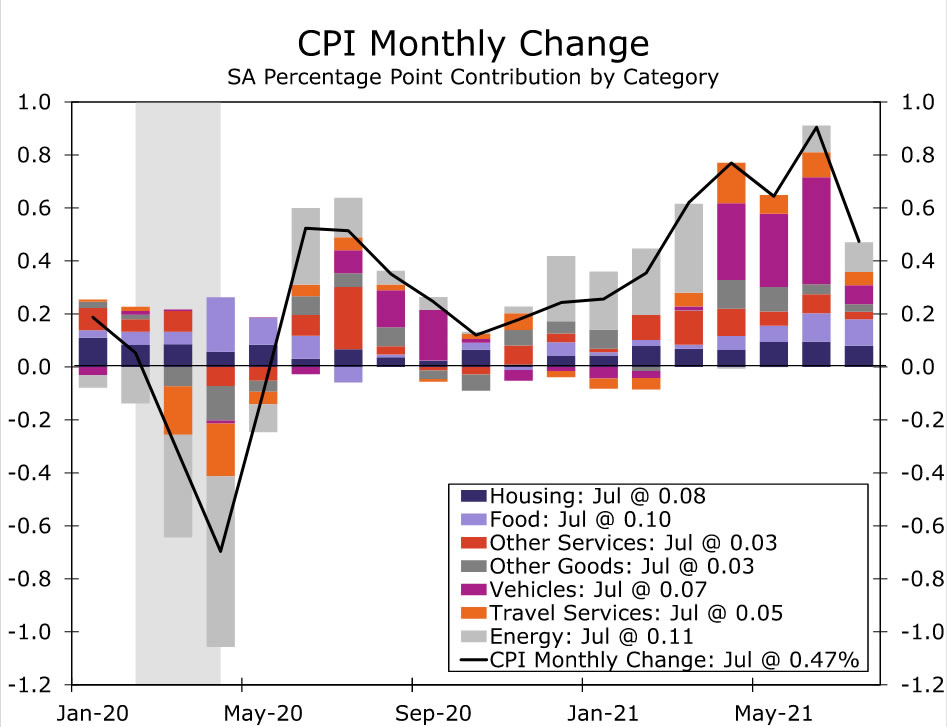
Fed officials likely breathed a sigh of relief when the July Consumer Price Index was released earlier this week. The 0.5% increase ended the four-month streak of upside surprises and showed price hikes easing from their startling pace over the past few months. Relief came on the used car front as well as in travel categories like car rentals and airfare, lending credence to the notion that the recent degree of inflation is unlikely to persist as supply constraints ease and demand cools from the frenzied pace of this spring's reopening and stimulus spending.
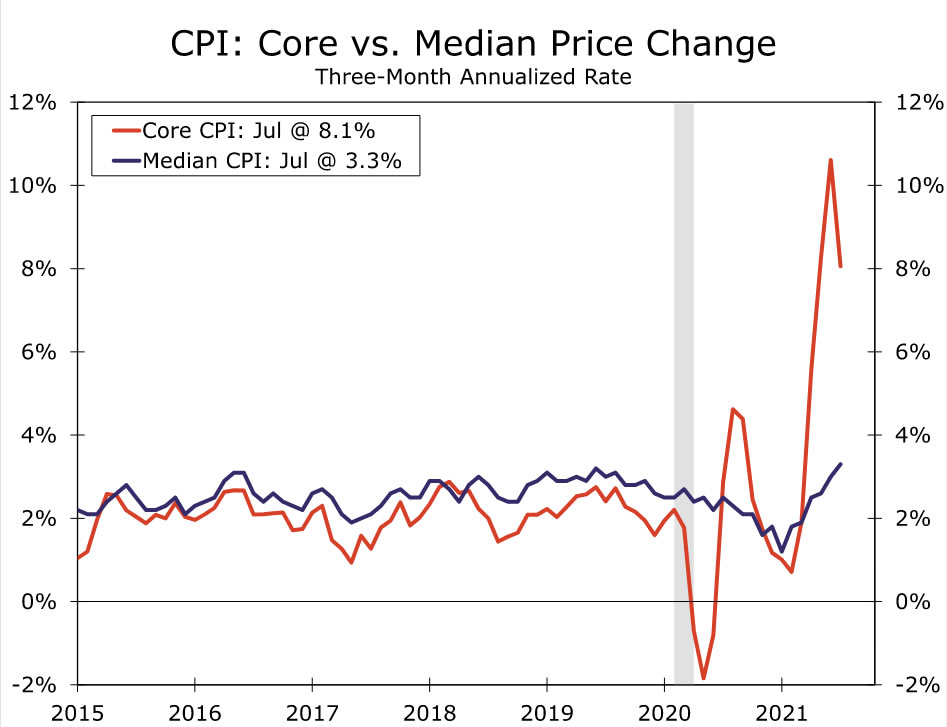
That said, inflation is not fading away entirely. While the direction of change was welcome, inflation continues to run at a strong pace. Even with used car prices leveling off, core inflation rose 0.3%. The Cleveland Fed's Median CPI has advanced at a 3.3% pace the past three months—less extreme than the traditional core, which captures the outsized gains in a few small categories, but the fastest clip since 2008.
U.S. producers also reported strong price increases in July. The Producer Price Index for final demand rose 1.0% and is now up 7.8% from a year ago. Although there were some signs of easing further back in the pipeline, input costs continue to rise at an eye-catching pace for both goods and services, such as transportation. For example, services for intermediate demand are up 9.2% over the past year, nearly triple the high-water mark of last cycle, while processed goods prices are up 23% from a year ago.
Input costs pressures also extend to labor. The oddly tight labor market was on full display with job openings reaching a fresh record for June at 10.1 milllion. For every job opening, there was only 0.9 unemployed workers, a ratio similar to when the unemployment rate was at 4.0% in early 2018 versus 5.9% in June of this year. The rate at which workers are voluntarily leaving their job rose to 2.7%, well above prior cycle highs. This is a sign that workers have growing opportunities and are using this time to improve their job situation.
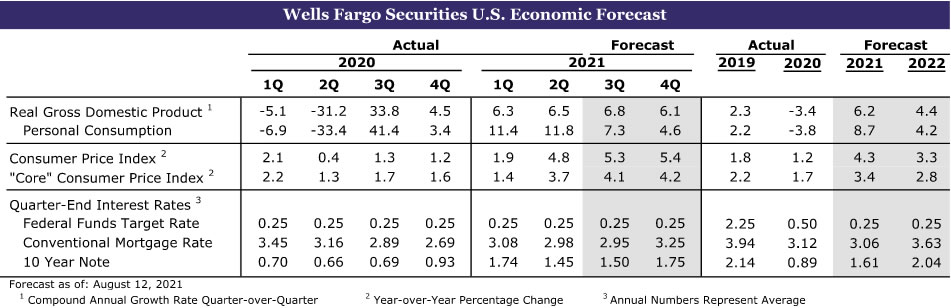
The pace of job switching has led firms to offer more flexibility, training and time off, but also pay. With a record 49% of small businesses reporting at least one job as hard to fill, the NFIB's latest small business survey shows that plans to raise compensation remain elevated in July. But the ongoing struggles to find workers, secure product to sell and contend with rising costs seemed to take a toll on optimism in July. The survey's headline index fell more than anticipated, with the largest drops in expectations for sales, earnings trends and the economy more broadly. The latest wave of COVID cases, the high inflation environment and ongoing supply constraints have similarly led us to pare down our expectations for growth over the coming months. As we discuss in more detail in our August Monthly Outlook, we now look for growth in the third quarter to increase "only" 6.8%.
U.S. Outlook
 Retail Sales • Tuesday
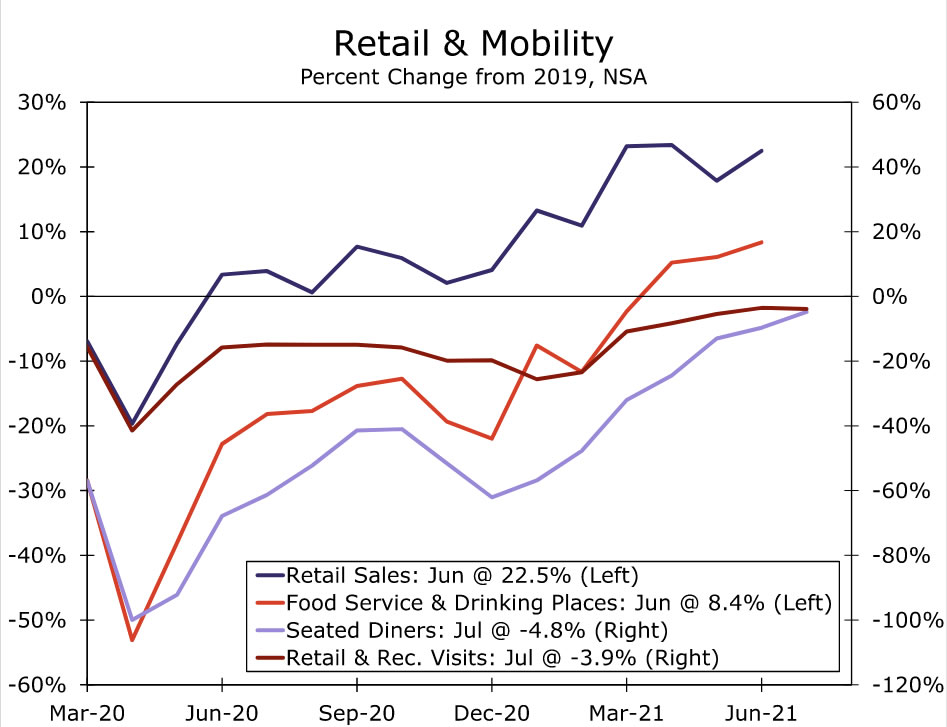
Retail sales were generally expected to slow this summer after their rapid recovery, as consumers shifted more spending toward services and experiences and away from goods. Data for June pushed back at this, as sales rose 0.6%, beating expectations for a 0.3% decline. Rather than a turn back toward stay-at-home habits, the details of the report showed that people were getting back out, with sales at clothing stores, gas stations, restaurants and bars all contributing to the top-line beat.
Looking ahead to July, we suspect sales growth slowed to around 0.1%. The spread of the Delta variant has tempered hopes for a further reopening of the economy. We did not see a reversal in visits to retail and recreation locations or seated diners at restaurants as we had seen in prior waves, but there was a stall in the return to normal in July. While retail sales have done well in the face of prior COVID waves, it seems unlikely that consumers will feel compelled to splurge on additional durable goods and appliances as they did last year. Durable goods by definition are meant to last, so the second appliance or recreational good may not be as helpful as the first. In addition, the run-up in goods prices over the past few months could lead to some sticker shock, making people more hesitant to spend. Over the next two months, however, the impact of the advance tax credit payments that went out in the middle of July as well as some much needed back-to-school shopping could offset some of these headwinds.
Industrial Production • Tuesday
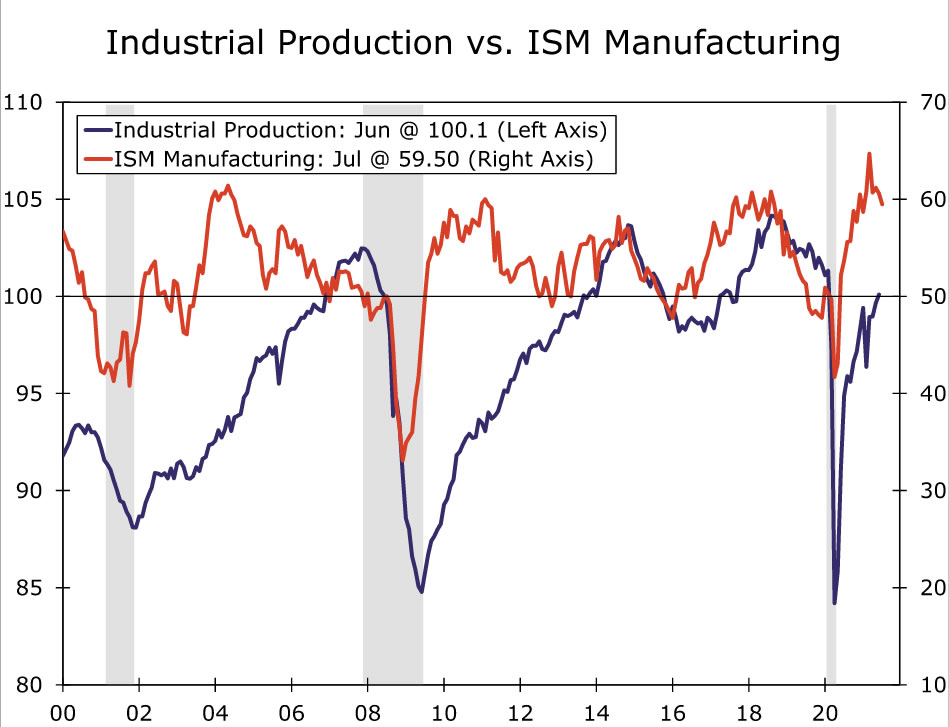
Industrial production increased 0.4% in June as gains in mining and utilities production helped offset a slight decline in manufacturing output. The slip in manufacturing output was largely driven by a 6.6% drop in motor vehicle and parts production, excluding autos manufacturing output increased 0.4%. Activity at the nation's auto plants has been incredibly choppy in 2021, with output up one month and down the next. The back and forth is primarily a result of continued supply shortages. Demand for cars, while cooling, remains strong as evidenced by the run-up in prices over the past few months.
More broadly, fluctuations in production have been driven by supply constraints rather than any cooling in demand thus far. Looking ahead to July, the ISM manufacturing survey showed some tentative signs of supply and demand coming into balance. The supplier delivery index fell to a five-month low of 72.5, but that remains a far cry from "normal." Slower growth in new orders appears to be helping manufacturers catch up, with the index slipping 1.1 points, although backlogs remain elevated. That said, it is likely too early to call the end of the supply problems that have bedeviled producers, and we will likely continue to see some disruptions going forward. Overall, we look for a 0.4% increase in industrial production in July, as producers continue to make due with supplies on hand and businesses try to restock depleted inventories.
Housing Starts • Wednesday
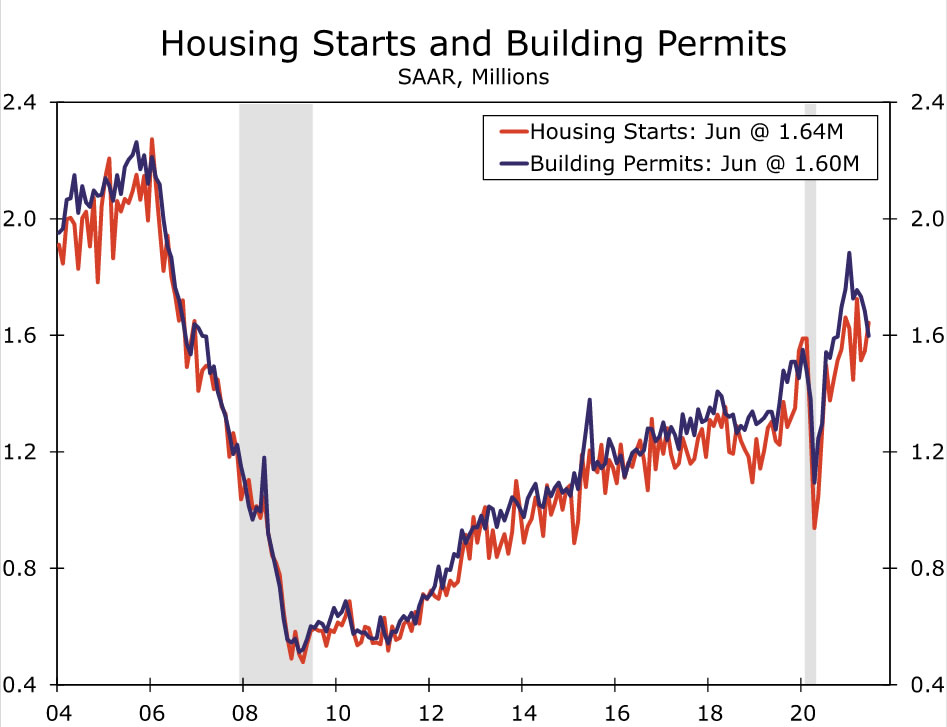
We expect housing starts cooled to a 1,602K annual rate in July, after beating expectations in June. June's increase brought housing starts more in line with building permits, which had been running well ahead of starts over the past year. While building permits normally lead housing starts, shortages of material and labor have led to a persistent rise in the number of homes authorized but not yet started. This backlog remains elevated, but the slowdown in permits over the past few months suggests the momentum in home building has started to fade.
Much like other sectors of the economy, this appears to be more of a supply problem than a demand problem. The lack of land, materials and labor has made it difficult for builders to ramp up production to meet the surge in demand over the past year. Going forward, we still expect home building to remain strong relative to its pre-pandemic trend, especially once supply constraints start to ease.
International Review
Solid Showing From the U.K. Economy
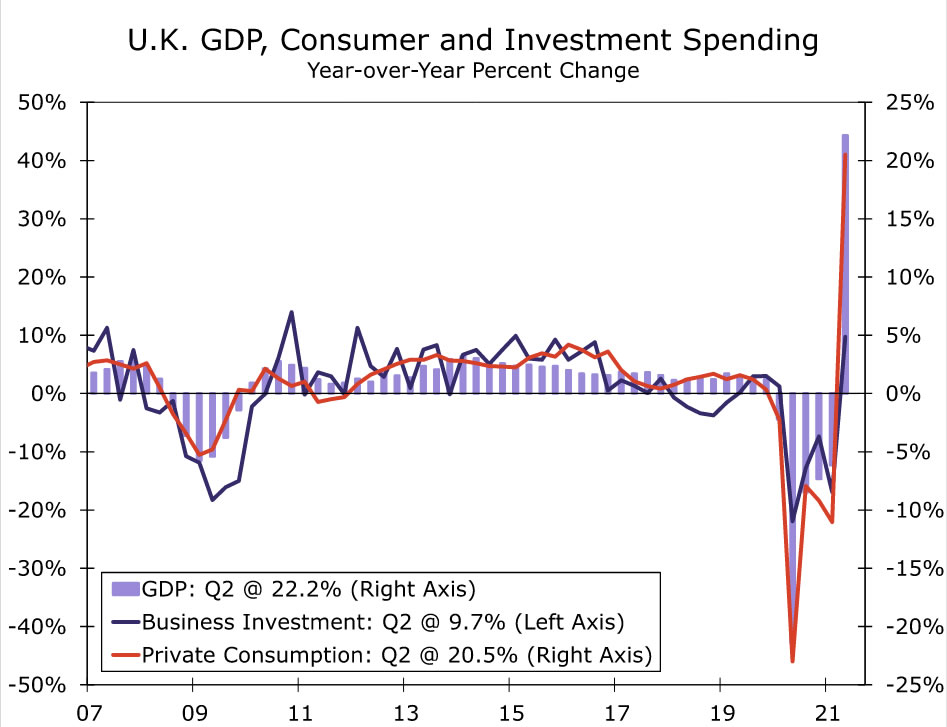
The U.K. economy put forth a sturdy performance in Q2, recovering from a COVID-related decline in activity during the first quarter of the year. Q2 GDP jumped 4.8% quarter-over-quarter, matching the consensus forecast, and by 22.2% year-over-year. In particular, private consumption and government spending were both strong, registering gains of 7.3% and 6.1% quarter-over-quarter, respectively. Q2 business investment was a slight disappointment, with a smaller gain of 2.4%.
Not only was Q2 solid as a whole, but the quarter also ended on a firm note, as June GDP rose 1.0% month-over-month, which was more than expected. Service sector activity was especially strong, with a gain of 1.5%, partly offset by a 0.7% fall in industrial output. GDP increased in June, even as the U.K. government delayed the final phase of its economic reopening from late June to late July. Looking ahead to the third quarter, while we do not expect the U.K. economy to repeat its Q2 increase, for Q3 GDP we forecast a more-than-respectable 2.5% quarter-over-quarter gain.
Inflation Concerns Persist in Latin America
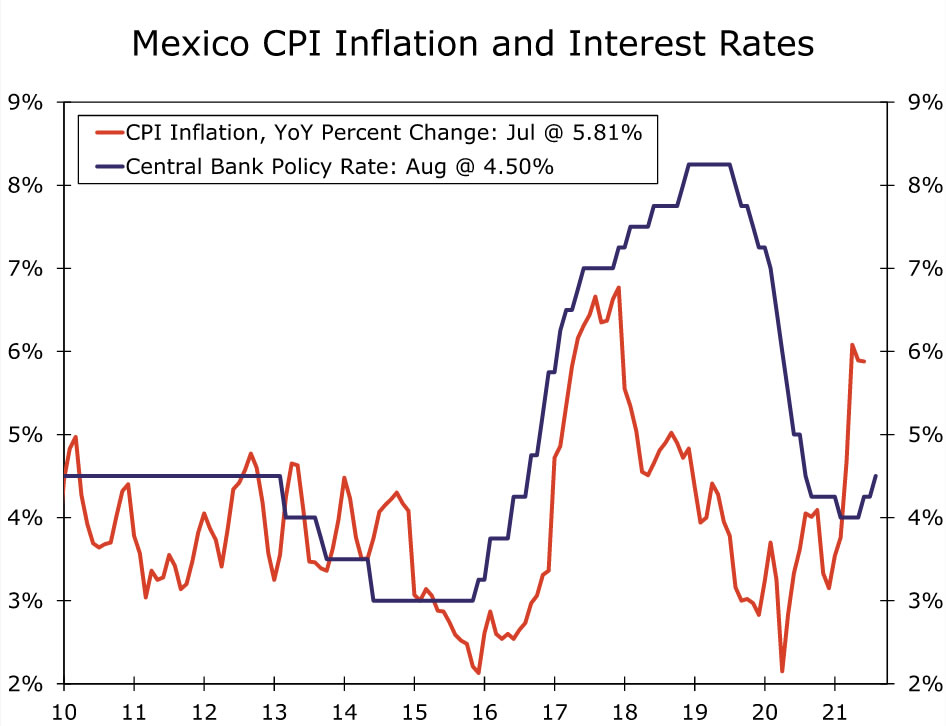
Another feature of this week's releases was the persistence of inflation pressures in Latin America. Brazil's July CPI quickened further to 8.99% year-over-year, the fastest pace of inflation since mid-2016. Housing and transportation costs were among the components contributing to the acceleration of inflation. With the CPI running more than double this year's CPI inflation target of 3.75%, we expect Brazil's central bank to add to the cumulative 325 bps of Selic rate increases so far this year at upcoming monetary policy meetings.
Mexico's July CPI inflation was also elevated, albeit easing slightly to 5.81% year-over-year, while the core CPI firmed slightly to 4.66%. Elevated inflation prompted Mexico's central bank to raise its overnight rate by 25 bps to 4.50% at this week's monetary policy meeting. The central bank said the balance of risks around the inflation outlook was to the upside, although in somewhat less hawkish comments also said that inflation shocks should be transitory and that future monetary policy decision would be data dependent. We also observe that it was through a split vote, rather than a unanimous decision, that monetary policymakers decided to raise interest rates by a quarter point at this meeting. While we expect that policy interest rates could move higher still, it's possible those rate hikes might not occur as quickly as expected by market participants.
International Outlook
Japan GDP • Monday
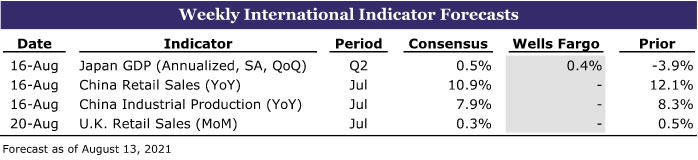
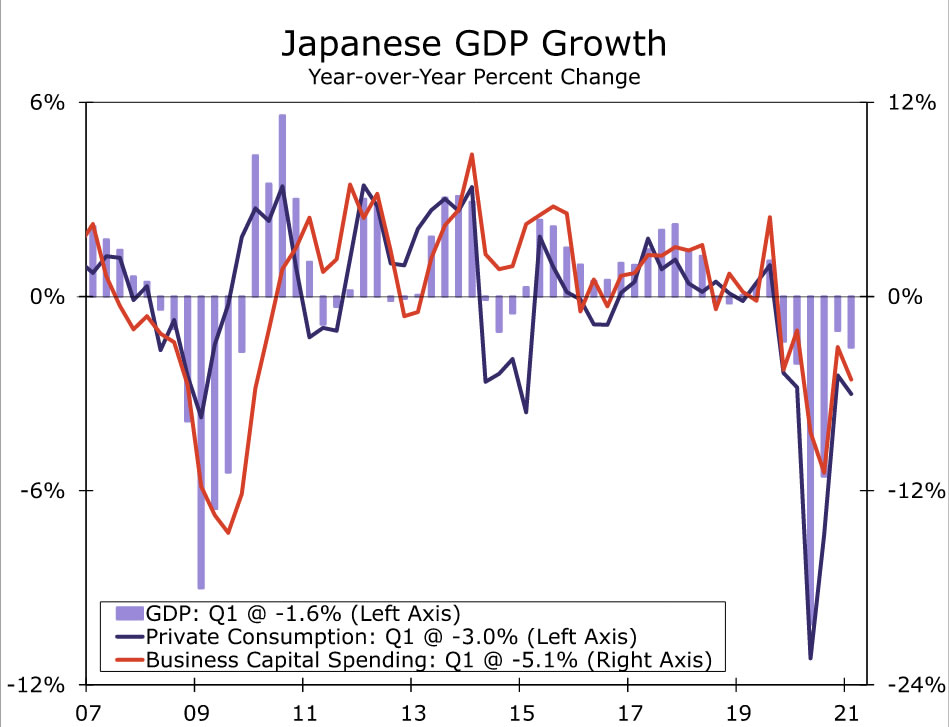
Japan's Q2 GDP figures to be released early next week are likely to portray an economy that continued to struggle during the first half of this year. Given relatively widespread COVID cases by Japanese standards through much of 2021 and associated restrictions, consumer demand has been muted. As a result, Q1 GDP fell 3.9% quarter-over-quarter annualized, while for Q2, we expect GDP to grow at a 0.4% pace, slightly below the consensus forecast for a 0.5% gain. Within the details, consumer spending is expected to be flat in Q2, following a large decline in consumer spending during the first quarter.
The GDP data is not the only release scheduled from Japan next week. The July CPI is due, with the consensus forecast for a 0.4% year-over-year decline. The June tertiary industry index—a measure of service sector output—is expected to rise 1.8% month-over-month after a 2.7% decline in May, which should indicate that Japan's economy finished the second quarter on a slightly better note.
China Retail Sales & Industrial Output • Monday
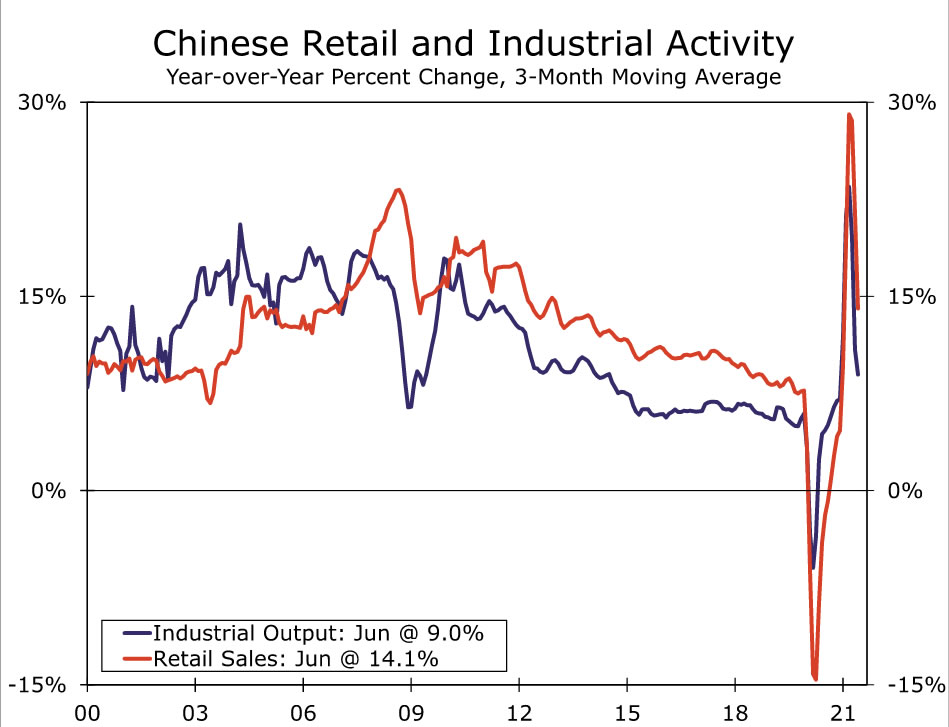
Over the past several weeks, China has seen some increased spread of COVID cases, prompting authorities in some regions to impose restrictions on movement and other activities. Partly due to base effects, Chinese economic growth—which had slowed in year-over-year terms in Q2—is widely expected to slow further during the third quarter.
Next week's Chinese data will offer a read on activity during early Q3. July retail sales are forecast to slow to 10.9% year-over-year, growth in July industrial output is expected to slow to 7.9%, and a slowdown in fixed asset investment growth is also anticipated. An "as expected" slowdown would likely not be especially worrying, but a precipitous slowdown might generate some concerns. For the record, we forecast a slowdown in China's Q3 GDP growth, to 0.7% quarter-over-quarter and 5.5% year-over-year.
U.K. Retail Sales • Friday
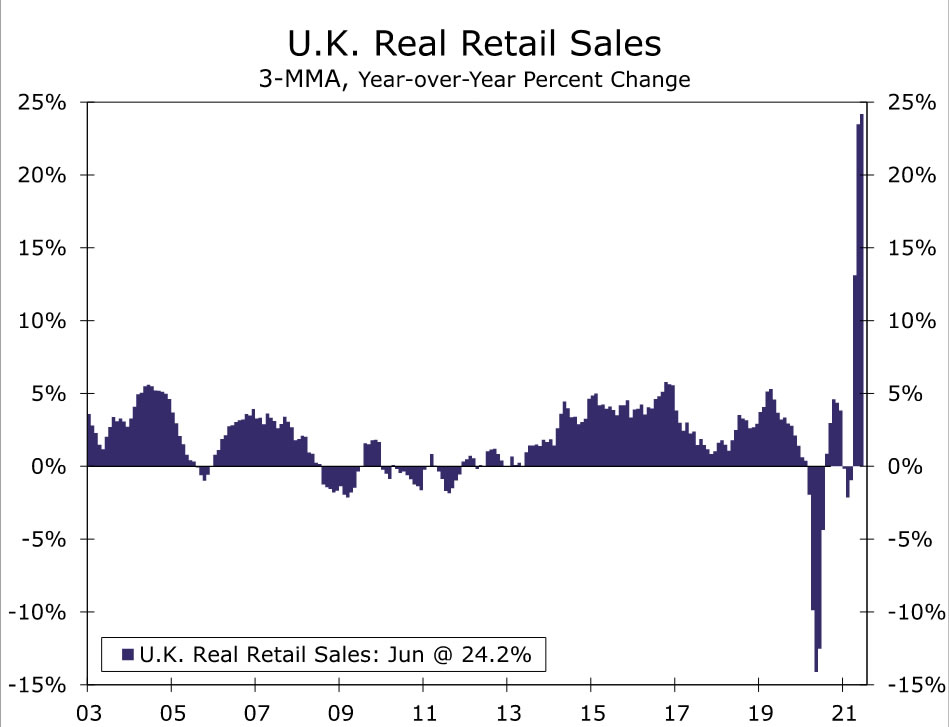
After a solid finish to the second quarter for the U.K. economy, the consumer will be in focus next week as some data for the early part of Q3 are released. July retail sales will be closely scrutinized for any insight on whether consumer activity is beginning to regain momentum. U.K. retail sales jumped sharply during the early spring, but given a renewed surge in COVID cases in recent months (a surge that has now receded), sales were relatively tepid in May and June. For July, the consensus forecast is for another moderate month of spending from the consumer, with a 0.3% month-over-month gain in retail sales anticipated.
The July Consumer Price Index will also be closely watched, with many surveys pointing to significant price pressures and the Bank of England recently forecasting CPI inflation to reach 4% year-over-year by the end of 2021. For July, however, the consensus forecast is for a relatively contained inflation reading, with the CPI expected to slow to 2.3% year-over-year and the core CPI expected to come in at 2.2%.
Credit Market Insights
Credit Cards Along for the Spending Ride
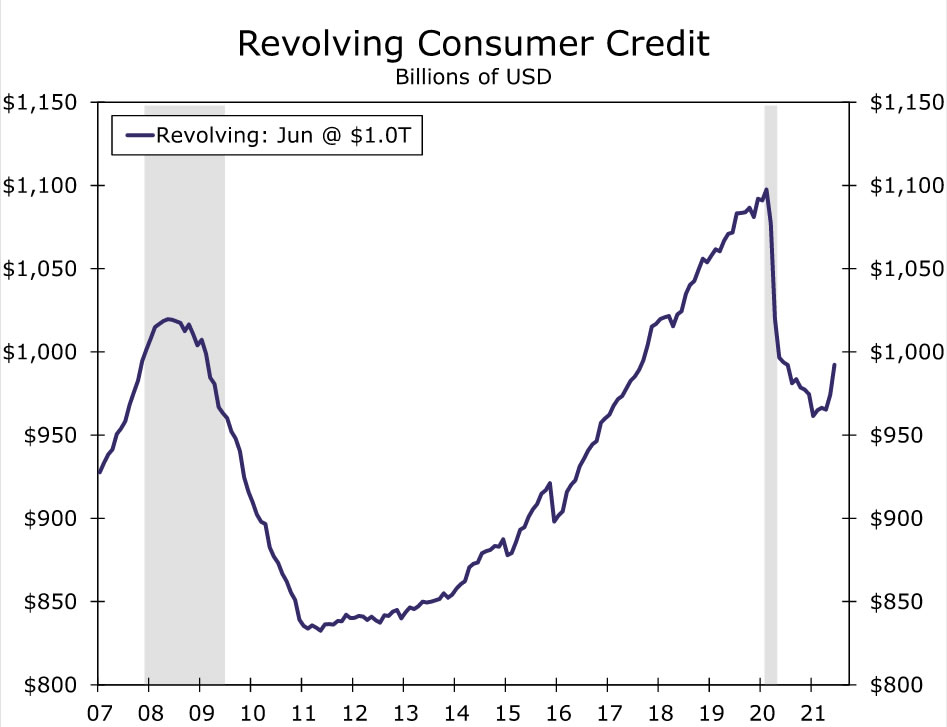
Consumer credit outstanding grew by an astounding $37.7 billion during June, the largest increase on record, according to data released by the Federal Reserve last week. While this is a significant jump, it is important to keep in mind that these increases are coming off of a relatively low base. Through the first half of this year, household debt as a share of disposable income was near its lowest levels in decades. Due to a host of factors, including a lack of consumer spending and increased transfer payments, consumers were able to start paying down some of their debt, particularly credit card debt. We expect consumer credit will rise over the coming months, alongside the continued growth in consumer spending.
Both revolving and nonrevolving credit saw impressive gains in June, rising at an annual rate of 22% and 7.2%, respectively. For revolving credit, which is largely comprised of credit card debt, this represents the largest increase in over two decades. Even after the increases of the past few months, revolving credit still remains nearly $100 billion below where it stood pre-pandemic. When the pandemic hit, consumers adjusted not only their levels of spending, but also the methods through which they spent, relying less on credit to finance their purchases. With increased transfer payments and fewer places to spend those funds over the past 18 months, many households began to pay down their debts and deleveraged their spending. For example, a U.S. Census report cited that 15.7% of stimulus recipients used their first check to pay down debts. As stimulus checks dwindle, unemployment benefits run out and spending levels continue to increase, we should see revolving credit normalize toward its pre-pandemic trend.
Nonrevolving credit also saw healthy increases over the past few months, rising at an annual rate of 8.3% during Q2-2021. Part of this increase came from new and used car prices, which rose 20.7% on a year-over-year basis in June. Subsequently, auto loans have risen 7.1% year-over-year during Q2, as consumers have taken out larger loans to finance increasingly-expensive car purchases. As supply shortages dwindle over the remainder of the year, we expect to see some of these credit pressures recede.
Similar to many other measures of the economy, consumer credit is experiencing large increases off of low bases brought about by the pandemic. With economic conditions beginning to normalize, tracking how or if consumers shift their pandemic-induced spending methods will be important in the coming months, particularly for revolving credit.
Topic of the Week
IMF Announces Significant New Allocation of SDRs
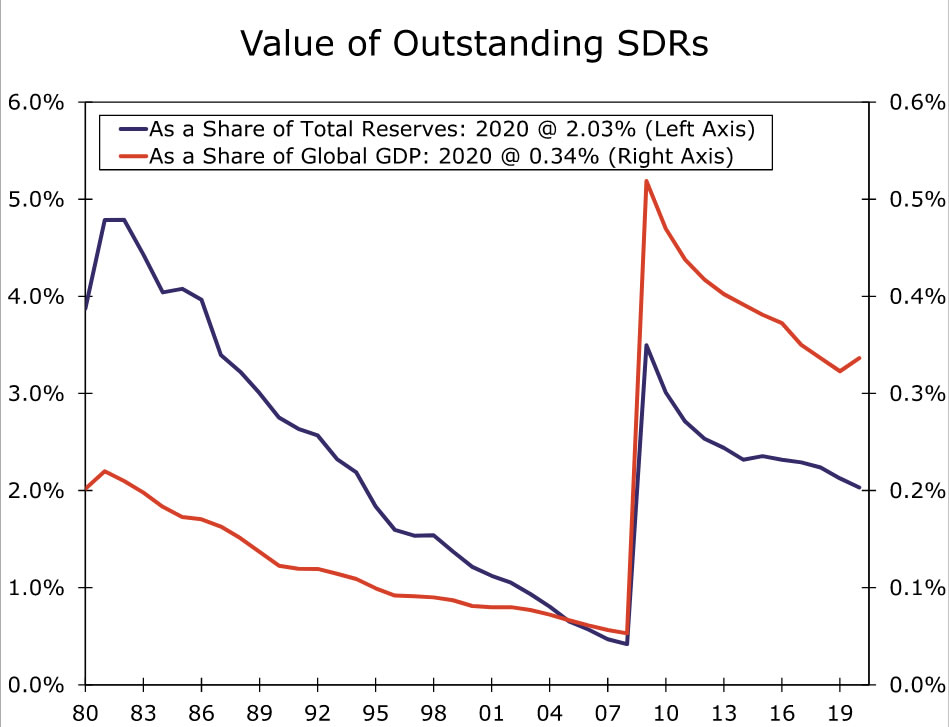
The International Monetary Fund (IMF) recently announced a significant new allocation of special drawing rights (SDR) that is valued at $650 billion. The new allocation will boost the total value of outstanding SDRs from nearly $300 billion to about $950 billion. The allocation will go into effect on August 23, and it is the largest increase in SDRs in the 77-year history of the IMF. That said, the last allocation of $250 billion that went into effect in August 2009, in the immediate aftermath of the global financial crisis, caused the stock of outstanding SDRs to skyrocket nearly ninefold. The new SDRs will be allocated to all 190 member countries of the IMF, according to the amount of capital that each country has contributed to the IMF. For example, the United States will receive roughly $100 billion of new SDRs, which will be a significant increase to its present holdings that are valued at nearly $53 billion.
The SDR was created by the IMF in the aftermath of the Second World War as a way to supplement international liquidity. It is a so-called "basket currency" that is composed of five important national currencies. At present, one SDR is composed of roughly 0.6 U.S. dollars, 0.4 euros, 12 Japanese yen, 0.09 British pounds and 1 Chinese yuan. The SDR is a component of the international reserves that countries hold, and member countries of the IMF can exchange their holdings of SDRs with other member countries for convertible currencies.
As shown in the chart, SDRs accounted for nearly 5% of all outstanding reserves in the 1980s, but that percentage has shrunk to only 2% over the past 40 years. The value of all outstanding SDRs at present is equivalent to only 0.3% or so of global GDP. The global economy has grown markedly over the past decade, yet the value of outstanding SDRs has remained essentially unchanged. Although a new allocation was more or less due, the strains that the pandemic has exerted on the global economy induced IMF policymakers to increase the outstanding stock of SDRs at this time. Once the allocation takes effect, the value of SDRs will represent about 6% of total reserves and be equivalent to approximately 1% of global GDP.
Will the new allocation have major consequence for the global economy? Probably not. The change in the stock of outstanding SDRs amounts to a scant 0.6% of global GDP. Because most countries will not "spend" their new SDRs, the allocation will have essentially no effect on global GDP growth or inflation. The SDRs will simply bolster countries' international reserve positions, which enhance their ability to combat future financial shocks.
Source: International Monetary Fund and Wells Fargo Securities
That said, the IMF notes that wealthier countries can voluntarily "channel" some of their SDRs to poorer countries that will allow the latter to scale up their borrowing from the IMF's Poverty Reduction and Growth Trust. Such borrowing is currently interest free. In short, the new allocation could potentially help to boost economic growth and reduce poverty, at least at the margin, in some developing economies.
The Weekly Bottom Line: Transitory Price Factors Ease
U.S. Highlights
- U.S. equity market continued to rise this week, while the 10-year Treasury yields took the consumer price index (CPI) inflation reading in stride, closing relatively flat on the week.
- The CPI report showed signs of moderation in categories that accounted for the much of the recent spike in inflation, while June’s JOLTS report pointed to a tight labor supply across most sectors of the economy.
- The recent upswing of the Delta variant is a threat, but there is good reason to believe that temporary price factors will continue to moderate while labor market steps on a firmer footing.
Canadian Highlights
- It’s shaping up to be a hot summer for the Canadian economy. Consumer demand has picked up and employers have responded by adding 325k net new workers in June and July.
- Job postings are soaring, but the question is whether labour supply rises to meet it. High labour market engagement and the impressive take up of vaccines suggest less acute labour shortages in Canada compared to the U.S.
- Looking ahead to the fall, concerns are rising due to the delta variant. Countries with solid vaccination rates have seen cases and hospitalizations rise, and Canada may not be immune. It could be a challenging fall season for Canadians.
U.S. - Transitory Price Factors Ease
Markets reaction to last week’s strong jobs print spilled over to this week. At the time of writing, U.S. equity market rose by 0.6% and 10-year Treasuries yields stabilized around the 1.30% mark (down from 1.36% on Thursday but flat from 1.30% a week ago). The Treasury market took Wednesday’s inflation reading in stride. Indeed, July’s CPI calls to mind that gourmet dish where one flavor is followed by another, stimulating the palate. On a year-over-year basis, prices paid by U.S. consumers increased by 5.4%, remaining at a 13 year high for the second month in a row. This makes a great headline, but the underlying factors have a far more nuanced flavor.
Compared to the previous monthly increase of 0.9%, in July consumer saw a more modest price growth of 0.5%. Excluding food and energy, CPI increased by 0.3% month-on-month – a rate of change last seen in March of this year. On this basis, the report provided hopeful signs of moderation in categories that accounted for the recent spike in inflation. Unlike in the last three months, used cars and tracks hardly contributed to price growth in July. Airfares went in the opposite direction – falling in the month and helping to compress prices of transportation services.
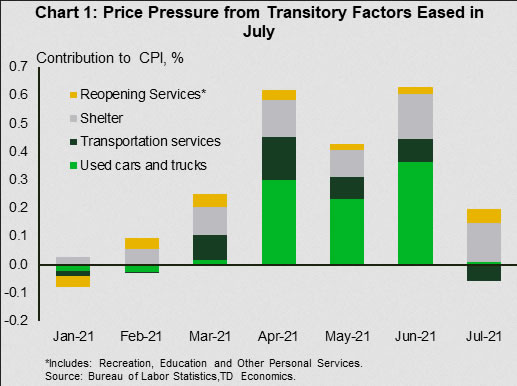
The CPI report did point to higher growth in services where activity is rebounding as the economy reopens, with recreation, hospitality and personal services heating up in the month. Meanwhile, the dominant ingredient remains the price for shelter, which accounts for roughly the third of the consumer price basket and has been rising steadily since the beginning of the year.
These first signs of easing pressures seem to have vindicated the Fed’s stance on the transitory nature of price changes. Still, the path to normalization remains precarious, especially if consumer behavior shift back to consumption of goods in the wake of the recent upswing of the Delta variant. This is especially relevant for the other side of the Fed’s mandate – the labor market.
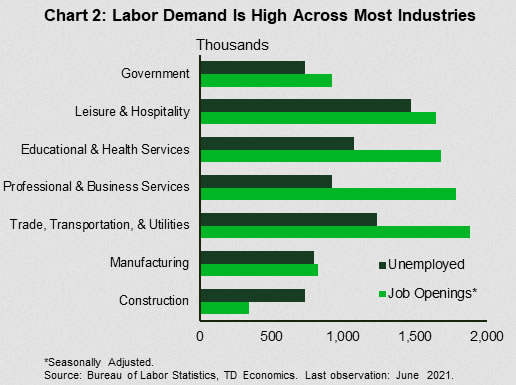
June’s Job Opening and Labor Turnover Survey (JOLTS) showed that job openings increased to another record high, surpassing the total number of unemployed workers for the second month since the beginning of the pandemic. Tight labor supply was broad-based, affecting most sectors of the economy, with an exception of construction services (which typically has a high unemployed-to-job opening ratio). The unfilled labor demand can be resolved through a recovery in the labor force, which remains suppressed by ongoing health risks.
All eyes are currently on the spread in the Delta variant that is threatening the economic recovery globally. While locally the spread may be mitigated by vaccinations and mask mandates, the American economy may still be impacted by an additional wave of supply chain disruptions. This week’s partial closure of one of China’s busiest ports is a good reminder that it’s too early to claim a victory over the pandemic. Still, as the economy adjusts further, there is good reason to believe that temporary price factors will continue to moderate while labor market steps on a firmer footing.
Canada - Summer Delight, Fall Concerns
It's shaping up to be a hot summer for the Canadian economy. The impressive take up of vaccines accelerated provincial reopening plans, and Canadians have been quick to take advantage. High-frequency credit and debit card data show a solid improvement in spending activity through June and early July. Employers have responded to this rapid rebound in demand by adding nearly 325k net new workers in these two months alone. The gain would have probably been even higher if not for Ontario and Manitoba only relaxing restrictions towards the end of July's Labour Force Survey period (July 11th to 17th).
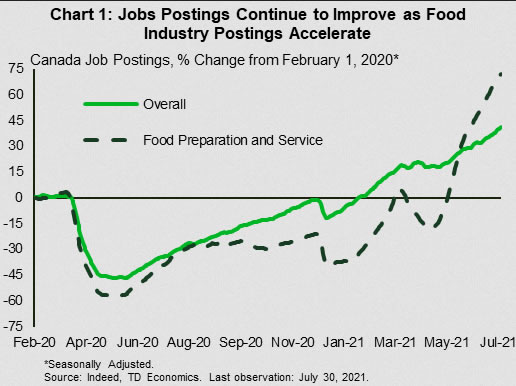
Indeed, August will likely see another robust improvement in employment. Job postings are soaring, driven in part by a flurry of ads for food and preparation services workers (Chart 1). Reopening has had a huge impact on the demand for workers, the question now is to what extent will labour supply rise to meet it.
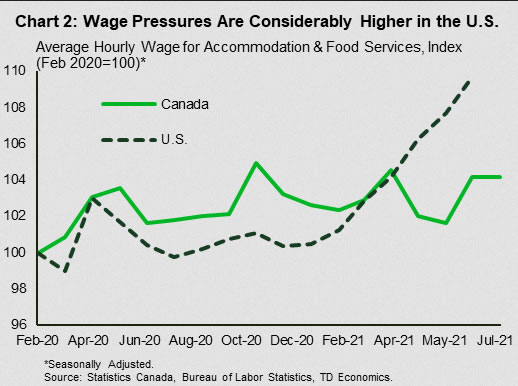
In the U.S., reopening of the economy was met with labour shortages, specifically in high-touch services industries, as health worries, occupational transitions, and perhaps even fiscal support, slowed the employment recovery. Canada could see similar complications — anecdotally, there have been reports — but as of July there has been little to indicate a lack of available workers. Unlike in the U.S., where employers had to increase wages to attract new staff, pay pressures have been moderate in Canada, even in the accommodation and food industry (Chart 2). In fact, the average hourly wage in this industry is only slightly higher than what it was prior to the pandemic in Canada, whereas it is 10% higher stateside.
Chart 2 reports the average hourly wage index for the accommodation and food services industry in Canada and the U.S. Both series are indexed to 100 in February 2020. In Canada, wages have stayed pretty flat in this industry since the pandemic struck, but in the U.S. there has been rapid improvement over the course of 2021. In June, the average hourly wage was 10% higher than February 2020 in the U.S., and only 4% higher in Canada.
It's possible that labour shortages will become more acute with time. Afterall, Canada reopened its economy after the U.S., and some provinces are still gradually easing public health measures. But there a few reasons to believe it may not be as bad north of the border. For one, Canadians have been more engaged with the labour market through the pandemic. The participation rate in July was 65.2%, a touch below the February 2020 rate of 65.5%. Two, the vaccination drive has impressed in Canada with 63% of the population fully vaccinated compared to America's 50%. Fiscal support as well has been clawed back (i.e. reduced Canada Recovery Benefit payments beginning in July), which could motivate the job search for some unemployed workers.
In all likelihood, labour market conditions will continue to tighten this month. But the picture gets murkier when looking out to September and beyond. Canada appears to now be entering the fourth wave of the pandemic, fueled by the highly contagious delta variant. This strain of the virus has already led to a startling pick up in cases and hospitalizations in some countries, even those with highly vaccinated populations like Israel and the U.K. If Canada suffers the same fate, provinces may have to revisit reopening strategies and re-impose public health measures. This could stall or even reverse the economic recovery. This fall season could be a more challenging one for the Canadian economy.
Week Ahead – Fed Minutes the Highlight
Country
US
Inflation data this week provided some light relief in the markets, even if it has probably done nothing to influence the Federal Reserve ahead of a significant few months. The economy is strong, the labour market is seeing major improvements and while inflation is not a problem, it’s also not something to ignore altogether.
Tapering is coming and September looks the most likely time for the announcement, be it to begin immediately or later in the year. Jackson Hole could see Chair Jerome Powell lay the groundwork for any announcement and even drop hints on the timing and pace.
Fed minutes next week is the most noteworthy release. After numerous Fed speakers over the last couple of weeks though, it may not hold too many surprises. Retail sales, jobless claims, Philly Fed, building permits and housing starts are also notable. But in reality, focus is very much on Jackson Hole now.
EU
Next week offers a small selection of data for the euro area, most notably the flash employment change and GDP figures. The data has been encouraging for the bloc recently, with the developments on the vaccine rollout driving confidence in the region.
That said, the ZEW data this week suggests businesses are still very cautious on the recovery. The expectation that there will be another surge in Covid cases and the belief that growth will soften as a result of that already achieved were behind the downbeat assessment of the outlook.
UK
Plenty of cause for optimism in this weeks GDP data, with the economy now only 4.4% below its Q4 2019 peak. Growth in June exceeded expectations ahead of final restrictions being lifted in July. As yet, the reopening has gone well, with cases not rising to an uncomfortable level, hospitalisations manageable and fatalities still low.
The “pingdemic” and associated labour shortages have been a slight drag for the economy in recent months but broadly speaking, it’s looking in good shape going into the final months of the year.
Unemployment, earnings, inflation and retail sales data next week should keep the pound active. The BoE has recently opened up on tightening plans in the coming years but we’re still quite a way from that at this stage, despite the progress in the economy. New purchases under its QE program will continue until the end of the year, as planned.
Emerging Markets
Russia
GDP and PPI data released next week. The central bank recently raised rates to 6.5% and warned that more may follow.
South Africa
Retail sales and inflation data due in the middle of next week.The central bank previously left interest rates unchanged and signaled a hike may be considered later in the year, which makes the inflation data on Wednesday all the more interesting. CPI is expected to fall from 4.9% to 4.2%.
Turkey
The CBRT surprised markets in leaving interest rates unchanged at 19% last month, just above the current rate of inflation and in-keeping with the promises made by Governor Şahap Kavcıoğlu when he took the role earlier this year.
This is despite continued pressure from President Erdogan who has repeatedly stressed his belief that higher interest rates stoke inflation, the opposite of what is widely believed to be true. Erdogan has continued to push for rate cuts and Kavcıoğlu may have the opportunity to later this year if inflation drops as the CBRT expects. Otherwise, he may suffer the same fate as his predecessor Naci Ağbal.
The lira is going to remain vulnerable to sell-offs as a result with Erdogan clearly not afraid to pull the trigger.
Asia Pacific
China
Government regulatory risk continues to dominate China equity markets, with state bodies releasing a new 5-year plan this week stating that this process will continue and expand. The question on everybody’s lips being, who is next? China equities remain under pressure this week and are set to do so going forward as markets rebalance pricing to find the equilibrium between attractive multiples and government risk. We’re not done yet. Hong Kong, home to the listings of China tech heavyweights, and the CSI 300, will continue to struggle.
Covid’s delta-variant has spread to more cities, although cases remain low. An escalation in cases is a key risk for China and the region. More notably, the two busiest ports in the world, Shanghai and Ningbo have been partially shut after cases were discovered there. That threatens knock-on effects in both China and across the globe and readers should monitor this situation closely. Asian equities fell on Friday in no small part because of this.
China releases activity data for July on Monday. It features Industrial Output, Fixed Asset Investment and Retail Sales. Markets are already nervous about the virus and data indicating China’s growth is slowing. Poor numbers will see China equities hit hard and that will have a similar effect across the region. We expect no change to the one and five-year Loan Prime Rates on Friday despite a recent RRR cut.
India
The Indian Rupee is befitting from strong international inflows as overseas investors switch funds from China to opportunities in India’s equity markets. USD/INR fell this week despite a generally strong US Dollar globally. A sell-off in China markets on Monday if the data is poor will almost certainly spill over into other Asian currencies and equity markets, including India.
India releases WPI inflation on Monday but with the RBI staying on hold at the latest policy meeting, it is unlikely to have much impact if it remains around 11.0%. A much lower number will be positive for the INR and local equities. A much higher number will have the opposite effect as the country’s stagflation woes deepen.
No other significant data.
Australia & New Zealand
Australia’s virus containment lockdowns continue to spread across the country with Canberra joining the lockdown and Sydney cases showing no signs of slowing. Equity markets continue to ignore this reality and its probable knock-on effects, content to follow Wall Street and firm commodity prices. Readers should watch those for directional indications. Australian Unemployment on Thursday should only cause short-term volatility. The Australian Dollar remains soft on globally cautious risk sentiment due to the delta-variant, and a very dovish RBA.
By contrast, New Zealand continues to print blockbuster data releases indicating an economy overheating. A rate hike of 0.25% this week by the Reserve Bank on the 18th is highly likely and the only question is whether they indicate whether another two or three will occur this year in the statement. Unsurprisingly the NZD continues to outperform, particularly against low yielders like AUD and JPY.
There is an outside chance the RBNZ could go all in and hike by 0.50% on Wednesday and indicate more hikes to follow this year. In that case NZD/USD could well rally by 150+ points and AUD/NZD could fall by 200-300 points.
Japan
Japan releases Q2 GDP on Monday, but its impact will be zero as Q2 is now old news. The Trade Balance on Wednesday will be of slightly more interest, with CPI on Friday expected to remain at 0.10% in 25 years of business as usual. Talk that PM Suga will enact another $270 billion stimulus has not moved markets.
Japan equity markets continue to ignore the Covid-19 situation, like Australia, with local investors happy to slavishly follow Wall Street’s FOMO gnomes. That could change next week as the Covid-19 situation in Japan continues to go from bad to worse. Notably, a Tokyo health official stated that they had lost control of the situation in the city. Japan’s restriction measures have the consistency of wet paper, and if the government signals a tightening finally, equities and the Yen will suffer. Most likely they will continue to sit like possums in the headlights and analysis paralysis themselves to a standstill.
USD/JPY has dissolved into a purely US/Japan interest rate differential play and the cross rallied sharply in the past week as US yields firmed notably. If US yields stay at present levels, USD/JPY may test 111.00 in the week ahead.
LegacyFX Sponsorship of the Spanish Football Club Real Betis Balompié
LegacyFX is proud to announce their sponsorship of the professional Spanish football club, Real Betis Balompié, S.A.D.
Real Betis Balompié S.A.D-commonly known as Real Betis, plays in Spain’s professional football league, La Liga. The club was founded in 1907 and is based out of Seville, Andalusia in Spain. Their home-field stadium–Estadio Benito Villamarín, holds a 61,000 seat capacity. Last year, the club finished in 6th place earning a spot in the UEFA Europa League for the 2021/2022 season. Some of their current notable players include Joaquín Sánchez Rodríguez and Nabil Fekir.
“We, at LegacyFX, are always looking to present our brand in a successful and promising manner. As such, we chose one of the best teams in LaLiga, due to its rich history in Spain, Europe, and even worldwide. We believe that this partnership with Real Betis is in-line with our vision, will positively represent our brand to our clientele proudly, and catapult our name as a truly leading global brokerage.” – Jad Abdelrahman, Chief Executive Officer at LegacyFX
As an international company that caters to clientele across the globe, LegacyFX appreciates the universal clout and reach that football carries and hopes that through this partnership it will be able to foster greater relations within the forex community, with the Club, and the football industry.
Week Ahead – RBNZ to Raise Rates, Dollar Awaits Fed Minutes
It’s an electrifying week, with a crucial central bank meeting and a storm of economic releases to spark volatility. The Reserve Bank of New Zealand will make history by raising interest rates. However, there is scope for some disappointment in the kiwi, as markets are pricing in a decent chance for a ‘double’ rate hike. Meanwhile, another round of normalization signals from the Fed could begin to reawaken ‘king dollar’.
RBNZ: Time for lift off
The main event will be the RBNZ meeting on Wednesday, when the central bank is widely expected to raise interest rates. There are clear signs that the New Zealand economy is overheating, so it is time for the Reserve Bank to step on the brakes.
Economic growth has been impressive lately, unemployment has returned to pre-crisis levels, inflation is high and rising, and the housing market is booming. Therefore, markets have fully priced in a quarter-point rate increase at this meeting, and are also assigning a 20% probability for a ‘double’ rate hike of a half-point.
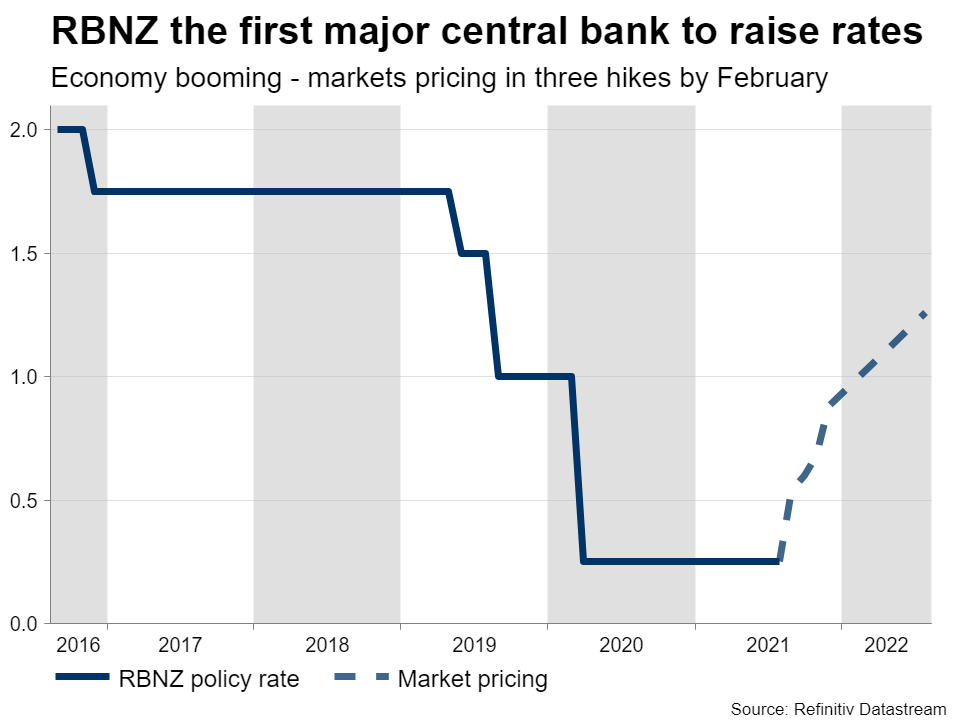
As for the kiwi, the initial reaction will depend on whether we see a single or a double rate increase. Most likely, it will be just a single. A double hike could shock the economy and it would also put massive upward pressure on the exchange rate, which the RBNZ wants to avoid. Plus, the global environment is still very fragile.
The central bank doesn’t need to pull the handbrake here, it only needs to step gently on the brakes. Interest rates can be raised again in October if everything goes well. In this case, the kiwi could take a hit as those looking for a double rate increase are left disappointed.
But in the bigger picture, the outlook for the currency is very bright. The economy is strong and the kiwi will soon enjoy higher interest rates, making it more attractive for carry trades, especially against the euro and yen. The only thing missing for an incredible rally is an improvement in the global outlook.
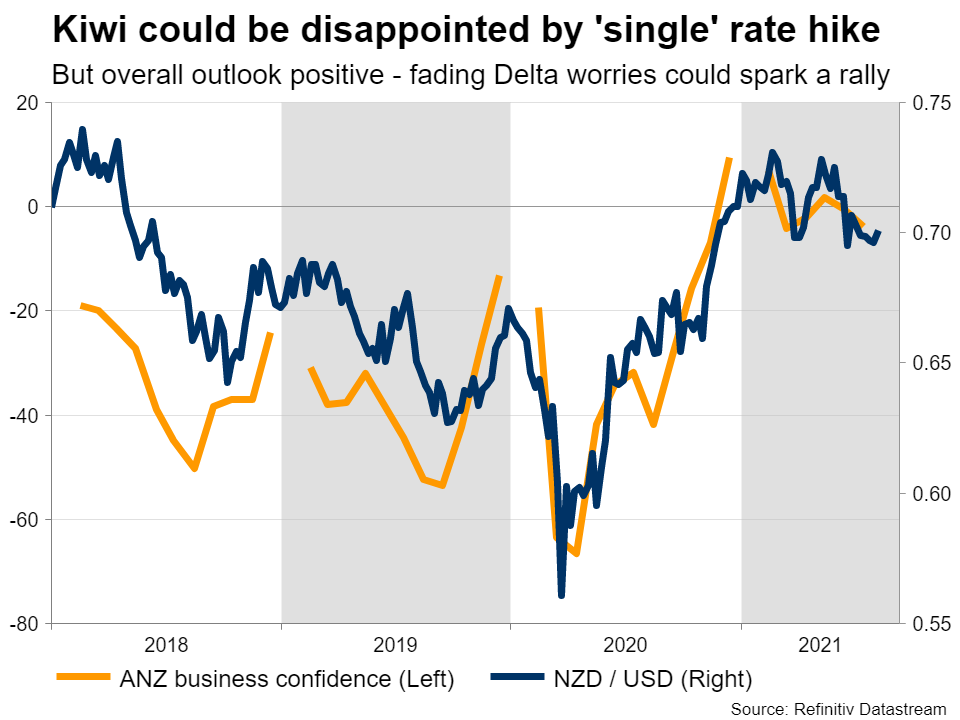
New Zealand is a small export-heavy economy after all, so for the kiwi to really go on a rampage, worries around global growth and the Delta variant have to fade a little.
Another dose of Fed tapering signals
Over in America, the ball will get rolling with the latest retail sales numbers and a speech by Fed chief Powell on Tuesday. Then on Wednesday, the central bank will release the minutes of its July meeting, where it signaled that the US economy had made progress, opening the door for dialing back asset purchases.
We have seen several FOMC officials lately - including Vice Chairman Clarida - getting behind the idea that the Fed should begin withdrawing liquidity soon. Inflation is scorching hot, consumption is off the charts, and the labor market is healing its wounds quickly. On top of everything, Congress is working on another multi-trillion spending package.
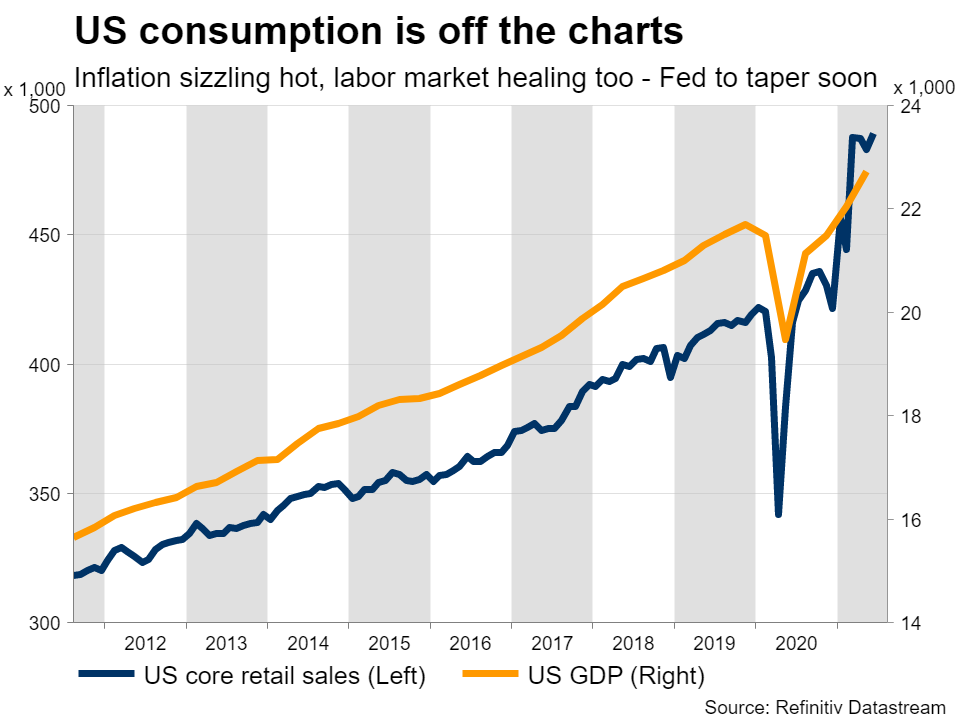
The minutes are likely to reflect this thinking, setting the stage for a formal tapering announcement in the coming months. Whether this is announced in September or November doesn’t matter much for the dollar.
What matters is that the Fed is years ahead of the ECB and the BoJ in the normalization game. Ultimately, this central bank divergence could allow US yields to rise faster than their European and Japanese counterparts, allowing the dollar to shine against the euro and the yen.
A barrage of UK releases
It’s also a packed week for British data releases. Employment stats for June are out Tuesday, ahead of inflation numbers for July on Wednesday and retail sales for the same month on Friday.
The UK economy is humming along nicely, with widespread vaccinations unchaining consumers and businesses. The only worry is what happens now that the government’s job-protecting programs are ending, risking a spike in unemployment. On the bright side, the Bank of England isn’t worried, amid countless reports that businesses are struggling to fill open job positions.
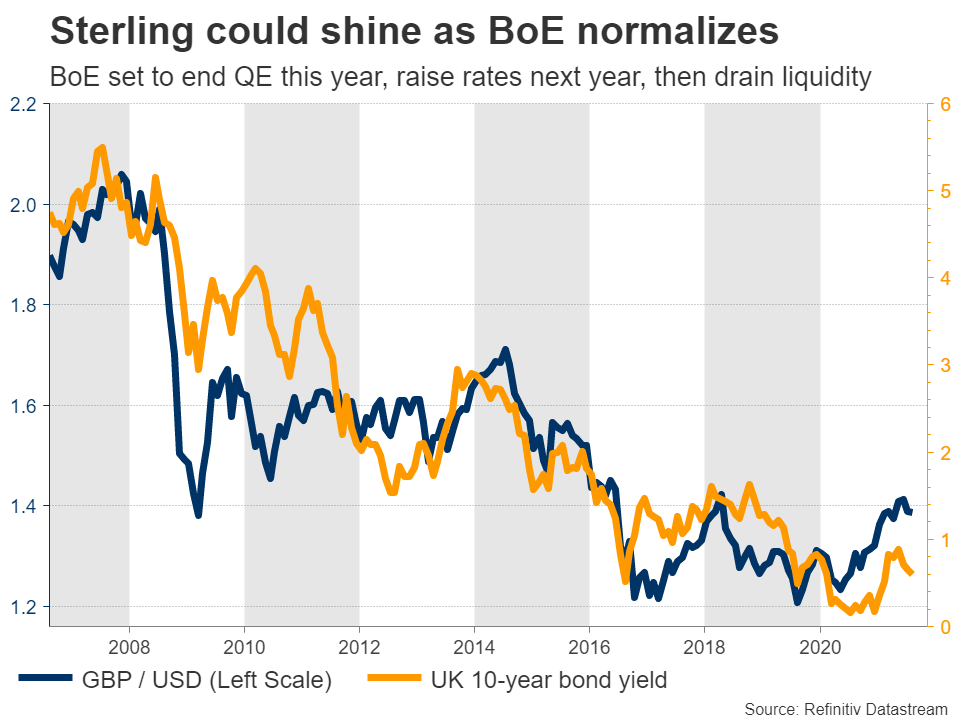
Indeed, the Bank recently signaled that it will probably raise rates next year. After two rate hikes, it plans to begin ‘quantitative tightening’, essentially draining liquidity out of sterling markets. That’s great news for the pound overall. When a central bank sucks liquidity out of the market, that ultimately pushes bond yields higher, making its currency more attractive.
Australian and Canadian data eyed
In Australia, the minutes of the latest Reserve Bank meeting are out on Tuesday. Then on Wednesday, wage growth numbers for Q2 will be released, ahead of monthly jobs data for July on Thursday.
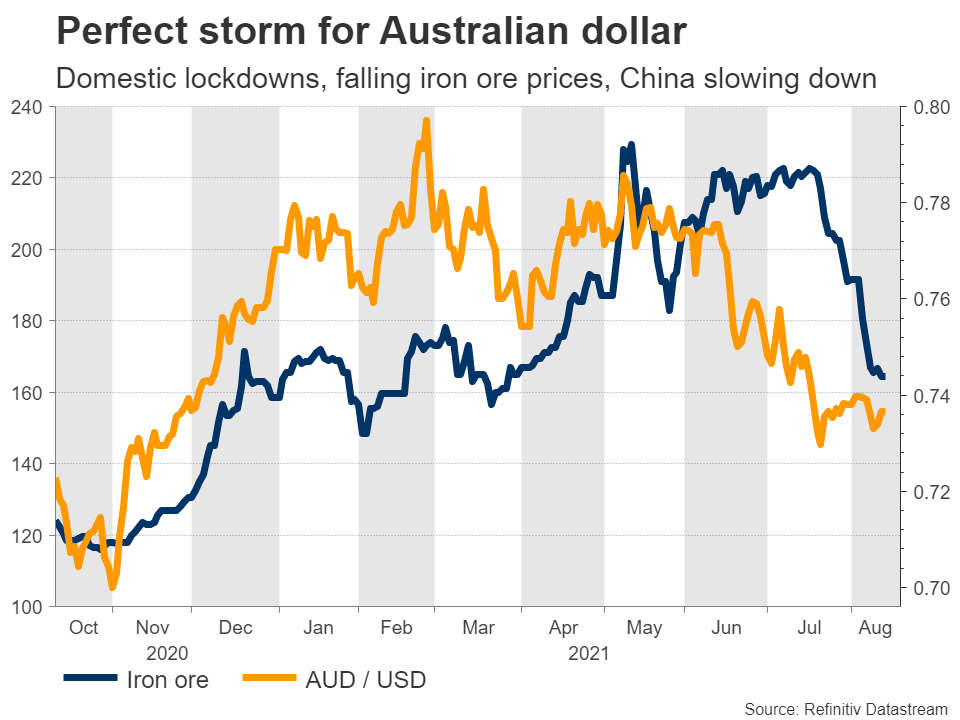
The Australian dollar got demolished lately as the nation went into strict lockdowns to battle the Delta outbreak. The economy will be hit hard, which might be reflected in the upcoming jobs data. The RBA won’t join the ‘rate hike club’ anytime soon, which is bad news for the aussie, especially in a climate of slowing growth in China due to Delta-related lockdowns.
Over in Canada, inflation stats and retail sales for July will hit the markets on Wednesday and Friday, respectively. The nation enjoys a very high vaccination rate and the economy is doing well. As such, the Bank of Canada is already tapering its bond purchases. The overall picture for the loonie looks promising, although a lot will ride on oil prices.
Japan trapped in deflation
In Japan, GDP numbers on Monday are expected to show the nation narrowly dodged a double-dip recession. That said, the economy is still struggling, as much of the country remains under a state of emergency. Reflecting this, inflation stats out on Friday are likely to confirm the nation is still trapped in deflation.
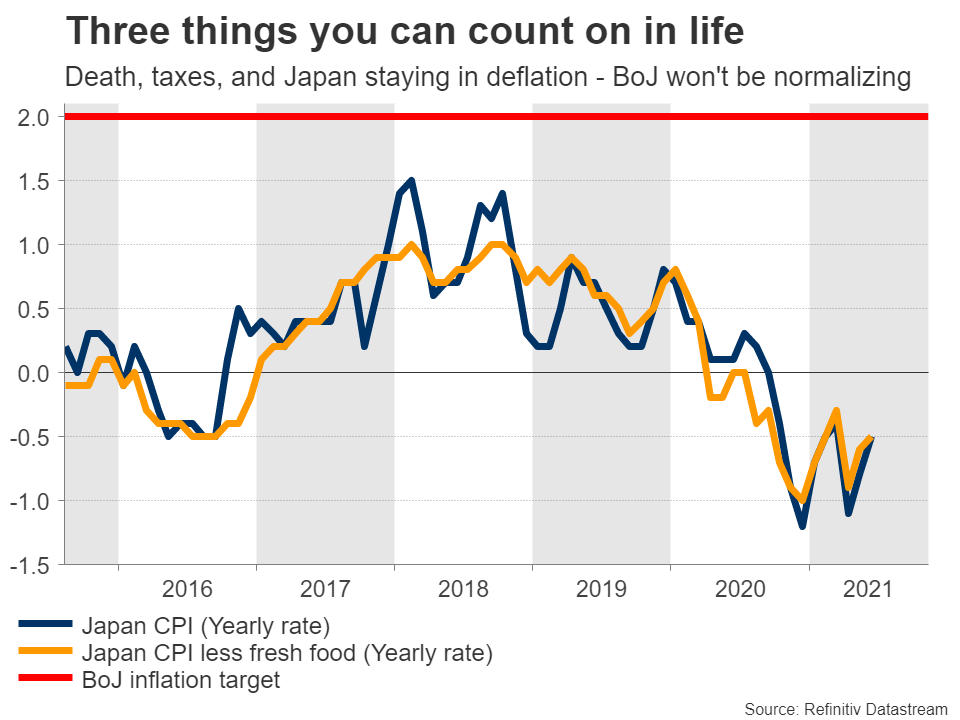
Therefore, the Bank of Japan won’t be taking its foot off the accelerator anytime soon. That spells downside risks for the yen moving forward, as foreign interest rates rise but Japanese ones don’t. Outside of an episode of panic in the markets, there isn’t much that can rescue the yen.
Meanwhile in China, the monthly data dump that includes retail sales, industrial production, and fixed asset investment for July will hit the markets on Monday. Finally, the Eurozone’s GDP print for Q2 will be released Tuesday, but this is the second estimate, which markets don’t react much to.
Forward Guidance: Canadian CPI Growth Likely Ticked Up in July; Core Price Growth Accelerated
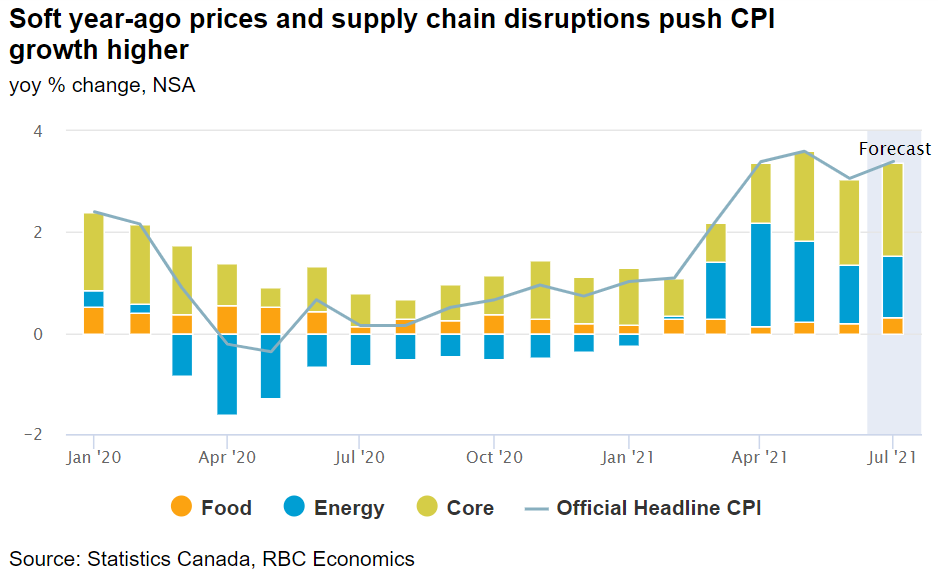
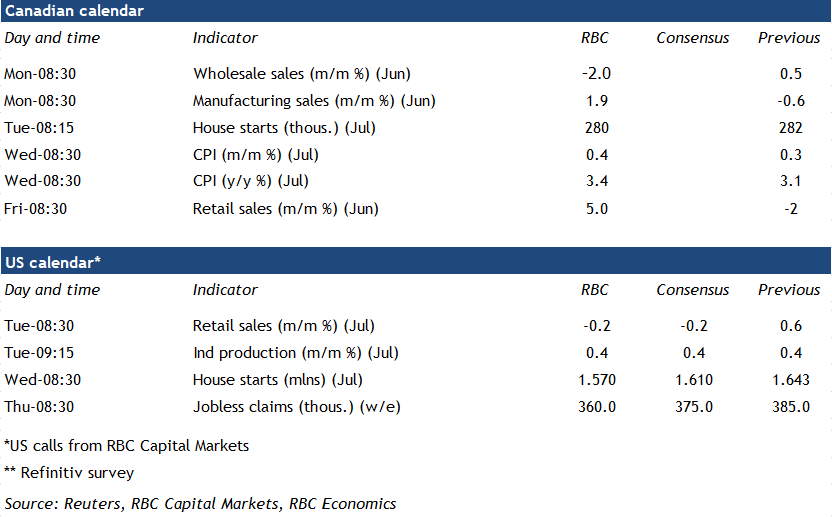
Expect another increase in the Canadian consumer price index in July, as supply chain disruptions and base effects continue to rattle price measures. The semi-conductor shortage—which has impacted all things auto-related, from production to manufacturing sales to car rental prices—has yet to show persistent signs of easing. It should keep prices higher for some products in the near-term. Meantime, we continue to compare higher energy prices this year with dramatically lower ones from 2020—distorting energy price growth measures. Overall we expect headline inflation to increase to 3.4% in July, from 3.1% in June. Core prices, excluding food and energy items, are likely to rise by 2.6%, the highest in almost two decades. Also, some volatility should be expected as Statistics Canada resumes collecting and reporting prices for products and services that were essentially unavailable during the pandemic (for example, travel and tours).
Supply chain disruptions, and the price hikes that go along with them, will eventually ease. Lumber prices have already pulled back sharply from record spring highs and auto production rebounded marginally in June. But consumer demand that has strengthened over the summer will probably be there to put a floor under inflation trends. Statistics Canada already provided a preliminary estimate that sales of merchandise bounced back 4.4% in June after falling in April and May. Our own tracking of card transactions points to some upside risk to that early estimate, and suggests another 2% increase in July. As expected, consumption for the hardest-hit service sectors has also looked much better, with our own tracking of card transactions on restaurants and hotels already back above pre-pandemic levels in July.
Week ahead data watch:
- Statistics Canada’s preliminary estimate of June manufacturing sales was up 1.9% from May—led by a rebound in the transportation sector, and consistent with an almost 15% increase in motor vehicle exports in the month.
- The early indicator of wholesale sales was down 2% in June from May, due to weakness in the building material, machinery, equipment and supplies subsectors.
- Housing starts likely remained elevated at 280,000 (annualized) in July, similar to June, and backed by solid permit issuance in recent months.
Weekly Focus – Fed Members Speak Openly about Tapering
The Delta variant is spreading fast in most of Asia and in a number US states in the southern part of the country. Asia is challenged by a lower vaccine coverage. Sydney has remained in lockdown for two months, yet the infection figures continue rising; Australia's vaccine coverage remains low with less than 19% of the population fully vaccinated. A similar story is playing out in Japan where Tokyo's coronavirus advisory panel said that the situation is getting out of control. China stands out in this sense, as the country's zero-tolerance policy for Covid is getting increasingly challenged. Despite mass testing and regional lockdowns, new infections continue rising, although the figures remain very low compared to US, for example. In the US, Florida and Texas are the hotspots with new cases and hospitalisations at record levels in the former state. In other big states like New York and California, the problems are less pronounced. New cases in most European countries continue to fall as the countries keep rolling out vaccines and selective restrictions have worked.
This week, many Fed members came on the wire with their views on the upcoming tapering of the Fed's QE programme. In general it now seems more a matter of when than if there will be tapering. Fed governors seem a bit divided on the timing of launching the tapering. It seems consensus is emerging on starting tapering later this year or early next year, in line with our view, and that the first rate hike could come in early 2023 although some Fed members have mentioned late 2022 (which is also our view). The more hawkish line follows the line taken at the July meeting (see our review of that meeting: Fed Research: Review - Another step towards less accommodative monetary policy). Chairman Powell is due to speak on Tuesday, and Fed minutes from the July meeting on Wednesday next week will likely give more indication of the thinking inside the Fed on the coming monetary tightening. The Jackson Hole conference on 26-28 August also looks crucial in this regard.
Monthly CPI US inflation pressures fell back in July in line with the market and Fed's narrative that the current spike in inflation is transitory. Both the core and headline inflation measures declined to 0.5% on a monthly basis in July from about 1% in June. Prices for items like used car prices led to weaker inflation pressures. Next week we get the final euro area inflation print for July, which will be very interesting in judging the underlying inflation pressures in the euro area and the size of the transitory drivers.
The Fed comments on likely tapering start weighed on US Treasuries, and 10Y yields rose above 1.30 % for the first time since mid-July. The higher US yields lent support to the USD, with EUR/USD falling to around 1.17. Commodity prices came under pressure as the resurgence of the virus and travel restrictions in China were seen as a threat to the demand outlook. However, oil prices rebounded later in the week in line with broader commodity markets. Amid a strong earnings season and low yields, equity markets ignored the virus problems and edged to record levels in the US.
More Daily Records
Stock markets making modest gains once more on Friday, in what is likely to be rather uneventful trade as we make our way into the weekend.
This has been a common feature of the markets recently, small and steady gains that have seen European stocks push into record territory. They've been quietly putting together a great run over the last few weeks which has seen them not only deliver strong gains, but hit new records on a daily basis.
Good earnings and a strong vaccine program that has enabled looser restrictions, while reducing the threat of them being strictly reimposed later in the year are driving the gains. The outlook is very encouraging for Europe and we're seeing that reflected in the indices. Of course, after such a strong run and going into a quieter period, there is the possibility that we could see some profit taking in the coming weeks.
The two weeks before Jackson Hole are looking a little uneventful with just the odd sprinkling of something to satisfy our appetite for more. The Fed minutes next week, for example, will naturally provide plenty of interest. Although we've heard so much from policy makers since the meeting, are we really going to learn that much?
The next couple of weeks could be all about delta and how well China, in particular, and others deal with the spread. China has shown its zero Covid approach has worked before and is not changing course, despite other countries taking a more relaxed approach thanks to the vaccines.
In closing the Meishan terminal at the Ningbo-Zhoushan port - one of the busiest in the world - as a result of one positive case, China has made it perfectly clear that it will take all measures - no matter how seemingly extreme - to contain any breakouts. What that means for the rest of the world is more supply disruptions in the months ahead, which could means more bottlenecks and higher costs.
But as central banks have shown, these are short-term problems with short-term price implications and while they may exacerbate headline inflation data further, they are willing to look beyond them. Although I'm sure from a markets perspective, it will add another layer of uncertainty and unease.
Oil reverses course on port closures
News of the port closure has been a drag on oil prices, with crude turning south yesterday just as it was heading for a third day of gains. WTI and Brent had rebounded off their lows around $65 and $67, respectively earlier this week and appeared to have established firm support in the area.
But the prospect of further strict shutdowns in China at the slightest hint of a breakout will have implications for growth in the worlds second largest economy and largest importer in the near-term. The outbreak in China, irrespective of how small the numbers currently appear, is a key catalyst behind crude prices tumbling from their highs again.
Should we see more evidence of these kinds of strict measures being imposed, we could see that support come under significant pressure. We've already seen the IEA revise down its expectations for the remaining months of the year as a result of delta. Further downward revisions will follow if it doesn't come under control.
Can gold see temporary support?
Gold moved back into the $1,740-1,760 range early on in the US session on Thursday and it has traded here since. This falls around that previous barrier of support, the break of which triggered the flash crash at the start of the week. If it can break above here, it would be quite the turnaround but I'm not convinced it would be sustainable.
We have seen the dollar pull back slightly since the US inflation data release earlier this week and US yields have steadied, but this is more a reflection of some profit taking than anything else. The Fed is likely to make a tapering announcement in September and the Jackson Hole event in a couple of weeks could be the platform to lay the groundwork.
Perhaps we could see some profit taking ahead of the event, especially given the relative light news flow that's expected. US data will provide points of interest, as will Fed commentary, but some profit taking could benefit gold in the short term. But I'd be surprised to see any significant gains ahead of the event.
Bitcoin correction short-lived but momentum already waning
Bitcoin is having another run at $47,000 at the end of the week. The pullback was quite shallow and short-lived in the end although it could still face resistance at the previous peak, where we're already seeing momentum slip a little.
A failure to break $47,000 wouldn't be any concern at this stage and could just be indicative of the correction having not run its course. The rally is looking perfectly healthy regardless of whether we see a breakout or a pullback.
Even a move below yesterday's lows could just signal a bigger correction back to the $41,000 region, based on the double top that would have formed, which would see it run into prior resistance and the 61.8 fib of the August lows to highs.
Sunset Market Commentary
Markets:
EUR/USD traders today drew an example from yesterday’s action in EUR/GBP. Summer trading conditions, an empty eco calendar and the weekend ahead made them reduce dollar long positions after the August rally stranded into EUR/USD 1.1704 resistance this week. Moving above the intraweek high of EUR/USD 1.1750 even caused a slight acceleration higher towards 1.1765. We stress that this move is technical in nature with no reason whatsoever to suddenly play the single currency card. EUR/USD 1.1769 is final intermediate resistance before a more profound move higher in the range and a return north of 1.18. A similar technically inspired move in EUR/GBP heads into its second day with EUR/GBP taking out the 0.85 handle.
Core bonds trade listless with US Treasuries slightly outperforming German Bunds. As is the case on FX markets, the move can be seen as somewhat of a reversal of the August US Treasuries’ sell-off. Especially since the mid-month refinancing operation, including 10y Note and 30y Bond sales, went well. US yields lose up to 2.3 bps (10-yr) in a daily perspective. The German yield curve flattens with yield changes ranging between +0.8 bps (2-yr) and -0.4 bps (30-yr). 10-yr yield spread changes vs Germany widen by 1 bp. Stock markets continue to profit from the low volatility environment with European and US indices adding to their winning strike. They both add up to 0.5% with yet another all-time high for the S&P 500 after the US opening bell.
Next week’s highlights include US retail sales (Tuesday), minutes of the July FOCM meeting (Wednesday), first indications on Chinese growth at the start of Q3 (Monday) and EMU Q2 GDP numbers (Tuesday). The Reserve Bank of New Zealand (Wednesday; see below) and Norges Bank (Thursday; preparing September hike?) hold policy meetings.
News Headlines:
The Polish economy has extended its strong rebound from the first quarter by growing 1.9% QoQ in the second. This result translates into 10.9% year-on-year growth. While the GDP detail structure has not been released yet, it is quite likely that annual GDP growth will be visibly above 5%, which is also above the NBP growth (July) forecast. Obviously, a debate about a start of a new hiking cycle, which has begun after the (high) July inflation figures, might only intensify among Polish rate-setters. Polish central banker Kropiwnicki today said that he would support a 15 bps rate hike in November when the bank publishes its updated macroeconomic forecasts, assuming the outlook for economic growth is good. The zloty didn’t respond to the data. EUR/PLN settles around 4.5750 after the Polish currency showed some weakness this week related to the lower house vote in favour of a controversial media bill which wants to exclude non EEA companies from holding stakes in Polish broadcasters.
Swedish inflation accelerated more than expected in July rising by 0.3% M/M and 1.7% Y/Y for the CPIF gauge (consumer price index with a fixed rate). The underlying core CPIF, excluding energy decelerated to only 0.5% Y/Y which was the lowest outcome since 2014 and backs the Swedish central bank’s cautious outlook. The Swedish krone was unnerved by the inflation numbers, treading water around EUR/SEK 10.20.
USD/JPY Mid-Day Outlook
Daily Pivots: (S1) 110.32; (P) 110.43; (R1) 110.54; More...
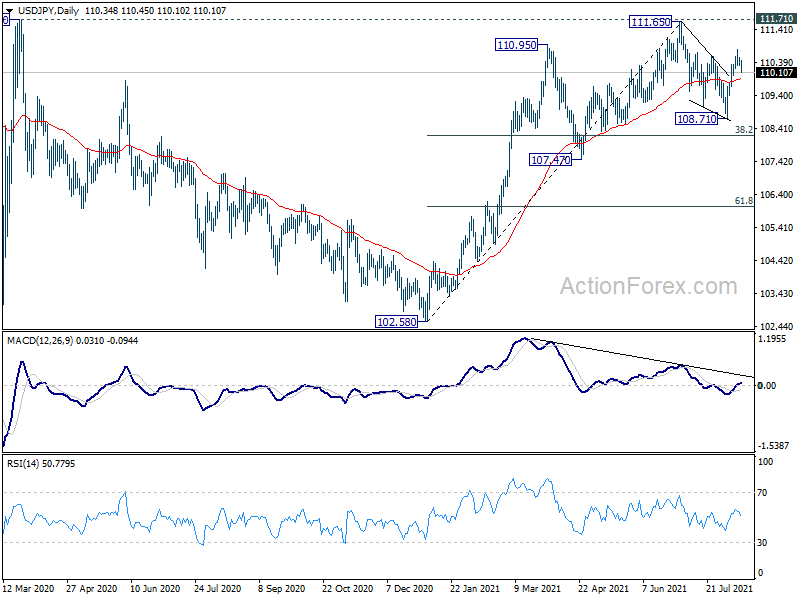
Intraday bias in USD/JPY remains neutral for the moment. Outlook is unchanged that corrective fall from 111.65 should have completed with three waves down to 108.71. Another rise is in favor with 110.01 support intact. Break of 110.79 will turn bias to the upside for retesting 111.65 high. However, break of 110.01 will dampen this bullish view, and turn bias to the downside for 108.71 support.
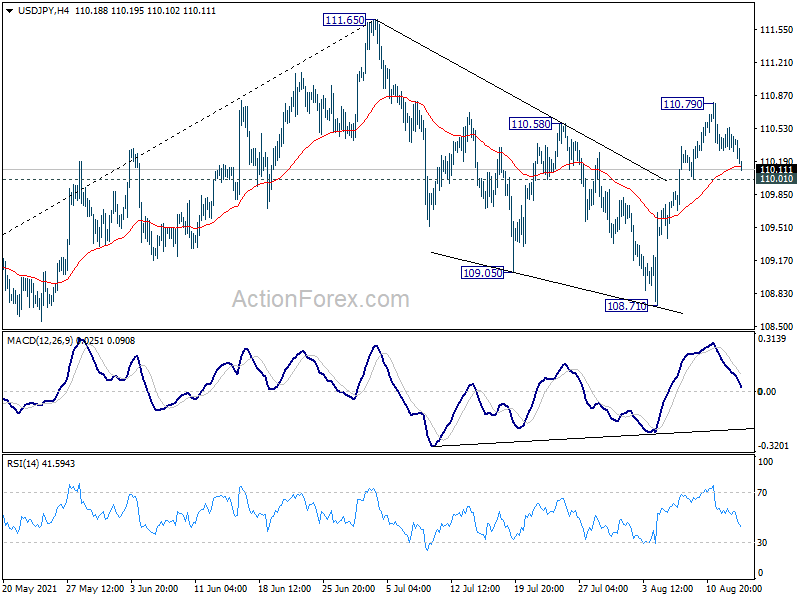
In the bigger picture, medium term outlook is staying neutral with 111.71 resistance intact. The pattern from 101.18 could still extend with another falling leg. Sustained trading below 55 day EMA will bring deeper fall to 107.47 support and below. Nevertheless, strong break of 111.71 resistance will confirm completion of the corrective decline from 118.65 (2016 high). Further rise should then be seen to 114.54 and then 118.65 resistance.