Sample Category Title
XAU/USD Bears Could Prevail
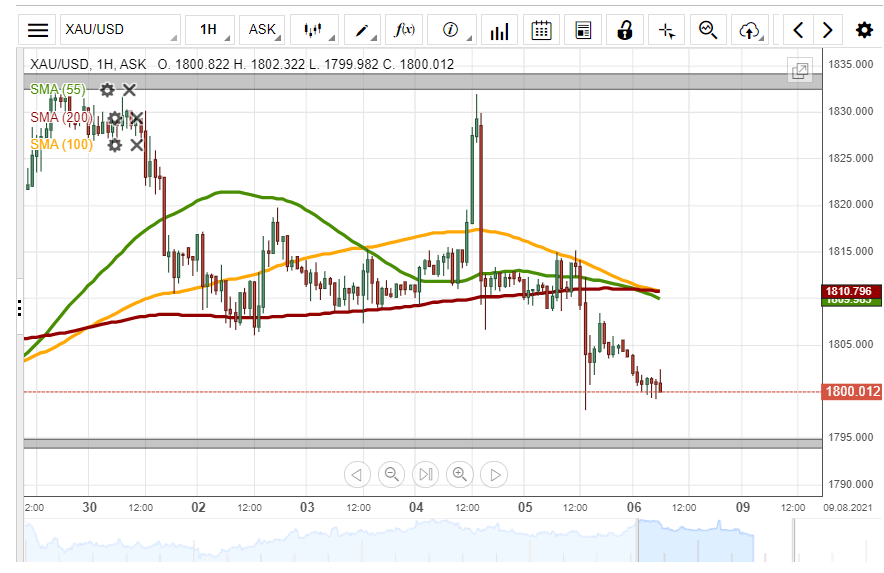
The 100– hour simple moving average provided resistance for the precious metal on Thursday. As a result, the XAU/USD exchange rate fell by 132 pips or 0.73% during Thursday's trading session.
Given that the commodity has breached the 200– hour SMA support level at 1810.8, bearish traders are likely to continue to drive the yellow metal's price lower within this session.
However, short traders could encounter support near the 1795.00 level during the following trading session.
USD/JPY Breakout Occurs
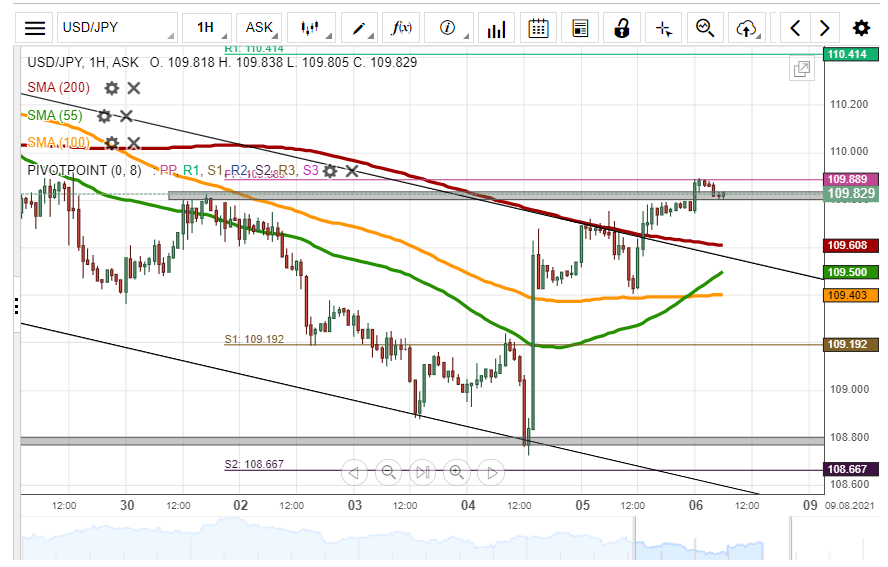
On Thursday, the US Dollar surged by 38 pips or 0.35% against the Japanese Yen. A breakout occurred through the upper boundary of a descending channel pattern during yesterday's trading session.
Given that a breakout has occurred, buyers are likely to continue to drive the exchange rate higher during the following trading session. The possible target will be next to the 110.41 area.
However, the weekly pivot point at 109.99 could provide resistance for the USD/JPY currency exchange rate within this session.
GBP/USD Bounces Off Support
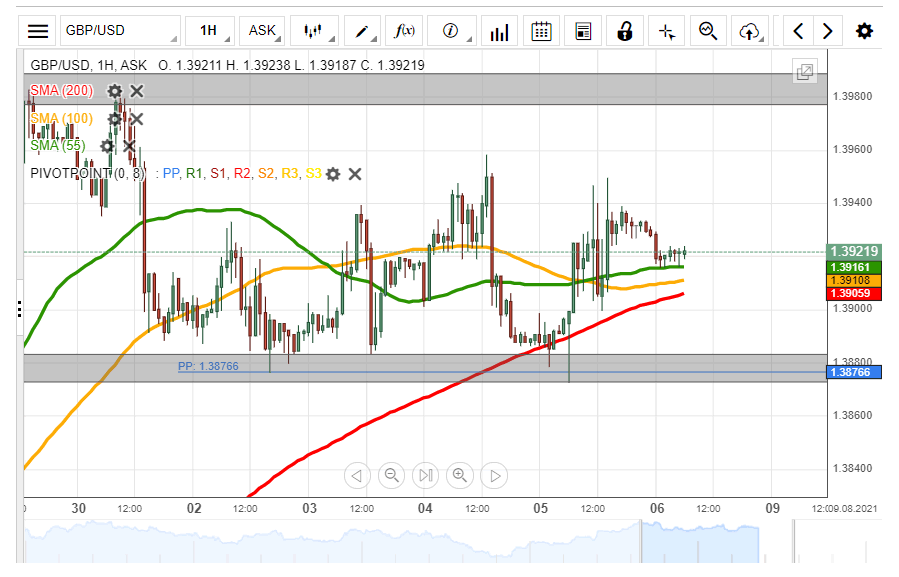
The GBP/USD currency pair bounced off a support level formed by the 200– hour simple moving average at 1.3883 on Thursday. As a result, the Pound Sterling surged by 54 pips or 0.39% against the US Dollar during yesterday's trading session.
Everything being equal, the exchange rate could continue to edge higher during the following trading session. The likely target for buyers will be near the 1.3980 area.
However, the US microeconomic data releases scheduled at 12:30 GMT could play an important part in the overall movement of the currency exchange rate within this session.
EUR/USD Could Target 1.1789
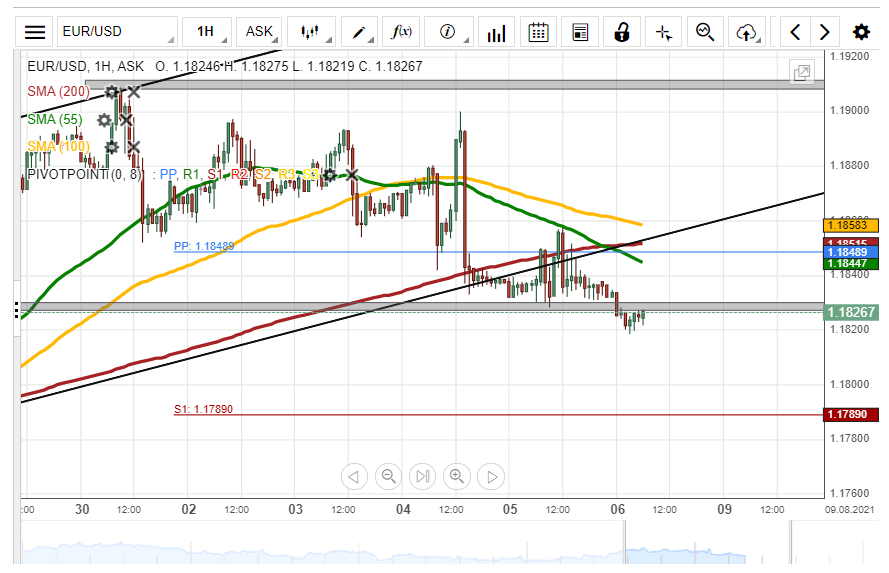
The 55– hour simple moving average provided resistance for the EUR/USD currency pair on Thursday. As a result, the common European currency declined by 32 pips or 0.27% against the US Dollar during Thursday's trading session.
All things being equal, the exchange rate is likely to continue to edge lower during the following trading session. The potential target for sellers will be near the weekly S1 at 1.1788.
However, the currency exchange rate might encounter support near the 1.1800 level within this session.
Oil Marks Time But Gold Looks Wobbly
Oil Stages A Modest Recovery
The corrective rally that started in Asia yesterday extended through to the New York session as physical bargain hunters emerged. Brent crude finished 1.30% higher at $71.30 a barrel, and WTI rose by 1.60% to $69.20 a barrel. Both contracts are 10 cents higher in subdued pre-US-data Asian trading.
I continue to believe that any deeper sell-off in oil, while entirely possible on speculative culling, will be short-lived and followed by equally vigorous rallies. The US Non-Farm Payrolls tonight could be good for a directional move either way.
Brent crude has support at $70.00 a barrel, and then its 100-DMA just below at $69.75 a barrel. Failure of the 100-DMA could see another reactionary spike lower, potentially reaching the 20th of July low at $67.50 a barrel; however, this is not my base case.
Similarly, WTI has support at $68.00 a barrel, followed closely by its 100-DMA at $67.20 a barrel. Again, failure of $67.20 could see a snap reaction lower, targeting the 20th of July low at $65.10 a barrel. I would not expect it to linger long at those lower levels, however.
Gold Looks Fragile
The US Dollar remained firm, but US yields rose slightly overnight, pushing gold prices lower once again. Gold fell 0.43% to $1804.00 an ounce, closing just below the 100-DMA at $1804.50 an ounce, an ominous technical development. Prices continue to sag today, with Asia pushing gold 0.23% lower to $1800.00 an ounce.
Gold’s price action remains very poor, with its rapid retreat from multi-day resistance around $1830.00 an ounce, a significant red light. Its inability to withstand even modest US Dollar strength or slightly higher US yields is an0other warning sign, signalling the bullish traders appear to be running out of patience. Gold looks increasingly likely to stage another substantial move lower to wash out stale long-positioning.
For gold to hold above $1800.00 an ounce, it will need tonight’s US Non-Farm Payrolls to be very weak. A robust payrolls number will likely see a failure of major support just below at $1790.00 an ounce. That will signal a more significant move lower, targeting $1750.00 an ounce in the days ahead. Hold has nearby resistance at $1805.00, today’s 100-DMA, followed by the 200-DMA at $1820.00 an ounce. That is followed by a series of multi-day highs between $1830.00 and $1834.00 an ounce, which is now a very formidable barrier to further advances in the near term.
FX: The US Dollar Maintains Its Gains
The US Dollar finished little changed overnight but is still holding on to all its gains this week. The dollar index edged 0.03% lower to 92.26, rising 0.11% to 92.36 in Asia today. The dollar index’s downside breakout point last week was at 92.60, and this is my initial resistance level. Support is distant at the 91.80 double bottom, followed by the more import 91.50 level, which is also the 100-day moving average. A firm payrolls number should see the greenback strengthen once again as the taper-nistas return to the fold. I suspect that more than a little risk-hedging buying has been supporting the US Dollar these last few days, and I expect that to continue into the US data.
EUR/USD continued moving lower overnight and has fallen another 0.10% to 1.1820 in Asia. Most of the weakness is due to EUR/GBP selling after the Bank of England left policy unchanged yesterday but hinted at future tapering. That has lifted GBP/USD to 1.3920 as of this morning, with a rise through 1.4000 signalling a 250+ point rally. EUR/GBP fell 0.35% to 0.8493 overnight, just shy of the April low at 0.8472. A daily close below 0.8472 would be a breakout of EUR/GBP’s multi-month 0.8470/0.8720 range, and the cross could fall to 0.8250 in the weeks ahead in this scenario.
USD/CNY remains anchored at 6.4650, a situation I don’t expect to change until next week at the earliest. Regional Asian currencies range-traded overnight. The Won, Ringgit, Indian Rupee, and Indonesian Rupiah made modest gains, but the Thai Baht remains under severe pressure after a dovish Bank of Thailand and the increasing onslaught of Covid-19. USD/THB has risen to 33.388 today and could well tell 34.000 next week if the virus situation does not rapidly improve. I wouldn’t be breaking the champagne out yet on the Ringgit or Rupiah either. The RBI will be good for some volatility in USD/INR soon. USD/INR is trading at 74.000 at the moment, and it wouldn’t surprise me post-decision if it traded at either 73.80 or 74.40; just don’t ask me which side it will be.
Asia On Hold Ahead Of A Messi US Session
Another day, another record close for US equity markets, and thus it was once again overnight despite US bond yields firming slightly. A better than expected Initial Jobless Claims print seems to have been the catalyst/excuse Wall Street needed to send the S&P and Nasdaq to all-time high closes. The S&P 500 rose by 0.60%, the Nasdaq climbed by 0.78%, and the Dow Jones rallied by 0.71%. Futures on all three are in a pre-payroll stupor in Asia, hovering each side of unchanged.
It is much the same in Asia markets, with the Nikkei 225 creeping 0.35% higher while the Kospi has edged 0.15% lower, and Taipei has fallen by 0.30%. Bangkok has had another record day of Covid-19 cases, but the SET has edged 0.15% on the ensuing Baht weakness. In Indonesia, local e-com unicorn Bukalapak IPO’ed today and promptly rose by 25%. That, however, could not lift the broader market, Jakarta climbing just 0.15%. Singapore has increased by 0.20%, while Kuala Lumpur has fallen by 0.15% as both ease into the end of the week. In Australia, the ASX 200 and All Ordinaries are unchanged. The Wallabies impending pummelling by the New Zealand All Blacks in tomorrow’s rugby test, limiting bullish sentiment.
China markets are generally lower as S&P downgraded Evergrande to CCC and warned about their debt trajectory. S&P, Moody’s and Fitch have now all downgraded Evergrande bonds, and that has sent shivers once again through China’s foreign currency-denominated corporate bond market. Combined with the Covid-19 outbreak and Government regulatory fears, China equity markets are heading for a negative finish to the week. The Shanghai Composite is 0.50% lower, with the CSI 300 falling 0.80%, while Hong Kong, somewhat surprisingly for the second day in a row, is holding its own unchanged for the day. Perhaps “bargain hunters” in China tech heavyweights are limiting the fallout there. Let’s see how that works out for them next week.
Europe is likely to follow suit and content itself to trade modestly in the green while awaiting the US employment data. As I said earlier, you can construct a bullish argument for US equities on both a weak or excellent Non-Farm’s number. It would be a brave man who said US equities wouldn’t finish higher tonight, especially if US yields move lower again.
All Eyes On NFP
It's NFP Friday, and the market mood is not too bad when we think that the major news in the wire point that the rapidly spreading delta variant is about to threaten the economic recovery sooner rather than later.
There are event cancellations, companies pushing back their plans to bring employees back to office and a clear shift in consumer behaviour.
Happily, the company earnings are relatively strong to keep investors from sliding into a new depression.
Yet, it's important to gauge the risks of a fresh contagion crisis starts on businesses, as the overshoot in inflation significantly decreases the maneuver margin for the Federal Reserve (Fed) policy, and the Fed may not be as supportive as it has been in the first year-and-a-half of the Covid crisis for helping companies keeping their heads above water.
Still, one 'good' news is, if things get worse, we might well see inflation starting to ease and softer inflation could eventually give a window of opportunity to the Fed for keeping its policy loose enough to help companies survive another crisis. But that's a stretched expectation and can not be taken as a basis for policy expectations.
For now, the major US indices are pricing in the strong company earnings rather than the rising delta worries, and even the possibility of seeing a soft NFP print doesn't interfere with the bullish market mood.
But still, after Wednesday's miss on private job additions in the US, investors are not walking light-heartedly to the NFP print. US futures are flat to negative, as although there is no significant correlation between the ADP and the NFP prints, a soft ADP figure inevitably dents the mood into the nonfarm payrolls.
The US economy is expected to have added 870'000 nonfarm jobs in July, slightly more than last month's 850'000. However, the analyst estimates tend to be inaccurate these days, therefore, we could well see a number significantly higher or lower than the consensus of analyst estimates.
A strong figure should further boost appetite in US equities, even though I expect the energy and cyclical stocks trend behind the stay-at-home stocks due to the rising Covid worries. A soft figure, on the other hand, could hardly change the expectation that the Fed will announce bond tapering sometime between the end of this year and the beginning of the next, and the first rate hike in 2023. And that's ok, it's still some two years away from now, and things could change!
In the FX, we will likely see a strong figure boosting gains in the US dollar against the euro and apply an additional negative pressure on the EURUSD, which failed to clear the 1.19 resistance recently.
And the recent rebound in the US 10-year yield is now pressuring gold prices lower. One curious thing about the significant easing in the US 10-year yield was the fact that the yellow metal remained relatively unresponsive to it, hinting that the low US yields mostly boosted appetite in the better-paying stock markets. In this respect, the yellow metal has a better chance to break its 1790/1830 range to the downside, unless the US prints an abnormally low jobs data that throws the investor appetite against the wall.
USDJPY Bearish Bias
Technical analysis
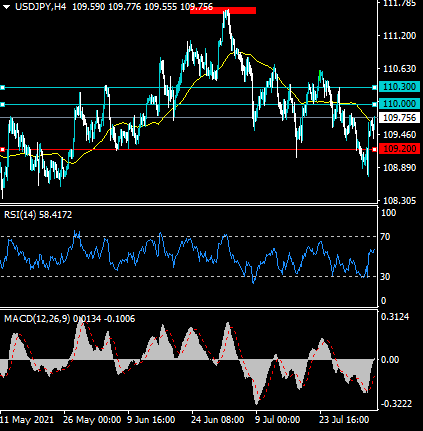
The USDJPY pair is starting to correct from oversold technical conditions, with the MACD and RSI indicator start to reset to the upside.
The four-hour time frame shows that an extremely large head and shoulders pattern is forming, with the neckline of the pattern found around the 109.20 level.
What the possible outcomes are
In our most likely scenario, the USDJPY pair will start to full towards the 107.50 price area as the bearish head and shoulders pattern plays out to the downside.
Alternatively, the USDJPY pair will stage one final corrective move higher towards its 200-period moving average on the four-hour time frame, around the 110.30 level.
Key levels
Support 109.20 107.50
Resistance 110.00 110.30
AUDUSD Still Bullish
Technical analysis
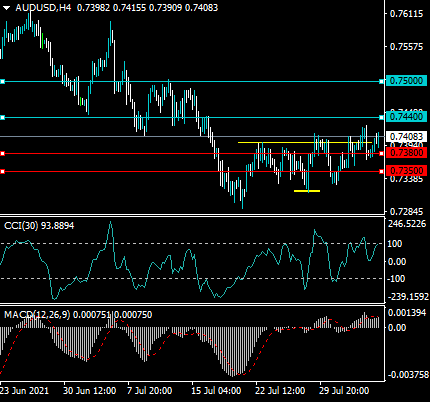
The daily time frame shows that the AUDUSD pair has staged a bullish breakout from a falling wedge pattern. Falling wedge patterns are typically considered to be bullish reversal patterns.
The MACD histogram on the daily time frame continues to trend higher and Commodity Channel Index is generating a strong buy signal.
What the possible outcomes are
In our most likely scenario, the AUDUSD pair will advance towards the 0.7500 level as the bullish breakout from the wedge pattern unfolds.
Alternatively, the AUDUSD pair will correct back towards the 0.7350 support area one final time and then start to rally towards the 0.7500 resistance area.
Key levels
Support 0.7380 0.7350
Resistance 0.7470 0.7500