Sample Category Title
Bank of England’s Subdued Signal of Future Tightening
Summary
The Bank of England (BoE) held monetary policy steady at today's announcement, but sent a subdued signal of future policy tightening in its accompanying statement. Specifically, the BoE said some modest tightening of monetary policy over the forecast period is likely to be necessary if the economy evolves in lines with its projections. The BoE also indicated the threshold for unwinding its quantitative easing purchases was lower than previously.
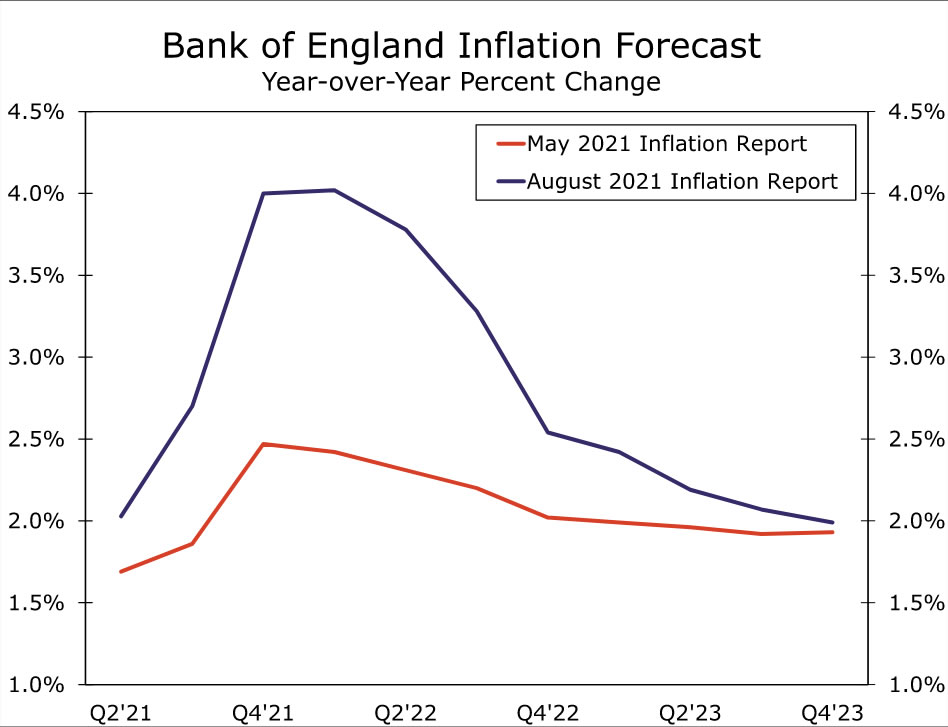
Those economic projections were revised higher in the central bank's August Inflation Report. The BoE kept its GDP growth forecast for 2021 unchanged, but lifted its forecasts for 2022 and 2023. The central bank also expects year-over-year CPI inflation to reach 4.0% by Q4-2021 but to gradually ease back to 2.0% by Q4-2023.
Given a monetary policy announcement that was arguably modestly hawkish in tone, we have modestly brought forward our expected timing for the BoE's rate hike cycle. We now forecast an initial rate increase in Q3-2022 (compared to early 2023 previously), albeit by only 15 basis points to 0.25%. We also anticipate multiple rate hikes during 2023, and would expect further cumulative rate increases of 50-75 basis points during that year.
Bank of England Happy to Hold Steady for Now
The Bank of England (BoE) announced its monetary policy decision today and, as widely expected, kept its policy stance unchanged. The BoE held its Bank Rate at 0.10% and also kept its asset purchase target at £895 billion. In addition, the central bank said that it would continue with its current £3.44 billion weekly pace of asset purchases between now and mid-December which, allowing for the reinvestment of currently held bonds that will mature in September, will see asset purchases finish on schedule by the end of this year. The decision to hold interest rates steady was unanimous, while there was only one dissent in favor of ending the asset purchase program early.
In addition to the BoE's monetary policy decision, the accompanying Inflation Report also included the central bank's latest economic projections. Those economic projections were relatively sturdy, reaffirming an expected GDP growth recovery and raising the central bank's CPI inflation forecast. For GDP growth the BoE maintained its 2021 forecast at 7.25%, while for 2022 its sees GDP growth of 6% (versus 5.75% previously) and for 2023 expects GDP growth of 1.5% (versus 1.25% previously).
The revisions to the central bank's CPI inflation forecast were even more stark. Looking at year-over-year changes, the Bank of England expects CPI inflation to spike to 4% by Q4-2021, before slowing later over the forecast horizon to 2.5% by Q4-2022 and 2.0% by Q4-2023.
Central Bank Sends Future Tightening Signal
While the Bank of England was happy to remain on hold for now, given the improving economic prospects and higher inflation forecast, its announcement did offer a subdued signal of future monetary tightening. Although policymakers on the Monetary Policy Committee do not appear to be excessively concerned about a spike in inflation they anticipate will be transient, they did say that:
"The Committee judges that, should the economy evolve broadly in line with the central projections in the August Monetary Policy Report, some modest tightening of monetary policy over the forecast period is likely to be necessary to be consistent with meeting the inflation target sustainably in the medium term."
Separately, the Bank of England offered guidance on when it might begin to unwind its quantitative easing purchases. While indicating that a decision to unwind would also be dependent on appropriate economic circumstances, the Bank of England said it could begin unwinding its quantitative easing by ceasing reinvestment of maturing assets when the Bank Rate reaches 0.50%, and might consider outright sales when the Bank Rate reaches 1.00%. This interest rate threshold to unwind quantitative easing is lower than previously signaled. That said, with the policy rate unlikely to reach even the 0.50% threshold until perhaps 2023, any unwinding of quantitative easing is clearly not an immediate issue.
Given a monetary policy announcement that was arguably modestly hawkish in tone, we have modestly brought forward our expected timing for the Bank of England's rate hike cycle. We now forecast an initial rate increase in Q3-2022 (compared to early 2023 previously), albeit by only 15 basis points in 0.25%. We expect the policy rate to remain steady in Q4-2022. In addition, while beyond our formal forecast horizon we anticipate multiple rate hikes during 2023, and would expect further cumulative rate increases of 50-75 basis points during that year.
Sterling Whipsaws After BoE Decision
Policymakers voted unanimously to leave interest rates unchanged at the current record low of 0.1% while a majority (7-1) voted to maintain government bond purchases at £875 billion. The latter vote was a slight surprise with the only dissenter being Michael Saunders, who was looking at tapering bond purchases as soon as possible, calling for a reduction to £830 billion.
There were a couple of tasty takeaways from the meeting, ranging from higher inflation forecasts to mention of tapering plans among other key topics. Policymakers remained optimistic with the latest growth forecasts barely changing from the meeting in May. The bank kept its growth projections at 7.25% for 2021 with GDP forecast to have risen 5% in Q2, but to have slowed to roughly 3% in Q3, reaching pre-pandemic levels in the fourth quarter. Inflation is expected to hit 4% by the end of 2021, though the BoE sees it as “transitory”, echoing the view of the US Federal Reserve.
When it comes to rate hike hints, the bank has made some fairly significant changes to its statement. The MPC acknowledged that “modest tightening of monetary policy over the forecast period is likely to be necessary” to tame inflationary pressures. In regard to tapering, the BoE also stated that it will begin unwinding purchases when interest rates hit 0.5%, which is much earlier than the previous level of 1.5%. The speed of the unwind does have the potential to be quicker than many expected. All in all, the central bank came across as positive with another small step towards tightening, although any action is still some way off.
This upbeat message has seen the pound appreciate against most G10 majors today, excluding the Australian Dollar, Norwegian Krone, and Canadian Dollar. GBPUSD whipsawed following the BoE decision with prices now trading marginally above 1.3900 as of writing. The major continues to trade in a choppy range on the daily charts with resistance around 1.3950. A solid daily close above this level could open the doors towards 1.4000 and 1.4070. Alternatively, a strong decline back below 1.3900 may open a path towards 1.3840 and 1.3786. For cable traders especially, focus now turns to the all-important monthly US employment report released tomorrow.
BOE Signals Earlier Unwinding of Balance Sheet. Modest Tightening On the Way
The BOE voted unanimously to keep Bank rate at 0.1%, and 7-1 to leave purchases of government bond at 875B pound. While the latter decision came less hawkish than we had anticipated (we expected 2 dissents), British pound got a boost as policymakers hinted about “modest tightening”.
Upgrading Inflation Forecast
The staff revised higher 2Q21 GDP growth forecast to +5%, from +4.25% projected in May. Growth for 3Q21 was downgraded by -1 ppt to +2.9%. The economy is estimated to expand by +7.25% in 2021, unchanged from previously. In light of a resilient ob market, the staff projected that the unemployment rate would peak at 4.8%in 4Q21, compared with 5.4% in 3Q21 in May’s forecast. The unemployment rate would likely return to BOE’s natural rate in 4Q22, a quarter earlier than May’s forecast.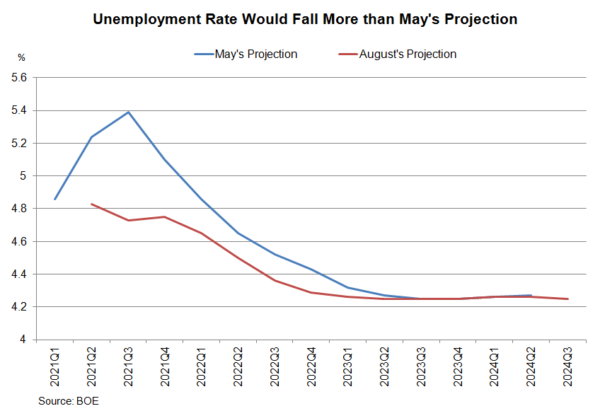 The central bank estimated that inflation would peak at around +4% in 1Q22, compared with previous projection of +2.5% in 4Q21. The upgrade was driven by the recent stronger-than-expected CPI data, and re-opening effects in services and input cost pass-through in consumer goods.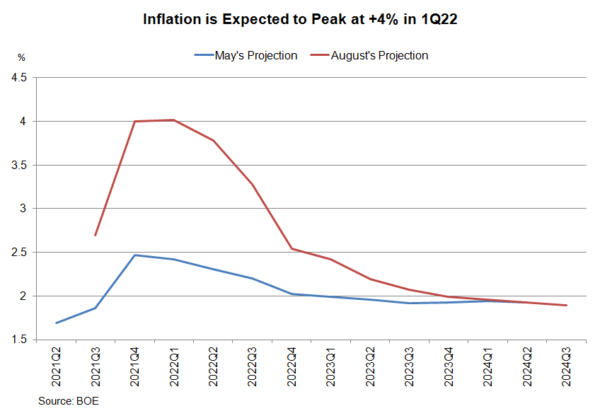
Policymakers acknowledged that the continued increase in price pressures reflected “the speed and unevenness of the recovery in activity, and disruptions to supply chains”. Yet, they reiterated that such pressures would be transitory. As noted in the statement, “current elevated global and domestic cost pressures will prove transitory. Nonetheless, the economy is projected to experience a more pronounced period of above-target inflation in the near term than expected in the May Report. And, alongside temporary constraints on supply, the rapid recovery in demand has eroded spare capacity such that the economy is projected to have a margin of excess demand for a period”. The committee remained divided over whether the +2% inflation target has been met. Some members suggested that “although considerable progress has been made in achieving the conditions of that guidance, the conditions are not yet met fully, while others judged that “the conditions of the guidance have been met fully, but note that the guidance made clear that these have only ever been necessary not sufficient conditions for any future tightening in monetary policy”.
Modest Tightening Approaching
While all the monetary policy measures stay unchanged, the central bank indicated that “modest tightening” could be necessary if the economy continues to improve. As noted in the statement, “should the economy evolve broadly in line with the central projections in the August Monetary Policy Report, some modest tightening of monetary policy over the forecast period is likely to be necessary to be consistent with meeting the inflation target sustainably in the medium term”.
In its updated monetary policy exit guidance, the BOE would begin reducing its balance sheet when the Bank rate hits 0.5% (currently at 0.1%), compared with previous guidance of 1.5%. It would also consider actively selling assets once the policy rate reaches 1%. The subtle changes signal that the unwinding of the balance sheet could come more quickly than previously anticipated.
BoE Treads with Caution
The British pound has had a relatively quiet week, and the pattern has continued on Thursday. GBP/USD is up slightly as the pair trades just above the 1.39 level.
BoE optimistic but cautious
There were no surprises for the BoE’s policy meeting earlier today, with the pound showing some choppiness ahead of the decision. As the markets had expected, the decision to maintain rates at 0.10% was unanimous, while the vote to keep QE at GBP 830 billion was 7-1.
The central bank raised its inflation forecasts, which was expected, given that the past two CPI readings have been higher than expected. The upward revision to the inflation projection was dramatic, with the BoE now projecting inflation will hit 4% in Q4 of 2021 and Q1 of 2022, up sharply from 1.5% in May.
BoE Governor Andew Bailey said that he expects UK GDP to recover to its pre-pandemic levels in the fourth quarter, with growth then expected to slow due to the tightening in fiscal policy. To sum up, the economy is headed in the right direction but caution is king.
The week will end with key US jobs data, highlighted by nonfarm payrolls, with a consensus of 870 thousand. There is some concern after the ADP Employment Report came in at 330 thousand, compared to the forecast of 695 thousand. The weak release sent the US dollar on its backside before it managed to recover after ISM Services PMI outperformed. If the NFP reading also falls flat, the US dollar could hit the retreat button before the weekend.
The dollar could also react if the unemployment rate and wage growth do not fall within expectations. The unemployment rate is expected to drop to 5.5%, down from 5.7%, while wage growth is forecast to remain steady at 0.3% MoM.
GBP/USD Technical Analysis
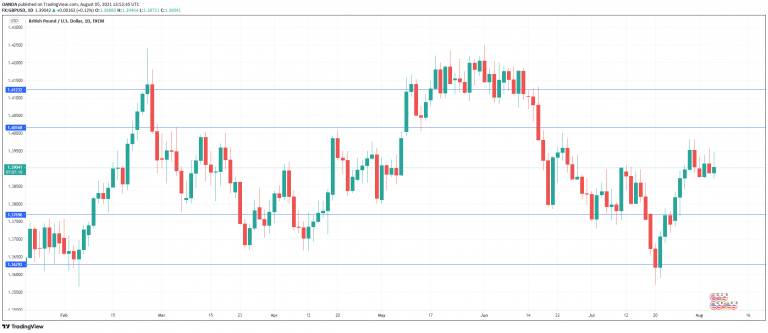
- GBP/USD is testing resistance at 1.3832. Above, there is resistance at 1.3917
- On the downside, 1.3617 is the first line of support. This is followed by support at 1.3487
Canada’s Merchandise Trade Balance Moved into Surplus Territory in June
- Canada recorded a merchandise trade surplus of $3.2 billion in June, following a deficit of $1.6 billion in May. Merchandise exports surged 8.7% (m/m), whereas imports fell 1.0%. Stripping away price effects, export volumes advanced an impressive 7.0% while import volumes fell by 2.2%.
- The increase in exports was broad-based, spanning 9 of the 11 industries. Exports of energy products (+22.9%) accounted for nearly half the gain in total shipments as volumes were up strongly in June. Meanwhile, exports of motor vehicles and parts increased 14.9% as work stoppages at assembly plants owing to the semi-conductor shortage were less severe than in April or May. Exports of metal and non-metallic mineral products also posted a hefty gain, rising 12.7%.
- Imports declined in 7 of the 11 industries. Imports of consumer goods (-3.7%) contributed most to the overall decline, partially retracing May's healthy gain. This category was weighed down by a decline in clothing footwear and accessories, which Statcan noted was in part due to restrictions in some parts of the country and port disruptions in Asia related to COVID-19 outbreaks. Imports of motor vehicles and parts also fell (-3.8%).
- In a separate release, Statistics Canada revealed that services exports were down 0.1% on the month, whereas services imports increased 3.5%.
Key Implications
- In June, Canadian exports benefitted from robust demand for energy products and a rise in auto production. However, production levels remain extremely low in the auto industry, largely reflecting global shortages for semiconductor chips. On the opposite side of the ledger, the drop in import volumes points to some moderation in domestic demand during the month. Notably, import volumes for machinery/equipment and consumer goods both declined, sending a subdued signal for business investment and consumer spending, respectively.
- For the second quarter overall, merchandise export volumes plunged 4.7%, while import volumes were flatter (-0.6%). This suggests that net trade weighed on second quarter economic growth.
- We continue to receive mixed signals on the outlook for trade going forward. We expect global economic growth to continue in the second half, with a strong performance recorded in the U.S. However, the Delta variant is a growing risk. In addition, the recovery in service exports is expected to lag until travel/international tourism restrictions are more significantly eased. Supply chain disruptions are still being reported in manufacturing PMI surveys, suggesting continued volatility in the data going forward.
EUR/USD Mid-Day Outlook
Daily Pivots: (S1) 1.1813; (P) 1.1857; (R1) 1.1880; More...
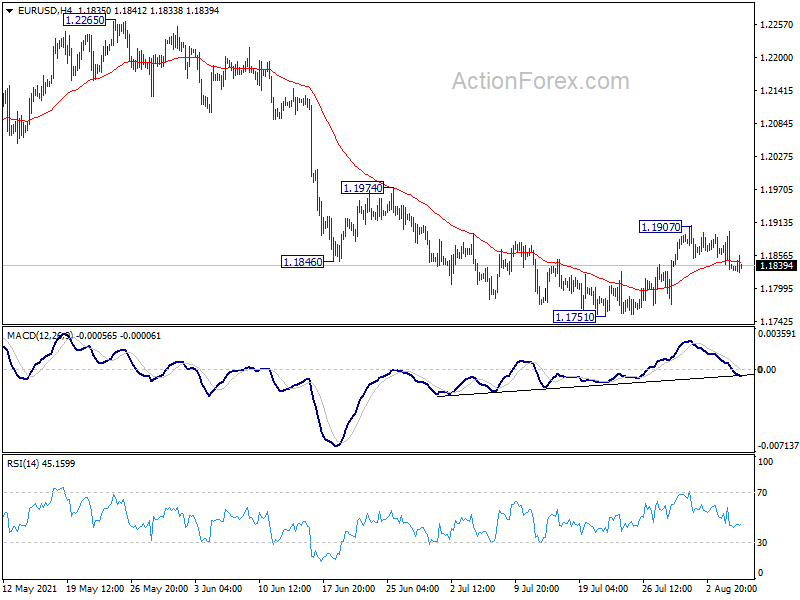
Intraday bias in EUR/USD remains neutral as consolidation continues. On the upside, above 1.1907 will resume the rebound to 1.1974 resistance first. Firm break there should argue that whole corrective pattern from 1.2348 has completed. On the downside, however, break of 1.1751 will resume the fall from 1.2265 to 1.1703 support instead.
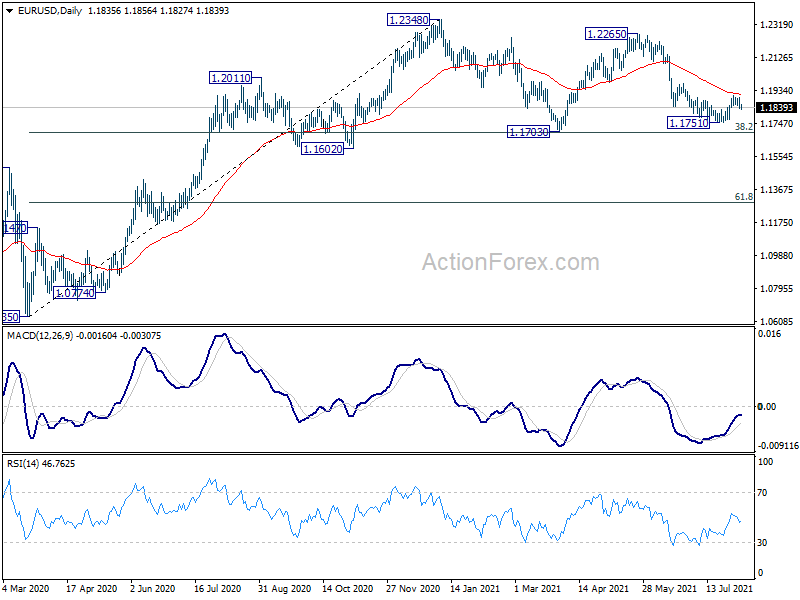
In the bigger picture, rise from 1.0635 is seen as the third leg of the pattern from 1.0339 (2017 low). Further rally could be seen to cluster resistance at 1.2555 next, (38.2% retracement of 1.6039 to 1.0339 at 1.2516). This will remain the favored case as long as 1.1602 support holds. Reaction from 1.2555 should reveal underlying long term momentum in the pair. However sustained break of 1.1602 will argue that the rise from 1.0635 is over, and turn medium term outlook bearish again.
USD/CHF Mid-Day Outlook
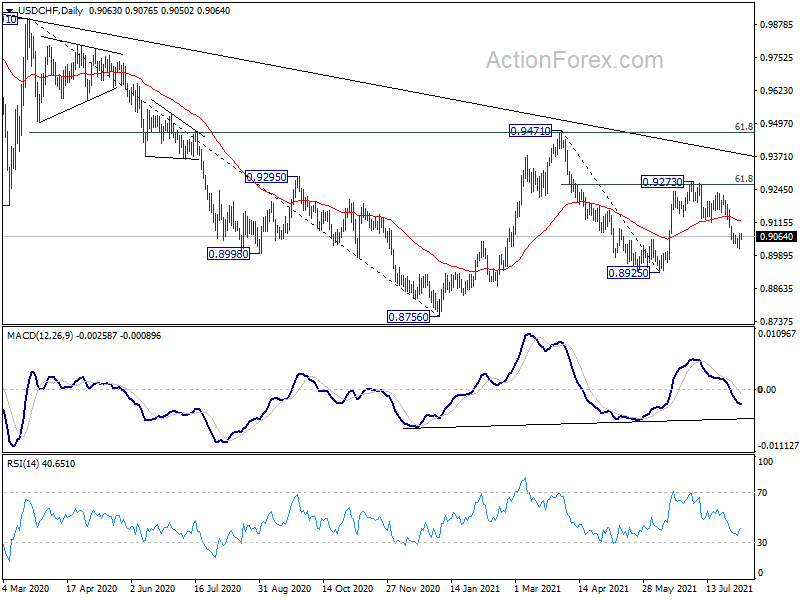
Daily Pivots: (S1) 0.9030; (P) 0.9053; (R1) 0.9087; More....
USD/CHF is staying in consolidation from 0.9017 and intraday bias remains neutral first. Further fall is expected as long as 0.9116 support turned resistance holds. Break of 0.9017 will resume the decline from 0.9273 to retest 0.8925 low. Nevertheless, sustained break of 0.9116 will turn bias back to the upside for retesting 0.9273 instead.
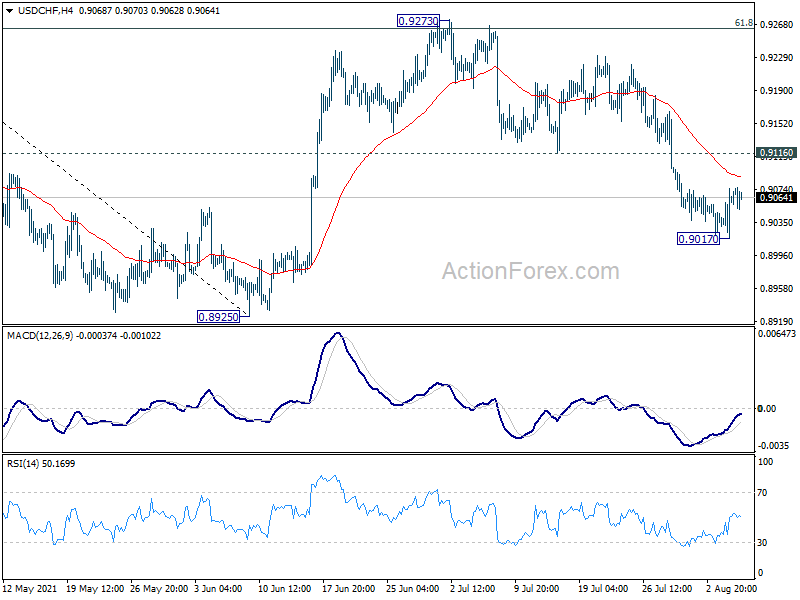
In the bigger picture, failure to sustain above 55 week EMA (now at 0.9183) affirms medium term bearish in USD/CHF. Break of 0.8925 support should resume the whole decline form 1.0342 (2016 high) through 0.8756 low. For now, risk will stay on the downside as long as 0.9273 resistance holds, in case of rebound.
USD/JPY Mid-Day Outlook
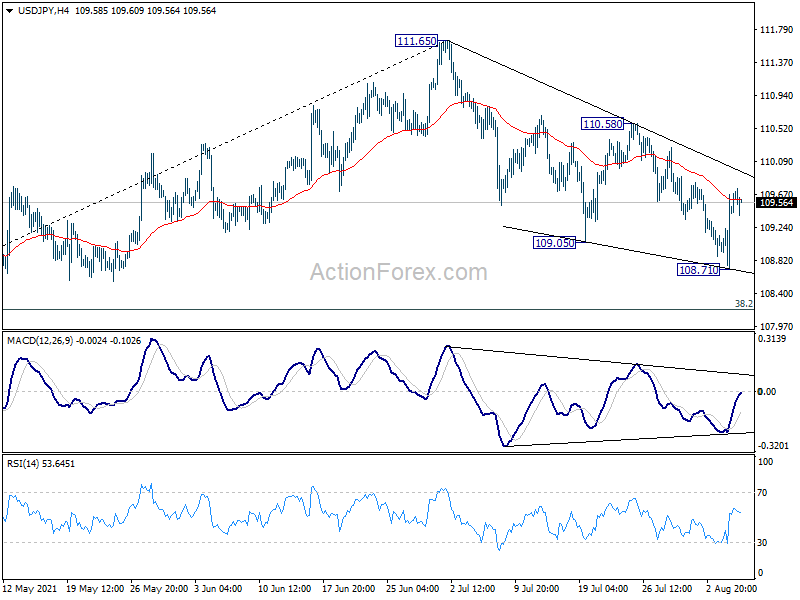
Daily Pivots: (S1) 108.91; (P) 109.29; (R1) 109.87; More...
Intraday bias in USD/JPY remains neutral for the moment. Some consolidation would be seen first but further decline remains in favor as long as 110.58 resistance holds. On the downside, break of 108.71 will resume the decline from 111.65 to 38.2% retracement of 102.58 to 111.65 at 108.18. Nevertheless, firm break of 110.58 will argue that that corrective fall has completed and bring retest of 111.65.
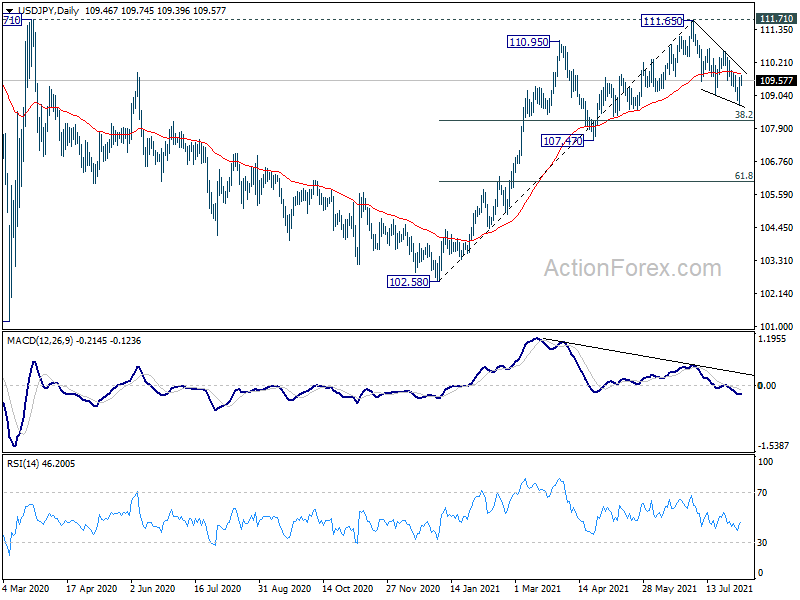
In the bigger picture, medium term outlook is staying neutral with 111.71 resistance intact. Firm break of 107.47 will argue that pattern from 101.18 has started another falling leg already. Deeper decline could be seen back to 101.18/102.58 support zone. For now, outlook won't turn bullish as long as 111.71 resistance holds, even in case of strong rebound.
US Open: Futures Rise as Jobless Claims Fall
US futures
- Dow futures +0.2% at 34867
- S&P futures +0.25% at 4411
- Nasdaq futures +0.21% at 15107
In Europe
- FTSE -0.11% at 7112
- Dax +0.2% at 15718
- Euro Stoxx +0.3% at 4158
Jobs data, earnings & covid in focus
US futures are edging higher as investors continue to digest corporate earnings, jobs data and concerns over the spread of the delta variant and its potential impact on the US economic recovery.
Initial jobless claims came in at 385k in line with forecasts and a mild improvement on last week’s 399k. Initial claims have been hovering around this level since early July, meanwhile layoffs are at the lowest level in 21 years as firms held onto workers amid labour shortages.
Data surrounding the labour market has painted a mixed picture so far this week with ADP report yesterday massively missing forecasts, whilst the employment subcomponent of the ISM services report was much more encouraging. As a result, it is harder to guage whether tomorrow’s all important non-farm payroll will beat or miss estimates.
With stocks trading around record high investors are keeping an eye covid developments. With half the population fully vaccinated the spread of Delta is not expected to create the same large spread shutdown that it caused previously. However. there are concerns that rising covid cases could slow the labour market recovery, particularly in states where there is a low vaccine take up.
Earnings continue to roll in. Uber will be under the spotlight as it trades down 4% pre-market. The ride hailing food delivery company reported widening losses.
Where next for the Dow Jones?
The Dow Jones continues to trade within a fairly tight range over the past two weeks capped on the up side by 35190 and on the downside by 34800. A meaningful move out of the current holding pattern is needed for further clues on direction. A break below 34800 is needed to open the door to 34635 the 200 sma on the 4 hour chart. A move below here could see the sellers gain traction. Meanwhile buyers could look for a move above 35190 for fresh all time highs.

FX – USD subdued, GBP rises post BoE
USD is drifting lower paring some of yesterday’s strong gains. Fed official Richard Clarida had said that he was in favour of tapering this year with the necessary conditions for a rate rise being met in late 2022 which had lifted the greenback. Investors now await tomorrow’s non-farm payroll.
GBP/USD trades higher after the BoE, as expected voted to keep monetary policy on hold. The BoE voted 8-0 to keep rates unchanged and 7-1 to keep asset purchases unchanged. The quarterly inflation report saw CPI upwardly revised to 4% in Q4 2021, higher than expected. Some officials said that some modest tightening could be needed in due course to keep price inflation under control, boosting the Pound. UK GDP is expected to reach pre-pandemic levels by the last quarter of this year.
- GBP/USD +0.1% at 1.3906
- EUR/USD -0.01% at 1.1837
Oil attempt to stabilise
Oil prices are attempting to rise after steep losses across the start of the week. Middle Eastern tensions are offering some support to oil. However, concerns that fresh restrictions imposed in some countries to curb surging COVID cases could threaten the demand recovery is limiting gains in oil.
Japan to set to expand emergency restrictions whilst China has imposed curbs and travel restrictions in some cities.
Growing tensions between Iran and Israel come as nuclear talks between Iran and the West which could see the easing of export restrictions on Iran’s oil, appear to have stalled.
- US crude trades +0.15% at $68.08
- Brent trades +0.13% at $70.37
Looking ahead
- 15:00 Fed Weller speech
GBP/USD Mid-Day Outlook
Daily Pivots: (S1) 1.3865; (P) 1.3911; (R1) 1.3937; More...
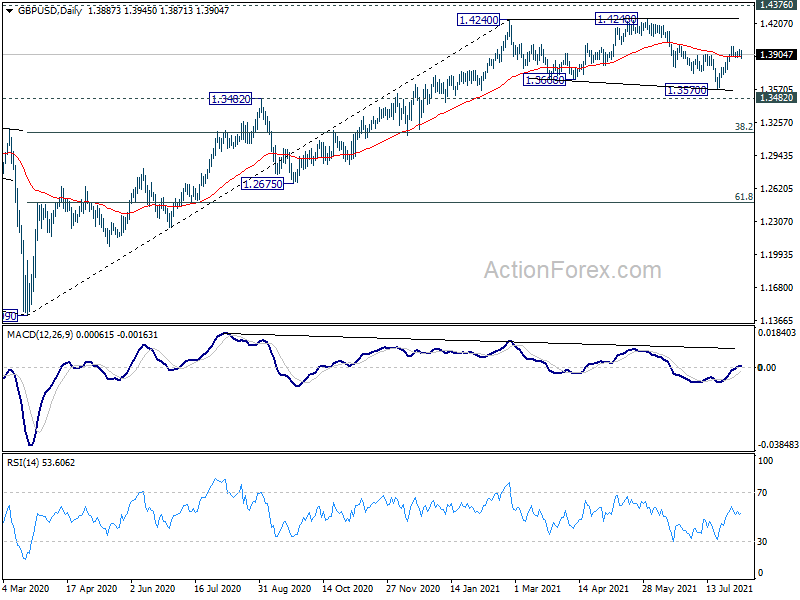
GBP/USD recovered after touching 4 hour 55 EMA, but stays below 1.3982. Intraday bias remains neutral for some more consolidations. Outlook is unchanged that corrective pattern from 1.4240 could have completed with three waves down to 1.3570. Further rise is expected as long as 1.3766 support holds. On the upside, break of 1.3982 will resume the rise from 1.3570 to retest 1.4248 high. However, break of 1.3766 support will dampen this bullish view and bring retest of 1.3570.
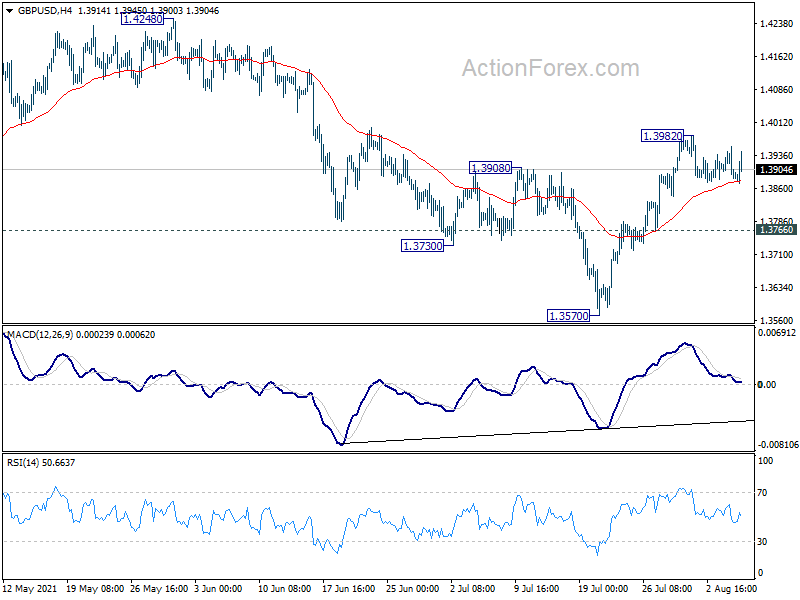
In the bigger picture, as long as 1.3482 resistance turned support holds, up trend from 1.1409 should still continue. Decisive break of 1.4376 resistance will carry larger bullish implications. However, firm break of 1.3482 support will argue that the rise from 1.1409 has completed. GBP/USD would then be seen in another leg of long term range pattern between 1.1409 and 1.4376. Deeper fall could then be seen to 61.8% retracement of 1.1409 to 1.4248 at 1.2493, and even below.