Sample Category Title
Oil Slides, Gold Whipsaws
Crude Inventories and Clarida clatter oil
Vice-Chairman Clarida’s overnight comments pushed the US dollar higher, weighing on an already nervous oil market looking at the global delta-variant numbers. However, the official US Crude Inventories delivered the knockout punch as they surprised markets by rising by 3.626 million barrels. (-4.1 Mio exp) Markets completely ignored an equally significant tumble in gasoline stocks of -5.3 million barrels, sending Brent crude 2.80% lower to USD 70.30 a barrel. WTI, meanwhile, collapsed by 3.10% to USD 68.05 a barrel.
Some bargain hunting is occurring in Asia today, with both contracts rising by 0.50% to USD 70.60 and USD 68.40 a barrel, respectively. The enthusiasm of Asian buyers suggests we are now in the zone where the physical market sees value, although the technical picture tells more of a dead cat bounce.
I continue to believe that material sell-offs in oil will be short-lived and followed by equally vigorous rallies; a powerful US Non-Farm Payrolls tomorrow would deliver that scenario. Brent crude has support at USD 70.00 a barrel, and then its 100-DMA just below at USD 69.70 a barrel. Failure of the 100-DMA could see another reactionary spike lower, potentially reaching the 20th of July low at USD 67.50 a barrel; however, this is not my base case.
Similarly, WTI has support at USD 68.00 a barrel, followed closely by its 100-DMA at USD 67.10 a barrel. Again, failure of the latter could see a snap reaction lower targeting the 20th July low at USD 65.10 a barrel. Fortune favours the brave, and in the bigger picture, the delta-variant is only slowing and not halting the global pandemic recovery. With that in mind, if we see those latter reaction targets, I could think of worse places to get long.
Gold has a tumultuous overnight session
With the resulting falls in US yields and the greenback, the soft US ADP Employment data sparked an aggressive gold rally overnight. Gold rose by 21 dollars intra-day to USD 1831.50 an ounce before the Clarida comments sparked a rapid fall from grace. With US yields and the dollar whipsawing higher, gold gave back all of its gains to finish almost unchanged at USD 1812.00 an ounce.
To say that gold’s price action was a disappointment is an understatement. Gold investors clearly have zero appetites for any sort of intra-day losses, as the price action demonstrates. It also highlights that gold has become a purely inverse US dollar/yield play and that traders would probably find more joy trading them than gold at the moment.
The price action was so disappointing that I cannot help but feel that the balance of risks has now shifted to further downside corrections, which robust Non-Farm Payrolls will likely deliver.
From a technical perspective, gold has traced out six daily highs between USD 1830.00 and USD 1834.00 an ounce over the past month, suggesting that this zone now forms formidable resistance. Gold has nearby support at a series of daily lows around USD 1805.00 an ounce, traced out over the past week. That is followed by the 100-DMA just behind at USD 1804.00 an ounce and then the critical USD 1790.00 an ounce region.
Gold is unchanged in Asia, but given the price action overnight, failure of USD 1804.00 will probably spark more selling from nervous longs. A daily close below USD 1790.00 signals a deeper correction, targeting USD 1750.00 an ounce. Gold looks like it is a sell on rallies above USD 1820.00 now.
Fed Hawks Gain The Upper Hand And Turn The Dollar Around
Yesterday, we had an opportunity to see how much the market is dependent on the Fed’s monetary policy expectations. Speculations about Fed’ taper timing is the primary driver of volatility in US and European markets and most of the world’s markets.
Yesterday, disappointingly weak employment data contrasted with hawkish comments from Fed policymakers, who won a local victory over the market minds.
The independent ADP’s report showed private-sector employment growth of only 330K, half of expected and below last month’s figures. This employment growth rate is a cause for concern as more than 6.5M workers are still out of work now against pre-pandemic levels. And that’s not counting the natural increase of the labour market during these 16 months.
ADP’s figures cooled the expectations of Friday’s official Nonfarm Payrolls data and sparked off a wave of speculation that the Fed would have no reason to cut back its stimulus. The report also provoked impressive pressure on the dollar while failing to support the stock market in a meaningful way. Investors feared a slowdown in corporate earnings and sales growth.
Prominent Fed hawk James Bullard said that the imminent unwinding of QE would clear the way for a rate hike as early as next year, if necessary.
Even more influential on the markets were comments from Vice-Chairman Richard Clarida. He said he could “certainly” see the Fed announcing QE tapering later this year, given the surprisingly strong pace of economic recovery.
Also, a couple of days ago, another FOMC member Christopher Waller signalled that the Fed is obliged to start cutting balance sheet purchases by October.
The concentration of hawkish comments on the previous day has sharply reversed the dynamics of the US currency. Thus, the dollar index added 0.5% after Clarida and Bullard’s speeches, developing a growth on Thursday morning. Moreover, there was a bullish reversal on the daily charts, clearly showing an active return of the buyers. Last week they retreated after peaceful comments from Powell and Brainard, pointed that the labour market had not reached a sufficient level for a stimulus cut.
The current stand-off between hawks vs doves at the Fed and bulls vs bears on the dollar promises to reach a peak this coming Friday. The labour market data could be a strong argument for one side or the other, but the stock markets and the dollar could continue to range in tight ranges until then.
EURUSD in particular failed to consolidate above 1.1900, trading around 1.1840 on Thursday morning. Position traders should look out for resistance at 1.1900 and support at 1.1750. Going beyond these boundaries could be seen as the start of a strong trend towards a breakout.
Clarida Sends US Dollar Higher
US dollar rebounds on Clarida’s hawkish comments
The US dollar reversed intra-day losses to finish the day higher after the Clarida comments signalling a timetable for Federal Reserve tapering and eventual rate hikes starting in 2023. The dollar index rose 0.23% to 92.28, edging higher to 92.31 in Asia. The index remains in a broader 91.50 to 92.60 range, and I await a break of either side to signal the US dollar’s next medium-term move. That said, a disappointingly low Non-Farm Payrolls print tomorrow should see structural support at 91.50 tested by early next week.
EUR/USD and GBP/USD retreated modestly to 1.1833 and 1.3891 as of this morning in the face of US dollar strength overnight but remained in range-trading mode ahead of Friday’s US employment data. USD/JPY climbed 0.40% to 109.40 overnight as US bond yields firmed post-Clarida, edging another 25 points to 109.65 in Asia as US 10-year futures fell this morning (yields rose). USD/JPY remains a purely US/Japan yield differential play at the moment.
Deteriorating risk sentiment saw both AUD/USD and NZDUSD give back some intra-day gains. AUD/USD fell 0.20% to 0.7380, and NZD/USD finished 0.66% higher at 0.7050 after blockbuster employment data. Notably, NZD/USD failed ahead of 0.7100 overnight, where the 100 and 200-day moving averages (DMAs) have converged. The 0.7100 level marks formidable resistance for the kiwi in the short term, but a daily close above it will signal a rally that should target 0.7300.
In Asia, the PBOC set a neutral CNY fix today, leaving USD/CNY marooned at 6.4640, where it has spent most of the past week. Only a rise through 4.4900 again, or a fall through notable support at 6.4500, will signal that USD/CNY is on the move. Except for the Thai baht, which remains near 17-month lows on today’s inflation data and its virus situation, the rest of the Asian FX has continued to quietly carve out gains versus the greenback these past few days. Some China rotation by investors into regional stocks could explain some of the gains, with viral loads priced-in, to some extent, and lower US yields assisting those dirty pegs.
Asia is not out of the delta-variant woods by any measure, and an escalation in virus cases in China will undoubtedly weigh on regional currencies. After soft inflation data, the Philippine peso gave back some of its recent gains, rising 0.70% to 50.08. I remain most concerned with Thailand and Malaysia. Both are struggling with virus cases and also political disruption. Of the two, the Malaysian ringgit looks the shakier as its virus, and the political situation goes from bad to worse. USD/MYR has based around 4.2200, and lower oil prices will be another kidney punch. I expect a retest of 4.2400 sooner rather than later, before rising to 4.2800 next week. Asia’s best outcome tomorrow would be a very low Non-Farm Payrolls pushing US yields and the US dollar lower.
Overall, I expect today to be a quiet session for currency markets as they, like equities, head into a pre-Non-Farm Payrolls holding pattern.
US Oil Heads Towards Daily Support
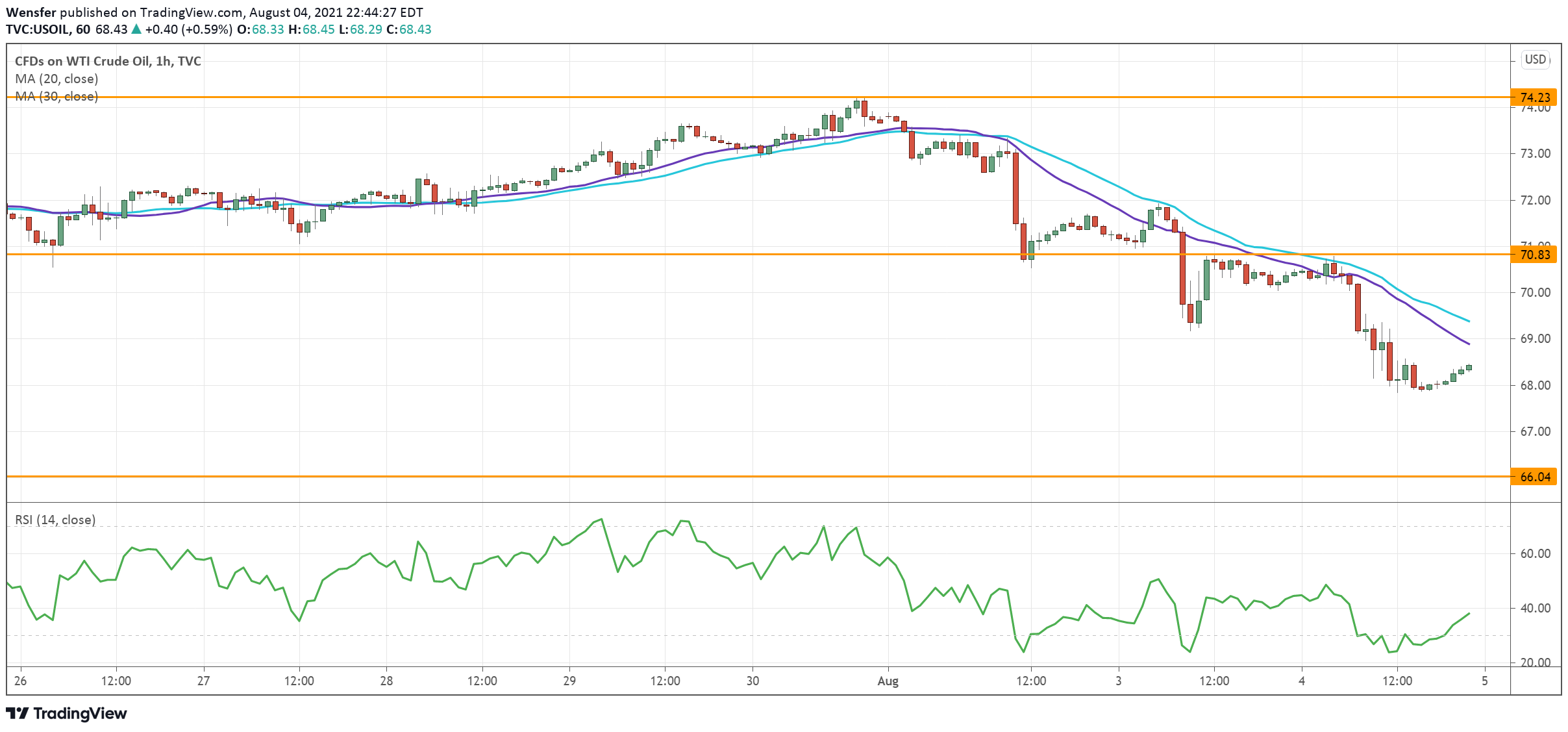
WTI crude fell as US inventory rose by 3.6M barrels last week.
The bearish MA cross on the daily chart could be the start of consolidation for the days to come. The fall below 71.80 is an indication that sentiment has turned sour in the short term at least.
The price is grinding down along the 30-hour moving average. The RSI’s double-dip in the oversold area may prompt a limited bounce.
But as long as the price stays below 70.80, sellers are likely to drive the action towards 66.00, a critical demand zone on the daily timeframe.
EUR/JPY Tests Major Support
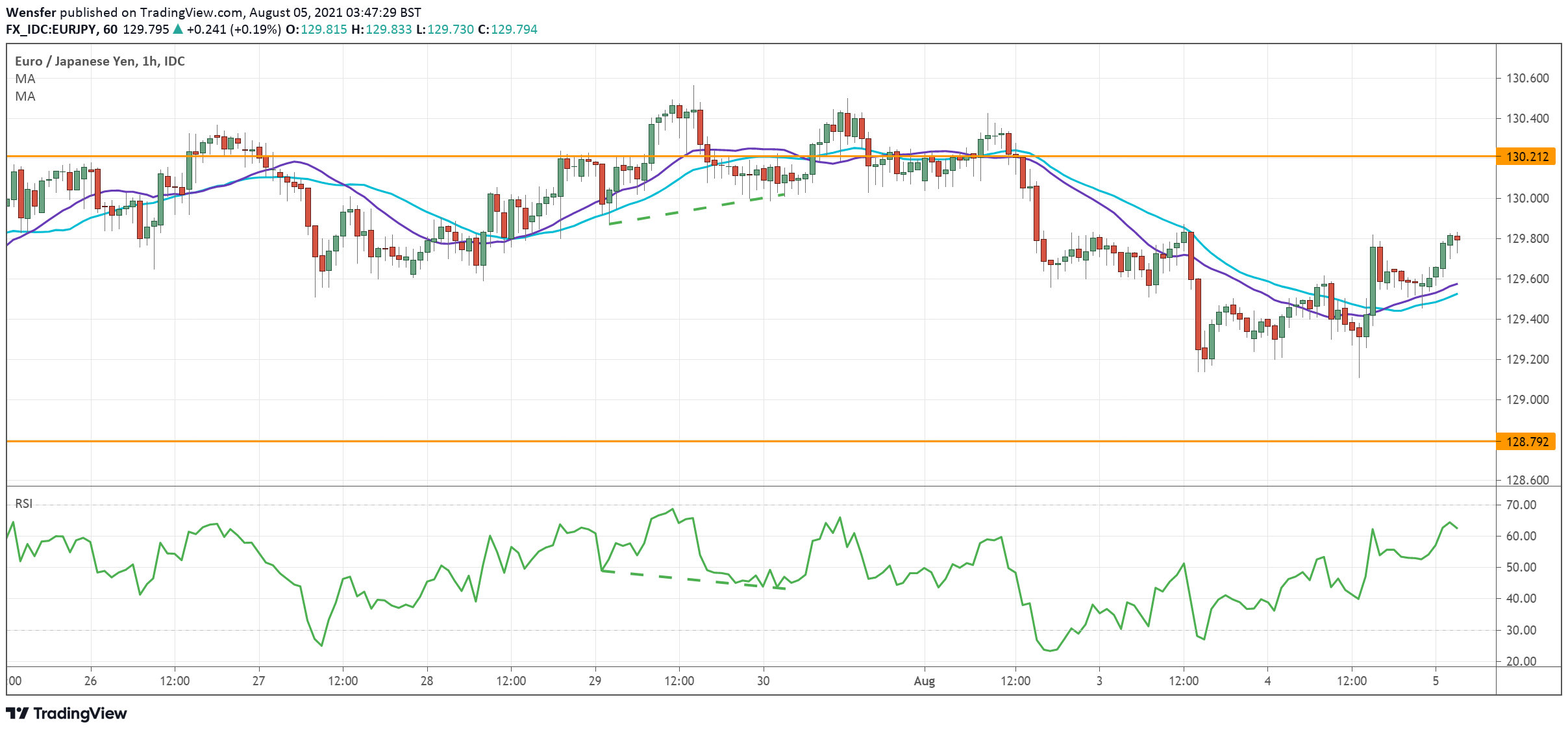
The euro stabilized as the eurozone’s retail sales in June (yoy) beat expectations. The pair has met stiff selling pressure at the 20-day moving average (130.50).
The RSI divergence acted as a warning sign when price action was in the supply zone. The confirmation came in the form of a break below 129.60. The RSI has recovered into the neutral area, as a temporary rebound for the bears to sell into strength.
130.20 is key resistance, and a drop below 128.80 could trigger a wave of sell-off to 127.00.
XAU/USD Challenges Resistance
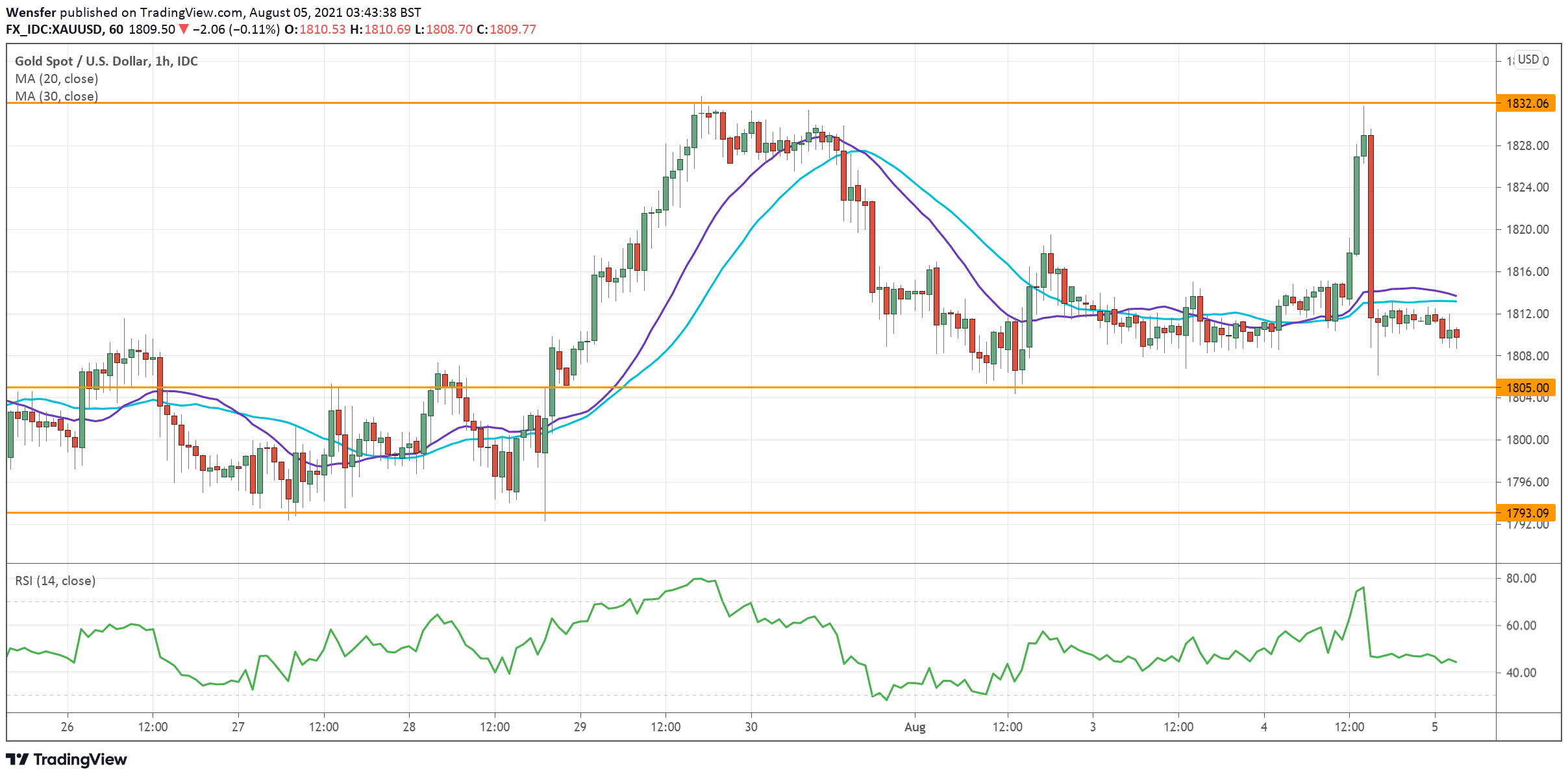
Gold whipsawed after Fed Vice Chair Richard Clarida’s hawkish comment on the US recovery.
The price is holding on to its gains above 1805. A previously oversold RSI has prompted buyers to bid the dip in this demand zone. Now buyers are looking to accumulate chips once more.
The double top at 1832 would be the last hurdle as a breakout could propel the precious metal towards 1860.
On the downside, 1793 at the lower end of consolidation is a key floor in case of the market’s prolonged hesitation.
China’s ‘Targeted’ Clampdown Acquires New Target
China's definition of targeted moves and the financial markets definition of what it thinks is China's definition continues to be different. That is probably because investors put lower stock prices, FOMO, and buy-the-dip into their equation, while the Chinese government does not. Today, China's Securities Times fired another salvo at the online gaming industry, citing teenage addiction and favourable tax treatment. I actually don't disagree; I'd rather the kids read books, even if it is online.
Now admittedly, China's online gaming industry is part of the broader tech space, but this is the second government mouthpiece to take a shot at the sector this week, and you ignore the non-too subtle warning at your perils. From IPOs to tech to after school education, the list of 'targets' seems to get longer every week. Unsurprisingly, China equities have headed south today, bucking the trend in Asia. It seems we still have some way to go before the price discount on China equities offsets the regulatory risk from China's government.
Elsewhere, the US saw some decent whipsaw price action overnight. The ADP Employment number missed severely, coming in at 330,000, less than half the expected result. That saw US bonds rally, the US dollar fall, stocks rise and gold fall. However, ISM Non-Manufacturing and its sub-indices, such as prices, new orders, and employment, impressively outperformed. That turned markets around, and it was left to US Federal Reserve Vice-Chairman Richard Clarida to administer the coup de gras.
Mr Clarida said the Fed would signal tapering before the end of the year, taper right through 2022, and then start hiking interest rates in 2023. Not exactly a surprise but timing is everything. Equities fell, the US dollar rose along with US bond yields and reversed all of its impressive intra-day gains, while oil also fell. More on both later.
In the background, markets are increasing, humming, 'Delta, Dawn, what's that virus you got on?' The list is seemingly lengthening every day of countries wilting under the latest variant. Australia's New South Wales has extended lockdowns to Newcastle and the Hunter Valley. Japan's cases are exploding. Now that Indonesia has increased testing again, cases are rising once again here. The critical regions to watch, though, in my mind, are the big three of the United States, Europe and China. Most particularly China, where a seriously widening outbreak would have negative repercussions for the rest of Asia and require a reassessment of the global recovery.
The appetite for lockdowns in the US and Europe being precisely zero now. One thing is for sure, the global recovery will be one of haves and have nots and will be uneven. And if the US and Europe/UK go down the booster shot route, you can pencil in an even longer recovery time scale for the developing world. In the shorter term, though, China is the one to watch.
Asia's calendar today contains a few snippets. Australia's Balance of Trade came in at an impressive AUD 10.50 billion, with the commodity machine firing on all cylinders. That has been enough to balance out escalating virus nerves in the lucky country and keep Australian equities marginally in the green. Philippine's Inflation eased to 4.0%, to the relief of the central bank, which can keep monetary policy supportive going forward while putting stagflation thoughts to bed for now.
Thailand inflation will be equally benign at around 1.0% later today, with stuttering exports and domestic consumption being crushed by its virus situation. The Bank of Thailand will likely remain at record low rates well into 2022, and the Thai baht will continue to be a regional underperformer. Singapore's Retail Sales have probably slumped under its virus lockdowns. However, DBS has followed OCBC and UOB yesterday and delivered a record result for H2, limiting any fallout in equity markets. Singapore big banking remains one of my favourite Asia recovery plays.
The Bank of England will announce its latest policy decision later today. Increasing delta-variant cases in the UK and a wait-and-see approach to its reopening should ensure the BOE continues its QE programme with rates unchanged. I also doubt any new signals will emerge as to tapering or future rate hikes. US Initial Jobless Claims will be of passing interest, with a print well north of 400,00o likely to spur another drop in US bond yields again, and probably the US dollar.
Overall, I expect markets across asset classes to enter a holding pattern today, with only headline risk moving volatility intra-day, as the street awaits the week's main event tomorrow, the US Non-Farm Payrolls.
Daily Tecnical Analysis
EUR/USD
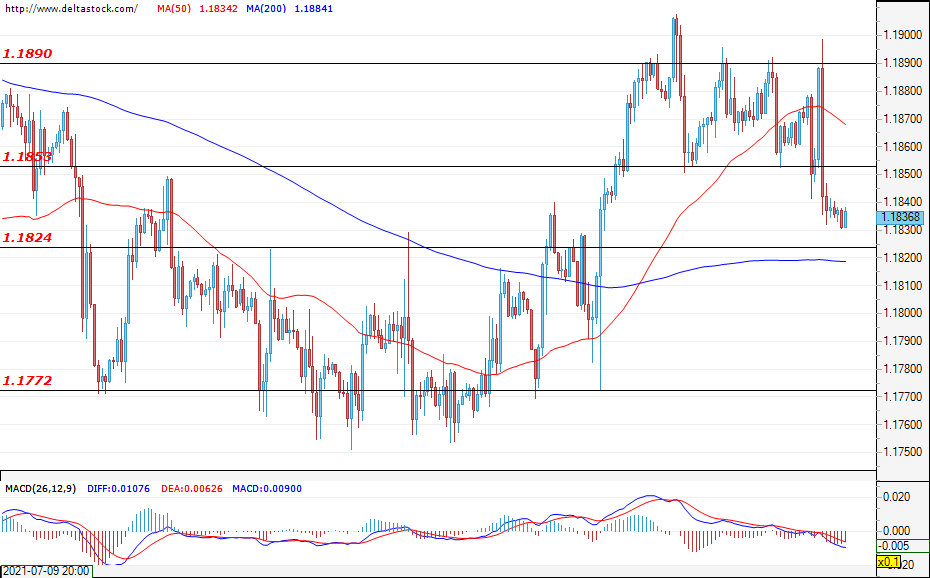
Current level - 1.1863
The bulls failed to breach the resistance at 1.1890 and the bears, in turn, sank the euro under the support of 1.1853. The pair is expected to test the support at 1.1824, where buyers will have a chance to re-enter the market at better prices. If this support does not withstand the bearish pressure, a decline towards 1.1770, and even 1.1700, is possible. Expectations would become bullish only if there is a breach above 1.1890. Today, an increase in activity can be expected around the announcement of the initial jobless claims for the United States at 12:00 GMT.
| Resistance | Support | ||
| intraday | intraweek | intraday | intraweek |
| 1.1853 | 1.1970 | 1.1824 | 1.1705 |
| 1.1890 | 1.2070 | 1.1772 | 1.1600 |
USD/JPY
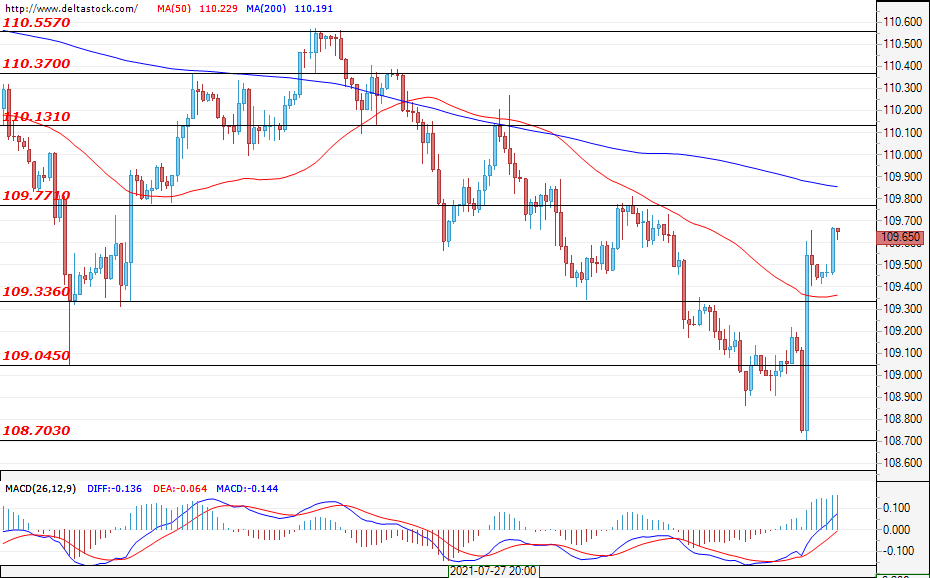
Current level - 109.65
After a false signal for a breach of the 109.04 support, the bulls became active around the support zone at 108.70 and managed to breach the resistance at 109.33. It is possible for the bears to try and attack the 109.33 zone again, but a non-violation here can be considered as an early signal for a reversal of the direction of the market. If the rally continues, it is possible for the bulls to head towards the resistance at 110.37.
| Resistance | Support | ||
| intraday | intraweek | intraday | intraweek |
| 109.77 | 110.37 | 109.04 | 108.55 |
| 110.13 | 110.55 | 108.70 | 108.10 |
GBP/USD
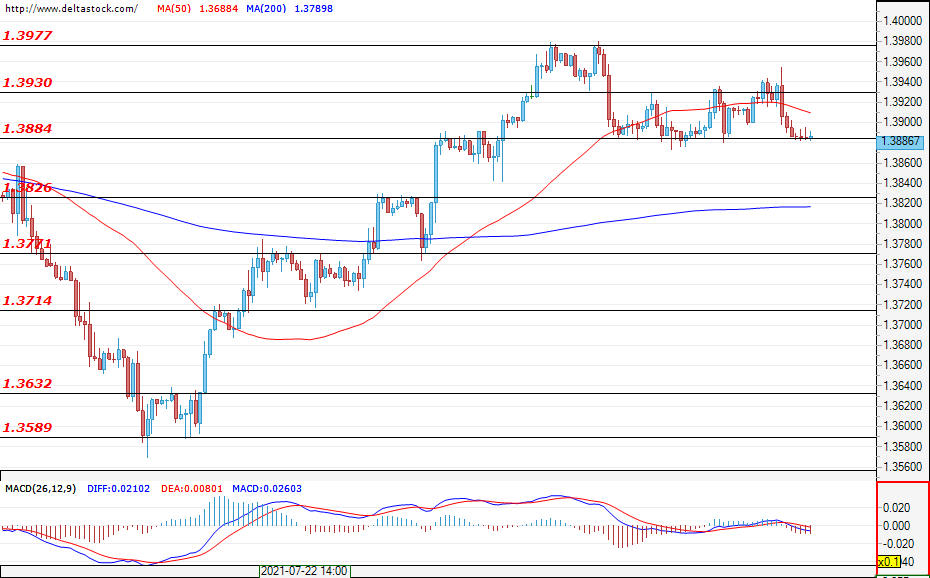
Current level - 1.3886
The pair is still unable to continue the rally and prices are consolidating between the support at 1.3884 and the resistance at around 1.3930. The market may need a catalyst before it could activate and move in a clear direction. Today is the decision of the Bank of England on interest rates and it is expected to lead to increased activity at 11:00 GMT. It is possible that the prices will breach the support of 1.3884 and move towards 1.3826. This would offer a better entry level for the bulls, but if they decide to return to the market, it would be desirable for prices to return above 1.3884 in order to maintain the integrity of the trend. If that isn’t the case, we would instead witness an early phase of a downtrend.
| Resistance | Support | ||
| intraday | intraweek | intraday | intraweek |
| 1.3930 | 1.4060 | 1.3884 | 1.3771 |
| 1.3977 | 1.4115 | 1.3826 | 1.3714 |
USD/CAD Daily Outlook
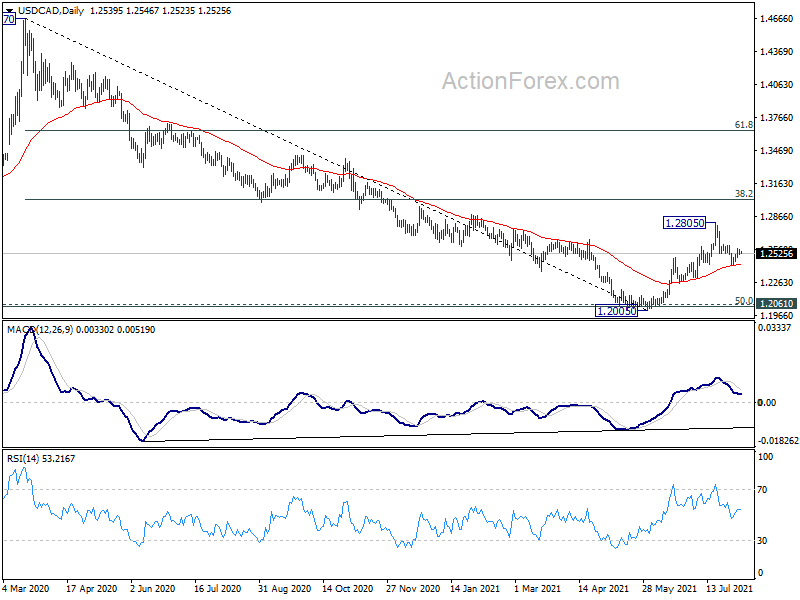
Daily Pivots: (S1) 1.2518; (P) 1.2540; (R1) 1.2565; More...
Outlook in USD/CAD is unchanged and intraday bias remains neutral for consolidations. Further fall is expected as long as 1.2605 resistance holds. On the downside, break of 1.2421 will resume the decline from 1.2805 to 1.2301 cluster support (61.8% retracement of 1.2005 to 1.2805 at 1.2311). However, firm break of 1.2605 will turn bias back to the upside for retesting 1.2805 resistance.
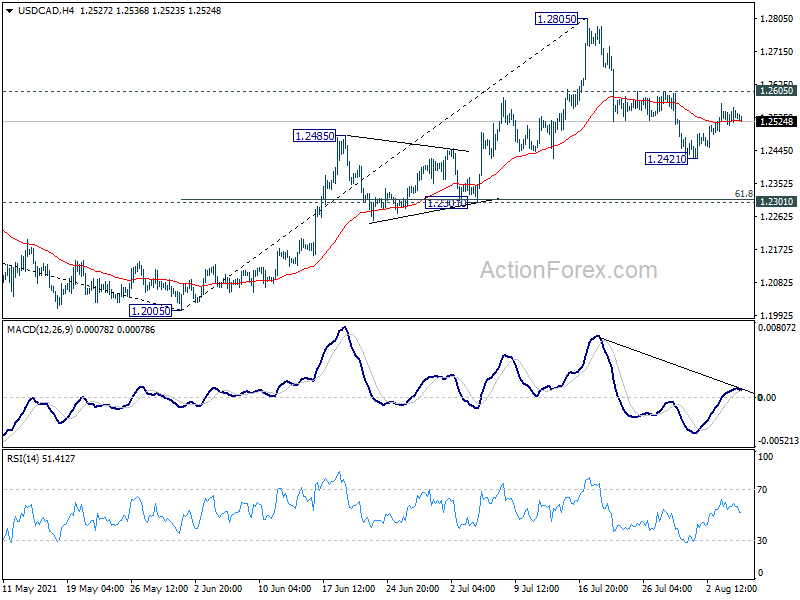
In the bigger picture, fall from 1.4667 is seen as the third leg of the corrective pattern from 1.4689 (2016 high). It should have completed after hitting 1.2061 (2017 low) and 50% retracement of 0.9406 to 1.4689 at 1.2048. Sustained break of 38.2% retracement of 1.4667 to 1.2005 at 1.3022 will pave the way to 61.8% retracement at 1.3650 and above. Overall, medium term outlook remains neutral at worst with 1.2048/61 support zone intact.
AUD/USD Daily Report
Daily Pivots: (S1) 0.7359; (P) 0.7393; (R1) 0.7416; More...
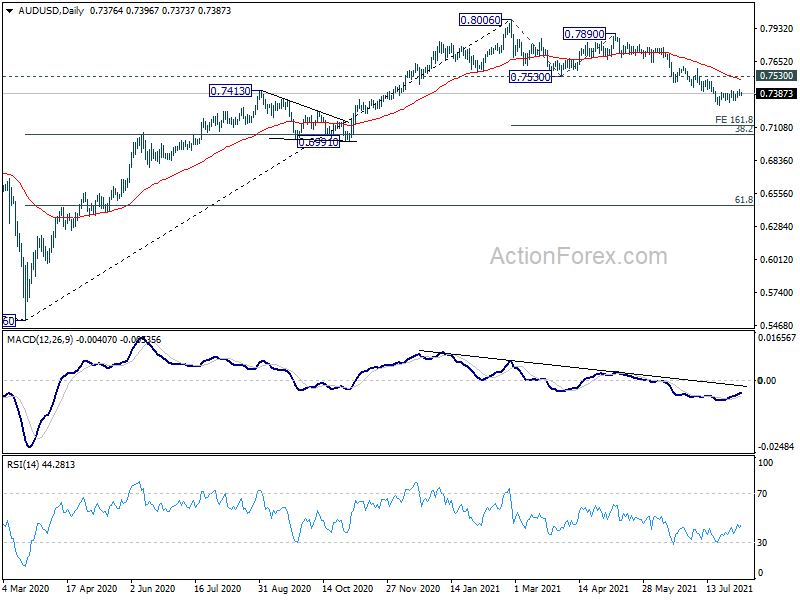
AUD/USD is staying in consolidation from 0.7288 and intraday bias remains neutral first. Near term outlook stays bearish with 0.7443 support turned resistance intact, and further decline is in favor. On the downside, break of 0.7288 will resume the whole fall from 0.8006 and target 161.8% projection of 0.8006 to 0.7530 from 0.7890 at 0.7120 next. On the upside, break of 0.7443 will bring stronger rebound to 0.7530 support turned resistance instead.
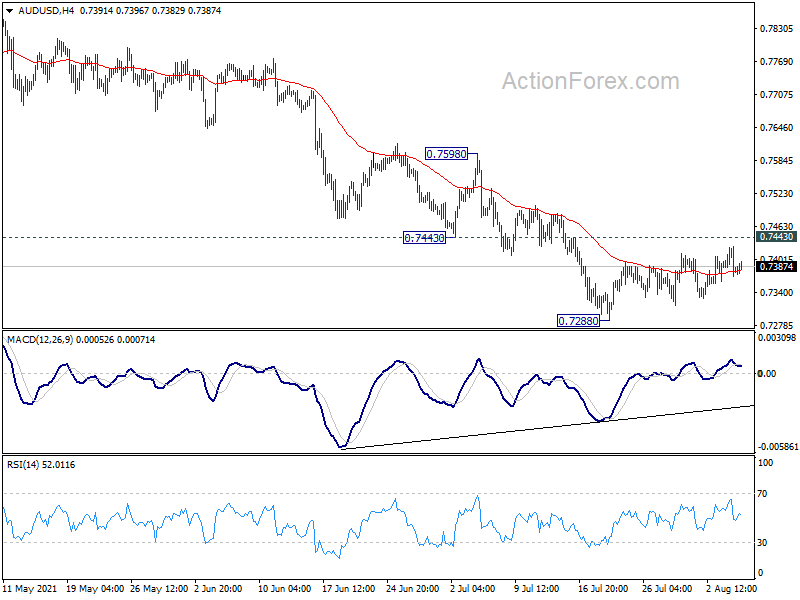
In the bigger picture, rise from 0.5506 medium term bottom could have completed at 0.8006, after failing 0.8135 key resistance. Correction from there could target 0.6991 cluster support (38.2% retracement of 0.5506 to 0.8006 at 0.7051). We'd look for strong support from there to bring rebound. However, sustained break of this level would argue that the whole medium term trend has indeed reversed.