

Sample Category Title
Sterling Lifted Slightly after BoE, But Overall Markets Tread Water
Sterling was lifted very briefly after BoE policy decision, but there was again no follow through buying. Dollar also pays little attention to jobless claims. Overall, the markets are staying in consolidative mode, and would probably stay so before tomorrow's non-farm payrolls report. As of now, Kiwi is the strongest one for the week followed by Aussie. Canadian is the weakest, followed by Euro.
Technically, we'd continue to pay attention to Dollar pairs. In particular, breaks of 110.58 resistance in USD/JPY and 0.9116 support turned resistance in USD/CHF are needed to confirm a Dollar come back. Otherwise, selling of the greenback could still come back any time. Meanwhile, break of 1.0907 resistance in EUR/USD would suggest that the Dollar selloff is taking off.
In Europe, at the time of writing, FTSE is down -0.10%. DAX is up 0.14%. CAC is up 0.39%. Germany 10-year yield is down -0.0133 at -0.508, staying below -0.5 handle. Earlier in Asia, Nikkei rose 0.52%. Hong Kong HSI dropped -0.84%. China Shanghai SSE dropped -0.31%. Singapore Strait Times dropped -0.25%. Japan 10-year JGB yield rose 0.0078 to 0.013.
US initial jobless claims dropped to 385k, continuing claims dropped to 2.9m
US initial jobless claims dropped -14k to 385k in the week ending July 31, slightly above expectation of 382k. Four-week moving average of initial claims dropped -250 to 394k.
Continuing claims dropped -366k to 2930k in the week ending July 24. That's the lowest level since March 14, 2020. Four-week moving average dropped -109k to 3188k, lowest since March 21, 2020.
Also released, US trade deficit widened to USD -75.7B in June, versus expectation of USD -72.5B.
Canada trade balance reported CAD 3.2B surplus in June, versus expectation of CAD 0.4B.
BoE stands pat, won't put undue weight on capacity pressures
BoE left Bank rate unchanged at 0.10% by unanimous vote. Asset purchase target was held at GBP 895B, by 701 vote. Michael Saunders was the only MPC member who voted for tapering to GBP 850B. BoE noted that the Committee will focus on "medium-term prospects for inflation", but "will not put undue weight on capacity pressures that are frictional in nature and likely to be temporary." Though, there remain "two-sided risk" around central path for medium term inflation and risk management considerations "continue to have some force".
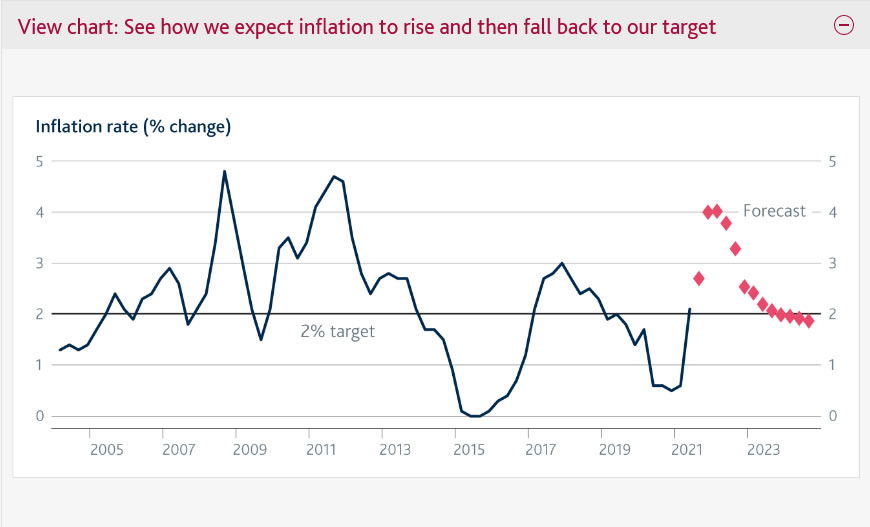
BoE also said that GDP is expected to grow by around 3% in Q3, with just a "small negative impact from recent developments in the pandemic". GDP is projected to "recover further over the remainder of the year", and reaches its prepandemic level in 2021 Q4. CPI inflation is projected to "temporarily" rise to 4% in Q4, but that falls back to close to the 2% target.
ECB bulletin: On track for strong Q3 with strong manufacturing and vigorous bounce-back services
In the Monthly Economic Bulletin, ECB said Eurozone economy is "on track for strong growth" in Q3. Manufacturing is expected to "perform strongly" despite supply bottlenecks. Reopening is supporting a "vigorous bounce-back" in services sector. However, Delta variant "could dampen this recovery in services, especially in tourism and hospitality."
Economic activity is expected to return to pre-crisis level in Q1 next year. But there is "still a long way to go" before the damage is offset. Thus, "significant policy support remains essential". It added, "an ambitious and coordinated fiscal policy should continue to complement monetary policy in underpinning confidence and supporting spending".
UK PMI construction dropped to 58.7, widespread supply shortages and constrained capacity
UK PMI Construction dropped to 58.7 in July, down sharply from June's 24-year high of 66.3. House building remained best-performing category. Supply shortages led to another rapid rise in input prices.
Also released, Germany factory orders rose 4.1% mom in June, above expectation of 1.5% mom. France industrial output rose 0.5% mom in June, matched expectations.
Australia trade surplus widened to AUD 10.2B in Jun
Australia exports of goods and services rose AUD 1489m (4% mom) to AUD 43.34B in June. Imports of goods and services rose AUD 261 m (1% mom) to AUD 32.84B. Trade surplus widened to AUD 10.50B, from AUD 9.27B, slightly above expectation of AUD 10.20B.
GBP/USD Mid-Day Outlook
Daily Pivots: (S1) 1.3865; (P) 1.3911; (R1) 1.3937; More...
GBP/USD recovered after touching 4 hour 55 EMA, but stays below 1.3982. Intraday bias remains neutral for some more consolidations. Outlook is unchanged that corrective pattern from 1.4240 could have completed with three waves down to 1.3570. Further rise is expected as long as 1.3766 support holds. On the upside, break of 1.3982 will resume the rise from 1.3570 to retest 1.4248 high. However, break of 1.3766 support will dampen this bullish view and bring retest of 1.3570.
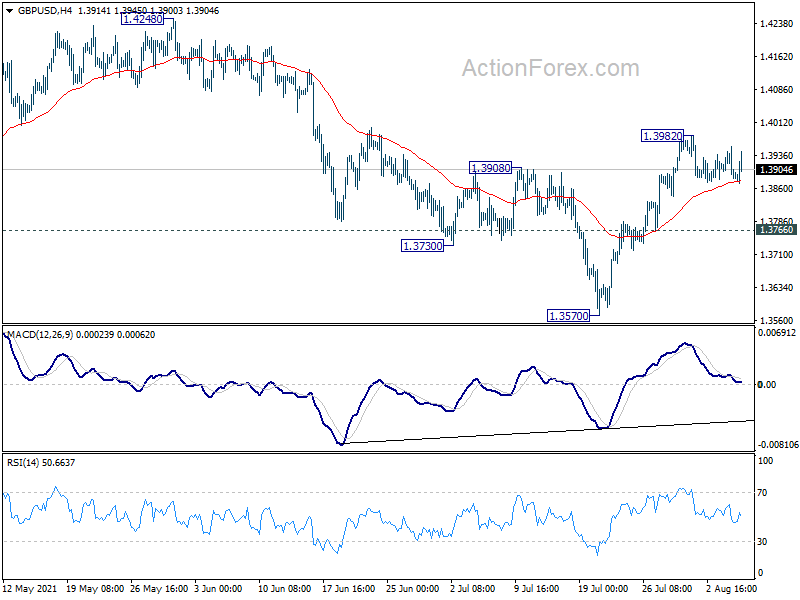
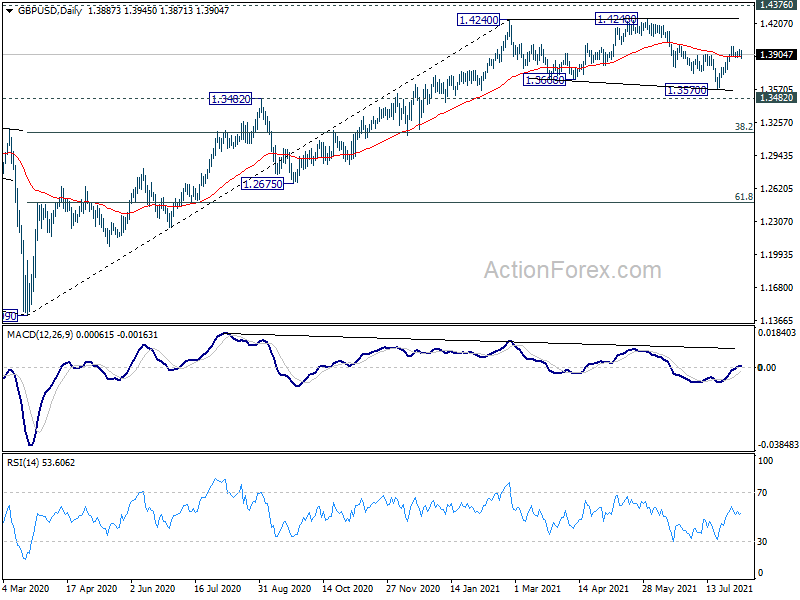
In the bigger picture, as long as 1.3482 resistance turned support holds, up trend from 1.1409 should still continue. Decisive break of 1.4376 resistance will carry larger bullish implications. However, firm break of 1.3482 support will argue that the rise from 1.1409 has completed. GBP/USD would then be seen in another leg of long term range pattern between 1.1409 and 1.4376. Deeper fall could then be seen to 61.8% retracement of 1.1409 to 1.4248 at 1.2493, and even below.
Economic Indicators Update
| GMT | Ccy | Events | Actual | Forecast | Previous | Revised |
|---|---|---|---|---|---|---|
| 01:30 | AUD | Trade Balance (AUD) Jun | 10.50B | 10.20B | 9.68B | 9.27B |
| 06:00 | EUR | Germany Factory Orders M/M Jun | 4.10% | 1.50% | -3.70% | -3.20% |
| 06:45 | EUR | France Industrial Output M/M Jun | 0.50% | 0.50% | -0.30% | -0.40% |
| 08:00 | EUR | ECB Economic Bulletin | ||||
| 08:30 | GBP | Construction PMI Jul | 58.7 | 63.8 | 66.3 | |
| 11:00 | GBP | BoE Rate Decision | 0.10% | 0.10% | 0.10% | |
| 11:00 | GBP | BoE Asset Purchase Facility | 895B | 895B | 895B | |
| 11:00 | GBP | MPC Official Bank Rate Votes | 0--0--8 | 0--0--9 | 0--0--9 | |
| 11:00 | GBP | MPC Asset Purchase Facility Votes | 0--1--7 | 0--1--8 | 0--1--8 | |
| 11:30 | USD | Challenger Job Cuts Y/Y Jul | -92.80% | -88.00% | ||
| 12:30 | CAD | International Merchandise Trade (CAD) Jun | 3.2B | 0.4B | -1.4B | -1.6B |
| 12:30 | USD | Trade Balance (USD) Jun | -75.7B | -72.5B | -71.2B | -71.0B |
| 12:30 | USD | Initial Jobless Claims (Jul 30) | 385K | 382K | 400K | 299K |
| 14:30 | USD | Natural Gas Storage | 19B | 36B |
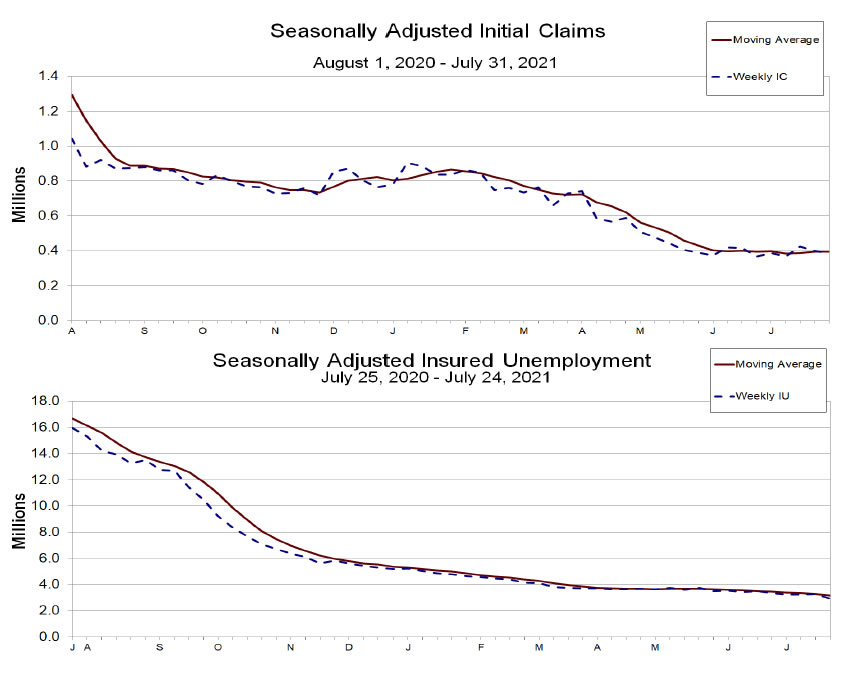
US initial jobless claims dropped to 385k, continuing claims dropped to 2.9m
US initial jobless claims dropped -14k to 385k in the week ending July 31, slightly above expectation of 382k. Four-week moving average of initial claims dropped -250 to 394k.
Continuing claims dropped -366k to 2930k in the week ending July 24. That's the lowest level since March 14, 2020. Four-week moving average dropped -109k to 3188k, lowest since March 21, 2020.
BoE press conference live stream
https://www.youtube.com/watch?v=58LChjcx2ZA
Steady ahead of Jobs Report
We appear to have entered into a holding pattern following a whirlwind session on Wednesday, as conflicting data and hawkish Fed commentary created some choppy conditions.
You can sense the nervousness in the markets this week. Every data release feels like it carries so much more weight and every word uttered by a central banker has the potential to shake things up. A sign of what's to come between now and the end of the year as central banks are pressured to tighten despite their economies not firing on all cyclinders.
Higher inflation is piling on the pressure and policy makers desperately want to avoid a situation in which they're forced to act too late. So while unemployment remains high and downside risks to the economy significant as a result of the delta spread and the risk of new strains, central bankers are pushing ahead with plans to remove emergency era stimulus and plan for rate hikes in the coming years.
Wednesday's rollercoaster ride could be a sign of things to come over the next few months. The ADP report was a shocker, falling well short of expectations and - despite its poor record of being a reliable indicator for Friday's jobs report - lowering expectations for the NFP number and, in turn, tapering odds. That lasted all of an hour and 45 minutes.
The record ISM services PMI, which carries far more respect than the ADP release, told an entirely different story. Employment, orders and prices all accelerated in the survey which will provide plenty of food for thought for the Federal Reserve in the coming months, especially given that services represents more than three quarters of US economic output.
This was compounded by Richard Clarida's comments on bond buying and interest rates which saw markets reverse course, yields and the dollar recoup its losses and some, while gold gave back all of its ADP gains. A tapering announcement in September, with strong hints coming from Jackson Hole in a few weeks, looks increasingly likely now, although that could be pushed back a few months if the jobs reports and other key data points don't deliver.
BoE cautious despite optimistic outlook
The pound was quite choppy around the Bank of England rate decision and the release of the monetary policy report and voting and at the time of writing, it isn't trading too far from where it was pre-release. Ultimately, there was nothing shocking from the MPC, with Michael Saunders the lone dissenter on asset purchases, preferring to end new purchases as soon as possible and cap bond purchases at £830 billion, rather than the current target of £875 billion. Given that some expected a 6-2 vote, this is actually a slightly dovish outcome.
The BoE also laid out the intended conditions for unwinding purchases, ceasing reinvestments once interest rates hit 0.5% before actively selling when bank rate is at least 1%. This is slightly earlier than previously indicated but in line with expectations ahead of the meeting.
Economic forecasts were slightly better on growth and unemployment which is encouraging. But the ending of the furlough scheme, which accounted for around two million jobs at the end of June, remains a risk in the coming months. All in all, a positive outlook from the central bank but the cautious approach still has the backing of the vast majority.
Oil steadies after third day of losses
Oil took its losses for the week to more than 7% on Wednesday, with the latest fall from grace coming as risk assets sold off on hawkish Fed commentary and the strong ISM data. A surprising inventory build of 3.6 million barrels compounded the negativity for crude and saw WTI fall back below $70 and Brent may not be far behind it.
The fundamentals continue to look favourable for oil in the longer run but a combination of negative factors are taking their toll as WTI flirts with seven year highs. The last time oil came under heavy selling pressure was just a few weeks ago and it saw some strong support not far from the levels it's currently trading around.
ISM spoils the party for gold
The ADP report offered such promise for gold prices on Wednesday. Falling well short of expectations and potentially setting us up for a below par jobs report on Friday, gold broke higher after another period of consolidation and once again found itself running into a brick wall around $1,833, an increasingly significant level of resistance.
The ISM report spoiled the party for the yellow metal, with higher yields and a stronger dollar delivering a major blow to its breakout prospects and forcing it back to the levels it traded at prior to the ADP release. With more Fed speak today and an increasingly important jobs report tomorrow, things could get more lively for gold prices.
The comments coming from various Fed officials gives the impression that the balance of power is falling in favour of the hawks, something a strong jobs report will only accelerate. This doesn't bode well for gold, despite the technical picture continuing to look bullish. A big couple of days ahead.
Bitcoin back in the red eyeing key support
Bitcoin is back in negative territory after prices ran into a wall of resistance around $40,000 on Wednesday. The cryptocurrency is 4.5% lower on the day and trading around $38,000. Perhaps profit taking hasn't run its course just yet.
The key level below continues to be $36,000, which coincides with resistance in late June/early July and also represents a 50% retracement of the move from the recent lows to highs.
BoE stands pat, won’t put undue weight on capacity pressures
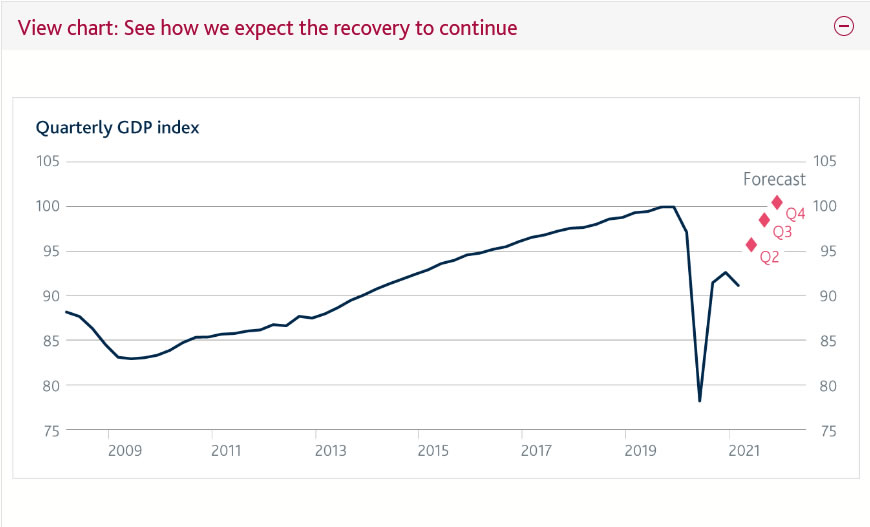
BoE left Bank rate unchanged at 0.10% by unanimous vote. Asset purchase target was held at GBP 895B, by 701 vote. Michael Saunders was the only MPC member who voted for tapering to GBP 850B. BoE noted that the Committee will focus on "medium-term prospects for inflation", but "will not put undue weight on capacity pressures that are frictional in nature and likely to be temporary." Though, there remain "two-sided risk" around central path for medium term inflation and risk management considerations "continue to have some force".
BoE also said that GDP is expected to grow by around 3% in Q3, with just a "small negative impact from recent developments in the pandemic". GDP is projected to "recover further over the remainder of the year", and reaches its prepandemic level in 2021 Q4. CPI inflation is projected to "temporarily" rise to 4% in Q4, but that falls back to close to the 2% target.
GBP/USD Stuck Between A Rock And A Hard Place
- What to expect from the BoE today?
- Hawks a bit more vocal at the BoE
- Why Bailey might call for patience
- Could the pound still find support on BoE inaction?
- NFP next major risk event for GBP/USD (and nearly all other markets)
Underpinned by an improving UK economy and undermined by a Federal Reserve slowly turning hawkish, the GBP/USD is stuck between a rock and a hard place as investors look forward to this week’s main events for this pair: the BoE’s policy decision later today and US non-farm payrolls report on Friday.
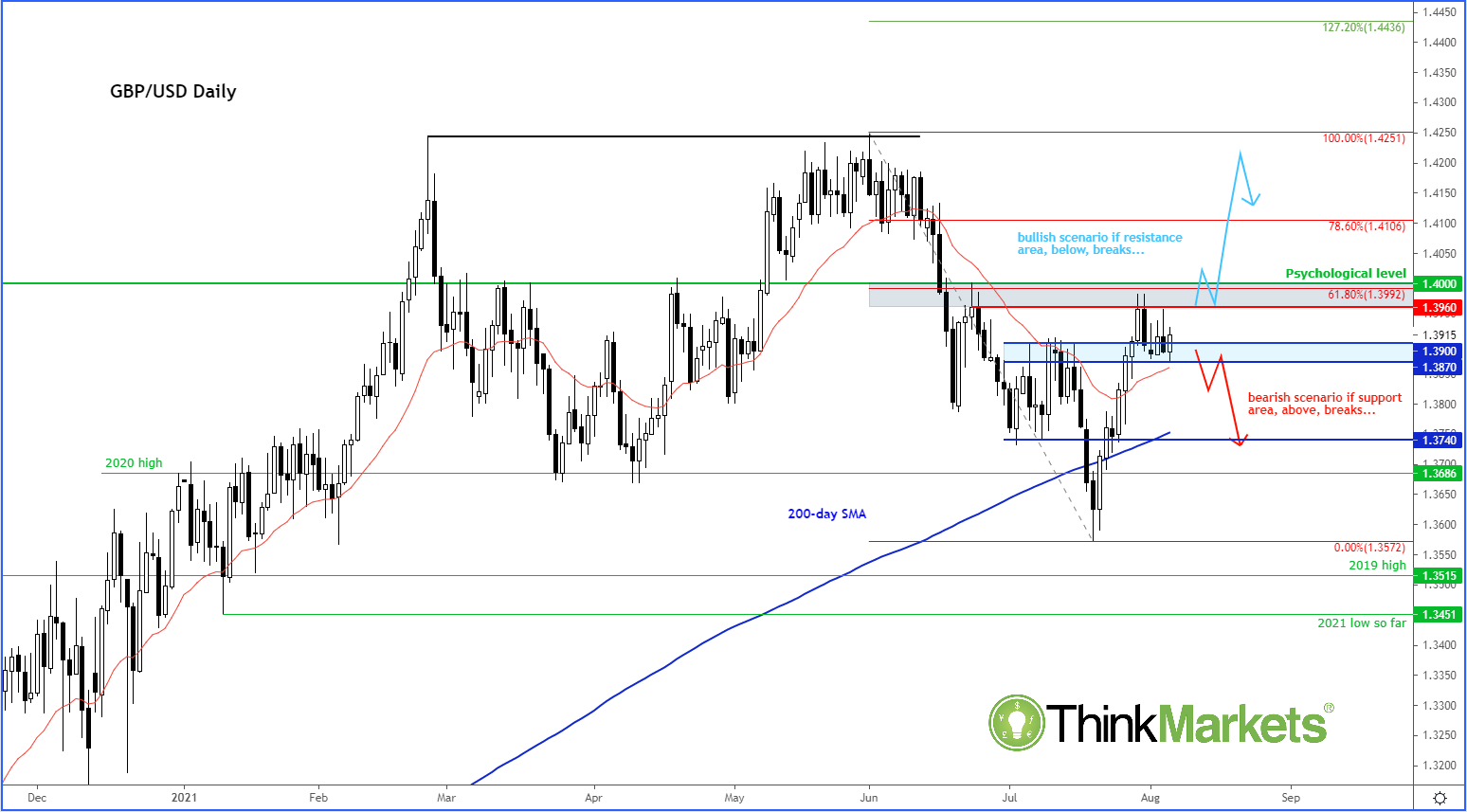
Support has been provided by the area between 1.3870 to 1.3900, while resistance comes in between 1.3960 to 1.4000. Between these ranges, the cable is residing inside no man’s land. Whichever side of the above ranges it eventually breaks out, expect to see further technical buying or selling in the direction of the break.
What to expect from the BoE today?
The need for emergency stimulus measures is receding but the BoE is unlikely to taper QE at this meeting. Still, the BoE may be unable to prevent the pound from appreciating, especially if there are a couple of dissenters at MPC meeting or if the Bank unexpectedly provides hints about when tapering will begin. Indeed, Britain’s respected independent economic research institute, NIESR, expects inflation to climb to 3.9% in early 2022. But like central bankers elsewhere in the developed world, Governor Andrew Bailey and his MPC colleagues are still seen calling for patience on scaling back QE on Thursday.
Hawks a bit more vocal at the BoE
The UK economy has been growing strongly in recent months as lockdown measures eased thanks to the rapid pace of vaccinations and previous lockdown helping to stem the spread of the virus. Although the delta variant has been spreading, new cases have been falling back in more recent days. This is unlikely to have hurt economic activity since all legal restrictions were lifted for England in a meaningful way. As a result, the Bank of England has become increasingly vocal about tapering QE, and the pound has responded by rising across the board. BoE’s Michael Saunders recently said that it "may become appropriate fairly soon to withdraw some stimulus." Saunders said that would be appropriate so long as economic activity and inflation indicators remain in line with recent trends, and downside risks to growth and inflation do not rise significantly. The hawkish comments from Saunders and those from Ramsden before have led to some speculation that the August MPC meeting could be a live one.
Why Bailey might call for patience
However, I don’t think the BoE will move that soon to end asset purchases, but it could nevertheless prepare the market for tapering in the months ahead. This is because inflation is expected to fall back after rising well above the Bank’s 2% target as the impact of temporary factors putting upward pressure on prices recede. What’s more, many economists, including those at the BoE, envisage a jump in UK unemployment rate as we approach the end of furlough, with some 1.9 million people still on the scheme. You also have the potential for new, deadlier, variants of Covid to emerge, while Delta continues to wreak havoc around the world.
Against this backdrop, the BoE is not going to be in hurry to start the normalisation process of its monetary policy, even if the UK economic growth this year is expected to surpass the G7. Therefore, the central bank’s £875 billion bond buying programme is likely to remain intact. Needless to say, interest rates won’t be hiked either.
Could the pound still find support on BoE inaction?
Absolutely. If we see a couple of dissenters at the MPC, this could trigger a rally in Sterling as it will increase the probability of a sooner-than-expected taper in the future policy meetings. Also, there’s the possibility the BoE could provide some insights about how it will eventually reduce its QE programme, which the market may interpret as a hawkish sign.
So, while QE in unlikely to be tapered at this meeting, this outcome is likely to have been priced in. Therefore, any hawkish signs that might emerge from the rate statement or meeting minutes could still underpin the pound, especially against currencies where the central bank is expected to remain dovish longer than the BoE, such as the as euro.
Thus, the EUR/GBP may finally break below that 0.8500 key support. The next bearish targets below this hurdle will be the liquidity resting beneath April’s low at 0.8470ish, followed by last year’s low that was made in February at 0.8280ish, which happens to be very close to the 2019’s low at 0.8277. In other words, big levels are at risk of being taken out. The Chunnel just needs a push to get us there.
However, in the event of a dovish surprise, it would be best to look at selling the pound against a stronger currency than the euro.
NFP next major risk event for GBP/USD (and nearly all other markets)
The US Federal Reserve is just waiting for employment to improve further before starting to reduce the pace of its asset purchases, with inflation already well above the central bank’s target and rising. The world’s largest economy is about 6 million or so jobs below the pre-pandemic level. The employment trend has been strong. If we get one or two really good jobs reports over the next couple of months then the conditions for starting the normalisation process will have been met for many of the Fed’s policy makers. This makes the upcoming jobs reports very important. Stay tuned, as we will later provide a preview for the July NFP data.
(BOE) Bank Rate Maintained at 0.1%
Monetary Policy Summary, August 2021
The Bank of England's Monetary Policy Committee (MPC) sets monetary policy to meet the 2% inflation target, and in a way that helps to sustain growth and employment. At its meeting ending on 4 August 2021, the Committee judged that the existing stance of monetary policy remained appropriate. The MPC voted unanimously to maintain Bank Rate at 0.1%. The Committee voted unanimously for the Bank of England to maintain the stock of sterling non-financial investment-grade corporate bond purchases, financed by the issuance of central bank reserves, at £20 billion. The Committee voted by a majority of 7-1 for the Bank of England to continue with its existing programme of UK government bond purchases, financed by the issuance of central bank reserves, maintaining the target for the stock of these government bond purchases at £875 billion and so the total target stock of asset purchases at £895 billion.
The Committee's updated projections for activity and inflation are set out in the accompanying August Monetary Policy Report. They assume that, despite the spread of the Delta variant, the impact of Covid on the UK economy fades further over time. They are also conditioned on the market path for interest rates.
Global GDP growth is estimated to have risen sharply in 2021 Q2, as Covid vaccination programmes gathered pace and restrictions were eased further. Partly reflecting the spread of the Delta variant, global growth in Q3 is expected to expand at a slower pace than anticipated in the May Report. Global price pressures have continued to build, reflecting the speed and unevenness of the recovery in activity, and disruptions to supply chains.
UK GDP is expected to have risen by 5% in 2021 Q2, leaving it around 4% below its pre-pandemic level and slightly stronger than expected in the May Report. After the MPC's previous meeting, the number of Covid cases continued to rise but has subsequently shown signs of falling back, although there has been a sharp increase in the number of people being asked to self-isolate temporarily. The majority of remaining domestic Covid restrictions have now been lifted. Faster indicators of household spending have been broadly flat, at close to pre-Covid levels, but the housing market has remained strong. GDP is expected to grow by around 3% in Q3, somewhat weaker than expected in the May Report, with a small negative impact from recent developments in the pandemic. UK GDP is projected to recover further over the remainder of the year, reaching its pre-pandemic level in 2021 Q4, with demand growth boosted by a waning impact from Covid. Further out, the pace of GDP growth is expected to slow towards more normal rates, partly reflecting the gradual tightening in the stance of announced fiscal policy.
The Labour Force Survey unemployment rate was 4.8% in the three months to May, 1 percentage point higher than at the end of 2019. The inactivity rate was also 1 percentage point above its level at the end of 2019. The number of full and part-time furloughed jobs has continued to decline as demand has recovered, but remained at around 2 million at the end of June. The stock of vacancies has increased further, as have indicators of recruitment difficulties. There appear to have been difficulties in matching available jobs and workers. These frictions are for a period reducing effective supply in the economy. Overall, the MPC judges that spare capacity has been eroded over the past couple of quarters, as demand has outstripped growth in effective supply. Frictions in the labour market are judged likely to dissipate over the forecast period, boosting growth in effective supply capacity. There is uncertainty around these judgements, including how the economy will adjust to the end of the furlough scheme.
Private sector regular pay in the three months to May was over 7% higher than a year earlier, and annual growth is projected to have peaked at around 8½% in 2021 Q2. Adjusted for the impact of the furlough scheme, the changing composition of employment during the pandemic and annual base effects, underlying pay growth appears to continue to be around pre-Covid rates.
Twelve-month CPI inflation rose to 2.5% in June, above the MPC's 2% target and 0.8 percentage points higher than expected in the May Report. Core CPI inflation has also risen further, to 2.3%, as building global input cost pressures have been passed through to some consumer goods prices and, to a lesser degree, the reopening of the economy has led to a pickup in some consumer services and goods prices. CPI inflation is projected to rise temporarily in the near term, to 4% in 2021 Q4, owing largely to developments in energy and other goods prices, before falling back to close to the 2% target.
The Committee's central expectation is that current elevated global and domestic cost pressures will prove transitory. Nonetheless, the economy is projected to experience a more pronounced period of above-target inflation in the near term than expected in the May Report. And, alongside temporary constraints on supply, the rapid recovery in demand has eroded spare capacity such that the economy is projected to have a margin of excess demand for a period. In the medium term, conditioned on the market path for interest rates, inflation is projected to fall back to close to the 2% target, and demand and supply are expected to return broadly to balance.
The MPC has had policy guidance in place specifying that it does not intend to tighten monetary policy at least until there is clear evidence that significant progress is being made in eliminating spare capacity and achieving the 2% inflation target sustainably. Some members of the Committee judge that, although considerable progress has been made in achieving the conditions of that guidance, the conditions are not yet met fully. The other members judge that the conditions of the guidance have been met fully, but note that the guidance made clear that these have only ever been necessary not sufficient conditions for any future tightening in monetary policy.
All members confirm that in judging the appropriate stance of monetary policy, the Committee will, as always, focus on the medium-term prospects for inflation, including medium-term inflation expectations, rather than factors that are likely to be transient. In particular, the Committee will not put undue weight on capacity pressures that are frictional in nature and likely to be temporary. The Committee will be monitoring closely the incoming evidence regarding developments in the labour market, and particularly unemployment, wider measures of slack and underlying wage pressures. In addition, there remain two-sided risks around the central path for inflation in the medium term. Risk management considerations continue to have some force.
The Committee judges that, should the economy evolve broadly in line with the central projections in the August Monetary Policy Report, some modest tightening of monetary policy over the forecast period is likely to be necessary to be consistent with meeting the inflation target sustainably in the medium term.
At this meeting, the Committee judged that the existing stance of monetary policy remained appropriate.
Minutes of the Monetary Policy Committee meeting ending on 4 August 2021
1 Before turning to its immediate policy decision, and against the backdrop of its latest economic projections, the Committee discussed: the international economy; monetary and financial conditions; demand and output; and supply, costs and prices.
The international economy
2) UK-weighted global GDP growth was estimated to have risen sharply in 2021 Q2, as Covid vaccination programmes had gathered pace and restrictions had eased further. Growth in Q2 was likely to have been somewhat stronger than projected in the May Monetary Policy Report. Partly reflecting the spread of the Delta variant, global GDP in Q3 was expected to expand at a slower pace than had been anticipated in the May Report.
3) Global price pressures had continued to build, reflecting the speed and unevenness of the recovery in global activity, supply chain disruptions, and some shortages of inputs. Some of these factors were likely to be transitory and could subsequently unwind. There had been further sharp increases in manufacturing output prices and non-oil commodity prices had also risen a little recently. The Brent oil spot price had fallen slightly since the MPC's previous meeting, however, to around $72 per barrel, with the increased production announced by OPEC+ members on 18 July having pushed down somewhat on prices. Shipping costs had increased further, although disruption at major Chinese ports had been easing and global containerised trade flows had continued to rise.
4) These factors had combined with strong demand for certain goods and services to push consumer price inflation higher in many advanced and emerging market economies (EMEs) in recent months. In the United States, core PCE inflation had ticked up to 3.5% in June, while the headline measure had remained unchanged at 4.0%. In the euro area, headline HICP inflation had increased somewhat in July, to 2.2%, although the core measure had fallen a little to 0.7%. Headline inflation in these regions was expected to fall somewhat in coming quarters, as some of the previous rises had reflected factors that were likely to be temporary, such as the contribution of energy prices and sector-specific supply and demand mismatches. In China, by contrast, consumer price inflation had remained subdued, although producer price inflation had picked up sharply.
5) According to the preliminary flash estimate, euro-area GDP had grown by 2.0% in 2021 Q2, following a slight fall in Q1. This Q2 outturn was stronger than expected at the time of the MPC's previous meeting, although it still left the level of GDP around 3% lower than immediately before the pandemic, in 2019 Q4. Led by the service sector, the euro-area composite output PMI had risen further in July, to 60.2, and the European Commission's business confidence survey balances had also picked up again. The euro-area unemployment rate had fallen by 0.3 percentage points to 7.7% in June. Recent news on the spread of the Delta variant was likely to push down on GDP growth in Q3 compared with previous assumptions.
6) According to the advance estimate, US GDP had increased by 1.6% in 2021 Q2. This was slightly weaker than expected at the time of the MPC's previous meeting, but it had been sufficient to raise the level of GDP back above its pre-Covid peak. Within this, household spending had continued to grow robustly, with services consumption having accelerated but goods consumption growth having slowed. In the labour market, the unemployment rate was little changed at 5.9% in June, but inactivity had remained persistently high, and there were signs of elevated mismatch, with a high level of vacancies despite unemployment remaining well above its pre-Covid rate. Recent news on the spread of the Delta variant was likely to weigh on GDP growth in Q3, although mobility indices and internet searches related to social spending suggested that the impact on US economic activity was likely to be smaller than in other major advanced economies.
7) In China, GDP growth had picked up to 1.3% in 2021 Q2, in line with expectations at the time of the MPC's previous meeting, following a relatively weak expansion of 0.4% in Q1. Covid-related restrictions imposed in Guangdong province in May and June appeared to have had a fairly limited impact on aggregate economic activity. Monthly data for June had suggested some rebalancing towards private domestic demand, with retail sales and manufacturing investment strengthening, albeit with property investment moderating.
8) In a number of large EMEs, there had been a sharp increase in Covid cases recently. The latest business surveys had nevertheless pointed to a mixed picture across countries, with manufacturing PMIs for July recovering in India and Turkey, but falling sharply in South Africa and Indonesia. The rollout of vaccines in EMEs continued to have been generally more limited than in many advanced economies. Given this, aggregate growth in large EMEs appeared likely to slow somewhat in the third quarter, and the economic impact from the spread of the Delta variant was expected to be more persistent than in advanced economies.
9) The Committee discussed any lessons that could be learned from the economic experience of countries that had taken earlier steps to relax Covid restrictions than the United Kingdom, such as Australia, New Zealand and Israel. None of these countries provided an exact parallel to the United Kingdom's situation, and each had had different experiences of the virus and policy responses. There were nevertheless some noteworthy features. Household savings had tended to decline from elevated rates after restrictions were lifted, but had not fallen materially below their pre-Covid levels, suggesting that there had been no rapid run-down of involuntarily accumulated savings. There had been only a gradual normalisation in the composition of consumer demand, with demand for durable goods remaining high as demand for services recovered. Governments in Australia and New Zealand appeared to have been able to withdraw support from the labour market without a sharp increase in unemployment.
Monetary and financial conditions
10) Advanced-economy longer-term government bond yields had fallen since the MPC's previous meeting, reversing some of the increases seen earlier in the year. The main drivers of these movements appeared to have been increased concerns about Covid-related risks to the global growth outlook. The falls in yields had been accounted for primarily by real rates, with inflation compensation components having been broadly stable.
11) Market-implied measures of advanced-economy policy rates had fallen a little since the MPC's previous meeting. At its meeting on 22 July, the ECB Governing Council had left its key policy interest rates and the scale and pace of its asset purchase programmes unchanged. The Governing Council had earlier published its new monetary policy strategy, on 8 July, which had included the adoption of a symmetric 2% inflation target over the medium term. The conclusions of the strategy review had been largely in line with market expectations. At its 28 July meeting, the Federal Open Market Committee had left unchanged its target range for the federal funds rate and the pace of asset purchases.
12) The market-implied path for Bank Rate that underpinned the August Monetary Policy Report projections rose to around 0.5% at the MPC's three-year forecast horizon, little changed from the May Report.
13) Movements in risky asset prices since the MPC's previous meeting had been mixed. US equity prices had increased, but in the United Kingdom and euro area, they had been little changed. Although the fall in government bond yields had supported equity prices, equity risk premia had risen in all regions, possibly reflecting a perceived increase in the risk posed by Covid to the economic outlook. Equity prices related to companies in industries that had been most exposed to Covid, such as airlines, had continued to underperform headline indices.
14) The sterling effective exchange rate had been broadly stable since the previous MPC meeting.
15) Credit supply conditions for households had loosened since the Committee's previous meeting, particularly for mortgage lending, for which much of the tightening that had occurred since the onset of the pandemic had unwound. Spreads on fixed-term mortgages had continued to fall. Net secured lending to households had risen to an all-time high of £17.9 billion in June. This strength was in large part due to an elevated number of property transactions completing before the tapering in July of the temporary stamp duty threshold in England and Northern Ireland, and the removal of the similar tax change in Wales. The net flow of consumer credit had continued to be slightly positive in June, having edged up gradually over the previous few months.
16) While credit conditions for small and medium-sized enterprises had tightened in 2021 Q2 with the ending of some government lending schemes, conditions for the corporate sector overall had been little changed, and were looser than expected in the May Report.
Demand and output
17) UK GDP was estimated to have risen by 0.8% in May, slightly weaker than had been expected by Bank staff immediately prior to the release. Within this, consumer-facing services output had increased by around 5% on the month, reflecting the reopening of indoor hospitality and non-self-contained accommodation. Private business-to-business services, construction and manufacturing output in May had been weaker than expected, however. In particular, there had been some evidence of global supply chain disruptions weighing on UK activity, with a shortage of semiconductor microchips leading to a sharp fall in car production. For the second quarter as a whole, Bank staff continued to expect GDP to have been slightly stronger than forecast at the time of the May Monetary Policy Report. The August Report projections incorporated 2021 Q2 quarterly growth of 5%, which would have left GDP around 4% below its level in 2019 Q4, prior to the pandemic.
18) After the MPC's previous meeting, the number of Covid cases had continued to increase but had subsequently shown signs of falling back, although there had been a sharp increase in the number of people asked to self-isolate temporarily through various channels. The number of hospitalisations of Covid patients and, in particular, deaths within 28 days of testing positive for Covid had risen to a lesser degree than during previous waves of the pandemic. The vaccination programme had continued. The majority of remaining domestic Covid restrictions had been lifted in England on 19 July, and were planned to be relaxed to a similar degree in Wales on 7 August and in Scotland on 9 August. Restrictions in Northern Ireland had been lifted progressively in late July.
19) Having picked up strongly in April and May, immediately following the reopening of the economy, faster indicators of household spending, such as CHAPS payments data, had been broadly flat in June and July, at levels close to those immediately before the pandemic. Measures of consumer confidence had also stabilised. Official retail sales volumes had risen by 0.5% in June, following a 1.3% fall in May, and leaving the level of sales around 9% above its 2019 Q4 level. Private new car registrations had risen slightly in June, to around their pre-pandemic levels.
20) Residential property transactions had picked up significantly in June, to 198,000 from 114,000 in May, as buyers had completed transactions before the tapering in July of the temporary stamp duty threshold in England and Northern Ireland, and the removal of the similar tax change in Wales. The number of mortgage approvals for house purchase had fallen slightly in June, however, to 81,300. The UK house price index had risen by 0.5% in May, taking the inflation rate in the three months to May compared to the same period a year earlier to around 10%. Timelier indicators had suggested some ongoing strength in house price inflation in the near term, with surveys and intelligence from the Bank's Agents continuing to point to demand running ahead of supply.
21) The ONS Business Insights and Conditions Survey suggested that the share of UK companies open for trading had increased slightly further since the MPC's previous meeting, although that share appeared to have stabilised at around 90% in the most recent data. There had been tentative signs that rising Covid cases and the number of individuals self-isolating had affected workplace mobility in some areas. Evidence from both manufacturing and services PMI surveys suggested that there remained substantial backlogs of work. The Bank's Agents had also reported constraints on output from frictions in both global and domestic supply chains, shortages of heavy goods vehicle delivery drivers and restrictions in labour supply. Official trade data for May had continued to show that goods imports from the European Union had been weaker than imports from non-EU countries.
22) Companies' expectations of the near-term impact of Covid on business investment had been at similar levels in the July Decision Maker Panel survey as in the May survey that the Committee had had available at its previous meeting. Firms expected investment in 2021 Q3 to be around 6% lower than it would otherwise have been, and around 3% lower in 2021 Q4. Agency contacts had reported that companies in several sectors were expecting to resume investment projects that had been put on hold during the pandemic, particularly in sectors in which demand was outpacing capacity.
23) Overall, GDP was expected to grow by around 3% in 2021 Q3 in the August Report projection, compared with just over 4% in the May Report. Despite the upside news in activity anticipated for the second quarter, this meant that the level of GDP was projected to be slightly lower in the third quarter than at the time of the May Report, with a small negative impact expected from recent developments in the pandemic.
24) The Committee discussed the risks around the near-term outlook for GDP. The impact of the Delta variant could, against a counterfactual of stronger growth, already be having a larger negative impact on activity than the Committee was assuming, including via voluntary social distancing. If the recent moderation in Covid cases persisted then that could lead to stronger-than-expected growth further out, however. And it was not clear to what extent voluntary social distancing was affecting spending at an aggregate level if consumption could now be substituted away more easily from activities considered riskier from a health perspective. But some levelling off in many indicators of spending had occurred before the latest pickup in cases and so it was also possible that the flattening in consumer spending over recent months had simply reflected an easing of the initial release of pent-up demand. This had also been observed in countries that had reopened earlier than the United Kingdom.
Supply, costs and prices
25) The Labour Force Survey (LFS) unemployment rate had fallen from 5.2% in 2020 Q4 to 4.8% in the three months to May, although it had remained 1 percentage point higher than at the end of 2019. The LFS inactivity rate was also around 1 percentage point higher than it had been before the pandemic. LFS responses since the beginning of 2020 had been reweighted using population weights informed by HMRC payrolls data. The revised LFS estimates were now consistent with a broadly stable population aged 16 and over, and had shown a slightly steeper decrease in the employment rate relative to earlier estimates for the period. HMRC payroll figures had continued to show a much steeper decline in the number of employees during 2020 than implied by the LFS, but had also shown a sharper recovery since the turn of the year. The HMRC series had increased by around a further 350,000 between May and June, although it was still around 200,000 lower than in February 2020.
26) The number of jobs furloughed under the Coronavirus Job Retention Scheme (CJRS) had fallen by around 600,000 during June, to just under 1.9 million by the end of the month, equivalent to around 8% of private sector jobs. The latest data from the ONS Business Insights and Conditions Survey, scaled to match the administrative estimates, had suggested that around 6% of private sector jobs were furloughed in the first half of July, of which 55% of these jobs were held by employees on a flexible form of furlough that allowed them to have undertaken some work with their employer. The proportion of salary for furloughed hours covered by the government had been tapered from 80% to 70% in July and to 60% from 1 August, with employers required to top up to 80%.
27) The increases in unemployment, inactivity and the number of jobs furloughed since the onset of the pandemic suggested a material amount of labour market slack. Other indicators pointed to the labour market having been tighter, however. The stock of vacancies had increased further in June, to almost 20% above its 2019 average, such that the single-month ratio of vacancies to unemployment had returned to its level in early 2020. The latest Bank's Agents' score for recruitment difficulties had also risen sharply to close to its pre-pandemic level, and the index of staff availability in the REC Report on Jobs had reached a record low in June. The speed and scale of the recovery in labour demand had contributed to increasing recruitment difficulties. In addition, there appeared to have been difficulties in matching available jobs and workers, perhaps reflecting disparities across geographical areas. In recent weeks, some of the Agents' contacts had also reported a significant number of employees self-isolating for a period, contributing to temporary labour shortages.
28) Private sector regular Average Weekly Earnings (AWE) had risen by 7.2% in the three months to May on a year earlier, and the annual rate was projected to have peaked at around 8½% in 2021 Q2 in the August Monetary Policy Report forecast. Annual AWE growth rates had been boosted by base effects, reflecting the marked drop in pay in 2020 Q2. The recent strength had also reflected significant compositional effects, with the jobs lost during the pandemic skewed towards lower-paid roles. Adjusted for the effects of the CJRS and changes in composition, Bank staff estimated that private sector regular pay had risen by an annualised rate of 2¾% since 2019 Q4, including 4% annualised growth in the first half of this year, the latter of which was around the rates seen prior to the pandemic. There was a lot of uncertainty around these estimates, however. The Agents had also reported a pickup in pay settlements, and signs of pay pressures emerging more broadly, with a number of contacts reviewing pay structures or giving targeted pay increases or bonuses.
29) Twelve-month CPI inflation had risen from 2.1% in May to 2.5% in June, 0.8 percentage points higher than projected in the May Report. Similarly, core CPI inflation, excluding food, beverages, tobacco and energy, had risen from 2.0% to 2.3%. The bulk of the news had been in core goods components, such as cars and clothing and footwear, with some additional upside news in services, and catering prices in particular, and to a lesser degree energy prices. Goods prices had increased globally, reflecting strong demand for goods and supply shortages. Some of the recent strength in CPI inflation might have also been related to the initial reopening of some sectors of the economy.
30) CPI inflation was projected to rise further in the near term, to around 4% in 2021 Q4. Almost half of the projected increase was accounted for by higher energy price inflation. At the same time, core CPI inflation was projected to rise to around 3%. The Agents' contacts had reported further increases in the costs of a wide range of materials and commodities, and higher-than-usual freight and warehousing costs, with such costs having been passed through to consumer prices to a greater extent than earlier in the year. Price and cost indicators, such as the manufacturing input and output PMIs, had remained high since the MPC's June meeting, and in some cases had strengthened further, posing a potential upside risk to the short-term inflation forecast alongside increasing labour cost pressures. UK import prices had picked up less strongly than these other cost measures would suggest, however, albeit by more than might have been expected given developments in world export prices and the sterling exchange rate. To the extent that CPI inflation had been boosted initially by the lifting of restrictions, there was the potential for such inflationary pressures to moderate as demand settled down.
31) Companies' expectations of inflation one and two years ahead had increased, according to a range of business surveys, including the latest Deloitte CFO and CBI surveys and the July Decision Maker Panel. One-year ahead financial market and professional forecasters' inflation expectations had also risen in 2021 Q2, and the Citi/YouGov measure of household one-year ahead inflation expectations had risen in July, having fallen a little in Q2. Short-term household measures tended to be correlated with inflation outturns, so it was possible that they would increase somewhat further alongside the expected rise in CPI inflation over the coming months. Medium-term measures of inflation expectations were expected to be more stable in the face of a temporary shock to inflation. The Citi/YouGov five-year ahead measure of inflation expectations had remained unchanged in July. Medium-term financial market measures of UK inflation compensation, such as the five-year inflation swap rate, five years forward, had been broadly stable since the MPC's previous meeting, at a little above their average levels over the previous decade.
The immediate policy decision
32) The MPC sets monetary policy to meet the 2% inflation target, and in a way that helps to sustain growth and employment.
33) The Committee reviewed recent developments against the backdrop of its latest economic projections as set out in the accompanying August Monetary Policy Report. Those projections assumed that, despite the spread of the Delta variant, the impact of Covid on the UK economy faded further over time. They were also conditioned on the market path for interest rates.
34) Global GDP growth was estimated to have risen sharply in 2021 Q2, as Covid vaccination programmes had gathered pace and restrictions had been eased further. Partly reflecting the spread of the Delta variant, global GDP in Q3 was expected to expand at a slower pace than had been anticipated in the May Report. In the August Report projections, UK-weighted world GDP continued to rise robustly in the near term, as the impact of Covid continued to wane, supported by vaccination programmes. The pace of the expansion in global GDP slowed over 2022, with growth returning to around pre-Covid rates in the latter years of the forecast period.
35) Global price pressures had continued to build, reflecting the speed and unevenness of the recovery in activity, and disruptions to supply chains. These developments had been reflected in world export price inflation, which had picked up sharply. Such trends could persist for a period, particularly if supply chains were vulnerable to further Covid-related disruptions. The strength in global inflationary pressures was expected to be transitory in the Committee's central projections, however. And it was possible that price pressures could prove to be weaker than expected in the medium term, as previous periods of elevated tradable goods prices had often been followed by periods of relatively low inflation, possibly because supply had adjusted only with a lag.
36) Advanced-economy longer-term government bond yields had fallen since the MPC's previous meeting, possibly reflecting concerns about Covid-related risks to global growth. The falls in yields had been accounted for primarily by real rates, with inflation compensation components having been broadly stable. Movements in risky asset prices globally had been mixed. Credit supply conditions for UK households had loosened, particularly for mortgage lending, for which much of the tightening that had occurred since the onset of the pandemic had unwound.
37) As of 4 August 2021, the total stock of assets held in the Asset Purchase Facility had reached £845 billion, including £100 billion of the £150 billion programme of UK government bond purchases announced on 5 November 2020.
38) UK GDP was expected to have risen by 5% in 2021 Q2, leaving it around 4% below its pre-pandemic level and slightly stronger than expected in the May Report.
39) After the MPC's previous meeting, the number of Covid cases in the United Kingdom had continued to rise but had subsequently shown signs of falling back, although there had been a sharp increase in the number of people being asked to self-isolate temporarily. The majority of remaining domestic Covid restrictions had now been lifted.
40) Faster indicators of household spending had been broadly flat, at close to pre-Covid levels, but the housing market had remained strong. There was some evidence of constraints on output from frictions in supply chains, and restrictions in labour supply. GDP was expected to grow by around 3% in 2021 Q3, somewhat weaker than expected in the May Report, with a small negative impact from recent developments in the pandemic. In the near term, the risks to GDP were judged to be skewed to the downside of the central forecast, as there could be an impact on UK and global activity from a renewed rise in Covid cases, especially if any new variants of the virus emerged for which vaccine efficacy was significantly lower.
41) UK GDP was projected to recover further over the remainder of the year, reaching its pre-pandemic level in 2021 Q4, with demand growth boosted by a waning impact from Covid. Further out, the pace of GDP growth was expected to slow towards more normal rates. Over the forecast period, consumption was supported by households running down around 10% of the additional savings they had accumulated in aggregate while spending on some activities had been restricted. Fiscal policy was estimated to continue to support UK demand in the near term, with the policy stance tightening gradually over time in line with government announcements.
42) The Labour Force Survey unemployment rate had been 4.8% in the three months to May, 1 percentage point higher than at the end of 2019. The inactivity rate had also been 1 percentage point above its level at the end of 2019. The number of full and part-time furloughed jobs had continued to decline as demand had recovered, but had remained at around 2 million at the end of June. The stock of vacancies had increased further, as had indicators of recruitment difficulties. There appeared to have been difficulties in matching available jobs and workers. These frictions were for a period reducing effective supply in the economy, suggesting that the unemployment rate consistent with stabilising wage growth at rates in line with meeting the inflation target was at present higher than prior to the pandemic. Overall, the MPC judged that spare capacity had been eroded over the past couple of quarters, as demand had outstripped growth in effective supply. Frictions in the labour market were judged likely to dissipate over the forecast period, boosting growth in effective supply capacity. There was uncertainty around these judgements, including how the economy would adjust to the end of the furlough scheme.
43) In the near term, excess demand was projected to emerge in the August Report projections, as the pickup in demand was projected to continue to be a little more rapid than that of supply. Over 2022, however, as supply growth slowed by a little less than demand growth, excess demand was eroded. Demand and supply returned broadly to balance in the third year of the forecast period.
44) There were two-sided risks around the MPC's assumptions about the degree to which the economy would need to adjust in the medium term in response to the pandemic, and hence its projections for supply growth. One possibility was that the composition of demand would normalise and that any sectoral re-adjustment on the supply side might be relatively quick. Alternatively, a larger reallocation of labour within or across sectors or geographic areas might be required, resulting in more persistent mismatches between supply and demand.
45) Private sector regular pay in the three months to May had been over 7% higher than a year earlier, and annual growth was projected to have peaked at around 8½% in 2021 Q2. Adjusted for the impact of the furlough scheme, the changing composition of employment during the pandemic and annual base effects, underlying pay growth appeared to continue to be around pre-Covid rates.
46) Twelve-month CPI inflation had risen to 2.5% in June, above the MPC's 2% target and 0.8 percentage points higher than had been expected in the May Report. Core CPI inflation had also risen further, to 2.3%, as building global input cost pressures had been passed through to some consumer goods prices and, to a lesser degree, the reopening of the economy had led to a pickup in some consumer services and goods prices.
47) CPI inflation was projected to rise temporarily in the near term, to 4% in 2021 Q4, 1.5 percentage points higher than had been expected in the May Report, and owing largely to developments in energy and other goods prices. Above-target inflation was expected to be transitory in the August Report projections, as commodity prices were assumed to stabilise, supply shortages were assumed to ease and global demand to rebalance away from goods and back towards services. As a result, CPI inflation was expected to fall back and was projected to return to close to the 2% target in the medium term.
48) There were two-sided risks around this central path for inflation. On the downside, for example, there could be larger-than-expected supply responses in commodity and other global markets, pushing down on future input prices and import costs. On the upside, current elevated inflationary pressures could potentially lead to some second-round effects on consumer prices. Taking together the evidence from financial market measures and surveys of households, businesses and professional forecasters, the Committee judged that UK inflation expectations remained well anchored. The Committee would continue to monitor the risk that domestic and global demand and cost pressures could affect medium-term inflation expectations.
49) The Committee turned to its immediate policy decision.
50) The Committee's central expectation was that current elevated global and domestic cost pressures would prove transitory. Nonetheless, the economy was projected to experience a more pronounced period of above-target inflation in the near term than had been expected in the May Report. And, alongside temporary constraints on supply, the rapid recovery in demand had eroded spare capacity such that the economy was projected to have a margin of excess demand for a period. In the medium term, conditioned on the market path for interest rates, inflation was projected to fall back to close to the 2% target, and demand and supply were expected to return broadly to balance.
51) The MPC had, since the second half of 2020, had policy guidance in place specifying that it did not intend to tighten monetary policy at least until there was clear evidence that significant progress was being made in eliminating spare capacity and achieving the 2% inflation target sustainably. The Committee discussed whether the conditions of that guidance had now been met, taking account of both the August Report projections and recent developments in economic data.
52) Some members of the Committee judged that, although considerable progress had been made in achieving the conditions of the MPC's existing policy guidance, the conditions were not yet met fully. In particular, they judged that it was not sufficiently clear that the economy was on a path to meet the inflation target sustainably, given the remaining downside risks from Covid, and the judgement of these members that GDP and employment were materially below their medium-term potential.
53) The other members of the Committee judged that the conditions of the existing policy guidance had been met fully, as demonstrated by developments in economic data and the latest central projections for spare capacity and CPI inflation in the August Report, but noted that the guidance had made clear that these had only ever been necessary not sufficient conditions for any future tightening in monetary policy.
54) All members confirmed that in judging the appropriate stance of monetary policy, the Committee would, as always, focus on the medium-term prospects for inflation, including medium-term inflation expectations, rather than factors that were likely to be transient. In particular, the Committee would not put undue weight on capacity pressures that were frictional in nature and likely to be temporary. The Committee would be monitoring closely the incoming evidence regarding developments in the labour market, and particularly unemployment, wider measures of slack and underlying wage pressures. In addition, there remained two-sided risks around the central path for inflation in the medium term. Risk management considerations continued to have some force.
55) At this meeting, most members of the Committee judged that the existing stance of monetary policy, which included the previously announced £150 billion increase in the target stock of purchased assets, remained appropriate.
56) For one member, the economic outlook warranted a reduction in the scale of monetary policy stimulus at this MPC meeting. This member preferred to stop the current asset purchase programme as soon as practical after this meeting rather than continue it until around the end of the year, as currently planned. This member judged that, with the existing policy stance, inflation was likely to remain above the 2% target two and three years ahead. This reflected the prospect of a larger and more persistent level of excess demand in the United Kingdom and a greater impact from global cost pressures than in the central forecast in the August Report. Moreover, continuing with asset purchases when CPI inflation was 4% and the output gap was closed, as was likely to be the situation later this year, might cause medium-term inflation expectations to drift higher. A modest tightening of monetary policy at this meeting would mitigate these risks, which otherwise might ultimately necessitate a more abrupt subsequent tightening in policy and hence a greater adjustment in growth and employment.
57) The Committee judged that, should the economy evolve broadly in line with the central projections in the August Monetary Policy Report, some modest tightening of monetary policy over the forecast period was likely to be necessary to be consistent with meeting the inflation target sustainably in the medium term.
58) The Chair invited the Committee to vote on the propositions that:
Bank Rate should be maintained at 0.1%;
The Bank of England should maintain the stock of sterling non-financial investment-grade corporate bond purchases, financed by the issuance of central bank reserves, at £20 billion;
The Bank of England should continue with its existing programme of UK government bond purchases, financed by the issuance of central bank reserves, maintaining the target for the stock of these purchases at £875 billion.
The Committee voted unanimously in favour of the first and second propositions.
Seven members (Andrew Bailey, Ben Broadbent, Jon Cunliffe, Jonathan Haskel, Dave Ramsden, Silvana Tenreyro and Gertjan Vlieghe) voted in favour of the third proposition. One member (Michael Saunders) voted against this proposition, preferring to reduce the target for the stock of UK government bond purchases from £875 billion to £830 billion.
Operational considerations
59) The existing programme of £150 billion of UK government bond purchases had started in January and its completion was expected by around the end of 2021. Further details of the planned operational approach to gilt purchases between the August and December MPC meetings were set out in the Market Notice accompanying these minutes. Should market functioning worsen materially, the Bank of England stood ready to increase the pace of purchases to ensure the effective transmission of monetary policy.
60) In addition, and as also described in the Market Notice accompanying these minutes, the Committee agreed to reinvest £16.6 billion of cash flows associated with the redemptions of the September 2021 gilt held by the Asset Purchase Facility.
61) The Committee would keep the asset purchase programme under review. If needed, there was scope for the Bank of England to re-evaluate the existing technical parameters of the gilt purchase programme.
The MPC's monetary policy toolkit
62) In its February 2021 minutes, the Committee had requested that the PRA should engage with PRA-regulated firms to ensure they commenced preparations in order to be ready to implement a negative Bank Rate at any point after six months. The MPC had also requested that Bank staff should commence internal technical preparations to deliver the option of a tiered system of reserve remuneration that could be ready to be implemented, should it be judged appropriate, alongside a negative Bank Rate. As the Committee had stressed in February, these preparations should not be interpreted as a signal that the setting of a negative Bank Rate was imminent, or in prospect at some specific time. At its August meeting, the Committee had been briefed that technical preparations internally and by PRA-regulated firms had progressed sufficiently that a negative Bank Rate could be implemented by the system as a whole, with or without tiered reserve account remuneration, if warranted.
63) In Box A of the accompanying August Monetary Policy Report, the Committee had set out its updated strategy for the mix of its monetary policy tools and its intended approach to using the instruments in its toolkit to deliver any tightening in the overall stance of policy, should that be required. The path of Bank Rate and the stock of purchased assets over the next few years would depend on economic developments. The overall stance of monetary policy would, as always, be set to meet the 2% inflation target, and in a way that helped sustain growth and employment.
64) Finally, on behalf of the Committee, the Chair expressed his appreciation to Gertjan Vlieghe for his contributions to the work of the MPC since becoming a member in 2015.
65) The following members of the Committee were present:
Andrew Bailey, Chair
Ben Broadbent
Jon Cunliffe
Jonathan Haskel
Dave Ramsden
Michael Saunders
Silvana Tenreyro
Gertjan Vlieghe
Clare Lombardelli was present as the Treasury representative.
As permitted under the Bank of England Act 1998, as amended by the Bank of England and Financial Services Act 2016, Bradley Fried was also present on 2 August, as an observer, for the purpose of exercising oversight functions in his role as a member of the Bank's Court of Directors.
Watching To See If Hawks Emerge At Upcoming BOE Decision
Notes/Observations
- BOE seen keeping policy steady inflation rebound; focus on QE vote.
- Overall markets weighing the prospects of economic recovery against the risk of possible curbs to stimulus measures.
- German industrial orders beat expectations but supply bottlenecks weigh.
- Busy Corporate data day: Companies due to report during the NY morning include Atlas Air, Arrow Electronics, Bombardier, BCE Inc, Becton Dickinson, Berry Global, Cardinal Health, Cars.com, CIGNA, datadog, Fiverr International, Gildan Activewear, Hanesbrands, Huntington Ingalls, Himax Technologies, Iron Mountain, Kellogg, Moderna, NRG Energy, Penn National Gaming, Parker Hannifin, Party City, Papa Johns, Regeneron, Revlon, SeaWorld, Stratasys, Tenneco, Thomson Reuters, ViacomCBS, ViaSat, Wayfair, DENTSPLY, Zoetis.
Asia
- Australia Jun Final Trade Balance: A$10.5B v A$10.5B prelim; Exports M/M: 4% v 6%e; Imports M/M: 1% v 4%e.
Coronavirus
- France to be removed from UK's Amber-plus travel restriction list for the fully vaccinated.
- US said to be considering a plan to require all foreign visitors to be vaccinated for the coronavirus.
Europe:
- Ireland Fin Min Donohoe (Eurogroup chief) saw the likelihood of a global tax deal, happening now, more than ever before.
Americas:
- Fed's Daly (non-voter, dove) reiterated that Fed would do something on asset purchases late this year or early 2022.
- Fed's Kaplan (non-voter; hawkish): Taper of bond purchases should start 'soon' and be gradual.
- US State Dept approved sales of military equipment to Taiwan in proposed $750M deal (1st such deal under the Biden Administration).
- Brazil Central Bank (BCB) raised the Selic Target Rate by 100bps to 5.25% (as expected) for its biggest rate hike in 18 years. The decision to raise rates was unanimous. Rate adjustments reflected worsening CPI, several core CPI measures above target and appropriate for this rate hike cycle to raise key rate above neutral. Expected to raise rate by another 100bps at next policy meeting.
Speakers/Fixed income/FX/Commodities/Erratum
Equities
- Indices [Stoxx600 +0.39% at 470.04, FTSE +0.05% at 7,127.25, DAX +0.20% at 15,723.35 , CAC-40 +0.54% at 6,782.64, IBEX-35 +0.15% at 8,806.00, FTSE MIB +0.26% at 25,555.50, SMI +0.15% at 12,196.68, S&P 500 Futures +0.23%].
- Market Focal Points/Key Themes: European indices open mixed but later moved to trade generally positive; plethora of earnings major theme of the session; sectors among these trending higher include technology and industrials; while materials and consumer discretionary among those leading to the downside; DAX weighed on by disappointing results from Adidas, Continental; Bayer acquires Vividion; Enel divets stake in Open Fiber; reportedly Unilever looking to sell stakein tea business; earnings expected during the upcoming US session include Nice, AES, Banco BMP and Ball Corp.
Equities
- Consumer discretionary: WPP [WPP.UK] +2% (earnings), Adidas [ADS.DE] -4% (earnings), Deutsche Post [DPW.DE] -1% (earnings).
- Financials: Credit Agricole [ACA.FR] -1% (earnings).
- Healthcare: Merck KGaA [MRK.DE] +5% (earnings), Bayer [BAYN.DE] -5% (earnings; acquisition).
- Industrials: Siemens [SIE.DE] +3.5% (earnings), Rolls Royce [RR.UK] +3% (earnings), Continental [CON.DE] -2% (earnings), Lufthansa [LHA.DE] -2% (earnings).
Speakers
- ECB Economic Bulletin noted that considered that price stability was best maintained by aiming for a 2.0% inflation target over the medium term.
- France President Macron: Quite likely that a 3rd covid dose will be needed for the elderly and most vulnerable.
- Japan M Suga announced that it would expand Covid-19 restrictions to more prefectures but not thinking of declaring a State of Emergency (SOE) for the whole country (**Note: Tokyo said to report >5.0K new coroanvirus cases for a fresh record high).
- Fitch affirmed Singapore sovereign rating at AAA; outlook stable.
- Israel Defense Min Gantz: Israel was prepared to attack in Iran.
- Biden Administration said to unveil goal and new car emissions standards later today. President to o sign executive order for half of cars sold to be emission-free by 2030.
Currencies/Fixed Income
- FX markets were dull despite some divergence on the rate outlook among the G7.
- USD mainly steady after several Fed comments on Wed led markets to move forward the likely timing of a policy tightening.
- GBP in focus with BOE policy decision. Dealers watching for hints to tapering a.
Economic data
- (NL) Netherlands July CPI M/M: 0.5% v 0.2% prior; Y/Y: 1.4% v 2.0% prior.
- (NL) Netherlands July CPI EU Harmonized M/M: 0.6% v 0.1% prior; Y/Y: 1.4% v 1.7% prior.
- (DE) Germany Jun Factory Orders M/M: 4.1% v 2.0%e; Y/Y: 26.2% v 22.9%e.
- (FR) France Jun Industrial Production M/M: 0.5% v 0.5%e; Y/Y: 7.1% v 7.5%e.
- (FR) France Jun Manufacturing Production M/M: 0.9% v 1.4%e; Y/Y: 7.5% v 22.1% prior.
- (CZ) Czech Jun Retail Sales Y/Y: 9.7% v 7.3%e; Retail Sales (ex-auto) Y/Y: 7.2% v 5.4%e.
- (DE) Germany July Construction PMI: 47.1 v 47.0 prior.
- (UK) July New Car Registrations Y/Y: -29.5% v 28.0% prior.
- (TW) Taiwan July CPI Y/Y: 2.0% v 1.9%e; CPI Core Y/Y: 1.3% v 1.3%e; WPI Y/Y: 11.8% v 10.7% prior.
- (TW) Taiwan July Foreign Reserves: $543.1B v $543.3B prior.
- (UK) July Construction PMI: 58.7 v 64.4e (6th month of expansion).
- (CY) Cyprus July CPI M/M: 0.1% v 0.3% prior; Y/Y: 4.0% v 3.1% prior.
Fixed income Issuance
- (ES) Spain Debt Agency (Tesoro) sold total €4.66B vs. €4.0-5.0B in 2024, 2026, 2031 bonds.
- Sold €1.124B in 0.0% May 2024 SPGB bonds; Avg yield: -0.547% v -0.440% prior; Bid-to-cover: 2.27x v 2.02x prior (Jun 17th 2021).
- Sold €2.00B in 0.0% Jan 2026 SPGB bonds; Avg Yield: -0.441% v -0.245% prior; bid-to-cover: 1.57x v 1.99x prior (July 1st 2021).
- Sold €1.54B in 0.50% Oct 2031 SPGB bonds; Avg Yield: 0.199% v 0.354% prior; bid-to-cover: 1.30x v 1.79x prior.
- (ES) Spain Debt Agency (Tesoro) sold €M vs. €250-750M indicated range in 1.00% Nov 2030 inflation linked bonds (SPGBi); Real Yield: -1.333% v -0.889% prior; Bid-to-cover: 1.62x v 1.39x prior.
- (FR) France Debt Agency (AFT) sold total €7.498B vs. €6.5-7.5B in 2031, 2032 and 2034 bonds.
- Sold €4.160B in 1.5% May 2031 Oat; Avg Yield: -0.23% v 0.92% prior; bid-to-cover: 1.77x v 1.79x prior (Aug 6th 2020).
- Sold €1.133B in 5.75% 2032 Oat; Avg Yield: -0.17% v -0.26% prior; bid-to-cover: 2.79x v 2.08x prior (Dec 3rd 2020).
- Sold €2.205B in 1.25% 2034 Oat; Avg Yield: +0.01% v -0.09% prior; bid-to-cover: 2.31x v 2.13x prior.
Looking Ahead
- (RU) Russia July Light Vehicle Car Sales Y/Y: 2.5%e v 28.7% prior.
- (IL) Israel July Foreign Currency Balance: No est v $200.2B prior.
- (UR) Ukraine July Official Reserve Assets: $28.8Be v $28.4B prior.
- 05:25 (EU) Daily ECB Liquidity Stats.
- 05:30 (HU) Hungary Debt Agency (AKK) to sell debt.
- 06:00 (IE) Ireland July Unemployment Rate: No est v 7.6% prior.
- 06:00 (RO) Romania to sell RON400M in 2.5% 2027 Bonds.
- 06:00 (RO) Romania to sell RON1.3B in 6-month and 12-month bills.
- 06:45 (US) Daily Libor Fixing.
- 07:00 (UK) Bank of England Bank (BOE Interest Rate Decision: Expected to leave Interest Rate unchanged at 0.10% and maintain Total Asset Purchases at £895B (Gilt Purchase Target at £875B and Corporate Assets at £20B).
- 07:00 (UK) BOE Aug Minutes and Monetary Policy Report.
- 07:00 (ZA) South Africa Jun Electricity Production Y/Y: No est v 12.1% prior; Electricity Consumption Y/Y: No est v 12.3% prior.
- 07:30 (US) July Challenger Job Cuts: No est v -20.5K prior; Y/Y: No est v -88.0% prior.
- 08:00 (UK) Daily Baltic Dry Bulk Index.
- 08:30 (US) Jun Trade Balance: -$74.1Be v -$71.2B prior.
- 08:30 (US) Initial Jobless Claims: 383Ke v 400K prior; Continuing Claims: 3.255Me v 3.269M prior.
- 08:30 (CA) Canada Jun Int'l Merchandise Trade (CAD): -0.6Be v -1.4B prior.
- 08:30 (CZ) Czech Central Bank (CNB) Interest Rate Decision: Expected to raise 2-Week Repurchase Rate by 25bps to 0.75%.
- 08:30 (US) Weekly USDA Net Export Sales.
- 09:00 (RU) Russia Gold and Forex Reserve w/e July 30th: No est v $594.5B prior.
- 09:00 (CL) Chile Jun Nominal Wage M/M: No est v -0.2% prior; Y/Y: No est v 5.8% prior.
- 10:00 (UK) Fed’s Waller on digital currency.
- 10:30 (US) Weekly EIA Natural Gas Inventories.
- 11:30 (US) Treasury to sell 4-Week and 8-Week Bills.
- 12:00 (RU) Russia July CPI M/M: 0.4%e v 0.7% prior; Y/Y: 6.6%e v 6.5% prior.
- 12:00 (RU) Russia July CPI Core M/M: 0.5%e v 0.8% prior; Y/Y: 6.7%e v 6.6% prior.
- 12:00 (CA) Canada to sell C$4.5B in 0.25% 2023 Bonds.
- (EG) Egypt Central Bank Interest Rate Decision: Expected to leave Deposit Rate unchanged at 8.25%; Lending Rate current at 9.25%.
- 15:00 (AR) Argentina Jun Industrial Production Y/Y: No est v 30.2% prior; Construction Activity Y/Y: No est v 70.9% prior.
- (MX) Citibanamex Survey of Economists.
- 19:00 (KR) South Korea Jun Current Account Balance: No est v $10.8B prior; Balance of Goods (BOP): No est v $6.4B prior.
- 19:00 (AU) RBA Gov Lowe Testimony to Parliament Committee.
- 19:30 (JP) Japan Jun Labor Cash Earnings Y/Y: 1.1%e v 1.9% prior; Real Cash Earnings Y/Y: 1.2%e v 2.0% prior.
- 19:30 (JP) Japan Jun Household Spending Y/Y: 0.2%e v 11.6% prior.
- 20:00 (CO) Colombia July CPI M/M: +0.1%e v -0.1% prior; Y/Y: 3.8%e v 3.6% prior.
- 20:00 (CO) Colombia July CPI Core M/M: No est v 0.2% prior; Y/Y: No est v 2.7% prior.
- 21:00 (PH) Philippines Jun Trade Balance: -$2.8Be v -$2.8B prior; Exports Y/Y: 9.9%e v 29.8% prior; Imports Y/Y: 28.8%e v 47.7% prior.
- 21:00 (AU) Australia to sell A$700M in 0.25% 2025 Bonds.
- 21:30 (AU) RBA Statement on Monetary Policy (SOMP).
- 23:30 (JP) Japan to sell 3-Month Bills.
WTI Futures Plunge But Broader Upside Risks Still In Force
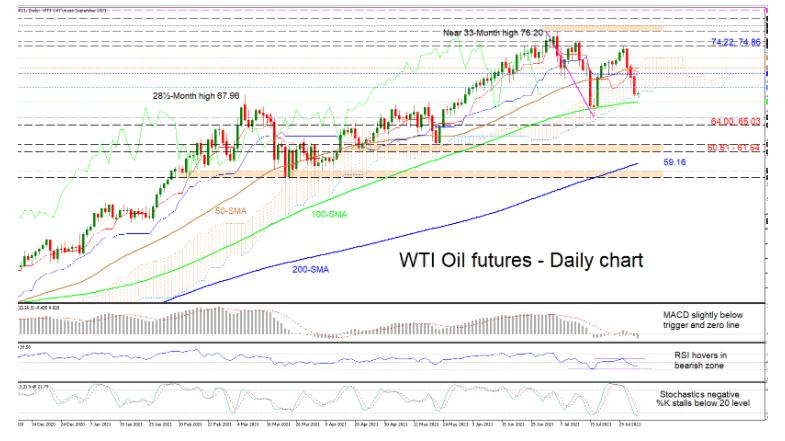
WTI oil futures are trying to create a foothold at the Ichimoku cloud’s lower surface around 67.52. The aggressive loss of ground from the 74.00 mark’s vicinity over the past three days, may be somewhat attributed to rising concerns that demand for the black liquid could become sluggish as spreading of the delta variant endures. The advancing simple moving averages (SMAs) are defending the bullish structure as they keep negative powers at bay.
Currently the Ichimoku lines are not indicating any clear directional momentum, while the negative tone of the short-term oscillators, has thus far not shown any strong signs of abating. The MACD is beneath its red trigger and zero lines, while the RSI is balanced in the bearish region. The stochastic oscillator is retaining a negative charge promoting downward price developments. That said, some caution is warranted as minor slowing in the %K line is signalling that buyers are fighting back.
To the downside, preliminary support could arise from the cloud’s bottom band around 67.52 and the 100-day SMA at 67.06 approaching from beneath. If selling interest intensifies and prolongs the drop in the commodity’s price, next vital support may emerge at the July 20 trough of 65.03 and the 64.00 handle. Should these barriers fail to dismiss a deeper decline from evolving, sellers may then drive the price to test the 60.61-61.54 support band.
Otherwise, if buyers find their feet at the floor of the cloud and build some positive traction, initial resistance could transpire from the 68.89 obstacle. Climbing higher in the cloud, upside limitations could develop in the zone between the blue Kijun-sen line at 70.67 until the 50-day SMA at 71.38. Successfully floating above this resistance border and the cloud at 72.74, buyers could then target the July 30 and 13 adjacent highs of 74.22 and 74.86 respectively.
Summarizing, WTI futures are sustaining a broad bullish tone. A price hold above the 100-day SMA may feed optimism in spite of the recent price pullback, while a drop below the 65.03 trough would give negative tendencies the upper hand.
ECB bulletin: On track for strong Q3 with strong manufacturing and vigorous bounce-back services
In the Monthly Economic Bulletin, ECB said Eurozone economy is "on track for strong growth" in Q3. Manufacturing is expected to "perform strongly" despite supply bottlenecks. Reopening is supporting a "vigorous bounce-back" in services sector. However, Delta variant "could dampen this recovery in services, especially in tourism and hospitality."
Economic activity is expected to return to pre-crisis level in Q1 next year. But there is "still a long way to go" before the damage is offset. Thus, "significant policy support remains essential". It added, "an ambitious and coordinated fiscal policy should continue to complement monetary policy in underpinning confidence and supporting spending".