

Sample Category Title
USD/JPY Mid-Day Outlook
Daily Pivots: (S1) 109.53; (P) 109.66; (R1) 109.91; More...
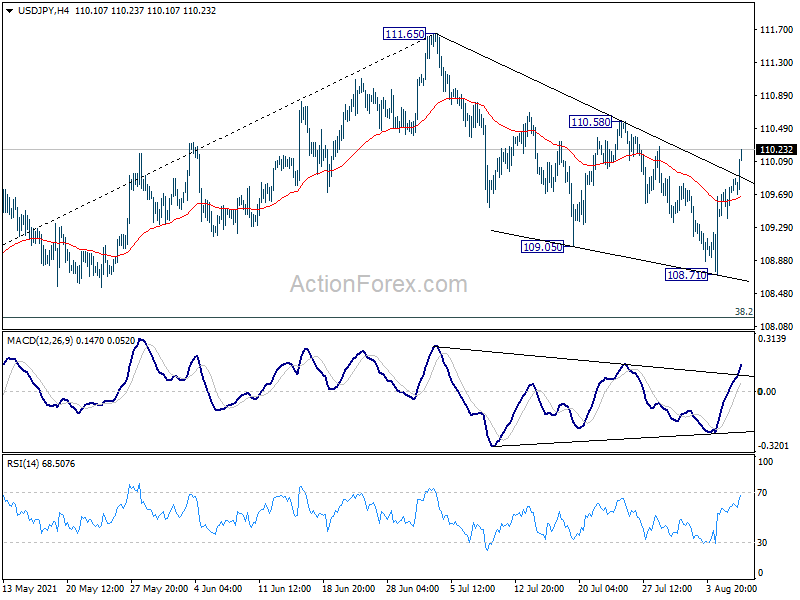
USD/JPY rises sharply in early US session and immediate focus is now on 110.58 resistance. Decisive break there will suggest that fall from 111.65 has completed. Stronger rise would be seen back to retest this high. On the downside, break of 108.71 will resume the decline from 111.65 to 38.2% retracement of 102.58 to 111.65 at 108.18.
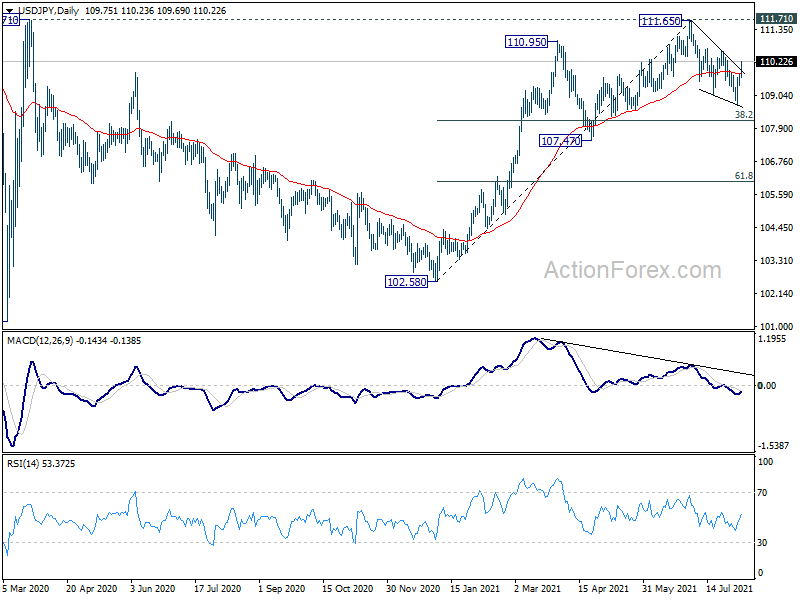
In the bigger picture, medium term outlook is staying neutral with 111.71 resistance intact. Firm break of 107.47 will argue that pattern from 101.18 has started another falling leg already. Deeper decline could be seen back to 101.18/102.58 support zone. For now, outlook won't turn bullish as long as 111.71 resistance holds, even in case of strong rebound.
USD/CHF Mid-Day Outlook
Daily Pivots: (S1) 0.9053; (P) 0.9066; (R1) 0.9079; More....
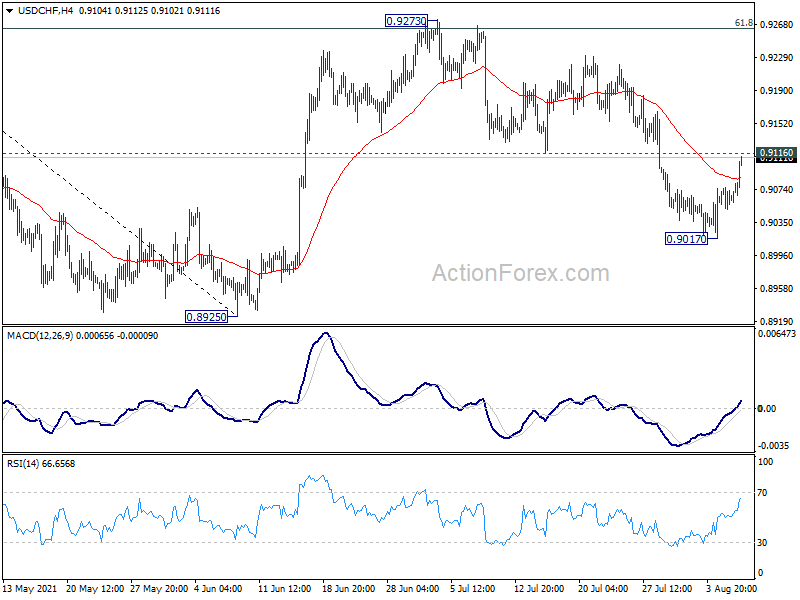
USD/CHF rebounds strongly today and focus is now on 0.9116 support turned resistance. Sustained break there will argue that fall from 0.9273 has completed. Intraday bias will be turned back to the upside for retesting 0.9273 high. On the downside, break of 0.9017 will resume the decline from 0.9273 to retest 0.8925 low.
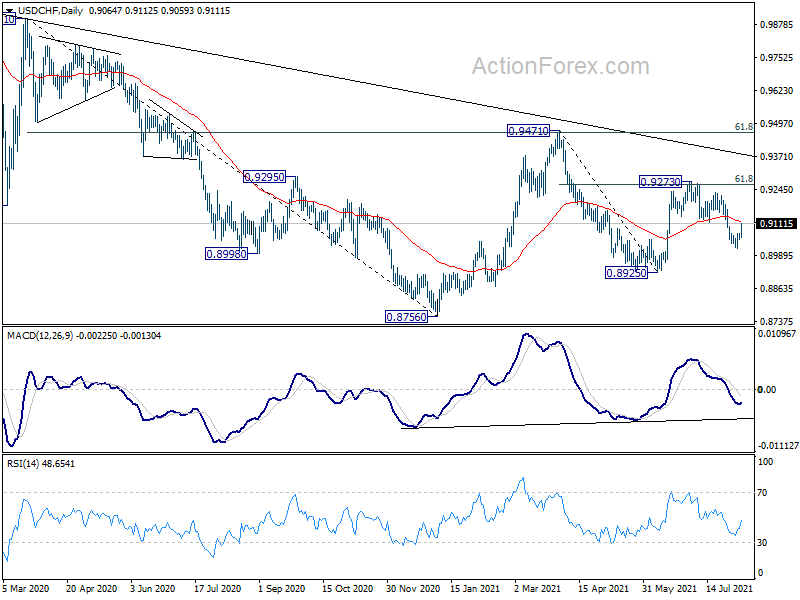
In the bigger picture, failure to sustain above 55 week EMA (now at 0.9183) affirms medium term bearish in USD/CHF. Break of 0.8925 support should resume the whole decline form 1.0342 (2016 high) through 0.8756 low. For now, risk will stay on the downside as long as 0.9273 resistance holds, in case of rebound.
GBP/USD Mid-Day Outlook
Daily Pivots: (S1) 1.3884; (P) 1.3916; (R1) 1.3960; More...
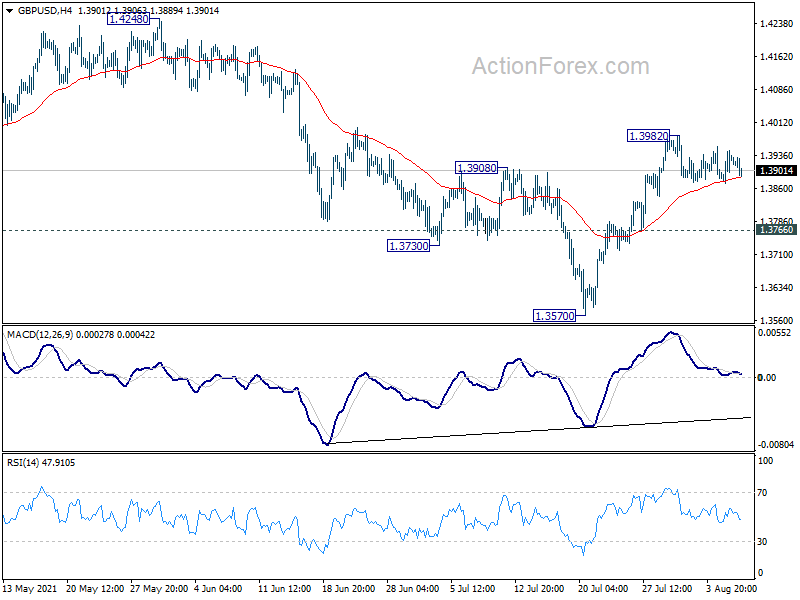
GBP/USD is staying in consolidation from 1.3982 and intraday bias remains neutral at this point. Corrective pattern from 1.4240 could have completed with three waves down to 1.3570. Further rise is expected as long as 1.3766 support holds. On the upside, break of 1.3982 will resume the rise from 1.3570 to retest 1.4248 high. However, break of 1.3766 support will dampen this bullish view and bring retest of 1.3570.
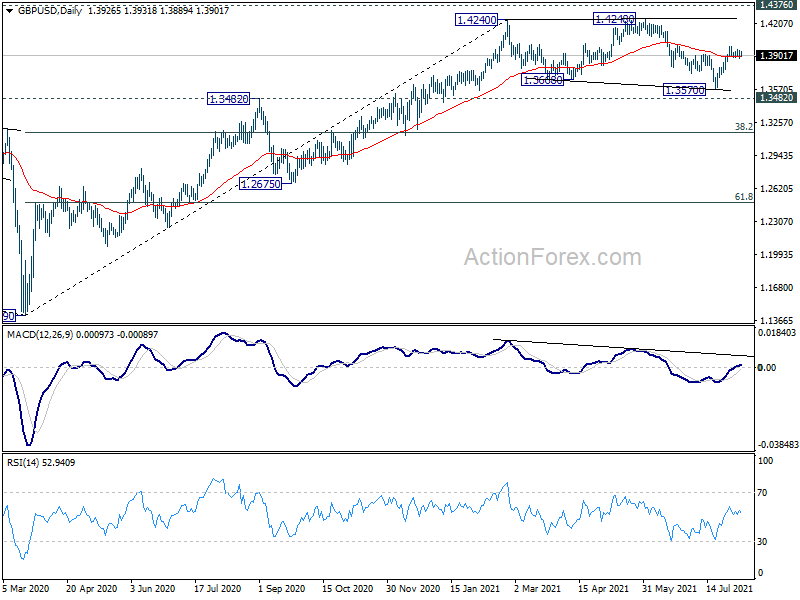
In the bigger picture, as long as 1.3482 resistance turned support holds, up trend from 1.1409 should still continue. Decisive break of 1.4376 resistance will carry larger bullish implications. However, firm break of 1.3482 support will argue that the rise from 1.1409 has completed. GBP/USD would then be seen in another leg of long term range pattern between 1.1409 and 1.4376. Deeper fall could then be seen to 61.8% retracement of 1.1409 to 1.4248 at 1.2493, and even below.
US: Hiring Gathers Speed in July, With Nearly a Million New Jobs
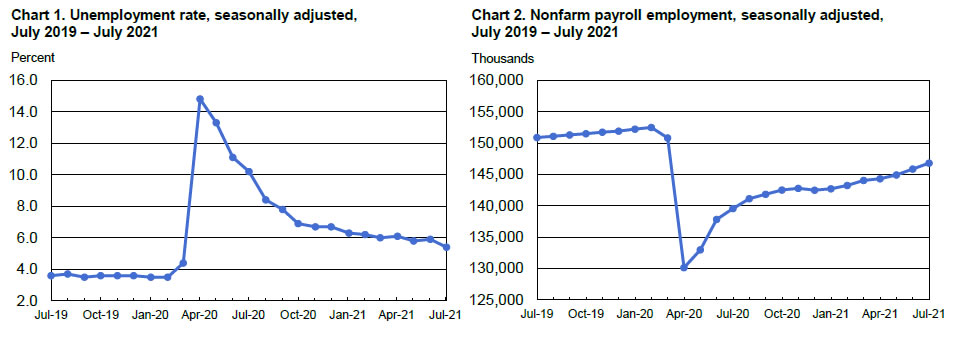
- Strong hiring momentum continued into July, as nonfarm payrolls rose 943k jobs, beating market expectations. That impressive result comes on top of upward revisions to May and June totaling 119k jobs. The unemployment rate dropped 0.5 points to 5.4%, after ticking up to 5.9% in June.
- As of July, nonfarm payroll employment was down by 5.7 million, or 3.7% from its pre-pandemic level in February 2020.
- Once again, leisure and hospitality led the way on job gains, adding 380k positions. Two-thirds of the job gains were in restaurants and bars, which added back 253k workers. Despite solid gains, leisure and hospitality employment is still down 10.3%, or 1.7 million jobs, versus pre-pandemic levels. Atypical seasonal patterns in education hiring due to pandemic-related school closures and re-openings led to strong education hiring again in July, with local government education (+221k) and private education (+40k) up strongly. However, both sectors remain well below their pre-pandemic levels.
- Job gains were broad-based across other industries. Once again, job gains were up strongly in professional and business services (+60k). Gains were also seen in transportation and warehousing (+50k), other services (+39k), health care (+37k), information services (+24k), finance (+22k) and manufacturing (+27k).
- The drop in the unemployment rate was helped by the continued stagnation in labor force participation, which has been fairly flat over the past year between 61.4% and 61.7%, and ticked up a tenth of a percentage point to 61.7% in July.
- Work life continues to normalize as the share of people teleworking fell to 13.2% in July, from 14.4% in June. However, among those not in the labor force, 1.6 million were prevented from looking for work due to the pandemic, unchanged from June.
Key Implications
- The American labor market continues to make impressive progress, particularly since May. If the pace of hiring over the last three months continues, all jobs lost due to the pandemic would be regained in seven months. However, the pace is likely to cool a bit and the risk of the Delta variant looms. We expect the labor force participation to improve in the coming months, which should slow the improvement in the unemployment rate.
- The rising spread of the Delta variant is likely to lead to some consumer caution in areas where infections are rising strongly, which could weigh on hiring in high-contact sectors in the near term. Beyond that we expect the unemployment rate to continue to fall as more pandemic-related constraints on work ease and activity continues to normalize.
Canada: Employment Continues to Recover as Restrictions Further Loosen
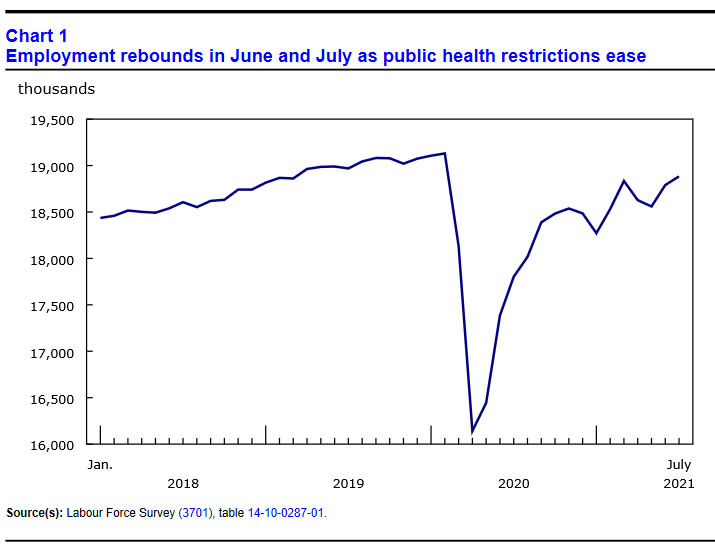
- The Canadian labour market added 94k positions in July, below the consensus call for 150k. This left employment 1.3% below its pre-pandemic (February 2020) level. Gains were predominantly in full-time positions (+83k). Part-time employment advanced 11k in July.
- Canada's labour force expanded by 24k in July. With stronger job growth, the unemployment rate fell by 0.3 percentage points to 7.5% in July, matching the post-February 2020 low hit earlier this year.
- By industry, gains were concentrated in the services sector (+93k) in July. Driving the increase were accommodation and food services (+35k) and finance, insurance, real estate, rental and leasing (+15k). There was not much employment growth in the retail trade, and information, culture and recreation industries due to ongoing travel restrictions, and capacity limitations.
- There was little change to employment in the goods-producing sector, but manufacturing employment added 9k positions in July after declining for two straight months.
- In terms of provinces, Ontario accounted for the majority of July's improvement, as employment increased by 72k in the province. Manitoba (+7k), Nova Scotia (+4k), and Prince Edward Island (+1k) also saw employment advance on the month. New Brunswick (-3k), Saskatchewan (-5k), and B.C. (-3k) lost jobs in July.
- Lastly, total hours worked improved by a robust 1.3% in July, but it is still 2.7% below its pre-pandemic level.
Key Implications
- It was another solid month for the Canadian labour market as the loosening of public health restrictions across the country spurred hiring activity. That said, capacity limits and travel restrictions, held back high-touch businesses from operating at full capacity, limiting job gains in July.
- Indeed, employment in high-touch services is still well below pre-pandemic levels. Even with gains in July, accommodation and food services employment was nearly 20% below its February 2020 level. It's important to note that July's labour survey was taken during the week of July 11th and restrictions in some provinces were loosened at the end of that week. So, we could see the recovery continue to strengthen in August.
- There are growing headwinds, however. Concerns around the Delta variant are rising and some countries, harder hit by the virus, are re-imposing restrictions. Canada has not yet been compelled to do so due to low hospitalization levels, but cases are rising. While the impressive vaccination drive should keep hospitalization rates low, health worries could dent consumer and business confidence. Indeed, the economy's path forward will be closely linked to evolution of the pandemic.
EUR/USD Mid-Day Outlook
Daily Pivots: (S1) 1.1820; (P) 1.1839; (R1) 1.1849; More...
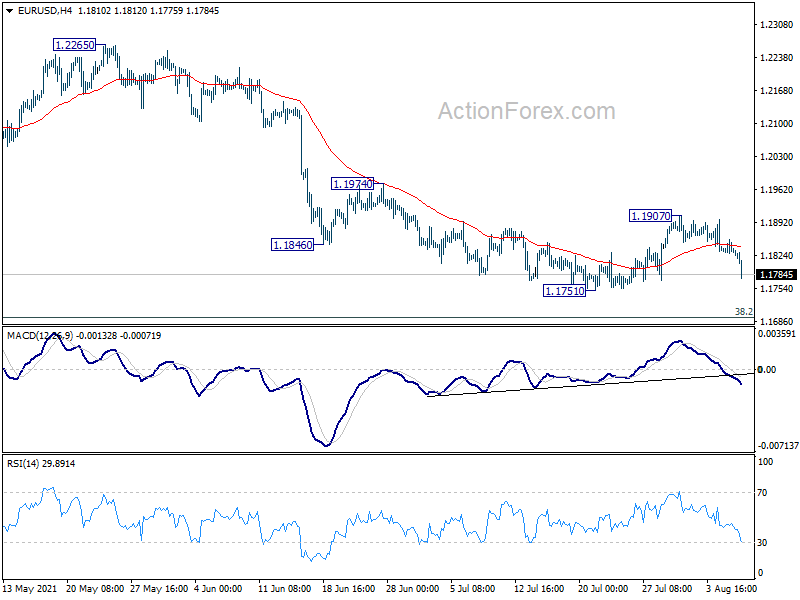
EUR/USD drops sharply in early US session and immediate focus is now on 1.1751 support. Break will resume the whole fall from 12265, as the third leg of the pattern from 1.2348, to 1.1703 support, or even further to 1.1602. On the upside, above 1.1907 will resume the rebound from 1.1751 to 1.1974 resistance.
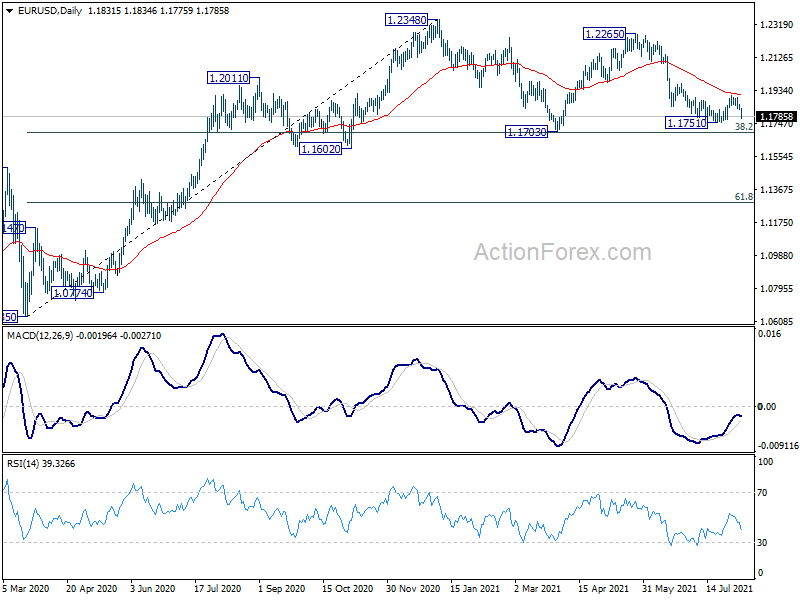
In the bigger picture, rise from 1.0635 is seen as the third leg of the pattern from 1.0339 (2017 low). Further rally could be seen to cluster resistance at 1.2555 next, (38.2% retracement of 1.6039 to 1.0339 at 1.2516). This will remain the favored case as long as 1.1602 support holds. Reaction from 1.2555 should reveal underlying long term momentum in the pair. However sustained break of 1.1602 will argue that the rise from 1.0635 is over, and turn medium term outlook bearish again.
Dollar Jumps as NFP Grew 943k, EUR/USD Heading Back to 1.175 Support
Dollar jumps sharply in early US session after stronger than expected non-farm payroll data. If job growth could sustain at current page in August, more FOMC members would be ready to call for tapering in Q4. Euro, Swiss Franc and Yen are the most responsive to Dollar buying so far. Sterling is staying resilient. Meanwhile, Canadian Dollar also drops slightly, along with Aussie, against the greenback.
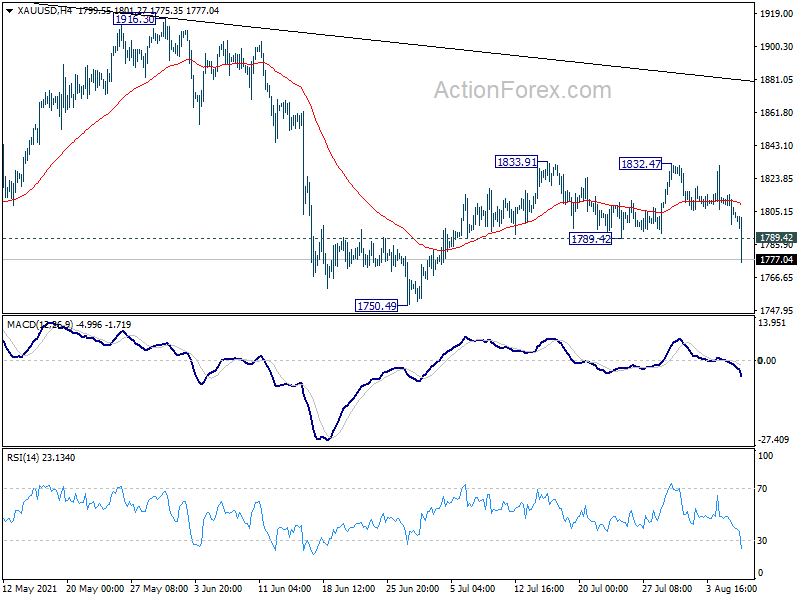
Technically, gold's break of 1789.42 support indicate that rebound from 1750.49 has completed already. Deeper fall would be seen back to retest this low, as Dollar strengthens in general. We'll not look at when EUR/USD will break through 1.1751 low to resume recent decline. Also, USD/CHF and USD/JPY should also break through 0.9116 and 110.58 resistance respectively if Dollar buying is to sustain.
In Europe, at the time of writing, FTSE is up 0.09%. DAX is up 0.18%. CAC is up 0.45%. Germany 10-year yield is up 0.044 at -0.455. Earlier in Asia, Nikkei rose 0.33%. Hong Kong HSI dropped -0.10%. China Shanghai SSE dropped -0.24%. Singapore Strait Times rose 0.07%. Japan 10-year JGB yield rose 0.0024 to 0.015.
US non-farm payroll grew 943k, unemployment rate dropped to 5.4%
US non-farm payroll employment grew 943k in July, above expectation of 900k. Prior month's figure was also revised up from 850k to 938k. Notable job gains occurred in leisure and hospitality, in local government education, and in professional and business services. Total employment was still down -3.7% from its pre-pandemic level in February 2020.
Unemployment rate dropped sharply by -0.5% to 5.4%, versus expectation of 5.7%. Number of unemployed person fell by -782k to 8.7m. Labor force participation rate was little changed at 61.7%, within a narrow range of 61.4% to 61.7% since June 2020.
Canada employment grew 94k in July, unemployment rate dropped to 7.5%
Canada employment grew 0.5% mom or 94k in July, below expectation of 148.5k.gains were concentrated in full-time work (83; +0.5%). Unemployment rate dropped -0.3% to 7.5%, below expectation of 7.7%.
BoE Broadbent: Judgements on labor market frictions dissipating uncertain
Deputy Governor Ben Broadbent said BoE will pay attention to second-round effects of inflation on wages. He added, "the judgements about labour market frictions dissipating are probably more uncertain than those on the trade and goods side of things".
At the same event, Governor Andrew Bailey also said labor shortages is the biggest topic in his discussions with businesses recently.
Released in European session, Italy industrial output rose 1.0% mom in June versus expectation of 0.8% mom. Swiss foreign currency reserves dropped to CHF 923B in July. France trade deficit narrowed to EUR -5.8B in June. Germany industrial production dropped -1.3% mom in June.
RBA Lowe: Fiscal support more appropriate response to temporary and localized hit to income
RBA Governor Philip Lowe said in a testimony that he didn't rule out a recession due to restrictions, but still expecting a return to strong growth next year. "Any additional bond purchases would have their maximum effect at that time and only a very small effect right now when the extra support is needed most," he added. For now, fiscal policy is "the more appropriate instrument for providing support in response to a temporary and localized hit to income."
Regarding inflation, Lowe said much of this discussion has come out of the US, which was in a "substantially different position to the one we're in." In Australia, "the fact that wages growth is likely to remain below 3 per cent for the next couple of years means it's very difficult for me to see us having an inflation problem."
In the Statement on Monetary Policy, RBA downgraded 2021 year-average GDP growth forecast from 5.25% to 4.75%, but upgraded 2022 from 4% to 5%. GDP growth would then slow to 2.75% in 2023. Inflation is projected to be at 2.25% in December 2021 (upgraded from 1.75%), 1.75% in December 2022 (up from 1.50%), and then 2.25% in 2023 year-end. Unemployment rate is projected to be at 5% by 2021 year end, then gradually fall to 4% by 2023 year-end.
Australia AiG services dropped to 51.7, but employment holding up
Australia AiG Performance of Services dropped sharply by -6.1 pts to 51.7 in July. That's the largest monthly decline since April 2020. Looking at some details, sales dropped -12.9 to 53.2. Employment dropped -3.2 to 51.0. New orders rose 0.1 to 56.7. Supplier deliveries dropped -9.6 to 45.3. Input prices rose 8.7 to 74.1. Selling prices rose 13.2 to 66.7. Average wages rose 2.0 to 68.0.
Ai Group Chief Executive, Innes Willox, said: "The substantial easing in the performance of the Australian services sector in July was mainly driven by the COVID-19 outbreaks and associated restrictions.... There were some encouraging signs with employment and sales holding up and new orders coming in at a faster pace than in June. This provides some grounds to expect the services sector could bounce back quickly if restrictions were able to be lifted. However, with COVID-19 infections and restricted areas on the rise in the early days of August, the chances of an early rebound appear to be fading."
EUR/USD Mid-Day Outlook
Daily Pivots: (S1) 1.1820; (P) 1.1839; (R1) 1.1849; More...
EUR/USD drops sharply in early US session and immediate focus is now on 1.1751 support. Break will resume the whole fall from 12265, as the third leg of the pattern from 1.2348, to 1.1703 support, or even further to 1.1602. On the upside, above 1.1907 will resume the rebound from 1.1751 to 1.1974 resistance.
In the bigger picture, rise from 1.0635 is seen as the third leg of the pattern from 1.0339 (2017 low). Further rally could be seen to cluster resistance at 1.2555 next, (38.2% retracement of 1.6039 to 1.0339 at 1.2516). This will remain the favored case as long as 1.1602 support holds. Reaction from 1.2555 should reveal underlying long term momentum in the pair. However sustained break of 1.1602 will argue that the rise from 1.0635 is over, and turn medium term outlook bearish again.
Economic Indicators Update
| GMT | Ccy | Events | Actual | Forecast | Previous | Revised |
|---|---|---|---|---|---|---|
| 22:30 | AUD | AiG Performance of Services Index Jul | 51.7 | 57.8 | ||
| 23:30 | JPY | Labor Cash Earnings Y/Y Jun | -0.10% | 1.20% | 1.90% | |
| 23:30 | JPY | Household Spending Y/Y Jun | -5.10% | 0.10% | 11.60% | |
| 01:30 | AUD | RBA Monetary Policy Statement | ||||
| 05:00 | JPY | Leading Economic Index Jun P | 104.1 | 104.2 | 102.6 | |
| 06:00 | EUR | Germany Industrial Production M/M Jun | -1.30% | 0.50% | -0.30% | -0.80% |
| 06:45 | EUR | France Trade Balance (EUR) Jun | -5.8B | -6.1B | -6.8B | -6.6B |
| 07:00 | CHF | Foreign Currency Reserves (CHF) Jul | 923B | 941B | ||
| 08:00 | EUR | Italy Industrial Output M/M Jun | 1.00% | 0.80% | -1.50% | -1.60% |
| 12:30 | USD | Nonfarm Payrolls Jul | 943K | 900K | 850K | 938K |
| 12:30 | USD | Unemployment Rate Jul | 5.40% | 5.70% | 5.90% | |
| 12:30 | USD | Average Hourly Earnings M/M Jul | 0.40% | 0.30% | 0.30% | |
| 12:30 | CAD | Net Change in Employment Jul | 94.0K | 148.5K | 230.7K | |
| 12:30 | CAD | Unemployment Rate Jul | 7.50% | 7.70% | 7.80% | |
| 14:00 | USD | Wholesale Inventories Jun F | 0.80% | 0.80% | ||
| 14:00 | CAD | Ivey PMI Jul | 67.3 | 71.9 |
Canada employment grew 94k in July, unemployment rate dropped to 7.5%
Canada employment grew 0.5% mom or 94k in July, below expectation of 148.5k.gains were concentrated in full-time work (83; +0.5%). Unemployment rate dropped -0.3% to 7.5%, below expectation of 7.7%.
US non-farm payroll grew 943k, unemployment rate dropped to 5.4%
US non-farm payroll employment grew 943k in July, above expectation of 900k. Prior month's figure was also revised up from 850k to 938k. Notable job gains occurred in leisure and hospitality, in local government education, and in professional and business services. Total employment was still down -3.7% from its pre-pandemic level in February 2020.
Unemployment rate dropped sharply by -0.5% to 5.4%, versus expectation of 5.7%. Number of unemployed person fell by -782k to 8.7m. Labor force participation rate was little changed at 61.7%, within a narrow range of 61.4% to 61.7% since June 2020.
BoE Broadbent: Judgements on labor market frictions dissipating uncertain
Deputy Governor Ben Broadbent said BoE will pay attention to second-round effects of inflation on wages. He added, "the judgements about labour market frictions dissipating are probably more uncertain than those on the trade and goods side of things".
At the same event, Governor Andrew Bailey also said labor shortages is the biggest topic in his discussions with businesses recently.