

Sample Category Title
Summary 8/9 – 8/13
Monday, Aug 9, 2021
[php_everywhere instance="1"]
Tuesday, Aug 10, 2021
[php_everywhere instance="2"]
Wednesday, Aug 11, 2021
[php_everywhere instance="3"]
Thursday, Aug 12, 2021
[php_everywhere instance="4"]
Friday, Aug 13, 2021
[php_everywhere instance="5"]
Weekly Economic & Financial Commentary: Summer Hiring Heats Up
Summary
United States: Summer Hiring Heats Up
- Data this week highlighted the economy's resilience in the face of ongoing supply constraints, while financial markets weighed the impact of the Delta variant wave on the outlook for the economy and Fed policy. ISM surveys for the manufacturing and service sectors continued to show businesses' ability to operate in this supply-strained world, with the latter hitting a new record high. Finally, this morning's virtually blemish-free employment report marked a big step down the road of "substantial further progress."
- Next week: CPI (Wednesday), U. of Mich. Consumer Sentiment (Friday)
International: China Hit by COVID; Brazilian Central Bank Picks Up Pace of Tightening
- The spread of the Delta variant has hit China, and in response, authorities have reimposed restrictions. Also this week, the Brazilian Central Bank signaled it will become more aggressive in tightening monetary policy as the fight against inflation persists.
- Next week: Mexico CPI (Tuesday), U.K. GDP (Thursday), Central Bank of Turkey (Thursday)
Interest Rate Watch: The Bank of England Turns a Bit More Hawkish
- As widely expected, the Monetary Policy Committee (MPC) at the Bank of England (BoE) left its main policy settings unchanged at its meeting this week, keeping its Bank Rate at 0.10%.
- Credit Market Insights: What Will Happen When Pandemic Emergency Programs End?
- The recent housing market frenzy in the United States, driven by people seeking more space and refinancing in this low mortgage rate environment, led mortgage debt to jump 2.8% to $10.44 trillion in Q2 2021.
Topic of the Week: Red Ink Recedes
- After hitting a budget deficit of $3.1T in FY 2020 due to extensive borrowing and spending measures, the U.S. Treasury is looking to decrease both its borrowing and the federal deficit in the coming months.
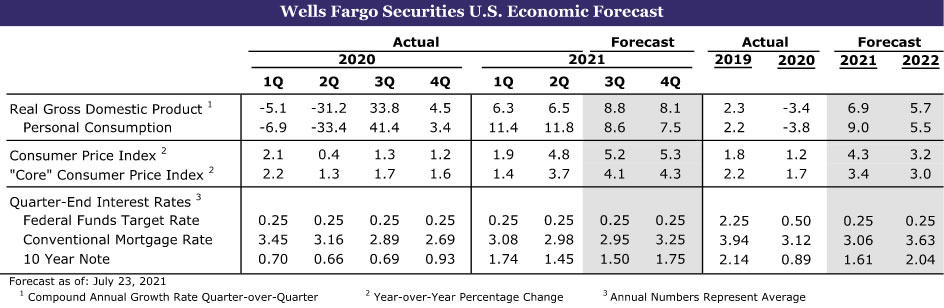
U.S. Review
Summer Hiring Heats Up
Data this week highlighted the economy's resilience in the face of ongoing supply constraints, while financial markets weighed the impact of the Delta variant wave on the outlook for the economy and Fed policy. On Monday, construction spending data for June came in slightly below expectations. Construction spending continued to be held back by outlays on nonresidential projects, reflecting sluggish demand in the most pandemic-afflicted sectors as well as shortages of key materials that are delaying the start of new projects. Home building remained strong, however, rising 1.1% in June, as builders work to restock the country's depleted inventory of homes for sale.
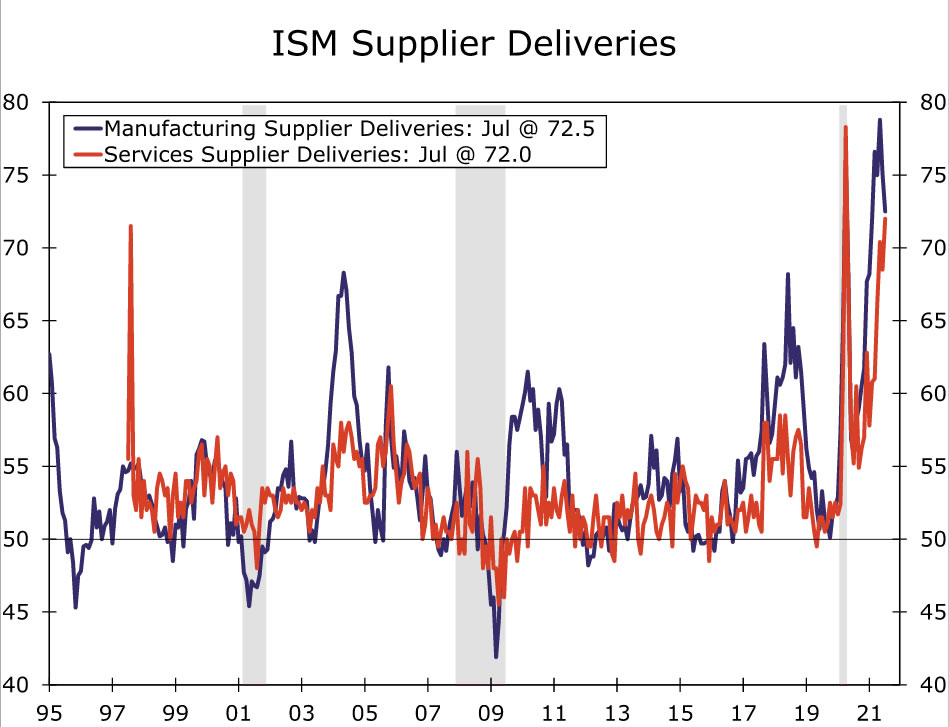
The ISM manufacturing index for July came in slightly below expectations at 59.5, the first sub-60 headline reading since January. Below the headline, there was some indication that supply and demand were coming back into balance. Supplier deliveries fell to a five-month low of 72.5, as the pace of new orders eased 1.1 points, but it is likely too soon to call the end of the supply-chain saga. Meanwhile, activity in the service sector expanded at record breadth in July. Despite their divergence this month, both sectors continue to suggest broad-based expansion, but operating in this environment has not come cheap, and the prices paid sub-index for both sectors remain historically elevated.
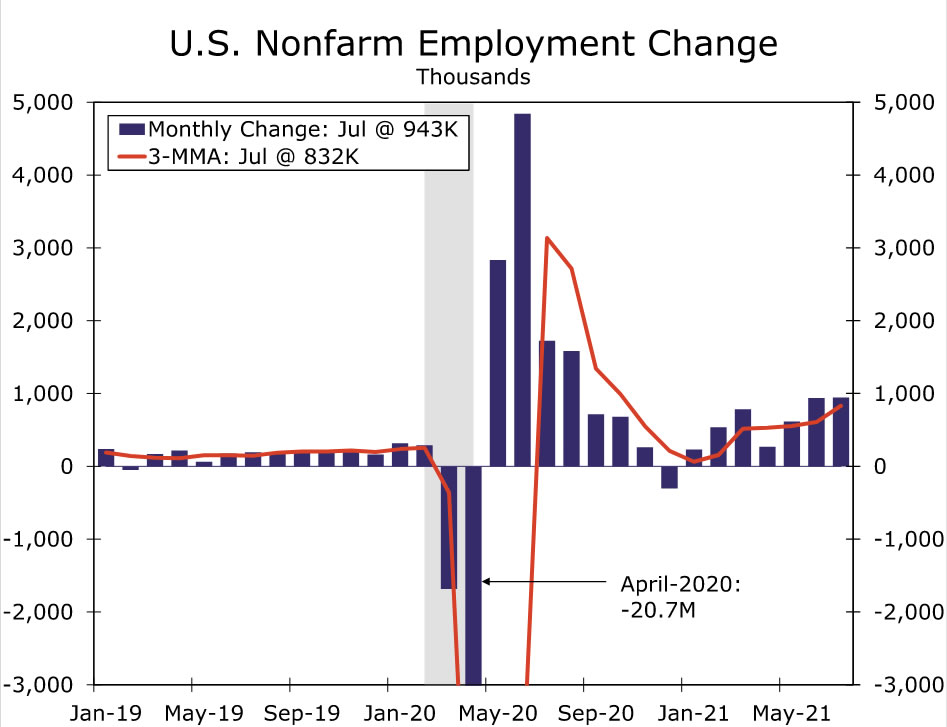
In addition to snarled supply chains and rising material costs, labor supply has been a key obstacle for businesses trying to scale up to meet the rising tide of demand. This morning's employment report showed that some of these constraints eased in July as employers added 943K net jobs. The strong gain was boosted by a 261K job gain in private and public education payrolls, due to fewer seasonal layoffs, but details elsewhere indicated that the labor market recovery heated up this summer. The reopening was on fully display, as the leisure & hospitality sector added 380K jobs, accounting for more than half of the gain in private sector payrolls. In the household survey, the unemployed rate fell by the most since last October to 5.4%, and the percentage of employed persons who teleworked due to the pandemic dropped to 13.2%, the lowest level since records began last May.
The employment report for July and healthy revisions to prior months marked a strong step toward the Fed's desire for "substantial further progress," before it starts tapering its asset purchases. That said, the report is somewhat backward looking. Cases have risen rapidly since the survey week in mid-July. The level of reported new cases now stands above the spring and summer waves of 2020 and is roughly on par with November 2020 before the pandemic's winter peak in the United States. Thus far, visits to retail and recreation locations and seated diners at restaurants have rolled over only modestly, reflecting a further delay in the return to normal rather than a drop in activity, like what we saw last winter. While Fed officials will certainly be pleased with this morning's strong report and the lack of a clear reversal in activity measures, we still expect them to wait and see if progress can be sustained and if constraints boil down to short-term frictions or longer-lasting damage before kicking off tapering.
U.S. Outlook
Consumer Price Index (CPI) • Wednesday
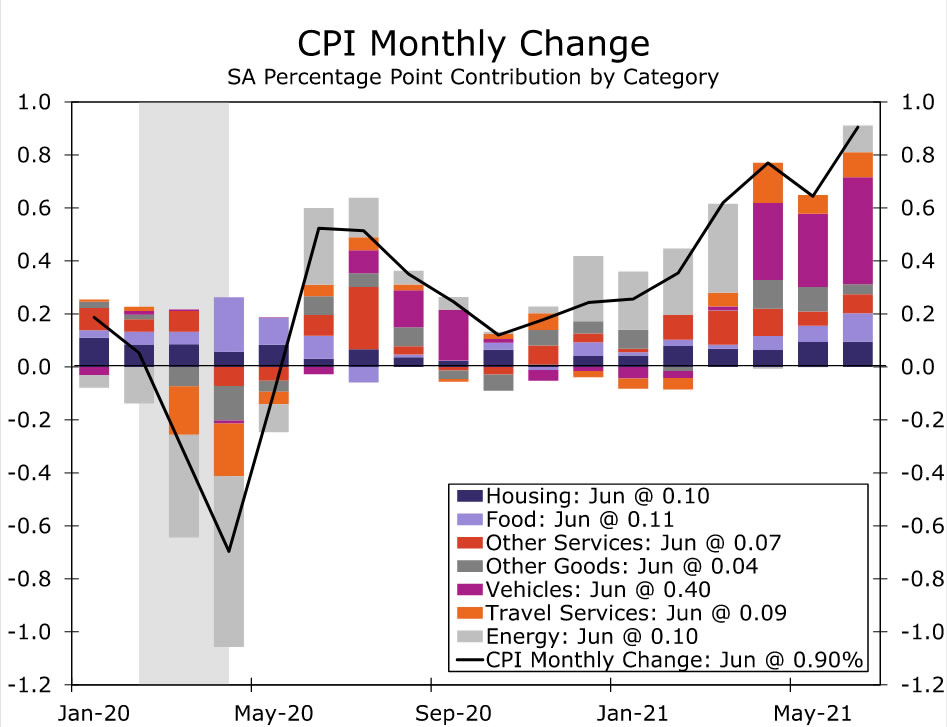
We forecast consumer prices advanced another 0.5% in July, which would cause the year-ago rate to slip modestly to 5.3%. Excluding food and energy costs, we suspect the core CPI rose 0.4%.
The underlying details of the report should continue to show price pressure broadening out beyond categories most acutely associated with the reopening. Shelter inflation, for example, likely continued to rise in June and will be a source of upward pressure on prices for some time to come as the run-up in home prices over the past year filters into the CPI and rents are quickly bouncing back. Similarly, food prices were still poised for some considerable strength in July based on the recent run up in food-related commodity prices and average hourly earnings at restaurants.
We suspect persistent supply problems across a number of sectors also kept the heat turned up on prices of particular categories, as did the fact that businesses have continued to struggle to meet surging demand. Categories like travel services and apparel may still have had some scope for a pickup in prices last month. But price gains may soon become more challenging to the extent that the Delta variant dampens near-term demand and the effects from the reopening begin to fade.
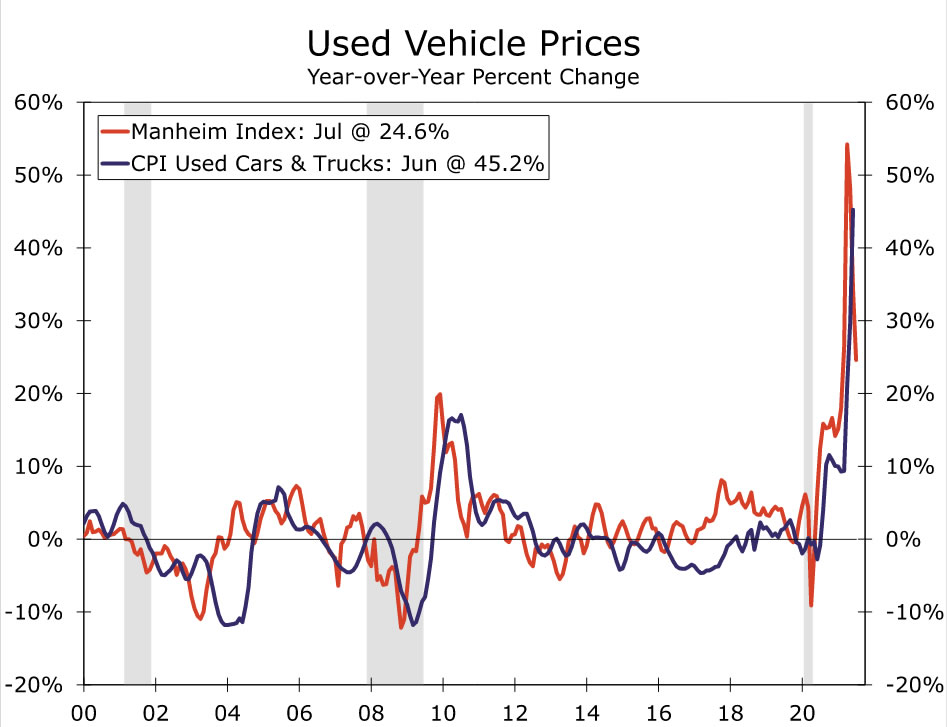
For used autos, some payback could begin as early as the July reading. Wholesale used auto auction prices measured by the Manheim index and prices in the CPI are more in alignment now (see chart), and with auction prices declining the past two months, it seems that the rise in used car prices is close to running its course. We look for declines in this segment over the next few months, potentially beginning in July, which would weigh on the overall CPI after supporting the monthly gain in prices in recent months.
If the July inflation data come in a tenth or so in either direction of our forecast, we do not think it will overly concern the Fed. The Fed believes the current degree of inflation to be transitory, which means it'll continue to wait for inflation to settle prior to taking too much stock in what the current data is showing.
While the Fed is effectively calling for an eventual slowdown in the pace of inflation rather than a reversal in the price level, we see a number of categories where the price level seems ripe for reversal. This suggests inflation could slow markedly by the middle of next year, following sharp gains in categories where prices were already well-above their pre-COVID trend, such as used autos and car rentals. The overall rate of inflation may therefore temporarily fall below what will eventually be its post-COVID trend, keeping the inflation picture for the Fed unsettled for a while yet.
Michigan Consumer Sentiment • Friday
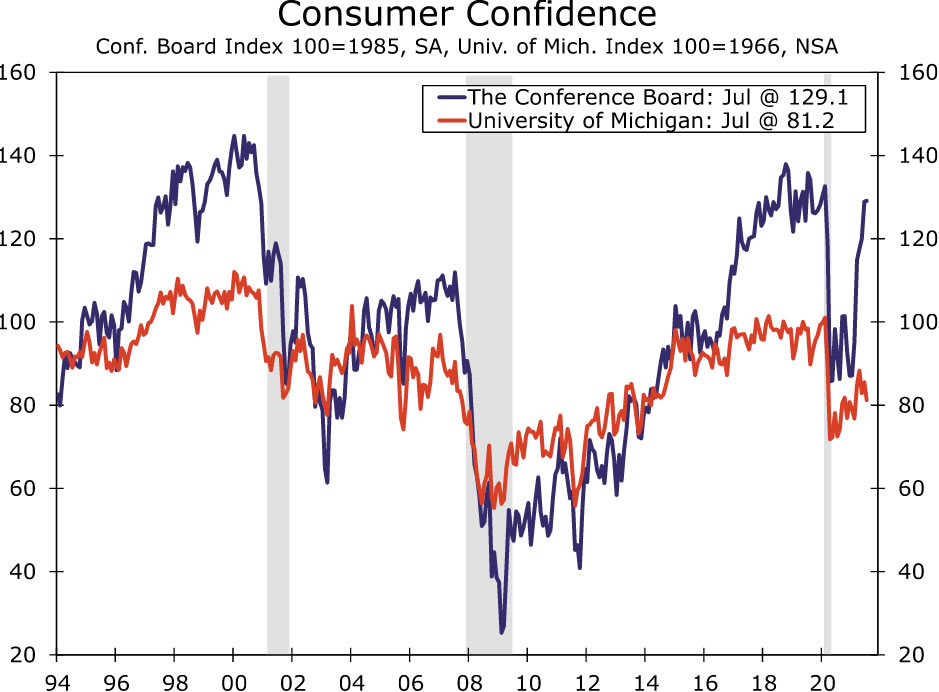
July's confidence data were mixed. Despite widespread expectations that inflation and a resurgence in COVID cases would weigh on sentiment, the Conference Board's measure of consumer confidence rose in July to its highest level of the post-pandemic era. That was at odds with the University of Michigan's Consumer Sentiment survey, which showed inflation fears pulling the measure lower in July.
There have been mixed signals from the consumer side of the economy. The hard data have generally exceeded expectations, with the 11.8% annualized growth rate for second quarter consumer spending being one of the few bright spots in an otherwise underwhelming GDP report. The ISM services component for July released earlier this week was the highest figure on record and signals the services economy was chugging along at full steam in July.
Next Friday will bring with it the first look at August sentiment and will serve as an indication of how consumer psyches are holding up amid the latest flare up in COVID cases and persistently high inflation.
International Review
Renewed Pressure on China's Economy
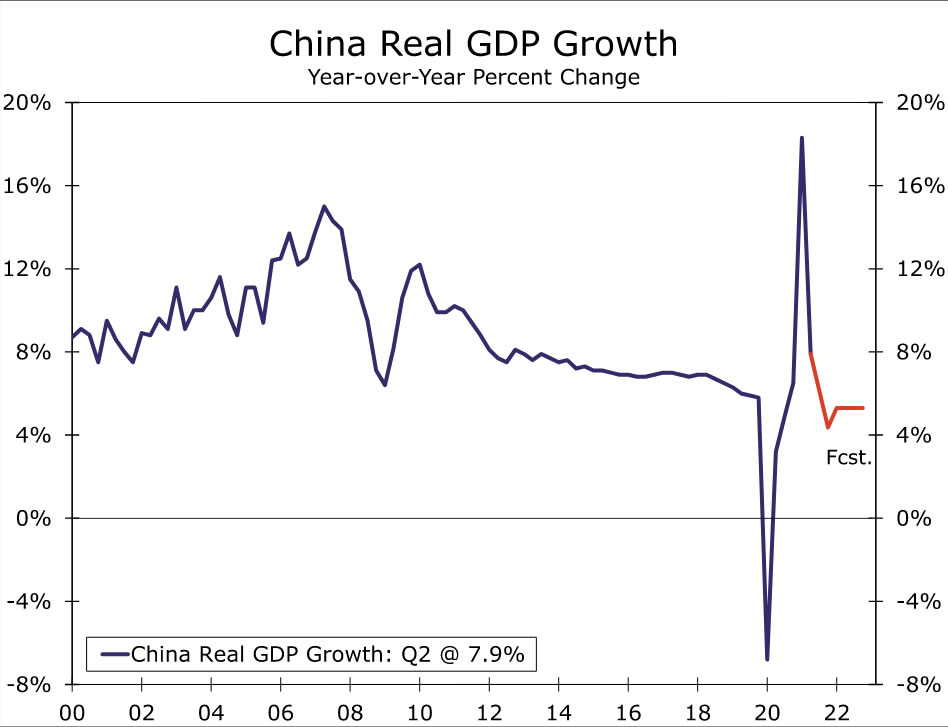
We have revised our annual 2021 GDP growth forecast for China's economy lower over the past few months, and recent developments will likely result in another downward revision in the near future. Multiple factors are at play in considering another downward GDP revision, most notably a COVID outbreak and harsh restrictions being put back in place. In addition, a nationwide flood has damaged some output potential, while a regulatory crackdown on certain sectors could also lead to reduced portfolio and capital flows into China. As far as COVID infections, case numbers have spiked to levels with which Chinese authorities are uncomfortable. Local travel restrictions, including public transportation, have been shuttered in the hardest-hit areas, while quarantine requirements are back in place for foreign travelers. Business-related travel and other non-essential trips have been canceled, with reports suggesting airline capacity has been reduced for many local providers. In addition, mass testing will occur in Wuhan, the origin city of the virus.
New restrictions are likely to have an impact on consumer activity nationwide. China's service sector, more formally known as the Tertiary Industry, and of which retail trade is a significant influence, accounts for close to 60% of China's economy. A major slowdown in retail activity could have a relatively large impact on the overall economy. On the other hand, given the renewed global spread of the Delta variant, China's export sector could slow as global demand dips. The timeframe around new restrictions is unclear; however, we believe there will be economic implications for Q3 GDP growth. On a quarterly basis, Q3 GDP may slow in line with how the economy performed in Q1-2021, growth of just 0.40%, when China also responded to a COVID outbreak with restrictions. For now, we forecast Q3-2021 GDP growth of 1.3% on a sequential basis; however, given the COVID-related risks, we will likely make downward revisions to our Q3 growth forecast and will formally make adjustments in our monthly update.
Brazilian Central Bank Tightening Quicker
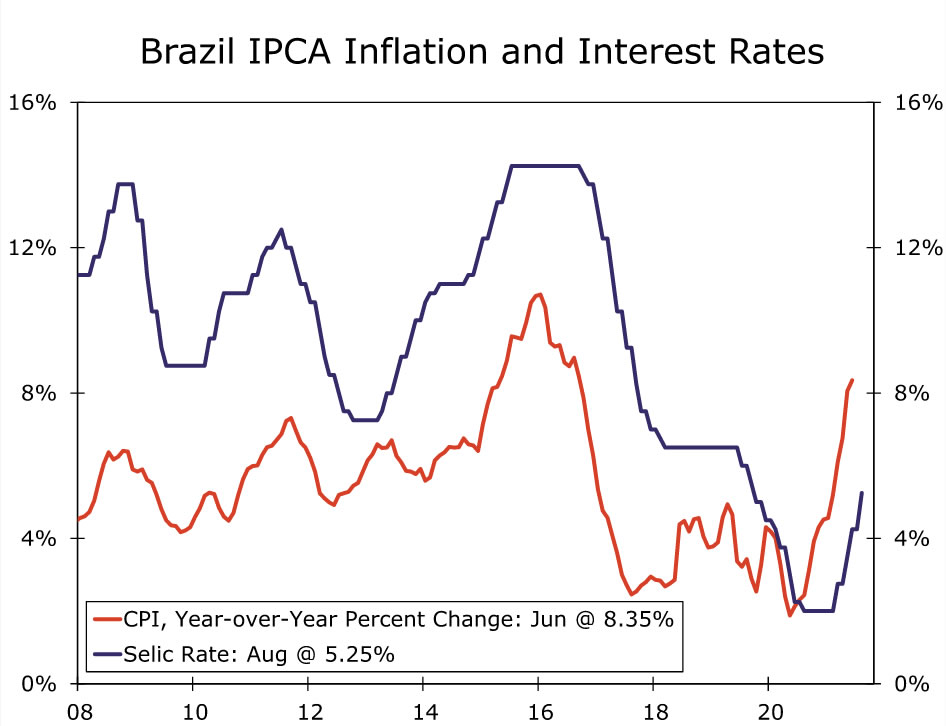
The Brazilian Central Bank (BCB) maintained its place as one of the most hawkish central banks in the world this week. At its latest meeting, BCB policymakers opted to raise its Selic Rate 100 bps, lifting the main interest rate to 5.25%. While the hike was not a surprise, the official statement and accompanying hawkish language was more of a shock as the BCB signaled a more aggressive pace of monetary tightening in an effort to contain inflation. To that point, the BCB told markets another 100-bp interest rate is likely at its next meeting, and policy rates would be lifted above "neutral" by the end of this year. Estimates of "neutral interest rates" are between 6% to 7%, which means the Selic Rate could be lifted another 200 bps before the end of 2021.
More hawkish guidance from the Brazilian policymakers will likely lead to adjustments in our Selic rate forecasts in the near future. Inflation is expected to hit close to 9% in July, well above the central bank's target range, while policymakers also cited fiscal stimulus risk could result in a deteriorating inflation outlook. The proactive stance of the BCB should be a welcome development and enhance the credibility of Brazil's central bank; however, we note that tighter monetary policy may not be all that effective against fiscal stimulus, the reopening of Brazil's economy and even higher commodity prices. In addition, Brazil has experienced weather-related developments such as extreme drought and even freezing temperatures that complicate the domestic inflation outlook as well. Despite these external developments, we believe policy rates will continue to rise over the remainder of the year, likely to reach at least 7% over the next few months.
International Outlook

Mexico Inflation • Tuesday
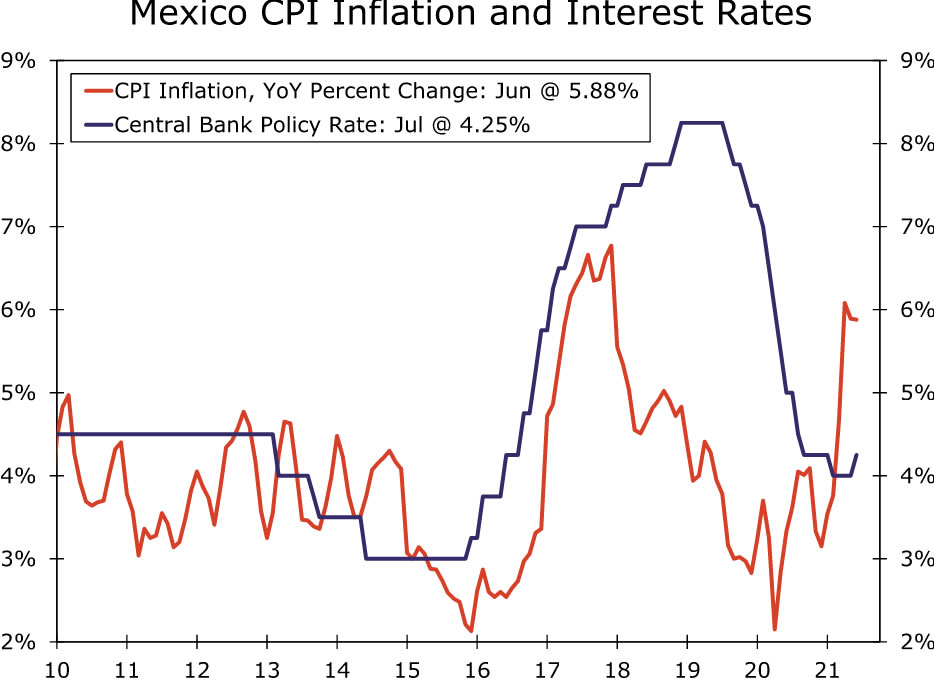
Inflation in Mexico is proving to be stickier than policymakers initially expected, with June inflation still well above the central bank's target. Elevated commodity prices, supply chain disruptions and weather-related impacts have all played a role in pushing the CPI higher; however, policymakers may have also underestimated the effects reopening the economy could have on prices. During the past few monetary policy meetings, Mexican policymakers have also cited inflation as being higher than they expected and as rationale for a surprise 25-bp rate hike not long ago.
Next week, July inflation data will be released, and prices are likely to remain above target for at least another month, likely longer. In that sense, financial markets have priced more aggressive monetary tightening from the central bank as market participants believe policymakers will need to turn more proactive to contain inflation. We have also adjusted our policy rate forecast as well, and now believe policy rates will be lifted at least another 50 bps before the end of this year. Should inflation continue to rise, policymakers may turn even more hawkish than we expect over time.
U.K. Q2 GDP • Thursday
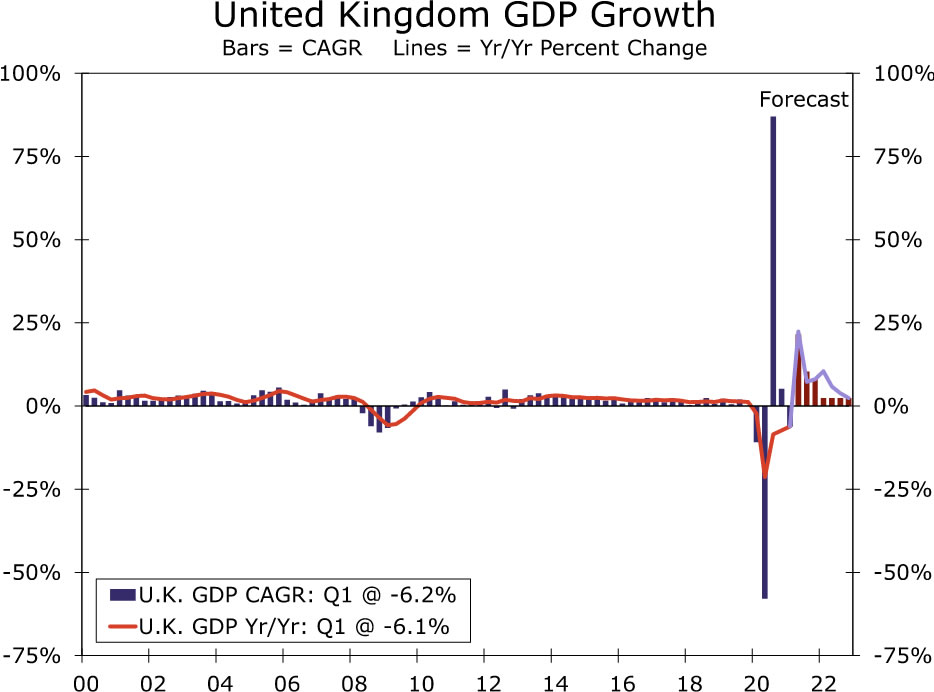
Economic activity in the United Kingdom, for the most part, has held up well over the past few months. Early this year, the economy came under modest pressure as a spike in COVID cases tied to the Delta variant delayed the reopening; however, with restrictions lifted, the outlook remains bright. Next week, Q2 GDP data should reflect momentum building within the economy, particularly as it relates to consumer spending. Household balance sheet data in the U.K. suggest consumers have plenty of cash ready to deploy, which should support the economy going forward.
In our view, we expect the U.K. economy to grow 5% on a quarter-over-quarter basis, 21.6% quarterly annualized. Growth in this range would be one of the strongest quarterly growth figures on record in the U.K. Given the full reopening of the economy and consumers flush with cash, we expect consumption to be the key driver of the economy in Q2 as well as in future quarters. Strong GDP data should also support our view for further Bank of England monetary tightening over time, especially if strong GDP data are matched with elevated inflation prints in the coming months.
Central Bank of Turkey • Thursday
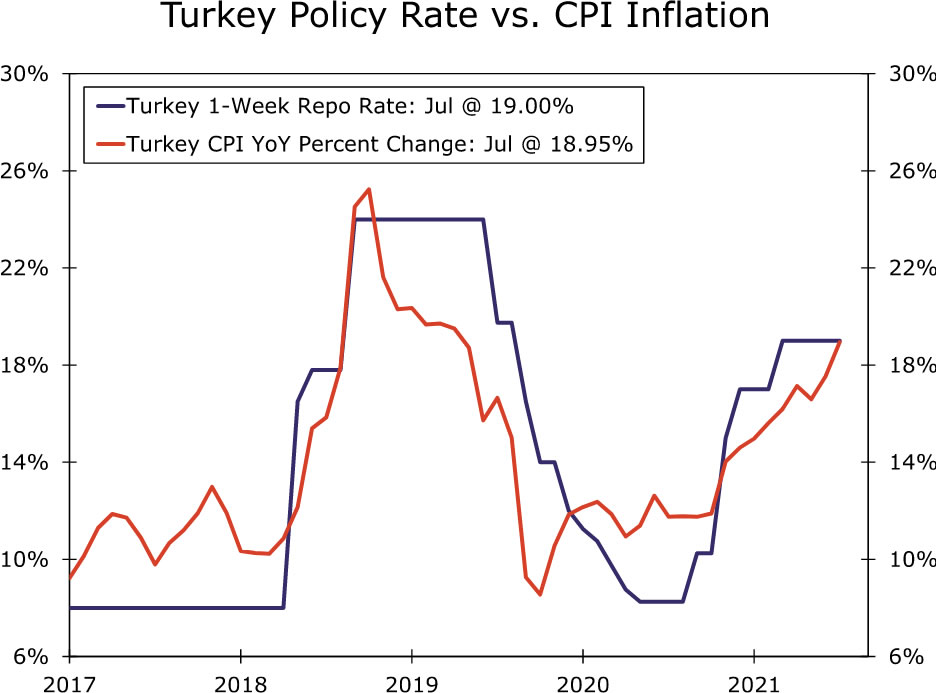
The unpredictability of monetary policy in Turkey always makes for interesting rate decisions. To that point, the Turkish Monetary Policy Committee will meet next week to decide on interest rates amid another sharp rise in inflation and heightened rhetoric from President Erdogan. While we expect interest rates to be held steady next week, President Erdogan has recently become more outspoken regarding his views on monetary policy and the path for policy rates. Historically, President Erdogan's monetary policy rhetoric has resulted in elevated currency volatility or a reshuffle of central bank policymakers. Since March, central bank officials have remained in office, and the currency has been somewhat stable; however, we would not be surprised if another bout of volatility hit the lira in the near future.
Rising inflation has typically been coupled with Erdogan calling for interest rate cuts, an unorthodox view. Should rates be left on hold and inflation continue to rise, Erdogan could become more aggressive and possibly look to replace central bankers with a team more likely to implement his views. Should this scenario unfold, we would expect another large depreciation in the lira and for inflation to continue to trend higher over time.
Interest Rate Watch
The Bank of England Turns a Bit More Hawkish
As widely expected, the Monetary Policy Committee (MPC) at the Bank of England (BoE) left its main policy settings unchanged at its meeting this week. The MPC voted unanimously to keep its Bank Rate at 0.10%, where it has been since March 2020, and it reaffirmed its commitment to purchase up to £875 billion worth of government bonds and £20 billion worth of corporate bonds. At the current rates of purchase, these targets should be met in December.
But, the MPC also said some modest tightening of monetary policy over its forecast period, which goes through mid-2024, is likely to be necessary if the economy evolves in line with its projections. In that regard, the BoE revised its forecast for real GDP growth in 2022 to 6% from the 5.75% rate that it had forecasted in its last Monetary Policy Report in May. It also expects that CPI inflation will jump to 4% by Q4-2021, which is a sharp upward revision from its projection in May, although the BoE still suspects that the spike in inflation will largely prove to be transitory. In addition, policymakers indicated that the threshold for unwinding the BoE's quantitative easing purchases was lower than previously. That is, the MPC previously had said that its Bank Rate would need to rise to 1.50% before it would stop re-investing the proceeds from its portfolio holdings that had matured. That new threshold is now 0.50% "if appropriate given the economic circumstances." In short, it appears that the MPC may start removing monetary accommodation a bit earlier than we had previously anticipated.
Given the MPC's new guidance, we have made some modest revisions to our forecast. Previously, we had looked for MPC tightening to begin in early 2023, but we now look for the first rate hike to occur in Q3-2022. That said, we think that the initial rate hike will only be 15 bps, which would take the Bank Rate to 0.25%. Although our current forecast officially ends in Q4-2022, we think there is a reasonable chance that the MPC could sanction another 50 bps or 75 bps of further rate hikes over the course of 2023.
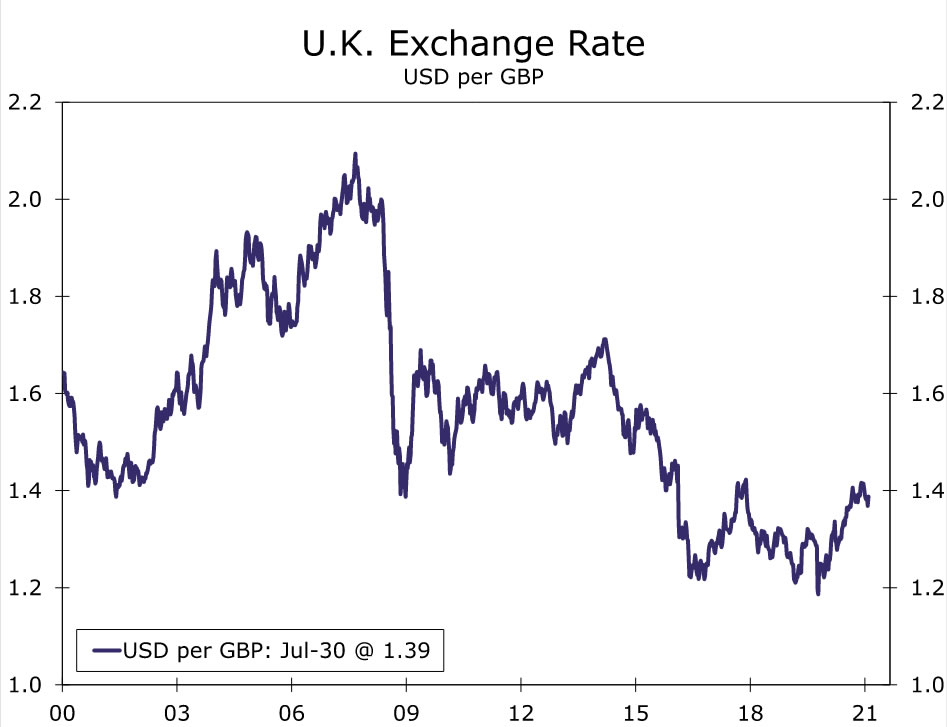
The British pound, which has traded in a 5% range versus the U.S. dollar since the beginning of the year, ticked up versus the greenback on the heels of the announcement (see chart). Looking forward, we expect sterling to remain largely within its year-to-date range through the end of 2021 as market participants continue to digest incoming data regarding the U.S. and U.K. economies. However, we look for the British pound to move higher against the U.S. dollar next year as expectations of BoE monetary tightening begin to ramp up.
For further reading on the MPC's announcement this week see "Bank of England's Subdued Signal of Future Tightening." See our International Economic Outlook for further reading on our sterling forecast.
Credit Market Insights
What Will Happen When Pandemic Emergency Programs End?
Mortgage debt jumped 2.8% to $10.44 trillion in Q2-2021 from $10.16 trillion last quarter, as rising home prices have pushed up the size of new home loans and homeowners have refinanced to take advantage of the summer downturn in mortgage rates. This increase in mortgage balances was the primary contributor to overall household debt rising 2.1% in Q2, the largest increase since 2013, to almost $15 trillion. Auto loans and credit card borrowing were also up from the previous quarter, increasing by 2.4% and 2.2%, respectively.
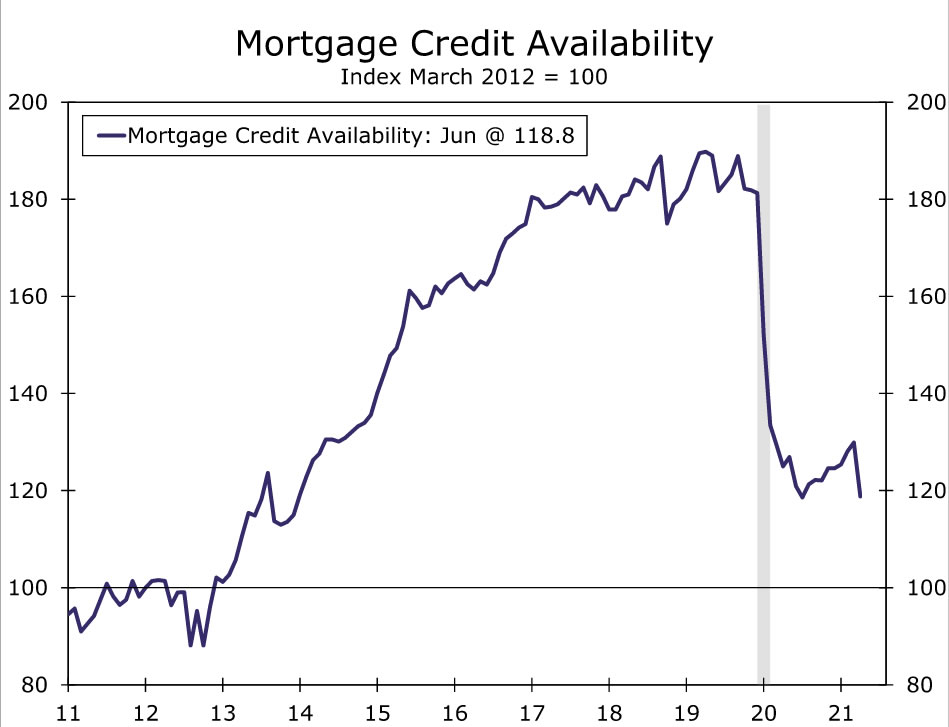
The level of mortgage debt is increasing, despite lending standards remaining tight. The mortgage credit availability index is still well below where it was pre-pandemic, according to the Mortgage Bankers Association. In addition, more than 70% of mortgage originations went to people with a credit score over 760 in Q2, near the record high of 73% set last quarter. However, according to the Fed's Senior Loan Officer Opinion Survey, a net share of banks reported loosening lending standards for auto loans and credit card borrowing in Q2.
Unemployment benefits, stimulus checks and loan forbearance have all helped people stay on top of their debt during the lingering pandemic. Only 5.7% of student debt is 90 days plus delinquent currently, compared to 11% pre-pandemic, and the share of mortgages becoming delinquent fell to 0.4%, a record low. In addition, the national forbearance rate, excluding forbearances due to the storms in Texas and Oklahoma, is trending downward with just 2.7% of mortgages in forbearance at the end of Q2. But, even though only 18% of mortgage holders are subprime, they make up a significant portion of mortgage borrowers in forbearance; 39% of borrowers in forbearance have a credit score lower than 620 versus 26% a year ago. The question of what will happen to these borrowers when forbearances end remains.
With most active forbearances ending this September and October, according to Black Knight, and unemployment benefits, the freeze on student loan repayments and the ban on evictions all expiring soon, delinquencies on debt could increase. With the Delta variant emerging, the robust pace of job and income growth could slow. That said, we do not anticipate a surge in foreclosures over the coming months. Many borrowers and loan officers will likely enter repayment plans once forbearances expire and, more broadly, we believe the economic recovery will remain intact despite the recent uptick in cases.
Topic of the Week
Red Ink Recedes
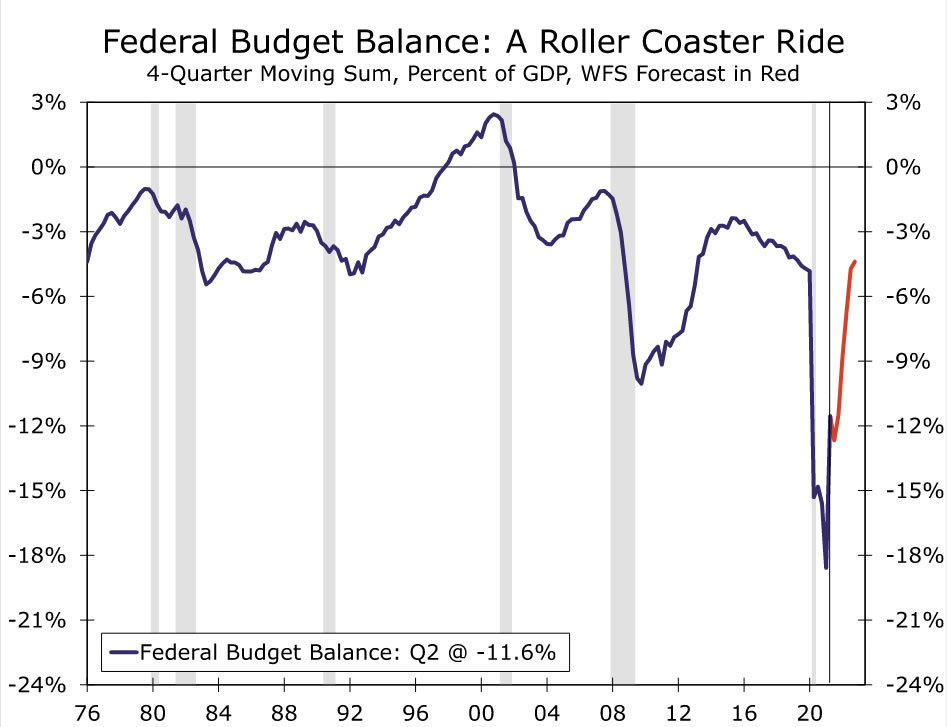
Since the COVID pandemic began, the federal budget deficit has widened significantly amid the sharp contraction in economic activity and the slew of measures adopted to provide financial relief to households, businesses and state and local governments. The federal budget deficit was about $3.1 trillion in FY 2020 and will likely be about $3 trillion when FY 2021 ends on September 30.
As the eventual tapering of the Federal Reserve’s asset purchase program draws nearer, some market participants are concerned about the supply and demand dynamics of the Treasury market. The Fed is currently buying $80 billion worth of Treasury securities and $40 billion worth of mortgage-backed securities per month. As of July 28, the Federal Reserve holds $5.3 trillion of Treasury securities, roughly half of which were purchased since the pandemic began. Currently, we expect the Federal Open Market Committee (FOMC) to announce a tapering of its asset purchases at its December meeting. Our expectation is that the Fed will begin to taper its purchases of Treasury securities and mortgage-backed securities by $10 billion and $5 billion, respectively, per FOMC meeting, in 2022. Will the Treasury market be disrupted by its largest buyer stepping away?
For the most part, we suspect the answer is no, as slowing Federal Reserve asset purchases should be mitigated by a sizable reduction in the federal budget deficit. The U.S. economy has strengthened significantly in recent months, and we anticipate further progress in the months ahead. This should boost tax collections on the revenue side of the ledger. And on the spending side of the ledger, most COVID relief money has been dispersed. Some money is still trickling out in the form of state and local relief, aid to renters, child tax credit payments and enhanced unemployment benefits, but by 2022, these payments largely should have ended as well.
Accordingly, our forecast for the FY 2022 budget deficit is $1.2 trillion, which is about $1.8 trillion smaller than our projected deficit for FY 2021. Smaller budget deficits should mean less debt issuance by the federal government, and the U.S. Treasury signaled as much in its quarterly refunding statement released this week. The Treasury signaled that reductions to its debt issuance schedule are likely later this year and into 2022, as its borrowing needs lessen. More specifically, we are looking for across-the-board reductions to all nominal coupon auction sizes starting in November 2021, with particularly large reductions in both the seven-year and 20-year Treasury securities. T-bills outstanding will also likely continue to contract in the quarters ahead.
Our FY 2022 budget deficit does not assume any major policy changes on the fiscal front, and as a result, we believe the risks are skewed toward larger rather than smaller deficits. However, even if Congress enacts $2 trillion-$3 trillion of new spending on infrastructure and social welfare programs, this money would likely be spread out over an entire decade. Contrast that with the nearly $2 trillion American Rescue Plan (ARP) enacted in mid-March. In that bill, nearly all the money would be sent out within the first year of enactment, which concentrates the deficit/borrowing impact into a much tighter window. Furthermore, we suspect tax increases would finance at least some of this new spending, another divergence from the ARP. Thus, even if major tax and spend policy changes are on the horizon, we suspect they would “only” add a few hundred billion dollars to next year’s deficit, which would still imply a sharp narrowing in the FY 2022 budget deficit compared to FY 2021.
The Weekly Bottom Line: Now and Then
U.S. Highlights
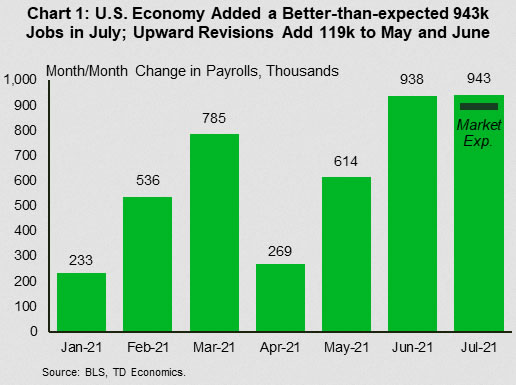
- The U.S. economy added 943k jobs in July, slightly better than an upwardly revised 938k in the month prior. The unemployment rate fell to 5.4% from 5.9% in the month prior, while wage growth accelerated to 3.9% in year-over-year terms.
- The ISM indexes remained well in expansionary territory last month. Of note, the ISM Services index rose to a new record high of 64.1. The July vehicle sales report was the only fly in the ointment as auto sales fell 4.2% on the month.
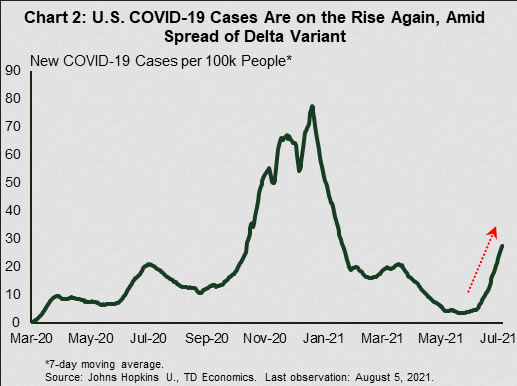
- COVID-19 cases continued to surge higher through the first week of August amidst the spread of the more contagious Delta variant. Fortunately, the pace of vaccinations is also trending higher.
Canadian Highlights
- Employment increased by a firm (even if below expected) 94k positions in July, while hours worked climbed 1.3% m/m, pointing to a strong start to Q3.
- Given re-openings, July’s healthy jobs gain was unsurprising. With Delta variant cases on the rise, risks to the outlook are building. However, a look at countries with similar vaccination rates as Canada reveals a lighter-touch approach to restrictions in the face of rising cases.
- Issues with supply continue to challenge economic growth, notably displayed in weak motor vehicle and parts export figures in June. Despite these challenges, our call for solid second half growth still looks achievable.
U.S. - Labor Market Recovery Powers Ahead in July
The first week of August ushered in plenty of first-tier economic data, but today’s employment report takes the cake. The economy added an impressive 943k jobs in July. This is slightly better than in June, and the strongest gain so far this year (Chart 1). While the employment recovery lags the recovery in economic output, July’s healthy gain, combined with upward revisions to May and June have helped shrink the gap in employment to just 3.7% relative to the pre-pandemic level.
Once again, the leisure and hospitality sector led the way on job gains, as it continued to make up for lost ground. Of the 380k positions added in the sector last month, the vast majority were in bars and restaurants (253k). The educational sector also had a strong showing, although this was partly the result of pandemic-related volatility (i.e. unseasonal school closures and re-openings), which helped prop up local government education payrolls. Gains were broad-based across most other industries. The good news didn’t stop there. Rapid overall employment growth dragged down the jobless rate to 5.4% from 5.9% in June.
Most other indicators in the week carried forward the positive narrative, with the vehicle sales report the only major fly in the ointment. Auto sales fell by 4.2% to 14.8 million (seasonally adjusted at annual rate) in July, marking the third consecutive monthly decline. Instead of demand, however, it is lean inventories – the result of supply chain disruptions – that are the primary culprit behind the downward trend. Constrained production from supply chain issues is acting as a drag on the rest of the economy. But as these disruptions are smoothed over, the need to rebuild inventories should support production in the longer term.
Tilting over to the ISM indexes, both remained well above the 50-point threshold in July, pointing to continued expansion through mid-summer, even as the manufacturing index ticked down a notch (-1.1 to 59.5). The ISM services index, which encompasses a larger part of the economy, reached a new record in July, rising four points to 64.1.
The manufacturing side of the economy had a better run in the earlier phases of the recovery as consumption shifted toward goods. With most COVID-related restrictions being lifted through the spring and early summer, the services side of the economy is primed to carry the torch as spending is reoriented toward services. The pandemic, however, may throw the recovery cycle yet another curveball.
New COVID cases are up sharply from only a few weeks ago, with the more contagious Delta variant now making up more than 93% of all new infections (Chart 2). Hospitalizations are also rising, with the number of patients currently receiving care near same level as at this time last year (around 50k). Thanks to more than 70% of those 18+ having already received at least one vaccine dose, vaccines are expected to play an important role in limiting hospitalizations in the current wave. Fortunately, the pace of jabs is also trending higher recently in hard-hit regions. As a result, future bouts of pandemic-related volatility should prove less disruptive to the economy than in the past.
Canada - Now and Then
Today's Labour Force Survey report revealed that job growth posted a solid (even if below expected) gain in July. Employment increased by 94k positions last month, leaving it only 1.3% below its pre-pandemic level. However, details in the report were somewhat mixed. On the one hand, gains were concentrated in full-time employment and hours worked climbed by 1.3% m/m. On the other, there was weaker-than-expected growth in high touch industries due to ongoing capacity constraints and travel restrictions.
Of course, a sturdy July jobs print is not that surprising, given re-openings taking place across the country. The healthy gain in hours worked also suggests that third quarter GDP growth began on a very solid footing. We had a pretty good idea that the economy would enjoy firm growth during the summer, but with new cases trending higher, risks to the outlook are also on the rise. What can we expect after a summer of fun?
Looking at countries with similar full-dose vaccination rates as Canada shows a surge in COVID cases from late June to late July (although they are on a downtrend since then). Yet, restrictions (measured by stringency indices) eased up a touch when cases were rapidly climbing (Chart 1) as hospitalization rates remained low due to a healthy vaccine uptake in these countries. The message is that the rise of the Delta variant didn't put the brakes on economic activity to nearly the same extent as in other waves.
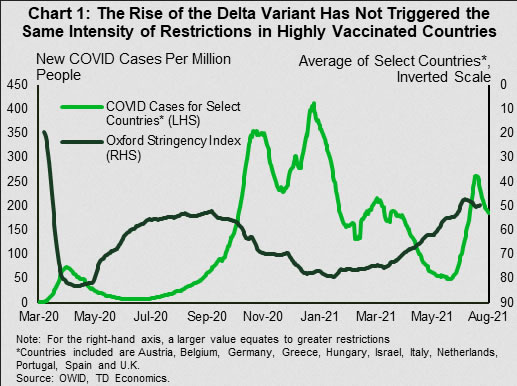
A similar story is emerging in Canada. Indeed, B.C. is applying a lighter touch to the latest round of restrictions triggered in response to an outbreak. This week, the Quebec government announced that vaccine passports will be implemented soon, as a measure to mitigate the potential spread of the virus. Manitoba, meanwhile, is set to fully ease restrictions in several sectors on August 7th and noted this week that recommendations and guidance would play an increasingly significant role, rather than restrictions. In Ontario, the government anticipates maintaining relatively few restrictions once the Province exits its "Roadmap" re-opening strategy. The view now seems to be that if COVID-19 is endemic, Canadians will have to adjust. And, more drastic measures, such as lockdowns, could be a thing of the past.
Re-opening plans could stall due to the Delta variant. The potential for further mutations of the virus is also a major risk, but not the only one. The recovery continues to be held back by challenges on the supply-side. Semi-conductor shortages are the posterchild for this and continue to plague parts of the economy. This week, we received international trade data for June, and although exports of motor vehicles and parts ticked higher, they remained over 20% below pre-pandemic levels (Chart 2). In July, manufacturers also pointed to near-record backlogs, staff and materials shortages as well as delivery delays as obstacles in keeping up with demand, according to the latest PMI survey (also released this week).
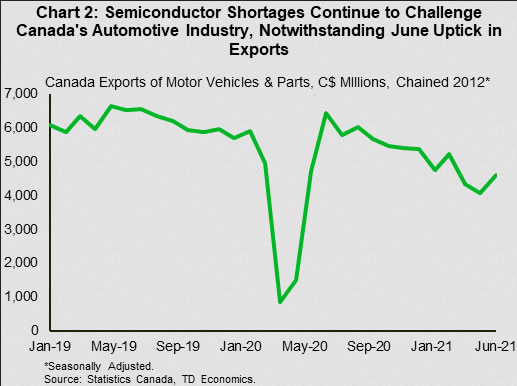
Despite the challenges, the prospect of lesser restrictions in the face of a fourth wave suggests that our forecast for solid second half economic growth remains achievable.
Week Ahead – Taper Debate in Focus
Country
US
A blockbuster nonfarm payroll report has moved forward taper expectations and allowed the yield curve to steepen. The labor market recovery is accelerating as temporary layoffs and permanent job losses dramatically improve.
Wall Street will pay close attention to Wednesday’s July inflation report which should show prices increased again. Persistent inflation worries are showing some signs of easing, but the peak is still not in place. Friday’s consumer sentiment report along with inflation expectations could prove to be market moving. Inflation expectations are already at a 13-year high and that could help support persistent pricing pressures.
Next week, investors will closely pay attention to Fed speak and any comments over tapering following this impressive nonfarm payroll report. On Monday, Fed’s Bostic and Barkin will speak separately. Tuesday, Fed’s Mester will discuss inflation risks. Wednesday is busy with appearance from Fed’s Logan, Bostic, and George.
EU
A quiet week on the data front for the euro area, with the ZEW data on Tuesday the standout.
The PMIs this week were very encouraging and the vaccine program is continuing to improve, which is promising for the coming months.
UK
The data out of the UK this week has remained strong, albeit with the expected negative points, most notably supply side issues and the “pingdemic”.
The Bank of England remains positive about the outlook, having improved its growth and unemployment forecasts and set out plans for tapering of asset purchases and rate hikes. Neither will happen soon, despite the inflation overshoot, with numerous downside risks remaining including delta and the end of the furlough scheme.
Next week offers mostly tier three data, the one exception being second quarter preliminary GDP.
Emerging Markets
Russia
No major data releases next week.
The central bank recently raised rates to 6.5% and warned that more may follow.
South Africa
Manufacturing and business confidence data next week, both of which are low tier releases.
The central bank previously left interest rates unchanged and signaled a hike may be considered later in the year.
Turkey
A plethora of data over the next week leading up to the central bank meeting and rate decision. With inflation now running just shy of the benchmark interest rate, pressure will be on the CBRT to avoid cutting interest rates despite President Erdogan pushing for cuts after sacking another Governor earlier this year.
Asia Pacific
China
Market sentiment has been dominated by the China government’s crackdown on the tech sector and now the education sector with Mainland and Hong Kong exchanges, as well as US-listed China companies taking a bath this week. Concerns are also rising in the corporate credit sector as S&P became the third major rating agency to downgrade Evergrande debt. This time CCC and other Chinese corporate dollar-denominated debt remain under pressure. Regulatory risk will overshadow another busy data week.
In a more ominous development, delta-variant Covid-19 has appeared in a number of Mainland cities, albeit in small numbers. Readers should pay close attention to these numbers over the weeknd and through next week. China succumbing to the latest virus variant, or having to lock down huge parts of the country, is a game-changer. Apart from China itself, think Asia growth and more supply chain disruption. A deteriorating situation will be a huge negative for China markets, but also regional equities and also developed markets like Australia and the US.
China releases its trade balance this weekend and any number under $50 billion will be a negative, indicating slowing growth. China Inflation released on Monday should be benign but poor trade data will add to the headwinds for China equity markets.
India
The Indian Rupee has recovered over the past week due to lower oil importer buying, with Covid-indced demand still weak. Additionally INR has seen inflows from international investors who have been fleeing China markets and rotating into India and ASEAN markets.The Sensex has risen nearly 3.50% this week, making it one of the regions best performers.
The Reserve Bank of India maintained its suite of policy rates unchanged with no change to the QE programme on Friday, despite stagflationary pressures. Like other Asian central banks, the focus is on the domestic Covid-19 economic recovery. The INR briefly fell but quickly recovered losses and is set to continue rallying next week on further investor inflows.
India releases Inflation, Industrial Production and Exports/Imports at the end of next week, but with the RBI out of the way, all should have low market impact. India’s biggest threat remains a resurgence of the virus. A positive for the currency but negative for equities.
Australia & New Zealand
AUD and NZD trading on Monday could be very choppy with both Singapore and Japan on holiday, severely reducing market liquidity.
Australian markets are showing surprising resilience as lockdown expands to Newcastle, Brisbane and Melbourne once again. Some 60% of Australia’s population is now under some sort of restriction with Sydney virus cases continuing to climb on a daily basis. An unchanged RBA had little market impact and Australian equities seem content to follow Wall Street, with Australia’s commodity export machine still firing on all cylinders judging by trade balance data this week.
NAB Business Confidence on Tuesday and Employment Change on Friday will cause some volatility, especially if the numbers are on the low side, heightening fears of the domestic economy slipping back into a Covid-induced recession. The AUD is most likely to suffer as markets price lower for longer from the RBA, but equities will likely take that as positive news in a zero percent fixed interest world.
Swings in global risk sentiment will continue to influence short-term moves in AUD and NZD.
Huge employment numbers this week saw market prices in the first of three RBNZ rate hikes this year, starting this month. The NZD has performed strongly versus the AUD, USD and other low yielders. I expect NZD/USD to rise through 0.7100 this week on its way to 0.7300. Only the arrival of Covid-19 in the community would change the outlook for NZ. Firm Electronic Retail Card Spending Tuesday makes a rate hike a certainty.
Japan
Japan markets are closed on Monday for a national holiday. Japanese stocks indexes continue to slavishly follow moves in the major US markets, ignoring drivers in other parts of Asia. Japan’s Current Account and PPI are the week’s highlights, but only a huge downside miss on either is likely to shake markets.
Japan expanded its Covid-19 states of emergencies and cases and hospitalizations are spiralling. Markets are for the most part ignoring these situations and only hard lockdowns is likely to be a negative for equities.
USD/JPY has dissolved into a purely US/Japan interest rate differential play and I expect this to continue.
Markets
Oil
Oil prices continue to see risk come off over delta variant fears and a stronger dollar. The oil market heavily remains in deficit, but the short-term hit to demand is weighing on prices. After last week’s surprise increase in US stockpiles, energy traders will closely watch to see if that is becoming a trend.
The focus will shift back to Iran nuclear deal negotiations now that Iran President Raisi has taken office. The supply outlook for crude remains very uncertain, but it seems we could see a more conciliary tone out of Iran which could support the expectation that sanction relief could happen closer to year end.
Gold
Gold prices did not stand a chance following a very strong nonfarm payroll report. This employment report was terrible for gold as it did not support needs for safe-havens and given a good chunk of the wage gains is from low-paying jobs, it did not do much for driving inflation hedges.
Gold could have further downward pressure as Fed tapering bets grow following this strong NFP beat, upward revisions, and strong declines with both temporary layoffs and permanent job losses.
Gold is in the danger zone after breaking below key moving averages, longer-term trendlines, and prior support levels. Gold may find some support from the $1,750 level, but if that breaks prices could tumble towards the psychological $1700 level.
Bitcoin
Bitcoin is once again testing the upper boundaries of its recent trading range. Now back above the $40,000 level and holding up nicely despite a strong dollar, bullish technical buying could accelerate over any fresh endorsements on Wall Street.
It is worth noting that Ethereum momentum is gaining following their latest network upgrade. Ethereum dominance could become the theme over the coming months.
Key Economic Events
Monday, Aug. 9
- Atlanta Fed President Bostic discusses building an inclusive economy at a virtual event hosted by the Greater Fort Lauderdale Alliance Foundation’s Prosperity Partnership.
- Richmond Fed President Barkin speaks to the Roanoke Regional Chamber.
- Bulgarian lawmakers may vote this week on a minority government proposed by ITN, the winner of inconclusive July do-over elections.
- Japan observes the Mountain Day holiday.
Economic data and events:
- China money supply, new yuan loans, PPI, CPI
- Germany Trade
- Indonesia consumer confidence
- Australia foreign reserves
- Mexico CPI
Tuesday, Aug. 10
- Cleveland Fed President Mester discusses inflation risks versus Europe at a virtual event hosted by her bank.
- Poland’s government takes aim at US-owned broadcaster
Economic data and events:
- Australia NAB business confidence
- Germany ZEW survey expectations
- Czech Republic CPI
- Hungary CPI
- Philippines GDP
- Japan bank lending, BoP, bankruptcies
- New Zealand REINZ house sales
- South Africa manufacturing production
Wednesday, Aug. 11
- Atlanta Fed President Bostic discusses the Fed’s role in making the economy more inclusive at a virtual event hosted by the Chautauqua Institution.
- Kansas City Fed President George delivers a keynote address at the virtual annual NABE Economic Measurement Seminar.
- New York Fed EVP Logan speaks at the virtual Financial Crisis Forum, hosted by the Bank for International Settlements and the Yale Program of Financial Stability.
Economic data and events:
- US July CPI M/M: 0.5%E V 0.9% prior; Y/Y: 5.3%e v 5.4% prior
- Germany CPI
- Japan M2 money stock, machine tool orders
- Mexico industrial production
- Singapore GDP
- Australia Westpac consumer confidence
- Russia trade
- EIA Crude Oil Inventory Report
Thursday, Aug. 12
Economic data and events:
- US initial jobless claims, PPI
- USDA World Agricultural Supply and Demand Report (WASDE)
- Eurozone Industrial production
- Turkey Industrial production
- India industrial production, CPI, trade
- Japan PPI
- UK Trade balance
- Mexico Rate decision: Banxico to raise Overnight Rate by 25 basis points
- Turkey Rate decision: CBRT to stick with a tight stance as it holds rates despite surging inflation
- New Zealand food prices, 2-year inflation expectation
- UK industrial production, manufacturing production, GDP
- OPEC monthly report
Friday, Aug. 13
Economic data and events:
- US Aug Prelim University of Michigan consumer sentiment: 81.2e v 81.2 prior
- France unemployment, CPI
- New Zealand Manufacturing PMI
- Russia GDP
- Poland GDP, CPI
- Thailand forward contracts, foreign reserves
- Turkey current account balance
- Czech Republic current account
Sovereign Rating Updates:
- Turkey (Fitch)
- Hungary (S&P)
- Sweden (S&P)
- Ireland (Moody’s)
- Belgium (DBRS)
Gold – Can it Recover from NFP Blow?
Jobs report a severe blow for gold
It feels a long time ago since gold was rallying on the back of a poor ADP number and expectations that it may signal a weaker jobs report and nudge the Fed in a dovish direction.
The yellow metal has gone from threatening to break $1,833 – and the 50 fib – to the upside to smashing through $1,790 support in just a couple of days, courtesy of a strong ISM reading, hawkish comments from the Fed’s Clarida and finally, a knockout jobs report.
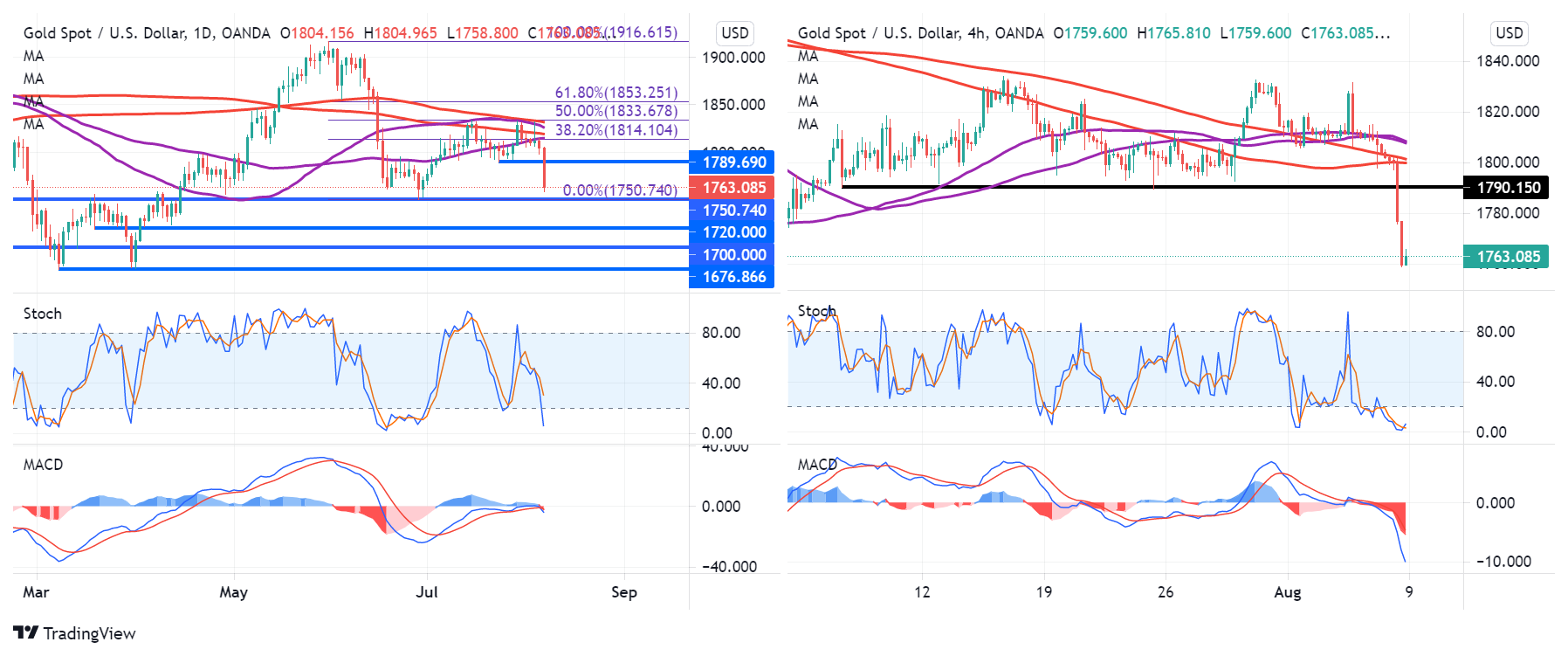
Today was the final nail in the coffin and gold is suddenly looking in a very vulnerable position. Already it has its sights set on $1,750 but the reality is there could be further to fall.
It’s going to take some dreadful data over the next month to stop the Fed announcing something on tapering in September and with Jackson Hole only a few weeks away, at which policy makers including Jerome Powell could lay the groundwork, time is running out.
Should gold rebound off $1,750, then the key test to the upside will come around that previously reliable support level at $1,790. But a look at the momentum indicators suggests any corrective move may not yet be forthcoming.
A break of $1,750 shines a light on $1,720 and $1,700, with $1,675 then interesting below that, should it get that far.
Who knows what the next couple of months will throw up but the last 48 hours have been a hammer blow for gold.
Forward Guidance: Travel/Hospitality Sector to Get Added Boost from Easing Border Restrictions
The recovery of the hospitality sector is progressing largely as expected. Businesses that were once shuttered are reopening, and green shoots have emerged. Our own data on card transactions shows spending on hospitality returned to pre-Covid (2019) levels in July as Candians ventured outside their homes. Next week Canada will take another step in the reopening process by opening its borders to fully vaccinated U.S. residents. There’s a growing concern that the rise of the delta variant could stall progress, particularly in parts of the U.S. where vaccination rates are low. Still, with over 80% of eligible Canadians at least partially vaccinated, another round of domestic lockdowns looks less likely – and much of the travel/tourism recovery to date has been driven by domestic tourists. Provided vaccines remain effective at protecting against new strains of the virus we expect a more sustained economic reopening over the remainder of this year.
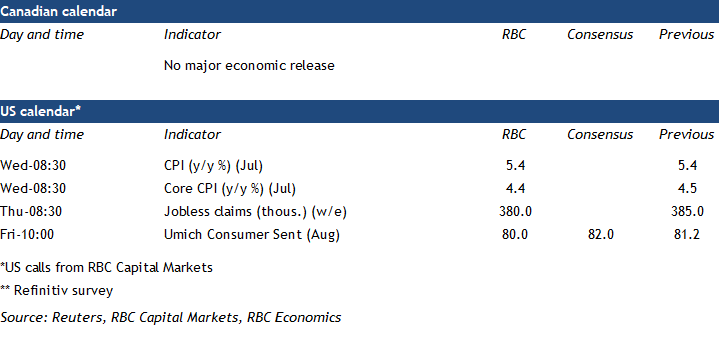
The bigger concern is whether strong demand will fuel further price increases. We expect next week’s US CPI report to show the inflation rate held steady at 5.4% in July. To date, much of that increase can be attributed to ‘base effects’ – as prices for products like energy, clothing, and airfares bounced back after falling sharply this time last year – and supply constraints that have sent used vehicle prices soaring. Early evidence shows that price pressures have retreated from lofty highs – lumber prices have eased and the wholesale price of used cars appears to have peaked. As businesses iron out supply chain bottlenecks, we continue to expect that price pressures will recede over the coming months. Central bankers will continue to look through transitory price jumps and keep a close eye on underlying broad-based price growth.
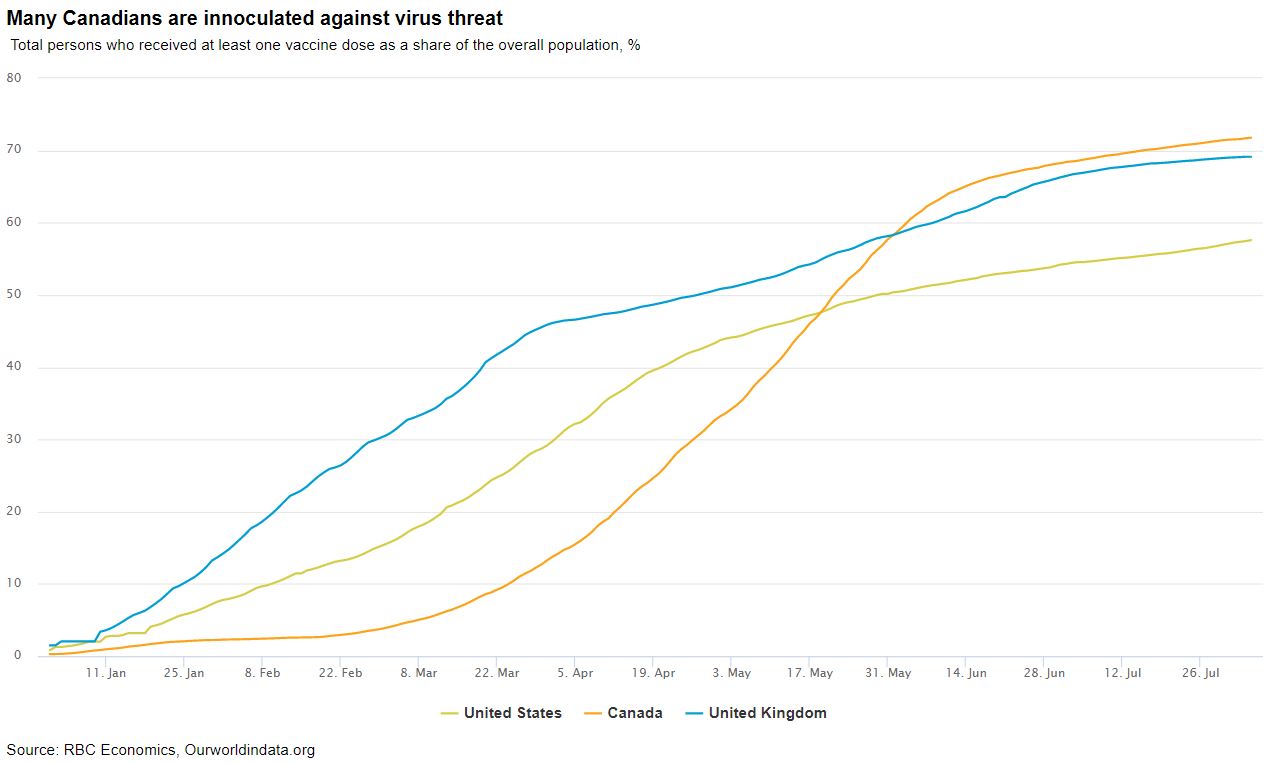
Week ahead data watch:
- Canada’s covid cases have edged up slightly over the past two weeks. A relatively high level of vaccinations is expected to limit the pass-through to hospitalizations in contrast to previous waves.
Week Ahead – Dollar Turns to US Inflation Data
It will be a quiet summer week, with no central bank meetings and only a handful of economic data. The main event will be the latest edition of US inflation, which could shape the narrative around the Fed and the dollar. Overall, we are entering a period when market liquidity might be very thin, making sharp moves possible without much news.
US inflation set to cool
Fed officials have started to beat the tapering drums. This past week, another two senior policymakers threw their weight behind dialing back stimulus soon. One of them was Vice Chairman Clarida, the Fed’s second in command.
The other was Board Governor Waller, who went as far as saying that if the next couple of employment reports are strong, the Fed should get the ball rolling in September already. Both are permanent voters in the FOMC, so their views carry weight.
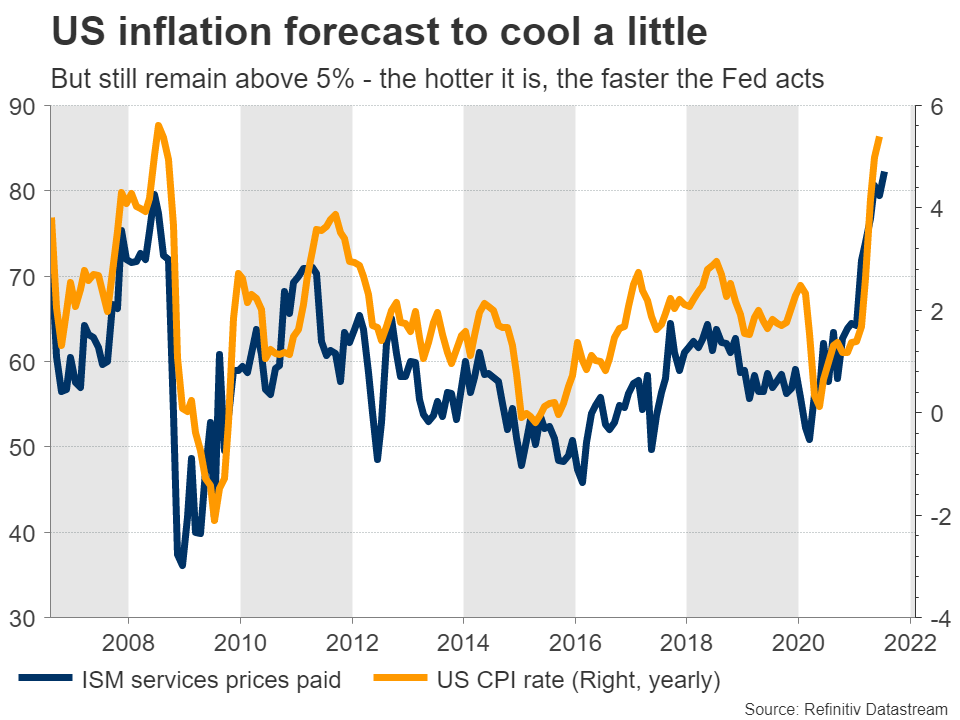
Next week’s inflation stats will be crucial. Forecasts point to a minor slowdown. The monthly CPI print is expected at 0.5% in July, which would push the yearly rate down a touch. That said, this would still leave the yearly rate comfortably above 5%. We could also see an upside surprise, considering the signals in the PMI surveys.
The dollar’s path next week will depend on this dataset. It could determine whether the prospect of a September tapering announcement is realistic or not. The hotter inflation is, the better the chances that the Fed gets moving early.
In the big picture though, it doesn’t really matter whether the announcement comes in September or December. What matters is that the Fed is years ahead of the European Central Bank and the Bank of Japan in the normalization game. Ultimately, this points to a stronger dollar against the euro and yen.
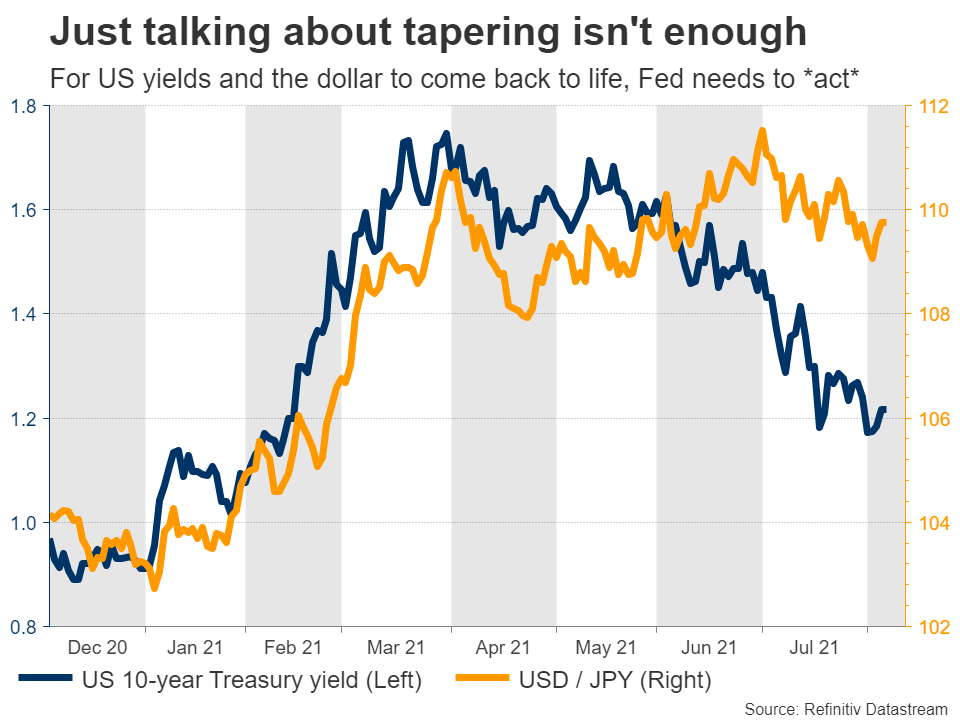
The catch is that any dollar strength may not materialize until the Fed actually begins to withdraw stimulus. Fed officials have been flirting with tapering for months now, but real US yields continued to slide. For that to change, the Fed needs to take its foot off the gas, not just talk about it. As the saying goes, talk is cheap.
Sterling turns to UK growth
Across the Atlantic, British economic growth numbers for June and the entire second quarter will be released on Thursday. It was a good quarter overall, with widespread vaccinations enabling the reopening of the economy and boosting consumption. Markets will probably focus on business investment, to gauge whether this momentum will be sustained.
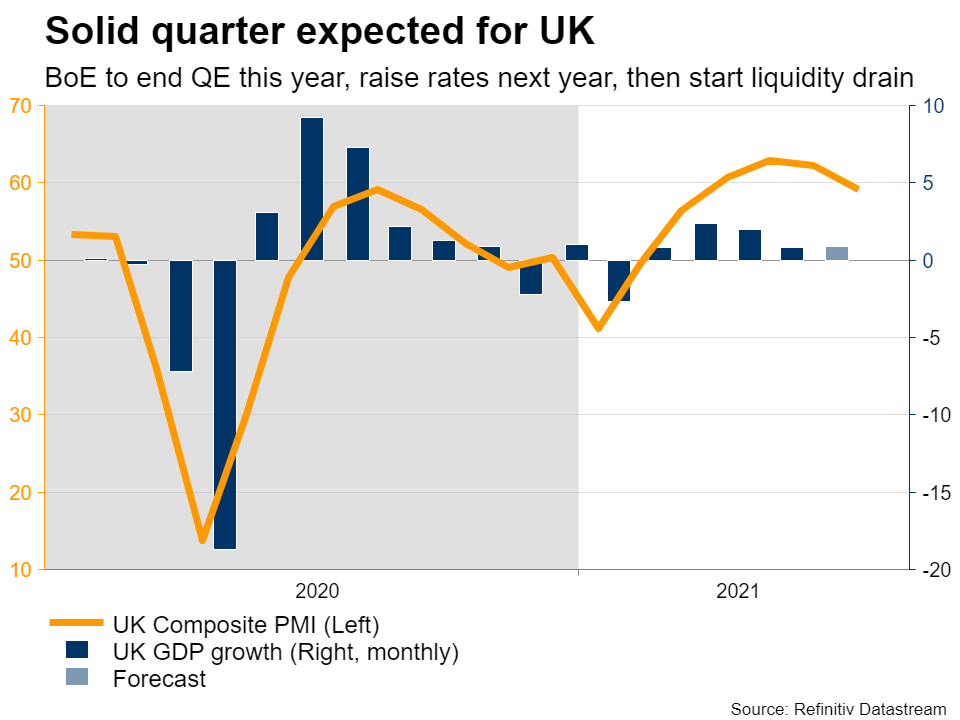
The Bank of England took another step towards normalization this week. The first rate increase is now expected in late 2022, while policymakers also signalled that once the Bank Rate hits 0.5%, they will stop reinvesting maturing bonds. This means that after two rate increases, the BoE will begin ‘quantitative tightening’ like the Fed did back in 2017-2019. Higher UK yields are on the horizon.
This is great news for sterling. If the UK economy continues to perform, allowing the BoE to be among the first major central banks to raise interest rates this cycle, the pound could also shine against the euro and the yen.
The FX market is essentially divided into two camps right now - the central banks that will be raising interest rates in the coming years and those that won’t. America, Britain, Canada, and New Zealand are moving towards higher rates, whereas Europe, Japan, and Switzerland aren’t.
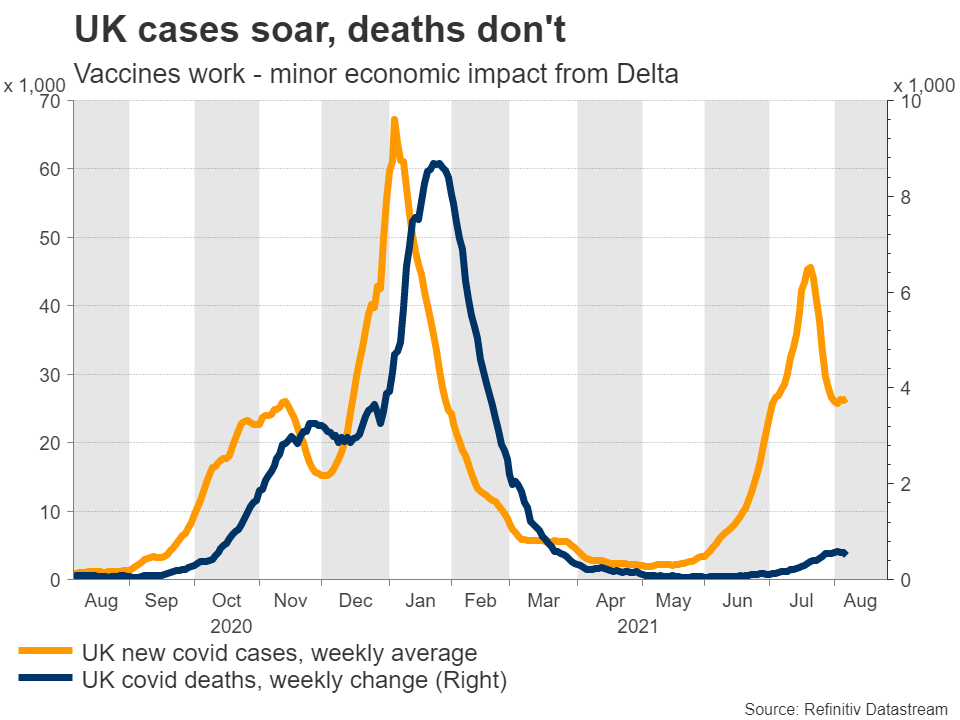
For the pound, the risk is what happens to unemployment now that the government’s job-protecting programs are being rolled back. The furlough scheme has been cut back and will end completely in late September. On the bright side, the BoE doesn’t foresee a spike in unemployment because of this.
Chinese and German data coming up
Over in China, trade data for July will be released over the weekend, ahead of inflation numbers early on Monday. Markets usually pay more attention to producer prices, which are seen as a proxy for global factory demand.
In Germany, the ZEW survey for August is due out on Tuesday. This is typically not a market mover for the euro, but it will be interesting to see how strategists see the Eurozone’s largest economy performing in August.
Finally, the earnings season will begin to wind down with household names like Walt Disney, eBay, Electronic Arts, and Airbnb releasing their quarterly results.
Impressive NFP Report, Yields and Dollar Surge, Oil Higher, Gold Tanks, Ethereum Dominance
The Fed will be pleased with this payroll report and will likely seek one more robust reading before announcing tapering at the September policy meeting. Yes, the Fed said the will continue to assess progress in the coming meetings, but if the unemployment rate falls to 5.1% before the September meeting, they could move earlier. The US labor market recovering is entering high gear after adding 943,000 jobs in July, a decent beat of the 870,000 consensus estimate. The range of estimates was wide, varying from 350,000 to 1.2 million jobs.
The Fed will be especially encouraged by the strong declines in both temporary layoffs and permanent job losses. Temporary layoffs declined by 572,000 to 1.2 million, while permanent job losses fell by 257,000 to 2.9 million (which is still above the 1.6 million seen in February 2020).
The unemployment rate improved to 5.4%, a beat of the 5.7% estimate, and very close to the 5.1% level which could be the level the Fed will need to see reached before formally announcing its taper plan.
Wall Street can now comfortably price in a taper start date before the end of the year, with an accelerated reduction of purchase finishing sometime next summer.
Inside the NFP report
The bar was set very high today and economy delivered. Leisure and hospitality jobs increased by 380,000. More money is coming into the economy as wages and hours work rise, but inflationary fears might be easing given its lower paying jobs.
No one will really focus on seasonal factors, but it is important to note that the report stated that “staffing fluctuations in education due to the pandemic have distorted the normal seasonal buildup and layoff patterns, likely contributing to the job gains in July.”
Stocks
US stocks are mixed following an impressive jobs report that triggered a return of the reopening trade and alleviated some inflationary concerns. The Russell 2000 index was the outperformer given the buying spree of reopening stocks. The Nasdaq turned underperformed given the surge in Treasury yields, while the S&P 500 barely held onto gains.
FX/treasuries
The dollar is surging following a better-than-expected nonfarm payroll report which may have paved the way for the Fed to announce tapering if the economy delivers one more robust report in September. The steepener trade is back as Treasury yields soar higher. The 10-year Treasury yield seems destined for 1.30%, with further upside likely targeting 1.35% over the next week or two.
Oil
After what was a brutal week for oil markets, crude prices are trying to hold onto small gains after a robust nonfarm payroll report supports the idea that the world’s largest economy is strengthening. A stronger dollar however will likely prove to be a big drag over prices in the short-term. The crude demand outlook has many headwinds ahead given COVID variants, but that should not move the oil market away from its deficit.
Vaccine mandates across Corporate America could help further get COVID under control which should support the demand outlook going forward.
It is important to note that earlier reporting from the Wall Street Journal’s Norman sources that Iran was committed to return to meaning Iran talks in Vienna. His tweet was deleted. The supply outlook for crude remains very uncertain, but it seems we could see a more conciliary tone out of Iran which could support the expectation that sanction relief could happen closer to year end.
Gold
Gold prices did not stand a chance following this very strong nonfarm payroll report. This employment report was terrible for gold as it did not support needs for safe-havens and given a good chunk of the wage gains is from low-paying jobs, it did not do much for driving inflation hedges.
Gold could have further downward pressure as Fed tapering bets grow following this strong NFP beat, upward revisions, and strong declines with both temporary layoffs and permanent job losses.
Gold is in the danger zone after breaking below key moving averages, longer-term trendlines, and prior support levels. Gold may find some support from the $1,750 level, but if that breaks prices could tumble towards the psychological $1700 level.
Cryptocurrency
A massive upgrade for Ethereum should prove to be very bullish for the cryptocurrency’s long-term outlook. The pace at how tokens are minted has been lowered, which will help make it a little bit more scarce, but nothing like Bitcoin’s finite 21 million coins. Ether’s tackles lots of key issues as it delivers lower fee volatility, improved market efficiency, and takes aim at reducing the network’s energy consumption by more than 99%, which would make it the greenest choice for the cryptoverse.
Once Wall Street gets beyond the market volatility from a potential mini taper tantrum from the Fed, Ethereum dominance could continue as ESG investors become ready to embrace the dramatically improved energy consumption outlook. Ethereum will likely become the favored crypto trade on Wall Street and could see limited resistance towards the $3000 level.
RBA SoMP Forecasts Based on a Delta Shock with Little Lasting Impact
The RBA’s August Statement on Monetary Policy presents revised forecasts incorporating both the stronger than expected economic rebound in the first half of 2021 and a Q3 shock from ‘delta lock-downs’. With the latter expected to have few enduring impacts, the net effect has seen the Bank’s end-2022 unemployment rate forecast lowered from 4.5% to 4.25%, explaining the Board’s decision to leave policy settings unchanged at its August meeting.
The RBA’s August Statement on Monetary Policy (SoMP) contains significant changes to the banks near term forecasts but retain a more upbeat view over the medium term horizon that frames the Bank’s policy decisions.
Economic growth
The RBA’s GDP growth forecast for 2021 has been lowered from 4.75% to 4%. Virus disruptions are expected to see the economy contract noticeably in the September quarter – “by at least 1 per cent” – with some of the decline recovered in Q4, assuming limited further lockdowns. That compares to Westpac’s considerably weaker profile of a 2.2% fall in Q3 and 3% rebound in Q4 taking annual growth down to 3.2%yr.
The RBA forecasts have the snap back sustaining growth of 4.25% through 2022, moderating to 2.5% as reopening rebounds are cycled in 2023. That is close to Westpac’s forecasts of 4.2% and 2.7% respectively.
The bank’s ‘baseline’ scenario assumes that the domestic vaccine rollout accelerates in the second half of the year, reducing the frequency and severity of lockdowns and allowing the international border to be reopened gradually from mid 2022. The Sydney lockdown is assumed to run through the September quarter – in line with Westpac’s assumptions. The latest lockdown in southeast Queensland is assumed to end as planned. Forecasts were completed prior to latest 7-day lock-down announced for Victoria.
Labour market
The forecast unemployment rate by end 2021 has been reduced again, from 5% to 4.5%. The improvement beyond that is still expected to be much slower with the unemployment rate at 4.25% by end 2022 (compared to 4.5% forecast in August) and 4% by the end of 2023 (the RBA’s first full year forecast for 2023).
The near term shock is expected to see the unemployment rate rise in coming months although most of the adjustment is expected to come via hours worked and participation rather than job losses. This week’s payrolls data release shows impacts were starting to come through in early July, although as we note, there are some important nuances to this data around both the definition ‘jobs’ compared to the labour force survey and technical issues around seasonality and the tendency for upward revisions (see here for more).
The main takeaway from the SoMP is that the RBA’s ‘baseline’ scenario has no lasting impact from the latest round of COVID disruptions. Specifically: “output and employment are expected to have returned to their previously anticipated paths by early next year” (in fact, the level of output beyond the near term is forecast to be a little higher than expected in the May SoMP). Hence the net effect of a stronger starting point for labour markets is a slightly lower unemployment rate by the end of next year. The net impact on 2022 looks to be the key determining factor for whether policy should respond to the latest COVID shocks.
Wages and prices
The forecast pace of wages growth has been lifted again, consistent with the lower profile for the unemployment rate with a 2.25% gain in 2021 (vs 1.75% in the May SoMP), lifting to 2.5% in 2022 (vs 2.25%) and 2.75% by the end of 2023. Despite the upgrade, the lift is still only gradual and does not have wages growth with a ‘3-handle’ seen as a key prerequisite for a sustained return of inflation in the 2-3% target range. Even if the gradual profile is extended, wages growth only just nudges 3% in 2024. That speaks to a still very significant policy task ahead. Of particular note: “liaison information suggests that wages growth in many firms is returning to around the pre-pandemic norm of 2–2½ per cent this year, but not stronger than this”.
On inflation, the trimmed mean inflation forecasts have seen marginal changes – the RBA’s 2021 forecast lifted from 1.5%yr to 1.75%yr but holding at that pace through 2022 (unchanged from the May forecasts), the mid-2023 forecast also unchanged at 2%yr but the extended forecast to December 2023 showing a move into the target band with read of 2.25%. As the RBA Governor commented in his Parliamentary testimony, simply achieving a one-off return to target is not sufficient with a sustained move into the band required for the bank’s policy goals to be achieved.
Conclusion
The RBA Governor’s Opening Statement to the House of Representatives Standing Committee on Economics emphasised five key themes from the August SoMP: 1) Australia’s economic bounce-back to date has been quicker and stronger than expected; 2) the ‘delta’ lock-down will see a significant interruption to the recovery near term; 3) a quick bounce-back is still expected to be seen once associated restrictions ease; and 4) the upside surprises on wages and prices have been more muted than those seen around the real economy (i.e. GDP and jobs).
The biggest uncertainties are clearly still around the near-term path of the virus.
As noted previously, we felt there was a strong case for the RBA to use its new flexible approach to QE at the July meeting, and provide some additional support to the economy by lifting the weekly purchase pace and deferring the planned taper from September to November. The Bank instead chose to sit pat.
The reasoning is clear – expectations for 2022 have not shifted materially. However, risks remain stacked to the downside particularly while the ‘delta’ variant threatens to seed in other major states. The RBA Governor noted that the Board is still prepared to respond with further policy easing “in response to further bad news on the health front that affects the outlook for the economy over the year ahead”. That may go ahead if we see more states succumb to delta outbreaks. While flexible QE gave the bank the option to respond earlier (and, in turn, to wind back measures quickly if needed) the Bank has instead adopted a more patient ‘watch and wait’ approach.
One last point to note, the Governor’s Parliamentary testimony also raised an important medium term issue that is starting to emerge, namely, what the “endemic phase” of the virus will look like once high vaccination rates are achieved in Australia. Experiences abroad and modelling released by both the Federal Government’s health advisors and the Federal Treasury over the last week highlights that high vaccination rates are very unlikely to eliminate the virus altogether. That in turn means there will likely be ongoing need for some measures to control and monitor the virus will almost certainly be required. Treasury’s estimates suggest that even under a positive scenario the ongoing economic cost of COVID-19 management will be around 0.4-0.5ppts of GDP. That in turn may have some marginal implications for potential growth over the medium term.
US: A Big Step Down the Road of “Substantial Further Progress”
Summary
Employers added 943K jobs in July and hiring was revised higher over the previous two months. The recent pickup in momentum turns the volume up on the debate over when the labor market will meet the FOMC's criteria of “substantial further progress.” While there were some indications that labor constraints continued to ease, the rise in the Delta variant clouds the outlook. Fed officials will likely be pleased with July's progress, but we ultimately think they will want to see further ground recovered and if constraints boil down to short-term frictions or longer-lasting damage before kicking off tapering.
Turning Up the Heat on Hiring
The July jobs report is likely to turn up the volume on the debate over whether the labor market has or will very soon meet the FOMC's criteria of “substantial further progress.” Employers added 943K new jobs in July, and hiring in May and June was revised up by a combined 119K. The pace of job growth over the past three months has reached 832K, the highest since October of last year, demonstrating a considerable pickup in momentum (see chart).
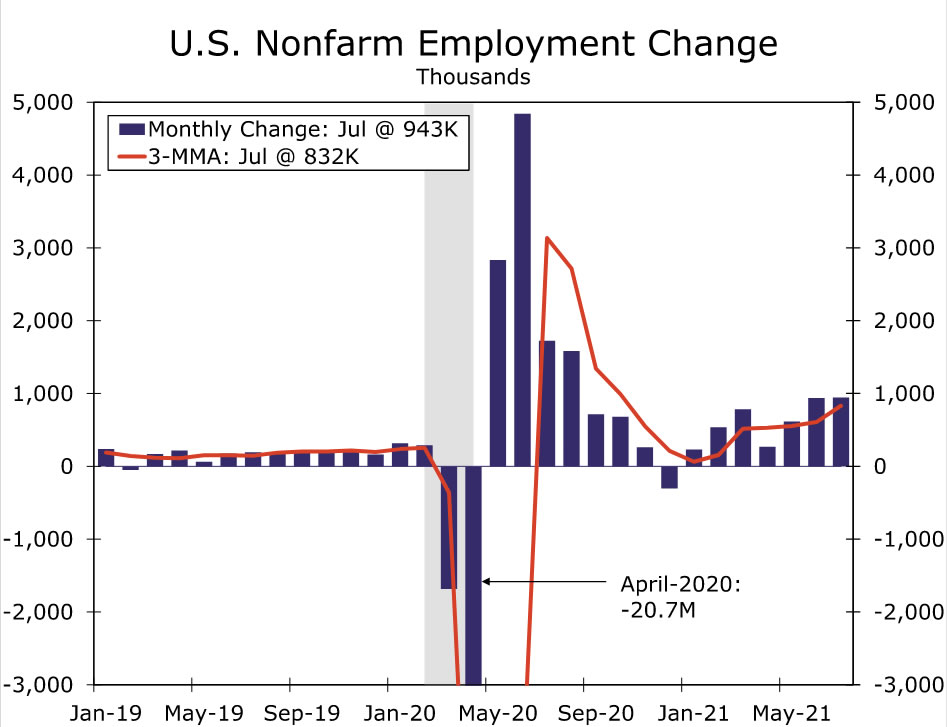
Some strength was driven by seasonal factors boosting government hiring by a hefty 240K, as lower levels of employment this past year led to fewer summer layoffs than usual. The release noted, “Staffing fluctuations in education due to the pandemic have distorted the normal seasonal buildup and layoff patterns, likely contributing to the job gains in July.” But private payrolls still advanced a solid 703K last month on top of a significant upward revision to June's figure (now +769K). Every major sector other than retail added jobs, with the leisure & hospitality sector (+380K) accounting for more than half of the private sector job gains last month.
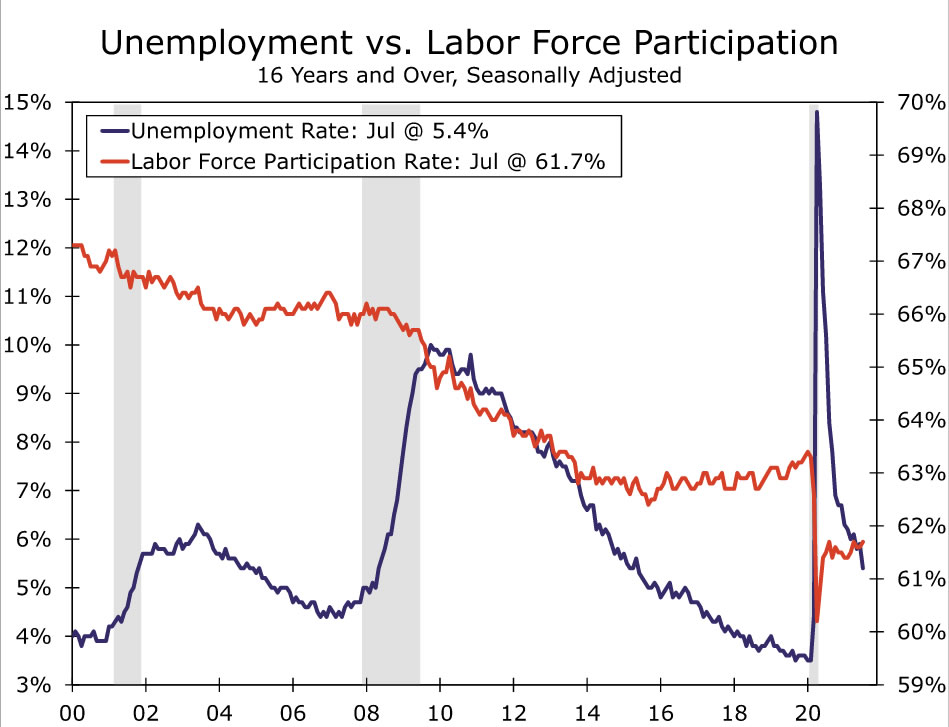
The solid gain in leisure & hospitality employment demonstrates that constraints on labor supply continue to slowly ease as workers return to the hard-hit sector. The labor force increased by 261K in July leading the participation rate to inch marginally higher to 61.7% (see chart). But participation still remains within its post-pandemic range, emphasizing that the availability of workers remains a challenge. Fear of catching COVID as the Delta variant has spread across the United States likely remains an impediment to the return to work, as does childcare responsibilities and perhaps enhanced unemployment benefits. Retirements among older workers are another challenge. With the labor force rising only moderately, the sharp drop in the unemployment rate to 5.4% from 5.9% in June was tied mostly to the +1 million increase in jobs as measured by the household survey being filled by the ranks of the previously unemployed.
Supply Constraints Continue to Bid Up Wages
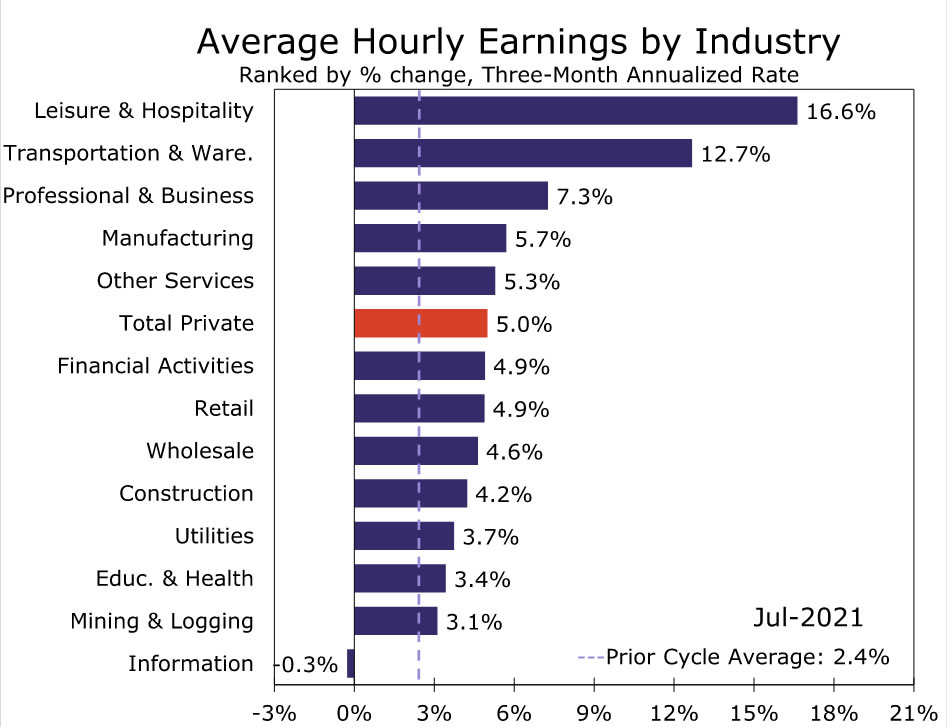
In further evidence that inflation is broadening beyond physical inputs and transportation costs, average hourly earnings (AHE) rose another 0.4% in July, bringing the three-month annualized pace to 5.0% (see chart). Wage gains continue to be most acute in the sectors where job losses remain the steepest, such as leisure & hospitality where wages are up 7.6% just since the start of the year. Constraints on the supply of labor continue to bid up wages as employers are finding it increasingly difficult to find the help they need.
Continued supply challenges will keep pressure on wage growth. Wages and salaries should offset some of the hit to personal income from dwindling fiscal support over the next couple of months, and this increased financial incentive from higher wages could potentially pull more workers back into the labor force. The bargaining power looks increasingly in the hands of workers, and with demand for labor strong, workers are able to consider their options rather than taking the first job that comes their way.
Still Need Better Visibility on Labor Supply
The better-than-expected July report is certainly a step in the direction of “substantial further progress” that the Fed is looking for. Through July about 75% of the jobs lost during lockdowns last year have been added back, but there remain 5.7M fewer jobs compared to February 2020 (see chart). At the same time, labor force participation has barely budged since the economy's broad reopening this spring.
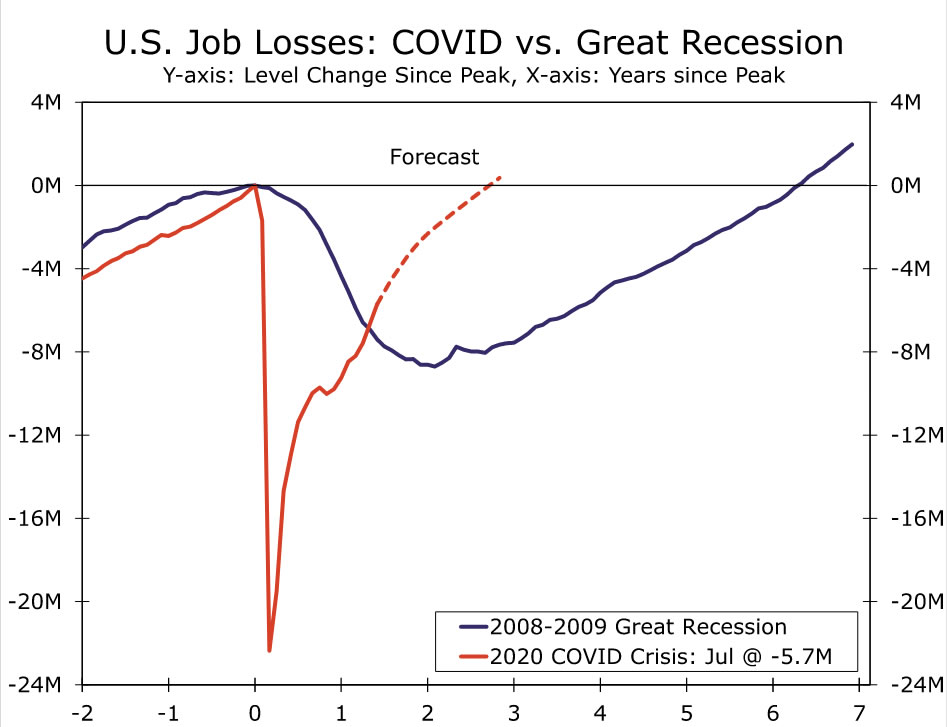
We continue to look for the factors currently constraining the labor supply to ease this fall, which should keep hiring strong. However, the rise of the Delta variant is likely to lead to a more muted rebound in labor force participation over the next few months than we had previously expected. Not only have health concerns reemerged, but even as in-person schooling resumes, the chance of outbreaks that intermittently send children home will make it difficult for some parents to commit to new jobs just yet.
Therefore, September may still be too soon to bring the clarity on the jobs market many are looking for. While additional progress is a good bet over the next month, we do not expect it will be enough for the bulk of the FOMC to get on board with tapering as early as its September 22 meeting even following today's report. A clearer picture of whether the current weakness in the labor supply largely boils down to short-term frictions or longer-lasting damage will probably not emerge until the October jobs report is released on November 5, two days after the November FOMC meeting concludes. While this report certainly puts the Fed closer to the threshold of “substantial further progress,” key Fed officials are likely to see that some ground still needs to be recovered.