


Week in review
- Escalating Middle East conflict and disruptions in the Strait of Hormuz have pushed Brent crude to $90 a barrel, raising fears of oil hitting $150.
- A surprising contraction in the US labor market (unexpected job losses in February and unemployment at 4.4%) has increased the chance of a June or July interest rate cut by the Fed.
- US markets show more resilience, supported by the tech sector and net oil exporter status, while Europe faces a potential “stagflationary shock” due to its vulnerability to energy price spikes
- The week ahead is dominated by geopolitics, but major economic releases include US CPI and Core PCE for insights into inflation’s “stickiness,” and a significant upward revision expected for Japan’s Q4 2025 GDP.
Wall Street’s primary indexes tumbled on Friday, led by a sharp decline in the Dow to a three-month low as the market grappled with escalating conflict in the Middle East and a surprising contraction in the US labor market.
Data revealed the economy unexpectedly lost jobs in February,exacerbated by healthcare strikes and severe winter weather pushing the unemployment rate up to 4.4%.
This combination of geopolitical tension and economic cooling has shifted market expectations; traders have now priced in a roughly 50% chance of a June interest rate cut, while some analysts suggest the Fed’s dual mandate to balance inflation and employment could pull the first cut forward to July.
The volatility is being fueled by a dramatic spike in energy prices, with Brent crude hitting $90 a barrel following disruptions in the Strait of Hormuz. As shipping halts and analysts warn that oil could reach $150 a barrel if Gulf exports are fully suspended, airline stocks have plummeted nearly 13% this week.
Qatar’s recent warnings regarding prolonged delivery delays for natural gas have only added to the “stagflation” fears, a situation where growth slows while prices rise.
Despite the downturn, US markets have shown more resilience than their global counterparts, buoyed by a strong tech sector and the nation’s status as a net oil exporter.
In contrast, European markets suffered their worst week in nearly a year, with the STOXX 600 hitting a two-month low. Because Europe is more vulnerable to energy price shocks, major exchanges in Frankfurt, Paris, and Madrid recorded historic weekly losses as investors braced for a potential stagflationary environment across the continent.
Gold prices edged higher on Friday as escalating tensions in the Middle East sparked a wave of safe-haven buying.
Spot gold rose 0.3% to $5,090.16 per ounce, while US gold futures for April delivery climbed 0.4% to $5,099.50. Despite these daily gains, the metal remained on track for a 3.5% weekly decline, effectively snapping a four-week winning streak.
This downward pressure stemmed from persistent inflation worries and a volatile dollar, both of which have dampened investor expectations for imminent interest rate cuts.
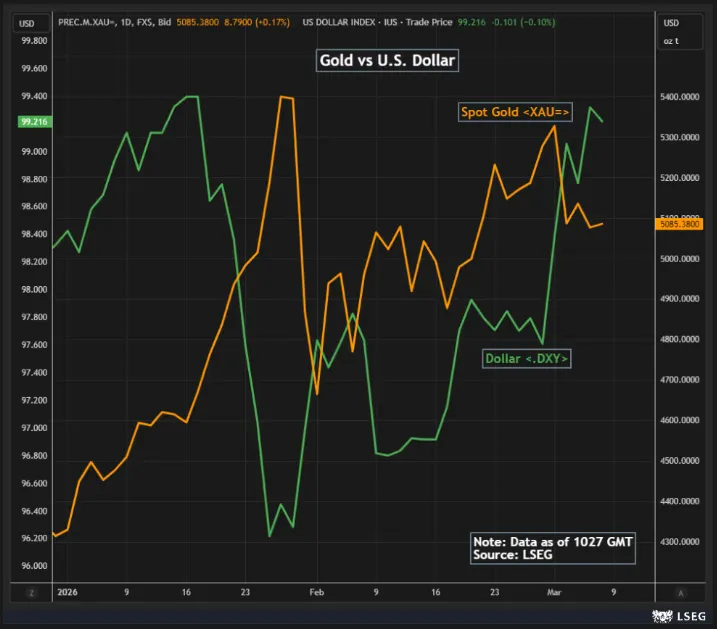
Source: LSEG
The broader commodities market showed a stark contrast, as crude oil prices surged toward their most significant weekly gain since the 2022 invasion of Ukraine.
Spot WTI oil was up around 34% at the time of writing.
While gold benefited slightly from its status as a refuge during geopolitical instability, the reality of “higher-for-longer” interest rates continues to weigh on bullion’s appeal compared to yield-bearing assets.
The Week Ahead
Global markets enter the second week of March 2026 under the shadow of a rapidly escalating Middle East conflict. With a US-led campaign against Iran entering its second week and shipping through the Strait of Hormuz at a standstill, the “2022 Energy Shock” is no longer just a historical reference, it is the primary lens through which investors are viewing the week ahead.
The Macro Theme: Geopolitics Overpowers Fundamentals
While the economic calendar is packed with heavy hitters like US CPI and UK GDP, their influence may be dampened by the “high-risk zone” of current geopolitics.
- Energy Prices as the Barometer: Brent crude has already surged toward $85/bbl. Analysts warn that a breach of $100/bbl would be a “psychological milestone” that could trigger a deeper sell-off in risk assets.
- 2022 vs. 2026: There does appear to be a critical difference from the 2022 shock: the labor market is now much cooler. Unlike 2022, when workers could chase higher pay to offset energy costs, the current cooling trend (highlighted by a weak February US jobs report) means consumers have less of a buffer.
United States: The Inflation-Rate Cut Tug-of-War
The spotlight is firmly on the US Consumer Price Index (CPI) due Wednesday and Core PCE on Friday.
The Dilemma: Markets are looking for signs of how “sticky” inflation remains before the full impact of the current energy spike is even recorded. A surprise upside in CPI would likely force markets to price out the two Fed rate cuts currently expected for 2026.
Consumer Sentiment: Friday’s University of Michigan survey will be the first real-time look at how the “energy shock” and tariff fears are sapping household confidence.
Asia: China’s “Two Sessions” and Japan’s GDP Revision
Asia remains at the forefront of the supply chain disruption, with a specific focus on the closing of China’s National People’s Congress.
- China (Monday/Tuesday): February CPI and PPI data will be released. Analysts expect a bounce in CPI to ~1.0% due to Lunar New Year spending, though this may be viewed as a “noise” rather than a trend. Trade data (Tuesday) will be scrutinized for the resilience of external demand.
- Japan (Tuesday): Expect a significant upward revision to Q4 2025 GDP (from 0.1% to 0.3% QoQ) following strong capital spending and winter bonuses. This could keep the Bank of Japan on its path toward normalization despite global turmoil.
Europe & UK: Looking for Signs of Life
The Eurozone is navigating a “stagflationary shock” where energy deficits punish the Euro, though narrowing interest rate differentials against the USD are providing some support.
- Germany (Monday/Wednesday): Industrial Production and final Inflation data will show if the “fledgling recovery” in manufacturing can withstand the new energy spike.
United Kingdom (Friday): Monthly GDP and industrial output for January will be released. Markets are looking for a pickup in growth to confirm the encouraging signals seen in recent PMI surveys.
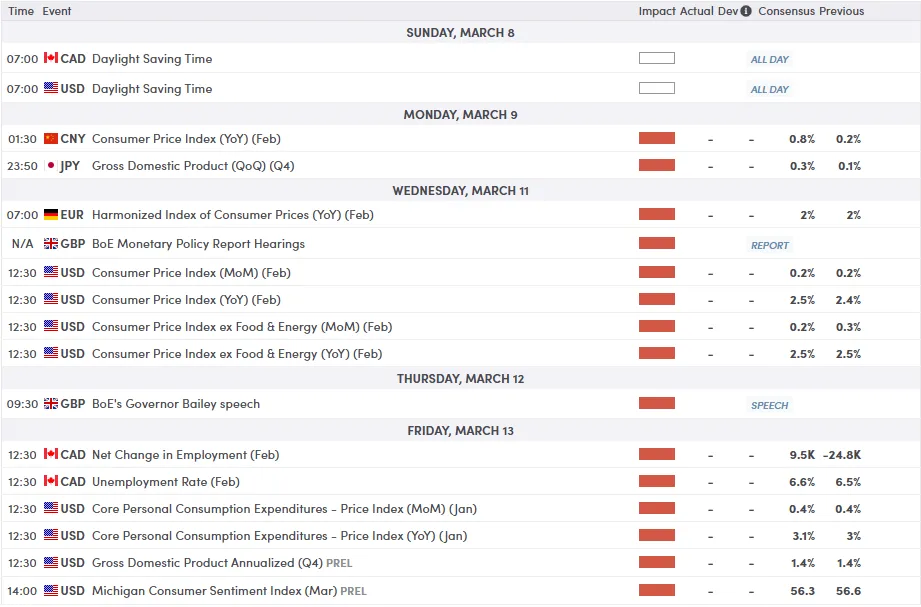
For all market-moving economic releases and events, see the MarketPulse Economic Calendar. (click to enlarge)
Chart of the week – WTI Oil
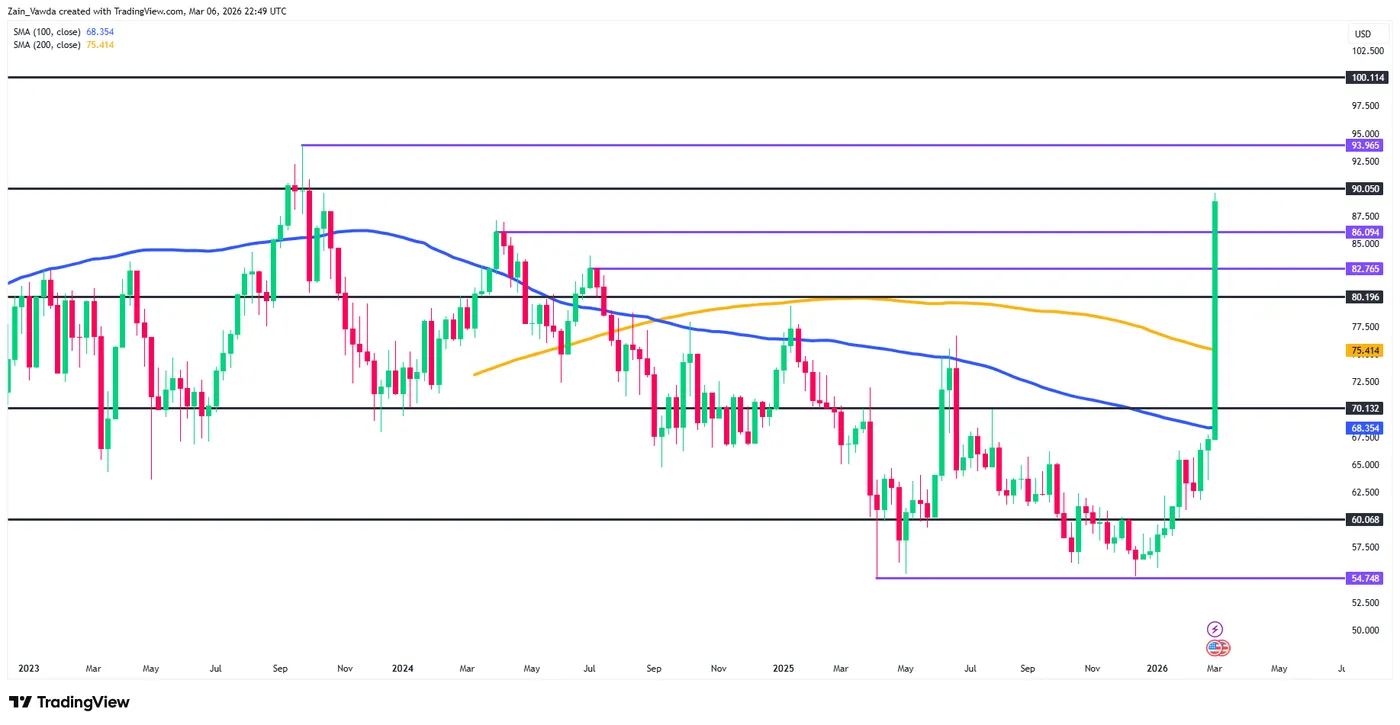
From a technical standpoint, WTI has just posted a massive bullish engulfing candle which has completely invalidated the previous multi-year downtrend, thrusting WTI from the mid-$60s to over $90.00 in a matter of days.
The move as is largely the case was driven by the geopolitical and fundamental dynamics around Oil prices. However, it is important to note that were thechnical signs that Oil was in a consolidation phase with a breakout growing ever-more likley.
Nobody however envisioned a 30% + price spike in the space of a week.
Where does price go to from here?
This will of course depend on the course the war in the Middle East takes.
Further refinery attacks by Iran or any escalation on that front and we could open the new week already above the $100/barrel mark.
Alternatively, if tensions do begin to ease, Oil prices may fall quite quickly.
The price is currently testing the $90.05 level. If the momentum continues, the next major psychological and technical targets are $93.96 and the multi-year high at $100.00.
In the event of a “cool-off,” the previous resistance at $80.19 and the 200-day SMA ($75.41) now serve as the primary floor.
There is a significant liquidity gap between $70 and $85. In normal market conditions, these gaps tend to fill, but in “war-premium” markets, they can remain open for weeks.
WTI Oil Weekly Chart, March 6, 2026
Source:TradingView.Com (click to enlarge)





