Dollar advanced broadly today as risk aversion swept through global markets. Asian equities declined while investors moved back toward safe-haven assets amid growing doubts about the narrative that the Iran war is nearing an end. Instead, markets are back pricing the possibility of prolonged energy scarcity and fragmentation in global trade.
The shift in sentiment followed fresh evidence that the conflict in the Middle East remains far from resolved. On the one hand, speaking at a rally in Kentucky, US President Donald Trump declared that the US had effectively won the war against Iran. Yet within hours, Iranian explosive boats attacked two oil tankers near Iraq’s Basra terminal, setting both vessels on fire and forcing Iraq to halt operations at its export facilities.
These events reinforced fears that critical energy infrastructure across the Gulf remains highly vulnerable. With the Strait of Hormuz effectively disrupted, traders increasingly view the region’s oil flows as exposed to further attacks.
Markets also reassessed the significance of the International Energy Agency’s emergency intervention. On Wednesday, the IEA authorized a historic release of 400 million barrels from strategic reserves in an attempt to stabilize the energy market following the supply shock.
Rather than reassuring investors, the sheer scale of the release has been interpreted as a warning signal. At more than twice the size of the 2022 Ukraine-related release, the move suggests authorities are preparing for a prolonged disruption to global oil supply.
Even so, the numbers highlight the limits of the intervention. With around 20 million barrels per day typically flowing through the Strait of Hormuz, the emergency reserves would replace only a small fraction of the potential supply loss. Brent crude quickly rebounded above 101 per barrel after an initial dip, reflecting the market’s skepticism.
Adding to market anxiety are renewed tariff threats from Washington. The US Trade Representative has launched Section 301 investigations into sixteen major trading partners, including China, Mexico, India and the European Union. Because Section 301 was the legal mechanism used during the first Trump administration’s trade war, investors see the move as laying the groundwork for a more durable tariff regime.
For the day so far, Loonie leads gains, followed by Dollar and Yen. Risk-sensitive currencies are under pressure, with Aussie the weakest performer of the session ahead of Sterling and Euro.
Looking at the week as a whole, however, Aussie remains the strongest currency thanks to growing expectations of back-to-back RBA rate hikes. Dollar ranks second, followed by Kiwi. Yen remains the weakest performer overall, with Swiss Franc and Euro also lagging, while Loonie and Sterling sit near the middle of the global currency performance table.
In Asia, at the time of writing, Nikkei is down -1.52%. Hong Kong HSI is down -1.19%. China Shanghai SSE is down -0.56%. Singapore Strait Times is down -0.55%. Japan 10-year JGB yield is up 0.018 at 2.184. Overnight, DOW fell -0.61%. S&P 500 fell -0.08%. NASDAQ rose 0.08%. 10-year yield rose 0.072 to 4.208.
AUD/JPY rally accelerates, GBP/AUD falls as RBA turns more activist on inflation
Aussie’s broad-based strength continues today as markets further strengthened expectations that the RBA will deliver two consecutive rate hikes in the coming months. Investors are increasingly convinced that the RBA will raise the cash rate at the March 17 meeting and follow up with another increase in May, lifting the policy rate from the current 3.85% to 4.35%.
What has significantly reinforced the narrative this week is the alignment among Australia’s major banks. Commonwealth Bank and ANZ have now joined NAB and Westpac in forecasting back-to-back hikes. With all four major institutions now projecting the same policy path, the market has quickly embraced the view that the RBA is preparing to act more decisively against inflation risks.
A key driver behind this shift is the belief that the RBA is becoming increasingly “activist” in defending inflation expectations. Westpac Chief Economist Luci Ellis, a former senior RBA official, noted that policymakers may now respond more aggressively to the headline inflation shock caused by rising oil prices. Acting pre-emptively could help prevent the energy-driven spike from becoming embedded in longer-term inflation expectations.
The urgency is understandable given Australia’s recent inflation data. Core inflation jumped to 3.4% in January, already well above the RBA’s 2–3% target range. With global energy prices surging following the Iran war, policymakers appear increasingly concerned that the inflation outlook could deteriorate further if action is delayed.
Despite the growing hawkish expectations, markets still broadly believe the tightening cycle will peak at around 4.35%. This level is widely viewed as sufficiently restrictive to contain inflation pressures while avoiding a sharp economic downturn. However, the more important question may be how long rates remain elevated. Many analysts now believe policy could stay at that level well into the second half of 2027.
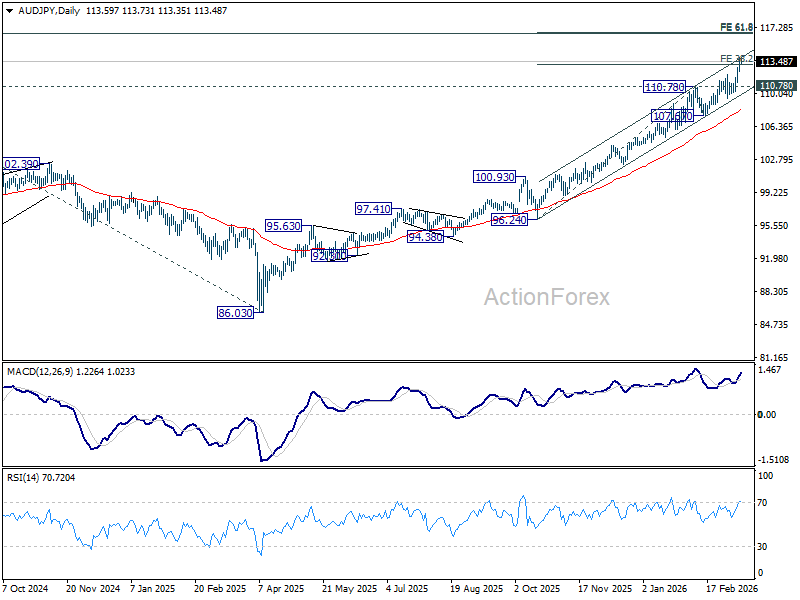
Technically, AUD/JPY has been one of the clearest beneficiaries of this shift in expectations. The cross surged above 38.2% projection of 96.24 to 110.78 from 107.67 at 113.22 this week. While the cross is now testing the ceiling of its rising channel and could see short-term consolidation, the broader outlook remains bullish as long as the former resistance at 110.78 holds as support. The next upside target for AUD/JPY is 61.8% projection at 116.20.
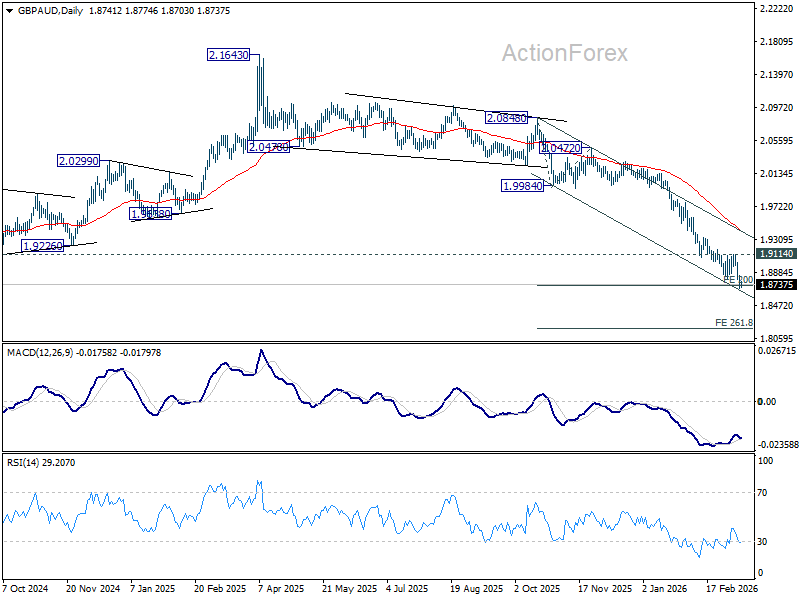
Meanwhile, GBP/AUD has continued its decline and has already reached 200% projection of 2.0848 to 1.9984 from 2.0472 at 1.8744. While the cross may attempt a temporary rebound from the falling channel floor, the broader outlook remains bearish. As long as resistance at 1.9114 caps any recovery, the downtrend is likely to continue toward 261.8% projection at 1.8210.
EU warns 100+ Brent could push inflation above 3%, cut growth by 0.4%
European policymakers are deeply concerned that the Iran war could deliver a fresh stagflation shock to the region’s economy. In a private briefing to EU finance ministers earlier this week, Economy Commissioner Valdis Dombrovskis reportedly warned that the conflict’s impact on energy markets could push inflation higher while simultaneously weighing on growth.
According to officials cited by Bloomberg, sustained Brent crude prices around $100 per barrel could lift EU inflation above 3% in 2026. That would mark a significant setback, reversing the disinflation progress achieved in 2025 as inflation gradually moved to the ECB’s 2% target.
The growth outlook could deteriorate at the same time. The European Commission estimates that economic expansion could be reduced by about 0.4 percentage points this year. With the bloc’s baseline forecast previously standing at just 1.4%, such a hit would meaningfully weaken Europe’s already fragile recovery.
Natural gas prices represent another key risk. Dombrovskis warned that gas could climb to around €75 per megawatt-hour by year-end. Such a move would likely feed directly into broader price pressures and could add another full percentage point to core inflation across the Eurozone economy.
Despite these warnings, the outlook still depends heavily on how long the conflict lasts. Dombrovskis emphasized that if the war is contained within a few weeks, inflation pressures could ease and growth forecasts might stabilize. But if the conflict drags on and Gulf energy infrastructure continues to face attacks, the EU may have to confront what he has already described publicly as a “stagflationary shock.”
EUR/USD Daily Outlook
Daily Pivots: (S1) 1.1590; (P) 1.1628; (R1) 1.1650; More….
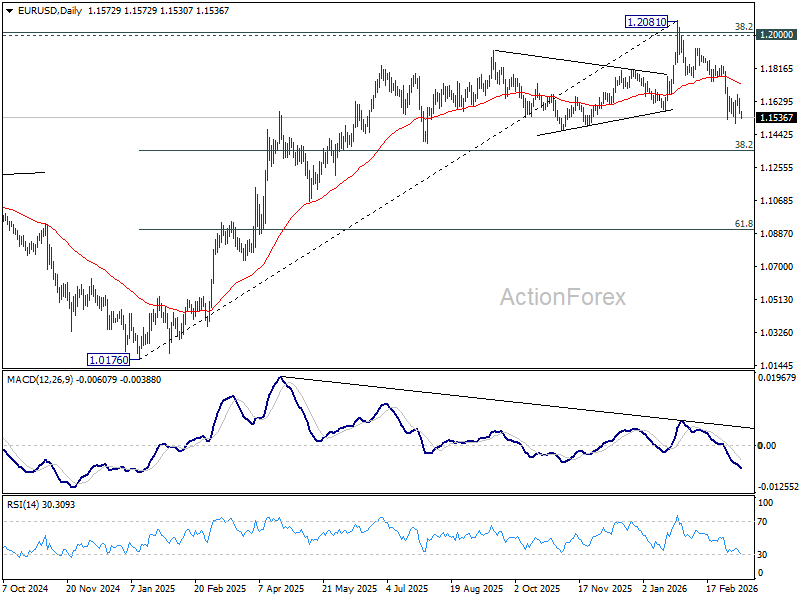
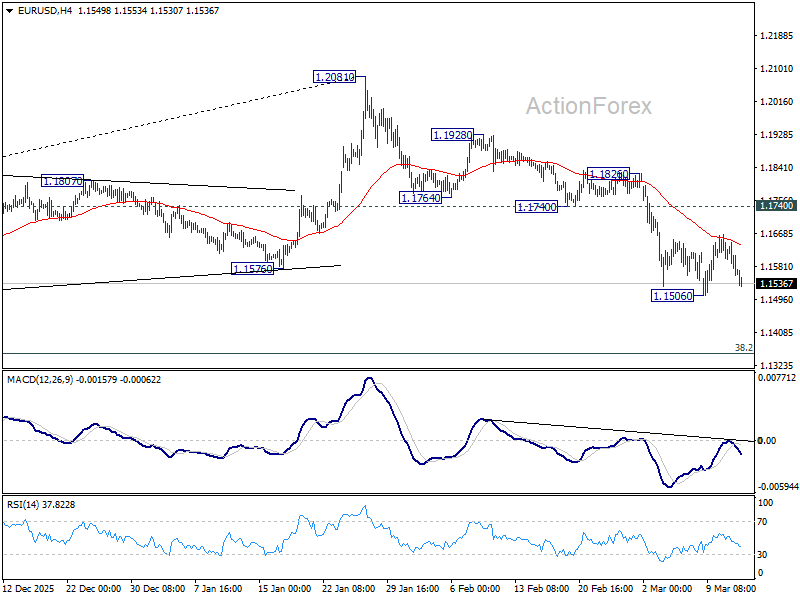
Intraday bias in EUR/USD remains neutral first, but focus is back on 1.1506 temporary low with today’s decline. Firm break there will resume the fall from 1.2081 and target 38.2% retracement of 1.0176 to 1.2081 at 1.1353 next. Overall, near term outlook will stay cautiously bearish as long as 1.1740 support turned resistance holds.
In the bigger picture, a medium term top should be in place at 1.2081 on bearish divergence condition in D MACD. Sustained trading below 55 W EMA (now at 1.1500) should confirm rejection by 1.2 key cluster resistance level. That would also raise the chance that whole up trend from 0.9534 (2022 low) has completed as a three wave corrective bounce too. For now, medium term outlook is neutral at best as long as 1.2081 holds, even in case of rebound.