


Key takeaways
- Stagflation fears returned sharply as President Trump’s threat of hard strikes on Iran pushed WTI crude back above US$90, while hot US CPI data reinforced expectations of a higher-for-longer Federal Reserve policy stance.
- Technology and AI-linked equities remain under heavy pressure as the S&P 500 and Nasdaq 100 sold off, weighed down by stretched valuations, semiconductor weakness, and concerns that mega tech IPOs may drain liquidity from public markets.
- Asia Pacific markets opened weaker amid global risk-off sentiment, with tech-heavy indices such as South Korea’s KOSPI and Taiwan’s TAIEX leading losses, while regional currencies remained under stress near multi-year lows.
- Chart of the day: Dow Jones (DJIA) rotation play evaporated; potential transition to a medium-term downtrend phase, with key short-term resistance at 50,390/540.
Chart of the day – Dow Jones (DJIA)’s in transit towards a medium-term downtrend
Fig. 1: US Wall Street 30 minor trend as of 11 Jun 2026 (Source: TradingView). The information presented is historical information, and past performance is not indicative of future performance.
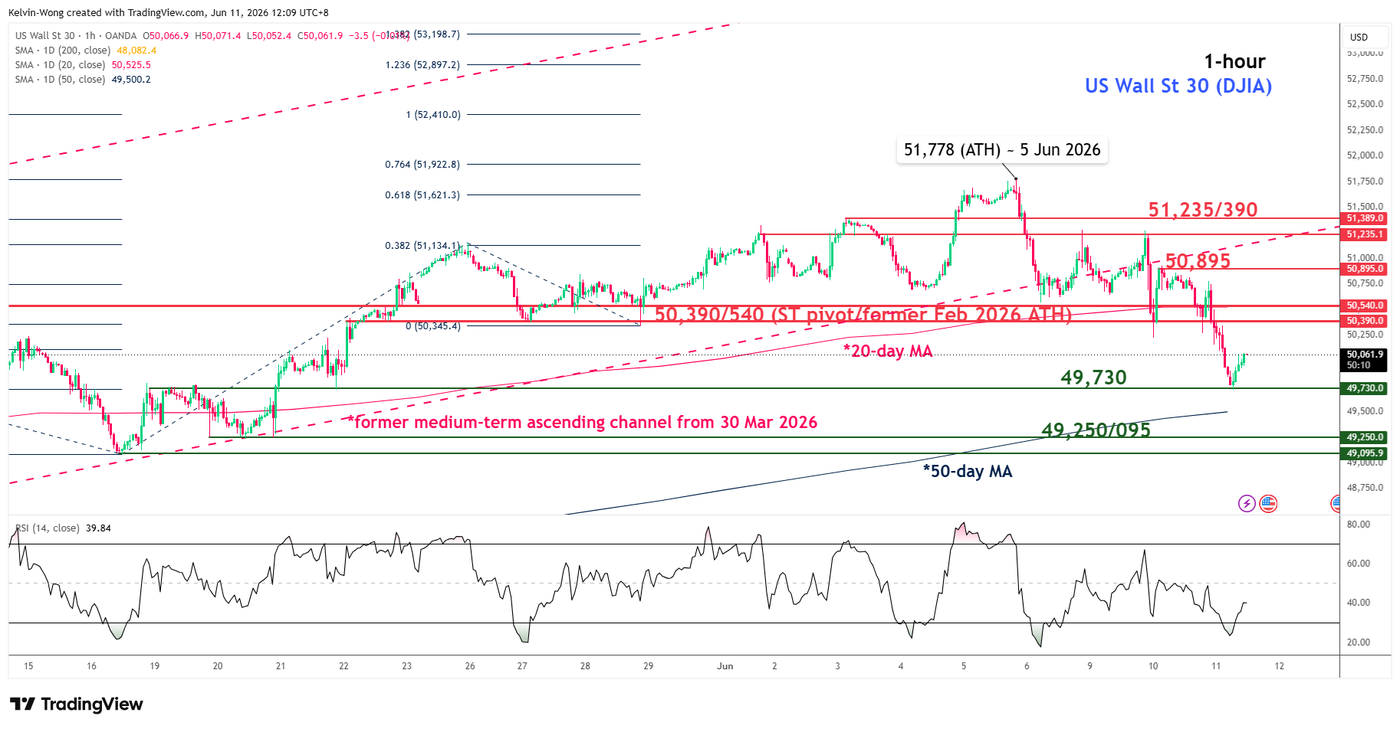
The earlier outperformance of the Dow Jones Industrial Average on Tuesday, 9 June, which eked out a 0.2% gain amid steep losses in the tech-heavy Nasdaq 100, has evaporated.
The last price action of the US Wall Street 30 CFD (a proxy for the DJIA E-mini futures) plummeted 1.9% on Wednesday, 11 June, and broke below its 20-day moving average, with a daily close below it (see Fig. 1).
Prior to the bearish breakdown of its 20-day moving average, the US Wall Street 30 CFD has breached below the medium-term ascending channel support from its 30 March 2026 low on Tuesday. These observations suggest the medium-term uptrend phase from 30 March 2026 has been demagaed, and it is now transiting into a potential medium-term downtrend phase.
Watch the 50,390/540 key short-term pivotal resistance for further potential weakness towards the next intermediate supports at 49,730 and 49,250/095 in the near-term.
On the flip side, a clearance and an hourly close above 50,540 invalidates the minor bearish bias scenario for a corrective rebound for a retest on the next intermediate resistance at 50,895.
Top macro headlines
- Trump threatens hard strikes on Iran, crude rebounds past $90: Geopolitical tensions erupted into a volatile escalation on Wednesday after U.S. President Donald Trump warned that the U.S. will be “attacking them, attacking them very hard.” The aggressive stance followed overnight strikes that damaged a fragile two-month truce, prompting West Texas Intermediate (WTI) crude to surge by more than 3% back above $90 as hopes for a quick resolution faded.
- Wall Street rout wipes out weekly advances as megacaps slump: Equity markets experienced a broad liquidation as the S&P 500 tumbled 1.6%, wiping out this week’s gains. Risk-off sentiment intensified as major technology firms and a closely watched semiconductor gauge (SOX) slid 3.6%, adding to anxieties over stretched AI valuations.
- US CPI jumped to almost a 3-year high, reinforced hawkish rate vibes: The U.S. Labour Department released a red-hot consumer price index data that showed an increase of 4.2% y/y in May, its highest level since April 2023, threatening sticky, energy-driven inflation and renewed fears of an emergency Federal Reserve interest rate hike before year-end.
- AI Capital demands are raising concerns about an institutional liquidity drain: Wall Street strategists are signalling alarm about an unprecedented wave of equity supply from private tech giants looking to fund AI ambitions. Capital allocators note that mega-cap private listings, including SpaceX’s fixed $135/share offering and Anthropic’s confidential IPO tracking, are forcing funds to dump liquid public equities to build necessary cash reserves.
- Amazon’s expansion of its shipping service targets major trucking routes: Shares of several large transportation and logistics companies plunged on Wednesday. The aggressive drop came immediately after Amazon.com Inc. announced a sweeping expansion of its proprietary internal shipping network, directly rattling the commercial freight sector.
Key macro themes
- The return of the stagflation dilemma: The core structural narrative guiding global macro desks shifted violently away from a “soft landing” and straight back toward stagflation risk. While consumer price metrics print near-stable levels, the persistence of an energy supply crunch amid direct military friction across the Middle East keeps input costs highly elevated. If the Strait of Hormuz shipping corridor faces prolonged or indefinite disruptions, oil-driven price pressures will override corporate margin resilience, forcing global central banks to lean toward hawkish policies despite weakening economic output.
- The AI funding bottleneck and private Issuance pressures: An underlying undercurrent to the weakness in public technology markets is a massive, looming structural drain of institutional capital. A flood of major private corporations seeking public capital to fund intensive infrastructure requirements threatens to crowd out standard secondary-market liquidity. As capital allocators clear the deck for multi-billion and near-trillion-dollar valuations across private artificial intelligence and defence aerospace firms, existing public tech listings are facing a persistent ceiling on structural bids.
- Cross-asset volatility inversion: As standard multi-asset insurance models begin to fray, correlations across traditionally inverse asset classes are breaking down. Bond market volatility metrics remain structurally elevated near multi-decade highs, driven by shifting policy outlooks in Tokyo, Frankfurt, and Washington. Rather than serving as an organic buffer, fixed income has become an active vector of volatility, driving stock market risk premiums significantly higher year-to-date.
Global markets impact (last 24 hours)
Equities: The S&P 500 lost 1.6%, and the technology-heavy Nasdaq 100 declined 2% as hardware and semiconductor names underperformed, while the Dow Jones Industrial Average dropped 1.9% amid weakness in consumer retail and logistics. In Europe, the STOXX 600 retreated amid concerns about industrial vulnerabilities.
In today’s Asia opening session, the S&P 500 and Nasdaq 100 E-mini futures staged a relief bounce of 0.2% and 0.4% respectively after US Central Command declared that military strikes on Iranian targets have been “completed’.
Fixed Income: Sovereign bonds posted modest losses as safe-haven bids failed to fully offset hawkish rate-hike fears. The yield on the benchmark 10-year U.S. Treasury note advanced 4 basis points to settle near 4.55%. Internationally, Germany’s 10-year Bund yield advanced 3 basis points to 3.08%, and the UK’s 10-year Gilt yield climbed 3 basis points to 4.95%.
FX: The US Dollar Index traded almost unchanged on Wednesday as market participants await the ECB’s new monetary policy guidance today after fully pricing in a 25 bps hike for today’s policy meeting. The euro traded flat at 1.1535, and the British pound rested virtually unchanged at $1.3368.
The Japanese yen inched up by 0.1%, hovering around 160.50 per dollar, just a whisker below the 30 April 2026 high of 160.73 that triggered intervention from Japanese authorities. The worst performer was the risk-sensitive AUD, which fell 0.4% to a 2-month low of 0.7000 per dollar.
Commodities: Energy-dominated resource complexes, with WTI crude jumping 3.5% to settle at $91.84/bbl on Trump’s geopolitical remarks. Conversely, spot gold collapsed 4.4% to trade at $4,072/oz as non-yielding safe-havens buckled under the higher-for-longer assumption of global sovereign yields.
Asia Pacific impact
- Equity indices retest key support levels: Driven lower by deep overnight liquidation across New York tech megacaps, regional APAC benchmarks tracked heavy downside on Thursday, Asia opening session. Speculative positioning in tech-concentrated hubs such as South Korea’s KOSPI (-2.4%) and Taiwan’s benchmark TAIEX (-2.3%) came under intense pressure amid declines in local semiconductor companies. Intraday losses were seen in other bourses: Nikkei 225 (-1.5%), Hang Seng Index (-1.4%), China A50 (-0.3%), CSI 300 (-0.4%), ASX 200 (-0.3%), and STI (-0.5%).
- Regional currencies hit 17-year lows: Underlying currency defence limits remain under extreme stress across Asia. The South Korean Won continued to trade near a severe 17-year low of 1,530 against the greenback, prompting localised currency stability committees to keep maximum alert flags raised.
- Indonesian Rupiah anchors following emergency actions: Following a surprise emergency interest rate hike implemented during the prior session by Bank Indonesia to insulate the local capital account from global capital flight, the Indonesian Rupiah showed tentative signs of consolidation, holding its hard floor against the U.S. Dollar as it rebounded for the consecutive session from its record low of 18,180 printed on Monday, 8 June 2026.
Top 5 events to watch today
- ECB Interest Rate Decision – 8:15 pm SGT (consensus: 25 bps hike) Impact: EUR, EUR crosses, DAX, Bunds
- US PPI (May) – 8:30 pm SGT (consensus: 5.4% y/y, Apr: 5.2% y/y) Impact: USD, US Treasuries, US stock indices, Gold
- US Weekly Initial Jobless Claims – 8.30 pm SGT Impact: USD, shorter-term US Treasuries, US stock indices
- ECB Press Conference – 8:45 pm SGT Impact: EUR, EUR crosses, DAX, Bunds
- US – Iran ceasefire agreement Impact: All asset classes





. The information presented is historical information, and past performance...)