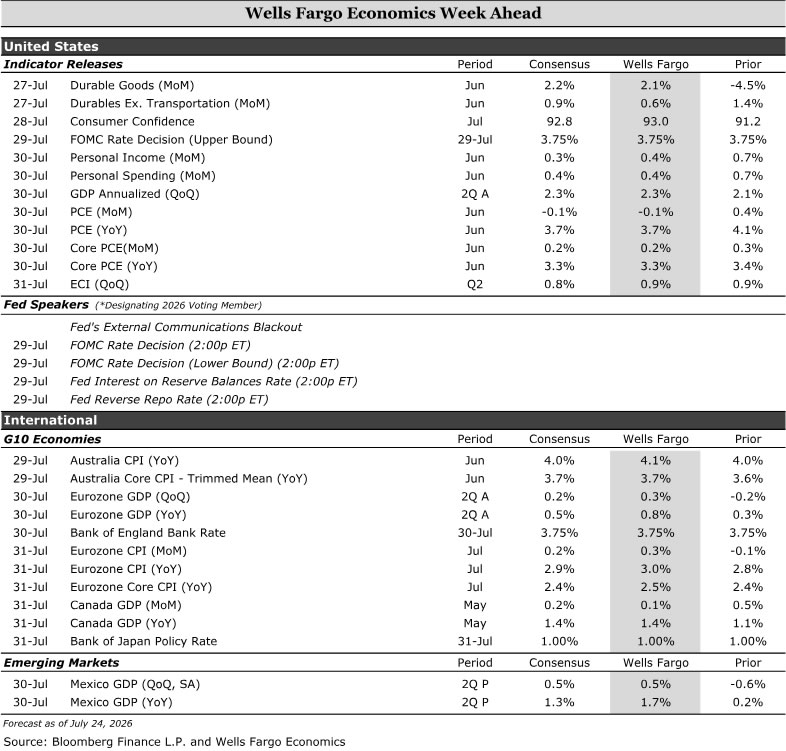
With Warsh’s second FOMC meeting approaching, we expect the Fed to remain on hold while maintaining a modest tightening bias. Next week’s PCE report will either reinforce or challenge that view, though we continue to expect slightly cooler inflation. We also expect Q2 GDP growth to moderate from Q1, despite continued economic resilience.
In Australia, we expect inflationary pressures to remain elevated. Over in the U.K., we expect the BoE to leave rates unchanged. Likewise, we expect the BoJ to keep policy unchanged as it continues its gradual normalization process. In Canada, we expect GDP growth to expand modestly. In the Eurozone, we expect firmer GDP growth and inflation. In emerging markets, Mexico’s GDP growth is expected to rebound, but not meaningfully accelerate.
- United States: FOMC (Wednesday), Personal Income & Spending (Thursday), Q2 GDP (Thursday)
- G10 Economies: Australia CPI (Wednesday), Bank of England (Thursday), Bank of Japan (Friday), Canada GDP (Friday), Eurozone GDP & CPI (Friday)
- Emerging Markets: Mexico GDP (Thursday)
U.S. Week Ahead
FOMC • Wednesday
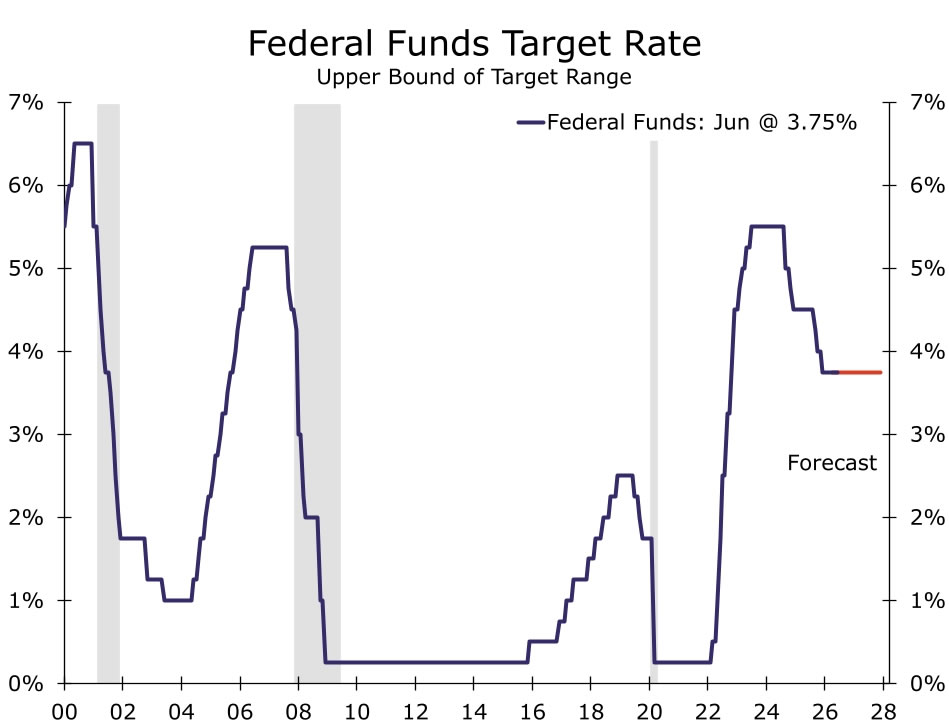
We expect Kevin Warsh’s second meeting as FOMC Chair to be a punt to September as the Committee awaits more data that either confirm or dispel their hawkish leanings. Since the last FOMC meeting, both employment and inflation have come in cooler than expected, and these factors should tilt the scales toward a policy rate hold. But, it is clear from recent Fed communications that the bar to hike rates is low, and the recent jump in oil prices is once again threatening to drive inflation higher in the months ahead. At least two hawkish dissents are probable, most likely from Dallas Fed President Lorie Logan and Cleveland Fed President Beth Hammack.
There will be no updated SEP at this meeting, and with Chair Warsh generally adopting a “less is more” mindset to Fed communications, we would be surprised if the shortened statement or press conference yielded any big reveals. We expect Chair Warsh will use the press conference to buy the Committee time ahead of its next meeting on September 16. He likely will note that policy is in a good place to await additional information and that the Committee will deliver on its inflation target. We expect he will point to the ongoing work of the task forces when asked about balance sheet policy, Committee communications, and the outlook for inflation.
Source: Federal Reserve Board and Wells Fargo Economics
We will be listening closely for any hints about where the median of the Committee’s views lie as it relates to what would trigger rate hikes, especially as it relates to the next few inflation reports. Our base case forecast remains that the FOMC will keep the fed funds rate on hold for the foreseeable future as core inflation gradually slows in the months ahead.
Personal Income & Spending • Thursday
June figures for personal income and spending become available the very day after the FOMC meeting. Financial markets will be dialed in to the latest inflation data delivered with that report, specifically the core PCE numbers. Despite the relatively benign inflation reading in the June CPI and PPI data, we are forecasting a monthly gain of 0.2% in core PCE which would translate to a year-over-year core inflation reading of 3.3%, only slightly cooler than the 3.4% print in May. At the moment inflation is concentrated in a handful of categories. For example, the AI build-out has whetted the appetites of hyperscalers and tech firms for all the needed tech inputs. Demand for these computer software & accessories has given a predictable lift to prices for them. The fact that this category has a larger weight in the PCE than in the CPI helps explain our expectation for only a modest cooling in core inflation.
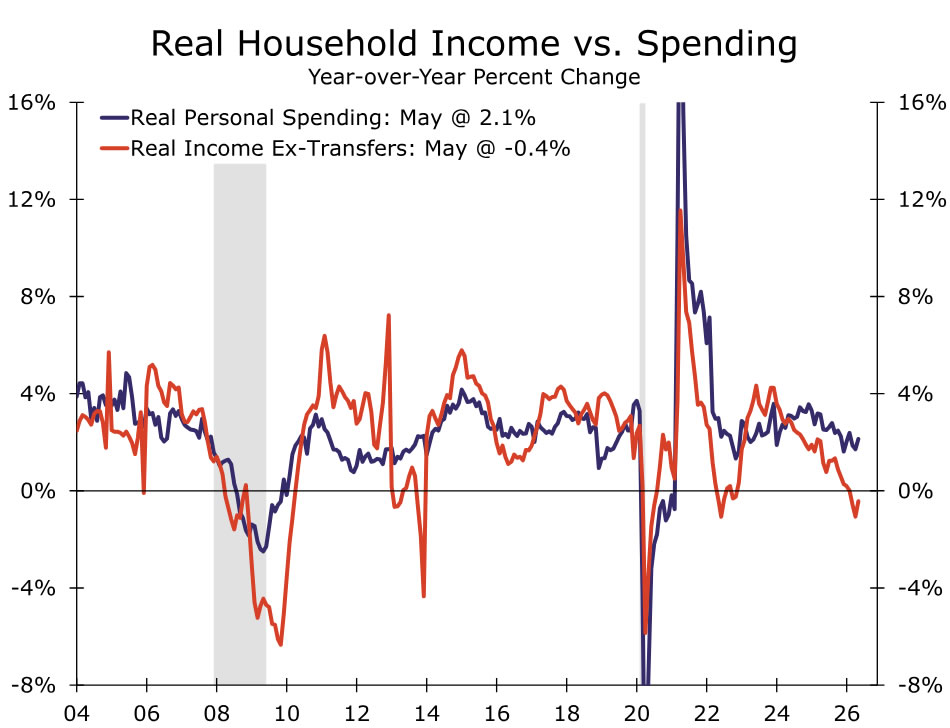
A solid June retail sales report points to a decent month for goods spending and upward revisions to May data. A key question will be whether households can afford to keep splashing out. Real disposable income growth has been under pressure and the saving rate has dipped to multi-year lows. The composition of income growth and any changes in the saving rate will offer some fresh perspective on how long the consumer can keep spending in the face of higher energy prices, especially now that tax refunds and the extra cash they provided have largely run their course.
Source: U.S. Department of Commerce and Wells Fargo Economics
Q2 GDP • Thursday
Alongside Thursday’s personal income & spending report, we’ll get the first comprehensive look at Q2 GDP, which we expect to show the U.S. economy expanded at a 1.8% annualized pace. As in Q1, growth was likely driven by robust business investment, with the AI buildout supporting a double-digit gain in equipment spending. Because much of that investment has been imported, however, we expect a sizable drag from net exports to offset some of this strength. Consumer spending also appears to have firmed, with growth likely exceeding a 2% annualized rate as larger-than-usual tax refunds largely offset higher gasoline prices. While the report should reinforce the economy’s resilience, we doubt growth will accelerate in the second half of the year given a softer labor market, weak real income growth and a saving rate that remains near historic lows.
G10 Week Ahead
Australia CPI • Wednesday
Australia’s June CPI and Q2 inflation releases are due next week and will be critical for the Reserve Bank of Australia’s (RBA) August policy decision. We expect headline inflation to rise to 4.1% year-over-year in June, while quarterly trimmed mean inflation comes in at 0.9% quarter-over-quarter, lifting the annual rate to 3.7%. Lower petrol and diesel prices should provide some relief in June, although higher fuel costs earlier in the quarter linked to the initial escalation of the Middle East conflict are still likely to be reflected in the Q2 data.
Underlying inflation pressures also remain elevated. Recent PMI surveys suggest strong demand is allowing service providers to become more aggressive in their pricing, raising the risk that inflation remains higher for longer. The inflation data will be released against a backdrop of resilient growth and a still-tight labor market, which leaves policymakers focused on whether progress toward the inflation target is slowing.
While a softer-than-expected inflation print could support another hold in August, the recent re-escalation of hostilities in the Middle East keeps upside inflation risks front of mind for the RBA. As such, we continue to expect a 25 bps rate hike in Q3. August remains our base case, though a softer inflation outcome could delay the move to September. Either way, we continue to expect the RBA to raise the Cash Rate to a terminal rate of 4.60%, which would mark its fourth hike this year.
Source: Bloomberg Finance L.P. and Wells Fargo Economics
Bank of England Monetary Policy Meeting • Thursday
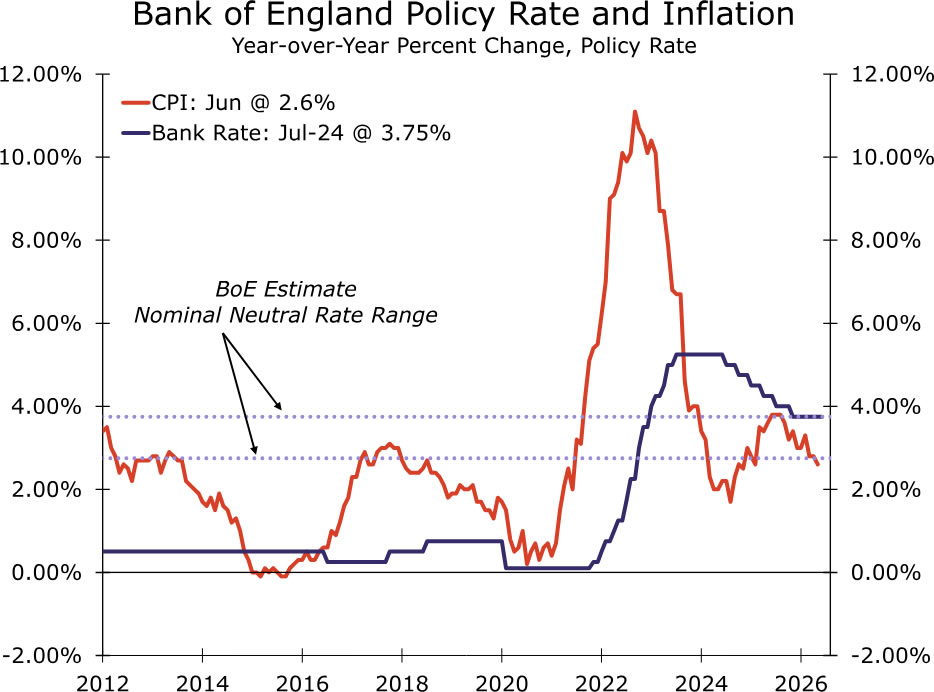
When Bank of England (BoE) policymakers meet next week, we expect the Bank Rate to remain unchanged at 3.75%. The June meeting revealed a more hawkish Committee than the headline 7-2 hold suggested. Catherine Mann, despite voting to hold, joined dissenters’ view of upside inflation risks as the more prominent threat.
The data nevertheless give the majority room to wait. June CPI slowed to 2.6% year-over-year from 2.8%, while services inflation eased to 3.6% and core inflation held at 2.6%. At the same time, the labor market continues to soften, with unemployment at 4.9% and private-sector regular pay growth slowing to 2.9%. While the 13.5% increase in the Ofgem energy price cap is likely to push headline inflation higher and household inflation expectations remain elevated at 4.0%, there is little evidence yet that those pressures are passing through more broadly.
We therefore expect the BoE to hold next week while preserving a tightening bias. We look for the Monetary Policy Report to revise near-term inflation higher and growth lower. We continue to expect a 25 bps hike in Q4, though risks remain tilted toward an extended hold should growth weaken further, or labor market conditions soften more quickly than expected.
Source: Bank of England, Bloomberg Finance L.P. and Wells Fargo Economics
Bank of Japan Monetary Policy Meeting • Friday
At its July meeting, we expect the Bank of Japan (BoJ) to keep its policy rate unchanged at 1.00%. Although headline CPI rose to 1.7% in June from 1.5% in May, core-core inflation eased to 1.7% from 1.8%, reflecting higher energy costs rather than a broadening in underlying inflation. Renewed conflict in the Middle East has increased the risk of higher energy prices and import costs in the coming months. Japan’s PPI has already risen sharply, driven largely by energy and import-price pressures. Further cost pass-through by firms could generate second round effects and broaden consumer inflation beyond energy, keeping the BoJ’s tightening bias intact. However, this would be less favorable cost-push inflation rather than the wage- and demand-driven inflation the central bank wants to see.
The renewed energy shock also brings back downside risks to Japan’s economic activity. While Japan’s economy has improved in recent quarters, growth remains moderate, and higher import costs could squeeze household purchasing power and firm margins. Resilient PMI and Tankan readings, alongside continued support from AI-related demand and investment, suggest the economy retains some momentum. However, a prolonged conflict could weigh on domestic demand and slow progress toward a self-sustaining wage-price cycle.
Against this uncertain backdrop, we expect the BoJ to remain on hold in July while maintaining a tightening bias. We continue to expect a 25 bps increase in Q4, most likely in October, bringing the policy rate to 1.25% year-end.
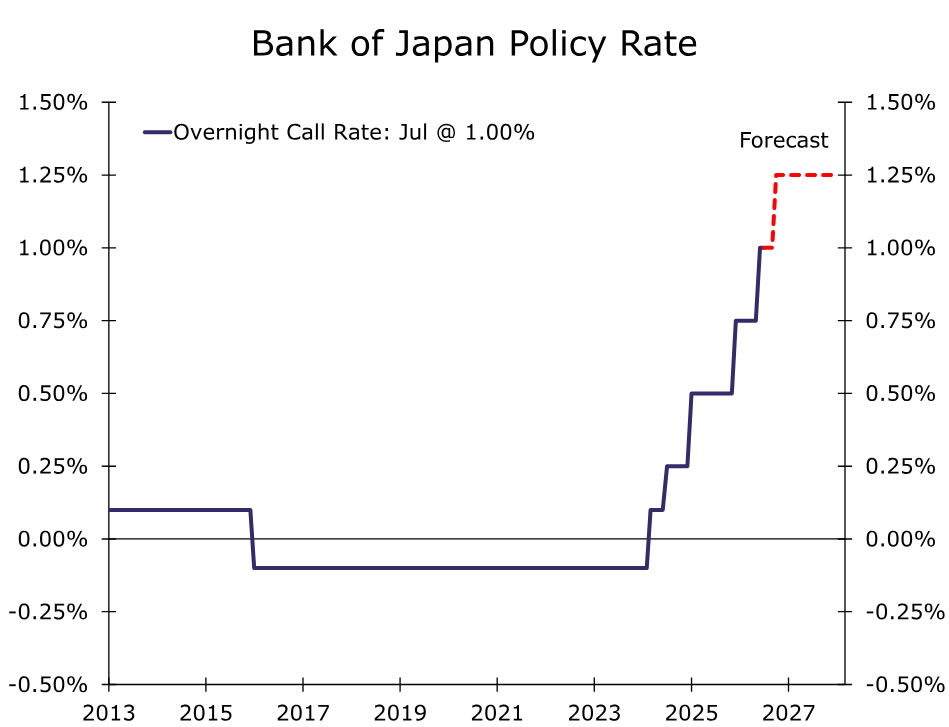
Source: Bloomberg Finance L.P. and Wells Fargo Economics
Canada GDP • Friday
We expect Canadian GDP to rise 0.1% month-over-month in May, matching Statistics Canada’s advance estimate, following an outsized gain in April. While some payback is likely after the previous month’s strength, incoming data continue to point to an economy that is expanding modestly rather than slipping toward recession.
Purchasing manager indices remained on firmer footing through May across both manufacturing and services, suggesting activity held up despite ongoing geopolitical uncertainty. Growth was likely led by service-producing industries, with gains in finance & insurance and real estate offsetting weakness in wholesale trade and agriculture.
Taken together, the monthly data point to a rebound in activity in Q2 after a soft patch over the past year. A firmer growth backdrop should continue to alleviate recession concerns and reinforces our expectation that the Bank of Canada will remain on hold for the foreseeable future. That said, downside risks remain, particularly surrounding the evolution of the U.S.-Iran conflict and the path of USMCA negotiations.
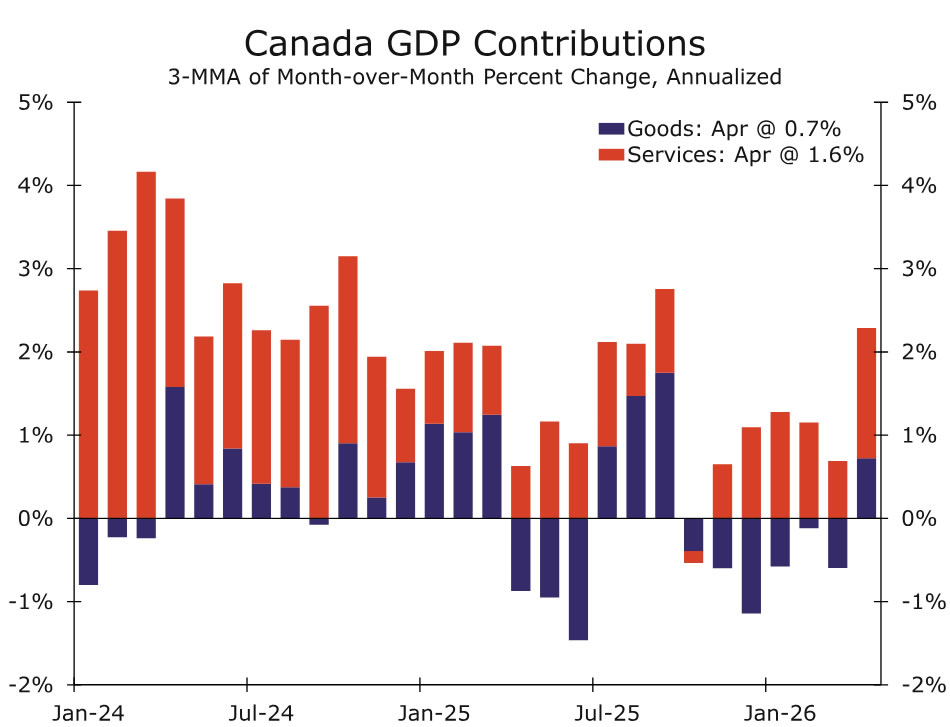
Source: Haver Analytics and Wells Fargo Economics
Eurozone GDP & CPI • Friday
Next week’s Eurozone GDP and CPI releases will provide important insight into the European Central Bank’s (ECB) policy outlook. We expect Q2 GDP growth to improve to 0.3% quarter-over-quarter from 0% in Q1, lifting annual growth to 0.8% year-over-year. Recent indicators point to firmer activity through the second quarter, though renewed tensions in the Middle East remain a headwind and raise questions about whether growth can maintain its recent resilience.
On inflation, we expect July headline CPI to rise to 3.0% year-over-year from 2.8% in June, while core inflation edges up to 2.5% from 2.4%. Although underlying inflation has remained relatively contained, higher energy prices continue to work their way through the economy. Firms continue to face higher input costs and are increasingly looking to pass those costs on through higher selling prices, leaving policymakers focused on whether broader price pressures begin to emerge.
While limited second-round effects and weaker-than-expected growth could strengthen the case for an extended hold, continued volatility in energy markets and ongoing disruptions in the Middle East keep upside inflation risks in focus. As such, we continue to expect the ECB to deliver one additional 25 bps rate hike in September, bringing the Deposit Rate to 2.50% by year-end.
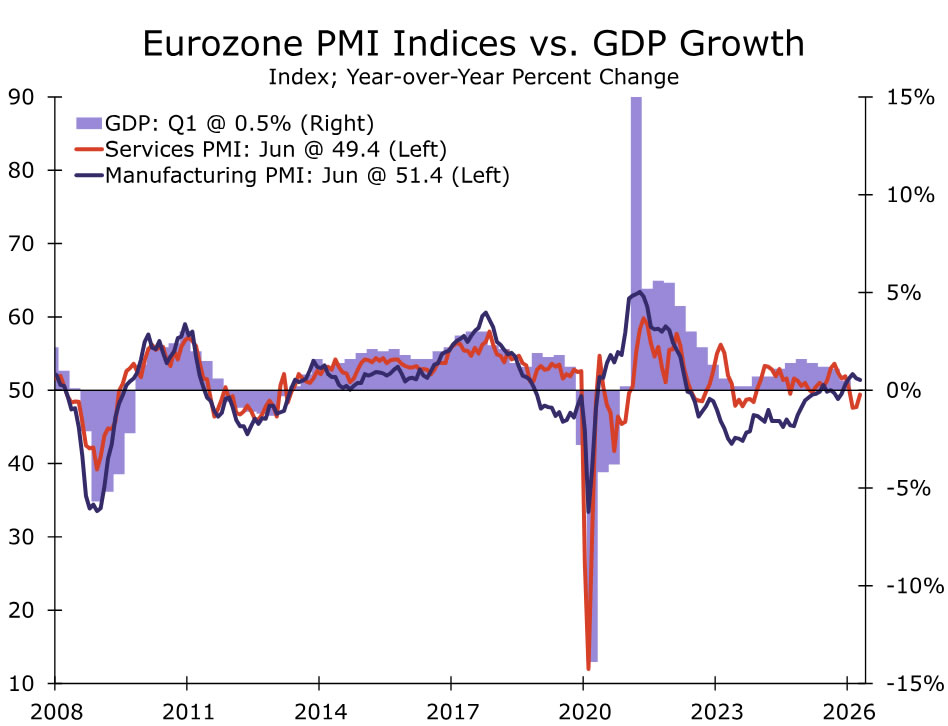
Source: Bloomberg Finance L.P. and Wells Fargo Economics
EM Week Ahead
Mexico GDP • Thursday
Next week’s GDP release will show whether Mexico’s economy stabilized in Q2 following a weak start to the year. We expect growth to rebound to 0.5% quarter-over-quarter and 1.7% year-over-year in Q2 after real GDP contracted 0.6% in Q1 and annual growth slowed to 0.2%.
Recent indicators point to some stabilization, but not a meaningful acceleration. Mexico’s economic activity, a monthly proxy for GDP, grew 1.1% from a year earlier, slowing from the prior month. Services remained the main source of growth, while industrial activity stayed weak. Retail sales momentum has moderated following an earlier rebound, and modest remittance growth should provide only limited support to household spending. Alongside continued weakness in fixed investment, domestic demand will likely remain subdued in Q2.
Manufacturing conditions are still mixed. The S&P manufacturing PMI moved into expansion in June, but any improvement in factory activity remains tentative. Looking ahead, uncertainty surrounding the USMCA review, together with our expectation that the nearshoring impulse will gradually fade, could constrain investment and limit the scope for a sustained manufacturing recovery.
We continue to expect Banxico to hold its policy rate at 6.50% through 2027. A firmer GDP reading would reinforce the case for remaining comfortably on hold, while another contraction, particularly alongside the recent moderation in inflation, could revive expectations for additional easing.
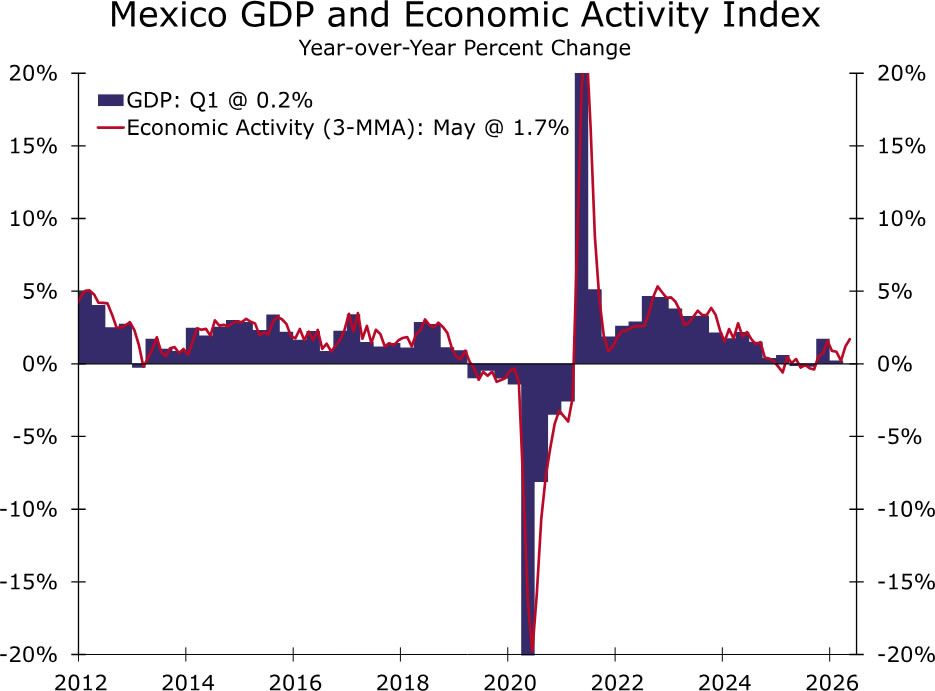
Source: Bloomberg Finance L.P. and Wells Fargo Economics