TL;DR: With markets already convinced the RBA is done hiking, tomorrow’s New Zealand employment report matters less for whether the RBNZ turns more hawkish and more for whether the labor market stays resilient enough to keep its tightening bias intact — a dynamic already pressuring AUD/NZD lower.
Why the Focus Has Shifted Across the Tasman
Markets have already reached a broad consensus that the Reserve Bank of Australia has finished tightening for this year. The focus is now shifting across the Tasman, where the Reserve Bank of New Zealand still appears to have work left to do. That makes tomorrow’s second-quarter employment report less about whether the RBNZ will turn more hawkish, and more about whether the labor market is resilient enough to keep its existing tightening bias intact.
Inflation Already Made the Case for More Tightening
The case for further tightening was largely established by inflation. New Zealand’s second-quarter CPI rose 4.1% y/y, exceeding the RBNZ’s 3.9% forecast and reminding policymakers that price pressures remain more persistent than expected. More importantly, non-tradable inflation held at an elevated 3.4%, indicating domestic inflation — not just higher fuel costs linked to the Middle East conflict — continues to pose a challenge.
Stronger business sentiment since then has only reinforced that picture, with July’s ANZ Business Confidence jumping to 56.1 from 36.6.
Why Tomorrow’s Data Doesn’t Need to Surprise
Against that backdrop, tomorrow’s labor market data don’t need to surprise on the upside to support the policy outlook. Consensus forecasts call for:
- Employment growth of 0.1% q/q.
- Unemployment edging up from 5.3% to 5.4%.
- The Labour Cost Index accelerating from 0.5% to 0.6% q/q.
Those figures are broadly consistent with the RBNZ’s own projections, meaning an in-line report would leave the Bank’s economic assessment largely intact. Instead of weakening the tightening narrative, it would reinforce the view that policy still needs to move somewhat further into restrictive territory to contain domestic inflation and limit second-round effects from higher energy prices.
What Would Actually Move Markets
The bigger market reaction would likely come from a stronger-than-expected report. Faster employment growth, firmer wage inflation, or a lower unemployment rate would strengthen the case for another hike as early as September, and increase expectations that the Official Cash Rate ultimately reaches the upper end of the 2.75%–3.00% range currently expected by many economists. Only a materially weaker labor market would cast meaningful doubt on that outlook, by suggesting higher borrowing costs are beginning to bite more sharply than anticipated.
Why This Matters for AUD/NZD
Those shifting policy expectations have become important for AUD/NZD. Australia’s softer-than-expected second-quarter CPI has persuaded markets the RBA is likely to keep the cash rate unchanged at 4.35% through year-end, effectively ending a period in which Australian rate expectations consistently outpaced those in New Zealand. With the RBA sidelined, investors are now watching whether the RBNZ can narrow the policy differential through further tightening, providing fundamental support for the New Zealand Dollar against its Australian counterpart.
ActionForex’s Technical View on AUD/NZD
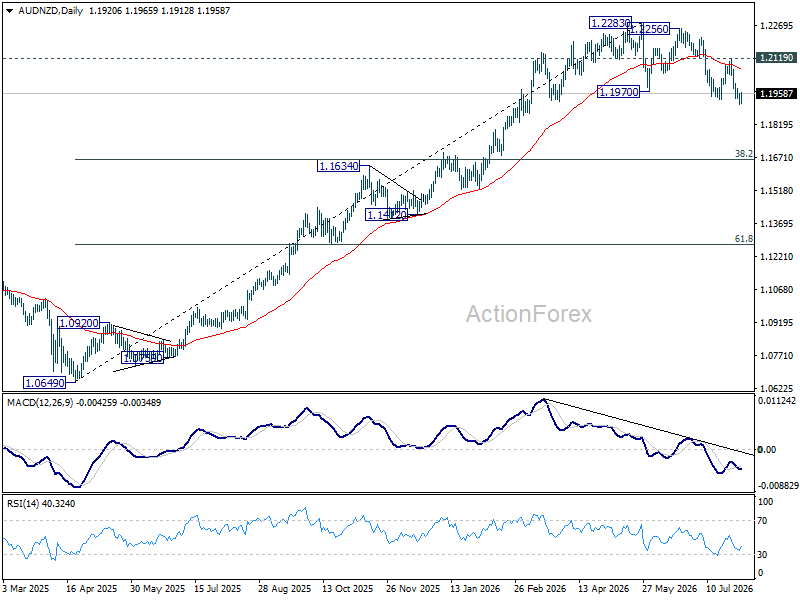
The technical picture complements the macro story. AUD/NZD’s decline from 1.2283 continues to look like a correction of the five-wave advance from 1.0649. As long as 1.2119 resistance caps rebounds, the bias remains lower. The next downside objective remains the 38.2% retracement at 1.1658, which sits just above the previous fourth-wave consolidation around 1.1412–1.1634.
Against a backdrop of narrowing policy differentials, tomorrow’s New Zealand labor market report has the potential to provide the catalyst for the next leg lower in AUD/NZD.
Key Takeaways
- New Zealand’s Q2 CPI beat the RBNZ’s own forecast at 4.1% y/y, with sticky non-tradable inflation at 3.4% keeping the tightening bias intact.
- Consensus expects tomorrow’s employment data to come in broadly in line with RBNZ projections, meaning an in-line print alone would reinforce, not weaken, the hawkish case.
- A stronger-than-expected report would raise September hike odds and support an Official Cash Rate move toward the top of the 2.75%-3.00% range.
- Australia’s softer CPI has convinced markets the RBA is done hiking, shifting the AUD/NZD policy narrative fully toward the RBNZ’s next move.
- AUD/NZD’s decline from 1.2283 remains capped below 1.2119 resistance, with 1.1658 the next downside objective if the labor data supports further RBNZ tightening.