TL;DR: Five major central banks announce decisions this week, but the RBNZ and BoC—not the Fed, ECB or BoJ—carry the greatest potential for a meaningful repricing. With NZD/USD testing 0.5766–0.5808 resistance and USD/CAD testing 1.3986–1.3927 support, the question for both is whether policy guidance validates the tightening markets have already priced in.
Why This Matters
Five major central banks announce policy decisions this week, but the greatest potential for a meaningful repricing of interest rate expectations may lie with the RBNZ and BoC, rather than the Fed, ECB or BoJ. While the immediate decisions are largely anticipated across all five meetings, the degree of uncertainty surrounding subsequent policy paths differs considerably. For New Zealand and Canada, the combination of policy guidance, voting dynamics and updated economic assessments could challenge market expectations, putting NZD/USD and USD/CAD at important technical turning points.
The broader backdrop is an increasingly difficult inflation environment, as the Middle East oil shock adds pressure to prices while central banks weigh the impact of tighter financial conditions on economic activity. The question is no longer simply whether policymakers will raise rates this week, but whether their communication supports the additional tightening already embedded in market pricing.
Fed, ECB and BoJ: Decisions Largely Priced, but Guidance Still Matters
Three of the five meetings carry little suspense over the immediate decision:
- Fed (Wednesday): 90.6% probability of a hold at 3.75–4.00%, vs. 9.4% for a hike; ~75% probability of at least one hike by December
- ECB (Thursday): ~96.8% probability of a hold at 2.50% (only ~3.2% for a hike); December tightening much more heavily priced
- BoJ (Friday): ~97.2% probability of a hold around 1.25% (only 2.8% for a hike); substantial probability already attached to a December move
The Fed is widely expected to leave its federal funds target range unchanged on Wednesday. Expectations have shifted substantially over the past month, when the probability of an October hike stood considerably higher. Fed Chair Kevin Warsh’s preference for limited forward guidance, together with the absence of updated economic projections at this meeting, reduces the likelihood of a significant change in the policy outlook. A hawkish dissent could attract attention, but its lasting impact would depend on whether it materially alters expectations for December.
The ECB is similarly expected to maintain its deposit rate on Thursday, leaving President Christine Lagarde’s assessment of inflation and financial conditions important. French sovereign risks could also feature prominently following renewed pressure on government bonds and Moody’s decision to maintain France’s Aa3 rating with a negative outlook.
The BoJ is expected to hold its policy rate on Friday. The updated economic outlook and Governor Kazuo Ueda’s communication could nevertheless alter those expectations, particularly if policymakers express greater caution about the timing of the next move.
These meetings are not without surprise potential, but their immediate rate decisions offer less uncertainty than the policy outlooks confronting New Zealand and Canada.
RBNZ: A Nearly Certain Hike Leaves Guidance as the Main Risk
The RBNZ is expected to raise its Official Cash Rate by 25bp from 2.75% to 3.00% on Wednesday, with market pricing indicating approximately 98% probability of an increase. The decision would follow rate hikes in July and September, although the September policy track had suggested a pause in October before further tightening in December.
New Zealand’s Q3 CPI rose 3.7% y/y, below market expectations of 3.8% and the RBNZ’s own 3.9% projection. Quarterly inflation was 0.7%, also slightly below expectations. However, annual inflation is still above the RBNZ’s 1–3% target range, while rising energy costs and currency depreciation threaten to sustain price pressures.
Westpac expects a hike to 3.00% this week and further tightening to 3.50% by February, with its forecast policy rate eventually reaching 4.00% in 2027. However, the full market-implied path is less clear, making it difficult to establish whether the bank’s forecasts are more hawkish than aggregate investor expectations.
The critical question is how firmly the RBNZ signals the next move. A divided decision, if revealed, or a statement emphasizing spare capacity and the restraining impact of higher interest rates could suggest greater caution about December. Conversely, a unanimous increase accompanied by firm inflation warnings and an open path to further tightening would reinforce expectations that the cycle has additional room to run.
Because the immediate hike is almost fully priced, NZD reaction could depend more on these distinctions than on the rate increase itself.
BoC: Can New Projections Justify the Tightening Already Priced?
The BoC faces a more complicated expectations gap:
- Markets price ~80.4% probability of a 25bp hike on Wednesday (to 2.50%)
- A Reuters poll (October 21–23) found only 19 of 34 economists expecting an increase
- OIS pricing implies a policy rate around 2.88% by March 2027, vs. a 2.75% median economist forecast for that endpoint
Markets are therefore pricing somewhat more tightening than the economists’ central forecast, creating room for disappointment even if the BoC raises rates this week.
Governor Tiff Macklem’s recent warnings about inflation risks contributed to a substantial repricing of October expectations. The BoC’s Business Outlook Survey also showed increasing concern about inflation and firms’ willingness to pass higher costs to customers. However, the domestic economy faces countervailing pressures from weaker labour-market conditions, modest wage growth and trade uncertainty with the US.
The BoC will publish updated inflation and growth projections alongside Wednesday’s decision. These forecasts should provide important evidence about how policymakers assess the persistence of the oil shock and the economy’s capacity to absorb tighter monetary conditions.
A hike accompanied by projections consistent with sustained inflation pressure and further tightening could reinforce Canadian Dollar strength. But a hike followed by a comparatively restrained inflation outlook could challenge the more aggressive path priced by markets.
Unlike the RBNZ, where the rate decision itself offers little surprise, the BoC presents uncertainty over both the immediate decision and the justification for subsequent tightening.
ActionForex’s Technical View: NZD/USD, Bullish Reversal Depends on 0.5766 and 0.5808
NZD/USD has recovered from the recent 0.5564 low, but the rebound has yet to establish a convincing bullish reversal. The pair is trading around 0.5704, below its daily 55 EMA near 0.5721 and weekly 55 EMA around 0.5808. The broader weekly structure also continues to reflect the downtrend from the 0.7463 peak in 2021.
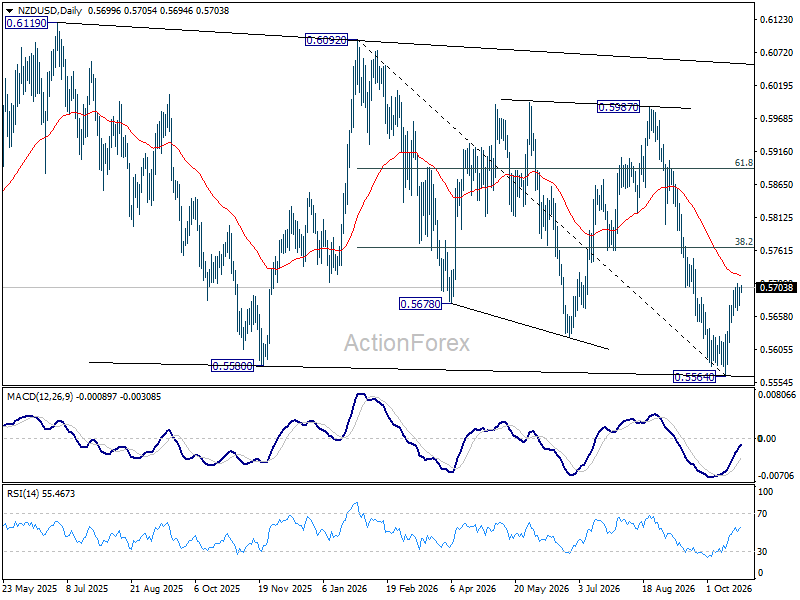
The immediate technical test is the 38.2% retracement of the decline from 0.6092 to 0.5564 at 0.5766. A decisive break above this level would strengthen the case that the fall from 0.6092 has completed, shifting attention toward the weekly 55 EMA around 0.5808.
A further sustained break above that moving average would carry greater significance. It would support the interpretation that the consolidation from 0.6119 has completed as a three-wave structure, comprising declines to 0.5580 and 0.5564 separated by the recovery to 0.6092. That would improve the medium-term technical outlook and bring 0.5987, followed by the 0.6092–0.6119 region, back into focus.
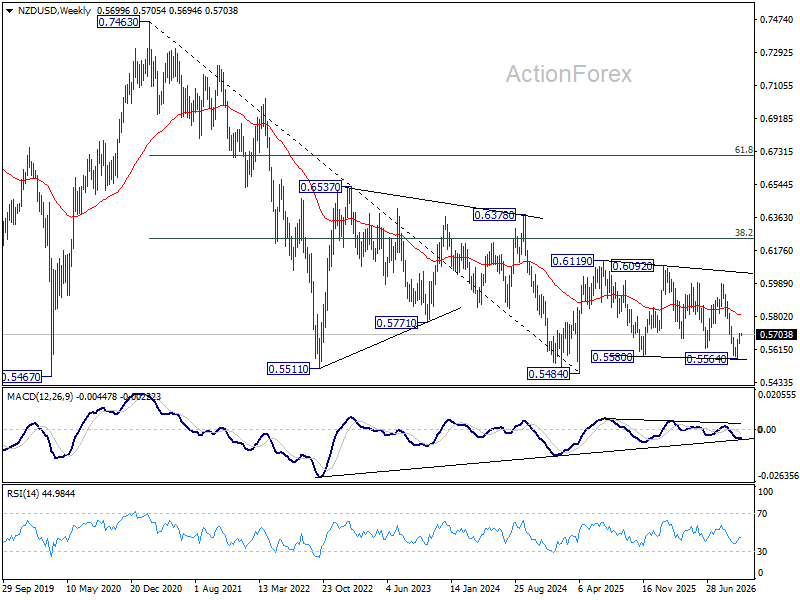
Such a bullish scenario would be more credible if the RBNZ delivers a firm policy message that reinforces expectations for further tightening. Conversely, unexpectedly cautious guidance could interrupt the rebound and expose 0.5564 support to another test. A sustained break below that low would revive the broader bearish outlook.
ActionForex’s Technical View: USD/CAD, Breakdown Could Extend Beyond the Immediate Correction
USD/CAD is approaching a potentially more advanced technical turning point. The pair has retreated from 1.4298 after encountering resistance near the 61.8% retracement of the decline from 1.4791 to 1.3480, situated around 1.4290. That rejection raises the possibility that the rise from 1.3480 has already completed as a corrective move.
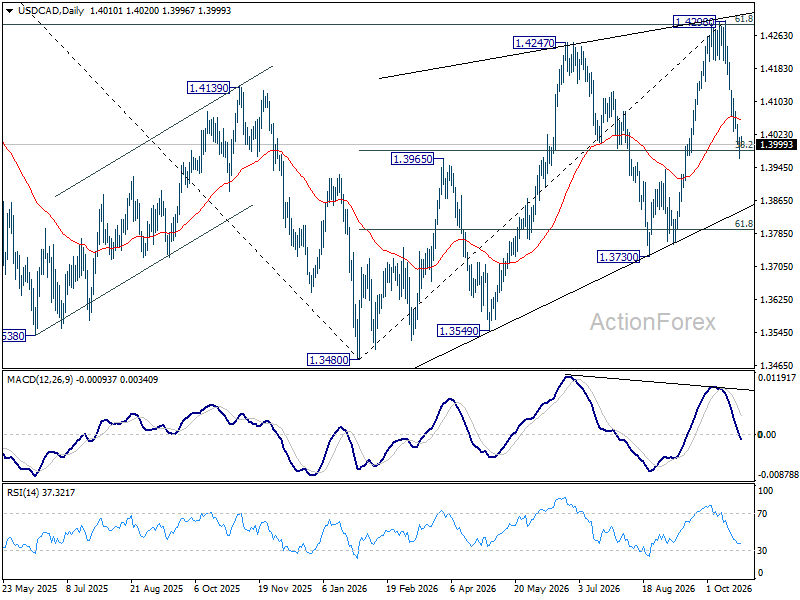
At approximately 1.3999, USD/CAD is testing the 38.2% retracement of the rise from 1.3480 to 1.4298 at 1.3986, with former swing support around 1.3965 immediately below. A decisive break through this support region would strengthen the short-term bearish case and put the 61.8% retracement at 1.3792 in focus.
More importantly, the weekly 55 EMA around 1.3927 represents a significant medium-term technical threshold. A sustained break below this moving average would reinforce the interpretation that the rise from 1.3480 has ended, raising the possibility of a retest of that low and eventual resumption of the larger decline from the 1.4791 high.
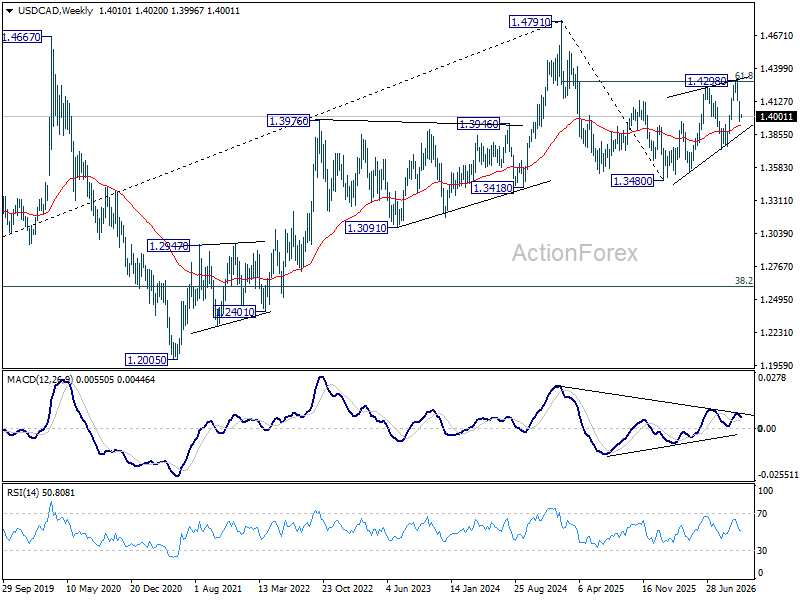
For this broader bearish scenario to develop, the BoC would likely need to deliver projections supporting further tightening, while subsequent economic data would have to validate both the inflation risks and the economy’s ability to absorb higher rates. Conversely, a hold or less hawkish outlook could trigger a rebound from current support and weaken the immediate bearish interpretation.
Beyond the Decisions: Policy Paths Will Determine Whether Breakouts Hold
The RBNZ and BoC offer different potential sources of surprise. For New Zealand, the question is whether an almost certain hike comes with sufficiently firm guidance to sustain expectations for further tightening. For Canada, the challenge is whether the decision and updated forecasts justify a policy path that is already somewhat more aggressive than economists anticipate.
The technical structures add another distinction. NZD/USD still needs to overcome resistance to confirm a bullish reversal, while USD/CAD is already testing support that could validate a broader bearish move.
Neither scenario depends exclusively on domestic central-bank decisions. Australia’s Q3 CPI, the Fed announcement, and Thursday’s US GDP and PCE releases could influence Dollar movements and complicate the interpretation of either currency pair.
Ultimately, the meaningful surprise this week may not be whether central banks deliver the expected rate decisions, but whether their communication supports what markets have already priced. For NZD/USD and USD/CAD, that distinction could determine whether the current technical tests develop into more durable directional moves.
Key Takeaways
- Fed (90.6% hold), ECB (~96.8% hold) and BoJ (~97.2% hold) decisions are largely priced; the real surprise risk this week sits with the RBNZ and BoC instead.
- The RBNZ’s 25bp hike to 3.00% is nearly certain (~98% priced), so NZD’s reaction will hinge on how firmly guidance signals (or doesn’t) a December follow-up.
- The BoC faces a genuine expectations gap: markets price 80.4% odds of a hike, but only 19 of 34 economists in a Reuters poll expect one, with OIS pricing more tightening through March 2027 (2.88%) than economists’ median forecast (2.75%).
- NZD/USD needs a break above 0.5766 and then the weekly 55 EMA near 0.5808 to confirm a bullish reversal; failure exposes 0.5564 support again.
- USD/CAD is testing 1.3986–1.3965 support, with the weekly 55 EMA at 1.3927 the more significant medium-term threshold that would open the way toward 1.3792 and revive the larger decline from 1.4791.
Related Reading
- Brent Nears $120 as Nasdaq Tests 25,800 and US 10-Year Yield Hovers at 5%
- Yen Rallies as Asian Stocks Tumble, AUD/JPY Rejected at Key Resistance
- USD/CAD Falls as BoC Hike Bets Surge, but Can One Hike Break 1.4000?
Stay ahead of this week’s five central bank decisions and their impact on NZD and CAD—subscribe to ActionForex’s daily market commentary for real-time technical and fundamental analysis.