For a market supposedly obsessed with geopolitics, investors appear remarkably calm. The proposed US-Iran agreement remains unsigned, key details are still unresolved, and military exchanges between the two sides continue. Yet financial markets are behaving as though a lasting settlement is only a matter of time. Oil remains well below recent highs, Treasury yields are contained, equity markets are stable, and there is little sign of the panic normally associated with renewed Middle East tensions.
The latest developments offer plenty of reasons for caution. U.S. Central Command said Iran fired two ballistic missiles overnight at American forces stationed in Kuwait, though both were intercepted without casualties. The attacks followed US “self-defense strikes” against Iranian radar and drone command facilities over the weekend.
Meanwhile, Iran has insisted that any agreement must include guarantees covering all fronts, including Lebanon. Foreign Minister Abbas Araghchi warned that any ceasefire violation by the US or Israel would be treated as a violation of the entire agreement. Despite these tensions, there is still no signed framework, and reports suggest negotiators have yet to finalize key aspects of the proposed deal.
Yet investors seem more focused on where negotiations are heading than on the latest military headlines. US President Donald Trump reiterated today that Iran “really wants to make a deal” and insisted that the eventual agreement would be beneficial for both the US and its allies. He also urged critics to stop second-guessing the process, concluding with the message: “Just sit back and relax, it will all work out well in the end.” Markets appear willing to take him at his word for now.
That confidence is visible across asset classes. Brent crude has recovered briefly above USD 94 a barrel but continues to trace a lower-high, lower-low pattern that suggests traders are still unwinding the geopolitical premium built earlier this year. US 10-year Treasury yields have edged higher but remain below 4.5%, indicating that investors are not yet pricing a renewed inflation shock. European equities are mixed with modest gains in Germany and France, while US futures point to a firmer open.
Currency markets are equally restrained. Dollar is recovering some of last week’s losses but lacks the momentum associated with a broader safe-haven rally. Sterling leads major currencies on the day, followed by Dollar and Euro. At the other end of the table, Kiwi is the weakest performer, followed by Swiss Franc and Canadian Dollar, while Aussie and Yen sit in the middle of the pack. The lack of aggressive defensive positioning suggests investors continue to view recent military incidents as negotiating noise rather than signs of a broader escalation.
The bigger challenge for markets may ultimately come from economics rather than geopolitics. This week brings a packed calendar featuring US ISM surveys, ADP employment, Eurozone inflation, Australian GDP, and Friday’s highly anticipated payroll reports from both the US and Canada. Markets may be betting on peace, but the next major move in currencies, yields, and equities could still be determined by the data.
Japan Spent ¥11.7 Trillion Defending USD/JPY 160. Traders May Test It Again This Week
Japan spent ¥11.7 trillion defending the Yen when USD/JPY broke above 160 during Golden Week. A month later, the pair is already back near the same level. With the Nikkei above 67,000, AI-fueled risk appetite sweeping across Asia, and Friday’s US payrolls report looming, traders may soon discover whether 160 is still Japan’s red line—or merely a temporary speed bump. Read More.
Markets Face Twin Tests: US Jobs Data and an Unsigned Iran Deal
Markets begin the week facing two major uncertainties: whether the proposed US-Iran framework evolves into a formal agreement, and whether Friday’s Non-Farm Payrolls report pushes the Fed closer to another rate hike. Investors have already priced a sharp decline in geopolitical risks, driving oil lower and equities higher, but the deal remains unsigned and key disputes are unresolved. With US jobs data, Eurozone inflation, Australian GDP, and Canadian employment all due this week, volatility across currencies, bonds, and commodities could quickly return. Read More.
ECB Survey Shows Inflation Expectations Stable but Growth Concerns Deepen
Eurozone consumers are becoming more pessimistic about growth, but they are not yet convinced inflation will fade quickly. The ECB’s latest survey showed one-year inflation expectations holding at 4.0% while economic growth expectations weakened further. With uncertainty about future prices still elevated, the results reinforce the difficult balancing act facing ECB policymakers ahead of their next rate decision. Read More.
ECB’s Schnabel Strengthens Case for June Hike as Inflation Expectations Risk Becoming Unanchored
The ECB’s inflation fight may be entering a new phase. Schnabel warned that higher energy costs are now spreading through global supply chains and lifting producer prices worldwide, creating inflation risks that can no longer be ignored. Her comments reinforce expectations for a June hike while keeping markets alert to the possibility of further tightening. Read More.
Eurozone PMI Manufacturing at 51.6, Growth Slows as Middle East Inflation Pressures Build
The latest Eurozone PMI report suggests inflation is returning as a bigger concern just as growth begins to lose momentum. Manufacturers are raising prices to offset surging costs, but customers are becoming more cautious, causing order growth to stall after several months of improvement. Read More.
UK PMI Manufacturing at 53.9, Expansion Extends to Seven Months, but Sustainability Questioned
Britain’s manufacturing sector is expanding, but not necessarily for the reasons policymakers would like. Businesses are bringing forward orders to protect themselves against rising costs and potential supply shortages, creating a temporary boost that may fade once inventories are fully stocked. Read More.
Swiss Q1 GDP Beats Expectations as Manufacturing Drives Growth
Switzerland’s economy delivered a stronger-than-expected start to 2026, with GDP growth accelerating sharply thanks to a rebound in manufacturing and industrial activity. But beneath the headline strength, domestic demand remained weak, consumer spending stagnated, and investment declined. The result is an economy growing faster than expected, yet still lacking broad-based momentum. Read More.
Japan Manufacturing PMI Finalized at 54.1, Strong Growth Despite Rising Cost Pressures
Japan’s PMI data painted a tale of two trends in May. Manufacturing growth remained robust thanks to strong demand from AI and electronics sectors, yet businesses also rushed to stockpile goods amid geopolitical uncertainty. Combined with surging input costs and cautious business sentiment, the report suggests today’s strength may be masking challenges further down the road. Read More.
China PMIs Signal Slower Growth as Export Demand Weakens
China’s latest PMI reports revealed a widening gap between domestic and external demand. Manufacturing activity slowed as export orders fell back into contraction, while services benefited from stronger holiday spending. With both official and private surveys pointing to softer foreign demand, the data suggest China’s growth outlook is becoming increasingly dependent on domestic consumption rather than exports. Read More.
USD/CAD Daily Outlook
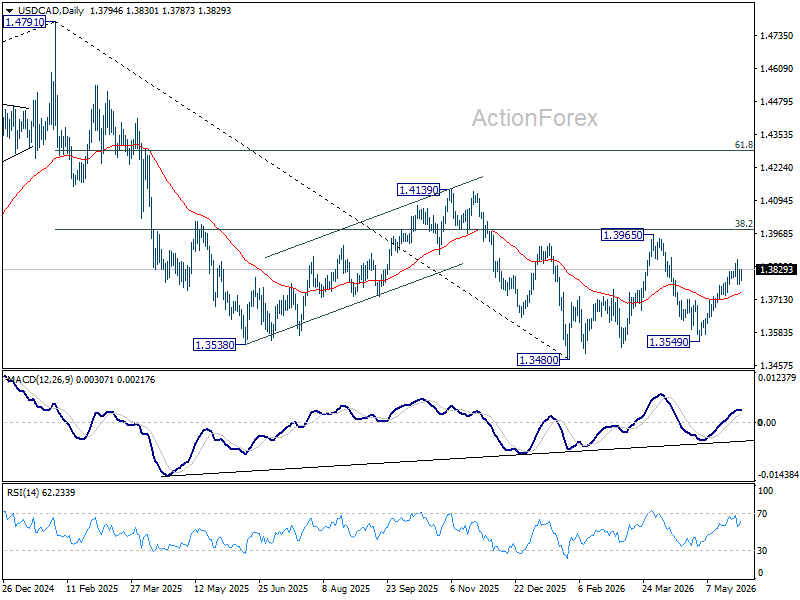
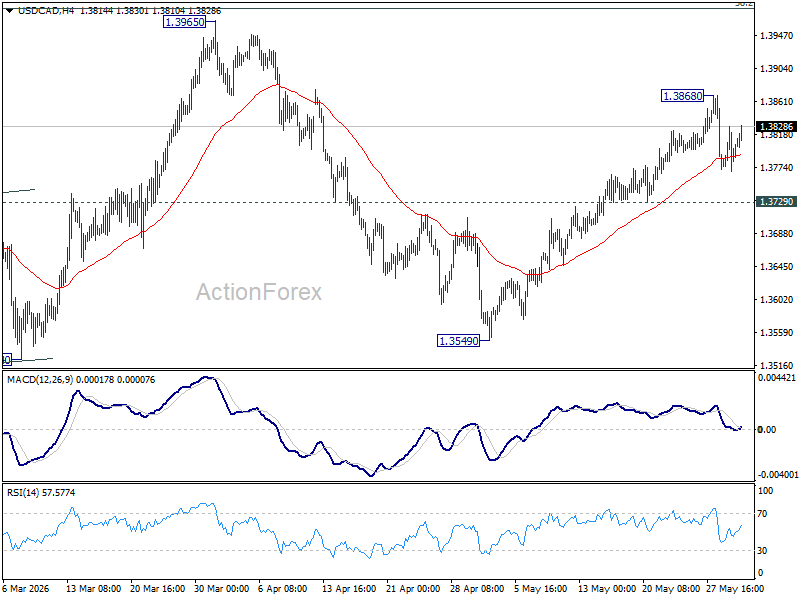
USD/CAD recovered after hitting 55 4H EMA but stays below 1.3868 resistance. Intraday bias remains neutral first. Rise from 1.3549 is seen as the third leg of the pattern from 1.3480. Above 1.3868 will target 1.3965 resistance next. Break of 1.3729 will suggest that the rebound has completed, and turn bias back to the downside.
In the bigger picture, price actions from 1.4791 are seen as a corrective pattern to the whole up trend from 1.2005 (2021 low). Deeper fall could be seen, as the pattern extends, to 61.8% retracement of 1.2005 to 1.4791 at 1.3069. However, decisive break of 38.2% retracement of 1.4791 to 1.3480 at 1.3981 will argue that the correction has completed with three waves down to 1.3480 already.