




Eurozone CPI finalized at -0.2% in Aug, EU CPI at 0.4%

    Eurozone CPI is finalized at -0.2% yoy in August, down from July’s 0.4% yoy. The highest contribution to the annual euro area inflation rate came from food, alcohol & tobacco (+0.33 percentage points, pp), followed by services (+0.30 pp), non-energy industrial goods (-0.03 pp) and energy (-0.77 pp).

    EU CPI was finalized at 0.4% yoy, up from July’s 0.9% yoy. The lowest annual rates were registered in Cyprus (-2.9%), Greece (-2.3%) and Estonia (-1.3%). The highest annual rates were recorded in Hungary (4.0%), Poland (3.7%) and Czechia (3.5%). Compared with July, annual inflation fell in sixteen Member States, remained stable in five and rose in six.

    Full release here.

    BoJ Kuroda: Given the pandemic, inflation is falling quite a lot in many countries

      In the post meeting press conference, BoJ Governor Haruhiko Kuroda said “domestic and overseas markets remain jittery but tensions have eased somewhat.” He pledged that “the BOJ will continue with measures that are exerting positive effects in the economy”.

      “There is absolutely no need to change our 2% inflation target,” he said. “Given the pandemic, inflation is falling quite a lot in many countries. Prices may start falling in Japan as well. But that doesn’t mean Japan and western countries are discussing the need to change their inflation targets.”

      On exchange rate, Kuroda reiterated that “currency rates should move in a way that reflects economic fundamentals.” He maintained the stance of “watching currency moves carefully from that perspective.”
      BoJ stands pat, will not hesitate to ease further

        BoJ left monetary policy unchanged as widely expected. Under the yield curve control framework, short term interest rate is kept at -0.1%. BoJ will also continue to purchase JGBs, without upper limit, to keep 10-year JGB yield at around 0%. The decision was made by 8-1 vote as usual, with Goushi Kataoka dissented, pushing to strengthen monetary easing.

        The central bank said the economic outlook is “likely to follow an improving trend through the materialization of pent-up demand and supported by accommodative financial conditions and the government’s economic measures”. But pace would be “only moderate while the impact of COVID-19 remains worldwide”. Annual CPI core is likely to be negative for the time being, but it’s expected to turn positive and increase gradually with economic improvement.

        It also reiterated the “extremely high uncertainties” over the pandemic impacts. For the time being it will closely monitor the impact of COVID-19 and “will not hesitate to take additional easing measures if necessary.”

        Full statement here.

        Australia employment grew 111k in Aug, unemployment rate dropped to 6.8%

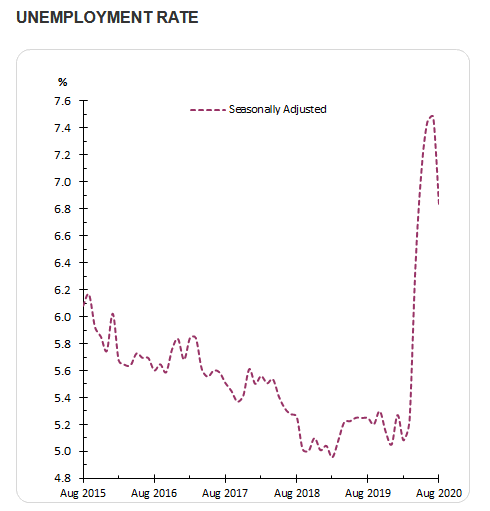
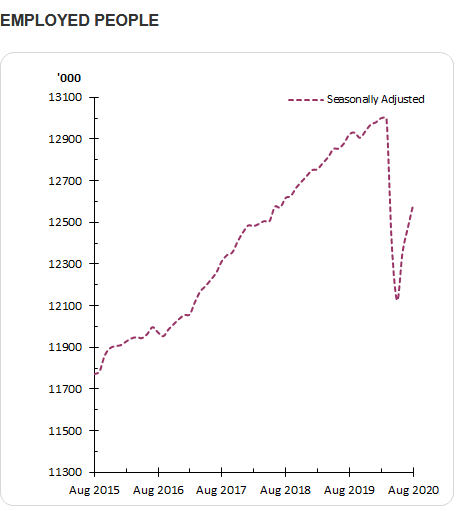
          Australia employment grew strongly by 111k to 12.6m in August, much better than expectation of -40k contraction. Full-time jobs rose 36.2k to 8.58m. Part-time jobs rose 74.8k to 4.00m. Unemployment rate dropped notably by 0.7 pts to 6.8%, much better than expectation of 7.8%. Participation rate also rose 0.1% to 64.8%. Monthly hours worked in all jobs also rose 1.6m hours to 1683 hours.

          All states and territories recorded increases in the number of employed people except for Victoria. The number of employed people in Victoria decreased by 42,400. In contrast, New South Wales recorded an increase of 51,500 employed people and there was an increase of 32,200 employed people in Western Australia. Unemployment rates decreased in most states and territories. The largest falls were seen in Northern Territory (down 3.3 pts to 4.2%). Increases were recorded in Victoria (up 0.4 pts to 7.1%) and Tasmania (up 0.3 pts to 6.3%).

          Full release here.

          New Zealand GDP contracted record -12.2% in Q2, NZD/JPY turning lower

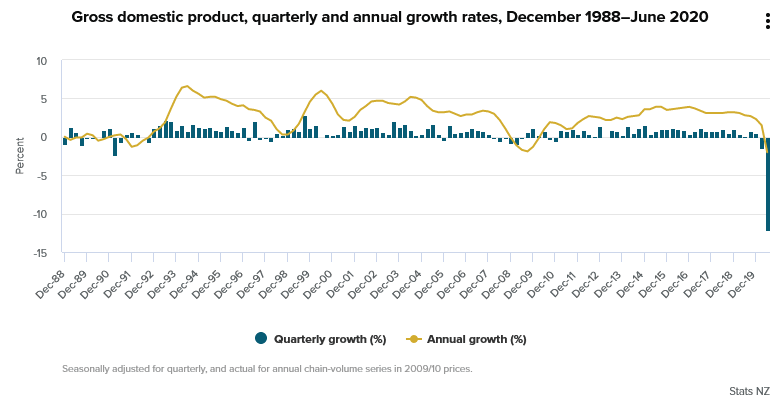
            New Zealand GDP contracted -12.2% qoq in Q2, the largest decline on record. But that’s slightly better than expectation of -12.5% qoq. Services industries, which contributed to 2/3 of the economy, dropped -10.9% qoq. Goods-producing industries, at about 1/5 of the economy, dropped -16.3% qoq. Primary industries dropped -8.7% qoq. Annual GDP in the year to June 2020 declined by -2.0%.

            Full release here.

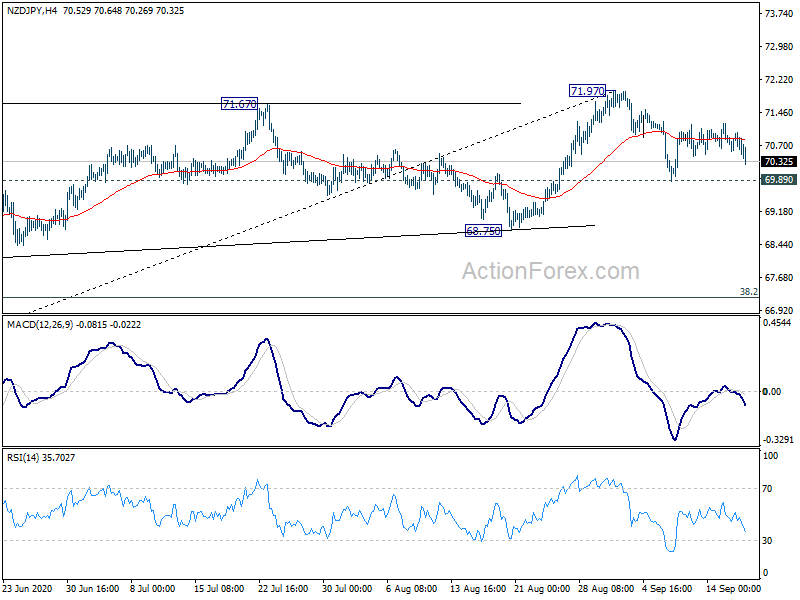
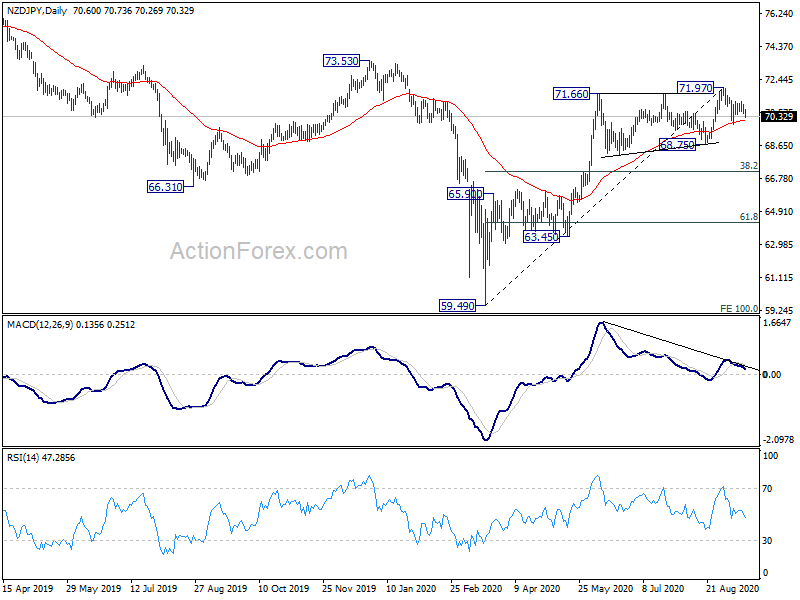
            NZD/JPY trades lower today after failing to sustain above 4 hour 55 EMA. Focus is now back on 69.89 support. Break there will firstly resume the decline from 71.97. Secondly, that will add to the case that whole rise form 59.49 has completed with five waves up to 71.97. A deeper correction would then be underway to 68.75 support and probably further to 38.2% retracement at 67.20.

            Fed chair Jerome Powell press conference live stream

              YouTube

              By loading the video, you agree to YouTube’s privacy policy.
              Learn more

              Load video

              Fed expects inflation to stay below target through 2022, despite upward revisions

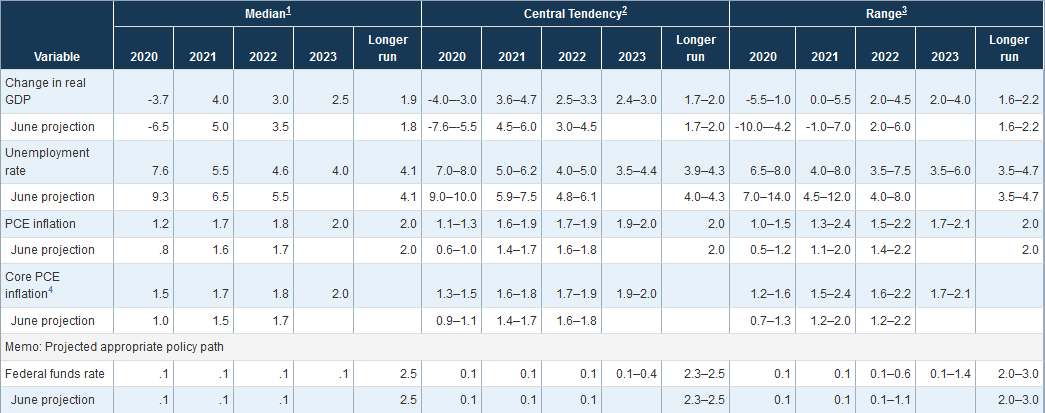
                In the new economic projections, Fed projected a much shallower contraction in 2020 but revised down 2021 and 2022 growth. Unemployment rate forecasts were also revised lower through the horizon. Core PCE inflation projections were revised up but would stay below Fed’s 2% target through 2022. Logically, with or even without the new average inflation targeting, federal funds rate are expected to stay at current level through 2022.

                Here are the median forecasts:

                GDP:

                • 2020 contraction revised up to -3.7% (from June’s -6.5%).
                • 2021 growth at 4.0% (down from 5.0%).
                • 2020 growth at 3.0% (down from 3.5%).

                Unemployment rate:

                • 2020 at 7.6% (revised down from 9.3).
                • 2021 at 5.5% (down from 6.5%).
                • 2022 at 4.6% (down from 5.5%).

                Core PCE inflation:

                • 2020 at 1.5% (revised up from 1.0%).
                • 2021 at 1.7% (up form 1.5%).
                • 2022 at 1.9% (up from 1.7%).

                Fed stands pat, aim to achieve inflation moderately above 2% for some time

                  FOMC kept federal funds rate unchanged at 0-0.25% as widely expected. Additionally, Fed will continue with asset purchases “at least at the current pace”. Also, the committee would be “prepared to adjust the stance of monetary policy as appropriate”.

                  In line with the new “average inflation targeting”, Fed said: “With inflation running persistently below this longer-run goal, the Committee will aim to achieve inflation moderately above 2 percent for some time so that inflation averages 2 percent over time and longer-term inflation expectations remain well anchored at 2 percent.”

                  Dallas Fed President Robert Kaplan dissented, preferring to retain “greater policy rate flexibility”. Minneapolis Fed President Neel Kashkari dissented in favor of waiting for a rate hike until “core inflation has reached 2% on a sustained basis.”

                  Full statement here.

                  US oil inventories dropped -4.4m barrels, WTI sets to break 40

                    US crude oil inventories dropped -4.4m barrels in the week ending September 11, versus expectation of 2.1m barrels rise. At 490m barrels, oil inventories are about 14% above the five year average for this time of the year. Gasoline inventories dropped -0.4m barrels. Distillate rose 3.5m barrels. Propane/propylene dropped -1.2m barrels. Commercial petroleum inventories rose 4.3m barrels.

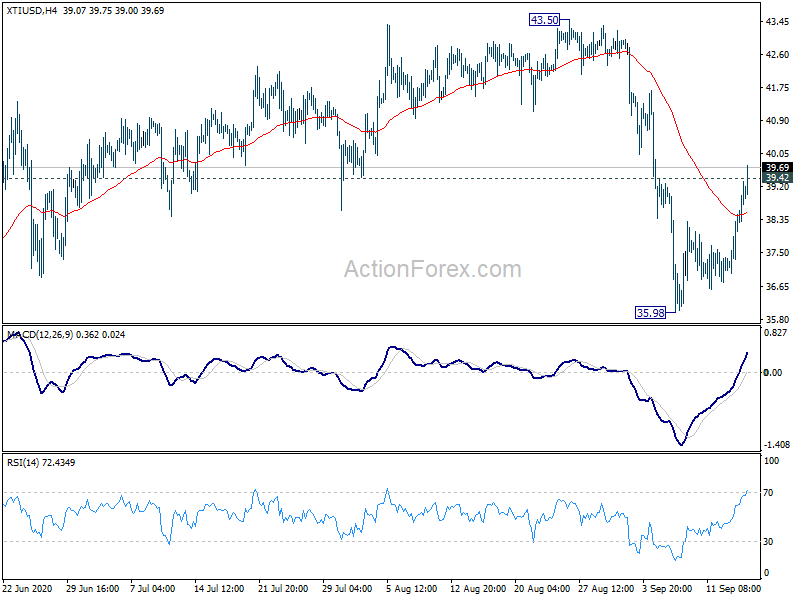
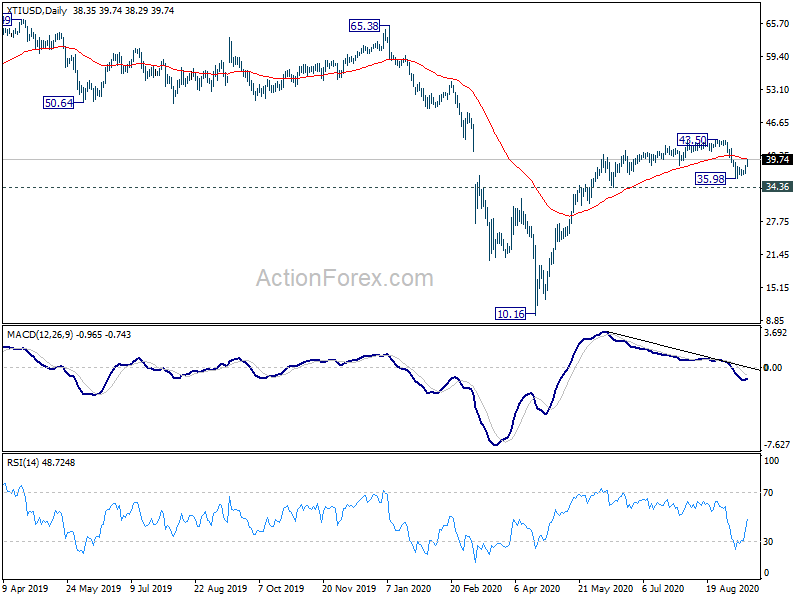
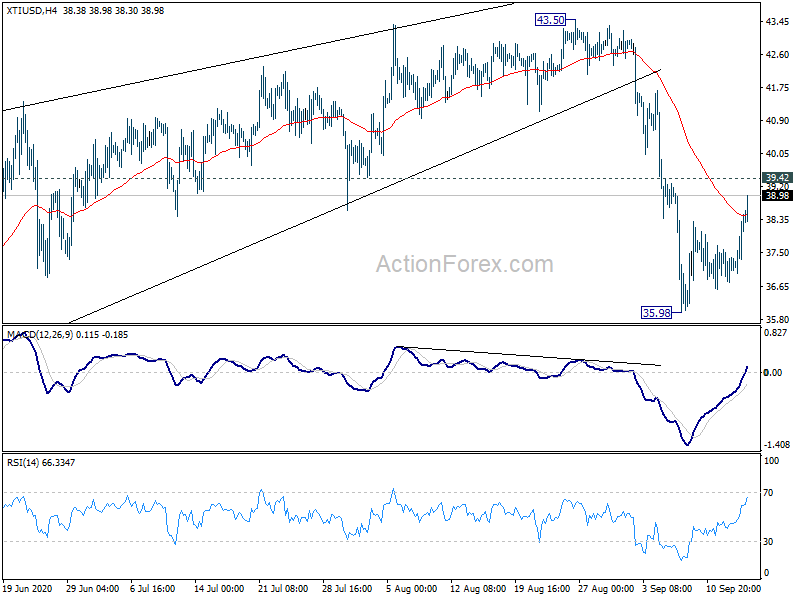
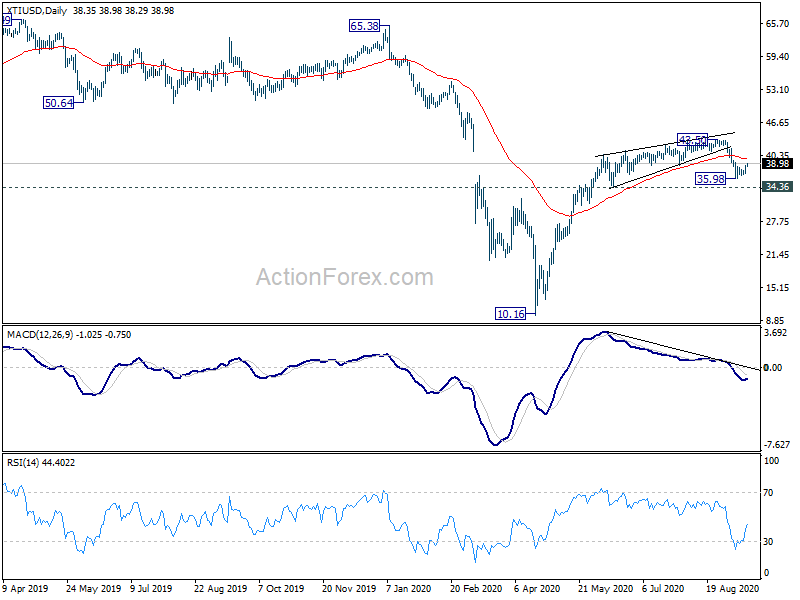
                    WTI crude oil surges to as high as 39.64 so far. The break of 39.42 resistance now suggests that pull back from 43.50 has completed at 35.98 already. Further rally would likely be seen through 40 handle to retest 43.50 high. Nevertheless, We’ expect sideway consolidation to continue below 43.50 with at least one more following leg. Hence, we don’t expect a firm break of 43.50 this time.

                    Canada CPI unchanged at 0.1% in Aug, missed expectations

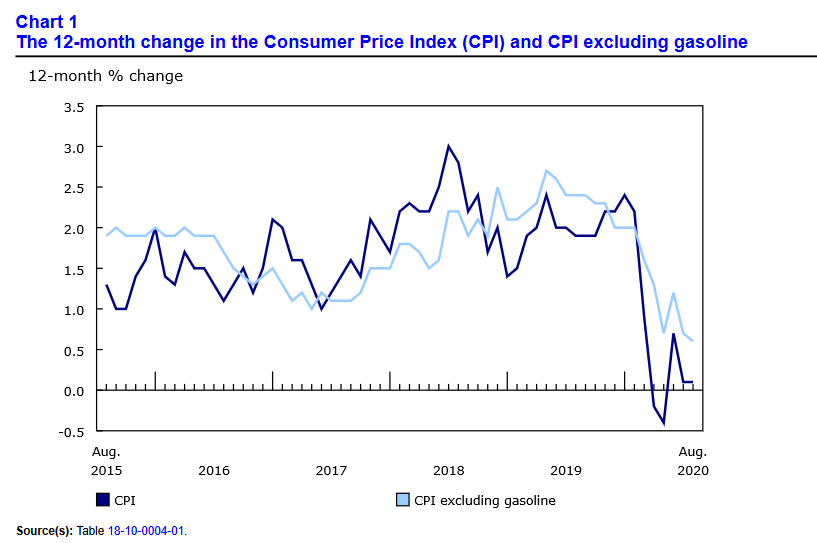
                      Canada CPI was unchanged at 0.1% yoy in August, missed expectation of 0.5% yoy. CPI common rose to 1.5% yoy, up from 1.3% yoy, beat expectation of 1.4% yoy. CPI median was unchanged at 1.9% yoy, matched expectations. CPI trimmed was unchanged at 1.7% yoy, below expectation of 1.8% yoy.

                      Full release here.

                      US retail sales rose 0.6% in Aug, ex-auto sales rose 0.7%, both missed expectations

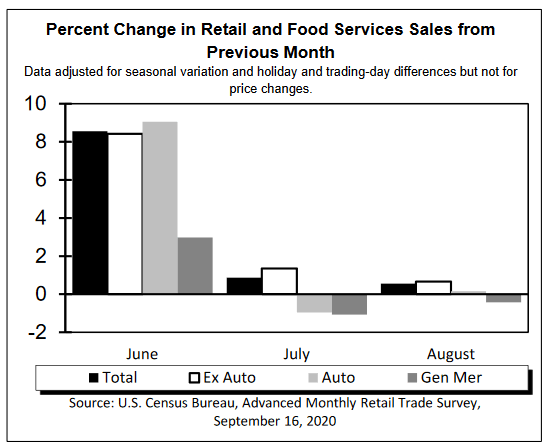
                        US retail sales rose just 0.6% mom to USD 537.5B in August, well below expectation of 1.1% mom. Ex-auto sales rose 0.7% mom, also below expectation of 1.1% mom. Total sales for June through August were up 2.4% yoy from the period a year ago.

                        Full release here.

                        OECD expects just -4.5% global contraction this year, US and China outlook revised up sharply

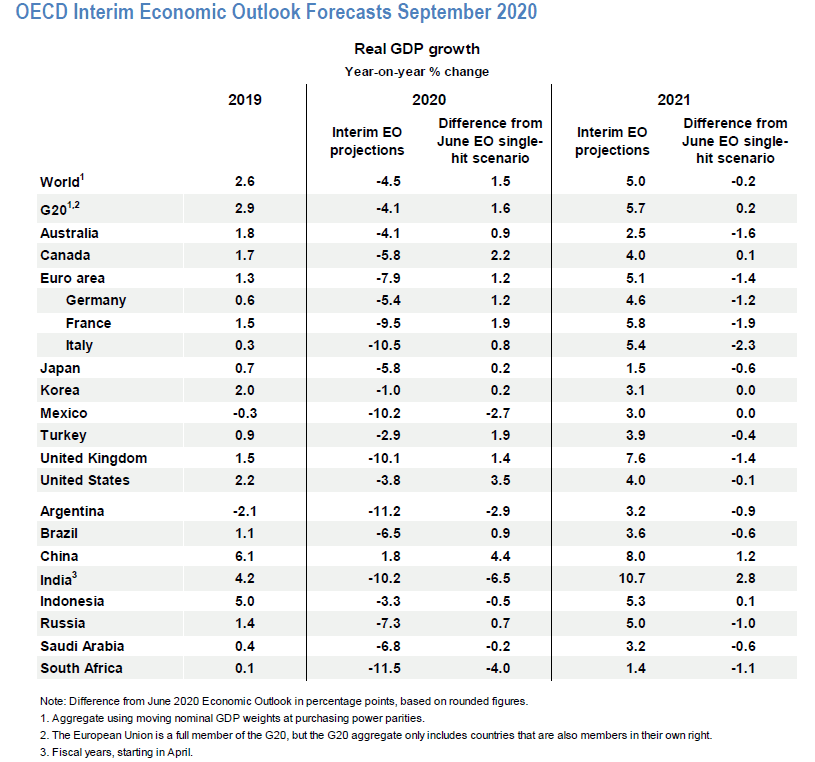
                          OECD revised up 2020 global GDP forecast, expecting to contract -4.5%, 1.5% higher than June’s single hit scenario. Both economic projections of US and China are revised up sharply higher. US economy is expected to contract -3.8% only, up by 3.5% from June. China is expected to grow 1.8%, up by 4.4% from June. Eurozone (at -7.9%, up by 1.2% from June), Japan (at -5.8%, up by 0.2%), UK at -10.1% (up by 1.4%) are just revised up slightly.

                          OECD said: “After collapsing in the first half of the year, economic output recovered swiftly following the easing of measures to contain the COVID-19 pandemic and the initial re-opening of businesses. Policymakers reacted rapidly and massively to buffer the initial blow to incomes and jobs. But the pace of recovery has lost momentum over the summer. Restoring confidence will be crucial to how successfully economies can recover, and for this we need to learn to safely live with the virus.”

                          Full report here.

                          Eurozone trade surplus widened in Jul, but exports and imports dropped double-digit over the year

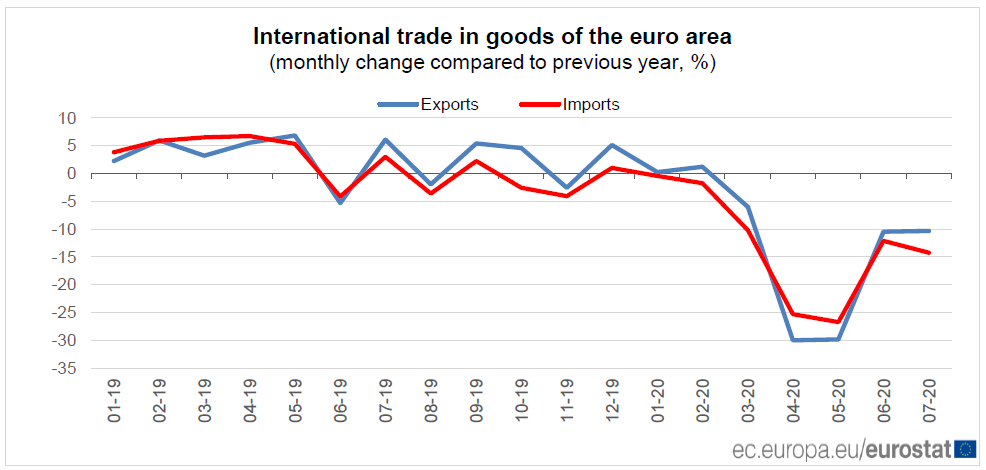
                            Eurozone exports dropped -10.4% yoy in July to EUR 185.2B. Imports dropped -14.3% yoy in EUR 183.5B. Trade surplus widened to EUR 27.9B, comparing with EUR 23.2B a year ago. Intra-eurozone trade dropped to EUR 153.7B, down -8.6% yoy. In seasonally adjusted term, Eurozone exports rose 6.5% mom while imports rose 4.2% mom. Trade surplus rose to EUR 20.3B, up from June’s EUR 16.0B.

                            Full release here.

                            Suga won parliament approval as PM, key ministers stay in cabinet

                              The Japanese Lower House of Parliament approved the appointment of Yoshihide Suga as the new Prime Minister. Roughly half of Shinzo Abe’s ministers remained in Suga’s cabinet. Taro Aso remains as Finance Minister and Toshimitsu Motegi kept his job as Foreign Minister. Also, Yasutoshi Nishimura stays as Economy Minister while Trade and Industry Minister Hiroshi Kajiyama also retains his post.

                              The signals are clear that Suga is going to continue with Abenomics and presses ahead with the reforms. Though, a new term “Suganomics” emerged as eventually, Suga is going to make is own marks, as least in some of the policy mix.

                              UK CPI slowed to 0.2% yoy, core CPI down to 0.9% yoy

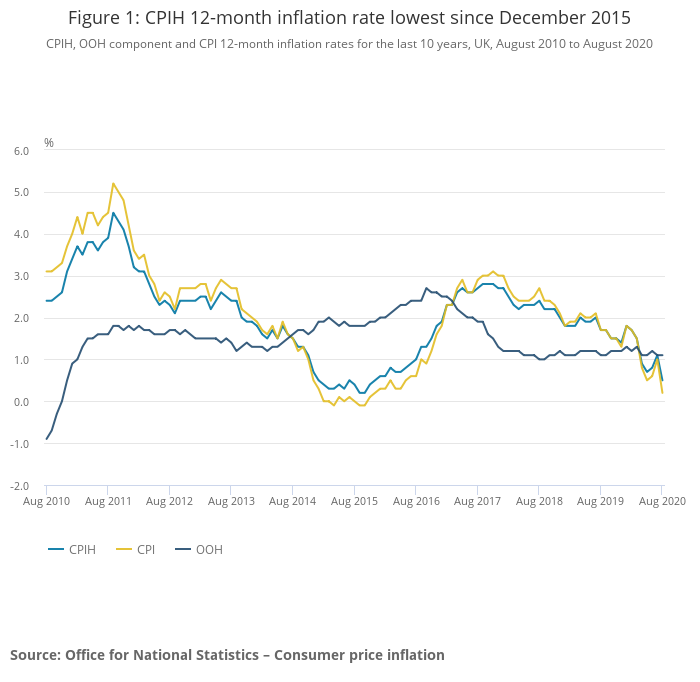
                                UK CPI slowed sharply to 0.2% yoy in August, down from 1.0% yoy, but above expectation of 0.1% yoy. Core CPI dropped to 0.9% yoy, down form 1.8% yoy, also above expectation of 0.9% yoy. RPI dropped to 0.5% yoy, down from 1.6% yoy, below expectation of 2.2% yoy.

                                Also released, PPI input came in at -0.4% mom, -5.8% yoy, versus expectation of 1.3% mom, -4.3% yoy. PPI output was at 0.0% mom, -0.9% yoy, versus expectation of -0.1% mom, -1.0% yoy. PPI core output was at 0.1% mom, 0.2% yoy, versus expectation of 0.0% mom, -0.2% yoy.

                                Dollar index struggles to find upside momentum as focus turns to FOMC

                                  Fed will have the first monetary policy decision after adopting “average inflation targeting”. No policy change is expected. Instead, first focus will be on the tweak in the accompanying statement. The statement should reflect that it seeks to seeking to achieve inflation that averages 2% over time. That is, as Chair Jerome Powell said before, “following periods when inflation has been running below 2%, appropriate monetary policy will likely aim to achieve inflation moderately above 2% for some time”. Secondly, new economic projections should reveal Fed’s view on the outlook of both the economy and the policy rate.

                                  Some suggested readings on Fed:

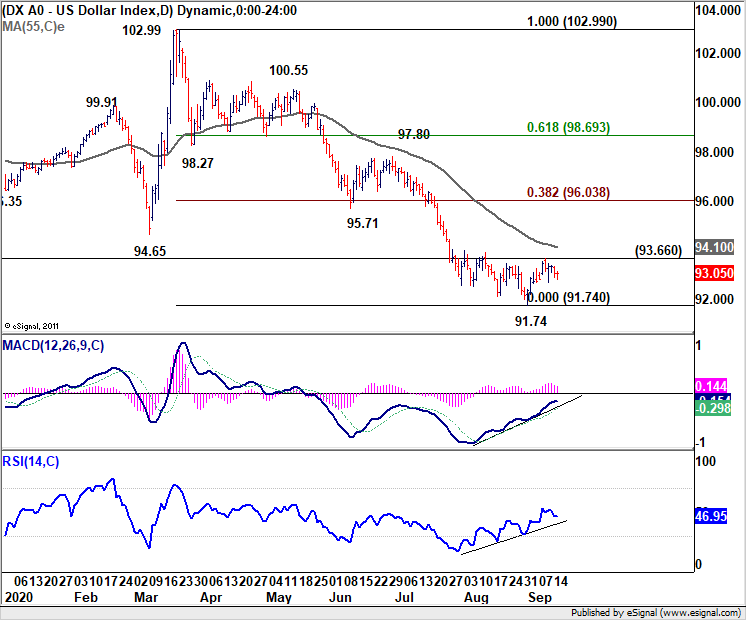
                                  Dollar index’s rebound from 91.74 remains unconvincing so far, lacking follow through momentum. the conditions for a rebound are still there, as fall from 102.99 has likely completed with five waves down to 91.74, on bullish convergence condition in daily MACD. Break of 93.66 resistance (with corresponding break of 1.1754 support in EUR/USD), should push DXY through 55 day EMA to 38.2% retracement of 102.99 to 91.74 at 96.03.

                                  WTI oil in strong rebound in hurrican shuts some US Gulf of Mexico productions

                                    Oil prices rebound notably as Hurricane Sally prompted shut down of more than a quarter of production at the US Gulf of Mexico. Sally’s is moving a a very slow pace of 85 miles per hour, threatening historic floods from Mississippi to Florida Nearly 500,000 bpd of offshore crude oil production and 28%, or 759 million cubic feet per day (mmcfd), of natural gas output were shut in the U.S. Gulf of Mexico on Tuesday.

                                    WTI crude oil surges to as high as 38.97 so far. The break of 4 hour 55 day EMA suggests that pull back from 43.50 might have completed at 35.98 already. Focus is now on 39.42 minor resistance. Firm break there would confirm the start of a rising leg inside the consolidation from 43.50.

                                    Overall, even in case of further rise, we don’t expect a break of 43.50 for the near term. Strong support should be seen from 34.36 in case of another decline. Range trading will continue between 34.36/43.50 until further development.

                                    Japan exports had 8th straight month of double-digit decline in Aug

                                      In non-seasonally adjusted term, Japan’s expected dropped -14.8% yoy to JPY 5232B in August. That’s the 8th straight month of double-digit decline, as well as the 21st month of contraction. It’s the worst run since the 23-month contraction through July 1987. Exports are generally expected to stay weak and might not reach pre-pandemic level until a least early 2022. Imports dropped -20.8% yoy to JPY 4984B. Trade surplus came in at JPY 248B.

                                      In seasonally adjusted term, exports rose 5.9% mom to JPY 5580B. Imports rose 0.1% mom to JPY 5230B. Trade surplus widened to JPY 350B.

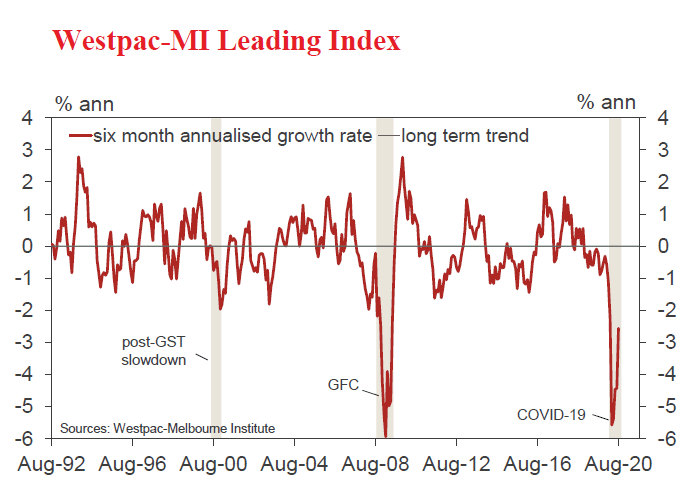
                                      Australia Westpac leading index rose to -2.56, consistent with 4% growth in H2

                                        Australia Westpac leading index rose to -2.56 in August, up from -4.42. Westpac said the improvement was broadly consistent with 1.8% growth in Q3, despite an expected -4% in the coronavirus center Victoria. That would also mean a “somewhat” moderated growth pace in Q4 at 2.2%. The combined second half growth would be 4%, more optimistic that RBA’s expectation of 1.3%.

                                        Westpac also noted some market speculation surfaced after RBA minutes, for a rate cut from 0.25% to 0.1%. Such an option will “remain under considering but there appears to be no urgency”. RBA would indeed focus on supporting government bond markets first, including borrowing of state and territory governments.

                                        Full release here.

                                        US drops tariffs on Canadian aluminum, Canada drops retaliation threat

                                          The US Trade Representative said it will drop the 10% tariffs on Canadian non-alloyed, unwrought aluminum, retroactive to September 1. The tariffs were reimposed in August due to a surge in import earlier this year. But USTR expects the volume to normalize back to 70k to 83k tons a month for the rest of the year, after consultation with Canada.

                                          Canadian also dropped the threat to retaliate after the US move. Trade Minister Mary Ng emphasized “Canada has not conceded anything. We fully retain our right to impose our countermeasures if the U.S. administration decides to reimpose its tariffs on Canadian aluminum products, and we are prepared to do so.” Deputy Prime Minister Chrystia Freeland also insisted: “This is not a negotiated deal … we have not negotiated an agreement with the United States on quotas”.

                                          Separately, USTR blasted WTO’s ruling against US tariffs on Chinese goods. Robert Lighthizer criticized in a statement the WTO “provides no remedy” for China’s “harmful technology practices.” ‘”The United States must be allowed to defend itself against unfair trade practices, and the Trump Administration will not let China use the WTO to take advantage of American workers, businesses, farmers, and ranchers,” he added.