


Canada – A Calm Week Before the Inflation Test
Canadian financial markets were relatively steady this week, though rising bond yields signaled a modest firming in rate expectations. In the absence of major domestic data, markets were shaped by global forces, as oil price volatility and lingering inflation uncertainty pushed Government of Canada yields higher across the curve. The TSX index climbed during the week, while demand for the U.S. Dollar strengthened, causing the Canadian dollar to drop by three-tenths of a cent as persistent volatility directed flows toward the USD.
This week’s data offered a more incremental read on economic conditions (Chart 1). March wholesale trade and manufacturing sales firmed up the trajectory of goods-sector activity, with early indications pointing to some stabilization following a soft start to the year. While neither release is likely to materially alter the broader growth backdrop, they will help refine tracking for first quarter GDP, which points to modest growth.
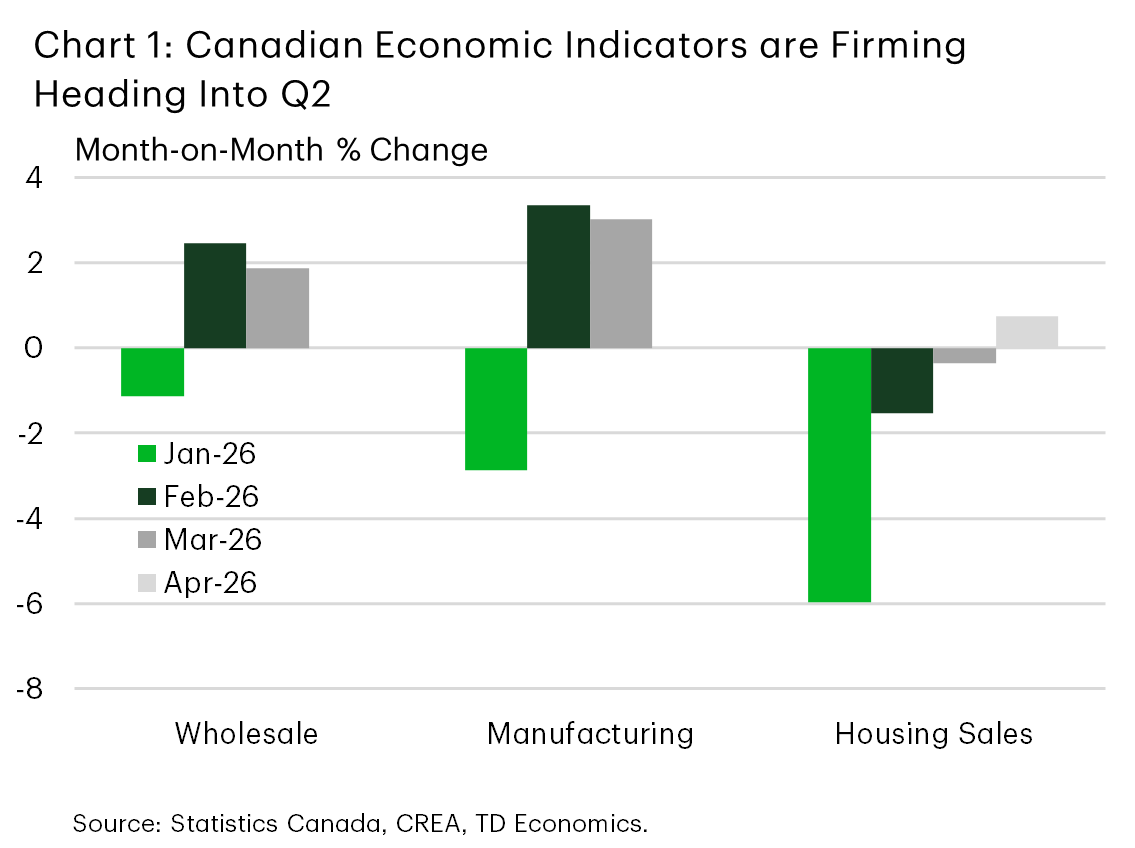
Meanwhile in the housing market, April home sales edged higher, consistent with our view that activity should see a bounce back in second quarter. Housing starts data also beat consensus expectations. Stepping back, we still expect only a gradual improvement in housing conditions in 2026, as high borrowing costs, affordability issues, and slower population growth continue to dampen demand and construction.
In a week with little economic data, the Bank of Canada’s Summary of Deliberations reinforced uncertainty around the policy outlook. While higher energy prices are expected to raise inflation soon, Governing Council judged there’s scope to remain patient and hold rates steady as the economy evolves as expected. They emphasized the outlook remains highly dependent on incoming data, with risks in both directions. Persistent strength in oil prices could broaden inflation pressures and warrant tighter policy, while weaker growth tied to trade or external shocks could necessitate easing, given uncertainty around the remaining slack in the economy.
Alongside the monetary policy update, reports of ongoing negotiations between Ottawa and Alberta over industrial carbon pricing and a potential west coast pipeline point to a shift toward aligning climate policy with major project development. Such efforts could help improve investment clarity in Canada’s energy sector, with implications for longer-term growth capacity.
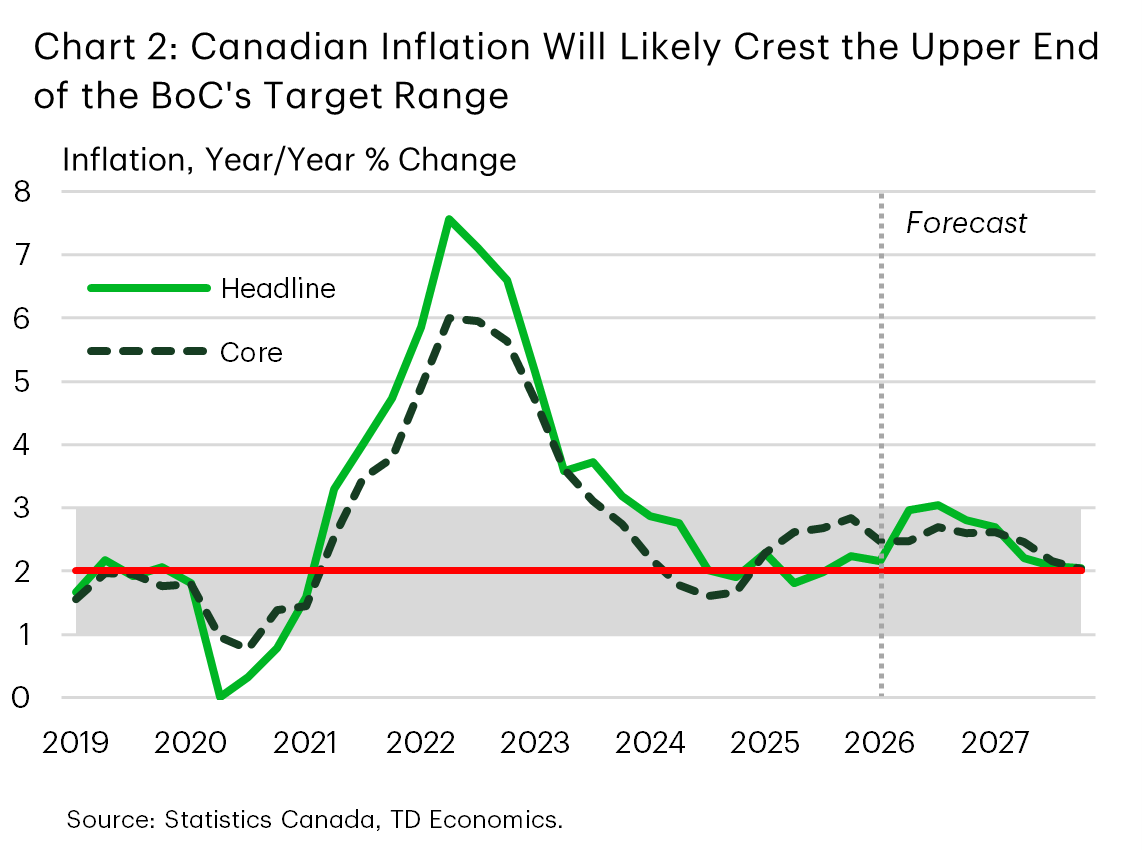
This week’s developments reinforce a familiar theme: an economy growing modestly but facing elevated uncertainty, and a central bank firmly in wait-and-see mode. Attention now turns to next week’s April inflation (CPI) release, where inflation is expected to move higher on energy base effects. We expect headline inflation to peak around 3% later this year before easing back toward target (Chart 2). The key question will be whether price pressures remain contained or begin to broaden more meaningfully into core components.
U.S. – Changing of the Guard
The changing of the guard at the Federal Reserve was formalized this week, as Kevin Warsh was confirmed by the Senate as Powell’s successor on Wednesday. This means Jerome Powell’s eight-year term as Chairman came to an end on Friday. Warsh takes the helm at a time when inflation pressures are rising sharply on the back of elevated global energy prices. Details on a potential resolution to the conflict in Iran remained elusive this week, which led to a 9% uptick in WTI oil prices. Equity markets were roughly unchanged on the week, with the S&P 500 rising 0.2%, as U.S. Treasury yields spiked by roughly 20 basis points, reflecting stronger inflation readings.
In terms of economic data releases, the inflation data for April was the biggest news item. Headline CPI hit a three-year high of 3.8% year-on-year (y/y), on the back of rising energy prices (Chart 1). Stripping out energy and food products, core CPI accelerated for a second consecutive month to 2.7% y/y, partly owing to the feedthrough of energy prices to categories like airline fares. Broad-based passthrough to non-energy categories was absent from the report, but with energy prices rising through early May, subsequent reports may be less benign, particularly if no resolution is reached over the near-term.
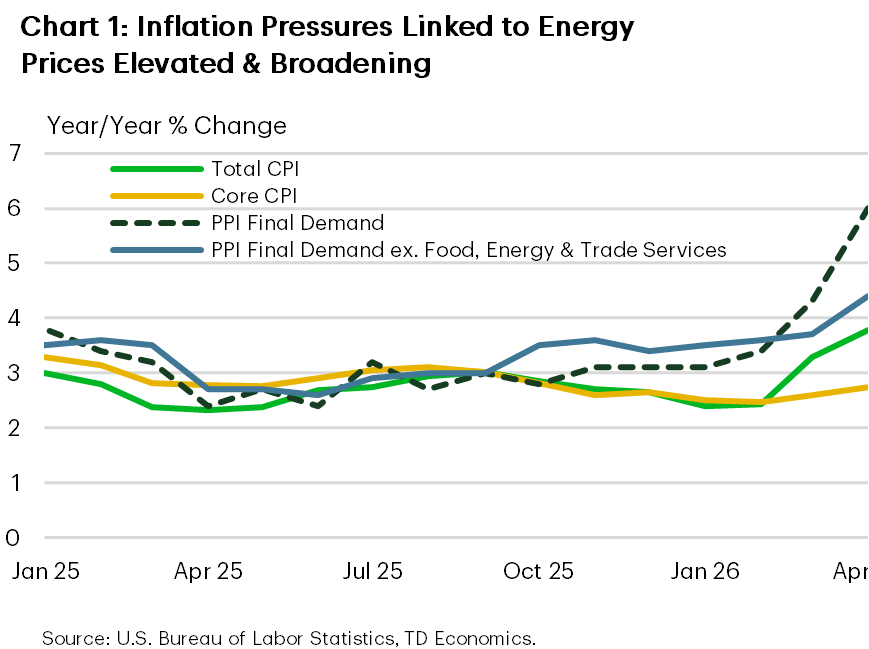
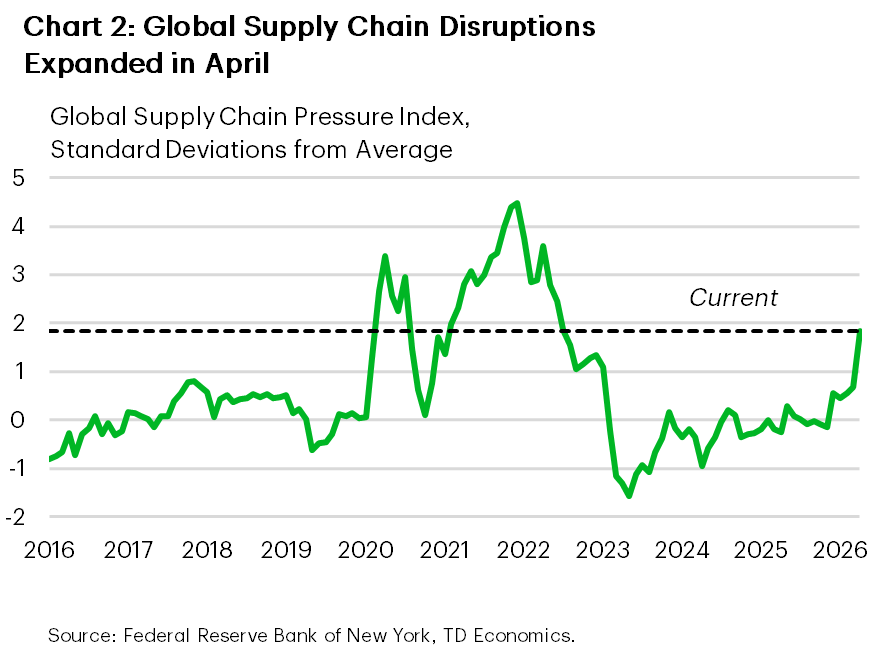
Upstream, the influence of higher energy prices was similarly evident for producers in April, with the Producer Price Index up 6% y/y. Selling price pressures have not been this elevated since late 2022, as global supply chain disruptions have begun to converge with those seen during the initial aftermath of the pandemic (Chart 2). The impacts of these developments on businesses, and the follow-through to consumers, will be monitored closely by the Federal Reserve.
To that end, the April retail sales report provided an early snapshot of consumer health. It showed a solid gain of 0.5% month-on-month in nominal terms, but after adjusting for inflation, sales fell 0.2%. This likely reflected, in part, the comparable contraction in real earnings during the month, which, if sustained, would continue to weigh on consumption going forward. A near-term resolution to the Iran conflict would help ease some of this pressure, although the effects would likely be gradual as supply disruptions take time to fully unwind. Taken together, these crosscurrents leave the near-term policy outlook highly dependent on incoming inflation data.
Against this backdrop, Fed officials in public remarks this week flagged concerns about the inflation reports. Several officials, including Chicago Fed President Goolsbee and Boston Fed President Collins, noted that tighter financial conditions may be required to quell emerging inflationary pressures. The balance of opinion among officials emphasized that a neutral stance would be appropriate over the near term to allow time to assess incoming data. As of the time of writing, financial market pricing for a rate hike by year-end has risen to 40%.





