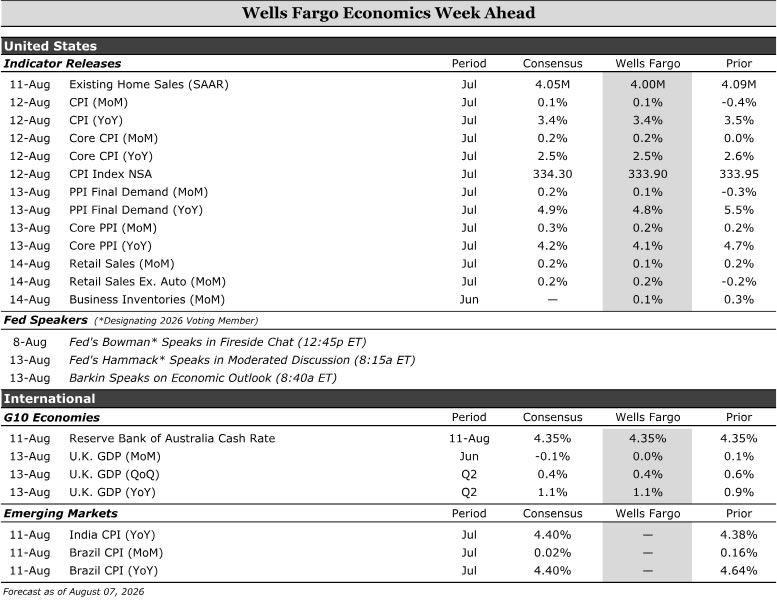
Next week, we expect CPI to have remained temperate in July, with pressures becoming less widespread and more concentrated in specific sectors. Retail spending is expected to rise modestly, and housing activity remains under pressure amid higher mortgage rates.
In Australia, we expect the RBA to leave rates unchanged while maintaining a hawkish bias. In the U.K., we expect resilient Q2 growth, which could support a hike later in the year. In emerging markets, Brazil’s inflation likely eased further, supporting gradual policy easing later this year, while India’s CPI inflation is expected to tick higher.
- United States: Existing Home Sales (Tuesday), CPI (Wednesday), Retail Sales (Friday)
- G10 Economies: Reserve Bank of Australia (Tuesday), U.K. GDP (Thursday)
- Emerging Markets: Brazil CPI (Tuesday), India CPI (Wednesday)
Source: Bloomberg Finance L.P. and Wells Fargo Economics
U.S. Week Ahead
Existing Home Sales • Tuesday
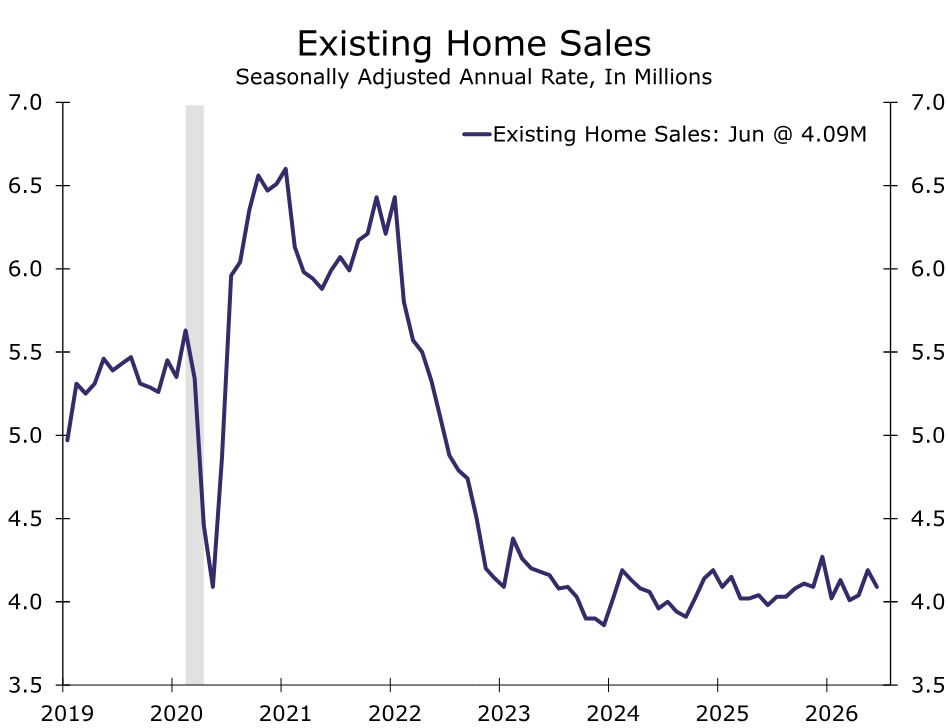
We look for existing home sales to dip 2.2% in July. It is no secret that the housing market is one of the most strained sectors of the economy. Mortgage rates rose to 6.5% on average in June and have since surpassed that. Home prices also continue to rise on a year-over-year basis, especially in the Northeast and Midwest. Pending home sales fell in June and mortgage purchase applications ticked up only modestly. Applications then took a sharp turn lower in July in a nod to ongoing affordability challenges. As we have been noting, longer-term interest rates (including mortgage rates) are being propped up by a variety of factors that are unlikely to subside in the near-term.
Source: NAR and Wells Fargo Economics
CPI • Wednesday
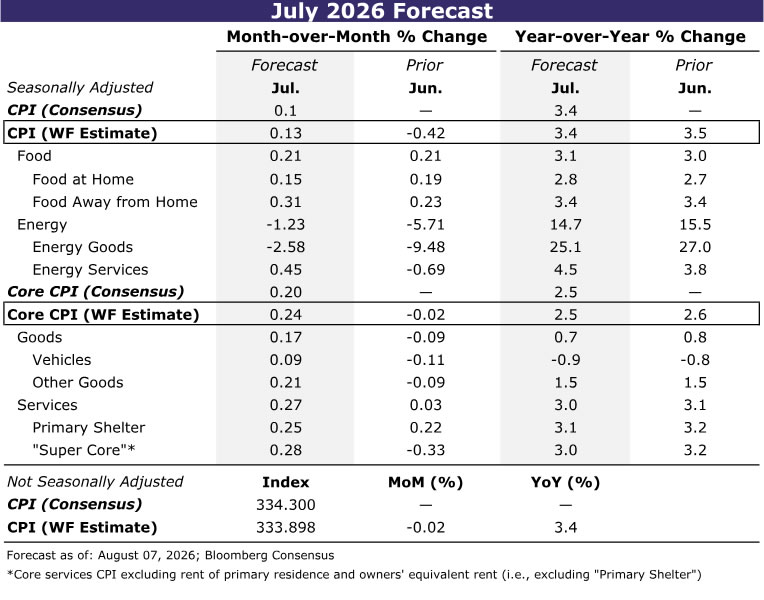
Inflation was likely temperate in July. We estimate the CPI rose 0.13% in July, as lower gasoline prices offset moderate increases elsewhere. Food inflation also appears to have remained contained despite concerns that higher energy costs would push through to grocery prices. Walmart’s price cuts likely helped limit some of that pass-through last month.
Excluding food and energy, we expect the core CPI to rise 0.24%, in a bounce-back from June’s unexpectedly soft reading. Core goods inflation should firm, with Apple product price increases lifting consumer electronics prices even as tariff-related pressures continue to fade across other categories. Core services inflation also is likely to run somewhat firmer than in June. We look for some normalization in medical services and a smaller drag from motor vehicle insurance, although broader services inflation should continue to trend lower.
Taken together, we expect headline CPI inflation to ebb to 3.4% year-over-year in July. The report should reinforce the view that the worst of the inflationary effects from a higher-tariff regime and the conflict in the Middle East are behind us. Increases appear driven by a narrow set of categories rather than a broadening in underlying price pressures. Yet, while inflation pressures are becoming less widespread, continued strength in a handful of sectors suggests progress toward 2% is likely to remain gradual.
Source: Bloomberg Finance L.P., U.S. Department of Labor and Wells Fargo Economics
Retail Sales • Friday
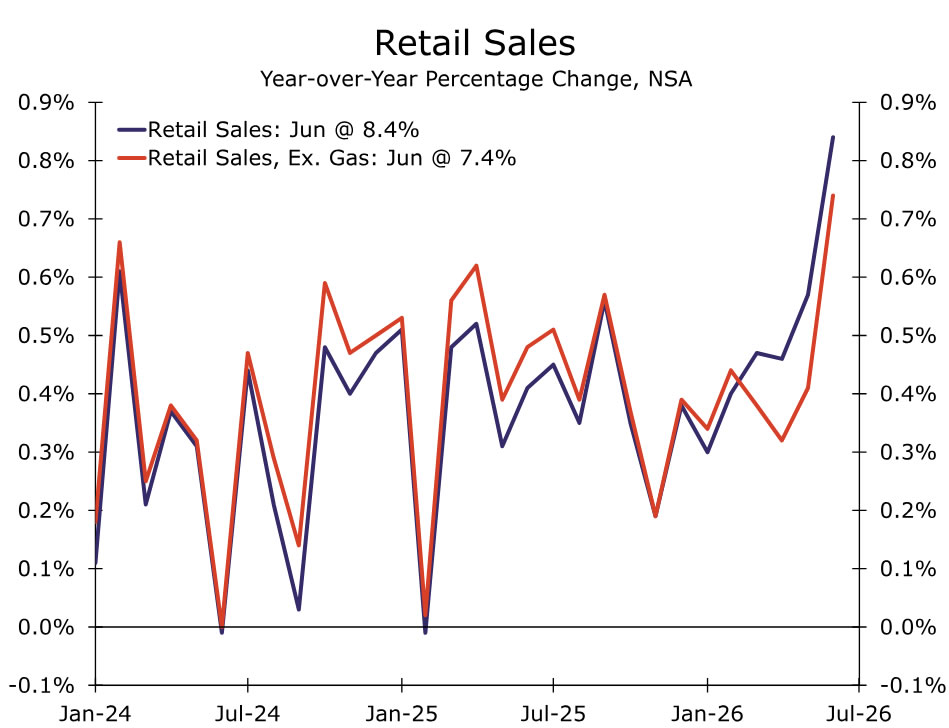
Retail sales likely notched a modest increase in July as a bottoming in gas prices translates into less downward price pressure than in June. While recent consumer sentiment and labor market indicators signal a more cautious household sector, our informal channel checks with retail businesses suggest that consumers continue to spend, even if that spending is becoming more selective.
Outside gas stations where sales are heavily influenced by price movements, underlying retail spending has been continuing to expand at a moderate pace. We had been braced for some giveback in auto sales, though that category has yet to reflect the sort of pullback one might expect when household budgets are constrained by higher energy costs. Meanwhile, underlying growth in e-commerce should underpin core retail sales.
More broadly, consumers have proven remarkably resilient this year despite higher prices and a soft labor market backdrop. We continue to flag the role of elevated asset prices, a lower saving rate and increased credit usage as factors helping consumers push the game into extra innings. But without a meaningful improvement in wages, growth is apt to be more uneven in the back half of the year.
Source: U.S. Department of Commerce and Wells Fargo Economics
G10 Week Ahead
Reserve Bank of Australia • Tuesday
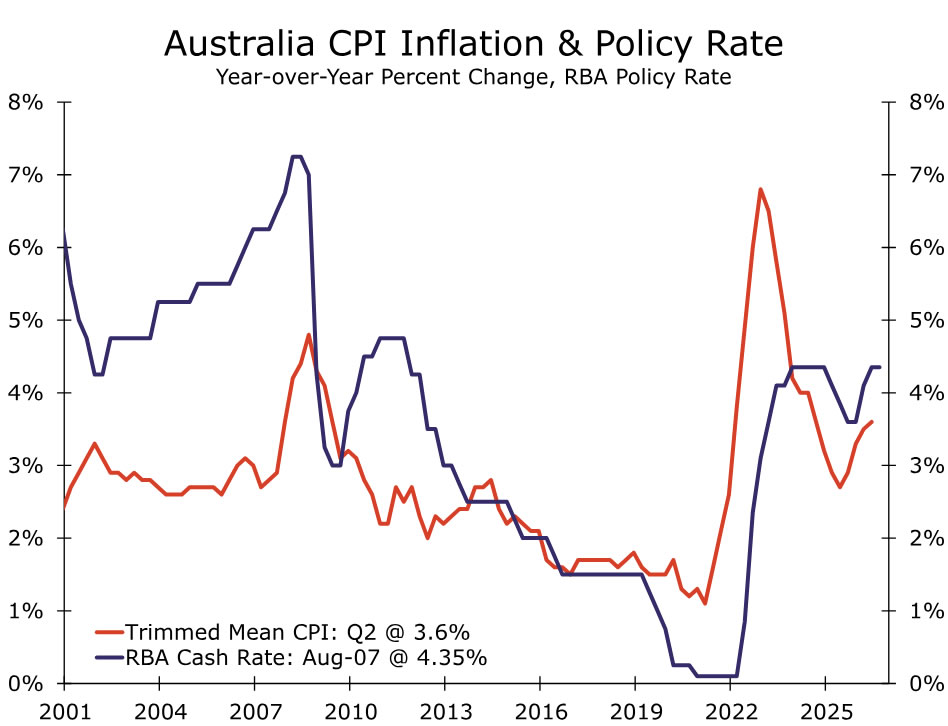
We expect the Reserve Bank of Australia (RBA) to hold the Cash Rate at 4.35% next week. After three hikes this year, the Board will likely allow more time for the effects of earlier tightening to materialize. However, we expect the RBA to maintain a hawkish stance as it remains focused on preventing elevated cost pressures from becoming entrenched in inflation. While recent inflation data provided some encouragement, underlying price pressures remain elevated. Q2 inflation slowed more than expected, with headline inflation at 0.6% quarter-over-quarter (from 1.4%), though underlying inflation remained elevated.
Recent RBA communications have acknowledged the limited ability of monetary policy to address supply shocks. However, officials continue to stress that with inflation still elevated and supply shocks compounding existing pressures, some moderation in demand growth may be needed to return inflation to target. Activity remains resilient and growth is expected to continue into Q3, keeping another hike in play.
While we expect a hold next week, we continue to expect an out-of-consensus 25 bps hike in September as the RBA gains greater clarity on activity and the domestic pass-through from higher energy prices. This would bring the Cash Rate to a peak of 4.60%, where we expect it to remain before a gradual easing cycle begins with a 25 bps cut in H2 2027.
Source: Bloomberg L.P. and Wells Fargo Economics
U.K. GDP • Thursday
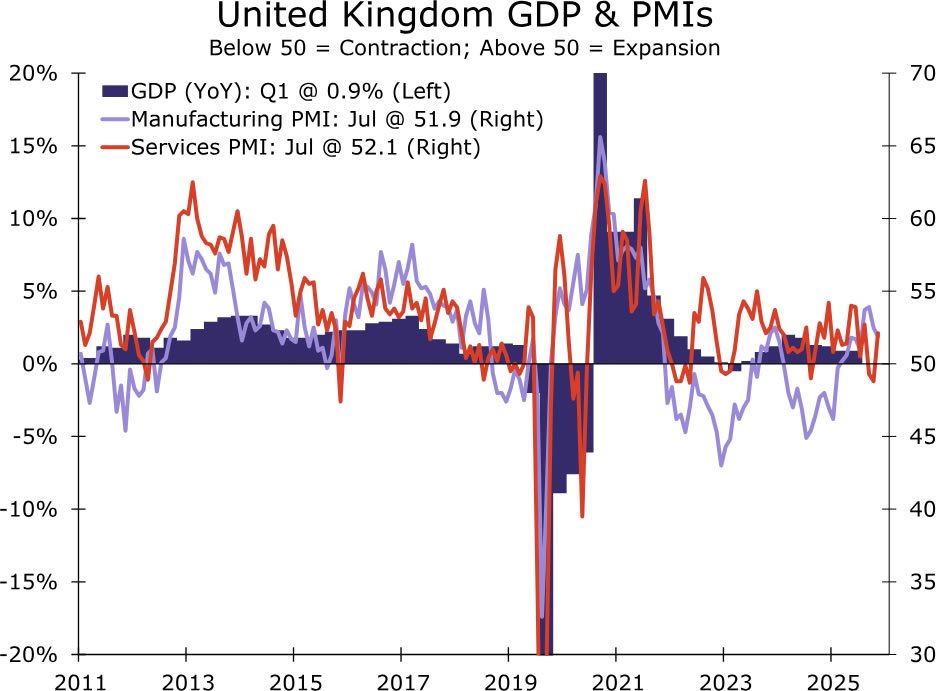
Next week’s U.K. Q2 GDP release will provide another test of whether the economy remains resilient despite tighter financial conditions, elevated global uncertainty and a changing domestic political backdrop. We expect GDP to grow 0.4% quarter-over-quarter and 1.1% year-over-year in Q2.
Growth momentum appears to have remained firm through Q2, supported in part by strategic stockpiling amid concerns over higher energy and input costs stemming from the Middle East conflict. The composition of growth will matter, as policymakers have repeatedly pointed to the growth outlook as a reason to remain on hold. As such, a broad-based, stronger-than-expected GDP print could give policymakers greater confidence that the economy can withstand tighter monetary policy.
While recent inflation data have been encouraging, much of the improvement reflects disinflationary progress made before the conflict. The Bank of England (BoE) remains focused on the risk that higher energy prices spill over into wages and broader inflation pressures. We continue to expect the BoE to deliver one rate hike in Q4, bringing the Bank Rate to a terminal rate of 4.00%.
Source: Bloomberg Finance L.P. and Wells Fargo Economics
EM Week Ahead
Brazil CPI • Tuesday
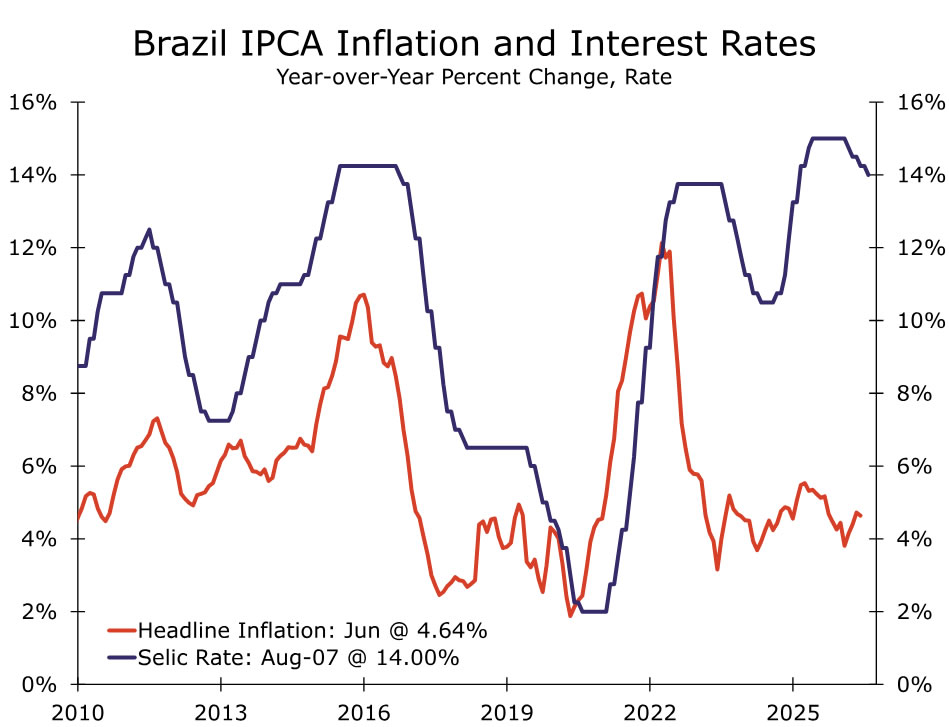
We expect Brazil’s July CPI to show a further slowdown in inflation. Headline inflation stood at 4.64% year-over-year in June, while data through mid-July point to continued easing. At its most recent meeting, the Brazilian Central Bank (BCB) also revised its 2026 inflation forecast slightly lower to 5.1% year-over-year.
Despite recent progress, the inflation outlook remains challenging. The BCB’s Focus survey expectations for 2026 and 2027 remain above target at 5.0% and 4.2%, respectively. Uncertainty surrounding the domestic election cycle, the Middle East conflict and El Niño also keeps inflation risks elevated.
Against a backdrop of moderating activity, a tight labor market and persistent inflation risks, we expect the BCB to maintain a gradual easing path. We remain comfortable with our call for another 25 bps cut in Q4, most likely in October, which would bring the Selic Rate to 13.75% by year-end.
Source: Bloomberg Finance L.P. and Wells Fargo Economics
India CPI • Wednesday
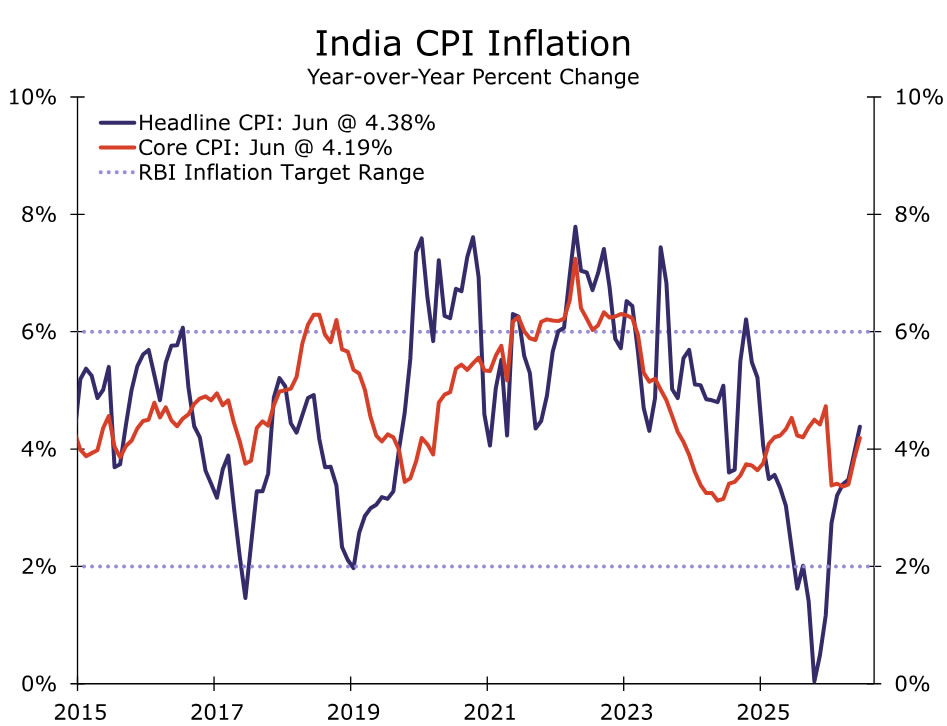
We expect India’s July CPI to increase further. Headline and core inflation rose to 4.38% and 4.19% year-over-year in June, respectively, placing both measures above the Reserve Bank of India’s (RBI) 4% midpoint target. Producer price pressures also remain elevated, with wholesale price inflation at 9.87% year-over-year. Recent PMI surveys further support the view that firms continue to face higher fuel, labor, material and transport costs, while El Niño conditions pose an additional upside risk to food prices.
At its most recent meeting, the RBI acknowledged that inflation is expected to rise further due to supply-side pressures. Policymakers also warned that higher food, fuel and input costs could generate broader inflation pressures through second-round effects.
With inflation rising, growth steady and higher oil prices adding pressure to both the trade balance and the rupee, we continue to expect the RBI to raise rates in October. In our view, a hike would help support the currency and act as a precautionary measure to keep inflation expectations anchored.
Source: Bloomberg Finance L.P. and Wells Fargo Economics