

Sample Category Title
GBP/USD Daily Outlook
Daily Pivots: (S1) 1.2888; (P) 1.2915; (R1) 1.2950; More...
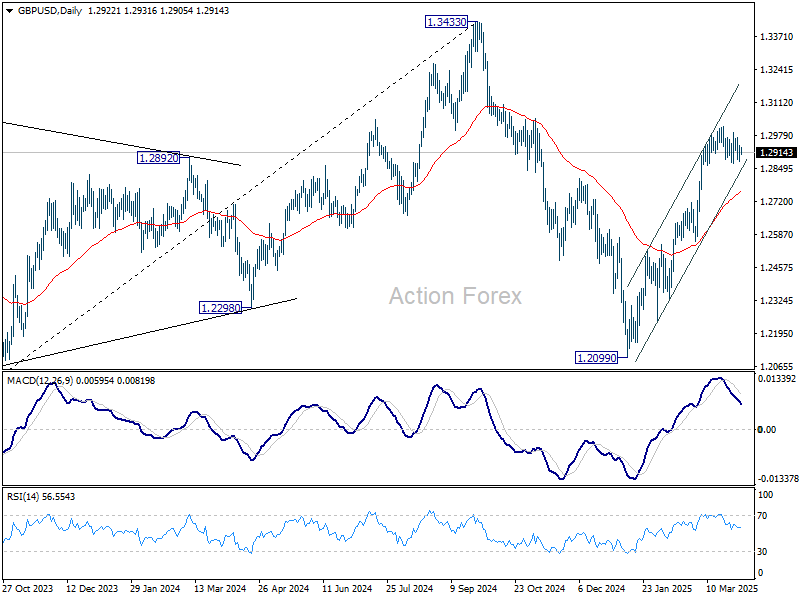
GBP/USD is still extending consolidation from 1.3013 and intraday bias remains neutral. On the downside, below 1.2869 will bring deeper correction. But downside should be contained above 38.2% retracement of 1.2248 to 1.3013 at 1.2721. On the upside, break of 1.3013 will resume the rally from 1.2099 towards 1.3433 high.
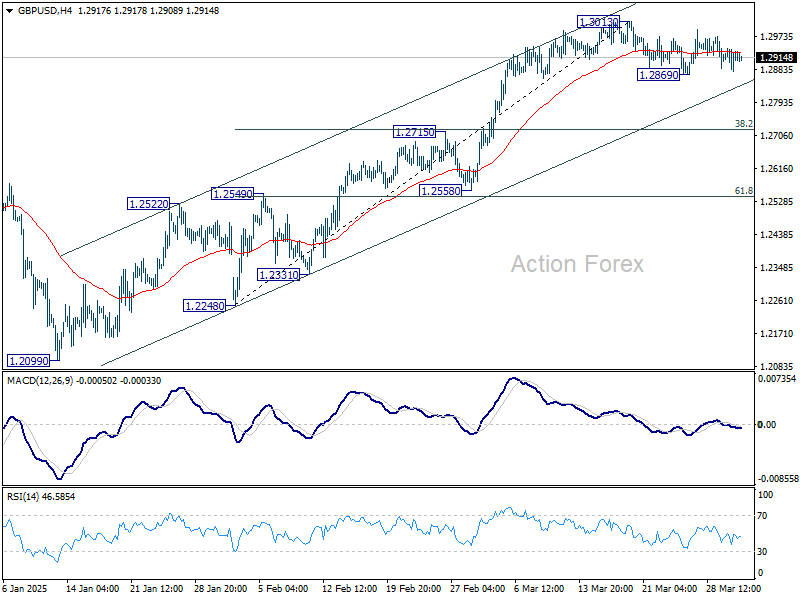
In the bigger picture, up trend from 1.3051 (2022 low) is not completed. Resumption is expected after corrective pattern from 1.3433 completes. Next target will be 1.4248 key resistance (2021 high). This will now remain the favored case as long as 1.2099 support holds.
USD/CHF Daily Outlook
Daily Pivots: (S1) 0.8819; (P) 0.8835; (R1) 0.8854; More…
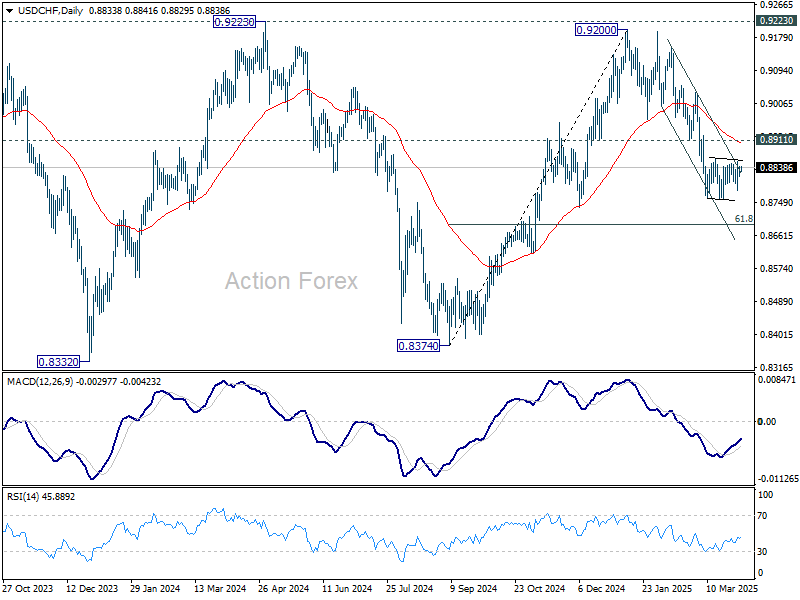
No change in USD/CHF's outlook as consolidation from 0.8757 is still extending. Intraday bias stays neutral at this point. In case of stronger recovery, upside should be limited by 0.8911 support turned resistance. On the downside, break of 0.8757 will resume the fall from 0.9200 to 61.8% retracement of 0.8374 to 0.9200 at 0.8690. Sustained break there will pave the way back to 0.8374 support.
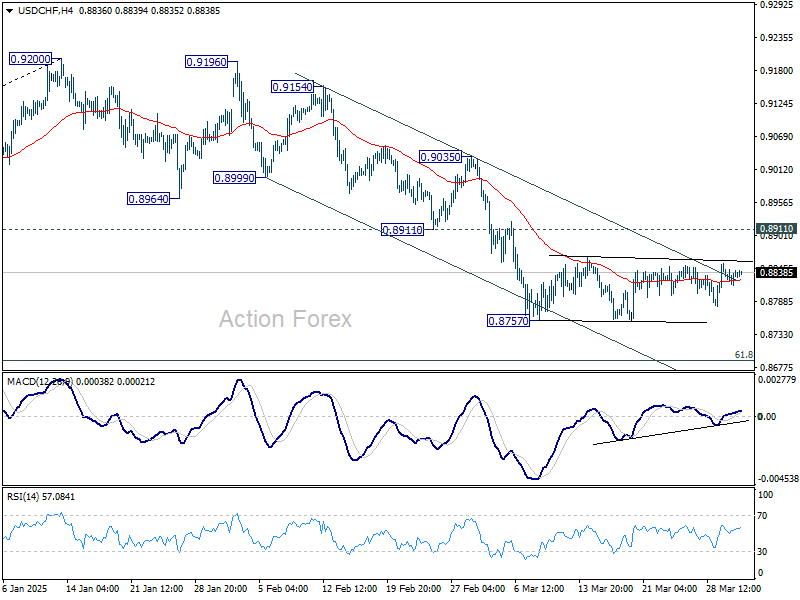
In the bigger picture, rejection by 0.9223 key resistance keep medium term outlook bearish. That is, larger fall from 1.0342 (2017 high) is not completed yet. Firm break of 0.8332 (2023 low) will confirm down trend resumption.
USD/JPY Daily Outlook
Daily Pivots: (S1) 149.01; (P) 149.58; (R1) 150.19; More...
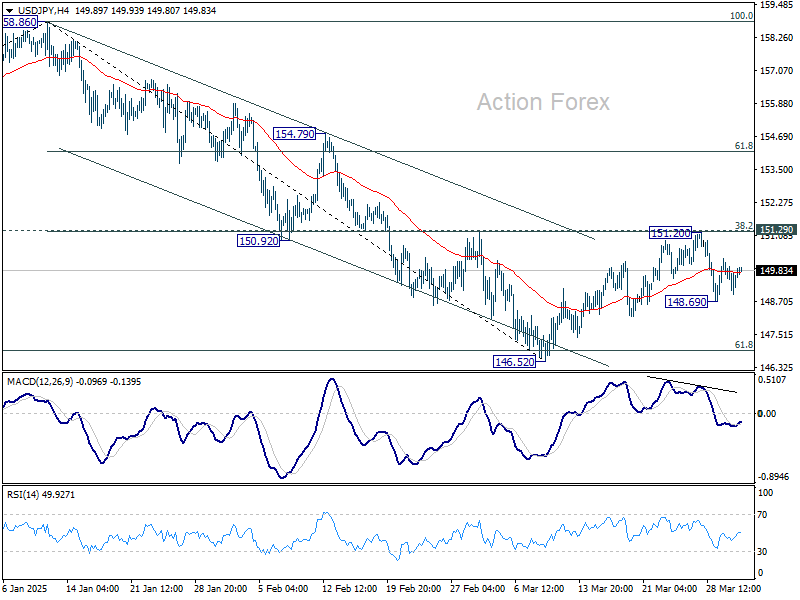
Intraday bias in USD/JPY remains neutral and outlook is unchanged. Corrective rise from 146.52 could have completed at 151.20 already. Risk will stay on the downside as long as 151.29 resistance holds. Below 148.69 will bring retest of 146.52 low first. Firm break there will resume whole decline from 158.86 towards 139.57 support next.
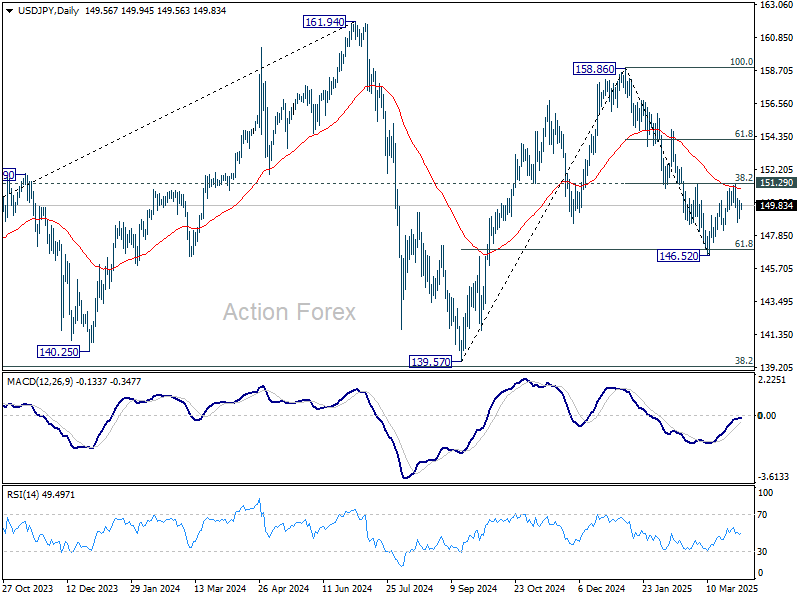
In the bigger picture, price actions from 161.94 are seen as a corrective pattern to rise from 102.58 (2021 low), with fall from 158.86 as the third leg. Strong support should be seen from 38.2% retracement of 102.58 to 161.94 at 139.26 to bring rebound. However, sustained break of 139.26 would open up deeper medium term decline to 61.8% retracement at 125.25.
AUD/USD Daily Report
Daily Pivots: (S1) 0.6246; (P) 0.6264; (R1) 0.6297; More...
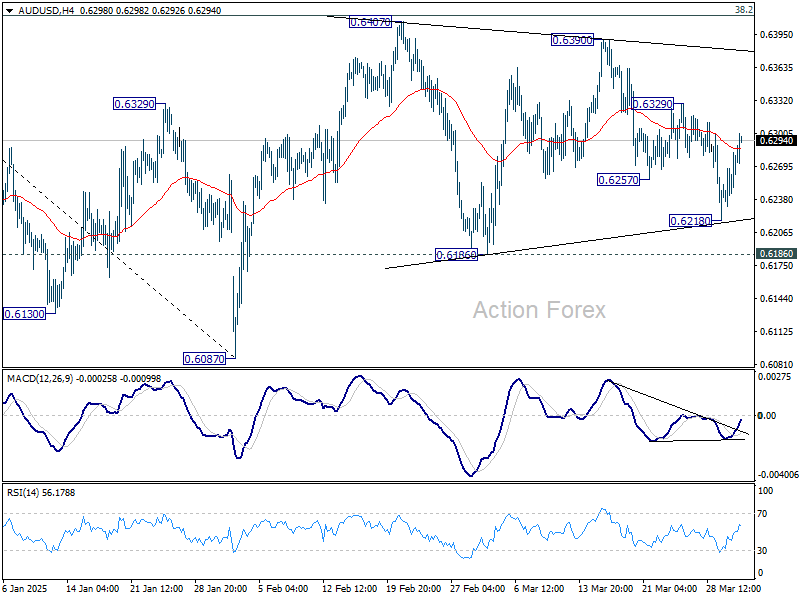
Intraday bias in AUD/USD is turned neutral again with current strong recovery. ON the downside, break of 0.6218 will target 0.6186 support first. Firm break there will indicate that corrective pattern from 0.6087 has completed and larger fall from 0.6941 is ready to resume. However, break of 0.6329 will bring stronger rise back to 0.6390/6407 resistance zone instead.
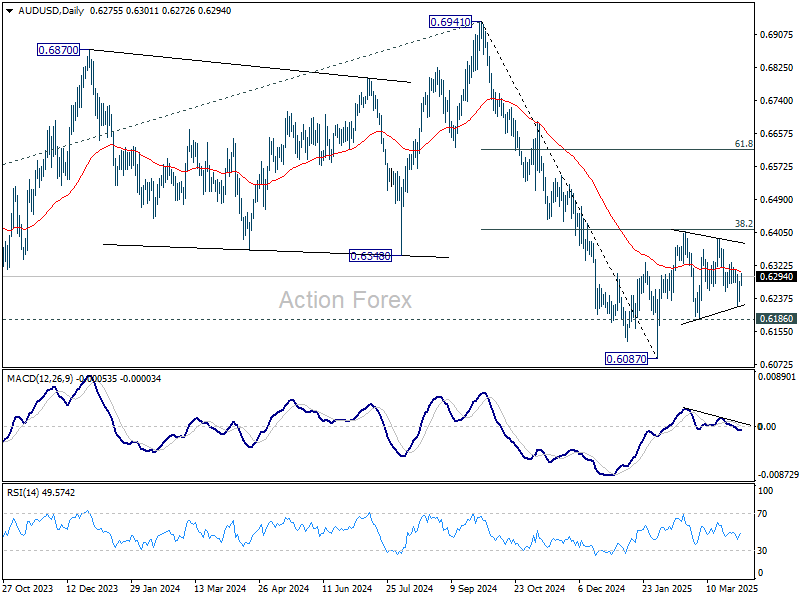
In the bigger picture, fall from 0.6941 (2024 high) is seen as part of the down trend from 0.8006 (2021 high). Next medium term target is 61.8% projection of 0.8006 to 0.6169 from 0.6941 at 0.5806. In any case, outlook will stay bearish as long as 55 W EMA (now at 0.6461) holds.
USD/CAD Daily Outlook
Daily Pivots: (S1) 1.4264; (P) 1.4339; (R1) 1.4380; More...
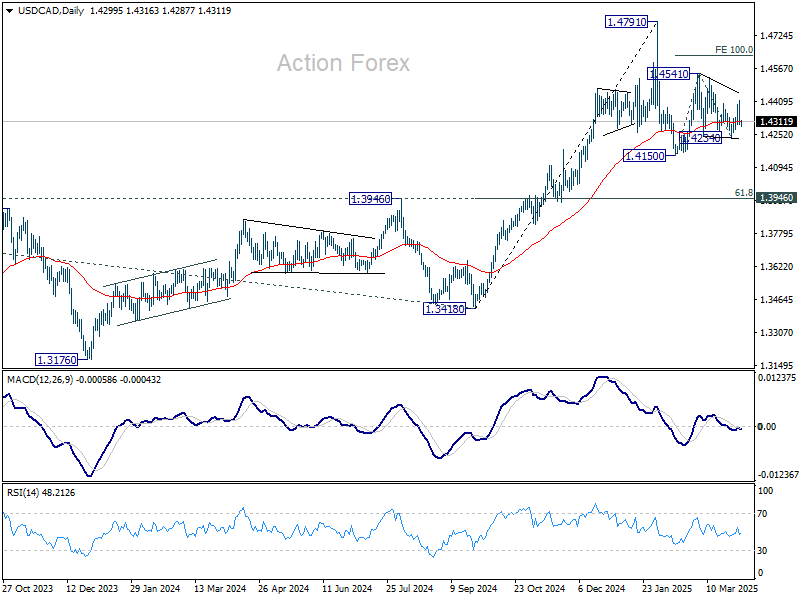
USD/CAD reversed after edging higher to 1.4414, but stays in established range. intraday bias remains neutral for the moment. Overall, corrective pattern from 1.4791 is still extending. On the upside, break of 1.4414 will argue that it's still in the second leg. Intraday bias will be turned back to the upside fro 1.4541 resistance first, and then 100% projection of 1.4150 to 1.4541 from 1.4234 at 1.4625. On the downside, though, break of 1.42324 support will suggest that the third leg has already started for 1.4150 and below.
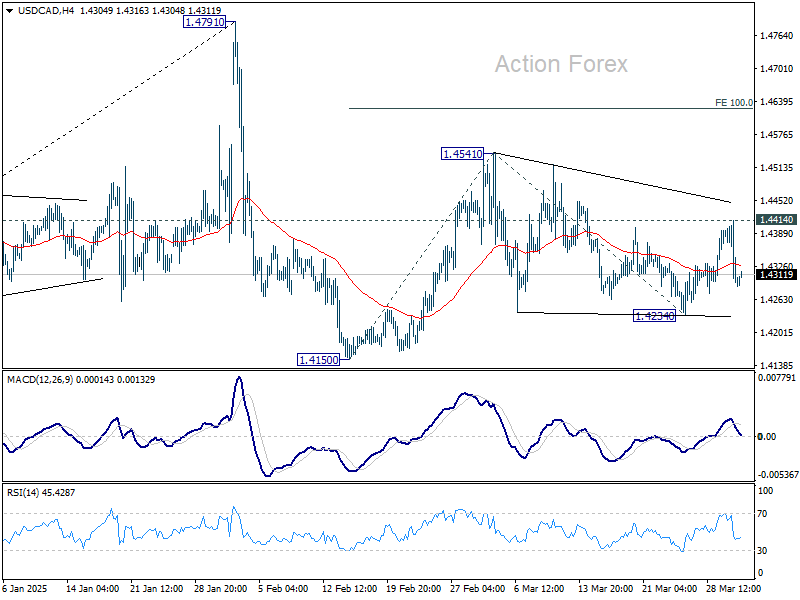
In the bigger picture, long term up trend is tentatively seen as resuming with prior breach of 1.4667/89 key resistance zone (2020/2015 highs). Next target is 100% projection of 1.2401 to 1.3976 from 1.3418 at 1.4993. This will remain the favored case as long as 1.3976 resistance turned support holds (2022 high), even in case of deep pullback.
Tense Silence Before Tariff Thunder, Liberation Day Looms
Asian markets traded cautiously today as investors await the long-anticipated reciprocal tariff announcement from the US, dubbed “Liberation Day” by President Donald Trump. Following the mixed close on Wall Street, risk sentiment remains fragile, with traders in clear wait-and-see mode. However, the rebound in commodity currencies overnight hints that some market participants are leaning toward a less aggressive scenario unfolding — a bet that could quickly unravel if reality disappoints.
According to the White House, the tariff announcement is set to take place today, with Trump scheduled to speak at 4 p.m. ET in the Rose Garden. Rumors continue to swirl over the exact details, but there is increasing chatter that the US may impose a blanket 20% tariff on most imports, lower than a strict “reciprocal” application would suggest. That level, while significant, may be seen as a relief to markets bracing for worse.
Further, reports indicate that Treasury Secretary Scott Bessent has characterized the tariffs as a “cap,” suggesting that countries could negotiate lower rates if they meet US trade demands. This strategy, if confirmed, would effectively introduce a variable rate tariff regime that could evolve through bilateral talks.
However, this overlooks a major wildcard: retaliatory measures from major US trading partners, such as Canada, the EU, and potentially China, which could unleash a spiral of escalation in the weeks ahead. In any case, volatility could spike over the next 24 hours as traders digest the final scope and tone of the announcement.
In the forex markets, price action remains relatively tight, with all major pairs and crosses still trapped within last week’s ranges. Aussie leads the pack, followed by Kiwi and Loonie. On the other end, Euro is the weakest, with Sterling and Swiss Franc also underperforming. Dollar and Yen are holding middle ground for now. But this pecking order could shift quickly once the tariff announcement is out.
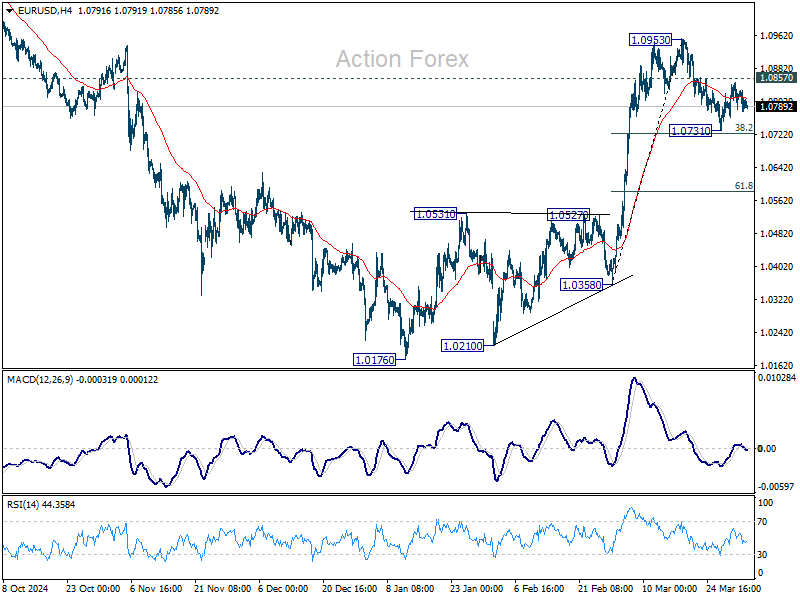
Technically, EUR/USD is worth a watch to gauge Dollar's response to today's tariff announcement. Firm break of 1.0857 resistance should confirm that correction from 1.0953 has completed. And larger rally from 1.0176 is ready to resume. However, firm break of 1.0731 will extend the correction from 1.0953 lower.
In Asia, at the time of writing, Nikkei is up 0.38%. Hong Kong HSI is up 0.17%. China Shanghai SSE is up 0.19%. Singapore Strait Times is down -0.16%. Japan 10-year JGB yield is down -0.005 at 1.499. Overnight, DOW fell -0.03%. S&P 500 rose 0.38%. NASDAQ rose 0.87%. 10-year yield fell -0.090 to 4.156.
BoJ's Ueda: US tariffs pose short-term inflation risk, long-term growth uncertainty
BoJ Governor Kazuo Ueda said today that the ramifications of US tariff policy remain "highly uncertain" and could significantly affect global trade.
Speaking to Japan’s parliament, Ueda emphasized that the ultimate impact would depend on the "range and scale" of the tariffs being implemented. He also noted that beyond trade flows, a key concern lies in "how the tariffs could affect the sentiment and spending of households and companies."
Ueda further highlighted that while US inflation may rise in the short term due to higher import costs, the longer-term effect is less predictable. He suggested that elevated tariffs could eventually weigh on US economic growth, which in turn might dampen inflationary pressures over time.
Fed's Goolsbee warns of fear-driven uncertainty as tariff worries grow
Chicago Fed President Austan Goolsbee acknowledged in a Fox News interview that while hard data, like the low 4.1% unemployment rate, still point to economic resilience, soft data are painting a gloomier picture.
Goolsbee highlighted the noticeable decline in business and consumer sentiment. Goolsbee said that this shift reflects growing uncertainty and fear regarding tariffs.
"They don't want to go back to the kind of inflationary environment that we had in '21 and '22. And we're just going to have to see how this plays out," he added.
Goolsbee emphasized that while imports make up only around 11% of the U.S. economy — potentially limiting the direct inflationary impact of tariffs — there are wider concerns.
“The fear is if it jumps out of the 11% lane,” he warned, noting that cascading effects from uncertainty could stall consumer spending or business investment.
Looking ahead
The European calendar is empty today. US will release ADP employment and factory orders.
USD/CAD Daily Outlook
Daily Pivots: (S1) 1.4264; (P) 1.4339; (R1) 1.4380; More...
USD/CAD reversed after edging higher to 1.4414, but stays in established range. intraday bias remains neutral for the moment. Overall, corrective pattern from 1.4791 is still extending. On the upside, break of 1.4414 will argue that it's still in the second leg. Intraday bias will be turned back to the upside fro 1.4541 resistance first, and then 100% projection of 1.4150 to 1.4541 from 1.4234 at 1.4625. On the downside, though, break of 1.42324 support will suggest that the third leg has already started for 1.4150 and below.
In the bigger picture, long term up trend is tentatively seen as resuming with prior breach of 1.4667/89 key resistance zone (2020/2015 highs). Next target is 100% projection of 1.2401 to 1.3976 from 1.3418 at 1.4993. This will remain the favored case as long as 1.3976 resistance turned support holds (2022 high), even in case of deep pullback.
AUD/USD Faces Headwinds—Can It Avoid a Steeper Drop?
Key Highlights
- AUD/USD started a fresh decline below the 0.6300 support.
- A key bearish trend line is forming with resistance at 0.6275 on the 4-hour chart.
- EUR/USD is consolidating below the 1.0870 resistance zone.
- Gold prices rallied further toward the $3,150 level.
AUD/USD Technical Analysis
The Aussie Dollar failed to continue higher above the 0.6330 resistance against the US Dollar. AUD/USD started a fresh decline below 0.6300 and tested 0.6220.
Looking at the 4-hour chart, the pair traded as low as 0.6218 and settled below the 100 simple moving average (red, 4-hour) and the 200 simple moving average (green, 4-hour). The pair is now consolidating losses and struggling to start a steady increase.
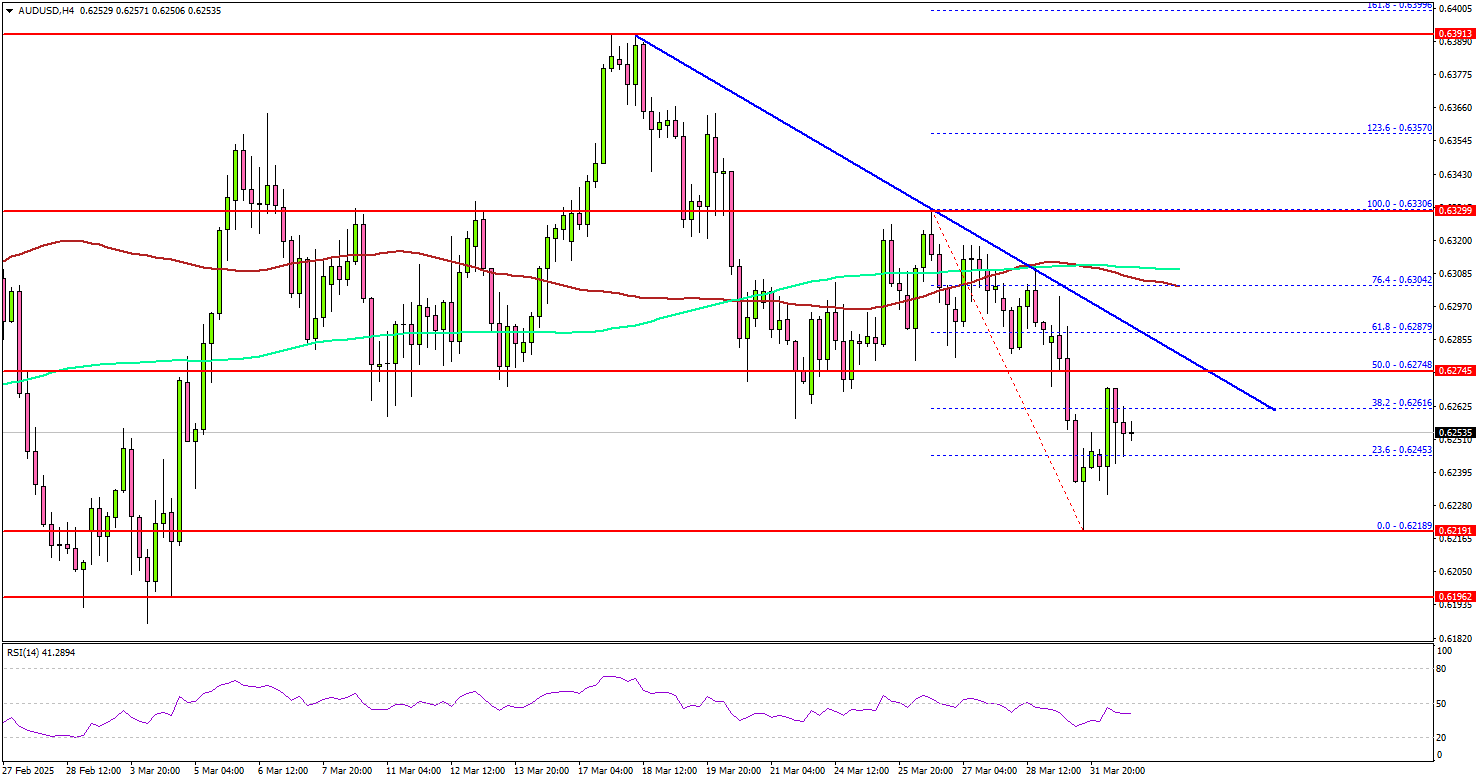
On the upside, the pair is facing resistance near the 0.6270 level. There is also a key bearish trend line forming with resistance at 0.6275 on the same chart.
The next major resistance is near the 0.6288 level. The main resistance is now forming near the 0.6300 zone and the 100 simple moving average (red, 4-hour). A close above the 0.6300 level could set the tone for another increase. In the stated case, the pair could even clear the 0.6330 resistance.
On the downside, immediate support sits near the 0.6220 level. The next key support sits near the 0.6200 level. Any more losses could send the pair toward the 0.6165 level.
Looking at Gold, the bulls remained in action and pushed the price to a new record high above the $3,145 level.
Upcoming Economic Events:
- US ADP Employment Change for March 2025 - Forecast 105K, versus 77K previous.
- US Liberation Day Tariff Announcements.
BoJ’s Ueda: US tariffs pose short-term inflation risk, long-term growth uncertainty
BoJ Governor Kazuo Ueda said today that the ramifications of US tariff policy remain "highly uncertain" and could significantly affect global trade.
Speaking to Japan’s parliament, Ueda emphasized that the ultimate impact would depend on the "range and scale" of the tariffs being implemented. He also noted that beyond trade flows, a key concern lies in "how the tariffs could affect the sentiment and spending of households and companies."
Ueda further highlighted that while US inflation may rise in the short term due to higher import costs, the longer-term effect is less predictable. He suggested that elevated tariffs could eventually weigh on US economic growth, which in turn might dampen inflationary pressures over time.
Fed’s Goolsbee warns of fear-driven uncertainty as tariff worries grow
Chicago Fed President Austan Goolsbee acknowledged in a Fox News interview that while hard data, like the low 4.1% unemployment rate, still point to economic resilience, soft data are painting a gloomier picture.
Goolsbee highlighted the noticeable decline in business and consumer sentiment. Goolsbee said that this shift reflects growing uncertainty and fear regarding tariffs.
"They don't want to go back to the kind of inflationary environment that we had in '21 and '22. And we're just going to have to see how this plays out," he added.
Goolsbee emphasized that while imports make up only around 11% of the U.S. economy — potentially limiting the direct inflationary impact of tariffs — there are wider concerns.
“The fear is if it jumps out of the 11% lane,” he warned, noting that cascading effects from uncertainty could stall consumer spending or business investment.
Preview of RBNZ: On Autopilot?
- We expect the OCR will be cut 25bp to 3.5%.
- The RBNZ will retain an easing bias.
- Global uncertainties and the perception the OCR is above the neutral rate will drive the easing bias.
- We are alert for signs of greater data dependency around future moves compared to the forward guidance in recent meetings.
- “No change” in the OCR will return to the set of plausible options for future meetings.
- The recent stronger data flow will be acknowledged and may be used to justify less confidence around cuts after the May Monetary Policy Statement.
- This OCR cut is likely the wrong thing to do. A more mandate consistent approach would be to leave the OCR unchanged at this meeting and consider a 25 bp cut at the May Monetary Policy Statement.
RBNZ decision and communication.
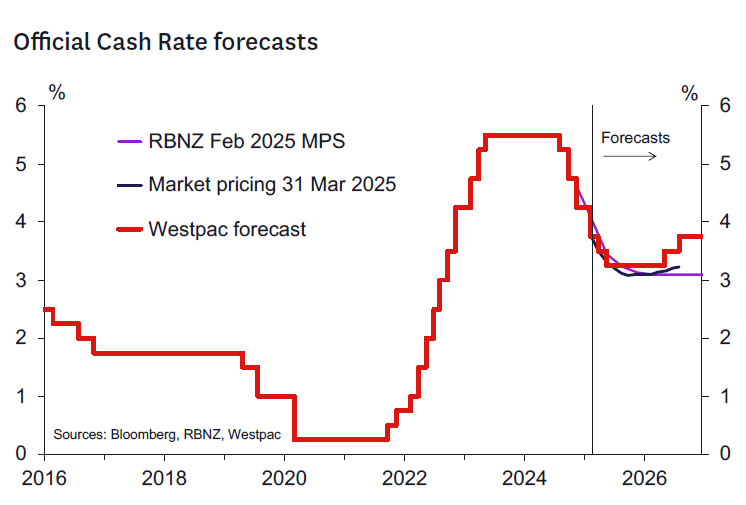
We expect the RBNZ to act on past signalling and cut the OCR by 25bp to 3.5% and signal a more data dependent easing bias looking ahead.
The RBNZ will likely note the economy was stronger than expected in late 2024 and that the recent data flow suggest growth has continued. This assessment will give the impression that another cut at the May Monetary Policy Statement is more likely than not but that cuts after May are more speculative than indicated at the February Monetary Policy Statement. The RBNZ is likely to note the inflation outlook remains at least as firm as previously expected and that developments on that front will be an important driver of the need for further OCR cuts in 2025.
We expect commentary on the weakening in the outlook in some trading partner economies, but also uncertainty on how the global activity will evolve. This is the stance other central banks have taken to date and should be a blueprint for the Monetary Policy Committee’s stance on this score.
We think the MPC’s objective will be to leave the option of pausing the easing cycle on the table at each meeting from here. We expect this will be in line with our forecast that the end of the cycle will come with the May Monetary Policy Statement and an OCR of 3.25%.
One thing to note is the key Q1 QSBO is released immediately ahead of the MPR. This data will be available to the Monetary Policy Committee in its deliberations. Should this survey indicate sharply reduced excess capacity and robust pricing pressures as evident in the monthly ANZBO survey then it’s possible our view of the MPR outcome will be revised.
Recent data flow and impact.
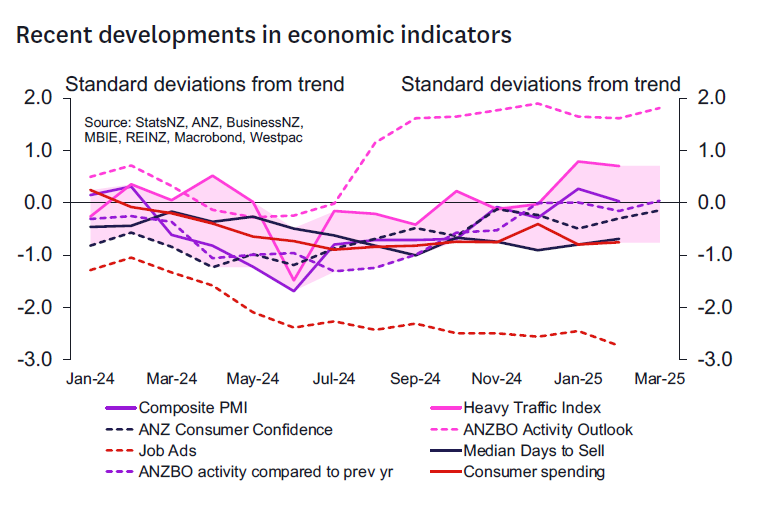
The key data since the February MPS release is as follows:
GDP: Activity grew 0.7%q/q in Q4, above the RBNZ’s February MPS estimate of 0.3%q/q. Private consumption spending was weaker than the RBNZ had estimated, but business capex and exports were stronger than expected (the latter probably reflecting the strength seen in services exports). Given the usual approach, the RBNZ will likely now assess that the negative output gap is narrower than the 1.7% of GDP that had been estimated for Q4. This data also provides confidence that the base level of growth in the economy in late 2024 was at least as strong as previously projected, which should increase confidence in the Bank’s growth forecasts in coming quarters.
Inflation: Based on selected prices data for the first two months of the quarter, we estimate that the CPI will increase 0.8%q/q in Q1 (data to be released on 17 April). Our estimate is in line with the RBNZ’s MPS forecast. The pricing intentions gauge in the ANZ’s business survey has increased in recent months and continues to sit at levels that historically have not been consistent with inflation remaining inside the target range. Given that the survey points to an expectation of subdued wage growth, these readings could reflect the factors such as rising global food prices and a weaker NZ dollar. Firms may also be optimistic that they can rebuild margins once the economy strengthens.
Employment: Based on filled jobs data for the first two months of the quarter, we estimate that household employment will likely print broadly flat in Q1, in line with the RBNZ’s February MPS forecast. Given growth in the working age population, we currently expect that the unemployment rate will rise to 5.3%, just above the RBNZ’s forecast of 5.2%. At this stage job advertising levels are yet to show a discernible lift from the cyclical lows reached last year.
Confidence: Consumer confidence (both Westpac and ANZ measures) has slipped a little in the last month or so but remains on an improving trend. The recent tick lower in confidence may reflect uncertainty associated with the global outlook as well as lingering concerns about job security. Ahead of the release of the QSBO on 8 April, business confidence – as measured in the ANZ’s Business Survey – has remained at an historically high level, with firms also very upbeat about the year-ahead outlook for their own activity.
Other activity indicators: The BusinessNZ manufacturing PMI posted a welcome lift to 53.9 in February – the first reading above 50 for two years. However, the services PMI fell back to 49.1 in February after rising above 50 in January for the first time in 12 months. Overall, most activity indicators confirm an improving underlying trend in activity – albeit with considerable month to month volatility as is inherent in these indicators.
Housing market: Both house sales and mortgage approvals point to increasing levels of housing activity since the second half of last year, trending higher as mortgage rates have been progressively lowered. House prices are on an improving trend but not booming as there remains a considerable stock of inventory on the market for demand to work through. At this stage the RBNZ will probably regard housing developments as tracking close to what was envisaged in the February MPS.
Kelly’s take – this cut is the wrong approach.
The main case for cutting at this meeting is the RBNZ essentially promised it at the February Monetary Policy Statement. However, I believe moving more slowly is more likely to be appropriate notwithstanding those past communications.
An evaluation of the data flow in recent months shows both an improving economy and robust inflation. Given the mandate is solely focused on inflation it’s hard to make the case for cutting rates at every meeting from here. A cut at the May Monetary Policy Statement is likely still to be justified. But its less clear further cuts would be required from there. Hence, we have reached the point where there is a difference between what I think the RBNZ will do as opposed to what they should do.
The RBNZ has put considerable weight on a view that the neutral OCR is around 3%. But this variable is unknown and unmeasurable in real time. Interest rates may also already be at neutral. Mortgage rates are likely at stimulatory levels now given rates between 1-3 years are around 5%. Stopping the easing cycle at either 3.5 or 3.25% may prove appropriate and would still deliver monetary conditions close to where they are today.
The exchange rate is also likely at stimulatory levels – evidence for that is clear in indicators of regional consumer demand and house prices.
The neutral OCR is an unhelpful concept for policy formulation now the OCR is no longer at obviously tight levels.
Another case for easing is concern on downside risks from the external outlook. Here I disagree that a proactive approach is appropriate. The starting point for the external sector is one of rude good health. If a negative shock is coming, the external sector is as well placed to deal with it as it could be. We have no idea if the global trade and tariff situation will meaningfully undermine the NZ economy. Any response to a negative external shock should be considered once the shock occurs and not before.
The exchange rate is playing the appropriate role as shock absorber. This should continue – cutting interest rates to somehow support asset prices to offset a permanent competitiveness loss from tariffs is unwise and inappropriate. How does pushing up NZ house prices to gee up domestic demand for a little while make NZ Inc better off right now? Especially when forecasts of inflation remain in the top half of the target range.
Conditions in the economy could deteriorate to the extent that inflation falls to the bottom half of the target range. That would justify an easing bias to be acted on when the data shows this to be happening. Guessing it might happen when inflation is heading towards 3% is not consistent with the MPC’s mandate.
The RBNZ has already cut rates aggressively – pretty much as quickly as seen in the Global Financial Crisis. We don’t have a crisis right now. Given the significant easing that’s already occurred, the stronger case is to step back and assess the impact of what’s already been done. No change in the OCR is appropriate.
While past communication appeared to promise a cut next week almost unconditionally, decisions should always be based on the situation on the ground. No change with an easing bias would be the right thing to do.