

Sample Category Title
EURUSD Analysis: Breaches Strong Up-Trend
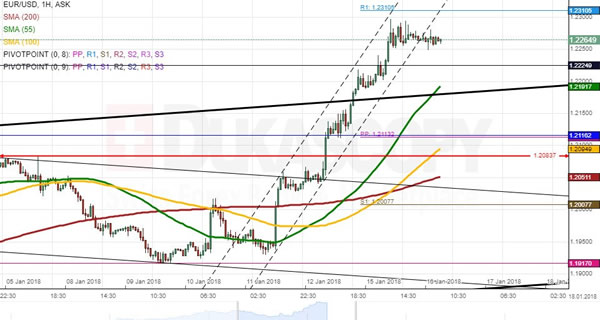
Apart from a 50-pip surge md-Monday, the common European currency showed no intention to leave its narrow trading range, thus leaving the market at a relative equilibrium. Even though bulls did not push higher in the previous sessions, bears nevertheless failed to take the upper hand. This suggests that bulls could still gather slight momentum and push the rate higher. A possible upside target in this case could be the weekly R1 at 1.2311. The pair’s subsequent movement should be tended south towards the upper boundary of the breached ascending channel and the 55-hour SMA circa 1.22. By and large, the US Dollar still remains weakened against its major counterparts. Thus, the Euro will continue surging until this period of value decline ends.
GBPUSD Analysis: Still Before Data Release
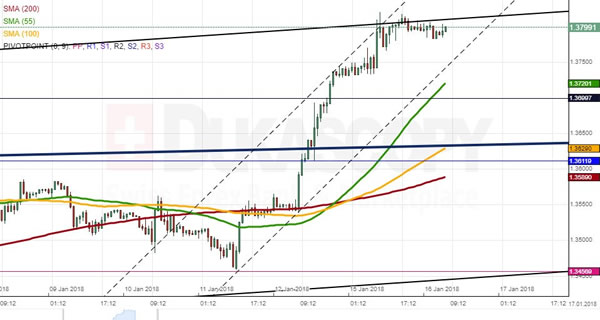
Similarly to other major currency pairs involving the US Dollar, GBP/USD was trading sideways for the most session on Monday. After a quiet morning, the Sterling surged 49 pips, but then resumed its period of consolidation slightly below the weekly R1. The Pound is currently testing the upper boundary of a three-month ascending channel circa 1.38. Given that this area is likewise reinforced by the weekly R1 and the monthly R3, it is unlikely that bulls manage to surpass the 1.3850 mark. Meanwhile, the UK is to publish its monthly CPI data at 0930GMT. This data release might disrupt the pair’s still movement and push the rate lower towards the 55-hour SMA and the monthly R2 near 1.37. In case no other significant events occur, the rate could remain in the 1.3700/1.3850 area today.
USDJPY Analysis: Returns Near 55-Hour SMA
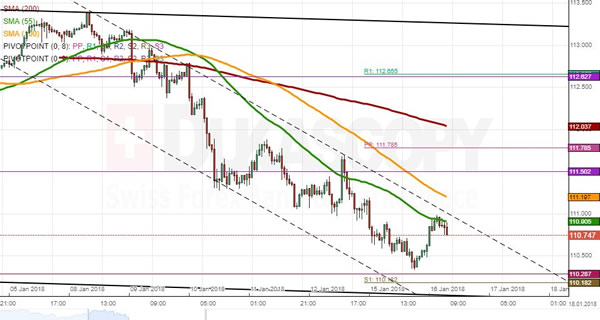
The bearish pressure continued to prevail on Monday, thus sending USD/JPY towards the combined support of the monthly S2 and the weekly S1 circa 110.30. Due to this cluster, the Greenback failed to reach the bottom boundary of a four-month channel circa 110.00. The test of this support was followed by a slight period of recovery until the rate reached the 55-hour SMA. Technical indicators suggest that the rate is likely to fail today, especially if its northern barrier is likewise reinforced by the 100-hour moving average. Even if the rate breaches the 110.30 area, its subsequent fall should not exceed the aforementioned channel. The pair’s movement would eventually lead to the breakout of a short-term descending channel and a possible surge.
XAUUSD Analysis: Shows No Changes
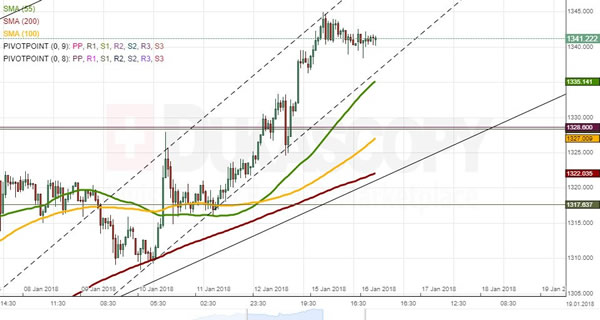
Gold was stable against the US Dollar on Monday. The pair reached a new four-week high of 1,344.03 early in the session, and remained trading in the 1,345.00/1,340.00 area for the whole session. As apparent on the chart, the yellow metal fell short from its nearest resistance—the weekly R1—at 1,348.83. Thus, bulls might try to realise these gains, while further advance is unlikely. Meanwhile, technical indicators suggest that Gold could continue its movement sideways until the lower boundary of a steep one-week channel is reached circa 1,340.00. This area intersects with the 55-hour SMA that is expected to provide a strong support level. The base scenario favours the same lack of momentum within the following session.
EUR/AUD 4H Chart: Bounces Off Resistance
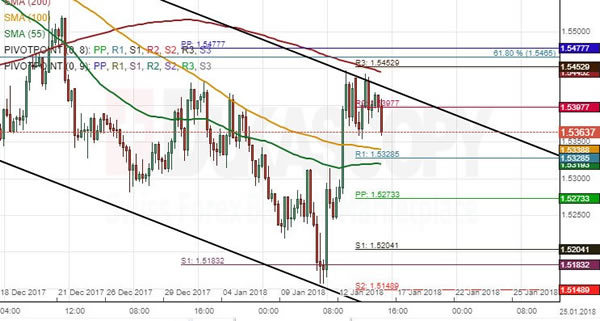
The common European currency recently jumped against the rest of the currency market. However, on the EUR/AUD pair the end of the surge has already occurred.
Namely, the currency exchange rates surge was stopped by the upper trend line of a long term channel down pattern. However, the trend line might have not affected the currency pair alone, as there are four additional resistance levels above the trend line.
Regarding the pairs future movement, the rate has clearly bounced off the resistance level and is set to soon reach a support cluster near 1.5330 mark. The cluster is made up of the 55 and 100-period SMAs and the weekly R1 level.
USD/CNH 4H Chart: Meets support
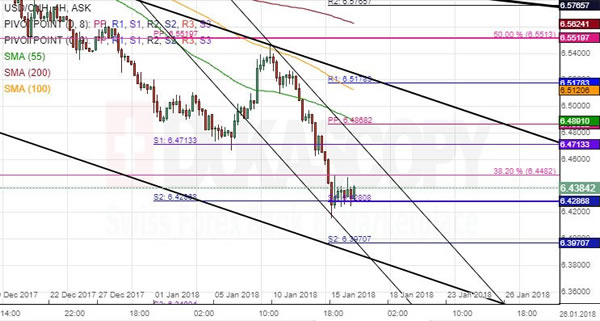
The US Dollar has continued to lose ground against the rest of the currencies. The USD/CNH pair is no exception to this event. However, there is one interesting aspect to the decline of the Buck against the Chinese Yuan.
The currency pair recently stopped its decline and began to trade sideways. The move was initiated by a combined support of the lower trend line of junior channel down pattern, weekly S1 and monthly S2. All of these support levels are located in a range from 6.4200 to 6.4290.
Meanwhile, resistance is provided by the 38.20% Fibonacci retracement level at the 6.4480 mark.
The pair is likely to trade sideways until it reaches the resistance of the channel. Afterwards, the decline should resume.
NZD/USD: NZIER Business Confidence
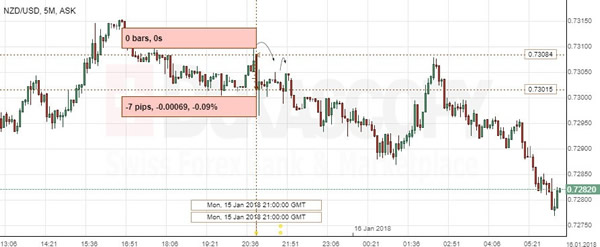
The Kiwi weakened against the Greenback, following business confidence report for New Zealand. The NZD/USD exchange rate lost 0.09% or 7 base points to keep declining to be seen trading at 0.7820.
Business sentiment in New Zealand turn negative in the fourth quarter of 2017, falling to the lowest level in two years, amid pessimistic stance towards the new Labour-led government, as it is usually less "pro-business", compared with the National Party. 12% of surveyed firms anticipated business conditions to worsen, compared with 5% expecting an improvement in the prior quarter, the New Zealand Institute of Economic Research report showed. Data is unlikely to change the RBNZ’s thinking about the economy to push back rate increases.
EUR/USD: EZ Trade Balance
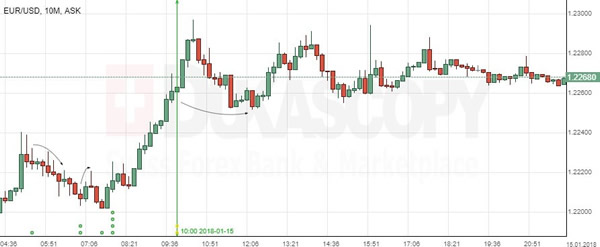
The European single currency was almost unchanged against the US Dollar on the trade balance report on Monday. The EUR/USD currency pair sustained the position near the 1.2270 level.
The trade surplus in the Euro area countries rose to the highest level in the last eight months, as an increase in exports outpaced higher exports, despite strengthnening of the Euro, official estimates revealed. The statistics office Eurostat showed that the Euro zone’s goods trade surplus grew to seasonally unadjusted €26.3B in November, compared with Octover’s €18.9B and €23.6B recorded in the same month a year earlier. In adjusted terms, the EZ trade surplus reached €22.5B in the reported month.
Technical Outlook: EURUSD – Bulls Are Taking A Breather But Bullish Bias Remains Intact
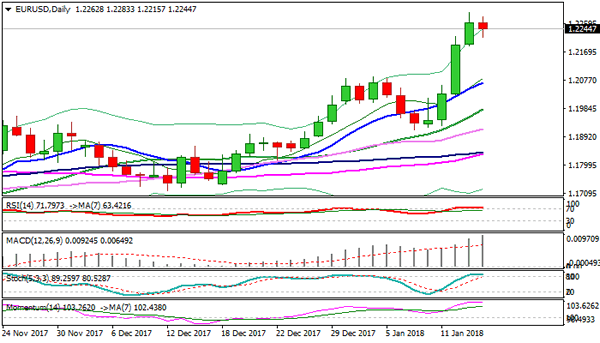
The Euro is taking a breather after steep three-day rally which peaked at 1.2296, the highest in more than three years. Recent strong rally was supported by broadly weaker dollar and additionally boosted by hopes the ECB could further trim its monetary stimulus. The pair is holding within consolidative range today, with overbought daily studies keeping in play risk of deeper correction. Firmer bearish signals are required to spark correction and expose initial supports at 1.2206 (Fibo 23.6% of 1.1915/1.2296 upleg) and 1.2187 (yesterday's low). Next significant support lies at 1.2150 (Fibo 38.2%) and corrective action should ideally find footstep here to keep intact pivotal supports at 1.2100 zone (former tops/daily Tenkan-sen). Overall structure is firmly bullish and favors continuation of broader uptrend after consolidative/corrective phase. Sustained break above 1.2300 barrier is needed to signal bullish continuation. German inflation numbers for December were released today and came in line with expectations, causing no significant moves in the market. Focus turns towards EU CPI data, due tomorrow, for fresh signals.
Res: 1.2296, 1.2350, 1.2400, 1.2450
Sup: 1.2215, 1.2206, 1.2187, 1.2150
Euro Rally Pauses, German Inflation Numbers Mixed
The euro is steady in the Tuesday session. Currently, EUR/USD is trading at 1.2255, down 0.07% on the day. In economic news, Germany released inflation figures. Final CPI improved to 0.6%, matching the forecast. WPI declined 0.3%, missing the estimate of +0.3%. In the US, the sole event on the schedule is the Empire State Manufacturing Index. The indicator is expected to climb to 18.4 points. On Wednesday, the eurozone releases Final CPI, and the US will publish two industrial reports.
The euro has impressed with its recent rally, climbing 2.4% since January 11. There are two key factors behind the upward trend. First, the ECB minutes from the December meeting were hawkish, leading to speculation that the ECB could wind up its asset purchase program in September. In the minutes, policymakers said that risks to the current outlook were to the upside, which could necessitate a gradual shift in guidance in the next few months. As for the eurozone, the minutes stated that the economy was displaying “continued robust and increasingly self-sustaining economic expansion”. Policymakers have echoed the sentiment that tighter policy could be on the way. On Monday, ECB Governing Council member Ardo Hansson said if the economy and inflation develop as expected, the ECB could wind up the asset purchase program in one shot after September. The second factor is major progress in coalition negotiations in Germany. There was a report on Friday that Angela Merkel’s conservative bloc and the Social Democrats have agreed on a coalition draft. This ends months of political uncertainty, which has eroded Merkel’s standing and also sidelined Germany on key issues such as Brexit and political reform in the eurozone. Still, the talks are only in the preliminary stage, and further negotiations will take at least several weeks before it is clear that the talks have been successful.
The dollar lost ground on Friday, as US consumer data for December was lukewarm. CPI slowed to 0.1%, down from 0.4% a month earlier. Core CPI was stronger, improving to 0.3%. Both indicators were within expectations, but pointed to weak inflation levels. On the bright side, consumer spending remained strong. December retail sales, buoyed by Christmas shopping, were up 5.4% compared to a year ago. Although investors were not impressed with the December data, as the euro rally continued, the spending numbers point to a strong finish for the US economy in 2017.