

Sample Category Title
Summary 12/25 – 12/29
Monday, Dec 25, 2017
[php_everywhere] [/php_everywhere]
Tuesday, Dec 26, 2017
[php_everywhere] [/php_everywhere]
Wednesday, Dec 27, 2017
[php_everywhere] [/php_everywhere]
Thursday, Dec 28, 2017
[php_everywhere] [/php_everywhere]
Friday, Dec 29, 2017
[php_everywhere] [/php_everywhere].
Weekly Economic and Financial Commentary: Housing to End the Year with a Bang
U.S. Review
Economic Data Show Solid Momentum in Q4
- The three major housing market readings out this week were predominantly upbeat. Housing starts continued to point to a strong construction outlook. Existing home sales surged, although inventory tightened further. New home sales jumped to a fresh cycle-high.
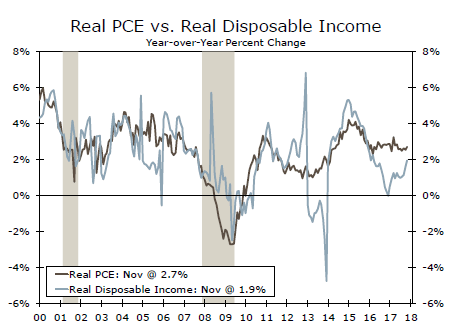
- Household spending was strong in November, income registered a solid monthly increase and inflation perked up.
- Durable goods surged on volatile aircraft orders but revisions and underlying data pointed to solid momentum in core capital goods orders and shipments, which were up at 3-month average annualized rates of 18 percent and 14.9 percent, respectively.
Housing to End the Year with a Bang
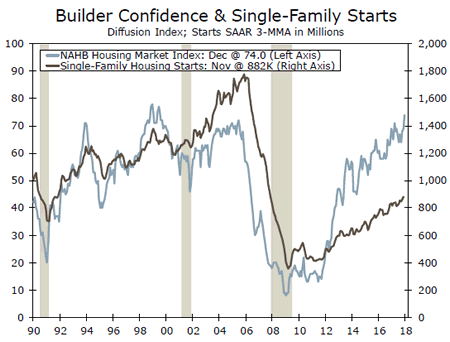
Housing market conditions were largely positive in November and October, and forward-looking indicators suggest upbeat conditions will continue. The NAHB/Wells Fargo survey of homebuilder sentiment in December revealed optimism not seen since 1999. The strong report exceeded expectations, as the overall gauge rose five points on the month to a reading of 74. Details of the survey were also upbeat, as current sales and prospective buyer traffic were at their highest point since the late 1990s.
Homebuilders' optimism for sales over the next six months is at its highest point of the current cycle. Homebuilders see continued income gains and low mortgage rates boosting demand, and also see policy changes in Washington as a plus to their industry. Builders specifically cited easier regulation and tax cuts.
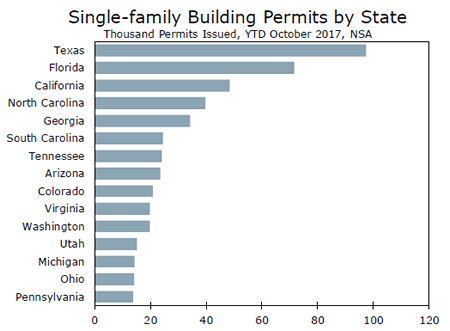
Groundbreaking on single-family homes was running at its fastest seasonally adjusted pace of the current cycle in November. Some of the strength in the report was likely due to activity coming back to normal in the South after storm disruptions, but the year-todate comparisons were also strong, which suggests underlying momentum is also gaining. The warmer-than-usual weather in November also helped make last month a busier-than-usual month for building. Indeed, not seasonally adjusted starts declined less than they usually do in November. Combined with the sky-high optimism among builders, it appears single-family construction has perked up in recent months and is slated to continue to drive total construction in 2018. Apartment construction has largely topped out. Still, existing limitations on building remain, i.e. lot shortages and a tight supply of construction labor in many cities.
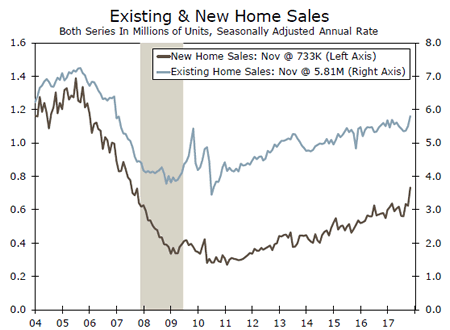
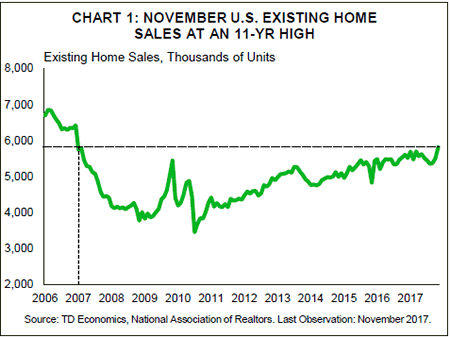
In step with other housing indicators this week, existing home sales were also at a cycle high in November. Resales surged well ahead of the 5.53-million unit pace expected by consensus to 5.81 million units, which is an 11-year high. This was the third monthly gain, and October's pace was also revised up. There was broad strength regionally, as the West posted the only decline that was easily offset by a strong month of sales in the South and Midwest. Resales measure contract closings so they reflect contracts signed about two months ago; therefore some of the surge may be attributed to pent-up activity from extreme weather events in late August and early September. Moreover, seasonal adjustment factors are large during this time of year, so they may have exaggerated the effects of deviations from usual sales activity.
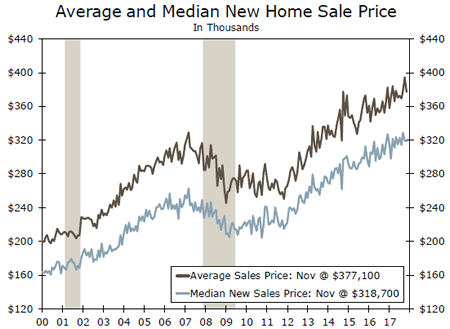
Even if some degree of the record-breaking surge was due to data volatility, it is also clear that underlying fundamentals in the housing market are strong. Strength in the job market continues to fuel housing demand, and mortgage rates are still quite low. That said, there are also supply headwinds that have not let up in recent months. Inventory of homes for sale declined 7.2 percent on the month, and there is now just a 3.4-month supply available. Cash purchases and investors also accounted for a larger share of resales in November, as first-time buyers run into affordability hurdles. Supply constraints and strong demand have pushed home prices higher and higher. Hopefully the optimism among homebuilders translates into better-priced new homes coming on the market.
U.S. Outlook
ISM Manufacturing • January 3
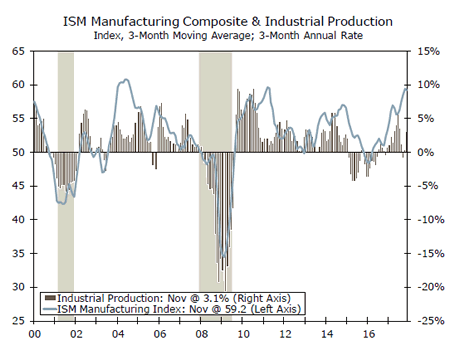
The ISM manufacturing index slowed ever so slightly in November to 58.2 from 58.7. The composite index is coming off a cycle high of 60.8 in September, and with a six-month average of 58.4, the index continues to signal firmness in the manufacturing sector.
Subcomponent details are encouraging. The production index, for example, has been above 60 since June and came in at 63.9 in November; that's the highest reading since March 2011.
As for employment, that index came in at 59.7, above its six-month average of 58.7. Industries reporting gains in employment include textile mills, machinery, computer products and paper. We anticipate that job gains in the first half of 2018 will be in line with the 2017 pace and thereby support continued consumer income and spending gains. We expect the December ISM manufacturing report to show a faint slowing to 58.0, while continuing to signal strength in the industry as a whole.
Previous: 58.2 Wells Fargo: 58.0 Consensus: 58.1
Trade Balance • January 5
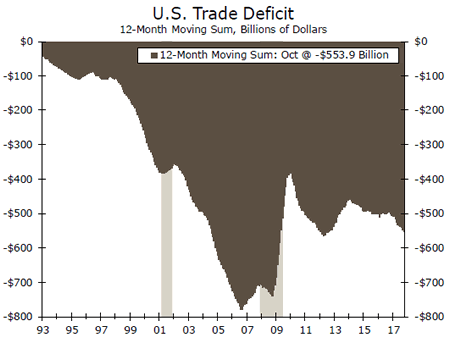
The data in last month's trade report for October are still being influenced by Hurricanes Harvey, Irma and Maria; these effects should blow away as we move farther away from the eye of the storm. Goods exports fell just more than $300 million and services exports increased $301 million for an overall increase of just $21 million —a drop in the bucket for the overall export figure of nearly $200 billion.
Imports posted the largest monthly gain since January. The surging imports, particularly in categories like consumer goods and autos, are consistent with our expectation that holiday sales will be strong this year and may reflect storekeepers and online vendors taking on stock in expectation of increased spending amid the highest levels of consumer confidence in more than 15 years. Looking forward, we forecast that the U.S. trade balance will widen modestly in the next two years.
Previous: -$48.7B Consensus: -$47.7B
Nonfarm Employment • January 5
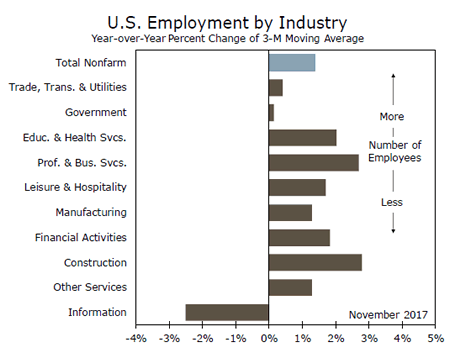
Nonfarm payrolls rose 228,000 in November, with the three-month average at 170,000 jobs. Job gains are consistent with 2.5-3.0 percent economic growth in the first half of 2018, with steady consumer spending, better business investment and a likely FOMC rate hike in Q1-2018. Jobs growth is strong in many sectors including business services, trade & transport as well as education & health.
Nominal average hourly earnings rose 0.2 percent in November, which was short of expectations. However, the average length of the work week edged up to 34.5 hours. Along with the net jobs added, this suggests income derived from the labor market has strengthened at a 4.7 percent annualized rate the past three months. Lackluster productivity growth in the current cycle has weighed on wage growth and will likely continue to hamper wage appreciation, even with low unemployment.
Previous: 228K Wells Fargo: 180K Consensus: 185K
Global Review
Foreign Economic Growth Remains Resilient
- The Ifo index of German business sentiment remained near its all-time high in December. Although the Ifo index overstates the strength of Germany at present, economic growth generally remains solid.
- Real GDP in Canada was flat in October, but the underlying pace of growth continues to look solid. With unemployment at its second-lowest rate in more than 40 years, we look for the Bank of Canada to hike rates further in 2018.
- Growth in Brazil and Argentina, the two largest economies in South America, has strengthened in recent quarters.
German Economy Not as Strong as Ifo Index Suggests
If the Ifo index of German business sentiment is taken literally, then the German economy is absolutely booming at present. Data released this week showed that the headline index edged down a bit in December, but that it remained near the post-reunification high that it set in November.
Unfortunately, the "hard" data out of Germany are not quite as strong as the Ifo data would imply. Specifically, industrial production (IP) fell 1.4 percent on a monthly basis in October, which follows the 0.9 percent decline registered in September. Yes, German IP growth remains positive on a year-ago basis, but growth clearly has been stronger in previous cycles. More broadly, real GDP in Germany was up 2.8 percent in Q3-2017, the strongest year-over-year growth rate since the economy was exiting recession in 2010-2011. Most analysts expect that the German economy will continue to expand in coming quarters, but that the year-over-year rate of growth will slow somewhat.
Canadian Economy Remains Resilient Despite Disappointing GDP Outturn in October
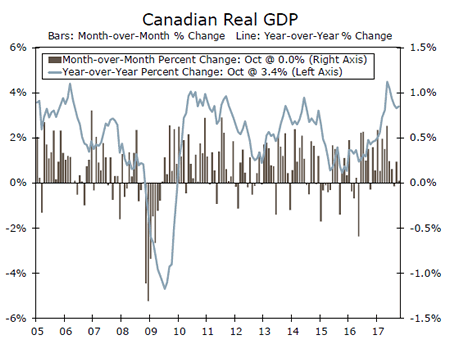
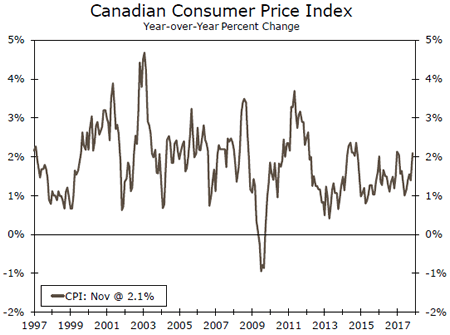
Speaking of slowing, the Canadian economy continues to decelerate from the unsustainable 4 percent-plus pace that it registered earlier this year. Despite strong growth in retail spending in October—sales surged 1.5 percent in October relative to the previous month—real GDP was flat on the month, which was weaker than most analysts had expected (top chart). That said, real GDP is up 3.4 percent on a year-ago basis, so the Canadian economy is hardly coming apart at the seams. Meanwhile, the yearover- year rate of CPI inflation jumped from 1.4 percent in October to 2.1 percent in November, but it remained well within the Bank of Canada's (BoC) target range of 1 percent to 3 percent.
Like most analysts, we look for the Canadian economy to decelerate a bit in the next two years from the 3 percent GDP growth rate that looks to have been registered in 2017. However, the low unemployment rate—it currently stands at 5.9 percent, its second-lowest rate in more than 40 years—means there probably is not much spare capacity left in the economy. Accordingly, we look for the BoC to hike rates twice in 2018, as it continues to remove policy accommodation.
Growth in South America Picking Up Again
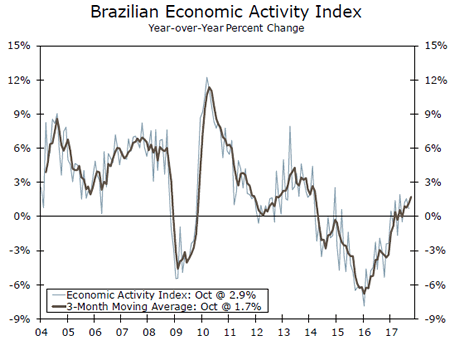
This week's economic data out of Brazil and Argentina suggest that South America's two largest economies are picking up steam. In Argentina (the continent's second-largest economy), real GDP growth strengthened from 2.9 percent in the second quarter to 4.2 percent in Q3, the strongest year-over-year growth rate in four years. In the continent's largest economy, the Brazilian economic activity index, which is a good proxy for real GDP growth, rose to a 44-month high of 2.9 percent in October (bottom chart). Although we certainly do not expect growth in Brazil to return to pre-crisis rates anytime soon, we look for the Brazilian economy to strengthen further over the next two years.
Global Outlook
Japanese CPI • December 25
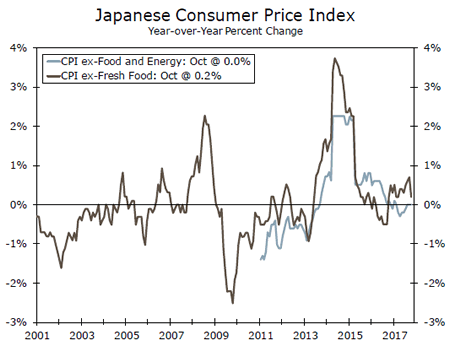
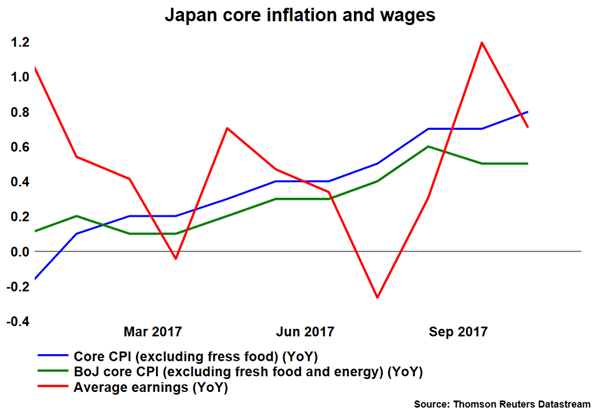
A slew of economic data print in Japan next week, including retail sales, industrial production and the consumer price index. We have noted in previous publications that the Japanese economy is experiencing a spurt of economic momentum that, while modest by global standards, represents a marked improvement from the pace of growth seen in Japan much of this cycle. The Bank of Japan (BoJ), however, has kept its foot on the monetary policy accelerator, largely as a result of still stagnant inflation. As the chart to the right illustrates, core consumer prices are still hovering just above deflation territory, an omnipresent threat to the Japanese economy for much of the past two decades.
Solid industrial production and retail sales numbers would suggest the recent acceleration in GDP will continue into Q4, but it will take a more meaningful and sustained increase in inflation to convince the BoJ that a tighter stance on monetary policy is warranted.
Previous: 0.2% Wells Fargo: 0.3% Consensus: 0.5% (Year-over-Year)
Brazilian Industrial Production • January 5
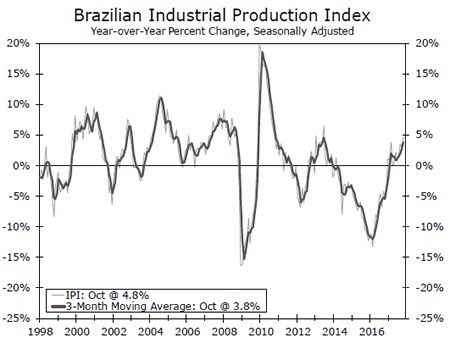
As we discussed in a recent special report, the Brazilian economy has continued to rebound, boosted by improvements in personal consumption and export growth. Third quarter data on the supply side of the Brazilian economy showed manufacturing output growing 2.4 percent on a year-earlier basis, the first positive reading for the manufacturing sector since Q1-2014. Even more encouraging, production in the factory sector in Q3 was up 1.4 percent sequentially and not annualized.
The cyclical rebound and strong global economy has benefitted Brazil, helping drive economic growth higher in the near-term. There are plenty of risks on the horizon, however, such as a presidential election cycle next year and a delicate fiscal situation. We will be watching the Q4 industrial production data for indications of just how much momentum the Brazilian economy will carry into 2018.
Previous: 5.3% (Year-over-Year)
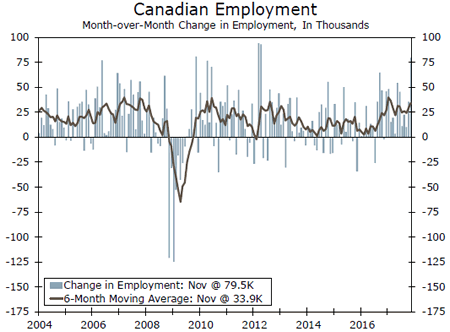
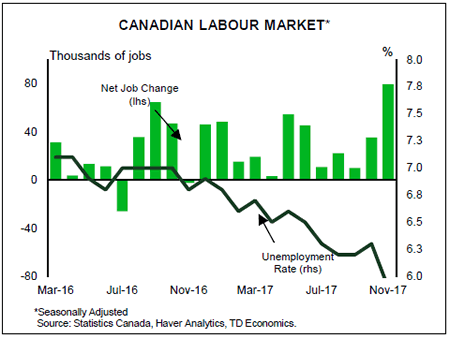
Canadian Employment • January 5
Canadian employment growth surged in November, as employers added more jobs than in any month since April 2012. Employment growth has been strong in 2017, helping support the 3 percent pace of real economic growth the Canadian economy has achieved on a year-ago basis.
Real private consumption growth in Canada was up 4 percent in Q3, the best pace of this expansion. The job gains through the first two months of Q4 suggest even more support to growth from the consumer sector. The downside, however, is that households have failed to make a meaningful dent in their debt burdens despite the robust labor market gains. The aggregate Canadian household debt-to-GDP ratio ticked higher in Q3 and is nearly 30 percentage points higher than in the United States. An accelerating economy and high household leverage continue to put the Bank of Canada in a challenging predicament.
Previous: 79.5K
Point of View
Interest Rate Watch
Tensions at the Turn
Inflation turns up. The Fed becomes more aggressive and shrinks the balance sheet. The dollar turns down. Economic growth picks up. The economic picture is turning and driving change in market interest rates.
Fundamentals are Turning for 2018
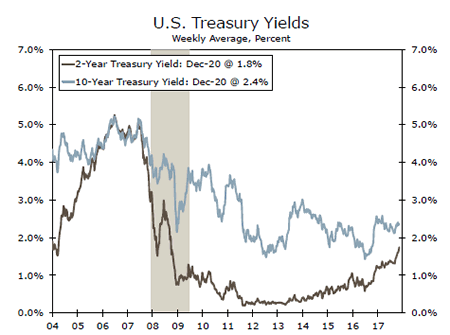
Since mid-2016, there has been a distinct upswing in benchmark Treasury rates (top graph). The first fundamental behind this turn has been the upswing in the PCE deflator to 1.7 percent from 1.2 percent in 2016. Over that same period, the employment cost index rose to 2.5 percent from 2.2 percent and the Brent front contract rose to $54.5 from $45.1 per barrel. For the year ahead, the PCE is expected to rise due to the unwinding of several one-off factors from 2017. In addition, we expect that labor costs and energy costs will continue to rise. Finally, we anticipate that stronger global growth and a weaker dollar will provide a boost to import prices as well.
As Inflation Goes, So Does the Fed
As inflation rises, and is expected to rise, so does the Fed. Two guideposts indicate upward pressure on our benchmark rate forecast. First, the dot-plot intimates that the Fed will pursue three increases in the Fed funds rate in 2018 and further increases in 2019. Investors in the two-year Treasury will have to discount these rises in the expected future funds rate. Our view is that the two-year rate will rise from 1.80 percent in the current quarter to 2.60 percent by the end of 2018.
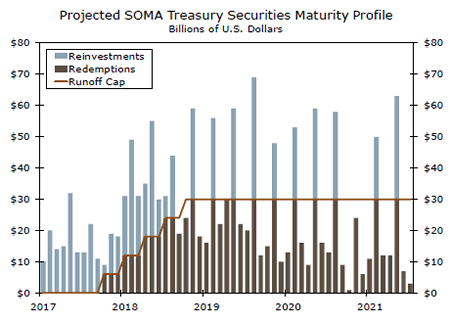
A second guidepost is the Fed's intended path to shrink its balance sheet in the years ahead (middle graph). We anticipate that the effect on the intermediate range of the Treasury yield curve (3 to 10 years) will start in mid-2018.
Dollar Weakness and Capital Flows
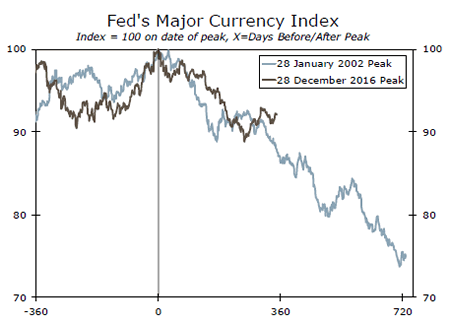
Our outlook is for the trade-weighted dollar (bottom graph) to weaken to 84.8 in Q4- 2018 from 89.3 in the current quarter. Expectations of a weaker dollar will incentivize foreign investors to seek a higher interest rate to compensate them for the exchange rate risk. There will likely also be a reduction of foreign capital flows into U.S. fixed income assets.
Credit Market Insights
Mortgage Lending Remains Low
The Federal Reserve's Flow of Funds report for Q3-2017 was recently released. On the household side, the data showed improving net worth, strong appreciation of corporate equities and a lessening burden with respect to leverage and household liabilities. Bank lending activity, the report showed, continues to struggle to recover, particularly within residential mortgages and commercial real estate.
After an epic run of apartment construction, it appears commercial real estate loan demand has peaked. As of Q3, multifamily residential lending was reported by a net -18.1 percent of banks as having increased demand, with construction loans at -10 percent. Commercial real estate lending got an early start during this recovery, and this partially contributed to single-family housing's slow recovery. This is reflected in the still low level of mortgage lending shown in the recent flow of funds data. As a percentage of total commercial bank assets, mortgages accounted for just 30.6 percent. This is slightly up from the recent all-time low, and down from the previous cycle high of 43.6 percent. Mortgages as a percent of assets seems to have bottomed out, displaying a slightly upward trend recently. With the apartment lending slowdown as multifamily construction seems to have peaked, combined with the positive momentum seen in housing demand and builder sentiment, we could see stronger mortgage lending growth on the horizon.
Topic of the Week
Tax Reform and Housing
Plenty of questions have arisen about the potential effects of tax reform on housing. Most center on the reduced limit of the mortgage interest deduction, which will fall to $750,000 from $1,000,000, and the $10,000 limitation on the deductibility of state and local taxes. These changes will fall disproportionately on high tax states, particularly those with lots of higher price homes. The standard deduction will also double for many households, so they will not receive any additional benefit from itemizing mortgage interest. Interest on home equity loans will also no longer be deductible.
Missing from this discussion is the upside of tax reform. Most tax payers will pay less in taxes and the reduction in corporate tax rates should unleash increased capital spending and stronger job growth. Our own forecast and the Federal Reserve's forecast show stronger economic growth with the tax cuts. Real GDP grows faster in 2018 and the unemployment rate falls further. Stronger growth and increased job security will encourage homeownership. Still there will be distributional effects.
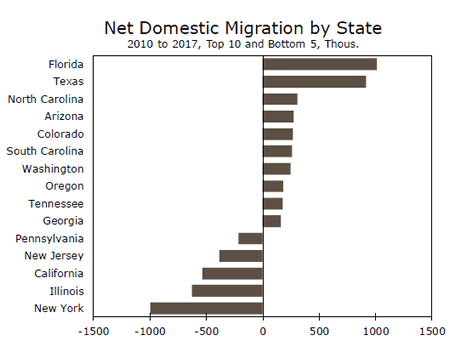
We see the changes in the tax law accelerating trends that are already in place. Residents have been leaving high cost and higher tax states for years and relocating to lower cost/lower tax states, principally in the Sunbelt. We see this trend accelerating. Within high cost states, demand will likely shift from higher priced markets, where mortgages are more likely to be above the new deductible cap, to more modest priced markets. We highlighted this trend in our recent report The Return of the Affordability Migration, published November 6.
The increase in the standard deduction may reduce some of the incentive for younger households to become homeowners. The shift of younger households to homeownership has been slow to materialize, however, as younger households continue to show a greater preference for mobility over tax breaks. If younger households delay homeownership further due to tax reform it might hurt the entry level home market somewhat but would help the apartment market.
The Weekly Bottom Line: Visions of Tax Cuts Dancing in our Heads
U.S. Highlights
- The Tax Cuts and Jobs Act was passed by Congress and signed by the President this week.
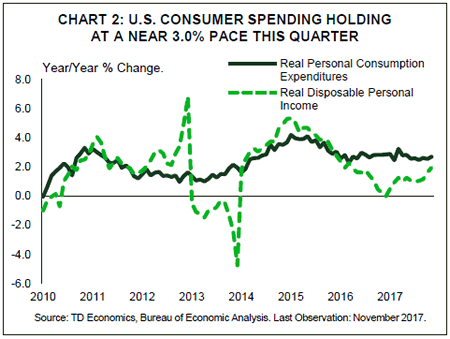
- The U.S. economy continues to show signs of strong momentum heading into 2018. Housing activity is recovering nicely from late summer hurricane-related disruptions, and consumer spending is on pace to expand at a 3.0% annualized pace this quarter.
- Looking ahead into 2018, political events in Europe are likely to continue to dominate headlines in the New Year.
Canadian Highlights
- Canadian economy bulls got some early Christmas presents, with several robust data reports lifting the loonie, supporting equities and leading to a government bond sell-off, with only one lump of coal to be found.
- Retail and wholesale trade reports were both very strong, boding well for consumption which we now project will grow by over 3% in the fourth-quarter. Still, a weak monthly GDP report, indicating that economic activity remained flat in October, suggests that GDP growth is likely to come in closer to the mid-2% mark.
- The relatively robust data, alongside a CPI report which indicated that inflationary pressures are building, has boosted the chances of a January rate hike. Still, we remain of the view that a move in March is the more likely scenario.
U.S. - Visions of Tax Cuts Dancing in our Heads
From an economist's perspective, it's difficult to be disappointed with how 2017 turned out. After a bumpy start to the year - courtesy of a phenomenon coined 'residual seasonality' - growth in the U.S. held at a 3.0% pace for the remainder of 2017, well above trend estimates at just under 2.0%. Moreover, stronger-than-expected growth became a global theme, as G7 economies broadly surprised to the upside. Since the middle of 2016, Canada, the U.S., the Euro Area, and even Japan reported growth well above trend estimates. Strong growth spurred central bank action, with the Fed raising rates thrice, but no longer alone in removing stimulus. The Bank of Canada raised rates twice in late summer, while the Bank of England followed with a rate hike in November. Not to be left out, the ECB followed through with earlier communication of reducing their pace of monthly asset purchases, halving them to €30 billion starting next month.
The hot streak for the U.S. economy looks set to continue heading into 2018. This week's indicators revealed a housing market rebounding nicely from hurricane-related setbacks, with both housing starts and existing home sales rising above consensus expectations in November. Consumer spending is also holding up, rising 0.4% in November (month-on-month, in real terms) after flat-lining in October. Moreover, with strong employment and decent income growth and a tax cut to boot, consumer spending looks set to advance about 3.0% (annualized) this quarter.
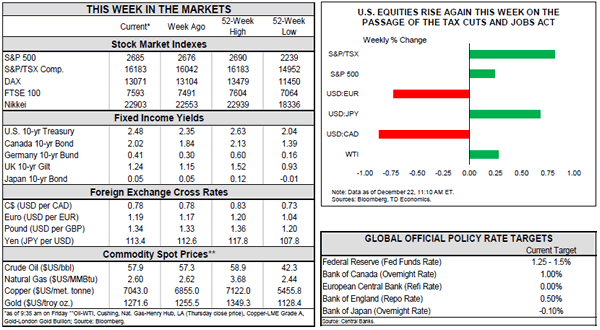
With the U.S. economy running hot, additional stimulus in the form of tax cuts seems unnecessary. But, after months of debate, Congress this week approved tax cuts that will leave American households and businesses with more money to spend for the next five to ten years. As covered in our note, we anticipate that the plan should help to stimulate economic activity in the medium-term, but at the expense of higher debt that may necessitate future cuts to entitlement spending, or higher taxes. Nevertheless, U.S. stock markets rallied in response to the news, while bonds markets sold off sending yields a touch higher on the week.
Heightened levels of economic optimism are to be expected with growth running hot globally. However, geopolitical events are stewing in the background, threatening to knock the current expansion off course. Looking ahead into 2018, concerns about North Korea's military ambitions will remain, as will tensions between the major powers in the Middle East. And, like a broken record, political events in Europe remain on the radar. Phase two of Brexit negotiations are set to begin early in the New Year, and EU officials this week stated that they will have a EU-Canada style trade agreement in their pocket in case negotiations fail to make material progress by summer. Moreover, results from this week's Catalonian election shows strong support for independence-minded parties, suggesting the potential for economic uncertainty to linger in Spain, the Euro Area's fourth largest economy.
Add elections in Italy, Sweden and Eastern Europe next year, and it's clear European politics will dominate headlines for another year. We hope that once again strong economic growth manages to trump uncertainty in 2018.
Canada - GDP Report Stands Out as the Only Lump of Coal
'Twas the week before Christmas, when all through the land no data disappointed, except for GDP. Despite the lump of coal that was the GDP report, Canadian economy bulls got some early Christmas presents, with a few robust data reports lifting the loonie near 79 U.S. cents and supporting Canadian equities. These also benefited from slightly higher oil prices and the passage of a tax bill by the United States Congress. The latter led to a sell-off in global bond markets, with long-term U.S. bond yields up 10 basis points, while the short end of the curve was 5 basis points higher. Canadian bond yields moved twice as much on account of the strong data which boosted expectations for a near-term Bank of Canada hike.
Wholesale trade data for October was the first on tap this week. It did not disappoint, rising by broad-based 1.5%, or 1.2% after price fluctuations were taken into account. Retail sales was just as impressive, rising by 1.5% and 1.4% in nominal and real terms, respectively, with all provinces seeing gains. The two reports suggest that consumers were out in full force ahead of the most important weeks for retailers, with consumption expected to increase by 3.1% in the fourth quarter.
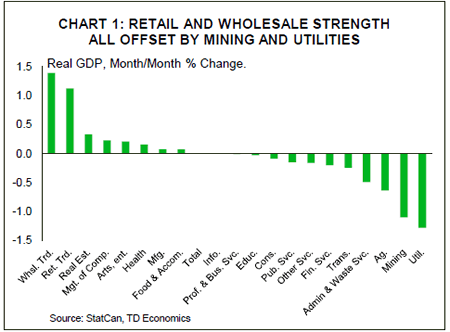
Despite the strong showing for the consumer in Q4, overall economic growth appears less robust. October GDP figures came in decidedly worse than expected, with activity largely unchanged. Gains in retail and wholesale led the way (see Chart 1), with activity increasing more modestly in several other service sectors, such as: real estate, health, and leisure & hospitality. But, these gains were largely offset by losses in mining and utilities while the flat performance in manufacturing and construction did not help. Much of the weakness in October was related to one-off factors, such as maintenance-related shutdowns amongst oil producers and automakers and a warm start to the heating season. As such, a bounce back is likely in November, with GDP likely to increase by around 2.5% in the fourth quarter - well above potential.
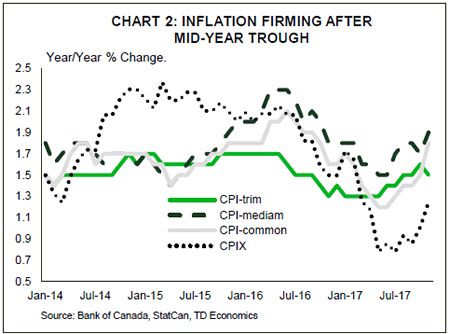
Above potential economic growth should continue to support inflation. Indeed, November consumer prices rose by a strong 0.5% on the month, lifting inflation to 2.1% from 1.4% in October. While much of this was related to a rebound in energy prices, all major categories except for health & personal care products saw increased inflationary pressures. In fact, core inflation firmed across two of the three measures closely watched by the Bank of Canada. The trim and median measures accelerated by 20 to 30 basis points to 1.8% and 1.9%, respectively, with the only blemish in the report being the common measure - which ticked down to 1.5% from 1.6% in the previous month (see Chart 2).
All in all, data released this week was largely positive and should, on the margin, augur for a sooner rate hike from an increasingly data-dependent central bank. It paints a picture of an economy that's outperforming its potential growth rate, helping reduce whatever slack remains. But, while the chances of a rate hike in January have certainly increased, we remain of the view that a move in March is the more likely scenario.
U.S.: Upcoming Key Economic Releases
U.S. Employment - December
Release Date: January 5, 2018
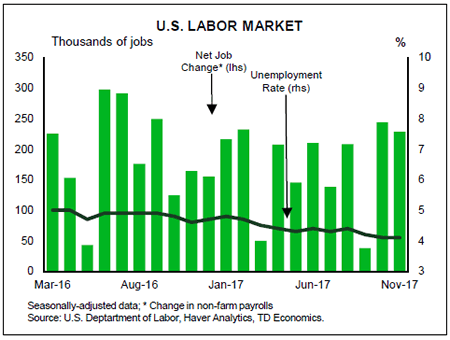
Previous Result: 228k, unemployment rate: 4.1%
TD Forecast: 170k, unemployment rate: 4.1%
Consensus: 185k, unemployment rate: 4.0%
We expect nonfarm payrolls to moderate to a 170k in December after two consecutive gains north of 200k. Moreover, payrolls are likely to give back some of its previous strength and slow to its current trend, at this stage of the cycle. The current trend in payrolls is running near 175k.
We expect the unemployment rate to remain at 4.1% for the third month with risks skewed to the downside amid robust employment growth. We expect to see a stronger 0.3% m/m print on average hourly earnings, which disappointed in the prior two months. Calendar effects are also in our favor this month, such that a sharper gain cannot be excluded. Still, the y/y pace will be held down by base effects, and our forecast suggests an unchanged 2.5% rate.
Canada: Upcoming Key Economic Releases
Canadian Employment - December
Release Date: January 5, 2018
Previous Result: 79.5k, unemployment rate: 5.9%
TD Forecast: -10k, unemployment rate: 6.0%
Consensus: N/A
The labour market is set to end 2017 on a weak note with the loss of 10k jobs, though this can hardly be viewed as overly negative after the hiring surge in November. Job losses should be felt in both goods and services as retail and manufacturing give back some of the +30k jobs each industry added in November. However, given the mature phase of the labour market it is likely that headline job growth is overlooked in favour of measures of labour market slack. Here we expect a further improvement in wage growth for permanent employees, with 2.8% y/y likely, though the unemployment rate will likely rebound to 6.0%.
Week Ahead – Japanese Indicators to Dominate Quiet Holiday Week; US Consumer Confidence also in Focus
The next seven days look set to be extremely quiet due to the shortened Christmas holiday week, with many markets closed on Monday and Tuesday. Japan and the United States will be the only major countries releasing data, though Australian private lending figures on Friday could also attract some attention. Volumes are expected to be thin as many traders will stay away from their desks and the year draws to a close. However, low volumes have a tendency to trigger erratic moves, while year-end flows could also drive forex markets.
Bank of Japan back in spotlight
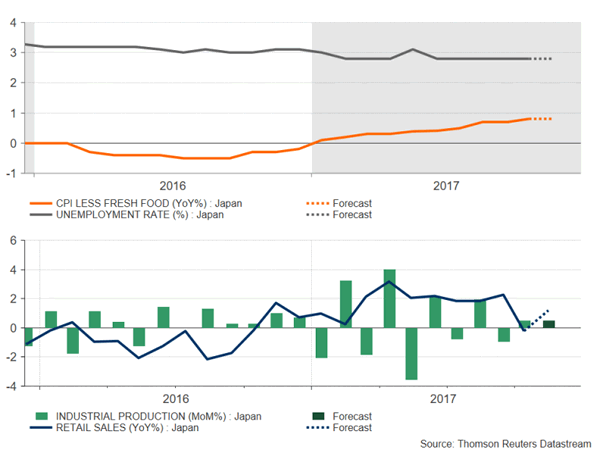
The week will get off to a slow start with no major data expected on Monday, Christmas Day. But household spending, inflation and unemployment figures out of Japan should keep traders busy on Tuesday. Japan's core CPI rate rose to a 2½-year high of 0.8% year-on-year in October and is forecast to stay unchanged in November. The unemployment rate is also expected to remain steady, at 2.8% for the same month.
More data will follow on Thursday with the release of industrial output and retail sales numbers. Industrial production is forecast to expand 0.5% month-on-month in November's preliminary reading, unchanged from October's rate. Japanese industrial output has gained and maintained momentum in 2017 on the back of a weaker yen and rising global demand. Domestic consumption has been lagging however, and annual growth in retail sales turned negative in October. A rebound to 1.2% is anticipated in November.
The Bank of Japan upgraded its assessment on industrial output and capital spending at its policy meeting this week but maintained its view on private consumption, saying it is "picking up moderately". Investors will get the chance to hear more from the Bank of Japan next week when it publishes its minutes of the October policy meeting (Tuesday) and the summary of opinions of the December meeting (Thursday). The summary of opinions will be the more interesting one, although few surprises are expected, especially after BoJ Governor Haruhiko Kuroda dismissed speculation of an early exit from its stimulus program in his press conference this week.
The yen is unlikely to see a significant reaction to the data but could be susceptible to year-end flows.
Housing and consumer confidence data to highlight US calendar
US economic indicators will not be sparse next week but will struggle to provide much direction to the lacklustre dollar, which failed to see a notable response even to the passing of the highly-anticipated tax reform bill. Traders will have to contend with housing and survey data to place their bets, starting with the S&P CoreLogic Case-Shiller 20-city home price index on Tuesday. Also on Tuesday is the Conference Board's consumer confidence gauge. The index is forecast to ease to 128.4 in December from November's 17-year high of 129.5. Other data will include the advanced goods trade balance and wholesale inventories for November, as well as the Chicago PMI for December, all due on Thursday.
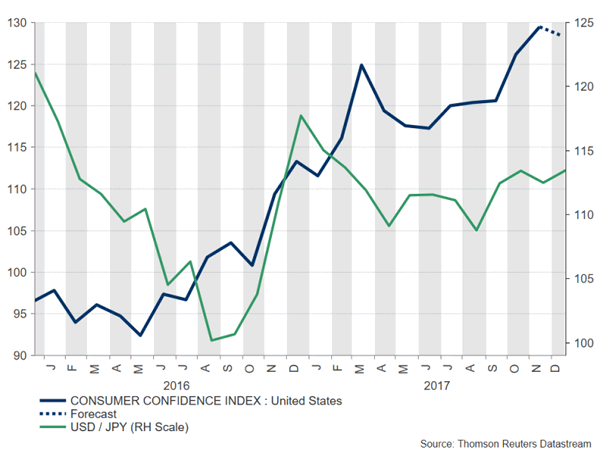
With the tax cuts and the FOMC meeting out of the way, the dollar may extend its consolidation in the coming weeks. Investors' main watch will be signs of faster wage and price growth as potential factors that could lead the Fed to project a more aggressive rate hike path for 2018.
Japanese Inflation Among Releases Having the Capacity to Spur Yen Positioning
Japan will see the release of November inflation figures on Monday at 2330 GMT. Core inflation, the measure targeted by the Bank of Japan, is expected to remain steady at 0.8% on an annual basis, well below the central bank's target of 2.0%.
Despite core CPI undershooting the BoJ's target and being one of the reasons the bank decided in its latest meeting to maintain its ultra-loose monetary policy, a positive figure would reflect the 11th consecutive rise for the measure, with the overall trend throughout this period being a positive one as well. Still, inflationary pressures remain subdued despite economic activity gaining some positive momentum – in the third quarter of the year the Japanese economy recorded positive growth for the seventh straight quarter, this being the longest such stretch since the period between Q2 1999 and Q1 2001 during which the economy expanded for eight straight quarters.
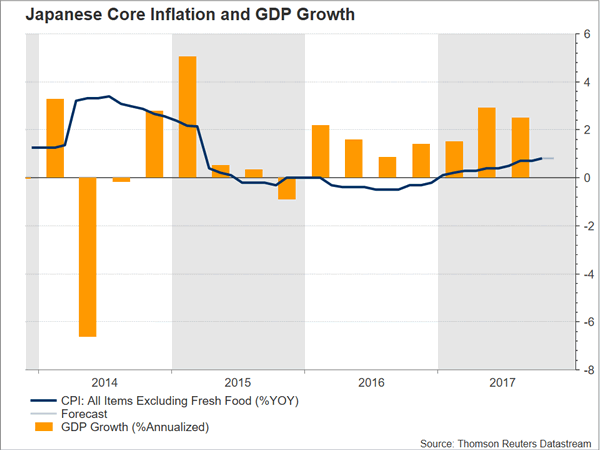
According to analysts, core CPI, which includes oil products but excludes more volatile fresh food prices, is expected to have faced downward pressure from easing utility costs and upward pressure from rising oil product prices, such as gasoline, during November.
December Core CPI in Tokyo is anticipated to grow by 0.7% y/y. November's respective figure was at 0.6%.
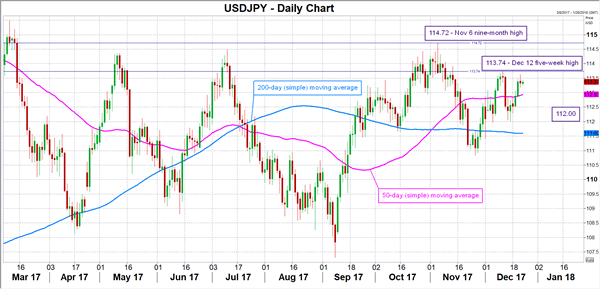
An upside surprise in inflation figures is expected to lend support to the Japanese currency, pushing dollar/yen lower. In such an event, the pair could find support around the current level of the 50-day moving average at 112.93, with steeper declines shifting the focus to the range around the 112.00 mark which was fairly congested recently.
Should CPI numbers disappoint though, dollar/yen is anticipated to advance as forex market participants will likely push further back in time any expectations for monetary policy normalization by the BoJ. In this case, dollar/yen might find resistance around December 12's more than five-week high of 113.74. Stronger bullish movement would eye the nine-month high of 114.72 that was recorded on November 6 as an additional barrier to the upside. The area around this level encapsulates other tops from the recent past, something which perhaps increases its significance.
Numbers on household spending, the jobs-to-applicants ratio and the unemployment rate all for the month of November will be released at the same time as inflation figures. These also have the capacity to spur positioning on the Japanese currency. Household spending is projected to have grown by 0.5% y/y after October's zero growth. The unemployment rate is anticipated to remain at the 23-year low of 2.8% and the jobs-to-applicants ratio is forecast to come at 1.56, its highest since January 1974.
Other Japanese data out next week include November's industrial output and retail sales figures. Both are due on Wednesday at 2350 GMT. The BoJ will also be publishing its minutes of the October 30-31 policy meeting on Monday (2350 GMT) and the summary of opinions of the December meeting on Wednesday (2350 GMT).
Weekly Focus: New Year – Same Low Inflation Pressure
Market Movers ahead
- In the US, we expect the labour market report for December to be strong, due partly to some catch-up effects from previous months.
- In the minutes from the December FOMC meeting, we will look for clues as to whether other members other than Charles Evans and Neel Kashkari came close to dissenting.
- We expect euro-area headline inflation to decline in December on weaker energy price inflation, while core inflation is expected to increase only slightly. We expect headline inflation to remain in the range of 1.1-1.4% throughout 2018, as long as underlying inflation pressure remains muted.
- In Scandinavia, the housing market remains in focus, particularly in Sweden where property prices are now falling. In Norway, households have remained resilient to uncertainty on the housing market and we expect retail sales to rebound somewhat.
Global macro and market themes
- With the US tax reform, they have adopted an expansionary fiscal policy for next year at a time when the economy is operating close to full employment.
- The US is using up limited fiscal ammunition in good times instead of saving it until the economic cycle turns.
- Relatively strong US economic growth and a further boost from the tax reform underscores our overweight US equities and creates upside risk for our forecast for US 10-year rates.
JPY to Continue Dancing to the BoJ’s Beat in 2018
The yen underperformed most of its major peers in 2017 despite the improving economic backdrop in Japan, as the Bank of Japan's ultra-loose policy framework continued to undermine the currency. Will the yen enjoy better times ahead? That is likely to depend on whether the Bank will scale back some of its stimulus, which in turn, will depend on the evolution of inflationary pressures in Japan. If the BoJ keeps its framework untouched while the Fed continues to raise rates, the policy divergence would argue in favor of a higher dollar/yen over time. Any hints to the contrary, however, could come as a major surprise to the market and thereby, lead to a material drop in the cross.
The Japanese economy enjoyed a remarkable year in 2017, though the same cannot be said for the JPY, with the currency set to finish the year lower or practically unchanged against all its major counterparts, besides the US dollar.
Japanese economic data have not looked this good in a long time. The nation's jobless rate fell to 2.8%, a low last seen in 1994, economic growth is faster compared to recent years, and business sentiment as measured by the Tankan survey is elevated. Meanwhile, even though the core inflation rate remains notably below the Bank of Japan's (BoJ) 2% target, it has still risen markedly throughout the year.
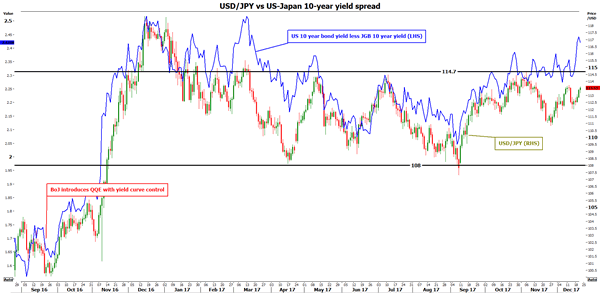
If things are improving, then why has the yen remained largely unfazed? A large part of that has to do with the BoJ. Under its current framework of QQE with yield curve control, the Bank has committed to keeping yields on longer-dated Japanese Government Bonds (JGBs) fixed near 0%. By stepping into the market and pushing down Japanese yields in an environment where global yields are moving higher, this framework keeps the JPY artificially weak, as the currency cannot draw support from relative interest rates.
So, what is on the cards for 2018, and will the yen enjoy better times ahead? The short answer is: only if inflation accelerates. Inflation, or the lack thereof, is key to understanding Japan and its policymakers. Following decades of very low or negative inflation, the deflationary mindset has almost become engraved in Japanese society, evident by extremely low inflation expectations feeding into subdued wage growth, thereby creating a negative feedback loop that keeps inflation muted. For the yen to recover its lost glamour, the BoJ may need to allow Japanese yields to move higher, but that will only happen once, and if, inflation approaches 2%.
Therefore, the real question is whether inflation will move higher anytime soon. According to the BoJ's latest forecasts, the 2% target will only be achieved by 2019. However, these forecasts could be revised higher in the foreseeable future, with a little help from Prime Minister Abe and the government. Japan's ruling coalition recently approved a plan to cut the corporate tax rate to 20% from 30% for three years, but crucially only for companies that raise wages on their employees by at least 3%, and boost capital spending. That said, given that the plan is set to be approved by Parliament in April 2018, any positive effects on inflation from such measures may only show up towards the end of 2018. Thus, although this could be a game-changer for 2019, it is doubtful whether it will impact BoJ policy in 2018.
Besides monetary policy, the other decisive factor for the JPY's path may be changes to global risk sentiment given the currency's status as a safe-haven asset. It is important to note, however, that haven flows into the JPY usually tend to be noise in the bigger picture, not trend-generators. Of course, a major risk-off event (such as escalation of tensions in the Korean Peninsula) would be the exception to this norm, and could well bring the yen under buying interest for a prolonged period of time.
All in all, with inflation likely to remain low for a while, there seems to be little need for the BoJ to alter its policy framework, and Japanese 10-year yields look set to remain near 0% in 2018. Meanwhile, the Fed could even deliver more rate hikes in 2018 than the market currently anticipates (may deliver three quarter-point hikes, markets have priced in two). The BoJ-Fed divergence and the resulting widening spread between Japanese and US yields would argue in favor of a higher dollar/yen over time. Dollar/yen could edge up and finish the year close to the 118.60 area, assuming the bulls are strong enough to overcome the 114.70 resistance zone, which is the upper bound of a sideways range that has contained the price action since January 2017. On the contrary, in case the BoJ does scale back some of its stimulus and/or risk sentiment shifts in favor of the yen, the cross could drift lower and aim for the lower bound of that range, at 108.00.
Silver Consolidates Near the Bottom of Descending Triangle
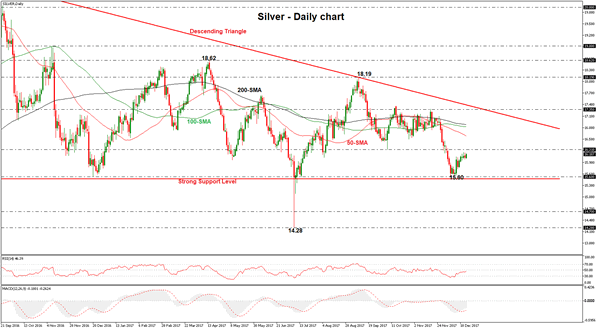
Silver has not had a clear tendency since June 2016 as the price has been trading in a broad descending triangle with the downtrend line starting from the $21.10 resistance level and forming a significant support barrier near $15.60. In the short term, prices have moved to the lower level of the triangle, though they have firmed up this week.
The price has made a recovery to the upside, following the bounce from the $15.60 barrier. But, XAGUSD is still developing beneath the $16.31 resistance level and if the price successfully surpasses it, it could open the door for the 50-simple moving average (SMA) at $16.65, in the daily timeframe.
An alternative scenario is a penetration of the critical level at $15.60, which could drive the price towards the $14.70 and $14.30 obstacles which stand since March 2016.
Technical indicators are pointing to more consolidation in the short to medium-term, as the RSI is flat and is near the 50 level, while the 50,100 and 200-day SMAs are moving sideways with a slight slope to the downside. On the other hand, the MACD oscillator is rising above its trigger line but remains in the bearish territory.
Canadian GDP Fell Short of Expectations With Flat October Reading
Highlights:
- Canadian GDP was unchanged in October following a 0.2% increase in September.
- Output of goods producing industries fell 0.4% while services growth returned to a trend-like 0.2% pace. Both were short of our expectations.
- A decline in non-conventional oil extraction due to maintenance shutdowns shaved about 0.1 percentage point from October's GDP growth.
- Today's report indicates some downside risk to our forecast for 2.0% annualized growth in Q4. Something along the lines of Q3's 1.7% increase looks more likely.
Our Take:
Yesterday's upside surprises on retail sales and inflation were countered by this morning's monthly GDP numbers showing a slow start to Q4. As was the case in the summer when the economy appeared to hit a soft patch, temporary shutdowns in one industry were responsible for some of October's weakness. Nonetheless, GDP growth has clearly shifted to a slower trend after 4% gains earlier this year. Today's release points to Q4 growth coming in closer to Q3's 1.7% increase than the Bank of Canada's 2.5% forecast. That would still be at or slightly above the economy's longer run speed limit, so while the second half of 2017 won't be nearly as impressive as the first half, trend-like growth should keep the economy running near full capacity. With inflation starting to respond to these tight conditions, we don't think it will be long before the Bank of Canada acts on their tightening bias. However, today's data lessens the odds of a move as soon as January. We continue to expect uncertainties surrounding Nafta and new mortgage regulations will have the bank holding off until April. Our forecast assumes three rate hikes next year will shift monetary policy to a less stimulative stance by the end of 2018.
Canada: Surprising Softness in Economic Growth in October
Canadian economic output was effectively unchanged in October, as weakness in the mining, quarrying, oil and gas sector was enough to offset healthy gains elsewhere. 12 of the 20 major industries saw output rise.
The goods-producing side of the economy disappointed. Mining, quarrying and oil and gas extraction fell 1.1%, led lower by declines in non-conventional oil extraction (-3.5%). This partially reflected a loss of capacity due to maintenance operations. Mining excluding oil and gas also fell (-0.8%) on weakness in potash mining. Elsewhere, utilities output declined 1.3%, while construction and manufacturing were both effectively flat on the month.
In contrast, the services side of the economy kept humming along, notching up a 19th straight monthly expansion (+0.2%). Robust gains in wholesale trade (+1.4%) and retail trade (+1.1%) led the way, with the other major sectors turning in mixed performances.
Key Implications
That was disappointing. With nearly all monthly indicators looking healthy, the oil sector threw a wrench in what was otherwise looking like a solid month. While there remains cause for optimism as several one-off factors reverse, there does appear to be less momentum heading into the fourth quarter than both we, and the Bank of Canada were expecting.
As it stands today, fourth quarter growth now looks likely to come in below the Bank of Canada's expectations of 2.5% (annualized).
Given the data-dependency of the Bank of Canada, this means that a hike in January is less likely. That the weakness in October can be put down to specific factors, and that consumer spending remains strong should provide some solace to Governor Poloz. Nevertheless, he may want to see confirmation that October was just a blip before making his next move.