

Sample Category Title
Pound Yawns as Construction PMI Beats Expectations
The British pound has ticked higher in the Monday session. In North American trade, GBP/USD is trading at 1.3455. On the release front, British Construction PMI in November looked sharp, accelerating to 53.1 points, above the forecast of 51.2 points. This marked the highest level since June. In the US, Factory Orders declined 0.1%, the first decline since July. Still, this beat the forecast of -0.3%. On Tuesday, the UK releases Services PMI, which is forecast to dip to 55.2 points. The US publishes ISM Non-Manufacturing PMI, with the markets expecting the indicator to slow to 59.2 points.
After sweetening the British offer over its Brexit bill last week, Prime Minister Theresa May is anxious to change the focus of the Brexit negotiations and talk trade with Europe. Prime Minister May and European Commission President Jean-Claude Juckner met earlier on Monday in Brussels, hoping to move closer to wrapping up the first phase of the talks. May has moved closer to the European's demands on a divorce bill of around EUR 50 billion, but two items have yet to be resolved. One is the border between the UK (Northern Ireland) and Ireland, which is a member of the EU. The UK will clearly not remain in a customs union with the EU, but Ireland is insistent that there not be a hard border. The second issue is whether the European Court of Justice will have a role protecting European citizens in the UK. The EU is in favor of a role for the court, while many British lawmakers feel that such a move would impinge on British sovereignty.
President Trump has asked lawmakers in Washington for a tax reform bill for Christmas, and Congress, at least on the Republican aisle, appears to be in a giving mood. After a false start and some anxious hours on Friday, the US Senate passed a tax reform bill on the weekend. The vote was a squeaker, with 51 Republicans voting yes, against 48 Democrats and 1 Republican. The Senate vote is a big win for President Trump, as tax reform would mark his first major legislative bill in office, after a stinging defeat in trying to pass a new health care bill. The Senate and House must now reconcile their two tax bills, and the new uniform bill will then have be passed in both houses. Investors are pleased with the legislation, and the dollar and the stock markets could continue to gain as a result of positive market sentiment.
Gold Slips as Factory Orders Beats Estimate
Gold has started the week with losses, erasing the gains seen in the Friday session. In the Monday North American session, the spot price for an ounce of gold is $ 1274.23, down 0.50% on the day. In the US, Factory Orders declined 0.1%, the first decline since July. Still, this beat the forecast of -0.3%. On Tuesday, the US publishes ISM Non-Manufacturing PMI, with the markets expecting the indicator to slow to 59.2 points.
President Trump has been pressing for a major legislative win before the end of the year, and it looks like he'll get tax reform all wrapped up in time for Christmas. The Republicans have pushed through tax legislation through the House and the Senate at breakneck speed. After a false start on Friday, the US Senate passed a tax reform bill on the weekend. The 51-49 vote was a squeaker, with 51 Republicans voting yes, against 48 Democrats and 1 Republican. Republican lawmakers hope to have Trump sign a bill before the end of the year. The Senate and House must now reconcile their two bills, and the new uniform bill will then have be passed in both houses. Investors are pleased with the bill, and the US dollar has responded to the vote with broad gains.
Gold could be marked by volatility in the upcoming weeks. Gold prices are inversely linked to interest rate hikes, and with the markets widely expecting rate hikes in December and January, traders should be prepared for some movement from gold. As well, there are major changes taking place at the Federal Reserve, as Jerome Powell is set to replace Janet Yellen as Fed chair in February. Powell didn't make any waves at his confirmation hearing last wee, although his comments on relaxing regulations for smaller banks did send global stock markets higher. Powell inherits a strong US economy, and this could mean several rate hikes in 2018, if the economy maintains its current pace. Still, inflation remains stubbornly low, and with Fed policymakers divided on whether to keep the 2 percent inflation target, the markets will be keeping close tabs on how Powell deals with inflation when he takes over the helm of the Fed.
Yen Steady, Japanese Inflation Report Ahead
The Japanese yen has inched lower in the Monday session. In North American trade, USD/JPY is trading at 112.74. On the release front, Japanese Consumer Confidence increased to 44.9, edging above the estimate of 44.8 points. Although the Japanese consumer remains pessimistic, this marked the strongest reading since September 2013. In the US, Factory Orders declined 0.1%, the first decline since July. Still, this beat the forecast of -0.3%. On Tuesday, the BoJ releases Core CPI, which is expected to remain unchanged at 0.5%. The US publishes ISM Non-Manufacturing PMI, with the markets expecting the indicator to slow to 59.2 points.
President Trump has been pressing for a major legislative win before the end of the year, and it looks like he'll get tax reform all wrapped up in time for Christmas. The Republicans have pushed through tax legislation through the House and the Senate at breakneck speed. After a false start on Friday, the US Senate passed a tax reform bill on the weekend. The 51-49 vote was a squeaker, with 51 Republicans voting yes, against 48 Democrats and 1 Republican. Republican lawmakers hope to have Trump sign a bill before the end of the year. The Senate and House must now reconcile their two bills, and the new uniform bill will then have be passed in both houses. Investors are pleased with the bill, and the US dollar has responded to the vote with broad gains.
Bank of Japan Governor Haruhiko Kuroda spoke at the Europlace financial forum in Tokyo on Monday, but there was nothing new in his message about where the BoJ is headed. Kuroda reiterated that the Bank would maintain its ultra-accommodative monetary policy in order "to achieve the 2 percent inflation target as soon as possible". The BoJ has been forced to constantly lower its inflation projections, yet the Bank has stubbornly stuck to the 2 percent target. Although the labor market remains tight, this has not translated into higher wages for workers, and nervous consumers have held tight to their purse strings, further contributing to a lack of inflation. Kuroda noted that global economic growth had improved, although he sounded a note of concern about President's Trump isolationist policy, saying that he hoped that global trade would be conducted under the multilateral trading system.
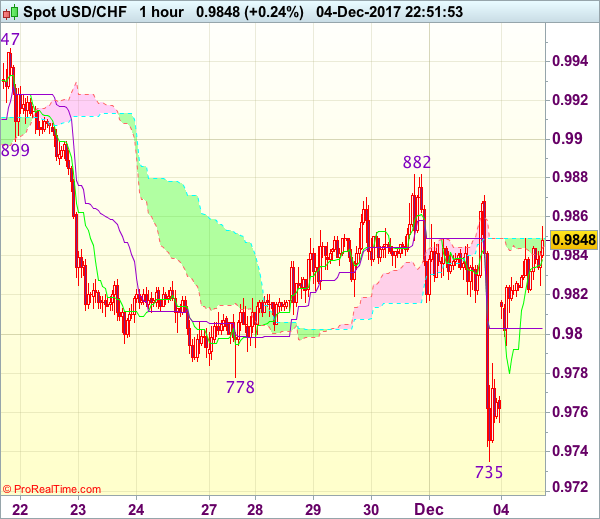
Trade Idea Wrap-up: USD/CHF – Buy at 0.9785
USD/CHF - 0.9845
Most recent candlesticks pattern : N/A
Trend : Near term down
Tenkan-Sen level : 0.9838
Kijun-Sen level : 0.9803
Ichimoku cloud top : 0.9849
Ichimoku cloud bottom : 0.9846
Original strategy :
Buy at 0.9785, Target: 0.9885, Stop: 0.9750
Position : -
Target : -
Stop : -
New strategy :
Buy at 0.9785, Target: 0.9885, Stop: 0.9750
Position : -
Target : -
Stop : -
Although the greenback dropped sharply to as low as 0.9735 on Friday, the subsequent reversal on dollar’s broad-based strength suggests low is formed there and consolidation with upside bias is seen for gain to last week’s high at 0.9882, however, a sustained breach above this level is needed to confirm this view and bring at least a retracement of recent decline to 0.9900 and later towards resistance at 0.9947.
In view of this, we are looking to buy dollar on dips as 0.9775-85 should limit downside and bring another rebound. Below 0.9750 would risk a retest of said last week’s low at 0.9735 but only break there would signal the decline from 1.1038 top has resumed for weakness to 0.9705 support.
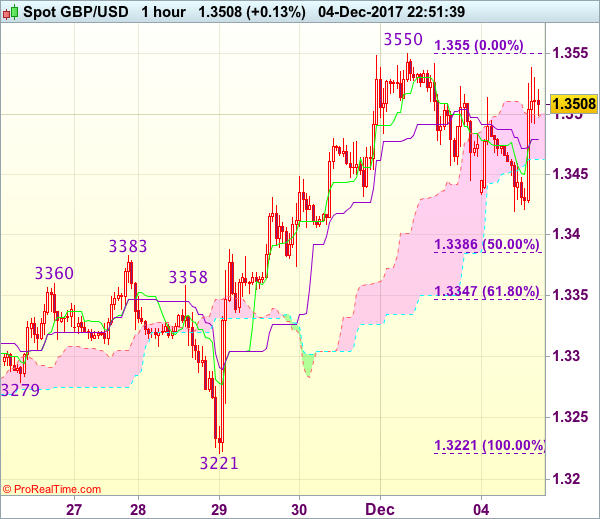
Trade Idea Wrap-up: GBP/USD – Hold short entered at 1.3500
GBP/USD - 1.3519
Most recent candlesticks pattern : N/A
Trend : Near term up
Tenkan-Sen level : 1.3479
Kijun-Sen level : 1.3479
Ichimoku cloud top : 1.3501
Ichimoku cloud bottom : 1.3462
Original strategy :
Sold at 1.3500, Target: 1.3400, Stop: 1.3535
Position : - Short at 1.3500
Target : - 1.3400
Stop : - 1.3535
New strategy :
Hold short entered at 1.3500, Target: 1.3400, Stop: 1.3535
Position : - Short at 1.3500
Target : - 1.3400
Stop : - 1.3535
Although cable has rebounded after finding support at 1.3419 and further consolidation would be seen, reckon upside would be limited to 1.3530-35 and bring retreat later, below said support at 1.3419 would bring retracement of recent rise for weakness to 1.3400, however, reckon downside would be limited to 1.3380-85 (50% Fibonacci retracement of 1.3221-1.3550) and bring rebound to 1.3500 but upside should be limited to 1.3515-25, bring another corrective decline later.
In view of this, we are holding on to our short position entered at 1.3500. Above 1.3535-40 would signal the retreat from 1.3550 has ended, bring retest of this level, then 1.3575-80 but reckon 1.3600-10 would hold. Below 1.3345-50 (61.8% Fibonacci retracement of 1.3221-1.3550) would abort and signal top has been formed at 1.3550, bring further fall towards 1.3300-10.
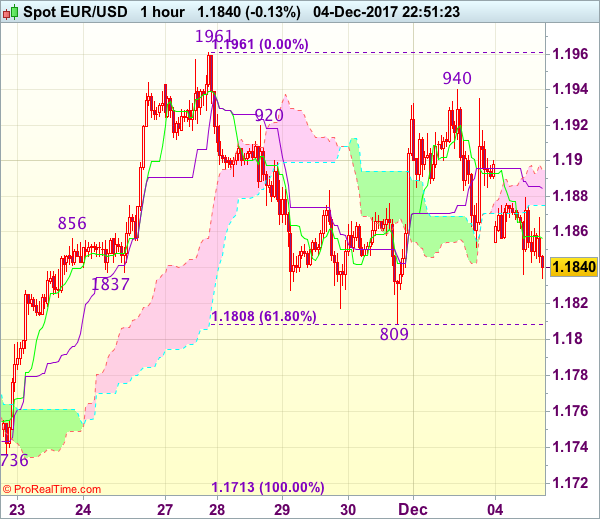
Trade Idea Wrap-up: EUR/USD – Sell at 1.1915
EUR/USD - 1.1843
Most recent candlesticks pattern : N/A
Trend : Near term up
Tenkan-Sen level : 1.1857
Kijun-Sen level : 1.1885
Ichimoku cloud top : 1.1895
Ichimoku cloud bottom : 1.1875
Original strategy :
Sell at 1.1915, Target: 1.1815, Stop: 1.1950
Position : -
Target : -
Stop : -
New strategy :
Sell at 1.1915, Target: 1.1815, Stop: 1.1950
Position : -
Target : -
Stop : -
As the single currency ran into resistance at 1.1940 on Friday and has retreated, suggesting further consolidation below resistance at 1.1961 (last week’s high) would be seen and weakness towards support at 1.1808-09 (61.8% Fibonacci retracement of 1.1713-1.1961 and previous support), however, break there is needed to retain bearishness and extend weakness to 1.1770 and possibly to support at 1.1736 but price should stay above previous key support at 1.1713.
In view of this, we are looking to sell euro on recovery as 1.1910-20 should limit upside and bring another decline. Above said Friday’s high at 1.1940 would revive bullishness, bring retest of 1.1961, break there would confirm early upmove has resumed for headway to 1.1990-00 which is likely to hold from here.
Dollar Succeeds Modest Gains, But No USD-Euphoria Yet
- European equities gain up to 2% today (German Dax), reversing Friday's losses with risk sentiment improving after the US Senate tax reform vote. US stock markets open around 0.75% higher, reaching yet another record high.
- Britain is heading for a breakthrough on Brexit talks after reaching a compromise with Ireland on the border between the Republic and Northern Ireland, the issue that threatened to derail the negotiations.
- A deal to complete post-financial crisis capital rules for banks around the globe may be reached on Thursday. French central bank governor Villeroy indicating he is ready to accept a compromise. France has been a key hold-out for completing the Basel III rules.
- The Bank of Japan does not plan to change its massive stimulus programme and will "immediately act" if risks to the economy undermines the momentum toward achieving its inflation target, central bank Governor Kuroda said.
- The leaders of Germany's Social Democrats (SPD) agreed to enter talks with Chancellor Merkel's conservatives on forming a government that could end a political deadlock. The SPD set the contours of its demands in coalition talks expected to start next year with proposals on issues like the economy and immigration likely to cause friction.
- Help-to-buy is helping the housebuilders at least: an increase in house building work meant activity increased much faster than expected in Britain's challenged construction industry during November. The construction PMI increased from 50.8 to 53.1 in November, compared with a 51 forecast.
- Czech wage growth slowed in the third quarter but still ran at its second fastest pace since 2009 to remain the main demand driver in the overheating economy. The average gross monthly wage grew by 4.2% from a year ago in real terms in Q3, as rising inflation bit, the Czech Statistical Bureau said. Nominal wages jumped by 6.8%.
Rates
Slight optimism after US Senate tax reform vote
Global core bonds lost part (Bund) to all (US Note future) of Friday's gains. The move was limited to a one-off repositioning in the Asian or European opening with the positive US Senate tax bill vote the main incentive. It's now up to House and Senate lawmakers to find common ground for a bill, preferable before year-end. More worrying headlines on the US political scene about Mueller's investigation into Russia-links in Trump's presidential campaign team perhaps hampered a more enthusiastic reaction. Core bond trading was rather lethargic after the opening move and confined to a tight sideways range. Investors probably have Friday's payrolls and next week's FOMC meeting in mind. The European eco calendar contained only second tier and slightly disappointing data (PPI, Sentix investor confidence).
At the time of writing, the German yield curve bull flattens with yields up to 4.7 bps (30-yr) lower. Changes on the US yield curve vary between +2.9 bps (30-yr) and +4.2 bps (5-yr). On intra-EMU bond markets, 10-yr yield spreads versus German range between +1 bp and -1 bp with Spain (-3 bps) and Greece (-7 bps) outperforming.
Currencies
Dollar succeeds modest gains, but no USD-euphoria yet
Markets reacted differently to the approval of the US tax bill in the US Senate. US and European equities jumped higher. ST US yields also rose a few basis points. The dollar extended cautious gains. USD/JPY trades in the 113 area. However, the gain of the dollar against the euro is far from impressive with EUR/USD trading at 1.1840.
Asian equity markets traded mixed this after the approval of the Tax bill in the US Senate. US yields were modestly higher and so was the dollar. USD/JPY profited most and rebounded to the high 112 area. Japanese equities underperformed despite the rise of USD/JPY. EUR/USD traded in the 1.1865 area, within the range that reigned for most of last week. Ongoing noise on the Russia investigation probably prevented a bigger USD gain on the Senate vote.
There were few important eco data in Europe. European equities reacted more positive than Japanese equities. Of course European markets had still some catching up to do after Friday's fall. ST interest rate differentials between the US and Germany widened further (2-y at 2.5% +). Changes at the long end of the curve were modest. However, during the European morning session, the dollar hardly profited from the rising interest rate support or the positive risk sentiment. USD/JPY finally tried a new upside test early in US dealings and is testing the 113 big figure. EUR/USD trades currently in the 1.1840 area. So, the dollar is gaining slightly further ground, but there is no euphoria after the approval of the Senate tax bill. Especially the gains of the dollar against the euro remain mediocre and EUR/USD holds it the established sideways consolidation pattern.
Sterling profits on Bxexit breakthrough
The focus for sterling trading was on the next steps in the Brexit process as UK PM May met with EU Commission president Juncker. This morning, it was still unclear whether the meetings in Brussels would yield enough progress that the EU deems needed to move to the next stage of the negotiations. EUR/GBP initially hovered in the 0.8825 area. However, around noon there were press headlines from several sources that EU's Barnier had indicated that negotiations on the separation issues were headed for a breakthrough. Sterling jumped higher across the board as the Brexit negotiations are likely to move to the content of the new relationship between the UK and the EU post Brexit. EUR/GBP trades currently in the 0.8765 area and nears the 0.8746/33 support area. The rally of cable ran into resistance in the 1.3540 area as the dollar was also better bid across the board.
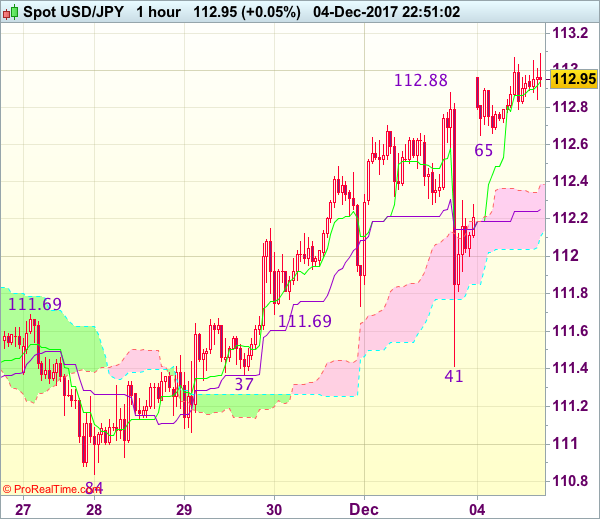
Trade Idea Wrap-up: USD/JPY – Buy at 112.30
USD/JPY - 112.96
Most recent candlesticks pattern : N/A
Trend : Near term up
Tenkan-Sen level : 112.94
Kijun-Sen level : 112.25
Ichimoku cloud top : 112.38
Ichimoku cloud bottom : 112.11
Original strategy :
Buy at 112.30, Target: 113.30, Stop: 111.95
Position : -
Target : -
Stop : -
New strategy :
Buy at 112.30, Target: 113.30, Stop: 111.95
Position : -
Target : -
Stop : -
Although the greenback retreated sharply on Friday to as low as 111.41, renewed buying interest emerged and the pair has rallied from there on dollar’s broad-based strength, reviving our bullishness for the rise from 110.84 low to extend gain to previous support at 113.09, however, near term overbought condition should limit upside to resistance at 113.33 and reckon 113.60-70 would hold on first testing.
In view of this, we are still looking to buy dollar on pullback as the Kijun-Sen (now at 112.24) should limit downside. Below 111.80 would defer and risk weakness to 111.60 but only break of said support at 111.37-41 would abort and signal top is formed instead.
Oil Will Be Led By Politics
The OPEC's November decision on the extension of the agreement, which establishes strict borders and limits for the oil extracting countries, was quite logical. The agreement has been extended at least until the end of 2018. So, the main question for the nearest future is how the OPEC is going to terminate the agreement if the organization has no plan B.
On the first Monday of December, oil prices are trying to start a correction. Brent costs $63.41 (-0.5%); WTI lost 0.7% and right now is $57.98. Less than 4 weeks left until the end of the year, that's why there are doubts that oil prices will update the highs reached this autumn.
Right now, political scandals that seem to have become a back-burner question are a key concern once again. Nobody forgot about them. We're talking about the "Russian trail" during the 2016 electoral campaign, when Donald Trump defeated the other candidate and won the elections.
It became known that the former US National Security Advisor, Michael Flynn, is ready to provide evidence of Trump's knowing about the contacts with Russian representatives. As a matter of fact, this is a testimony against the US President and it will put the pressure on all assets, which are risky one way or another. The Oil is one of them.
Due to this, the latest statistics on the Oil Rigs changes from Baker Hughes published last Friday didn't attract much attention. However, it might be considered as "bearish", because the Rig Count increased by 6 and now equals 929 units. The statistics over the last couple of months is looking rather mixed. To a certain degree, this is the reason why investors barely react to these numbers.
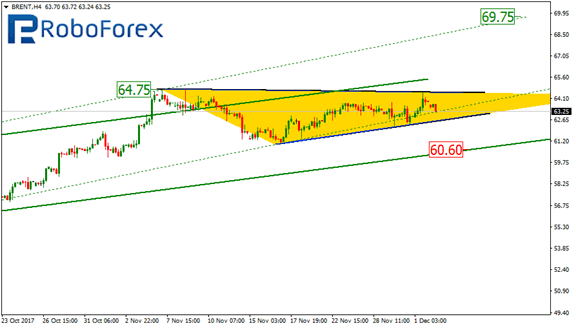
From the technical point of view, Brent is moving inside the uptrend; however, the tendency is being corrected to the downside for about a month. For form of the mid-term correctional trend looks like the Triangle pattern, which may be a short pause before further growth.
In the short-term, Brent may break the downside border of the triangle channel and the support level of the main trend. After that, the instrument is expected to rebound and start forming a new rising impulse with the main target at the current high at 64.75. If the price breaks this level, it may continue growing towards the upside border of the main trend channel close to 69.75.
Washington Whipsaw
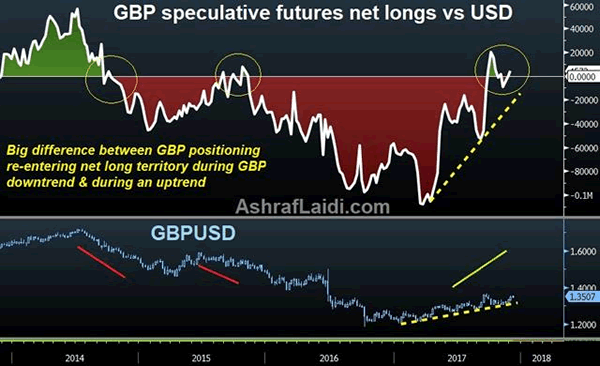
Buying the dip on Trump-Russia news proved to be the right trade again Friday as a reporting error led to an oversized market reaction. The US dollar bounces strongly to kick off the new week, with the exception of against the GBP and CAD, which are holding firm. CFTC positioning data showed yen shorts easing up and GBP positions re-entering net long territory. The EURUSD short Premium trade was closed for 60-90 pip gain (depending on point of entry), leaving one EURUSD trade open.
A half-dozen times this year, markets have been swept away by bombshells about the Trump government and Russian connections. On Friday, former national security advisor Mike Flynn pled guilty to lying to the FBI and promised to cooperate. That Flynn headline put a chill in markets but when ABC reported he would testify he was instructed to contact Russian officials before the election, then a full-scale flight to quality hit. USD/JPY dropped 130 pips to 111.40 and the S&P 500 fell more than 40 points. There were holes in the report from the start and markets slowly recovered. But it wasn't until the weekend that the news was retracted. The new report was that he was instructed to lobby Russian officials after the election and before the inauguration. That was still inappropriate and likely illegal but it's nowhere near stealing an election.
As a result, the US dollar opened stronger with USD/JPY rebounding 50 pips to 112.70, which is where it was before the Flynn news.
At the same time, the Senate voted on the tax bill on Saturday and that's likely to boost US stocks on Monday. At the same time, Flynn's cooperation will mean some fresh blame is laid and that the Russia story continues to roil markets – or at least provides a dip to buy.
CFTC Commitments of Traders
Speculative net futures trader positions as of the close on Tuesday. Net short denoted by - long by +.
- EUR +90K vs +95K prior
- GBP +5K vs -1K prior
- JPY -110K vs -123K prior
- CHF -30K vs -30K prior
- CAD +46K vs +45K prior
- AUD +39K vs +40K prior
The shifts this week were relatively small but the crowded yen short remains a highly-vulnerable trade. Canadian dollar longs will be feeling better after the ultra-strong jobs report on Friday.