Sample Category Title
Market Morning Briefing: Dollar-Yen Had Risen To 114.73
STOCKS
Dow (23548.42, +0.04%) is almost stable but the upside is open to test 23800 in the coming sessions. Near to medium term looks bullish.
Dax (13468.79, -0.07%) is likely to trade sideways in the 13500-13400 region for a few sessions before again resuming the uptrend. A break below 13400, if seen could take it down to 13300-13200 in the longer term.
Nikkei (22724.86, +0.78%) continues to rise higher and our earlier target of 22666 was unable to stop the upward momentum. Looking at the 3-day candles, there is scope of testing 23000-23500 levels in the coming sessions before a medium term top formation takes place. Important to see if 115 could be a decent top for the medium term on Dollar Yen. A corrective dip in Dollar Yen could prevent further rise in Nikkei.
Shanghai (3406.62, +0.54%) bounced back from 3360 as expected and could now move up towards 3425-3430 levels in the near term. Overall the short term upward channel from May’17 is likely to remain intact with an upside potential of 3450 in the medium term.
Nifty (10451.80, -0.01%) stayed above immediate support near 10400 and while that holds, the index could be sideways range-bound in the 10400-10500 region. In case it breaks below 10400, we could see a test of 10300 or slightly lower in the medium term.
COMMODITIES
Gold (1279.64) has bounced back from immediate support near 1265 as expected. Range-trade within 1260-1290 is accounted for the week with a possible extension towards 1295-1300 levels. Note that 1260 is a decent support as seen on the daily candles and is likely to hold in the coming sessions.
Both the Brent (64.14) and the WTI (57.25) have moved up sharply yesterday after news of high profile arrests in Saudi Arabia on an anti-corruption crackdown. Brent is trading near immediate resistance and could possibly pause before again moving up higher while WTI can test 59 before coming off from there.
Copper (3.1535) looks bullish towards 3.25-3.30 for the coming sessions and could well remain above support of 3.05 this week. Near to medium term looks bullish.
FOREX
Slight dip in the Dollar Index (94.78) which has come down from an overnight high near 95.07. The Euro (1.1608) has also recovered a bit from a low near 1.1580. However, the overall uptrend in the Dollar Index remains in force while above 94.50 and the overall downtrend remains in force on the Euro while below 1.1620 (immediate Resistance) and 1.1670 (higher Resistance). The targets are 95.50 on Dollar Index and 1.1550-30 on the Euro.
Dollar-Yen (113.78) had risen to 114.73 yesterday morning but came off sharply from there. It may try to test lower levels of 113.40 over the next couple of days while below 114.50. The Euro-Yen (132.16) has come down alongwith Dollar-Yen. Look for a relatively wide range of 131-134 over the coming days.
As it turns out, the Pound (1.3166) held above trendline Support near 1.3050 and has moved higher. A test of 1.33 looks more possible now. The Aussie (0.7686) also moved up a bit from 0.7630 but looks mixed between 0.7630-7730 for a few days.
Dollar-Yuan (USDCNY = 6.6265) trades a wee bit lower and could spend some time sideways between 6.61-65 for a few days. Dollar-Rupee (64.68) trades a little lower near 62.65 on the NDF. Support should be available in the 64.60-55 region.
INTEREST RATES
Bond Yields continue to dip across the globe even though Brent (64.10) has seen a sharp rise. This is a bit of a surprise for us.
In USA, the 30Yr (2.80%) may have an important Support near 2.78%. This is to be watched. The Yield Curve has been flattening sharply over the last few days but maybe there is some scope for a bounce from near current levels for the 30-5 (0.81%) and 30-10 (0.47%).
The German 10Yr (0.34%) has dipped further and now trades well below 0.40% suggesting that the uptrend since -0.1% (Oct-16) could be breaking.The German-US 10Yr Spread (-1.99%) has bounced from -2.05% over the last few days, but could be vulnerable to a fresh fall from current levels.
Japanese Yields (10Yr 0.03%, 5Yr -0.12%) have been falling over the last few days. The 5Yr may find Support near -0.14%.
(RBA) Statement by Philip Lowe, Governor: Monetary Policy Decision
At its meeting today, the Board decided to leave the cash rate unchanged at 1.50 per cent.
Conditions in the global economy are continuing to improve. Labour markets have tightened and further above-trend growth is expected in a number of advanced economies, although uncertainties remain. Growth in the Chinese economy is being supported by increased spending on infrastructure and property construction, with the high level of debt continuing to present a medium-term risk. Australia's terms of trade are expected to decline in the period ahead but remain at relatively high levels.
Wage growth remains low in most countries, as does core inflation. Headline inflation rates are generally lower than at the start of the year, largely reflecting the earlier decline in oil prices. In the United States, the Federal Reserve has started the process of balance sheet normalisation and expects to increase interest rates further. In a number of other major advanced economies, monetary policy has become a bit less accommodative. Equity markets have been strong, credit spreads have narrowed and volatility in financial markets remains low.
The Bank's forecasts for growth in the Australian economy are largely unchanged. The central forecast is for GDP growth to pick up and to average around 3 per cent over the next few years. Business conditions are positive and capacity utilisation has increased. The outlook for non-mining business investment has improved, with the forward-looking indicators being more positive than they have been for some time. Increased public infrastructure investment is also supporting the economy. One continuing source of uncertainty is the outlook for household consumption. Household incomes are growing slowly and debt levels are high.
The labour market has continued to strengthen. Employment has been rising in all states and has been accompanied by a rise in labour force participation. The various forward-looking indicators continue to point to solid growth in employment over the period ahead. The unemployment rate is expected to decline gradually from its current level of 5½ per cent. Wage growth remains low. This is likely to continue for a while yet, although the stronger conditions in the labour market should see some lift in wage growth over time.
Inflation remains low, with both CPI and underlying inflation running a little below 2 per cent. In underlying terms, inflation is likely to remain low for some time, reflecting the slow growth in labour costs and increased competitive pressures, especially in retailing. CPI inflation is being boosted by higher prices for tobacco and electricity. The Bank's central forecast remains for inflation to pick up gradually as the economy strengthens.
The Australian dollar has appreciated since mid year, partly reflecting a lower US dollar. The higher exchange rate is expected to contribute to continued subdued price pressures in the economy. It is also weighing on the outlook for output and employment. An appreciating exchange rate would be expected to result in a slower pick-up in economic activity and inflation than currently forecast.
Growth in housing debt has been outpacing the slow growth in household income for some time. To address the medium-term risks associated with high and rising household indebtedness, APRA has introduced a number of supervisory measures. Credit standards have been tightened in a way that has reduced the risk profile of borrowers. Housing market conditions have eased further in Sydney. In most cities, housing prices have shown little change over recent months, although they are still increasing in Melbourne. In the eastern capital cities, a considerable additional supply of apartments is scheduled to come on stream over the next couple of years. Rent increases remain low in most cities.
The low level of interest rates is continuing to support the Australian economy. Taking account of the available information, the Board judged that holding the stance of monetary policy unchanged at this meeting would be consistent with sustainable growth in the economy and achieving the inflation target over time.
Predictably Unpredictable
Predictably Unpredictable
Being predictably unpredictable is a lot more challenging than one think but this notion has been the mainstay on FX markets this year and holding a view beyond one shift is exceptionally challenging for even the most seasoned. Whether its the plentitude of noise from headline risk or the latest reversal of fortunes from global central bankers, there's certainly no shortage of conflicting drivers in this topsy-turvy world of currency trading.
Still, we have plenty of noise to consume today whether its the tax reform cacophony, central bank musing or a possible escalation in NK geopolitical tension, the air is thick with tension and currency markets are on the move in the early trade as traders evaluate and reevaluate headline risk
With Dudley's retirement, it's out with the old and in with the new at the Fed. But overnight Dudely was at his candid best outlining his best vision for the Fed going forward. While hinting at price level targeting, I think it's safe to assume we should expect a new framework in the offing on how the Fed gauges this New Age Economy in 2018.
The Japanese Yen
Yesterday Kuroda inspired USDJPY rally was quickly snuffed out by a heavy dose of Trump protectionist rhetoric, and of course, the possible flare-up in geopolitical tension have some traders hedging their bets.
There was nothing new from Kuroda who reiterated his dovish rhetoric, but with dollar bulls looking for some apparent reason to buy dollars in the absence of domestic data this week the BoJ determined dovish tone fit the bill sending them off to the races.
But with concerns, as unlikely as they seem, that North Korea may provoke the US by launching a missile or testing a nuclear weapon during the next leg of Trumps Asia tour has put more than a few investors on edge. Even more so with an impressive US armada positioned in the western Pacific set to retaliate.
And with Trump pledging ' Era To End Of ‘Strategic Patience' Over N. Korea', things could get messy quickly. Given the escalation of geopolitical tension, the USDJPY should remain a bit soggy this week despite the BOJ's doggedly dovish efforts to weaken the JPY
The New Zealand Dollar
The New Zealand government released terms of the Reserve Act Review this morning. And the Kiwi bulls gasped a sigh of relief when the New Zealand Finance Minister stated there was no desire to have the NZD included in the RBNZ review. Predictably we've seen some hedges against this specific tail risk unwind as the minor NZD relief rally ensued. As far as other changes in the act, they appear to be more superficial and would do little more than bringing the RNBZ in line with other Central Banker Practices of having multiple decision makers, publication of minutes and the dual mandate. Overall this is positive for the NZD, but the air remains heavy with political uncertainty and traders are showing little appetite to chase the NZD higher in early trade.
The Australian Dollar
It's tough being an Aussie bear and whatever price action expected pre RBA statement from those anticipating a dovish tweak to RBA policy is just not panning out. Commodity prices are ramping higher, especially oil and iron ore and with ith the majority in the market apparently in the RBA's steady as she goes camp, despite the dismal run of economic data, price action must be respected. But with most of Australia tuning into the Melbourne Cup perhaps the RBA is in little mood to dampen local festivities anyway.Back to the drawing board for the Aussie bears
USD/CAD Canadian Dollar Higher After Dollar Struggles
The Canadian dollar appreciated 0.29 percent on Monday. Trading opened for the USD/CAD at 1.2771 and is now on track to end near the 1.2721 price level. The economic calendar looks sparse this week, but geopolitical developments around the world are driving market movements. Oil prices have surged due to the high profile arrests in Saudi Arabia that have consolidated the power of crown prince Mohammed bin Salman.
Canadian purchasing managers remain optimistic about the economy. The Ivey PMI survey beat expectations with a 63.8 reading reaching a 21 month high. The Canadian economy had a strong first half that defied expectations that prompted the Bank of Canada (BoC) to lift the benchmark interest rate twice by 25 basis points. The slowdown in the second half has been forecasted, but as the Canadian jobs number last week and today's PMI shows there are still positive signs in Canada.
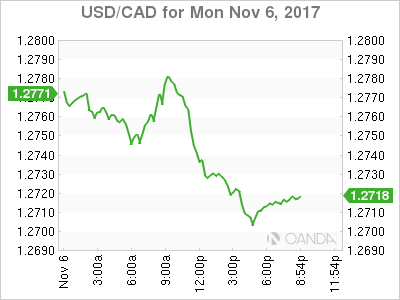
The USD/CAD lost 0.29 percent on Monday. The currency pair is trading at 1.2721 after the US dollar struggled on Monday after concerns about the tax reform rose. The US dollar did not get a strong boost form the employment numbers released on Friday. The greenback fell when the U.S. non farm payrolls (NFP) report showed the US economy added 261,000 jobs, 50,000 short of the forecast. Despite the upward 18,000 revision to the September figures the biggest miss was the hourly wages remaining flat. The U.S. Federal Reserve is expected to raise interest rates in December, but lack of inflationary pressure will make further tightening more complicated.
The Canadian economy added 35,300 jobs with the gains coming in full time employment. Forecasters had predicted a 15,000 gain. Wages also rose to the biggest gain in 18 months boosting the loonie agains the dollar for a 0.38 percent gain on Friday. The improvement in economic data once again has put forth the argument for another rate hike before the end of the year. The BoC already hiked twice in 2017, but only by enough to return to 2015 levels. The Canadian benchmark rate stands at 1 percent.
Marketpulse analyst Kenny Fisher wrote about the nomination of Jerome Powell to the position of Chair of the U.S. Federal Reserve:
On Thursday, US President Trump nominated Federal Reserve Governor Jerome Powell to head the Federal Reserve. Powell will take over in February 2018 when Yellen's term expires. Powell is expected to hold the course with monetary policy, which has been marked by incremental and small rate hikes since December 2015. It's all but a given that the Fed will raise interest rates in December, but the forecast for 2018 is less clear. If the US economy continues to grow at current levels, we could see up to three rate hikes next year. Powell will also be tasked with continuing to trim the Fed's huge balance sheet of $4.2 billion. Last month, the Fed has started trimming the balance sheet by $10 billion/mth, but these cuts are expected to increase in size next year.
US President Donald Trump deliver his nomination before embarking on an Asian trip. The Trump administration is hard at work pushing the tax reform into fruition but it faces the usual obstacles that have plagued other policy initiatives as there are plenty of divisive points that could urge caution from even Republican senators ahead of next year's primaries.
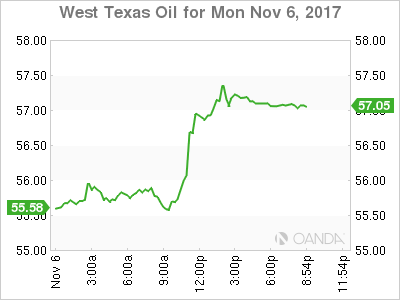
The price of energy is surging on Monday. West Texas Intermediate is trading at 57.23 after rising 3 percent. The crackdown in Saudi Arabia which resulted in high profile arrests raised concerns about the stability of the kingdom. Saudi Arabia's crown prince Mohammed bin Salman has risen as the next in line to succeed his father. He has been the main driver of reform to diversify away from oil revenues and this move could end up silencing the most powerful critics of his plans.
Prince Mohammed bin Salman was the main force behind the economic boycott against Qatar in June and a showdown with Iran seems to be a question of when, not if it will happen. The Organization of the Petroleum Exporting Countries (OPEC) decision to cut production alongside Russia and other energy supplying nations has provided stability to the energy market.
Disruptions have been the main factor lifting prices above current ranges, but this last move by Saudi Arabia could unravel the OPEC as it pits major members against each other.
Weekly inventory releases will get further scrutiny, but will not have their normal effect in current rarified market conditions. The Energy Information Administration (EIA) will release oil stocks on Wednesday, November 8 at 10:30 am EDT.
Market events to watch this week:
Tuesday, November 7
1:45 pm CAD BOC Gov Poloz Speaks
Wednesday, November 8
11:30 am USD Crude Oil Inventories
4:00 pm NZD Official Cash Rate
4:00 pm NZD RBNZ Rate Statement
5:00 pm NZD RBNZ Press Conference
Thursday, November 9
9:30 am USD Unemployment Claims
8:30 pm AUD RBA Monetary Policy Statement
Friday, November 10
5:30am GBP Manufacturing Production m/m
Gold Starts Week With Strong Gains
Gold has posted considerable gains in the Monday session. In North American trade, the spot price for an ounce of gold is $1282.27, up 1.05% on the day. On the release front, there are no major events on the schedule. William Dudley, President of the New York Federal Reserve, announced his retirement. On Tuesday, Fed Chair Janet Yellen will speak at an event in Washington.
US numbers ended the week on a disappointing note, as payrolls and wage growth missed their forecasts. After a decline in September, a result of the hurricanes which battered the US, nonfarm payrolls rebounded sharply with a reading of 261 thousand. This was a respectable number, but still fell short of the forecast of 312 thousand. Wage growth also disappointed, slowing to 0.0%, short of the estimate of 0.2%. This marked the first time in 2017 that wage growth did not increase, underlining persistent weak inflation. Although Fed Chair Yellen and other Fed policymakers have expressed confidence that inflation levels will rise, this is still yet to occur, despite strong growth and a labor market at capacity.
The Federal Reserve remains in the news, after FOMC member William Dudley announced that he will retire in mid-2018. This move could have implications for monetary policy, depending on who will replace Dudley. A possible candidate is Kevin Warsh, who made the short list for the successor to Fed Chair Janet Yellen. Warsh is in favor of higher rates and favors less regulation of the banking sector, and if he would certainly support a more hawkish stance on monetary policy.
Pound Gains on Brexit Optimism; Euro Struggles Despite Robust Economic Data
During the European trading hours, the pound outperformed its peers as investors stood optimistic about Brexit developments, while the euro failed to find support on robust economic data out of the eurozone.
With Brexit negotiations expected to resume on Thursday, the pound was on track to post gains for the second consecutive trading day supported mainly by encouraging remarks made by the British Prime Minister Theresa May in front of business leaders. May backed a deal on a transitional period crucial for businesses so as not to face a cliff-edge after the country leaves the EU, saying that she wants to reach a detailed agreement on this period as "early as possible". She also mentioned that throughout this period both sides (the other side of course being the EU) should have access to one another's markets under current conditions, but she called businesses to be "realistic" about the time-frame needed to finalize the new long-term relationship with the EU. Pound/dollar gained 0.37% on the day, rising to an intra-day high of 1.3126.
In Eurozone, the IHS final composite Purchasing Manager's Index (PMI) fell from 56.7 to 56.0 in October as expected, remaining at multi-year high levels and above the threshold of 50 that separates growth from contraction in the sector. Regarding the services sector PMI, it came in solid at 56.0 as anticipated, though, among the readings for the largest European economies, Spain posted the smallest growth with the relevant index declining more than expected to a nine-month low of 54.6 from 56.7, harmed by the political uncertainties in the country.
In another report, the Sentix index which gauges investors' confidence in the eurozone jumped surprisingly to the highest level since July 2007 in November, climbing from 29.7 to 34.0, while analysts projected a smaller increase to 30.8.
Despite the mostly positive data, the euro followed a downtrend, breaking below the $1.16 key level, last trading at $1.1582 (-0.22%). Against the pound, the euro lost 0.44% on the day, falling to 0.8837 pounds.
In the US, the Senate started revising the tax code, with the House Speaker, Paul Ryan, arguing on Sunday that the outline is expected to remain similar to the current draft so that the tax bill could be agreed by both the Senate and the House of Representatives before the year-end. However, the idea that tax reforms could excessively widen the federal deficit concerns several Republicans as they recently claimed they would not support the package.
Besides that, investors have turned their focus to Trump's tour in Asia, where he will have bilateral meetings with five countries including in his agenda issues on trade and North Korea.
Next on the day, the New York Fed President, William Duddley who is expected to retire in the mid-2018, will give a speech at the Economic Club of New York.
The dollar index was moving sideways around the 95 key-level during the session. Dollar/yen was also trading flat around 114.
The aussie managed to climb higher to $0.7657 ahead of the RBA's policy meeting early on Tuesday. The kiwi reversed part of its earlier losses, though remained 0.12% down on the day at $0.6896.
Turning to commodities, oil prices stood near 2-year high levels after Saudi Arabia's Crown Prince, Mohammed bin Salman who backs OPEC supply cuts, applied anti-corruption measures, arresting royals and ministers. WTI crude moved up by 0.70% to $56 per barrel and Brent surged by 1.18% to $62.80. Gold increased by 0.28% to $1,272.70 per ounce.
Pound Claws Back After BoE Setback
The British pound has posted gains at the start of the week. In Monday's North American trade, GBP/USD is trading at 1.3121, up 0.35% on the day. On the release front, there are no major releases out of the UK or the US. The UK will release British BRC Retail Sales Monitor, an important consumer spending indicator. On Tuesday, the UK releases Halifax HPI and Fed Chair Janet Yellen will speak at event in Washington.
After taking a bath on Thursday, the British pound has made up some ground. The pound plunged 1.4 percent after the BoE raised rates for the first time since 2007. The rate hike had been expected for weeks, and the markets treated the BoE's move as a dovish rate, as the Bank indicated that this could be a "one and done" rate hike, given that the UK economy has lost a step, and the uncertainty of Brexit continues to concern investors. Thursday's rate hike reversed the rate cut back in August 2016, which was an "emergency cut" which the cautious BoE implemented to cushion the economy following the stunning Brexit vote in June 2016.
The Federal Reserve remains in the news, after FOMC member William Dudley announced that he will retire in mid-2018. This move could have implications for monetary policy, depending on who will replace Dudley. A possible candidate is Kevin Warsh, who made the short list for the successor to Fed Chair Janet Yellen. Warsh is in favor of higher rates and favors less regulation of the banking sector.
On Thursday, US President Trump nominated Federal Reserve Governor Jerome Powell to head the Federal Reserve. Powell will take over in February 2018 when Yellen's term expires. Powell is expected to hold the course with monetary policy, which has been marked by incremental and small rate hikes since December 2015. It's all but a given that the Fed will raise interest rates in December, but the forecast for 2018 is less clear. If the US economy continues to grow at current levels, we could see up to three rate hikes next year. Powell will also be tasked with continuing to trim the Fed's huge balance sheet of $4.2 billion. Last month, the Fed has started trimming the balance sheet by $10 billion/mth, but these cuts are expected to increase in size next year.
UK Economy at Important Crossroads: Brexit and Wider Politics, Inflation and Interest Rate Decisions Setting the Outlook
The UK economy's resilience to the Brexit vote did not continue into 2017 as largely upbeat economic releases following last year's vote did not manage to maintain momentum with economic activity eventually slowing down. Meanwhile, June 2016's vote shock led to sterling depreciating versus other currencies, pushing inflation higher.
Inflation is growing at a faster pace than wage growth resulting in consumers' reduced purchasing power. This is negatively affecting spending patterns.
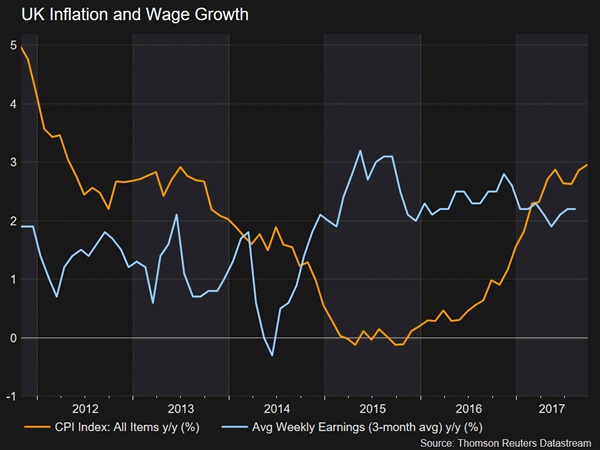
The Bank of England proceeded with a rate rise for the first time in over a decade upon completion of its November meeting on monetary policy in its efforts to push inflation lower towards the central bank's target. However, the central bank faces important tradeoffs: is it wise to raise rates in an environment of declining economic activity?
Adding to the challenges, politics go beyond Brexit-related uncertainty after Prime Minister Theresa May's Conservative Party failed to maintain its parliamentary majority following the elections that took place in early summer. On top of that, her leadership is challenged, further complicating the situation and acting as a drag on the pound.
Bank of England balancing act: inflation Vs risk to hamper economic activity
The BoE decided to raise its benchmark rate by 25bps to 0.5% as its complemented its latest policy meeting. However, just as markets interpreted the European Central Bank's tapering decision earlier in October as relatively dovish, the BoE's rate rise was also dubbed as a "dovish hike" with sterling recording sizable losses relative to majors including the dollar and the euro.
Given the BoE's guidance, markets now anticipate only two additional quarter percentage point hikes by the end of 2020 as the central bank appeared more dovish than many had anticipated. Using currency movements as a means to gauge dovishness in the BoE's message: euro/pound advanced by 1.8% on November 2, the day the bank completed its meeting. This represents the British currency's worst daily drop since sterling's "flash crash" on October 7, 2016.
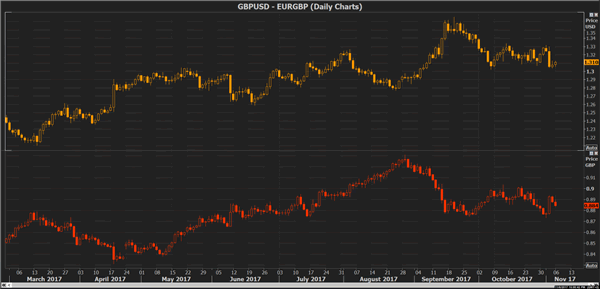
Monetary policy divergence with the Federal Reserve, which is normalizing its policies more "actively", is supportive of a weaker pound/dollar pair over the medium- to longer-term. As of now, the Fed remains on track to deliver an additional rate hike as it meets in December, while it has also started the process of shrinking its massive balance sheet in a gradual effort to slowly bring its size down to pre-crisis levels.
The BoE is in a difficult position. Its primary objective is price stability, interpreted as achieving an annual inflation rate of 2%. Inflation rose by 3% year-on-year in September, at its highest pace since 2012, with the bank anticipating further acceleration in consumer prices in October. In light of this and given its mandate, its hands in proceeding with a rate hike were tied to an extent; the bank acted to facilitate the return of inflation to its target.
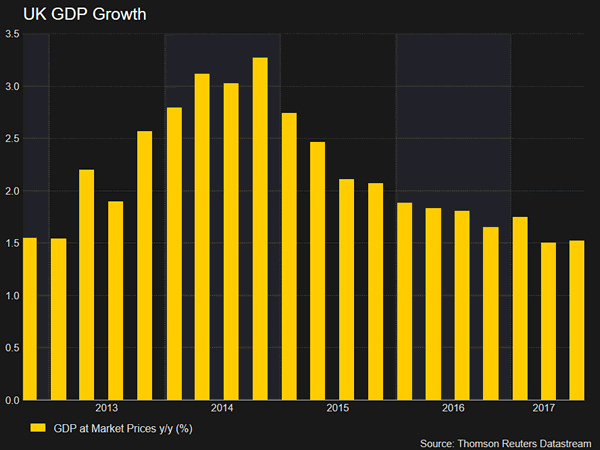
However, raising rates - a tightening action - at a time when the UK economy is slowing down is a risky endeavor; the UK economy grew by 1.5% year-on-year in the third quarter of 2017, at its slowest pace since the first quarter of 2013. The BoE is in a balancing act. In the words of BoE Governor Mark Carney, it needs to: "balance any trade-off between the speed at which we (MPC members) return inflation sustainably to target with the support that monetary policy provides to jobs and activity."
Governor Carney's considerations of the effects of Brexit on the UK economy of course persist as negotiations are ongoing. One of his remarks during the press conference that followed the central bank's latest meeting and having Britain's departure from the EU in mind was: "These aren't normal times."
Brexit asymmetry and PM May's position
Given that pending issues are resolved, Britain is set to officially exit the EU in March 2019, two years after triggering Article 50, this being the act of giving formal notice to the European Council of Britain's intention to withdraw from the EU bloc.
The UK's financial obligations to the EU, how the UK will protect the rights of EU citizens living in the nation and the future of the Irish border - the Republic of Ireland will remain an EU member state but Northern Ireland that is part of the UK will not - seem to, at least for now, constitute the most pressing issues in the talks that are taking place.
A statement from Brexit Secretary David Davis and the EU's Chief Negotiator for Brexit Michel Barnier indicated that talks would resume on November 9 and 10. A tough stance by the UK that does not leave much room for progress in negotiations and consequently leads to a no-deal scenario, though still a possibility, does not seem to be the base case scenario at the moment as tensions between the two sides appear to be on the decline. Given the immensely significant investment and trade ties between the two parties, this is also evidently a rational stance by the two sides.
It is noteworthy that market perception is one of an asymmetric burden in the case of a no-deal scenario; one that weighs much more on the UK economy than the eurozone's. And this is evident from the currency markets. Whenever a story of an impasse in negotiations emerges, it is often the case that sterling retreats considerably relative to other currencies (the British currency tends to lose ground versus the euro as well) with the eurozone's common currency not behaving in the same manner.
Asymmetry in investors' minds though does not just exist in relation to the effects of a no-deal outcome, but this also seems to be the case when the two sides seem to be moving towards achieving a constructive future relationship - sterling is much more likely to gain versus other currencies (including against the euro) when such positive developments emerge. Markets are therefore projecting an asymmetric burden as well as an asymmetric benefit.
One should not forget that Prime Minister Theresa May's bet when she called June's snap elections did not pay off as her Conservative party lost its parliamentary majority. This creates additional uncertainty not just within the context of Brexit but in a broader sense as well. On top of this, May's leadership has been recently challenged by members within her own party. This additional layer of uncertainty may prove too much for corporations making business decisions that involve investing large sums of money in the UK; the risk premium being applied potentially has the capacity to turn lucrative projects into unprofitable ones, with declining investments acting as a drag on the economy and its future prospects.
The UK is at important crossroads with decisions over the coming months having the capacity to steer the outlook both in favor but also to the nation's detriment - currency markets will react accordingly.
With the Federal Reserve remaining on what looks a firm path of policy tightening - contrasting the BoE - and uncertainty on US tax reform gradually dissipating, pound/dollar is looking likely to record losses further ahead. Of course, derailment on any of the aforementioned dollar positives will lead to greenback weakness, however the trend has been towards an ever-increasing tightening bias on behalf of the Fed, while similarly there is gradual progress on the delivery of business-friendly tax reforms. Should these trends continue, the view for a stronger dollar relative to sterling over the long-term remains well-supported.
Emmanuel Macron prevailing in the French elections earlier in the year seemed to open the way for more integration in the eurozone, delivering a blow - at least this was the perception - to populist forces. As a result, the euro rallied across the board. Things have changed since then. Angela Merkel secured a fourth term as German chancellor, but her party faced its worst result in decades in September's elections. The Free Democrats (potential partners in Merkel's government) remain skeptical of many of Macron's ideas for enhancing European integration. Merkel might find herself in a balancing act as well with uncertainty over Europe's future hurting eurozone's common currency versus sterling. Beyond this, one should not forget Catalonia's bid for independence with the latest polls showing regional pro-independence parties being in the lead, as well as next year's Italian elections with strong support expected for the populist-perceived Five Star Movement. While great uncertainty remains in relation to UK politics, on balance it might be argued that eurozone's headwinds over the coming months have a high chance of outweighing those faced by Britain, leading to a weaker euro/pound pair, though, at the moment, attempting to call this pair's direction further ahead is a trickier endeavor than pound/dollar's.
Yen Quiet as Investors Search for Cues
USD/JPY has ticked lower in the Monday session. In North American trade, USD/JPY is trading at 114.12, up 0.07% on the day. On the release front, the BoJ released the minutes of the October policy meeting. In the US, there are no major events. William Dudley, President of the New York Fed, announced his retirement. On Tuesday, Fed Chair Janet Yellen will speak at an event in Washington.
Bank of Japan Governor Haruhiko Kuroda spoke on Monday, after the release of the BoJ minutes. Kuroda expressed optimism that the improving economy will trigger higher inflation and move closer to the Bank's target of 2 percent. Kuroda called the economic expansion "highly sustainable", and the markets took his optimism as a sign that the BoJ has no plans to inject further stimulus in order to beef up inflation. The minutes from the October meeting indicated that many of the board members were satisfied that the inflation target would be met under current policy.
The Federal Reserve remains in the news, after FOMC member William Dudley announced that he will retire in mid-2018. This move could have implications for monetary policy, depending on who will replace Dudley. A possible candidate is Kevin Warsh, who made the short list for the successor to Fed Chair Janet Yellen. Warsh is in favor of higher rates and favors less regulation of the banking sector.
On Thursday, US President Trump nominated Federal Reserve Governor Jerome Powell to head the Federal Reserve. Powell will take over in February 2018 when Yellen's term expires. Powell is expected to hold the course with monetary policy, which has been marked by incremental and small rate hikes since December 2015. It's all but a given that the Fed will raise interest rates in December, but the forecast for 2018 is less clear. If the US economy continues to grow at current levels, we could see up to three rate hikes next year. Powell will also be tasked with continuing to trim the Fed's huge balance sheet of $4.2 billion. Last month, the Fed has started trimming the balance sheet by $10 billion/mth, but these cuts are expected to increase in size next year.
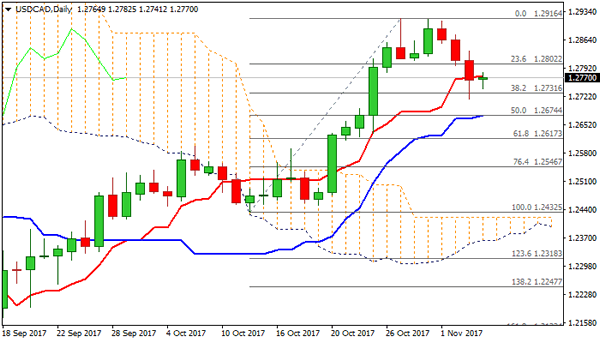
USDCAD – Last Week’s Fall is Taking a Breather; Daily Tenkan-sen Caps Recovery for Now
The pair is slightly firmer on Monday, following strong fall in last three days of past week. Bearish acceleration found footstep at 1.2700 zone and closed above cracked Fibo 38.2% of 1.2432/1.2916 upleg at 1.2731.
Upside attempts today remain capped by broken daily Tenkan-sen (1.2773) and repeated close below it would keep near-term focus at the downside for retest of 1.2731 Fibo support.
Sustained break here is needed to signal fresh extension of pullback from 1.2916 top towards next key support at 1.2674 (50% retracement / daily Kijun-sen).
Conversely, close above Tenkan-sen is required to sideline current bearish threats while sustained break above 1.2800 would signal reversal.
Res: 1.2773; 1.2802; 1.2835; 1.2875
Sup: 1.2731; 1.2714; 1.2674; 1.2617