

Sample Category Title
GBP/USD Reached Another Upside Target
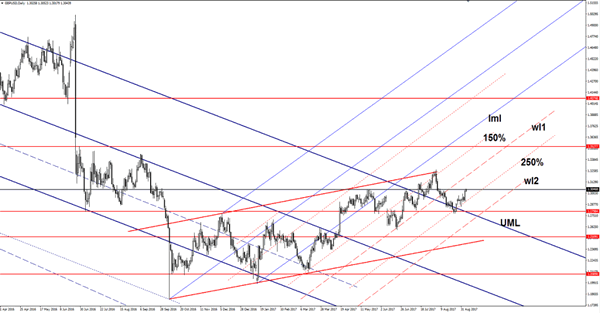
GBP/USD resumed the upside movement and has managed to reach the 1.3046 static resistance. I've said in the previous reports that the rate should reach this level after the retest of the 250% Fibonacci line. A breakout will signal a further increase towards the warning line (wl1).
AUD/USD Is This Really Overbought?
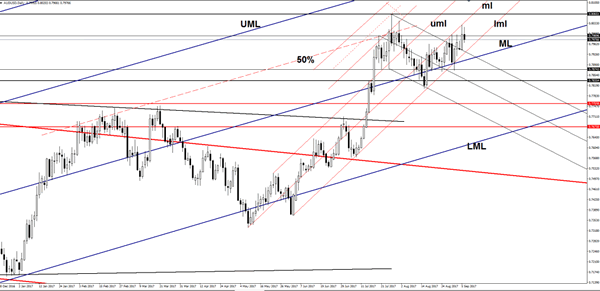
AUD/USD increased today, but failed to reach the 0.8027 yesterday's high and the median line (ml) of the minor ascending pitchfork, signaling an exhaustion. Price rallied in the yesterday's trading session and retested the median line (ml), but unfortunately has failed to close near it. The pair is trading in the red right now and seems determined to reach and retest the lower median line (lml) again.
ECB: Copy of December 2016’s Playbook?
- ECB ready to extend APP and reduce monthly amount of purchases
- Strong growth, but tame inflation warrants such scenario
- Curve steepening; Draghi able to prevent more unwarranted euro strength?
ECB President Draghi informed markets at the July press conference that the central bank would have significant discussions on its policy stance in autumn. He refused to clarify whether this timeframe referred to the September or October (26) policy meeting. So, markets are unsure as to whether this week's ECB press conference will produce any significant news in terms of the ECB policy outlook.
The most likely market moving development would probably be in relation to the ECB's Asset Purchase Programme. The current forward guidance reads that "net asset purchases, at the current monthly pace of €60 billion, are intended to run until the end of December 2017, or beyond, if necessary, and in any case until the Governing Council sees a sustained adjustment in the path of inflation consistent with its inflation aim.". Markets will be keen to see whether and to what extent this guidance might be altered on Thursday.
APP: Extend and recalibrate?
As we approach the current specified target date of end December, we expect the ECB to adapt its guidance to clear uncertainty in markets and avoid unwarranted speculation/nervousness in the months running up to the year-end. Draghi and Co could use the playbook they've put together in December 2016. Nine months ago, the central bank was in a more or less similar situation as the APP guidance noted that purchases were intended to run until the end of March 2017, or beyond, if necessary. The ECB then decided to lengthen asset purchases, but also to "recalibrate" the monthly amount (from €80bn/month to €60bn/month) in order to adapt to the changing/improving economic reality. A similar approach could well be followed tomorrow or at the latest on the October meeting.
Expectations for some modification of the current pace of asset purchases increased immediately after a speech by ECB President Draghi in Sintra (June 27) in which he noted that "As the economy continues to recover, a constant policy stance will become more accommodative, and the central bank can accompany the recovery by adjusting the parameters of its policy instruments - not in order to tighten the policy stance, but to keep it broadly unchanged". However, Mr Draghi also referred to financial conditions in that speech, suggesting the alternative view that he could use the argument of a stronger euro as making policy less accommodative.
Whether Mr Draghi is forthcoming tomorrow or not, we expect the ECB to extend purchases until the end of June 2018 or beyond if necessary with a reduction of asset purchases from €60bn/month to €30bn/month taking effect from the start of 2018. Regardless of the preferred monetary stance, lowering the monthly amount of bond purchases is also becoming necessary for technical reasons as the ECB is in danger of running into issue(r) limits for several EMU countries.
This phased process of policy normalization can then be stepped up next year with the ECB signaling at the end of Q1 2018 that APP won't be extended beyond June 2018 and preparing markets for a first rate hike in Q4 2018.
Strong growth, but tame inflation
The mix of strong EMU growth momentum and tame inflation readings both warrants and allows the ECB room for manoeuvre to implement a gradual and well signalled path for ending APP, but not suddenly hitting the brakes. EMU Q2 GDP growth remained above trend (0.6% Q/Q) while the EMU composite PMI now records 55+ readings for seven months running. New GDP forecasts from the ECB should reflect those developments, especially in 2017/2018. Strong activity data are accompanied by an improving labour market, even if some slack remains.
There's less optimism from the inflation front. Headline CPI rose to 1.5% Y/Y in August, and although it has trended higher over the past year core inflation remains lacklustre at 1.2% Y/Y. The euro's appreciation since the ECB's June projections (+/- 4% on a trade-weighted basis) suggests that next year's inflation forecast could be cut further, despite the positive effect from stronger GDP expectations. ECB President Draghi will therefore reiterate that "a very substantial degree of monetary accommodation is still needed for underlying inflation pressures to gradually build up and support headline inflation developments in the medium term."
Curve steepening and correction euro?
We return to the December 2016 policy meeting in order to assess the potential market impact from the scenario outlined above. The market reaction was dovish: the German yield curve steepened (lower ST yields, higher LT yields), the euro lost ground and equities profited after Draghi explained the future of APP.
A new steepening of the German yield curve is likely, but this may be a little less than was the case in December. First of all, because the ECB in December changed some technical parameters of APP. One of them was the inclusion of bonds with a 1-2 yr maturity. Second, (rate) markets are now positioned more dovishly than they were on the eve of the December 2016 policy meeting. The Euribor 3m strip curve trades 10 to 20 bps lower on tenors between 2018 and 2022. Both factors suggest that the downward potential of short term German yields is much lower than the 6 bps drop we witnessed in December last.
That said, in order to cause German short term yields to significantly increase, the ECB would probably have to change its forward guidance ("we expect rates to remain at their present levels for an extended period of time, and well past the horizon of our net asset purchases") which we only expect to happen in Q1 2018.
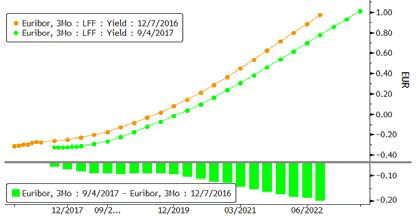
Euriobor 3m strip curve: Markets more dovish positioned than ahead of December 2016 ECB meeting
The German 10-yr yield currently trades around similar levels to 9 months ago. A further reduction in bond purchases could push longer term yields again higher, especially against the background of strengthening growth.
The December 2016 meeting started the euro's dive to the current cycle low (EUR/USD 1.0350 area) around the turn of the year. The recent nature of the climb to current levels (EUR/USD 1.19) suggests that euro bulls could take some chips off the table in the outlined scenario, resulting in a more neutral FX market positioning and consolidation. The downside of EUR/USD seems nevertheless limited given already relatively dovish rate expectations. Dollar positive news is necessary to trigger a more sustained correction lower.
Extending the APP-programme would also fit in the central bank's recent warnings/concerns on euro strength. ECB July Minutes remarked that "concerns were expressed about the risk of the exchange rate overshooting in the future". Draghi will probably again put the onus on the single currency's strength to avoid an unwarranted rise. However, he will also need to be careful not to give the impression that the ECB wants to manage the exchange rate.
EURUSD Cracks Weekly Pivot
The EURUSD pair has continued to gain bullish trading momentum during Wednesday's European session, with price-action now moving comfortably above the euro's weekly pivot point, located at the 1.1918 level.
So far, the single currency has found strong intraday resistance from the 1.1950 level, ahead of the release of U.S ISM non-manufacturing and PMI services data.
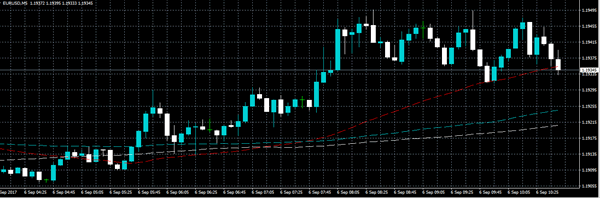
The EURUSD remains strongly bullish while trading above the 1.1918 level, with buyers now aiming to take price above the 1.1979 level.
Key intraday technical resistance is located at 1.1960, 1.1979 and 1.2000. Above the 1.2000 level, traders will focus on a series of daily time-frame price closes above the key 1.2030 level.
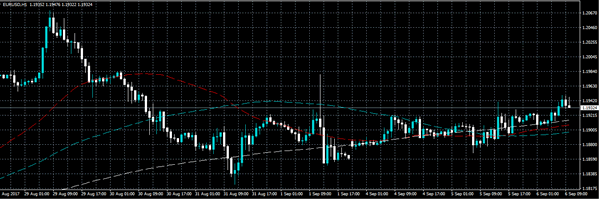
To the downside, intraday technical EURUSD support is located at 1.1918, and the daily pivot point, at 1.1910.
Below 1.1900, the 200-hour moving average is located at 1.1897, with the monthly pivot offering further support, at 1.1884.
USDJPY Pushes Above Fibonacci Resistance
The USDJPY pair has moved above strong historical Fibonacci resistance, hitting 108.95, after intraday sellers failed to push price-action below the August monthly price low, found at the 108.26 level.
After reaching a new September price low of 108.44, the USDJPY found strong intraday buying demand, with the pair now testing its calculated daily pivot point, at 108.88.
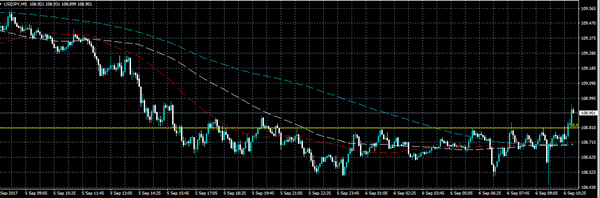
The USDJPY pair is currently neutral on an intraday basis, whilst trading above the 108.88 level. However, traders should note the bullish higher monthly price low, created on the charts, at 108.44.
Key intraday technical resistance is located at the 50-hour moving average, at 109.17, and the September 4th swing price low, at 109.38.
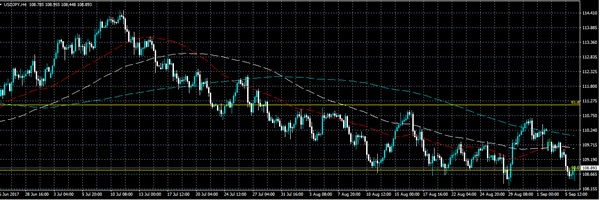
Key intraday USDJPY support is located at the long-term Fibonacci retracement level, 108.81, with further technical support at 108.60 and 108.44.
Below the 108.44 level, traders should look for further selling towards 108.26, 108.13 and 107.81.
GBP/JPY Switched To Uptrend
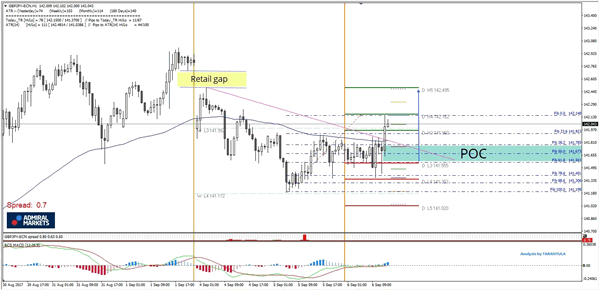
After a risk on sentiment where the Yen gained substantial strength versus its counterpart GBP, the pair is having a retracement now. Turmoil between the US and NK has turned the sentiment to risk on, leaving the retail gap behind on most Yen pairs. At this point we see a trend change and buying the dips could be the option. 141.55-70 is the POC zone (D L3, trend line, 50.0, ATR pivot) and another retracement in the pair should push it to the upside. 4h close and strong 1h momentum above 142.00 will target 142.16 as the first target then 142.50. Reaching 142.50 will open the door for the close of the retail gap. Only below 141.30 we could see 141.15, 141.00 and resume of downtrend.
Financial Markets Gripped by Geopolitical Turmoil
Financial markets were firmly gripped by geopolitical risks on Tuesday, as brewing tensions between the United States and North Korea weighed heavily on global sentiment.
Risk aversion is becoming a dominant theme amid escalating North Korean tensions, and the jitters punished Asian stocks during early trading on Wednesday. In Europe, shares ended mostly lower yesterday and have extended losses today, as the cautious mood from Asia encouraged investors to avoid riskier assets. The lack of appetite for risk sent U.S stocks to their lowest level in almost three weeks on Tuesday, with further downsides on the cards as the mixture of geopolitical tension and political uncertainty sours risk appetite.
The movements observed in stock markets and safe-haven assets suggest that markets have become increasingly sensitive to geopolitical influence. Recent comments from a North Korean diplomat threatening that the country was prepared to deliver 'gift packages' to the U.S is likely to fuel further risk aversion.
Dollar punished by Fed doves
King Dollar struggled to hold ground against a basket of major currencies during Wednesday's trading session, after dovish comments from Federal Reserve Governor Lael Brainard prompted investors to re-evaluate the likelihood of another rate hike this year.
Brainard stated that inflation was "well short" of targets and the central bank should be cautious about tightening policy until policy makers are confident that inflation will rebound. These dovish remarks have effectively trimmed market expectations of a December rate hike, exposing the Greenback to further pain.
As the trading month of September gets underway, Dollar weakness is likely to remain a dominant theme; political instability in Washington and fading rate hike expectations will weigh heavily on the currency. From a technical standpoint, the Dollar Index is under intense selling pressure on the daily charts. Repeated weakness below 92.00 should encourage a further depreciation towards 90.00.
Commodity spotlight - Gold
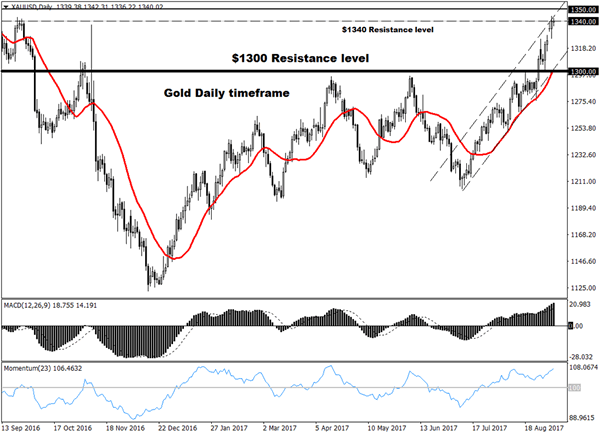
The heightened geopolitical risks over North Korea and ongoing concerns about stubbornly low inflation in the United States have supported Gold, with prices trading around $1340 as of writing.
The yellow metal has found itself back in fashion, with further upside expected as geopolitical tensions and political uncertainty in Washington accelerate the flight to safety. From a technical standpoint, Gold is bullish on the daily charts as there have been consistently higher highs and higher lows. A solid breakout and daily close above $1340 should open a path higher towards $1350.
Currency spotlight - EURUSD
Thursday's main risk event for the Euro will be the highly anticipated European Central Bank meeting, which is expected to conclude with interest rates left unchanged.
The prospects of the European Central Bank tapering QE have heavily supported the Euro and, with the current QE program due to end in September, tomorrow's ECB meeting will be in sharp focus. While markets were widely expecting the central bank to announce the winding down of its QE program this week, the resurgent Euro and the impact it may have on the inflation target may prompt the central bank to wait until October.
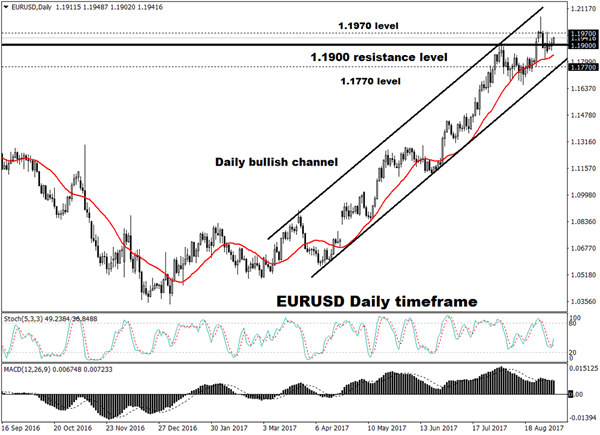
From a technical standpoint, the EURUSD remains bullish on the daily charts. The breakout above 1.1900 should encourage a further appreciation towards 1.1970 and 1.2000, respectively. In an alternative scenario, repeated weakness below 1.1900 is likely to trigger a selloff towards 1.1770.
DAX Unchanged, Shrugs Off Soft German Factory Orders
The DAX index is unchanged in the Wednesday session. Currently, the DAX is currently trading at 12,118.50, down 0.05% on the day. On the release front, German Factory Orders dropped 0.7%, well off the forecast of a 0.2% gain. Eurozone Retail PMI edged lower to 50.8 points. On Thursday, the ECB releases its rate statement, followed by a press conference with ECB President Mario Draghi. As well, Germany releases Industrial Production and the Eurozone publishes Revised GDP.
German business leaders are closely following developments at the ECB, as the current quantitative easing (QE) scheme winds down in December. On Wednesday, Deutsche Bank chief executive John Cryan weighed in on the matter, calling on the ECB to alter course and stop providing “cheap money” to the markets. Cryan warned that the ECB’s monetary stance threatened to cause bubbles in the capital markets, including property, stocks and bonds. Cryan added that the stronger euro should not serve as an excuse for the ECB to continue its QE program. Turning to Brexit, Cryan argued that Frankfurt is ideally suited to take over from London as the financial hub for European banks. There is fierce jockeying in Europe as to who will take over from London, with Paris, Dublin and Amsterdam all hoping to pick up the spoils after Britain leaves the European Union.
The euro continues to trade at high levels, and EUR/USD broke above the symbolic 1.20 level in August.The euro has gained some 13% against the dollar in 2017, with two main reasons for the appreciation. First, the euro-area economy has looked impressive this year, led by robust growth in Germany. Second, there is increasing speculation that the ECB will taper its asset purchase program (QE), which is scheduled to terminate in December. The ECB is yet to decide what to do next, and analysts do not the details of the new program to be announced until October or possibly December. ECB policymakers must weigh competing interests – Germany would like nothing more than the ECB to simply exit the program, which was brought in as an emergency measure to begin with. However, other eurozone members, which are not enjoying German-style growth, favor a gradual tapering of the program, perhaps lowering monthly asset purchases from EUR 60 billion to EUR 45 billion. The stronger euro is equivalent to a raise in interest rates and has resulted in monetary tightening, so the ECB may favor a slow exit. Aside from the headache of a stronger euro, ECB policymakers must wrestle with the dilemma of a stronger economy that remains gripped by very low inflation. Will the ECB address these concerns at the Thursday meeting? Any hints about a change in monetary policy could have a sharp impact on the euro.
Australian Q2 GDP Growth Puts Pressure On The Aussie
A day after the Reserve Bank of Australia decided to hold cash rates at a record low of 1.5% and maintained its optimism about the future economic performance of the country, the Australian Bureau of Statistics (ABS) published the GDP growth figures for the second quarter on Wednesday. These surprised analysts to the downside pushing consequently the aussie down.
The Australian economy expanded by 0.8% quarter-on-quarter in the three months to June, 0.5 percentage points higher than in the previous quarter and registering its 26-year consecutive growth without a recession. Although this was a sign of improvement, analysts anticipated GDP to grow slightly higher by 0.9%. On an annual basis, the figure was up by 0.1 to 1.8% but below the 1.9% forecasted.
In current prices, GDP growth declined by 0.1% due to decreasing coal and iron prices. The chief economist at the ABS said that lower iron and coal prices, observed in the second quarter, weighed on export revenues and real incomes. However, export volumes continued rising in the aforementioned period.
Looking at the GDP components, final consumption increased by 0.2 percentage points to 0.8%, posting the highest rise since September 2016, while capital expenditure more than tripled to 1.5% from an upwardly revised 0.4% (from -0.6%) in the prior period. Consequently, households saved less, with the saving rate dropping from 5.3% to an 8 ½-year low of 4.6%.
The report also mentioned that the compensation of employees increased by 0.7% as Australians’ worked more despite the subdued wage growth.
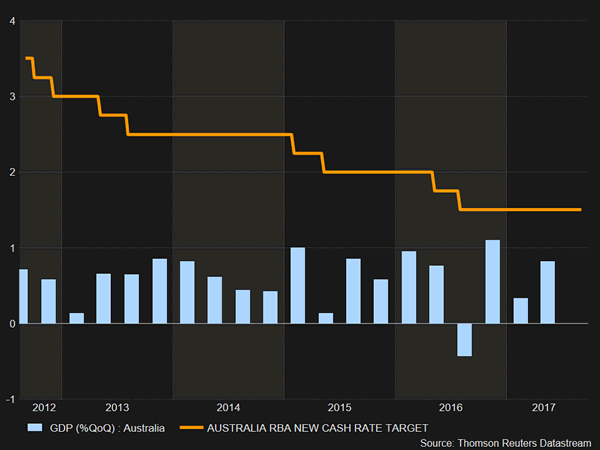
While the above data justify the RBA’s positive view on the country’s economic performance, the central bank’s 2018 GDP growth forecast of 3.0% might be overestimated as household debt- to- income ratio remains at the extremely high level of 190% – one of the highest indebtedness levels in the world – while wage growth rose at the inflation rate of 1.9% on a yearly basis in the second quarter. The monetary policy statement published after the RBA monthly meeting yesterday indicated that policymakers agreed to keep rates steady at a record low of 1.5% as household debt continues fluctuating at high levels, while the exchange rate remains strong. Nevertheless, the RBA Governor Philip Lowe explained on Tuesday that the current monetary policy is accommodative as it limits the risks arising from the high and rising household debt. Moreover, he remained optimistic about country’s economic outlook and specifically about labor market developments, saying that “It is likely that as our economy strengthens and the demand for labor picks up, growth in wages will pick up too”.
In the forex markets, the aussie dropped immediately by 0.46% to an intra-day low of $0.7973 after the release of the data. Before the release, dollar/aussie was trading above the 0.80 key level, near the one-week high of 0.8027 reached yesterday.
Euro Edges Up Despite Weak German Factory Orders
EUR/USD is showing little movement this week, as the pair hovers close to the 1.19 level. Currently, the pair is trading at 1.1942, up 0.24% on the day. In economic news, German Factory Orders declined 0.7%, well off the forecast of a 0.2% gain. Eurozone Retail PMI edged lower to 50.8 points. In the US, today's key event is the ISM Non-Manufacturing PMI, which is expected to strengthen to 55.8 points. On Thursday, the ECB releases its rate statement, and the US publishes unemployment claims.
The streaking euro broke above the symbolic 1.20 level in August, and could make another run at 1.20 this week. The euro has gained some 13% against the dollar in 2017, with two main reasons for the appreciation. First, the euro-area economy has looked impressive this year, led by robust growth in Germany. Second, there is increasing speculation that the ECB will taper its asset purchase program (QE), which is scheduled to terminate in December. The ECB is yet to decide what to do next, and analysts do not the details of the new program to be announced until October or possibly December. ECB policymakers must weigh competing interests – Germany would like nothing more than the ECB to simply exit the program, which was brought in as an emergency measure to begin with. However, other eurozone members, which are not enjoying German-style growth, favor a gradual tapering of the program, perhaps lowering monthly asset purchases from EUR 60 billion to EUR 45 billion. The stronger euro is equivalent to a raise in interest rates and has resulted in monetary tightening, so the ECB may favor a slow exit. Aside from the headache of a stronger euro, ECB policymakers must wrestle with the dilemma of a stronger economy that remains gripped by very low inflation. Will the ECB address these concerns at the Thursday meeting? Any hints about a change in monetary policy could have a sharp impact on the euro.
US employment numbers were anything but impressive last week, as nonfarm payrolls tumbled to 156 thousand and wage growth slowed to just 0.1%. The soft numbers weren't lost on the Federal Reserve, as FOMC member Leal Brainard weighed in interest rate policy on Tuesday. Brainard noted that inflation remained “well short” of the Fed's target of 2%, and urged the Fed to act cautiously and resist raising interest rates until inflation moves higher. Brainard did acknowledge the rebound in the US economy, saying that the economy was on “solid footing”. A December rate hike remains very much in doubt, with odds of an increase at just 30%. With the likelihood of a rate hike pegged at less than 2% at next week's policy meeting, the markets will be focusing on the Fed's balance sheet, which stands at $4.2 trillion. Earlier in the year, the Fed outlined plans to reduce the balance sheet, and analysts expect further details at the September meeting.